Mining Explosives Consumables Market
Mining Explosives Consumables Market Outlook from 2026 to 2033
The global mining explosives consumables market is heading into a strong growth phase between 2026 and 2033. Valued at USD 15.2 billion in 2026, the market is expected to climb to USD 22.7 billion by 2033, reflecting a steady CAGR of 5.8% over the period. Behind this trajectory are three converging forces: a sustained global appetite for minerals and metals, meaningful progress in blasting technology, and the rapid opening of new mining frontiers across developing economies. The market covers a broad product mix bulk explosives, packaged explosives, initiating systems, and blasting accessories each playing a distinct but interconnected role in keeping mine sites productive and safe.
Competition in this space is intense. Leading players are not sitting still; they are channeling resources into product development, forming strategic alliances, and pushing into new geographies to protect and grow their positions. At the same time, the regulatory environment around explosives handling and transport is tightening, and the industry is responding by placing greater weight on safety protocols and environmental responsibility. The growing use of digital tools and automation across mine sites is also changing how explosives are selected, deployed, and monitored and that shift is gradually lifting the bar for what consumables need to deliver.
| Attribute | 2026 (USD Billion) | 2033 (USD Billion) | CAGR (2026 – 2033) |
| Market Size | 15.2 | 22.7 | 5.8% |

Market Scenario & Strategic Insights
Something meaningful is changing in how mining companies approach blasting. The old mindset focused almost entirely on breaking rock has given way to a more sophisticated calculus that weighs operational efficiency, cost control, and environmental performance side by side. Electronic detonators and emulsion explosives are at the center of this shift. By offering precise, programmable control over detonation sequences, these products help miners achieve cleaner fragmentation, cut down on material wastage, and reduce the blast-related disturbances that increasingly draw scrutiny from regulators and nearby communities.
Partnerships between explosives producers and mining operators are also evolving. Rather than transactional supplier relationships, there is a growing preference for collaborative engagements where both sides work together to develop solutions matched to specific rock types, deposit geometries, and mining methods. Layered on top of this is the deepening use of blast design software and remote monitoring platforms, which give engineers better visibility and control across the entire blasting cycle from planning through execution to post-blast assessment.
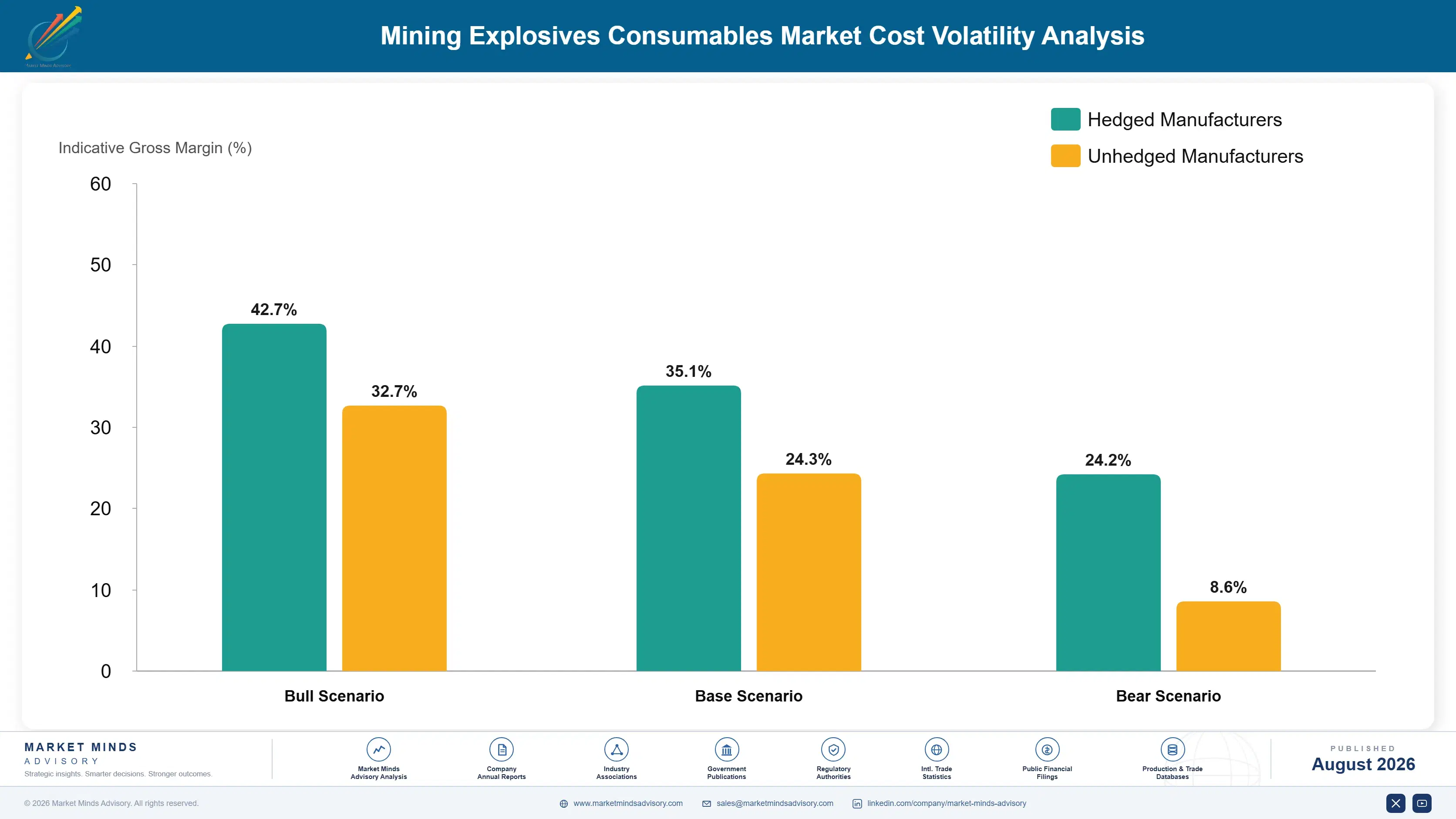
Commodity price volatility remains a genuine wild card. When metal prices soften, mining capex contracts, and explosives demand follows. But the structural story still points upward. Mining activity is expanding in Asia-Pacific, Sub-Saharan Africa, and Latin America, and operators in these regions are increasingly tackling deeper, more geologically challenging ore bodies where the quality of blasting consumables directly affects recovery rates and overall economics.
Mining Explosives Consumables Market Trends
- Rise of Digital and Automated Blasting
The shift toward digital and automated blasting is arguably the most consequential trend reshaping this market right now. Electronic detonators have moved from niche to mainstream in many jurisdictions, and their adoption is pulling demand for the supporting ecosystem blast design software, real-time vibration monitoring, wireless initiation systems. Together, these tools give drill-and-blast engineers a degree of precision that was simply not achievable with conventional pyrotechnic systems. The practical benefits are tangible: better muck pile profiles, lower dilution, reduced fly rock risk, and measurable reductions in ground vibration transmitted to nearby structures or sensitive ecosystems. There is also a longer-term dimension here. As mining companies accelerate moves toward autonomous and remotely operated sites, the ability to execute blasting operations without putting personnel in the blast zone becomes increasingly attractive and the technology infrastructure to support that is rapidly maturing.
- Growing Pressure for Environmentally Responsible Products
Mining’s environmental footprint is under scrutiny like never before, and blasting practices are not exempt from that pressure. Post-blast fume generation, nitrate residue in groundwater, and the cumulative impact of repeated large blasts on local ecosystems are drawing attention from regulators, investors, and local communities alike. Manufacturers are responding. Water-gel explosives, advanced emulsion formulations, and low-toxicity initiation systems are gaining ground as operators look for products that perform well while producing a smaller environmental signature. This is not purely altruistic in many jurisdictions, obtaining and retaining operating licenses increasingly depends on demonstrating responsible blasting practices. R&D investment in greener consumables is picking up pace as a result, and the companies that establish credible environmental credentials early are likely to enjoy a meaningful competitive edge.
- Emerging Market Expansion Driving Volume Growth
The volume story for this market is increasingly being written in emerging economies. Across Asia-Pacific, Africa, and Latin America, mineral exploration budgets are rising, new project pipelines are filling, and governments are actively courting mining investment as a lever for economic development. Demand for copper, gold, lithium, and other critical minerals is providing the commercial justification. For explosives suppliers, these markets present both opportunity and operational complexity. Supply chains are longer, regulatory frameworks less predictable, and geological conditions often more demanding than in mature mining jurisdictions. In response, several major suppliers are investing in local manufacturing capacity and regional distribution infrastructure moves that reduce logistics risk, improve responsiveness, and build the kind of on-the-ground relationships that matter when competition for contracts is fierce.
Segment & Category Analysis for Mining Explosives Consumables Market
By Product Type
- Bulk Explosives
- Packaged Explosives Initiating Systems Blasting Accessories
- Ammonium Nitrate
The product type segment is a critical determinant of the mining explosives consumables market, as each product serves distinct applications and operational requirements. Bulk explosives, such as ANFO (Ammonium Nitrate Fuel Oil) and emulsions, are widely used for large-scale surface mining due to their cost-effectiveness and ease of handling. Packaged explosives are preferred for underground mining and specialized applications where precise placement is required. Initiating systems, including detonators and boosters, play a vital role in ensuring controlled and safe detonation. Blasting accessories, such as fuses and connectors, support the efficient execution of blasting operations. Ammonium nitrate remains a key raw material, underpinning the production of various explosive formulations.

By Application
- Surface Mining
- Underground Mining Quarrying Construction
- Others
The application segment highlights the diverse end-uses of mining explosives consumables across different mining and construction activities. Surface mining accounts for the largest share, driven by the extraction of coal, iron ore, and other minerals from open-pit mines. Underground mining requires specialized explosives and initiating systems to navigate confined spaces and complex geological formations. Quarrying, which involves the extraction of aggregates and dimension stones, relies on precise blasting techniques to achieve desired fragmentation. The construction sector utilizes explosives for tunneling, road building, and demolition projects, further expanding the market scope.
By End User
- Mining Companies
- Quarry Operators Construction Contractors Government Agencies
- Others
End users of mining explosives consumables encompass a broad spectrum of stakeholders, each with unique requirements and procurement practices. Mining companies, both large-scale and small-scale, represent the primary consumers, seeking reliable and cost-effective solutions to optimize their operations. Quarry operators focus on maximizing yield and minimizing environmental impact. Construction contractors utilize explosives for infrastructure development, while government agencies may be involved in regulatory oversight and public works projects. The diversity of end users underscores the need for tailored products and services.
By Sales Channel
- Direct Sales
- Distributors Online Platforms
- Third-party Agents
The sales channel segment reflects the evolving distribution landscape for mining explosives consumables. Direct sales remain the dominant channel, particularly for large mining companies with established supplier relationships. Distributors play a crucial role in reaching smaller operators and remote locations, offering value-added services such as technical support and inventory management. Online platforms are emerging as a convenient option for procurement, enabling buyers to access a wide range of products and compare prices. Third-party agents facilitate transactions and provide market intelligence, especially in regions with complex regulatory environments.

By Region
- Asia-Pacific
- North America Europe South America
- Middle East & Africa
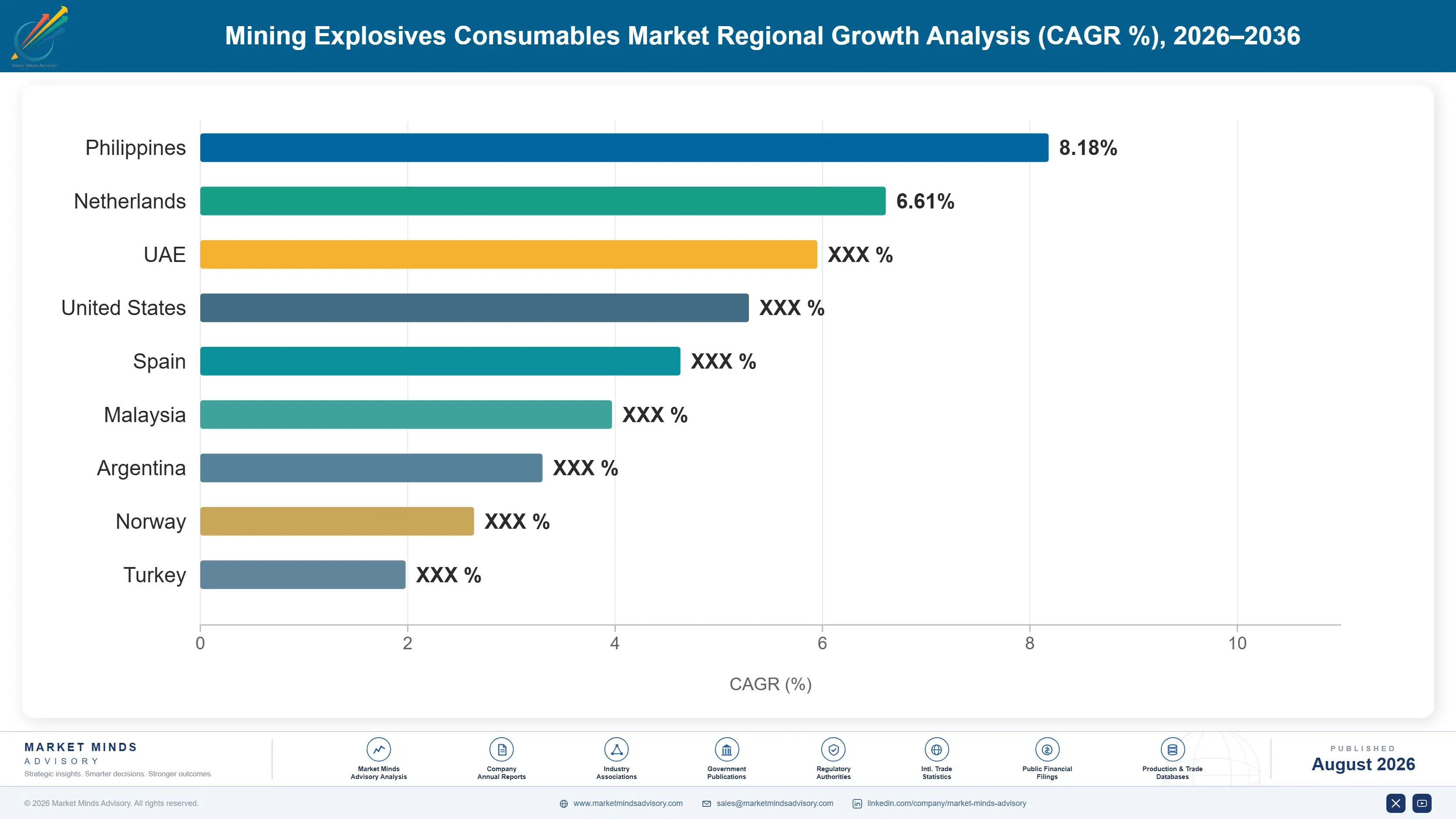
Regional segmentation provides insights into the geographic distribution of demand for mining explosives consumables. Asia-Pacific leads the market, driven by robust mining activities in China, Australia, and India. North America and Europe are characterized by mature markets with a focus on technological innovation and sustainability. South America is witnessing rapid growth, fueled by investments in copper and gold mining. The Middle East & Africa region presents untapped opportunities, with increasing exploration and infrastructure development projects.
Growth Drivers and Opportunities in Mining Explosives Consumables Market
- Rising Demand for Minerals and Metals
The global surge in demand for minerals and metals, driven by industrialization, urbanization, and the transition to renewable energy, is a key growth driver for the mining explosives consumables market. The extraction of critical minerals such as copper, lithium, and rare earth elements is essential for the production of batteries, electronics, and clean energy technologies. This trend is prompting mining companies to expand their operations and invest in advanced blasting solutions to enhance productivity and resource recovery.
- Technological Advancements in Blasting Techniques
Technological advancements in blasting techniques are creating new opportunities for the mining explosives consumables market. The development of electronic detonators, precision blasting software, and real-time monitoring systems is enabling miners to achieve optimal fragmentation, reduce operational costs, and improve safety outcomes. These innovations are particularly valuable in complex mining environments, where traditional methods may be less effective. The adoption of digital technologies is expected to drive the demand for high-performance consumables and support the evolution of smart mining practices.
Emerging Opportunities for Mining Explosives Consumables Market
- Expansion into Untapped Geographies
The mining explosives consumables market is poised to benefit from the expansion of mining activities into untapped geographies, particularly in Africa and Latin America. These regions offer abundant mineral resources and favorable investment climates, attracting global mining companies and explosives manufacturers. The development of new mining projects and infrastructure initiatives is expected to generate significant demand for explosives consumables, presenting lucrative growth opportunities for market participants.
- Development of Eco-friendly Explosives
The increasing emphasis on environmental sustainability is driving the development of eco-friendly explosives and consumables. Manufacturers are investing in research and development to create products that minimize environmental impact, such as low-emission explosives, biodegradable packaging, and water-based formulations. The adoption of sustainable practices is not only a regulatory requirement but also a competitive differentiator, enabling companies to meet the evolving expectations of stakeholders and secure long-term contracts.
Growth Restrain factors and Challanges in Mining Explosives Consumables Market
- Stringent Regulatory Frameworks and Safety Concerns
The mining explosives consumables market is subject to stringent regulatory frameworks governing the production, storage, transportation, and use of explosives. Compliance with safety standards and environmental regulations is a significant challenge for manufacturers and end users alike. Regulatory requirements vary across regions, adding complexity to supply chain management and increasing operational costs. In addition, the inherent risks associated with handling explosives necessitate robust safety protocols and continuous training, which can be resource-intensive for mining companies.
The heightened focus on safety and environmental protection has led to the implementation of stricter controls and monitoring mechanisms. While these measures are essential for mitigating risks, they can also result in delays, increased compliance costs, and operational disruptions. Companies must invest in advanced safety technologies and foster a culture of safety to navigate these challenges and maintain their license to operate.
- Volatility in Raw Material Prices and Supply Chain Disruptions
The mining explosives consumables market is vulnerable to volatility in raw material prices, particularly ammonium nitrate, which is a key ingredient in many explosive formulations. Fluctuations in the prices of raw materials can impact profit margins and create uncertainty for manufacturers and end users. Supply chain disruptions, caused by geopolitical tensions, transportation bottlenecks, or natural disasters, can further exacerbate these challenges, leading to shortages and delays in product delivery.
The COVID-19 pandemic highlighted the fragility of global supply chains, prompting companies to reassess their sourcing strategies and build greater resilience. Diversification of suppliers, localization of manufacturing, and investment in inventory management systems are some of the measures being adopted to mitigate supply chain risks. However, these initiatives require significant capital investment and may not be feasible for all market participants.
Mining Explosives Consumables Market Regional Analysis Table
| Region | Market Share (2025) | Key Market Highlight |
| Asia-Pacific | 38% | Dominates due to large-scale mining in China, Australia, India |
| North America | 22% | Mature market with focus on innovation and safety |
| Europe | 18% | Emphasis on sustainability and regulatory compliance |
| South America | 14% | Rapid growth driven by copper and gold mining |
| Middle East & Africa | 8% | Emerging opportunities in mineral-rich regions |
Regional Analysis for Mining Explosives Consumables Market
Asia-Pacific
Asia-Pacific is the largest and fastest-growing region in the mining explosives consumables market, accounting for approximately 38% of the global market share in 2025. The region’s dominance is attributed to extensive mining activities in China, Australia, and India, which are major producers of coal, iron ore, and other minerals. The increasing demand for metals, coupled with government initiatives to boost mining output, is driving the consumption of explosives consumables. Additionally, the adoption of advanced blasting technologies and the presence of leading manufacturers are supporting market growth in the region.
North America
North America holds a significant share of the mining explosives consumables market, characterized by mature mining operations and a strong focus on technological innovation. The United States and Canada are key contributors, with well-established regulatory frameworks and high safety standards. The region is witnessing increased adoption of electronic detonators and digital blasting solutions, aimed at improving operational efficiency and reducing environmental impact. Ongoing investments in mineral exploration and the development of new mining projects are expected to sustain market growth.
Europe
Europe’s mining explosives consumables market is driven by the emphasis on sustainability, regulatory compliance, and the modernization of mining operations. Countries such as Russia, Sweden, and Poland are prominent players, with a focus on extracting critical minerals for industrial and energy applications. The adoption of eco-friendly explosives and the implementation of stringent environmental regulations are shaping market dynamics. European manufacturers are investing in research and development to create innovative products that meet the evolving needs of the mining sector.
South America
South America is emerging as a high-growth region in the mining explosives consumables market, fueled by investments in copper, gold, and lithium mining. Countries such as Chile, Peru, and Brazil are attracting global mining companies seeking to capitalize on abundant mineral resources. The expansion of mining activities, coupled with infrastructure development projects, is boosting the demand for explosives consumables. Local manufacturing and supply chain localization are becoming important strategies to address the unique challenges of the region.
Middle East & Africa
The Middle East & Africa region presents untapped opportunities for the mining explosives consumables market, with increasing exploration and mining activities in countries such as South Africa, Ghana, and Saudi Arabia. The region’s mineral wealth, combined with government initiatives to attract foreign investment, is driving market growth. However, challenges related to infrastructure, regulatory compliance, and security must be addressed to fully realize the potential of the market.

Competition Landscape in Mining Explosives Consumables Market
The mining explosives consumables market is highly competitive, with a mix of global and regional players vying for market share. Leading companies are focusing on product innovation, strategic partnerships, and geographic expansion to strengthen their competitive position. The market is characterized by high entry barriers, owing to stringent regulatory requirements and the need for specialized expertise in explosives manufacturing and handling. Mergers and acquisitions, joint ventures, and collaborations with mining companies are common strategies employed by key players to enhance their product portfolios and expand their customer base. The increasing emphasis on sustainability and digitalization is prompting companies to invest in research and development of eco-friendly and technologically advanced consumables.
Major Players in Mining Explosives Consumables Market
- Orica Limited
- Dyno Nobel (Incitec Pivot Limited)
- MAXAM Corp Holding, S.L.
- AEL Mining Services
- Austin Powder Company
- EPC Groupe
- Solar Industries India Ltd.
- Sasol Limited
- Hanwha Corporation
- BME (Omnia Holdings Limited)
- NOF Corporation
- Yara International ASA
- Enaex S.A.
- China Poly Group Corporation
- Sichuan Yahua Industrial Group Co., Ltd.
- Anhui Jiangnan Chemical Industry Co., Ltd.
- IDEAL Industrial Explosives Ltd.
- Davey Bickford SAS
- IBP Co., Ltd.
- Explosives Manufacturing Company Limited
Recent Developments in Mining Explosives Consumables Market
- In January 2024, Orica Limited launched a new range of eco-friendly bulk explosives designed to reduce greenhouse gas emissions during blasting operations.
- In November 2023, Dyno Nobel announced a strategic partnership with a leading mining company in South America to supply advanced electronic detonators for a major copper mining project.
- In September 2023, MAXAM Corp Holding, S.L. expanded its manufacturing facility in Australia to meet the growing demand for packaged explosives in the Asia-Pacific region.
- In July 2023, AEL Mining Services introduced a digital blast design platform, enabling real-time monitoring and optimization of blasting processes.
- In May 2023, Solar Industries India Ltd. secured a long-term contract to supply explosives consumables to a large-scale iron ore mining operation in India.
- In March 2023, Hanwha Corporation invested in the development of water-based emulsion explosives to enhance safety and environmental performance.
FAQ for Mining Explosives Consumables Market
- What is the projected market size of the mining explosives consumables market by 2033?
The mining explosives consumables market is projected to reach USD 22.7 billion by 2033, growing at a CAGR of 5.8% from its 2026 value of USD 15.2 billion.
- Which regions are expected to drive the growth of the mining explosives consumables market?
Asia-Pacific is expected to lead the market, followed by North America and South America, due to extensive mining activities, investments in mineral exploration, and the adoption of advanced blasting technologies.
- What are the key trends shaping the mining explosives consumables market?
Key trends include the adoption of digital and automated blasting solutions, the shift towards environmentally sustainable explosives, and the expansion of mining activities in emerging markets.
- What challenges are faced by the mining explosives consumables market?
The market faces challenges such as stringent regulatory frameworks, safety concerns, volatility in raw material prices, and supply chain disruptions, all of which impact operational efficiency and profitability.
- Who are the major players in the mining explosives consumables market?
Major players include Orica Limited, Dyno Nobel, MAXAM Corp Holding, AEL Mining Services, Austin Powder Company, EPC Groupe, Solar Industries India Ltd., Sasol Limited, Hanwha Corporation, and BME, among others.