Market Minds Advisory
Rare Earth Metals Market

Rare Earth Metals Market: Magnet Demand Rewrites A China-Controlled Supply Chain

A commercial reading of critical minerals, where NdPr magnet demand from electric vehicles and wind turbines now drives pricing, China's separation dominance faces genuine Western challenge, and heavy rare earth supply remains dangerously concentrated regardless.

Lead Analyst

Bilal Shaikh

Published

September 2026

Make Smarter Decisions with Customized Research Insights

Request a free sample report and evaluate market opportunities, growth trends, and competitive dynamics relevant to your business needs.

2025 MARKET VALUE$14.5BMarket Size 2025
2036 FORECAST VALUE$33.1BBase Case , 2026 to 2036
CAGR 2026 TO 20367.8 %Bull 9.0% / Bear 6.5%
INCREMENTAL OPPORTUNITY$17.5BNet 10- year value creation
EXPANSION MULTIPLE2.12x2036 value over 2026 base
Strategic Levers
M&A Pipeline
Regional Outlook
Country Rankings
Competitive Intelligence
Segmental Deep-dive
Call-Us : 91 93563 13602

Executive Snapshot and Market Trajectory

China's grip on rare earth separation still decides who gets supply, but magnet demand growing faster than China alone can expand capacity is forcing every downstream buyer to fund alternative sources directly for the first time in a generation of underinvestment.
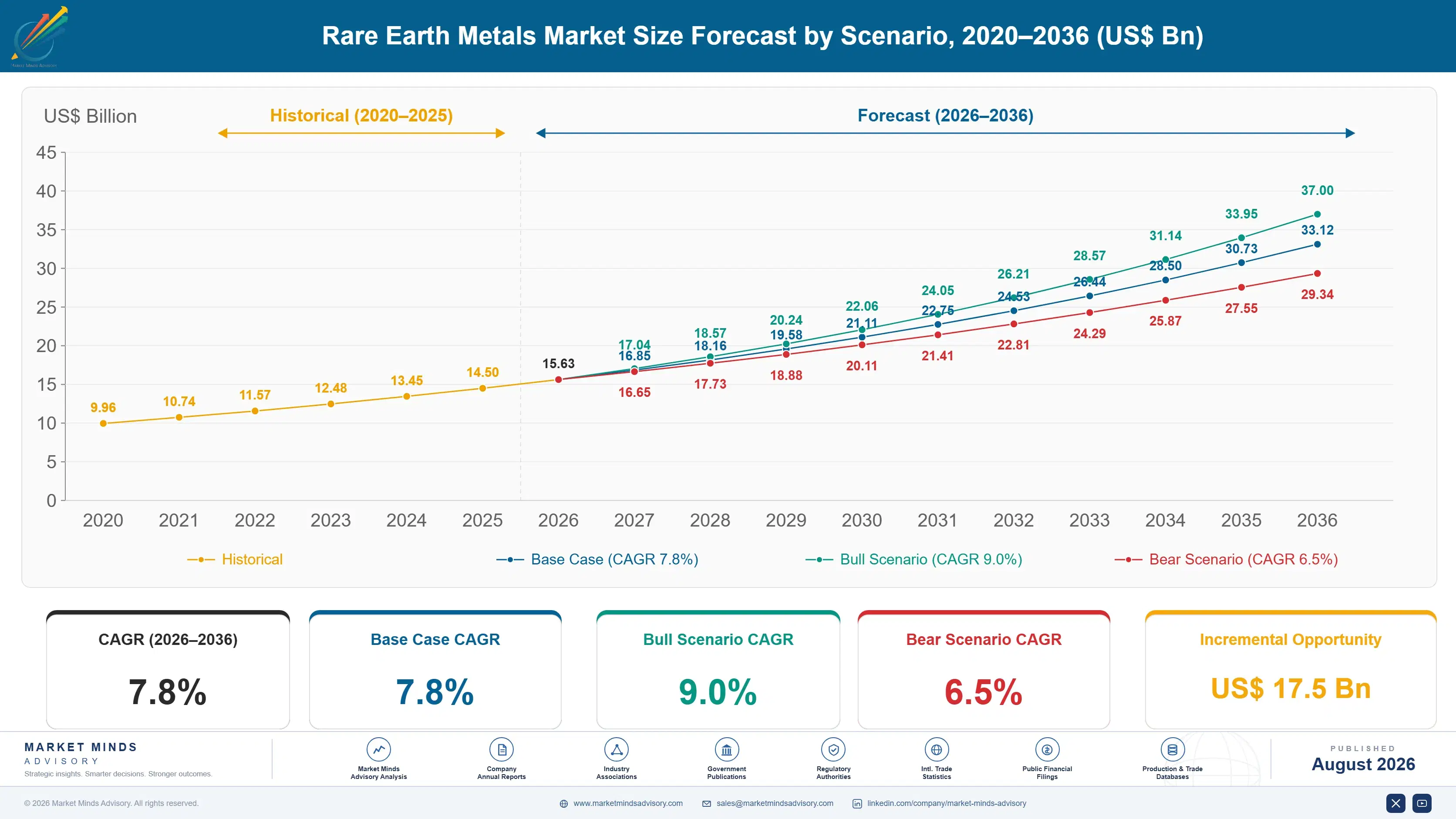
The market stands at USD 14.5 billion in 2025 and reaches USD 33.12 billion by 2036 at a 7.8% CAGR. NdPr oxide grows fastest at 11.5%, about 1.47 times the overall rate, as electric vehicle motors and wind turbine generators both demand permanent magnets no other material matches at comparable size. East Asia holds 30% of value on Chinese separation capacity, while the United States posts the quickest growth at 13.5% off a small base.
Concentration is high, with the top five holding roughly 58% of revenue, dominated by Chinese state-linked producers against a small but growing group of Western and allied challengers building capacity from scratch right now. Two forces reshape the field. Export licensing decisions out of Beijing function as genuine geopolitical leverage over downstream industries, and heavy rare earth supply remains dangerously concentrated in ways NdPr expansion alone does nothing to fix.
Market Definition
The rare earth metals market covers the mining, separation, and refining of the fifteen lanthanide elements plus yttrium and scandium into oxides, chlorides, carbonates, and metallic alloys sold to industrial buyers. Finished permanent magnets, rare earth-containing electronic components, and mining equipment or services sold separately from the refined material are excluded.
Base Year Value
$14.5B in 2025 (MMA Primary Research Dataset, August 2026)
Forecast Period
2026 to 2036, eleven discrete annual values
CAGR
7.8% base case. Bull 9.0%. Bear 6.5%.
Fastest Growth Segment
NdPr Oxide (Magnet Feedstock): 11.5% CAGR
Fastest Growth Country
United States: 13.5% CAGR
Fastest Growth Region
South Asia and Pacific: 9.8% CAGR
Largest Region
East Asia: 30% of 2025 global value
Market Leaders
China Northern Rare Earth Group, China Rare Earth Group, Lynas Rare Earths, MP Materials, Iluka Resources. Source: MMA Analysis based on company annual reports.
Primary Survey
n=3,800 procurement and R&D decision-makers, Q4 2025, six countries
Methodology
Demand-side build-up, cross-validated against public data, 47 expert interviews

Rare Earth Metals Market Forecast Scenarios

rare-earth-metals-market-size-forecast-scenario-1787324847233
Growth from 2020 to 2025 compounded near 6.8%, accelerating as electric vehicle and wind turbine deployment both scaled faster than legacy demand from catalysts and glass polishing ever had. Export licensing tension between China and Western governments intensified across the same period, pushing buyers to fund alternative supply for the first time in a generation of underinvestment.
Three mechanisms carry the base case to 7.8%. First, electric vehicle motor demand keeps expanding steadily, and every additional vehicle needs NdPr magnets no substitute material matches at comparable size and cost per unit. Second, wind turbine generator demand grows alongside renewable capacity targets across every major economy pursuing decarbonisation goals. Third, Western and allied processing capacity keeps coming online, adding supply outside Chinese control even as China itself continues expanding domestic output.
The bull case at 9.0% assumes Western processing capacity scales faster than currently planned and electric vehicle adoption accelerates further across major automotive markets worldwide over the decade. The bear case at 6.5% assumes electric vehicle growth slows meaningfully in key markets and China's export licensing eases enough that Western buyers deprioritise the alternative supply investment currently underway.

Why Magnet Demand Now Sets The Pricing Floor

Three converging forces set demand now. Electric vehicle motor output keeps rising, and every additional vehicle needs NdPr magnets no substitute material matches at comparable size and cost per unit produced. Wind turbine generator deployment expands alongside renewable capacity targets across every major economy pursuing decarbonisation. And geopolitical tension keeps pushing Western buyers toward alternative supply regardless of near-term cost disadvantage against Chinese material.
MARKET CONCENTRATIONCR5: 58%Highly concentrated supply dominated by Chinese state-linked producers
AVERAGE SELLING PRICENdPr oxide: USD 60 to 110 per kilogramBlended pricing across light and heavy oxide categories
TOP PRODUCING COUNTRY SHAREChina: 69% of global refined outputChinese separation and refining scale supplying most global demand
PROCESSING CAPACITY UTILISATION72 to 85%Separation plant utilisation across major producing facilities worldwide
FEEDSTOCK COST SHAREMined concentrate: 35 to 48%Raw ore concentrate costs dominate separation and refining expense
MAGNET DEMAND GROWTH9 to 12% annuallyPermanent magnet feedstock demand expansion driving addressable volume growth
The commercial character splits along supply chain position almost entirely across every buyer category. Chinese producers compete on cost and scale built over decades of integrated mining, separation, and refining investment few rivals can match quickly. Western and allied producers compete on supply chain security instead, commanding a genuine premium from buyers who now treat single-source Chinese dependency as an unacceptable strategic risk regardless of near-term cost.
The next decade turns on separation capacity and heavy rare earth supply together across every producing region. Producers that add genuine separation capability outside China capture premium pricing no light rare earth oxide alone could ever command from buyers seeking diversified supply. Heavy rare earth supply concentration remains the unresolved problem NdPr-focused Western investment does little to address directly.
"Everyone focuses on NdPr because magnets get the headlines, and that focus is leaving heavy rare earths dangerously under-addressed. Dysprosium and terbium supply is thinner and more concentrated than NdPr ever was, and nobody is building separation capacity for those elements at anything like the pace magnet feedstock investment is attracting."
Director, Critical Minerals and Materials Practice · MMA Chemicals and Materials

Market Trends

Export Licensing Turns Rare Earths Into Geopolitical Leverage

China's Ministry of Commerce expanded export licensing requirements covering rare earth elements and related processing technology, requiring case-by-case approval that has slowed or blocked shipments to specific buyers and countries at politically sensitive moments. The mechanism converts a routine trade flow into a negotiating instrument Beijing can deploy against individual companies or entire national industries with little advance warning given to affected buyers. The commercial consequence is that downstream manufacturers now hold strategic inventory and qualify alternative non-Chinese suppliers regardless of the cost premium, treating single-source exposure as a risk no margin advantage justifies carrying indefinitely.
Market Impact: EV motor demand grows 10-14%
Western Separation Capacity Comes Online After Decades Of Underinvestment

MP Materials restarted domestic separation at Mountain Pass and Lynas Rare Earths commissioned processing capacity in Malaysia and Texas, adding meaningful non-Chinese supply for the first time in a generation of underinvestment following Western mine closures. Government funding through the Defense Production Act and comparable allied programmes has directly subsidised this buildout, recognising that pure market economics alone never justified the investment against subsidised Chinese competition. Buyers are signing offtake agreements years before production starts, locking in non-Chinese supply at premium pricing that reflects genuine strategic value rather than production cost alone.
Market Impact: Wind capacity adds over 100 GW

Market Opportunities and Growth Drivers

Electric Vehicle Motor Demand Keeps Expanding Every Year

Global electric vehicle production has grown steadily for over a decade, and the great majority of traction motors use NdFeB permanent magnets because no substitute material matches their power density at comparable size and weight. Every additional vehicle produced represents recurring NdPr oxide demand that scales directly with production volume rather than a one-time purchase decision made once per platform. Automakers have largely accepted magnet cost as a fixed input rather than pursuing substitute motor technologies at scale, since the performance and packaging tradeoffs of alternatives remain commercially unattractive across most vehicle segments.
Market Impact: Heavy REE supply stays 85% China-so

Wind Turbine Generator Deployment Adds Durable Magnet Demand

Offshore and onshore wind turbine capacity additions keep expanding across every major economy pursuing renewable deployment targets, and direct-drive generator designs increasingly favoured for offshore installations use substantially more rare earth magnet material per megawatt than geared alternatives. China, the United States, and the European Union have all set aggressive wind capacity targets extending through the next decade, and each gigawatt installed translates into a predictable, quantifiable increment of NdPr and dysprosium demand. That demand is considerably more stable than automotive demand, since utility procurement cycles run on multi-year contracted schedules rather than consumer purchase decisions.
Market Impact: Permitting adds 3 to 5 years

Market Restraints and Challenges

Heavy Rare Earth Supply Remains Dangerously Concentrated

Dysprosium and terbium, essential for magnet performance at elevated operating temperature, come overwhelmingly from a small number of Chinese ion-adsorption clay deposits with no comparable Western alternative currently in production at meaningful scale. The root cause is that these heavy elements occur at far lower concentration than light rare earths, making economic extraction outside China's specific deposit geology genuinely difficult rather than merely a matter of insufficient investment. Commercially this leaves magnet manufacturers exposed even as NdPr supply diversifies. Producers are mitigating exposure through reduced-heavy-rare-earth magnet formulations and by funding exploration at emerging deposits in Africa and Australia specifically.
Market Impact: Licensing delays run 60 to 120

Environmental Processing Costs Constrain New Capacity Buildout

Rare earth separation generates radioactive thorium byproduct and requires substantial chemical processing that faces stringent environmental permitting in most Western jurisdictions, adding years and considerable capital cost to new facility development. The root cause is that separation chemistry has not changed fundamentally in decades, so environmental compliance cost scales with facility size rather than falling through genuine process innovation. Commercially this keeps new Western capacity expensive relative to Chinese facilities built under considerably looser historical standards. Developers are mitigating the burden through government co-funding and by locating new facilities in jurisdictions with established mining permitting frameworks already in place.
Market Impact: Non-Chinese capacity grows past 15%
4 additional market trends, 3 additional growth drivers, and 2 additional restraints and challenges are covered in the full report. Contact sales@marketmindsadvisory.com to access the complete intelligence.

Segment CAGR and Growth Architecture

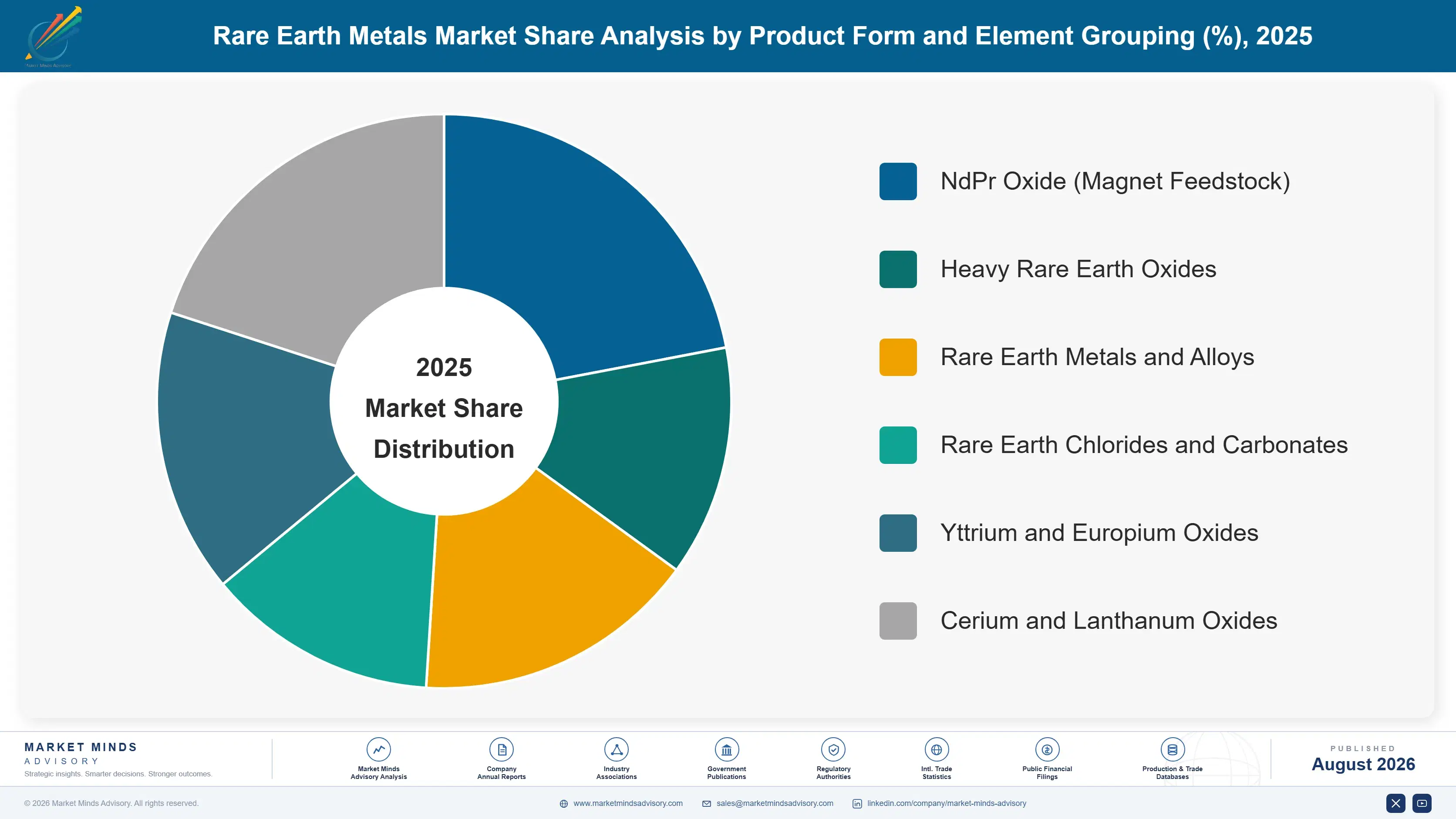
Segmentation follows product form and element grouping, a single technical logic describing what stage of processing the material has reached and which elements it contains. Each form carries its own pricing basis, buyer type, and value density, so commercial character tracks the product form rather than the end application. Downstream magnet manufacturing appears separately outside this framework entirely.
rare-earth-metals-market-market-share-analysis-1787324847770

NdPr Oxide (Magnet Feedstock)

NdPr oxide grows fastest at 11.5%, about 1.47 times the overall 7.8% rate, as electric vehicle motors and wind turbine generators both demand permanent magnets no substitute material matches at comparable size and cost. Pricing has become considerably more volatile as buyers now negotiate directly with both Chinese and emerging non-Chinese suppliers, creating a genuine two-tier pricing structure that did not previously exist in this category at all. MP Materials and Lynas Rare Earths have both scaled NdPr-focused separation capacity specifically, targeting the segment where Western government funding and automaker offtake commitments concentrate most heavily right now. Buyers increasingly sign multi-year contracts locking in non-Chinese volume regardless of the price premium involved.
CAGR 11.5%

Heavy Rare Earth Oxides

Heavy rare earth oxides grow second-fastest at 10.2%, covering dysprosium, terbium, and related elements essential for magnet performance at elevated operating temperature in demanding aerospace and defense applications. Supply remains overwhelmingly concentrated in Chinese ion-adsorption clay deposits, since these elements occur at far lower ore concentration than light rare earths, making economic extraction elsewhere genuinely difficult rather than simply underinvested capacity waiting to be built. Defense and aerospace buyers pay considerable premium for verified non-Chinese supply chains regardless of cost, treating supply security as a procurement requirement rather than a negotiable commercial preference. Very few credible non-Chinese heavy rare earth separation projects exist anywhere close to production today, and most remain years from meaningful output.
CAGR 10.2%
Full segment breakdown across 6 segments available in the complete report.

Regional Architecture and Country Demand Map

Separation and refining capacity location, not mineral reserves alone, sets this distribution across the seven regions tracked here almost entirely. East Asia dominates on Chinese processing scale, while share elsewhere tracks how quickly each region's separation capacity is actually coming online and how much government funding backs it.

North America

North America holds 23% of value on MP Materials' restarted Mountain Pass mining and separation operations plus growing Department of Defense funding directed at domestic supply chain independence from China specifically. Automaker offtake agreements now lock in NdPr volume years before magnet production actually begins, reflecting genuine strategic urgency rather than routine commercial procurement. Canadian exploration projects are advancing but remain years from production at meaningful commercial scale. The region still imports the great majority of its refined rare earth needs despite this investment, since separation capacity takes years to build regardless of funding availability or political will behind it. Growth of 8.8% reflects this capacity buildout accelerating from a genuinely small production base historically.
Share: 23% | CAGR: 8.8% (2026 to 2036)

Western Europe

Western Europe holds 19% of value, almost entirely as a downstream magnet and component manufacturing base rather than a mining or separation region, since the continent holds minimal domestic rare earth reserves worth developing commercially at scale. German and French automakers and wind turbine manufacturers drive substantial demand, and European Union critical raw materials policy has begun funding processing capacity, though meaningful domestic production remains years away from actual measurable output. Import dependence on both China and increasingly the United States defines the region's genuine strategic vulnerability in this category specifically. Growth of 6.2%, the slowest of the seven regions, reflects mature downstream demand without corresponding upstream capacity development happening domestically at any real pace.
Share: 19% | CAGR: 6.2% (2026 to 2036)
Regional intelligence for 5 additional markets available in the complete report: East Asia, South Asia and Pacific, Latin America, Middle East and Africa, Eastern Europe. Contact sales@marketmindsadvisory.com.
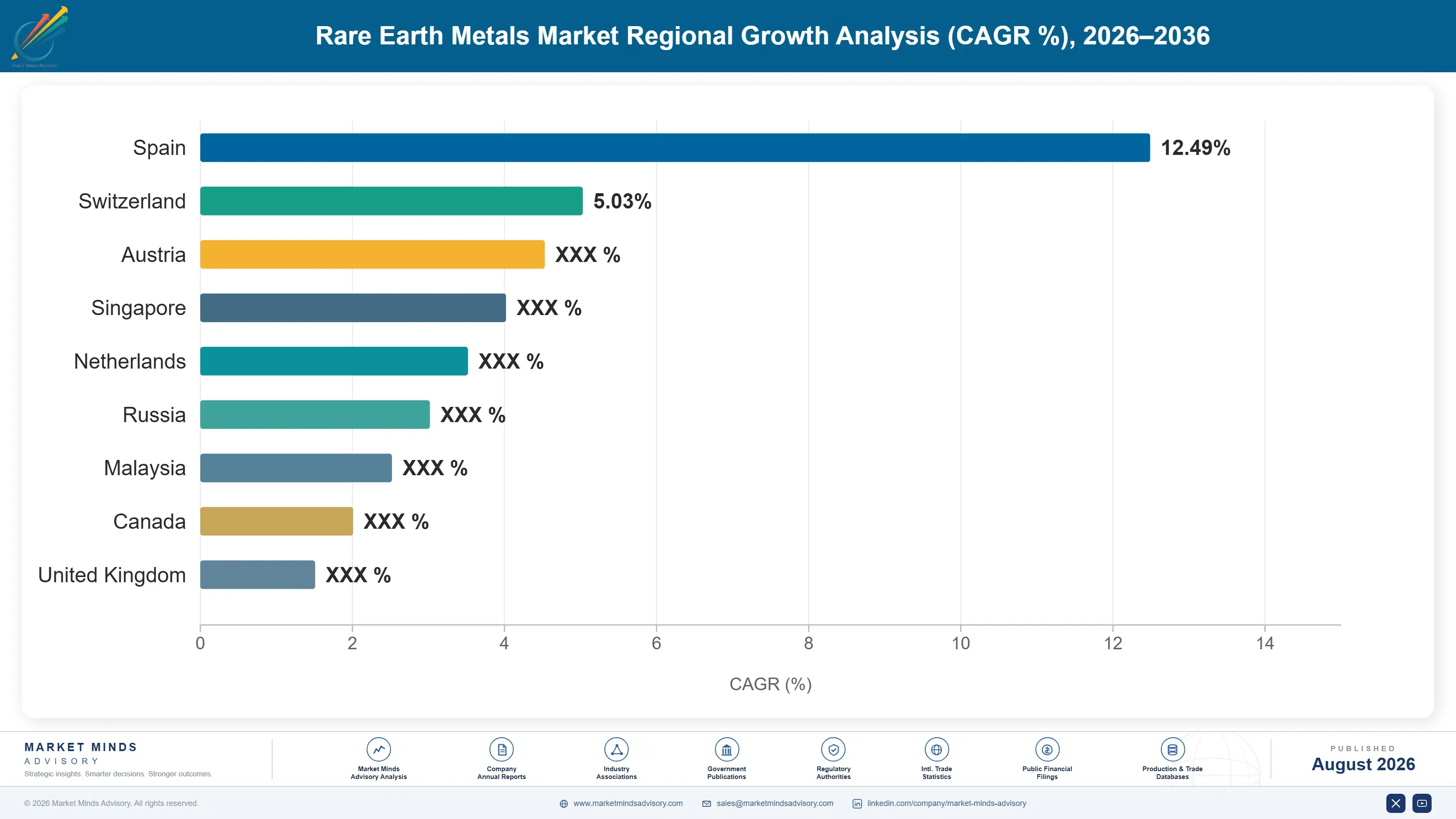
rare-earth-metals-market-country-cagr-analysis-1787324848294

Where Rare Earth Value Actually Concentrates Now

Selling light rare earth oxide against Chinese scale pricing is a race few Western producers can win on cost alone against decades of integrated investment. The four moves below shift value toward positions a bulk price comparison cannot easily erode: heavy element capability, supply chain verification, offtake lock-in, and reduced-magnet formulation science developed jointly with buyers.

Build Heavy Rare Earth Separation Capability First

Dysprosium and terbium supply remains roughly 85% concentrated in Chinese deposits, since these elements occur at far lower ore concentration than light rare earths, making the segment genuinely underserved outside China rather than merely underinvested capacity. Defense and aerospace buyers already pay considerable premium for verified non-Chinese heavy rare earth supply, treating security as a procurement requirement rather than a negotiable preference on price alone. Developers who solve heavy element separation chemistry capture a segment NdPr-focused competitors have largely ignored, commanding pricing power scale alone could never replicate against established Chinese incumbents holding the deposits.
Market Impact: Heavy REE commands a premium above

Sell Verified Supply Chain Traceability As A Product

Buyers increasingly treat single-source Chinese dependency as an unacceptable strategic risk regardless of near-term cost disadvantage, and export licensing delays running 60 to 120 days have proven that risk is genuinely commercial rather than theoretical for downstream buyers across the industry. Suppliers offering fully documented, audited non-Chinese supply chains capture premium pricing buyers now budget for explicitly as a line item separate from material cost itself entirely. That premium reflects real avoided risk, not marketing, and it compounds further as more buyers adopt supply-chain-security procurement policies following recent disruption events.
Market Impact: Verified non-Chinese supply command

Secure Multi-Year Offtake Before Production Even Starts

Buyers are signing offtake agreements 2 to 4 years before new separation facilities reach production, locking in non-Chinese supply at premium pricing that reflects genuine strategic value rather than production cost alone determining the negotiated number. That behaviour represents a fundamental shift from the spot-market pricing that historically governed this whole category entirely before recent geopolitical tension emerged across the industry. Developers who structure offtake agreements early de-risk project financing considerably, since committed volume at fixed pricing makes capital raising dramatically easier than betting on genuinely uncertain future spot market prices.
Market Impact: Offtake agreements now precede prod

Develop Reduced-Heavy-Rare-Earth Magnet Formulations Jointly With Buyers

Magnet manufacturers facing genuine heavy rare earth scarcity are funding formulation research that cuts dysprosium and terbium content by 30% to 50% while preserving high-temperature performance through alternative alloying and grain boundary engineering techniques developed jointly. Suppliers who co-develop these formulations with magnet manufacturers directly capture design-in relationships that a pure commodity oxide seller never accesses at all. That collaboration also reduces the buyer's exposure to the most severely constrained element category, making the supplier relationship considerably stickier and harder for competitors to displace once genuinely established at a customer.
Market Impact: Reduced-formulation magnets cut hea

Who Controls the Margin Pool

Concentration is high: the top five hold roughly 58% of revenue, dominated by Chinese state-linked producers against a small but growing group of Western and allied challengers. The gap between leaders and challengers is decades of integrated scale, not a technology barrier a newcomer cannot eventually clear. All participants are assessed on one basis, revenue from refined rare earth oxides, chlorides, carbonates, and metallic alloys sold to industrial buyers.
Competition runs along three lines. First, heavy rare earth capability, since dysprosium and terbium supply remains overwhelmingly Chinese and buyers pay premium for any verified alternative. Second, supply chain verification, where documented non-Chinese origin commands pricing power a bulk oxide comparison cannot capture. Third, offtake relationships, since buyers increasingly lock in volume years before new capacity reaches production.

Pressure is building from two directions. Western and allied producers including MP Materials and Lynas Rare Earths are winning offtake commitments from buyers who now treat single-source Chinese dependency as unacceptable regardless of cost. Meanwhile Chinese producers continue consolidating domestic capacity under state direction, maintaining scale advantage even as global share erodes. Rankings should favour companies with genuine heavy rare earth capability over those competing on light oxide volume alone.
rare-earth-metals-market-company-positioning-matrix-1787324848814

Competitive Moat and Risk Dimensions

CHINA NORTHERN RARE EARTH GROUP

Moat: State-linked scale and integration

China Northern Rare Earth Group controls mining quotas and separation capacity built over decades of state-directed investment, giving it cost and scale advantages Western challengers cannot replicate within any realistic timeframe. Its integration across mining, separation, and metal production captures margin at every stage most single-function competitors never access.
CHINA NORTHERN RARE EARTH GROUP

Risk: Geopolitical exposure and licensing risk

Export licensing policy decisions made in Beijing directly affect the company's addressable customer base, and buyers actively diversifying away from Chinese supply represent a persistent headwind quota increases cannot offset. Environmental and quota policy shifts inside China itself also introduce genuine production uncertainty beyond the company's own control.
LYNAS RARE EARTHS

Moat: Non-Chinese processing and offtake depth

Lynas Rare Earths operates the largest rare earth separation facility outside China, giving it a genuine first-mover position among Western-aligned producers that newer entrants are still years from matching. Long-term offtake agreements with Japanese and American buyers lock in demand regardless of spot price volatility elsewhere.
LYNAS RARE EARTHS

Risk: Single-facility concentration and cost gap

A meaningful share of Lynas production still depends on Malaysian processing facilities facing periodic regulatory and licensing scrutiny that has disrupted operations before and could again disrupt output. Production costs run considerably above integrated Chinese competitors, leaving margin dependent on the strategic premium buyers continue paying.

Players Tracked

Prominent Players

China Northern Rare Earth Group
China Rare Earth Group
Lynas Rare Earths
MP Materials
Iluka Resources

Other Key Players

Shenghe Resources
Ganzhou Rare Earth
Australian Strategic Materials
Arafura Rare Earths
Ucore Rare Metals
Rainbow Rare Earths
Energy Fuels
Vital Metals
Peak Rare Earths
Neo Performance Materials
Aclara Resources
Meteoric Resources
Pensana Plc
Mkango Resources
Leading Edge Materials

Recent Developments

MAY 2025

MP Materials commissions expanded Mountain Pass separation capacity

MP Materials commissioned expanded NdPr separation capacity at its Mountain Pass facility in California, adding meaningful domestic magnet feedstock supply years ahead of most competing Western projects reaching similar scale. This was an organic capacity expansion rather than any acquisition or joint venture, backed partly by Department of Defense funding.
Signal: Government-backed domestic capacity expans
NOVEMBER 2024

Lynas Rare Earths signs multi-year NdPr offtake with major automaker

Lynas Rare Earths signed a long-term offtake agreement with a major automaker for NdPr oxide supply from its expanded Malaysian and Australian processing capacity, securing demand years ahead of full production. This was a supply agreement rather than an acquisition or merger, reflecting buyer urgency around supply security.
Signal: Multi-year offtake agreements signed befor
MARCH 2025

China expands export licensing scope for rare earth processing technology

China's Ministry of Commerce tightened export licensing requirements covering additional rare earth processing technology categories, extending approval requirements that had previously applied mainly to raw material shipments alone. This was a regulatory policy change rather than any corporate transaction, expanding Beijing's leverage over downstream buyers.
Signal: Expanding licensing scope beyond raw mater

Mining, Separation Chemistry, And Licensing Exposure

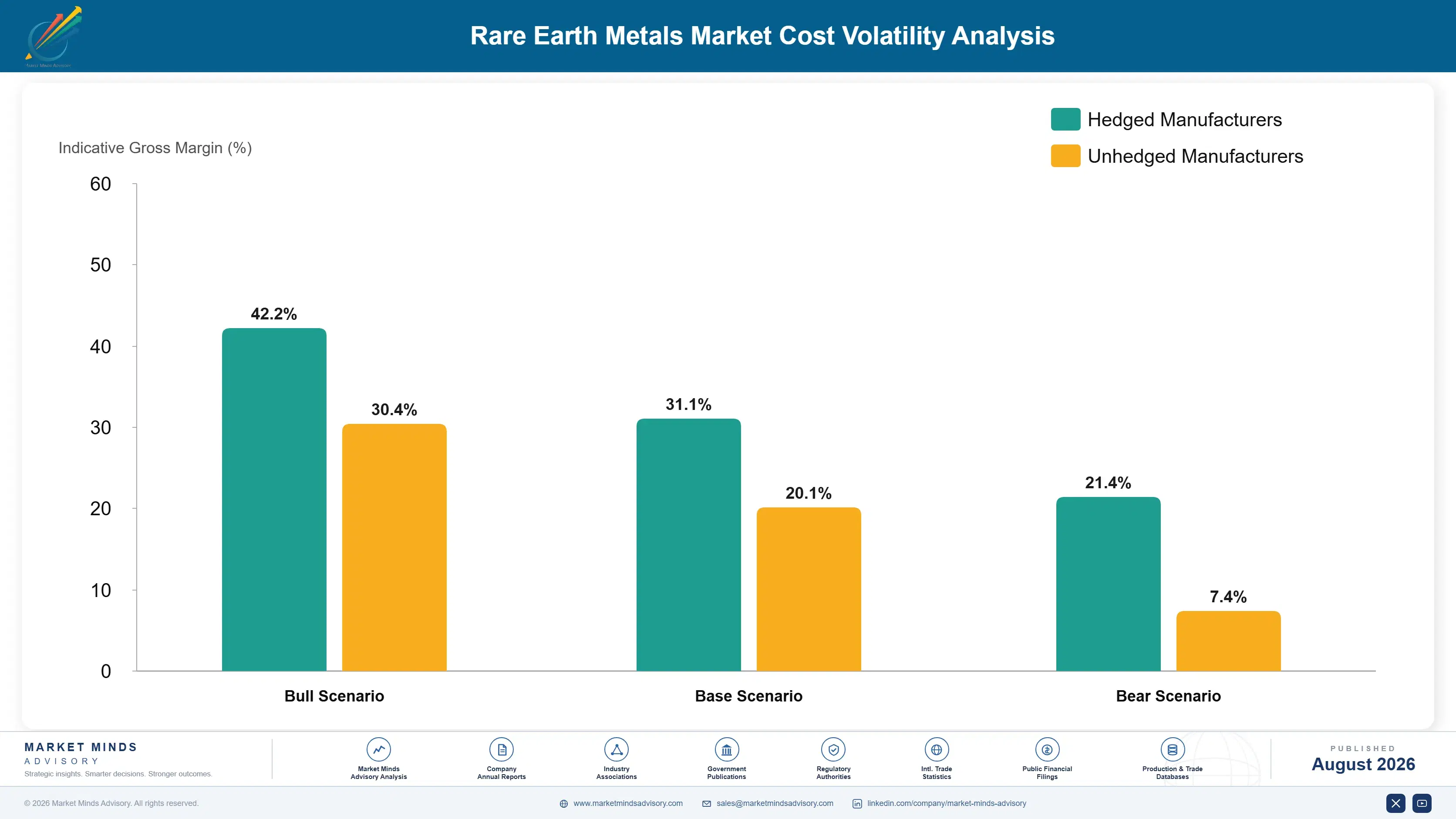
Mined rare earth concentrate accounts for roughly 35% to 48% of production cost, sourced from a small number of major deposits concentrated in China, Australia, and the United States. Separation chemistry, involving hundreds of solvent extraction stages to isolate individual elements, adds another 25% to 35%. Environmental compliance and thorium byproduct management make up most of the remainder in Western facilities specifically.
Rare earth prices spiked sharply in 2021 and 2022 as China tightened export quotas while electric vehicle and wind turbine demand both accelerated simultaneously, a combination the market had not previously faced at that scale. The IEA's Critical Minerals Market Review recorded NdPr oxide prices roughly tripling from 2020 levels at the peak, and MP Materials' 2022 annual report cited that volatility as a direct driver of renewed domestic investment interest.

Exposure separates sharply by integration and geographic position. Chinese integrated producers control cost through owned mining and separation capacity built over decades, while Western developers dependent on purchased concentrate compete for a genuinely limited non-Chinese supply. Licensing exposure adds a further layer specific to buyers dependent on Chinese material, since export approval delays function as an unpredictable cost regardless of underlying material pricing.
rare-earth-metals-market-cost-volatility-analysis-1787324849011

Diversify concentrate sourcing across multiple non-Chinese deposits

Dependence on a single mine or a single country's export policy leaves separation facilities exposed to supply interruption regardless of how efficient their own processing operations run day to day. Sourcing concentrate from multiple deposits across different jurisdictions, even at higher blended cost, protects production continuity through any single-country disruption event that geopolitical tension makes increasingly plausible.

Build strategic inventory buffers against licensing delays

Export licensing delays running 60 to 120 days can halt production at facilities dependent on Chinese material with essentially no advance warning given to affected buyers anywhere. Maintaining several months of strategic inventory buffers against this specific risk costs working capital but avoids production interruption that would otherwise cascade through downstream customer commitments and contracts already signed.

Pursue government co-funding for new separation capacity

New Western separation facilities carry substantial capital cost and multi-year environmental permitting timelines that pure market economics have never justified against subsidised Chinese competition historically built over decades. Government funding through programmes like the Defense Production Act directly offsets that gap, and developers pursuing this funding access capital private markets alone would not otherwise provide.

Portfolio Architecture for Margin Defence

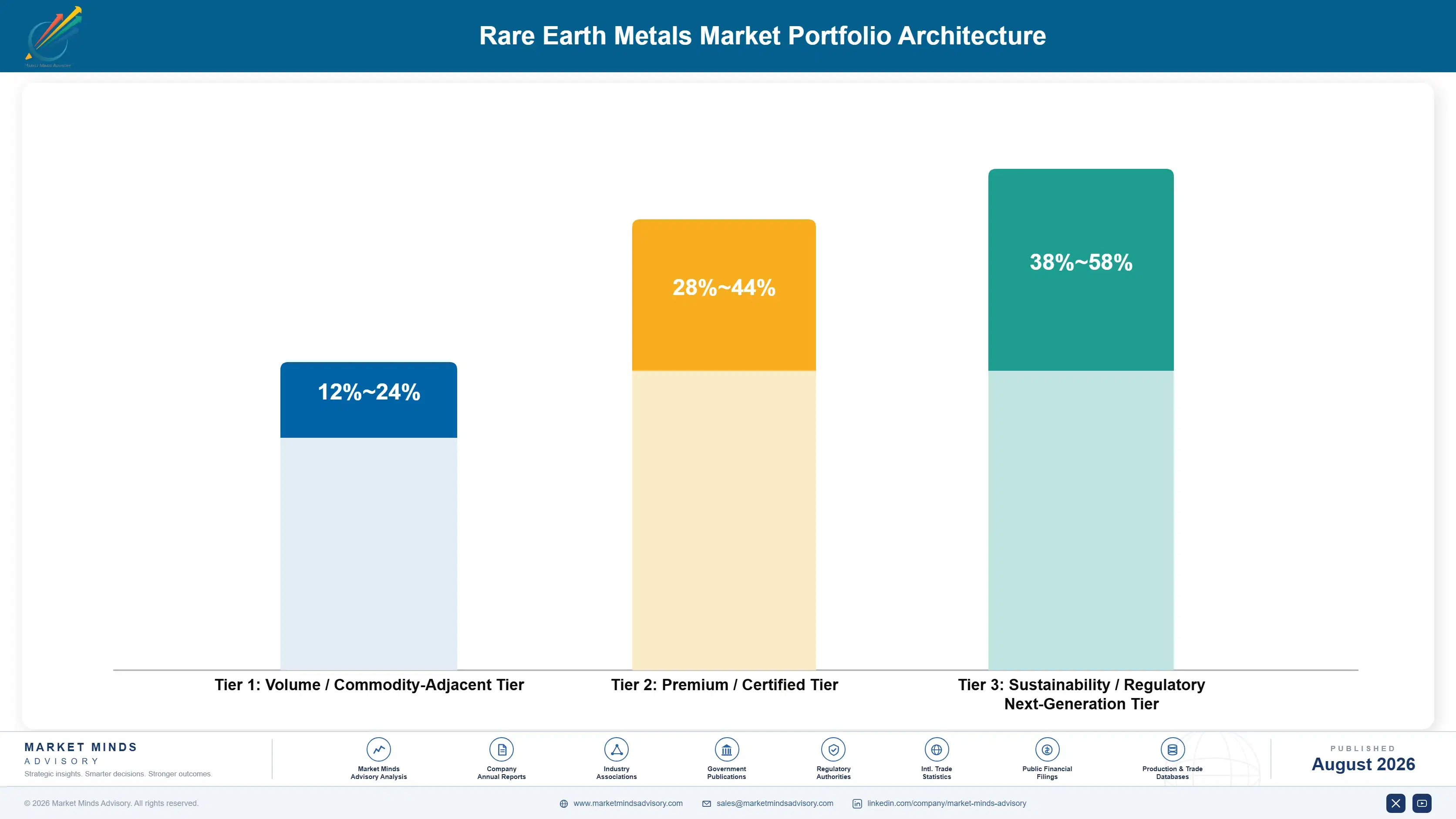
The portfolio splits into three tiers with sharply different economics. Light rare earth oxides including cerium and lanthanum form the volume tier, priced near commodity levels against integrated Chinese producers with decades of scale advantage. NdPr oxide and heavy rare earth elements earn considerably more, since magnet demand and genuine supply scarcity both resist pure price negotiation between buyer and seller throughout the cycle.
Tension runs between the light oxide volume business funding today's operations and the heavy element capability investment that captures tomorrow's strategic premium. A producer defending light oxide volume too aggressively under-invests in the separation chemistry heavy elements actually require from every credible supplier now bidding for defense and aerospace contracts. Yet abandoning volume revenue too early starves the cash flow that funds the very capability build a producer needs simply to compete.

High-value pools concentrate where genuine scarcity or verification barriers limit competition meaningfully: heavy rare earth elements with essentially no non-Chinese alternative, verified non-Chinese supply chains commanding a real strategic premium, and NdPr oxide sold under long-term offtake to buyers who value certainty. Light rare earth oxides for undifferentiated bulk sale sit at the other end, competing purely on cost against every integrated Chinese producer.

Volume / Commodity-Adjacent Tier

Light rare earth oxides including cerium and lanthanum sold near commodity pricing, competing directly against integrated Chinese producers with decades of scale advantage and correspondingly thin margin throughout the cycle.
Gross Margin: 12-24%

Premium / Certified Tier

NdPr oxide and rare earth metals and alloys carrying validated magnet-grade specification, where genuine demand growth and supply diversification both resist pure price negotiation between buyer and seller directly during contracting.
Gross Margin: 28-44%

Sustainability / Regulatory / Next-Generation Tier

Heavy rare earth elements, verified non-Chinese supply chains, and long-term offtake volume commanding premium pricing on genuine scarcity and strategic value that a spot-market comparison entirely fails to capture at all.
Gross Margin: 38-58%
rare-earth-metals-market-portfolio-architecture-1787324849504

High-value Sub-segments and Strategic Watch-out

NdPr Oxide (Magnet Feedstock)

NdPr oxide for magnet feedstock, high-value and fastest-growing at 11.5%, where electric vehicle and wind turbine demand both justify premium pricing well above light oxide margins across every qualified producer. Offtake agreements signed years ahead of production protect this pricing power considerably longer than spot markets ever could.
Gross Margin: 32-50%

Heavy Rare Earth Oxides

Heavy rare earth oxides, high-value with strong growth at 10.2%, as defense and aerospace buyers pay considerable premium for verified non-Chinese dysprosium and terbium supply regardless of underlying cost differences involved. Very few credible non-Chinese separation projects exist anywhere close to production today, and most remain years away.
Gross Margin: 40-58%

Rare Earth Metals and Alloys

Rare earth metals and alloys, the volume core supplying magnet and battery alloy production, growing steadily at 8.5% but priced through routine negotiation that leaves limited room for margin expansion over time regardless of buyer. Scale and integration, not differentiation, decide who wins this business.
Gross Margin: 20-32%

Cerium and Lanthanum Oxides

Cerium and lanthanum oxides, the strategic watch-out, growing just 4.5% and constrained by declining catalyst and glass polishing demand that newer technologies increasingly displace across major end markets worldwide. Volume persists mainly as an unavoidable byproduct of separating the higher-value elements buyers actually want most.
Gross Margin: 8-18%

How Magnet Demand Locks In Volume

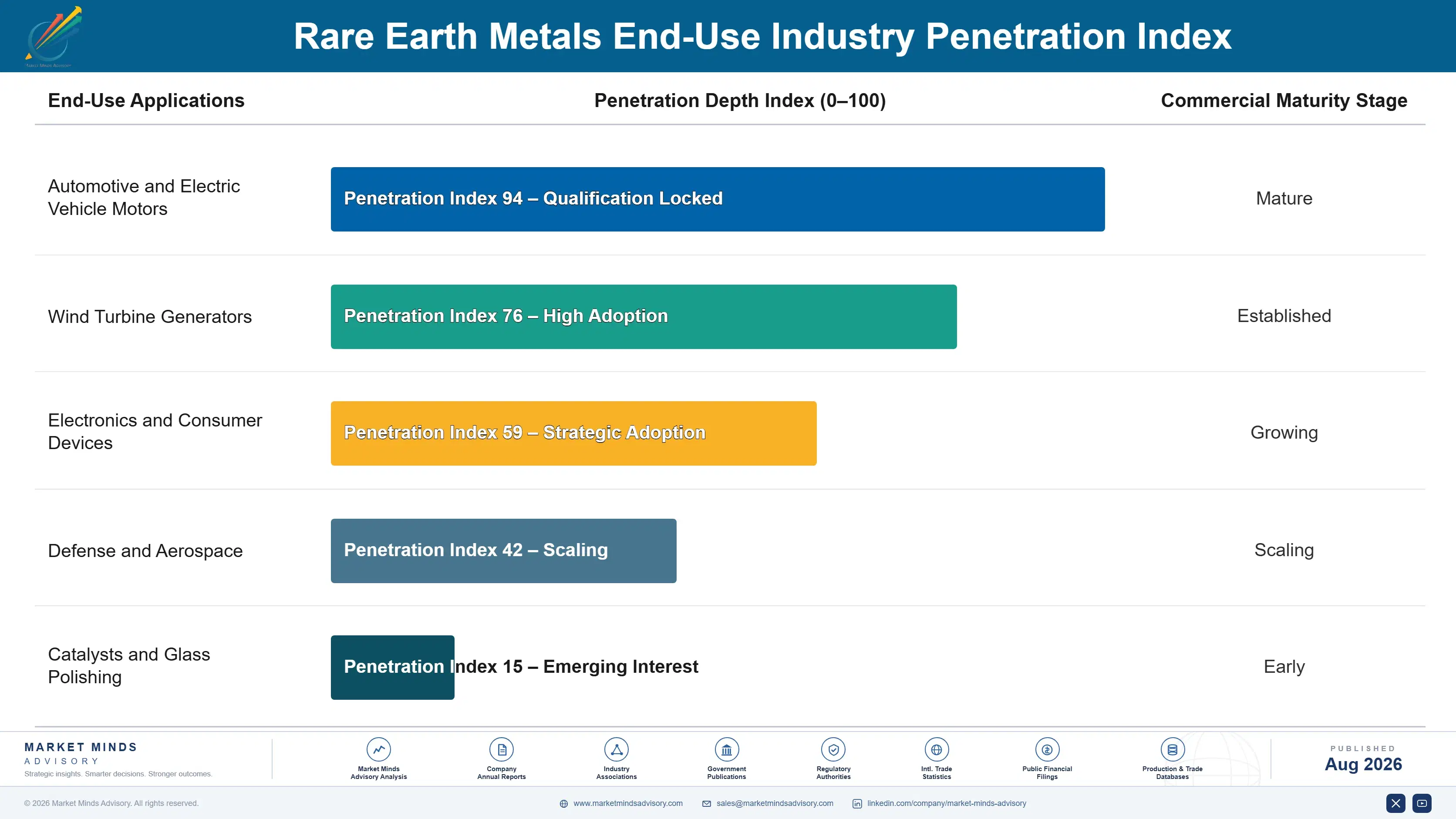
Revenue increasingly depends on multi-year offtake commitments rather than spot transactions, and a buyer signing an agreement years before production starts locks in volume for the life of the underlying vehicle or turbine platform it supplies. A producer winning that offtake relationship captures recurring demand for years, while losing it to a competitor means lost revenue across every future production cycle the buyer commits elsewhere instead.
Adoption depth varies sharply by buyer type. Defense and aerospace buyers adopt verified non-Chinese supply first regardless of cost premium, since procurement policy treats supply security as a non-negotiable requirement rather than a preference. Automotive and wind buyers follow with a meaningful lag as non-Chinese capacity scales and pricing gaps narrow. Legacy catalyst and glass polishing buyers retain conventional Chinese sourcing largely unchanged, since cost sensitivity dominates purchasing decisions in that declining category.

Buyer profiles have shifted from pure commodity procurement toward strategic supply chain relationships where suppliers increasingly provide verified documentation and long-term capacity commitments alongside the material itself. Younger procurement leadership at Western manufacturers increasingly treats geographic supply diversification as a board-level risk management priority, which favours suppliers with genuine non-Chinese capability over pure Chinese trading intermediaries.
rare-earth-metals-market-end-use-penetration-index-1787324849992

Our Read On Rare Earth Metals

These are among the four positions where our research anticipates prominent divergence between winners and laggards over the coming forecast period. Each is grounded in the demand model, the regulatory perimeter, and the announced capacity pipeline.
01 / HEAVY ELEMENTS STAY SCARCE

Dysprosium and terbium remain the genuine bottleneck

Dysprosium and terbium supply remains roughly 85% concentrated in Chinese ion-adsorption clay deposits, since these elements occur at far lower ore concentration than light rare earths, making the segment genuinely underserved outside China rather than merely underinvested capacity waiting to be built. NdPr-focused Western investment does almost nothing to fix this specific problem, since the deposit geology simply does not exist at comparable scale outside a handful of jurisdictions. Buyers should treat heavy rare earth capability as the genuine strategic bottleneck, not NdPr supply, when evaluating alternative producers.
02 / LICENSING IS GENUINE LEVERAGE

Export approval delays function as real commercial risk

China's export licensing requirements covering rare earth elements and processing technology function as genuine geopolitical leverage, with approval delays running 60 to 120 days that have disrupted shipments to specific buyers and countries at politically sensitive moments without meaningful advance warning given. That risk has proven commercial rather than theoretical, and buyers now budget explicitly for supply chain verification as a line item separate from material cost. Suppliers offering documented non-Chinese origin capture premium pricing that reflects genuine avoided risk, not marketing positioning alone.
03 / OFFTAKE NOW PRECEDES PRODUCTION

Buyers lock in volume years before facilities even open

Buyers are signing offtake agreements 2 to 4 years before new separation facilities reach production, locking in non-Chinese supply at premium pricing that reflects genuine strategic value rather than production cost alone determining the negotiated number agreed. That represents a fundamental shift from the spot-market pricing that historically governed this category before recent geopolitical tension emerged across the whole industry. Developers should structure offtake agreements early, since committed volume at fixed pricing makes capital raising dramatically easier than betting on spot prices.
04 / WESTERN CAPACITY TRAILS SCALE

New separation plants cannot yet match Chinese integration

MP Materials and Lynas Rare Earths have both scaled meaningful non-Chinese separation capacity, but production costs run considerably above integrated Chinese competitors built over decades of state-directed investment across mining, separation, and refining together at national scale. Government funding through the Defense Production Act and comparable allied programmes directly offsets that gap, recognising pure market economics alone never justified the investment. Buyers should expect the strategic premium on non-Chinese material to persist for years, not fade as new capacity comes online gradually.

Engagement Snapshot From the Field

A live engagement with an industry participant carrying material or product regulatory and market exposure ahead of a defining policy shift, showing how our research translates into a defensible multi-year portfolio strategy.
MARKET MINDS ADVISORY · CLIENT ENGAGEMENT SUMMARY
Rare Earth Metals Producer Strategic Portfolio Review and Transition Roadmap 2026·Investment Scenario on Rare Earth Metals Exposure Evaluation 2025-26
CLIENT PROFILE
A global permanent magnet manufacturer supplying automotive and wind turbine customers engaged MMA as customers began requiring documented non-Chinese material content in their contracts. The client reported annual NdFeB magnet revenue near USD 410 million, with roughly 94% of rare earth input sourced from Chinese suppliers and no established qualification for alternative non-Chinese material (client-reported, unverified by MMA).
STRATEGIC CHALLENGE
Procurement leadership wanted to negotiate better pricing from existing Chinese suppliers rather than fund the qualification cost of alternative material sources, treating supply diversification as a cost problem rather than a genuine strategic risk. Sales leadership worried this stance would cost major contracts, since two key customers had already signalled that non-Chinese content requirements were becoming a firm contractual condition.
MMA APPROACH
MMA modelled contract loss risk under continued Chinese-only sourcing against the qualification cost and timeline of adding MP Materials and Lynas Rare Earths as approved alternative suppliers. We assessed which specific customer contracts carried explicit or emerging non-Chinese content requirements, and we quantified the premium the client would need to absorb or pass through under a diversified sourcing structure.
KEY FINDINGS
  1. Two customers representing roughly 38% of client revenue had already moved toward requiring fully documented non-Chinese content within the next eighteen months.
  2. Qualifying MP Materials and Lynas Rare Earths as approved suppliers required roughly eight months and USD 1.8 million in testing (client-reported, unverified by MMA).
  3. Non-Chinese NdPr oxide carried a price premium of roughly 20% to 35% versus Chinese material at the time of the engagement itself.
  4. Losing the two at-risk customer contracts would have cost more than four times the total qualification investment required to retain them fully.
CLIENT PROFILE
A global permanent magnet manufacturer supplying automotive and wind turbine customers engaged MMA as customers began requiring documented non-Chinese material content in their contracts. The client reported annual NdFeB magnet revenue near USD 410 million, with roughly 94% of rare earth input sourced from Chinese suppliers and no established qualification for alternative non-Chinese material (client-reported, unverified by MMA).
STRATEGIC CHALLENGE
Procurement leadership wanted to negotiate better pricing from existing Chinese suppliers rather than fund the qualification cost of alternative material sources, treating supply diversification as a cost problem rather than a genuine strategic risk. Sales leadership worried this stance would cost major contracts, since two key customers had already signalled that non-Chinese content requirements were becoming a firm contractual condition.
MMA APPROACH
MMA modelled contract loss risk under continued Chinese-only sourcing against the qualification cost and timeline of adding MP Materials and Lynas Rare Earths as approved alternative suppliers. We assessed which specific customer contracts carried explicit or emerging non-Chinese content requirements, and we quantified the premium the client would need to absorb or pass through under a diversified sourcing structure.
KEY FINDINGS
  1. Two customers representing roughly 38% of client revenue had already moved toward requiring fully documented non-Chinese content within the next eighteen months.
  2. Qualifying MP Materials and Lynas Rare Earths as approved suppliers required roughly eight months and USD 1.8 million in testing (client-reported, unverified by MMA).
  3. Non-Chinese NdPr oxide carried a price premium of roughly 20% to 35% versus Chinese material at the time of the engagement itself.
  4. Losing the two at-risk customer contracts would have cost more than four times the total qualification investment required to retain them fully.
RECOMMENDED STRATEGY
Phase 1: Phase 1 (0 to 2 months): Begin formal qualification of MP Materials and Lynas Rare Earths as approved alternative suppliers. Phase 2: Phase 2 (2 to 8 months): Complete testing and negotiate blended contracts passing part of the premium through to at-risk customers. Phase 3: Phase 3 (8 to 14 months): Scale non-Chinese volume to meet the specific contractual thresholds the two key customers required.
OUTCOME
The client completed supplier qualification and retained both at-risk customer contracts by demonstrating documented non-Chinese sourcing capability ahead of competitors still negotiating with Chinese suppliers alone. Blended material cost rose roughly 12% overall, but retained revenue far exceeded the qualification investment required (client-reported, unverified by MMA).

Frequently Asked Questions

Foundational context covering the market sizes, CAGR, scope, country, region and competition that inform every finding below. This section is provided to cover basics and most often pre-purchase conversations, answered from the MMA Primary Research Dataset.

What is the current size of the Rare Earth Metals Market?

The global rare earth metals market is valued at USD 14.5 billion in 2025, covering mined and refined oxides, chlorides, carbonates, and metallic alloys of the lanthanide elements plus yttrium and scandium. Finished magnets are excluded.

How large will the Rare Earth Metals Market be by 2036?

The market is forecast to reach USD 33.12 billion by 2036 in the base case, about 2.12 times the 2026 level. That represents incremental value of roughly USD 17.49 billion across the decade.

What is the CAGR for the Rare Earth Metals Market 2026 to 2036?

The market grows at a 7.8% CAGR in the base case, with bull and bear scenarios at 9.0% and 6.5%. The spread turns mainly on electric vehicle adoption pace and Western processing capacity buildout.

Which segment is growing fastest?

NdPr oxide grows fastest at 11.5%, about 1.47 times the overall rate, as electric vehicle motors and wind turbines both demand permanent magnets no substitute material matches. Heavy rare earth oxides follow at 10.2%.

Who are the major companies in the Rare Earth Metals Market?

Leading companies include China Northern Rare Earth Group, China Rare Earth Group, Lynas Rare Earths, MP Materials, and Iluka Resources. Concentration is high, with the top five holding roughly 58% of revenue.

Which country is growing fastest?

The United States grows fastest at a 13.5% CAGR off a small base, as domestic separation capacity scales with government funding support. China remains the largest producer by a wide margin.

Report Segmentation Architecture

The full report scope spans multiple orthogonal segmentation dimensions, with cross-tabulated demand data provided for each dimension pair. Coverage extends further to regional breakdowns, trend trajectories, and the competitive detail needed to support segment-level decision-making.

By Product Form and Element Grouping

  • NdPr Oxide (Magnet Feedstock)
  • Heavy Rare Earth Oxides
  • Rare Earth Metals and Alloys
  • Rare Earth Chlorides and Carbonates
  • Yttrium and Europium Oxides
  • Cerium and Lanthanum Oxides

By End-Use Industry

  • Automotive and Electric Vehicle Motors
  • Wind Turbine Generators
  • Electronics and Consumer Devices
  • Defense and Aerospace
  • Catalysts and Glass Polishing

By Commercial Dimension

  • Long-Term Offtake Contracts
  • Spot Market Sales
  • Government-Backed Strategic Reserve
  • Verified Non-Chinese Supply Chain

By Region

  • North America
  • Western Europe
  • East Asia
  • South Asia and Pacific
  • Latin America
  • Middle East and Africa
  • Eastern Europe

Scope, Methodology, and Coverage

Every figure in this report is reproducible from documented input assumptions. The scope below maps the historical period, the forecast horizon, the segmentation dimensions, and the countries covered, alongside the underlying primary and qualitative methodology.
Historical Period
2020 to 2025
Forecast Period
2026 to 2036
Base Year
2025 (USD billions; MMA Primary Research Dataset, August 2026)
Market Definition
The rare earth metals market comprises the mining, separation, and refining of the fifteen lanthanide elements plus yttrium and scandium into oxides, chlorides, carbonates, and metallic alloys, valued at producer net revenue. It spans light and heavy rare earth oxides, NdPr oxide magnet feedstock, rare earth metals and alloys, and chloride and carbonate intermediate chemical forms sold to industrial buyers. Finished permanent magnets, rare earth-containing electronic components, and mining equipment or services sold separately from the refined material are excluded.
Quantitative Units
USD billions (current prices); metric tonnes of rare earth oxide equivalent where applicable
Segmentation Dimensions
By Product Form and Element Grouping; By End-Use Industry; By Commercial Dimension; By Region
Regions Covered
North America, Western Europe, East Asia, South Asia and Pacific, Latin America, Middle East and Africa, Eastern Europe
Countries Covered
USA, China, Germany, France, UK, Japan, South Korea, India, Australia, Canada, Brazil, Mexico, Indonesia, Vietnam, Thailand, Malaysia, UAE, Saudi Arabia, South Africa, Nigeria, Turkey, Poland, Netherlands, Italy, Spain, Sweden, Switzerland, Argentina, Colombia, Singapore, and additional markets relevant to this sector
Key Companies Profiled
China Northern Rare Earth Group, China Rare Earth Group, Lynas Rare Earths, MP Materials, Iluka Resources, Shenghe Resources, Ganzhou Rare Earth, Australian Strategic Materials, Arafura Rare Earths, Ucore Rare Metals, Rainbow Rare Earths, Energy Fuels, Vital Metals, Peak Rare Earths, Neo Performance Materials, Aclara Resources, Meteoric Resources, Pensana Plc, Mkango Resources, Leading Edge Materials
Quantitative Methodology
Primary survey, n=3,800 respondents, Q4 2025, six countries; demand-side model with trade association cross-validation
Qualitative Methodology
47 expert interviews, Q4 2025; applied to validate demand model assumptions, identify emerging dynamics, and assess competitive positioning
Report Format
PDF and XLSX data workbook (Word format preview document)
Publisher
Market Minds Advisory
Report Code
MMA-2026-CHM-103
Published
August 2026
Contact
sales@marketmindsadvisory.com | www.marketmindsadvisory.com

Purchase the full Rare Earth Metals Market Report (2026 to 2036).

The full MMA Rare Earth Metals report sizes the market across six product forms, five end-use industries, four commercial dimensions, and seven regions through 2036. It profiles 20 companies on a consistent revenue basis, scoring each on heavy rare earth capability, supply chain verification, and offtake relationship depth. Scenario models quantify how electric vehicle adoption, export licensing policy, and Western processing capacity buildout move addressable demand by element category. The report also includes NdPr price volatility benchmarking, export licensing timeline tracking, and regional separation capacity assessment for commercial and sourcing strategy teams.
Six-form and four-channel market sizing to 2036
Twenty-company benchmark on consistent producer revenue basis
Export licensing timeline tracking across major geopolitical events
NdPr and heavy rare earth price volatility benchmarking
Offtake agreement analysis by buyer type and region
Regional separation capacity assessment for sourcing strategy teams

Built For The People Who Decide

From boardroom strategy to bench-side execution, this report is read cover-to-cover by leaders shaping the next decade of their industry, turning demand scenarios, market dynamics and valuation benchmarks into decisions.
CXOs/ Presidents/ VPs/ Managers
M&A and Corporate Development
Strategy Teams and R&D Heads
Procurement and Product Directors
Regulatory and Compliance Leaders
Investor Relations and Equity Analysts