Market Minds Advisory
Biodegradable Packaging Market

Biodegradable Packaging Market: The Material Degrades, The Waste System Does Not Care

A commercial reading of degradable packaging materials, where a polymer that genuinely breaks down still ends up in landfill because no collection route distinguishes it from conventional plastic, and enforcement now asks about it.

Lead Analyst

Bilal Shaikh

Published

September 2026

Make Smarter Decisions with Customized Research Insights

Request a free sample report and evaluate market opportunities, growth trends, and competitive dynamics relevant to your business needs.

2025 MARKET VALUE$7.9BMarket Size 2025
2036 FORECAST VALUE$24.2BBase Case , 2026 to 2036
CAGR 2026 TO 203610.7 %Bull 12.0% / Bear 9.3%
INCREMENTAL OPPORTUNITY$15.5BNet 10- year value creation
EXPANSION MULTIPLE2.77x2036 value over 2026 base
Strategic Levers
M&A Pipeline
Regional Outlook
Country Rankings
Competitive Intelligence
Segmental Deep-dive
Call-Us : 91 93563 13602

Executive Snapshot and Market Trajectory

A biodegradable polymer does what it claims in the right conditions. The problem is that almost no waste system sorts for it, so most of it goes to landfill or incineration alongside conventional plastic and degrades no faster than anything else there. The chemistry is not the issue.
The market stands at USD 7.9 billion in 2025 and reaches USD 24.24 billion by 2036 at a 10.7% CAGR. Polyhydroxyalkanoate materials grow fastest at 19.6%, about 1.83 times the overall rate, because they degrade in marine and soil conditions where other biodegradable polymers do not. Western Europe holds 26% of value on single-use plastic rules, while India posts the quickest national growth at 15.8%.
Concentration is moderately high, with the top five holding roughly 46% of biodegradable material revenue because polymer capacity is expensive and few producers hold it at scale. Two forces pull against each other. Single-use plastic bans and brand commitments keep creating demand for degradable substitutes, while the absence of collection infrastructure and the arrival of greenwashing enforcement both undermine what those substitutes can credibly claim. Enforcement has now noticed the gap between them.
Market Definition
The biodegradable packaging market covers packaging materials whose polymer or fibre chemistry breaks down through biological action, spanning polylactic acid materials, polyhydroxyalkanoate materials, starch and cellulose blends, biodegradable polyester blends, and moulded fibre and paper-based biodegradable formats. It is defined by material degradation chemistry rather than by any disposal certification. Certified compostable packaging sold on documented disposal performance is treated as a separate market, as are conventional recyclable plastics, bio-based but non-degradable polymers, packaging machinery, and waste collection services.
Base Year Value
$7.9B in 2025 (MMA Primary Research Dataset, August 2026)
Forecast Period
2026 to 2036, eleven discrete annual values
CAGR
10.7% base case. Bull 12.0%. Bear 9.3%.
Fastest Growth Segment
Polyhydroxyalkanoate Materials: 19.6% CAGR
Fastest Growth Country
India: 15.8% CAGR
Fastest Growth Region
South Asia and Pacific: 13.0% CAGR
Largest Region
Western Europe: 26% of 2025 global value
Market Leaders
NatureWorks, TotalEnergies Corbion, Danimer Scientific, Novamont, BASF. Source: MMA Analysis based on company annual reports.
Primary Survey
n=3,800 procurement and R&D decision-makers, Q4 2025, six countries
Methodology
Demand-side build-up, cross-validated against public data, 47 expert interviews

Biodegradable Packaging Market Forecast Scenarios

biodegradable-packaging-market-size-forecast-scenario-1787332011277
Growth from 2020 to 2025 compounded near 9.4%, and legislation rather than consumer demand drove almost all of it. Single-use plastic bans across Europe and a widening set of other markets created substitution demand on fixed dates, and converters scrambled for material that would run on existing equipment. Capacity additions lagged badly and pricing stayed firm. Meanwhile enforcement began questioning what degradation claims actually meant.
Three mechanisms carry the base case to 10.7%. First, single-use plastic substitution, where bans on specific items force material change on a timetable no brand owner controls. Second, polyhydroxyalkanoate capacity coming online, which addresses marine and soil degradation that polylactic acid genuinely cannot. Third, food service and agriculture applications, where the material reaches an environment with soil contact and degradation becomes a real functional benefit rather than a disposal claim nobody can verify.
The bull case at 12.0% assumes collection infrastructure develops enough to make degradation claims meaningful and polyhydroxyalkanoate cost falls toward conventional polymer. The bear case at 9.3% assumes greenwashing enforcement restricts what can be claimed on pack, brand owners retreat toward recyclable conventional plastic where infrastructure already exists, and biodegradable material stays a premium niche justified by regulation rather than outcome.

A Real Material Answer To The Wrong Question

Demand rests on three foundations. Single-use plastic legislation provides the timetable, since a banned item creates substitution demand on a date nobody negotiates. Brand commitment provides the volume, because public pledges get delivered in ways internal targets do not. And material capability provides the ceiling, since heat deflection near 55 to 65 degrees and moisture sensitivity rule these polymers out of applications conventional plastic handles without thought.
MARKET CONCENTRATIONCR5: 46%Moderately concentrated because polymer capacity is expensive to build
COST MULTIPLE VERSUS CONVENTIONAL2 to 6 timesBiodegradable resin cost against an equivalent conventional polymer
SORTED COLLECTION RATEUnder 5%Degradable material reaching a route that suits it
CAPACITY UTILISATIONAbout 84%Running rate across dedicated biodegradable polymer production plants
PLANT BUILD TIMELINE3 to 5 yearsPeriod from investment decision to qualified commercial output
HEAT DEFLECTION LIMIT55 to 65 degreesTemperature above which most degradable polymers lose form
Commercially the awkward fact is the gap between claim and outcome. Under 5% of degradable material reaches a collection route that suits its chemistry, so most of it behaves in landfill exactly as conventional plastic does. Cost runs two to six times conventional resin. That combination is why greenwashing enforcement has become the central commercial risk rather than a reputational footnote for anybody making claims on pack.
The next decade turns on whether degradation is functional or merely claimed. Agricultural mulch film, food service items reaching soil, and marine applications all give degradation genuine functional value regardless of collection systems. Polyhydroxyalkanoate at 19.6% growth is where that case is strongest, because it degrades in ambient soil and seawater rather than needing industrial conditions. Everything else depends on infrastructure that does not exist.
"The material science here is genuinely good and the waste infrastructure is genuinely absent, and the industry keeps selling the first while quietly hoping nobody checks the second. The applications that will survive enforcement are the ones where the thing degrades where it is actually used."
Director, Sustainable Materials and Packaging Chemistry Practice · MMA Packaging

Market Trends

Greenwashing Enforcement Restricts What A Pack Can Claim

Regulators and advertising authorities have moved from tolerating degradation claims to challenging them, on the straightforward basis that a material which only breaks down in industrial conditions does not break down where consumers actually dispose of it. Under 5% of degradable packaging reaches a suitable route. The commercial consequence is that brand owners now need evidence about the disposal environment rather than the material, which is a considerably harder thing to supply. Suppliers whose case rested on the polymer certificate alone are finding those conversations have changed entirely. Material certificates no longer settle the argument.
Market Impact: Bans name 10 specific items

Polyhydroxyalkanoate Capacity Finally Addresses Ambient Degradation Claims

Polylactic acid needs industrial conditions to break down at any useful rate, which is the weakness enforcement has exposed. Polyhydroxyalkanoate degrades in ambient soil and seawater, which makes the claim defensible without any collection infrastructure at all, and it grows at 19.6% against a market at 10.7% for exactly that reason. Capacity has been the constraint rather than demand, since fermentation plants take three to five years to build and qualify. Cost remains several times conventional polymer and considerably above polylactic acid. Capacity rather than demand has always been the limit.
Market Impact: Mulch film removes 1 retrieval oper

Market Opportunities and Growth Drivers

Single-Use Plastic Bans Force Substitution On Fixed Dates

Bans on named single-use items across Europe, India, and a widening set of other markets remove specific products from sale on published dates rather than discouraging them, which converts substitution from a brand choice into a compliance requirement. Converters need material that runs on existing equipment inside the timetable, and that urgency has kept biodegradable resin pricing firm despite cost several times conventional polymer. Legislation rather than consumer preference drives almost all of this demand, which makes forecasting a matter of reading statute books. Reading statute books beats reading customer surveys.
Market Impact: Under 5% reaches a suitable route

Agriculture And Food Service Give Degradation Real Function

An agricultural mulch film that degrades in the soil it was laid on removes a retrieval and disposal operation entirely, which is a genuine functional benefit rather than a disposal claim requiring infrastructure. Food service items that reach soil or water behave similarly. These applications work regardless of collection systems, which is why they survive enforcement scrutiny that packaging claims increasingly do not. They are also the applications where users will accept higher material cost, because the alternative carries a labour and disposal cost of its own. Enforcement leaves these applications untouched.
Market Impact: Heat limit stops at 65 degrees

Market Restraints and Challenges

No Collection Route Distinguishes Degradable From Conventional Plastic

Under 5% of biodegradable packaging reaches a waste route suited to its chemistry, because sorting infrastructure was built for conventional polymer streams and optical sorters frequently misidentify degradable material as a contaminant. The root cause is that the material was designed for a disposal system nobody has built. Commercially this leaves the environmental case unverifiable and increasingly indefensible. Suppliers mitigate by targeting applications where degradation happens in use, funding sorting trials with waste operators, and marking material for identification where standards permit it. The material was designed for a system nobody built.
Market Impact: Under 5% reaches suitable routes

Material Properties Rule Out Many Packaging Applications

Heat deflection near 55 to 65 degrees, moisture sensitivity, and lower barrier performance together exclude biodegradable polymers from hot fill, retort, long shelf life, and most demanding food applications. The root cause is chemistry: the bonds that allow biological breakdown are the same bonds that fail under heat and humidity. Commercially this caps the addressable share of packaging regardless of legislation or willingness to pay. Participants mitigate through blends, coatings, multi-material constructions, and concentrating on applications where the performance envelope genuinely fits. Chemistry sets that ceiling rather than any formulation effort.
Market Impact: Growth runs at 19.6% annually
4 additional market trends, 3 additional growth drivers, and 2 additional restraints and challenges are covered in the full report. Contact sales@marketmindsadvisory.com to access the complete intelligence.

Segment CAGR and Growth Architecture

Segmentation follows material chemistry, a single classification describing the polymer or fibre family that provides the degradation behaviour. Each chemistry carries its own production route, degradation environment, performance envelope, and cost position, so economics track the material rather than the pack format made from it. End-use industry and sales channel appear separately within the framework as their own distinct dimensions.
biodegradable-packaging-market-market-share-analysis-1787332011812

Polyhydroxyalkanoate Materials

Polyhydroxyalkanoate materials grow fastest at 19.6%, about 1.83 times the overall 10.7% rate, and ambient degradation rather than any performance advantage explains it. These polymers break down in soil and seawater without industrial conditions, which makes the environmental claim defensible where collection infrastructure does not exist and enforcement is tightening. Production runs through bacterial fermentation, so capacity is specialised and takes three to five years to build and qualify. Cost sits several times conventional polymer and well above polylactic acid, which restricts use to applications where degradation carries genuine functional value. Capacity rather than demand has been the binding constraint throughout. Demand has never once been the problem in this chemistry.
CAGR 19.6%

Starch and Cellulose Blends

Starch and cellulose blends grow at 11.4%, the second-fastest chemistry, and cost rather than performance drives their position. Blending starch or cellulose derivatives with biodegradable polyester produces material considerably cheaper than pure polylactic acid or polyhydroxyalkanoate while retaining degradation behaviour, which matters enormously in price-sensitive applications like carrier bags and waste sacks. Moisture sensitivity is the persistent weakness and it worsens as starch content rises, so formulation is a direct trade between cost and durability. Agricultural film and food service items are the largest applications, and both tolerate the performance envelope these blends actually deliver. Field failures in these blends damage the whole category reputation rather than the reputation of one supplier.
CAGR 11.4%
Full segment breakdown across 5 segments available in the complete report.

Regional Architecture and Country Demand Map

Legislation rather than consumption sets this distribution, since almost all demand here exists because a conventional material was banned. Western Europe leads on single-use plastic rules, while South Asia and Pacific grows quickest as bans reach very large consumption bases from a small material footprint.

North America

North America holds 24% of value, and state and municipal legislation rather than federal rules explains the pattern. Bans on foodware and carrier bags vary by jurisdiction, which fragments demand and forces brand owners into different materials across a single distribution footprint. Industrial composting access is limited outside a handful of metropolitan areas, so degradation claims face the same verification problem as elsewhere. Advertising enforcement on environmental claims has become genuinely active, and several brands have retreated to recyclable conventional plastic instead. Growth of 10.0% reflects legislative patchwork rather than any coherent national substitution programme. Brand owners increasingly ask what the claim can survive rather than what the material can do.
Share: 24% | CAGR: 10.0% (2026 to 2036)

Western Europe

Legislation defines this market almost entirely. Western Europe holds 26% of value, with single-use plastic rules removing named items from sale on published dates and packaging regulation raising expectations further, which created the substitution demand that built this industry in the first place. Industrial composting infrastructure is more developed than anywhere, though still nothing like universal, so the disposal gap is narrower here without being closed. Greenwashing enforcement is the strictest of any region and has already restricted what packs can claim. Growth of 9.0% is the slowest of the seven, reflecting a substitution wave that has largely passed. The disposal gap here is narrower than elsewhere without being closed anywhere.
Share: 26% | CAGR: 9.0% (2026 to 2036)
Regional intelligence for 5 additional markets available in the complete report: East Asia, South Asia and Pacific, Latin America, Middle East and Africa, Eastern Europe. Contact sales@marketmindsadvisory.com.
biodegradable-packaging-market-country-cagr-analysis-1787332012324

Where Biodegradable Material Margin Survives

Selling degradation into a waste system that cannot sort it is a claim enforcement will eventually catch. The four moves below build on ground that survives scrutiny: applications where the material degrades in use, ambient-degrading chemistry, capacity built before the ban date, and blends that reach the price point legislation actually creates. Each survives scrutiny.

Target Applications Where Degradation Happens In Use

An agricultural mulch film that breaks down in the soil it was laid on removes a retrieval operation entirely, and a food service item reaching soil or water degrades where it lands. Neither requires any collection infrastructure or any claim about consumer behaviour, which is why both survive greenwashing enforcement that packaging claims increasingly do not. Under 5% of degradable packaging reaches a suitable route, so applications that need no route at all are the defensible core. Everything else depends on infrastructure nobody has committed to build. Everything else needs infrastructure nobody committed to.
Market Impact: Under 5% currently reaches any suit

Hold Ambient-Degrading Chemistry Rather Than Industrial-Only Grades

Polylactic acid needs industrial conditions and polyhydroxyalkanoate does not, which is the entire difference between a claim that survives scrutiny and one that does not. That is why polyhydroxyalkanoate grows at 19.6% against a market at 10.7% despite costing several times more. Fermentation capacity takes three to five years to build and qualify, so the position is defended by time rather than by patent. Producers still selling only industrial-composting chemistry are carrying a regulatory exposure they have not priced. Time rather than any intellectual property is what actually defends this position today.
Market Impact: Ambient chemistry grows at 19.6% ag

Build Capacity Against Ban Dates, Not Demand Forecasts

Single-use plastic prohibitions name items and dates, which makes substitution demand unusually predictable for a young material market, and capacity additions have consistently lagged those dates by years. A plant takes 3 to 5 years from investment decision to qualified output, so the decision has to precede the ban by roughly that margin. Producers who waited for demand signals have watched converters buy from whoever had material available at whatever price. Statute books forecast this market better than customers do. Nobody has ever been rewarded for waiting patiently in this particular market.
Market Impact: Plants need 3 to 5 years to qualify

Blend Down To The Price Point Legislation Creates

Bans create demand in carrier bags, waste sacks, and food service where cost sensitivity is severe and pure polylactic acid or polyhydroxyalkanoate at two to six times conventional polymer simply will not sell. Starch and cellulose blends reach that price point while retaining degradation behaviour, which is why they grow at 11.4%. Moisture sensitivity worsens as starch content rises, so formulation is a direct trade between cost and durability. Producers holding only premium chemistry cede the largest volumes entirely. Volume and margin are in different chemistries here, which the portfolio has to reflect.
Market Impact: Premium resin costs 2 to 6 times mo

Who Controls the Margin Pool

Concentration is moderately high: the top five hold roughly 46% of biodegradable material revenue, because polymer capacity is expensive and few producers hold it at scale. The gap between leaders and challengers is chemistry breadth and capacity position rather than formulation skill, which is widely available through compounders. All participants here are assessed on one basis, revenue from biodegradable polymer and fibre material supply, excluding conventional polymers, converted pack sales,
Competition runs along four lines. First, chemistry breadth, since ambient-degrading and industrial-only materials now face quite different regulatory exposure. Second, capacity position, because plants take three to five years and ban dates do not move. Third, cost position through blending, which decides access to the high-volume price-sensitive applications. Fourth, claim substantiation support, as brand owners increasingly need disposal evidence rather than material certificates.

Pressure is building from two directions. Greenwashing enforcement is narrowing what any pack can claim, which favours producers whose material degrades where it is actually used. Meanwhile Chinese capacity supplies polylactic acid and starch blends at costs Western producers cannot match. Rankings should favour producers with ambient-degrading chemistry and functional application positions over those selling industrial-composting material into general packaging.
biodegradable-packaging-market-company-positioning-matrix-1787332012847

Competitive Moat and Risk Dimensions

NATUREWORKS

Moat: Polylactic acid scale and integration

NatureWorks operates polylactic acid capacity at a scale very few producers match, with integration back into lactide production that controls both cost and quality consistency. That scale matters in a market where capacity rather than demand has been the constraint. Long-standing converter qualification across food service and packaging applications means its grades are already specified in many running products.
NATUREWORKS

Risk: Industrial composting dependence

Polylactic acid requires industrial conditions to degrade at any useful rate, which is precisely the weakness greenwashing enforcement has begun exposing. Chinese producers supply comparable grades at prices that are difficult to match on straightforward applications. Polyhydroxyalkanoate competitors also address the ambient degradation case that the polylactic acid position simply cannot reach at all.
DANIMER SCIENTIFIC

Moat: Ambient degradation and marine performance

Danimer holds polyhydroxyalkanoate capability where degradation happens in ambient soil and seawater without any industrial process, which is the case that survives enforcement scrutiny as claims are challenged. That chemistry addresses applications no polylactic acid grade can serve credibly. Fermentation capacity takes years to build and qualify, so the position is protected by time rather than by any patent position.
DANIMER SCIENTIFIC

Risk: Cost position and capacity scale

Polyhydroxyalkanoate costs several times conventional polymer and considerably more than polylactic acid, which restricts it to applications where degradation carries genuine functional value. Absolute capacity remains small against the volumes legislation is creating. Financial capacity to fund further fermentation plants has also been a persistent constraint on converting the technical position into commercial scale.

Players Tracked

Prominent Players

NatureWorks
TotalEnergies Corbion
Danimer Scientific
Novamont
BASF

Other Key Players

Kaneka
Mitsubishi Chemical
Biome Bioplastics
Plantic Technologies
Futerro
Hengli Petrochemical
Zhejiang Hisun Biomaterials
Anhui BBCA Biochemical
Bio-on
RWDC Industries
Trinseo
Amcor
Huhtamaki
Stora Enso
Sabert

Recent Developments

FEBRUARY 2025

Environmental claim enforcement tightens on degradation marketing

Regulators and advertising authorities in several markets challenged degradation and biodegradability claims on packaging, on the basis that materials needing industrial conditions do not break down where consumers dispose of them. These were enforcement actions rather than transactions, and they shifted the evidence burden from material certificate to disposal environment.
Signal: Enforcement now asks where the pack ends u
SEPTEMBER 2024

Polyhydroxyalkanoate capacity expansions advance across producers

Several producers progressed fermentation capacity for polyhydroxyalkanoate materials that degrade in ambient soil and marine conditions rather than requiring industrial composting. These were organic capacity investments rather than acquisitions or joint ventures, and each carries a three to five year timeline before qualified commercial output reaches converters.
Signal: Ambient-degrading capacity built now serve
MAY 2024

Further single-use plastic prohibitions take effect across markets

Additional jurisdictions brought named single-use plastic item prohibitions into force, removing specific products from sale and obliging converters to source degradable or fibre-based alternatives inside fixed timetables. These were legislative deadlines rather than corporate events, and material availability rather than price determined who supplied the substitution.
Signal: Statute books forecast this particular mar

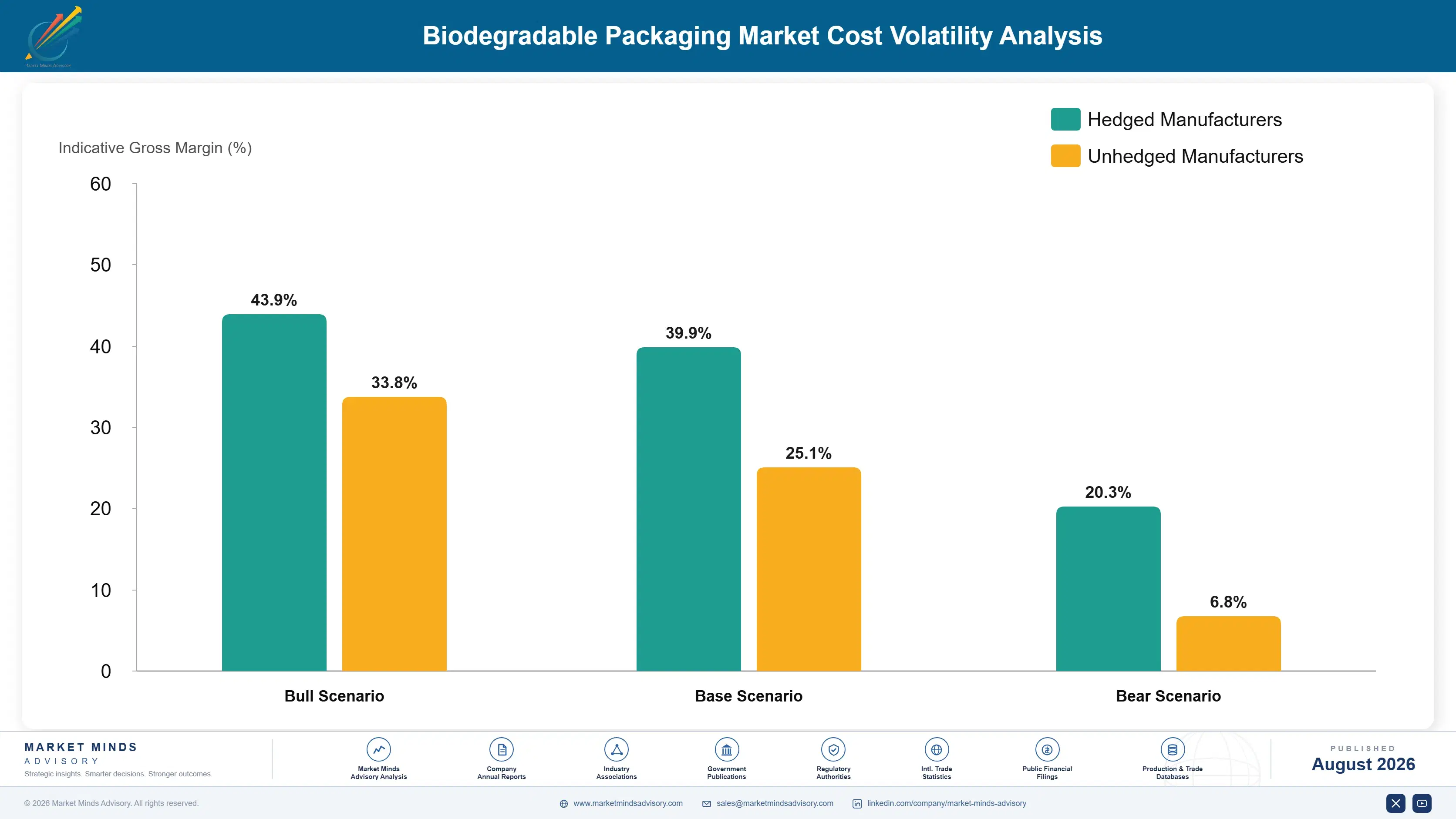
Fermentation Feedstock, Lactide, Starch, Energy

Feedstock and conversion dominate this cost sheet, and both are more expensive than conventional polymer routes. Fermentable sugar and starch feedstock runs 28% to 38% of material cost, drawn from corn, sugarcane, and cassava depending on region. Fermentation and polymerisation energy adds 18% to 26%, downstream recovery and purification 12% to 20%, and compounding with plasticisers and additives a further 8% to 14%.
Corn and sugar feedstock pricing rose sharply through 2022 as agricultural markets reacted to the Ukraine disruption and energy costs, and biodegradable polymer producers had no ability to pass that through against conventional polymer that was falling at the same time. Novamont and Danimer Scientific both disclosed feedstock and energy cost pressure across that reporting period, and IEA analysis recorded European industrial gas at several times prior-year levels.

Exposure separates by feedstock flexibility and scale rather than by chemistry. A producer able to run multiple feedstocks controls cost across a harvest cycle, while one qualified on a single crop carries whatever that crop does. Geography compounds it, since Asian producers access cassava and sugarcane at costs European corn-based production cannot approach, and European fermentation energy costs multiples of Asian equivalents on identical processes.
biodegradable-packaging-market-cost-volatility-analysis-1787332013043

Qualify multiple fermentable feedstocks per production route

Corn, sugarcane, cassava, and waste streams all ferment, but each requires process qualification and produces different impurity profiles. Running one feedstock leaves a producer exposed to a single harvest and a single agricultural market. Qualifying alternatives costs process development time once and provides genuine cost flexibility across seasons, which matters in a category where conventional polymer sets the competing price.

Site fermentation where energy and feedstock are cheapest

Fermentation and polymerisation consume energy at 18% to 26% of material cost, and feedstock a further third, so regional differences in both decide competitiveness outright rather than marginally. Locating capacity near cheap sugar and power changes the cost position permanently. It also moves production away from the legislation creating most of the demand, which adds freight and lead time.

Blend with starch to reach legislated volume applications

Pure polylactic acid and polyhydroxyalkanoate cannot reach the price point carrier bag and foodware bans create. Starch and cellulose blending brings material cost down substantially while retaining degradation behaviour. Moisture resistance falls as starch content rises, so the formulation is a direct trade, and getting it wrong produces field failures that damage the whole category.

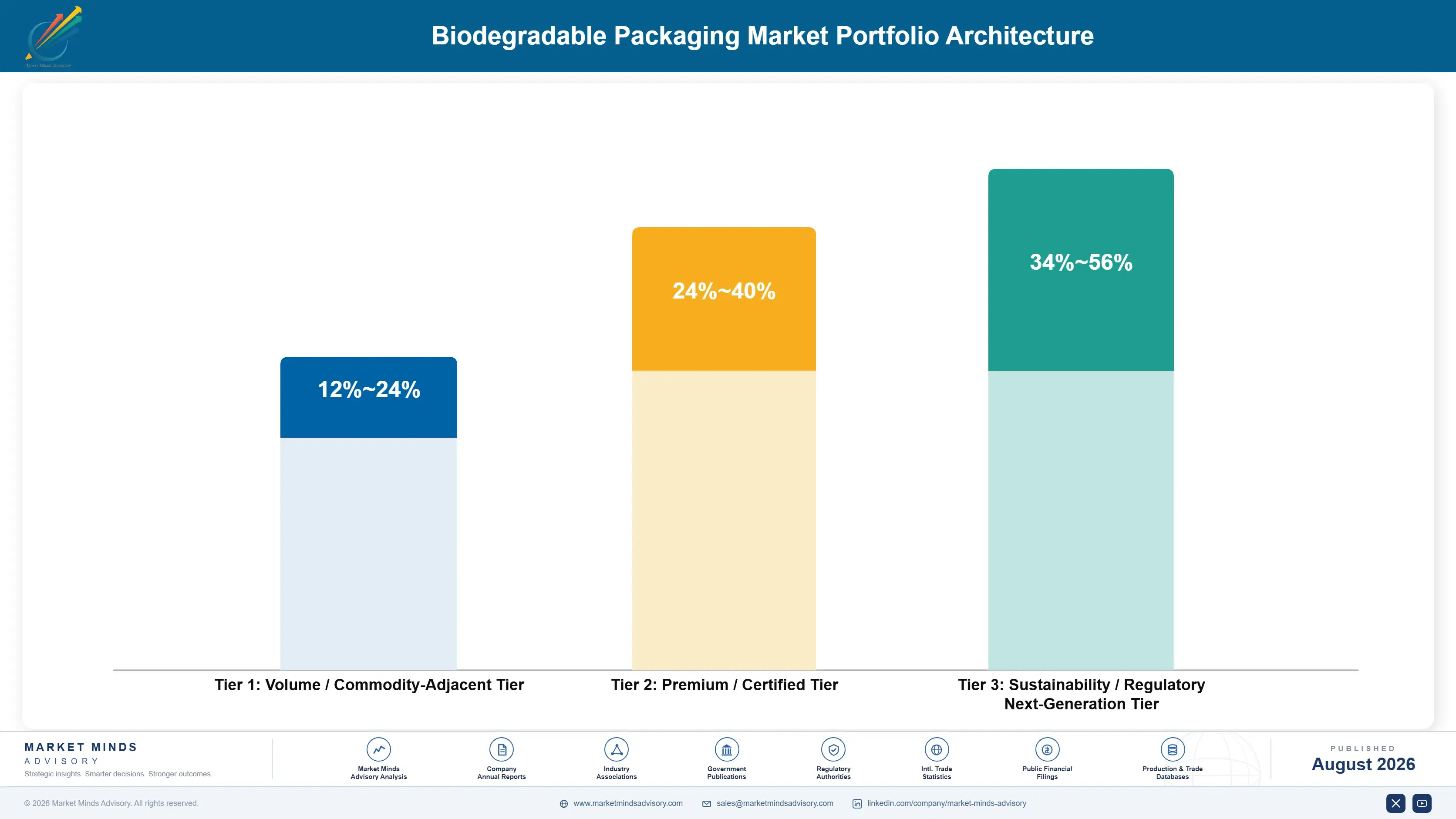
Portfolio Architecture for Margin Defence

The portfolio splits into three tiers with different economics. Starch blends and basic biodegradable polyester form the volume tier, where cost decides everything and Chinese producers set the floor. Polylactic acid grades with qualified converter positions earn more because specification and consistency narrow the field. Polyhydroxyalkanoate and ambient-degrading materials price against regulatory defensibility rather than against a competing resin quotation.
The tension runs between blends that fill the legislated volume and premium chemistry that earns the return. Starch blends reach the carrier bag and food service applications bans actually create, keep capacity loaded, and hold converter relationships through which premium grades eventually sell. Yet they compete on cost against Asian production. Producers handling this well accept thin blend margin for the volume while directing capital toward fermentation capacity for ambient-degrading chemistry.

High-value pools concentrate where regulatory defensibility or capability limits competition: polyhydroxyalkanoate for marine and soil applications, agricultural film degrading in the field, food service items reaching soil or water, and grades qualified into a converter's running process. All four survive enforcement scrutiny. Industrial-composting-only material sold into general packaging sits at the other end, where the claim is weakest and the cost premium hardest to defend.

Volume / Commodity-Adjacent Tier

Starch and cellulose blends and basic biodegradable polyester sold on cost into legislated bag and foodware applications. The range is wide because feedstock access and regional energy cost separate producers enormously at identical selling prices.
Gross Margin: 12-24%

Premium / Certified Tier

Polylactic acid grades with converter qualification, food contact approval, and consistent processing performance. The range is wide because Chinese capacity competes hard on standard grades while specialist formulations retain genuine pricing power.
Gross Margin: 24-40%

Sustainability / Regulatory / Next-Generation Tier

Polyhydroxyalkanoate materials, marine-degradable grades, and agricultural films degrading in the field. The range is wide because scarcity supports pricing while fermentation capacity still carries unrecovered development and qualification cost. Scarcity supports it for now.
Gross Margin: 34-56%
biodegradable-packaging-market-portfolio-architecture-1787332013542

High-value Sub-segments and Strategic Watch-out

Polyhydroxyalkanoate Materials

High value and high growth at 19.6%, the fastest chemistry, because degradation happens in ambient soil and seawater without any industrial process. Cost sits several times conventional polymer and fermentation capacity takes three to five years, so capacity rather than demand binds. Cost restricts it to functional uses.
Gross Margin: 34-56%

Starch and Cellulose Blends

High volume with strong growth at 11.4%, reaching the price point that carrier bag and foodware bans actually create. Moisture sensitivity worsens as starch content rises, so formulation is a direct trade between cost and durability that field failures punish. Cost is the only reason they win.
Gross Margin: 12-24%

Polylactic Acid Materials

The volume core by a wide margin, growing at 9.6% on food service and packaging substitution, and squeezed between Chinese capacity and the industrial composting problem. Converter qualification protects positions, though the degradation claim is the weakest in the category. The claim here is the category's weakest.
Gross Margin: 24-40%

Moulded Fibre and Paper-Based Formats

The strategic watch-out, growing at 10.8% because fibre degrades credibly and recycles into existing paper streams, which sidesteps the whole infrastructure argument. Barrier performance is the constraint and coatings frequently compromise the degradation claim entirely. Coating choice ultimately decides whether the degradation claim survives at all.
Gross Margin: 18-32%

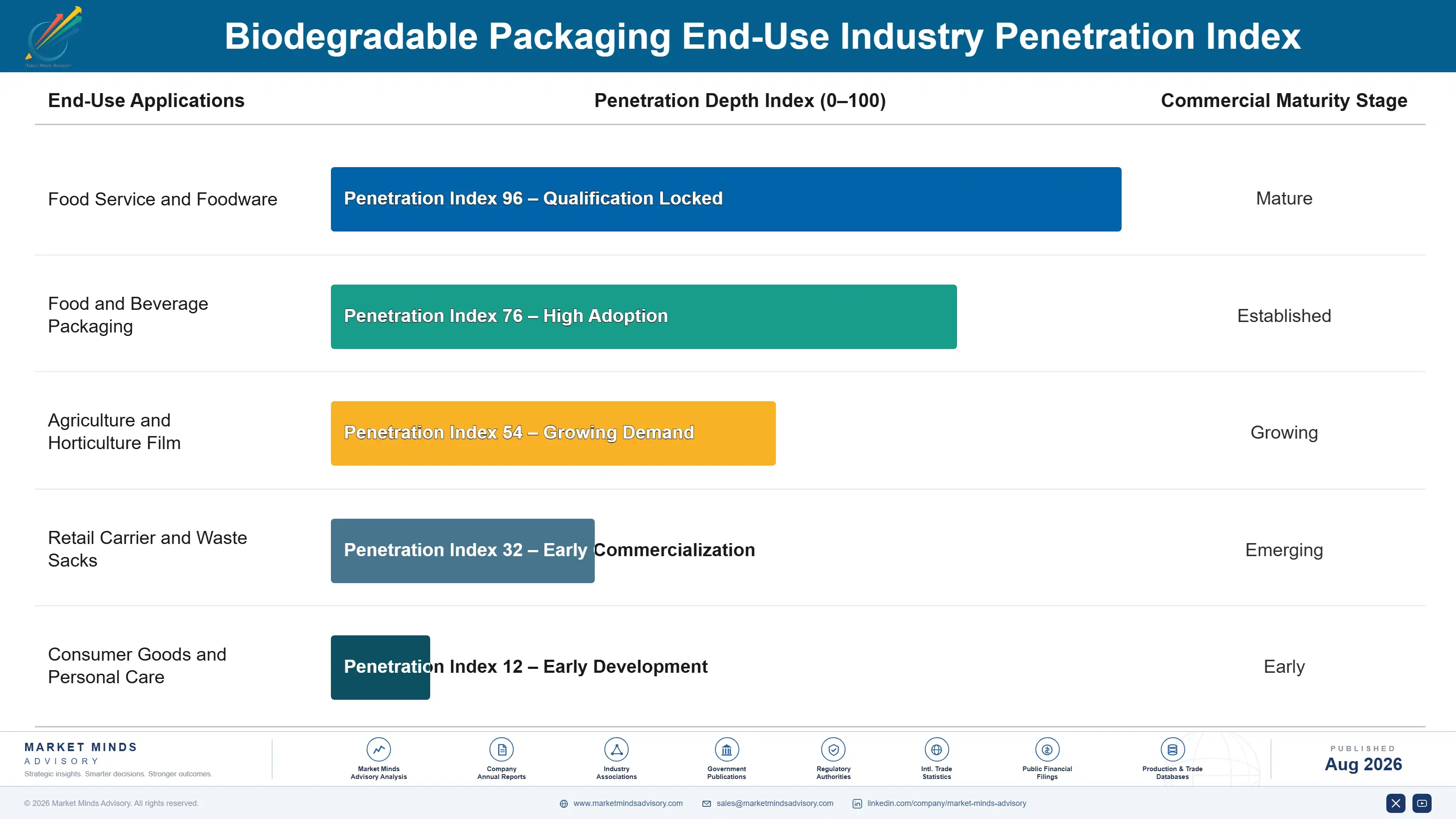
How Material Positions Actually Hold

Demand commits at converter qualification and repeats as resin orders. A grade running on a converter's extrusion or thermoforming line has passed processing trials, food contact review, and shelf life validation, and requalifying an alternative risks scrap and downtime on equipment already near its limits. That protects incumbent grades well. The genuine competitive moments are a new ban, a converter adding capacity, and any enforcement action invalidating a claim already on pack.
Stickiness varies by processing difficulty and claim exposure. Polyhydroxyalkanoate grades stick hardest, since alternatives that degrade in ambient conditions barely exist. Agricultural film grades stick through field performance history that farmers will not gamble with. Polylactic acid sticks through converter qualification. Starch blends stick least, moving on cost at every purchase because compounders can match a formulation reasonably closely.

Buyer profiles have shifted from packaging technologists selecting on processing behaviour toward sustainability, legal, and procurement all holding a veto. Legal now asks what can actually be claimed on pack, which is a question nobody asked five years ago. That change rewards suppliers bringing disposal environment evidence rather than material certificates, and penalises those still selling degradation test results to a technologist who cannot use them.
biodegradable-packaging-market-end-use-penetration-index-1787332014034

Our Call On Biodegradable Materials

These are among the four positions where our research anticipates prominent divergence between winners and laggards over the coming forecast period. Each is grounded in the demand model, the regulatory perimeter, and the announced capacity pipeline.
01 / DEGRADATION IN USE

Build where the material breaks down where it lands

Under 5% of biodegradable packaging reaches a waste route suited to its chemistry, which makes most degradation claims unverifiable and increasingly indefensible under any enforcement scrutiny. Agricultural mulch film breaking down in the soil it was laid on and food service items reaching soil or water need no collection infrastructure and no assumption about consumer behaviour at all. Those applications survive scrutiny that general packaging claims do not, and they are where this category's genuinely defensible commercial core actually sits today.
02 / AMBIENT CHEMISTRY PRIORITY

Industrial-composting-only material carries unpriced regulatory risk

Polylactic acid requires industrial conditions to break down at any useful rate at all while polyhydroxyalkanoate degrades in ambient soil and seawater, and that single difference separates a claim which survives enforcement from one which simply does not. Polyhydroxyalkanoate grows at 19.6% against a market at 10.7% despite costing several times more, for exactly that reason alone. Producers selling only industrial-composting chemistry into general packaging are still carrying a regulatory exposure that nothing in their current pricing reflects at all.
03 / BAN DATE CAPACITY PLANNING

Statute books forecast this market better than customers

Single-use plastic prohibitions name specific items and specific dates, which makes substitution demand unusually predictable for a young material market, and capacity additions have lagged those dates by years in every cycle so far. A fermentation or polymerisation plant needs three to five years from investment decision to qualified output, so the commitment must precede the ban by roughly that margin. Producers who waited for demand signals watched converters buy from whoever happened to have material at whatever price they asked.
04 / BLEND COST DISCIPLINE

Premium chemistry cannot reach the legislated volume

Bans create their largest demand in carrier bags, waste sacks, and foodware, where cost sensitivity is genuinely severe, and pure polylactic acid or polyhydroxyalkanoate at two to six times conventional polymer will simply never sell into those applications at all. Starch and cellulose blending reaches that price point while keeping degradation behaviour, which is precisely why blends grow at 11.4%. Moisture resistance falls as starch content rises, so producers holding only premium grades concede that entire volume to somebody else.

Engagement Snapshot From the Field

A live engagement with an industry participant carrying material or product regulatory and market exposure ahead of a defining policy shift, showing how our research translates into a defensible multi-year portfolio strategy.
MARKET MINDS ADVISORY · CLIENT ENGAGEMENT SUMMARY
Biodegradable Packaging Producer Strategic Portfolio Review and Transition Roadmap 2026·Investment Scenario on Biodegradable Packaging Exposure Evaluation 2025-26
CLIENT PROFILE
A global food service brand operating in twenty-eight markets engaged MMA after an advertising authority challenged the degradation claims on its foodware. The client reported roughly 40% of its single-use range converted to biodegradable material at a cost premium of about USD 28 million annually, and no evidence about where any of it actually ended up (client-reported, unverified by MMA).
STRATEGIC CHALLENGE
Withdrawing the claims would look like retreat while defending them required disposal evidence the client did not have and could not easily obtain. Legal wanted the claims removed, sustainability wanted the material retained, and procurement wanted the premium justified or cancelled. The board needed a position it could hold publicly before the next reporting cycle.
MMA APPROACH
MMA mapped actual disposal routes for the client's foodware by market rather than accepting material certificates, which nobody had examined. We separated items reaching soil or water in normal use from those entering general waste, since the two carry entirely different claim exposure. We then compared the premium being paid against what each material could credibly support in each jurisdiction.
KEY FINDINGS
  1. Under 4% of the converted foodware reached any industrial composting route, and in eleven markets no such route existed at all (client-reported, unverified by MMA).
  2. About 23% of items were consumed outdoors and genuinely reached soil or water, where ambient-degrading material carried a defensible claim and polylactic acid did not.
  3. The premium on industrial-composting-only material was buying a claim the client could not substantiate in most of its markets, which was roughly USD 19 million of the total.
  4. Fibre-based alternatives recycled into existing paper streams in nineteen markets, which sidestepped the infrastructure argument entirely on about a third of the range.
CLIENT PROFILE
A global food service brand operating in twenty-eight markets engaged MMA after an advertising authority challenged the degradation claims on its foodware. The client reported roughly 40% of its single-use range converted to biodegradable material at a cost premium of about USD 28 million annually, and no evidence about where any of it actually ended up (client-reported, unverified by MMA).
STRATEGIC CHALLENGE
Withdrawing the claims would look like retreat while defending them required disposal evidence the client did not have and could not easily obtain. Legal wanted the claims removed, sustainability wanted the material retained, and procurement wanted the premium justified or cancelled. The board needed a position it could hold publicly before the next reporting cycle.
MMA APPROACH
MMA mapped actual disposal routes for the client's foodware by market rather than accepting material certificates, which nobody had examined. We separated items reaching soil or water in normal use from those entering general waste, since the two carry entirely different claim exposure. We then compared the premium being paid against what each material could credibly support in each jurisdiction.
KEY FINDINGS
  1. Under 4% of the converted foodware reached any industrial composting route, and in eleven markets no such route existed at all (client-reported, unverified by MMA).
  2. About 23% of items were consumed outdoors and genuinely reached soil or water, where ambient-degrading material carried a defensible claim and polylactic acid did not.
  3. The premium on industrial-composting-only material was buying a claim the client could not substantiate in most of its markets, which was roughly USD 19 million of the total.
  4. Fibre-based alternatives recycled into existing paper streams in nineteen markets, which sidestepped the infrastructure argument entirely on about a third of the range.
RECOMMENDED STRATEGY
Phase 1: Phase 1 (0 to 6 months): Withdraw degradation claims in markets without a suitable disposal route rather than defending them further. Phase 2: Phase 2 (6 to 18 months): Move outdoor-consumed items to ambient-degrading material where the claim genuinely holds without infrastructure of any kind. Phase 3: Phase 3 (18 to 30 months): Convert the remaining range to fibre where barrier requirements permit and retire the unsupportable premium.
OUTCOME
The client withdrew claims in the markets it could not substantiate, moved outdoor items to ambient-degrading material, and cut the unsupported premium by roughly USD 17 million annually. Fibre conversion covered a third of the range without any claim exposure, and the advertising challenge was resolved without further escalation (client-reported, unverified by MMA).

Frequently Asked Questions

Foundational context covering the market sizes, CAGR, scope, country, region and competition that inform every finding below. This section is provided to cover basics and most often pre-purchase conversations, answered from the MMA Primary Research Dataset.

What is the current size of the Biodegradable Packaging Market?

The global biodegradable packaging market is valued at USD 7.9 billion in 2025, covering polylactic acid, polyhydroxyalkanoate, starch and cellulose blends, biodegradable polyesters, and fibre-based formats. Certified compostable packaging is treated separately.

How large will the Biodegradable Packaging Market be by 2036?

The market is forecast to reach USD 24.24 billion by 2036 in the base case, about 2.77 times the 2026 level. That represents incremental value of roughly USD 15.49 billion across the decade.

What is the CAGR for the Biodegradable Packaging Market 2026 to 2036?

The market grows at a 10.7% CAGR in the base case, with bull and bear scenarios at 12.0% and 9.3%. The spread turns mainly on greenwashing enforcement and polyhydroxyalkanoate cost reduction.

Which segment is growing fastest?

Polyhydroxyalkanoate materials grow fastest at 19.6%, about 1.83 times the overall rate, because they degrade in ambient soil and seawater. Starch and cellulose blends follow at 11.4% on cost.

Who are the major companies in the Biodegradable Packaging Market?

Leading producers include NatureWorks, TotalEnergies Corbion, Danimer Scientific, Novamont, and BASF. Concentration is moderately high, with the top five holding roughly 46% of biodegradable material revenue.

Which country is growing fastest?

India grows fastest at a 15.8% CAGR, as single-use plastic prohibitions cover very large consumption volumes. China and Indonesia follow on domestic rule tightening and capacity expansion.

Report Segmentation Architecture

The full report scope spans multiple orthogonal segmentation dimensions, with cross-tabulated demand data provided for each dimension pair. Coverage extends further to regional breakdowns, trend trajectories, and the competitive detail needed to support segment-level decision-making.

By Material Chemistry

  • Polylactic Acid Materials
  • Polyhydroxyalkanoate Materials
  • Starch and Cellulose Blends
  • Biodegradable Polyester Blends
  • Moulded Fibre and Paper-Based Formats

By End-Use Industry

  • Food Service and Foodware
  • Food and Beverage Packaging
  • Agriculture and Horticulture Film
  • Retail Carrier and Waste Sacks
  • Consumer Goods and Personal Care

By Sales Channel

  • Direct Contract To Converter
  • Compounder and Masterbatch Supply
  • Distributor and Trader Supply
  • Brand Owner Specified Supply

By Region

  • North America
  • Western Europe
  • East Asia
  • South Asia and Pacific
  • Latin America
  • Middle East and Africa
  • Eastern Europe

Scope, Methodology, and Coverage

Every figure in this report is reproducible from documented input assumptions. The scope below maps the historical period, the forecast horizon, the segmentation dimensions, and the countries covered, alongside the underlying primary and qualitative methodology.
Historical Period
2020 to 2025
Forecast Period
2026 to 2036
Base Year
2025 (USD billions; MMA Primary Research Dataset, August 2026)
Market Definition
The biodegradable packaging market comprises the manufacture and sale of packaging materials whose polymer or fibre chemistry breaks down through biological action, valued at producer selling prices to converters, compounders, and distributors. It spans polylactic acid materials, polyhydroxyalkanoate materials, starch and cellulose blends, biodegradable polyester blends including copolyesters, and moulded fibre and paper-based biodegradable formats, together with the compounding, additive systems, and processing support supplied with them. The market is defined by material degradation chemistry rather than by any disposal certification. Certified compostable packaging sold on documented disposal performance against a composting standard is treated as a separate market in the MMA series, as are conventional recyclable plastics, bio-based but non-degradable polymers such as bio-polyethylene, oxo-degradable additives, packaging and converting machinery, waste collection, sorting and industrial composting services, and finished packaged goods.
Quantitative Units
USD billions (current prices); material volume in thousand tonnes and installed polymer capacity
Segmentation Dimensions
By Material Chemistry; By End-Use Industry; By Sales Channel; By Region
Regions Covered
North America, Western Europe, East Asia, South Asia and Pacific, Latin America, Middle East and Africa, Eastern Europe
Countries Covered
USA, Canada, Germany, France, UK, Italy, Spain, Netherlands, Sweden, Poland, Japan, China, South Korea, India, Australia, Indonesia, Vietnam, Thailand, Brazil, Mexico, Chile, Colombia, UAE, Saudi Arabia, South Africa, Kenya, Rwanda, Nigeria, Turkey, Switzerland, and additional markets relevant to this sector
Key Companies Profiled
NatureWorks, TotalEnergies Corbion, Danimer Scientific, Novamont, BASF, Kaneka, Mitsubishi Chemical, Biome Bioplastics, Plantic Technologies, Futerro, Hengli Petrochemical, Zhejiang Hisun Biomaterials, Anhui BBCA Biochemical, Bio-on, RWDC Industries, Trinseo, Amcor, Huhtamaki, Stora Enso, Sabert
Quantitative Methodology
Primary survey, n=3,800 respondents, Q4 2025, six countries; demand-side model with trade association cross-validation
Qualitative Methodology
47 expert interviews, Q4 2025; applied to validate demand model assumptions, identify emerging dynamics, and assess competitive positioning
Report Format
PDF and XLSX data workbook (Word format preview document)
Publisher
Market Minds Advisory
Report Code
MMA-2026-PAC-337
Published
August 2026
Contact
sales@marketmindsadvisory.com | www.marketmindsadvisory.com

Purchase the full Biodegradable Packaging Market Report (2026 to 2036).

The full MMA Biodegradable Packaging report sizes the market across five material chemistries, five end-use industries, four sales channels, and seven regions through 2036. It profiles 20 producers on a consistent basis of biodegradable polymer and fibre material revenue, scoring each on chemistry breadth, capacity position, cost position through blending, and claim substantiation support. Scenario models quantify how single-use plastic prohibitions, greenwashing enforcement, and fermentation capacity additions move both volume and achievable margin by chemistry. The report also includes disposal route mapping by market and material, degradation environment comparison across chemistries, ban timetable tracking by jurisdiction, and cost premium benchmarking against conventional polymer.
Five-chemistry and four-channel market sizing to 2036
Twenty-producer benchmark on biodegradable material supply revenue
Disposal route mapping by market and material chemistry
Degradation environment comparison across polymer chemistries
Single-use plastic ban timetable tracking by jurisdiction
Cost premium benchmarking against equivalent conventional polymer

Built For The People Who Decide

From boardroom strategy to bench-side execution, this report is read cover-to-cover by leaders shaping the next decade of their industry, turning demand scenarios, market dynamics and valuation benchmarks into decisions.
CXOs/ Presidents/ VPs/ Managers
M&A and Corporate Development
Strategy Teams and R&D Heads
Procurement and Product Directors
Regulatory and Compliance Leaders
Investor Relations and Equity Analysts