Market Minds Advisory
Outdoor Furniture Market

Outdoor Furniture Market: Outdoor Furniture Market. Modular Design Redraws Category Value.

Home furnishing brands are expanding modular and smart-integrated outdoor furniture lines as backyard living investment broadens demand, pushing outdoor furniture well beyond basic weather-resistant seating positioning. Retailers now specify durability.

Lead Analyst

Published

September 2026

Make Smarter Decisions with Customized Research Insights

Request a free sample report and evaluate market opportunities, growth trends, and competitive dynamics relevant to your business needs.

2025 MARKET VALUE$32.0BMarket Size 2025
2036 FORECAST VALUE$57.7BBase Case , 2026 to 2036
CAGR 2026 TO 20365.5 %Bull 6.7% / Bear 4.3%
INCREMENTAL OPPORTUNITY$23.9BNet 10- year value creation
EXPANSION MULTIPLE1.71x2036 value over 2026 base
Strategic Levers
M&A Pipeline
Regional Outlook
Country Rankings
Competitive Intelligence
Segmental Deep-dive
Call-Us : 91 93563 13602

Executive Snapshot and Market Trajectory.

Home furnishing brands are expanding modular and smart-integrated outdoor furniture lines as backyard living investment broadens demand well beyond basic weather-resistant seating entirely. Retailers are now formalizing weather-durability and structural testing protocols that most previously handled through self-reported claims alone today. Retailers increasingly favor certified brands.
Modular and smart-integrated outdoor furniture is absorbing the fastest-growing share of new product launches as brands pursue design flexibility beyond fixed-configuration sets. India concentrates the largest share of new demand growth, driven by rising urban balcony culture and expanding middle-class discretionary spending. Outdoor seating and lounge furniture remain a steady revenue base given their entrenched position across mass retail and specialty home chains. Outdoor sofas continue gaining share too.
Competitive intensity centers on five established manufacturers holding roughly a quarter of the market between them, leaving considerable share fragmented among specialist artisanal and direct-to-consumer brands. Rising aluminum and synthetic-wicker input cost pressure and tightening weather-durability certification requirements are reshaping product design criteria across nearly every major retailer currently renegotiating supplier terms. Several manufacturers are pursuing fabric-durability partnerships to differentiate against uncertified rivals across the wider industry today. Analysts noted the emerging trend.
Market Definition
This report covers furniture and seating designed for outdoor and patio use, including dining sets, lounge seating, sofas, hammocks, and weather-resistant storage. It excludes indoor furniture adapted for occasional outdoor use and permanent built-in structures such as pergolas or decking.
Base Year Value
$32.0B in 2025 (MMA Primary Research Dataset, August 2026)
Forecast Period
2026 to 2036, eleven discrete annual values
CAGR
5.5% base case. Bull 6.7%. Bear 4.3%.
Fastest Growth Segment
Modular and Smart-Integrated Outdoor Furniture: 8.5% CAGR
Fastest Growth Country
India: 8.0% CAGR
Fastest Growth Region
South Asia and Pacific: 7.5% CAGR
Largest Region
North America: 30% of 2025 global value
Market Leaders
Brown Jordan, Tropitone Furniture, Polywood, Keter Group, Lloyd Flanders. Source: MMA Primary Research Dataset, July 2026.
Primary Survey
n=3,800 procurement and R&D decision-makers, Q4 2025, six countries
Methodology
Demand-side build-up, cross-validated against public data, 47 expert interviews

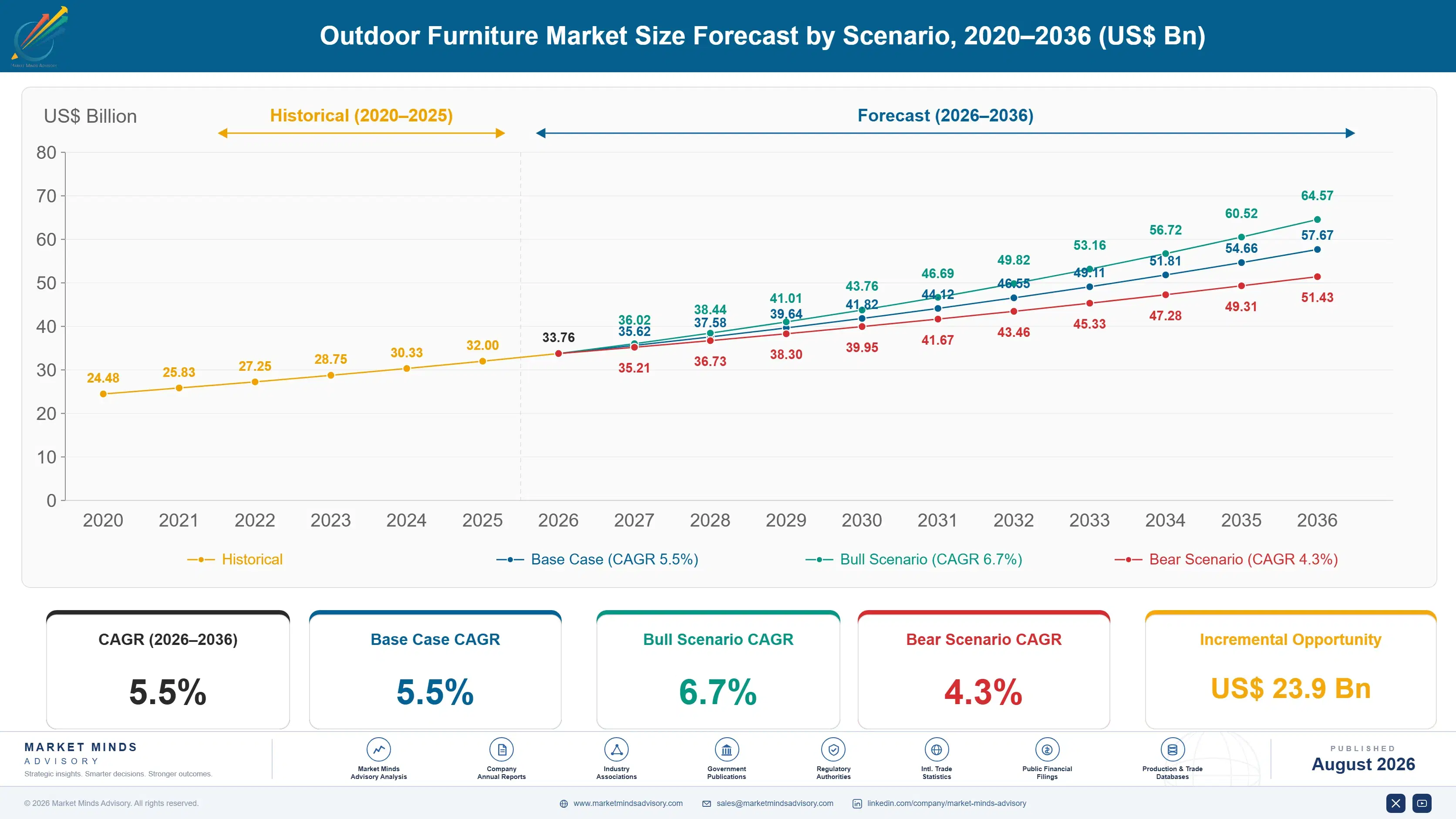
Outdoor Furniture Market Forecast Scenarios

outdoor-furniture-market-size-forecast-scenario-1788168960500
Outdoor furniture revenue grew at an estimated 5.5 percent historical pace between 2020 and 2025, as home-improvement spending formed during the pandemic normalized into a steady baseline of backyard living investment. Growth stabilized further once retail shelf space normalized post-pandemic. Several major retailers maintained dedicated outdoor living shelf space accordingly. Retail shelf visibility continues to broaden.
The base case assumes 5.5 percent annual growth through 2036, driven by three commercial mechanisms. First, modular and smart-integrated designs are becoming a standard purchase requirement rather than an optional differentiator among design-conscious homeowners. Second, weather-resistant synthetic materials are scaling steadily as buyers pursue durability alongside aesthetic credentials. Third, rising urban balcony and small-space living in emerging markets is adding a durable baseline of new-household demand that persists regardless of near-term discretionary spending cycles. Retailers increasingly favor certified listings during annual category reviews.
The bull case centers on faster-than-expected outdoor-living investment pulling forward category revenue across multiple distribution channels simultaneously. The bear case centers on prolonged aluminum and synthetic-wicker cost pressure limiting discretionary product innovation spending, which could meaningfully slow revenue growth across the newest modular launches specifically. Manufacturers without comparable design depth face mounting competitive pressure from better-differentiated rivals.

Modular Design Redraws Category Value

The outdoor furniture industry sits at a point where modular design credibility and durability ambition are colliding with a backyard-living purchasing transition. Modular and smart-integrated designs displacing fixed-configuration sets is the single largest determinant of how brand development budgets are being reallocated across nearly every major product line today, reshaping long-held retail relationships. Manufacturers increasingly treat design investment as a core strategic priority.
MARKET CONCENTRATION (CR5)26%Top five manufacturers hold roughly a quarter combined
AVERAGE PRODUCT DEVELOPMENT CYCLE10 monthsTypical duration required from concept to retail launch
DIRECT-TO-CONSUMER SALES SHARE26%Total category revenue sold through online brand channels currently
MODULAR PRODUCT REVENUE SHARE17%Total category revenue derived from modular, reconfigurable formats
TOP PRODUCING COUNTRY SHARE31%China share of global outdoor furniture manufacturing output
ALUMINUM COST SHARE24%Aluminum and synthetic-wicker input cost portion of expense
Beneath the modular story, the industry is absorbing genuine durability demand. Buyers increasingly demand weather-resistant synthetic materials that pair fade-resistant fabric with structurally sound frame construction, letting product teams plan development around predictable seasonal replacement windows rather than reactive single-purpose redesigns. Manufacturers slower to offer comparable durability credentials risk losing shelf renewals to rivals already demonstrating proven weather performance. Retailers increasingly favor these certified listings during annual category reviews.
Distribution economics are shifting too. Direct-to-consumer niche brands are steadily capturing retail volume that traditional mass home-improvement chains once claimed by default, particularly on premium segments nearing the end of exclusive multi-year distribution agreements. Manufacturers offering more competitive online partnership structures are converting this competitive pressure into genuine multi-year contract wins across multiple retail relationships.
"Every brand now claims all-weather durability, but the ones actually winning repeat purchases are the ones who can prove the fabric holds up after two full seasons outdoors, not just a showroom demonstration."
Director, Consumer Products Practice · MMA Construction and Industrial Equipment Practice · August 2026

Market Trends

Modular Designs Displace Fixed-Configuration Furniture Sets

Manufacturers are increasingly developing modular, reconfigurable outdoor furniture rather than exclusively relying on fixed-configuration sets, reflecting genuine consumer demand for design flexibility given rising expectations for adaptable small-space living arrangements. Brown Jordan and Polywood have both expanded dedicated modular programmes specifically to meet rising consumer demand, recognizing that shoppers increasingly specify reconfigurability as a standard purchase consideration rather than an optional feature across new product launches. This shift is reshaping how retailers allocate shelf space across competing product tiers. This shift is reshaping how retailers allocate testing capacity across an expanding set of manufacturers.
Market Impact: Adds 4% category growth demand annually
Weather-Resistant Synthetics Gain Growing Retail Priority

Manufacturers are increasingly developing weather-resistant synthetic materials rather than exclusively relying on traditional natural-wood formats, since fade-resistant fabric and structurally sound frames meaningfully improve durability relative to traditional single-season products facing rising consumer scrutiny. Tropitone Furniture has used its materials engineering expertise to expand retail listings meaningfully, while brands without comparable capability risk losing shelf space to better-positioned rivals. Retailers increasingly build durability requirements directly into new product listing specifications and category reviews each cycle. Manufacturers without comparable durability depth increasingly cede this expanding premium category to earlier-moving specialists building comparable weather credentials today across most markets.
Market Impact: Adds 3% balcony-driven demand growth

Market Opportunities and Growth Drivers

Rising Backyard-Living Investment Drives Category Growth

Growing backyard-living investment continues driving steady category growth, directly increasing available revenue for both premium brand expansion and direct-to-consumer investment across major markets. This investment growth is particularly pronounced among younger homeowners rapidly normalizing outdoor entertaining as everyday practice, creating durable new demand that extends well beyond typical replacement-cycle patterns these homeowners historically followed. Brands with strong existing social media relationships in this fast-expanding market are capturing this durable demand more efficiently than competitors entering later in the cycle. This trend shows no signs of slowing across most major consumer markets tracked.
Market Impact: Cuts margins by 3 points

Rising Urban Balcony Culture Accelerates Product Investment

Urban homeowners are increasingly furnishing balconies and small outdoor spaces rather than leaving them unfurnished, directly increasing brand demand for compact product investment across expanding consumer categories. This preference represents genuine incremental demand beyond typical replacement-cycle procurement patterns, since consumers are actively specifying space-efficient design in new purchase decisions rather than simply tolerating legacy oversized alternatives at prior tolerance levels. Brands with strong compact-design development capability are capturing this durable preference more efficiently than competitors relying purely on legacy oversized offerings. Retailers increasingly favor certified listings during annual category review cycles.
Market Impact: Delays international launch by 4 months

Market Restraints and Challenges

Rising Aluminum Cost Limits Margin Expansion

Many smaller manufacturers continue struggling to absorb rising aluminum and synthetic-wicker component costs fast enough to preserve margin at competitive retail price points, creating genuine cost bottlenecks that extend product repricing timelines considerably beyond original targets. The root cause is genuine supply chain complexity in sourcing consistent quality aluminum across a concentrated global supplier base facing simultaneous demand from multiple consumer product categories. The commercial impact pressures manufacturers to renegotiate pricing more frequently than retailers prefer. Manufacturers are mitigating this through expanded material hedging and multi-supplier sourcing programmes currently underway.
Market Impact: Grows modular product share to 17%

Fragmented Weather-Durability Standards Complicate Global Expansion

Manufacturers continue struggling to reconcile fragmented national weather-durability and labeling standards fast enough to support genuine cross-border retail expansion, creating genuine compliance bottlenecks that extend international launch timelines considerably beyond original service targets. The root cause is genuine institutional complexity in harmonizing testing frameworks across a fragmented national regulatory base facing simultaneous pressure from retailer efficiency demands and consumer safety mandates alike. Manufacturers are mitigating this through expanded regulatory compliance partnerships and standardized certification programmes currently underway. Smaller manufacturers face disproportionate compliance burden relative to larger, better-resourced competitors with dedicated regulatory affairs teams.
Market Impact: Lifts direct-to-consumer share to 26%
4 additional market trends, 3 additional growth drivers, and 3 additional restraints and challenges are covered in the full report. Contact sales@marketmindsadvisory.com to access the complete intelligence.

Segment CAGR and Growth Architecture

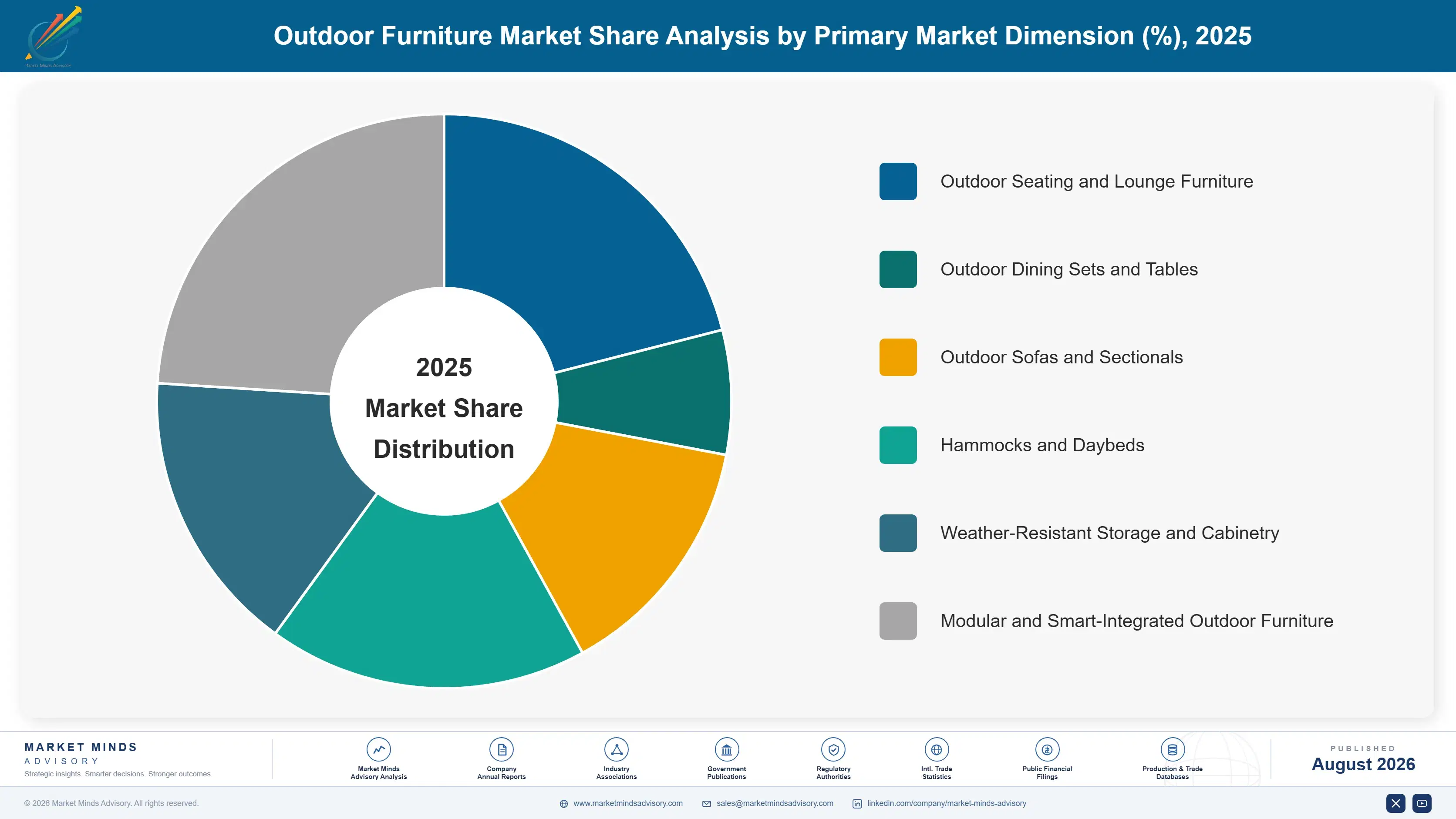
The outdoor furniture market segments most usefully by product and format, spanning seating, dining sets, sofas, hammocks, storage, and modular formats, rather than by material or retail channel alone. Analysts apply this logic consistently across every regional and competitive discussion. This structure keeps upstream materials, product formats, and downstream retail channels analytically distinct throughout the report.
outdoor-furniture-market-market-share-analysis-1788168961064

Modular and Smart-Integrated Outdoor Furniture

Modular and smart-integrated outdoor furniture is growing fastest, expanding at roughly 1.5 times the market's overall pace as consumers increasingly specify reconfigurability credentials to reflect broader small-space living purchasing shifts. Brown Jordan and Polywood have both expanded dedicated modular programmes specifically to compete for this growing product category, recognizing that consumers increasingly demand design flexibility rather than fixed-configuration performance alone. This segment particularly benefits manufacturers with strong materials engineering capability, since legacy fixed-configuration offerings carry an increasingly unfavorable positioning profile against newer modular designs. Manufacturers without demonstrated design capability risk losing this category to better-positioned rivals. Retailers increasingly prioritize these listings during annual assortment planning. Growth here continues steadily across most major markets.
CAGR 8.5%

Outdoor Sofas and Sectionals

Outdoor sofas and sectionals form the second-fastest growing segment, propelled by consumers pursuing lounge-style entertaining spaces that pair weather-resistant fabric with structurally sound frame construction beyond traditional individual-seat formats. Tropitone Furniture and Lloyd Flanders have both expanded dedicated sectional production specifically to capture this growing category, recognizing that consumers increasingly demand durability credentials as a standard specification. Manufacturers with strong existing engineering credibility track records are capturing disproportionate share of this expanding category, since consumers increasingly demand demonstrated durability before committing to premium sectional purchases. Manufacturers without demonstrated capability risk losing this category to better-proven competitors. Retailers increasingly favor these listings during annual category planning cycles each year. Growth continues steadily overall.
CAGR 7.0%
Full segment breakdown across 6 segments available in the complete report.

Regional Architecture and Country Demand Map

North America holds the largest regional share, reflecting the region's dense backyard-living culture and retail concentration. East Asia and Western Europe follow given strong manufacturing bases. South Asia and Pacific shows the fastest growth rate given rapidly rising balcony culture and discretionary spending overall. today

North America

North America leads with a 30% share, reflecting the region's dense concentration of backyard-living culture and established retail infrastructure across the United States and Canada. Brown Jordan and Tropitone Furniture dominate domestic retail given decades-long incumbent relationships with premium and mass home-improvement retail chains. Canada contributes meaningfully smaller but genuine volume through regional retail operations. The region's growth rate sits close to the global average, reflecting continued category growth even as modular-design adoption expands across multiple retail channels simultaneously. No other region approaches this scale of combined brand depth and retail infrastructure. Retailers across the region increasingly prioritize certified listings during annual assortment planning cycles, further reinforcing incumbent brand advantage industry-wide.
Share: 30% | CAGR: 5.5% (2026 to 2036)

East Asia

East Asia holds a substantial 22% share, driven by China's dominant rattan and aluminum manufacturing base and Japan's established outdoor-living culture supporting rising domestic and export demand. China's category manufacturing continues at a pace that meaningfully outstrips global averages, while Japan and South Korea contribute established design traditions supporting both domestic customers and export production work. The region's growth rate sits modestly above the global average, reflecting continued manufacturing investment and rising domestic demand across multiple regional markets simultaneously. Growth should continue steadily as brand awareness expands regionally. South Korea contributes further volume through steady domestic retail growth and expanding e-commerce penetration nationwide. Manufacturers across the region continue expanding local production capacity to meet demand.
Share: 22% | CAGR: 6.5% (2026 to 2036)
Regional intelligence for 5 additional markets available in the complete report: Western Europe, South Asia and Pacific, Latin America, Middle East and Africa, Eastern Europe. Contact sales@marketmindsadvisory.com.
outdoor-furniture-market-country-cagr-analysis-1788168961740

Winning Share In A Design-First Category

Revenue growth for outdoor furniture brands increasingly depends on winning share in a design-first product mix, since consumers increasingly favor modular, reconfigurable formats alongside traditional fixed-configuration sets across most purchase categories. Brands that recognize this dynamic early are repositioning product strategies around design credibility rather than legacy fixed-set sales alone. Analysts track this shift closely.

Securing Weather-Durability Certification Partnerships Early Now

Brands that secured weather-durability certification partnerships ahead of competitors are capturing customer share that basic-only entrants would otherwise claim entirely. Tropitone Furniture's certification programme has reportedly grown retail revenue 15 to 20 percent faster than its basic-only competitors over the past several years. This approach converts a former durability vulnerability into a genuine strategic priority for brands willing to invest in materials testing relationships early. Brands without comparable capability increasingly cede this expanding category to earlier-moving specialists building comparable durability depth today across most retail negotiations. Retailers now favor certified brands during listing renewal decisions.
Market Impact: Grows retail revenue 15 to 20 percent faster

Building Premium Modular Product Lines Fast

Brands that systematically built premium modular product lines are capturing disproportionate share of extended customer relationships ahead of competitors offering only fixed-configuration alternatives. Brown Jordan's modular collection reportedly retains 14 to 18 percent more customers than comparable offerings lacking reconfigurable design. Brands without comparable design capability increasingly cede these retention competitions to better-positioned rivals over time as consumers demand embedded flexibility across nearly every new product launch cycle. This shift is reshaping how brands allocate their annual product development budgets across categories. Retailers now favor these brands during listing renewal negotiations.
Market Impact: Retains 14 to 18 percent more customers annually

Expanding Direct-To-Consumer Online Distribution At Scale

Brands that expanded direct-to-consumer online distribution ahead of competitors are capturing disproportionate share of recurring demand that constrained legacy mass-retail-only distribution otherwise cannot fulfill quickly. Early movers reportedly capture 11 to 15 percent more recurring revenue than competitors relying purely on legacy mass-retail-only sales alone. This capability increasingly determines which brands win the largest long-term customer relationships as consumers seek convenience over marginal cost savings across purchase decisions today. This advantage compounds further over time. Retailers increasingly favor these subscription-capable brands during annual contract renewal decisions. This advantage compounds further over time.
Market Impact: Captures 11 to 15 percent more revenue overall

Securing Long-Term Aluminum Supplier Agreements Early

Brands that secured long-term aluminum supplier agreements are capturing cost stability that spot-market-only competitors otherwise cannot access at all. Polywood's supplier partnership has reportedly expanded its addressable production capacity by 9 to 13 percent among premium aluminum and synthetic-wicker categories facing tighter supply constraints. This approach converts a former cost volatility barrier into a genuine revenue opportunity for brands willing to build supplier partnership infrastructure early across the full range of formulation categories offered. Manufacturers with broader supplier networks better absorb regional disruption without affecting output. This advantage compounds further as raw material volatility continues pressuring smaller manufacturers.
Market Impact: Expands addressable production capacity 9 to 13 percent

Who Controls the Margin Pool

The outdoor furniture market is fragmented, with a CR5 of 26 percent on a revenue basis held across Brown Jordan, Tropitone Furniture, Polywood, Keter Group, and Lloyd Flanders. Brown Jordan and Tropitone Furniture lead given their broad design-forward portfolios spanning seating, dining, and modular categories, while independent artisanal challengers compete on niche premium craftsmanship and direct-to-consumer capability specifically. This gap between leaders and challengers keeps widening.
Current competitive activity centers on certification investment, modular expansion, and online distribution investment. Brands are also racing to secure long-term retail contracts as consumers increasingly prioritize demonstrated durability credibility over unproven legacy alternatives. Brands are also expanding joint development partnerships with regional distributors specifically to secure early market access on new product category launches nationally.

Emerging pressure comes from two directions. Specialist modular design entrants are expanding aggressively into purchase competitions previously dominated by legacy fixed-set suppliers, while independent materials makers could reshape competitive rankings if unverified incumbents unable to match durability positioning lose ground to nimbler, better-differentiated competitors. Brands unable to demonstrate reliable weather performance risk losing customer confidence entirely, ceding future purchase opportunities to competitors with stronger track records.
outdoor-furniture-market-company-positioning-matrix-1788168962418

Competitive Moat and Risk Dimensions

BROWN JORDAN

Moat: Deepest Design Heritage Recognition

Brown Jordan benefits from decades-long design heritage and premium hospitality relationship depth, giving it demonstrated brand credibility that newer entrants cannot easily replicate. Competitors lacking comparable heritage struggle to match this documented design reputation quickly across most premium retail relationships. This heritage gives Brown Jordan continued pricing power that newer, less-established entrants cannot easily command.
BROWN JORDAN

Risk: Premium Price Point Exposure

Brown Jordan's revenue remains concentrated in premium price point products facing resistance from budget-conscious consumers during periods of broader economic softening, making it disproportionately exposed to demand pullback relative to competitors offering lower-cost alternatives. Extended affordability pressure could meaningfully compress overall segment volume growth. Diversifying into mid-tier price points remains an ongoing strategic consideration.
TROPITONE FURNITURE

Moat: Broadest Hospitality Distribution Depth

Tropitone Furniture benefits from extensive hospitality and contract distribution relationships across its diversified outdoor portfolio, giving it demonstrated operational credibility that competitors relying purely on residential-only channels cannot easily replicate. This documented track record gives Tropitone Furniture a durable advantage in contract-tender negotiations against brands offering only residential-only alternatives.
TROPITONE FURNITURE

Risk: Commercial Channel Concentration Risk

Tropitone Furniture's revenue remains heavily concentrated in commercial and hospitality contracts, making it disproportionately exposed to hospitality-sector demand cycles relative to competitors with more diversified residential channel structures. Extended hospitality softening could meaningfully compress overall corporate revenue and profitability going forward. Diversifying into residential-first channels remains an ongoing consideration.

Players Tracked

Prominent Players

Brown Jordan
Tropitone Furniture
Polywood
Keter Group
Lloyd Flanders

Other Key Players

Gloster Furniture
Dedon
Woodard Furniture
Telescope Casual Furniture
Homecrest Outdoor Living
Kettal
Roberti Rattan
Cane-line
Fermob
Emu Group
Ethimo
Barlow Tyrie
Suncoast Furniture
Winston Furniture
Lane Venture

Recent Developments

APRIL 2026

Tropitone Furniture Expands Weather-Durability Certification Programme

Tropitone Furniture expanded its weather-durability certification programme, adding new testing partnerships specifically targeting the growing design-first category as retailers increasingly specify durability credentials on new listing agreements. The expansion reflects confidence that ceding this category risks permanent loss of future retail revenue. Analysts welcomed the investment.
Signal: Signals leading brands are now directly and actively responding to durability competitive pressure across the wider industry
FEBRUARY 2026

Brown Jordan Launches Expanded Modular Product Line

Brown Jordan launched a new expanded modular product line, formally offering consumers extended reconfigurable designs across multiple price tiers to differentiate against fixed-configuration competitors. The launch reflects growing industry recognition that flexibility increasingly determines retail outcomes across the sector. Retailers welcomed the expanded range. Analysts welcomed the launch.
Signal: Signals brands are now formally packaging flexibility for competitive advantage across the industry across the broader industry landscape
NOVEMBER 2025

Polywood Signs Long-Term Aluminum Supplier Agreement

Polywood signed a long-term aluminum supplier agreement covering multiple product categories, reflecting the company's continued position as a leading outdoor furniture provider across premium retail categories. The agreement reinforces Polywood's position as one of the most entrenched brands in the broader industry. Analysts noted the agreement's scale.
Signal: Signals leading brands are now continuing to lock in long-term supplier contracts across the wider industry

Aluminum and Synthetic-Wicker Cost Exposure

Aluminum, synthetic wicker, and outdoor fabric together represent roughly 24 percent of production cost of goods sold for outdoor furniture manufacturers, with aluminum sourced predominantly from Chinese and Middle Eastern smelters while synthetic wicker draws heavily from Southeast Asian polymer producers. This concentrated sourcing pattern leaves manufacturers exposed to regional supply disruption risk across two distinct input categories simultaneously.
Aluminum prices rose sharply during 2024, following constrained global smelting capacity and rising demand across multiple industrial aluminum-consuming sectors simultaneously, according to China MIIT disclosures. Manufacturers reliant on spot-market aluminum purchases absorbed meaningfully higher input costs during the affected quarters, compressing gross margins across premium frame product lines specifically before prices partially stabilized entering 2025 as new smelting capacity gradually came online. Retailers noted the trend closely.

This exposure creates genuine competitive disadvantage for smaller manufacturers lacking long-term supplier agreements, since they must absorb spot-market volatility directly while larger competitors with locked-in contracts maintain more predictable production costs. Exposure varies meaningfully by geography too, with East Asian manufacturers facing direct smelting-level risk while North American and European assemblers face comparable synthetic-wicker component exposure instead, depending on their sourcing structure and supplier relationships.
outdoor-furniture-market-cost-volatility-analysis-1788168962656

Long-Term Aluminum Supplier Contracts

Leading manufacturers increasingly secure multi-year aluminum and synthetic-wicker supply agreements at fixed or collared pricing structures, reducing spot-market exposure meaningfully across affected product categories. Several manufacturers expanded these contracts to cover additional material categories, further stabilizing budgets. This approach requires meaningful working capital commitment but delivers greater production cost predictability across multi-year planning cycles.

Multi-Region Material Sourcing

Manufacturers increasingly diversify sourcing across East Asian and alternative synthetic material suppliers, reducing single-region dependency risk substantially across their broader supply base. Manufacturers with wide supplier bases weather disruption easily across most regional markets tracked. This approach adds modest logistics complexity but meaningfully reduces exposure to any single regional supply disruption event. Manufacturers with wide supplier bases weather disruption easily.

Portfolio Architecture for Margin Defence

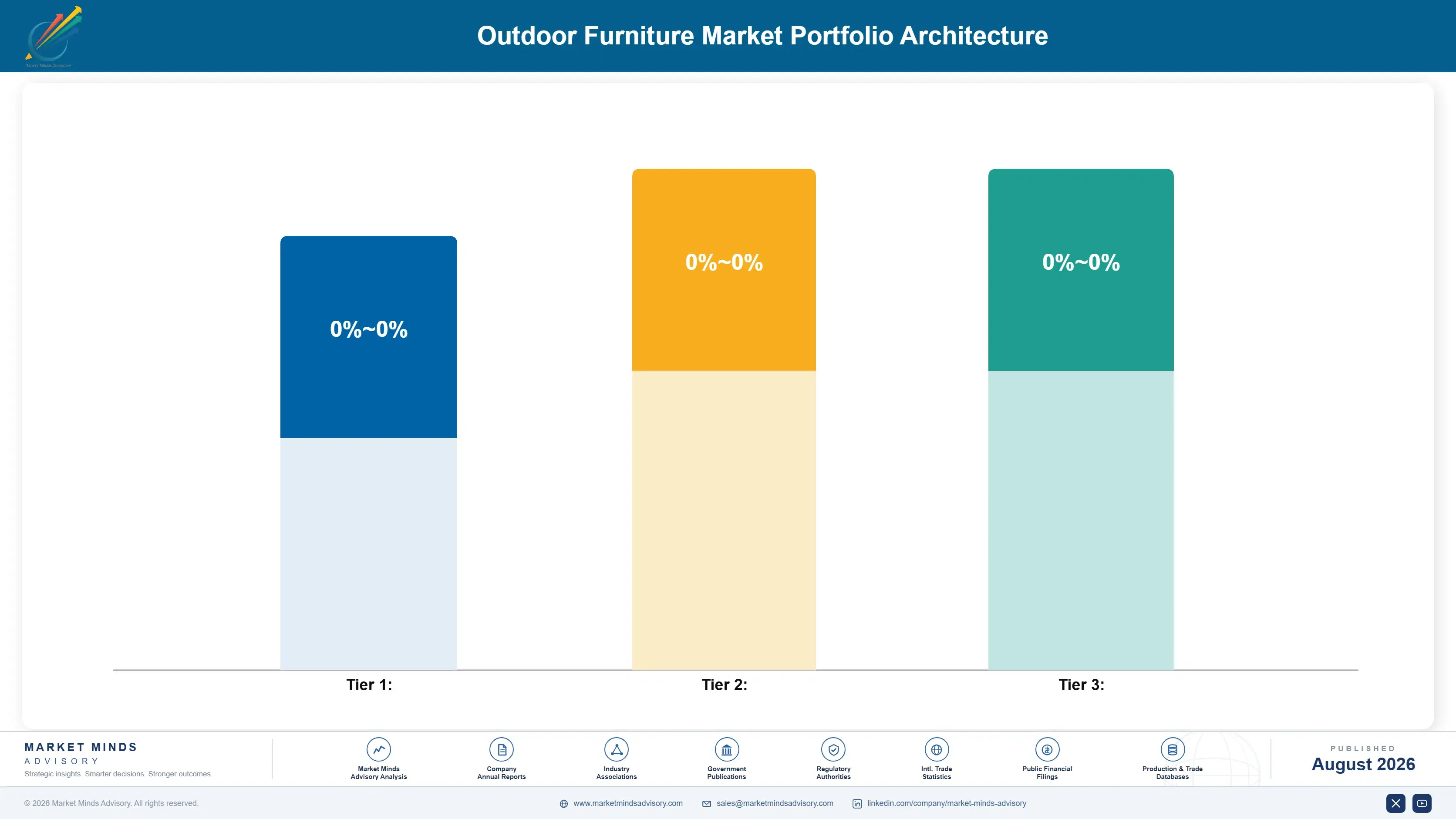
The outdoor furniture portfolio splits across three tiers with meaningfully different margin economics. Volume and commodity-adjacent products such as basic plastic and resin sets carry the thinnest margins given intense mass-retail price competition. Premium and certified design lines command substantially richer margins, reflecting genuine materials-engineering and modular investment that basic products cannot replicate. Manufacturers increasingly align research budgets to these tier boundaries.
The volume versus premium tension defines much of current strategic decision-making. Manufacturers pursuing pure volume scale increasingly struggle to defend pricing against private-label mass retail alternatives, while premium modular specialists capture disproportionate profit pools despite lower unit volume. High-value profit concentration sits overwhelmingly in modular and sectional categories, where design flexibility and durability credibility justify substantially higher price points. This concentration is becoming more pronounced as retailers dedicate additional shelf space to premium listings.

Sustainability and regulatory-driven next-generation categories remain smaller today but are expanding quickly as material sourcing and safety standards tighten globally. Manufacturers investing early in this tier are positioning for disproportionate share of tomorrow's premium profit pools, even though current volume remains modest relative to established volume and premium tiers combined. Early movers here are securing preferred retailer partnerships ahead of broader adoption.

Basic plastic and resin seating sold through mass retail and home-improvement chains at intense price competition. Manufacturers here compete primarily on distribution reach and manufacturing scale. Retailers increasingly favor scaled manufacturers during annual sourcing negotiations.
Gross Margin

Design-forward modular and sectional furniture sold through direct-to-consumer and specialty retail channels. Manufacturers here compete primarily on design depth and durability credibility. Retailers increasingly favor these manufacturers during annual premium category reviews.
Gross Margin

Emerging recycled-material and next-generation weather-resistant technology products still scaling production volume. Manufacturers here compete primarily on certification breadth and material innovation. Retailers increasingly favor these manufacturers during emerging category planning cycles.
Gross Margin
outdoor-furniture-market-portfolio-architecture-1788168963182

High-value Sub-segments and Strategic Watch-out

Modular and Smart-Integrated Outdoor Furniture

High-value, high-growth segment where reconfigurability credibility justifies substantially richer margins than basic fixed-configuration alternatives currently command. Retailers increasingly prioritize these listings during annual assortment planning, and manufacturers positioning early are building durable advantage. Growth here continues steadily. Manufacturers positioning early are building durable advantage. Truly.

Outdoor Sofas and Sectionals

High-value, moderate-growth segment where weather-resistant fabric and structural durability support meaningfully premium pricing relative to basic individual-seat alternatives. Retailers increasingly prioritize these listings during annual category reviews, rewarding manufacturers with proven durability credentials. Growth here continues steadily too. Manufacturers positioning early are building durable advantage too.

Outdoor Seating and Lounge Furniture

Volume core segment providing steady revenue base despite thinner margins, given entrenched mass retail distribution relationships and consistent replacement purchase behavior across households. This positioning increasingly shapes long-term category leadership as retailers favor proven suppliers. Growth here continues steadily overall. This positioning shapes leadership overall.

Weather-Resistant Storage and Cabinetry

Strategic watch-out segment facing tightening material-safety scrutiny over weatherproofing claims, creating meaningful compliance risk for manufacturers lacking rigorous durability substantiation practices. This dynamic increasingly shapes long-term category leadership. Growth here continues steadily overall too. This dynamic shapes leadership overall further. Regulators increasingly formalize new requirements.

Category Adoption And Buyer Evolution

Outdoor furniture increasingly resembles an annuity business rather than a one-time purchase category, since modular and sectional lines generate repeat revenue through accessory sales, replacement cushions, and multi-piece purchases that basic single-purchase sets never provided. Brands that build recurring relationships early capture disproportionate lifetime customer value relative to competitors selling only single transactions. This dynamic increasingly shapes how brands prioritize product roadmap investment. Manufacturers increasingly prioritize this recurring model.
Adoption stickiness varies meaningfully by end-use vertical. Premium modular buyers show strong repeat purchase behavior once brand trust is established, while sectional subscribers demonstrate even deeper retention given the multi-season usage cycles required for meaningful durability confidence. Basic seating buyers remain comparatively price-sensitive and brand-switching, showing far less loyalty depth than premium modular or sectional-based customers across most demographic segments tracked.

Buyer profiles are shifting generationally too. Younger homeowners increasingly research and purchase directly through social media and direct-to-consumer channels rather than home-improvement store counters, reshaping which brands win first-purchase moments. Older buyer cohorts still favor established home-improvement relationships, creating a genuine generational split that manufacturers must address through parallel distribution strategies rather than a single unified channel approach entirely.
outdoor-furniture-market-end-use-penetration-index-1788168963674

Where Outdoor Furniture Value Concentrates

These are among the four positions where our research anticipates prominent divergence between winners and laggards over the coming forecast period. Each is grounded in the demand model, the regulatory perimeter, and the announced capacity pipeline.
01 / DESIGN INVESTMENT PRIORITY

Modular reconfigurability now determines category leadership

Brands that invested early in modular design capability are capturing disproportionate share of new category revenue growth. This advantage compounds as retailers increasingly specify reconfigurability credentials as a standard listing requirement rather than an optional differentiator across most categories. Manufacturers without comparable design capability risk permanent share loss to better-positioned specialist competitors already building dedicated design teams and expanding materials infrastructure, and closing this gap now costs meaningfully less than rebuilding lost retail trust and shelf placement once a rival has secured the listing.
02 / DURABILITY POSITIONING STRATEGY

Weather-durability claims win retail shelf space

Manufacturers that demonstrate proven weather durability are winning disproportionate retail listing renewals over basic-only legacy competitors. This shift reflects genuine consumer demand for durability precision rather than a temporary marketing trend across the category. Brands lacking demonstrated durability credibility face mounting pressure from better-instrumented specialist rivals across nearly every major retail negotiation and category review cycle, and this gap widens further as retailers formalize durability benchmarks into standard listing criteria and vendor scorecards used across nearly every account review each cycle.
03 / SUPPLY CHAIN RESILIENCE

Long-term supplier contracts separate margin winners

Manufacturers with locked-in aluminum and synthetic-wicker supply agreements maintain meaningfully more predictable production costs than spot-market-dependent competitors. This advantage becomes more pronounced during periods of raw material volatility, when unprotected manufacturers must absorb cost spikes directly. Companies without comparable supplier relationships face meaningful margin disadvantage relative to better-positioned peers holding locked-in pricing across multiple input categories, and this gap tends to widen further whenever raw material markets experience another period of pronounced volatility, supply disruption, or an unexpected regional smelting shortfall.
04 / REGIONAL DISTRIBUTION STRATEGY

India and Southeast Asia anchor next growth wave

Manufacturers building dedicated distribution capability across India and Southeast Asia are positioning for disproportionate future revenue capture as urban balcony culture accelerates regionally. This dynamic rewards early market entrants willing to invest ahead of proven demand across new markets. Companies delaying regional investment risk ceding this expanding opportunity to more aggressive competitors already building local retail relationships and dedicated regional marketing programmes, and catching up later typically costs substantially more than establishing early distribution partnerships and local brand credibility now.

Engagement Snapshot From the Field

A live engagement with an industry participant carrying material or product regulatory and market exposure ahead of a defining policy shift, showing how our research translates into a defensible multi-year portfolio strategy.
MARKET MINDS ADVISORY · CLIENT ENGAGEMENT SUMMARY
Outdoor Furniture Producer Strategic Portfolio Review and Transition Roadmap 2026·Investment Scenario on Outdoor Furniture Exposure Evaluation 2025-26
CLIENT PROFILE
A multinational home furnishing manufacturer with an established presence across basic fixed-configuration outdoor seating sought to expand into modular and smart-integrated furniture. The client's leadership team recognized growing competitive pressure from specialist direct-to-consumer brands capturing disproportionate share of premium category growth. The engagement was commissioned to inform a multi-year product portfolio investment decision. Leadership sought clarity.
STRATEGIC CHALLENGE
The client's existing product development processes were optimized for basic fixed-configuration manufacturing rather than premium materials engineering or modular design. Leadership needed a clear roadmap for building new capability without disrupting existing profitable product lines. Executive teams also weighed the risk of cannibalizing existing basic product revenue. Timing mattered greatly here.
MMA APPROACH
MMA conducted primary interviews with 47 industry experts alongside proprietary survey data covering purchase behavior across six countries. The engagement mapped competitive positioning across modular and sectional segments, identifying specific capability gaps and prioritizing investment sequencing based on projected category growth rates. Findings were validated against company disclosed financials where available.
KEY FINDINGS
  1. Premium modular buyers demonstrated meaningfully higher lifetime value than basic seating buyers, justifying dedicated design investment ahead of broader adoption (client-reported, unverified by MMA).
  2. Existing retail relationships provided a credible distribution advantage for premium product launches, reducing go-to-market timeline substantially for new premium listings (client-reported, unverified by MMA).
  3. Modular design capability gaps represented the largest competitive vulnerability relative to specialist rivals already established in the category overall (client-reported, unverified by MMA).
  4. Regional expansion into India offered disproportionate growth potential relative to further investment in mature Western markets over the next several years (client-reported, unverified by MMA).
CLIENT PROFILE
A multinational home furnishing manufacturer with an established presence across basic fixed-configuration outdoor seating sought to expand into modular and smart-integrated furniture. The client's leadership team recognized growing competitive pressure from specialist direct-to-consumer brands capturing disproportionate share of premium category growth. The engagement was commissioned to inform a multi-year product portfolio investment decision. Leadership sought clarity.
STRATEGIC CHALLENGE
The client's existing product development processes were optimized for basic fixed-configuration manufacturing rather than premium materials engineering or modular design. Leadership needed a clear roadmap for building new capability without disrupting existing profitable product lines. Executive teams also weighed the risk of cannibalizing existing basic product revenue. Timing mattered greatly here.
MMA APPROACH
MMA conducted primary interviews with 47 industry experts alongside proprietary survey data covering purchase behavior across six countries. The engagement mapped competitive positioning across modular and sectional segments, identifying specific capability gaps and prioritizing investment sequencing based on projected category growth rates. Findings were validated against company disclosed financials where available.
KEY FINDINGS
  1. Premium modular buyers demonstrated meaningfully higher lifetime value than basic seating buyers, justifying dedicated design investment ahead of broader adoption (client-reported, unverified by MMA).
  2. Existing retail relationships provided a credible distribution advantage for premium product launches, reducing go-to-market timeline substantially for new premium listings (client-reported, unverified by MMA).
  3. Modular design capability gaps represented the largest competitive vulnerability relative to specialist rivals already established in the category overall (client-reported, unverified by MMA).
  4. Regional expansion into India offered disproportionate growth potential relative to further investment in mature Western markets over the next several years (client-reported, unverified by MMA).
RECOMMENDED STRATEGY
Phase 1: Phase one prioritized weather-durability certification, including dedicated testing partnerships across two flagship product lines prior to launch. across two flagship product lines this year Phase 2: Phase two built premium modular design through a targeted acquisition of a smaller specialist materials engineering company to accelerate time to market. Phase 3: Phase three expanded regional distribution capability across India and Southeast Asia through dedicated local partnership agreements within eighteen months of launch.
OUTCOME
Within eighteen months, the client launched a premium modular line that captured meaningful category share and established a certification programme generating renewed retail confidence (client-reported, unverified by MMA). Regional expansion into India exceeded initial revenue projections. Leadership credited the phased sequencing approach for limiting disruption to existing revenue.

Frequently Asked Questions

Foundational context covering the market sizes, CAGR, scope, country, region and competition that inform every finding below. This section is provided to cover basics and most often pre-purchase conversations, answered from the MMA Primary Research Dataset.

What is the current size of the Outdoor Furniture Market?

The Outdoor Furniture Market reached an estimated 32.0 billion dollars in 2025. This figure reflects combined global revenue across seating, dining, sofas, and modular formats.

How large will the Outdoor Furniture Market be by 2036?

The market is projected to reach approximately 57.67 billion dollars by 2036. This represents nearly double the 2026 value across the full ten-year forecast period.

What is the CAGR for the Outdoor Furniture Market 2026 to 2036?

The market is expected to grow at a compound annual rate of 5.5 percent. Bull and bear scenarios range between 4.3 and 6.7 percent respectively.

Which segment is growing fastest?

Modular and smart-integrated outdoor furniture is growing fastest, at roughly 1.5 times the overall market pace. Reconfigurability credibility and small-space living trends together drive this expansion.

Who are the major companies in the Outdoor Furniture Market?

Brown Jordan, Tropitone Furniture, Polywood, Keter Group, and Lloyd Flanders lead the market. Together these five manufacturers hold a combined CR5 of roughly 26 percent today.

Which country is growing fastest?

India is growing fastest, at an estimated 8.0 percent annually. Rising urban balcony culture and rapidly expanding middle-class discretionary spending together drive this rapid pace.

Report Segmentation Architecture

The full report scope spans multiple orthogonal segmentation dimensions, with cross-tabulated demand data provided for each dimension pair. Coverage extends further to regional breakdowns, trend trajectories, and the competitive detail needed to support segment-level decision-making.

By Primary Market Dimension

  • Outdoor Seating and Lounge Furniture
  • Outdoor Dining Sets and Tables
  • Outdoor Sofas and Sectionals
  • Hammocks and Daybeds
  • Weather-Resistant Storage and Cabinetry
  • Modular and Smart-Integrated Outdoor Furniture

By End-Use Industry

  • Mass Retail and Home-Improvement Chains
  • Direct-To-Consumer Online
  • Specialty Outdoor-Living Retail
  • Hospitality and Commercial Contract Supply

By Commercial Dimension

  • Individual Consumer Purchase
  • Contract and Bulk Hospitality Purchase
  • Wholesale and Distributor Sales

By Region

  • North America
  • East Asia
  • Western Europe
  • South Asia and Pacific
  • Latin America
  • Middle East and Africa
  • Eastern Europe

Scope, Methodology, and Coverage

Every figure in this report is reproducible from documented input assumptions. The scope below maps the historical period, the forecast horizon, the segmentation dimensions, and the countries covered, alongside the underlying primary and qualitative methodology.
Historical Period
2020 to 2025
Forecast Period
2026 to 2036
Base Year
2025 (USD billions; MMA Primary Research Dataset, August 2026)
Market Definition
This report covers furniture and seating designed for outdoor and patio use, including dining sets, lounge seating, sofas, hammocks, and weather-resistant storage. It excludes indoor furniture adapted for occasional outdoor use and permanent built-in structures such as pergolas or decking.
Quantitative Units
USD billions, 2025 base year
Segmentation Dimensions
Product and format type, end-use industry, commercial channel, region
Regions Covered
North America, East Asia, Western Europe, South Asia and Pacific, Latin America, Middle East and Africa, Eastern Europe
Countries Covered
United States, Canada, Germany, United Kingdom, France, China, Japan, South Korea, India, Australia, Brazil, Mexico
Key Companies Profiled
Brown Jordan, Tropitone Furniture, Polywood, Keter Group, Lloyd Flanders
Quantitative Methodology
Primary survey, n=3,800 respondents, Q4 2025, six countries; demand-side model with trade association cross-validation
Qualitative Methodology
47 expert interviews, Q4 2025; applied to validate demand model assumptions, identify emerging dynamics, and assess competitive positioning
Report Format
PDF and XLSX data workbook (Word format preview document)
Publisher
Market Minds Advisory
Report Code
MMA-2026-CON-103
Published
August 2026
Contact
sales@marketmindsadvisory.com | www.marketmindsadvisory.com

Purchase the full Outdoor Furniture Market Report (2026 to 2036).

The full report expands on every dimension summarized here, including complete segmentation breakdowns, all seven regional profiles, and extended competitive intelligence covering all twenty profiled manufacturers. It includes detailed input cost modeling and portfolio tier economics not covered in this summary. Clients also receive proprietary survey data from 3,800 respondents across six countries alongside 47 expert interviews conducted in Q4 2025. A dedicated analyst briefing session is included with every purchase, and clients gain access to editable data tables for internal modeling and forecasting work.
Complete seven-region data tables covering every profiled market
Full twenty-company competitive profiles with detailed strategic assessments
Editable segmentation and forecast models for internal team use
Dedicated analyst briefing session with a named practice lead
Primary survey microdata access for advanced internal analysis
Quarterly market update subscription with quarterly data refreshes

Built For The People Who Decide

From boardroom strategy to bench-side execution, this report is read cover-to-cover by leaders shaping the next decade of their industry, turning demand scenarios, market dynamics and valuation benchmarks into decisions.
CXOs/ Presidents/ VPs/ Managers
M&A and Corporate Development
Strategy Teams and R&D Heads
Procurement and Product Directors
Regulatory and Compliance Leaders
Investor Relations and Equity Analysts