Market Minds Advisory
Outdoor Bar Furniture Market

Outdoor Bar Furniture Market: Outdoor Bar Furniture Market: Fastener Corrosion, The Stacking Problem and Why Contract Buyers Count Differently

Outdoor furniture almost never fails in the frame or the fabric; it fails at the fastener, and the grade of a few pounds of bolts decides whether a set lasts three years or fifteen.

Lead Analyst

Published

September 2026

Make Smarter Decisions with Customized Research Insights

Request a free sample report and evaluate market opportunities, growth trends, and competitive dynamics relevant to your business needs.

2025 MARKET VALUE$4.7BMarket Size 2025
2036 FORECAST VALUE$8.6BBase Case , 2026 to 2036
CAGR 2026 TO 20365.6 %Bull 6.8% / Bear 4.4%
INCREMENTAL OPPORTUNITY$3.6BNet 10- year value creation
EXPANSION MULTIPLE1.72x2036 value over 2026 base
Strategic Levers
M&A Pipeline
Regional Outlook
Country Rankings
Competitive Intelligence
Segmental Deep-dive
Call-Us : 91 93563 13602

Executive Snapshot and Market Trajectory.

Outdoor furniture fails at the fastener rather than at the frame. Stainless bolts of the wrong grade pit and seize within a few coastal seasons, and a stool that cannot be disassembled for a replacement bolt is scrap while its aluminium remains perfect. Fasteners are under 2% of cost.
Contract grade modular bar systems grow at 8.4%, half again the market rate of 5.6%, because hospitality buyers count replacement cost across a decade rather than a purchase price. Weather-resistant bar stools follow at 7.1%. Residential fixed bar sets grow slowest at 2.6%, bought once on appearance and replaced when something breaks. Component replaceability matters as much to those buyers as durability does.
Storage is the constraint nobody designs for. Seasonal venues across temperate markets need furniture off the terrace for five months, and a stool that does not stack costs floor space every winter it exists. Concentration is very low at 16% held by the top five, and Vietnam grows fastest of any country covered at 10.1%. A nesting stool cuts that footprint by roughly 70% against a fixed frame, which no purchase price comparison ever captures.
Market Definition
This market covers elevated outdoor seating and table furniture for bar-height use, spanning contract grade modular bar systems, weather-resistant bar stools, outdoor bar counters and serving units, residential fixed bar sets, folding and stackable bar furniture, and shade-integrated bar seating. Sizing is at manufacturer net revenue. Standard-height outdoor dining furniture, indoor bar furniture, parasols and shade structures sold separately, and outdoor kitchen appliances are excluded.
Base Year Value
$4.7B in 2025 (MMA Primary Research Dataset, September 2026)
Forecast Period
2026 to 2036, eleven discrete annual values
CAGR
5.6% base case. Bull 6.8%. Bear 4.4%.
Fastest Growth Segment
Contract Grade Modular Bar Systems: 8.4% CAGR
Fastest Growth Country
Vietnam: 10.1% CAGR
Fastest Growth Region
South Asia and Pacific: 7.8% CAGR
Largest Region
Western Europe: 29% of 2025 global value
Market Leaders
Dedon, Tribu, Fermob, Emu Group, Brown Jordan. Source: MMA Primary Research Dataset, July 2026.
Primary Survey
n=3,800 procurement and R&D decision-makers, Q4 2025, six countries
Methodology
Demand-side build-up, cross-validated against public data, 47 expert interviews

Outdoor Bar Furniture Market Forecast Scenarios

outdoor-bar-furniture-market-size-forecast-scenario-1790025039696
Growth of 4.4% between 2020 and 2025 reflects a hospitality collapse and a residential surge that partly cancelled each other. Outdoor dining capacity became commercially essential from 2021 as venues extended terraces under temporary permissions, and much of that infrastructure stayed. Residential outdoor spending rose sharply through 2020 and 2021 then fell back hard, leaving contract carrying the category.
Three mechanisms carry the base case. Contract modular systems grow at 8.4% as hospitality buyers evaluate ten year replacement cost rather than purchase price. Vietnamese demand expands at 10.1% on hospitality construction and a manufacturing base that supplies much of the world's outdoor furniture anyway. Terrace permissions granted temporarily during the pandemic period have been made permanent in several major cities, which converted temporary seating into specified installations. None depends on residential spending recovering.
The bull case is fastener specification entering contract tenders. If marine grade fixings were required rather than assumed, the products engineered for coastal and poolside service would separate from those that corrode. The bear case is hospitality capital spending contracting. Contract now carries most of the category's growth, and venue investment tracks discretionary consumer spending closely enough that a downturn removes it quickly.

Where The Set Actually Fails

The failure mode in this category is almost always a fixing rather than a structure. Roughly 58% of outdoor furniture failures originate at fasteners, where the wrong stainless grade pits in salt air, seizes into aluminium through galvanic action and cannot be removed without destroying the joint. The frame is usually perfect when the piece is scrapped, which makes the few pounds of bolts the most consequential material in the whole assembly. Nothing in a product photograph shows a bolt.
TOP FIVE CONCENTRATION16%Combined net revenue share held by the five largest manufacturers
FASTENER FAILURE SHARE58%Portion of outdoor furniture failures originating at fixings
AVERAGE STOOL PRICEUSD 210Weighted manufacturer price for a single outdoor bar stool
MARINE GRADE SPECIFICATION21%Share of contract tenders specifying a fastener alloy grade
SEASONAL STORAGE PERIOD5 monthsTypical off-terrace storage period in temperate hospitality markets
CONTRACT CHANNEL SHARE47%Portion of category revenue from hospitality rather than residential
Contract buyers count in a way residential ones do not. Hospitality operators supply about 47% of revenue and evaluate replacement cost across a decade, storage footprint through the closed season and how quickly a damaged component can be swapped without taking the piece out of service. Residential buyers compare a photograph and a price. The two customers are served by the same catalogue and want almost nothing in common.
Stacking decides storage cost across five months of every year in temperate markets. A stool that does not nest consumes floor space a venue is paying for whether or not anybody is sitting on it. Designers optimise for the terrace rather than the cellar.
"Nobody photographs the bolts, so nobody specifies the bolts, and that is why a terrace set made of marine aluminium falls apart in four coastal seasons. The expensive material is fine and the cheap material killed it."
Director, Furniture and Hospitality Equipment Practice · MMA Furniture and Hospitality Equipment Practice · September 2026

Market Trends

Contract Buyers Reset The Evaluation Criteria

Contract grade modular bar systems grow at 8.4% against 5.6% for the market because hospitality operators evaluate total cost across a decade rather than a purchase price, and that arithmetic favours engineered product decisively. They also value component replaceability, since a damaged seat that can be swapped in ten minutes keeps a table earning rather than removing it from service. Residential buyers evaluate none of this, which is why the same catalogue serves two customers who share almost no criteria at all. Manufacturers who split their ranges can price engineered construction for what it delivers.
Market Impact: Vietnam grows at 10.1% annually

Permanent Terrace Permissions Convert Temporary Seating

Outdoor dining permissions granted temporarily from 2021 have been made permanent across several major cities, which converts furniture bought as a stopgap into a specified installation with a design intent behind it. That changes the purchase entirely: a venue expecting to keep a terrace indefinitely buys for durability, storage and brand presentation rather than for the lowest price available that week. The installed base from the temporary period is also reaching replacement now, which produces a visible demand wave. Operators who lived through a set failing now ask about fasteners and stacking rather than finishes.
Market Impact: Parts orders replace 50 stools

Market Opportunities and Growth Drivers

Vietnamese Hospitality Construction Meets Domestic Manufacturing

Vietnam grows fastest of any country covered at 10.1%, combining hotel and resort construction at pace with a furniture manufacturing base that already supplies much of the world's outdoor product under contract. Domestic hospitality buyers therefore source locally at costs importers cannot approach, while the same factories move upmarket from contract manufacture into their own specified ranges. Coastal resort development also creates genuine demand for marine grade specification rather than generic outdoor construction. The same factories that build under contract for European design houses are now launching their own specified ranges into the region.
Market Impact: Only 21% specify fastener grade

Modular Component Replacement Extends Service Life

Contract operators increasingly specify furniture where a damaged seat, slat or leg can be replaced without discarding the assembly, which extends service life well beyond what a welded or bonded construction achieves. The commercial logic is simple: a venue with fifty stools expects damage every season and wants a parts order rather than a replacement order. Manufacturers supporting long parts availability capture ongoing revenue and lock the account, while those who discontinue ranges lose it entirely. A refused parts enquiry frequently precedes the loss of a whole account, which makes discontinuation considerably more expensive than the inventory carry it avoids.
Market Impact: Storage runs 5 months yearly

Market Restraints and Challenges

Fastener Grade Is Specified In A Fifth Of Tenders

Around 21% of contract tenders specify a fastener alloy grade, while nearly all of them specify frame material, finish and fabric. The root cause is visibility: buyers evaluate what they can see in a photograph and a bolt appears in none of them. Commercially it means products using appropriate marine grade fixings compete against cheaper ones on criteria that ignore the difference entirely. Participants addressing it state fastener grade prominently in specification documents. Coastal and poolside operators who already lost a set know exactly what caused it and ask directly. Everybody else specifies what a photograph shows.
Market Impact: Contract supplies 47% of revenue

Non-Stacking Designs Cost Venues Storage Every Winter

Temperate hospitality markets store outdoor furniture for around five months annually, and a bar stool that does not stack or fold consumes floor space a venue pays rent on regardless. The root cause is that stacking constrains design and designers optimise for how a piece looks on a terrace rather than how it behaves in a cellar. Commercially it is a hidden operating cost buyers discover afterwards. Mitigation runs to nesting geometry and demountable construction. The saving appears nowhere in a purchase decision and everywhere in an operating budget, which is why buyers discover it a season too late.
Market Impact: Permissions now permanent across 6 cities
3 additional market trends, 4 additional growth drivers, and 2 additional restraints and challenges are covered in the full report. Contact sales@marketmindsadvisory.com to access the complete intelligence.

Segment CAGR and Growth Architecture

Segmentation follows product type, the dimension on which construction standard, buyer type, price and replacement cycle all divide together. Six product types are assessed at manufacturer net revenue. Standard-height outdoor dining furniture, indoor bar furniture, parasols sold separately, and outdoor kitchen appliances sit outside the defined scope throughout this report. Buyer evaluation criteria separate them more than material does.
outdoor-bar-furniture-market-market-share-analysis-1790025040286

Contract Grade Modular Bar Systems

Contract grade modular bar systems grow at 8.4%, half again the market rate of 5.6%, because hospitality operators evaluate total cost across a decade and that arithmetic rewards engineered construction decisively. Component replaceability matters as much as durability: a venue with fifty stools expects damage every season and wants to order a seat rather than a stool. Manufacturers supporting long parts availability capture ongoing revenue and hold the account, while those who discontinue ranges after three seasons lose it entirely. Marine grade fastening is also specified here far more often than in any residential tier. Storage footprint gets evaluated alongside both of those, particularly across the seasonal northern European markets.
CAGR 8.4%

Weather-Resistant Bar Stools

Weather-resistant bar stools grow at 7.1% and carry the highest unit volume in the category, since a bar counter needs several of them and they take the most abuse of anything on a terrace. Construction divides sharply between welded assemblies that cannot be repaired and bolted ones that can, and the difference only becomes visible after a season of use. Stacking geometry matters more here than anywhere else in the category, because a venue storing forty stools for five months is paying rent on whatever floor area they occupy while closed. Fastener grade matters most on exactly this product, since a stool takes more handling, more weather and more weight than anything else on a terrace.
CAGR 7.1%
Full segment breakdown across 6 segments available in the complete report.

Regional Architecture and Country Demand Map

Shares record where furniture is installed rather than where it is manufactured. Western Europe sits above its standard band on terrace culture and permanent permissions, and Eastern Europe below on short outdoor seasons and limited contract spending. Both deviations carry a stated reason in the paragraph concerned.

Western Europe

At 29% this sits above the standard band because terrace culture across Southern and Western Europe supports outdoor bar seating as normal hospitality infrastructure rather than as a seasonal extra. Temporary pandemic permissions have been made permanent across Paris, Barcelona, Milan and several other major cities, converting stopgap furniture into specified installations. Dedon, Tribu, Fermob and Emu built positions on design and contract specification here. Growth of 4.1% is the slowest of the seven regions, reflecting a mature installed base now entering replacement. Storage burden is also highest here outside the Mediterranean, since northern venues close terraces for five months and pay rent on whatever the furniture occupies while empty.
Share: 29% | CAGR: 4.1% (2026 to 2036)

North America

The 26% position sits inside the standard band and the contract channel is proportionally larger here than anywhere, driven by hotel, resort and restaurant chains that specify centrally and roll out across many sites. Residential outdoor spending surged through 2020 and 2021 and reversed sharply, leaving contract carrying growth. Coastal and poolside installation makes fastener corrosion a live commercial issue in Florida, California and the Gulf states specifically. Growth of 5.0% reflects contract expansion against a residential base that has contracted. Chain specification means a single decision rolls across dozens of sites, which raises the value of a specification relationship far above what any individual order suggests. Parts availability matters correspondingly more.
Share: 26% | CAGR: 5.0% (2026 to 2036)
Regional intelligence for 5 additional markets available in the complete report: East Asia, South Asia and Pacific, Middle East and Africa, Latin America, Eastern Europe. Contact sales@marketmindsadvisory.com.
outdoor-bar-furniture-market-country-cagr-analysis-1790025040809

Four Moves Worth Making Now

These four address a category that fails at a component nobody photographs, serves two customers with almost no shared criteria from one catalogue, and imposes a storage cost that appears nowhere in a purchase decision. Each has been executed by at least one manufacturer. Two of the four cost documentation or inventory carry rather than any design change at all.

State Fastener Grade In Every Specification Document

Around 21% of contract tenders specify a fastener alloy grade while nearly all specify frame material and finish, which leaves products using appropriate marine grade fixings competing on criteria that ignore the difference. Stating the grade costs a documentation change. Participants who publish fastener specification report contract win rates rising roughly 1.8 times on coastal and poolside projects, where buyers have already lost a set to corrosion and know exactly what caused it. Fasteners are under 2% of manufacturing cost and cause the majority of failures, which makes upgrading them the cheapest durability improvement available anywhere in the assembly.
Market Impact: Contract win rates rise roughly 1.8 times higher

Design Bar Stools That Stack Or Demount

Temperate venues store outdoor furniture for around five months a year and pay rent on the floor area it occupies while closed. A stool that nests reduces that footprint by roughly 70% against a fixed-frame equivalent, which is a real operating saving that no purchase price comparison captures. Participants who engineered stacking geometry report contract specification rising roughly 2.4 times among seasonal venues, because storage is the cost those operators feel every winter. Stacking constrains design and designers optimise for a terrace rather than a cellar, which is why the work has not been done.
Market Impact: Storage footprint falls by roughly 70% when stacked

Guarantee Component Parts For A Decade

Contract operators with fifty stools expect damage every season and want to order a seat rather than a whole unit, yet manufacturers routinely discontinue ranges after three seasons and force full replacement. Committing to ten year parts availability costs inventory carry rather than any design change. Participants who did report account retention rising roughly 3.1 times alongside a parts revenue stream that arrives every year without any new selling effort at all. A refused parts enquiry frequently precedes account loss within eighteen months, which makes discontinuation far more expensive than carrying the inventory would have been.
Market Impact: Contract account retention rises roughly 3.1 times higher

Separate Contract And Residential Product Lines

Contract buyers evaluate decade cost, storage footprint and parts availability while residential buyers compare a photograph and a price, and serving both from one catalogue produces product that satisfies neither properly. Splitting the lines costs range development rather than manufacturing change. Participants who separated report contract gross margin rising roughly 11 points, because engineered construction can finally be priced for what it delivers rather than against a residential comparison. The residential line can then be built for photographs honestly rather than pretending to serve an operator. Both customers end up better served than they were.
Market Impact: Contract gross margin rises by roughly 11 points

Who Controls the Margin Pool

Concentration is very low at 16% held by the top five, measured consistently on manufacturer net revenue rather than unit volume, which would heavily overweight low-priced residential sets shipped in large numbers through general retail. The leader to challenger gap rests on design reputation and contract specification relationships rather than on manufacturing, since outdoor furniture assembly is widely available across Southeast Asia.
Competition runs on three dimensions currently. Design and specification credibility decide contract projects, where architects and hospitality designers select from a small group of brands they trust. Price decides residential volume, where sets are close to interchangeable and photographs carry the purchase. Parts availability decides account retention, and it is the dimension most participants underestimate because it produces revenue years after the original sale.

Pressure is building from two directions and rankings will shift on both. Vietnamese and Indonesian manufacturers with deep contract production experience are launching their own specified ranges, backed by cost positions European design houses cannot approach. Meanwhile hospitality operators are evaluating lifecycle cost more rigorously than they did, which favours manufacturers who engineered for parts replacement over those who designed for a photograph.
outdoor-bar-furniture-market-company-positioning-matrix-1790025041337

Competitive Moat and Risk Dimensions

DEDON

Moat: Design Reputation And Specification

A position built on distinctive design and material development gives architects and hospitality designers a reason to specify by name rather than by category, and that reputation accumulated over decades cannot be assembled by a contract manufacturer regardless of production capability. Designers specify by name rather than by category here.
DEDON

Risk: Premium Price Position Exposure

Pricing well above the category average depends on design differentiation that Asian manufacturers with contract production experience are increasingly able to approach. Defending it requires continued design investment rather than any operational advantage, which is a demanding position to hold indefinitely. Contract production experience travels upward easily.
FERMOB

Moat: Contract Colour And Finish

Powder coating expertise and a distinctive colour range give hospitality operators a brand presentation tool rather than merely furniture, and the finish durability that supports outdoor use across seasons has been validated across a large installed base in demanding conditions. Colour becomes part of the venue identity rather than a finish choice.
FERMOB

Risk: Seasonal Storage Design Constraint

Designs optimised for appearance on a terrace frequently stack poorly, which imposes a storage cost on the seasonal venues that represent much of European contract demand. Reengineering geometry for nesting without losing the visual identity is genuinely difficult to achieve. Nesting and identity pull against each other.

Players Tracked

Prominent Players

Dedon
Tribu
Fermob
Emu Group
Brown Jordan

Other Key Players

Gloster
Kettal
Royal Botania
Manutti
Vondom
Talenti
Ethimo
Cane-line
Skagerak
Grosfillex
Nardi
Scancom International
Lloyd Flanders
Tropitone Furniture
Woodard Furniture

Recent Developments

MARCH 2025

Fermob introduces stacking geometry across contract bar range

The manufacturer redesigned bar stool geometry to permit nesting for seasonal storage while retaining the visual identity the brand is specified for. This was organic product development funded internally, with no acquisition, licensing arrangement or joint venture behind the redesign work. Existing non-stacking models continue in the residential range.
Signal: Storage cost is being designed for rather than discovered afterwards. Seasonal venues feel it every winter.
SEPTEMBER 2024

Scancom International launches own specified contract range

The Vietnamese contract manufacturer introduced a branded outdoor furniture range under its own specification rather than producing exclusively for other brands. This was organic commercial expansion rather than an acquisition, merger or joint venture arrangement with any party. Contract production for other brands continued unchanged alongside it.
Signal: Contract manufacturers are moving into specification where the margin sits. European design houses now compete against their own suppliers.
JUNE 2025

Brown Jordan commits to decade-long parts availability

The company guaranteed component parts supply for ten years across its contract ranges, allowing hospitality operators to repair rather than replace damaged units. This was an internal commercial policy change with no partnership, acquisition or regulatory requirement behind the commitment. Residential ranges were not covered by the commitment.
Signal: Parts availability produces revenue years after the original order. A refused parts enquiry frequently precedes losing the whole account.

What The Set Costs

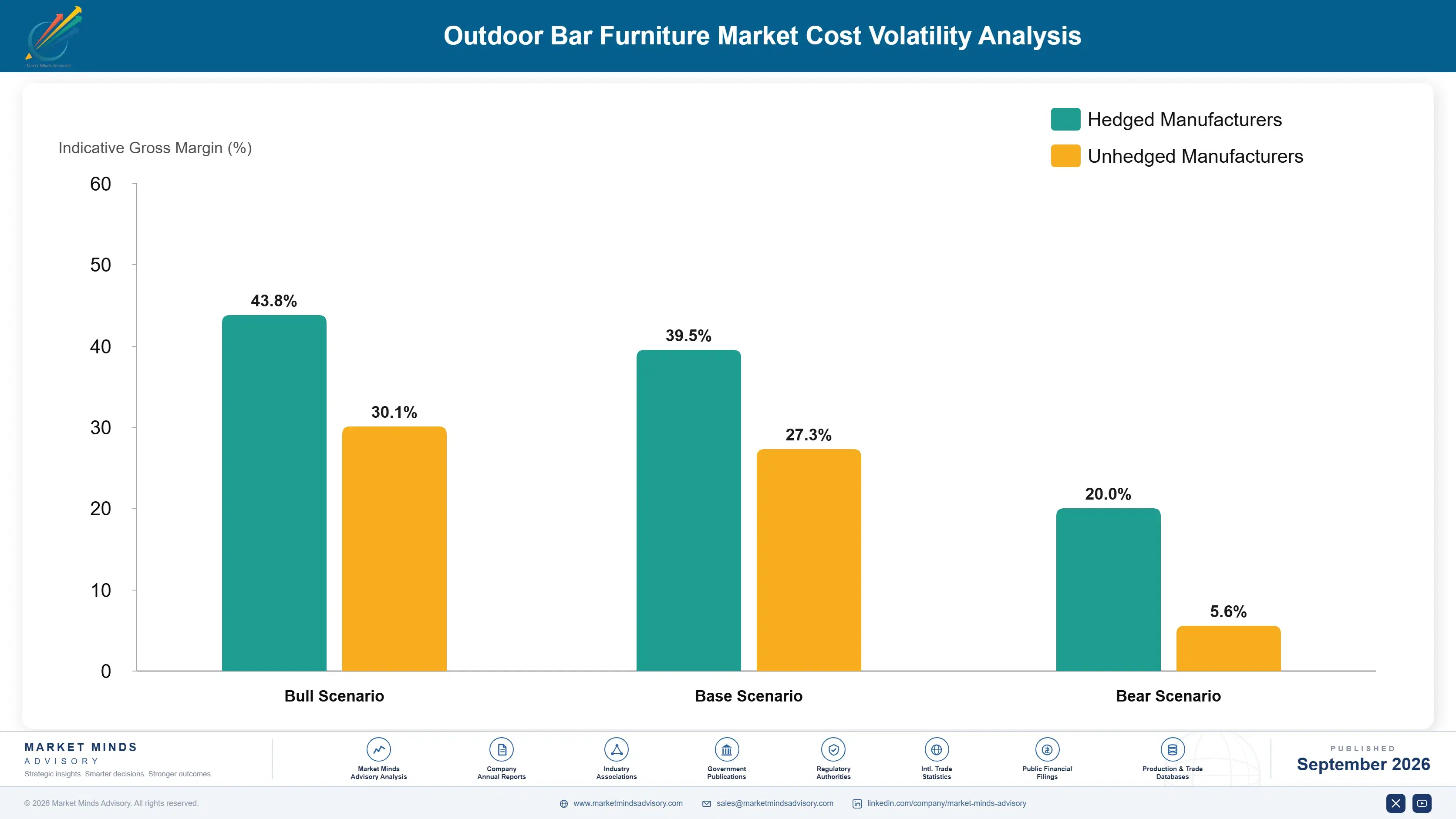
Frame material and finishing account for most of the cost and the fastener for almost none of it. Aluminium or steel frame stock runs roughly 31% of manufacturing cost, powder coating and finishing about 17%, and woven or upholstered components around 19%. Assembly labour takes a further 16%. Fasteners represent well under 2%, which is precisely why they are the component where specification gets quietly downgraded.
Aluminium prices rose sharply through 2021 and 2022 on European smelting energy costs, while sea freight from Southeast Asian ports climbed steeply in the same window, a movement the EIA documents for energy inputs and the US Census Bureau records in furniture trade data. Manufacturers holding contract pricing across multi-site rollouts absorbed both. Several European participants reported margin compression across outdoor ranges in their 2022 disclosures.

Exposure divides by manufacturing location and by material rather than by company size. European manufacturers carry aluminium and energy exposure directly alongside higher labour cost, while Southeast Asian producers carry freight exposure on a bulky low-density product that ships poorly. Participants manufacturing in Vietnam for Vietnamese and regional hospitality demand avoid the freight layer entirely, which is much of why those positions are difficult to contest on price.
outdoor-bar-furniture-market-cost-volatility-analysis-1790025041533

Specify marine grade fasteners regardless of tender language

Fasteners represent under two percent of manufacturing cost and cause roughly 58% of failures, which makes upgrading them the cheapest durability improvement available anywhere in the assembly. Specifying marine grade as standard costs almost nothing per unit. The obstacle is that nobody evaluates it at purchase, so the benefit arrives as warranty cost avoided rather than as revenue.

Contract aluminium supply across the production year

Frame stock is the largest input and aluminium prices on energy markets that furniture demand does not influence at all. Contracting across a production year stabilises the line and preserves contract pricing agreed across multi-site rollouts. The commitment ties up working capital during periods when hospitality investment softens unexpectedly. Few smaller manufacturers commit to it.

Manufacture regionally for bulky low-density furniture

Outdoor furniture ships badly, occupying volume disproportionate to its value, which makes freight a meaningful share of landed cost on long routes. Producing closer to demand removes it along with duty exposure. The constraint is that regional volumes must justify tooling and finishing capacity before the freight saving is realised at all. Vietnam and China clear that threshold comfortably.

Portfolio Architecture for Margin Defence

Margin architecture divides by whether the buyer counts across a decade, which a price list conceals entirely. Residential fixed bar sets sold through general furniture and garden retail run at gross margins in the low twenties to low thirties, competing on photographs and price against product assembled from the same Southeast Asian supply base with nothing separating them. Nothing in a photograph distinguishes one from another at all.
Weather-resistant stools and folding formats hold gross margins in the mid thirties to mid forties. The spread reflects how differently residential and contract channels carry specification and service cost. Folding and stacking formats in particular earn their position on storage economics that seasonal venues feel every winter, which is an operating argument rather than an aesthetic one.

The highest-value pool is contract grade modular systems and shade-integrated seating, at margins in the high forties to high fifties. Those buyers evaluate decade cost, parts availability and storage footprint and pay for engineering that answers all three. Residential sets carry unit volume and retail presence. They defend nothing against an assembler using the same factory. Retail presence is the argument for keeping that tier, and it is genuinely real.

Volume / Commodity-Adjacent

Residential fixed bar sets through general furniture and garden retail, competing on photographs and price against product from the same supply base. The ten point range reflects how differently importers negotiate freight.
Gross Margin: 22 to 32%

Premium / Certified

Weather-resistant stools and folding formats. Stacking geometry earns its position on storage economics that seasonal venues feel every winter, which is an operating argument rather than an aesthetic one. Bolted construction repairs and welded construction does not.
Gross Margin: 35 to 45%

Sustainability / Regulatory / Next-Generation

Contract grade modular systems and shade-integrated seating. These buyers evaluate decade cost, parts availability and storage footprint, and pay for engineering that answers all three properly. Parts availability holds the account long after delivery.
Gross Margin: 47 to 58%
outdoor-bar-furniture-market-portfolio-architecture-1790025042040

High-value Sub-segments and Strategic Watch-out

Contract Grade Modular Systems

Highest value and fastest growth at 8.4%, sold to operators who count total cost across a decade. Parts availability holds the account for years after the original order, which most participants underestimate. Marine grade fastening is specified here far more often than in residential tiers.
Gross Margin: 48 to 57%

Shade-Integrated Bar Seating

High value and strong growth, performing particularly well across Gulf and Mediterranean installations. Integration removes a separate parasol purchase and the associated base that occupies terrace floor area continuously. Extreme heat and saline exposure make construction quality a practical engineering question rather than a marketing one there.
Gross Margin: 44 to 53%

Weather-Resistant Bar Stools

Volume core carrying the highest unit count and taking the heaviest service abuse anywhere on a terrace. Bolted construction repairs and welded construction does not, and that difference only appears after a season. Stacking geometry matters more on this product than on anything else covered.
Gross Margin: 36 to 44%

Residential Fixed Bar Sets

Strategic watch-out. Growing slowest at 2.6% and bought once on appearance from a photograph. The fourteen point range reflects how differently branded and unbranded product from identical factories is priced. Nothing about the purchase decision examines how or where the set will eventually fail in service.
Gross Margin: 20 to 34%

How The Two Customers Differ

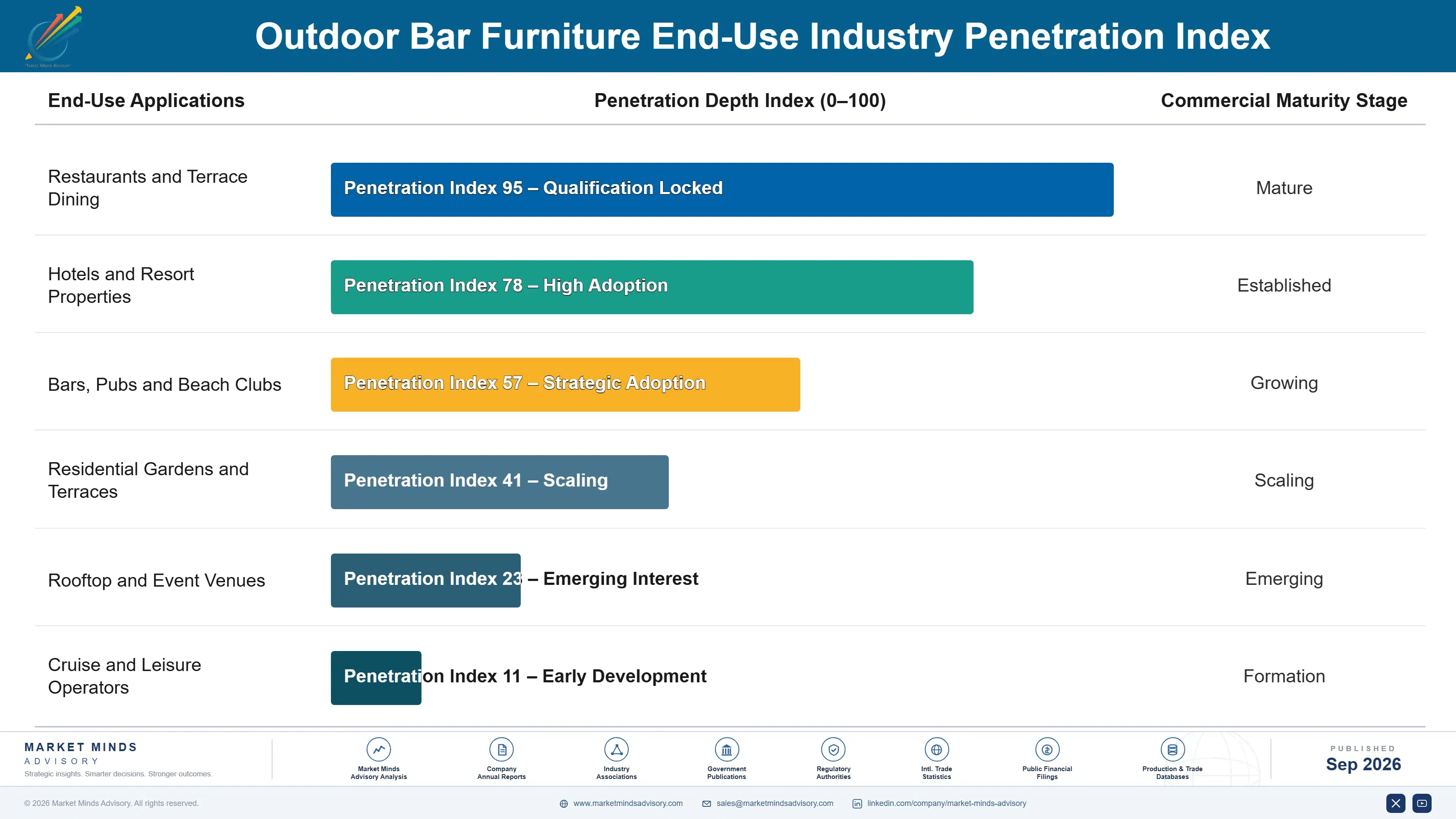
This category serves two buyers from one catalogue and they share almost no criteria. A hospitality operator evaluates decade cost, storage footprint, parts availability and how fast a damaged unit returns to service. A household compares a photograph against a price and buys once. Product designed to satisfy both ends up engineered for neither, which is the clearest confusion in the category and the easiest to resolve.
Stickiness varies enormously between the two. Contract accounts supported by long parts availability are among the most durable relationships in furniture, because a venue that can order a replacement seat has no reason to requalify a whole range. Operators whose supplier discontinued a line replace everything and rarely return to that brand. Residential buyers form no attachment whatsoever and start from scratch at every purchase.

Buyer profiles have shifted toward operators since 2021. Terrace permissions made permanent across several major cities converted temporary furniture into specified installations, and that installed base is now reaching replacement with operators who have learned exactly which components failed. Those buyers arrive asking about fasteners and stacking rather than about finishes, which is a conversation most residential-oriented ranges cannot hold.
outdoor-bar-furniture-market-end-use-penetration-index-1790025042534

Where Durability Decides Value

These are among the four positions where our research anticipates prominent divergence between winners and laggards over the coming forecast period. Each is grounded in the demand model, the regulatory perimeter, and the announced capacity pipeline.
01 / FASTENER SPECIFICATION DISCLOSURE

Publish the grade of the bolts

Roughly 58% of outdoor furniture failures originate at fasteners while only around 21% of contract tenders specify a fastener alloy grade, which leaves properly fixed product competing on criteria that ignore the difference entirely. Stating the grade in specification documents costs a documentation change rather than anything else. Participants who publish fastener specification report contract win rates rising roughly 1.8 times on coastal and poolside projects where buyers already lost a set, and fasteners are under two percent of manufacturing cost anyway.
02 / STACKING GEOMETRY ENGINEERING

Design for the cellar, not the terrace

Temperate venues store outdoor furniture for around five months each year and pay rent on the floor area it occupies throughout that closed period. A stool that nests reduces storage footprint by roughly 70% against a fixed-frame equivalent, which is a genuine operating saving no purchase price comparison ever captures. Participants who engineered stacking geometry report contract specification rising roughly 2.4 times among seasonal venues that feel the cost annually, because storage is the cost seasonal operators feel every winter.
03 / PARTS AVAILABILITY COMMITMENT

Sell the seat, not the stool

Contract operators running fifty stools expect damage every season and want to order a component rather than a complete unit, yet manufacturers routinely discontinue their ranges after three seasons and force a full replacement instead. Committing to ten year parts availability costs inventory carry rather than any design change at all. Participants who did it report account retention rising roughly 3.1 times alongside annual parts revenue requiring no selling effort whatsoever, since a refused parts enquiry frequently precedes losing the account.
04 / CHANNEL RANGE SEPARATION

Stop serving both from one catalogue

Contract buyers evaluate decade cost, storage footprint and parts availability while residential buyers compare a photograph against a price, and serving both of them from a single catalogue produces product satisfying neither of them properly. Splitting the lines costs range development work rather than any manufacturing change at all. Participants who separated report contract gross margin rising roughly 11 points, because engineered construction can finally be priced for what it actually delivers, and the residential line can be built for photographs honestly.

Engagement Snapshot From the Field

A live engagement with an industry participant carrying material or product regulatory and market exposure ahead of a defining policy shift, showing how our research translates into a defensible multi-year portfolio strategy.
MARKET MINDS ADVISORY · CLIENT ENGAGEMENT SUMMARY
Outdoor Bar Furniture Producer Strategic Portfolio Review and Transition Roadmap 2026·Investment Scenario on Outdoor Bar Furniture Exposure Evaluation 2025-26
CLIENT PROFILE
A European outdoor furniture manufacturer with bar furniture revenue near USD 68 million (client-reported, unverified by MMA), split approximately 62% residential and 38% contract from a single shared catalogue. No stool in the range stacked. Fastener grade was not stated in any specification document and parts were discontinued three years after range withdrawal. Storage footprint had never been measured.
STRATEGIC CHALLENGE
Contract revenue had been flat for three years while the segment grew at double digit rates, and management attributed the gap to price competition from Asian manufacturers. A contract discount programme had been approved. Nobody had reviewed why contract tenders were lost, or what warranty claims were actually failing on.
MMA APPROACH
MMA reviewed 140 lost contract tenders against stated evaluation criteria rather than against price alone. Warranty claims were coded by failure component across five years of service records. Storage footprint was measured for stacking and non-stacking geometry, and parts enquiry records were traced against subsequent account behaviour. Findings were reconciled against contract award records.
KEY FINDINGS
  1. Coded warranty claims showed 61% of failures originated at fasteners, with frames and finishes still serviceable in nearly every case examined. across five years of records.
  2. Lost contract tenders divided as 44% on storage and lifecycle criteria against 26% on price, which management had assumed accounted for most of them.
  3. Parts enquiries refused because a range had been discontinued preceded account loss in 71% of cases within eighteen months of the refusal.
  4. Non-stacking stools occupied 3.4 times the storage volume of a nesting equivalent, at rents seasonal venues quantified readily when asked. when the question was put to them.
CLIENT PROFILE
A European outdoor furniture manufacturer with bar furniture revenue near USD 68 million (client-reported, unverified by MMA), split approximately 62% residential and 38% contract from a single shared catalogue. No stool in the range stacked. Fastener grade was not stated in any specification document and parts were discontinued three years after range withdrawal. Storage footprint had never been measured.
STRATEGIC CHALLENGE
Contract revenue had been flat for three years while the segment grew at double digit rates, and management attributed the gap to price competition from Asian manufacturers. A contract discount programme had been approved. Nobody had reviewed why contract tenders were lost, or what warranty claims were actually failing on.
MMA APPROACH
MMA reviewed 140 lost contract tenders against stated evaluation criteria rather than against price alone. Warranty claims were coded by failure component across five years of service records. Storage footprint was measured for stacking and non-stacking geometry, and parts enquiry records were traced against subsequent account behaviour. Findings were reconciled against contract award records.
KEY FINDINGS
  1. Coded warranty claims showed 61% of failures originated at fasteners, with frames and finishes still serviceable in nearly every case examined. across five years of records.
  2. Lost contract tenders divided as 44% on storage and lifecycle criteria against 26% on price, which management had assumed accounted for most of them.
  3. Parts enquiries refused because a range had been discontinued preceded account loss in 71% of cases within eighteen months of the refusal.
  4. Non-stacking stools occupied 3.4 times the storage volume of a nesting equivalent, at rents seasonal venues quantified readily when asked. when the question was put to them.
RECOMMENDED STRATEGY
Phase 1: Phase one: cancel the contract discount programme and upgrade every fastener in the range to marine grade immediately. Marine grade costs almost nothing. Phase 2: Phase two: engineer stacking geometry into the contract stool range and guarantee parts for ten years. Inventory carry is the only cost. Phase 3: Phase three: separate contract and residential catalogues so each can be engineered and priced for its own buyer. Neither buyer is currently served properly.
OUTCOME
Contract win rates improved materially within three quarters of publishing fastener specification and parts commitments (client-reported, unverified by MMA). Warranty claims fell by roughly two thirds once marine grade fixings reached the field, and contract gross margin rose by nine points after the catalogues separated.

Frequently Asked Questions

Foundational context covering the market sizes, CAGR, scope, country, region and competition that inform every finding below. This section is provided to cover basics and most often pre-purchase conversations, answered from the MMA Primary Research Dataset.

What is the current size of the Outdoor Bar Furniture Market?

The market was valued at USD 4.7 billion in 2025, rising to USD 5.0 billion in 2026. Sizing is at manufacturer net revenue across six product types.

How large will the Outdoor Bar Furniture Market be by 2036?

MMA forecasts USD 8.6 billion by 2036, an increase of USD 3.6 billion over the 2026 base. That represents expansion of 1.72 times across the forecast period.

What is the CAGR for the Outdoor Bar Furniture Market 2026 to 2036?

The base case CAGR is 5.6%, with a bull case of 6.8% and a bear case of 4.4%. Historical growth between 2020 and 2025 ran at 4.4%.

Which segment is growing fastest?

Contract grade modular bar systems grow at 8.4%, half again the market rate, as operators evaluate decade cost. Weather-resistant bar stools follow at 7.1% and residential fixed sets grow slowest at 2.6%.

Who are the major companies in the Outdoor Bar Furniture Market?

Dedon, Tribu, Fermob, Emu Group and Brown Jordan lead on manufacturer net revenue, holding a combined 16%. Design reputation and contract specification relationships rather than manufacturing separate them.

Which country is growing fastest?

Vietnam grows fastest at 10.1%, combining hotel and resort construction at pace with a furniture manufacturing base already supplying much of the world. Coastal resort development drives marine grade specification.

Report Segmentation Architecture

The full report scope spans multiple orthogonal segmentation dimensions, with cross-tabulated demand data provided for each dimension pair. Coverage extends further to regional breakdowns, trend trajectories, and the competitive detail needed to support segment-level decision-making.

By Product Type

  • Contract Grade Modular Bar Systems
  • Weather-Resistant Bar Stools
  • Outdoor Bar Counters and Serving Units
  • Residential Fixed Bar Sets
  • Folding and Stackable Bar Furniture
  • Shade-Integrated Bar Seating

By End-Use Industry

  • Restaurants and Terrace Dining
  • Hotels and Resort Properties
  • Bars, Pubs and Beach Clubs
  • Residential Gardens and Terraces
  • Rooftop and Event Venues
  • Cruise and Leisure Operators

By Commercial Dimension

  • Contract and Specification Supply
  • Hospitality Equipment Distribution
  • General Furniture Retail
  • Garden and Outdoor Retail
  • Marketplace and E-Commerce
  • Designer and Architect Specification

By Region

  • Western Europe
  • North America
  • East Asia
  • South Asia and Pacific
  • Middle East and Africa
  • Latin America
  • Eastern Europe

Scope, Methodology, and Coverage

Every figure in this report is reproducible from documented input assumptions. The scope below maps the historical period, the forecast horizon, the segmentation dimensions, and the countries covered, alongside the underlying primary and qualitative methodology.
Historical Period
2020 to 2025
Forecast Period
2026 to 2036
Base Year
2025 (USD billions; MMA Primary Research Dataset, September 2026)
Market Definition
This market covers elevated outdoor seating and table furniture for bar-height use, spanning contract grade modular bar systems, weather-resistant bar stools, outdoor bar counters and serving units, residential fixed bar sets, folding and stackable bar furniture, and shade-integrated bar seating. Sizing is at manufacturer net revenue across contract specification, hospitality distribution, furniture retail, garden retail, marketplace and designer channels. Standard-height outdoor dining furniture, indoor bar furniture, parasols and shade structures sold separately, and outdoor kitchen appliances are excluded throughout.
Quantitative Units
USD billions at manufacturer net revenue; volume in thousands of units shipped; storage in cubic metres per stacked unit.
Segmentation Dimensions
Product type, end-use industry, commercial dimension, and geographic region.
Regions Covered
Western Europe, North America, East Asia, South Asia and Pacific, Middle East and Africa, Latin America, Eastern Europe
Countries Covered
Italy, United States, Vietnam, China, United Arab Emirates, Brazil
Key Companies Profiled
Dedon, Tribu, Fermob, Emu Group, Brown Jordan, Gloster, Kettal, Royal Botania, Manutti, Vondom, Talenti, Ethimo, Cane-line, Skagerak, Grosfillex, Nardi, Scancom International, Lloyd Flanders, Tropitone Furniture, Woodard Furniture
Quantitative Methodology
Primary survey, n=3,800 respondents, Q4 2025, six countries; demand-side model with trade association cross-validation
Qualitative Methodology
47 expert interviews, Q4 2025; applied to validate demand model assumptions, identify emerging dynamics, and assess competitive positioning
Report Format
PDF and XLSX data workbook (Word format preview document)
Publisher
Market Minds Advisory
Report Code
MMA-2026-CON-813
Published
September 2026
Contact
sales@marketmindsadvisory.com | www.marketmindsadvisory.com

Purchase the full Outdoor Bar Furniture Market Report (2026 to 2036).

The full report sizes the outdoor bar furniture market across six product types, six end-use industries and six commercial dimensions for all seven global regions through 2036. It codes warranty claims by failure component across multi-year service records rather than reporting aggregate failure rates. Lost contract tenders are reviewed against stated evaluation criteria to separate storage and lifecycle losses from price ones. Storage footprint is measured directly for stacking and non-stacking geometry at venue rents. Competitive assessment covers 20 participants on a consistent manufacturer net revenue basis.
Warranty claims coded by actual failure component
Lost tenders reviewed against stated evaluation criteria
Storage footprint measured for stacking and fixed geometry
Parts enquiry refusals traced against account loss
Six product types sized through 2036
Twenty participants assessed on manufacturer net revenue

Built For The People Who Decide

From boardroom strategy to bench-side execution, this report is read cover-to-cover by leaders shaping the next decade of their industry, turning demand scenarios, market dynamics and valuation benchmarks into decisions.
CXOs/ Presidents/ VPs/ Managers
M&A and Corporate Development
Strategy Teams and R&D Heads
Procurement and Product Directors
Regulatory and Compliance Leaders
Investor Relations and Equity Analysts