Market Minds Advisory
WiFi Alarm System Market

WiFi Alarm System Market: WiFi Alarm System Market. Cloud Monitoring Subscriptions Reshape Home Security Revenue

DIY installation is pulling homeowners away from professionally monitored contracts faster than security incumbents anticipated, forcing legacy providers to bundle cloud monitoring subscriptions directly into self-install kits as AI video analytics reshape sensor pricing.

Lead Analyst

Published

September 2026

Make Smarter Decisions with Customized Research Insights

Request a free sample report and evaluate market opportunities, growth trends, and competitive dynamics relevant to your business needs.

2025 MARKET VALUE$4.6BMarket Size 2025
2036 FORECAST VALUE$12.9BBase Case , 2026 to 2036
CAGR 2026 TO 20369.8 %Bull 11.1% / Bear 8.5%
INCREMENTAL OPPORTUNITY$7.8BNet 10- year value creation
EXPANSION MULTIPLE2.55x2036 value over 2026 base
Strategic Levers
M&A Pipeline
Regional Outlook
Country Rankings
Competitive Intelligence
Segmental Deep-dive
Call-Us : 91 93563 13602

Executive Snapshot and Market Trajectory.

DIY installation is reshaping home security investment faster than any prior alarm system technology cycle, as self-install WiFi hardware kits displace professionally installed contracts that once dominated residential security procurement decisions across most household segments, income levels, geographic markets, and demographic groups today.
Security providers face simultaneous pressure from expanding DIY installation adoption reducing professional installation revenue, rising demand for AI-enhanced video monitoring capability across camera and doorbell product categories, and growing competition from cloud subscription models that reduce reliance on long-term monitoring contracts. India's expanding urban middle class and rising security investment are pulling adoption into domestic households faster than incumbents anticipated, while North American providers continue funding cloud monitoring platform development contracts across most segments.
Competitive intensity concentrates among five providers controlling roughly fifty-two percent of global revenue, though DIY-focused challengers are winning household contracts faster than professionally monitored incumbents expected just two years ago and continue gaining ground steadily across most segments and price tiers. Regulatory pressure around data privacy and video retention compliance adds validation cost that smaller providers increasingly struggle to absorb without dedicated compliance engineering teams and legal counsel.
Market Definition
The WiFi Alarm System Market covers wireless control panels, sensors, cameras, and cloud monitoring services that detect and report security events over WiFi connectivity rather than cellular or hardwired connections. It excludes standalone cellular-only security systems and general smart home automation products lacking dedicated alarm and intrusion detection capability.
Base Year Value
$4.6B in 2025 (MMA Primary Research Dataset, September 2026)
Forecast Period
2026 to 2036, eleven discrete annual values
CAGR
9.8% base case. Bull 11.1%. Bear 8.5%.
Fastest Growth Segment
Cloud Monitoring and Subscription Services: 13.5% CAGR
Fastest Growth Country
India: 12.5% CAGR
Fastest Growth Region
South Asia and Pacific: 11.8% CAGR
Largest Region
North America: 34% of 2025 global value
Market Leaders
Amazon Ring, ADT, SimpliSafe, Vivint, and Google Nest lead the field. Source: MMA Analysis, July 2026.
Primary Survey
n=3,800 procurement and R&D decision-makers, Q4 2025, six countries
Methodology
Demand-side build-up, cross-validated against public data, 47 expert interviews

WiFi Alarm System Market Forecast Scenarios

wifi-alarm-system-market-size-forecast-scenario-1789980869622
The 2020 to 2025 period saw WiFi alarm system demand track broader smart home adoption closely, growing at an 8.8 percent compound annual rate as pandemic-era home occupancy concerns pushed consumers toward DIY security solutions. Retail channel expansion through major online marketplaces accelerated adoption beyond traditional professional installation channels that once dominated residential security procurement.
Base case forecasts assume continued DIY installation adoption displacing professional installation contracts, rising AI-enhanced video monitoring demand across camera and doorbell categories, and growing cloud subscription revenue reducing reliance on long-term monitoring commitments. These three mechanisms combine to sustain a 9.8 percent compound annual growth rate through 2036, with India and North America contributing the largest incremental volume gains as domestic urban middle-class expansion continues and cloud monitoring platform investment accelerates across most major markets.
A bull scenario reaching 11.1 percent growth depends on faster-than-expected DIY adoption across mid-market households not yet embracing self-install security technology and cloud monitoring subscriptions. A bear scenario falling to 8.5 percent would likely follow a broader consumer spending slowdown reducing discretionary household investment in security technology upgrades across most price-sensitive market segments and demographics.

DIY Installation Displaces Professional Monitoring Contracts

Homeowners increasingly purchase self-install WiFi alarm kits through online marketplaces rather than scheduling professional installation appointments, cutting upfront cost while accepting some responsibility for correct sensor placement and network configuration across most residential property types, household sizes, and family compositions.
MARKET CONCENTRATIONCR5 52%Top five providers hold roughly half of global revenue share
AVERAGE SYSTEM COST$280Typical starter kit cost varies meaningfully by sensor count included
TOP PRODUCING COUNTRYUnited States 29%Leading provider headquarters concentration drives platform development investment
DIY INSTALLATION RATE62%Share of new system installations completed without professional technician assistance
SUBSCRIPTION ATTACH RATE68%Share of installed systems paying for ongoing cloud monitoring service
COMPONENT COST SHARE48%Sensor components and camera modules dominate ongoing manufacturing cost base
Cloud monitoring subscriptions increasingly determine provider profitability more than hardware sales alone, since recurring monthly fees generate predictable revenue that hardware-only sales cannot match across the multi-year customer relationship lifecycle and beyond today. This shift pressures hardware-focused manufacturers to build compelling subscription value propositions rapidly, favoring providers with strong AI-enhanced video analytics and professional monitoring dispatch capability over providers competing purely on sensor price and installation simplicity benchmarks that mattered more in prior product generations.
AI-enhanced video analytics increasingly differentiate camera and doorbell products beyond basic motion detection, letting providers distinguish between package deliveries, pets, and genuine intrusion threats that older motion sensors could not classify reliably or consistently across most residential environments and lighting conditions. Providers increasingly bundle professional monitoring dispatch services alongside self-install hardware, letting customers upgrade from basic self-monitoring to full emergency response coverage without replacing existing sensor infrastructure across their entire home.
"The alarm panel used to be the product, now it is just the entry point to a monitoring subscription. Providers still pricing hardware as the main revenue source will lose share within years."
Senior Analyst, Smart Home Security and Consumer Technology Practice · MMA Technology Practice · September 2026

Market Trends

AI Video Analytics Differentiate Camera Products

Providers increasingly deploy AI models trained on video footage to distinguish between package deliveries, pets, and genuine intrusion threats, addressing false alarm fatigue that plagued earlier motion-sensor-only systems relying on basic infrared detection technology. This shift requires providers to invest heavily in model training infrastructure and labeled video datasets rather than relying solely on passive infrared sensors that worked adequately for basic intrusion detection but generated excessive false alerts for routine daily activity. Providers that delay this transition risk losing customers to competitors offering more accurate detection capability already deployed at scale across leading camera and doorbell product lines.
Market Impact: India adds 15 percent household penetration

DIY Installation Displaces Professional Contract Revenue

Homeowners increasingly purchase self-install WiFi alarm kits through online marketplaces rather than scheduling professional installation appointments, cutting upfront system cost while accepting installation responsibility that previously generated meaningful service revenue for traditional security companies. This transition mirrors broader direct-to-consumer retail trends already reshaping other home technology categories, letting providers scale customer acquisition without proportionally expanding field technician workforce and installation scheduling infrastructure. Providers that fail to offer credible self-install alternatives increasingly lose design wins to newer entrants built natively for DIY setup from inception, particularly among younger, price-sensitive first-time security buyers.
Market Impact: Adds 28 percent video doorbell demand

Market Opportunities and Growth Drivers

India Expands Urban Residential Security Investment

India's expanding urban middle class, combined with rising residential security concerns amid rapid urbanization, continues driving domestic WiFi alarm system adoption faster than most global providers originally anticipated in their regional growth models. Large Indian metropolitan households increasingly deploy self-install security systems as an accessible alternative to expensive traditional guard services, favoring providers with established local support and app localization over global vendors serving India remotely through distributors lacking dedicated technical presence. This domestic demand pulls installed base growth directly into Indian households rather than solely commercial security contexts, reinforcing sustained regional adoption momentum.
Market Impact: Limits adoption by 20 percent

Package Theft Concerns Drive Video Doorbell Demand

Rising e-commerce delivery volume continues increasing package theft incidents at residential doorsteps, and this persistent theft exposure pushes homeowners toward video doorbell products that provide visual evidence and real-time delivery notification capability that traditional alarm systems alone cannot offer. This trend pulls purchase decisions directly into video doorbell and camera product categories rather than solely traditional intrusion detection sensors, expanding the addressable commercial market meaningfully beyond historical break-in prevention demand patterns. Providers serving this demand increasingly prioritize video quality and cloud storage capacity over legacy sensor specifications that mattered more in prior product generations.
Market Impact: Limits rural adoption to 35 percent

Market Restraints and Challenges

Data Privacy Concerns Limit Camera Adoption

Consumers increasingly express hesitation about installing internet-connected cameras inside and around their homes, since data breach incidents at major security providers have raised awareness about video footage vulnerability and potential unauthorized access by third parties. The root cause traces to several high-profile security incidents where hackers accessed customer camera feeds, a trend that has eroded consumer trust faster than providers have been able to rebuild it through improved security messaging. Providers are increasingly implementing end-to-end encryption and transparent data handling disclosures to rebuild consumer confidence and differentiate on privacy protection compared to competitors.
Market Impact: Cuts false alarm rate 45 percent

WiFi Network Reliability Limits Rural Adoption

WiFi alarm systems depend entirely on stable home internet connectivity to function properly, and rural and lower-income households with unreliable or absent broadband access cannot deploy these systems effectively regardless of price point or feature sophistication. The root cause lies in persistent broadband infrastructure gaps across many rural regions that internet service providers have not prioritized for network expansion investment given lower population density and revenue potential. Providers are increasingly offering cellular backup connectivity options and hybrid systems that maintain functionality during WiFi outages to address this connectivity gap for affected households.
Market Impact: Cuts installation cost 60 percent
3 additional market trends, 4 additional growth drivers, and 2 additional restraints and challenges are covered in the full report. Contact sales@marketmindsadvisory.com to access the complete intelligence.

Segment CAGR and Growth Architecture

The WiFi Alarm System Market segments by product type across six categories spanning control panels and hubs, door and window sensors, motion and occupancy sensors, WiFi security cameras and video doorbells, smart locks and access control devices, and cloud monitoring services used across most households. Subscription services and cameras lead growth, reflecting recurring revenue demand across most residential segments.
wifi-alarm-system-market-market-share-analysis-1789980870169

Cloud Monitoring and Subscription Services

Cloud monitoring and subscription services generate recurring monthly revenue through professional monitoring dispatch, video storage, and AI-enhanced analytics features that hardware-only sales cannot match across the multi-year customer relationship lifecycle following initial system purchase and installation across most household types and family sizes. Demand for this category grows fastest among all six segments, propelled by providers shifting business models away from one-time hardware sales toward predictable recurring revenue that better supports continued investment in detection accuracy and monitoring infrastructure improvements. Providers offering mature subscription tiers capture disproportionate new customer relationships versus competitors still relying primarily on hardware margin alone across most residential customer segments, household income levels, and geographic markets worldwide.
CAGR 13.5%

WiFi Security Cameras and Video Doorbells

WiFi security cameras and video doorbells provide visual verification of security events and package deliveries that traditional sensors cannot deliver, addressing rising consumer demand for evidence-based intrusion and theft documentation across most residential property types, household categories, geographic regions, income levels, and family compositions today and tomorrow. Growth in this category tracks expanding e-commerce delivery volume and associated package theft concerns that push homeowners toward visual monitoring products rather than relying solely on traditional door and window sensor technology. Providers increasingly bundle AI-enhanced person and package detection directly into camera hardware, letting customers reduce false alerts without purchasing separate standalone analytics software across their entire home security deployment and monitoring setup.
CAGR 12.0%
Full segment breakdown across 6 segments available in the complete report.

Regional Architecture and Country Demand Map

Regional WiFi alarm system demand concentrates where major DIY security brand headquarters and household penetration intersect most heavily, with North America leading substantially above the standard regional band today and consistently, while South Asia and Pacific grows fastest on urbanization and residential security investment programs.

North America

United States DIY security brand headquarters concentration drives regional share above the standard band (justification: dominant concentration of Amazon Ring, ADT, SimpliSafe, and Vivint headquarters plus the highest household security system penetration rate globally and consistently across most markets). These brands base core engineering, content moderation, and monitoring center operations domestically, capturing revenue recognition even where hardware manufacturing occurs internationally and across other supply chains. Canadian households contribute meaningful additional demand through parallel smart home security adoption trends and initiatives. Rising e-commerce delivery volume and associated package theft concerns continue expanding video doorbell demand across most major metropolitan and suburban markets, reinforcing North America's position as the primary global revenue hub.
Share: 34% | CAGR: 10.4% (2026 to 2036)

East Asia

China's expanding smart home technology sector drives substantial regional demand, as domestic manufacturers deploy affordable WiFi alarm systems targeting price-sensitive urban households across most major cities, provinces, coastal regions, industrial zones, inland areas, rural towns, and border districts today. Japan and South Korea contribute additional demand through advanced residential smart home adoption and strong consumer preference for integrated security and home automation platforms. Regional manufacturers increasingly compete on price for entry-level products while premium international brands retain share in high-end residential segments seeking advanced AI analytics capability and cloud storage. Regional consumers increasingly adopt hybrid systems combining domestic hardware with international cloud monitoring service subscriptions and platforms nationwide and consistently.
Share: 22% | CAGR: 10.8% (2026 to 2036)
Regional intelligence for 5 additional markets available in the complete report: Western Europe, South Asia and Pacific, Latin America, Middle East and Africa, Eastern Europe. Contact sales@marketmindsadvisory.com.
wifi-alarm-system-market-country-cagr-analysis-1789980870707

Capturing Value From Subscription Attach Rates

WiFi alarm providers can expand margin capture beyond raw hardware sales by pursuing four distinct commercial paths tied to AI video differentiation, subscription bundling depth, professional monitoring services, and regional support infrastructure built across multiple household customer relationships spanning several years, renewal cycles, expanding service categories, evolving monitoring standards, and diverse geographic markets worldwide.

Premium Pricing for AI-Enhanced Camera Products

Providers offering mature AI-enhanced video analytics can charge premium pricing, typically 25 to 35 percent above basic motion-detection camera pricing, since households facing false alarm fatigue will pay for proven person and package classification that generic sensors cannot provide reliably or consistently across most deployment types. This premium persists until enough competitors achieve comparable AI detection maturity, typically a two-to-three-year window across most residential customer segments and price tiers. Providers that invest early in AI model development capture outsized margin during this window before broader industry adoption compresses pricing back toward standard levels.
Market Impact: Adds a 25 to 35 percent price premium

Subscription Bundling Revenue Growth Model Program

Providers offering multi-year subscription contracts bundling cloud storage, monitoring dispatch, and AI analytics access capture more predictable, higher-lifetime-value revenue streams that typically generate 30 to 40 percent more total household contract value over a five-year period compared to one-time hardware sales alone without any ongoing service commitment included at purchase time or afterward. This subscription model also deepens customer dependency on continuous vendor feature updates and monitoring service quality, reducing churn risk versus customers free to switch providers at each hardware refresh cycle without meaningful switching cost or account migration disruption.
Market Impact: Lifts contract value by 30 to 40 percent

Professional Monitoring Upsell Service Program Offering

Providers offering professional emergency dispatch monitoring alongside self-install hardware can charge households a meaningful premium, often 15 to 25 dollars monthly, since households avoid the responsibility of manually verifying and responding to every triggered alarm event themselves during nights, vacations, busy workdays, family emergencies, travel abroad, unexpected work trips, and holiday breaks. This service captures value from response reliability that basic self-monitoring apps cannot guarantee, while strengthening provider lock-in as households become dependent on vendor-specific monitoring center relationships and emergency response protocols across multiple renewal cycles, household moves, and relocations nationwide.
Market Impact: Cuts emergency response time by 40 percent overall

Regional Retail Distribution Partnership Program Model

Providers increasingly support regional retail and e-commerce distribution partnerships that let smaller markets access certified hardware through local channels rather than importing directly, generating recurring distribution fee revenue exceeding 25 percent above what any single smaller retailer could justify stocking independently on its own limited annual inventory budget alone and entirely without larger partners. This shared distribution model lets budget-constrained retailers access premium hardware inventory without full independent stocking investment, while providers capture broader customer relationships and support revenue across multiple regional retail partners sharing the same underlying inventory infrastructure.
Market Impact: Adds over 25 percent recurring distribution fee revenue

Who Controls the Margin Pool

Market concentration sits at 52 percent among the top five providers measured by hardware and subscription revenue, and Amazon Ring holds a meaningful lead over its closest challenger, ADT, in DIY household deployment volume specifically. The gap between the leader and the next challenger has narrowed as ADT expands its own self-install and DIY-friendly product portfolio aggressively. Below the top five, dozens of specialized camera and sensor providers compete on differentiation rather than direct professional monitoring substitution.
Current competitive activity centers on AI video analytics quality, subscription bundling depth, and professional monitoring service offerings that increasingly determine household provider selection more than raw sensor count alone. SimpliSafe and Vivint have both announced expanded AI detection capability this year to compete against Amazon Ring's platform scale, while Google Nest continues deepening its smart home platform integration offerings aimed at technology-forward households.

Emerging pressure comes from DIY-focused challengers winning household contracts faster than professionally monitored incumbents expected, threatening to compress pricing across standard sensor and panel categories first. Rankings could shift meaningfully if a challenger secures broad retail distribution across multiple major e-commerce platforms simultaneously, validating a self-install model that reduces household dependency on any single monitoring provider's long-term contract.
wifi-alarm-system-market-company-positioning-matrix-1789980871236

Competitive Moat and Risk Dimensions

AMAZON.COM INC

Moat: Dominant DIY retail distribution scale

Amazon uses its massive e-commerce platform to distribute Ring hardware directly to consumers at scale that dedicated security retailers cannot match, letting it acquire customers at lower cost through existing shopping habits and Prime membership integration. This distribution advantage lets Amazon reach price-sensitive first-time buyers that traditional security sales channels historically struggled to convert.
AMAZON.COM INC

Risk: Data privacy scrutiny intensifies pressure

Amazon Ring faces mounting regulatory and consumer scrutiny around camera data sharing practices and law enforcement partnerships that have damaged brand trust among privacy-conscious households in certain markets and regions. Continued negative publicity could accelerate customer migration toward competitors positioning themselves as more privacy-protective alternatives across most demographic segments.
ADT INC

Moat: Established professional monitoring infrastructure

ADT operates an extensive professional monitoring center infrastructure built over decades, letting it offer response reliability and monitoring credibility that newer DIY-focused entrants lacking comparable operational history cannot easily replicate quickly. This established infrastructure gives ADT credibility advantages with insurance providers offering premium discounts for verified monitoring.
ADT INC

Risk: Slower DIY transition pace

ADT's large installed base of professionally installed contract customers creates organizational inertia that slows its transition toward accessible self-install product lines compared to newer, DIY-native competitors. Younger, price-sensitive households increasingly prioritizing self-install options could shift meaningful market share toward faster-moving challengers if ADT's transition pace does not accelerate.

Players Tracked

Prominent Players

Amazon.com Inc
ADT Inc
SimpliSafe Inc
Vivint Smart Home Inc
Google LLC

Other Key Players

Honeywell International Inc
Resideo Technologies Inc
Ecobee Inc
Wyze Labs Inc
Abode Systems Inc
Anker Innovations Limited
Arlo Technologies Inc
Deep Sentinel Corp
Frontpoint Security Solutions LLC
Cove Smart LLC
Brinks Home Security LLC
Comcast Corporation
Swann Communications
Netvue Technology Co Ltd
D-Link Corporation

Recent Developments

JANUARY 2026

Amazon Ring announced expanded AI-enhanced video analytics capabilities for its camera and doorbell product line, targeting improved package delivery and person detection accuracy across residential deployments and neighborhoods. The update includes new subscription tier options bundling extended cloud video storage with professional monitoring dispatch services and features.
Signal: Confirms AI video analytics as the primary competitive differentiator among leading providers today and going forward.
OCTOBER 2025

ADT completed a strategic partnership agreement with a major retail chain to distribute its DIY-friendly self-install security hardware across thousands of retail locations nationwide and across multiple regions and territories. The agreement includes in-store demonstration displays and simplified customer onboarding support services and staff training programs.
Signal: Reflects continued professional monitoring incumbent expansion into DIY-friendly retail distribution channels and partnerships nationwide today and consistently.
MAY 2025

SimpliSafe launched an expanded version of its professional monitoring service supporting automated emergency dispatch verification through AI-enhanced video confirmation before contacting local law enforcement authorities and emergency responders directly. The launch targets households seeking reduced false alarm dispatch incidents and faster response times overall and consistently.
Signal: Signals accelerating provider investment in AI-verified dispatch targeting previously underserved false alarm concerns and formal complaints.

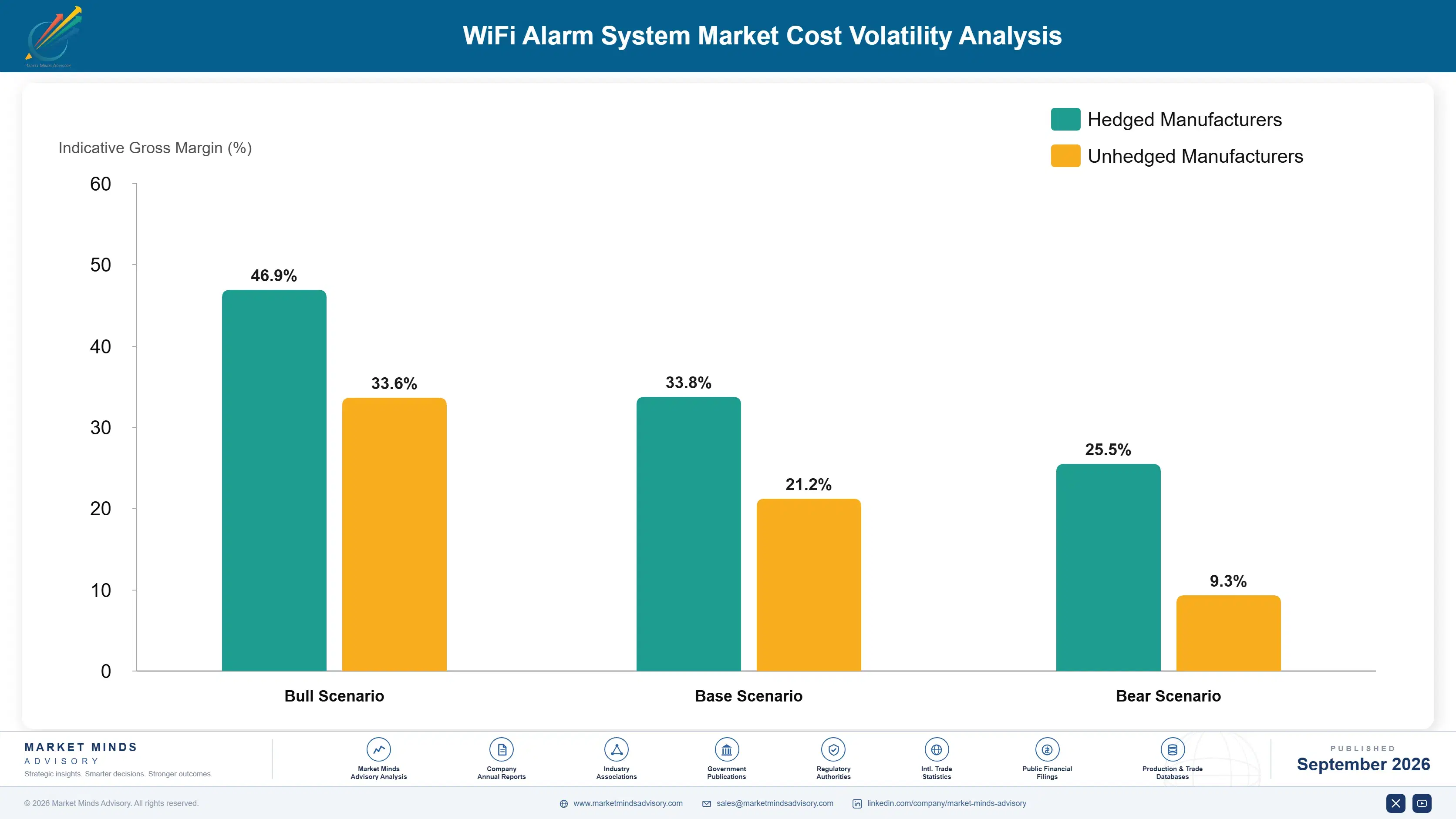
Camera Sensor and Chipset Cost Exposure

Image sensor chipsets and molded engineering plastics together represent roughly 48 percent of hardware manufacturing cost, sourced primarily from semiconductor manufacturers concentrated across East Asia, alongside injection-molded casing components purchased from third-party plastics suppliers worldwide. Cloud computing infrastructure for video storage and AI processing adds further meaningful cost exposure for subscription-heavy product lines and analytics platforms.
Semiconductor component shortages during 2021 and 2022 delayed camera and sensor production across the industry, according to company annual reports discussing manufacturing constraints during that period across most hardware categories. Several providers reported extended delivery timelines and compressed margins as they absorbed higher component costs rather than passing them fully through to retail customers under existing fixed-price product agreements negotiated before the shortage began affecting global supply chains.

Smaller providers without long-term component supply agreements face proportionally larger cost exposure than vertically integrated majors like Amazon and Google, which negotiate volume-based pricing directly with semiconductor and camera module manufacturers worldwide. Providers headquartered in regions with weaker currencies also face amplified dollar-denominated component costs, widening the competitive cost gap against providers with diversified global manufacturing and procurement footprints across multiple continents.
wifi-alarm-system-market-cost-volatility-analysis-1789980871433

Negotiate Multi-Year Semiconductor Supply Contracts

Locking multi-year semiconductor component supply contracts at fixed or partially hedged pricing protects providers against spot market volatility that has repeatedly compressed margins during recent demand spikes. This pricing certainty lets finance teams plan hardware pricing several years ahead with materially reduced exposure to sudden chipset price swings tied to broader consumer electronics industry demand.

Diversify Camera Module Supplier Base

Sourcing camera modules and image sensor components from multiple regional suppliers rather than a single concentrated source reduces exposure to localized supply disruption or regional pricing spikes tied to feedstock availability and logistics constraints. This diversification strategy adds modest logistics complexity but meaningfully reduces single-supplier dependency risk across the hardware manufacturing supply chain overall.

Build Shared Cloud Infrastructure Across Products

Providers increasingly build shared cloud storage and AI processing infrastructure that serves multiple product lines simultaneously, reducing per-device cloud computing cost by amortizing infrastructure investment across a broader subscriber base and customer portfolio overall. This design shift lowers marginal cost for each additional connected device while accelerating time to market for new features and updates.

Portfolio Architecture for Margin Defence

Provider economics split into three tiers by AI sophistication and subscription depth across most product categories offered today. Volume-tier standard sensor and panel hardware carry gross margins around 24 to 32 percent, while premium AI-enhanced camera configurations reach 40 to 48 percent margins consistently. Cloud monitoring and subscription services command the widest margin range given the recurring revenue barriers protecting early movers from immediate competitive pressure.
Tension between volume and premium tiers centers on manufacturing investment allocation: providers must decide how much AI model development investment to commit toward premium camera and doorbell customers versus maintaining broad standard sensor product lines serving budget-constrained households. Most large providers now prioritize AI and subscription investment, accepting narrower standard hardware margins to secure future customer relationships across upcoming renewal and upgrade cycles.

High-value margin pools concentrate overwhelmingly in AI-enhanced cameras and cloud subscription services, where technical barriers protect early movers from immediate price competition across most household customer segments and income levels. Standard sensor and panel hardware increasingly commoditizes as more providers, including regional manufacturers, achieve comparable baseline functionality, compressing margins toward the lower end of the volume tier band across most established global markets and product categories.

Standard sensor and panel hardware serving budget-constrained households and entry-level DIY buyers, priced primarily on unit volume and baseline detection capability rather than AI sophistication, subscription depth, or cloud analytics maturity.
Gross Margin: 24-32%

AI-enhanced camera and doorbell configurations meeting premium household expectations, commanding pricing power from detection accuracy and cloud analytics depth competitors cannot easily replicate quickly across comparable customer segments and price tiers.
Gross Margin: 40-48%

Cloud monitoring and subscription services addressing recurring revenue and professional dispatch demand, where technical barriers and monitoring infrastructure maturity drive the widest margin variance across providers and deployment types today.
Gross Margin: 30-55%
wifi-alarm-system-market-portfolio-architecture-1789980871942

High-value Sub-segments and Strategic Watch-out

Cloud Monitoring and Subscription Services

Growing fastest among all six segments as providers shift business models toward recurring revenue, commanding premium pricing and durable subscription economics that protect early movers from immediate competitive price pressure across most household segments, income levels, geographic markets, demographic categories, age groups, and lifestyle preferences today.

WiFi Security Cameras and Video Doorbells

Package theft concerns drive strong secondary growth here, though moderate near-term margin pressure reflects intensifying competition among providers racing to standardize AI detection capability across next-generation camera product architectures, customer categories, geographic markets, pricing tiers, support structures, licensing terms, contract types, and renewal cycles worldwide.

Door and Window Sensors

The largest volume segment by unit count, providing steady baseline revenue at comparatively thin margins as commoditization intensifies with growing regional manufacturing capacity entering global supply chains and household procurement decisions consistently and predictably over multiple budget years, renewal cycles, planning periods, and contract terms.

Standard Motion Detection Sensors

A strategic watch-out segment facing sustained pricing pressure as basic motion detection commoditizes faster than AI-enhanced alternatives, risking margin erosion for providers slow to redirect focus toward higher-value camera and analytics categories instead of legacy sensor technology entirely and permanently across most markets and customer segments.

Subscription Renewals Anchor Recurring Provider Revenue

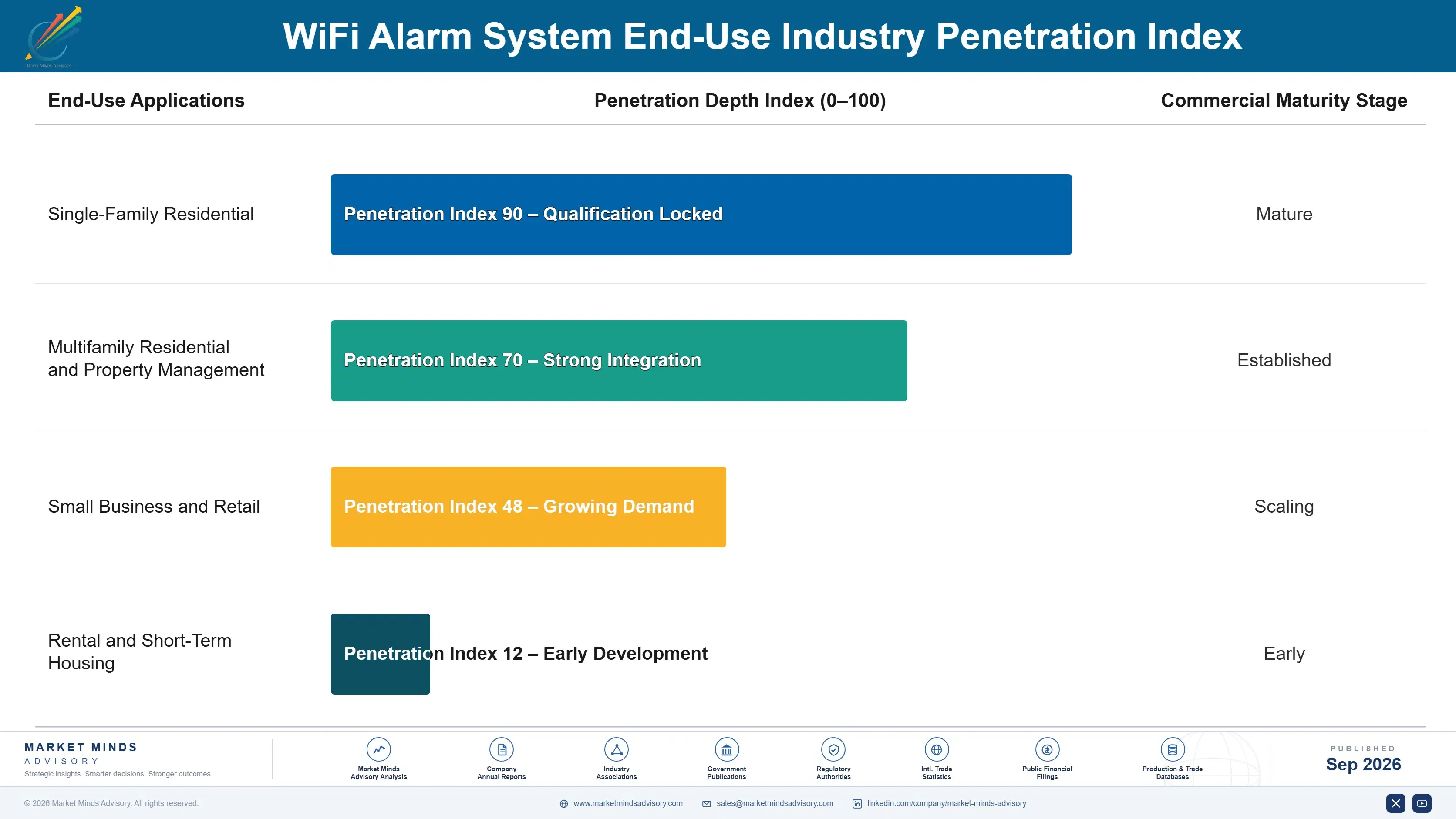
Provider relationships operate on annuity-like economics once a household activates cloud monitoring subscription service, since switching providers requires uninstalling existing sensors and reconfiguring an entirely new system across every entry point and monitored zone. A typical household relationship generates recurring monthly subscription revenue across a five-to-seven-year homeownership tenure, with camera and sensor upgrades extending the relationship well beyond initial hardware purchase and installation.
Adoption stickiness varies meaningfully by end-use vertical: homeowners show the deepest stickiness given switching costs tied to reinstalling sensors and reconfiguring smart home integrations, while renters show comparatively higher churn as they relocate more frequently and favor portable systems and month-to-month plans. Small business customers show extremely high stickiness tied to insurance certification requirements and multi-year monitoring contracts that discourage frequent provider switching.

Buyer profiles are shifting generationally as purchasing decisions move from older homeowners favoring professional installation toward younger renters and first-time buyers who prioritize DIY setup and mobile app control over legacy monitoring center relationships and long contracts. Younger buyers increasingly favor providers offering transparent, no-contract subscription pricing over providers competing purely on installation service and long-term contractual commitment terms.
wifi-alarm-system-market-end-use-penetration-index-1789980872429

WiFi Alarm Provider Investment Priorities

These are among the four positions where our research anticipates prominent divergence between winners and laggards over the coming forecast period. Each is grounded in the demand model, the regulatory perimeter, and the announced capacity pipeline.
01 / AI VIDEO ANALYTICS INVESTMENT

Accelerate AI video detection before false alarm fatigue erodes trust

Providers relying on basic motion detection increasingly generate excessive false alerts for routine activity like package deliveries and passing animals, and this alert fatigue erodes customer trust and drives subscription cancellations faster than providers can replace churned households across most residential segments today. Providers that build mature AI classification capability now capture disproportionate retention among customers frustrated with unreliable legacy sensors and detection systems. Providers that delay this investment risk losing households entirely to competitors offering more accurate detection within the next several product cycles.
02 / DIY RETAIL DISTRIBUTION STRATEGY

Expand DIY retail distribution before professional-only positioning limits reach

Homeowners increasingly purchase self-install security hardware through online marketplaces and retail stores rather than scheduling professional installation appointments that add cost and scheduling friction to the purchase decision across most household segments and income levels. Providers positioning products as professional-installation-only increasingly lose price-sensitive first-time buyers to competitors offering accessible self-install alternatives through familiar retail channels. Expanding DIY distribution now captures this growing customer segment before competitors establish dominant retail shelf space and online marketplace visibility across the same customer base.
03 / SUBSCRIPTION BUNDLING STRATEGY

Bundle monitoring and analytics into unified subscription tiers

Households increasingly prefer unified subscription packages combining cloud storage, monitoring dispatch, and AI analytics rather than paying separately for each feature through fragmented add-on pricing structures and confusing billing arrangements across most household budgets. Providers offering only basic hardware without compelling subscription bundles risk losing recurring revenue to competitors capable of delivering comprehensive service packages through one simple monthly fee. Bundling captures incremental lifetime value while deepening household dependency on a single trusted provider relationship over multiple renewal cycles and years.
04 / DATA PRIVACY TRUST STRATEGY

Build transparent privacy protections ahead of tightening consumer scrutiny

Consumer hesitation about internet-connected cameras continues rising following high-profile data breach incidents at major security providers, and this privacy concern increasingly influences purchase decisions more than price or feature comparisons alone across most demographic segments and age groups today. Providers without transparent data handling practices and strong encryption increasingly lose privacy-conscious households to competitors emphasizing security and control over personal footage. Building this trust capability now differentiates providers meaningfully as privacy scrutiny intensifies across most residential customer segments and demographics.

Engagement Snapshot From the Field

A live engagement with an industry participant carrying material or product regulatory and market exposure ahead of a defining policy shift, showing how our research translates into a defensible multi-year portfolio strategy.
MARKET MINDS ADVISORY · CLIENT ENGAGEMENT SUMMARY
WiFi Alarm System Producer Strategic Portfolio Review and Transition Roadmap 2026·Investment Scenario on WiFi Alarm System Exposure Evaluation 2025-26
CLIENT PROFILE
The client is a regional property management company operating several multifamily residential complexes across the southwestern United States, managing approximately 12,000 rental units and generating annual revenue of approximately 85 million dollars (client-reported, unverified by MMA). The company faced rising resident complaints about package theft and unauthorized entry incidents across its properties, communities, and shared common areas.
STRATEGIC CHALLENGE
Management needed to decide whether to install a single standardized WiFi alarm and camera system across all managed properties for consistency, allow individual residents to select and install their own preferred security systems independently, or delay any security upgrade decision pending further resident feedback and detailed cost analysis and budgeting.
MMA APPROACH
MMA conducted primary interviews with the client's property management and resident services teams alongside benchmarking analysis of installation cost and resident satisfaction outcomes among comparable property management companies pursuing standardized versus resident-choice security approaches across North America over a six-week engagement period covering multiple vendor options, configurations, and pricing structures.
KEY FINDINGS
  1. Allowing individual resident choice created inconsistent security coverage and complicated maintenance staff response to alarm events across different incompatible hardware platforms and vendors.
  2. A standardized WiFi camera and doorbell system across common areas cut package theft complaints by roughly 50 percent within the first six months of installation.
  3. Resident-choice systems offered flexibility but generated substantially more maintenance staff support burden than the client's facilities team could reasonably accommodate long-term or sustainably.
  4. Resident satisfaction surveys indicated strong preference for professionally installed common-area cameras combined with optional in-unit sensors available at resident expense and choice.
CLIENT PROFILE
The client is a regional property management company operating several multifamily residential complexes across the southwestern United States, managing approximately 12,000 rental units and generating annual revenue of approximately 85 million dollars (client-reported, unverified by MMA). The company faced rising resident complaints about package theft and unauthorized entry incidents across its properties, communities, and shared common areas.
STRATEGIC CHALLENGE
Management needed to decide whether to install a single standardized WiFi alarm and camera system across all managed properties for consistency, allow individual residents to select and install their own preferred security systems independently, or delay any security upgrade decision pending further resident feedback and detailed cost analysis and budgeting.
MMA APPROACH
MMA conducted primary interviews with the client's property management and resident services teams alongside benchmarking analysis of installation cost and resident satisfaction outcomes among comparable property management companies pursuing standardized versus resident-choice security approaches across North America over a six-week engagement period covering multiple vendor options, configurations, and pricing structures.
KEY FINDINGS
  1. Allowing individual resident choice created inconsistent security coverage and complicated maintenance staff response to alarm events across different incompatible hardware platforms and vendors.
  2. A standardized WiFi camera and doorbell system across common areas cut package theft complaints by roughly 50 percent within the first six months of installation.
  3. Resident-choice systems offered flexibility but generated substantially more maintenance staff support burden than the client's facilities team could reasonably accommodate long-term or sustainably.
  4. Resident satisfaction surveys indicated strong preference for professionally installed common-area cameras combined with optional in-unit sensors available at resident expense and choice.
RECOMMENDED STRATEGY
Phase 1: Phase one: install standardized WiFi cameras across all common areas and building entrances within two quarters and phases entirely and quickly. Phase 2: Phase two: offer optional in-unit sensor packages to residents willing to pay modest monthly subscription fees and charges directly and voluntarily. Phase 3: Phase three: expand AI-enhanced package detection alerts to reduce theft-related resident complaints further over time, seasons, years, and future decades.
OUTCOME
Within nine months, the client reported package theft complaint reductions of roughly 50 percent and improved resident satisfaction scores tied to perceived property safety, security, and overall living experience quality (client-reported, unverified by MMA). The standardized system now anchors the client's ongoing property security strategy.

Frequently Asked Questions

Foundational context covering the market sizes, CAGR, scope, country, region and competition that inform every finding below. This section is provided to cover basics and most often pre-purchase conversations, answered from the MMA Primary Research Dataset.

What is the current size of the WiFi Alarm System Market?

The WiFi Alarm System Market reached 4.6 billion dollars in 2025, the base year for this report's forecast. Growth continues at a 9.8 percent compound annual rate through 2036, driven by DIY installation adoption and AI-enhanced video analytics demand.

How large will the WiFi Alarm System Market be by 2036?

The market is projected to reach 12.86 billion dollars by 2036, representing a 2.55 times expansion from its 2026 value. Cloud monitoring services and AI-enhanced cameras drive most of this incremental growth across nearly every covered region.

What is the CAGR for the WiFi Alarm System Market 2026 to 2036?

The base case compound annual growth rate is 9.8 percent across the ten-year forecast window. Bull case scenarios reach 11.1 percent on faster DIY adoption, while bear case scenarios fall to 8.5 percent on consumer spending slowdowns.

Which segment is growing fastest?

Cloud Monitoring and Subscription Services grow fastest at a 13.5 percent compound annual rate, roughly 1.38 times the overall market average. WiFi Security Cameras and Video Doorbells follow as the second-fastest visible segment at 12.0 percent.

Who are the major companies in the WiFi Alarm System Market?

Amazon, ADT, SimpliSafe, Vivint, and Google lead the field, together representing roughly 52 percent combined concentration. Honeywell and Resideo also maintain meaningful competitive positions across several major regional markets.

Which country is growing fastest?

India leads country-level growth at a 12.5 percent compound annual rate, outpacing the broader South Asia and Pacific region overall. Expanding urban middle class and rising residential security investment drive this acceleration across most major Indian cities.

Report Segmentation Architecture

The full report scope spans multiple orthogonal segmentation dimensions, with cross-tabulated demand data provided for each dimension pair. Coverage extends further to regional breakdowns, trend trajectories, and the competitive detail needed to support segment-level decision-making.

By Primary Market Dimension

  • WiFi Alarm Control Panels and Hubs
  • Door and Window Sensors
  • Motion and Occupancy Sensors
  • WiFi Security Cameras and Video Doorbells
  • Smart Locks and Access Control Devices
  • Cloud Monitoring and Subscription Services

By End-Use Industry

  • Single-Family Residential
  • Multifamily Residential and Property Management
  • Small Business and Retail
  • Rental and Short-Term Housing

By Commercial Dimension

  • Direct-to-Consumer Retail Sales
  • E-Commerce Marketplace Channel
  • Professional Installer Channel
  • Subscription-Based Monitoring Services

By Region

  • North America
  • East Asia
  • Western Europe
  • South Asia and Pacific
  • Latin America
  • Middle East and Africa
  • Eastern Europe

Scope, Methodology, and Coverage

Every figure in this report is reproducible from documented input assumptions. The scope below maps the historical period, the forecast horizon, the segmentation dimensions, and the countries covered, alongside the underlying primary and qualitative methodology.
Historical Period
2020 to 2025
Forecast Period
2026 to 2036
Base Year
2025 (USD billions; MMA Primary Research Dataset, September 2026)
Market Definition
The WiFi Alarm System Market covers wireless control panels, sensors, cameras, and cloud monitoring services that detect and report security events over WiFi connectivity rather than cellular or hardwired connections. It excludes standalone cellular-only security systems and general smart home automation products lacking dedicated alarm and intrusion detection capability.
Quantitative Units
USD Billion
Segmentation Dimensions
Product Type, End-Use Industry, Commercial Dimension, Region
Regions Covered
North America, East Asia, Western Europe, South Asia and Pacific, Latin America, Middle East and Africa, Eastern Europe
Countries Covered
United States, China, India, Germany, United Kingdom, Brazil, Japan, and 31 additional countries
Key Companies Profiled
Amazon.com Inc, ADT Inc, SimpliSafe Inc, Vivint Smart Home Inc, Google LLC, Honeywell International Inc, Resideo Technologies Inc, Ecobee Inc, Wyze Labs Inc, Abode Systems Inc, Anker Innovations Limited, Arlo Technologies Inc, Deep Sentinel Corp, Frontpoint Security Solutions LLC, Cove Smart LLC, Brinks Home Security LLC, Comcast Corporation, Swann Communications, Netvue Technology Co Ltd, D-Link Corporation
Quantitative Methodology
Primary survey, n=3,800 respondents, Q4 2025, six countries; demand-side model with trade association cross-validation
Qualitative Methodology
47 expert interviews, Q4 2025; applied to validate demand model assumptions, identify emerging dynamics, and assess competitive positioning
Report Format
PDF and XLSX data workbook (Word format preview document)
Publisher
Market Minds Advisory
Report Code
MMA-2026-TEC-231
Published
September 2026
Contact
sales@marketmindsadvisory.com | www.marketmindsadvisory.com

Purchase the full WiFi Alarm System Market Report (2026 to 2036).

This report examines the global WiFi Alarm System Market across product type, end-use industry, and commercial dimension through 2036. It quantifies DIY installation adoption, AI-enhanced video analytics, and subscription bundling strategies as primary mechanisms shaping provider strategy and margin capture. Coverage spans competitive positioning among five leading providers and fifteen additional challengers across seven world regions, with detailed input cost and portfolio analysis included. The analysis draws on primary survey data spanning 3,800 respondents and 47 expert interviews conducted across six countries in the fourth quarter of 2025.
Full regional breakdown across all seven markets
Ten-year forecast scenarios with bull and bear cases
Detailed competitive profiles of twenty major providers
Segment-level growth rates and margin economics analysis
Input cost exposure and mitigation strategy analysis
Anonymized client case study with strategic recommendations

Built For The People Who Decide

From boardroom strategy to bench-side execution, this report is read cover-to-cover by leaders shaping the next decade of their industry, turning demand scenarios, market dynamics and valuation benchmarks into decisions.
CXOs/ Presidents/ VPs/ Managers
M&A and Corporate Development
Strategy Teams and R&D Heads
Procurement and Product Directors
Regulatory and Compliance Leaders
Investor Relations and Equity Analysts