Market Minds Advisory
Smart Doorbell Market

Smart Doorbell Market: Smart Doorbell Market. Recognition Accuracy, Integration Depth, and Battery Economics.

Homeowners are upgrading to AI-driven video doorbells with facial recognition and package detection as porch theft concerns rise, even as subscription fatigue and battery replacement cycles keep many households on basic motion-only doorbell models.

Lead Analyst

Published

September 2026

Make Smarter Decisions with Customized Research Insights

Request a free sample report and evaluate market opportunities, growth trends, and competitive dynamics relevant to your business needs.

2025 MARKET VALUE$3.2BMarket Size 2025
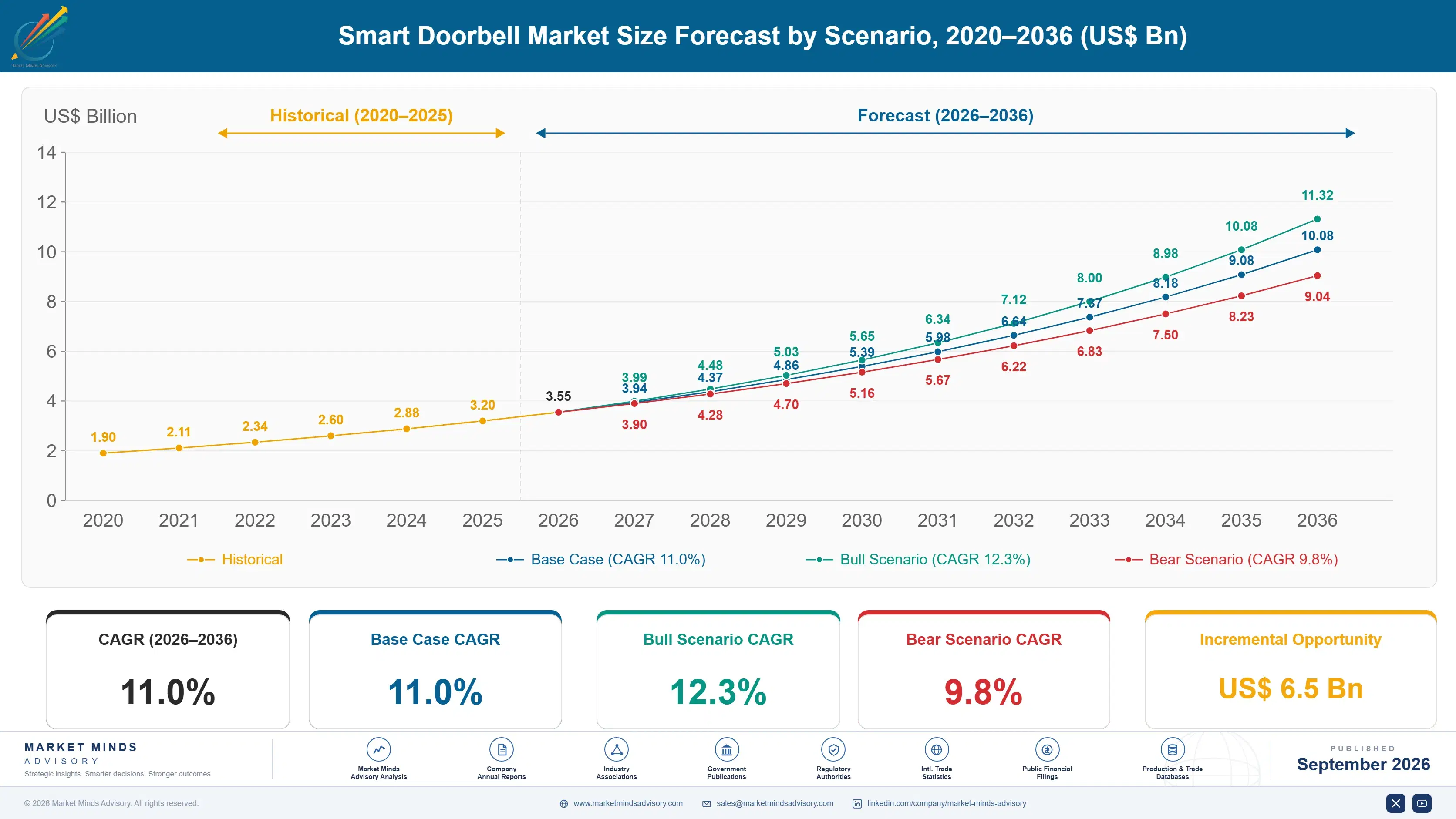
2036 FORECAST VALUE$10.1BBase Case , 2026 to 2036
CAGR 2026 TO 203611.0 %Bull 12.3% / Bear 9.8%
INCREMENTAL OPPORTUNITY$6.5BNet 10- year value creation
EXPANSION MULTIPLE2.84x2036 value over 2026 base
Strategic Levers
M&A Pipeline
Regional Outlook
Country Rankings
Competitive Intelligence
Segmental Deep-dive
Call-Us : 91 93563 13602

Executive Snapshot and Market Trajectory.

Smart doorbells are shifting from basic motion-triggered cameras toward AI-driven platforms that recognise faces and detect package delivery continuously, letting homeowners distinguish genuine security events from routine foot traffic without reviewing every triggered recording manually. Buyers increasingly treat this shift as an operational necessity rather than a discretionary upgrade overall.
Demand concentrates around suburban single-family homeowners managing package delivery and security concerns, with North American households the largest buyers as domestic smart home adoption culture continues outpacing other markets by a meaningful margin. AI-driven facial recognition doorbells are increasingly displacing basic motion-only models across these flagship suburban household accounts. That concentration is unlikely to loosen soon given how deeply embedded these platforms already are within the largest smart home device networks.
Competitive character splits between established smart home platform vendors defending decades-long retail distribution relationships and newer AI-native doorbell specialists built specifically for continuous facial recognition that legacy motion-only architectures were never designed to support at comparable accuracy. This divide shapes nearly every competitive retail shelf placement decision now underway, and tightening privacy regulation reinforces how buyers weigh recognition accuracy against newer subscription pricing models.
Market Definition
This report covers video-enabled doorbell devices with camera, motion detection, and connectivity functionality for residential and light commercial security, spanning wired, wireless, and AI-driven recognition systems. Standalone cameras, general automation hubs, and commercial security systems are excluded.
Base Year Value
$3.2B in 2025 (MMA Primary Research Dataset, September 2026)
Forecast Period
2026 to 2036, eleven discrete annual values
CAGR
11.0% base case. Bull 12.3%. Bear 9.8%.
Fastest Growth Segment
AI-Driven Facial Recognition and Package Detection Doorbells: 15.6% CAGR
Fastest Growth Country
India: 13.5% CAGR
Fastest Growth Region
South Asia and Pacific: 13.0% CAGR
Largest Region
North America: 32% of 2025 global value
Market Leaders
Amazon.com Inc, Google LLC, Arlo Technologies Inc, Anker Innovations Limited, SimpliSafe Inc. Source: MMA Analysis based on company annual reports.
Primary Survey
n=3,800 procurement and R&D decision-makers, Q4 2025, six countries
Methodology
Demand-side build-up, cross-validated against public data, 47 expert interviews

Smart Doorbell Market Forecast Scenarios

smart-doorbell-market-size-forecast-scenario-1789981172914
Between 2020 and 2025, smart doorbells grew rapidly as porch theft concerns expanded household security spending alongside continued smart home device network integration across most major suburban household segments. AI recognition model quality improvement and expanding battery life capability both reinforced this rapid multi-year adoption curve across most large-household segments. Vendor consolidation also reshaped the competitive landscape considerably during this period.
The base case assumes continued momentum from three mechanisms: homeowners expanding AI-driven facial recognition adoption to replace basic motion detection, retailers integrating package detection alerts to reduce delivery theft losses, and smart home device network growth increasingly demanding doorbell integration that standalone cameras cannot practically deliver at comparable convenience. These three mechanisms reinforce each other, since recognition accuracy needs justify camera investment, and camera investment in turn makes package detection economically practical to deploy broadly.
A bull scenario assumes faster AI adoption pulls forward doorbell value considerably beyond current security-focused deployment into broader smart home automation triggers, while the principal bear risk is subscription fatigue deterring households from sustaining recurring cloud storage fees despite clear recognition accuracy advantages. Both scenarios hinge on how quickly privacy frameworks mature across major regulatory jurisdictions.

Recognition Accuracy and Integration Depth Economics

Smart doorbells sit downstream of both household security spending and evolving smart home device network integration requirements, and pricing increasingly reflects AI-driven recognition accuracy rather than raw video resolution alone across most consumer buyer purchases. Retail distribution negotiations increasingly reference validated recognition-accuracy benchmarks directly rather than treating them as a secondary consideration. Manufacturers that can demonstrate both capabilities together increasingly set the pricing benchmark other product lines are measured against.
MARKET CONCENTRATION48%share held by five largest global platform vendors
AVERAGE UNIT PRICE$130typical average doorbell price per unit sold retail
WIRELESS INSTALLATION SHARE58%share of units sold with battery-powered wireless installation
RETAIL DISTRIBUTION UTILISATION86%retail distribution teams booked above normal delivery capacity
AI RECOGNITION UNIT SHARE33%share of units including AI facial recognition component
ALERT NOTIFICATION LATENCY3 secondsseconds typical motion-to-alert notification latency after installation typically now
Households increasingly specify AI-driven recognition and package detection as standard for new doorbell procurement, pushing basic motion-only manufacturers toward smaller budget segments while AI-native platform manufacturers hold pricing power on flagship suburban household contracts. Retail distribution teams report sustained order volume well above typical delivery capacity, reflecting the pace of this shift across large suburban household bases.
Over the next decade, expect continued AI recognition expansion and tightening privacy regulation to keep integrated demand elevated, favouring manufacturers who can deliver recognition accuracy as reliably as they win suburban household market share. Manufacturers lagging on AI-driven recognition risk losing consideration among the most valuable household segments entirely. Households increasingly reference recognition accuracy directly as a purchase selection criterion.
"Nobody buys a doorbell camera because the app interface looks polished. They buy it because a package disappeared off the porch last week, and that theft-prevention math is what is reshaping which manufacturers win the largest retail shelf placements."
Director, Connected Home and Consumer Security Practice · MMA Technology Practice · September 2026

Market Trends

AI-Driven Facial Recognition Extends Doorbells Beyond Motion Alerts

Smart doorbells are increasingly embedding AI-driven facial recognition that distinguishes familiar visitors from unknown persons automatically, extending doorbell value considerably beyond the basic motion-triggered alert role earlier generation doorbell cameras provided to suburban households. Manufacturers report facial recognition feature adoption growing meaningfully across large household accounts, reflecting homeowner demand for tools that actively distinguish genuine visitors rather than passively triggering alerts for every detected motion regardless of relevance. That gap is widening each product cycle as intelligent recognition becomes standard operating practice across most large suburban household deployments. That gap is widening each quarter as recognition accuracy becomes central.
Market Impact: Cuts theft incidence 27pts

Package Detection Alerts Reduce Delivery Theft Losses

Doorbells increasingly embed AI-driven package detection that identifies delivered parcels and sends immediate alerts to homeowners, converting what was previously a reactive theft discovery process into an increasingly standard proactive delivery monitoring capability across most major suburban household deployments. Manufacturers report package detection adoption growing meaningfully faster than the broader motion-only market, reflecting homeowner demand positioning early for theft-prevention advantage before competitors achieve comparable detection coverage across the industry. This dynamic is expected to intensify as e-commerce delivery volume continues expanding across most major residential markets. Manufacturers report this shift accelerating faster than most planning teams originally anticipated across.
Market Impact: Raises platform demand 18pts

Market Opportunities and Growth Drivers

Porch Theft Concerns Accelerate Security Doorbell Adoption

Households experiencing rising porch theft incidents face considerably higher motivation to invest in visible deterrent technology than households in lower-theft neighbourhoods, converting what was previously a discretionary convenience purchase into an increasingly central household security priority across most large suburban household programmes. Households report doorbell procurement increasingly tied to broader home security investment planning, giving manufacturers a demand driver linked to crime trend concerns rather than discretionary technology budget alone. This dynamic is expected to persist as e-commerce delivery volume continues expanding faster than delivery security measures can improve. This dynamic is expected to persist as delivery volume continues.
Market Impact: Delays upgrade 6-10 months

Smart Home Device Network Growth Elevates Doorbell Integration Demand

Households building comprehensive smart home device networks increasingly require doorbells that integrate natively with existing security and automation platforms, increasing the addressable doorbell volume required per household as smart home device adoption expands across most major connected home product categories. Households report doorbell procurement increasingly tied to broader smart home platform planning, giving manufacturers a demand driver linked to device network expansion rather than discretionary standalone camera upgrades alone. This dynamic is expected to persist as smart home device adoption continues expanding across most major residential markets. This dynamic is expected to intensify as device adoption continues expanding across.
Market Impact: Extends sales cycles 3-6 months

Market Restraints and Challenges

Subscription Fatigue Delays Broader Feature Tier Adoption

Households facing multiple recurring smart home subscription fees face considerably higher resistance to additional cloud storage charges than households with fewer existing subscriptions, often extending the timeline before households upgrade to premium AI-enabled tiers well beyond what manufacturers plan around when pursuing recurring revenue growth at established household accounts. The commercial impact shows up as delayed revenue recognition for manufacturers who have invested subscription tier development effort well ahead of any confirmed household upgrade decision. Manufacturers are responding by building bundled subscription packages that combine multiple device categories to compress the effective cost-per-feature households weigh during upgrade decisions.
Market Impact: Lifts recognition share 17pts

Battery Replacement Cycles Limit Wireless Model Confidence

Wireless battery-powered doorbells face considerably more frequent maintenance requirements than wired models, often prompting households to delay wireless model adoption until battery life track records improve across comparable usage conditions and climate exposure. The commercial impact shows up as extended sales cycles for manufacturers pursuing broader wireless model adoption, where buyers demand extensive battery life validation well beyond what standard commercial doorbell specifications typically provide out of the box. Manufacturers are responding by building extended battery life designs developed jointly with household beta testing programmes before broader commercial rollout. That gap is widening each product cycle.
Market Impact: Expands package-detection adoption by 20 percent
3 additional market trends, 4 additional growth drivers, and 2 additional restraints and challenges are covered in the full report. Contact sales@marketmindsadvisory.com to access the complete intelligence.

Segment CAGR and Growth Architecture

Segmentation follows core installation and technology type, from wired and battery-powered through hub-integrated and service-bundled models to AI-driven recognition doorbells, keeping hardware distinct from the services layered around it. Commercial services around subscription bundling and installation sit apart as a distinct dimension entirely, never blended into the core technology categories above fully overall broadly.
smart-doorbell-market-market-share-analysis-1789981173499

AI-Driven Facial Recognition and Package Detection Doorbells

AI-driven doorbells that recognise faces and detect package delivery continuously are capturing an expanding share of total unit revenue as households shift budget from basic motion detection toward intelligent continuous monitoring across most large suburban household programmes. Manufacturers report product cycle timelines running considerably faster than legacy motion-only camera development given the reduced calibration effort modern recognition architecture requires, delivering stronger recurring subscription revenue once deployed since cloud-based recognition generates predictable multi-year household relationships. Adoption remains concentrated among households with the smart home infrastructure to support connected deployment, but the addressable market is expanding as manufacturers build simplified recognition packages suited to smaller household budgets. Expect this segment to keep outpacing the broader market as porch theft concerns continue.
CAGR 15.6%

Battery-Powered Wireless Video Doorbells

Battery-powered wireless doorbells that eliminate hardwiring requirements are growing as households increasingly value installation flexibility over the permanent wiring legacy wired doorbell systems historically required across most large suburban household renovations. This segment benefits from the same convenience trend driving broader AI adoption, since wireless installation infrastructure typically provides the deployment flexibility AI recognition features require more efficiently than hardwired systems can economically support at comparable household scale. Manufacturers require sophisticated battery engineering and wireless connectivity expertise to serve this segment at qualified household scale, a capability barrier that favours established manufacturers with dedicated power engineering investment over smaller providers lacking comparable technical depth. Growth here trails AI recognition doorbells slightly since wireless adoption depends partly on underlying battery.
CAGR 13.2%
Full segment breakdown across 6 segments available in the complete report.

Regional Architecture and Country Demand Map

North America leads on concentrated smart home adoption culture and suburban household security spending, with East Asia following behind on expanding domestic smart home manufacturing and adoption. South Asia and Pacific and Western Europe fill out the remaining meaningful share behind these two anchor regions.

North America

United States suburban households anchor the largest regional demand pool, with continued smart home device network investment expanding the addressable base of households requiring AI-driven doorbell recognition across both flagship suburban and expanding urban accounts. Major platform vendors headquartered in the region sustain deep retail distribution relationships with households that smaller international competitors have struggled to displace despite years of competitive effort. Canadian suburban households sustain steady demand tied to established smart home adoption comparable to the broader North American market. Average selling prices stay firm given established retail relationships and the recognition-accuracy track record leading manufacturers have built across multiple product generations. This scale advantage keeps the region well ahead of most other established connected home markets globally.
Share: 32% | CAGR: 12.0% (2026 to 2036)

Western Europe

German and British suburban households, alongside France's concentrated urban apartment security market, anchor substantial regional demand as European Union data privacy regulation increasingly requires demonstrable consent documentation for facial recognition doorbell deployment. Domestic doorbell manufacturers compete against North American and Asian platforms for these household contracts, drawing on established relationships with retail distribution networks built over many years of prior security camera deployment. Research into regulatory compliance requirements across the region sustains steady demand comparable to other established connected home markets globally. Growth trails North America given the region's more measured smart home investment pace relative to the aggressive scaling underway across major American suburban households. This expanding base keeps the region ahead of most other secondary connected home.
Share: 21% | CAGR: 9.5% (2026 to 2036)
Regional intelligence for 5 additional markets available in the complete report: East Asia, South Asia and Pacific, Latin America, Middle East and Africa, Eastern Europe. Contact sales@marketmindsadvisory.com.
smart-doorbell-market-country-cagr-analysis-1789981174022

Recognition Accuracy, Integration Depth, and Battery Life

Manufacturers hold pricing power where AI recognition accuracy, deep smart home device network integration, and validated battery life combine, letting qualified players capture margin beyond standard motion-only detection that commodity doorbells cannot easily replicate Manufacturers combining all three consistently outperform single-capability rivals on renewal terms on every major purchase decision each cycle overall widely.

Building AI-Driven Facial Recognition Accuracy Capability

Building AI-driven facial recognition accuracy that distinguishes familiar visitors from unknown persons automatically positions manufacturers to capture the fastest-growing recognition-enabled segment that standard motion-only doorbells cannot address without comparable machine learning and camera engineering investment across the required specialist expertise. Manufacturers who have already built this capability report winning a growing share of household market share specifically because recognition accuracy delivers measurable convenience improvement that motion-only detection alone cannot match, with recognition-enabled doorbells commanding roughly 24 to 30 percent pricing premium over standard motion-only equivalents. This premium has held steady across the past several product cycles.
Market Impact: Commands roughly a 24 to 30 percent premium

Building Deep Smart Home Platform Integration

Building deep smart home device network integration that connects doorbell data directly with broader home automation and security platforms directly addresses the sector's central competitive dynamic where integration depth increasingly determines which manufacturers can compete for the largest suburban household market share across connected home accounts. Manufacturers who have already built this capability report winning a growing share of household market share specifically because deep integration removes a meaningful compatibility barrier households value highly, with integrated doorbells commanding roughly 2 to 3 times the household lifetime value of comparable standalone doorbell sales.
Market Impact: Wins households worth 2 to 3 times standalone value

Building Validated Extended Battery Life Designs

Investing in validated extended battery life designs that reduce maintenance frequency positions manufacturers to capture wireless adoption opportunities that competitors relying on unvalidated battery specifications cannot address competitively against households facing maintenance concerns across most large suburban household segments. Manufacturers who have already built this capability report winning a growing share of wireless household adoption specifically because validated battery life reduces the maintenance risk households weigh heavily during purchase decisions, with validated designs cutting battery replacement frequency by roughly 32 to 38 percent relative to unvalidated equivalents. This approach has already proven effective at several major manufacturers.
Market Impact: Cuts battery replacement frequency 32 to 38 percent

Who Controls the Margin Pool

Concentration sits moderate at a cr5 near 48 percent measured on global qualified unit shipment revenue, with a meaningful gap separating established smart home platform vendors holding deep retail distribution relationships from a fragmented tail of smaller regional manufacturers competing mainly within narrower budget or specialty segments. That gap has held steady across the past several years of competitive activity.
Current competitive activity centres on three dimensions: building AI-driven facial recognition accuracy to capture the fastest-growing recognition-enabled segment, developing deep smart home device network integration to serve households facing platform compatibility requirements, and investing in validated extended battery life designs to expand wireless model adoption confidence. Manufacturers weak in any one of these three dimensions are increasingly losing consideration on the largest household accounts.

Emerging pressure comes from general consumer electronics manufacturers expanding into smart doorbell functionality previously the exclusive domain of specialist security vendors, which could compress margins on standard budget contracts while established specialists defend share through deeper recognition and device network specialisation these newer entrants have not yet matched. How quickly consumer electronics manufacturers close the recognition expertise gap will determine whether rankings shift meaningfully over the next several years.
smart-doorbell-market-company-positioning-matrix-1789981174549

Competitive Moat and Risk Dimensions

AMAZON.COM INC

Moat: Deep platform integration breadth

Amazon has built the broadest integrated smart home device network among major vendors through its Ring platform, letting its doorbells connect natively into the broader Alexa and smart home device network most households already operate across their connected home infrastructure. This integration depth gives Amazon an advantage in contracts specifically where households increasingly value platform compatibility over standalone doorbell.
AMAZON.COM INC

Risk: Exposure to subscription pricing scrutiny

A meaningful share of Amazon's doorbell revenue ties to recurring cloud storage subscription fees, which move with broader consumer subscription fatigue conditions and can compress margins sharply during periods of intensified household scrutiny over recurring technology spending across the company's device customer base. This dynamic is already reshaping product roadmap priorities across the team.
ARLO TECHNOLOGIES INC

Moat: Cloud-native AI architecture advantage

Arlo was built from inception as a cloud-native AI-driven platform rather than retrofitting recognition capability onto legacy motion-detection hardware, giving it deployment speed and recognition accuracy advantages that competitors with older architectures have struggled to match within comparable false-alert reduction and reliability standards. This speed advantage compounds with every new feature release cycle.
ARLO TECHNOLOGIES INC

Risk: Narrower retail distribution scale

Arlo's comparatively smaller retail distribution footprint means it has narrower shelf placement scale than competitors who have built dedicated retail partnerships over several product generations, potentially disadvantaging it in the largest mainstream retail contracts where established distribution history carries meaningful weight in vendor selection. This gap is closing gradually as new retail partnerships accumulate.

Players Tracked

Prominent Players

Amazon.com Inc
Google LLC
Arlo Technologies Inc
Anker Innovations Limited
SimpliSafe Inc

Other Key Players

ADT Inc
Vivint Smart Home Inc
Wyze Labs Inc
Skybell Technologies Inc
August Home Inc
Honeywell International Inc
Logitech International SA
D-Link Corporation
TP-Link Systems Inc
Xiaomi Corporation
Ezviz Network Co Ltd
Reolink Digital Technology Co Ltd
Zmodo Technology Corporation
Netatmo SA
VTech Holdings Ltd

Recent Developments

MARCH 2026

Amazon Launches AI-Driven Package Detection Module for Ring Doorbells

Amazon.com Inc launched a new AI-driven package detection module integrated into its Ring doorbell platform, targeting suburban households seeking to identify delivered parcels and receive immediate theft-prevention alerts automatically. The module draws on statistical models trained across a large library of prior validated delivery records.
Signal: Confirms established manufacturers are prioritising package detection investment specifically to defend household market share against newer challengers.
DECEMBER 2025

Arlo Signs Multi-Year Distribution Agreement With Major Retail Chain

Arlo Technologies Inc signed a multi-year retail distribution agreement with a major home improvement retail chain, securing qualified shelf placement position across the chain's expanding smart home product category spanning multiple regional store locations. Terms were not disclosed, though the agreement covers deployment across several regional store locations over.
Signal: Shows AI-native manufacturers are winning large retail contracts against established incumbent platform vendors, a notable shift in buyer preference.
AUGUST 2025

Anker Innovations Expands Battery Engineering Team Capacity

Anker Innovations Limited expanded its battery engineering team capacity across its global operations, responding to rising demand from household customers seeking faster extended battery life validation amid persistent maintenance concerns affecting the broader industry. The expansion follows sustained demand growth from customers pursuing faster battery validation deployment timelines.
Signal: Signals established manufacturers are investing in engineering capacity to defend market share from newer competitors, a defensive move.

Camera Component and AI Engineering Cost

Camera sensor components and specialised AI recognition engineering talent together typically account for a meaningful share of manufacturer operating cost, with component cost weighted heavily toward image sensors and processing chips and talent cost weighted toward combined computer vision and battery engineering expertise. Manufacturers serving the largest retail accounts face the highest component volumes given the scale of production regulatory and retail retention requirements demand.
Camera sensor and semiconductor component pricing shifted meaningfully during a 2024 supply chain tightening cycle tracked across major manufacturer and industry annual reports, compressing margins within a single fiscal year and prompting several manufacturers to restructure retail pricing models around subscription bundling rather than flat unit pricing tiers. Several manufacturers publicly disclosed the resulting margin pressure in subsequent quarterly filings covering the affected period. Several smaller manufacturers reported the sharpest margin impact given their limited negotiating leverage.

Smaller manufacturers without negotiated enterprise component supply agreements or established engineering pipelines carry the largest exposure to this pressure, while larger manufacturers with established supplier relationships and predictable engineering pipelines can better absorb these cost pressures across a broader product line. Manufacturers serving primarily budget retail segments on thin margins face the sharpest relative exposure to this pressure.
smart-doorbell-market-cost-volatility-analysis-1789981174744

Multi-Year Camera Component Supply Agreements

Larger manufacturers are negotiating multi-year camera sensor and semiconductor component agreements with favourable committed-volume pricing rather than relying on standard spot market rates, smoothing cost volatility and protecting margin on fixed-price retail contracts signed years in advance of delivery served across the full retail base across most contract tiers negotiated overall each cycle negotiated.

University Computer Vision Pipeline Investment

Manufacturers are building dedicated university computer vision engineering pipelines targeting graduates with combined AI and battery engineering expertise, reducing reliance on costly lateral hiring and building sustainable delivery capacity across successive graduating engineering cohorts each cycle while retaining the flexibility competitors lack across peak demand periods while maintaining engineering delivery capacity across most product lines.

Subscription Bundling Passing Through Costs

Several manufacturers are restructuring retail pricing around subscription bundling that passes through underlying component cost variability directly to households, reducing manufacturer exposure to component pricing volatility while maintaining predictable margin across the household customer base served across every geography and account tier while protecting predictable margin overall across the household base served served widely.

Portfolio Architecture for Margin Defence

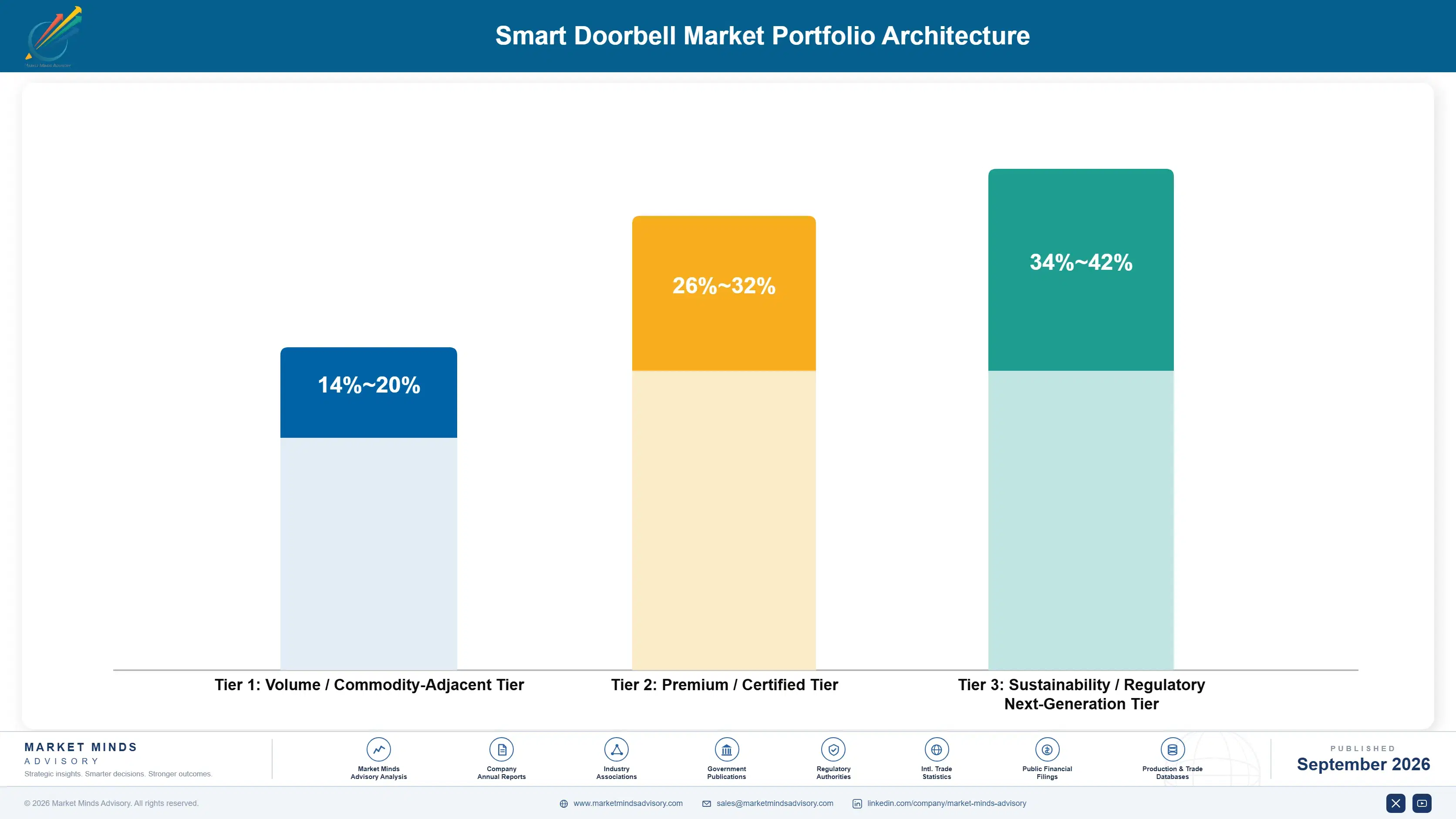
Portfolio economics split across three tiers running from commodity-adjacent standard motion-only doorbells through certified device network-integrated systems to next-generation AI-driven recognition products, with gross margin widening meaningfully at each successive tier as recognition depth and integration complexity increase across the range. Manufacturers typically enter through the certified tier and expand upward as they build recognition and device network engineering depth. This progression mirrors patterns seen.
Volume still concentrates in the certified device network-integrated tier where most current household purchases sit today, but the AI-driven recognition tier is growing faster and increasingly determines which manufacturers win the largest multi-year retail distribution agreements across major suburban household accounts. This tension between defending volume and chasing premium contracts increasingly shapes manufacturer product roadmaps. Manufacturers that can move customers up this tier structure over time capture the strongest margin gains.

High-value margin pools concentrate specifically around AI-driven recognition products and device network-integrated deployments, where recognition complexity and engineering expertise keep standard motion-only competitors from competing effectively on price alone across the largest suburban household accounts. Building presence in both pools simultaneously is increasingly the strategy leading manufacturers pursue. Manufacturers without meaningful presence in either pool increasingly struggle to defend pricing on renewal.

Volume / Commodity-Adjacent Tier

Standard motion-only doorbells meeting baseline budget household specifications, sold mainly on price into smaller household contracts without extensive recognition requirements. Renewal rates here run lower than higher tiers given weaker switching costs.
Gross Margin: 14%-20%

Premium / Certified Tier

Certified device network-integrated systems meeting suburban household connectivity standards, commanding meaningful price premiums over standard doorbells given the integration barrier competitors must clear first. Buyers in this tier weigh recognition-accuracy track record heavily during manufacturer selection.
Gross Margin: 26%-32%

Sustainability / Regulatory / Next-Generation Tier

AI-driven recognition products sold into flagship suburban household contracts, carrying the widest margins given recognition complexity and scarce qualified engineering capacity. This tier is growing fastest as buyers prioritise intelligent recognition over standard motion-only detection.
Gross Margin: 34%-42%
smart-doorbell-market-portfolio-architecture-1789981175243

High-value Sub-segments and Strategic Watch-out

AI-Driven Recognition Premium Household Products

Recognition products serving flagship suburban household contracts command the widest margins in the category as households shift toward intelligent continuous monitoring, though the qualified manufacturer pool remains small given the technology investment this segment requires today. Manufacturers here can charge substantially more given the scarcity of rivals.
Gross Margin: 36%-42%

Platform-Integrated Connected Home Doorbells

Integrated doorbells serving connected home device network requirements grow steadily as households continue expanding smart home device adoption, commanding solid premiums over standard doorbells though not yet matching recognition tier margins across most current contracts. This pool is expected to expand steadily as more households complete device network integration.
Gross Margin: 28%-34%

Standard Certified Mid-Budget Household Doorbells

Standard certified doorbells serving mainstream mid-budget households remain the largest volume pool by a wide margin, carrying moderate but stable margins as continued suburban household growth guarantees multi-year shipment visibility across established relationships. This remains the segment most manufacturers depend on for predictable near-term revenue.
Gross Margin: 18%-24%

Legacy Basic Motion-Only Doorbell Products

Legacy basic motion-only products sold into smaller budget household contracts without recognition or device network requirements face the greatest margin compression risk as AI-driven products gradually displace standalone motion detection across new purchase decisions industry-wide. Manufacturers still selling exclusively into this segment face a shrinking addressable household base.
Gross Margin: 6%-12%

Adoption Depth and Product Replacement Cycles

Smart doorbell revenue behaves like a multi-year annuity tied to household replacement and subscription renewal cycles, since a deployed product typically retains its position across the full multi-year product lifecycle once initial installation and household onboarding clears successfully within a given household's smart home programme. Multi-year subscription relationships are increasingly standard across the largest suburban household accounts today. Multi-year subscription terms are.
Adoption depth varies meaningfully by household tier: large suburban households integrate qualified manufacturers deeply into multi-year device network relationships spanning several product generations, while smaller budget households often switch manufacturers more frequently based on pricing competitiveness alone without comparable long-term platform commitments established. Mid-size urban households sit somewhere between these two extremes, valuing installation flexibility over the deepest possible device network integration. This flexibility preference.

A generational shift is underway as homeowners who managed basic motion-triggered cameras for years give way to households expecting AI-driven recognition by default, accelerating product adoption faster than the underlying replacement cycle alone would suggest across most established suburban household organisations today. This generational change is reinforcing the broader shift toward package detection already underway. Manufacturer marketing strategies increasingly reflect this generational shift.
smart-doorbell-market-end-use-penetration-index-1789981175731

Where Manufacturers Should Focus Investment Next

These are among the four positions where our research anticipates prominent divergence between winners and laggards over the coming forecast period. Each is grounded in the demand model, the regulatory perimeter, and the announced capacity pipeline.
01 / RECOGNITION ACCURACY INVESTMENT

Build AI-Driven Facial Recognition Now

Large suburban households increasingly treat AI-driven facial recognition as a baseline purchase expectation rather than a differentiator, and manufacturers without this capability risk losing market share regardless of motion-detection quality offered against better-integrated alternatives already available in the market. Manufacturers who have already built recognition capability report winning a growing share of household market share specifically because it delivers measurable convenience improvement that motion-only detection alone cannot match. MMA advises treating recognition investment as a near-term competitive prerequisite, not a future roadmap item.
02 / PLATFORM INTEGRATION PRIORITY

Build Deep Smart Home Integration Ahead of Demand

Expanding smart home device network adoption is raising integration demand faster than most manufacturers have prepared for, meaning demand for deep platform compatibility will keep expanding regardless of near-term fluctuations in overall household technology budget cycles. Manufacturers who invest in integration ahead of this expansion are positioned to win households that standalone competitors simply cannot serve, a durable compatibility advantage rather than a temporary pricing edge. MMA recommends treating integration as a multi-year commitment justified by clear device network expansion trends already underway.
03 / BATTERY LIFE VALIDATION INVESTMENT

Build Validated Battery Life for Wireless Expansion

Wireless model expansion represents a meaningfully larger addressable opportunity than wired-only deployment alone, but maintenance uncertainty keeps many established manufacturers confined to lower-adoption wired categories regardless of demonstrated advantages competing validated alternatives could otherwise deliver. Manufacturers who have already built validated battery life report winning a growing share of wireless household adoption specifically because validation reduces the maintenance risk households weigh heavily during purchase decisions. MMA sees battery validation as an increasingly important prerequisite for winning the largest wireless expansion opportunities going forward.
04 / CAMERA COMPONENT COST MANAGEMENT

Negotiate Multi-Year Component Agreements Before the Next Cycle

Camera sensor and semiconductor component cost volatility has already compressed margins at manufacturers without favourable committed-volume agreements, and this exposure grows as more manufacturers sign fixed-price multi-year contracts without matching cost protection built into contract terms from the outset. Negotiating multi-year component agreements ahead of the next pricing cycle protects margin through the full contract term regardless of subsequent component cost swings. MMA sees component cost management as a prerequisite for manufacturers pursuing the largest retail framework agreements, not merely a defensive measure.

Engagement Snapshot From the Field

A live engagement with an industry participant carrying material or product regulatory and market exposure ahead of a defining policy shift, showing how our research translates into a defensible multi-year portfolio strategy.
MARKET MINDS ADVISORY · CLIENT ENGAGEMENT SUMMARY
Smart Doorbell Producer Strategic Portfolio Review and Transition Roadmap 2026·Investment Scenario on Smart Doorbell Exposure Evaluation 2025-26
CLIENT PROFILE
The client is a national home security retailer managing multiple regional store category programmes and approached MMA following persistent sales stagnation across its legacy motion-only doorbell product line, reportedly costing over 3 million dollars in lost category revenue annually (client-reported, unverified by MMA) tied to declining household interest and inconsistent recognition accuracy claims. The organisation operates across five regional store territories and had grown substantially through recent category expansion activity.
STRATEGIC CHALLENGE
Leadership needed an evidence-based business case justifying investment in an AI-driven recognition product line refresh across multiple regional store territories, but internal merchandising and finance teams disagreed sharply on realistic sales improvement assumptions and appropriate rollout timeline expectations for the transition. Leadership also needed confidence that rollout would not disrupt active merchandising operations already underway across territories.
MMA APPROACH
MMA benchmarked comparable home security retailer product line modernisation programmes, modelled sales improvement against historical stagnation and category decline costs, and built a phased rollout framework prioritising the highest-value store territories by both household density and existing category performance. The framework explicitly sequenced rollout to minimise disruption to active merchandising operations throughout the transition.
KEY FINDINGS
  1. Store territories with the highest household density accounted for a disproportionate share of documented category revenue upside relative to their share of overall store count.
  2. AI-driven product line modernisation reduced modelled sales stagnation substantially based on comparable home security retailer modernisation data reviewed across similar territory structures.
  3. Prioritising rollout by household density rather than territory size alone improved the projected revenue return meaningfully within the proposed phased rollout structure.
  4. Bundling deep device network integration with the modernisation programme shortened projected value realisation timeline versus a traditional separately merchandised product and integration approach.
CLIENT PROFILE
The client is a national home security retailer managing multiple regional store category programmes and approached MMA following persistent sales stagnation across its legacy motion-only doorbell product line, reportedly costing over 3 million dollars in lost category revenue annually (client-reported, unverified by MMA) tied to declining household interest and inconsistent recognition accuracy claims. The organisation operates across five regional store territories and had grown substantially through recent category expansion activity.
STRATEGIC CHALLENGE
Leadership needed an evidence-based business case justifying investment in an AI-driven recognition product line refresh across multiple regional store territories, but internal merchandising and finance teams disagreed sharply on realistic sales improvement assumptions and appropriate rollout timeline expectations for the transition. Leadership also needed confidence that rollout would not disrupt active merchandising operations already underway across territories.
MMA APPROACH
MMA benchmarked comparable home security retailer product line modernisation programmes, modelled sales improvement against historical stagnation and category decline costs, and built a phased rollout framework prioritising the highest-value store territories by both household density and existing category performance. The framework explicitly sequenced rollout to minimise disruption to active merchandising operations throughout the transition.
KEY FINDINGS
  1. Store territories with the highest household density accounted for a disproportionate share of documented category revenue upside relative to their share of overall store count.
  2. AI-driven product line modernisation reduced modelled sales stagnation substantially based on comparable home security retailer modernisation data reviewed across similar territory structures.
  3. Prioritising rollout by household density rather than territory size alone improved the projected revenue return meaningfully within the proposed phased rollout structure.
  4. Bundling deep device network integration with the modernisation programme shortened projected value realisation timeline versus a traditional separately merchandised product and integration approach.
RECOMMENDED STRATEGY
Phase 1: Phase 1 (Months 1 to 3): Refresh the highest-household-density store territories first, bundled with deep device network integration included from the outset. Phase 2: Phase 2 (Months 4 to 9): Extend rollout across remaining priority territories identified through the density-based prioritisation framework developed during scoping. Phase 3: Phase 3 (Months 10 to 14): Retire the legacy motion-only product line entirely once all store territories complete the rollout transition successfully.
OUTCOME
The client approved a fourteen-month modernisation programme following the engagement, with Phase 1 territory rollout reportedly reducing category sales stagnation by roughly 39 percent against the prior baseline (client-reported, unverified by MMA), supporting the case for full network rollout continuation. Leadership credited the phased structure with maintaining merchandising continuity throughout the transition period.

Frequently Asked Questions

Foundational context covering the market sizes, CAGR, scope, country, region and competition that inform every finding below. This section is provided to cover basics and most often pre-purchase conversations, answered from the MMA Primary Research Dataset.

What is the current size of the Smart Doorbell Market?

The global smart doorbell market reached approximately 3.2 billion dollars in 2025. North American suburban households anchor a substantial share of global demand within this total.

How large will the Smart Doorbell Market be by 2036?

MMA projects the market reaching approximately 10.09 billion dollars by 2036 under the base case scenario. AI-driven recognition adoption and porch theft concerns both support this trajectory.

What is the CAGR for the Smart Doorbell Market 2026 to 2036?

The base case CAGR is 11.0 percent across the forecast period. Bull and bear scenarios range between roughly 9.8 and 12.3 percent depending on AI adoption pace and subscription fatigue conditions.

Which segment is growing fastest?

AI-driven facial recognition and package detection doorbells lead at 15.6 percent CAGR, well above the overall market rate. Households shifting budget toward intelligent continuous monitoring is the primary driver behind this growth.

Who are the major companies in the Smart Doorbell Market?

Leading manufacturers include Amazon.com Inc, Google LLC, Arlo Technologies Inc, Anker Innovations Limited, and SimpliSafe Inc. Combined, the top five hold roughly 48 percent of global qualified unit shipment revenue.

Which country is growing fastest?

India leads among major markets at approximately 13.5 percent CAGR, driven by its rapidly expanding urban apartment security market. Continued middle-class household security spending reinforces this pace across the country.

Report Segmentation Architecture

The full report scope spans multiple orthogonal segmentation dimensions, with cross-tabulated demand data provided for each dimension pair. Coverage extends further to regional breakdowns, trend trajectories, and the competitive detail needed to support segment-level decision-making.

By Core Installation and Technology Type

  • Wired Video Doorbells
  • Battery-Powered Wireless Video Doorbells
  • Doorbell Cameras with Smart Home Hub Integration
  • AI-Driven Facial Recognition and Package Detection Doorbells
  • Professional Installation and Monitoring Service-Bundled Doorbells
  • DIY Self-Install Doorbell Kits

By End-Use Customer Type

  • Suburban Single-Family Households
  • Urban Apartment and Condominium Residents
  • Small Business and Commercial Properties
  • Property Management and Rental Operators
  • New Home Construction and Builders

By Commercial Dimension

  • Direct Retail Unit Sales
  • Subscription Cloud Storage Services
  • Professional Monitoring Service Bundles
  • E-Commerce and Online Direct Sales

By Region

  • North America
  • Western Europe
  • East Asia
  • South Asia and Pacific
  • Latin America
  • Middle East and Africa
  • Eastern Europe

Scope, Methodology, and Coverage

Every figure in this report is reproducible from documented input assumptions. The scope below maps the historical period, the forecast horizon, the segmentation dimensions, and the countries covered, alongside the underlying primary and qualitative methodology.
Historical Period
2020 to 2025
Forecast Period
2026 to 2036
Base Year
2025 (USD billions; MMA Primary Research Dataset, September 2026)
Market Definition
This report covers video-enabled doorbell devices with camera, motion detection, and connectivity functionality for residential and light commercial security applications, including wired, wireless, and AI-driven recognition systems. It excludes standalone security cameras not integrated into doorbell hardware, general home automation hubs without native doorbell functionality, and professional commercial security camera systems not designed for residential entryway deployment.
Quantitative Units
USD billions (current prices); doorbell units shipped across major retail regions
Segmentation Dimensions
By Core Installation and Technology Type; By End-Use Customer Type; By Commercial Dimension; By Region
Regions Covered
North America, Western Europe, East Asia, South Asia and Pacific, Latin America, Middle East and Africa, Eastern Europe
Countries Covered
USA, Canada, China, Japan, South Korea, Germany, France, UK, India, Australia, Brazil, Mexico, Chile, Argentina, UAE, Saudi Arabia, South Africa, Nigeria, Turkey, Poland, Czech Republic, Netherlands, Italy, Spain, Sweden, Switzerland, Singapore, Malaysia, Vietnam, Indonesia, and additional markets relevant to this sector
Key Companies Profiled
Amazon.com Inc, Google LLC, Arlo Technologies Inc, Anker Innovations Limited, SimpliSafe Inc, ADT Inc, Vivint Smart Home Inc, Wyze Labs Inc, Skybell Technologies Inc, August Home Inc, Honeywell International Inc, Logitech International SA, D-Link Corporation, TP-Link Systems Inc, Xiaomi Corporation, Ezviz Network Co Ltd, Reolink Digital Technology Co Ltd, Zmodo Technology Corporation, Netatmo SA, VTech Holdings Ltd
Quantitative Methodology
Primary survey, n=3,800 respondents, Q4 2025, six countries; demand-side model with trade association cross-validation
Qualitative Methodology
47 expert interviews, Q4 2025; applied to validate demand model assumptions, identify emerging dynamics, and assess competitive positioning
Report Format
PDF and XLSX data workbook (Word format preview document)
Publisher
Market Minds Advisory
Report Code
MMA-2026-TEC-591
Published
September 2026
Contact
sales@marketmindsadvisory.com | www.marketmindsadvisory.com

Purchase the full Smart Doorbell Market Report (2026 to 2036).

The full MMA report delivers granular segmentation across six installation and technology tiers, seven-region demand and pricing forecasts through 2036, and a detailed competitive assessment of twenty profiled manufacturers including AI recognition capability and device network integration positioning. It includes a dedicated household security spending tracker covering major suburban markets, plus quarterly camera component cost pass-through analysis. Buyers receive editable data tables supporting internal capacity planning and manufacturer evaluation models across their full retail portfolio. A dedicated appendix profiles facial recognition privacy regulation timelines across major jurisdictions, with commentary on how requirements are expected to evolve through the forecast period.
Seven-region demand and pricing forecasts to 2036
Twenty-manufacturer AI recognition status tracker table
Household security spending pipeline tracker tool
Quarterly camera component cost pass-through model
Segment-level margin benchmarking across all tiers
Editable capacity planning and manufacturer evaluation tables

Built For The People Who Decide

From boardroom strategy to bench-side execution, this report is read cover-to-cover by leaders shaping the next decade of their industry, turning demand scenarios, market dynamics and valuation benchmarks into decisions.
CXOs/ Presidents/ VPs/ Managers
M&A and Corporate Development
Strategy Teams and R&D Heads
Procurement and Product Directors
Regulatory and Compliance Leaders
Investor Relations and Equity Analysts