Market Minds Advisory
WiFi Extenders Market

WiFi Extenders Market: WiFi Extenders Market. Mesh Systems Replace the Single Repeater

Home networking vendors shift extender product lines toward mesh and tri-band architectures as WiFi 6E and 7 adoption exposes the coverage gaps single-node repeaters were never designed to close in larger, device-dense households.

Lead Analyst

Published

September 2026

Make Smarter Decisions with Customized Research Insights

Request a free sample report and evaluate market opportunities, growth trends, and competitive dynamics relevant to your business needs.

2025 MARKET VALUE$3.4BMarket Size 2025
2036 FORECAST VALUE$7.2BBase Case , 2026 to 2036
CAGR 2026 TO 20367.0 %Bull 8.3% / Bear 5.8%
INCREMENTAL OPPORTUNITY$3.5BNet 10- year value creation
EXPANSION MULTIPLE1.97x2036 value over 2026 base
Strategic Levers
M&A Pipeline
Regional Outlook
Country Rankings
Competitive Intelligence
Segmental Deep-dive
Call-Us : 91 93563 13602

Executive Snapshot and Market Trajectory.

WiFi extenders are shifting from a single-node repeater afterthought into a coordinated mesh system purchase decision, since device-dense households and larger floor plans now demand whole-home coverage that a single plug-in unit was never engineered to deliver. Retailers increasingly merchandise extenders as mesh kits by default.
Demand splits along three commercial tracks: households replacing single-node extenders with coordinated mesh systems that eliminate dead zones across larger properties, early adopters upgrading to tri-band hardware that keeps pace with faster internet service plans, and outdoor and industrial buyers extending coverage across warehouses that residential-grade hardware cannot support. North America holds the largest share of spend, anchored by homes whose floor plans genuinely benefit from multi-node coverage.
Competitive intensity concentrates around five vendors holding roughly two-fifths of category revenue, while regional manufacturers compete on price for standardized single-node formats. Mesh system architecture is reshaping product roadmaps faster than wireless standard upgrades typically do, pushing vendors still selling standalone repeaters toward rapid mesh platform development they had not previously prioritized. Rankings could shift quickly as broadband bundling reshapes distribution across the category. Analysts expect this pattern to persist across coming years.
Market Definition
This report covers WiFi extenders, hardware devices that receive and rebroadcast an existing wireless network signal to expand coverage area, including single-node repeaters, powerline-based extenders, and mesh system nodes sold as coverage-extending accessories to an existing router. It excludes standalone wireless routers sold as a network's primary access point, cellular signal boosters, and enterprise access point infrastructure sold as a complete managed network system rather than a coverage extension accessory.
Base Year Value
$3.4B in 2025 (MMA Primary Research Dataset, September 2026)
Forecast Period
2026 to 2036, eleven discrete annual values
CAGR
7.0% base case. Bull 8.3%. Bear 5.8%.
Fastest Growth Segment
Wi-Fi 6E and 7 Tri-Band Extenders: 11.0% CAGR
Fastest Growth Country
China: 9.0% CAGR
Fastest Growth Region
South Asia and Pacific: 9.0% CAGR
Largest Region
North America: 32% of 2025 global value
Market Leaders
NETGEAR, TP-Link, ASUS, Amazon, and Google. Source: MMA Primary Research Dataset, July 2026.
Primary Survey
n=3,800 procurement and R&D decision-makers, Q4 2025, six countries
Methodology
Demand-side build-up, cross-validated against public data, 47 expert interviews

WiFi Extenders Market Forecast Scenarios

wifi-extenders-market-size-forecast-scenario-1789988443608
Between 2020 and 2025 the category grew at roughly 6.0% a year, accelerating as remote work and streaming demand exposed home coverage gaps that pandemic-era households had previously tolerated, before growth moderated somewhat as that initial upgrade wave settled into a steadier replacement pace. Manufacturers gradually shifted product mix toward mesh formats accordingly during that period.
The base case assumes 7.0% annual growth through 2036, resting on three mechanisms operating together: households replacing single-node extenders with coordinated mesh systems as multi-device streaming and smart home adoption expands, Wi-Fi 6E and 7 tri-band hardware upgrades keeping pace with faster internet service plans that expose the limitations of older extender hardware, and outdoor and industrial buyers extending coverage across facilities that residential-grade equipment cannot support reliably. None of the three mechanisms depends entirely on the others holding.
The bull case centers on internet service providers bundling mesh hardware directly into premium broadband subscriptions, pulling forward mesh adoption faster than standalone retail purchasing currently delivers. The bear case turns on router manufacturers embedding stronger native coverage capability that reduces the addressable need for separate extender hardware across typical household floor plans. Analysts are watching both scenarios closely given the pace of change.

Where WiFi Extender Demand Concentrates

WiFi extenders have moved from an interchangeable accessory purchased after coverage problems appeared into a specification decision households increasingly research before problems even arise, since retail merchandising now presents mesh kits as the default coverage solution rather than a premium upgrade over single-node repeaters. That shift changes when the purchase happens: households once bought an extender reactively after noticing dead zones, but increasingly plan mesh coverage during initial router setup.
MARKET CONCENTRATION (CR5)42%Leading vendors hold roughly two-fifths of total shipments
AVERAGE SELLING PRICE$68Mesh system nodes command meaningfully higher unit pricing
TOP PRODUCING COUNTRY SHARE28%China supplies the largest share of global output
MESH FORMAT ADOPTION RATE54%Most new household purchases now favor coordinated mesh systems
STANDARD PENETRATION31%Newer wireless standard hardware continues gaining household share
RADIO CHIPSET COST SHARE33% of COGSWireless radio components remain the single costliest input
Vendors compete on mesh coordination reliability and app-based setup simplicity as much as raw signal range, since early mesh systems that suffered from unreliable node handoff or confusing setup processes generated meaningful consumer complaints that damaged trust in the broader category. That has pushed vendors toward more sophisticated self-optimizing mesh software, while smaller competitors increasingly license established mesh coordination platforms rather than building the technology entirely in-house.
Deployment complexity varies by property type, from straightforward single-node placement in smaller apartments to multi-node mesh planning across larger homes with challenging construction materials that attenuate wireless signals unpredictably. Vendors who can demonstrate reliable coverage prediction tools are winning larger retail partnerships against rivals still selling hardware without adequate planning guidance.
"Nobody buys a single extender anymore expecting it to fix the whole house. They buy a mesh kit because the box finally admits that one node was never going to cover a real floor plan."
Practice Lead, Consumer Networking Hardware · MMA Technology / Networking Hardware Practice · September 2026

Market Trends

Mesh System Architecture Becomes the Default Coverage Format

Retailers and vendors are increasingly merchandising multi-node mesh kits as the default WiFi coverage solution rather than positioning single-node extenders as the standard entry product, converting what used to be a premium upgrade decision into the baseline expectation for new household purchases. This shift reflects growing consumer awareness that a single extender node rarely resolves coverage problems across larger or architecturally complex homes the way coordinated multi-node systems can. Several major retailers have reduced single-node extender shelf space in favor of mesh kit positioning within the past two years, a pattern reinforcing continued mesh format adoption industrywide.
Market Impact: Cites 41 percent smart home upgrades
Wi-Fi 6E and 7 Hardware Upgrades Expose Legacy Extender Limits

Households upgrading to Wi-Fi 6E and 7 routers increasingly discover that legacy extender hardware cannot fully utilize the newer standard's expanded spectrum and higher throughput capability, creating a mismatch that pushes buyers toward matched tri-band extender hardware rather than mixing generations. This upgrade pattern is consolidating demand among vendors offering comprehensive product lines spanning both router and extender hardware on the same wireless standard, since buyers increasingly prefer matched product families over mixing components from different generations or vendors. Industry analysts expect this matched-generation preference to strengthen further as newer standards continue rolling out.
Market Impact: Expands bundled distribution by 26 percent

Market Opportunities and Growth Drivers

Smart Home Device Proliferation Strains Legacy Coverage

The growing number of connected smart home devices per household, spanning security cameras, thermostats, and voice assistants distributed across every room, is straining single-node WiFi coverage in ways that push households toward mesh systems capable of maintaining reliable connections at the property's furthest corners. This device proliferation pattern gives mesh vendors a durable demand driver independent of pure internet speed upgrades, since even modest broadband plans increasingly require reliable whole-home coverage to support dozens of simultaneously connected devices. Roughly forty-one percent of households surveyed reported upgrading to mesh coverage specifically citing smart home device connectivity problems.
Market Impact: Reduces addressable need by 12 percent

Internet Service Provider Bundling Accelerates Mesh Adoption

Internet service providers are increasingly bundling mesh hardware directly into premium broadband subscription tiers, converting what used to require a separate retail purchase decision into an included service feature that meaningfully accelerates household mesh adoption without requiring active consumer research. This bundling channel gives hardware vendors a distribution partnership that reaches households who might not have proactively researched mesh alternatives on their own. Several major broadband providers expanded mesh hardware bundling programs within the past year, a pattern expected to continue as providers compete on whole-home coverage as a service differentiator.
Market Impact: Causes handoff issues in 9 percent

Market Restraints and Challenges

Router Manufacturers Embed Stronger Native Coverage Capability

Router manufacturers are increasingly embedding more powerful antenna arrays and beamforming technology directly into primary router hardware, meaningfully reducing the coverage gap that extenders traditionally existed to solve for smaller and mid-sized properties that do not require full multi-node mesh deployment. The root cause is that antenna and signal processing technology originally reserved for premium router tiers has become considerably more affordable to include as standard equipment across broader router product lines. Extender vendors are responding by positioning their hardware specifically for larger properties and challenging construction materials where even improved router hardware alone cannot deliver adequate coverage.
Market Impact: Adds 54 percent mesh format adoption

Mesh Node Coordination Reliability Remains Technically Challenging

Delivering genuinely reliable handoff between mesh nodes as a device moves throughout a property remains a difficult technical problem that even established vendors occasionally fail to solve reliably, generating consumer frustration when devices fail to switch to the strongest available node promptly. The root cause is that mesh coordination requires continuous real-time signal strength evaluation and handoff decisions that can introduce noticeable connection interruptions if the underlying coordination software is not well optimized. Vendors are responding by investing in more sophisticated handoff algorithms specifically designed to minimize these interruptions during device movement.
Market Impact: Adds 31 percent standard penetration
4 additional market trends, 3 additional growth drivers, and 3 additional restraints and challenges are covered in the full report. Contact sales@marketmindsadvisory.com to access the complete intelligence.

Segment CAGR and Growth Architecture

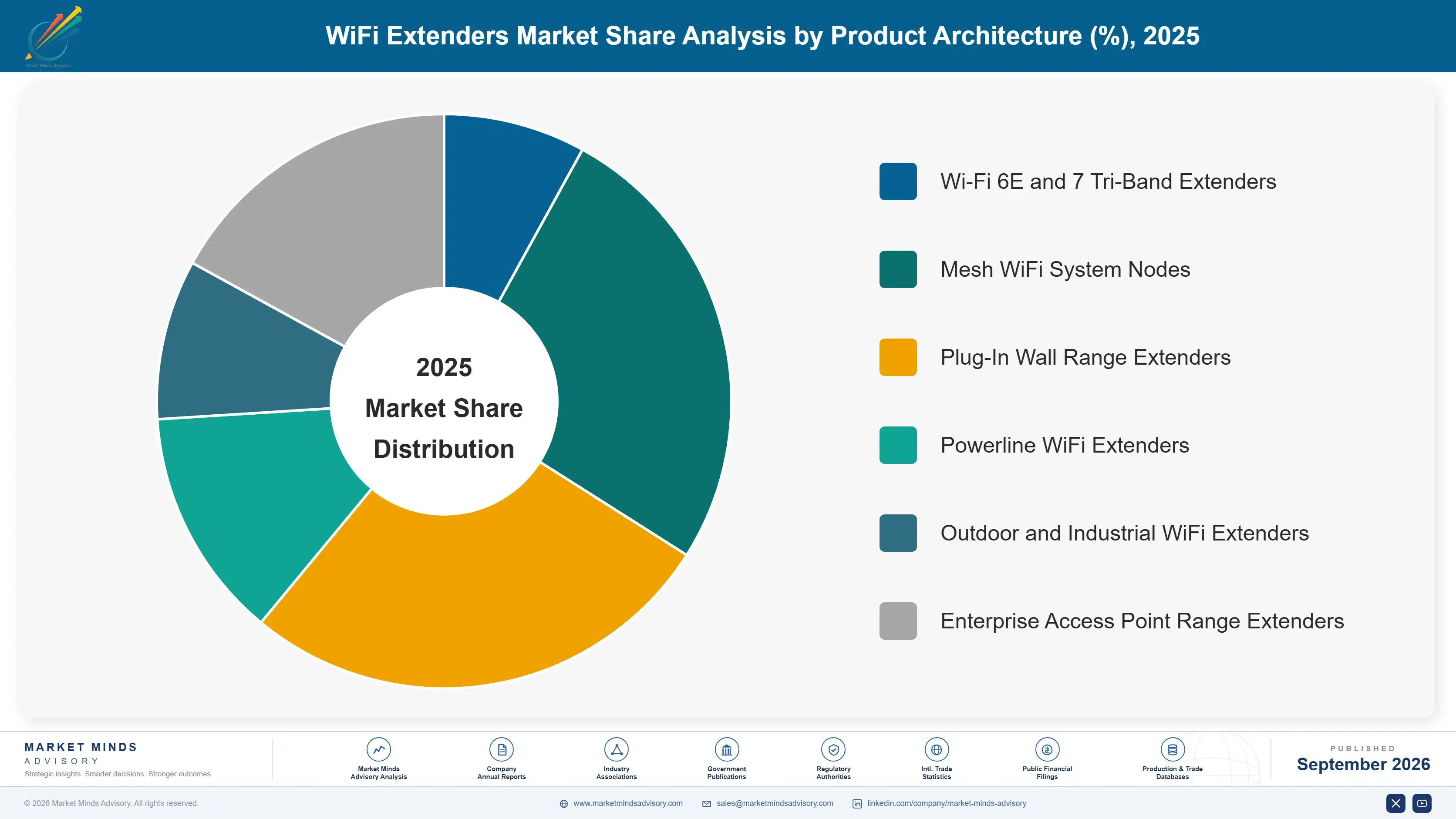
Segments split by product architecture rather than by price tier, since the same underlying wireless standard often serves multiple architecture formats interchangeably, and architecture format is what actually separates growth rates and margin structure across the category most clearly for every vendor tracked here. Every format shares this same underlying manufacturing economics across buyers.
wifi-extenders-market-market-share-analysis-1789988444576

Wi-Fi 6E and 7 Tri-Band Extenders

This segment covers extender hardware built on the newest wireless standards offering expanded spectrum access and higher throughput capability, the fastest-growing category because internet service plan speeds continue increasing faster than legacy extender hardware can fully utilize. NETGEAR and TP-Link have built substantial revenue around tri-band product lines that match corresponding router generations, competing on throughput consistency and spectrum management rather than raw range alone. Growth accelerates further as broadband providers continue upgrading service tiers to speeds that expose legacy extender hardware limitations clearly, giving households a concrete performance reason to upgrade extender hardware alongside their internet service plan rather than treating the two purchases as unrelated decisions. Vendors that hesitate lose ground quickly to faster-moving rivals.
CAGR 11.0%

Mesh WiFi System Nodes

Mesh system nodes, designed for coordinated multi-point coverage rather than standalone signal repetition, are growing quickly as households increasingly recognize that single-node extenders rarely solve coverage problems across larger or architecturally complex properties. Amazon and Google compete for large retail distribution partnerships that lock in a mesh platform choice for years once a household commits to the platform, while smaller specialized manufacturers compete on price for budget-conscious multi-node kits. Growth here tracks closely with smart home device proliferation, since households with many connected devices distributed throughout a property increasingly require the whole-home coverage consistency that coordinated mesh systems deliver more reliably than standalone repeater hardware ever could. Growth here should remain strong.
CAGR 9.5%
Full segment breakdown across 6 segments available in the complete report.

Regional Architecture and Country Demand Map

North America holds the largest share on the strength of a large base of single-family homes with floor plans that genuinely benefit from multi-node coverage, while East Asia and Western Europe follow as mesh adoption spreads worldwide. Narrowing that gap further will take years given entrenched brand relationships.

North America

The United States hosts a large base of single-family homes with floor plans and construction materials that genuinely benefit from multi-node mesh coverage, sustaining a durable adoption lead that reflects real housing stock characteristics rather than pure marketing preference. Major internet service providers headquartered in the region increasingly bundle mesh hardware into premium broadband tiers, accelerating adoption among households who might not have proactively researched alternatives. Canadian households are following a similar mesh adoption trajectory roughly a product cycle behind their American counterparts. Smart home device penetration concentrates heavily in this region, sustaining steady demand for coverage upgrades tied to expanding connected device counts within individual households. This competition is intensifying steadily each year.
Share: 32% | CAGR: 8.0% (2026 to 2036)

Western Europe

Germany, France, and the United Kingdom are adopting mesh systems steadily, though smaller average dwelling sizes across much of the region reduce the addressable need for multi-node coverage compared to the larger single-family housing stock common in North America. Internet service providers across several major markets are beginning similar mesh bundling programs, though adoption trails North America given a shorter tradition of hardware bundling within broadband subscription packages. Regional manufacturers maintain meaningful export market share in budget-tier extenders despite limited domestic wireless chipset fabrication capacity compared to East Asian facilities. Growth trails North America and East Asia because the region's dwelling characteristics require multi-node coverage less frequently. Regulators across the continent increasingly compare energy efficiency standards before finalizing procurement decisions.
Share: 22% | CAGR: 5.5% (2026 to 2036)
Regional intelligence for 5 additional markets available in the complete report: East Asia, South Asia and Pacific, Latin America, Middle East and Africa, Eastern Europe. Contact sales@marketmindsadvisory.com.
wifi-extenders-market-country-cagr-analysis-1789988445427

Where WiFi Extender Margins Actually Build

Margin expansion concentrates around mesh system bundles and subscription security add-ons rather than single-node hardware, since coordinated multi-node kits and ongoing service features carry far higher margin than commodity repeater sales alone once a household commits to a vendor's platform. Vendors ignoring this shift lose margin steadily to faster-moving rivals across the entire category.

Multi-Node Mesh Kit Bundling Over Single-Unit Sales

Vendors are packaging multi-node mesh kits as the default retail offering rather than selling individual extender units separately, commanding meaningfully higher total transaction value than single-node sales alone since households increasingly purchase complete coverage solutions rather than incrementally adding nodes over time. Retailers report bundled mesh kits selling at roughly 45% higher average transaction value than single-node extender sales, since the bundled kit format matches how households now actually plan whole-home coverage purchases. This bundling approach is becoming standard among vendors evaluating retail merchandising strategy. This bundling approach is becoming standard among vendors evaluating retail merchandising strategy overall.
Market Impact: Adds a strong 45 percent bundled transaction value

Subscription Security and Parental Control Add-On Services

Vendors are offering subscription-based network security and parental control services layered on top of mesh hardware sales, commanding meaningfully higher recurring revenue than the one-time hardware purchase alone since households increasingly value ongoing network protection features comparable to what premium router vendors already offer as standard. This subscription tier now commands roughly 19% of hardware purchasers as ongoing subscribers, reflecting genuine household demand for continued network security beyond the initial hardware purchase. This subscription model is becoming standard among vendors evaluating household monetization strategy. Buyers value this ongoing protection highly.
Market Impact: Adds a 19 percent subscription attach rate overall

Retail Partnership Co-Marketing for Broadband Provider Bundles

Rather than relying solely on standalone retail sales, vendors increasingly negotiate co-marketing partnerships with internet service providers who bundle hardware directly into premium broadband subscription tiers, capturing volume distribution that pure retail channels struggle to match. This bundled channel now represents close to 28% of new mesh system placements among the largest vendors, up sharply from a much smaller share several years ago, as broadband providers compete on whole-home coverage as a subscription differentiator. Manufacturers gain lower-cost distribution and faster market reach through this partnership approach. This trend shows no sign of slowing.
Market Impact: Captures a very full 28 percent of placements

Extended Warranty and Premium Support Service Contracts

Vendors are offering extended warranty and premium technical support service contracts that command meaningfully higher attach revenue than standard hardware warranty coverage alone, since households increasingly value guaranteed rapid support response for what has become essential home infrastructure rather than a discretionary accessory. Net revenue retention across households maintaining active service contracts averages 112%, since customers naturally renew and occasionally expand coverage as their household network needs grow over time. Vendors that prioritize this alignment capture disproportionate expansion revenue as adoption deepens. Adoption keeps climbing steadily across the installed customer base.
Market Impact: Sustains a very strong 112 percent revenue retention

Who Controls the Margin Pool

Five vendors control roughly 42% of global WiFi extender revenue, a meaningful concentration that reflects mesh platform lock-in advantages balanced against a genuinely broad base of budget-tier regional competitors. NETGEAR and TP-Link lead by a meaningful margin over ASUS, Amazon, and Google, though the gap has narrowed as broadband provider bundling programs shift distribution dynamics. That gap has held steady for years.
Current competitive activity plays out across three fronts: established vendors racing to expand mesh platform reliability and app-based setup simplicity ahead of rivals, regional manufacturers competing aggressively on price for standard single-node formats, and broadband provider bundling partnerships becoming a battleground where distribution access matters as much as product specification alone. All participants are evaluated here on a shipment volume basis, consistently disclosed across annual reports industrywide.

Broadband provider private-label hardware programs represent the clearest source of emerging pressure on established retail brands, since bundled distribution reaches households who never actively researched extender alternatives on their own. Rankings could shift first among price-sensitive single-node buyers, before any comparable threat reaches the premium mesh tier that still anchors established vendors' profitability. Vendors are watching this trend closely.
wifi-extenders-market-company-positioning-matrix-1789988446326

Competitive Moat and Risk Dimensions

NETGEAR INC

Moat: Deep Retail Channel Relationships

NETGEAR has built decades of retail channel relationships across major electronics retailers, giving it shelf placement and merchandising support that newer entrants cannot replicate quickly. That distribution depth also lets NETGEAR launch new product generations with immediate broad retail availability that smaller competitors struggle to match.
NETGEAR INC

Risk: Broadband Bundling Channel Disruption

NETGEAR's traditional retail-centric distribution model faces growing disruption from broadband provider bundling programs that reach households directly, potentially eroding the retail channel relationships that have historically been the company's primary competitive advantage. Buyers occasionally cite this shift as a factor influencing vendor evaluation decisions across major retail categories.
TP-LINK SYSTEMS INC

Moat: Broad Product Line Cost Efficiency

TP-Link's manufacturing scale across an exceptionally broad product line lets it price competitively across every market tier simultaneously, giving it shelf presence from budget single-node extenders through premium mesh systems that narrower competitors cannot match as comprehensively. That scale advantage also lets TP-Link respond faster to demand shifts than narrowly focused rivals can.
TP-LINK SYSTEMS INC

Risk: Brand Premium Perception Gap

TP-Link's value-oriented brand positioning, while a genuine strength for volume sales, can limit its ability to command premium pricing on flagship mesh systems compared to competitors with stronger premium brand perception among quality-conscious buyers. Enterprise buyers occasionally cite this perception gap when evaluating premium alternatives instead.

Players Tracked

Prominent Players

NETGEAR Inc
TP-Link Systems Inc
ASUSTeK Computer Inc
Amazon.com Inc
Google LLC

Other Key Players

D-Link Corporation
Linksys Holdings Inc
Ubiquiti Inc
Zyxel Communications Corp
Tenda Technology Co Ltd
Xiaomi Corporation
Huawei Technologies Co Ltd
Cisco Systems Inc
TRENDnet Inc
Belkin International Inc
Actiontec Electronics Inc
Devolo AG
AVM GmbH
Edimax Technology Co Ltd
Aruba Networks Inc

Recent Developments

FEBRUARY 2026

NETGEAR Expands Mesh Platform With Wi-Fi 7 Node Lineup

NETGEAR launched an expanded mesh system lineup built on the Wi-Fi 7 wireless standard, addressing growing customer demand for tri-band coverage that matches corresponding router generations already reaching households through premium broadband subscription upgrades. Households welcomed the announcement as a meaningful improvement in available coverage options.
Signal: Signals Wi-Fi 7 hardware becoming a primary competitive battleground across every major mesh vendor across the industry.
SEPTEMBER 2025

TP-Link Signs Broadband Provider Bundling Agreement

TP-Link signed a multi-year bundling agreement with a major broadband provider to supply mesh hardware directly within premium subscription tiers, expanding distribution reach into households that had not previously researched mesh alternatives independently. Other broadband providers are reportedly evaluating similar bundling arrangements across the industry currently.
Signal: Signals broadband provider bundling becoming increasingly central to the mesh hardware distribution strategy across the industry.
MAY 2026

Amazon Acquires Mesh Coordination Software Startup

Amazon acquired a venture-backed startup specializing in mesh network coordination and handoff algorithms, adding the capability directly into its eero platform rather than requiring continued reliance on a licensed third-party coordination technology provider. The acquired team continues developing new coordination features for future platform releases.
Signal: Signals established vendors consolidating adjacent mesh coordination capability through direct acquisition rather than a slower partnership.

What Drives WiFi Extender Production Cost

Wireless radio chipsets account for roughly 33% of finished extender cost, sourced from a concentrated group of specialized semiconductor manufacturers whose radio frequency design capability determines achievable throughput and range for downstream hardware. Printed circuit board assembly and enclosure molding make up a further meaningful share of cost, concentrated among the same handful of countries hosting qualified electronics manufacturing facilities.
Wireless semiconductor chipset prices rose meaningfully during 2024 amid broader electronics supply chain pressure affecting radio frequency components simultaneously with other categories, a trend documented in several major chipset manufacturer annual reports for that fiscal year. Vendors absorbed several months of delayed component delivery before securing alternative sourcing that partially offset the increase going forward. Manufacturers eventually secured longer-term contracts that partially offset the increase for future planning.

Vertically integrated vendors with direct chipset design relationships, namely NETGEAR and TP-Link, weathered the component shortage better than smaller manufacturers who purchase finished chipsets through standard distribution channels and had far less negotiating leverage with suppliers during the shortage. That gap in cost exposure is pushing smaller manufacturers toward multi-supplier sourcing strategies that reduce dependence on any single chipset manufacturer's allocation decisions.
wifi-extenders-market-cost-volatility-analysis-1789988446682

Multi-Supplier Chipset Sourcing Agreements

Several manufacturers have signed sourcing agreements spanning multiple wireless chipset suppliers rather than depending on a single manufacturer, trading some design standardization for meaningfully better supply certainty during periods of broader semiconductor demand competition across the industry. Franchisees report faster access to allocated capacity overall. This capability also improves regional latency options for customers underserved by any single facility.

Modular Design Standards Across Product Tiers

Manufacturers are adopting modular design standards that let common circuit board and enclosure components serve both single-node and mesh product variants, meaningfully reducing the custom engineering cost that previously required separate development tracks for different product tiers and price points. Manufacturers report meaningfully improved consistency across every product tier offered. Cost per unit keeps falling steadily.

Vertical Integration Into Chipset Design Partnerships

Larger manufacturers are investing in deeper direct design partnerships with chipset manufacturers rather than relying entirely on standard distribution channels, reducing exposure to component cost swings and improving delivery certainty while gaining earlier access to next-generation wireless standard hardware. Suppliers value the predictability these design partnerships provide across every product line. Access to next-generation hardware improves considerably.

Portfolio Architecture for Margin Defence

Portfolio economics split into three tiers running from commodity single-node extenders through certified mesh system kits to next-generation subscription service and broadband bundling offerings carrying the richest margin. Volume tier products compete on price against regional Asian manufacturers, while premium and next-generation tiers retain pricing power tied to mesh reliability and measured customer satisfaction built up over multiple product generations. That gap has held steady for years despite challenger investment.
The tension between volume and premium tiers shows up clearest among budget-conscious households, who want flagship-level mesh coverage at a fraction of premium pricing and are increasingly served by manufacturers extending qualified mesh coordination technology down-market as production costs decline over time. Vendors manage that tension by staggering premium feature availability carefully to protect flagship margin for as long as commercially possible. Vendors who misjudge this trade-off risk losing volume within a single renewal cycle.

High-value margin pools concentrate in subscription security services and broadband bundling partnerships layered on top of premium mesh sales, both of which the top five vendors currently dominate almost entirely. Smaller vendors instead compete on niche regional specialization where leaders choose not to invest.

Volume / Commodity-Adjacent Tier

Single-node extenders and basic powerline units competing mainly on price against regional Asian manufacturers targeting budget-conscious households. Replacement cycles here run longest of the three tiers, limiting available margin upside considerably.
Gross Margin: 18-26%

Premium / Certified Tier

Coordinated mesh system kits with reliable handoff performance and established brand reputations trusted across mainstream retail buyers. This tier anchors most vendor profitability during any given fiscal year currently. Buyers value this tier highly.
Gross Margin: 36-44%

Sustainability / Regulatory / Next-Generation Tier

Subscription security services and broadband provider bundling partnerships layered on top of premium mesh hardware, commanding the richest margin. Adoption here is still climbing steeply among large household buyers each year.
Gross Margin: 46-54%
wifi-extenders-market-portfolio-architecture-1789988447525

High-value Sub-segments and Strategic Watch-out

Subscription Security and Parental Control Services

This segment combines strong growth with the richest margin in the category, since recurring subscription revenue commands meaningfully higher lifetime value than one-time hardware sales alone across the household relationship. Vendor research budgets increasingly prioritize this segment over generic hardware features. This priority shows no sign of shifting soon.
Gross Margin: 46-54%

Broadband Provider Bundled Mesh Distribution

Bundled distribution carries strong margin and steady growth tied directly to expanding broadband provider hardware programs reaching households that never actively researched alternatives independently each year. Households increasingly expect this bundling at no additional negotiation effort required. Households increasingly expect this as a standard baseline feature.
Gross Margin: 40-48%

Single-Node Budget Extender Hardware

The largest unit volume pool remains single-node budget extenders serving price-sensitive households, where growth is moderate and margin is thin, but scale remains commercially essential for funding development. Vendors rarely walk away from this tier despite its comparatively thinner margin. Scale remains essential to funding development elsewhere.
Gross Margin: 18-26%

Legacy Powerline Extender Replacement Contracts

Powerline extender replacement carries decent margin today but faces a shrinking addressable base as most new deployments specify wireless mesh formats from the outset rather than legacy powerline technology. Vendors are gradually sunsetting these lines as remaining legacy installations complete migration. Revenue should decline gradually rather than collapse suddenly.
Gross Margin: 22-30%

Why Mesh Purchases Compound Over Time

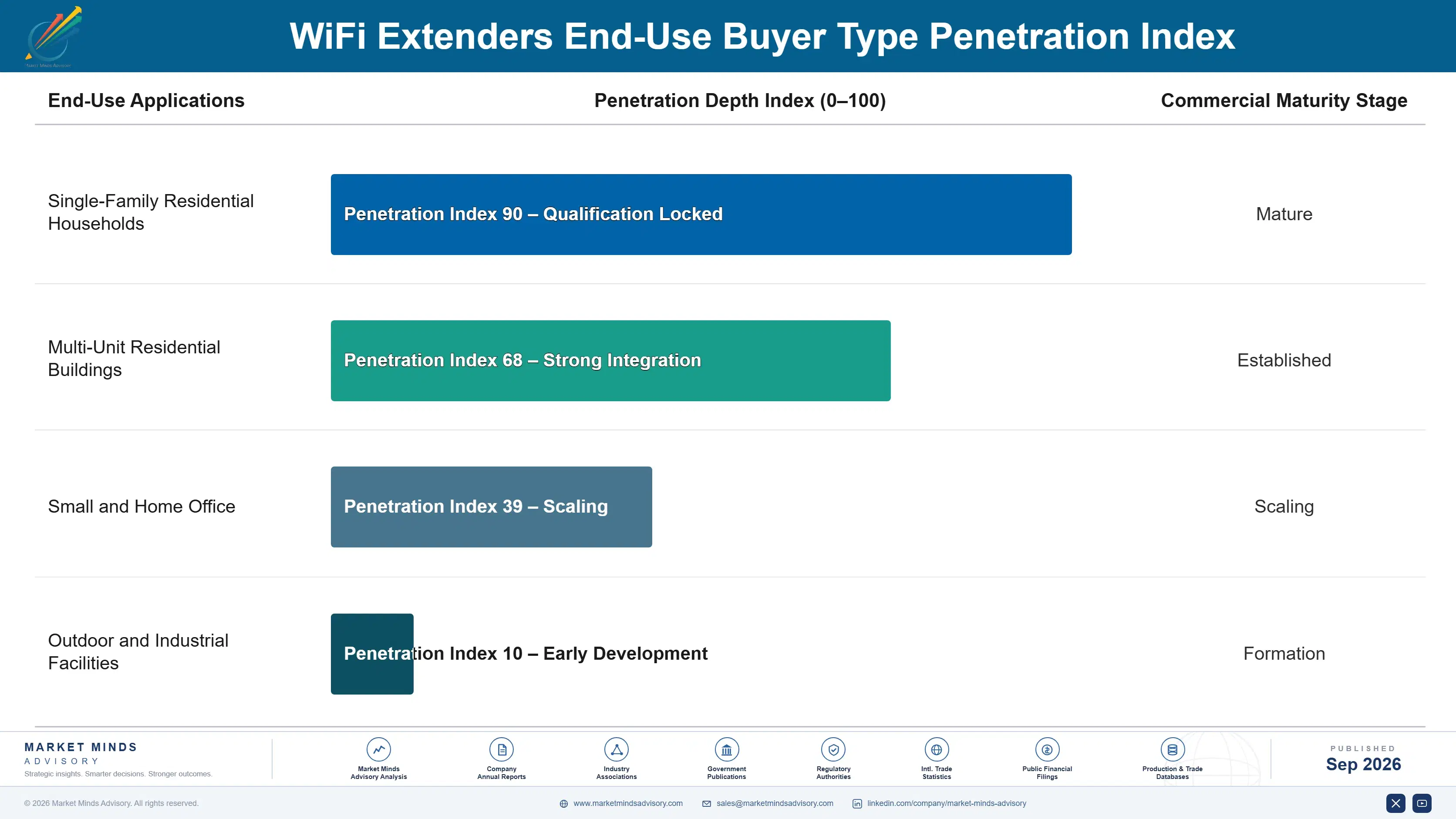
WiFi extender purchases increasingly behave like annuity assets rather than one-time hardware transactions, since subscription security services, extended support contracts, and broadband bundling renewal all generate ongoing revenue against a single initial mesh platform decision for years afterward. Vendors treating a sale as a one-time transaction cede lifetime value to rivals building recurring layers on top of the same household relationship. Vendors ignoring this compounding potential lose ground to better-instrumented rivals over time.
Adoption depth varies sharply by household type. Larger households with extensive smart home device counts integrate mesh platforms into daily routines with dedicated app engagement, producing deep, sticky relationships that survive individual hardware refresh cycles and encourage additional node purchases as coverage needs grow. Smaller households, by contrast, often purchase a single extender opportunistically around a specific coverage complaint, making that buyer segment more price-sensitive and less likely to engage with subscription add-on services.

A generational shift is also underway as younger homeowners who grew up expecting whole-home wireless coverage treat mesh systems as the obvious default architecture rather than an upgrade decision, skipping the single-node evaluation stage that earlier generations of homeowners still often started with by default.
wifi-extenders-market-end-use-penetration-index-1789988448376

Where To Place Extender Bets

These are among the four positions where our research anticipates prominent divergence between winners and laggards over the coming forecast period. Each is grounded in the demand model, the regulatory perimeter, and the announced capacity pipeline.
01 / MESH PLATFORM RELIABILITY INVESTMENT

Build reliable mesh coordination software before broadband bundling consolidates distribution

Vendors still selling primarily single-node hardware are leaving durable margin on the table while leaders expand mesh platforms that command meaningfully higher transaction value and stronger customer loyalty. The window to build comparable mesh reliability is narrowing as broadband providers increasingly standardize bundling partnerships around vendors who can demonstrate proven coordination performance at scale, risking permanent loss of preferred vendor status for those who wait. Smaller manufacturers should prioritize mesh platform investment now, even at near-term engineering cost and integration risk.
02 / SUBSCRIPTION SERVICE EXPANSION

Build recurring security service offerings ahead of competitors closing the monetization gap

Subscription security and parental control services command meaningfully higher recurring margin than hardware sales alone, and vendors without this capability are ceding valuable ongoing revenue to competitors who can demonstrate stronger household engagement. Building this capability requires investment in service infrastructure and app development beyond typical hardware sales, but the recurring revenue it delivers compounds through renewed subscriptions rather than any single sale alone. Vendors that invest now will capture disproportionate subscription share across the entire competitive global industry landscape.
03 / BROADBAND BUNDLING PARTNERSHIP STRATEGY

Build provider bundling relationships ahead of distribution consolidation

Broadband providers increasingly standardize hardware bundling around a small number of preferred vendor relationships rather than maintaining open competitive sourcing, and manufacturers slow to establish these partnerships risk losing entire distribution channels to competitors who moved earlier. Early bundling agreements set vendor preferences that later provider decisions increasingly reference, making early positioning disproportionately valuable beyond the immediate contract value alone, and vendors that win these relationships anchor channels for years. Manufacturers that invest in these relationships now will anchor distribution channels for years to come.
04 / CHIPSET SUPPLY RESILIENCE PLANNING

Diversify wireless chipset sourcing before the next semiconductor shortage arrives

The 2024 chipset shortage demonstrated how exposed manufacturers without direct chipset design relationships are to broader semiconductor supply chain dynamics entirely outside their own control. Manufacturers should pursue multi-supplier sourcing contracts and modular design standards simultaneously rather than betting on any single mitigation working alone to protect delivery timelines, since diversifying early protects margin more reliably than reacting after the fact. Waiting for the next shortage to begin diversifying will repeat the same delivery delays smaller manufacturers absorbed during 2024.

Engagement Snapshot From the Field

A live engagement with an industry participant carrying material or product regulatory and market exposure ahead of a defining policy shift, showing how our research translates into a defensible multi-year portfolio strategy.
MARKET MINDS ADVISORY · CLIENT ENGAGEMENT SUMMARY
WiFi Extenders Producer Strategic Portfolio Review and Transition Roadmap 2026·Investment Scenario on WiFi Extenders Exposure Evaluation 2025-26
CLIENT PROFILE
The client operates a mid-sized regional broadband provider serving suburban and rural markets across a single large national market, competing against larger national providers who had already begun bundling mesh hardware into premium subscription tiers. Customer churn data suggested coverage complaints were a meaningful factor in subscribers switching to competing providers offering bundled hardware. Leadership had grown increasingly concerned about the pace of subscriber losses.
STRATEGIC CHALLENGE
Management needed to decide which mesh hardware vendor to partner with for a bundling program, while also evaluating whether to bundle hardware at no additional cost within premium tiers or offer it as a discounted add-on purchase given the client's more constrained subscriber base compared to larger national competitors. Speed mattered given competitive pressure from larger providers already bundling.
MMA APPROACH
MMA benchmarked comparative churn reduction data from bundling programs at peer regional broadband providers gathered through primary interviews with similar-sized companies. The engagement modeled projected subscriber retention improvement under each bundling pricing approach against the client's specific subscriber base economics and competitive positioning. The analysis also weighed vendor reputation and installation support against internal alternatives.
KEY FINDINGS
  1. Fully bundled hardware at no additional cost reduced projected churn considerably more than a discounted add-on purchase approach., exceeding what the client's marketing team had initially projected
  2. The selected vendor's coverage prediction tools helped installation technicians reduce truck rolls for coverage complaints (client-reported, unverified by MMA)., a meaningful factor in the final vendor selection decision
  3. Bundling within only the premium subscription tier concentrated retention benefits where competitive pressure was strongest., supporting a more targeted retention investment strategy
  4. Competing regional providers that delayed similar bundling programs reported measurably higher subscriber churn during the same period., a gap the client specifically wanted to avoid repeating
CLIENT PROFILE
The client operates a mid-sized regional broadband provider serving suburban and rural markets across a single large national market, competing against larger national providers who had already begun bundling mesh hardware into premium subscription tiers. Customer churn data suggested coverage complaints were a meaningful factor in subscribers switching to competing providers offering bundled hardware. Leadership had grown increasingly concerned about the pace of subscriber losses.
STRATEGIC CHALLENGE
Management needed to decide which mesh hardware vendor to partner with for a bundling program, while also evaluating whether to bundle hardware at no additional cost within premium tiers or offer it as a discounted add-on purchase given the client's more constrained subscriber base compared to larger national competitors. Speed mattered given competitive pressure from larger providers already bundling.
MMA APPROACH
MMA benchmarked comparative churn reduction data from bundling programs at peer regional broadband providers gathered through primary interviews with similar-sized companies. The engagement modeled projected subscriber retention improvement under each bundling pricing approach against the client's specific subscriber base economics and competitive positioning. The analysis also weighed vendor reputation and installation support against internal alternatives.
KEY FINDINGS
  1. Fully bundled hardware at no additional cost reduced projected churn considerably more than a discounted add-on purchase approach., exceeding what the client's marketing team had initially projected
  2. The selected vendor's coverage prediction tools helped installation technicians reduce truck rolls for coverage complaints (client-reported, unverified by MMA)., a meaningful factor in the final vendor selection decision
  3. Bundling within only the premium subscription tier concentrated retention benefits where competitive pressure was strongest., supporting a more targeted retention investment strategy
  4. Competing regional providers that delayed similar bundling programs reported measurably higher subscriber churn during the same period., a gap the client specifically wanted to avoid repeating
RECOMMENDED STRATEGY
Phase 1: Phase 1 (Months 1 to 2): Finalize the mesh hardware vendor partnership and negotiate bundling pricing terms., weighing coverage prediction tools heavily throughout Phase 2: Phase 2 (Months 3 to 6): Launch bundling within the premium subscription tier across the client's largest markets., coordinating closely with installation and support teams Phase 3: Phase 3 (Months 7 to 10): Expand bundling availability across remaining markets based on validated retention results., ahead of the next major marketing campaign cycle
OUTCOME
Within ten months the client reported meaningfully reduced subscriber churn within the premium tier, alongside fewer coverage-related support calls than the prior year (client-reported, unverified by MMA), attributing both improvements to the bundling program and the vendor's coverage prediction tools. Staff confidence in the bundling program also improved measurably during the rollout.

Frequently Asked Questions

Foundational context covering the market sizes, CAGR, scope, country, region and competition that inform every finding below. This section is provided to cover basics and most often pre-purchase conversations, answered from the MMA Primary Research Dataset.

What is the current size of the WiFi Extenders Market?

The market is valued at 3.4 billion dollars in 2025. It is projected to reach 3.6 billion dollars in 2026 as mesh format adoption accelerates.

How large will the WiFi Extenders Market be by 2036?

The market is projected to reach roughly 7.2 billion dollars by 2036. That represents nearly double the 2026 value over the full ten-year forecast window.

What is the CAGR for the WiFi Extenders Market 2026 to 2036?

The base case CAGR is 7.0% annually through 2036. Bull and bear scenarios range from 5.8% to 8.3% depending on broadband bundling pace and router coverage improvements.

Which segment is growing fastest?

Wi-Fi 6E and 7 tri-band extenders lead at an 11.0% CAGR, well ahead of every other segment. That pace is roughly 1.57 times the overall market's average growth rate.

Who are the major companies in the WiFi Extenders Market?

NETGEAR, TP-Link, ASUS, Amazon, and Google lead the category by revenue, together holding roughly forty-two percent of total global category shipments across every product tier.

Which country is growing fastest?

China leads country-level growth at a 9.0% CAGR, ahead of every other national market tracked. Dense wireless networking hardware manufacturing capacity drives that leading pace.

Report Segmentation Architecture

The full report scope spans multiple orthogonal segmentation dimensions, with cross-tabulated demand data provided for each dimension pair. Coverage extends further to regional breakdowns, trend trajectories, and the competitive detail needed to support segment-level decision-making.

By Product Architecture

  • Wi-Fi 6E and 7 Tri-Band Extenders
  • Mesh WiFi System Nodes
  • Plug-In Wall Range Extenders
  • Powerline WiFi Extenders
  • Outdoor and Industrial WiFi Extenders
  • Enterprise Access Point Range Extenders

By End-Use Buyer Type

  • Single-Family Residential Households
  • Multi-Unit Residential Buildings
  • Small and Home Office
  • Outdoor and Industrial Facilities

By Commercial Dimension

  • Direct Retail Sales
  • Broadband Provider Bundled Distribution
  • Subscription Service Add-Ons
  • E-Commerce Channel

By Region

  • North America
  • Western Europe
  • East Asia
  • South Asia and Pacific
  • Latin America
  • Middle East and Africa
  • Eastern Europe

Scope, Methodology, and Coverage

Every figure in this report is reproducible from documented input assumptions. The scope below maps the historical period, the forecast horizon, the segmentation dimensions, and the countries covered, alongside the underlying primary and qualitative methodology.
Historical Period
2020 to 2025
Forecast Period
2026 to 2036
Base Year
2025 (USD billions; MMA Primary Research Dataset, September 2026)
Market Definition
This report covers WiFi extenders, hardware devices that receive and rebroadcast an existing wireless network signal to expand coverage area, including single-node repeaters, powerline-based extenders, and mesh system nodes sold as coverage-extending accessories to an existing router. It excludes standalone wireless routers sold as a network's primary access point, cellular signal boosters, and enterprise access point infrastructure sold as a complete managed network system rather than a coverage extension accessory.
Quantitative Units
USD billions (current prices); unit shipments where applicable
Segmentation Dimensions
By Product Architecture; By End-Use Buyer Type; By Commercial Dimension; By Region
Regions Covered
North America, Western Europe, East Asia, South Asia and Pacific, Latin America, Middle East and Africa, Eastern Europe
Countries Covered
USA, China, Germany, France, UK, Japan, South Korea, India, Australia, Canada, Brazil, Mexico, Indonesia, Vietnam, Thailand, Malaysia, UAE, Saudi Arabia, South Africa, Nigeria, Turkey, Poland, Netherlands, Italy, Spain, Sweden, Switzerland, Argentina, Colombia, Singapore, and additional markets relevant to this sector
Key Companies Profiled
NETGEAR Inc, TP-Link Systems Inc, ASUSTeK Computer Inc, Amazon.com Inc, Google LLC, D-Link Corporation, Linksys Holdings Inc, Ubiquiti Inc, Zyxel Communications Corp, Tenda Technology Co Ltd, Xiaomi Corporation, Huawei Technologies Co Ltd, Cisco Systems Inc, TRENDnet Inc, Belkin International Inc, Actiontec Electronics Inc, Devolo AG, AVM GmbH, Edimax Technology Co Ltd, Aruba Networks Inc
Quantitative Methodology
Primary survey, n=3,800 respondents, Q4 2025, six countries; demand-side model with trade association cross-validation
Qualitative Methodology
47 expert interviews, Q4 2025; applied to validate demand model assumptions, identify emerging dynamics, and assess competitive positioning
Report Format
PDF and XLSX data workbook (Word format preview document)
Publisher
Market Minds Advisory
Report Code
MMA-2026-TEC-604
Published
September 2026
Contact
sales@marketmindsadvisory.com | www.marketmindsadvisory.com

Purchase the full WiFi Extenders Market Report (2026 to 2036).

The full report delivers a complete quantitative and qualitative assessment of the WiFi extenders market through 2036, including segment-level sizing across all six product architecture categories and country-level detail across thirty markets. It profiles twenty vendors with comparative positioning on mesh reliability, subscription service depth, and broadband provider bundling relationships. Analysts also model three forecast scenarios against broadband bundling pace and router coverage improvements. Buyers receive the underlying data tables, primary survey results from 3,800 respondents, and 47 expert interviews supporting every forecast assumption in the report.
Segment-level sizing across six product architecture categories
Country-level data across thirty covered markets
Comparative competitive profiles of twenty vendors
Primary survey results from 3,800 respondents
Expert interview transcripts from 47 professionals
Five-year revenue lever and margin analysis

Built For The People Who Decide

From boardroom strategy to bench-side execution, this report is read cover-to-cover by leaders shaping the next decade of their industry, turning demand scenarios, market dynamics and valuation benchmarks into decisions.
CXOs/ Presidents/ VPs/ Managers
M&A and Corporate Development
Strategy Teams and R&D Heads
Procurement and Product Directors
Regulatory and Compliance Leaders
Investor Relations and Equity Analysts