Market Minds Advisory
Ultrasound Conductivity Gels Market

Ultrasound Conductivity Gels Market: Ultrasound Conductivity Gels: The Cheapest Thing in the Department

A coupling medium costing pennies a scan has caused documented bloodstream infection outbreaks, and the investigation into one of them costs thousands of times the department's entire annual gel budget.

Lead Analyst

Alice Ballenger

Published

September 2026

Make Smarter Decisions with Customized Research Insights

Request a free sample report and evaluate market opportunities, growth trends, and competitive dynamics relevant to your business needs.

2025 MARKET VALUE$0.4BMarket Size 2025
2036 FORECAST VALUE$0.8BBase Case , 2026 to 2036
CAGR 2026 TO 20366.8 %Bull 8.0% / Bear 5.6%
INCREMENTAL OPPORTUNITY$0.4BNet 10- year value creation
EXPANSION MULTIPLE1.93x2036 value over 2026 base
Strategic Levers
M&A Pipeline
Regional Outlook
Country Rankings
Competitive Intelligence
Segmental Deep-dive
Call-Us : 91 93563 13602

Executive Snapshot and Market Trajectory.

Coupling gel is water, a humectant and a thickener, it costs around eight cents a scan, and it has repeatedly caused hospital bloodstream infection outbreaks. Roughly 62% of departments decant bulk gel into smaller reusable bottles, which introduces contamination and voids whatever the manufacturer validated.
The economics behind that practice are entirely rational at department level and indefensible at hospital level. Refilling saves a genuinely trivial sum. An outbreak investigation costs thousands of times the annual gel spend, and tracing one back to the gel takes around 19 days during which nobody knows where the organism is coming from. By then a cluster of infections has already formed and more obvious sources have been eliminated one at a time.
What is actually changing the market is what ultrasound is now used for. Around 27% of examinations involve needle guidance, vascular access or biopsy, where the coupling medium sits at a puncture site rather than on intact skin. Sterile single-use sachets grow at 10.2%, half again the market rate of 6.8%, on that shift alone. That converts format from a departmental preference into a clinical specification.
Market Definition
Acoustic coupling media for diagnostic and therapeutic ultrasound, covering non-sterile bulk gel, sterile single-use sachets, non-sterile single-use sachets, sterile bottled and tube gel, gel pads and standoff media, and warming system compatible formats. Measured at manufacturer selling value. Excludes electrocardiography electrode gel, ultrasound systems and transducers, probe disinfectants and covers, and therapeutic ultrasound equipment.
Base Year Value
$0.4B in 2025 (MMA Primary Research Dataset, August 2026)
Forecast Period
2026 to 2036, eleven discrete annual values
CAGR
6.8% base case. Bull 8.0%. Bear 5.6%.
Fastest Growth Segment
Sterile Single-Use Sachets: 10.2% CAGR
Fastest Growth Country
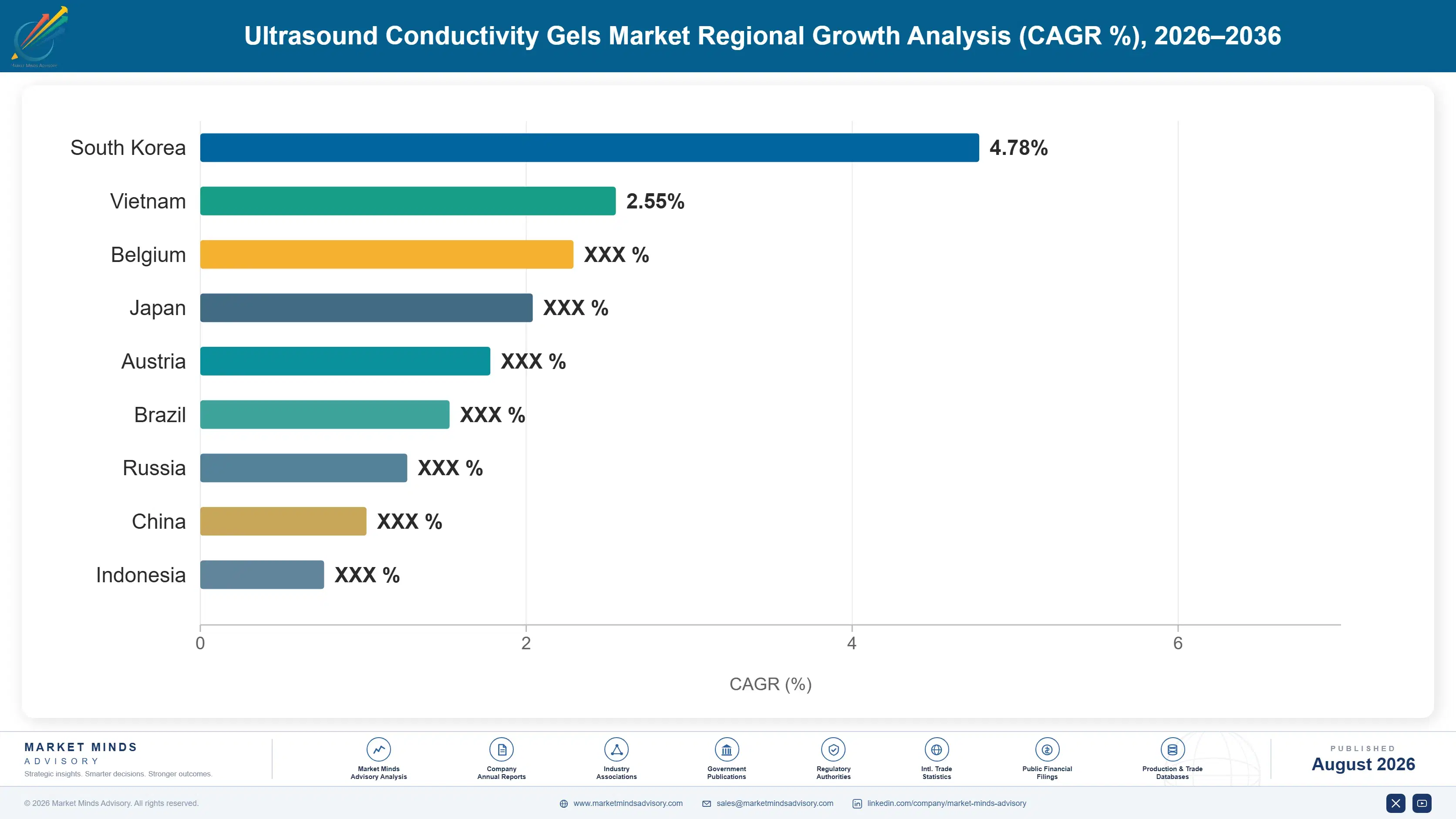
Vietnam: 12.4% CAGR
Fastest Growth Region
South Asia and Pacific: 8.8% CAGR
Largest Region
East Asia: 30% of 2025 global value
Market Leaders
Parker Laboratories, Eco-Med Pharmaceutical, National Therapy Products, Sonotech, HR Pharmaceuticals. Source: MMA Primary Research Dataset, July 2026.
Primary Survey
n=3,800 procurement and R&D decision-makers, Q4 2025, six countries
Methodology
Demand-side build-up, cross-validated against public data, 47 expert interviews

Ultrasound Conductivity Gels Market Forecast Scenarios

ultrasound-conductivity-gels-market-size-forecast-scenario-1787640987491
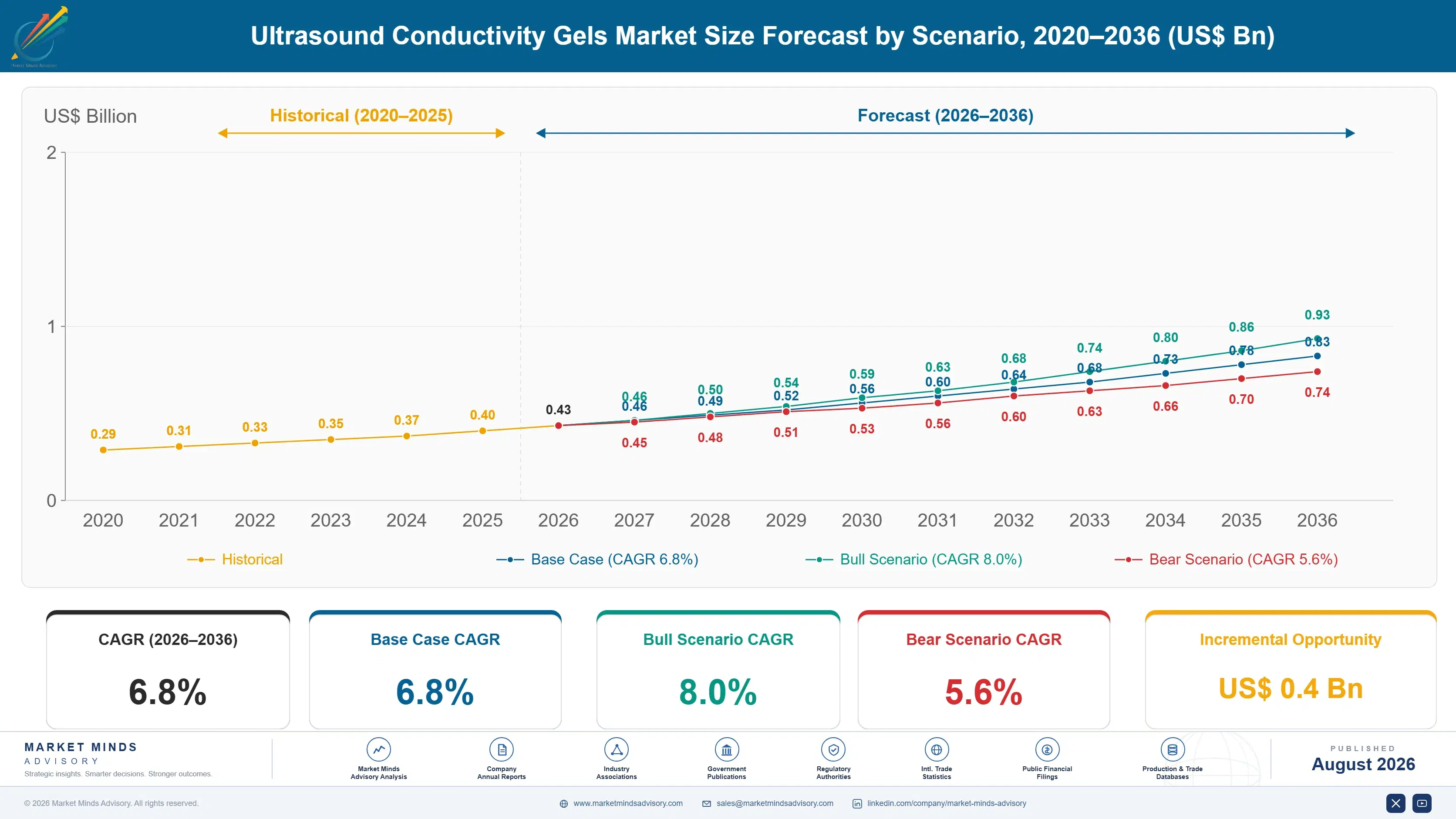
Growth ran near 5.4% between 2020 and 2025 and the shift in what ultrasound is used for mattered far more than any change in scan volume. Needle guidance, vascular access and regional anaesthesia moved from specialist practice into routine care across the period. Published outbreak investigations linked to contaminated gel accumulated steadily and infection control committees began writing single-use requirements into local policy.
Base case 6.8% rests on three mechanisms. Sterile single-use sachets grow at 10.2% as guided procedures become a larger share of examinations. Non-sterile single-use sachets grow at 8.4% because handheld ultrasound leaves the imaging department entirely and bottles do not travel well. And Vietnam grows fastest of any country at 12.4% on hospital imaging capacity expanding rapidly alongside point-of-care adoption. None depends on scan volume rising. Scan volume itself grows slowly and is reported late almost everywhere.
The bull case at 8.0% assumes infection control policy mandating single-use formats more widely, since each published outbreak makes the argument harder for a department to resist. The bear case at 5.6% is procurement continuing to buy on price per litre, which sustains bulk gel and the refilling practice that accompanies it regardless of what infection control committees would prefer.

Eight Cents and an Outbreak

Nothing in an imaging department costs less than the coupling medium and nothing has caused more trouble per cent spent. Ultrasound gel is essentially water held in suspension by a thickener with a humectant added, it costs around eight cents per examination, and its water content makes it an entirely hospitable environment for organisms once a container has been opened and handled repeatedly.
TOP FIVE CONCENTRATION40%Specialist gel makers compete against broad medical consumable distributors
BOTTLE REFILL PRACTICE62%Departments decanting bulk gel into smaller reusable containers
COST PER EXAMINATION8 centsPrice of coupling medium for a single routine examination
GUIDED PROCEDURE SHARE27%Examinations now requiring a sterile single-use coupling medium
OUTBREAK COST MULTIPLE4000xInvestigation expense against the annual gel spend involved
CONTAMINATION TRACING DELAY19 daysTime before an outbreak is traced back to gel
Around 62% of departments refill smaller bottles from bulk containers, a practice that saves a genuinely negligible sum and voids every validation the manufacturer performed. Published investigations have traced bloodstream infection outbreaks to exactly that behaviour, and tracing takes around 19 days. The investigation alone costs thousands of times the department's entire annual expenditure on the product.
The commercially significant change is not infection control policy but what ultrasound has become. Roughly 27% of examinations now involve needle guidance, vascular access, biopsy or regional anaesthesia, where the coupling medium sits directly at a puncture site rather than on intact skin. That converts sterile single-use format from a preference into a requirement, and it explains why sterile sachets grow at 10.2% while bulk gel volume grows barely at all.
"Somebody saves four pounds a month refilling bottles and the hospital spends six figures working out why patients keep growing the same organism. Everybody knows this and the bottles keep getting refilled."
Director, Imaging Consumables and Infection Prevention Practice · MMA Medical Devices and Diagnostics Practice · August 2026

Market Trends

Guided procedures converting coupling medium into a sterile requirement

Around 27% of examinations now involve needle guidance, vascular access, biopsy or regional anaesthesia, where the gel sits at a puncture site rather than on intact skin. That removes any argument about whether sterility matters and makes single-use sterile format a specification rather than a preference. Sterile sachets grow at 10.2% on that shift, and the growth follows procedure type rather than any increase in the number of scans performed. Sterility assurance cannot be maintained in a refillable container, which removes the format debate entirely for these procedures. Procedure mix is the variable.
Market Impact: Vietnam growing fastest at 12.4%
Handheld ultrasound leaving the department and the bottle behind

Point-of-care ultrasound put probes in ambulances, wards, clinics and community settings where a five hundred millilitre bottle is impractical and refilling is impossible. Non-sterile single-use sachets grow at 8.4% because the format travels and the bottle does not. Consumable supply chains built around imaging department stores are reaching a fraction of the locations where scanning now actually happens across most health systems. Handheld probes at most institutions now outnumber department systems, and none of that consumption reaches a supplier selling through imaging tenders alone. Bottles simply do not travel. Coverage misses them.
Market Impact: Tracing takes about 19 days

Market Opportunities and Growth Drivers

Imaging capacity and point-of-care adoption expanding together

Vietnam grows fastest of any country at 12.4% as hospital imaging capacity expands rapidly while handheld ultrasound reaches clinics and district facilities at the same time. Each alone would lift consumption and together they compound. Suppliers organised around established imaging geographies are covering departments where scan volumes settled years ago, in markets where the number of probes in circulation is growing far more slowly. Device shipment data predicts consumable demand considerably better than examination statistics, which most systems collect poorly and report late. Probes are the useful unit. Probes keep multiplying.
Market Impact: About 62% still refill bottles

Outbreak publication making the argument for departments

Each published investigation linking a bloodstream infection cluster to contaminated coupling gel makes single-use format harder for a department to refuse, because the evidence is specific, documented and awkward to dismiss in a committee meeting. Infection control functions increasingly write the requirement into local policy rather than recommending it. That converts a procurement conversation about price per litre into a policy compliance question instead. Nobody wishes to be the person who overruled infection control shortly before an outbreak, which is a powerful argument in its own right. Committees rarely overrule that.
Market Impact: Detection takes about 19 days

Market Restraints and Challenges

Price per litre purchasing sustaining the refilling practice

Procurement buys coupling medium on price per litre because at around eight cents an examination nothing else appears to matter, and bulk containers win that comparison every time. Roughly 62% of departments then refill smaller bottles from them. The root cause is that the saving lands in a consumables budget while the consequence lands in infection control. Whole cost presentation and infection control policy are the routes that actually change it. Presenting the arithmetic to infection control rather than to procurement reaches the function that owns the consequence. Price per litre answers the wrong question entirely.
Market Impact: Guided procedures reach 27% of scans

Contamination invisible until an outbreak is already established

Contaminated gel produces no visible change, no smell and no immediate clinical event, so nothing prompts anybody to question it until a cluster of infections has already formed and around 19 days of investigation have eliminated more obvious sources. The root cause is that the product looks identical whether or not it is contaminated. Single-use format, tamper evidence and validated dispensing are the working mitigations available. The product looks and smells identical whether or not it is contaminated, which is the whole difficulty. Single-use format removes the exposure by construction.
Market Impact: Single-use sachets growing at 8.4%
4 additional market trends, 3 additional growth drivers, and 2 additional restraints and challenges are covered in the full report. Contact sales@marketmindsadvisory.com to access the complete intelligence.

Segment CAGR and Growth Architecture

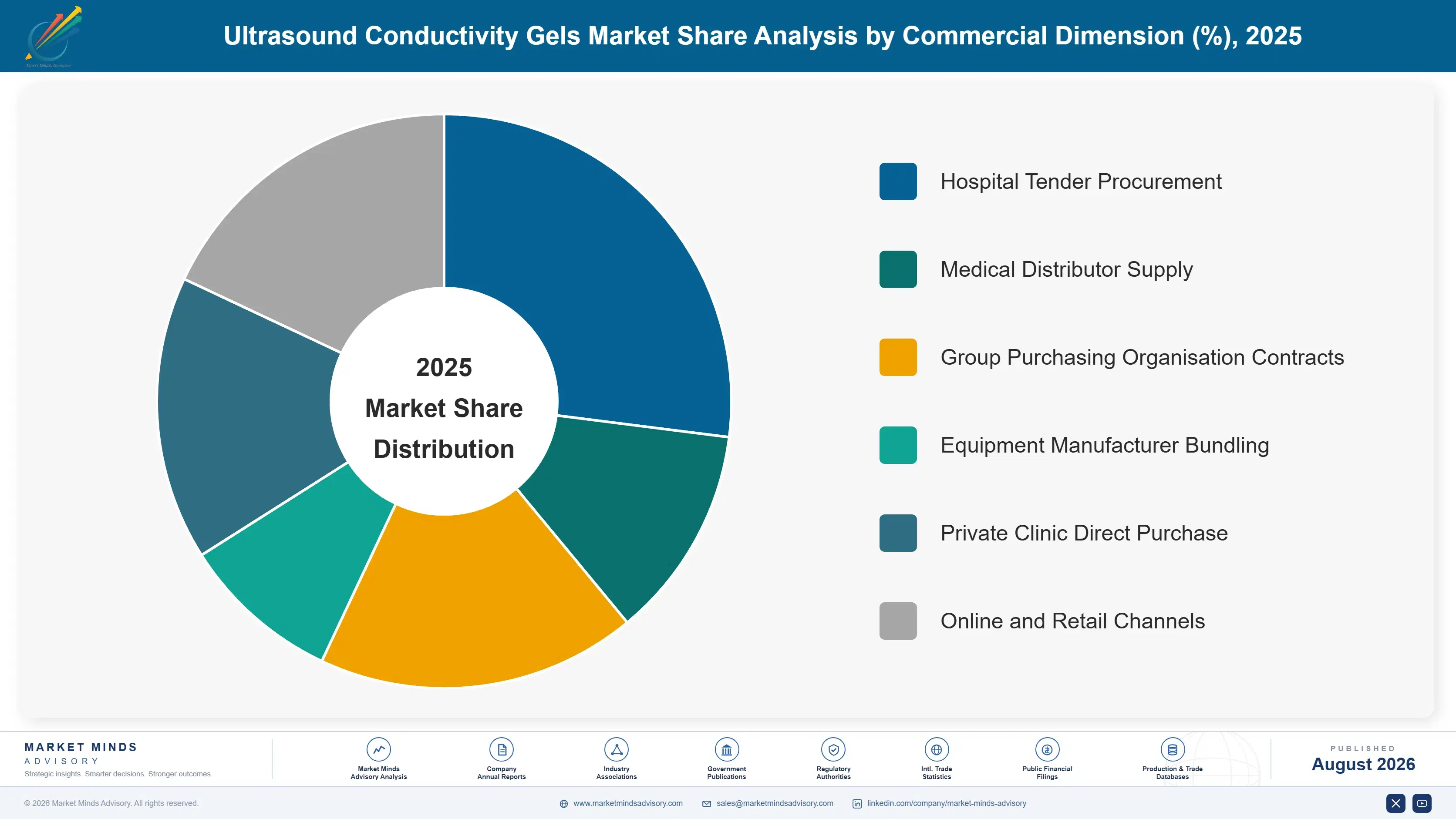
Six segments split by product format, because format determines the sterility assurance provided, whether refilling is possible, the setting the product can practically be used in and the price per examination it carries. Volume and viscosity variants sit inside each format. Care setting and channel dimensions are handled separately within the framework. Format decides the buyer.
ultrasound-conductivity-gels-market-market-share-analysis-1787640988044

Sterile Single-Use Sachets

Growing at 10.2%, half again the market rate of 6.8%, sterile single-use sachets serve the roughly 27% of examinations involving needle guidance, vascular access, biopsy or regional anaesthesia, where the coupling medium contacts a puncture site rather than intact skin. Sterility assurance cannot be maintained in a refillable container, which removes the format argument entirely for these procedures. Cost per examination runs many times bulk gel and is genuinely irrelevant against the procedure it accompanies. Growth follows procedure mix rather than examination count, which means forecasting against total scan volume understates the value shift underneath it considerably. Sterile filling capability rather than formulation is what limits the qualified supplier field in this segment considerably.
CAGR 10.2%

Non-Sterile Single-Use Sachets

At 8.4% non-sterile sachets serve point-of-care ultrasound in ambulances, wards, clinics and community settings where a bulk bottle is impractical to carry and impossible to refill hygienically. The format eliminates the refilling practice by construction rather than by policy, which is why infection control functions favour it even where sterility is not clinically required. Distribution reach into non-imaging settings matters far more here than any product characteristic does. Infection control functions favour the format even where sterility is not clinically required, precisely because it removes refilling by construction rather than relying on anybody following a policy. Distribution into wards, ambulances and community clinics decides who supplies it rather than any product characteristic at all.
CAGR 8.4%
Full segment breakdown across 6 segments available in the complete report.

Regional Architecture and Country Demand Map

East Asia holds 30% of value on imaging examination volume and manufacturing capability together. North America follows at 24% on point-of-care adoption and infection control policy driving format upgrade. South Asia and Pacific grows fastest of the seven regions covered here. Probe counts drive both.

North America

Point-of-care ultrasound adoption is the most advanced anywhere, with probes in emergency departments, wards, ambulances and increasingly in primary care, which pulls demand toward portable formats the imaging department never handled. Infection control committees write single-use requirements into policy more readily here than elsewhere. Guided vascular access is standard practice rather than optional. Growth at 6.0% reflects format upgrade rather than any increase in examinations performed. Handheld probes now substantially outnumber department systems at many institutions, which puts most of the consumption outside the tender that supplies it. Guided vascular access is standard practice rather than an option, which places sterile format demand across most acute institutions. Format upgrade rather than volume drives growth.
Share: 24% | CAGR: 6.0% (2026 to 2036)

Western Europe

Infection prevention policy is well developed and several national bodies have issued specific guidance on coupling medium handling following published outbreak investigations. Refilling persists nonetheless in departments where procurement operates independently of infection control. Regional anaesthesia and guided access are routine across most systems. Regional growth of 5.2% is the slowest anywhere on mature examination volumes and a format transition already partly completed. Several national bodies have issued specific guidance on coupling medium handling following published outbreak investigations across the region. Regional anaesthesia and guided access are routine across most systems, and refilling persists where procurement operates independently of infection control. A format transition has already partly completed here across the better funded systems.
Share: 22% | CAGR: 5.2% (2026 to 2036)
Regional intelligence for 5 additional markets available in the complete report: East Asia, South Asia and Pacific, Latin America, Middle East and Africa, Eastern Europe. Contact sales@marketmindsadvisory.com.
ultrasound-conductivity-gels-market-country-cagr-analysis-1787640988574

Four Moves Against Eight Cents

Nobody can win a price argument on a product costing eight cents a scan, and nobody needs to. What remains available is following the procedure rather than the scan, reaching the settings the imaging department never supplied, and putting the outbreak arithmetic in front of the committee that owns the consequence. Procurement is the wrong door.

Follow the procedure, not the examination count

Around 27% of examinations now involve needle guidance, vascular access, biopsy or regional anaesthesia, and those procedures require sterile single-use coupling medium regardless of price. Sterile sachets grow at 10.2% on that basis alone. Suppliers forecasting against total scan volume are tracking a number that grows slowly, while the procedure mix underneath it shifts toward formats worth many times more per examination. Format decides the price, not the litre. Sterile sachets grow at 10.2% while bulk volume grows barely at all, which is a mix shift rather than a market expansion.
Market Impact: Serves the whole 27% share of guided procedures

Supply the places the department never reached

Point-of-care ultrasound put probes in ambulances, wards, clinics and community settings where a bulk bottle cannot travel and cannot be refilled hygienically, and non-sterile sachets grow at 8.4% accordingly. Consumable supply chains built around imaging department stores reach a fraction of those locations. Distribution into non-imaging settings is worth more here than any formulation improvement a supplier could realistically develop. A bulk bottle cannot be carried in an ambulance or cleaned adequately inside one, which settles the format question without anybody debating policy at all. Distribution decides it. Ambulances cannot carry bottles.
Market Impact: Sachet formats growing at 8.4% every single year

Put the outbreak arithmetic to infection control

Refilling saves a trivial sum while an outbreak investigation costs thousands of times the annual gel spend, and roughly 62% of departments refill anyway because the saving and the consequence sit in different budgets. Procurement will never resolve that on its own. Presenting the arithmetic to infection control, which owns the consequence and can write policy, reaches the only function able to change the practice. Infection control can write policy where procurement can only negotiate price. An outbreak investigation costs thousands of times the annual gel spend, which is an argument procurement has no way of hearing.
Market Impact: Ends the refilling across all 62% of departments

Follow probe counts rather than department volumes

Vietnam grows fastest at 12.4% because hospital imaging capacity and handheld adoption expand simultaneously, and consumption follows the number of probes in circulation rather than the throughput of any single department. Suppliers organised around established imaging geographies are covering markets where probe numbers settled years ago. Device shipment data predicts consumable demand considerably better than examination statistics ever do. Probe counts rather than department throughput predict consumption, and device shipment data is published while examination statistics frequently are not. Coverage rarely follows probes. Device shipments are published openly and predict this demand precisely.
Market Impact: Follows the 12.4% Vietnamese probe population growth rate

Who Controls the Margin Pool

Participation is measured on annual revenue from acoustic coupling media, and the top five hold 40%. Concentration is moderate and unusually shaped, because specialist gel manufacturers with acoustic formulation expertise compete against broad medical consumable distributors carrying the product as one line among thousands. The gap to challengers is sterile filling capability on one side and distribution breadth on the other, which are entirely different things to build.
Competition runs on three fronts. Formulation and acoustic performance decide specialist positions, where transducer manufacturers occasionally have views. Distribution breadth decides access to non-imaging settings. And tender pricing decides bulk volume, awarded on price per litre with nothing else considered. Each front rewards a different capability, and very few participants hold more than one of them properly.

Pressure ahead comes from guided procedures requiring sterile format and from point-of-care ultrasound spreading beyond imaging. Expect suppliers with sachet manufacturing and broad distribution to gain. Rankings shift on whoever reaches infection control rather than procurement. Concentration should stay moderate given the split. Bulk only manufacturers without sachet capability look most exposed as guided procedures and portable scanning both pull demand toward formats they cannot make.
ultrasound-conductivity-gels-market-company-positioning-matrix-1787640989090

Competitive Moat and Risk Dimensions

PARKER LABORATORIES

Moat: Acoustic formulation and transducer compatibility

Long established acoustic formulation expertise and transducer manufacturer compatibility endorsements give the brand a specification position that a general consumable supplier cannot readily claim, particularly where equipment warranties reference approved coupling media. That relationship with transducer makers took decades to build and is renewed with each new probe generation rather than won once.
PARKER LABORATORIES

Risk: Price per litre tender exposure

Bulk gel is procured on price per litre with acoustic performance treated as identical across suppliers, which leaves formulation expertise commercially invisible in the segment carrying most of the volume. Defending that volume requires the specification argument to reach somebody other than procurement, and procurement rarely invites anybody else into the conversation.
ECO-MED PHARMACEUTICAL

Moat: Sterile sachet manufacturing capability

Sterile single-use sachet production requires validated aseptic filling and packaging capability that bulk gel manufacturing does not provide, and it serves the segment growing fastest as guided procedures become routine. That capability is expensive to establish and slow to qualify, which keeps the field considerably narrower than the bulk segment.
ECO-MED PHARMACEUTICAL

Risk: Distributor channel dependence

Reaching point-of-care settings outside imaging departments requires distribution into wards, ambulances and community clinics that a specialist manufacturer rarely holds directly. That leaves growth dependent on distributors carrying the product actively rather than merely listing it, and a distributor with thousands of lines has little reason to promote one costing pennies.

Players Tracked

Prominent Players

Parker Laboratories
Eco-Med Pharmaceutical
National Therapy Products
Sonotech
HR Pharmaceuticals

Other Key Players

Ultragel Hungary
Next Medical Products
Wavelength Medical
Medline Industries
Cardinal Health
Ecolab
Pharmaceutical Innovations
Besmed Health Business
Ceracarta
Asept InMed
GE HealthCare
Fujifilm Sonosite
Owens and Minor
Henry Schein
McKesson

Recent Developments

FEBRUARY 2026

Hospital traces infection cluster to refilled gel bottles

An infection control investigation traced a bloodstream infection cluster to coupling gel decanted into reusable bottles, after eliminating more obvious sources across nearly three weeks of surveillance and environmental sampling first. Bulk purchasing was discontinued immediately afterwards. The saving it had produced was trivial. Policy followed.
Signal: Nobody ever suspects the coupling gel until every more obvious source has first been carefully eliminated
SEPTEMBER 2025

Anaesthesia guidance requires sterile medium for regional blocks

A national anaesthesia body required sterile single-use coupling medium for all ultrasound guided regional blocks, converting format from departmental preference into a documented standard of practice for those procedures. Departments could no longer treat format as a local budget decision. Compliance was auditable. Sachet volume rose sharply.
Signal: Guided procedures removed any remaining argument about whether the coupling medium format actually matters clinically here
DECEMBER 2025

Ambulance service adopts sachet format for handheld scanning

An ambulance service adopted single-use sachets across its handheld ultrasound fleet after finding bottles impractical to carry, impossible to clean adequately in a vehicle and unusable within existing infection control policy. Bottles had been carried and refilled informally beforehand. Nobody had authorised that practice. Sachets travel.
Signal: Portable scanning made the bottle format entirely unworkable anywhere at all outside a hospital imaging department

Water, Thickener and Packaging

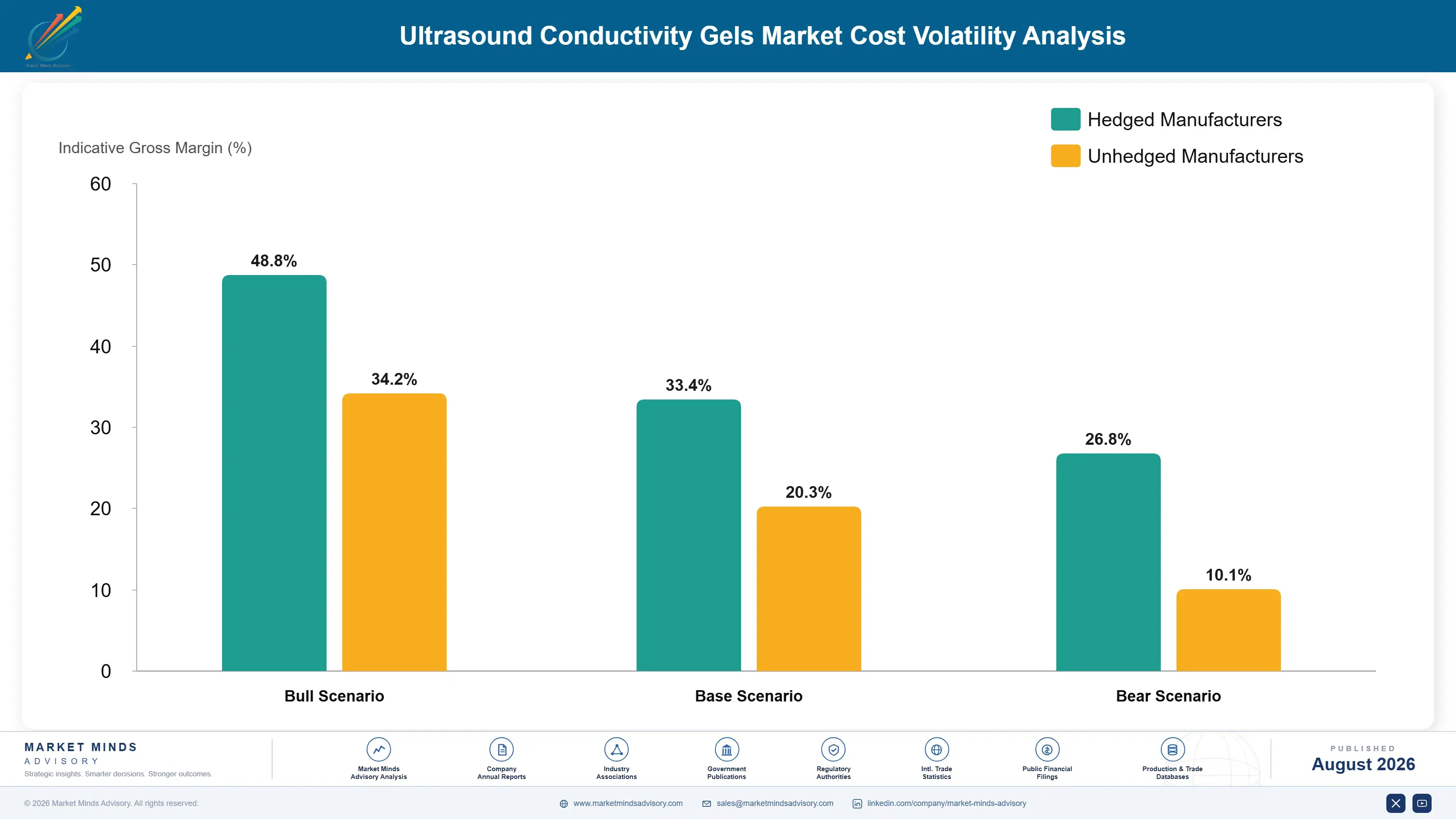
Purified water, propylene glycol and carbomer or cellulose thickeners carry around 23% of bulk gel cost, which is remarkably low and explains why price per litre competition is so severe. Packaging accounts for roughly 41% across bulk formats and considerably more in sachets, where the pack costs more than the contents. Sterilisation and validated aseptic filling absorb about 18% of sterile product cost. Distribution and quality release take the balance.
Propylene glycol and packaging film pricing both moved across recent years, per published chemical market reporting and Ecolab annual reporting for 2025 on input cost commentary. Manufacturers passed very little through on bulk gel, where tenders award on price per litre and substitution is immediate, and considerably more on sterile formats where the qualified supplier field is narrow. Sterile filling capacity is expensive to leave idle.

Exposure divides on format rather than on scale. A bulk gel manufacturer carries packaging across more than two fifths of cost against tender pricing that ignores everything else. A sachet producer carries higher packaging cost supported by pricing that reflects format rather than volume. A sterile manufacturer carries validated filling capacity, which is expensive and idle unless demand justifies the line running continuously.
ultrasound-conductivity-gels-market-cost-volatility-analysis-1787640989285

Shift mix toward formats priced on function not volume

Bulk gel competes on price per litre with formulation treated as identical, which leaves no defensible position for anybody. Sterile and single-use formats price against the procedure they accompany rather than against a litre of anything, and the packaging cost that makes them look expensive is precisely what removes the refilling practice buyers cannot otherwise abandon.

Locate manufacture close to the consuming market

Gel is mostly water and packaging, both of which travel poorly relative to their value, so freight consumes a meaningful share of delivered cost on any international shipment. Regional manufacturing wins on delivered price without any formulation advantage, which is why domestic producers hold strong positions in most large markets regardless of what specialists offer.

Size sterile filling capacity against contracted volume

Validated aseptic filling lines are expensive to establish and expensive to leave idle, and sterile demand arrives through guided procedure growth rather than through any single large contract. Sizing capacity against contracted rather than forecast volume avoids the position where a line built for anticipated demand runs well below the utilisation its economics assumed.

Portfolio Architecture for Margin Defence

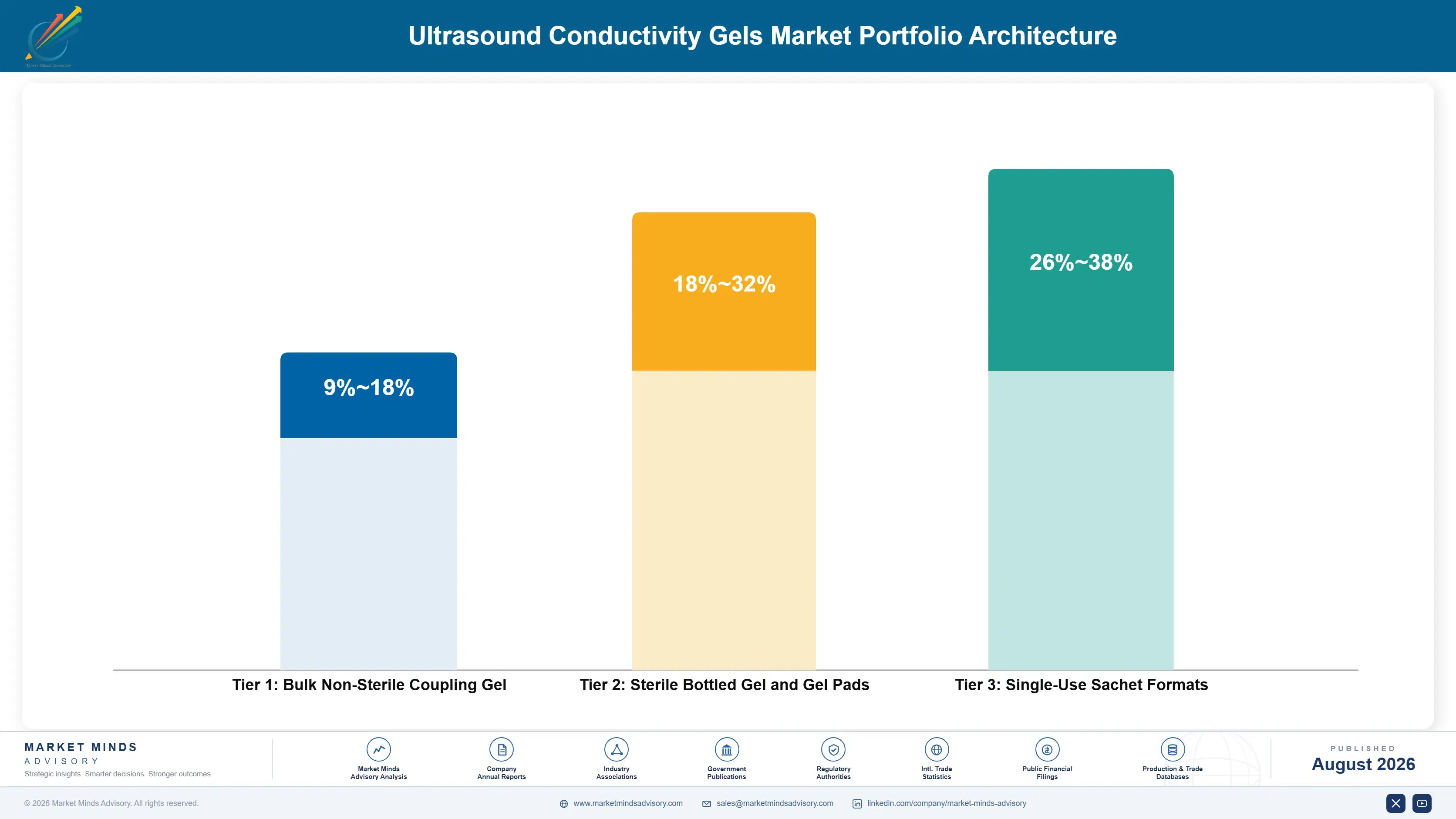
Margin here follows format rather than formulation, because acoustic performance is treated as identical across suppliers by everybody except a handful of transducer engineers. Bulk non-sterile gel earns margins in the high single digits to high teens, procured on price per litre with nothing else evaluated and substitution effectively instantaneous. Nothing distinguishes one supplier from another at that level.
Bottled sterile gel and gel pads do better in the high teens to low thirties, because both carry sterility assurance or a physical function that bulk product cannot replicate at any price. Standoff pads in particular serve applications where no liquid medium works at all. Sterile bottled product sits awkwardly between the two.

Sterile and non-sterile single-use sachets hold the strongest position, reaching into the high thirties, where the format itself is what is being purchased and price per litre becomes a meaningless comparison. Those margins depend on guided procedure growth and infection control policy continuing, and would compress if procurement ever succeeded in reframing sachets as an expensive way to buy the same gel. Guided procedure growth and infection control policy together sustain the position, and neither shows any sign of reversing.

Bulk Non-Sterile Coupling Gel

Product procured purely on price per litre with substitution effectively instantaneous. The nine point range reflects manufacturing location and packaging cost rather than any acoustic difference between suppliers. Refilling follows almost automatically.
Gross Margin: 9-18%

Sterile Bottled Gel and Gel Pads

Products carrying sterility assurance or a physical standoff function bulk gel cannot replicate. The fourteen point range reflects sterile capability and how specialised the pad application actually is. Function rather than volume prices them.
Gross Margin: 18-32%

Single-Use Sachet Formats

Formats where the packaging is the product and price per litre stops meaning anything at all. The twelve point range reflects sterile capability and distribution reach into non-imaging care settings.
Gross Margin: 26-38%
ultrasound-conductivity-gels-market-portfolio-architecture-1787640989790

High-value Sub-segments and Strategic Watch-out

Sterile Single-Use Sachets

High value and the fastest growth at 10.2%, required wherever coupling medium contacts a puncture site rather than intact skin. Guided procedure share rather than scan volume drives it entirely. Cost per examination is many times bulk gel and genuinely irrelevant against the procedure it accompanies.
Gross Margin: 28-38%

Non-Sterile Single-Use Sachets

High value and growing at 8.4% as handheld probes reach settings a bulk bottle cannot travel to. Distribution into non-imaging locations matters more than any product characteristic here. The format removes refilling by construction, which infection control values independently of sterility. Policy compliance is unnecessary.
Gross Margin: 26-36%

Bulk Non-Sterile Gel

The volume core, procured on price per litre with acoustic performance assumed identical across every supplier. Roughly 62% of buying departments then refill smaller bottles from it anyway. Substitution is instantaneous and nothing but delivered price is ever evaluated in the tender. Refilling follows almost inevitably.
Gross Margin: 9-18%

Refilling Practice Exposure

The strategic watch-out. Refilling voids validation and has caused documented outbreaks, and the range reflects whether a supplier reaches infection control or sells only into procurement tenders. Policy written by infection control is what actually ends the practice at an institution. Construction beats policy reliably.
Gross Margin: 0-35%

Consumed Per Scan, Bought Per Litre

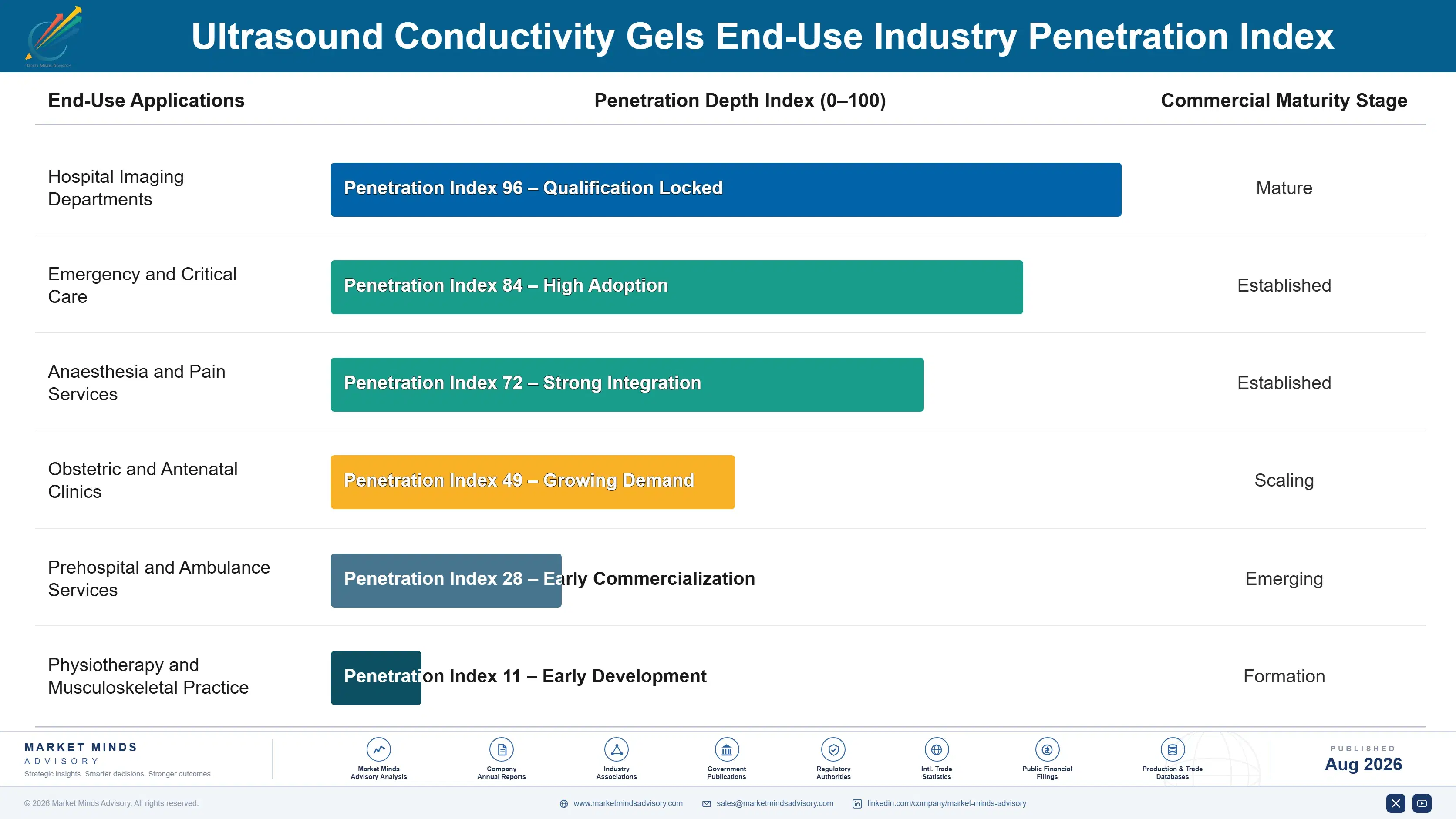
Demand here is entirely mechanical and unusually predictable, because every examination consumes coupling medium and no examination can proceed without it. Consumption therefore tracks the number of probes in use and how often each is applied, which makes device shipment data a better forecasting basis than examination statistics that most health systems collect poorly and report late. Probe counts are the useful number.
Stickiness barely exists in bulk supply, where tenders reopen annually and substitution requires nothing of anybody. It is considerably stronger in sterile and sachet formats, where infection control policy naming a format creates a requirement that procurement must satisfy rather than optimise. Transducer manufacturer compatibility statements add a further layer that occasionally survives a tender intact. Policy creates a requirement rather than a preference.

The deciding party depends entirely on which conversation is happening. Procurement decides bulk volume on price per litre. Infection control decides format where policy exists. Clinicians performing guided procedures decide what they will accept at a puncture site, and their view is rarely overruled because nobody wishes to be the person who did so before an outbreak. Three functions, three conversations.
ultrasound-conductivity-gels-market-end-use-penetration-index-1787640990283

Where We Would Put Effort

These are among the four positions where our research anticipates prominent divergence between winners and laggards over the coming forecast period. Each is grounded in the demand model, the regulatory perimeter, and the announced capacity pipeline.
01 / PROCEDURE MIX TARGETING

Scan counts hide what actually matters

Around 27% of all examinations now involve needle guidance, vascular access, biopsy or regional anaesthesia, and every one of those procedures requires a sterile single-use coupling medium regardless of what it happens to cost. Sterile sachets grow at 10.2% on that procedure shift alone rather than on any growth in scan volume. Suppliers still forecasting against total examination counts are tracking a very slow moving number while the procedure mix underneath it shifts toward formats worth many times more each.
02 / NON-IMAGING DISTRIBUTION REACH

The probes left the department entirely

Point-of-care ultrasound has now placed probes into ambulances, wards, outpatient clinics and community settings where a bulk gel bottle cannot travel and cannot be refilled hygienically by anybody at all. Non-sterile single-use sachet formats are growing at 8.4% accordingly, while consumable supply chains built entirely around imaging department stores reach only a small fraction of those locations. Distribution reach into non-imaging care settings is worth considerably more here than any formulation improvement that a supplier could realistically develop and launch.
03 / INFECTION CONTROL ACCESS

Procurement cannot fix this problem

Refilling saves a genuinely trivial sum while a single outbreak investigation costs thousands of times the annual gel spend, and roughly 62% of departments refill anyway, because the saving and the consequence sit in two entirely different budgets. Procurement will never resolve that on its own and has no particular reason to try either. Presenting that arithmetic to infection control, which owns the consequence and can actually write policy, reaches the only hospital function that is genuinely capable of changing anything here.
04 / PROBE POPULATION TRACKING

Devices predict this, examinations do not

Vietnam grows fastest of any country covered here at 12.4% because its hospital imaging capacity and handheld adoption are both expanding simultaneously, and consumption follows the total number of probes in circulation rather than the throughput of any one individual department. Suppliers still organised around the established imaging geographies are covering markets where probe populations settled several years ago. Device shipment data predicts consumable demand considerably better than examination statistics ever manage to, and it happens to be published openly.

Engagement Snapshot From the Field

A live engagement with an industry participant carrying material or product regulatory and market exposure ahead of a defining policy shift, showing how our research translates into a defensible multi-year portfolio strategy.
MARKET MINDS ADVISORY · CLIENT ENGAGEMENT SUMMARY
Ultrasound Conductivity Gels Producer Strategic Portfolio Review and Transition Roadmap 2026·Investment Scenario on Ultrasound Conductivity Gels Exposure Evaluation 2025-26
CLIENT PROFILE
A medical consumables manufacturer supplying bulk and bottled ultrasound coupling gel to hospital imaging departments across European and Asian markets, at annual revenue near 64 million dollars (client-reported, unverified by MMA). Sachet capability was absent and selling ran entirely through procurement tenders. Infection control functions had never been contacted at any customer institution. Coverage was tender based.
STRATEGIC CHALLENGE
Bulk tender pricing had compressed to almost nothing while sachet formats the business could not supply were growing quickly. Management wanted to know whether investing in sachet filling made sense in a market where the product costs pennies per examination. Volume was holding while margin disappeared entirely. Nothing in the tender changed.
MMA APPROACH
MMA quantified guided procedure share across customer institutions, traced where handheld probes had been deployed outside imaging departments, modelled sachet filling economics against contracted rather than forecast volume, and mapped which hospital function actually decided format. Interviews with 47 experts covered radiology, infection prevention, anaesthesia, emergency medicine and hospital procurement.
KEY FINDINGS
  1. Guided procedures accounted for a considerably larger share of examinations than the client had assumed, and every one of them required a format the business did not manufacture.
  2. Handheld probes at customer institutions substantially outnumbered department systems, and none of that consumption was reaching the client through imaging department tenders.
  3. Infection control functions had recommended single-use formats at most institutions examined, and procurement had overridden the recommendation on price per litre grounds every time.
  4. Sachet filling economics worked at contracted volumes because the qualified field was narrow, though absolute revenue remained modest against the capital required.
CLIENT PROFILE
A medical consumables manufacturer supplying bulk and bottled ultrasound coupling gel to hospital imaging departments across European and Asian markets, at annual revenue near 64 million dollars (client-reported, unverified by MMA). Sachet capability was absent and selling ran entirely through procurement tenders. Infection control functions had never been contacted at any customer institution. Coverage was tender based.
STRATEGIC CHALLENGE
Bulk tender pricing had compressed to almost nothing while sachet formats the business could not supply were growing quickly. Management wanted to know whether investing in sachet filling made sense in a market where the product costs pennies per examination. Volume was holding while margin disappeared entirely. Nothing in the tender changed.
MMA APPROACH
MMA quantified guided procedure share across customer institutions, traced where handheld probes had been deployed outside imaging departments, modelled sachet filling economics against contracted rather than forecast volume, and mapped which hospital function actually decided format. Interviews with 47 experts covered radiology, infection prevention, anaesthesia, emergency medicine and hospital procurement.
KEY FINDINGS
  1. Guided procedures accounted for a considerably larger share of examinations than the client had assumed, and every one of them required a format the business did not manufacture.
  2. Handheld probes at customer institutions substantially outnumbered department systems, and none of that consumption was reaching the client through imaging department tenders.
  3. Infection control functions had recommended single-use formats at most institutions examined, and procurement had overridden the recommendation on price per litre grounds every time.
  4. Sachet filling economics worked at contracted volumes because the qualified field was narrow, though absolute revenue remained modest against the capital required.
RECOMMENDED STRATEGY
Phase 1: Phase one: take the outbreak cost arithmetic to infection control functions, since procurement has no incentive to act on a risk it does not carry. Phase 2: Phase two: invest in sachet filling capability, because guided procedures and portable scanning both require a format the business cannot currently supply. Phase 3: Phase three: build distribution into wards, ambulances and clinics rather than imaging department stores alone. Probes outnumber department systems now.
OUTCOME
The manufacturer engaged infection control functions directly during 2026 and single-use specification improved at several institutions (client-reported, unverified by MMA). Sachet filling investment was approved, and non-imaging distribution partnerships were established. Tender only selling was abandoned across the European business entirely. Infection control engagement became the primary route.

Frequently Asked Questions

Foundational context covering the market sizes, CAGR, scope, country, region and competition that inform every finding below. This section is provided to cover basics and most often pre-purchase conversations, answered from the MMA Primary Research Dataset.

What is the current size of the Ultrasound Conductivity Gels Market?

MMA sizes it at USD 0.38 billion in 2025, rising to USD 0.41 billion in 2026. The figure covers acoustic coupling media for diagnostic and therapeutic ultrasound at manufacturer selling value.

How large will the Ultrasound Conductivity Gels Market be by 2036?

USD 0.79 billion by 2036, an incremental USD 0.38 billion over the 2026 base and an expansion multiple of 1.93 times. Single-use formats carry most of that gain.

What is the CAGR for the Ultrasound Conductivity Gels Market 2026 to 2036?

6.8% in the base case, with a bull case at 8.0% and a bear case at 5.6%. Whether infection control policy mandates single-use formats drives most of the spread.

Which segment is growing fastest?

Sterile single-use sachets at 10.2%, half again the market rate of 6.8%. Around 27% of examinations now involve guidance where the medium contacts a puncture site.

Who are the major companies in the Ultrasound Conductivity Gels Market?

Parker Laboratories, Eco-Med Pharmaceutical, National Therapy Products, Sonotech and HR Pharmaceuticals lead on coupling media revenue. Fifteen further participants are profiled in the full report on the same consistent basis.

Which country is growing fastest?

Vietnam at 12.4%, where hospital imaging capacity is expanding rapidly while handheld ultrasound reaches clinics and district facilities at the same time across the whole health system.

Report Segmentation Architecture

The full report scope spans multiple orthogonal segmentation dimensions, with cross-tabulated demand data provided for each dimension pair. Coverage extends further to regional breakdowns, trend trajectories, and the competitive detail needed to support segment-level decision-making.

By Product Format

  • Non-Sterile Bulk Gel
  • Sterile Single-Use Sachets
  • Non-Sterile Single-Use Sachets
  • Sterile Bottled and Tube Gel
  • Gel Pads and Standoff Media
  • Warming System Compatible Formats

By End-Use Industry

  • Hospital Imaging Departments
  • Emergency and Critical Care
  • Anaesthesia and Pain Services
  • Obstetric and Antenatal Clinics
  • Prehospital and Ambulance Services
  • Physiotherapy and Musculoskeletal Practice

By Commercial Dimension

  • Hospital Tender Procurement
  • Medical Distributor Supply
  • Group Purchasing Organisation Contracts
  • Equipment Manufacturer Bundling
  • Private Clinic Direct Purchase
  • Online and Retail Channels

By Region

  • North America
  • Western Europe
  • East Asia
  • South Asia and Pacific
  • Latin America
  • Middle East and Africa
  • Eastern Europe

Scope, Methodology, and Coverage

Every figure in this report is reproducible from documented input assumptions. The scope below maps the historical period, the forecast horizon, the segmentation dimensions, and the countries covered, alongside the underlying primary and qualitative methodology.
Historical Period
2020 to 2025
Forecast Period
2026 to 2036
Base Year
2025 (USD billions; MMA Primary Research Dataset, August 2026)
Market Definition
Acoustic coupling media for diagnostic and therapeutic ultrasound, covering non-sterile bulk gel, sterile single-use sachets, non-sterile single-use sachets, sterile bottled and tube gel, gel pads and standoff media, and warming system compatible formats. Measured at manufacturer selling value. Electrocardiography electrode gel, ultrasound systems and transducers, probe disinfectants and covers, and therapeutic ultrasound equipment are excluded from scope.
Quantitative Units
USD billions (current prices); litres and units shipped; USD per examination by format
Segmentation Dimensions
Product format; end-use industry; commercial dimension; region
Regions Covered
North America, Western Europe, East Asia, South Asia and Pacific, Latin America, Middle East and Africa, Eastern Europe
Countries Covered
United States, Canada, Mexico, Germany, United Kingdom, France, Italy, Netherlands, China, Japan, South Korea, Taiwan, India, Vietnam, Australia, Brazil, Argentina, Saudi Arabia, South Africa, Poland
Key Companies Profiled
Parker Laboratories, Eco-Med Pharmaceutical, National Therapy Products, Sonotech, HR Pharmaceuticals, Ultragel Hungary, Next Medical Products, Wavelength Medical, Medline Industries, Cardinal Health, Ecolab, Pharmaceutical Innovations, Besmed Health Business, Ceracarta, Asept InMed, GE HealthCare, Fujifilm Sonosite, Owens and Minor, Henry Schein, McKesson
Quantitative Methodology
Primary survey, n=3,800 respondents, Q4 2025, six countries; demand-side model with trade association cross-validation
Qualitative Methodology
47 expert interviews, Q4 2025; applied to validate demand model assumptions, identify emerging dynamics, and assess competitive positioning
Report Format
PDF and XLSX data workbook (Word format preview document)
Publisher
Market Minds Advisory
Report Code
MMA-2026-MED-125
Published
August 2026
Contact
sales@marketmindsadvisory.com | www.marketmindsadvisory.com

Purchase the full Ultrasound Conductivity Gels Market Report (2026 to 2036).

The full report treats coupling gel as the cheapest consumable in imaging and a documented cause of hospital infection, which is a combination procurement is structurally unable to resolve. It sizes all six formats independently through 2036, quantifies refilling practice against outbreak investigation cost, and traces where handheld probes have been deployed outside imaging departments. Regional chapters cover all seven regions with probe population tracked separately from examination volume. Competitive profiling covers 20 participants on one consistent revenue basis. Format decisions are traced to the deciding hospital function throughout.
Six product formats sized independently through 2036
Refilling practice quantified against outbreak investigation cost
Handheld probe deployment traced outside imaging department settings
Probe population tracked separately from examination volume by region
Guided procedure share measured against sterile format requirement
Twenty participants profiled on one consistent revenue basis

Built For The People Who Decide

From boardroom strategy to bench-side execution, this report is read cover-to-cover by leaders shaping the next decade of their industry, turning demand scenarios, market dynamics and valuation benchmarks into decisions.
CXOs/ Presidents/ VPs/ Managers
M&A and Corporate Development
Strategy Teams and R&D Heads
Procurement and Product Directors
Regulatory and Compliance Leaders
Investor Relations and Equity Analysts