Market Minds Advisory
Cardiovascular Ultrasound Market

Cardiovascular Ultrasound Market: AI-Assisted Analysis Redefines Point-of-Care Diagnostics

AI-assisted interpretation software is turning a mature imaging category into a recurring-revenue software business, as handheld devices push cardiac screening capability well beyond specialist cardiology suites into busy primary care practices.

Lead Analyst

Alice Ballenger

Published

September 2026

Make Smarter Decisions with Customized Research Insights

Request a free sample report and evaluate market opportunities, growth trends, and competitive dynamics relevant to your business needs.

2025 MARKET VALUE$8.5BMarket Size 2025
2036 FORECAST VALUE$20.6BBase Case , 2026 to 2036
CAGR 2026 TO 20368.4 %Bull 9.6% / Bear 7.0%
INCREMENTAL OPPORTUNITY$11.4BNet 10- year value creation
EXPANSION MULTIPLE2.24x2036 value over 2026 base
Strategic Levers
M&A Pipeline
Regional Outlook
Country Rankings
Competitive Intelligence
Segmental Deep-dive
Call-Us : 91 93563 13602

Executive Snapshot and Market Trajectory

Cardiovascular ultrasound is being reshaped by AI-assisted interpretation software as much as by any new hardware architecture, turning a mature diagnostic category into a software-driven growth story where algorithm accuracy now competes directly with probe image quality for buyer attention across most major purchasing decisions made today.
Reimbursement expansion for point-of-care echocardiography, rising handheld device adoption in emergency and primary care settings, and rapid hospital capital expenditure growth in China are together concentrating demand upside in two clear directions: decentralized care settings outside dedicated cardiology suites, and East Asian markets where hospital infrastructure investment continues accelerating well ahead of most other regions tracked closely by MMA analysts through primary research conducted across multiple countries and health systems.
GE HealthCare, Philips Healthcare, and Siemens Healthineers lead a moderately concentrated competitive field where AI algorithm regulatory clearance breadth is fast becoming as commercially decisive as installed base scale and service contract depth, while domestic Chinese manufacturers advance steadily upmarket into mid-tier systems, narrowing the gap with established multinational vendors more each year across nearly every product category and regional market tracked closely by MMA analysts through ongoing primary research interviews conducted with industry specialists.
Market Definition
The cardiovascular ultrasound market covers cart-based and handheld diagnostic ultrasound devices, transducers and probes, AI-assisted image analysis software, and service contracts used specifically for cardiac imaging. General-purpose ultrasound systems and unrelated cardiac diagnostic modalities are excluded.
Base Year Value
$8.5B in 2025 (MMA Primary Research Dataset, August 2026)
Forecast Period
2026 to 2036, eleven discrete annual values
CAGR
8.4% base case. Bull 9.6%. Bear 7.0%.
Fastest Growth Segment
AI-Assisted Image Analysis Software: 17.5% CAGR
Fastest Growth Country
China: 11.5% CAGR
Fastest Growth Region
South Asia and Pacific: 10.4% CAGR
Largest Region
North America: 29% of 2025 global value
Market Leaders
GE HealthCare, Philips Healthcare, Siemens Healthineers, Canon Medical Systems, Fujifilm Sonosite. Source: MMA Analysis, July 2026.
Primary Survey
n=3,800 procurement and R&D decision-makers, Q4 2025, six countries
Methodology
Demand-side build-up, cross-validated against public data, 47 expert interviews

Cardiovascular Ultrasound Market Forecast Scenarios

cardiovascular-ultrasound-market-size-forecast-scenario-1787304949618
Cardiovascular ultrasound demand grew steadily between 2020 and 2025 as handheld point-of-care devices expanded well beyond leading cardiology departments into broader clinical settings nationwide and internationally alike, with the historical growth rate running somewhat below the coming decade's pace as AI-assisted analysis software adoption accelerates further across most established and emerging diagnostic imaging markets tracked closely by MMA analysts today.
The base case assumes 8.4 percent annual growth through 2036, anchored on three commercial mechanisms: reimbursement expansion for point-of-care echocardiography across outpatient, emergency, and primary care settings, hospital replacement cycles increasingly favoring AI-enabled platforms over legacy console systems that are nearing end of service life, and rising cardiovascular screening volume tied to aging populations and growing chronic disease burden across both developed and fast-growing emerging economies worldwide through the forecast window.
The bull case centers on accelerated regulatory approval for AI diagnostic software, broadening automated interpretation into routine primary care workflows well beyond specialist cardiology settings and smaller clinics. The bear case flags reimbursement tightening for point-of-care devices in cost-constrained health systems, which could compress hospital replacement cycles and slow platform upgrade spending meaningfully across mid-tier hospital networks and community providers.

AI Software Is Rewriting the Competitive Question

Cardiovascular ultrasound sits at an unusual inflection point: a mature diagnostic category being reshaped from underneath by AI-assisted interpretation software rather than by new hardware architecture. Cart-based systems still dominate tertiary hospital cardiology suites, but the growth edge has shifted decisively toward handheld and pocket-sized devices carried by internists, emergency physicians, and increasingly primary care clinicians working well outside dedicated imaging departments and
MARKET CONCENTRATIONCR5 58%Top five vendors control majority of global unit shipments
AVERAGE SELLING PRICEUSD 42,000Blended average price across cart-based and handheld device tiers
TOP PRODUCING COUNTRY SHARE34%Share of global installed base concentrated in leading producing country
CAPACITY UTILISATION76%Average operating rate at accredited hospital imaging service centers
TRADE INTENSITY48%Portion of unit trade crossing borders versus domestically consumed
INPUT COST SHARE42%Software and sensor components as share of total device cost
Reimbursement policy is the swing factor across most developed markets. Countries that have extended point-of-care echocardiography billing codes into outpatient and emergency settings have seen adoption curves steepen sharply within eighteen to twenty-four months, while jurisdictions still restricting reimbursement to accredited cardiology labs show markedly slower handheld penetration despite comparable clinical demand, similar physician training levels, and equivalent device availability across comparable hospital tiers.
Vendor strategy has bifurcated accordingly. Legacy imaging majors defend premium cart-based installed bases through service contracts and AI software upgrade paths, while newer entrants compete almost entirely on handheld price and workflow simplicity, a split that is starting to compress margins at the middle of the product range where neither approach holds a clear durable cost edge over the other supplier group.
"The device that wins this decade will not be the sharpest probe on the market. It will be the platform whose AI software a cardiologist trusts enough to sign off on without a second look."
Director, Medical Imaging Practice · MMA Medical Devices / Cardiovascular Diagno

Market Trends

AI-Assisted Interpretation Software Reaches Clinical Maturity

FDA clearance activity for AI-assisted echocardiography software accelerated through 2024 and 2025, with more than thirty distinct algorithm clearances covering ejection fraction estimation, valve assessment, and automated view recognition. Major vendors now bundle interpretation software into new cart-based and handheld platforms rather than selling it separately, shifting the competitive question from probe image quality toward algorithm accuracy and workflow integration. Hospital systems piloting these tools report measurable reductions in scan time and inter-operator variability, both of which matter directly to throughput-constrained cardiology departments managing rising referral volume without proportional staffing increases.
Market Impact: Screening guidelines now cover 65 p

Handheld Devices Push Ultrasound Into Primary Care

Pocket-sized ultrasound units priced under five thousand dollars have moved cardiovascular screening capability into primary care offices, urgent care clinics, and emergency departments that never previously stocked dedicated echocardiography equipment. Several national medical societies issued point-of-care ultrasound training guidance during 2024, formalizing curricula for non-cardiologist physicians using these compact devices routinely. Adoption is fastest where insurers reimburse limited focused cardiac exams performed by generalists, a policy shift now active across a growing number of state and national health systems tracked by MMA analysts through primary research interviews conducted in Q4 2025.
Market Impact: Cuts diagnosis time by 40 percent

Market Opportunities and Growth Drivers

Aging Populations Expand Chronic Cardiovascular Screening Volume

Population aging across North America, Western Europe, and East Asia is pushing cardiovascular disease prevalence steadily upward, with echocardiography remaining the frontline diagnostic tool for heart failure, valve disease, and post-infarction monitoring. National health systems in several countries have expanded screening guidelines for patients over sixty-five, directly increasing annual scan volume per accredited imaging center. Hospitals are responding by adding evening and weekend scanning shifts and by training more sonographers, both of which sustain equipment utilization and support continued replacement demand for cart-based systems nearing the end of their service life.
Market Impact: Payback period uncertainty exceeds

Emergency and Critical Care Adoption Broadens Device Deployment

Point-of-care echocardiography has become standard practice in many emergency departments and intensive care units for rapid assessment of cardiac function, fluid status, and suspected tamponade. Clinical guidelines from several emergency medicine societies now recommend focused cardiac ultrasound as part of initial patient workup for undifferentiated shock, trauma, and chest pain presentations. This has pushed handheld device purchasing decisions into departments that previously relied entirely on radiology-scheduled formal echocardiograms, shortening time to diagnosis meaningfully and creating a durable new purchasing channel that sits outside the traditional cardiology equipment budget entirely and independently.
Market Impact: Certification takes 2 to 3 years

Market Restraints and Challenges

Reimbursement Fragmentation Slows Point-of-Care Device Adoption

Handheld ultrasound reimbursement varies sharply by country and even by payer within a single country, rooted in the fact that many billing frameworks were designed decades ago around formal cardiology-lab echocardiograms rather than brief focused generalist exams. This friction slows purchasing decisions in primary care and urgent care settings where uncertain reimbursement makes device payback periods difficult to justify to practice administrators. Vendors are responding by publishing standardized coding guidance and partnering with medical societies to lobby payers directly, though harmonization across jurisdictions remains a multi-year undertaking rather than a near-term fix.
Market Impact: Over 30 AI algorithm clearances

Sonographer Shortage Constrains Scan Throughput Growth

Certified cardiac sonographer supply has not kept pace with rising scan demand, a shortage traced directly to limited accredited training program capacity and lengthy certification pathways lasting two to three years in most jurisdictions. The resulting bottleneck caps how quickly hospitals can expand echocardiography throughput even where equipment budgets are available, pushing patient wait times noticeably higher across several regional markets tracked by MMA researchers. Providers are mitigating the gap through AI-assisted image acquisition guidance for less experienced staff and expanded tele-sonography arrangements that route interpretation to remote specialist reading centers.
Market Impact: Devices priced under $5,000 expand
4 additional market trends, 4 additional growth drivers, and 4 additional restraints and challenges are covered in the full report. Contact sales@marketmindsadvisory.com to access the complete intelligence.

Segment CAGR and Growth Architecture

Cardiovascular ultrasound segments by product type across six categories spanning hardware, software, and consumable dimensions of the market. AI-assisted image analysis software and handheld point-of-care devices stand out as the two fastest-growing categories tracked, both outpacing the broader market by a wide margin as diagnostic workflows shift decisively toward algorithm-supported, decentralized cardiac imaging across most care settings.
cardiovascular-ultrasound-market-market-share-analysis-1787304950154

AI-Assisted Image Analysis Software

AI-assisted image analysis software has moved from experimental pilot deployments to standard bundled functionality across new cart-based and handheld platforms alike. Algorithms now automate ejection fraction calculation, valve regurgitation grading, and view quality scoring, tasks that previously required years of sonographer training to perform consistently. Hospital systems adopting these tools report meaningful reductions in scan interpretation time and reduced variability between operators of differing experience levels. Vendors increasingly license software on a subscription basis layered atop hardware sales, creating a recurring revenue stream that is reshaping how imaging majors structure long-term customer contracts. Regulatory clearance activity has accelerated sharply, with dozens of distinct algorithms cleared since 2023 covering an expanding range of diagnostic tasks.
CAGR 17.5%

Handheld and Point-of-Care Devices

Handheld and pocket-sized point-of-care devices have expanded the addressable clinician base for cardiac ultrasound far beyond dedicated cardiology suites into primary care, emergency medicine, and internal medicine practice. Falling unit prices, now well under prior generation costs, combined with simplified touchscreen interfaces have lowered the training barrier for non-specialist operators considerably. Emergency and critical care adoption has been particularly strong, driven by clinical guidelines that now recommend focused cardiac assessment as part of initial workup for shock and chest pain. Growth here consistently outpaces the cart-based segment as purchasing decisions increasingly originate outside traditional radiology and cardiology equipment budgets entirely, spreading demand across a wider and more fragmented buyer base.
CAGR 12.5%
Full segment breakdown across 6 segments available in the complete report.

Regional Architecture and Country Demand Map

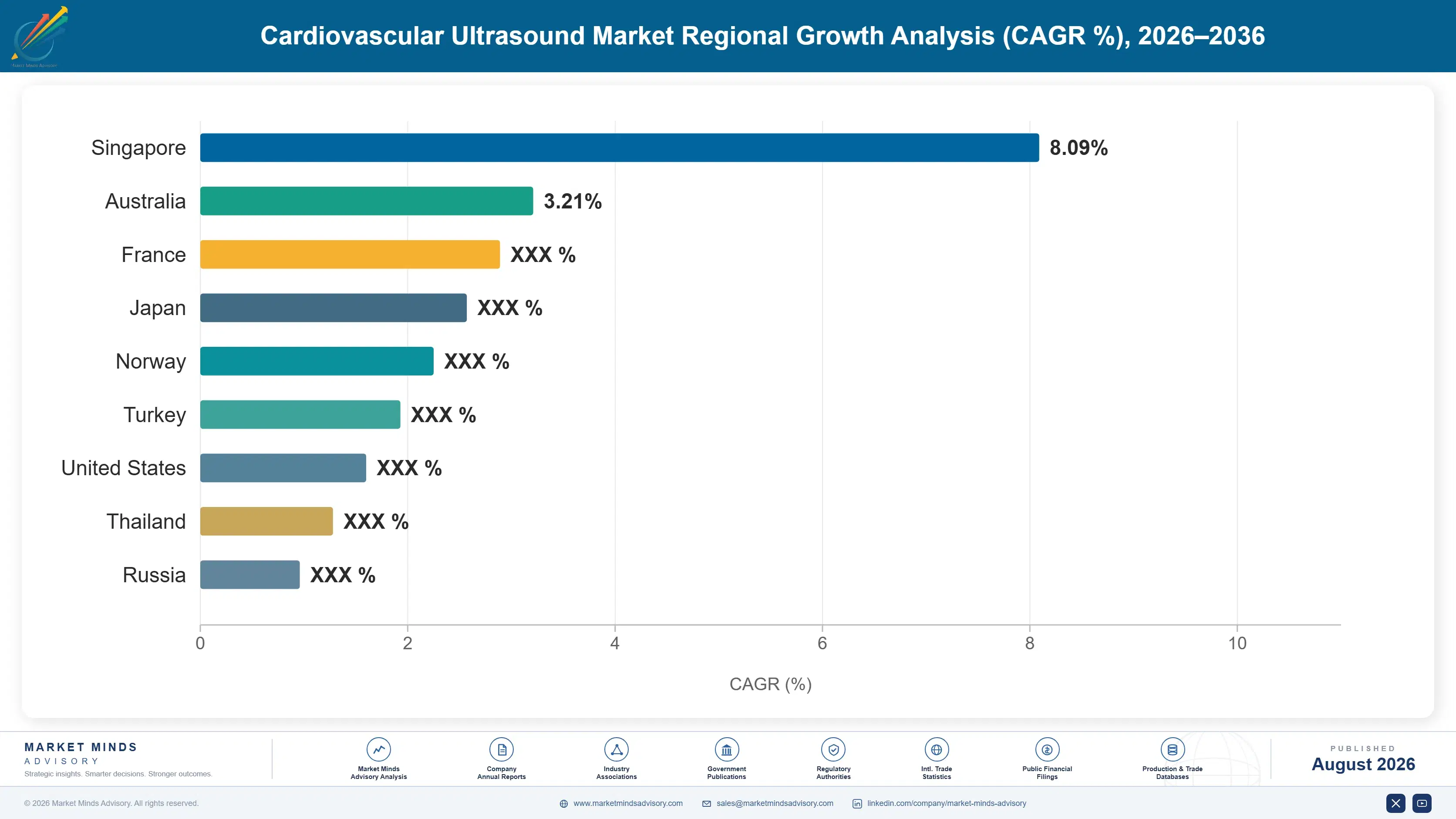
Cardiovascular ultrasound demand concentrates where reimbursement, installed hospital infrastructure, and specialist training capacity intersect most favorably. North America and East Asia lead on absolute value and unit volume respectively, while South Asia and Pacific markets post the fastest regional growth off a comparatively small installed base.

North America

North America holds the largest share of global cardiovascular ultrasound revenue on a device-value basis, supported by premium hospital reimbursement rates and the earliest adoption of AI-assisted interpretation software among major economies. The United States accounts for the substantial majority of regional revenue, with an installed base of cart-based systems that vendors continue upgrading through software licensing rather than full hardware replacement. Canada contributes a smaller but steadily growing share tied to provincial health system modernization programs. Point-of-care ultrasound training has been formally incorporated into emergency medicine and internal medicine residency curricula across the region, sustaining a durable handheld device replacement cycle that shows no sign of decelerating through the forecast period ahead.
Share: 29% | CAGR: 8.9% (2026 to 2036)

Western Europe

Western Europe follows North America in absolute value, anchored by Germany, France, and the United Kingdom, where national health systems fund cardiology imaging upgrades on multi-year capital cycles. Reimbursement for point-of-care echocardiography has expanded more cautiously here than in North America, keeping handheld adoption a step behind despite comparable clinical guideline support from regional cardiology societies. Germany maintains the largest installed base of cart-based systems in the region, reflecting its dense hospital network and strong domestic device manufacturing presence. Growth continues at a measured pace as public procurement cycles favor proven platforms over newly launched AI-forward systems, though software upgrade attachment rates are rising steadily across most participating national markets.
Share: 23% | CAGR: 6.9% (2026 to 2036)
Regional intelligence for 5 additional markets available in the complete report: East Asia, South Asia and Pacific, Latin America, Middle East and Africa, Eastern Europe. Contact sales@marketmindsadvisory.com.
cardiovascular-ultrasound-market-country-cagr-analysis-1787304950665

Software Attach and Service Expansion Pathways

Cardiovascular ultrasound vendors are shifting revenue mix toward recurring software and service streams as hardware margins compress under increasingly intense price competition across most product tiers. Four levers stand out as commercially significant across the forecast period, spanning software licensing, service contract expansion, flexible financing structures, and emerging market channel development strategies pursued by leading vendors today.

AI Software Subscription Licensing Model for Hardware

Vendors are increasingly separating AI interpretation software from the underlying hardware sale, offering it instead as an annual subscription layered on top of the device purchase price. Early adopter hospital systems report software attach rates approaching 40 percent on new cart-based system sales, a figure vendors expect to climb further as more algorithms clear regulatory review and clinical confidence builds. This shift converts a historically one-time hardware transaction into a multi-year recurring revenue relationship, improving vendor gross margin quality meaningfully and giving vendors far greater visibility into customer retention and future upgrade cycles across their installed base.
Market Impact: Software subscription attach rates

Extended Service and Preventive Maintenance Contracts

Extended service agreements bundling preventive maintenance, remote diagnostics, and software updates have become a primary profit pool as hardware pricing compresses across the mid-tier segment. Leading vendors now attach multi-year service contracts to more than 60 percent of new cart-based system placements, generating margin well above the hardware sale itself over the contract lifetime. Remote monitoring capability lets vendors flag failing components before they cause unplanned downtime, strengthening customer retention at contract renewal. This lever matters most in premium hospital accounts where uptime carries direct clinical and financial consequences for cardiology departments.
Market Impact: Service contracts cover over 60 per

Flexible Financing Structures for Capital-Constrained Buyers

Equipment-as-a-service and operating lease financing structures are opening purchasing decisions to hospital systems and clinics that lack capital budget for outright cart-based system purchase. Vendors offering per-scan or subscription pricing report win rates roughly 25 percent higher among community hospitals and outpatient clinics compared to standard capital sale terms. This lever matters most in price-sensitive segments including community hospitals, ambulatory surgery centers, and public health systems across emerging markets, where operating budget flexibility often exceeds available capital budget by a wide margin, making financing structure the deciding factor in many purchasing decisions.
Market Impact: Financed deals show win rates 25 pe

Emerging Market Distributor Network Expansion Strategy

Building dedicated distributor and local service partner networks across South Asia, Latin America, and parts of the Middle East is opening volume growth that direct sales models cannot reach cost-effectively. Vendors investing in local training centers and regional service hubs report unit volume growth exceeding 15 percent annually in newly established distributor territories, well above mature market rates. This approach requires patient multi-year investment before returns materialize, but it positions vendors to capture disproportionate share as hospital infrastructure investment accelerates across price-sensitive regions where global brand recognition alone does not guarantee purchasing preference among cautious local buyers.
Market Impact: Distributor territory unit volume g

Who Controls the Margin Pool

Cardiovascular ultrasound carries a CR5 near fifty-eight percent, concentrated among five multinational imaging majors that each maintain broad cart-based and handheld product lines. The gap between the top two vendors and the next tier of challengers is widening as AI software investment favors incumbents with larger installed bases and richer proprietary imaging datasets to train algorithms against.
Current competitive activity plays out across three dimensions simultaneously: AI algorithm regulatory clearance races, handheld price competition from newer entrants, and service contract bundling aimed at defending installed base revenue. Vendors are also expanding distributor networks into South Asia and Latin America to capture volume growth that direct sales models reach less efficiently, while smaller specialists carve out niche positions in portable and veterinary-adjacent segments.

Emerging pressure comes from domestic Chinese manufacturers moving upmarket beyond entry-level hardware into AI-enabled mid-tier systems, and from software-only entrants offering interpretation algorithms that plug into third-party hardware rather than bundled platforms. Rankings could shift meaningfully over the next five years if regulatory clearance speed or algorithm accuracy diverges significantly between the current leaders, particularly as hospital purchasing committees weigh software performance increasingly heavily against traditional image quality benchmarks alone.
cardiovascular-ultrasound-market-company-positioning-matrix-1787304951181

Competitive Moat and Risk Dimensions

GE HEALTHCARE

Moat: Installed Base Data Advantage

GE HealthCare holds the largest global cart-based and handheld installed base among all vendors tracked, generating a proprietary imaging dataset that trains AI algorithms more effectively than smaller rivals can match. This scale advantage compounds, since each new software release benefits from a larger training set drawn from real clinical use across thousands of accounts.
GE HEALTHCARE

Risk: Legacy Platform Transition Risk

A large share of GE HealthCare revenue still derives from cart-based console sales and service contracts, exposing the company to margin pressure as handheld and software-centric competitors capture growth at the category edge. Slower internal transition toward subscription economics could leave revenue mix skewed toward the slower-growing segment, pressuring margin expansion.
PHILIPS HEALTHCARE

Moat: AI Software Regulatory Lead

Philips Healthcare has secured a disproportionate share of recent FDA algorithm clearances covering automated cardiac measurement and view guidance, giving it a genuine first-mover position in software-driven differentiation. This regulatory lead lets Philips charge premium subscription pricing on new platform sales while competitors still work through their own clearance pipelines for comparable functionality.
PHILIPS HEALTHCARE

Risk: Hardware Manufacturing Cost Exposure

Philips carries meaningful exposure to semiconductor and specialty component costs embedded in probe and transducer manufacturing, a cost base that has proven volatile in recent years. Component price swings compress hardware margin more severely for Philips than for rivals with greater manufacturing scale or more diversified component sourcing arrangements across multiple regions.

Players Tracked

Prominent Players

GE HealthCare
Philips Healthcare
Siemens Healthineers
Canon Medical Systems
Fujifilm Sonosite

Other Key Players

Mindray Medical
Samsung Medison
Esaote
Hologic
Butterfly Network
Clarius Mobile Health
Konica Minolta Healthcare
Chison Medical Imaging
EDAN Instruments
Terason
Vave Health
Exo Imaging
EchoNous
SuperSonic Imagine
Analogic Corporation

Recent Developments

MARCH 2025

GE HealthCare Receives FDA Clearance for AI Cardiac Measurement Suite

GE HealthCare received FDA clearance for an expanded AI measurement suite covering automated ejection fraction, strain analysis, and valve assessment across its cart-based and handheld ultrasound platforms. The clearance extends existing algorithm capability into new clinical workflows, reinforcing the company installed base advantage in AI-assisted cardiac interpretation software licensing.
Signal: Signals accelerating regulatory clearance
SEPTEMBER 2024

Philips Healthcare Signs Multi-Year Supply Agreement With Regional Hospital Network

Philips Healthcare signed a multi-year supply agreement with a large United States regional hospital network to replace aging cart-based systems across forty facilities with AI-enabled platforms bundled with extended service contracts. The agreement includes staged software upgrade rights through 2028, securing recurring revenue well beyond the initial hardware transaction.
Signal: Signals growing vendor preference for bund
JANUARY 2025

Butterfly Network Acquired by Fujifilm Sonosite in Handheld Portfolio Consolidation

Fujifilm Sonosite completed the acquisition of Butterfly Network, combining Sonosite handheld hardware strength with Butterfly proprietary semiconductor-based probe technology and cloud-connected imaging software platforms. The deal consolidates two established handheld ultrasound brands under a single ownership structure, expanding combined AI software development capacity substantially across future product generations.
Signal: Signals continued consolidation among hand

Component and Semiconductor Cost Exposure

Semiconductor components, specialty piezoelectric transducer materials, and precision display panels together represent roughly forty to forty-five percent of ultrasound device cost of goods sold. Transducer-grade piezoelectric ceramics are sourced predominantly from a small number of specialized manufacturers in Japan and the United States, creating a narrow supplier base for a component with no readily available substitute at comparable image quality.
Semiconductor supply tightness during 2021 and 2022 pushed lead times for imaging-grade processors out to over a year for several vendors, delaying new product launches and forcing some manufacturers to redesign circuit boards around substitute chips mid-cycle. The IEA has noted similar chip allocation pressure across medical device categories broadly, and several vendors disclosed in annual reports that component costs added meaningful pressure to hardware gross margin through the period before easing gradually into 2023.

Cost exposure varies by player type. Vertically integrated majors with in-house transducer manufacturing absorb component volatility more easily than smaller handheld specialists purchasing piezoelectric elements from third-party suppliers on shorter-term contracts. Geographic exposure also differs: vendors sourcing displays and semiconductors primarily from East Asian supply chains face greater currency and logistics cost variability than those with more diversified, multi-region component sourcing arrangements already in place.
cardiovascular-ultrasound-market-cost-volatility-analysis-1787304951377

Dual-Source Qualification for Critical Transducer Components

Leading vendors are qualifying second and third suppliers for piezoelectric ceramics and imaging processors to reduce dependence on any single manufacturer or region entirely. This lengthens initial qualification cycles but meaningfully reduces exposure to regional supply disruption, giving procurement teams greater negotiating leverage on pricing during periods of component tightness and allocation constraints across markets.

Vertical Integration Into Transducer Manufacturing

Several major vendors have expanded in-house transducer manufacturing capacity to capture margin previously paid to third-party suppliers and to gain tighter control over component quality and delivery timing across product lines, regions, and hospital accounts. This shift requires substantial upfront capital investment but pays back through reduced volatility exposure over multi-year hardware product cycles ahead.

Software Revenue Mix Shift to Reduce Hardware Dependence

Vendors are deliberately growing the software licensing share of total revenue, which carries minimal exposure to component cost volatility compared to hardware manufacturing and assembly operations. This mix shift cushions overall margin during hardware cost spikes and gives finance teams a more predictable, higher-margin revenue base to plan against confidently over the long term.

Portfolio Architecture for Margin Defence

Cardiovascular ultrasound portfolios span three margin tiers running from commodity-adjacent entry hardware through certified premium platforms to sustainability-linked and AI-differentiated next-generation systems built for advanced clinical workflows and specialist use. Gross margin widens considerably moving up the tier structure, driven primarily by software licensing attach and extended service contract penetration rather than hardware bill of materials differences alone across most product
Volume tier competition centers on price and basic image quality for cost-constrained buyers across emerging markets and community hospitals operating under tight capital budgets. Premium tier competition instead centers on AI software accuracy, workflow integration depth, and service reliability, an entirely different buying calculus that rewards incumbents with proprietary algorithm training data and established clinical trust built over many years of sustained engagement.

High-value margin pools concentrate overwhelmingly in the premium and next-generation tiers, where software subscription and multi-year service contracts generate recurring revenue well above any one-time hardware transaction alone. Vendors increasingly steer new product development and sales incentive structures toward this upper tier as volume-tier hardware margin continues compressing under sustained price competition from newer entrants and regional challengers gaining ground.

Volume / Commodity-Adjacent Tier

Entry-level cart-based and basic handheld systems targeting price-sensitive community hospitals, ambulatory clinics, and emerging market buyers where core image quality and reliability matter more than advanced AI feature depth or premium branding.
Gross Margin: 28%-35%

Premium / Certified Tier

Mid-to-high-tier cart-based systems and handheld devices with FDA-cleared AI interpretation software, typically sold with multi-year service contracts to established hospital cardiology departments and specialist imaging centers seeking proven clinical performance.
Gross Margin: 42%-50%

Sustainability / Regulatory / Next-Generation Tier

Newest-generation platforms bundling advanced AI algorithms, cloud connectivity, and subscription software licensing, targeted at leading academic medical centers and health systems piloting next-generation workflow automation ahead of broader market adoption.
Gross Margin: 55%-64%
cardiovascular-ultrasound-market-portfolio-architecture-1787304951874

Recurring Revenue and Adoption Depth

Cardiovascular ultrasound is transitioning from a pure capital equipment sale into an annuity-style relationship anchored by software subscription and multi-year service contracts spanning the full device lifecycle. Vendors increasingly value customer lifetime revenue over initial hardware transaction size, restructuring sales compensation and product roadmaps to prioritize retention and recurring attach rate over unit volume alone across most major hospital and clinic accounts today.
Adoption depth varies sharply by end-use vertical across the market. Cardiology departments show the deepest, most sustained engagement, layering AI software across nearly their entire installed base of cart-based and handheld devices. Emergency medicine and primary care adoption remains shallower and more device-count driven, with software attach still catching up as clinical trust in automated interpretation builds gradually across generalist practice settings and residency training programs nationwide.

A generational shift in buyer profile is underway as younger physicians trained on point-of-care ultrasound during residency reach purchasing influence roles within hospital systems and group practices. This cohort expects AI-assisted interpretation as a baseline feature rather than a premium add-on, reshaping procurement criteria toward software capability and away from hardware specification sheets that dominated purchasing decisions a decade ago across most institutions.
cardiovascular-ultrasound-market-end-use-penetration-index-1787304952363

Where Cardiovascular Ultrasound Value Concentrates

These are among the four positions where our research anticipates prominent divergence between winners and laggards over the coming forecast period. Each is grounded in the demand model, the regulatory perimeter, and the announced capacity pipeline.
01 / SOFTWARE PLATFORM INVESTMENT

Prioritize AI Software Capability Over Hardware Specification Alone

Vendors that treat AI interpretation software as a core product rather than a bolt-on feature are capturing a disproportionate share of new hospital purchasing decisions across most developed markets today and beyond. Buying committees now weigh algorithm accuracy and regulatory clearance breadth alongside traditional image quality, a shift that rewards sustained software investment over incremental hardware refinement. Suppliers slow to build genuine software depth risk losing premium-tier positioning within three to five years as this evaluation criterion becomes the clear default.
02 / SERVICE CONTRACT RETENTION

Defend Installed Base Through Extended Service Agreement Renewal

Service contract retention has become as commercially important as new hardware placement, since renewal rates directly determine long-term revenue predictability across the entire installed base of cart-based and handheld devices. Vendors offering remote monitoring and preventive diagnostics report meaningfully higher renewal rates than those selling maintenance as a standalone add-on service. Losing a service contract at renewal often signals a customer preparing to switch hardware vendors entirely at the next full replacement cycle, making renewal rate a leading indicator worth tracking closely.
03 / EMERGING MARKET DISTRIBUTION

Build Local Distributor Capacity Ahead of Infrastructure Investment Cycles

South Asia and Pacific, along with parts of Latin America, are expanding hospital cardiac care infrastructure faster than most vendors currently have distribution capacity to serve profitably at scale. Establishing local training centers and service hubs ahead of demand requires patient multi-year investment with limited near-term payback for most vendors. Vendors that build this presence early are positioned to capture disproportionate share as procurement volume accelerates, while latecomers face a steeper and more expensive path to establishing credible local market presence.
04 / DOMESTIC COMPETITOR RESPONSE

Prepare Mid-Tier Pricing Strategy for Chinese Manufacturer Advance

Domestic Chinese manufacturers are moving upmarket from entry-level hardware into AI-enabled mid-tier systems at price points multinational vendors currently cannot match without meaningful margin sacrifice across most affected product lines and regions. This pressure will intensify steadily through the forecast period as these manufacturers gain regulatory clearance in additional export markets well beyond China itself. Multinational vendors need a deliberate mid-tier pricing and feature response before this dynamic compresses margin faster than premium-tier software revenue can offset it across the broader portfolio.

Engagement Snapshot From the Field

A live engagement with an industry participant carrying material or product regulatory and market exposure ahead of a defining policy shift, showing how our research translates into a defensible multi-year portfolio strategy.
MARKET MINDS ADVISORY · CLIENT ENGAGEMENT SUMMARY
Cardiovascular Ultrasound Producer Strategic Portfolio Review and Transition Roadmap 2026·Investment Scenario on Cardiovascular Ultrasound Exposure Evaluation 2025-26
CLIENT PROFILE
The client is a mid-sized regional hospital network operating twelve acute care facilities across the southeastern United States, serving a mixed urban and suburban patient population. The network cardiology service line had grown steadily over five years but relied on cart-based ultrasound systems averaging nine years in service age, well past typical replacement cycles, with growing concern from clinical staff about widening interpretation variability across facilities.
STRATEGIC CHALLENGE
Leadership needed to modernize cardiovascular imaging capacity across all twelve facilities within a constrained capital budget while addressing a persistent sonographer staffing shortage limiting scan throughput at three of the busiest sites. The network also lacked a clear framework for evaluating competing AI software claims from vendors, several of which offered overlapping but differently validated interpretation algorithms with unclear comparative performance.
MMA APPROACH
MMA conducted a structured vendor capability assessment across five leading cardiovascular ultrasound suppliers, benchmarking AI algorithm regulatory clearance breadth, service contract terms, and total cost of ownership over a seven-year hold period. The engagement combined primary interviews with cardiology leadership at each facility, competitive procurement benchmarking against comparable regional networks, and a phased capital deployment model sequencing replacement by clinical urgency and equipment age.
KEY FINDINGS
  1. Cart-based systems averaging nine years in service showed measurably higher scan repeat rates than facilities with equipment under five years old, directly linked to image quality degradation over time.
  2. AI-assisted interpretation software reduced average scan review time by an estimated thirty percent in pilot deployments (client-reported, unverified by MMA), meaningfully easing pressure on the sonographer staffing shortage.
  3. Vendors offering bundled financing and phased hardware rollout secured meaningfully better pricing terms than facility-by-facility procurement, saving an estimated twelve percent on total contract value (client-reported, unverified by MMA).
  4. Service contract structure varied more across vendors than headline hardware pricing, making total cost of ownership analysis over a full seven-year hold period the decisive procurement factor overall.
CLIENT PROFILE
The client is a mid-sized regional hospital network operating twelve acute care facilities across the southeastern United States, serving a mixed urban and suburban patient population. The network cardiology service line had grown steadily over five years but relied on cart-based ultrasound systems averaging nine years in service age, well past typical replacement cycles, with growing concern from clinical staff about widening interpretation variability across facilities.
STRATEGIC CHALLENGE
Leadership needed to modernize cardiovascular imaging capacity across all twelve facilities within a constrained capital budget while addressing a persistent sonographer staffing shortage limiting scan throughput at three of the busiest sites. The network also lacked a clear framework for evaluating competing AI software claims from vendors, several of which offered overlapping but differently validated interpretation algorithms with unclear comparative performance.
MMA APPROACH
MMA conducted a structured vendor capability assessment across five leading cardiovascular ultrasound suppliers, benchmarking AI algorithm regulatory clearance breadth, service contract terms, and total cost of ownership over a seven-year hold period. The engagement combined primary interviews with cardiology leadership at each facility, competitive procurement benchmarking against comparable regional networks, and a phased capital deployment model sequencing replacement by clinical urgency and equipment age.
KEY FINDINGS
  1. Cart-based systems averaging nine years in service showed measurably higher scan repeat rates than facilities with equipment under five years old, directly linked to image quality degradation over time.
  2. AI-assisted interpretation software reduced average scan review time by an estimated thirty percent in pilot deployments (client-reported, unverified by MMA), meaningfully easing pressure on the sonographer staffing shortage.
  3. Vendors offering bundled financing and phased hardware rollout secured meaningfully better pricing terms than facility-by-facility procurement, saving an estimated twelve percent on total contract value (client-reported, unverified by MMA).
  4. Service contract structure varied more across vendors than headline hardware pricing, making total cost of ownership analysis over a full seven-year hold period the decisive procurement factor overall.
RECOMMENDED STRATEGY
Phase 1: Phase 1 (Months 1 to 3): Complete vendor capability benchmarking and total cost of ownership modeling, prioritizing replacement sequencing at the three highest-urgency facilities with oldest equipment. Phase 2: Phase 2 (Months 4 to 9): Execute phased hardware and software procurement across the network, negotiating bundled financing terms and standardized multi-year service contract structures throughout. Phase 3: Phase 3 (Months 10 to 18): Roll out AI-assisted interpretation training across cardiology and emergency staff, tracking scan throughput and interpretation variability improvements against baseline metrics.
OUTCOME
Within eighteen months, the network completed replacement across nine of twelve facilities, reduced average scan repeat rates meaningfully, and reported a fifteen percent improvement in sonographer throughput at previously constrained sites (client-reported, unverified by MMA). Standardized service contracts across the network also simplified vendor management considerably, consolidating what had been fragmented facility-level purchasing into a single coordinated procurement relationship.

Frequently Asked Questions

Foundational context covering the market sizes, CAGR, scope, country, region and competition that inform every finding below. This section is provided to cover basics and most often pre-purchase conversations, answered from the MMA Primary Research Dataset.

What is the current size of the Cardiovascular Ultrasound Market?

The global cardiovascular ultrasound market was valued at 8.5 billion dollars in 2025. This figure covers cart-based systems, handheld point-of-care devices, and associated AI-assisted interpretation software worldwide.

How large will the Cardiovascular Ultrasound Market be by 2036?

MMA forecasts the market will reach 20.64 billion dollars by 2036, more than doubling in value. This growth is driven primarily by AI software adoption and expanding point-of-care device use.

What is the CAGR for the Cardiovascular Ultrasound Market 2026 to 2036?

The base case CAGR is 8.4 percent annually across the forecast period. Bull and bear scenarios range from 9.6 percent to 7.0 percent depending on reimbursement and software adoption pace.

Which segment is growing fastest?

AI-assisted image analysis software is the fastest-growing segment, expanding at approximately 17.5 percent annually. This is roughly double the overall market growth rate, reflecting rapid regulatory clearance and hospital adoption.

Who are the major companies in the Cardiovascular Ultrasound Market?

Leading companies include GE HealthCare, Philips Healthcare, Siemens Healthineers, Canon Medical Systems, and Fujifilm Sonosite. These five vendors hold a combined CR5 near fifty-eight percent of the global market.

Which country is growing fastest?

China is the fastest-growing national market, expanding at approximately 11.5 percent annually. This is driven by rising hospital capital expenditure and rapid population aging across the country.

Report Segmentation Architecture

The full report scope spans multiple orthogonal segmentation dimensions, with cross-tabulated demand data provided for each dimension pair. Coverage extends further to regional breakdowns, trend trajectories, and the competitive detail needed to support segment-level decision-making.

By Product Type

  • Cart-Based Console Systems
  • Handheld and Point-of-Care Devices
  • AI-Assisted Image Analysis Software
  • Compact Portable Systems
  • Probes and Transducers
  • Service and Maintenance Contracts

By End-Use Industry

  • Hospitals and Cardiology Departments
  • Emergency and Critical Care Units
  • Primary Care and Outpatient Clinics
  • Diagnostic Imaging Centers
  • Academic and Research Institutions

By Commercial Dimension

  • Direct Hospital Procurement
  • Distributor and Channel Sales
  • Subscription and Software Licensing
  • Equipment-as-a-Service Financing

By Region

  • North America
  • Western Europe
  • East Asia
  • South Asia and Pacific
  • Latin America
  • Middle East and Africa
  • Eastern Europe

Scope, Methodology, and Coverage

Every figure in this report is reproducible from documented input assumptions. The scope below maps the historical period, the forecast horizon, the segmentation dimensions, and the countries covered, alongside the underlying primary and qualitative methodology.
Historical Period
2020 to 2025
Forecast Period
2026 to 2036
Base Year
2025 (USD billions; MMA Primary Research Dataset, August 2026)
Market Definition
The cardiovascular ultrasound market covers cart-based and handheld diagnostic ultrasound devices, associated transducers and probes, AI-assisted image analysis software, and service and maintenance contracts used specifically for cardiac imaging. General-purpose or abdominal ultrasound systems, cardiac catheterization equipment, and unrelated diagnostic imaging modalities such as MRI or CT are excluded from this scope.
Quantitative Units
USD billions (current prices); unit shipment volume where applicable
Segmentation Dimensions
By Product Type; By End-Use Industry; By Commercial Dimension; By Region
Regions Covered
North America, Western Europe, East Asia, South Asia and Pacific, Latin America, Middle East and Africa, Eastern Europe
Countries Covered
USA, China, Germany, France, UK, Japan, South Korea, India, Australia, Canada, Brazil, Mexico, Indonesia, Vietnam, Thailand, Malaysia, UAE, Saudi Arabia, South Africa, Nigeria, Turkey, Poland, Netherlands, Italy, Spain, Sweden, Switzerland, Argentina, Colombia, Singapore, and additional markets relevant to this sector
Key Companies Profiled
GE HealthCare, Philips Healthcare, Siemens Healthineers, Canon Medical Systems, Fujifilm Sonosite, Mindray Medical, Samsung Medison, Esaote, Hologic, Butterfly Network, Clarius Mobile Health, Konica Minolta Healthcare, Chison Medical Imaging, EDAN Instruments, Terason, Vave Health, Exo Imaging, EchoNous, SuperSonic Imagine, Analogic Corporation
Quantitative Methodology
Primary survey, n=3,800 respondents, Q4 2025, six countries; demand-side model with trade association cross-validation
Qualitative Methodology
47 expert interviews, Q4 2025; applied to validate demand model assumptions, identify emerging dynamics, and assess competitive positioning
Report Format
PDF and XLSX data workbook (Word format preview document)
Publisher
Market Minds Advisory
Report Code
MMA-2026-MED-519
Published
August 2026
Contact
sales@marketmindsadvisory.com | www.marketmindsadvisory.com

Purchase the full Cardiovascular Ultrasound Market Report (2026 to 2036).

The full report delivers detailed segment-level revenue forecasts across all six product categories through 2036. It includes country-level breakdowns for the fourteen markets carrying the deepest primary research coverage, alongside a complete competitive benchmarking module covering all twenty profiled companies. Proprietary MMA survey data drawn from 3,800 respondents across six countries supports the demand analysis, complemented by expert interview findings from 47 industry specialists gathered during the fourth quarter of 2025. Buyers also receive editable data tables and a quarterly market monitor update subscription for twelve months following purchase.
Segment-level revenue forecasts across six product categories
Country-level breakdowns for fourteen deeply researched markets
Competitive benchmarking module covering twenty profiled companies
Proprietary survey data from 3,800 respondents worldwide
Expert interview findings from 47 industry specialists
Twelve months of quarterly market monitor updates

Built For The People Who Decide

From boardroom strategy to bench-side execution, this report is read cover-to-cover by leaders shaping the next decade of their industry, turning demand scenarios, market dynamics and valuation benchmarks into decisions.
CXOs/ Presidents/ VPs/ Managers
M&A and Corporate Development
Strategy Teams and R&D Heads
Procurement and Product Directors
Regulatory and Compliance Leaders
Investor Relations and Equity Analysts