Market Minds Advisory
Short Wave Near Infrared Lens Market

Short Wave Near Infrared Lens Market: Short Wave Near Infrared Lenses: Cheap Detectors, a Narrow Glass Palette and an Optics Industry Built for the Wrong Volumes

Detector pricing fell roughly 82% once quantum dot sensors arrived, which handed a low-volume optics industry demand it was never organised to manufacture at anything like that scale or price.

Lead Analyst

Published

September 2026

Make Smarter Decisions with Customized Research Insights

Request a free sample report and evaluate market opportunities, growth trends, and competitive dynamics relevant to your business needs.

2025 MARKET VALUE$0.4BMarket Size 2025
2036 FORECAST VALUE$1.8BBase Case , 2026 to 2036
CAGR 2026 TO 203614.8 %Bull 16.0% / Bear 13.5%
INCREMENTAL OPPORTUNITY$1.4BNet 10- year value creation
EXPANSION MULTIPLE3.98x2036 value over 2026 base
Strategic Levers
M&A Pipeline
Regional Outlook
Country Rankings
Competitive Intelligence
Segmental Deep-dive
Call-Us : 91 93563 13602

Executive Snapshot and Market Trajectory.

The lens was never the obstacle in short wave infrared imaging. Indium gallium arsenide detectors were, and quantum dot sensors cut detector pricing by roughly 82%, which handed a hand-figured, low-volume optics industry demand at volumes it cannot currently build. That is really the whole story here.
Automotive and mobility sensing lenses grow at 22.2%, half again the market rate of 14.8%, and remain the segment most likely to disappoint since announced programme volumes have slipped repeatedly. Semiconductor through-silicon inspection follows at 16.4% and is the more dependable of the two. East Asia takes 44% of value, because cameras, sorters and sensing modules are almost all assembled there. Machine vision and food sorting quietly carry the steadier volume underneath both.
Concentration sits near 41% across the top five on measured lens and assembly revenue, spread across specialist optical manufacturers rather than large electronics groups. Only about 11 optical glasses transmit usefully across the full band, and band-specific coating absorbs roughly 27% of manufactured cost. Materials rather than machining are what make these lenses expensive. Manufacturing method rather than optical design will decide who serves which applications.
Market Definition
This market covers optical lenses and lens assemblies designed for imaging in the near infrared and short wave infrared bands, spanning machine vision and industrial inspection lenses, agricultural and food sorting lenses, semiconductor through-silicon inspection lenses, hyperspectral and scientific imaging lenses, automotive and mobility sensing lenses, and defence, security and surveillance lenses. Revenue is measured as lens and assembly value at supplier level, including attributable coating and qualification. Infrared detectors and sensors, complete cameras, thermal long wave infrared optics, optical filters sold separately, and illumination sources are excluded.
Base Year Value
$0.4B in 2025 (MMA Primary Research Dataset, September 2026)
Forecast Period
2026 to 2036, eleven discrete annual values
CAGR
14.8% base case. Bull 16.0%. Bear 13.5%.
Fastest Growth Segment
Automotive and Mobility Sensing Lenses: 22.2% CAGR
Fastest Growth Country
Vietnam: 18.2% CAGR
Fastest Growth Region
South Asia and Pacific: 17.0% CAGR
Largest Region
East Asia: 44% of 2025 global value
Market Leaders
Jenoptik, Excelitas Technologies, Edmund Optics, Sumita Optical Glass and Kowa Optical Products lead on measured lens and assembly revenue. Source: MMA Primary Research Dataset, July 2026.
Primary Survey
n=3,800 procurement and R&D decision-makers, Q4 2025, six countries
Methodology
Demand-side build-up, cross-validated against public data, 47 expert interviews

Short Wave Near Infrared Lens Market Forecast Scenarios

short-wave-near-infrared-lens-market-size-forecast-scenario-1788427350417
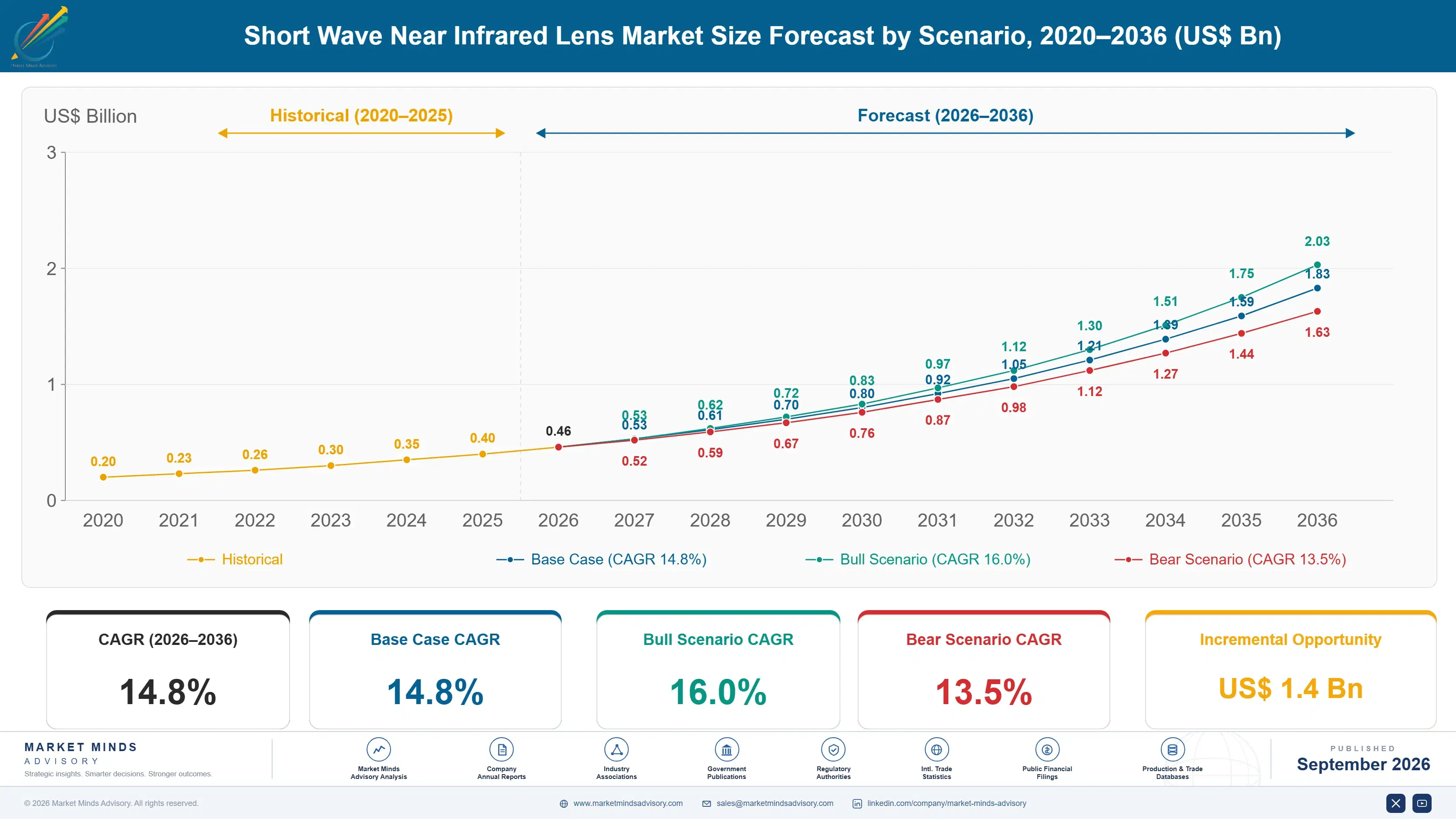
Growth ran at 13.4% from 2020 to 2025 and the demand mix changed completely inside the period. Early volume came from food sorting and moisture measurement, unglamorous applications using short wave infrared for years because water absorbs distinctively there. Detector pricing then collapsed as quantum dot and germanium-on-silicon sensors reached production, and applications that had been priced out for a decade suddenly became arguable.
The base case at 14.8% rests on three mechanisms. Detector cost falling roughly 82% moves short wave imaging from specialist instruments into ordinary machine vision, where volumes are far larger and lens prices near USD 640 look expensive rather than trivial. Semiconductor inspection through silicon, which is transparent in this band, grows on packaging complexity that visible-light inspection cannot address. Third, food and agricultural sorting continues expanding on labour cost and contamination liability together.
The bull case at 16.0% assumes automotive sensing programmes at 1550 nanometres reach announced volumes, which would change the industry's manufacturing basis entirely. The bear case at 13.5% is that automotive slips again, as it has repeatedly, leaving growth to industrial and semiconductor applications that are genuinely healthy and considerably smaller than the volumes optics manufacturers have been asked to prepare for.

Cheap Sensors, Expensive Glass

For twenty years short wave imaging stayed in laboratories and defence programmes because of detector cost, not optics. Indium gallium arsenide arrays were expensive, small and made by few suppliers. Quantum dot and germanium-on-silicon sensors changed that, cutting pricing roughly 82% and putting the band within reach of industrial buyers. The lens then became the expensive item in the camera, which nobody had planned for.
TOP FIVE CONCENTRATION41%Moderately concentrated among specialist optical manufacturers operating worldwide
SENSOR COST DECLINE82%Fall in detector pricing since quantum dot sensors arrived
USABLE GLASS TYPES11Optical materials transmitting usefully across the full band
COATING SHARE OF COST27%Manufactured cost attributable to the band-specific anti-reflection coating
TYPICAL LENS UNIT PRICEUSD 640Average selling price for an industrial inspection assembly
DESIGN CYCLE TIME34 weeksPeriod from initial specification to qualified production optic
What makes these lenses costly is materials rather than manufacturing skill. Most optical glasses absorb well before the top of the band, so a designer works with about 11 materials rather than the several hundred available in the visible. Anti-reflection coatings must be tuned to the band and absorb roughly 27% of manufactured cost. The design freedom is narrow, which is why unit prices sit near USD 640 for an industrial assembly.
The industry now faces an awkward mismatch. Optics houses are organised around low volumes, qualification cycles running about 34 weeks and prices reflecting craft. The applications arriving want thousands of units at prices set by camera economics. Some manufacturers are investing in moulded and replicated optics to meet that; others are quietly hoping automotive slips again, which it has done repeatedly.
"The uncomfortable truth is that a sensor price collapse is not a gift to a lens maker. It is an invitation to be the expensive component in somebody else's cost model, and the industry has about two years to decide whether it wants to manufacture at those volumes or keep the margins it has."
Director, Photonics and Imaging Systems Practice · MMA Technology Practice · September 2026

Market Trends

Detector Price Collapse Moves the Cost Into Optics

Quantum dot and germanium-on-silicon sensors cut short wave detector pricing by roughly 82%, which removed the barrier that had confined this band to laboratories and defence work for two decades. The consequence for lens makers is uncomfortable rather than purely good: at around USD 640 an industrial assembly is now the most expensive item in the camera, and camera builders are negotiating accordingly. Volumes rise while unit prices come under pressure that hand-figured optics economics were never designed to absorb. Manufacturing method rather than optical design decides who survives that.
Market Impact: Inspects through 100% of silicon
Moulded and Replicated Optics Enter a Craft Industry

Precision glass moulding and polymer replication are being adopted for short wave assemblies by manufacturers preparing for volumes that grinding and polishing cannot economically serve. The transition is genuinely difficult, since the narrow glass palette limits which materials mould well and coating adhesion behaves differently on moulded surfaces. Qualification cycles running about 34 weeks make each attempt expensive to get wrong. Manufacturers who began this investment early hold a cost position that competitors cannot replicate quickly, whatever their optical design capability looks like. Optical design capability is no longer what actually separates these suppliers.
Market Impact: Sorts across 4 measurable properties

Market Opportunities and Growth Drivers

Silicon Is Transparent in This Band

Short wave infrared passes through silicon, which lets inspection systems see bonding, voids and cracks inside packaged devices that visible light cannot reach at all. Advanced packaging has made those internal features commercially decisive rather than merely interesting, since a defect inside a stacked assembly is discovered late and scrapped expensively. Semiconductor through-silicon inspection lenses grow at 16.4% on packaging complexity alone. The physics is settled and unchanging, which makes this the most dependable demand anywhere in the market. Demand follows semiconductor capital equipment cycles rather than device shipments, so it arrives in blocks.
Market Impact: Restricts designers to 11 materials

Water Absorbs Distinctively Across These Wavelengths

Moisture, sugar content, fat and foreign material all present differently in the short wave band, which is why food sorting and agricultural grading adopted this imaging long before detector prices fell. Rising labour cost in sorting operations and tightening contamination liability across major food markets both push adoption further. The applications are unglamorous and the demand is steady, following food processing capacity rather than any technology cycle. Lens requirements here favour durability and cleanability over ultimate optical performance, which suits certain manufacturers considerably better than others. Sorting environments damage optics steadily, which creates replacement demand.
Market Impact: Targets 1550 nanometre programmes

Market Restraints and Challenges

The Usable Glass Palette Is Genuinely Narrow

Only about 11 optical materials transmit usefully across the full short wave band, against several hundred available to a visible-light designer, which constrains correction of chromatic and thermal aberration in ways no amount of design effort removes. The root cause is material physics rather than supply, since most optical glasses absorb before the top of the band. Commercially this keeps assemblies complex, expensive and slow to qualify. Manufacturers mitigate with specialist glass types and hybrid designs, which help genuinely and narrow the supplier base further. Thermal drift across the band remains the hardest problem.
Market Impact: Cuts detector pricing by 82%

Automotive Volumes Keep Being Promised and Deferred

Sensing programmes at 1550 nanometres have been announced repeatedly at volumes that would transform this industry's manufacturing basis, and have slipped repeatedly as vehicle sensing architectures changed and cost targets tightened. The root cause is that automotive buyers specify against a price point rather than a capability, and short wave optics have not reached it. Commercially this has led several manufacturers to invest in volume capability against demand that did not arrive. Mitigation runs through equipment that serves industrial volumes usefully whether or not automotive proceeds. Two rounds of that investment have already been written down.
Market Impact: Serves volumes beyond 34 week cycles
3 additional market trends, 4 additional growth drivers, and 2 additional restraints and challenges are covered in the full report. Contact sales@marketmindsadvisory.com to access the complete intelligence.

Segment CAGR and Growth Architecture

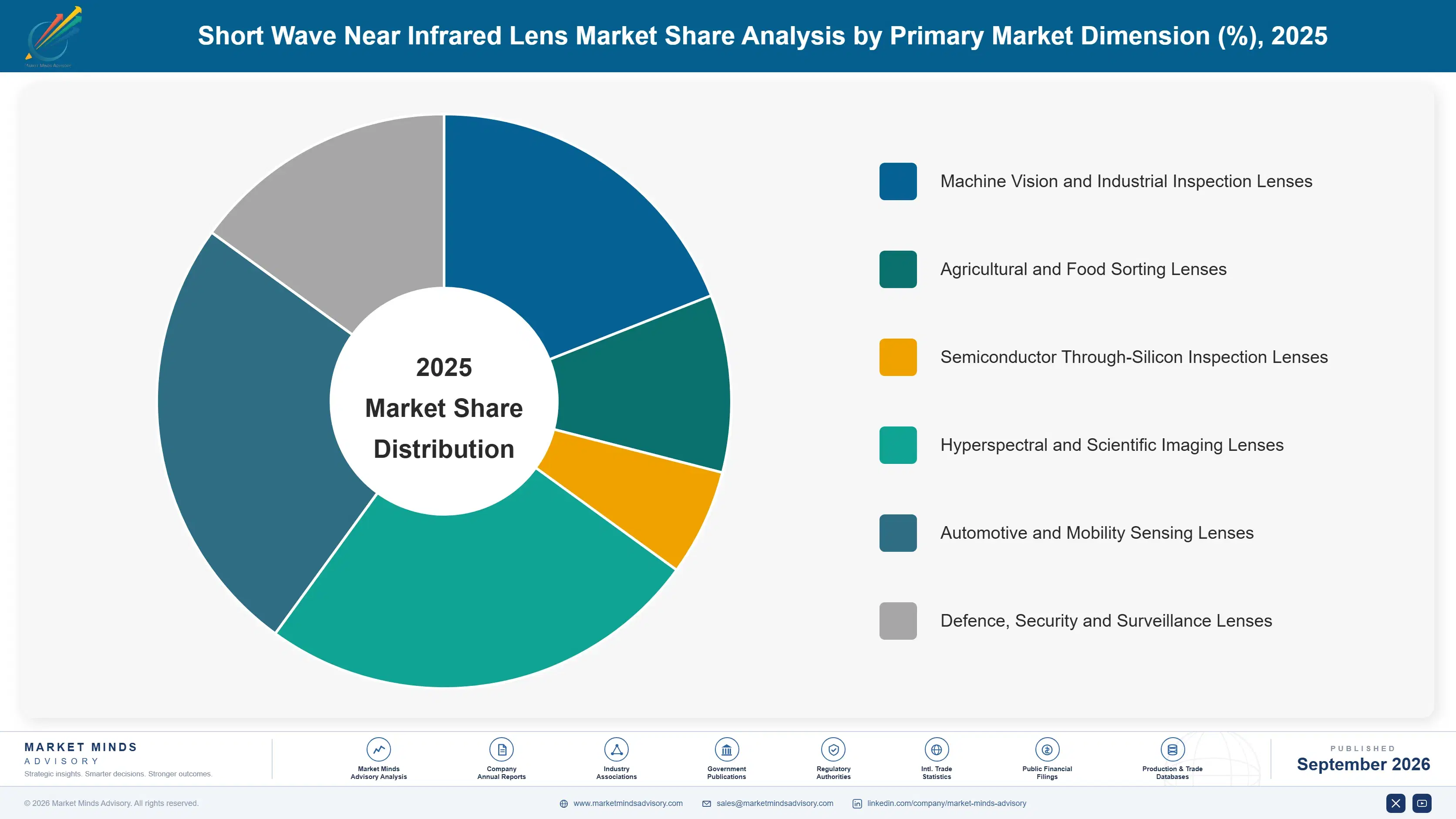
Segmentation follows the application context, because that determines the volume, the price point and whether craft manufacturing survives the order. An inspection lens for a semiconductor fab and a sensing lens for a vehicle platform share a waveband and essentially nothing else about how they are specified, priced, qualified, built or sold. Only the waveband is common.
short-wave-near-infrared-lens-market-market-share-analysis-1788427350951

Automotive and Mobility Sensing Lenses

Automotive sensing grows at 22.2%, half again the market rate of 14.8%, and it is simultaneously the fastest segment and the least reliable one. Sensing at 1550 nanometres offers eye safety advantages at power levels shorter wavelengths cannot use, which is the technical reason the interest is genuine. The commercial reason for caution is that announced programme volumes have slipped repeatedly as vehicle architectures changed and cost targets tightened further. Manufacturers investing in moulded and replicated capability for this segment are making a bet on timing rather than on physics, and several have made it twice already. Manufacturers sizing capacity here should assume industrial demand carries it, with vehicle programmes treated as upside.
CAGR 22.2%

Semiconductor Through-Silicon Inspection Lenses

Through-silicon inspection grows at 16.4% because silicon is transparent in this band, which lets systems examine bonding, voids and cracks inside packaged devices that visible imaging cannot see at all. Advanced packaging made those internal features commercially decisive, since a defect inside a stacked assembly is found late and scrapped at full assembled value. Demand follows semiconductor capital equipment cycles rather than unit shipments, so it is lumpy and predictable in direction. Requirements favour resolution and repeatability over cost, which preserves the craft manufacturing economics that volume applications are steadily eroding elsewhere. Qualification into a tool's measurement recipes makes substitution genuinely difficult afterwards, since replacing the optic means requalifying the recipe rather than fitting a new part.
CAGR 16.4%
Full segment breakdown across 6 segments available in the complete report.

Regional Architecture and Country Demand Map

Value follows where cameras, sorters and inspection systems are built rather than where they are eventually used. Optical glass supply and precision manufacturing capability are concentrated in the same places, which reinforces the pattern considerably. Where systems are designed and where they are used diverge sharply here.

East Asia

East Asia holds 44%, well above the regional band, because machine vision cameras, food sorting equipment, semiconductor inspection tools and sensing modules are overwhelmingly assembled here and lenses are consumed where systems are built. Japanese optical glass producers supply much of the narrow material palette this band requires, which gives regional manufacturers both availability and pricing advantages nobody else holds. Chinese lens manufacturers have moved into industrial short wave assemblies at prices Western specialists do not attempt to match. Korean and Taiwanese semiconductor inspection demand adds high-specification volume that supports craft manufacturing economics. Vietnamese and Malaysian assembly is drawing some of that volume away from China, though the optical glass supply and precision manufacturing stay firmly within the region.
Share: 44% | CAGR: 15.8% (2026 to 2036)

North America

North America holds 21%, just below the regional band, because volume camera and inspection assembly sits elsewhere while design and programme funding stay concentrated here. American demand is weighted toward semiconductor inspection, defence programmes and hyperspectral scientific instruments rather than toward volume camera assembly, which largely left the region decades ago. Defence and space work sustains a specialist manufacturing base at specifications and prices no commercial application supports, and that base carries technical capability the commercial market draws upon. Automotive sensing development is concentrated here even where eventual manufacture would sit elsewhere. Growth at 15.8% runs ahead of the market on semiconductor packaging inspection and on continued defence programme funding. Coating and metrology capability supporting defence work is world class.
Share: 21% | CAGR: 15.8% (2026 to 2036)
Regional intelligence for 5 additional markets available in the complete report: Western Europe, South Asia and Pacific, Middle East and Africa, Latin America, Eastern Europe. Contact sales@marketmindsadvisory.com.
short-wave-near-infrared-lens-market-country-cagr-analysis-1788427351498

Choosing Volume or Choosing Margin

A detector price collapse hands lens makers more demand and less pricing power at once. Every lever in this market is really the same decision expressed differently: build for volume and accept camera economics, or hold the specifications where craft manufacturing still commands its price, and stop pretending both are possible inside one organisation. Very few manage it.

Commit to Moulded Capability Before Volume Arrives

Precision glass moulding and polymer replication are the only routes to the unit costs that camera builders now expect, and qualification cycles running about 34 weeks mean capability cannot be assembled after an order lands. Manufacturers who invested early hold cost positions roughly 40% below ground and polished equivalents at comparable specification. The narrow glass palette makes the engineering genuinely hard. Those waiting for demand certainty will find the certainty arrives about a year after the window to serve it closed. Two manufacturers made that investment ahead of demand and now hold positions competitors cannot buy.
Market Impact: Holds unit costs roughly 40% below polished equivalents

Defend Semiconductor Inspection Rather Than Chasing Vehicles

Through-silicon inspection grows at 16.4% on packaging physics that will not change, values resolution over unit cost and preserves the manufacturing economics this industry was built around. Automotive at 22.2% offers larger volumes at prices that erase those economics and has slipped repeatedly besides. Manufacturers concentrating on semiconductor and scientific work hold gross margins around 22 percentage points above volume suppliers. It is a smaller business and a considerably more durable one than the automotive case as currently presented. Demand follows semiconductor capital equipment cycles, which are lumpy in timing and entirely predictable in direction.
Market Impact: Holds roughly 22 points more gross margin overall

Sell Coating Capability as the Differentiator

Band-specific anti-reflection coating absorbs roughly 27% of manufactured cost and determines transmission, ghosting and durability more than any element geometry does, yet it is usually presented as a process step rather than a capability. Manufacturers with in-house coating for this band control quality, lead time and about a quarter of their own cost base. Those outsourcing it are exposed on all three and compete on glass they did not make. Coating capability decides more competitive outcomes here than optical design does. Buyers rarely ask about it directly, and it shows up in every transmission measurement they take afterwards.
Market Impact: Controls roughly 27% of the manufactured cost directly

Qualify Alternate Glasses Inside Every Design

With about 11 usable materials and a small number of producers supplying most of them, a single glass becoming unavailable can strand a qualified design for the 34 weeks a requalification takes. Designing with alternates identified and pre-tested costs additional engineering and removes an exposure that has repeatedly interrupted supply across this industry. Manufacturers doing this consistently report qualification delays around 60% lower. It has to happen during original design, when it looks like effort nobody has asked for. Supply interruptions in this band come from material availability rather than from anything a manufacturer controls.
Market Impact: Cuts subsequent qualification delays by around 60% overall

Who Controls the Margin Pool

Concentration sits near 41% across the top five on measured lens and assembly revenue, and the participants are specialist optical manufacturers rather than divisions of large electronics groups. That matters commercially: these are organisations sized for craft volumes, with coating lines, metrology and qualification processes built around hundreds of units rather than tens of thousands. The detector price collapse arrived as an opportunity for their customers and a manufacturing problem for them.
Competition runs on three dimensions. Coating capability for this specific band is first, since it drives transmission, durability and roughly a quarter of cost. Second is manufacturing method, where moulded and replicated capability separates suppliers who can serve volume applications from those who cannot. Third is glass access, because a narrow palette from few producers makes supply relationships genuinely competitive rather than administrative.

Two pressures are reshaping positions. Volume applications favour manufacturers who invested in moulding before demand justified it, and that investment cannot be made quickly. Meanwhile Chinese manufacturers have moved into industrial short wave assemblies at prices Western specialists do not attempt, and they are winning the machine vision work where integrators rather than optical engineers make the selection.
short-wave-near-infrared-lens-market-company-positioning-matrix-1788427352023

Competitive Moat and Risk Dimensions

JENOPTIK

Moat: Coating and materials depth

Jenoptik holds in-house coating capability tuned to infrared bands alongside materials and metrology depth, which controls transmission quality, lead time and roughly a quarter of manufactured cost internally. Its position across industrial, semiconductor and defence applications spreads exposure across cycles that do not move together. Long qualification relationships with equipment manufacturers renew across successive tool generations with limited competitive exposure.
JENOPTIK

Risk: Volume manufacturing transition

Applications arriving from the detector price collapse want thousands of units at camera economics rather than hundreds at instrument prices, which requires moulded and replicated manufacturing that a precision optics organisation adopts slowly. Chinese suppliers are already competing there on price. Holding high-specification work preserves margin and concedes the volume growth that most of the market's expansion actually represents.
EDMUND OPTICS

Moat: Catalogue and availability breadth

Edmund Optics supplies a broad catalogue of stock and semi-custom optics with availability that machine vision integrators value more than bespoke optimisation, since an integrator needs a working assembly now rather than an ideal one later. Its distribution reach puts short wave products in front of non-specialist buyers. Volume purchasing across the catalogue supports pricing project-based manufacturers cannot match.
EDMUND OPTICS

Risk: High specification depth limits

Semiconductor inspection and scientific applications demand qualification rigour, custom correction and coating specifications that a catalogue model addresses less completely than project-based specialists do. Those segments carry the margins that volume work does not. As Chinese suppliers compete harder on catalogue-grade industrial optics, the middle position becomes narrower from both directions simultaneously.

Players Tracked

Prominent Players

Jenoptik
Excelitas Technologies
Edmund Optics
Sumita Optical Glass
Kowa Optical Products

Other Key Players

Nikon
Canon
Fujifilm
Schott
Ohara
Thorlabs
Optikos
LightPath Technologies
Universe Kogaku
Resolve Optics
StingRay Optics
Computar
Moritex
Tamron
Sunny Optical Technology

Recent Developments

FEBRUARY 2025

Optics manufacturers commission moulding lines for short wave assemblies

Several precision optics suppliers installed glass moulding and replication capability aimed at short wave infrared volumes, accepting the narrow material palette limits which glasses can be formed this way. The investment targets unit cost rather than optical performance, and qualification runs well over half a year.
Signal: Manufacturing method rather than optical design is becoming the dimension that decides who serves volume applications.
JUNE 2025

Machine vision integrators add short wave channels to existing inspection systems

System integrators began specifying a second short wave imaging channel alongside visible inspection in packaging, recycling and pharmaceutical applications, now that detector cost no longer prevents it. The buyers were integrators rather than optical specialists, which changed how lenses were compared and selected. Detector cost had been the sole obstacle.
Signal: The purchasing decision has moved to buyers who compare availability and price rather than optical specification.
SEPTEMBER 2025

Automotive sensing programmes at longer wavelengths deferred once more

Vehicle manufacturers again postponed sensing programmes specified at 1550 nanometres, citing component cost against alternative architectures at shorter wavelengths. Optics suppliers who had built capacity against earlier announced volumes were left carrying it against industrial demand instead. Industrial demand absorbed part of that capacity at considerably lower prices.
Signal: Automotive volume has been promised and deferred often enough that capacity built against it is now a real risk.

What a Short Wave Lens Costs

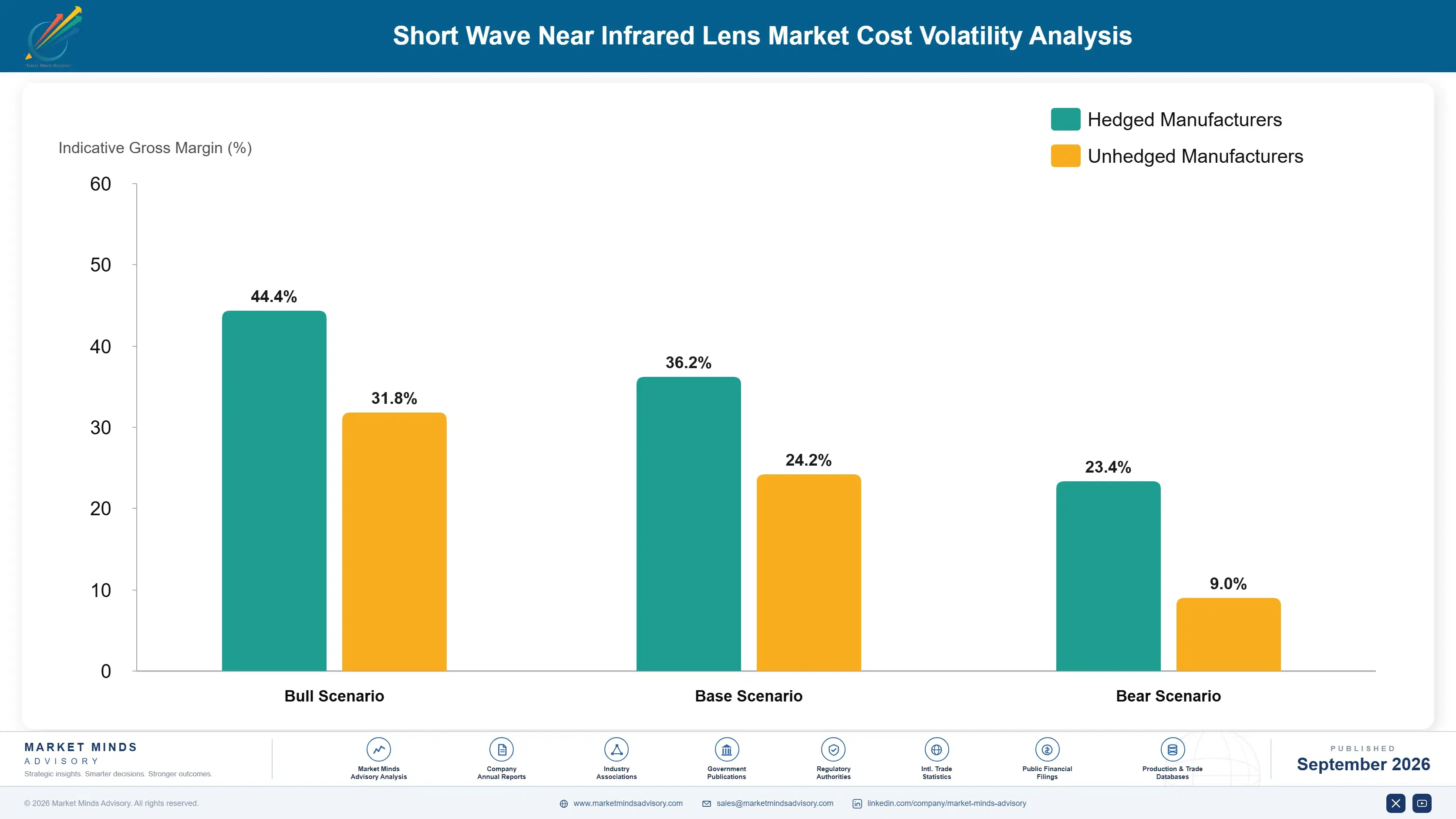
Cost structure is unusual because coating rivals glass and machining combined. Band-specific anti-reflection coating absorbs roughly 27% of manufactured cost, optical glass and blanks a further large share, and grinding, polishing, centring and assembly the remainder. Metrology behaves like capital rather than unit cost, since measuring transmission and wavefront across this band requires instruments visible-light shops do not hold.
Specialist glass availability has been the sharpest pressure. Only about 11 materials transmit usefully across the full band and a handful of producers supply most of them, so demand growth from imaging applications tightened availability through 2024 and 2025 against producers whose furnaces are scheduled far ahead. Jenoptik and Schott both referenced materials and capacity conditions in recent annual reporting. Lens manufacturers absorbed most of it, since qualified designs cannot substitute glass without requalification.

Exposure varies by coating position rather than by scale. Manufacturers with in-house coating control quality, lead time and about a quarter of cost directly. Those outsourcing coating carry variable quality alongside the same glass exposure and can influence neither. Suppliers moving toward moulded manufacturing carry capital and qualification cost ahead of the volumes justifying it, which is uncomfortable if automotive defers once more.
short-wave-near-infrared-lens-market-cost-volatility-analysis-1788427352219

Bring band-specific coating capability in house

Coating drives transmission, ghosting and durability while absorbing roughly 27% of manufactured cost, and outsourcing it means conceding quality control, lead time and a quarter of the cost base simultaneously. Establishing capability for this band requires chamber investment and process development that takes time. Manufacturers who did it hold the margin and can iterate designs without waiting on somebody else.

Design with pre-qualified alternate glasses from the outset

With about 11 usable materials from a handful of producers, one glass becoming unavailable strands a qualified design for the 34 weeks a requalification consumes. Pre-testing alternates during original design costs modest engineering and removes an exposure that has interrupted supply repeatedly. It must happen before qualification completes, which is precisely when it looks like unnecessary work.

Size moulding investment against industrial rather than automotive volumes

Automotive sensing programmes have been announced and deferred repeatedly, so capacity sized against them has twice carried cost with no demand behind it. Sizing moulding investment against industrial volumes that are already real keeps the capability useful whatever automotive does next. A vehicle programme then arrives as upside rather than as the assumption the business case rested on.

Portfolio Architecture for Margin Defence

Margin architecture separates on whether the buyer is an optical specialist or an integrator. Catalogue and semi-custom industrial optics sell to machine vision integrators comparing availability and price, which caps margin regardless of design quality. Semiconductor inspection and scientific optics sell to buyers who specify correction, coating and qualification precisely, and who pay accordingly because no substitute exists at their specification.
The tension runs between volume capability and craft economics. Moulded manufacturing serves the volumes the detector price collapse created and produces margins that look thin against everything this industry historically earned. Ground and polished work preserves those margins on demand that grows steadily rather than quickly. Manufacturers trying to hold both find their metrology, coating and qualification capacity contested internally between orders with completely different economics.

High-value revenue concentrates in semiconductor inspection optics and in defence and scientific work where specification rather than price governs. Both are defended by qualification relationships that take years to establish and that competitors cannot shortcut. Volume machine vision optics fund the coating and metrology capability the high-value work depends upon, which is a genuine argument for staying in a segment that earns comparatively little.

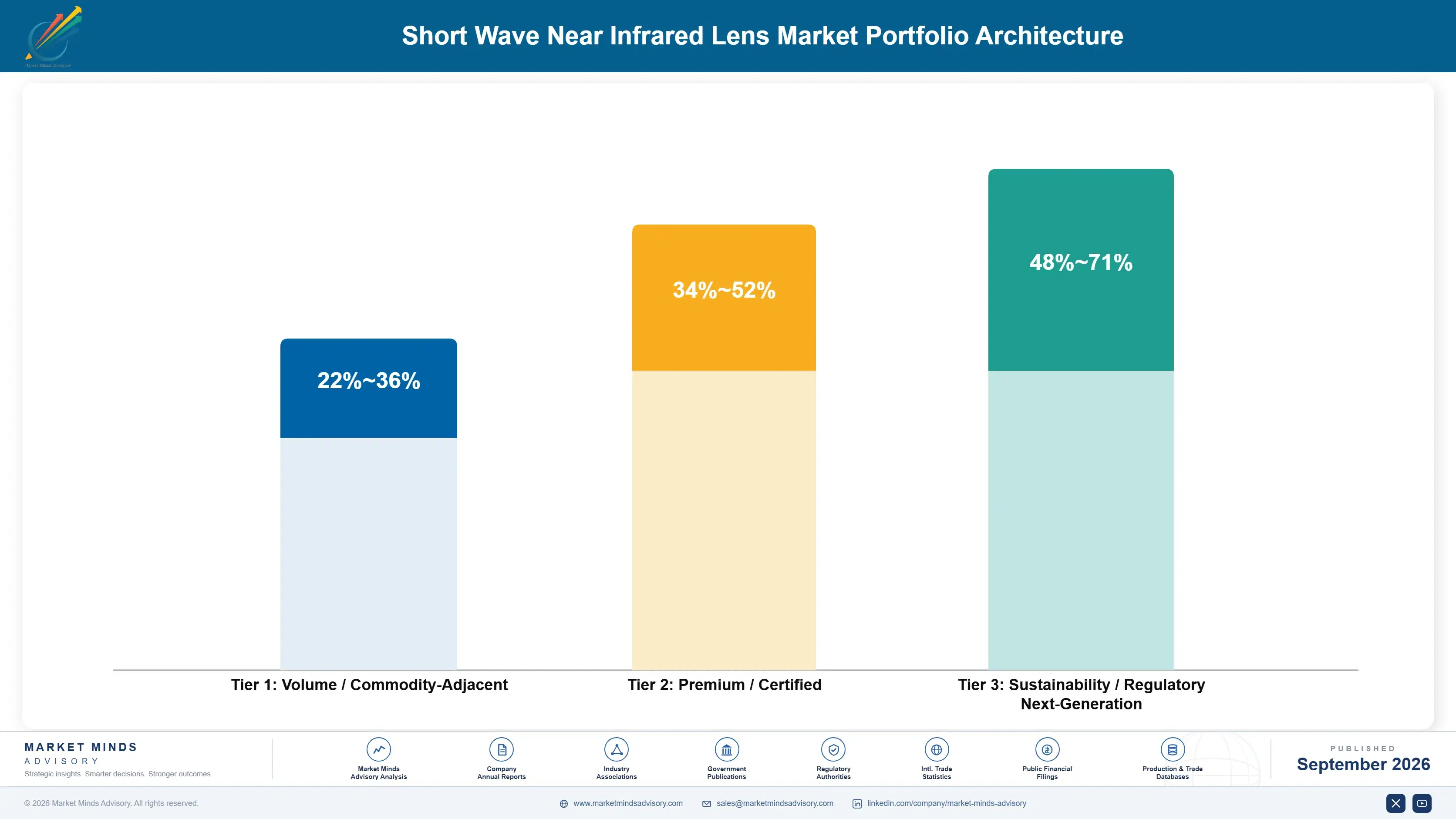
Volume / Commodity-Adjacent

Catalogue and semi-custom industrial optics sold to machine vision integrators on availability and price. The range separates manufacturers with moulded capability from those grinding and polishing. Chinese suppliers compete here directly and increasingly effectively on cost.
Gross Margin: 22-36%

Premium / Certified

Application-specific assemblies for food sorting, hyperspectral imaging and pharmaceutical inspection, sold with coating and durability specifications. Margin depends on in-house coating and on qualification depth. Buyers here specify properly rather than comparing catalogue entries.
Gross Margin: 34-52%

Sustainability / Regulatory / Next-Generation

Semiconductor through-silicon inspection, defence and scientific optics where specification rather than price governs selection entirely. The widest range in the portfolio, reflecting programme specificity and qualification content. Highest margin and most protected by relationship depth.
Gross Margin: 48-71%
short-wave-near-infrared-lens-market-portfolio-architecture-1788427352712

High-value Sub-segments and Strategic Watch-out

Semiconductor Inspection Optics

High value with strong growth at 16.4%, resting on packaging physics that will not change and on qualification relationships taking years to establish. The range reflects programme specificity by tool generation. It preserves the craft manufacturing economics that volume applications are eroding everywhere else in this market.
Gross Margin: 50-71%

Food and Agricultural Sorting Optics

Moderate value with steady growth, following food processing capacity and contamination liability rather than any technology cycle. The range reflects durability and cleanability specifications by application. It is the least discussed and most dependable demand here, and it predates the detector price collapse entirely by many years.
Gross Margin: 36-51%

Machine Vision Industrial Optics

The volume core, selling to integrators who compare availability and price rather than optical specification. The range separates moulded from ground and polished manufacturing. It funds the coating and metrology capability that higher-value work depends upon, which is its real commercial justification. Margin is not the point here.
Gross Margin: 21-35%

Automotive Capacity Investment

The strategic watch-out, where capacity built against announced 1550 nanometre programmes has twice been left carrying cost after deferrals. The physics case is sound and the timing case has failed repeatedly. Several manufacturers are sizing a third round of investment against exactly the same promises. It may yet work.
Gross Margin: 0-18%

How These Orders Repeat

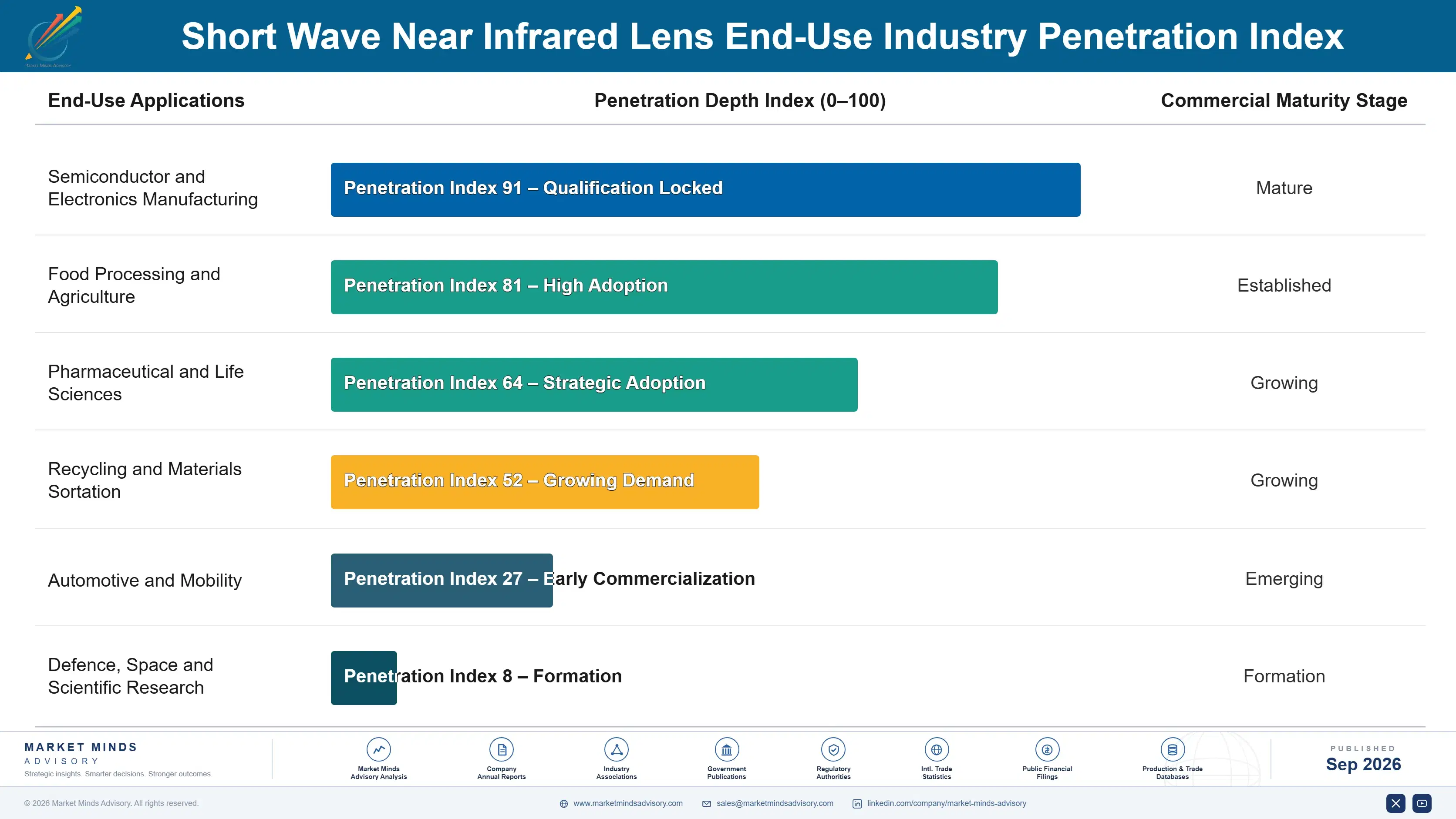
Recurrence follows the equipment the lens sits inside. Semiconductor inspection optics repeat with tool generations running several years, so a qualified design is close to permanent within that generation and a loss removes a supplier until the next one. Machine vision optics repeat continuously with camera production. Food sorting equipment refreshes over long cycles, and replacement lenses recur throughout because sorting environments damage optics steadily.
Adoption depth varies with how deeply the optic is qualified into a process. A semiconductor inspection lens is characterised into the tool's measurement recipes, so substitution requires requalifying the recipe rather than merely fitting a new part. A machine vision lens can be swapped in an afternoon. That distinction explains why apparently similar suppliers report retention figures that differ enormously, and why catalogue business churns constantly.

The buyer has changed as the market widened. Short wave optics were historically specified by optical engineers inside instrument companies who understood aberration correction and coating trade-offs. Volume demand now comes from machine vision integrators comparing availability, price and delivery. Manufacturers whose sales approach assumes an optical specialist across the table are addressing a shrinking share of a growing market.
short-wave-near-infrared-lens-market-end-use-penetration-index-1788427353203

Volume or Margin, Not Both

These are among the four positions where our research anticipates prominent divergence between winners and laggards over the coming forecast period. Each is grounded in the demand model, the regulatory perimeter, and the announced capacity pipeline.
01 / MANUFACTURING METHOD CHOICE

Commit to moulding early or concede the volume

Precision glass moulding and replication are the only routes to the unit costs camera builders now expect, and qualification cycles running about 34 weeks mean the capability cannot be assembled after an order arrives from a customer. Manufacturers who invested early hold cost positions roughly 40% below ground and polished equivalents at comparable optical specification and coating quality. Those waiting for demand certainty will find that certainty arrives roughly a year after the window to serve it has already closed behind them entirely.
02 / SEGMENT SELECTION DISCIPLINE

Defend semiconductor inspection rather than chasing vehicles

Through-silicon inspection grows at 16.4% on packaging physics that will not change, values resolution above unit cost and preserves the manufacturing economics this industry was actually built around over decades. Automotive at 22.2% offers larger volumes at prices that erase those economics, and it has been deferred repeatedly besides, twice within five years. Manufacturers concentrating on semiconductor and scientific work hold gross margins around 22 percentage points above volume suppliers, in a smaller and considerably more durable business than the automotive case currently presents.
03 / COATING CAPABILITY OWNERSHIP

Own the coating line or compete on somebody else's glass

Band-specific anti-reflection coating determines transmission, ghosting and durability while absorbing roughly 27% of manufactured cost, yet it is routinely treated as a mere process step rather than as the capability that decides competitive outcomes in this market. Manufacturers with in-house coating control quality, lead time and a quarter of their own cost base directly and internally. Those outsourcing the work are exposed on all three at once and end up competing on glass they did not make themselves or coat themselves.
04 / GLASS SUPPLY REDUNDANCY

Qualify alternate materials inside every original design

About 11 materials transmit usefully across this band and a handful of producers supply most of them, so one glass becoming unavailable strands a qualified design for the 34 weeks that requalification consumes from start to qualified production. Identifying and pre-testing alternates during original design costs modest engineering effort and removes an exposure that has interrupted supply repeatedly across this industry. It must happen before qualification completes, which is precisely when it looks like work nobody requested or budgeted for.

Engagement Snapshot From the Field

A live engagement with an industry participant carrying material or product regulatory and market exposure ahead of a defining policy shift, showing how our research translates into a defensible multi-year portfolio strategy.
MARKET MINDS ADVISORY · CLIENT ENGAGEMENT SUMMARY
Short Wave Near Infrared Lens Producer Strategic Portfolio Review and Transition Roadmap 2026·Investment Scenario on Short Wave Near Infrared Lens Exposure Evaluation 2025-26
CLIENT PROFILE
A machine vision camera manufacturer preparing a short wave infrared product line following detector price reductions, with projected volumes near 14,000 units annually within three years (client-reported, unverified by MMA). Its existing optics suppliers were precision houses accustomed to hundreds of units, and quoted lens pricing consumed most of the target camera cost entirely. Nobody had questioned why.
STRATEGIC CHALLENGE
Quoted lens pricing near USD 610 per assembly left the camera uncompetitive against the price point integrators had begun expecting once detector cost fell (client-reported, unverified by MMA). The client assumed volume commitments would move supplier pricing. Nobody had established whether the suppliers could physically manufacture at those volumes at any price at all.
MMA APPROACH
MMA assessed supplier manufacturing method rather than quoted pricing, since ground and polished capacity does not scale with commitment. We reviewed coating capacity, metrology throughput and glass supply positions across nine candidate suppliers, and interviewed 14 engineering and procurement staff plus four optical glass producers directly about capacity. Pricing came last.
KEY FINDINGS
  1. Only three of the nine candidate suppliers held moulding or replication capability, and two of those had qualified it for this waveband already.
  2. Ground and polished suppliers could not reach the target volume at any price, since coating and metrology throughput rather than polishing was the binding constraint.
  3. Two suppliers depended on a single glass type from one producer, with no alternate qualified and a requalification cycle exceeding eight months.
  4. Suppliers with in-house coating quoted roughly 24% below those outsourcing it, and offered lead times shorter by about seven weeks on comparable assemblies.
CLIENT PROFILE
A machine vision camera manufacturer preparing a short wave infrared product line following detector price reductions, with projected volumes near 14,000 units annually within three years (client-reported, unverified by MMA). Its existing optics suppliers were precision houses accustomed to hundreds of units, and quoted lens pricing consumed most of the target camera cost entirely. Nobody had questioned why.
STRATEGIC CHALLENGE
Quoted lens pricing near USD 610 per assembly left the camera uncompetitive against the price point integrators had begun expecting once detector cost fell (client-reported, unverified by MMA). The client assumed volume commitments would move supplier pricing. Nobody had established whether the suppliers could physically manufacture at those volumes at any price at all.
MMA APPROACH
MMA assessed supplier manufacturing method rather than quoted pricing, since ground and polished capacity does not scale with commitment. We reviewed coating capacity, metrology throughput and glass supply positions across nine candidate suppliers, and interviewed 14 engineering and procurement staff plus four optical glass producers directly about capacity. Pricing came last.
KEY FINDINGS
  1. Only three of the nine candidate suppliers held moulding or replication capability, and two of those had qualified it for this waveband already.
  2. Ground and polished suppliers could not reach the target volume at any price, since coating and metrology throughput rather than polishing was the binding constraint.
  3. Two suppliers depended on a single glass type from one producer, with no alternate qualified and a requalification cycle exceeding eight months.
  4. Suppliers with in-house coating quoted roughly 24% below those outsourcing it, and offered lead times shorter by about seven weeks on comparable assemblies.
RECOMMENDED STRATEGY
Phase 1: Shortlist only suppliers holding qualified moulding capability for this waveband, since volume cannot be reached by commitment alone at any price. Phase 2: Require pre-qualified alternate glass within the design, given that two candidates were exposed to a single producer with no fallback. Phase 3: Weight in-house coating capability explicitly in selection, since it drove both quoted price and lead time more than any other supplier attribute.
OUTCOME
Assembly pricing settled near USD 390 with a supplier holding qualified moulding and in-house coating (client-reported, unverified by MMA), which brought the camera within its target cost. Lead times ran about seven weeks shorter than the original shortlist average, and the alternate glass requirement was written into the design specification.

Frequently Asked Questions

Foundational context covering the market sizes, CAGR, scope, country, region and competition that inform every finding below. This section is provided to cover basics and most often pre-purchase conversations, answered from the MMA Primary Research Dataset.

What is the current size of the Short Wave Near Infrared Lens Market?

The market was worth USD 0.4 billion in 2025 and reaches USD 0.46 billion in 2026. Industrial inspection assemblies typically sell near USD 640 each at supplier level.

How large will the Short Wave Near Infrared Lens Market be by 2036?

MMA forecasts USD 1.83 billion by 2036, an expansion of 3.98 times over the forecast period. That represents USD 1.37 billion of incremental annual revenue against 2026.

What is the CAGR for the Short Wave Near Infrared Lens Market 2026 to 2036?

The base case is 14.8% compound annual growth, with a bull case at 16.0% and a bear case at 13.5%. Whether automotive sensing volumes finally arrive separates the scenarios.

Which segment is growing fastest?

Automotive and mobility sensing lenses grow at 22.2%, half again the market rate of 14.8%. It is also the least reliable segment, since announced programme volumes have slipped repeatedly.

Who are the major companies in the Short Wave Near Infrared Lens Market?

Jenoptik, Excelitas Technologies, Edmund Optics, Sumita Optical Glass and Kowa Optical Products lead on measured lens and assembly revenue. Together they hold roughly 41%, all specialist optical manufacturers.

Which country is growing fastest?

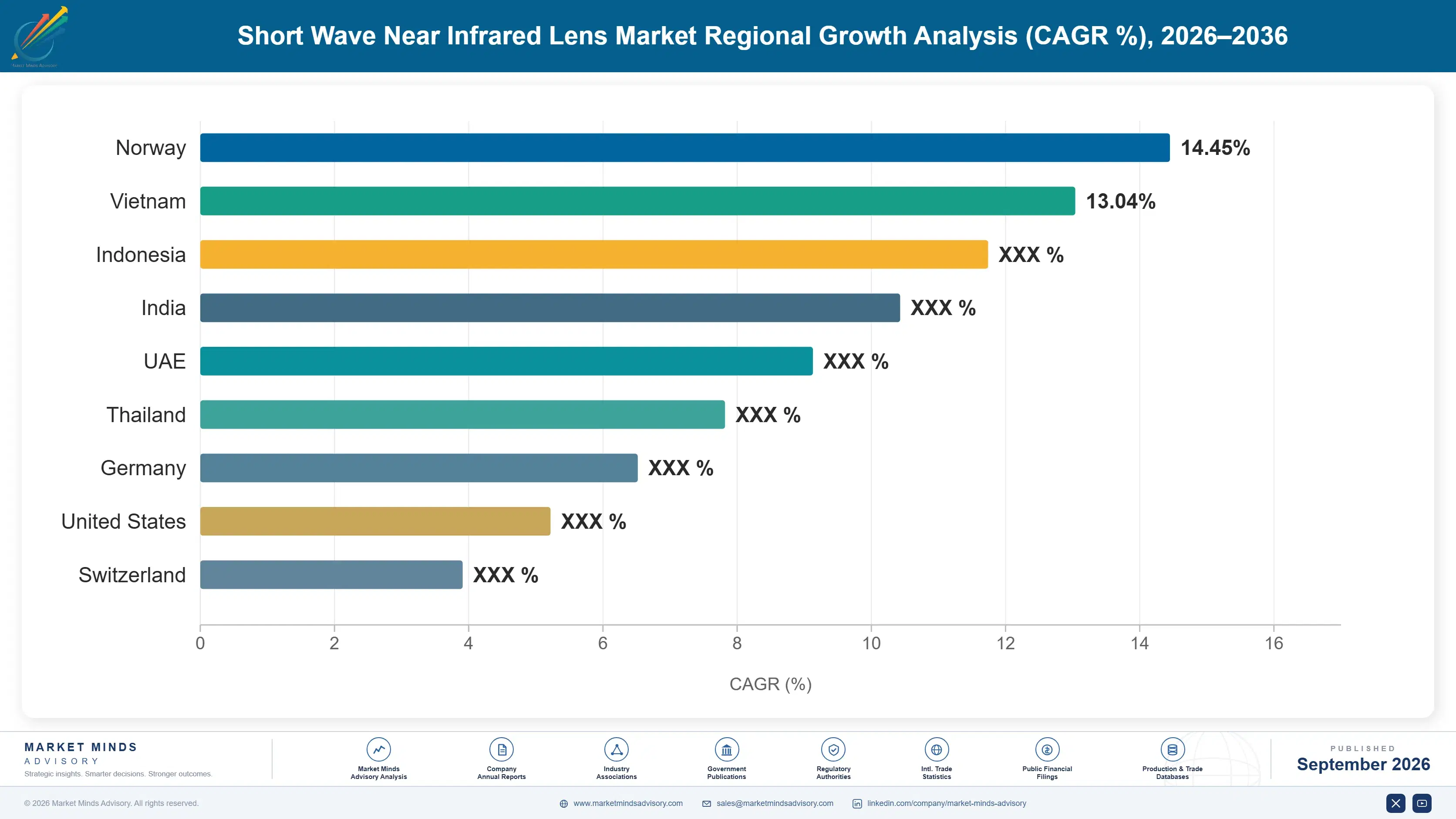
Vietnam grows fastest at 18.2%, as optical module and camera assembly relocates there from China and brings lens demand into the country alongside it, rather than optics capability.

Report Segmentation Architecture

The full report scope spans multiple orthogonal segmentation dimensions, with cross-tabulated demand data provided for each dimension pair. Coverage extends further to regional breakdowns, trend trajectories, and the competitive detail needed to support segment-level decision-making.

By Primary Market Dimension

  • Machine Vision and Industrial Inspection Lenses
  • Agricultural and Food Sorting Lenses
  • Semiconductor Through-Silicon Inspection Lenses
  • Hyperspectral and Scientific Imaging Lenses
  • Automotive and Mobility Sensing Lenses
  • Defence, Security and Surveillance Lenses

By End-Use Industry

  • Semiconductor and Electronics Manufacturing
  • Food Processing and Agriculture
  • Pharmaceutical and Life Sciences
  • Recycling and Materials Sortation
  • Automotive and Mobility
  • Defence, Space and Scientific Research

By Commercial Dimension

  • Catalogue and Stock Supply
  • Custom Design Programmes
  • Camera Manufacturer Direct Supply
  • Equipment Builder Framework Agreements
  • Distribution and Integrator Channels
  • Defence Programme Contracts

By Region

  • East Asia
  • North America
  • Western Europe
  • South Asia and Pacific
  • Middle East and Africa
  • Latin America
  • Eastern Europe

Scope, Methodology, and Coverage

Every figure in this report is reproducible from documented input assumptions. The scope below maps the historical period, the forecast horizon, the segmentation dimensions, and the countries covered, alongside the underlying primary and qualitative methodology.
Historical Period
2020 to 2025
Forecast Period
2026 to 2036
Base Year
2025 (USD billions; MMA Primary Research Dataset, September 2026)
Market Definition
This market covers optical lenses and lens assemblies designed and coated for imaging in the near infrared and short wave infrared bands, spanning machine vision and industrial inspection lenses, agricultural and food sorting lenses, semiconductor through-silicon inspection lenses, hyperspectral and scientific imaging lenses, automotive and mobility sensing lenses, and defence, security and surveillance lenses. Revenue is measured as lens and assembly value at supplier level, including attributable band-specific coating, metrology and qualification. Infrared detectors and image sensors, complete camera systems, long wave thermal infrared optics, optical filters and windows sold separately, illumination sources, and visible-band optics are excluded from scope.
Quantitative Units
USD billions, lens and assembly revenue at supplier level
Segmentation Dimensions
Application context, end-use industry, commercial channel, region
Regions Covered
East Asia, North America, Western Europe, South Asia and Pacific, Middle East and Africa, Latin America, Eastern Europe
Countries Covered
Japan, China, South Korea, Taiwan, Singapore, Vietnam, India, Thailand, Malaysia, Australia, United States, Canada, Mexico, Brazil, Chile, Peru, Germany, Switzerland, Netherlands, Belgium, United Kingdom, France, Italy, Poland, Czechia, Lithuania, Israel, United Arab Emirates, Saudi Arabia, South Africa
Key Companies Profiled
Jenoptik, Excelitas Technologies, Edmund Optics, Sumita Optical Glass, Kowa Optical Products, Nikon, Canon, Fujifilm, Schott, Ohara, Thorlabs, Optikos, LightPath Technologies, Universe Kogaku, Resolve Optics, StingRay Optics, Computar, Moritex, Tamron, Sunny Optical Technology
Quantitative Methodology
Primary survey, n=3,800 respondents, Q4 2025, six countries; demand-side model with trade association cross-validation
Qualitative Methodology
47 expert interviews, Q4 2025; applied to validate demand model assumptions, identify emerging dynamics, and assess competitive positioning
Report Format
PDF and XLSX data workbook (Word format preview document)
Publisher
Market Minds Advisory
Report Code
MMA-2026-TEC-991
Published
September 2026
Contact
sales@marketmindsadvisory.com | www.marketmindsadvisory.com

Purchase the full Short Wave Near Infrared Lens Market Report (2026 to 2036).

The full MMA report treats the detector price collapse as a manufacturing problem for lens makers rather than simply as an opportunity, and works through which segments survive camera economics. It sizes the market to 2036 across six application contexts, seven regions and 30 countries, with segment growth rates and regional demand mechanisms set out throughout. Competitive analysis covers 20 suppliers assessed on measured lens and assembly revenue, with moat and risk assessment for the two leaders. The report quantifies coating and glass cost structure, moulding investment economics and margin architecture across three portfolio tiers. It closes with four verdicts and an anonymised camera manufacturer engagement.
Six application contexts sized through 2036
Seven regions with demand mechanism analysis
Twenty suppliers on consistent revenue basis
Coating cost and qualification cycle benchmarks
Margin architecture across three portfolio tiers
Anonymised machine vision optics sourcing engagement

Built For The People Who Decide

From boardroom strategy to bench-side execution, this report is read cover-to-cover by leaders shaping the next decade of their industry, turning demand scenarios, market dynamics and valuation benchmarks into decisions.
CXOs/ Presidents/ VPs/ Managers
M&A and Corporate Development
Strategy Teams and R&D Heads
Procurement and Product Directors
Regulatory and Compliance Leaders
Investor Relations and Equity Analysts