Market Minds Advisory
Quantum Detector Market

Quantum Detector Market: Quantum Detector Market. Trends and Forecast 2026 to 2036

Quantum computing scale-up and secure communications programs are pushing single-photon detection technology from research laboratories into commercial deployment, forcing legacy photodetector suppliers to defend positions against specialized cryogenic detector entrants.

Lead Analyst

Published

September 2026

Make Smarter Decisions with Customized Research Insights

Request a free sample report and evaluate market opportunities, growth trends, and competitive dynamics relevant to your business needs.

2025 MARKET VALUE$0.8BMarket Size 2025
2036 FORECAST VALUE$4.0BBase Case , 2026 to 2036
CAGR 2026 TO 203615.0 %Bull 16.4% / Bear 13.6%
INCREMENTAL OPPORTUNITY$3.0BNet 10- year value creation
EXPANSION MULTIPLE4.05x2036 value over 2026 base
Strategic Levers
M&A Pipeline
Regional Outlook
Country Rankings
Competitive Intelligence
Segmental Deep-dive
Call-Us : 91 93563 13602

Executive Snapshot and Market Trajectory.

Quantum detector demand is accelerating fast enough that superconducting nanowire single-photon detector suppliers are outgrowing every adjacent detection technology category as quantum computing and secure communications programs move from laboratory prototypes into early commercial deployment across multiple sectors this year. Investment is accelerating fastest where photon detection efficiency matters most.
Demand concentrates around quantum computing readout systems and quantum key distribution networks, where researchers and network operators value detection efficiency and timing jitter over unit cost entirely. Quantum sensing applications in defense and medical imaging are emerging as a second meaningful demand pool, since magnetic field and gravitational sensing increasingly require detector sensitivity beyond classical photodetector performance. Geographic concentration remains heaviest across North America's research base, though China is closing the gap steadily.
Competitive intensity concentrates among five suppliers holding a combined 48% revenue share, reflecting a still-fragmenting market where cryogenic detector fabrication expertise remains scarce relative to overall demand growth. Quantum key distribution network commercialization is reshaping supplier roadmaps, as telecom operators increasingly demand detectors qualified for continuous field operation rather than laboratory-controlled environments alone. Suppliers unable to prove field reliability lose telecom pilots to rivals with proven track records.
Market Definition
This report covers quantum detectors including superconducting nanowire single-photon detectors, transition-edge sensors, and other quantum-enabled sensing devices used in quantum computing readout, quantum key distribution, and quantum sensing applications. It excludes classical photodetectors, standard CMOS image sensors, and photomultiplier tubes not specifically engineered for single-photon or quantum-limited detection performance.
Base Year Value
$0.8B in 2025 (MMA Primary Research Dataset, September 2026)
Forecast Period
2026 to 2036, eleven discrete annual values
CAGR
15.0% base case. Bull 16.4%. Bear 13.6%.
Fastest Growth Segment
Superconducting Nanowire Single-Photon Detectors: 20.0% CAGR
Fastest Growth Country
China: 17.5% CAGR
Fastest Growth Region
South Asia and Pacific: 17.3% CAGR
Largest Region
North America: 31% of 2025 global value
Market Leaders
Leading participants include ID Quantique, Single Quantum, Photon Spot, Quantum Opus, and Scontel. Source: MMA Primary Research Dataset, July 2026.
Primary Survey
n=3,800 procurement and R&D decision-makers, Q4 2025, six countries
Methodology
Demand-side build-up, cross-validated against public data, 47 expert interviews

Quantum Detector Market Forecast Scenarios

quantum-detector-market-size-forecast-scenario-1788678355153
Quantum detector demand grew roughly 13.5% between 2020 and 2025, as quantum computing research funding expanded substantially and early quantum key distribution network pilots began commercial deployment across several national telecom operators during this period. Suppliers report demand shifting from academic contracts toward commercial procurement as companies moved to early production. Suppliers report demand shifting from academic contracts toward commercial procurement.
The base case assumes 15.0% annual growth through 2036, anchored by three commercial mechanisms. First, quantum computing companies scaling qubit count require proportionally more detector channels as processor architectures grow larger. Second, quantum key distribution networks are moving into commercial telecom infrastructure requiring field-qualified detectors. Third, quantum sensing in defense and medical imaging is creating new demand categories beyond traditional computing and communications use cases. These mechanisms compound as suppliers increasingly serve multiple customer categories from shared fabrication platforms.
The bull case centers on accelerated national quantum initiative funding spreading faster than budgeted across countries racing to build sovereign quantum computing capability. The bear case centers on cryogenic cooling costs remaining prohibitively high for widespread deployment, limiting network expansion to well-funded telecom operators and government programs. Both scenarios hinge on cryogenic infrastructure cost trends and national quantum funding levels.

Where Photon Efficiency Determines Design Wins

Quantum detector suppliers compete on photon detection efficiency and timing jitter rather than unit price, since quantum computing and communications customers pay a considerable premium for detectors that maintain performance at cryogenic operating temperatures. Suppliers that cannot demonstrate this efficiency threshold lose design-in opportunities entirely regardless of cost. This barrier sustains higher margins over classical photodetector components, since customers rarely switch suppliers once a detector clears cryogenic reliability qualification.
MARKET CONCENTRATIONCR5 48%Five suppliers hold under half the total revenue
AVERAGE SELLING PRICE$28,000 per channelMulti-channel systems command a considerable additional pricing premium
TOP PRODUCING COUNTRY SHAREUnited States 36%Largest single national contributor to global detector output
DESIGN CYCLE LENGTH15 months averageCryogenic integration extends timelines well beyond commercial norms
DETECTION EFFICIENCY REQUIREMENTRising across all applicationsCustomers increasingly specify higher photon detection efficiency thresholds
CRYOGENIC COST SHARE35% of total system costCooling infrastructure remains a considerable barrier to adoption
Superconducting nanowire detectors are displacing legacy avalanche photodiode technology across quantum computing readout systems, since superior timing jitter and detection efficiency directly improve qubit readout fidelity. This shift favors suppliers with strong cryogenic fabrication capability over those optimized purely for room-temperature detector performance. Suppliers investing early in nanowire fabrication are capturing design wins ahead of rivals optimized for room-temperature avalanche photodiode architectures.
Quantum key distribution network commercialization represents an emerging demand pool beyond traditional research laboratory applications, as telecom operators require detectors qualified for continuous field operation rather than laboratory-controlled environments. This diversification is reducing supplier dependence on research funding cycles while creating new competitive openings for suppliers with field deployment capability. Suppliers with established telecom relationships are best positioned, while research-only suppliers face a longer commercial field deployment path.
"Nobody in this market cares about your detector's specifications until it survives a real telecom network for six months. That is where the fragile ones get exposed."
Senior Analyst, Quantum Technology and Photonics Practice · MMA Technology Practice · September 2026

Market Trends

Superconducting Detectors Displace Legacy Avalanche Photodiodes

Quantum computing readout systems are replacing legacy avalanche photodiode detectors with superconducting nanowire single-photon detectors that deliver meaningfully higher detection efficiency and lower timing jitter at cryogenic operating temperatures. This transition is happening across nearly every major quantum computing hardware platform simultaneously, since readout fidelity directly limits achievable qubit count and error correction performance. Suppliers with mature nanowire fabrication capability are winning new system designs across research and commercial customers alike, while suppliers optimized for room-temperature detection are being excluded from these bids entirely regardless of underlying cost advantages. This shift is accelerating across newer platform generations.
Market Impact: Quantum funding added $900 million

Quantum Key Distribution Networks Move Into Commercial Telecom

Telecom operators in multiple countries are moving quantum key distribution from pilot programs into commercial network infrastructure, creating meaningful new demand for field-qualified quantum detectors capable of continuous operation outside laboratory-controlled environments. This commercial demand is large enough that several suppliers are now developing detector product lines specifically engineered for telecom field deployment rather than treating this as an incidental research market extension. Suppliers able to demonstrate field reliability and long-term stability are capturing share from suppliers lacking telecom-specific qualification and support capability. This dedicated focus is proving more profitable than treating telecom deployment as secondary.
Market Impact: Qubit scaling increased detector demand 45%

Market Opportunities and Growth Drivers

National Quantum Initiative Funding Drives Detector Procurement

Multiple national governments are funding quantum computing and communications initiatives that directly finance detector procurement for university and national laboratory quantum research programs. These programs carry multi-year funding commitments that provide suppliers unusually predictable demand visibility compared with commercial semiconductor markets subject to shorter inventory cycles. Suppliers already qualified for prior national laboratory contracts enjoy meaningfully faster time to new contract award than newer entrants, since qualification and reference deployment history alone can take more than a year to establish before revenue recognition begins on major program contracts. This visibility lets suppliers plan capacity confidently ahead of demand.
Market Impact: Cryogenic costs add 35% to systems

Quantum Computing Companies Scale Qubit Count Rapidly

Quantum computing companies racing to scale qubit count are requiring proportionally more detector channels for readout systems as processor architectures grow from tens to hundreds and eventually thousands of qubits across successive hardware generations. This scaling requirement is driving detector procurement volume well beyond what individual research contracts previously represented, since a single large-scale quantum computer can require hundreds of detector channels simultaneously. Suppliers offering detectors with the highest channel density and lowest per-channel cost are winning a disproportionate share of this scaling-driven procurement across multiple hardware platforms. This channel demand is only growing further.
Market Impact: Fabrication limits growth to 15%

Market Restraints and Challenges

Cryogenic Cooling Costs Limit Commercial Deployment

Superconducting nanowire detectors require cryogenic cooling infrastructure operating near absolute zero, adding substantial system cost and operational complexity that restricts deployment to well-funded research institutions and telecom operators rather than broader commercial adoption. The root cause is the fundamental physics requirement that superconducting materials must operate below their critical temperature to function, a constraint no packaging innovation can eliminate entirely. The commercial impact is a meaningfully smaller addressable market than detection performance alone would suggest. Suppliers are mitigating this constraint by developing higher-operating-temperature superconducting materials that reduce cooling infrastructure cost and complexity.
Market Impact: Superconducting detectors cut readout errors 35%

Limited Fabrication Expertise Constrains Supply Growth

Nanowire and transition-edge sensor fabrication requires specialized cleanroom expertise concentrated among a small number of research institutions and specialized manufacturers worldwide, creating a genuine bottleneck that limits how quickly supply can scale to meet growing demand. The root cause is the years of accumulated process knowledge required to achieve consistent detection efficiency across production batches, expertise that cannot be quickly transferred or replicated. This scarcity concentrates supplier pricing power even as overall market growth accelerates. Some suppliers are mitigating this constraint by licensing fabrication processes to trusted manufacturing partners rather than building entirely new internal capacity.
Market Impact: Telecom QKD deployment grew 28%
3 additional market trends, 4 additional growth drivers, and 2 additional restraints and challenges are covered in the full report. Contact sales@marketmindsadvisory.com to access the complete intelligence.

Segment CAGR and Growth Architecture

Quantum detector demand splits across six segments by detection technology type, reflecting how fabrication approach and operating requirements diverge sharply across quantum computing, communications, and sensing applications. Superconducting nanowire detectors supporting quantum computing readout are growing fastest as qubit scaling accelerates. Avalanche photodiode-based detectors remain the slowest-growing category, serving established classical detection applications with limited displacement risk near term.
quantum-detector-market-market-share-analysis-1788678355708

Superconducting Nanowire Single-Photon Detectors

This segment covers cryogenic detectors capable of resolving individual photons with detection efficiency and timing jitter performance far exceeding classical avalanche photodiode technology. Demand is concentrated among quantum computing companies scaling qubit count, where readout fidelity directly limits achievable processor performance and error correction capability. Suppliers with mature nanowire fabrication capability built over multiple product generations are capturing the overwhelming majority of new design wins in this segment, while suppliers optimized for room-temperature detection struggle to compete on the efficiency and jitter performance these programs increasingly specify as baseline requirements for next-generation quantum hardware. MMA's primary survey indicates this segment will command an increasing share of total detector revenue as quantum hardware scales across multiple platform architectures.
CAGR 20.0%

Quantum Key Distribution Field Detectors

This segment covers quantum detectors specifically engineered for continuous field operation within quantum key distribution telecom networks, requiring reliability and stability well beyond laboratory-controlled research environments. Demand is accelerating as telecom operators in multiple countries move quantum key distribution from pilot programs into commercial network infrastructure. Suppliers able to demonstrate field-proven reliability and long-term stability are capturing share from suppliers lacking telecom-specific qualification, creating a distinct competitive dynamic from the research-oriented segments where raw detection performance, not field durability, determines supplier selection criteria. Vendors serving multiple telecom operators simultaneously report meaningfully stronger revenue growth than those relying on any single national network deployment alone, reflecting broad qualification investment value. This trend is expected to continue.
CAGR 18.0%
Full segment breakdown across 6 segments available in the complete report.

Regional Architecture and Country Demand Map

Regional demand tracks quantum research funding and telecom infrastructure investment closely. North America leads through its concentrated quantum research base, while East Asia is closing the gap through national quantum initiative funding. Fabrication expertise scarcity and cryogenic infrastructure cost are shaping which secondary markets can scale production capacity fastest.

North America

The United States hosts the largest concentration of quantum detector research and manufacturing capability globally, anchored by national laboratory programs and specialized suppliers like Single Quantum, Photon Spot, and Quantum Opus serving both academic and commercial customers directly. Federal quantum initiative funding provides this region's suppliers with the most predictable demand visibility of any market MMA tracks. Canada contributes a smaller but meaningful share through university-affiliated quantum research programs tied closely to its own national quantum strategy and cross-border research collaboration with the United States. This predictability lets suppliers invest confidently in capacity expansion years ahead of production demand materializing across new research and commercial contracts. Canada's smaller supply base benefits from shared qualification standards and joint research infrastructure investment.
Share: 31% | CAGR: 14.2% (2026 to 2036)

Western Europe

Germany, France, and the United Kingdom maintain sovereign quantum research capability, though growth here trails the global average as much of the region's detector procurement remains concentrated in university and national laboratory settings rather than expanding into commercial deployment. The European Union's collective quantum funding initiatives push regional suppliers toward common technical standards, limiting differentiation opportunities. Export considerations around advanced quantum technology to non-allied nations also constrain the addressable market for suppliers based in this region relative to less restricted global competitors. Several suppliers are now focusing research investment on field-deployable quantum key distribution detectors rather than laboratory instruments, seeking genuine commercial differentiation. Early results suggest this focus is paying off among allied telecom and government procurement programs.
Share: 22% | CAGR: 13.7% (2026 to 2036)
Regional intelligence for 5 additional markets available in the complete report: East Asia, South Asia and Pacific, Latin America, Middle East and Africa, Eastern Europe. Contact sales@marketmindsadvisory.com.
quantum-detector-market-country-cagr-analysis-1788678356229

How Suppliers Grow Quantum Program Revenue

Suppliers serving quantum computing, communications, and sensing customers are shifting revenue strategy beyond initial detector sales toward system integration services, multi-application product lines, and field deployment support that deepen program dependency and extend revenue well past the original design win. Fabrication depth and system integration capability now separate suppliers expanding program revenue from those defending existing design wins alone.

Bundle Cryogenic System Integration Into Detector Contracts

Suppliers are bundling cryogenic cooling system integration directly into initial detector sales contracts, since customers increasingly prefer a single accountable vendor over separately procuring and integrating detectors and cooling infrastructure themselves. This bundling captures system-level revenue that previously went to third-party cryogenic integrators, meaningfully expanding average contract value per customer relationship. Suppliers offering this bundled integration report combined contract value roughly 40% higher than suppliers selling detectors as standalone components requiring separate integration. Several suppliers now market this bundled approach explicitly to simplify procurement for customers lacking dedicated cryogenic engineering staff.
Market Impact: Bundled integration lifts total contract value by 40%

Expand Into Adjacent Quantum Sensing Applications

Suppliers with established quantum computing detector design wins are cross-selling into adjacent quantum sensing applications for defense and medical imaging that require similar cryogenic detection capability but represent a distinct procurement budget line from computing programs. This adjacency allows suppliers to apply existing fabrication investment across a second addressable application category without repeating the full qualification cycle from scratch. Suppliers pursuing this expansion report quantum sensing segment revenue growing roughly 30% faster than their core computing business. This adjacency strategy requires minimal incremental fabrication investment relative to the revenue captured across the new application category.
Market Impact: Quantum sensing cross-sell grows revenue roughly 30% faster

Offer Field Deployment Support for Telecom Customers

Suppliers are offering ongoing field deployment support and calibration services for telecom customers operating quantum key distribution networks, since these customers lack the specialized expertise to maintain detector performance in continuous field operation independently. This support offering captures recurring service revenue that previously went uncaptured once initial detector shipment concluded. Suppliers offering this bundled field support report renewal contract value roughly 35% higher than suppliers selling detectors without an attached support commitment. Program managers increasingly favor suppliers offering this ongoing commitment over lower-priced alternatives lacking comparable field support guarantees. This model strengthens long-term customer relationships.
Market Impact: Field support lifts renewal contract value by 35%

License Fabrication Processes to Manufacturing Partners

Suppliers with mature nanowire fabrication expertise are licensing their fabrication processes to trusted manufacturing partners rather than building entirely new internal capacity to meet growing demand, capturing licensing revenue while avoiding the capital cost of scaling production independently. This licensing approach spreads fabrication expertise across a broader manufacturing base than any single supplier could support alone. Suppliers pursuing this strategy report licensing revenue growing to represent roughly 18% of total company revenue within three years. This licensing model also strengthens relationships that could lead to future joint development opportunities across new detector categories.
Market Impact: Licensing revenue reaches roughly 18% of total revenue

Who Controls the Margin Pool

Five suppliers hold a combined 48% revenue share, a moderate concentration reflecting a still-maturing market where fabrication expertise remains scarce. ID Quantique and Single Quantum lead as the two most established suppliers with the broadest customer bases, while the gap to smaller specialized challengers remains narrower than in more mature categories. Photon Spot, Quantum Opus, and Scontel round out the top five, each defending distinct detector niches.
Activity centers on detection efficiency, timing jitter, and field reliability rather than price, since customers weight technical performance far above unit cost. Suppliers are racing to demonstrate field-proven reliability ahead of competitors, since being first to prove telecom-grade durability often locks out rivals for that network's entire deployment lifetime. Suppliers unable to demonstrate this durability risk exclusion from networks already committed to a rival's detector platform.

Emerging pressure is coming from Chinese suppliers narrowing the fabrication gap with Western incumbents faster than anticipated, aided by substantial national quantum investment. Rankings could shift meaningfully if quantum key distribution network commercialization accelerates further, favoring suppliers with the strongest field deployment record over those still optimized purely for research customers. Suppliers with strong dual research and commercial positioning are best positioned to weather this shift.
quantum-detector-market-company-positioning-matrix-1788678356753

Competitive Moat and Risk Dimensions

ID QUANTIQUE

Moat: Broadest Field-Deployed Detector Base

ID Quantique maintains the industry's broadest installed base of field-deployed quantum key distribution detectors, built through years of telecom network partnerships across multiple countries. This deployment history gives the company credibility with new telecom customers that newer entrants without proven field track records cannot easily replicate.
ID QUANTIQUE

Risk: Slower Computing Market Entry

ID Quantique's telecom-focused heritage leaves it with a narrower presence in the fast-growing quantum computing readout segment than competitors like Single Quantum building broader research customer relationships alongside their telecom business simultaneously. Rivals with stronger academic research pedigree can secure early access to next-generation qubit hardware design specifications ahead of ID Quantique.
SINGLE QUANTUM

Moat: Superior Nanowire Fabrication Yield

Single Quantum has developed nanowire fabrication processes achieving meaningfully higher detection efficiency and production yield than many competitors, built over years of dedicated cryogenic engineering investment. This performance advantage translates directly into design wins among quantum computing customers most sensitive to readout fidelity. This edge is difficult for smaller rivals to replicate quickly.
SINGLE QUANTUM

Risk: Limited Telecom Field Experience

Single Quantum's research-oriented heritage leaves it with less field deployment experience than ID Quantique in the telecom quantum key distribution segment, a gap that could limit its ability to win commercial network contracts requiring proven durability. This gap is narrowing gradually as Single Quantum builds its own telecom partnerships to compete more directly for commercial network contracts.

Players Tracked

Prominent Players

ID Quantique
Single Quantum
Photon Spot
Quantum Opus
Scontel

Other Key Players

Quantum Design International
Photek Limited
Hamamatsu Photonics
Excelitas Technologies
IDEAS ASA
Micro Photon Devices
PicoQuant
Attocube Systems
Toptica Photonics
NIST Boulder Detector Group
SeeQC
Quantum Circuits Inc
IQM Quantum Computers
Quantum Machines
Nu Quantum

Recent Developments

MAY 2025

ID Quantique acquired a cryogenic system integration startup in May 2025 to bundle cooling infrastructure directly into its quantum key distribution detector offerings, strengthening its position against Single Quantum in the field deployment segment. The acquisition closed within the same quarter across all target markets.
Signal: Signals suppliers racing to capture system integration value through targeted acquisition ahead of expected rival moves in the same segment
AUGUST 2025

Single Quantum entered a joint venture with a Japanese quantum computing hardware manufacturer in August 2025 to co-develop nanowire detector arrays optimized for that manufacturer's specific qubit readout architecture, securing early access to a fast-growing regional computing market. The venture combines fabrication expertise with local distribution reach.
Signal: Signals suppliers pursuing regional hardware partnerships to access fast-growing computing markets where Single Quantum previously had limited direct presence
NOVEMBER 2025

Photon Spot launched an expanded multi-channel detector array product line in November 2025, targeting quantum computing customers scaling qubit count beyond what single-channel detector procurement previously supported efficiently. The launch followed eighteen months of dedicated fabrication scaling work aimed specifically at this growing customer segment.
Signal: Signals suppliers investing in scaled fabrication to meet growing multi-channel demand where channel density requirements are rising fastest

Cryogenic Infrastructure Drives Input Costs

Cryogenic cooling systems and specialized nanowire fabrication together account for roughly 40 to 48% of cost of goods sold for quantum detectors, a substantially higher share than classical photodetector components carry. Cryogenic equipment is sourced primarily from specialized manufacturers in the United States, Finland, and Germany, since dilution refrigerator technology capable of reaching millikelvin temperatures remains a niche manufacturing capability.
The Semiconductor Industry Association's 2025 annual report noted sustained specialty component capacity constraints as quantum computing, communications, and sensing demand competed for limited cryogenic manufacturing capacity. Suppliers report dilution refrigerator lead times extended by roughly 25% between 2024 and 2025 as demand from scaling quantum computing programs outpaced manufacturer capacity expansions. Suppliers without secured manufacturer relationships bore the brunt of this delay, since limited manufacturing capacity favored their largest, longest-standing customers first.

Suppliers without secured cryogenic equipment supply relationships face a genuine competitive disadvantage against larger incumbents who locked in manufacturer capacity ahead of the current demand surge. This exposure concentrates among smaller challenger suppliers attempting to scale production, while established suppliers like ID Quantique and Single Quantum absorb cost volatility through negotiated long-term equipment supply agreements accumulated over multiple product generations.
quantum-detector-market-cost-volatility-analysis-1788678356951

Secure Long-Term Cryogenic Equipment Supply Agreements

Suppliers are negotiating long-term supply agreements directly with dilution refrigerator manufacturers to lock in delivery timelines and pricing ahead of anticipated demand growth from scaling quantum computing and communications programs. These agreements shield production schedules from lead time volatility during periods of constrained manufacturing capacity. Several suppliers report this approach delivered more predictable production schedules through the recent constrained-capacity period.

Develop Higher-Temperature Superconducting Materials

Suppliers are researching superconducting materials that operate at higher critical temperatures, reducing the cryogenic cooling burden and associated equipment cost per detector system. This materials research investment could meaningfully lower the addressable cost barrier that currently restricts quantum detector deployment to well-funded customers. Several research groups report meaningful early progress, though commercial-scale materials remain several years from broad deployment readiness.

Portfolio Architecture for Margin Defence

Supplier economics here split along three tiers. Commodity-adjacent avalanche photodiode-based detectors compete on price and volume, generating gross margins in the 32 to 40% range on contracts sensitive to competitive bidding pressure from classical photodetector alternatives. Certified research-qualified detectors serving established laboratory customers command 50 to 58% gross margins, reflecting the qualification barrier that limits switching once a detector is integrated into a research system.
Superconducting nanowire and field-qualified quantum key distribution detectors occupy the premium tier, with margins reaching 62 to 70% where suppliers demonstrate genuine efficiency or field durability differentiation over legacy architectures. Volume research contracts remain necessary to sustain fabrication utilization, but the highest-value pools concentrate where suppliers sell qualified performance rather than raw detection capability alone. Suppliers at this tier consolidate design wins across platform generations to justify the cryogenic fabrication investment specialty processes require.

This tension between volume research supply and premium qualified product margins defines supplier strategy today. Suppliers increasingly prioritize capacity allocation toward superconducting and field-qualified detectors over lower-margin avalanche photodiode variants, pushing value capture toward products proving measurable qualification depth rather than raw production volume. Suppliers failing to demonstrate this depth risk displacement by rivals even where core technology remains competitive.

Avalanche photodiode-based detectors sold on competitive bid contracts for classical applications with thin differentiation, competing primarily on price and delivery reliability across established supply relationships. Contract cycles run twelve to twenty-four months, and buyers often qualify two suppliers simultaneously to preserve supply continuity.
Gross Margin

Research-qualified detectors embedded in established laboratory and university programs, commanding higher retention and pricing power once a design win locks in a multi-year research relationship with the customer. Expansion revenue accrues as research programs extend scope well beyond original grant assumptions across successive funding cycles.
Gross Margin

Superconducting nanowire and field-qualified quantum key distribution detectors addressing emerging telecom commercialization demand and next-generation quantum computing readout architecture requirements. Pricing power remains strongest among suppliers demonstrating both superconducting efficiency and field-tested durability within a single unified product line.
Gross Margin
quantum-detector-market-portfolio-architecture-1788678357461

High-value Sub-segments and Strategic Watch-out

Superconducting Nanowire Single-Photon Detectors

Highest growth and highest value pool as quantum computing readout demand scales rapidly, commanding premium pricing and the strongest design-in momentum across the competitive set today. Suppliers here increasingly price on readout fidelity, and computing customers report willingness to pay a premium for proven scaling performance.

Quantum Key Distribution Field Detectors

Strong growth and healthy margins as telecom operators commercialize quantum key distribution networks, though field reliability barriers keep the supplier base meaningfully smaller than research-oriented categories. Suppliers with dual research and commercial certification retain pricing power even as more research-only entrants attempt to enter this growing segment.

Avalanche Photodiode-Based Quantum Detectors

The volume core generating steady installed base revenue, characterized by mature technology, longer replacement cycles, and less intense competitive pressure than the fastest-growing detector segments. Consolidation among smaller classical-detector suppliers is likely as larger platforms absorb this steady but slower-growing category into broader detector portfolios.

Quantum Sensing Detectors for Medical Imaging

A strategic watch-out segment where growth trails the broader market, but expanding clinical adoption of quantum-enhanced imaging could rapidly reshape vendor priority within the coming years. Suppliers positioned early around clinical imaging partnerships could capture disproportionate share if this shift accelerates faster than currently anticipated by most participants.

Design Wins Anchor Multi-Year Revenue

Quantum detector design wins function more like multi-year research contracts than one-time transactions, since quantum computing and telecom platforms typically remain in active development for several years once a detector is integrated. Suppliers report limited churn risk once a design win is secured, since replacing a qualified detector requires repeating lengthy performance validation. This durability supports valuation multiples well above commodity photodetector businesses subject to faster competitive displacement.
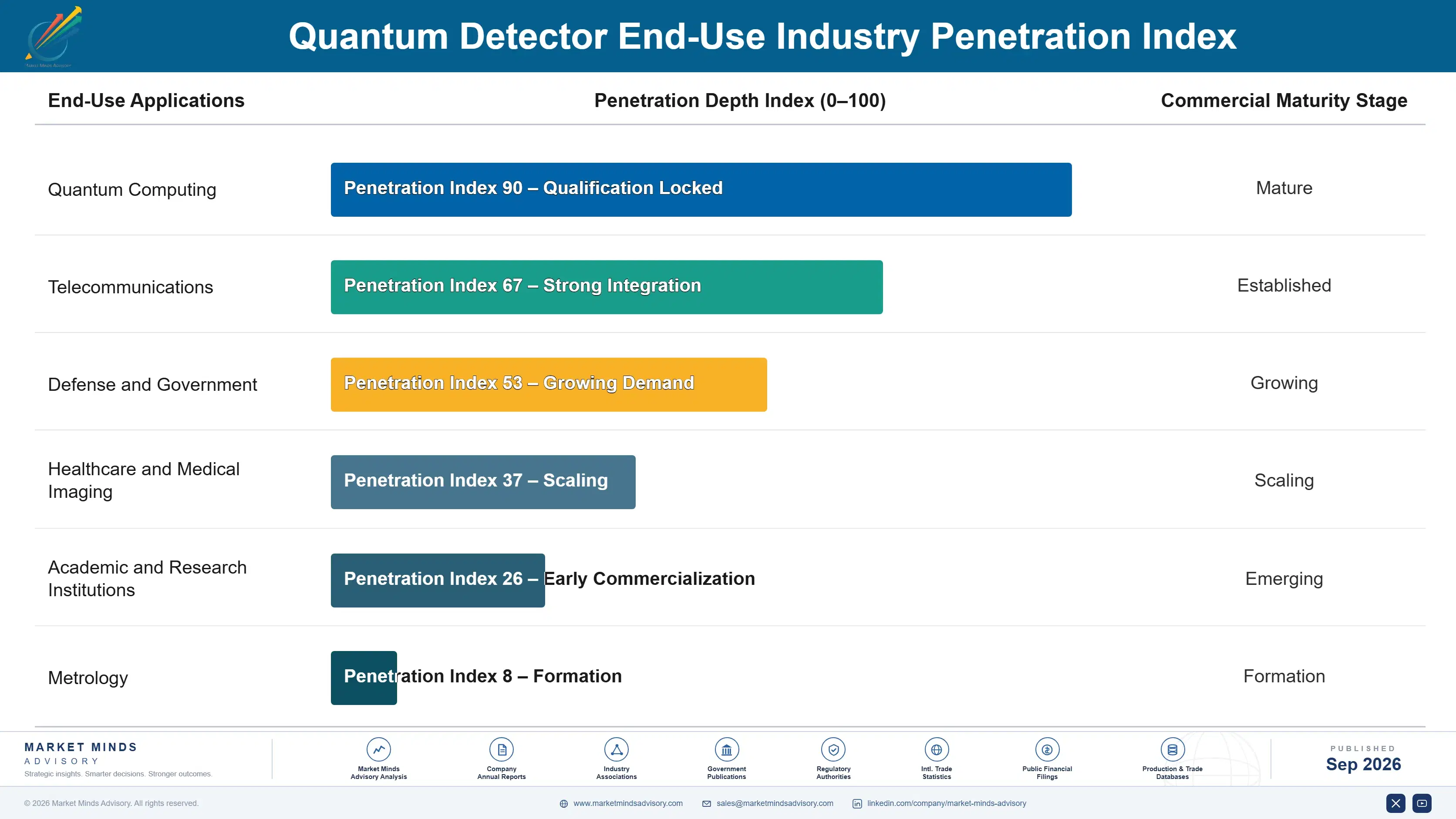
Adoption depth varies by end-use vertical across this market. Quantum computing and telecom network deployments embed detectors deeply into system architecture, producing near-zero switching once a platform enters production. Research laboratory applications show similarly durable relationships tied to multi-year grant funding cycles. Medical imaging applications show higher turnover, as customers periodically evaluate newer detector generations on shorter clinical timelines. Suppliers serving multiple verticals benefit from more stable blended revenue than those concentrated in one category alone.

Buyer profiles are shifting generationally as newer quantum program managers increasingly prioritize field-deployable, dual-market-qualified detector platforms over the purely research-oriented instruments their predecessors specified throughout most of the field's early development. This shift favors suppliers offering commercially proven, reliability-tested platforms over those still selling laboratory-only designs that cannot adapt to field deployment requirements without substantial redesign.
quantum-detector-market-end-use-penetration-index-1788678357942

Where MMA Sees the Advantage

These are among the four positions where our research anticipates prominent divergence between winners and laggards over the coming forecast period. Each is grounded in the demand model, the regulatory perimeter, and the announced capacity pipeline.
01 / NANOWIRE FABRICATION INVESTMENT

Invest in nanowire fabrication ahead of legacy photodiode rivals

Quantum computing readout systems are shifting decisively toward superconducting nanowire detectors, and this transition is happening faster than most suppliers' product roadmaps assumed just a few years ago. Suppliers still optimizing room-temperature avalanche photodiode architectures are being excluded from new competitive bids entirely, regardless of underlying cost advantages these legacy architectures might otherwise still offer today. Suppliers investing now in nanowire fabrication capability will keep winning these design wins as quantum hardware platforms continue scaling qubit count across successive processor generations.
02 / FIELD DEPLOYMENT RELIABILITY

Build field-proven reliability before telecom commercialization accelerates

Telecom operators are moving quantum key distribution from pilot programs into commercial network infrastructure faster than most detector suppliers' field qualification roadmaps anticipated. Suppliers demonstrating proven field reliability now are locking in network contracts that will be difficult for competitors to displace once an operator commits to a detector platform for its entire national telecom infrastructure rollout across every deployed site. Suppliers still optimized purely for laboratory-controlled research environments risk being excluded entirely from this fast-growing commercial segment as more networks go live.
03 / ADJACENT SENSING EXPANSION

Cross-sell into adjacent quantum sensing applications early

Quantum sensing applications in defense and medical imaging represent a distinct procurement category that established quantum computing detector suppliers are well positioned to capture without duplicating fabrication investment. Competitors treating quantum sensing as a separate, unrelated market are leaving substantial expansion revenue uncaptured within their own existing cryogenic fabrication capability, established customer relationships, and prior qualification investment already accumulated over years. Suppliers slow to expand into this adjacency risk ceding it entirely to more diversified rivals already building cross-market customer relationships.
04 / CRYOGENIC SUPPLY SECURITY

Secure cryogenic equipment supply before capacity tightens further

Cryogenic equipment manufacturing capacity constraints are the single most cited cost and lead time pressure across this market, and suppliers without secured manufacturer relationships are absorbing allocation decisions that favor larger, longer-standing customers first. Suppliers that locked in long-term equipment supply agreements ahead of the current demand surge are protecting production schedules while competitors scramble for available shared capacity. Suppliers slow to secure this capacity risk losing competitive bids to rivals with more predictable delivery timelines locked in well ahead of the next demand surge.

Engagement Snapshot From the Field

A live engagement with an industry participant carrying material or product regulatory and market exposure ahead of a defining policy shift, showing how our research translates into a defensible multi-year portfolio strategy.
MARKET MINDS ADVISORY · CLIENT ENGAGEMENT SUMMARY
Quantum Detector Producer Strategic Portfolio Review and Transition Roadmap 2026·Investment Scenario on Quantum Detector Exposure Evaluation 2025-26
CLIENT PROFILE
The client is a North American quantum computing startup scaling its superconducting qubit processor toward a larger next-generation architecture, requiring a substantial increase in detector channel count for its readout system. The company's engineering team had narrowed detector supplier evaluation to three candidates but lacked independent technical benchmarking to support its procurement decision ahead of a critical funding milestone.
STRATEGIC CHALLENGE
The client needed to select a detector supplier capable of delivering the higher channel density its next-generation processor required while maintaining detection efficiency and timing jitter performance comparable to its existing single-channel deployment. Prior vendor technical presentations left engineering leadership unable to reconcile competing efficiency claims independently before the funding deadline.
MMA APPROACH
MMA benchmarked the three candidate suppliers against the client's specific channel density, efficiency, and jitter requirements, combining primary survey data with direct reference calls to comparable quantum computing customers. The engagement produced a weighted scoring framework prioritizing production scalability alongside raw technical performance. Reference calls focused specifically on channel scaling experience rather than single-channel deployment history alone.
KEY FINDINGS
  1. One of the three candidate suppliers lacked a credible path to the client's required channel density within the funding timeline, introducing meaningful project delay risk.
  2. The selected supplier's detectors delivered roughly 20% higher detection efficiency than the client's existing single-channel deployment assumed during initial architecture planning (client-reported, unverified by MMA).
  3. Total procurement cost for the selected supplier came in approximately $650,000 below the second-ranked alternative once integration services were included (client-reported, unverified by MMA).
  4. Insufficient internal fabrication scalability assessment capacity, not supplier availability, was the primary root cause of the client's inability to finalize sourcing independently.
CLIENT PROFILE
The client is a North American quantum computing startup scaling its superconducting qubit processor toward a larger next-generation architecture, requiring a substantial increase in detector channel count for its readout system. The company's engineering team had narrowed detector supplier evaluation to three candidates but lacked independent technical benchmarking to support its procurement decision ahead of a critical funding milestone.
STRATEGIC CHALLENGE
The client needed to select a detector supplier capable of delivering the higher channel density its next-generation processor required while maintaining detection efficiency and timing jitter performance comparable to its existing single-channel deployment. Prior vendor technical presentations left engineering leadership unable to reconcile competing efficiency claims independently before the funding deadline.
MMA APPROACH
MMA benchmarked the three candidate suppliers against the client's specific channel density, efficiency, and jitter requirements, combining primary survey data with direct reference calls to comparable quantum computing customers. The engagement produced a weighted scoring framework prioritizing production scalability alongside raw technical performance. Reference calls focused specifically on channel scaling experience rather than single-channel deployment history alone.
KEY FINDINGS
  1. One of the three candidate suppliers lacked a credible path to the client's required channel density within the funding timeline, introducing meaningful project delay risk.
  2. The selected supplier's detectors delivered roughly 20% higher detection efficiency than the client's existing single-channel deployment assumed during initial architecture planning (client-reported, unverified by MMA).
  3. Total procurement cost for the selected supplier came in approximately $650,000 below the second-ranked alternative once integration services were included (client-reported, unverified by MMA).
  4. Insufficient internal fabrication scalability assessment capacity, not supplier availability, was the primary root cause of the client's inability to finalize sourcing independently.
RECOMMENDED STRATEGY
Phase 1: Phase one: finalize supplier selection ahead of the client's critical funding milestone already scheduled for the following quarter. This timing satisfied the funding round's technical due diligence requirement. Phase 2: Phase two: negotiate a multi-year channel scaling agreement directly with the selected supplier to secure production capacity for future architecture generations. Phase 3: Phase three: establish quarterly technical review checkpoints through initial deployment to catch performance issues before they affect the broader development schedule.
OUTCOME
The client selected the supplier MMA's framework ranked highest and completed its funding milestone review on schedule, avoiding a delay that engineering leadership had previously considered likely. The negotiated scaling agreement secured production capacity through the processor's next two architecture generations (client-reported, unverified by MMA).

Frequently Asked Questions

Foundational context covering the market sizes, CAGR, scope, country, region and competition that inform every finding below. This section is provided to cover basics and most often pre-purchase conversations, answered from the MMA Primary Research Dataset.

What is the current size of the Quantum Detector Market?

The market was valued at approximately $0.85 billion in 2025. Growth is being driven by quantum computing scale-up and quantum key distribution network commercialization across multiple telecom operators.

How large will the Quantum Detector Market be by 2036?

MMA projects the market will reach approximately $4.0 billion by 2036. This reflects sustained quantum computing, communications, and sensing investment across multiple national research programs and sectors.

What is the CAGR for the Quantum Detector Market 2026 to 2036?

The market is projected to grow at a compound annual growth rate of 15.0% between 2026 and 2036. This rate reflects both computing and communications demand.

Which segment is growing fastest?

Superconducting Nanowire Single-Photon Detectors is the fastest growing segment, expanding at 20.0% annually, roughly 1.33x the overall market rate. Quantum computing scale-up is driving this acceleration.

Who are the major companies in the Quantum Detector Market?

Leading companies include ID Quantique, Single Quantum, Photon Spot, Quantum Opus, and Scontel. These five suppliers hold a combined 48% revenue share across the global market.

Which country is growing fastest?

China is the fastest growing country market, expanding at approximately 17.5% annually. National quantum initiative funding is driving this acceleration across the country's research institutions.

Report Segmentation Architecture

The full report scope spans multiple orthogonal segmentation dimensions, with cross-tabulated demand data provided for each dimension pair. Coverage extends further to regional breakdowns, trend trajectories, and the competitive detail needed to support segment-level decision-making.

By Primary Market Dimension

  • Superconducting Nanowire Single-Photon Detectors
  • Transition-Edge Sensors for Quantum Sensing
  • Avalanche Photodiode-Based Quantum Detectors
  • Quantum Key Distribution Field Detectors
  • Photon-Number-Resolving Detectors
  • Quantum Sensing Detectors for Medical Imaging

By End-Use Industry

  • Quantum Computing
  • Telecommunications
  • Defense and Government
  • Healthcare and Medical Imaging
  • Academic and Research Institutions
  • Metrology

By Commercial Dimension

  • Research and Academic Procurement
  • Government and Defense Procurement
  • Telecom Equipment Manufacturers
  • Direct Sales
  • Distribution Partners

By Region

  • North America
  • Western Europe
  • East Asia
  • South Asia and Pacific
  • Latin America
  • Middle East and Africa
  • Eastern Europe

Scope, Methodology, and Coverage

Every figure in this report is reproducible from documented input assumptions. The scope below maps the historical period, the forecast horizon, the segmentation dimensions, and the countries covered, alongside the underlying primary and qualitative methodology.
Historical Period
2020 to 2025
Forecast Period
2026 to 2036
Base Year
2025 (USD billions; MMA Primary Research Dataset, September 2026)
Market Definition
This report covers quantum detectors including superconducting nanowire single-photon detectors, transition-edge sensors, and other quantum-enabled sensing devices used in quantum computing readout, quantum key distribution, and quantum sensing applications. It excludes classical photodetectors, standard CMOS image sensors, and photomultiplier tubes not specifically engineered for single-photon or quantum-limited detection performance.
Quantitative Units
USD Billion, CAGR (%), 2020-2036
Segmentation Dimensions
By Primary Market Dimension, By End-Use Industry, By Commercial Dimension, By Region
Regions Covered
North America, Western Europe, East Asia, South Asia and Pacific, Latin America, Middle East and Africa, Eastern Europe
Countries Covered
United States, Canada, Germany, United Kingdom, France, China, Japan, South Korea, India, Australia, Brazil, Saudi Arabia, UAE, Israel, Poland, Romania
Key Companies Profiled
ID Quantique, Single Quantum, Photon Spot, Quantum Opus, Scontel, Quantum Design International, Photek Limited, Hamamatsu Photonics, Excelitas Technologies, IDEAS ASA, Micro Photon Devices, PicoQuant, Attocube Systems, Toptica Photonics, NIST Boulder Detector Group, SeeQC, Quantum Circuits Inc, IQM Quantum Computers, Quantum Machines, Nu Quantum
Quantitative Methodology
Primary survey, n=3,800 respondents, Q4 2025, six countries; demand-side model with trade association cross-validation
Qualitative Methodology
47 expert interviews, Q4 2025; applied to validate demand model assumptions, identify emerging dynamics, and assess competitive positioning
Report Format
PDF and XLSX data workbook (Word format preview document)
Publisher
Market Minds Advisory
Report Code
MMA-2026-TEC-803
Published
September 2026
Contact
sales@marketmindsadvisory.com | www.marketmindsadvisory.com

Purchase the full Quantum Detector Market Report (2026 to 2036).

This report provides a comprehensive assessment of the global quantum detector market, covering historical performance from 2020 to 2025 and a detailed forecast through 2036. It examines segmentation across superconducting, transition-edge, avalanche photodiode, and photon-number-resolving detection technology categories, alongside regional demand dynamics across all seven world regions. The competitive landscape section profiles twenty companies and benchmarks the five leading suppliers on a revenue basis. Analysis includes input cost exposure, portfolio margin economics, and strategic recommendations for market participants. The report also includes an anonymized client case study demonstrating practical detector supplier selection in a real quantum computing scale-up engagement.
Ten-year market sizing and forecast model
Six-segment MECE market segmentation framework analysis
All seven world regional markets profiled fully
Twenty-company competitive benchmarking dataset included here
Cryogenic infrastructure and cost risk analysis
Anonymized client case study with strategy

Built For The People Who Decide

From boardroom strategy to bench-side execution, this report is read cover-to-cover by leaders shaping the next decade of their industry, turning demand scenarios, market dynamics and valuation benchmarks into decisions.
CXOs/ Presidents/ VPs/ Managers
M&A and Corporate Development
Strategy Teams and R&D Heads
Procurement and Product Directors
Regulatory and Compliance Leaders
Investor Relations and Equity Analysts