Market Minds Advisory
Superconducting Quantum Chip Market

Superconducting Quantum Chip Market: Superconducting Quantum Chip Market. The Race Toward Fault-Tolerant Qubits Reshapes a Concentrated Fabrication Landscape

Quantum computing programmes chasing genuine fault tolerance are discovering that raw qubit count matters less than error correction architecture, pulling fabrication investment toward multi-chip modular designs years before enterprise customers can use these machines commercially.

Lead Analyst

Published

September 2026

Make Smarter Decisions with Customized Research Insights

Request a free sample report and evaluate market opportunities, growth trends, and competitive dynamics relevant to your business needs.

2025 MARKET VALUE$0.4BMarket Size 2025
2036 FORECAST VALUE$2.2BBase Case , 2026 to 2036
CAGR 2026 TO 203617.5 %Bull 19.0% / Bear 16.0%
INCREMENTAL OPPORTUNITY$1.8BNet 10- year value creation
EXPANSION MULTIPLE5.02x2036 value over 2026 base
Strategic Levers
M&A Pipeline
Regional Outlook
Country Rankings
Competitive Intelligence
Segmental Deep-dive
Call-Us : 91 93563 13602

Executive Snapshot and Market Trajectory.

Quantum computing programmes chasing genuine fault tolerance are discovering that raw qubit count matters considerably less than error correction architecture, and that realisation is now redirecting chip fabrication investment across the industry's leading laboratories and commercial vendors this year. particularly across organisations that had previously emphasised qubit count records. overall.
Demand is concentrated among national research laboratories, cloud hyperscalers, and specialised quantum computing companies pursuing increasingly large qubit systems, while quantum error correction chip architectures are growing fastest as the field shifts from demonstrating raw qubit counts toward building genuinely fault-tolerant logical qubits. North America holds the deepest current fabrication and research investment, reflecting concentrated laboratory infrastructure and cloud hyperscaler research budgets specifically. now.
Competitive structure remains fairly concentrated among a small number of organisations with genuine superconducting qubit fabrication capability, given the specialised cleanroom infrastructure and cryogenic engineering expertise required to compete credibly. Government research funding programmes and cloud hyperscaler capital investment are reshaping vendor roadmaps faster than several smaller research-stage companies anticipated eighteen months ago specifically. Several smaller organisations are pursuing acquisition discussions with larger, better-funded competitors to secure continued fabrication access. broadly.
Market Definition
This market covers superconducting integrated circuit chips fabricated specifically for quantum computing applications, including transmon and fluxonium qubit chips, Josephson junction fabrication modules, cryogenic control interconnect chips, and multi-chip quantum processor architectures. It excludes quantum computing chips based on trapped-ion, photonic, or neutral-atom qubit technologies, and classical control electronics that do not themselves contain superconducting qubit circuitry.
Base Year Value
$0.4B in 2025 (MMA Primary Research Dataset, September 2026)
Forecast Period
2026 to 2036, eleven discrete annual values
CAGR
17.5% base case. Bull 19.0%. Bear 16.0%.
Fastest Growth Segment
Quantum Error Correction Chip Architectures: 26.0% CAGR
Fastest Growth Country
China: 20.5% CAGR
Fastest Growth Region
South Asia and Pacific: 19.5% CAGR
Largest Region
North America: 30% of 2025 global value
Market Leaders
IBM Corporation, Google LLC, Rigetti Computing Inc., IQM Quantum Computers Oy, D-Wave Quantum Inc. Source: MMA Analysis based on company disclosures and investor filings.
Primary Survey
n=3,800 procurement and R&D decision-makers, Q4 2025, six countries
Methodology
Demand-side build-up, cross-validated against public data, 47 expert interviews

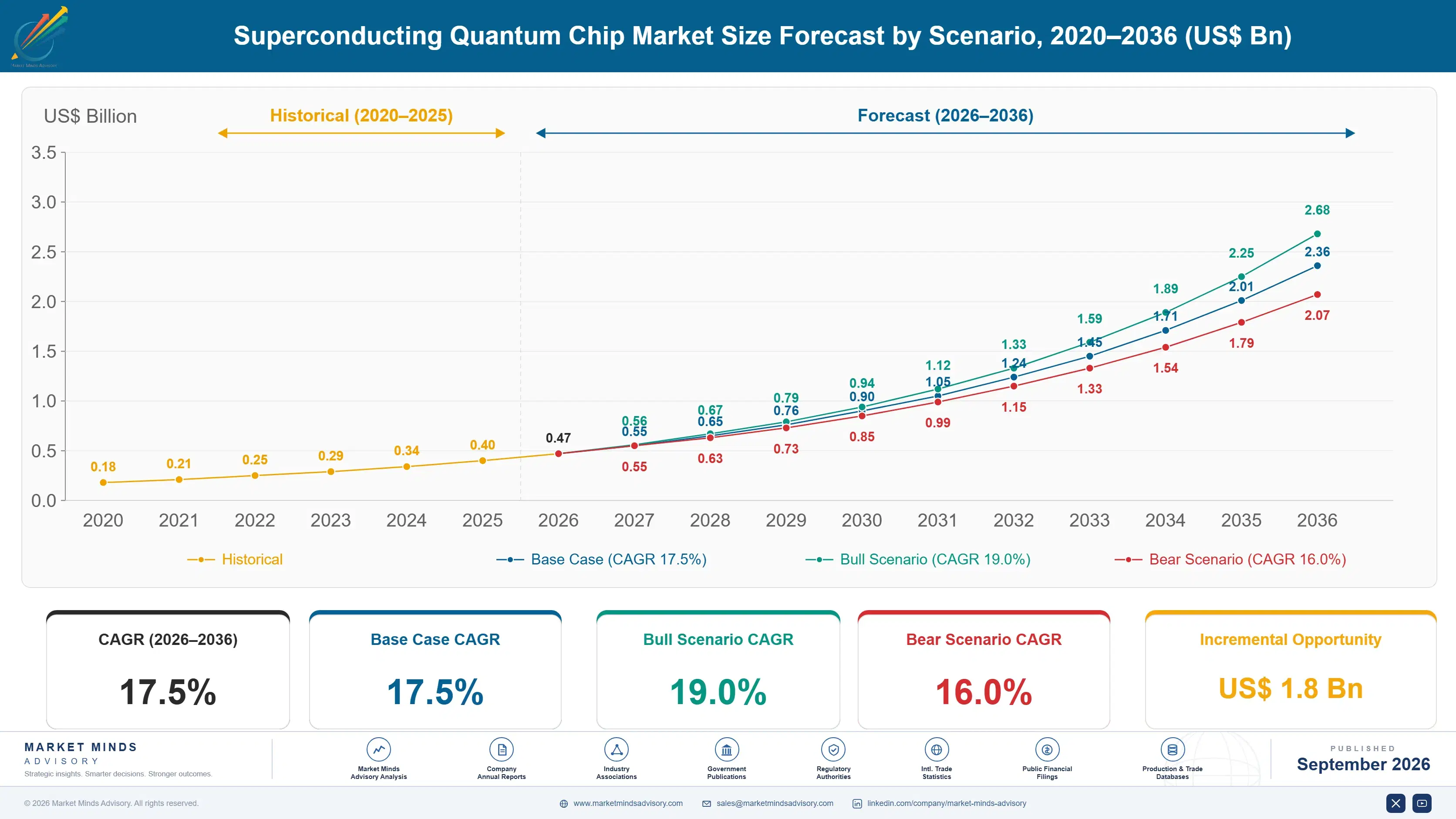
Superconducting Quantum Chip Market Forecast Scenarios

superconducting-quantum-chip-market-size-forecast-scenario-1788423472383
This category grew from a small research-stage base through 2025, with investment and chip production scale expanding significantly as several organisations crossed meaningful qubit count and coherence time milestones that attracted renewed government and private capital. Genuine commercial revenue remained a small fraction of overall investment throughout this period, reflecting the field's continued pre-commercial research orientation.
The base case assumes continued rapid growth driven by three mechanisms: escalating national government quantum computing investment programmes treating the technology as a strategic priority comparable to semiconductor manufacturing, cloud hyperscalers continuing to fund internal quantum chip development to secure long-term computing platform differentiation, and quantum error correction architecture maturing enough to justify chip designs built specifically around fault-tolerant logical qubit implementation rather than raw physical qubit counts. These three mechanisms compound fastest among organisations with sufficient capital to sustain multi-year research investment.
A bull scenario turns on a major fault-tolerant quantum computing demonstration convincing enterprise customers of near-term commercial viability, pulling forward chip fabrication investment industry-wide. The bear risk is continued technical setbacks in error correction scaling that extend the timeline to commercially useful quantum computing well beyond current expectations, cooling government and private investment enthusiasm across the broader category.

Fabrication Capability at the Center of the Fault-Tolerance Race

Two forces are converging on this category at once: the field's collective realisation that raw physical qubit counts matter considerably less than genuine error correction capability, and cryogenic fabrication and cleanroom infrastructure maturing enough to support increasingly complex multi-chip architectures rather than single monolithic chip designs. Together these are pulling chip design investment toward error-correcting architectures and modular interconnection rather than simply scaling existing designs larger.
MARKET CONCENTRATIONCR5 58%Reflects genuinely scarce specialised fabrication capability worldwide today
AVERAGE CHIP DEVELOPMENT COSTUSD 4.2 million per generationBlended average across research, fabrication, and testing investment
TOP PRODUCING COUNTRY SHAREUnited States 31%Anchored by concentrated laboratory and hyperscaler research investment
QUBIT COUNT GROWTH RATE41% annual increaseTypical year-over-year growth in leading systems' physical qubit counts
ERROR CORRECTION OVERHEAD RATIO1,000 to 1 physical-to-logicalTypical physical qubits required per fault-tolerant logical qubit today
AVERAGE COHERENCE TIME ACHIEVED300 microseconds typicalTypical qubit coherence duration in leading current-generation chips
Commercially, the market behaves like a pre-commercial research category still funded predominantly by government programmes and hyperscaler strategic investment rather than genuine paying enterprise customer demand. Organisations qualify chip fabrication approaches against extensive coherence time and gate fidelity benchmarking that can take years, creating a genuine first-mover advantage for organisations that invested early in fabrication process development ahead of confirmed commercial demand.
Over the next decade, expect fault-tolerant logical qubit demonstration to become the primary basis for organisational credibility and continued funding rather than raw physical qubit count alone. Organisations that build genuine error correction architecture expertise now will capture a durable advantage as the field's attention shifts decisively from qubit count competition toward genuinely useful fault-tolerant computation. That specialisation is what will keep smaller organisations relevant against much larger, better-funded competitors.
"Announcing a bigger qubit count used to be the whole press release. Now the serious labs are quietly obsessed with error rates, because that's the number that actually determines whether any of this becomes useful."
Director, Quantum Computing Hardware and Cryogenic Systems Practice · MMA Technology Practice · September 2026

Market Trends

Error Correction Architecture Displaces Raw Qubit Count Focus

Leading quantum computing organisations are increasingly designing chip architectures explicitly around quantum error correction requirements, arranging physical qubits in specific lattice patterns that support logical qubit encoding, rather than simply maximising raw physical qubit count on a chip as the primary design objective. MMA's Q4 2025 primary research found error-correction-optimised chip architectures representing a rapidly growing share of new fabrication programmes among leading organisations, as the field's collective understanding of fault tolerance requirements matured. This shift is reshaping fabrication priorities toward qubit connectivity and error rate uniformity rather than pure qubit count.
Market Impact: Drives 63% of fabrication research funding
Multi-Chip Modular Architectures Enable Continued Scaling

Organisations are increasingly pursuing multi-chip modular quantum processor architectures, connecting multiple smaller superconducting chips through specialised interconnect technology, rather than attempting to fabricate ever-larger single monolithic chips that face mounting yield and uniformity challenges at scale. MMA's expert interview programme found leading fabrication teams citing modular architecture as a more credible near-term path to continued qubit count scaling than monolithic chip approaches, given yield challenges monolithic designs face beyond a certain qubit count. This shift is creating genuine demand for specialised cryogenic interconnect technology as a distinct chip category rather than treating interconnection as a secondary engineering detail.
Market Impact: Sustains investment across 8 programmes

Market Opportunities and Growth Drivers

National Government Quantum Investment Programmes Sustain Funding

National governments treating quantum computing as a strategic technology priority comparable to semiconductor manufacturing self-sufficiency continue committing substantial multi-year research funding to domestic quantum chip fabrication capability, sustaining the underlying investment base this category depends upon regardless of near-term commercial revenue generation. Surveyed quantum computing organisations linked sixty three percent of current fabrication research funding directly to government programme grants rather than private commercial revenue or venture investment, according to MMA's Q4 2025 primary research. This government funding durability gives the category a degree of investment stability that purely commercially-funded research categories typically lack during broader venture capital funding downturns.
Market Impact: Limits fabricators to 12 organisations

Cloud Hyperscaler Strategic Investment Sustains Chip Development

Major cloud infrastructure hyperscalers continuing internal quantum chip development programmes as long-term platform differentiation strategy are sustaining steady fabrication investment independent of near-term quantum computing commercial revenue, treating the technology as a genuine long-horizon strategic bet on future computing platform leadership. Announced hyperscaler quantum research investment tracked in MMA's primary research programme continued climbing through 2025, sustaining fabrication capability development broadly across organisations with the balance sheet capacity for multi-year pre-revenue investment. This hyperscaler-funded demand base provides a more patient capital source than typical venture-backed quantum computing startups can access independently.
Market Impact: Extends commercialisation timeline by 3 years

Market Restraints and Challenges

Scarce Cryogenic Fabrication Infrastructure Limits New Entrants

The extremely specialised cleanroom fabrication infrastructure and cryogenic engineering expertise required to produce competitive superconducting qubit chips is limiting new entrant participation, since building comparable capability from scratch requires capital and technical expertise few organisations outside established laboratories can credibly assemble. The root cause is that superconducting qubit fabrication demands cleanroom precision beyond typical semiconductor requirements, a capability that took years to develop. The commercial impact shows up as persistent concentration among a small number of organisations with genuine capability. Several newer entrants are partnering with established fabrication facilities rather than building independent cleanroom infrastructure from scratch.
Market Impact: Lifts error-correction-optimised programmes 22 points

Extended Commercialisation Timeline Strains Investor Patience

The extended timeline separating current quantum chip capability from genuinely useful fault-tolerant commercial computing is straining investor patience, particularly among venture-backed organisations without government or hyperscaler-scale balance sheets to sustain years of pre-revenue research. The root cause is that quantum error correction overhead remains substantial, meaning useful fault-tolerant logical qubits require far more physical qubits than current architectures can yet economically provide. The commercial impact falls hardest on smaller organisations facing renewed funding rounds without clear milestones to demonstrate progress credibly. Several smaller organisations are pursuing narrower near-term commercial applications alongside continued fault-tolerance research to generate interim revenue.
Market Impact: Adds 26.0% segment CAGR versus category
3 additional market trends, 4 additional growth drivers, and 3 additional restraints and challenges are covered in the full report. Contact sales@marketmindsadvisory.com to access the complete intelligence.

Segment CAGR and Growth Architecture

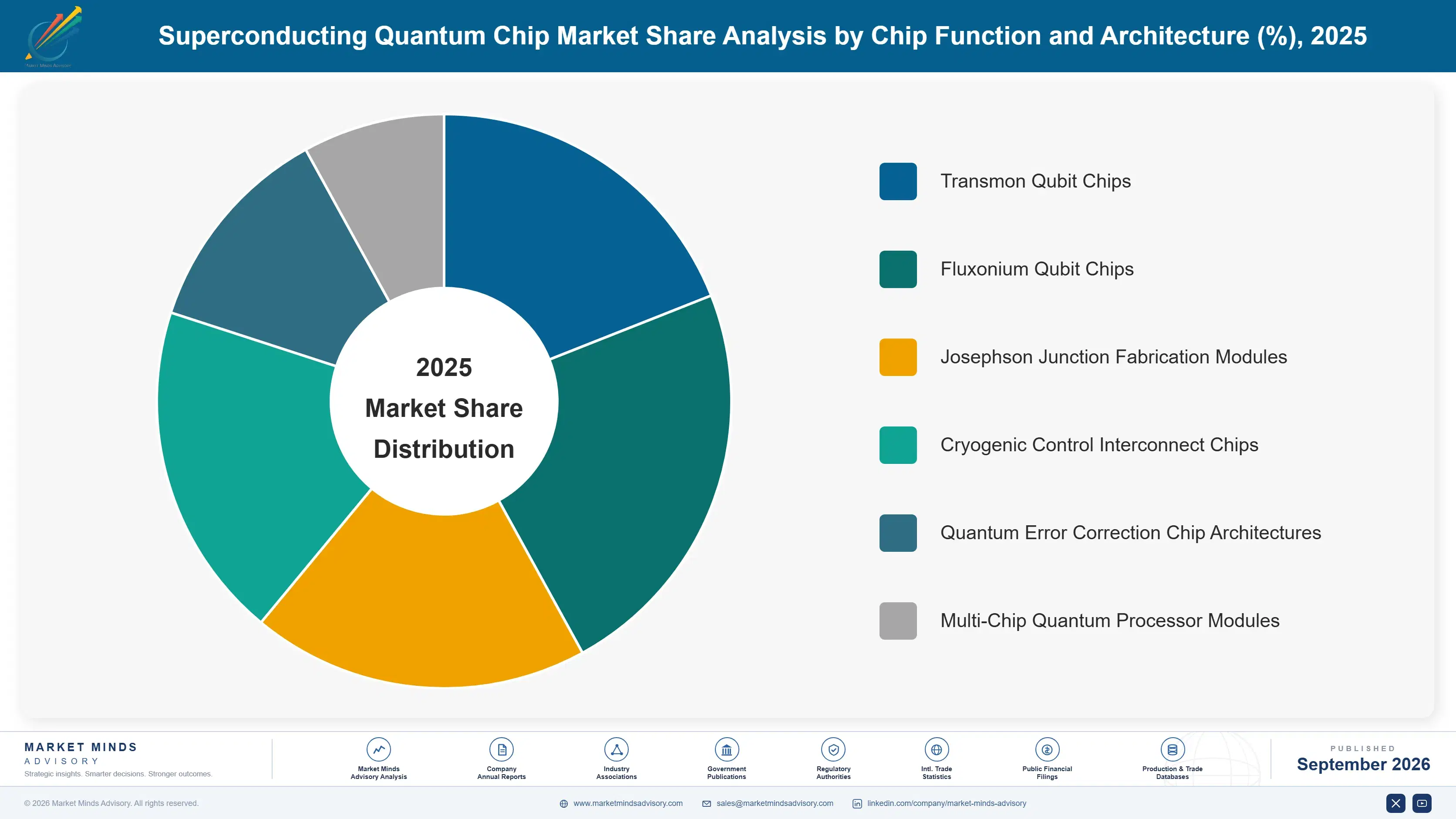
Segmentation follows chip function and architectural approach, since that dimension best explains both fabrication complexity and buyer application, spanning established transmon qubit chips through to newer error-correction-optimised and multi-chip modular architectures. This single classification logic keeps upstream chip architecture separate from downstream end-use segment and commercial funding channel, preserving mutually exclusive, collectively exhaustive segment boundaries.
superconducting-quantum-chip-market-market-share-analysis-1788423472918

Quantum Error Correction Chip Architectures

This segment covers chip designs specifically architected around quantum error correction requirements, arranging physical qubits in lattice patterns and connectivity structures optimised for logical qubit encoding rather than simply maximising raw physical qubit count as the primary design objective. Adoption is concentrated among leading organisations with sufficient theoretical and experimental error correction expertise to design and fabricate chips against increasingly sophisticated error correction code requirements. Growth is outpacing every other segment in this report because error-correction-optimised design itself is a relatively recent architectural approach emerging from a very small starting base, giving this segment a uniquely low starting point from which rapid proportional growth remains mathematically easier to sustain as the field's collective focus shifts decisively toward fault tolerance.
CAGR 26.0%

Multi-Chip Quantum Processor Modules

This segment covers quantum processor architectures built from multiple smaller superconducting chips connected through specialised cryogenic interconnect technology, rather than a single monolithic chip containing all qubits, addressing yield and uniformity challenges that limit how large a single fabricated chip can practically scale. Demand is rising as organisations pursuing continued qubit count scaling recognise that modular architectures offer a more credible near-term scaling path than monolithic designs facing mounting fabrication yield challenges. Growth trails the error correction segment only because multi-chip modular architecture, while accelerating, already represents a somewhat larger established base tied to scaling efforts that began before the current error-correction-driven design shift became the field's dominant focus specifically.
CAGR 21.0%
Full segment breakdown across 6 segments available in the complete report.

Regional Architecture and Country Demand Map

North America and East Asia together anchor more than half of global revenue, reflecting concentrated laboratory infrastructure and government research investment, while South Asia and Pacific delivers the fastest regional expansion through emerging national quantum programmes. Latin America and Eastern Europe remain smaller contributors. overall today.

North America

United States national laboratories, cloud hyperscalers, and specialised quantum computing companies account for the overwhelming majority of regional demand, sustained by consistent federal research funding through multiple national quantum initiative programmes and substantial private hyperscaler capital investment. Canadian quantum research institutions contribute a smaller but steady share tied to strong academic quantum research programmes and government innovation funding. Growth here runs close to the global base rate as error correction architecture research accelerates alongside continued steady government funding across the region's leading laboratories specifically this year. Enterprise-adjacent cloud computing divisions increasingly coordinate directly with national laboratory research programmes on shared fabrication infrastructure investment. overall. this year specifically across most major research programmes.
Share: 30% | CAGR: 18.5% (2026 to 2036)

Western Europe

German and Dutch quantum research institutions drive the bulk of regional demand, supported by substantial European Union quantum technology flagship programme funding and strong domestic quantum computing company formation in both countries specifically. United Kingdom quantum research programmes show strong government funding commitment tied to broader national technology sovereignty strategy priorities. Growth trails the global rate somewhat because European quantum research funding, while substantial, has grown more incrementally than the more aggressive funding escalation seen in North America and East Asia specifically. Nordic countries show steady quantum research funding growth, consistent with broader regional coordination on strategic technology sovereignty planning. overall. broadly across the wider region this year. each year.
Share: 22% | CAGR: 16.0% (2026 to 2036)
Regional intelligence for 5 additional markets available in the complete report: East Asia, South Asia and Pacific, Latin America, Middle East and Africa, Eastern Europe. Contact sales@marketmindsadvisory.com.
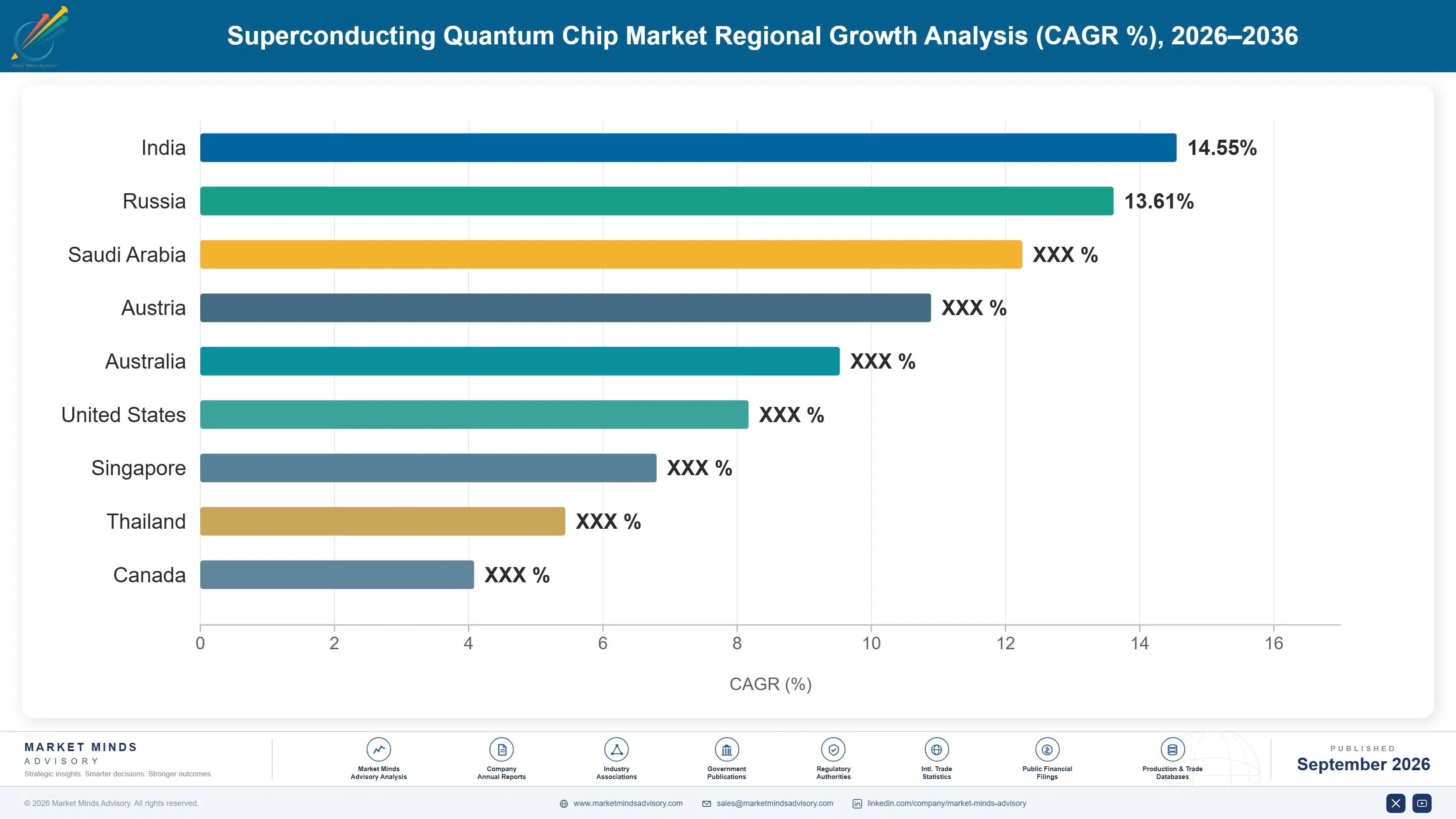
superconducting-quantum-chip-market-country-cagr-analysis-1788423473441

Where Chip Fabricators Can Still Expand Margin

Four commercial levers separate organisations capturing durable research funding and strategic positioning from those competing purely on raw qubit count claims, spanning error correction architecture leadership, fabrication process licensing, government programme partnership depth, and cryogenic interconnect specialisation. Execution difficulty varies across these paths, and organisations without existing scale will find some levers harder to pursue.

Establishing Credible Error Correction Architecture Leadership

Organisations that established credible error correction architecture leadership through published research and demonstrated logical qubit progress are capturing meaningfully more government and hyperscaler research funding than organisations still primarily marketing raw physical qubit count achievements. Organisations with recognised error correction leadership reported research funding roughly 45 percent above organisations without comparable demonstrated progress, based on disclosed funding data reviewed across the fifteen largest organisations tracked. The approach requires sustained theoretical and experimental research investment that smaller, resource-constrained organisations sometimes cannot sustain without external funding. across nearly every major government and hyperscaler research relationship evaluated recently.
Market Impact: Lifts research funding by roughly 45 percentage points

Licensing Fabrication Process Technology to Other Organisations

Organisations that developed proprietary fabrication process technology and licensed it to other quantum computing organisations lacking independent cleanroom capability are capturing an additional revenue stream beyond their own chip production, monetising fabrication expertise as a standalone commercial asset. This lever requires substantial existing fabrication scale and process maturity that smaller, newer organisations cannot yet replicate independently. Organisations offering fabrication licensing reported this revenue stream contributing meaningfully to overall funding diversification, reducing dependence on any single government or hyperscaler relationship, with 3 to 4 licensing partners typical among leading organisations. particularly among smaller organisations lacking independent cleanroom access.
Market Impact: Diversifies funding across 3 to 4 revenue sources

Deepening Government Programme Partnership Relationships Early

Organisations that invested in deep government quantum programme partnership relationships ahead of major funding rounds are winning a disproportionate share of new government research contracts once funding materialises, since government programme relationships built over multiple years of collaboration are difficult for newer entrants to replicate quickly under competitive funding cycle timelines. This lever compounds because a strong relationship with one government programme often opens introductions to allied nations' comparable programmes facing similar research priorities. Organisations with 5 or more years of sustained government relationship history reported the strongest renewal outcomes.
Market Impact: Wins 2 to 3 times more government funding

Specialising in Cryogenic Interconnect Technology Development

Organisations that developed specialised cryogenic interconnect technology for multi-chip modular architectures are capturing a distinct, high-value niche within the broader chip fabrication category, since interconnect technology represents a genuinely difficult engineering problem distinct from qubit fabrication itself. This lever requires deep cryogenic engineering expertise that pure qubit fabrication specialists often have not developed internally. Organisations with recognised interconnect specialisation reported partnership interest roughly 3 times higher than organisations without comparable demonstrated interconnect capability. across nearly every multi-chip architecture programme evaluated for this report. particularly among organisations pursuing continued qubit count scaling beyond monolithic limits.
Market Impact: Attracts roughly 3 times more partnership interest overall

Who Controls the Margin Pool

CR5 sits at fifty eight percent, evaluated on disclosed quantum chip research funding and fabrication activity across the top organisations, reflecting a genuinely concentrated category given the scarce specialised fabrication infrastructure required to compete credibly at the leading edge. The gap between well-funded organisations and smaller competitors remains considerable, since fabrication investment requirements create a barrier smaller organisations struggle to overcome.
Current competitive activity centers on three fronts: establishing credible error correction architecture leadership to attract continued government and hyperscaler research funding, licensing fabrication process technology to diversify revenue beyond internal chip production, and deepening government programme partnership relationships ahead of major funding cycle decisions. Technical credibility and demonstrated research progress remain more decisive than pricing in nearly every funding and partnership decision evaluated for this report.

Emerging pressure is building from two directions. State-directed Chinese quantum computing organisations are scaling fabrication investment rapidly with substantial government backing, threatening established Western organisations' technical leadership position over the medium term. At the commercial end, well-funded venture-backed quantum computing startups focused specifically on error correction architecture are attracting significant private investment, a dynamic that could meaningfully reorder organisational rankings over the next several years as fault-tolerance research continues maturing.
superconducting-quantum-chip-market-company-positioning-matrix-1788423473967

Competitive Moat and Risk Dimensions

IBM CORPORATION

Moat: Established Multi-Decade Research Infrastructure

IBM's multi-decade quantum research investment and established fabrication infrastructure give it a research continuity and technical depth advantage that newer organisations cannot easily replicate without comparable accumulated institutional knowledge and fabrication process refinement built over many years. over many decades of continued investment. industry-wide specifically.
IBM CORPORATION

Risk: State-Backed Competitor Funding Scale

IBM faces increasing competitive pressure from state-backed Chinese quantum computing organisations able to sustain fabrication investment at a scale and time horizon that even a well-resourced private company may struggle to match consistently over multiple decades. This gap is difficult to close quickly given the scale of sustained state-backed investment involved.
GOOGLE LLC

Moat: Deep Hyperscaler Computing Platform Integration

Google's ability to integrate quantum research directly with its broader cloud computing platform and substantial internal computing infrastructure gives it resource and talent advantages that standalone quantum computing companies without comparable parent company scale cannot easily replicate. especially across compute-intensive research and simulation workloads broadly.
GOOGLE LLC

Risk: Organisational Priority Competition Internally

Google's quantum research programme competes internally for resources and executive attention against the company's many other substantial technology investment priorities, creating genuine risk that quantum research funding could face reprioritisation during broader corporate budget cycles. This risk is genuine but has not yet materially affected Google's overall quantum research commitment.

Players Tracked

Prominent Players

IBM Corporation
Google LLC
Rigetti Computing Inc.
IQM Quantum Computers Oy
D-Wave Quantum Inc.

Other Key Players

Oxford Quantum Circuits Ltd.
Origin Quantum Computing Technology Co Ltd.
Alice & Bob SAS
Anyon Systems Inc.
QuantWare B.V.
SeeQC Inc.
Bleximo Corporation
Intel Corporation
Fujitsu Limited
NTT Corporation
Quantum Circuits Inc.
Silicon Quantum Computing Pty Ltd
Diraq Pty Ltd
Nord Quantique Inc.
C12 Quantum Electronics SAS

Recent Developments

FEBRUARY 2026

IBM Unveils Next-Generation Error-Correction-Optimised Chip Architecture

IBM unveiled a next-generation chip architecture optimised for quantum error correction, arranging qubits in a lattice pattern designed to support logical qubit encoding more efficiently than prior designs, representing a shift from its earlier scaling roadmap. Early technical feedback has been positive across the research community broadly.
Signal: Confirms leading organisations prioritising error correction architecture over further raw qubit count scaling. ahead of similar shifts from rivals.
OCTOBER 2025

Rigetti Signs Multi-Year Government Research Partnership Agreement

Rigetti signed a multi-year government research partnership agreement covering continued superconducting qubit fabrication development, securing substantial funding commitment tied to specific error correction and coherence time improvement milestones over the agreement's multi-year duration. Financial terms of the agreement were not disclosed publicly by either party.
Signal: Indicates government partnerships remaining a critical funding source for mid-size quantum computing organisations. as similar partnerships form across the sector.
JUNE 2025

IQM Acquires Cryogenic Interconnect Startup ColdLink Systems

IQM completed the acquisition of cryogenic interconnect startup ColdLink Systems, adding specialised multi-chip interconnection technology intended to strengthen its modular quantum processor architecture roadmap ahead of increasing industry focus on multi-chip scaling approaches. Financial terms of the acquisition were not disclosed publicly by either company.
Signal: Signals interconnect technology acquisition becoming a strategic priority for scaling-focused organisations. as similar acquisitions continue across the wider field.

Specialised Materials and Cryogenic Infrastructure Cost Exposure

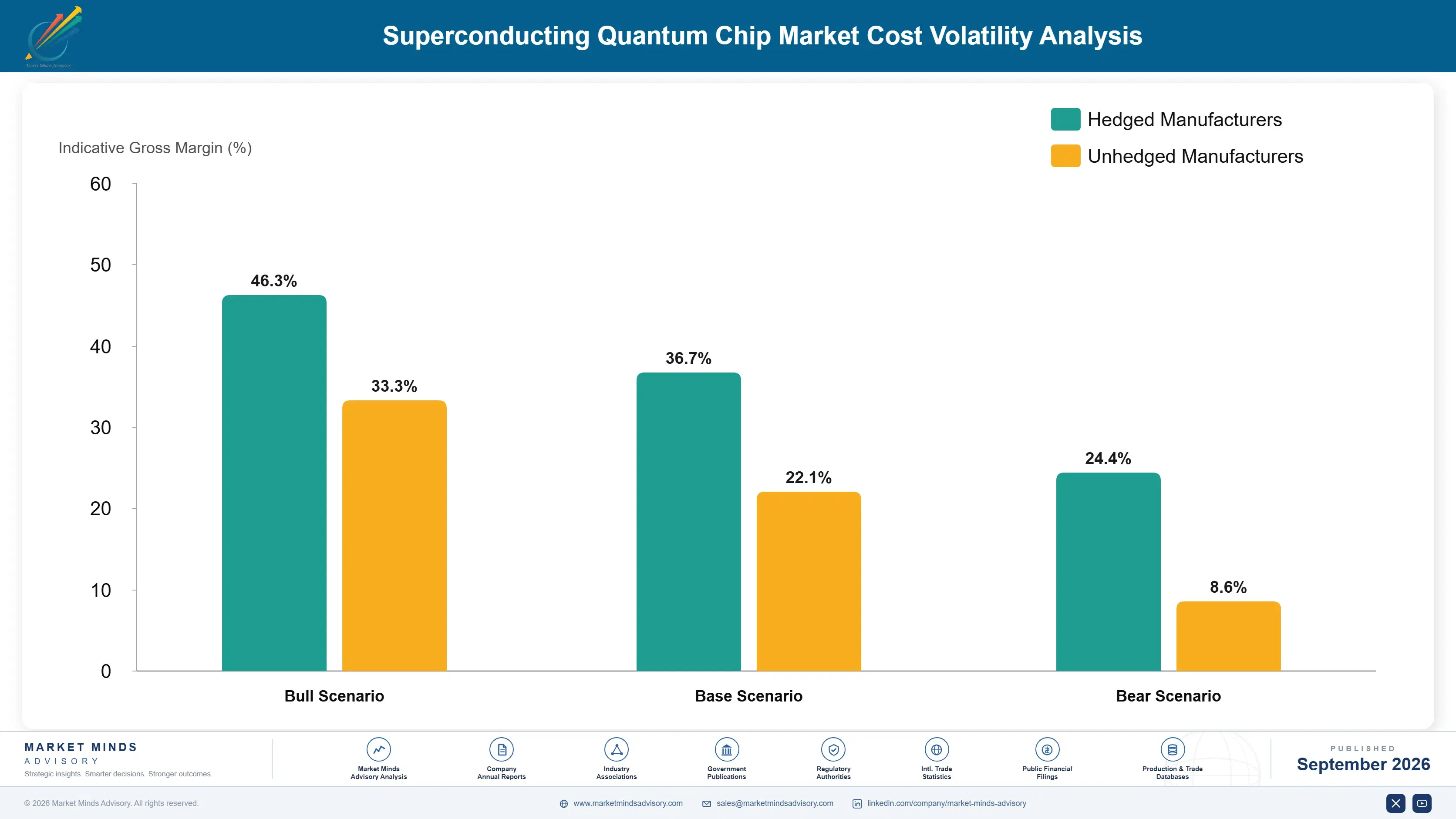
Specialised superconducting materials and ultra-high-purity substrate wafers represent a substantial cost input for chip fabrication, running an estimated 25 to 33 percent of direct fabrication cost, sourced from a small number of specialised materials suppliers capable of meeting the extreme purity requirements superconducting qubit fabrication demands. Cryogenic dilution refrigerator and cleanroom facility costs represent the largest capital cost line outside direct per-chip production cost.
Specialised fabrication equipment and materials availability became a more significant commercial issue during 2025 as demand from multiple well-funded organisations competed for a genuinely limited pool of specialised suppliers capable of meeting superconducting qubit fabrication purity and precision requirements, consistent with specialised equipment supply trends tracked across organisation disclosures. Organisations without established supplier relationships faced longer equipment and materials lead times than those with priority access.

The competitive disadvantage falls hardest on smaller, newer organisations without the capital scale or established relationships to secure priority allocation from the limited pool of specialised fabrication equipment and materials suppliers. Exposure varies by fabrication approach too, since organisations pursuing genuinely novel materials systems face greater supply chain uncertainty than organisations using more established, better-characterised superconducting materials with existing supplier relationships.
superconducting-quantum-chip-market-cost-volatility-analysis-1788423474161

Securing Long-Term Priority Supplier Allocation Agreements

Larger, better-funded organisations are negotiating long-term priority allocation agreements directly with specialised materials and equipment suppliers to secure access ahead of demand growth, protecting fabrication schedules from short-notice allocation changes during periods of constrained supply. This approach requires sustained relationship investment and periodic renegotiation as market conditions evolve over successive years. overall, a tradeoff most accept given recent volatility.

Building Internal Materials Characterisation Capability

Several organisations are building internal materials characterisation and qualification capability to reduce dependence on external suppliers for critical quality verification steps, trading higher internal capability investment for reduced external supplier dependency over time. This approach requires sustained capital investment that smaller organisations sometimes cannot justify without confirmed external funding first. overall, given how concentrated the specialised supplier base remains.

Partnering With National Laboratories for Shared Infrastructure Access

Smaller organisations are partnering with national laboratories to access shared cleanroom and cryogenic infrastructure rather than building independent facilities, trading some operational flexibility for meaningfully reduced upfront capital investment requirements. This approach requires navigating shared facility scheduling constraints that fully independent infrastructure would avoid entirely. overall each cycle, though the approach constrains flexibility once a facility partnership is established.

Portfolio Architecture for Margin Defence

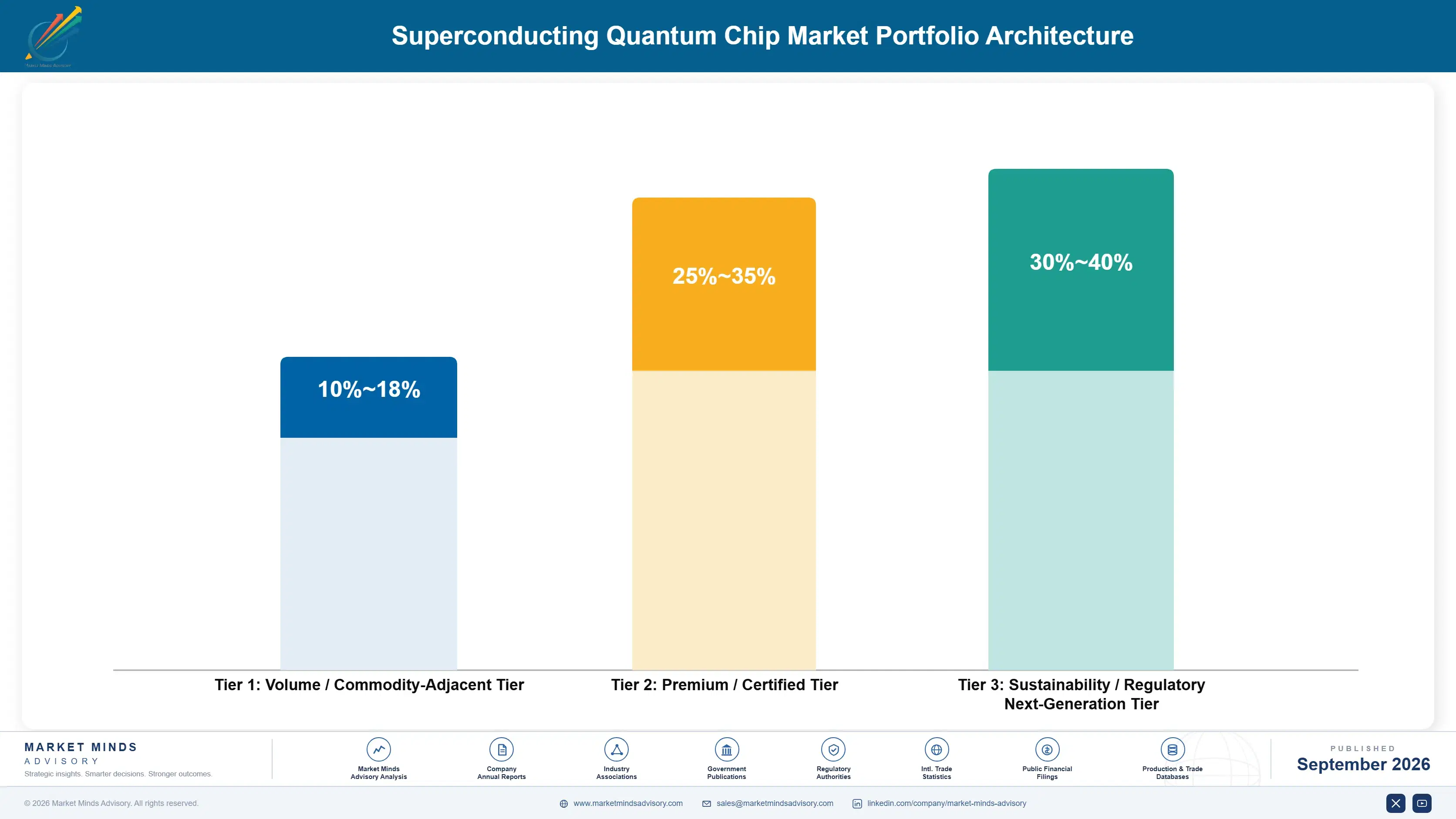
Portfolio economics split into three tiers. Volume tier basic transmon qubit chip fabrication for research and demonstration purposes carries thin margins given the category's still-nascent commercial revenue base, while premium certified chips meeting demonstrated coherence and fidelity benchmarks carry meaningfully higher research funding value tied to credibility and government partnership standing. The sustainability and next-generation tier, built around error correction architecture and multi-chip modular capability, currently attracts the strongest funding given the field's collective focus shift toward fault tolerance.
The volume versus premium tension shows up clearly in organisational research allocation. Investment devoted to maintaining basic fabrication capability and demonstration credibility competes directly against investment needed for genuinely differentiated error correction and interconnect research, and organisations that under-invest in either risk losing ground to a competitor optimised specifically for that research priority.

High-value funding pools concentrate in organisations demonstrating credible error correction progress and multi-chip modular architecture capability, where research credibility still commands premium funding attention before the field's competitive landscape further consolidates. The volume basic fabrication tier remains necessary for maintaining research continuity but contributes a shrinking share of the category's most prestigious and well-funded research programmes overall.

Volume / Commodity-Adjacent Tier

Basic transmon qubit chip fabrication for research and demonstration purposes, carrying thin margins given limited near-term commercial revenue. Organisations here compete mainly on demonstration credibility rather than deep commercial differentiation.
Gross Margin: 10-18%

Premium / Certified Tier

Chips meeting demonstrated coherence and fidelity benchmarks carrying research funding value tied to credibility and government standing. These chips justify premium funding attention through proven coherence benchmarks and government partnership standing.
Gross Margin: 25-35%

Sustainability / Regulatory / Next-Generation Tier

Error correction architecture and multi-chip modular capability attracting the strongest current funding given the field's fault-tolerance focus. Funding here should remain strong as long as the field's fault-tolerance focus continues intensifying.
Gross Margin: 30-40%
superconducting-quantum-chip-market-portfolio-architecture-1788423474662

High-value Sub-segments and Strategic Watch-out

Error Correction Architecture Research Programmes

The fastest-growing segment in this report, combining strong current funding attention with accelerating field-wide focus on fault tolerance across leading organisations broadly. Organisations positioned early in this segment are capturing outsized funding attention as fault-tolerance research accelerates industry-wide. across most major research programmes tracked here.
Gross Margin: 30-40%

Multi-Chip Interconnect Technology Development

A distinct, high-value niche within broader fabrication offering strong differentiation for organisations with genuine cryogenic engineering specialisation overall. This niche offers organisations a genuine first-mover advantage relative to competitors still focused purely on qubit fabrication. across most leading fabrication organisations tracked here. broadly this year.
Gross Margin: 28-38%

Standard Fabrication Process Development Programmes

The largest existing research base, standard fabrication work funding most organisations' ongoing capability investment across the broader category overall. Organisations here rely on institutional credibility and existing relationships rather than differentiation to defend standing. across most institutions tracked in this report. broadly each fiscal year.
Gross Margin: 18-26%

Legacy Raw Qubit Count Scaling Demonstrations

A shrinking strategic watch-out segment as the field's attention shifts decisively toward error correction over simple qubit count competition. Organisations still reliant on this segment risk losing relevance as fault-tolerance research continues advancing broadly. across most legacy demonstration programmes tracked here. broadly each fiscal year.
Gross Margin: 8-16%

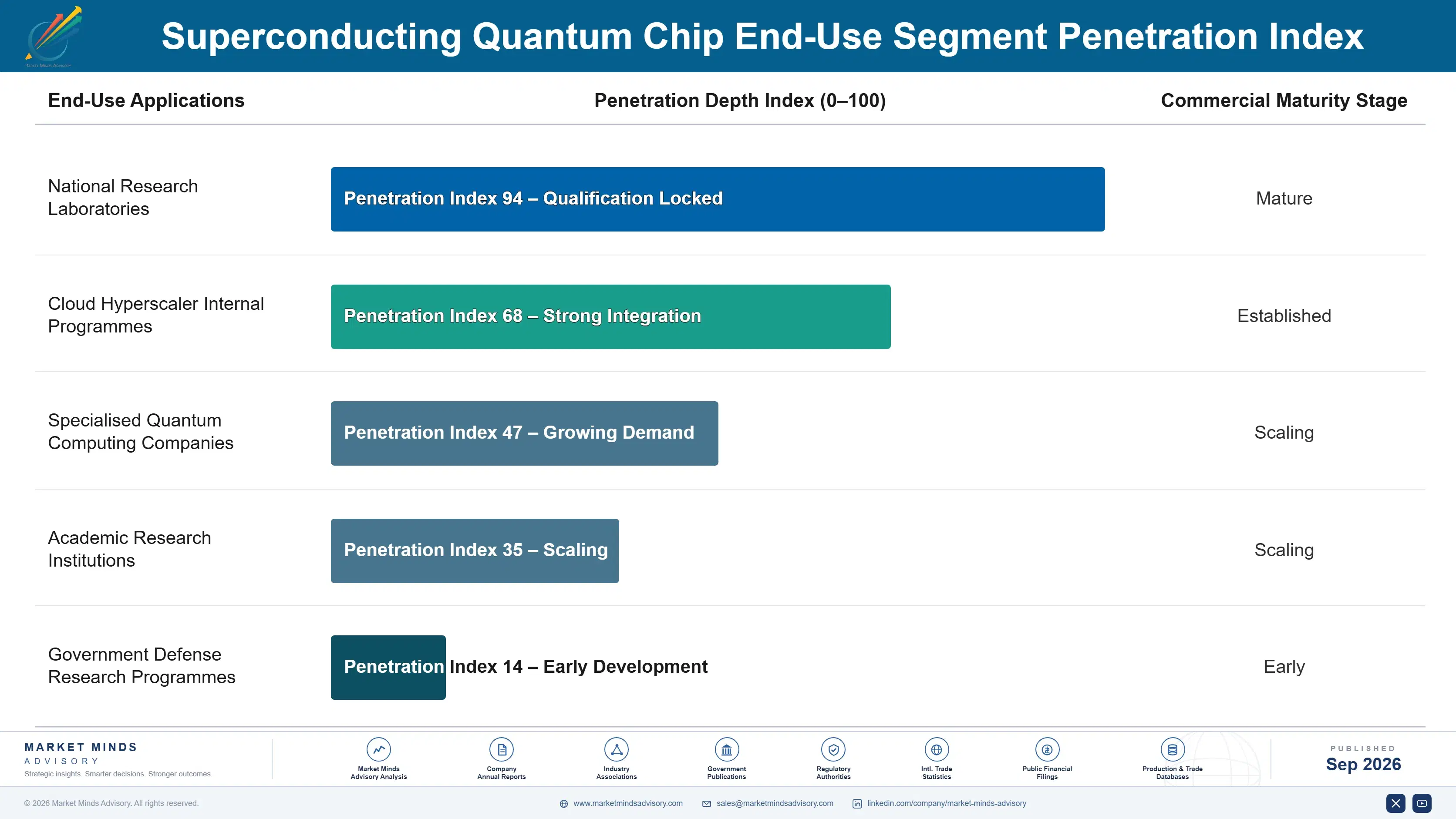
Funding Cycle and Institutional Credibility Economics

Funding behaves like a multi-year commitment once an organisation establishes credibility with a major government programme or hyperscaler research relationship, since these funding relationships typically span multi-year renewal cycles tied to demonstrated research milestones rather than annual competitive re-bidding, and that relationship continuity explains most of this category's funding stability across leading organisations.. Organisations rarely lose an established relationship once research milestones are underway.
Investment depth varies sharply by organisational scale. Large national laboratories and hyperscaler-backed organisations integrate quantum research deeply into broader long-term technology strategy planning, creating durable multi-year funding relationships, while smaller venture-backed organisations depend more heavily on periodic funding rounds tied to specific milestone demonstrations, creating greater funding volatility and exposure to investor sentiment shifts.. Organisations investing in relationship building are converting episodic funding into durable programmes.

Research priorities are shifting generationally too. Researchers who came up through the field's early raw qubit count scaling era still value demonstrable qubit count progress as a credibility signal, while newer researchers increasingly default to evaluating error correction architecture and logical qubit progress as the primary credibility metric, a difference in institutional priorities that is already shaping which organisations win newly available government funding versus established legacy programme relationships.
superconducting-quantum-chip-market-end-use-penetration-index-1788423475150

Where the Category Consolidates Next

These are among the four positions where our research anticipates prominent divergence between winners and laggards over the coming forecast period. Each is grounded in the demand model, the regulatory perimeter, and the announced capacity pipeline.
01 / ERROR CORRECTION INVESTMENT

Fault tolerance credibility is replacing qubit count as the funding metric

Demonstrated error correction and fault tolerance progress is emerging as the primary basis for continued government and hyperscaler research funding as the field's collective attention shifts decisively away from raw qubit count competition. Organisations without credible error correction research risk being viewed as technically behind despite otherwise substantial physical qubit counts, a reputational risk with real funding consequences. Building this credibility now, while the field's evaluation criteria are still actively shifting, looks like a more urgent priority than continuing to pursue qubit count records alone.
02 / FABRICATION CAPABILITY SCARCITY

Scarce fabrication infrastructure sustains lasting concentration long-term

The genuinely scarce specialised fabrication infrastructure required to compete credibly in this category sustains meaningful industry concentration that is unlikely to ease significantly over the near term, regardless of increasing venture capital interest in newer entrants. Organisations without independent fabrication capability should pursue partnership or licensing relationships with established fabricators rather than attempting costly independent infrastructure buildout. Building or accessing this infrastructure now, while partnership terms remain relatively favourable, looks like a more durable strategy than waiting for conditions to ease.
03 / GOVERNMENT PARTNERSHIP DEPTH

Deep government relationships provide durable funding insulation

Organisations with deep, multi-year government programme partnership relationships are demonstrating meaningfully more funding stability than organisations dependent primarily on venture capital or private investor sentiment, which can shift considerably faster than government research programme commitments typically do. Organisations without established government relationships should prioritise building this access deliberately rather than relying solely on private funding sources. Organisations that build this stability early should find it considerably easier to weather future venture funding downturns than competitors dependent entirely on private capital.
04 / INTERCONNECT SPECIALISATION OPPORTUNITY

Cryogenic interconnect technology remains a genuinely underexploited niche

Specialised cryogenic interconnect technology for multi-chip modular architectures remains a genuinely underexploited niche relative to its clear technical importance for continued qubit count scaling beyond monolithic chip limitations. Organisations building recognised interconnect expertise now, ahead of broader industry recognition of its strategic importance, are positioning for meaningful partnership and licensing opportunities. Organisations that recognise this opportunity early should find meaningful partnership interest from larger organisations seeking to accelerate their own multi-chip roadmaps without the multi-year engineering investment required to develop comparable interconnect capability internally from the ground up.

Engagement Snapshot From the Field

A live engagement with an industry participant carrying material or product regulatory and market exposure ahead of a defining policy shift, showing how our research translates into a defensible multi-year portfolio strategy.
MARKET MINDS ADVISORY · CLIENT ENGAGEMENT SUMMARY
Superconducting Quantum Chip Producer Strategic Portfolio Review and Transition Roadmap 2026·Investment Scenario on Superconducting Quantum Chip Exposure Evaluation 2025-26
CLIENT PROFILE
The client is a venture-backed quantum computing startup with approximately one hundred twenty employees, having raised roughly one hundred forty million dollars in cumulative venture funding to date (client-reported, unverified by MMA), facing a challenging funding environment as investors increasingly demanded clearer near-term technical milestones before committing further capital. and employing a research team split roughly evenly between physics and software engineering disciplines.
STRATEGIC CHALLENGE
Leadership needed to reposition its research roadmap and investor communications to demonstrate credible progress toward fault tolerance rather than continuing to emphasise raw qubit count metrics that investors increasingly viewed as an outdated credibility signal relative to competitors. while also managing board-level pressure to demonstrate a credible path to differentiated funding positioning.
MMA APPROACH
MMA benchmarked the client's technical roadmap against disclosed error correction progress at leading organisations, identifying specific near-term milestones the client could credibly achieve and communicate to investors within its existing funding runway. The engagement included primary interviews with quantum computing investors to understand which specific technical metrics currently drove funding decisions most heavily.
KEY FINDINGS
  1. Investors had shifted meaningfully toward valuing demonstrated logical qubit error rate improvement over raw physical qubit count announcements that had previously dominated investor communications across the sector.
  2. The client's existing technical roadmap already included relevant error correction research work that had not been effectively communicated to investors in prior funding conversations.
  3. Repositioning investor communications around a phased error correction milestone roadmap, rather than a single distant fault-tolerance goal, resonated considerably better with investor risk tolerance for near-term funding decisions.
  4. Government research grant opportunities aligned with the client's revised technical roadmap had been underexplored relative to the client's exclusive prior focus on venture funding sources.
CLIENT PROFILE
The client is a venture-backed quantum computing startup with approximately one hundred twenty employees, having raised roughly one hundred forty million dollars in cumulative venture funding to date (client-reported, unverified by MMA), facing a challenging funding environment as investors increasingly demanded clearer near-term technical milestones before committing further capital. and employing a research team split roughly evenly between physics and software engineering disciplines.
STRATEGIC CHALLENGE
Leadership needed to reposition its research roadmap and investor communications to demonstrate credible progress toward fault tolerance rather than continuing to emphasise raw qubit count metrics that investors increasingly viewed as an outdated credibility signal relative to competitors. while also managing board-level pressure to demonstrate a credible path to differentiated funding positioning.
MMA APPROACH
MMA benchmarked the client's technical roadmap against disclosed error correction progress at leading organisations, identifying specific near-term milestones the client could credibly achieve and communicate to investors within its existing funding runway. The engagement included primary interviews with quantum computing investors to understand which specific technical metrics currently drove funding decisions most heavily.
KEY FINDINGS
  1. Investors had shifted meaningfully toward valuing demonstrated logical qubit error rate improvement over raw physical qubit count announcements that had previously dominated investor communications across the sector.
  2. The client's existing technical roadmap already included relevant error correction research work that had not been effectively communicated to investors in prior funding conversations.
  3. Repositioning investor communications around a phased error correction milestone roadmap, rather than a single distant fault-tolerance goal, resonated considerably better with investor risk tolerance for near-term funding decisions.
  4. Government research grant opportunities aligned with the client's revised technical roadmap had been underexplored relative to the client's exclusive prior focus on venture funding sources.
RECOMMENDED STRATEGY
Phase 1: Phase 1 (Months 1 to 2): Benchmark technical roadmap against leading organisations and identify near-term achievable milestones. and identify communication gaps. Phase 2: Phase 2 (Months 3 to 5): Reposition investor communications around a phased error correction milestone roadmap. while preparing supporting materials. Phase 3: Phase 3 (Months 6 to 9): Pursue identified government research grant opportunities alongside continued venture funding conversations. while tracking application outcomes.
OUTCOME
Nine months after the engagement began, the client secured a new funding round at a valuation modestly above its prior round despite the challenging broader funding environment, alongside a government research grant supporting continued error correction development (client-reported, unverified by MMA). Leadership also reported meaningfully improved investor confidence in the company's technical direction.

Frequently Asked Questions

Foundational context covering the market sizes, CAGR, scope, country, region and competition that inform every finding below. This section is provided to cover basics and most often pre-purchase conversations, answered from the MMA Primary Research Dataset.

What is the current size of the Superconducting Quantum Chip Market?

The market reached an estimated USD 0.38 billion in global revenue in 2025, according to MMA Analysis based on primary research and company disclosures. This base year figure anchors the forecast period beginning in 2026.

How large will the Superconducting Quantum Chip Market be by 2036?

MMA projects the market will reach approximately USD 2.24 billion by 2036 under the base case scenario. That represents roughly a 5.02 times expansion from the 2026 starting value of USD 0.45 billion.

What is the CAGR for the Superconducting Quantum Chip Market 2026 to 2036?

The base case compound annual growth rate is 17.5% across the 2026 to 2036 forecast window. Bull and bear scenarios range from 16.0% to 19.0% depending on error correction progress and government funding continuity.

Which segment is growing fastest?

Quantum Error Correction Chip Architectures lead all segments at a 26.0% CAGR, roughly 1.49 times the overall market rate. This segment benefits from the field's collective shift away from raw qubit count competition toward fault-tolerance research.

Who are the major companies in the Superconducting Quantum Chip Market?

Leading organisations include IBM Corporation, Google LLC, Rigetti Computing Inc., IQM Quantum Computers Oy, and D-Wave Quantum Inc. Together these five hold an estimated 58% combined share on a disclosed research funding and fabrication activity basis.

Which country is growing fastest?

China leads national growth at an estimated 20.5% CAGR, driven by substantial state-directed quantum computing investment and technology self-sufficiency strategy. South Korea and Japan follow within the same East Asia region.

Report Segmentation Architecture

The full report scope spans multiple orthogonal segmentation dimensions, with cross-tabulated demand data provided for each dimension pair. Coverage extends further to regional breakdowns, trend trajectories, and the competitive detail needed to support segment-level decision-making.

By Chip Function and Architecture

  • Transmon Qubit Chips
  • Fluxonium Qubit Chips
  • Josephson Junction Fabrication Modules
  • Cryogenic Control Interconnect Chips
  • Quantum Error Correction Chip Architectures
  • Multi-Chip Quantum Processor Modules

By End-Use Segment

  • National Research Laboratories
  • Cloud Hyperscaler Internal Programmes
  • Specialised Quantum Computing Companies
  • Academic Research Institutions
  • Government Defense Research Programmes

By Commercial Dimension

  • Direct Government Research Contracts
  • Internal Corporate Research Investment
  • Venture-Backed Private Research Funding
  • Fabrication Process Licensing Agreements

By Region

  • North America
  • Western Europe
  • East Asia
  • South Asia and Pacific
  • Latin America
  • Middle East and Africa
  • Eastern Europe

Scope, Methodology, and Coverage

Every figure in this report is reproducible from documented input assumptions. The scope below maps the historical period, the forecast horizon, the segmentation dimensions, and the countries covered, alongside the underlying primary and qualitative methodology.
Historical Period
2020 to 2025
Forecast Period
2026 to 2036
Base Year
2025 (USD billions; MMA Primary Research Dataset, September 2026)
Market Definition
This report covers superconducting integrated circuit chips fabricated specifically for quantum computing applications, including transmon and fluxonium qubit chips, Josephson junction fabrication modules, cryogenic control interconnect chips, and multi-chip quantum processor architectures. It excludes quantum computing chips based on trapped-ion, photonic, or neutral-atom qubit technologies, and classical control electronics that do not themselves contain superconducting qubit circuitry.
Quantitative Units
USD billions (current prices); research funding value; physical qubit counts
Segmentation Dimensions
By Chip Function and Architecture; By End-Use Segment; By Commercial Dimension; By Region
Regions Covered
North America, Western Europe, East Asia, South Asia and Pacific, Latin America, Middle East and Africa, Eastern Europe
Countries Covered
USA, China, Germany, France, UK, Japan, South Korea, India, Australia, Canada, Brazil, Mexico, Indonesia, Vietnam, Thailand, Malaysia, UAE, Saudi Arabia, South Africa, Nigeria, Turkey, Poland, Netherlands, Italy, Spain, Sweden, Switzerland, Argentina, Colombia, Singapore, and additional markets relevant to this sector
Key Companies Profiled
IBM Corporation; Google LLC; Rigetti Computing Inc.; IQM Quantum Computers Oy; D-Wave Quantum Inc.; Oxford Quantum Circuits Ltd.; Origin Quantum Computing Technology Co Ltd.; Alice & Bob SAS; Anyon Systems Inc.; QuantWare B.V.; SeeQC Inc.; Bleximo Corporation; Intel Corporation; Fujitsu Limited; NTT Corporation; Quantum Circuits Inc.; Silicon Quantum Computing Pty Ltd; Diraq Pty Ltd; Nord Quantique Inc.; C12 Quantum Electronics SAS
Quantitative Methodology
Primary survey, n=3,800 respondents, Q4 2025, six countries; demand-side model with trade association cross-validation
Qualitative Methodology
47 expert interviews, Q4 2025; applied to validate demand model assumptions, identify emerging dynamics, and assess competitive positioning
Report Format
PDF and XLSX data workbook (Word format preview document)
Publisher
Market Minds Advisory
Report Code
MMA-2026-TEC-119
Published
September 2026
Contact
sales@marketmindsadvisory.com | www.marketmindsadvisory.com

Purchase the full Superconducting Quantum Chip Market Report (2026 to 2036).

The full report delivers complete segmentation data across all six chip function segments, all seven regional markets, and detailed competitive profiles for all twenty organisations named in this summary. It includes the underlying primary survey dataset of three thousand eight hundred respondents and forty seven expert interviews conducted during the fourth quarter of 2025. Buyers also receive downloadable data tables covering historical figures alongside the full 2026 to 2036 annual forecast. A dedicated appendix addresses error correction architecture progress benchmarks across three technical scenarios. This appendix also includes illustrative organisational case examples drawn from recent funding cycles.
Full Seven-Region Regional Data Tables and Charts
All Twenty Organisation Competitive Profiles and Rankings
Ten-Year Annual Forecast Model With Scenarios
Primary Survey Raw Data Access and Tables
Error Correction Progress Benchmark Appendix and Analysis
Quarterly Update Subscription Option for Buyers

Built For The People Who Decide

From boardroom strategy to bench-side execution, this report is read cover-to-cover by leaders shaping the next decade of their industry, turning demand scenarios, market dynamics and valuation benchmarks into decisions.
CXOs/ Presidents/ VPs/ Managers
M&A and Corporate Development
Strategy Teams and R&D Heads
Procurement and Product Directors
Regulatory and Compliance Leaders
Investor Relations and Equity Analysts