Market Minds Advisory
Food Sorting Machines Market

Food Sorting Machines Market: Sensor Modality, Contamination Detection, and the Compliance Cycle

Food processors are racing to replace manual and mechanical sorting lines with hyperspectral and X-ray systems that catch contamination human inspectors miss, even though the capital outlay still gives smaller processors real pause.

Lead Analyst

David Horsley

Published

September 2026

Make Smarter Decisions with Customized Research Insights

Request a free sample report and evaluate market opportunities, growth trends, and competitive dynamics relevant to your business needs.

2025 MARKET VALUE$2.9BMarket Size 2025
2036 FORECAST VALUE$7.1BBase Case , 2026 to 2036
CAGR 2026 TO 20368.6 %Bull 9.9% / Bear 7.3%
INCREMENTAL OPPORTUNITY$4.0BNet 10- year value creation
EXPANSION MULTIPLE2.29x2036 value over 2026 base
Strategic Levers
M&A Pipeline
Regional Outlook
Country Rankings
Competitive Intelligence
Segmental Deep-dive
Call-Us : 91 93563 13602

Executive Snapshot and Market Trajectory

Hyperspectral and X-ray sorting systems are converting food safety compliance from a labour-intensive inspection task into a capital equipment decision, as processors race to catch contamination and foreign material that manual sorting lines and human inspectors routinely miss on the line.
Optical camera-based sorters still carry the largest installed base across fruit, vegetable, and grain processing lines, but hyperspectral imaging and X-ray systems pull growth fastest as food safety regulation tightens globally and retailers demand documented contamination screening. East Asia hosts the largest regional share given China's massive food processing base, while South Asia and Pacific compounds fastest as India's grain and rice processing sector modernises rapidly away from manual and mechanical sorting toward sensor-based lines.
Five suppliers hold roughly half of a moderately concentrated global market, and TOMRA Systems' multi-modality sensor portfolio spanning optical, laser, and X-ray detection has proven durable even as Bühler Group's integrated processing-line bundling captures customers who want sorting embedded within a larger milling or handling system rather than bought standalone. Food safety regulation, contamination detection accuracy, and integration with automated processing lines now decide which suppliers win large processor contracts.
Market Definition
The market covers automated sorting and inspection equipment engineered for food processing applications, spanning optical, near-infrared, laser, X-ray, and hyperspectral sensor modalities sold to fruit, vegetable, grain, nut, and seafood processors. General industrial recycling and mining sorting equipment are excluded.
Base Year Value
$2.9B in 2025 (MMA Primary Research Dataset, August 2026)
Forecast Period
2026 to 2036, eleven discrete annual values
CAGR
8.6% base case. Bull 9.9%. Bear 7.3%.
Fastest Growth Segment
Hyperspectral Imaging Sorters: 14.5% CAGR
Fastest Growth Country
India: 11.5% CAGR
Fastest Growth Region
South Asia and Pacific: 10.6% CAGR
Largest Region
East Asia: 29% of 2025 global value
Market Leaders
TOMRA Systems, Bühler Group, Key Technology, Satake, and Sesotec. Source: MMA Primary Research Dataset, July 2026.
Primary Survey
n=3,800 procurement and R&D decision-makers, Q4 2025, six countries
Methodology
Demand-side build-up, cross-validated against public data, 47 expert interviews

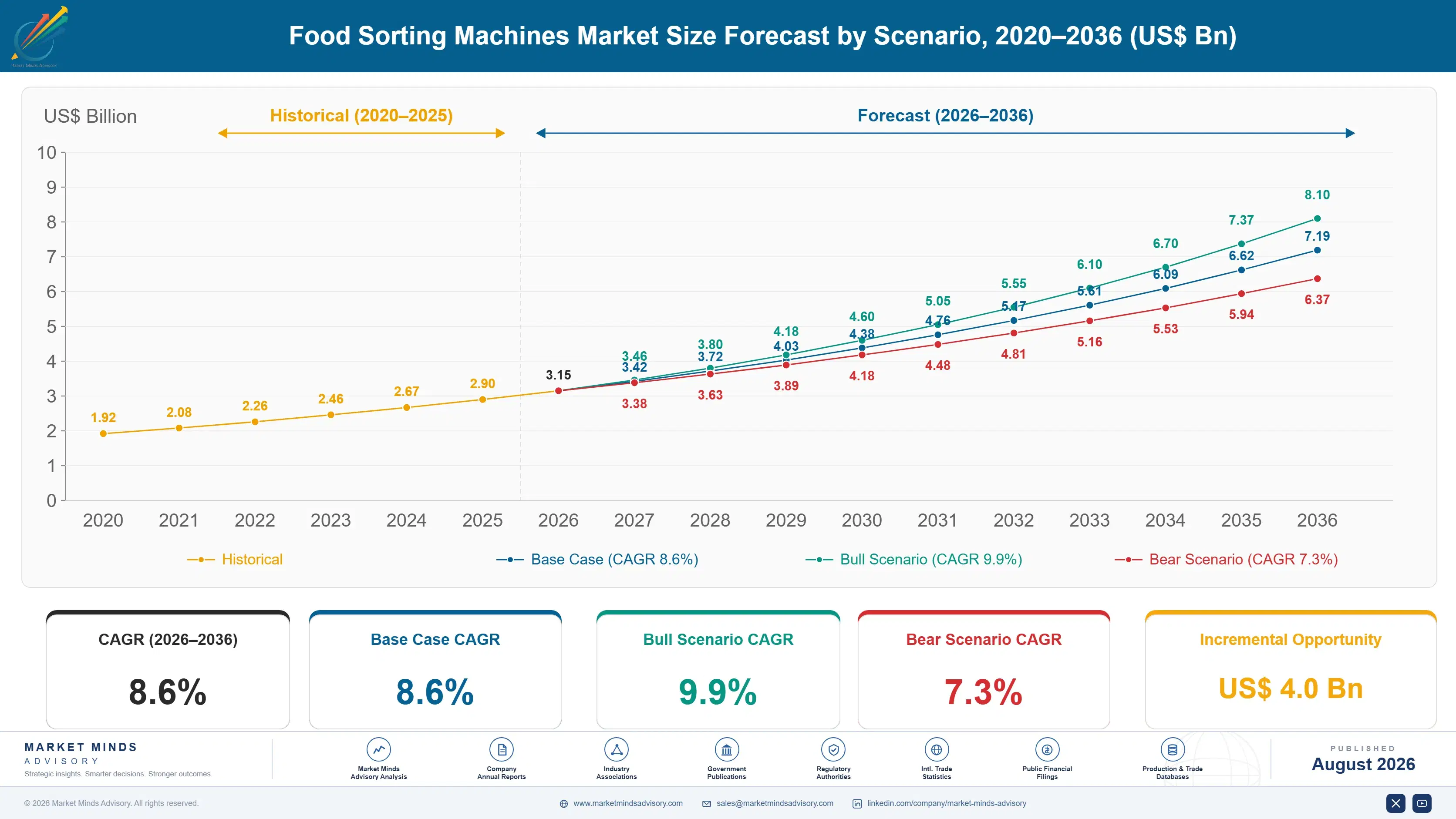
Food Sorting Machines Market Forecast Scenarios

food-sorting-machines-market-size-forecast-scenario-1787300843762
Food sorting machine demand grew near 7.4% annually between 2020 and 2025, distorted by pandemic-era food safety scrutiny and supply chain disruption that pulled some processors toward automated inspection sooner than planned, before order timing normalised and capital spending patterns settled into a steadier expansion through the back half of the period across most major processing regions tracked worldwide.
The base case reaches 8.6% on three mechanisms. First, hyperspectral and X-ray sensor cost keeps falling, bringing contamination detection technology within reach of mid-size processors that previously relied on manual inspection alone. Second, tightening food safety regulation across major export markets makes documented sorting a purchasing requirement rather than a competitive differentiator for exporters. Third, labour shortages in fresh produce and grain handling accelerate automation investment across processing lines worldwide.
The bull case at 9.9% assumes food safety regulation tightens faster than currently modelled and sensor cost declines accelerate adoption among smaller processors sooner than expected. The bear case at 7.3% assumes capital spending on processing equipment slows as processors defer upgrades amid tighter margins and elevated financing costs across the wider agricultural processing sector broadly.

Sensor Accuracy Now Decides Processor Purchasing

Food sorting machines behave like an insurance policy wearing a productivity label. Processors buy detection accuracy against contamination recalls and customer rejection as much as they buy throughput, and the two motives increasingly point toward the same hyperspectral and X-ray sensor upgrades regardless of which budget line funds the purchase, since both a quality manager and an operations director sign off on the same equipment decision.
CR5 CONCENTRATION52%Top five suppliers hold roughly half of shipments globally
AVERAGE SELLING PRICEUSD 185,000 per lineBlended price across mid-size multi-sensor processing installations today
LEADING PRODUCING COUNTRYChina, 27% shareOne country dominates global sorting equipment manufacturing capacity broadly
SENSOR MODALITY MIX58% optical-basedShare of installed base still running camera-only detection systems
TRADE INTENSITY44% cross-borderA meaningful share of finished systems crosses a border
ELECTRONICS COMPONENT SHARE22-28% of COGSSensor and processing electronics dominate machine input cost structure
Commercial activity concentrates around multi-sensor line integration rather than single-machine sales. Suppliers who bundle optical, NIR, and X-ray detection into one processing line win large processor contracts that single-modality specialists increasingly cannot match once a customer standardises on integrated detection architecture across a facility, since replacing one machine at a time becomes harder to justify against a unified platform upgrade.
Over the next decade, sensor cost decline and food safety regulation will matter more than any single throughput improvement introduced this cycle. Retailer-driven contamination screening requirements, labour shortages in processing plants, and integration with automated sorting lines will decide who captures the next wave of large processor contracts before purchasing decisions lock in for years at a time across most tracked processing segments.
"The buying decision has quietly shifted from a plant manager's throughput spreadsheet to a food safety officer's risk register. Suppliers who still sell purely on tons-per-hour are losing deals to sensor-modality breadth."
Director, Food Processing Technology Practice · MMA Food Processing Equipment Pr

Market Trends

Hyperspectral Imaging Moves From Pilot Line To Standard Spec

TOMRA and Bühler have both expanded hyperspectral imaging product lines beyond premium export-grade processing lines into mainstream mid-size facility specifications, as sensor cost decline makes the technology viable for processors who previously could only afford single-modality optical sorters. Processors report hyperspectral systems catch contamination and quality defects that standard camera-based optical sorters routinely miss, particularly foreign material with colour and texture closely matching the target product itself. This shift is pulling contract volume away from legacy optical-only suppliers faster than most had planned for heading into the current planning cycle.
Market Impact: Cuts sensor cost 30% since 2020
Retailer Contamination Screening Mandates Reshape Purchasing Criteria

Major grocery retailers across North America and Western Europe have quietly tightened supplier contamination screening requirements over the past several years, requiring documented sorting technology rather than accepting manual inspection alone as sufficient quality assurance for fresh produce and packaged food contracts. This shift converts sorting equipment purchases from a discretionary efficiency investment into a documented compliance requirement that processors cannot simply defer during tight budget cycles. Suppliers able to demonstrate detection accuracy against specific contaminant classes increasingly win retailer-mandated equipment upgrade cycles ahead of competitors selling on throughput alone.
Market Impact: Replaces 8 to 12 manual inspectors

Market Opportunities and Growth Drivers

Sensor Cost Decline Brings Advanced Detection To Mid-Size Processors

Hyperspectral and X-ray sensor component cost has fallen meaningfully over the past several product generations, narrowing the price gap between basic optical sorters and advanced multi-modality detection systems that previously only large export-focused processors could justify buying outright. Mid-size grain, produce, and nut processors increasingly specify hyperspectral or X-ray detection on new line purchases rather than settling for camera-only optical sorting as a budget compromise driven purely by upfront cost. This democratisation is pulling replacement demand forward across a much broader processor base than advanced sensor technology reached even five years earlier.
Market Impact: Adds USD 150,000 to 400,000 upfront

Labour Shortages In Processing Plants Accelerate Automation Investment

Fresh produce and grain processing facilities across North America and Western Europe report persistent difficulty staffing manual inspection lines, particularly for seasonal harvest peaks when labour demand spikes sharply above available local workforce capacity. Processors increasingly view automated sorting equipment as a staffing solution rather than a pure throughput upgrade, since a single sorting line can replace multiple manual inspection positions that have become genuinely difficult to fill reliably each season. This labour constraint is pulling automation investment forward across facility types that previously relied heavily on seasonal manual labour.
Market Impact: Extends installation 6 to 10 weeks

Market Restraints and Challenges

High Capital Cost Slows Small Processor Adoption

Multi-sensor sorting lines with hyperspectral or X-ray detection typically cost several times more than basic optical or mechanical sorting equipment, a premium that small and mid-size processors in price-sensitive emerging markets still find difficult to justify against thin processing margins that leave little room for large capital outlays. The root cause is the specialised sensor and processing electronics component cost that has not fallen as quickly as broader semiconductor pricing trends might otherwise suggest. Suppliers are mitigating this through leasing and equipment-as-a-service financing models that spread capital cost across a longer payback period for smaller processors specifically.
Market Impact: Lifts hyperspectral share 9 points yearly

Integration Complexity Delays Retrofit Into Legacy Processing Lines

Retrofitting advanced sorting equipment into decades-old processing facilities often requires significant conveyor and control system modification, creating installation delays and unplanned cost overruns that processors did not anticipate when budgeting the equipment purchase itself against a fixed project timeline. The root cause is inconsistent legacy line architecture across older facilities, which rarely matches the standardised interfaces modern sorting equipment assumes during installation planning stages of a project. Suppliers are mitigating this through modular retrofit kits engineered specifically for common legacy conveyor configurations, reducing installation timelines meaningfully for processors upgrading existing facilities today.
Market Impact: Requires screening on 65% of contracts
3 additional market trends, 4 additional growth drivers, and 2 additional restraints and challenges are covered in the full report. Contact sales@marketmindsadvisory.com to access the complete intelligence.

Segment CAGR and Growth Architecture

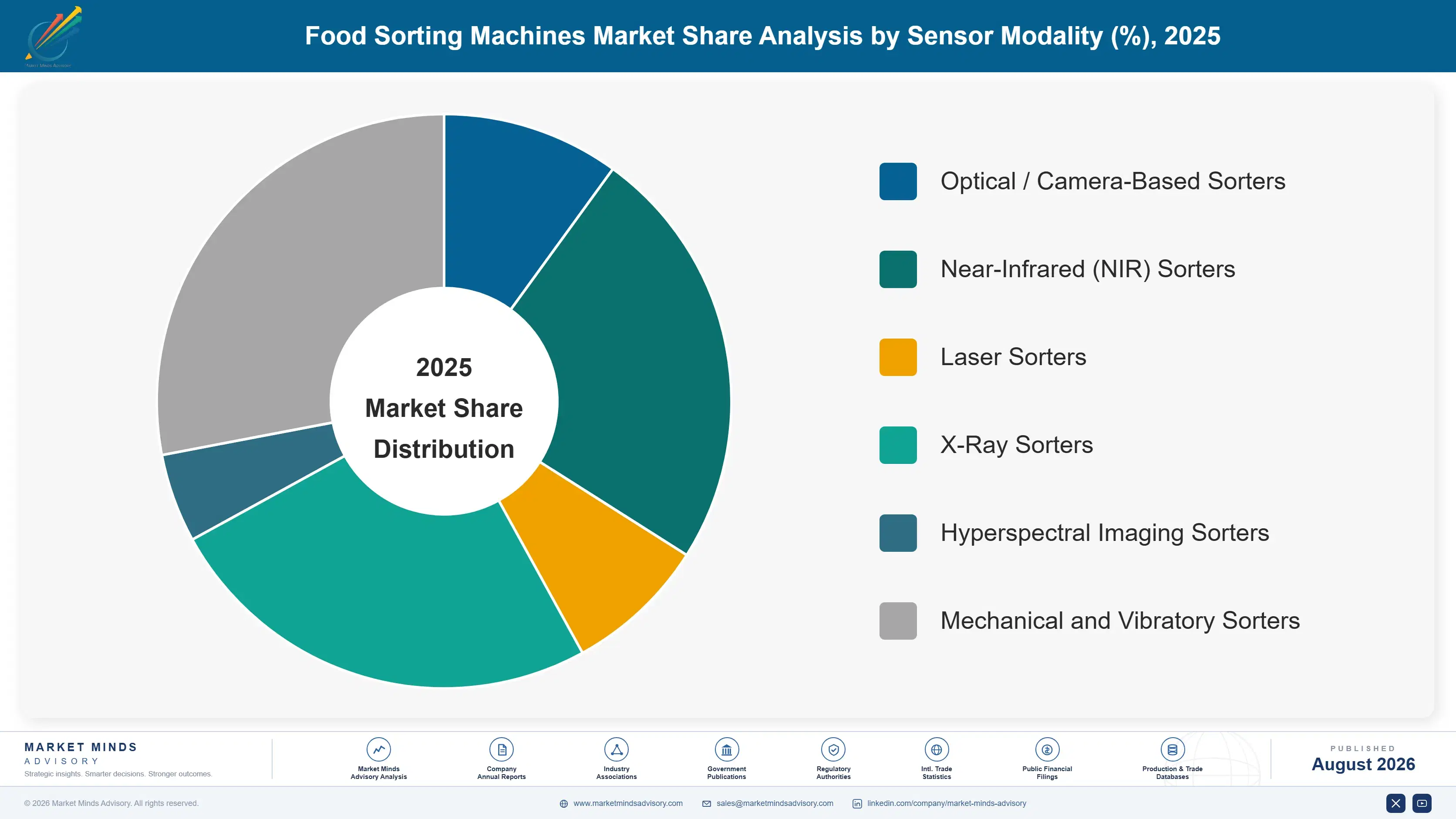
Segmentation follows sorting technology, a single classification logic grounded in which sensor modality a machine uses to detect and separate product, from basic camera-based optical sorting to hyperspectral imaging. Each modality carries its own sensor cost, detection accuracy profile, and processor purchasing calculus, so commercial position tracks sensor technology rather than crop or product application.
food-sorting-machines-market-market-share-analysis-1787300844293

Hyperspectral Imaging Sorters

Hyperspectral imaging sorters grow fastest at 14.5%, about 1.69 times the overall 8.6% rate, as sensor cost decline brings contamination and quality defect detection accuracy that camera-based optical sorters cannot match within reach of mid-size processors. TOMRA and Bühler both lead this category specifically, having invested heavily in sensor miniaturisation that has cut hyperspectral system cost meaningfully over recent product generations. This format benefits most directly from tightening food safety regulation, since hyperspectral imaging catches foreign material and quality defects with colour and texture closely matching the target product that standard optical cameras routinely miss on the line. Adoption has moved beyond premium export-grade lines into mainstream mid-size facility specifications as sensor pricing keeps falling steadily.
CAGR 14.5%

X-Ray Sorters

X-ray sorters grow second-fastest at 11.2%, using radiographic imaging to detect dense foreign material such as glass, metal, and stone that optical and near-infrared sensors cannot reliably distinguish from the product itself by surface appearance alone. Sesotec and Key Technology both pioneered this approach specifically, targeting processors who need physical contaminant detection beyond what colour and shape-based optical sorting alone can deliver reliably. This format occupies a distinct commercial niche from hyperspectral imaging, appealing to processors prioritising foreign material safety over quality grading, though the two technologies increasingly ship bundled on the same processing line together. Regulatory contamination screening mandates remain the primary purchase trigger driving current X-ray adoption industry-wide.
CAGR 11.2%
Full segment breakdown across 6 segments available in the complete report.

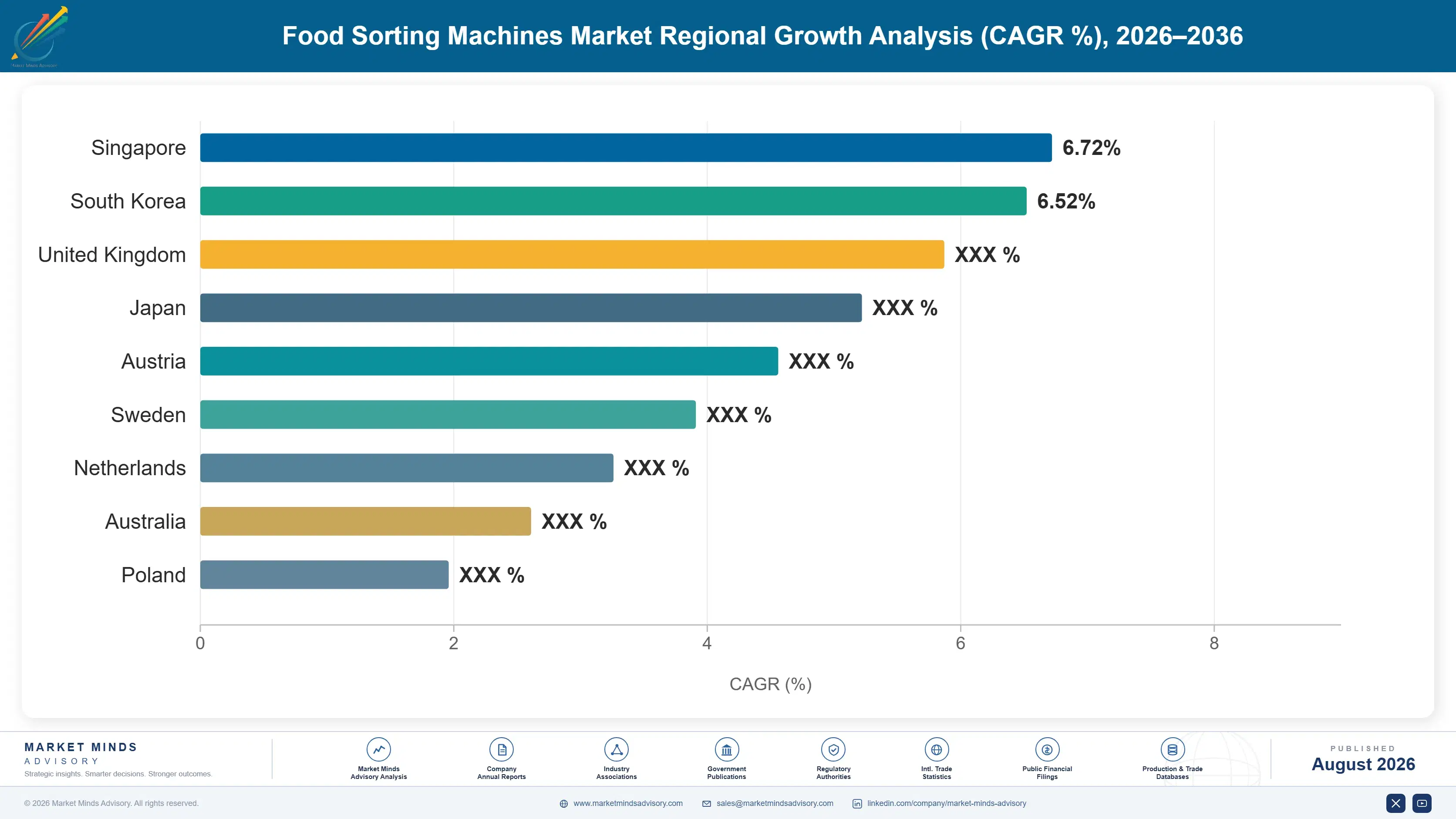
Regional Architecture and Country Demand Map

Seven regions divide between processing scale and food safety regulatory intensity. East Asia holds the largest share given China's massive food processing base and export volume, while South Asia and Pacific compounds fastest as India's grain and rice processing sector modernises rapidly away from manual sorting toward sensor-based lines.

North America

The United States and Canada's large-scale fresh produce, grain, and nut processing sectors sustain steady demand for advanced sorting equipment, reinforced by retailer contamination screening requirements that have tightened meaningfully across major grocery chains over recent years. Key Technology and TOMRA both maintain substantial regional operations here, serving processors who increasingly specify hyperspectral and X-ray detection on new line purchases rather than settling for camera-only optical sorting. Labour shortages in seasonal harvest processing add a second demand driver independent of regulatory pressure specifically. Growth trails the fastest-expanding regions because the installed base here is already extensive and mature, so incremental growth comes mainly from sensor-modality upgrades rather than first-time equipment purchases.
Share: 26% | CAGR: 7.4% (2026 to 2036)

Western Europe

Germany, the Netherlands, and France's food processing sectors sustain steady demand for sorting equipment, reinforced by some of the world's strictest food safety and contamination screening regulation under European Commission oversight specifically and consistently across member states. Bühler, TOMRA, and Sesotec all maintain substantial regional manufacturing and engineering operations here, giving the region genuine technology leadership beyond just consumption scale in this category. Export-oriented processors serving demanding international retail contracts sustain premium equipment demand independent of domestic consumption trends and pricing pressure specifically. Growth trails East Asia and South Asia because the underlying processing base here is already large and mature, limiting how much incremental equipment volume remains genuinely available.
Share: 22% | CAGR: 7.1% (2026 to 2036)
Regional intelligence for 5 additional markets available in the complete report: East Asia, South Asia and Pacific, Latin America, Middle East and Africa, Eastern Europe. Contact sales@marketmindsadvisory.com.
food-sorting-machines-market-country-cagr-analysis-1787300844813

How Sorting Equipment Makers Can Capture More Margin

Margin in this market concentrates where sensor modality breadth, integration depth, and regulatory compliance credibility protect a supplier from throughput-only price competition and processor switching costs across the entire purchasing relationship and equipment lifecycle. The four moves below shift revenue toward processors who pay for detection accuracy rather than machines priced purely off raw tons-per-hour throughput.

Expand Hyperspectral Lines To Defend Against Optical Commoditisation

Optical-only sorter manufacturers without a credible hyperspectral or X-ray product line are losing large processor contracts to competitors offering multi-modality detection, regardless of how competitive their basic optical pricing remains on a standalone basis. Suppliers expanding hyperspectral and X-ray product lines can capture pricing roughly 25% to 40% above equivalent optical-only tools while also securing the retailer-mandated contracts that pure optical specialists increasingly cannot bid for. TOMRA and Bühler both moved early into multi-modality detection specifically to defend broader processor relationships, and their resulting market position gives them leverage competitors entering later cannot easily close.
Market Impact: Captures a 25% to 40% modality price premium

Bundle Sorting Equipment Into Full Processing Line Sales

Processors increasingly evaluate sorting equipment purchases as part of a broader processing line decision rather than a standalone machine choice, and suppliers bundling sorting with milling, grading, and packaging equipment capture cross-sell revenue that single-category competitors cannot access. This bundling approach typically increases total equipment spend per facility by roughly 30% to 45% compared with piecemeal individual machine purchases spread across competing brands. Suppliers without a broad processing equipment portfolio increasingly lose entire facility contracts to integrated competitors, regardless of how their standalone sorter compares on price or accuracy specifications.
Market Impact: Lifts equipment spend per facility by 30% to 45%

Build Regulatory Compliance Documentation Into The Core Offering

Retailer and export market contamination screening requirements increasingly demand documented detection accuracy data, and suppliers without built-in compliance reporting tools force processors into costly third-party verification arrangements that erode the equipment's overall value proposition over the ownership period. Suppliers embedding automated compliance documentation and traceability reporting directly into machine software typically command service contract renewal rates roughly 20% to 30% higher than suppliers offering bare detection hardware alone without any reporting layer. This compliance layer increasingly separates suppliers who win retailer-mandated upgrade cycles from those competing purely on hardware specifications and price.
Market Impact: Lifts renewal rates 20% to 30% above hardware-only

Target Mid-Size Processors With Leasing And Financing Models

Small and mid-size processors across price-sensitive emerging markets represent a genuinely underserved segment for advanced hyperspectral and X-ray sorting equipment priced beyond what thin processing margins can absorb in a single upfront capital outlay. Suppliers developing leasing and equipment-as-a-service financing models specifically for these price-sensitive but rapidly growing markets are capturing new customer acquisition at rates meaningfully above the category average in mature markets, roughly 35% to 50% higher new-customer growth than suppliers requiring full upfront payment. This represents a genuine first-mover opportunity before competitors recognise the addressable market scale fully.
Market Impact: Wins roughly 35% to 50% more new customers

Who Controls the Margin Pool

Concentration is moderate at CR5 52%, assessed on installed processing line shipment volume, and the gap between leader and challenger reflects sensor modality breadth as much as manufacturing scale. TOMRA's multi-modality sensor portfolio and Bühler's integrated processing-line bundling each defend distinct processor relationships neither has fully displaced.
Three dimensions define current activity. Sensor modality racing continues as suppliers expand hyperspectral and X-ray detection faster than optical-only competitors can respond credibly. Processing-line integration is accelerating, as suppliers bundle sorting equipment with milling and grading systems on shared platforms. Compliance documentation keeps advancing too, as suppliers embed traceability reporting to win retailer-mandated contamination screening contracts ahead of hardware-only competitors.

Pressure is building from two directions at once. Chinese optical sorter manufacturers are expanding capacity aggressively, testing whether established European and Japanese brands can defend premium positioning against steadily improving build quality. Meanwhile large food processors themselves are exploring in-house sensor development, threatening to compress independent supplier margin on the highest-volume commodity grain contracts specifically. Rankings will shift toward suppliers combining sensor modality breadth with compliance documentation depth, not toward whoever ships the most basic optical tonnage globally.
food-sorting-machines-market-company-positioning-matrix-1787300845331

Competitive Moat and Risk Dimensions

TOMRA SYSTEMS

Moat: Broadest Multi-Modality Sensor Portfolio

TOMRA's optical, near-infrared, laser, and X-ray sensor portfolio together spans nearly every contamination and quality detection need, letting it capture processor spend across sorting applications rivals with narrower sensor portfolios cannot match. That breadth advantage compounds as more processors consolidate purchasing toward fewer preferred multi-modality suppliers.
TOMRA SYSTEMS

Risk: High Price Point Limits Reach

A substantial share of TOMRA's premium multi-modality systems carry price points that smaller and mid-size processors in price-sensitive emerging markets still find genuinely difficult to justify against thin processing margins. Slower-than-expected financing model adoption would limit revenue growth among exactly the processor segment where unit volume growth potential runs highest.
BÜHLER GROUP

Moat: Integrated Processing Line Bundling

Bühler Group embeds sorting equipment within its broader milling, grading, and handling systems, letting it win full processing line contracts that standalone sorting specialists competing purely on equipment specifications cannot match. Customers who commit to Bühler's integrated architecture find switching individual components meaningfully harder later.
BÜHLER GROUP

Risk: Large Processor Capex Cycle Exposure

Bühler Group's reliance on large-scale industrial processor customers investing in complete processing lines exposes it to capital expenditure cycles that fluctuate meaningfully with commodity prices and financing conditions beyond the company's direct control. A prolonged capex downturn would compress this revenue base faster than smaller-ticket standalone equipment competitors would feel it.

Key Players

TOMRA Systems ASA
Bühler Group
Key Technology (Duravant LLC)
Satake Corporation
Sesotec GmbH

Others

Marel hf.
GEA Group AG
JBT Corporation
Multiscan Technologies S.L.
Greefa B.V.
Compac Sorting Equipment Ltd.
Aweta G&P B.V.
Unitec Group S.p.A.
Raytec Vision S.p.A.
Cimbria A/S (AGCO Corporation)
MSS Inc.
Newtec B.V.
Hefei Meyer Optoelectronic Technology Inc.
Anhui Zhongke Guangdian Technology Co. Ltd.
Ellips B.V.

Recent Developments

FEBRUARY 2026

TOMRA Systems announced an expanded hyperspectral imaging product lineup specifically targeted at mid-size grain and produce processors, adding detection specifications matching premium export-grade system performance that smaller processors had previously considered financially out of reach, backed by an accompanying leasing programme across the wider product line.
Signal: A product launch, not an acquisition, signals TOMRA's deliberate push into the mid-size processor segment specifically.
OCTOBER 2025

Several major grocery retailers across North America updated supplier contamination screening standards, clarifying which sorting technology and documentation levels satisfy contract requirements that had created ambiguity for processors and quality auditors alike since prior standard revisions, following extended consultation with major food safety associations nationwide over several months.
Signal: A standards clarification, not a corporate transaction, removes ambiguity that had slowed some equipment upgrade decisions.
MAY 2025

Bühler Group signed a multi-year sensor component supply agreement with a specialist electronics manufacturer, securing contracted hyperspectral sensor volume for its expanding detection product line ahead of anticipated demand growth across the broader food sorting equipment category, insulating margin from component price volatility through the contract term.
Signal: A supply agreement, not a joint venture, secures sensor component pricing without equity entanglement or shared control.

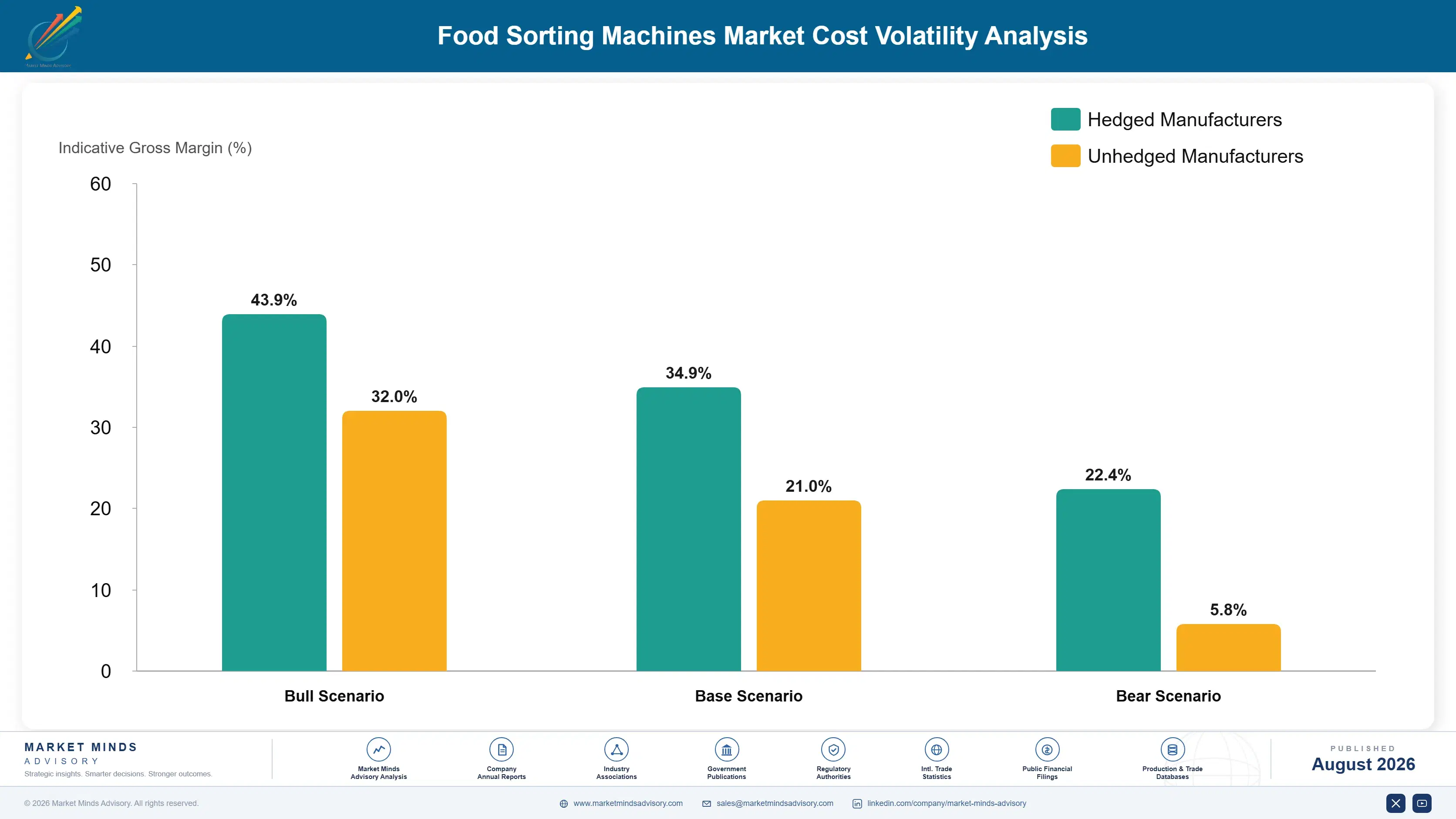
Where Sorting Equipment Cost Structures Face Pressure

Sensor and processing electronics together represent roughly 22% to 28% of finished machine COGS, sourced predominantly from specialist imaging component manufacturers in Germany, Japan, and the United States. Steel framing, conveyor components, and control cabinetry add further meaningful cost, typically sourced from regional fabricators located near final assembly facilities across each supplier's core manufacturing footprint.
Specialist imaging sensor prices rose sharply during the 2021 to 2022 global semiconductor shortage, as camera and hyperspectral sensor component manufacturers prioritised higher-volume automotive and consumer electronics customers over smaller-volume industrial equipment orders, according to IEA and national semiconductor supply tracking. Bühler Group's 2023 annual report cited elevated sensor component procurement cost as a meaningful drag on new equipment gross margin during the period, before pricing eased through 2024 as broader chip supply normalised.

Suppliers without diversified sensor component sourcing absorb component shortages and price swings directly into new equipment lead times and margin, a disadvantage smaller regional manufacturers feel more acutely than the five largest global suppliers who negotiate volume-based contracts. Exposure also varies by geography, since manufacturers assembling machines domestically within Western Europe face less currency and logistics volatility than competitors dependent on imported components from distant suppliers.
food-sorting-machines-market-cost-volatility-analysis-1787300845527

Diversify Imaging Sensor Component Sourcing

Suppliers qualifying imaging sensor sources across multiple component manufacturers, rather than depending on one dominant supplier, reduce exposure to any single manufacturer's capacity constraint or allocation priority during industry-wide semiconductor shortages, though qualification and testing costs rise modestly as sourcing diversity increases across the supplier base each product cycle and additional audits become routine.

Lock Multi-Year Sensor Component Supply Agreements

Manufacturers negotiating multi-year sensor supply agreements directly with imaging component makers, rather than purchasing on the spot market, insulate new equipment margin from allocation priority swings that automotive and consumer electronics demand periodically create across shared semiconductor manufacturing capacity worldwide, locking predictable component pricing well ahead of each new product launch cycle across the range.

Standardise Control Cabinetry Across Product Lines

Suppliers standardising control cabinetry and conveyor components across multiple machine models reduce component variety and associated inventory carrying cost simultaneously, though the transition requires validating that shared components meet the performance specifications each distinct machine model and processing application genuinely requires before any wide commercial release proceeds across the full product range each year.

Portfolio Architecture for Margin Defence

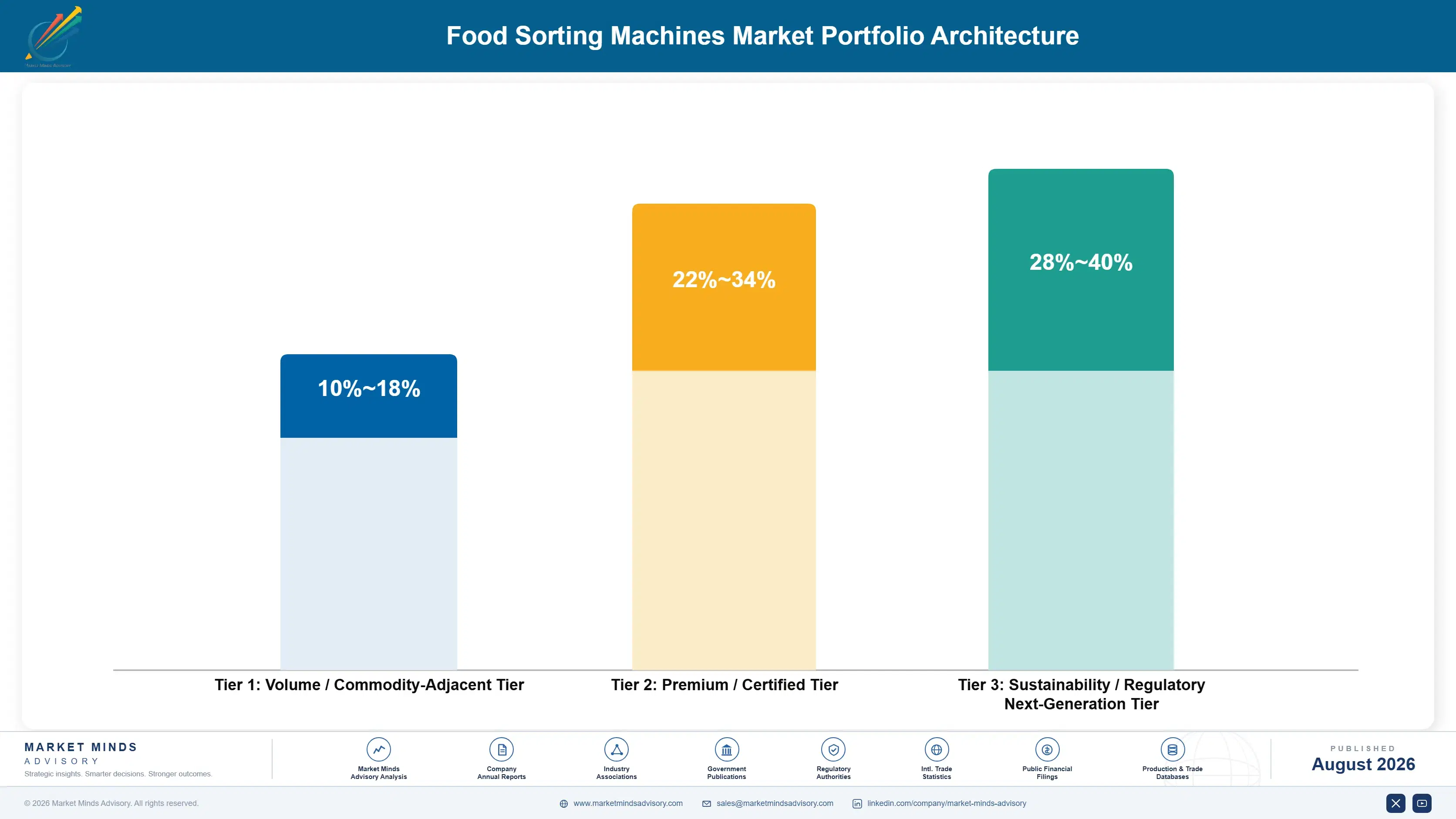
Three tiers define margin architecture in this market. Volume optical and mechanical sorters compete almost entirely on unit price and throughput specifications, leaving thin margin for manufacturers without genuine manufacturing scale advantages. Premium hyperspectral and X-ray systems command materially better economics, since processors pay for detection accuracy against contamination risk rather than raw throughput specifications alone, and that willingness to pay keeps widening as retailer
The volume versus premium tension shows up clearly in product roadmaps: suppliers cannot simultaneously chase the lowest optical sorter price point and fund the sensor research that premium multi-modality positioning demands, so most successful manufacturers now deliberately pick a lane rather than straddling both, reallocating capital away from legacy optical tooling toward sensor platform development instead.

High-value margin pools concentrate in hyperspectral and X-ray formats, where detection accuracy and compliance documentation let suppliers price above raw component cost. Basic optical and mechanical sorters increasingly sit in the volume tier, still generating meaningful revenue but facing steel and electronics cost pressure that limits how much margin expansion remains available there, pushing several established optical specialists to fund their own multi-modality conversion programmes.

Volume / Commodity-Adjacent Tier

Basic optical and mechanical sorters sold on unit price and throughput specification, competing directly against regional manufacturers with minimal multi-modality differentiation in this segment today, where switching cost between competing suppliers stays genuinely low.
Gross Margin: 10-18%

Premium / Certified Tier

NIR and X-ray sorters certified against retailer contamination screening specifications, commanding premium pricing tied to detection accuracy and compliance documentation depth across a processor's full facility footprint and export contracts.
Gross Margin: 22-34%

Sustainability / Regulatory / Next-Generation Tier

Emerging AI-enabled hyperspectral systems with predictive quality analytics and cloud-based traceability integration, positioned toward large export-focused processors managing regulatory compliance across multiple facilities simultaneously and remotely through centralised software dashboards.
Gross Margin: 28-40%
food-sorting-machines-market-portfolio-architecture-1787300846016

High-value Sub-segments and Strategic Watch-out

Hyperspectral Imaging Sorters

Hyperspectral imaging sorters represent the high-value, high-growth pool, expanding at 14.5% as sensor cost decline brings contamination detection accuracy that camera-based optical sorters cannot match within reach of mid-size processors. The margin range reflects manufacturing maturity, since established platforms capture the top end while newer entrants refining efficiency earn less.
Gross Margin: 26-40%

X-Ray Sorters

X-ray sorters form the high-value, moderate-growth pool, expanding at 11.2% as retailer and export market contamination screening mandates make physical foreign material detection a documented purchasing requirement. Margin sits below pure hyperspectral systems given the added radiographic shielding and safety certification cost each X-ray unit still carries.
Gross Margin: 22-34%

Optical Camera-Based Sorters

Optical camera-based sorters remain the volume core, still carrying the largest installed base across fruit, vegetable, and grain processing lines despite slowing growth. Margin stays thin given intense price competition among established manufacturers and Chinese entrants, but replacement and accessory sales sustain steady, dependable revenue regardless of new hyperspectral adoption.
Gross Margin: 12-20%

Mechanical and Vibratory Sorters

Mechanical and vibratory sorters are the strategic watch-out, facing durable long-term share erosion as sensor-based alternatives eliminate the detection accuracy limitations that once made mechanical sorting acceptable for basic size and weight grading. Loyal legacy relationships still sustain near-term revenue, but the category's processing role keeps shrinking steadily.
Gross Margin: 8-16%

How Sorting Equipment Demand Renews

Sorting equipment purchases behave less like one-time capital buys and more like an annuity once a processor commits to a sensor supplier, since compliance documentation, service contracts, and sensor calibration all renew on a recurring cycle that keeps revenue flowing past the initial machine sale. This renewal pattern compounds over years, as sensor upgrades and software licensing generate recurring revenue a transactional hardware sale never delivers.
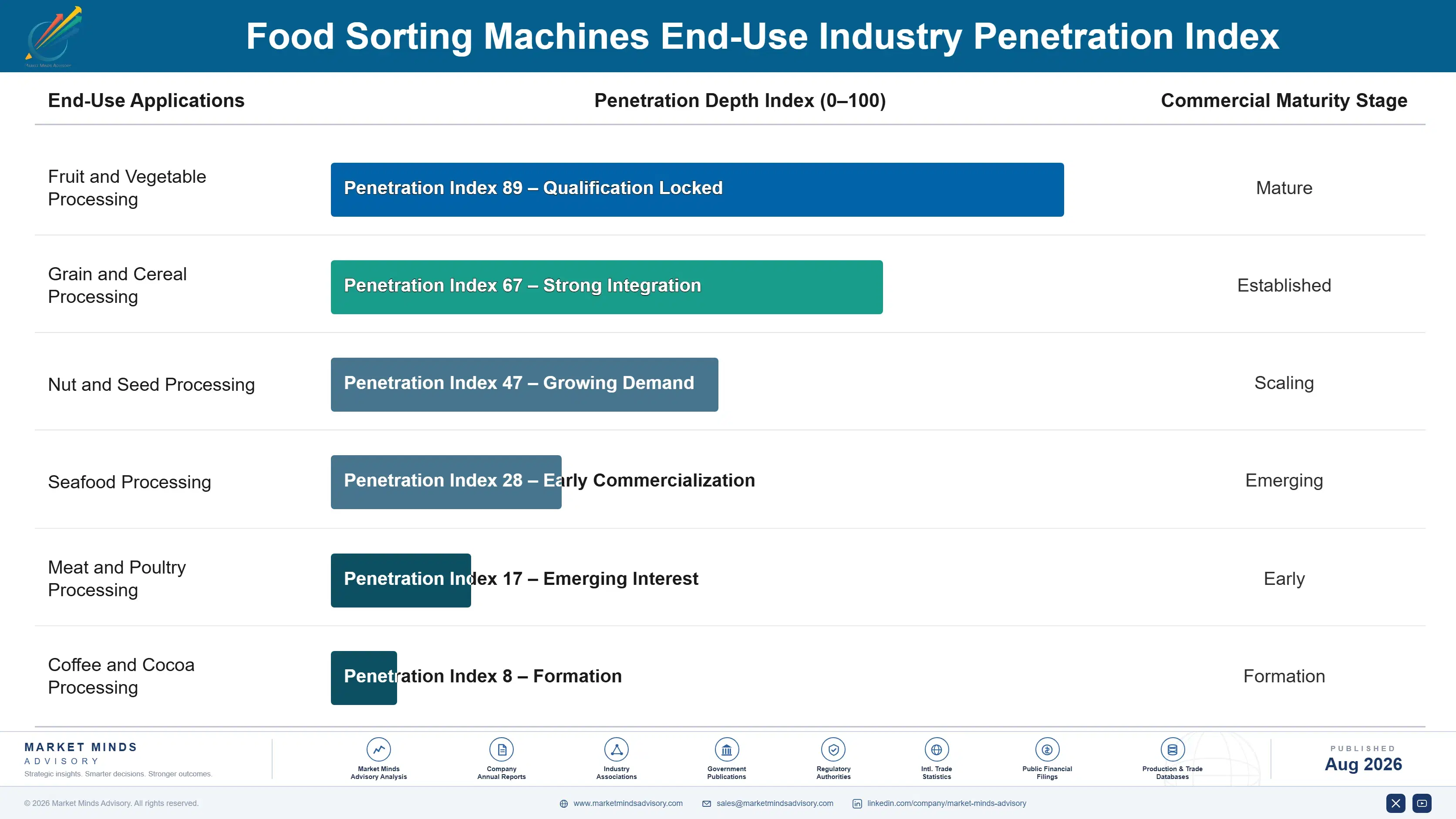
Stickiness varies meaningfully by end-use vertical. Export-focused grain and produce processors, who face the strictest documented screening requirements, show the deepest supplier loyalty once committed, while domestic-market processors, facing lighter compliance pressure, switch suppliers readily since their purchase frequency never builds the same compliance documentation sunk cost that export processors accumulate. Seafood and nut processors sit between these two extremes, forming loyalty gradually as export ambitions grow.

A generational shift is underway in buyer profiles too. Younger quality assurance managers entering food safety roles over the past decade default to sensor-based detection from their first purchase decision, never developing the manual inspection reliance older quality managers built over careers, which erodes the market for basic optical equipment that once anchored replacement demand. Processors report this cohort researches sensor specifications online before contacting any supplier.
food-sorting-machines-market-end-use-penetration-index-1787300846503

Where Sorting Equipment Makers Should Focus

These are among the four positions where our research anticipates prominent divergence between winners and laggards over the coming forecast period. Each is grounded in the demand model, the regulatory perimeter, and the announced capacity pipeline.
01 / MULTI-MODALITY SENSOR INVESTMENT

Winning requires sensor modality breadth, not just throughput

Manufacturers competing purely on throughput specifications are losing large processor contracts to competitors who bundle optical, NIR, and X-ray detection into one processing line spanning a customer's full facility. Processors increasingly choose their sorting supplier based on documented contamination detection accuracy, not raw tons-per-hour, and that decision now happens before any throughput comparison even begins. Suppliers without a credible multi-modality investment plan risk losing entire facility relationships rather than individual machine sales over the coming decade of compliance-driven upgrade cycles.
02 / COMPLIANCE DOCUMENTATION BUILD-OUT

Retailer contamination mandates reward suppliers with reporting depth

Retailer and export market contamination screening requirements increasingly demand documented detection accuracy data, not just hardware that catches contamination reliably on the line without any accompanying reporting layer built in. Suppliers embedding automated compliance documentation directly into machine software win retailer-mandated upgrade cycles that hardware-only competitors increasingly cannot bid for credibly against an already documentation-equipped rival. The window to build this documentation advantage before it becomes table stakes across the industry is narrowing steadily with every regulatory cycle that passes.
03 / MID-SIZE PROCESSOR FINANCING MODELS

Leasing models open underserved mid-size processor segments early

Small and mid-size processors across price-sensitive emerging markets represent a genuinely underserved segment for advanced hyperspectral and X-ray detection priced beyond what thin processing margins can absorb in a single capital outlay paid upfront. Suppliers establishing leasing and equipment-as-a-service financing now, ahead of demand fully maturing, capture first-mover customer loyalty that later entrants will find genuinely expensive to dislodge once processor purchasing habits solidify across the segment. Distributors who wait risk permanently ceding this early positioning advantage to faster-moving competitors.
04 / SENSOR COMPONENT SUPPLY SECURITY

Component supply agreements now separate margin winners from losers

Suppliers without secured long-term imaging sensor component agreements remain exposed to allocation priority swings that automotive and consumer electronics demand periodically triggers across shared semiconductor manufacturing capacity worldwide, compressing new equipment margin unpredictably. This exposure increasingly separates suppliers who sustain stable lead times from those forced into reactive delivery delays that frustrate processors and erode brand loyalty over repeated purchase cycles. Securing multi-year component contracts is no longer a defensive move; it has become a genuine prerequisite for competing credibly.

Engagement Snapshot From the Field

A live engagement with an industry participant carrying material or product regulatory and market exposure ahead of a defining policy shift, showing how our research translates into a defensible multi-year portfolio strategy.
MARKET MINDS ADVISORY · CLIENT ENGAGEMENT SUMMARY
Food Sorting Machines Producer Strategic Portfolio Review and Transition Roadmap 2026·Investment Scenario on Food Sorting Machines Exposure Evaluation 2025-26
CLIENT PROFILE
A mid-size fresh produce exporter operating three packing facilities across the western United States supplies fruit and vegetable products to major grocery retailers across North America and select export markets in Asia. The client's facilities had historically relied on basic optical sorting equipment, but retailer contamination screening requirements had tightened noticeably over the prior two seasons, prompting a formal review of its detection technology roadmap.
STRATEGIC CHALLENGE
The exporter's operations leadership disagreed on how quickly to upgrade toward hyperspectral detection, given the substantial capital cost involved and uncertainty about which retailer contracts would actually require documented sensor-based screening within the coming procurement cycle. Leadership needed an evidence-based view of regulatory timing before approving a multi-million-dollar equipment upgrade.
MMA APPROACH
MMA combined its quantitative processor survey data with expert interviews across five equipment suppliers to model retailer contamination screening adoption timelines by customer segment and export destination. The engagement benchmarked the client's existing sorting technology against category-wide compliance trends and identified which retailer relationships carried the nearest-term documented screening requirement.
KEY FINDINGS
  1. Two of the client's three largest retailer contracts were expected to require documented hyperspectral or X-ray screening within eighteen months, confirming the urgency MMA's broader research had identified across the category.
  2. Retailers increasingly requested contamination screening documentation as part of standard supplier onboarding, rather than treating it as an optional value-add during contract renewal negotiations.
  3. The facility serving the client's largest retail contract lacked any multi-modality detection capability, creating meaningful exposure to lost shelf space as requirements tightened further.
  4. Competing regional exporters who had already upgraded to hyperspectral detection reported meaningfully stronger contract renewal rates with major retailers (client-reported, unverified by MMA).
CLIENT PROFILE
A mid-size fresh produce exporter operating three packing facilities across the western United States supplies fruit and vegetable products to major grocery retailers across North America and select export markets in Asia. The client's facilities had historically relied on basic optical sorting equipment, but retailer contamination screening requirements had tightened noticeably over the prior two seasons, prompting a formal review of its detection technology roadmap.
STRATEGIC CHALLENGE
The exporter's operations leadership disagreed on how quickly to upgrade toward hyperspectral detection, given the substantial capital cost involved and uncertainty about which retailer contracts would actually require documented sensor-based screening within the coming procurement cycle. Leadership needed an evidence-based view of regulatory timing before approving a multi-million-dollar equipment upgrade.
MMA APPROACH
MMA combined its quantitative processor survey data with expert interviews across five equipment suppliers to model retailer contamination screening adoption timelines by customer segment and export destination. The engagement benchmarked the client's existing sorting technology against category-wide compliance trends and identified which retailer relationships carried the nearest-term documented screening requirement.
KEY FINDINGS
  1. Two of the client's three largest retailer contracts were expected to require documented hyperspectral or X-ray screening within eighteen months, confirming the urgency MMA's broader research had identified across the category.
  2. Retailers increasingly requested contamination screening documentation as part of standard supplier onboarding, rather than treating it as an optional value-add during contract renewal negotiations.
  3. The facility serving the client's largest retail contract lacked any multi-modality detection capability, creating meaningful exposure to lost shelf space as requirements tightened further.
  4. Competing regional exporters who had already upgraded to hyperspectral detection reported meaningfully stronger contract renewal rates with major retailers (client-reported, unverified by MMA).
RECOMMENDED STRATEGY
Phase 1: Phase 1 (0 to 6 months): Install hyperspectral detection at the facility serving the client's largest retailer contract, the nearest-term compliance deadline identified. Phase 2: Phase 2 (6 to 14 months): Extend hyperspectral or X-ray detection to the second facility ahead of its retailer's own screening deadline. Phase 3: Phase 3 (14 to 24 months): Evaluate the third facility's upgrade timing against actual retailer requirement confirmation rather than a fixed assumption.
OUTCOME
The exporter approved the phased upgrade plan and began equipment procurement within the following quarter. The first facility's hyperspectral installation passed its retailer's documented screening audit ahead of the compliance deadline, though results from the remaining two facilities remained pending at time of writing (client-reported, unverified by MMA).

Frequently Asked Questions

Foundational context covering the market sizes, CAGR, scope, country, region and competition that inform every finding below. This section is provided to cover basics and most often pre-purchase conversations, answered from the MMA Primary Research Dataset.

What is the current size of the Food Sorting Machines Market?

The global food sorting machines market was valued at USD 2.9 billion in 2025. Hyperspectral imaging sorters account for the fastest-growing share of that total.

How large will the Food Sorting Machines Market be by 2036?

MMA projects the market reaching USD 7.1 billion by 2036, roughly 2.29 times its 2026 value as sensor-based detection adoption continues across food processors worldwide.

What is the CAGR for the Food Sorting Machines Market 2026 to 2036?

The base case CAGR is 8.6% between 2026 and 2036. The bull case reaches 9.9% and the bear case falls to 7.3% depending on regulatory pace.

Which segment is growing fastest?

Hyperspectral imaging sorters grow fastest at 14.5%, about 1.69 times the overall market rate, as sensor cost decline brings advanced detection within reach of mid-size processors.

Who are the major companies in the Food Sorting Machines Market?

TOMRA Systems, Bühler Group, Key Technology, Satake, and Sesotec lead the category. Together the top five suppliers hold roughly 52% of global shipment volume today.

Which country is growing fastest?

India posts the fastest national growth at 11.5%, as rapidly modernising grain and rice processing pulls sorting equipment adoption past traditional manual practices quite quickly.

Report Segmentation Architecture

The full report scope spans multiple orthogonal segmentation dimensions, with cross-tabulated demand data provided for each dimension pair. Coverage extends further to regional breakdowns, trend trajectories, and the competitive detail needed to support segment-level decision-making.

By Sensor Modality

  • Optical / Camera-Based Sorters
  • Near-Infrared (NIR) Sorters
  • Laser Sorters
  • X-Ray Sorters
  • Hyperspectral Imaging Sorters
  • Mechanical and Vibratory Sorters

By End-Use Industry

  • Fruit and Vegetable Processing
  • Grain and Cereal Processing
  • Nut and Seed Processing
  • Seafood Processing
  • Meat and Poultry Processing
  • Coffee and Cocoa Processing

By Commercial Dimension

  • Direct Equipment Sales
  • Equipment Leasing and Financing
  • Retrofit and Upgrade Services
  • Distributor and Systems Integrator Channel

By Region

  • North America
  • Western Europe
  • East Asia
  • South Asia and Pacific
  • Latin America
  • Middle East and Africa
  • Eastern Europe

Scope, Methodology, and Coverage

Every figure in this report is reproducible from documented input assumptions. The scope below maps the historical period, the forecast horizon, the segmentation dimensions, and the countries covered, alongside the underlying primary and qualitative methodology.
Historical Period
2020 to 2025
Forecast Period
2026 to 2036
Base Year
2025 (USD billions; MMA Primary Research Dataset, August 2026)
Market Definition
The market covers automated sorting and inspection equipment engineered for food processing applications, spanning optical, near-infrared, laser, X-ray, and hyperspectral sensor modalities sold to fruit, vegetable, grain, nut, and seafood processors. General industrial recycling and mining sorting equipment are excluded from this scope.
Quantitative Units
USD billions (current prices); thousands of units shipped where applicable
Segmentation Dimensions
By Sensor Modality; By End-Use Industry; By Commercial Dimension; By Region
Regions Covered
North America, Western Europe, East Asia, South Asia and Pacific, Latin America, Middle East and Africa, Eastern Europe
Countries Covered
USA, Canada, China, Japan, South Korea, Germany, Netherlands, France, UK, India, Vietnam, Thailand, Indonesia, Australia, Brazil, Mexico, Argentina, Saudi Arabia, UAE, South Africa, Nigeria, Poland, Ukraine, Italy, Spain, Sweden, Turkey, Colombia, Malaysia, and additional markets relevant to this sector
Key Companies Profiled
TOMRA Systems, Bühler Group, Key Technology, Satake Corporation, Sesotec, Marel, GEA Group, JBT Corporation, Multiscan Technologies, Greefa, Compac Sorting Equipment, Aweta, Unitec Group, Raytec Vision, Cimbria, MSS Inc., Newtec, Hefei Meyer Optoelectronic Technology, Anhui Zhongke Guangdian Technology, Ellips
Quantitative Methodology
Primary survey, n=3,800 respondents, Q4 2025, six countries; demand-side model with trade association cross-validation
Qualitative Methodology
47 expert interviews, Q4 2025; applied to validate demand model assumptions, identify emerging dynamics, and assess competitive positioning
Report Format
PDF and XLSX data workbook (Word format preview document)
Publisher
Market Minds Advisory
Report Code
MMA-2026-AGR-111
Published
August 2026
Contact
sales@marketmindsadvisory.com | www.marketmindsadvisory.com

Purchase the full Food Sorting Machines Market Report (2026 to 2036).

The full MMA Food Sorting Machines report sizes the market across six sensor-modality segments, seven regions, and twenty profiled participants through 2036 on a consistent shipment volume basis. It scores the top two suppliers on sensor modality breadth and processing-line integration depth. Scenario models quantify how sensor cost decline, food safety regulation, and semiconductor component supply security move both demand and realised pricing across the forecast period. The report also includes delivered-cost modelling by sensor modality, a component supply exposure screen, and a compliance documentation adoption tracking framework built for product, procurement, and investment teams.
Six-segment sensor-modality forecast with volume and value detail
Seven-region demand map with country-level processing context
Twenty-company competitive profiles on shipment volume basis
Sensor component supply chain and electronics cost exposure screen
Compliance documentation tracking across processor end-use verticals
Mid-size processor financing and market entry playbook

Built For The People Who Decide

From boardroom strategy to bench-side execution, this report is read cover-to-cover by leaders shaping the next decade of their industry, turning demand scenarios, market dynamics and valuation benchmarks into decisions.
CXOs/ Presidents/ VPs/ Managers
M&A and Corporate Development
Strategy Teams and R&D Heads
Procurement and Product Directors
Regulatory and Compliance Leaders
Investor Relations and Equity Analysts