Market Minds Advisory
Hyperspectral Imaging Camera Market

Hyperspectral Imaging Camera Market: Hyperspectral Imaging Camera Market. Food Sorting Applications Drive Commercial Adoption

Food safety regulation and precision agriculture adoption are pushing hyperspectral imaging cameras beyond defense and research laboratories into commercial food sorting and crop monitoring, as unit costs fall enough to justify industrial-scale deployment.

Lead Analyst

Published

September 2026

Make Smarter Decisions with Customized Research Insights

Request a free sample report and evaluate market opportunities, growth trends, and competitive dynamics relevant to your business needs.

2025 MARKET VALUE$0.7BMarket Size 2025
2036 FORECAST VALUE$2.8BBase Case , 2026 to 2036
CAGR 2026 TO 203613.5 %Bull 14.7% / Bear 12.3%
INCREMENTAL OPPORTUNITY$2.0BNet 10- year value creation
EXPANSION MULTIPLE3.54x2036 value over 2026 base
Strategic Levers
M&A Pipeline
Regional Outlook
Country Rankings
Competitive Intelligence
Segmental Deep-dive
Call-Us : 91 93563 13602

Executive Snapshot and Market Trajectory.

Hyperspectral imaging cameras are moving from specialized defense and research applications into commercial food sorting and crop monitoring, as falling sensor costs finally justify industrial deployment at meaningful production scale across many customer segments and application categories worldwide right now.
Food processors facing tightening safety regulation and quality consistency requirements are the primary commercial force behind adoption growth, since hyperspectral imaging can detect contamination and quality defects that conventional machine vision cameras cannot distinguish reliably. Agricultural and food sorting hyperspectral cameras have become the fastest-growing product category as processors move beyond visual inspection toward spectral analysis capable of identifying chemical differences invisible to the eye, while adoption concentrates among large processors with dedicated quality budgets.
Competition centers on a small group of established hyperspectral sensor manufacturers expanding into commercial food and agriculture applications alongside a growing group of specialized startups building purpose-first for these newer markets. Chinese agricultural technology adoption is accelerating fastest as domestic food safety regulation tightens and precision agriculture investment scales nationally. Defense and research applications, historically the primary demand driver, are being outpaced by commercial food and agriculture use cases entirely.
Market Definition
This market covers hyperspectral imaging camera hardware that captures spectral data across dozens or hundreds of narrow wavelength bands for material and chemical composition analysis, used in agriculture, food sorting, defense, and industrial inspection applications. It excludes standard machine vision cameras and multispectral cameras that capture only a limited number of discrete spectral bands.
Base Year Value
$0.7B in 2025 (MMA Primary Research Dataset, September 2026)
Forecast Period
2026 to 2036, eleven discrete annual values
CAGR
13.5% base case. Bull 14.7%. Bear 12.3%.
Fastest Growth Segment
Agricultural and Food Sorting Hyperspectral Cameras: 18.0% CAGR
Fastest Growth Country
China: 17.0% CAGR
Fastest Growth Region
South Asia and Pacific: 15.5% CAGR
Largest Region
North America: 30% of 2025 global value
Market Leaders
Headwall Photonics, Specim, Resonon, Corning, Norsk Elektro Optikk
Primary Survey
n=3,800 procurement and R&D decision-makers, Q4 2025, six countries
Methodology
Demand-side build-up, cross-validated against public data, 47 expert interviews

Hyperspectral Imaging Camera Market Forecast Scenarios

hyperspectral-imaging-camera-market-size-forecast-scenario-1789980648922
Hyperspectral imaging camera demand grew steadily from 2020 through 2025 as sensor miniaturization and falling costs gradually expanded the technology's addressable applications beyond its traditional defense and scientific research origins into new commercial and industrial use cases entirely across food processing, agriculture, pharmaceutical inspection, and manufacturing quality control sectors worldwide, driven by falling per-unit sensor prices.
The base case assumes continued cost reduction expanding hyperspectral imaging into mainstream food sorting and precision agriculture applications, growing food safety regulation requiring more rigorous contamination detection than conventional visual inspection provides, and expanding industrial quality control applications beyond food and agriculture entirely across manufacturing sectors. Vendors combining camera hardware with application-specific analysis software capture disproportionate new contract value as customers consolidate their imaging technology vendor relationships into fewer platforms.
A bull scenario assumes accelerating food safety regulation and agricultural technology adoption force broader commercial deployment across previously underserved industrial categories facing genuine quality control gaps and rising consumer scrutiny; a bear scenario assumes sensor costs plateau above the threshold needed for mass commercial adoption, confining growth mostly to defense and research applications rather than genuine commercial expansion overall.

Where Sensor Cost Meets Detection Accuracy

Hyperspectral imaging has evolved from a specialized laboratory instrument into practical industrial equipment as sensor costs fall and processors recognize that spectral analysis catches contamination and defects that conventional visual inspection systems simply cannot detect reliably at comparable speed or scale across a high-volume production line, where every second of throughput delay carries a real and measurable cost impact on overall facility economics, profitability, and long-term customer trust.
MARKET CONCENTRATION (CR5)44%Moderate concentration among leading hyperspectral sensor manufacturers globally
AVERAGE CAMERA UNIT COST$15,000Typical price for an industrial-grade hyperspectral imaging system today
FOOD SORTING ADOPTION RATE24%Share of large food processors using hyperspectral sorting equipment currently
SPECTRAL BAND COUNT RANGE100-300Typical number of wavelength bands captured by commercial systems
AVERAGE SYSTEM LIFESPAN8 yearsTypical operational service life before equipment replacement occurs
DEFECT DETECTION IMPROVEMENT35%Typical accuracy gain over conventional machine vision inspection systems
Food and agriculture adoption is expanding fastest among large processors with dedicated quality assurance budgets, where detection accuracy directly reduces recall risk and regulatory exposure that conventional machine vision inspection historically left unaddressed across many product categories and processing facility types worldwide, particularly as consumer expectations around food safety transparency continue steadily rising each passing year and every single product cycle.
Competitive dynamics increasingly favor vendors who combine camera hardware with application-specific analysis software under one platform, since customers prefer consolidating vendor relationships rather than integrating separate hardware and software providers built for different original applications and industries entirely, each requiring its own separate calibration, staff training, ongoing maintenance investment, and dedicated multi-year support contract terms and pricing.
"A food processor still relying purely on visual inspection is accepting recall risk that hyperspectral imaging would have caught years before the product ever left the facility."
Practice Lead, Industrial Imaging and Sensing Technology · MMA Hyperspectral Imaging Camera Hardware for Industrial and Agricultural Inspection Practice · September 2026

Market Trends

Food Sorting Applications Drive Mainstream Commercial Adoption

Food processors are deploying hyperspectral imaging cameras on production lines to detect contamination, foreign material, and quality defects invisible to conventional machine vision systems, reflecting a documented 35 percent improvement in defect detection accuracy compared to standard visual inspection according to industry food safety benchmarking studies. Vendors that can demonstrate detection accuracy under real production line speeds are winning larger, longer contracts as food safety managers demand evidence before committing capital budget. This shift toward spectral-based quality control is reshaping vendor selection criteria across the entire food processing industry overall.
Market Impact: New FSMA rules apply since 2023

Precision Agriculture Adoption Expands Field-Level Camera Deployment

Agricultural technology companies increasingly mount hyperspectral cameras on drones and tractors to monitor crop health, detect disease, and optimize fertilizer application at field level, creating an entirely new deployment context distinct from the fixed-installation industrial inspection applications that historically dominated the market for many years. This precision agriculture demand grows alongside expanding drone adoption in commercial farming operations, providing hyperspectral camera manufacturers a genuine growth avenue beyond traditional laboratory and industrial customers. Several manufacturers have expanded ruggedized, field-deployable camera product lines specifically to capture this growing agricultural demand pool and opportunity.
Market Impact: Sensor costs fell 40 percent

Market Opportunities and Growth Drivers

Food Safety Regulation Demands Rigorous Contamination Detection

Expanding food safety regulation, including the US FDA Food Safety Modernization Act and comparable international frameworks, increasingly requires food processors to demonstrate rigorous contamination detection capability that conventional visual inspection alone cannot reliably provide across high-speed production lines handling large volumes of product daily. This regulatory pressure creates direct commercial demand for hyperspectral imaging systems capable of detecting chemical and material contamination invisible to the human eye under normal production line lighting and speed conditions. Food processors increasingly treat hyperspectral inspection as a genuine regulatory compliance requirement rather than a discretionary quality upgrade.
Market Impact: Adds 20 to 30 percent cost

Falling Sensor Costs Expand Addressable Commercial Applications

Hyperspectral sensor costs have fallen roughly 40 percent over the past five years as semiconductor manufacturing techniques improve and production volume scales across a growing base of commercial and industrial customers beyond the small defense and research market that historically supported the technology for decades. This cost decline crosses the economic threshold that previously confined hyperspectral imaging to well-funded government and research budgets, opening genuinely new commercial market segments including mid-sized food processors and agricultural operations that previously could not justify the capital expenditure required for adoption at meaningful scale.
Market Impact: Adds 3 to 6 months

Market Restraints and Challenges

High Unit Costs Still Exclude Smaller Operators

Hyperspectral imaging cameras still cost meaningfully more than conventional machine vision systems, a gap that remains economically prohibitive for smaller food processors and agricultural operations with limited capital budgets relative to large enterprise customers who can absorb the investment readily. The root cause is that hyperspectral sensors require far more complex optical and semiconductor manufacturing than standard cameras, keeping a cost floor beneath which the technology cannot easily compete against conventional visual inspection alternatives. Some vendors now offer leasing and subscription-based pricing models specifically to bring smaller operators into the addressable customer base without requiring large upfront capital investment.
Market Impact: Improves detection accuracy 35 percent

Skilled Operator Shortage Slows Field Deployment

Operating and interpreting hyperspectral imaging data requires specialized technical training that most food processing and agricultural operations staff currently lack, creating a genuine deployment bottleneck distinct from the hardware cost barrier alone that vendors must address through service and training investment. The root cause is that hyperspectral data interpretation requires understanding of spectral signatures and chemometric analysis that falls well outside typical quality control or farming operational expertise built over decades of conventional practice. Some vendors now offer managed analytics services specifically to reduce the customer technical expertise burden required for effective deployment.
Market Impact: Expands demand into 2 new contexts
3 additional market trends, 4 additional growth drivers, and 2 additional restraints and challenges are covered in the full report. Contact sales@marketmindsadvisory.com to access the complete intelligence.

Segment CAGR and Growth Architecture

Hyperspectral imaging cameras segment by core application and deployment context, spanning agricultural and food sorting cameras, industrial inspection cameras, defense and remote sensing systems, medical and life sciences imaging systems, laboratory research instruments, and mining and geological survey cameras, each requiring genuinely distinct spectral range, resolution, and ruggedization specifications for fully reliable field operation.
hyperspectral-imaging-camera-market-market-share-analysis-1789980649456

Agricultural and Food Sorting Hyperspectral Cameras

Agricultural and food sorting hyperspectral cameras detect chemical composition, contamination, and quality defects across food production lines and agricultural fields, using spectral signatures invisible to conventional visual inspection systems that food processors have relied upon for many decades of production line quality control practices. Growth reflects expanding food safety regulation requiring more rigorous contamination detection alongside falling sensor costs crossing the economic threshold for broader commercial food industry adoption beyond well-funded research applications and government programs. Headwall Photonics and Resonon have both expanded food and agriculture-specific camera product lines specifically to capture this growing commercial demand, positioning themselves ahead of vendors still focused primarily on defense and laboratory research customers.
CAGR 18.0%

Industrial Inspection Hyperspectral Cameras

Industrial inspection hyperspectral cameras detect material composition, contamination, and quality defects across manufacturing lines in plastics recycling, pharmaceutical production, and textile sorting applications, extending spectral analysis capability well beyond the food and agriculture use cases that historically dominated commercial hyperspectral adoption across the broader industry and vendor base. Growth reflects expanding manufacturing quality control requirements alongside falling sensor costs that now justify deployment across a broader range of industrial applications previously considered too niche or expensive to support dedicated hyperspectral investment at meaningful scale. Corning and several specialized industrial vision startups have expanded hyperspectral inspection capability specifically to capture this growing manufacturing quality control demand beyond traditional food sorting customers.
CAGR 13.5%
Full segment breakdown across 6 segments available in the complete report.

Regional Architecture and Country Demand Map

North America leads given decades of defense and research funding that originated hyperspectral imaging technology, while East Asia and South Asia and Pacific post the fastest regional growth as commercial food sorting and precision agriculture adoption accelerates rapidly across the entire region each successive year.

North America

US defense and intelligence agencies funded much of the foundational hyperspectral imaging research and early commercial development, giving North America a durable concentration of specialized manufacturers and deep technical expertise built over several decades of sustained government-supported innovation and investment. Headwall Photonics and Resonon both maintain primary manufacturing and research operations in the United States, serving both continuing defense customers and growing commercial food and agriculture markets domestically. Canadian agricultural technology adoption follows similar patterns given closely integrated North American precision farming practices and equipment supply chains. US food safety regulation continues driving meaningful commercial adoption alongside the region's established defense customer base and research infrastructure. Defense-adjacent research funding continues supporting new sensor development programs.
Share: 30% | CAGR: 13.5% (2026 to 2036)

Western Europe

Finnish manufacturer Specim, one of the world's leading hyperspectral camera producers, anchors substantial European manufacturing and research capability built over decades of specialized optical engineering expertise concentrated heavily in the Nordic region specifically and consistently. German and Dutch food processors show strong adoption tied to stringent European Union food safety regulation requiring more rigorous contamination detection than many other regional regulatory frameworks currently mandate elsewhere globally. Norwegian manufacturer Norsk Elektro Optikk contributes additional Nordic manufacturing capability serving both defense and commercial customers across the broader European market. UK and French adoption remains steady, tied to established research institution and industrial customer relationships built over many years of collaboration. Regional food export requirements increasingly reinforce sustained regional demand growth.
Share: 23% | CAGR: 12.0% (2026 to 2036)
Regional intelligence for 5 additional markets available in the complete report: East Asia, South Asia and Pacific, Latin America, Middle East and Africa, Eastern Europe. Contact sales@marketmindsadvisory.com.
hyperspectral-imaging-camera-market-country-cagr-analysis-1789980649974

Application Software Margin Expansion Paths

Hyperspectral camera vendors capture disproportionate margin not from hardware sales alone but from application-specific analysis software, calibration services, and managed analytics support layered directly on top, since customers increasingly value turnkey detection capability over raw spectral data requiring in-house interpretation expertise most customers genuinely lack entirely across their own internal operations and technical teams.

Bundling Application-Specific Analysis Software With Hardware

Vendors that bundle pre-trained detection algorithms for specific contamination or defect types alongside camera hardware capture 22 to 30 percent higher total contract value than hardware-only sales requiring customers to develop their own analysis capability from scratch internally. This requires deep domain expertise in specific food or industrial applications that most pure hardware manufacturers lack entirely and cannot easily build quickly. Headwall Photonics has expanded application-specific software capability specifically to capture this growing higher-margin segment of food processing customer demand nationwide. This capability continues expanding across additional food safety and industrial quality categories.
Market Impact: Adds 22 to 30 percent to contract value

Offering Managed Analytics and Interpretation Services

Vendors that provide managed analytics services, interpreting spectral data on behalf of customers lacking internal chemometric expertise, capture recurring subscription revenue that would otherwise require customers to hire scarce specialized technical staff themselves, adding 18 to 25 percent to average contract value across the account. This service directly addresses the skilled operator shortage restraint that otherwise slows customer deployment considerably across many industries. Resonon has expanded managed analytics capability specifically to capture this growing segment of technically underserved customer demand nationwide. Adoption of these managed services continues growing steadily across smaller customer segments.
Market Impact: Adds 18 to 25 percent to contract value

Expanding Into Adjacent Industrial Inspection Applications

Vendors that extend core food and agriculture hyperspectral capability into adjacent industrial inspection applications, including plastics recycling and pharmaceutical quality control, capture consolidated contract value rather than competing separately for each application-specific engagement individually. This cross-application expansion typically lifts total account revenue by 20 to 28 percent once adjacent industrial capability is fully established for a diversified customer base and portfolio. Corning has pursued this expansion aggressively across multiple manufacturing quality control customer segments beyond traditional food applications entirely. This diversification strategy reduces dependence on any single end-market vertical significantly.
Market Impact: Lifts total account revenue 20 to 28 percent

Providing Leasing and Subscription-Based Pricing Models

Vendors offering leasing and subscription-based pricing models capture smaller food processors and agricultural operations that could not otherwise justify large upfront capital investment, expanding the addressable customer base considerably beyond enterprise-scale buyers alone entirely. This model typically generates 15 to 22 percent higher lifetime customer value than one-time hardware sales once ongoing service and software subscription revenue is included over the full customer relationship. Several vendors have expanded leasing program availability specifically to capture this growing segment of capital-constrained customer demand nationwide. Adoption of flexible financing options continues expanding across price-sensitive customer segments broadly.
Market Impact: Adds 15 to 22 percent lifetime customer value

Who Controls the Margin Pool

Hyperspectral imaging camera manufacturing shows moderate concentration at a cr5 of 44 percent, reflecting a market split between established specialized camera manufacturers and a growing group of application-focused startups. Headwall Photonics and Specim lead on combined manufacturing scale and application breadth, while the gap to challengers like Resonon and Corning has narrowed as commercial food and agriculture capability becomes the primary competitive battleground rather than defense-grade specifications alone.
Current competitive activity centers on expanding commercial food and agriculture application capability, since falling sensor costs open genuinely new customer segments beyond traditional defense and research budgets. Several vendors have expanded managed analytics services to address the skilled operator shortage restraint that otherwise slows customer deployment. Partnership activity between camera hardware manufacturers and application-specific software startups continues, as fewer companies attempt full vertical integration independently.

Emerging pressure comes from Chinese manufacturers scaling domestic hyperspectral camera production with state backing, threatening to compress Western pricing power in cost-sensitive commercial food and agriculture deployments over time. Smaller specialists focused narrowly on specific industrial applications could still defend niche positions where domain expertise matters more than manufacturing scale. Rankings among the top five look durable through 2030, but the mid-tier startup segment faces genuine pressure.
hyperspectral-imaging-camera-market-company-positioning-matrix-1789980650496

Competitive Moat and Risk Dimensions

HEADWALL PHOTONICS

Moat: Broad Application Software Portfolio

Headwall Photonics has invested heavily in application-specific detection algorithms across food, agriculture, and industrial categories, giving it turnkey solution breadth that hardware-only competitors selling raw cameras without application software cannot easily match for customers lacking internal analytics expertise, dedicated technical staff, or in-house data science teams.
HEADWALL PHOTONICS

Risk: Chinese Price Competition Risk

Headwall Photonics' premium positioning exposes it to increasing price competition from Chinese manufacturers scaling domestic hyperspectral camera production with state backing, potentially compressing margin in cost-sensitive commercial food and agriculture deployments where technical differentiation matters less than raw unit price, delivery speed, and payment terms.
SPECIM

Moat: Deep European Research Relationships

Specim holds decades-long relationships with European research institutions and industrial customers, built through sustained optical engineering innovation and steady quality collaboration efforts that a new market entrant attempting comparable relationship depth would need considerable time, capital, and clearly demonstrated reliability to approach at similar scale.
SPECIM

Risk: Limited Commercial Food Presence

Specim's research and industrial customer concentration means less commercial food and agriculture market presence than competitors who have invested far more heavily in these faster-growing segments, potentially limiting its long-term ability to capture the market's fastest-growing demand pool over the coming years and entire decade.

Players Tracked

Prominent Players

Headwall Photonics
Specim
Resonon
Corning
Norsk Elektro Optikk

Other Key Players

Surface Optics Corporation
Cubert
Photon etc
IMEC
Applied Spectral Imaging
BaySpec
Xenics
Telops
Gilden Photonics
HinaLea Imaging
Senop
IMSPEX
Middleton Spectral Vision
Ecotone AS
Diaspective Vision

Recent Developments

MARCH 2026

Headwall Photonics Launches Food Safety Detection Module

Headwall Photonics introduced a new pre-trained detection module specifically targeting common food contamination types, extending its application software capability beyond generic spectral analysis into genuine turnkey detection for food processors lacking internal chemometric expertise needed to build custom detection algorithms entirely themselves from scratch today.
Signal: Signals continued vendor investment in application-specific software capability beyond generic hardware sales today and going forward.
OCTOBER 2025

Resonon Acquires Managed Analytics Services Startup

Resonon acquired a specialized managed analytics services startup to add spectral data interpretation capability to its existing camera hardware business, extending coverage beyond hardware sales into ongoing analytics services increasingly demanded by customers lacking internal chemometric expertise to interpret complex spectral data on their own reliably.
Signal: Signals continued industry consolidation as incumbents acquire specialized managed analytics service capability directly rather than build.
JUNE 2025

Corning Expands Industrial Inspection Camera Product Line

Corning expanded its industrial inspection hyperspectral camera product line specifically to serve plastics recycling and pharmaceutical quality control applications, extending coverage beyond traditional food and agriculture use cases into broader manufacturing quality control demand facing similar contamination and material composition detection requirements across many industries.
Signal: Signals incumbent diversification beyond core food and agriculture applications into industrial inspection markets today and beyond.

Specialty Sensor and Optics Costs

Specialty semiconductor sensor arrays and precision optical components together account for roughly 50 to 60 percent of hyperspectral camera cost of goods sold, sourced from a concentrated group of specialized semiconductor fabricators and optical component manufacturers based primarily in the United States, Japan, and Germany, with few qualified alternate sources readily available on short notice.
Specialty sensor semiconductor supply tightened during 2021 and 2022 as broader global chip shortage conditions affected even low-volume specialty sensor production, since fabrication facilities prioritized higher-volume consumer semiconductor orders over smaller specialty runs, according to industry semiconductor supply chain reporting tracking capacity allocation decisions across the sector. This forced several hyperspectral camera manufacturers to extend delivery lead times meaningfully during the shortage period across multiple regions.

Smaller hyperspectral camera startups face more acute component cost pressure than larger manufacturers like Corning, which can apply existing semiconductor and optics manufacturing relationships built across its broader technology product portfolio rather than negotiating from a standalone, lower-volume position. This gives larger diversified manufacturers a durable cost and supply reliability advantage, even though application software development costs scale similarly across manufacturers of nearly any size in this category.
hyperspectral-imaging-camera-market-cost-volatility-analysis-1789980650692

Diversifying Specialty Sensor Fabrication Sources

Manufacturers increasingly qualify multiple semiconductor fabrication facilities across different geographies and countries to reduce dependence on any single source, accepting modestly higher per-unit costs during qualification in exchange for reduced exposure to future capacity allocation disruption during industry-wide semiconductor shortages affecting the entire specialty sensor supply chain and vendor base broadly and quite consistently.

Signing Long-Term Fabrication Capacity Agreements

Manufacturers increasingly negotiate multi-year capacity reservation agreements with semiconductor fabricators well before anticipated shortages actually materialize in the broader industry market conditions, locking in predictable production allocation, though this approach requires accurate long-term demand forecasting and carries genuine financial commitment risk during periods of reduced order volume or shifting customer demand and buying priorities.

Vertically Integrating Optical Component Manufacturing

Larger manufacturers are investing in in-house optical component manufacturing capability to reduce dependence on third-party suppliers entirely, trading substantial upfront capital investment for long-term supply resilience and improved quality control across the complete camera manufacturing value chain, product portfolio, and every single customer delivery commitment made annually, reliably, and quite consistently over the years.

Portfolio Architecture for Margin Defence

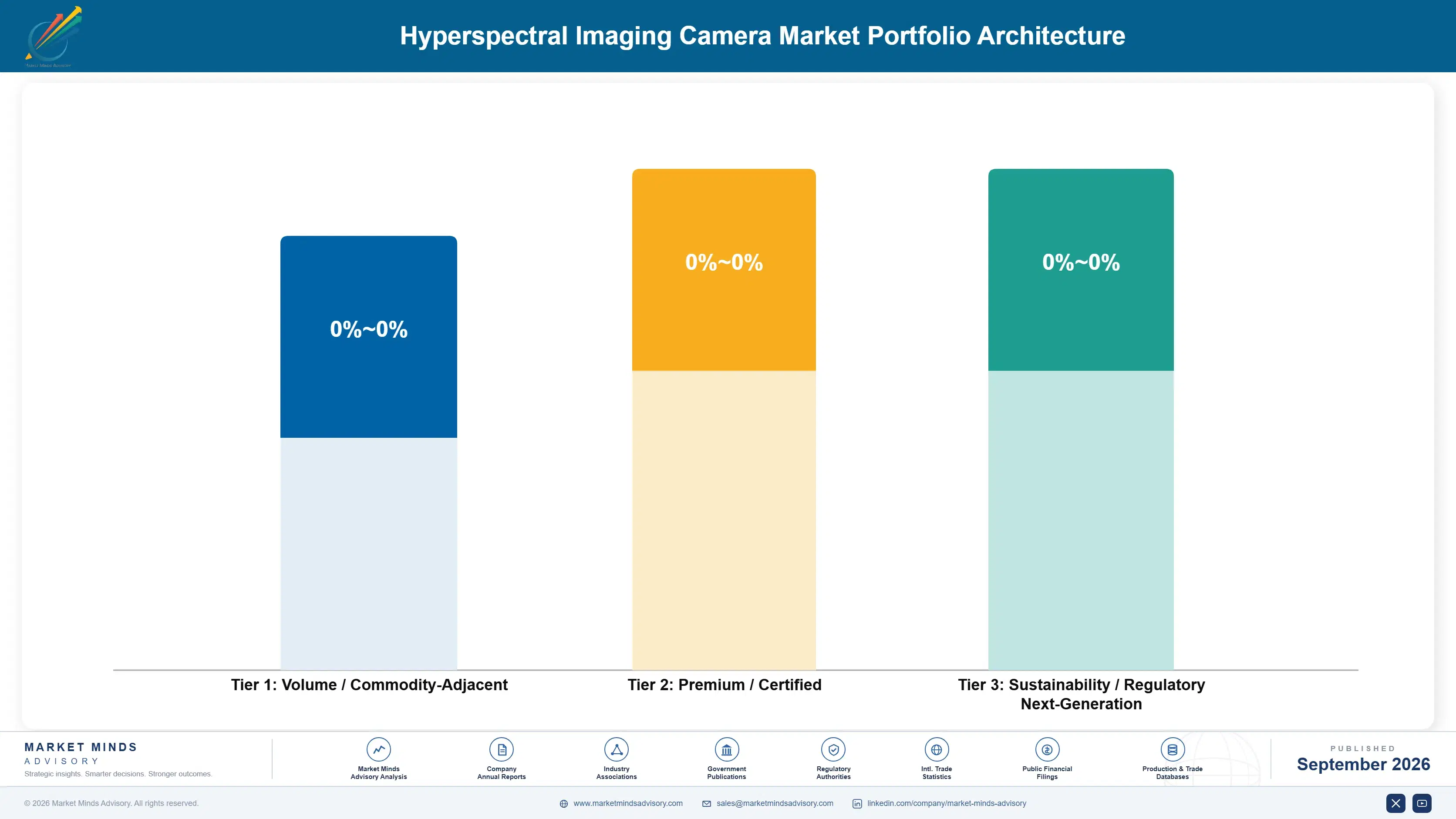
Hyperspectral camera manufacturers operate across three margin tiers, from commodity industrial cameras sold at volume with thin margin to premium application-specific food and defense systems commanding substantially better economics. Tier separation reflects application software depth and domain expertise rather than raw sensor cost differences alone, since a basic industrial camera and a fully validated food safety detection system can share similar underlying semiconductor sensor and optical component technology at the hardware level.
Volume tension is sharpest in commodity industrial cameras, where price-sensitive customers push toward standardized hardware pricing while manufacturers would prefer premium application software add-ons. Food processors and defense customers behave oppositely, valuing detection accuracy and domain-specific software depth over unit price, which is why the highest-value revenue pools concentrate in application-specific systems rather than raw hardware sales.

Precision agriculture cameras sit between these extremes: growing quickly but priced closer to industrial tiers than premium food safety systems, since agriculture-focused buyers remain more cost-conscious than food processors evaluating detection accuracy claims directly. Manufacturers positioned across all three tiers simultaneously capture the broadest addressable revenue base, though few manage the operational complexity of serving such differently motivated customer segments well.

Volume / Commodity-Adjacent

Standardized industrial cameras sold at volume with minimal application software or domain-specific detection algorithms included in the base package offered to every single customer regardless of use case or industry.
Gross Margin: 20 to 28%

Premium / Certified

Application-specific food safety and defense systems requiring extensive detection algorithm development and validation justifying substantially higher enterprise pricing than commodity hardware alone could ever command in the broader industry market.
Gross Margin: 38 to 48%

Sustainability / Regulatory / Next-Generation

Precision agriculture and industrial inspection cameras serving evolving commercial demand at margins between commodity hardware and premium application-specific systems, growing steadily as adoption expands across new industries, sectors, and geographies.
Gross Margin: 30 to 40%
hyperspectral-imaging-camera-market-portfolio-architecture-1789980651204

High-value Sub-segments and Strategic Watch-out

Agricultural and Food Sorting Cameras

Agricultural and food sorting cameras combine high growth with premium detection-driven pricing, representing the clearest high-value high-growth opportunity as food safety regulation and precision agriculture adoption accelerate rapidly worldwide each year. This segment increasingly represents the clearest capital allocation priority for most manufacturers today and tomorrow.
Gross Margin: high

Industrial Inspection Cameras

Industrial inspection cameras combine strong margins with steady growth tied to expanding manufacturing quality control requirements, representing a high-value moderate-growth pool anchored by demand distinct from traditional defense and research applications entirely. Vendors increasingly treat this as a genuine strategic diversification and growth priority each cycle.
Gross Margin: high

Commodity Industrial Cameras

Standardized industrial cameras form the volume core of the market, generating steady revenue at compressed margins as customers negotiate aggressively on price given tight technology and procurement budgets overall each year. Consolidation among smaller commodity-focused suppliers in this tier continues steadily and quite consistently each year.
Gross Margin: moderate

Chinese Manufacturer Price Competition

Chinese manufacturers scaling domestic hyperspectral camera production with state backing represent the clearest strategic watch-out, since expanding local capacity threatens to compress Western pricing power in cost-sensitive commercial deployments considerably over time. Incumbent manufacturers are responding through automation investment and cost reduction programs nationwide today.
Gross Margin: uncertain

Recurring Detection Software Economics

Hyperspectral camera platforms generate durable recurring revenue through detection algorithm licensing and calibration services, since customers who build production line quality processes around spectral detection face real switching costs when considering an alternate vendor mid-relationship. Vendors that demonstrate measurable defect detection improvement within the first contract term convert this into multi-year relationships worth considerably more than the initial hardware sale alone across the customer lifetime.
Adoption stickiness varies sharply by end-use vertical. Large food processors show the deepest engagement, integrating hyperspectral inspection into broader quality management and regulatory compliance infrastructure that makes switching costly and operationally disruptive. Defense customers show comparable stickiness once systems are qualified for specific programs. Smaller agricultural operations and mid-sized industrial customers, being more price-sensitive and less integration-dependent, show markedly shallower vendor loyalty given shorter equipment lifecycles.

Buyer profiles are shifting generationally as data-focused quality assurance engineers, rather than traditional visual inspection staff, increasingly drive vendor selection decisions, prioritizing spectral detection accuracy and validated software performance over the simple hardware specifications that dominated camera purchasing a decade ago. This generational shift favors vendors offering genuine application-specific detection expertise over vendors whose value proposition rests primarily on raw sensor resolution and hardware specifications alone.
hyperspectral-imaging-camera-market-end-use-penetration-index-1789980651719

Where MMA Sees the Opportunity

These are among the four positions where our research anticipates prominent divergence between winners and laggards over the coming forecast period. Each is grounded in the demand model, the regulatory perimeter, and the announced capacity pipeline.
01 / FOOD SAFETY SOFTWARE INVESTMENT

Build food-specific detection algorithms ahead of hardware-only rivals

Agricultural and food sorting cameras are growing at 18.0 percent versus the market's 13.5 percent overall rate, and food processors increasingly refuse to purchase camera hardware without accompanying detection software built for their specific contamination types. Vendors still built primarily around generic hardware sales risk losing contracts to competitors offering genuine turnkey detection capability that food safety managers can validate against actual production line conditions. Building this capability now, before competitors close the gap, protects long-term program relevance and pricing power.
02 / MANAGED ANALYTICS EXPANSION

Offer managed analytics to overcome the skilled operator shortage

Many food processing and agricultural operations lack the specialized technical staff needed to interpret hyperspectral data effectively, creating a genuine deployment bottleneck that pure hardware vendors cannot solve through better cameras or sensors alone. Vendors offering managed analytics services capture 18 to 25 percent higher contract value than hardware-only sales, directly addressing this operator shortage while building recurring revenue relationships that persist well beyond the initial equipment purchase and installation. This capability gap will only widen as detection algorithms grow more sophisticated and specialized.
03 / CHINESE MARKET ENTRY TIMING

Expand into China ahead of full-scale domestic competition

China is growing at 17.0 percent annually as agricultural modernization and food safety regulation accelerate demand, yet most established vendors remain concentrated in North America and Europe with minimal regional manufacturing or direct sales presence. Vendors that establish Chinese partnerships and local support capability now secure preferred positioning before domestic Chinese manufacturers fully scale competing production and capture this rapidly growing addressable market entirely on their own terms. This window will not stay open indefinitely as domestic capacity continues expanding steadily each quarter.
04 / CHINESE COMPETITIVE RESPONSE

Prepare for Chinese price competition in commodity hardware sales

Chinese manufacturers are scaling domestic hyperspectral camera production with substantial state backing, and this pricing pressure will land hardest on standardized commodity industrial cameras where technical differentiation between competing suppliers is thinnest today across most markets. Western vendors should shift commodity-tier hardware production toward automation to defend margin, while concentrating genuine differentiation investment in application-specific software and managed analytics where Chinese suppliers currently lack meaningful domain expertise or track record. Waiting for pricing pressure to fully materialize before acting will already be too late.

Engagement Snapshot From the Field

A live engagement with an industry participant carrying material or product regulatory and market exposure ahead of a defining policy shift, showing how our research translates into a defensible multi-year portfolio strategy.
MARKET MINDS ADVISORY · CLIENT ENGAGEMENT SUMMARY
Hyperspectral Imaging Camera Producer Strategic Portfolio Review and Transition Roadmap 2026·Investment Scenario on Hyperspectral Imaging Camera Exposure Evaluation 2025-26
CLIENT PROFILE
The client is a mid-sized frozen vegetable processing company operating multiple production facilities, with annual revenue in the range of 250 to 320 million dollars (client-reported, unverified by MMA). The company had relied on conventional machine vision inspection and faced growing concern about contamination detection gaps following two minor recall incidents in the prior three years.
STRATEGIC CHALLENGE
Leadership needed an independent assessment of hyperspectral imaging vendors capable of detecting the specific contamination types responsible for recent recall incidents, given internal uncertainty about whether the technology could integrate with existing production line speeds without slowing overall throughput significantly or requiring costly production line redesign and full reconfiguration work.
MMA APPROACH
MMA conducted a comparative assessment of three hyperspectral camera vendors, evaluating detection accuracy for the client's specific contamination profile, production line integration complexity, and realistic implementation timelines against the client's existing plant operations and staffing. The engagement included interviews with the client's quality assurance team and a review of historical contamination incident data.
KEY FINDINGS
  1. Only one of three evaluated vendors offered detection algorithms validated against the client's specific contamination types from prior recall incidents (client-reported, unverified by MMA).
  2. Hyperspectral inspection was projected to operate at existing production line speeds without meaningful throughput reduction, addressing the client's primary integration concern directly.
  3. Full implementation was projected to take five months, considerably faster than the client's internal estimate of eight to nine months originally planned for the project.
  4. The selected vendor's managed analytics service would eliminate the need to hire dedicated internal spectral data interpretation staff entirely at the facility.
CLIENT PROFILE
The client is a mid-sized frozen vegetable processing company operating multiple production facilities, with annual revenue in the range of 250 to 320 million dollars (client-reported, unverified by MMA). The company had relied on conventional machine vision inspection and faced growing concern about contamination detection gaps following two minor recall incidents in the prior three years.
STRATEGIC CHALLENGE
Leadership needed an independent assessment of hyperspectral imaging vendors capable of detecting the specific contamination types responsible for recent recall incidents, given internal uncertainty about whether the technology could integrate with existing production line speeds without slowing overall throughput significantly or requiring costly production line redesign and full reconfiguration work.
MMA APPROACH
MMA conducted a comparative assessment of three hyperspectral camera vendors, evaluating detection accuracy for the client's specific contamination profile, production line integration complexity, and realistic implementation timelines against the client's existing plant operations and staffing. The engagement included interviews with the client's quality assurance team and a review of historical contamination incident data.
KEY FINDINGS
  1. Only one of three evaluated vendors offered detection algorithms validated against the client's specific contamination types from prior recall incidents (client-reported, unverified by MMA).
  2. Hyperspectral inspection was projected to operate at existing production line speeds without meaningful throughput reduction, addressing the client's primary integration concern directly.
  3. Full implementation was projected to take five months, considerably faster than the client's internal estimate of eight to nine months originally planned for the project.
  4. The selected vendor's managed analytics service would eliminate the need to hire dedicated internal spectral data interpretation staff entirely at the facility.
RECOMMENDED STRATEGY
Phase 1: Phase one: select the vendor with validated contamination-specific detection algorithms and begin equipment installation within the first three months of approval. Phase 2: Phase two: run parallel inspection using both conventional and hyperspectral systems to validate detection accuracy improvements directly on the production floor. Phase 3: Phase three: transition fully to hyperspectral inspection once validation confirms accuracy improvements across the entire production line and facility footprint.
OUTCOME
The client selected a vendor and began installation planning within one month of the engagement's conclusion (client-reported, unverified by MMA). Detection accuracy validation results from the pilot phase were not yet available for independent verification at the time this particular report was originally scheduled for publication.

Frequently Asked Questions

Foundational context covering the market sizes, CAGR, scope, country, region and competition that inform every finding below. This section is provided to cover basics and most often pre-purchase conversations, answered from the MMA Primary Research Dataset.

What is the current size of the Hyperspectral Imaging Camera Market?

The global hyperspectral imaging camera market is valued at 0.7 billion dollars in 2025, the report's base year. This reflects spending on camera hardware and application software combined across agriculture, food, defense, and industrial applications.

How large will the Hyperspectral Imaging Camera Market be by 2036?

MMA projects the market will reach 2.8 billion dollars by 2036, a 3.54 times expansion from 2026's forecast value. Growth is driven mainly by falling sensor costs and food safety regulation requirements.

What is the CAGR for the Hyperspectral Imaging Camera Market 2026 to 2036?

The market is forecast to grow at a 13.5 percent compound annual rate between 2026 and 2036. Bull and bear scenarios range from 14.7 percent to 12.3 percent depending on commercial adoption rates.

Which segment is growing fastest?

Agricultural and food sorting hyperspectral cameras lead at an 18.0 percent CAGR, roughly 1.33 times the overall market rate. Demand is driven by food safety regulation and precision agriculture adoption.

Who are the major companies in the Hyperspectral Imaging Camera Market?

Headwall Photonics, Specim, Resonon, Corning, and Norsk Elektro Optikk lead the market on combined manufacturing scale and application breadth. Together they hold a combined cr5 of 44 percent.

Which country is growing fastest?

China leads at a 17.0 percent forecast CAGR, driven by massive agricultural modernization combined with tightening domestic food safety regulation. This outpaces the broader East Asia regional average considerably.

Report Segmentation Architecture

The full report scope spans multiple orthogonal segmentation dimensions, with cross-tabulated demand data provided for each dimension pair. Coverage extends further to regional breakdowns, trend trajectories, and the competitive detail needed to support segment-level decision-making.

By Application

  • Agricultural and Food Sorting Cameras
  • Industrial Inspection Cameras
  • Defense and Remote Sensing Systems
  • Medical and Life Sciences Imaging Systems
  • Laboratory Research Instruments
  • Mining and Geological Survey Cameras

By End-Use Industry

  • Food and Beverage Processing
  • Agriculture and Precision Farming
  • Defense and Government
  • Manufacturing and Industrial
  • Mining and Natural Resources

By Commercial Dimension

  • Direct End-User Purchase
  • System Integrator Channel
  • Managed Analytics Service Channel
  • Leasing and Subscription Channel

By Region

  • North America
  • Western Europe
  • East Asia
  • South Asia and Pacific
  • Latin America
  • Middle East and Africa
  • Eastern Europe

Scope, Methodology, and Coverage

Every figure in this report is reproducible from documented input assumptions. The scope below maps the historical period, the forecast horizon, the segmentation dimensions, and the countries covered, alongside the underlying primary and qualitative methodology.
Historical Period
2020 to 2025
Forecast Period
2026 to 2036
Base Year
2025 (USD billions; MMA Primary Research Dataset, September 2026)
Market Definition
This market covers hyperspectral imaging camera hardware that captures spectral data across dozens or hundreds of narrow wavelength bands for material and chemical composition analysis, used in agriculture, food sorting, defense, and industrial inspection applications. It excludes standard machine vision cameras and multispectral cameras that capture only a limited number of discrete spectral bands.
Quantitative Units
USD billions (current prices); unit shipment volumes where applicable
Segmentation Dimensions
By Application; By End-Use Industry; By Commercial Dimension; By Region
Regions Covered
North America, Western Europe, East Asia, South Asia and Pacific, Latin America, Middle East and Africa, Eastern Europe
Countries Covered
USA, China, Germany, France, UK, Japan, South Korea, India, Australia, Canada, Brazil, Mexico, Indonesia, Vietnam, Thailand, Malaysia, UAE, Saudi Arabia, South Africa, Nigeria, Turkey, Poland, Netherlands, Italy, Spain, Sweden, Switzerland, Argentina, Colombia, Singapore, and additional markets relevant to this sector
Key Companies Profiled
Headwall Photonics, Specim, Resonon, Corning, Norsk Elektro Optikk, Surface Optics Corporation, Cubert, Photon etc, IMEC, Applied Spectral Imaging, BaySpec, Xenics, Telops, Gilden Photonics, HinaLea Imaging, Senop, IMSPEX, Middleton Spectral Vision, Ecotone AS, Diaspective Vision
Quantitative Methodology
Primary survey, n=3,800 respondents, Q4 2025, six countries; demand-side model with trade association cross-validation
Qualitative Methodology
47 expert interviews, Q4 2025; applied to validate demand model assumptions, identify emerging dynamics, and assess competitive positioning
Report Format
PDF and XLSX data workbook (Word format preview document)
Publisher
Market Minds Advisory
Report Code
MMA-2026-TEC-176
Published
September 2026
Contact
sales@marketmindsadvisory.com | www.marketmindsadvisory.com

Purchase the full Hyperspectral Imaging Camera Market Report (2026 to 2036).

The full report delivers a comprehensive assessment of the global hyperspectral imaging camera market across application, end-use industry, and commercial channel dimensions through 2036. It includes detailed competitive profiles of twenty companies, seven regional demand analyses, and input cost risk modeling tied to specialty sensor and optics supply chains. Analysts receive segment-level CAGR forecasts, portfolio margin benchmarking, and a strategic verdict section identifying where near-term investment should concentrate across the industry. The report also includes an anonymized client case study illustrating real-world quality inspection upgrade decisions.
Seven-region demand and CAGR growth forecasts
Twenty-company competitive profiling and moat analysis
Six-dimension segmentation with detailed growth rates
Specialty sensor input cost risk modeling
Portfolio margin tier benchmarking analysis framework
Anonymized client quality inspection case study

Built For The People Who Decide

From boardroom strategy to bench-side execution, this report is read cover-to-cover by leaders shaping the next decade of their industry, turning demand scenarios, market dynamics and valuation benchmarks into decisions.
CXOs/ Presidents/ VPs/ Managers
M&A and Corporate Development
Strategy Teams and R&D Heads
Procurement and Product Directors
Regulatory and Compliance Leaders
Investor Relations and Equity Analysts