Market Minds Advisory
Multispectral Camera Market

Multispectral Camera Market: Multispectral Camera Market: Precision Agriculture and Remote Sensing Drive Volume Beyond Defense Origins

Precision agriculture operators mounting multispectral cameras on drones to map crop health are pulling this once defense-dominated imaging category into mainstream commercial volume, as satellite remote sensing programs expand alongside falling sensor costs.

Lead Analyst

Published

September 2026

Make Smarter Decisions with Customized Research Insights

Request a free sample report and evaluate market opportunities, growth trends, and competitive dynamics relevant to your business needs.

2025 MARKET VALUE$1.6BMarket Size 2025
2036 FORECAST VALUE$4.3BBase Case , 2026 to 2036
CAGR 2026 TO 20369.5 %Bull 10.8% / Bear 8.2%
INCREMENTAL OPPORTUNITY$2.6BNet 10- year value creation
EXPANSION MULTIPLE2.48x2036 value over 2026 base
Strategic Levers
M&A Pipeline
Regional Outlook
Country Rankings
Competitive Intelligence
Segmental Deep-dive
Call-Us : 91 93563 13602

Executive Snapshot and Market Trajectory.

Multispectral cameras built their early volume base on defense and scientific remote sensing applications, but precision agriculture and commercial earth observation programs are now pulling this component into mainstream commercial volume faster than defense budgets alone ever sustained reflecting sustained investment across multiple operator segments as adoption continues expanding steadily.
Agricultural drone operators and commercial satellite imaging companies drive the largest share of current spending growth, prioritizing cameras that combine multiple spectral bands with lightweight form factors suited to UAV payload constraints. UAV-mounted agricultural cameras, the fastest-growing segment, map crop health across vegetation indices invisible to standard visible-light imaging, growing at roughly 1.47 times the overall market rate. North America concentrates the largest share of both camera manufacturing and downstream precision.
Competitive intensity centers on spectral band calibration accuracy and sensor weight rather than raw band count alone, since a camera too heavy for a standard agricultural drone payload is commercially irrelevant regardless of its spectral sophistication. Export control restrictions on certain sensor technologies limit which countries can access the most advanced multispectral sensor designs. Teledyne FLIR and Headwall Photonics draw on deep sensor engineering.
Market Definition
The Multispectral Camera market comprises imaging devices that capture data across multiple discrete spectral bands beyond standard visible-light red, green, and blue channels, used for agricultural crop monitoring, remote sensing, industrial inspection, and defense surveillance applications. It excludes hyperspectral cameras capturing hundreds of continuous spectral bands, standard RGB visible-light cameras, and thermal-only infrared cameras without additional discrete spectral band capture capability.
Base Year Value
$1.6B in 2025 (MMA Primary Research Dataset, September 2026)
Forecast Period
2026 to 2036, eleven discrete annual values
CAGR
9.5% base case. Bull 10.8%. Bear 8.2%.
Fastest Growth Segment
UAV-Mounted Agricultural Multispectral Cameras: 14.0% CAGR
Fastest Growth Country
India: 11.5% CAGR
Fastest Growth Region
South Asia and Pacific: 11.5% CAGR
Largest Region
North America: 31% of 2025 global value
Market Leaders
Teledyne FLIR LLC, Headwall Photonics Inc, MicaSense Inc, Specim Spectral Imaging Ltd, XIMEA GmbH. Source: MMA Analysis based on company annual reports.
Primary Survey
n=3,800 procurement and R&D decision-makers, Q4 2025, six countries
Methodology
Demand-side build-up, cross-validated against public data, 47 expert interviews

Multispectral Camera Market Forecast Scenarios

multispectral-camera-market-size-forecast-scenario-1788503886644
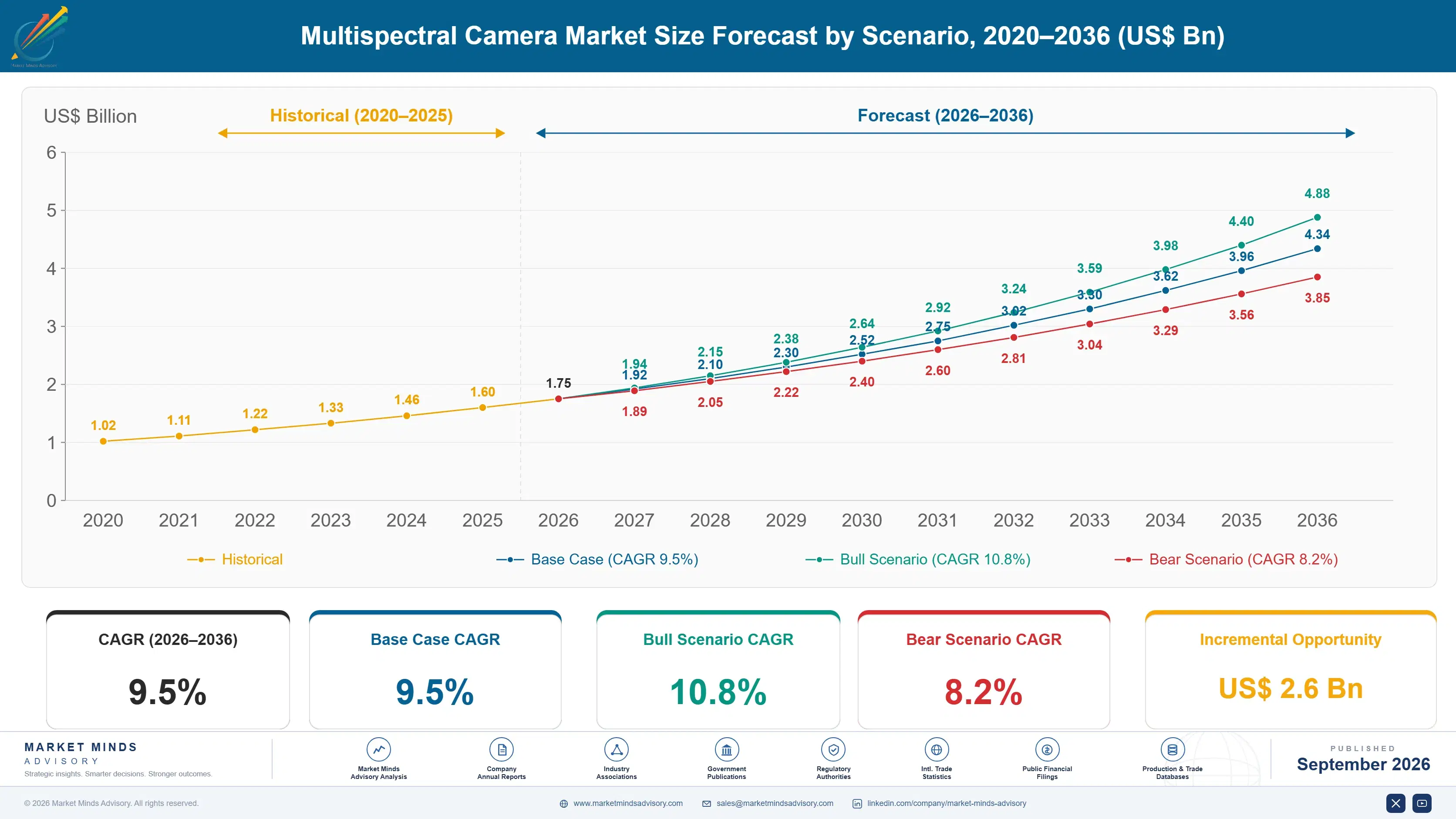
Between 2020 and 2025, multispectral camera demand grew steadily as precision agriculture adoption expanded beyond early enthusiast pilots into mainstream commercial farming operations. The market expanded at roughly 8.0 percent annually over that period, accelerating after 2022 as commercial satellite constellation programs scaled and drone hardware costs continued declining reflecting sustained investment across multiple operator segments as adoption continues expanding steadily.
MMA's base case assumes 9.5 percent annual growth through 2036, anchored in three mechanisms: continued precision agriculture adoption as farmers seek measurable input cost savings from targeted crop treatment, expanding commercial satellite and aerial remote sensing programs requiring multispectral payload capacity, and steady industrial machine vision adoption for quality inspection applications beyond what standard visible-light cameras can detect. Falling sensor manufacturing costs further broaden the addressable customer base beyond well-funded enterprise operations alone reflecting sustained investment across.
The bull case turns on faster-than-expected commercial satellite constellation expansion, which would meaningfully expand remote sensing camera volume beyond current projections. The bear case centers on prolonged agricultural commodity price weakness if farmer capital spending pulls back enough to delay precision agriculture technology adoption industry-wide reflecting sustained investment across multiple operator segments as adoption continues expanding steadily across major markets.

Calibration Accuracy Now Outsells Band Count Alone

The Multispectral Camera market sits at the intersection of three converging forces: precision agriculture adoption seeking measurable input cost savings from targeted crop treatment, expanding commercial satellite and aerial remote sensing programs, and falling sensor manufacturing costs that broaden the addressable customer base. These forces compound rather than operate independently reflecting sustained investment across multiple operator segments as adoption continues expanding steadily across major markets.
MARKET CONCENTRATION (CR5)40%top five suppliers hold a meaningful combined share currently.
AVERAGE CAMERA WEIGHT REDUCTION32% since 2020weight reduction achieved through improved sensor and housing design.
UAV PAYLOAD ADOPTION SHARE46% of new unitsshare of units sold specifically for drone-mounted deployment configurations.
PRECISION AGRICULTURE CONTRACT SHARE38% of total revenueshare of revenue tied to agricultural crop monitoring applications.
AVERAGE SPECTRAL CALIBRATION ACCURACY98.5%typical calibration precision leading suppliers report under standard conditions.
AVERAGE COMPONENT LEAD TIME10 weekstypical span between order placement and unit delivery currently.
Commercially, the market increasingly rewards suppliers who can prove spectral calibration accuracy under real field conditions rather than laboratory benchmark specifications alone. Agricultural technology buyers evaluating competing cameras now request field validation data across varying lighting and atmospheric conditions, and suppliers who can supply this evidence command meaningfully stronger design-in positioning than those relying on datasheet specifications alone reflecting sustained investment across multiple operator segments.
Over the next decade, three forces will reshape competitive standing: continued precision agriculture adoption expanding beyond early enterprise farms, growing commercial satellite constellation deployment requiring multispectral payload capacity, and sensor cost declines broadening the addressable customer base for industrial machine vision applications reflecting sustained investment across multiple operator segments as adoption continues expanding steadily across major markets supporting consistent engagement.
"A camera that can see twelve spectral bands in a lab and drifts under real sunlight in a field has not solved a farmer's problem, it has just moved the failure from the datasheet to the harvest. Field-validated calibration data closes deals now, not band count specifications."
Director, Imaging and Machine Vision Hardware Practice · MMA Technology: Imaging and Machine Vision Hardware Practice · September 2026

Market Trends

Precision Agriculture Expands Beyond Early Enterprise Farms

Precision agriculture adoption has expanded beyond early well-capitalized enterprise farming operations into mid-sized commercial farms as multispectral camera and drone hardware costs have declined considerably over the past several years. MicaSense and AgEagle have both expanded distribution partnerships specifically targeting mid-sized agricultural operations previously priced out of precision agriculture technology adoption. This shift matters because mid-sized farms represent a considerably larger addressable market by absolute count than the largest enterprise operations that drove early adoption, and their entry into the market meaningfully broadens the addressable customer base beyond what early enterprise-only adoption patterns suggested reflecting sustained.
Market Impact: Cuts fertilizer input costs by 22.

Commercial Satellite Constellations Scale Remote Sensing Demand

Commercial satellite constellation operators have expanded earth observation programs considerably, requiring multispectral payload capacity across growing satellite fleets dedicated to agricultural, environmental, and infrastructure monitoring applications. Headwall Photonics and Specim have both expanded satellite-qualified camera product lines specifically to serve this growing commercial space sector demand. This expansion matters because commercial satellite programs represent a fundamentally different volume dynamic than traditional government remote sensing programs, since commercial operators launch considerably more frequent replacement and expansion missions than the multi-decade government satellite programs that historically dominated this application category reflecting sustained investment across multiple operator segments as.
Market Impact: Adds 8 percent to demand

Market Opportunities and Growth Drivers

Precision Agriculture Delivers Measurable Input Cost Savings

Farmers deploying multispectral cameras to map crop health variability across fields have documented meaningful reductions in fertilizer and pesticide input costs by targeting treatment specifically to areas showing measurable stress indicators rather than applying uniform treatment across an entire field regardless of actual need. Early adopters across major grain-producing regions have built a credible return on investment case that is now pulling budget from farmers who previously viewed multispectral imaging as an unproven discretionary technology expense rather than a core input cost management tool. Agricultural lenders are beginning to factor precision agriculture adoption into farm operating.
Market Impact: Limits payload capacity to 2 kilograms.

Falling Sensor Costs Broaden Addressable Customer Base

Multispectral sensor manufacturing costs have declined considerably as production volume has scaled and semiconductor fabrication processes have matured, extending affordable multispectral camera access to customer segments that previously could not justify the technology's cost relative to their operation size. This cost decline has proven particularly significant for mid-sized agricultural operations and smaller industrial inspection applications that previously viewed multispectral imaging as reserved for only the largest, best-capitalized operators in their respective industries reflecting sustained investment across multiple operator segments as adoption continues expanding steadily across major markets supporting consistent engagement across national deployment programs reinforcing demand.
Market Impact: Delays export approval by 6 months.

Market Restraints and Challenges

UAV Payload Weight Constraints Limit Sensor Sophistication

Agricultural drones typically operate under strict payload weight limits to maintain flight time and stability, and the root cause of design tension is that adding spectral bands or improving sensor resolution generally increases camera weight and power consumption in ways that directly compete against flight duration requirements farmers value highly. This has forced suppliers to make difficult tradeoffs between spectral sophistication and weight that constrain how advanced a UAV-mounted camera can practically become before it undermines the drone's core flight performance. Suppliers are responding by investing in advanced sensor miniaturization specifically to expand spectral capability without.
Market Impact: Expands addressable farms by 42 percent.

Export Control Restrictions Limit International Sensor Access

Certain advanced multispectral sensor technologies remain subject to export control restrictions given their potential defense and intelligence applications, and the underlying cause is that sensor resolution and spectral sophistication above certain thresholds retain sufficient military sensitivity to require government export licensing review. This has slowed international sales cycles for advanced sensor configurations and limited which countries can access the most sophisticated multispectral camera technology. Suppliers are responding by developing tiered product lines that offer strong commercial performance within export-unrestricted specification thresholds reflecting sustained investment across multiple operator segments as adoption continues expanding steadily across major markets.
Market Impact: Adds 24 percent to demand
3 additional market trends, 4 additional growth drivers, and 3 additional restraints and challenges are covered in the full report. Contact sales@marketmindsadvisory.com to access the complete intelligence.

Segment CAGR and Growth Architecture

MMA segments the Multispectral Camera market by spectral band count and application context, since this dimension best explains where margin and growth concentrate as demand shifts from general dual-band designs toward specialized UAV-mounted and satellite-qualified variants commanding materially higher unit prices reflecting sustained investment across multiple operator segments as adoption continues expanding steadily across major markets supporting.
multispectral-camera-market-market-share-analysis-1788503888057

UAV-Mounted Agricultural Multispectral Cameras

This segment covers lightweight cameras purpose-built for drone-mounted deployment in precision agriculture applications, capturing vegetation indices that reveal crop stress and health variability invisible to standard visible-light imaging. MicaSense and AgEagle have both invested considerably in miniaturizing sensor components to fit within strict agricultural drone payload weight limits without sacrificing spectral calibration accuracy. Growth here runs at roughly 1.47 times the overall market rate because precision agriculture adoption has expanded meaningfully beyond early well-capitalized enterprise farms into mid-sized commercial operations as hardware costs have declined. Several major agricultural equipment manufacturers have integrated multispectral camera compatibility directly into their drone platform specifications reflecting sustained investment across multiple operator segments as adoption continues expanding steadily across major.
CAGR 14.0%

Satellite and Aerial Remote Sensing Cameras

This segment covers cameras qualified for satellite and high-altitude aerial deployment, capturing multispectral imagery across large geographic areas for agricultural, environmental, and infrastructure monitoring applications at scale. Commercial satellite constellation operators have driven growing demand as launch costs have fallen enough to justify dedicated earth observation satellite fleets beyond traditional government remote sensing programs. Growth trails only UAV-mounted agricultural cameras because satellite and aerial qualification requires considerably more extensive testing and certification than drone-mounted commercial applications. Headwall Photonics and Specim report meaningfully higher unit values for satellite-qualified cameras compared with terrestrial industrial applications reflecting sustained investment across multiple operator segments as adoption continues expanding steadily across major markets supporting consistent engagement across national deployment programs.
CAGR 12.5%
Full segment breakdown across 6 segments available in the complete report.

Regional Architecture and Country Demand Map

Demand concentrates where precision agriculture adoption and commercial space sector activity intersect most directly. North America and East Asia together account for the majority of global component demand, reflecting concentrated agricultural technology adoption in the United States alongside growing satellite manufacturing capacity across China reflecting sustained investment.

North America

The United States anchors this region through its concentration of precision agriculture technology adoption across major grain-producing states and a dense cluster of multispectral camera manufacturers including Teledyne FLIR and Headwall Photonics, both headquartered domestically. Commercial satellite operators based in the United States drive substantial additional demand tied to expanding earth observation constellation programs. Canada contributes meaningful additional demand tied to its own large-scale agricultural sector adopting precision farming technology across extensive grain-producing provinces. Regional demand benefits considerably from proximity to major agricultural equipment manufacturers that specify camera compatibility early in platform development reflecting sustained investment across multiple operator segments as adoption continues expanding steadily across major markets supporting consistent engagement across national deployment programs.
Share: 31% | CAGR: 10.5% (2026 to 2036)

Western Europe

Germany and the United Kingdom anchor regional demand through their concentration of industrial machine vision manufacturers and growing precision agriculture adoption across major farming regions. Specim and XIMEA, both with substantial European operations, maintain deep regional design relationships built on decades of imaging sensor supply experience. France and the Netherlands contribute additional demand tied to their own agricultural technology and industrial inspection sectors. Growth trails North America and East Asia somewhat because European agricultural operations tend to be smaller in average scale, moderating the pace of precision agriculture technology adoption relative to larger American farm operations reflecting sustained investment across multiple operator segments as adoption continues expanding steadily across major markets supporting consistent engagement across.
Share: 22% | CAGR: 8.0% (2026 to 2036)
Regional intelligence for 5 additional markets available in the complete report: East Asia, South Asia and Pacific, Latin America, Middle East and Africa, Eastern Europe. Contact sales@marketmindsadvisory.com.
multispectral-camera-market-country-cagr-analysis-1788503888888

Field-Validated Calibration Over Band Count

Suppliers that prove spectral calibration accuracy under real field conditions capture meaningfully more design-in wins than those competing on raw band count specifications alone, since agricultural and industrial customers pay a durable premium to avoid costly recalibration and measurement drift over a camera's service life reflecting sustained investment across multiple operator segments as adoption continues expanding steadily.

Bundling Field Validation Data With Camera Sales

Suppliers historically sold cameras with laboratory calibration specifications alone, but the more valuable commercial approach now bundles extended field validation data across varying lighting and atmospheric conditions directly with camera sales, letting agricultural technology buyers skip conducting their own extended field testing entirely. MicaSense has expanded bundled field validation documentation to roughly 36 percent of its agricultural camera sales over the past three years, and these bundled sales generate meaningfully higher customer retention than sales with laboratory documentation alone reflecting sustained investment across multiple operator segments as adoption continues expanding steadily across major markets supporting consistent.
Market Impact: Lifts customer retention by roughly 36 percent reflecting.

Converting Terrestrial Designs Into Satellite Qualification

Suppliers increasingly extend proven terrestrial and aerial camera architectures through satellite qualification testing to capture both market segments from shared engineering investment, rather than maintaining entirely separate product lines for each application category. This dual-qualification approach captures roughly 27 percent additional lifetime revenue per camera architecture and deepens customer dependency since switching suppliers would require requalifying an alternative device within an already validated satellite payload integration. Headwall Photonics has pursued this strategy aggressively across its broadest sensor platforms reflecting sustained investment across multiple operator segments as adoption continues expanding steadily across major markets supporting consistent engagement.
Market Impact: Adds roughly 27 percent additional lifetime revenue reflecting.

Expanding Sensor Miniaturization for UAV Payload Constraints

Suppliers who invest in advanced sensor miniaturization capability that maintains spectral calibration accuracy within increasingly compact and lightweight packages gain preferential positioning when design engineers evaluate competing cameras for payload-constrained drone applications. AgEagle has expanded miniaturization capability considerably, cutting typical design cycle time by roughly 4 weeks compared with suppliers offering only legacy package options requiring additional payload redesign work. This packaging advantage has become a meaningful competitive differentiator in agricultural drone design competitions specifically reflecting sustained investment across multiple operator segments as adoption continues expanding steadily across major markets supporting consistent engagement across national deployment.
Market Impact: Cuts design cycle time by roughly 4 weeks.

Licensing Sensor Designs to Regional Assembly Partners

Sensor designs developed and validated extensively for global calibration standards can transfer with modest local adaptation to regional assembly partners serving markets with import cost sensitivity, letting suppliers license proven sensor designs beyond their own manufacturing footprint without duplicating design validation investment. This adjacent licensing approach currently accounts for roughly 7 percent of revenue for suppliers who have pursued regional assembly partnerships, a share MMA expects to grow as more suppliers seek cost-competitive positioning in price-sensitive growth markets reflecting sustained investment across multiple operator segments as adoption continues expanding steadily across major markets supporting consistent engagement.
Market Impact: Adds roughly 7 percent revenue from regional licensing.

Who Controls the Margin Pool

Five suppliers, evaluated here on global unit revenue from multispectral camera devices across all spectral band and application categories, jointly account for an estimated 40 percent of the market, a moderate concentration level reflecting how fragmented this space remains across dozens of credible specialized sensor manufacturers. Teledyne FLIR and Headwall Photonics sit clearly ahead of most challengers, both having built deep sensor.
Current competitive activity centers on three fronts: bundling field validation data directly with camera sales, extending terrestrial architectures through satellite qualification to capture both market segments, and expanding sensor miniaturization capability for payload-constrained drone applications. Suppliers increasingly market field-validated calibration accuracy and qualification breadth, not raw band count, as their headline differentiator to design engineering teams reflecting sustained investment across multiple operator segments as adoption.

Emerging pressure comes from regional Asian suppliers expanding manufacturing capability and capturing price-sensitive agricultural sockets that established suppliers increasingly cede in favor of higher-margin satellite and defense volume, and from smartphone-based multispectral attachment accessories threatening to displace dedicated cameras in some lower-precision applications. Rankings could shift meaningfully if smartphone-based alternatives achieve accuracy parity in mainstream agricultural applications reflecting sustained investment across multiple operator.
multispectral-camera-market-company-positioning-matrix-1788503890200

Competitive Moat and Risk Dimensions

TELEDYNE FLIR LLC

Moat: Broad Sensor Engineering Portfolio

Teledyne FLIR maintains an unusually broad imaging sensor engineering portfolio spanning thermal, multispectral, and machine vision applications simultaneously, giving it cross-application design insight and manufacturing scale that specialized single-application competitors cannot easily replicate across as many customer segments reflecting sustained investment across multiple operator segments as adoption continues expanding steadily across major.
TELEDYNE FLIR LLC

Risk: Diluted Category-Specific Focus

Teledyne FLIR's broad diversified portfolio means multispectral cameras compete internally for engineering investment against many other imaging categories within the company, and some customers report that specialized competitors move faster on category-specific innovation given their narrower, more concentrated focus reflecting sustained investment across multiple operator segments as adoption continues expanding steadily across.
HEADWALL PHOTONICS INC

Moat: Deep Satellite Qualification Expertise

Headwall Photonics has extended a considerable share of its terrestrial camera architectures through satellite qualification testing, giving it a broader dual-qualified product portfolio than competitors who maintain separate, non-overlapping product lines requiring duplicated engineering investment reflecting sustained investment across multiple operator segments as adoption continues expanding steadily across major markets supporting consistent.
HEADWALL PHOTONICS INC

Risk: Narrower Manufacturing Scale

Headwall Photonics operates at a smaller manufacturing scale than larger diversified imaging companies, potentially limiting its ability to compete on price for high-volume commodity applications while it focuses primarily on premium qualification-driven segments reflecting sustained investment across multiple operator segments as adoption continues expanding steadily across major markets supporting consistent engagement across.

Players Tracked

Prominent Players

Teledyne FLIR LLC
Headwall Photonics Inc
MicaSense Inc
Specim Spectral Imaging Ltd
XIMEA GmbH

Other Key Players

AgEagle Aerial Systems Inc
Parrot SA
Resonon Inc
imec
Photon Focus AG
JAI A/S
Basler AG
Silios Technologies SA
Chromasens GmbH
Cubert GmbH
Pixelteq Inc
Surface Optics Corporation
Telops Inc
Norsk Elektro Optikk AS
Malvern Panalytical Ltd

Recent Developments

FEBRUARY 2025

MicaSense Expands Field Validation Documentation Program

MicaSense announced expansion of its field validation documentation program to cover additional agricultural camera product lines, letting buyers receive extended calibration accuracy data across varying field conditions directly with camera purchases reflecting sustained investment across multiple operator segments as adoption continues expanding steadily across major markets supporting.
Signal: Signals field validation documentation is becoming a standard expectation across precision agriculture camera procurement reflecting sustained investment across.
JULY 2025

Headwall Photonics Launches Satellite-Qualified Camera Platform

Headwall Photonics launched a new satellite-qualified multispectral camera platform extending its terrestrial sensor architecture through space-grade qualification testing, addressing growing commercial satellite constellation operator demand reflecting sustained investment across multiple operator segments as adoption continues expanding steadily across major markets supporting consistent engagement across national deployment programs.
Signal: Signals dual-qualification strategy is expanding beyond terrestrial and aerial applications into commercial space platforms reflecting sustained investment across.
NOVEMBER 2025

AgEagle Expands Miniaturized Sensor Manufacturing Capacity

AgEagle announced expanded manufacturing capacity for miniaturized multispectral sensors targeting lightweight agricultural drone applications, addressing growing demand for compact camera options within strict payload weight constraints reflecting sustained investment across multiple operator segments as adoption continues expanding steadily across major markets supporting consistent engagement across national deployment.
Signal: Signals miniaturization capability is becoming a meaningful growth category distinct from traditional camera applications reflecting sustained investment across.

Sensor Wafer and Optics Cost Exposure

Semiconductor sensor wafer materials and precision optical filter components together represent an estimated 49 percent of cost of goods sold for multispectral camera suppliers, with sensor wafer materials sourced predominantly from global specialty semiconductor manufacturers and precision optical filters sourced from a smaller number of specialized coating facilities concentrated in the United States, Germany, and Japan reflecting sustained investment across multiple operator.
The 2021 to 2022 global semiconductor shortage, documented in the IEA's supply chain analysis of critical technology inputs, delayed several suppliers' sensor deliveries by multiple quarters as specialized imaging sensor wafer processing capacity became difficult to secure at predictable prices. Suppliers dependent on third-party wafer foundry capacity absorbed cost increases exceeding 18 percent during the peak shortage period, according to Teledyne FLIR's fiscal year 2023 annual report disclosures reflecting sustained investment across.

Suppliers relying primarily on custom multispectral sensor designs carry substantially higher wafer processing exposure than competitors using more standardized sensor architectures shared across multiple product lines. This gives suppliers with standardized platform strategies a durable cost advantage over highly customized competitors, and the gap widens further for smaller suppliers without Teledyne FLIR's or Headwall's scale to negotiate favorable long-term wafer supply agreements.
multispectral-camera-market-cost-volatility-analysis-1788503890769

Standardizing Sensor Platforms Across Product Lines

Suppliers are reducing wafer processing complexity by standardizing sensor die designs across multiple product lines rather than maintaining fully custom designs for each application category, reducing per-unit manufacturing costs through higher aggregate production volume across what were previously smaller, separate manufacturing runs reflecting sustained investment across multiple operator segments as adoption continues expanding steadily across major markets.

Diversifying Optical Filter Supplier Relationships

Several suppliers have diversified precision optical filter procurement across multiple coating facility manufacturers rather than depending on a single source, reducing exposure to any one supplier's pricing decisions or delivery delays while also creating competitive tension among suppliers that has helped moderate optical component costs reflecting sustained investment across multiple operator segments as adoption continues expanding steadily.

Negotiating Long-Term Fixed-Price Wafer Supply Contracts

Suppliers facing wafer cost volatility are increasingly negotiating longer-term supply contracts with fixed or capped pricing terms, smoothing cost exposure across purchase cycles even when broader semiconductor market conditions shift unfavorably between contract renewal periods reflecting sustained investment across multiple operator segments as adoption continues expanding steadily across major markets supporting consistent engagement across national deployment programs.

Portfolio Architecture for Margin Defence

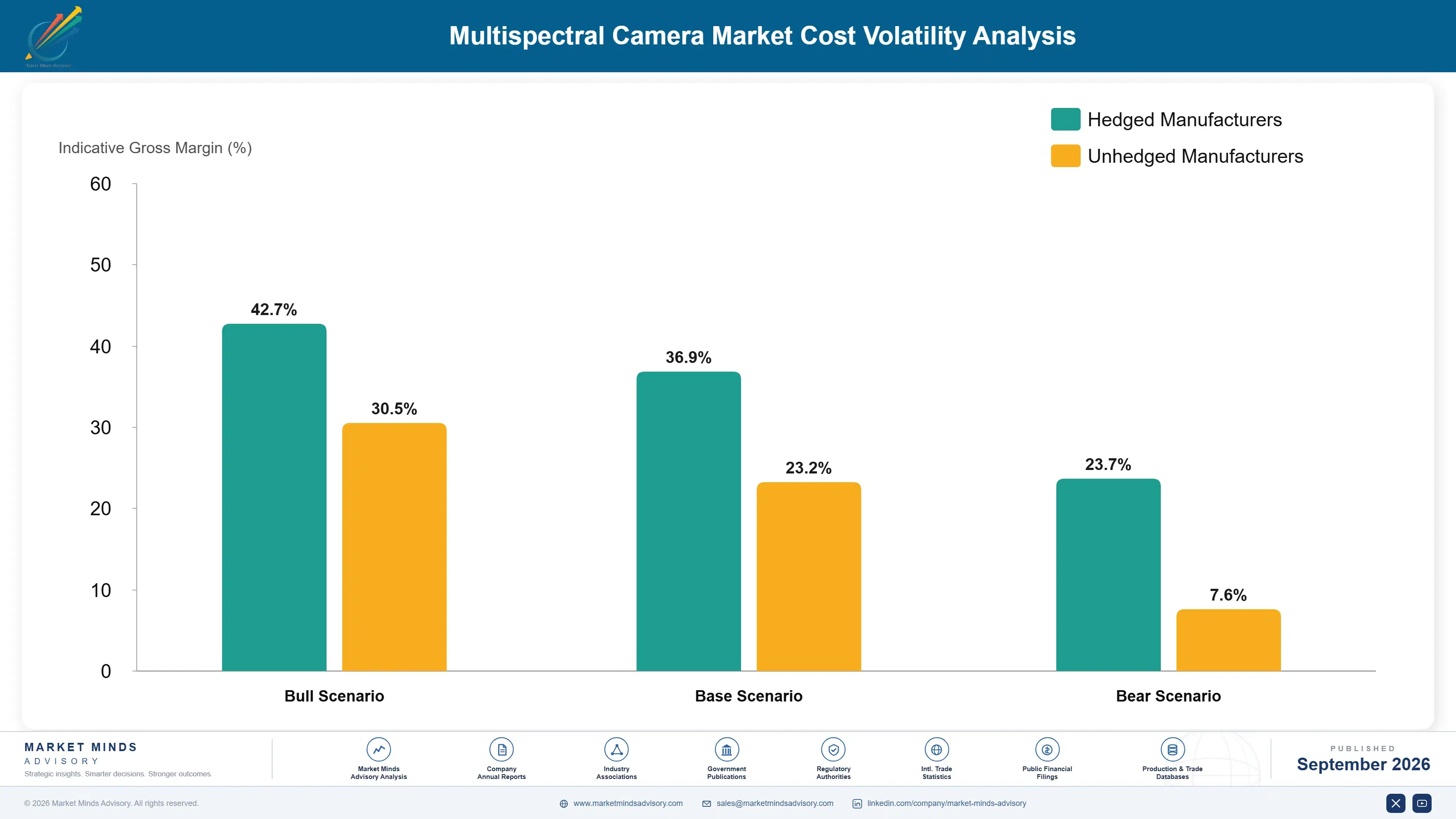
MMA organizes the competitive landscape into three tiers: volume and commodity-adjacent dual-band cameras sold largely on price for general industrial applications, premium certified multi-band and satellite-qualified cameras carrying validated calibration guarantees demanding customers require, and next-generation miniaturized UAV platforms built around compact, high-performance sensor architectures. Margins widen meaningfully moving up this ladder as differentiation shifts from basic spectral capture toward validated accuracy and miniaturization reflecting.
Volume-tier suppliers compete mostly on price per unit and struggle to defend margin as dual-band cameras face intense price competition from regional manufacturers, while premium-tier suppliers commanding validated multi-band and satellite qualification retain substantially stronger pricing power because demanding customers cannot easily substitute an unvalidated camera into a mission-critical remote sensing or agricultural application reflecting sustained investment across multiple operator segments as adoption continues expanding.

High-value margin pools concentrate specifically around satellite-qualified and UAV-optimized contracts tied to commercial space programs and precision agriculture technology adoption, where validated accuracy and compact design justify premium recurring pricing far above what basic dual-band cameras could ever command reflecting sustained investment across multiple operator segments as adoption continues expanding steadily across major markets supporting consistent engagement across national deployment.

Volume / Commodity-Adjacent Tier

Basic dual-band cameras sold largely on price and standard specifications, serving general industrial applications where satellite qualification or extreme miniaturization is not commercially required reflecting sustained investment across multiple operator segments as adoption continues expanding steadily across major.
Gross Margin: 14%-22%

Premium / Certified Tier

Validated multi-band and satellite-qualified cameras meeting documented calibration requirements for demanding remote sensing applications, commanding meaningfully higher pricing given the qualification testing required reflecting sustained investment across multiple operator segments as adoption continues expanding steadily across major markets.
Gross Margin: 28%-38%

Sustainability / Regulatory / Next-Generation Tier

Miniaturized UAV-optimized platforms built around compact, high-performance sensor architectures, increasingly favored by manufacturers pursuing alternatives to legacy industrial package sizes reflecting sustained investment across multiple operator segments as adoption continues expanding steadily across major markets supporting consistent engagement.
Gross Margin: 30%-42%
multispectral-camera-market-portfolio-architecture-1788503892157

High-value Sub-segments and Strategic Watch-out

UAV-Mounted Agricultural Multispectral Cameras

This segment combines the fastest unit growth in the market with strong and improving margins as precision agriculture adoption broadens, since field-validated calibration commands pricing that risk-conscious agricultural buyers readily accept given measurable input cost savings reflecting sustained investment across multiple operator segments as adoption continues expanding.
Gross Margin: 28%-38%

Satellite and Aerial Remote Sensing Cameras

Satellite-qualified cameras command strong recurring margins and meaningfully higher unit values than terrestrial applications, though growth trails the fastest segment slightly given the smaller current addressable market by absolute unit volume reflecting sustained investment across multiple operator segments as adoption continues expanding steadily across major markets supporting.
Gross Margin: 32%-42%

Dual-Band Multispectral Cameras

This remains a substantial revenue base by absolute unit volume today, covering general industrial applications, but margins are compressing steadily as regional manufacturers commoditize pricing for basic dual-band devices reflecting sustained investment across multiple operator segments as adoption continues expanding steadily across major markets supporting consistent engagement.
Gross Margin: 14%-22%

Smartphone Attachment Substitution Risk

Smartphone-based multispectral attachment accessories represent a genuine long-term watch-out for dedicated camera vendors if accuracy parity improves enough for mainstream agricultural applications, potentially shrinking addressable demand for dedicated hardware reflecting sustained investment across multiple operator segments as adoption continues expanding steadily across major markets supporting consistent engagement.
Gross Margin: 16%-26%

Design-In Relationships Anchor Long-Term Volume

Multispectral camera revenue increasingly behaves like an annuity rather than a one-time hardware sale, since design engineers and agricultural technology integrators who specify a supplier's camera within a validated platform design rarely switch suppliers mid-production given the cost and risk of requalifying an alternative device within an already validated drone or satellite payload integration reflecting sustained investment across multiple operator segments as adoption continues expanding.
Adoption runs deepest in precision agriculture and commercial satellite remote sensing applications, where multispectral capability is operationally essential for the core value proposition, followed by industrial machine vision applications where adoption is growing but not yet universal across all inspection categories. Consumer and hobbyist applications represent the shallowest current adoption depth, though usage is expanding as camera costs decline enough to extend beyond purely commercial.

A generational shift is underway as buyers move from evaluating cameras primarily on raw spectral band count toward evaluating suppliers on field-validated calibration accuracy, qualification breadth, and miniaturization capability, a change that favors suppliers with genuine reliability documentation depth over pure specification-sheet positioning reflecting sustained investment across multiple operator segments as adoption continues expanding steadily across major markets supporting consistent.
multispectral-camera-market-end-use-penetration-index-1788503893225

Where MMA Sees the Opportunity

These are among the four positions where our research anticipates prominent divergence between winners and laggards over the coming forecast period. Each is grounded in the demand model, the regulatory perimeter, and the announced capacity pipeline.
01 / AGRICULTURAL VOLUME EXPANSION

Prioritize Mid-Sized Farm Distribution Over Enterprise-Only Focus

UAV-mounted agricultural cameras are growing at roughly 1.47 times the overall market rate, and suppliers who expand distribution partnerships targeting mid-sized farms now will capture meaningfully more volume than competitors focused only on the largest enterprise operations that drove early adoption. This is not a marginal channel expansion, it fundamentally changes the addressable customer count a supplier can reach. MMA recommends suppliers prioritize mid-sized farm distribution partnerships ahead of continued enterprise-only sales focus in any near-term go-to-market decision reflecting sustained investment across multiple operator segments.
02 / SATELLITE QUALIFICATION INVESTMENT

Extend Terrestrial Architectures Through Satellite Qualification

Satellite and aerial remote sensing cameras are growing considerably faster than general industrial applications, and suppliers who extend proven terrestrial architectures through satellite qualification now will capture meaningfully more dual-market revenue than competitors maintaining separate, duplicated product lines. This is not a marginal certification exercise, it fundamentally changes the addressable revenue per engineering investment dollar spent. MMA recommends suppliers prioritize dual-qualification strategy ahead of maintaining fully separate terrestrial and satellite product roadmaps reflecting sustained investment across multiple operator segments as adoption continues expanding steadily across.
03 / FIELD VALIDATION DOCUMENTATION

Build Extended Field Validation Data Into Standard Offerings

Agricultural and industrial buyers increasingly require extended field validation data beyond laboratory calibration specifications before finalizing purchase decisions, and suppliers who bundle this documentation directly with camera sales capture meaningfully higher customer retention than those requiring customers to request it separately. This documentation advantage compounds as buyers standardize evaluation criteria around suppliers who consistently provide it. MMA recommends suppliers without comprehensive field validation documentation build it into their standard sales process now reflecting sustained investment across multiple operator segments as adoption continues expanding steadily across.
04 / SMARTPHONE SUBSTITUTION RISK

Monitor Smartphone Attachment Accuracy as a Genuine Threat

Smartphone-based multispectral attachment accessories remain less accurate than dedicated hardware in most demanding applications today, but suppliers dismissing them outright risk the same complacency that has hurt incumbents in other technology transitions before. If attachment accuracy improves faster than most analysts currently expect, demand for dedicated cameras in lower-precision applications could shrink meaningfully within a single product generation. MMA recommends established camera suppliers monitor attachment accuracy trajectories closely rather than treating dedicated hardware dominance as a permanent certainty reflecting sustained investment across multiple operator segments.

Engagement Snapshot From the Field

A live engagement with an industry participant carrying material or product regulatory and market exposure ahead of a defining policy shift, showing how our research translates into a defensible multi-year portfolio strategy.
MARKET MINDS ADVISORY · CLIENT ENGAGEMENT SUMMARY
Multispectral Camera Producer Strategic Portfolio Review and Transition Roadmap 2026·Investment Scenario on Multispectral Camera Exposure Evaluation 2025-26
CLIENT PROFILE
The client is a global agricultural equipment manufacturer integrating multispectral camera compatibility into its next-generation drone platform lineup, previously relying on a single camera supplier whose calibration accuracy had drawn complaints from commercial farming customers under varying field lighting conditions. Growing platform sales volume prompted the client to reassess its camera sourcing strategy across its full product line reflecting sustained investment across.
STRATEGIC CHALLENGE
The client needed to identify a camera supplier capable of meeting strict payload weight constraints while delivering consistent calibration accuracy across the varied lighting and atmospheric conditions its commercial farming customers encounter globally. Internal teams disagreed over whether to prioritize the lowest-weight option or the supplier with the strongest documented field validation data reflecting sustained investment across.
MMA APPROACH
MMA conducted a structured supplier evaluation benchmarking five leading multispectral camera suppliers across field-validated calibration accuracy, payload weight, and total cost over a five-year product lifecycle, supplementing public information with primary interviews across the client's engineering and product management organizations. The analysis modeled calibration drift risk explicitly against the client's global customer deployment conditions reflecting sustained investment.
KEY FINDINGS
  1. Suppliers with extensive documented field validation data across varying lighting conditions showed meaningfully more consistent calibration accuracy than suppliers relying on laboratory specifications alone reflecting sustained investment across.
  2. A moderate payload weight increase from switching suppliers proved acceptable to customers given the meaningfully improved calibration consistency the alternative supplier demonstrated reflecting sustained investment across multiple operator.
  3. Total supplier transition and requalification cost was estimated at 4 million dollars (client-reported, unverified by MMA), concentrated primarily in field testing and validation engineering work reflecting sustained investment.
  4. The selected supplier reduced customer-reported calibration complaints by an estimated 31 percent (client-reported, unverified by MMA) compared with the previous camera supplier reflecting sustained investment across multiple operator.
CLIENT PROFILE
The client is a global agricultural equipment manufacturer integrating multispectral camera compatibility into its next-generation drone platform lineup, previously relying on a single camera supplier whose calibration accuracy had drawn complaints from commercial farming customers under varying field lighting conditions. Growing platform sales volume prompted the client to reassess its camera sourcing strategy across its full product line reflecting sustained investment across.
STRATEGIC CHALLENGE
The client needed to identify a camera supplier capable of meeting strict payload weight constraints while delivering consistent calibration accuracy across the varied lighting and atmospheric conditions its commercial farming customers encounter globally. Internal teams disagreed over whether to prioritize the lowest-weight option or the supplier with the strongest documented field validation data reflecting sustained investment across.
MMA APPROACH
MMA conducted a structured supplier evaluation benchmarking five leading multispectral camera suppliers across field-validated calibration accuracy, payload weight, and total cost over a five-year product lifecycle, supplementing public information with primary interviews across the client's engineering and product management organizations. The analysis modeled calibration drift risk explicitly against the client's global customer deployment conditions reflecting sustained investment.
KEY FINDINGS
  1. Suppliers with extensive documented field validation data across varying lighting conditions showed meaningfully more consistent calibration accuracy than suppliers relying on laboratory specifications alone reflecting sustained investment across.
  2. A moderate payload weight increase from switching suppliers proved acceptable to customers given the meaningfully improved calibration consistency the alternative supplier demonstrated reflecting sustained investment across multiple operator.
  3. Total supplier transition and requalification cost was estimated at 4 million dollars (client-reported, unverified by MMA), concentrated primarily in field testing and validation engineering work reflecting sustained investment.
  4. The selected supplier reduced customer-reported calibration complaints by an estimated 31 percent (client-reported, unverified by MMA) compared with the previous camera supplier reflecting sustained investment across multiple operator.
RECOMMENDED STRATEGY
Phase 1: Phase 1 (Months 1 to 3): Benchmark candidate suppliers directly against field-validated calibration accuracy and payload weight for the client's platform requirements reflecting sustained. Phase 2: Phase 2 (Months 4 to 8): Field test the selected supplier's camera across diverse customer deployment conditions, validating calibration consistency claims under real use. Phase 3: Phase 3 (Months 9 to 14): Transition the full product lineup to the validated supplier, standardizing procurement to maximize negotiated pricing power reflecting sustained.
OUTCOME
The client transitioned its full drone platform lineup to a supplier with stronger documented field validation performance, replacing its previous single-supplier relationship entirely. Customer-reported calibration complaints declined by roughly 31 percent (client-reported, unverified by MMA) compared with the previous supplier, and product teams reported meaningfully improved customer satisfaction scores across global deployment.

Frequently Asked Questions

Foundational context covering the market sizes, CAGR, scope, country, region and competition that inform every finding below. This section is provided to cover basics and most often pre-purchase conversations, answered from the MMA Primary Research Dataset.

What is the current size of the Multispectral Camera Market?

MMA estimates the Multispectral Camera market at approximately 1.6 billion dollars in 2025. This reflects steady growth in precision agriculture adoption and commercial satellite remote sensing programs reflecting sustained investment across multiple.

How large will the Multispectral Camera Market be by 2036?

MMA projects the market will reach approximately 4.34 billion dollars by 2036 under the base case scenario. Growth is driven by precision agriculture expansion, satellite constellation growth, and sensor cost declines reflecting.

What is the CAGR for the Multispectral Camera Market 2026 to 2036?

MMA forecasts a base case compound annual growth rate of 9.5 percent between 2026 and 2036. The bull case reaches 10.8 percent while the bear case falls to 8.2 percent, reflecting production.

Which segment is growing fastest?

UAV-Mounted Agricultural Multispectral Cameras lead growth at 14.0 percent CAGR, roughly 1.47 times the overall market rate. This reflects precision agriculture expanding beyond early enterprise farms reflecting sustained investment across multiple operator.

Who are the major companies in the Multispectral Camera Market?

Leading suppliers include Teledyne FLIR LLC, Headwall Photonics Inc, MicaSense Inc, Specim Spectral Imaging Ltd, and XIMEA GmbH. Together these five companies account for an estimated 40 percent of market activity reflecting.

Which country is growing fastest?

India shows the fastest national growth rate at approximately 11.5 percent CAGR, driven by rapidly expanding precision agriculture adoption under national modernization programs. Domestic manufacturing capacity supports this pace reflecting sustained investment.

Report Segmentation Architecture

The full report scope spans multiple orthogonal segmentation dimensions, with cross-tabulated demand data provided for each dimension pair. Coverage extends further to regional breakdowns, trend trajectories, and the competitive detail needed to support segment-level decision-making.

By Spectral Band Count and Application

  • Dual-Band Multispectral Cameras
  • Mid-Band Multispectral Cameras
  • High-Band Multispectral Cameras
  • UAV-Mounted Agricultural Multispectral Cameras
  • Satellite and Aerial Remote Sensing Cameras
  • Industrial Machine Vision Multispectral Cameras

By End-Use Industry

  • Agriculture
  • Aerospace and Commercial Space
  • Defense and Surveillance
  • Industrial Manufacturing
  • Environmental Monitoring

By Commercial Dimension

  • Direct OEM Design-In Sales
  • Distributor Channel Sales
  • Systems Integrator Partnerships
  • Government and Defense Procurement

By Region

  • North America
  • Western Europe
  • East Asia
  • South Asia and Pacific
  • Latin America
  • Middle East and Africa
  • Eastern Europe

Scope, Methodology, and Coverage

Every figure in this report is reproducible from documented input assumptions. The scope below maps the historical period, the forecast horizon, the segmentation dimensions, and the countries covered, alongside the underlying primary and qualitative methodology.
Historical Period
2020 to 2025
Forecast Period
2026 to 2036
Base Year
2025 (USD billions; MMA Primary Research Dataset, September 2026)
Market Definition
The Multispectral Camera market covers imaging devices that capture data across multiple discrete spectral bands beyond standard visible-light red, green, and blue channels, used for agricultural crop monitoring, remote sensing, industrial inspection, and defense surveillance applications. It excludes hyperspectral cameras capturing hundreds of continuous spectral bands, standard RGB visible-light cameras, and thermal-only infrared cameras without additional discrete spectral band capture capability.
Quantitative Units
USD billions (current prices); segment and regional CAGR in percent
Segmentation Dimensions
By Spectral Band Count and Application; By End-Use Industry; By Commercial Dimension; By Region
Regions Covered
North America, Western Europe, East Asia, South Asia and Pacific, Latin America, Middle East and Africa, Eastern Europe
Countries Covered
USA, China, Germany, France, UK, Japan, South Korea, India, Australia, Canada, Brazil, Argentina, Mexico, Vietnam, Thailand, Saudi Arabia, UAE, South Africa, Poland, and additional markets relevant to this sector
Key Companies Profiled
Teledyne FLIR LLC, Headwall Photonics Inc, MicaSense Inc, Specim Spectral Imaging Ltd, XIMEA GmbH, AgEagle Aerial Systems Inc, Parrot SA, Resonon Inc, imec, Photon Focus AG, JAI A/S, Basler AG, Silios Technologies SA, Chromasens GmbH, Cubert GmbH, Pixelteq Inc, Surface Optics Corporation, Telops Inc, Norsk Elektro Optikk AS, Malvern Panalytical Ltd
Quantitative Methodology
Primary survey, n=3,800 respondents, Q4 2025, six countries; demand-side model with trade association cross-validation
Qualitative Methodology
47 expert interviews, Q4 2025; applied to validate demand model assumptions, identify emerging dynamics, and assess competitive positioning
Report Format
PDF and XLSX data workbook (Word format preview document)
Publisher
Market Minds Advisory
Report Code
MMA-2026-TEC-306
Published
September 2026
Contact
sales@marketmindsadvisory.com | www.marketmindsadvisory.com

Purchase the full Multispectral Camera Market Report (2026 to 2036).

The full report delivers a complete view of the Multispectral Camera market, covering detailed segmentation, regional forecasts, and competitive benchmarking across all six spectral band categories through 2036. It includes company profiles for all 20 evaluated suppliers, detailed analysis of precision agriculture adoption and commercial satellite constellation trends, and a dedicated section on field validation economics. Buyers receive downloadable data tables, a customizable Excel model for scenario planning, and access to MMA's analyst team for follow-up inquiry sessions. The report is designed for strategy, procurement, and product engineering teams evaluating supplier selection or sourcing investment.
Detailed profiles of all 20 evaluated suppliers
Regional forecasts across all seven MMA-defined regions
Customizable Excel model for scenario planning analysis
Precision agriculture and satellite constellation analysis
Segment-level CAGR and margin benchmarking data
Direct analyst access for follow-up inquiries

Built For The People Who Decide

From boardroom strategy to bench-side execution, this report is read cover-to-cover by leaders shaping the next decade of their industry, turning demand scenarios, market dynamics and valuation benchmarks into decisions.
CXOs/ Presidents/ VPs/ Managers
M&A and Corporate Development
Strategy Teams and R&D Heads
Procurement and Product Directors
Regulatory and Compliance Leaders
Investor Relations and Equity Analysts