

Market Minds Advisory
Membrane Switch Market

Membrane Switch Market: Membrane Switch Market. Tactile, Backlit, and Capacitive Touch Hybrid Control Panel Interfaces, 2026 to 2036

Industrial control panel makers demanding capacitive touch feel without abandoning tactile feedback reliability are pushing membrane switch manufacturers to build genuinely hybrid interface products at accessible price points across every application.

Lead Analyst

Published

September 2026

Make Smarter Decisions with Customized Research Insights

Request a free sample report and evaluate market opportunities, growth trends, and competitive dynamics relevant to your business needs.

2025 MARKET VALUE$2.6BMarket Size 2025
2036 FORECAST VALUE$4.2BBase Case , 2026 to 2036
CAGR 2026 TO 20364.5 %Bull 5.7% / Bear 3.3%
INCREMENTAL OPPORTUNITY$1.5BNet 10- year value creation
EXPANSION MULTIPLE1.55x2036 value over 2026 base
Strategic Levers
M&A Pipeline
Regional Outlook
Country Rankings
Competitive Intelligence
Segmental Deep-dive
Call-Us : 91 93563 13602

Executive Snapshot and Market Trajectory.

Membrane switches remain the quiet workhorse of industrial and medical control panels, valued precisely because they seal out dust and liquid ingress in environments where a capacitive touchscreen alone would fail reliability testing outright and require costly, disruptive replacement soon after installation in the field under harsh operating conditions.
Capacitive touch hybrid membrane switches are growing fastest as equipment designers demand the sleek visual appearance of modern touch interfaces without sacrificing the tactile feedback and moisture sealing that pure capacitive panels cannot reliably provide in harsh industrial settings exposed to chemicals, vibration, and repeated washdown cycles daily. East Asia leads regional demand given its concentration of electronics contract manufacturing and appliance production serving global supply chains and export markets.
Competitive character remains fragmented and regionally concentrated, since custom membrane switch manufacturing favors vendors located near the equipment maker's own assembly lines rather than distant low-cost suppliers unfamiliar with specific tooling requirements and design tolerances, and long-standing customer relationships built on design collaboration and reliable tooling matter considerably more than pure unit price in most procurement decisions made across the industry and its specialized application niches.
Market Definition
The Membrane Switch Market covers flexible, multi-layer electromechanical input devices used in industrial control panels, medical equipment, appliances, and automotive interiors, including tactile, non-tactile, backlit, and capacitive touch hybrid variants. It excludes standalone capacitive touchscreens without a membrane switch layer, mechanical keyboard switches, and general-purpose flexible printed circuits without input functionality.
Base Year Value
$2.6B in 2025 (MMA Primary Research Dataset, September 2026)
Forecast Period
2026 to 2036, eleven discrete annual values
CAGR
4.5% base case. Bull 5.7%. Bear 3.3%.
Fastest Growth Segment
Capacitive Touch Hybrid Membrane Switches: 7.0% CAGR
Fastest Growth Country
Thailand: 6.5% CAGR
Fastest Growth Region
South Asia and Pacific: 6.5% CAGR
Largest Region
East Asia: 29% of 2025 global value
Market Leaders
Leading vendors: Nissha, Grayhill, Schurter, Molex, Interlink Electronics. Source: MMA Primary Research Dataset, July 2026.
Primary Survey
n=3,800 procurement and R&D decision-makers, Q4 2025, six countries
Methodology
Demand-side build-up, cross-validated against public data, 47 expert interviews

Membrane Switch Market Forecast Scenarios

membrane-switch-market-size-forecast-scenario-1789993123306
Growth through 2020 to 2025 tracked general industrial and appliance production volumes closely, without any dramatic technology disruption reshaping the category, as membrane switches continued serving as the reliable, low-cost default interface choice for equipment makers prioritizing durability over visual sophistication across nearly every application segment and geography served worldwide, from factory floors to hospital equipment.
Base case growth through 2036 rests on three commercial mechanisms: expanding industrial automation equipment production requiring durable sealed control interfaces across every major manufacturing economy worldwide, rising medical device manufacturing demand for washable, sterilizable membrane switch panels meeting stringent regulatory hygiene standards imposed by health authorities globally, and growing capacitive touch hybrid adoption that commands meaningfully higher average selling prices than traditional tactile-only designs sold in prior years across the industry.
A bull scenario turns on faster capacitive touch hybrid adoption spreading beyond premium equipment tiers into mainstream industrial products, expanding the addressable premium segment considerably across every price tier. The bear risk is that falling capacitive touchscreen costs eventually make pure touchscreen interfaces reliable enough for harsh environments, eroding membrane switches' core durability advantage that has protected the category for decades.

Durability Economics Behind the Humble Control Panel

Membrane switches occupy a genuinely durable niche in the interface hardware world, surviving decades of capacitive touchscreen advancement precisely because they solve a problem screens still cannot fully address: sealing electronics completely against dust, liquid, and chemical exposure while remaining fully operable with gloved hands in cold storage, outdoor equipment, and demanding industrial settings around the world every single working day.
MARKET CONCENTRATIONCR5: 25%Top five manufacturers hold roughly a quarter of the market
AVERAGE UNIT PRICE$4.50Typical mid-complexity industrial membrane switch panel unit cost
TOP MANUFACTURING COUNTRY SHAREChina: 24%Reflects concentration of electronics contract manufacturing production capacity
POLYESTER FILM COST SHARE28% of COGSBase substrate material as a share of total unit cost
PRODUCT LIFECYCLE RATING1 million actuationsTypical tactile switch rated operating life before failure occurs
DESIGN-TO-PRODUCTION LEAD TIME6 to 10 weeksTypical time from custom design approval to first shipment
Manufacturers compete less on raw unit price today and more on design collaboration depth and tooling flexibility, since custom control panel requirements vary enormously across medical, industrial, and automotive applications, and vendors capable of rapid prototyping and iteration win repeat business that pure low-cost producers cannot easily displace once a design relationship becomes established over multiple product generations, platform refreshes, and long-term supply agreements signed.
Capacitive touch hybrid designs have moved from a premium niche to a genuine mainstream option as equipment makers increasingly demand the visual sophistication of touch interfaces without sacrificing the tactile confirmation and moisture sealing that industrial and medical operators specifically require in daily use across demanding field conditions, long operating shifts, and repeated cleaning and full chemical sterilization cycles.
"Everyone assumes touchscreens will eventually kill this category. They said the same thing fifteen years ago, and membrane switches are still the only interface that survives being run over by a forklift."
Practice Lead, Industrial Components and Electromechanical Research · MMA Construction and Industrial Equipment Practice · September 2026

Market Trends

Capacitive Touch Hybrid Designs Enter Mainstream Adoption

Membrane switch manufacturers have increasingly integrated thin-film capacitive touch layers directly into traditional membrane switch stacks over the past two years, delivering the sleek visual appearance customers now expect from modern equipment while retaining the tactile feedback and sealed durability that pure capacitive touchscreens cannot reliably provide in harsh industrial and outdoor environments year-round and across seasons. Several leading manufacturers have launched dedicated hybrid product lines specifically targeting mid-tier industrial equipment that previously used only basic tactile designs, expanding the addressable premium segment meaningfully across multiple end-use categories and geographies worldwide.
Market Impact: Equipment capex up over 12%

Antimicrobial Surface Coatings Address Hygiene-Sensitive Applications

Medical device and food processing equipment manufacturers increasingly specify antimicrobial coatings on membrane switch overlay surfaces, a requirement that barely existed as a standard specification five years ago but now appears in the majority of new medical equipment procurement documents reviewed by manufacturers across most major global markets today and beyond. Several major membrane switch producers have introduced certified antimicrobial overlay materials specifically to meet this growing hygiene requirement, and hospital equipment buyers increasingly treat this certification as a baseline procurement requirement rather than an optional premium feature worth extra cost.
Market Impact: Medical device production growth exceeds 8%

Market Opportunities and Growth Drivers

Industrial Automation Equipment Production Expands Steadily

Global industrial automation equipment production has expanded steadily as manufacturers across automotive, food processing, and heavy machinery sectors invest in new control panels requiring durable, sealed interfaces that survive years of continuous operation in dusty and washdown-prone factory environments common across most production settings today. Several major industrial equipment producers have publicly disclosed capital expenditure increases exceeding 12% over the past two years specifically directed toward new production line control systems, directly expanding the addressable base of equipment requiring membrane switch interfaces at scale across every major manufacturing region worldwide.
Market Impact: Touchscreen costs fell 20% recently

Medical Device Manufacturing Growth Drives Sterilizable Panel Demand

Medical device manufacturers require membrane switch interfaces that withstand repeated chemical sterilization cycles without degrading, a specification requirement that has grown considerably more stringent as regulatory bodies tighten infection control standards across hospital and clinical equipment procurement worldwide and across most national jurisdictions and modern healthcare systems everywhere today. Global medical device production volume has grown steadily in recent years, and several major medical equipment manufacturers now specify sterilizable membrane switch panels as a standard requirement rather than an optional upgrade for any new equipment platform introduced to the market.
Market Impact: Tooling adds 15% to unit cost

Market Restraints and Challenges

Falling Capacitive Touchscreen Costs Pressure Premium Positioning

Capacitive touchscreen unit costs have declined steadily as smartphone-driven manufacturing scale spills over into industrial-grade panel production, and the root cause is that touchscreen suppliers now benefit from consumer electronics volume economics that membrane switch manufacturers, serving a smaller and more fragmented custom market, simply cannot match at comparable manufacturing scale. Vendors are mitigating this by emphasizing sealed durability and tactile feedback advantages that touchscreens genuinely cannot replicate in harsh environments, and several manufacturers now market hybrid designs specifically as a bridge solution capturing both advantages simultaneously for cost-conscious buyers.
Market Impact: Hybrid designs command 30% price premium

Custom Tooling Costs Limit Small-Batch Order Economics

Membrane switch production requires custom tooling for each unique design, and the underlying cause is that unlike standardized electronic components, control panels rarely share dimensions or layout across different equipment models, making tooling amortization genuinely difficult for smaller production runs that cannot spread setup costs across enough finished units sold each year. Vendors are mitigating this by investing in more flexible, reconfigurable tooling systems that reduce setup costs for smaller custom orders, and several manufacturers now offer digital printing alternatives to traditional screen printing for prototype and low-volume runs specifically.
Market Impact: Antimicrobial coating demand up 25% yearly
3 additional market trends, 4 additional growth drivers, and 2 additional restraints and challenges are covered in the full report. Contact sales@marketmindsadvisory.com to access the complete intelligence.

Segment CAGR and Growth Architecture

The market divides into five segments by construction technology, spanning capacitive touch hybrid membrane switches, tactile metal dome switches, non-tactile flat panel switches, backlit and illuminated switches, and graphic overlay assemblies, each addressing a distinct combination of tactile feel, visual appearance, and sealing requirement across every major end-use application category and industry vertical served.
membrane-switch-market-market-share-analysis-1789993123838

Capacitive Touch Hybrid Membrane Switches

Capacitive touch hybrid membrane switches are growing fastest as equipment designers demand the sleek visual appearance of modern touch interfaces without sacrificing the tactile confirmation and moisture sealing that pure capacitive panels cannot reliably provide in industrial and medical environments exposed to chemicals, vibration, and repeated cleaning cycles throughout the equipment's entire operating life and full warranty period spanning many years of continuous service. This segment increasingly captures the largest share of premium new product spending, since equipment makers increasingly refuse to choose between visual modernity and operational durability, pushing legacy tactile-only manufacturers to rapidly develop hybrid capability they historically lacked or license the underlying technology from specialized suppliers instead.
CAGR 7.0%

Tactile Metal Dome Switches

Tactile metal dome switches remain the second-fastest-growing segment as industrial equipment operators wearing gloves in cold storage, outdoor, and heavy machinery environments continue requiring physically confirmable actuation that purely flat interfaces cannot reliably deliver under those very specific working conditions and stringent safety requirements imposed by workplace regulators across most jurisdictions and industries worldwide today and well into the future. This segment increasingly determines vendor selection at safety-critical industrial applications, since operators must confirm button actuation without looking directly at the panel, a requirement that pure capacitive or flat non-tactile designs simply cannot satisfy regardless of how sophisticated the underlying touch sensing technology eventually becomes over time and across generations.
CAGR 5.0%
Full segment breakdown across 5 segments available in the complete report.

Regional Architecture and Country Demand Map

East Asia leads demand given its exceptional concentration of electronics contract manufacturing and appliance production capacity across the entire region, while North America and Western Europe follow closely with substantial demand from industrial automation and medical device manufacturers serving both domestic and export markets worldwide.

North America

American industrial automation and medical device manufacturers drive the bulk of North American demand, with control panel design work concentrated near equipment assembly lines given the value of close collaboration during prototyping and tooling development stages spanning multiple product generations. Persistent demand for washdown-rated food processing and pharmaceutical equipment interfaces has strengthened membrane switch adoption specifically over touchscreen alternatives, since regulatory sanitation requirements favor sealed designs proven over decades of field use across the industry. Canadian and Mexican manufacturers contribute a smaller but steady secondary demand pool, often supplying components into the broader North American industrial equipment supply chain and its many original equipment manufacturer customers operating across the continent.
Share: 25% | CAGR: 5.2% (2026 to 2036)

Western Europe

German industrial equipment manufacturers lead Western European demand, applying membrane switch interfaces extensively across factory automation and heavy machinery control panels built to rigorous engineering durability standards demanded by the country's export-oriented industrial base. British and French medical device manufacturers drive meaningful secondary demand, specifying sterilizable membrane switch panels for hospital equipment meeting stringent regional health authority requirements imposed across the European Union. Growth trails East Asia and North America given generally mature, already-saturated industrial equipment replacement cycles across the region and a manufacturing base that has largely completed its automation modernization investment over the previous several decades of steady, sustained capital spending across most large industrial firms and equipment groups.
Share: 20% | CAGR: 3.2% (2026 to 2036)
Regional intelligence for 5 additional markets available in the complete report: East Asia, South Asia and Pacific, Latin America, Middle East and Africa, Eastern Europe. Contact sales@marketmindsadvisory.com.
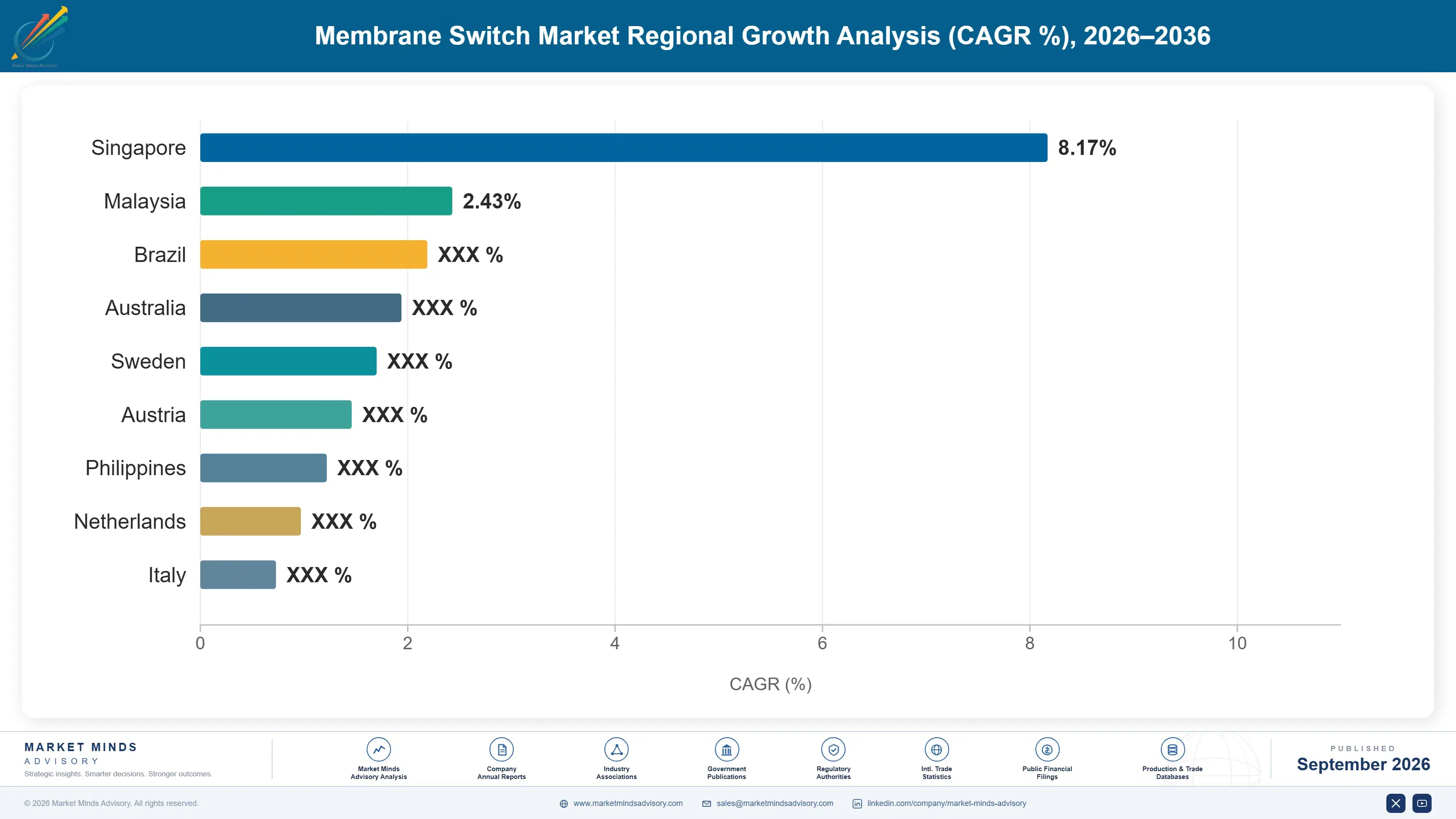
membrane-switch-market-country-cagr-analysis-1789993124349

Where Margin Hides in a Commodity Component

Beyond raw unit volume, four distinct commercial mechanisms determine which manufacturers actually expand margin rather than simply competing on price alone each and every single fiscal year, quarter, and product cycle: hybrid capacitive touch upselling, design collaboration lock-in, vertical-specific certification depth, and value-added assembly services layered on top of the base membrane switch component.

Actively Upselling Capacitive Touch Hybrid Designs

Manufacturers that offer capacitive touch hybrid upgrades to customers previously purchasing basic tactile membrane switches capture meaningfully higher revenue per unit, since hybrid designs command a genuine price premium justified by the visual sophistication and expanded functionality equipment makers increasingly demand from their control panels today across every product tier and price point served worldwide. Several leading manufacturers report hybrid designs selling at price points 30% above comparable tactile-only equivalents, turning an existing customer relationship into an upsell opportunity without requiring any new customer acquisition effort at all this year.
Market Impact: Hybrid designs command a full 30% price premium

Deepening Customer Design Collaboration Lock-In Early

Manufacturers that embed themselves early in a customer's product design process, contributing engineering input on tooling and layout before the design freezes, create genuine switching costs since redesigning tooling with a new vendor requires the customer to restart much of the engineering work already completed and paid for previously. Customers report switching membrane switch vendors after a design relationship is established costs 2 to 3 times more than the original tooling investment, making early design collaboration a genuinely durable margin strategy for manufacturers over the long term and across product generations.
Market Impact: Switching after lock-in costs 2 to 3x more

Building Much Deeper Vertical-Specific Regulatory Certifications

Manufacturers that invest in medical-grade sterilization certification or food-safe material compliance win deals faster and command premium pricing over generic manufacturers requiring lengthy customer-driven certification testing before any product can actually ship to regulated end markets at all without any meaningful delay or additional unplanned expense whatsoever for either party. Vertical-specific certification reduces customer qualification time meaningfully, and several manufacturers report certified product lines produce win rates roughly 25% higher than uncertified offerings when competing for regulated medical and food processing equipment contracts specifically each and every single fiscal year.
Market Impact: Certified product lines lift win rates fully 25%

Bundling Value-Added Assembly and Integration Services

Manufacturers increasingly bundle full assembly, connector integration, and testing services on top of the base membrane switch component, capturing revenue that would otherwise flow to a separate contract assembler hired independently by the equipment maker to complete final integration and testing work before shipment to the end customer directly. Services attach revenue now represents a meaningful share of total contract value at several leading manufacturers, sometimes exceeding 20% of total order value, and this bundling also deepens customer relationships since switching means re-establishing an entirely new assembly relationship from scratch.
Market Impact: Services attach reaches over 20% of order value

Who Controls the Margin Pool

Competitive concentration sits at a fragmented CR5 near 25%, evaluated on annual production capacity across the category, leaving considerable daylight between the largest global manufacturers and a long tail of regional custom specialists. Nissha and Grayhill hold meaningful production capacity leads through decades of accumulated design collaboration relationships, and the gap to smaller regional competitors remains wide given the switching costs embedded in established customer tooling investments.
Current competitive activity centers on hybrid capacitive touch capability and vertical certification depth rather than raw unit price alone, which most serious manufacturers now treat as a baseline expectation. Several manufacturers have pursued targeted acquisitions of smaller regional specialists over the past two years specifically to expand geographic production footprint, while others have doubled down on medical and food-safe certification depth competitors lack.

Rankings are most likely to shift as regional manufacturers located near growing electronics assembly hubs in Southeast Asia continue winning share from manufacturers positioned solely near legacy production centers facing rising labor costs. Consolidation among smaller custom specialists appears increasingly likely, and private equity interest in certified medical and food-safe membrane switch manufacturers has picked up as buyers recognize the durability of design-locked customer relationships.
membrane-switch-market-company-positioning-matrix-1789993124871

Competitive Moat and Risk Dimensions

NISSHA

Moat: Decades of Design Relationships

Nissha's multi-decade history serving major appliance and automotive customers has produced deeply embedded design collaboration relationships that give it visibility into customer product roadmaps years before competitors even learn of them, letting the company shape tooling investment decisions well ahead of formal competitive bidding processes each cycle.
NISSHA

Risk: Exposure to Consumer Electronics Cycles

Nissha's meaningful exposure to consumer electronics and appliance customer segments makes its revenue considerably more cyclical than competitors concentrated in steadier industrial and medical end markets, leaving the company more vulnerable to demand swings during broader consumer spending downturns across major economies and product categories worldwide.
GRAYHILL

Moat: Deep Industrial Switch Expertise

Grayhill's many decades of dedicated focus specifically on industrial and harsh-environment switch applications gives it engineering credibility that consumer-electronics-focused competitors genuinely struggle to replicate quickly, particularly for safety-critical applications requiring extensive environmental and durability testing before customer approval and final production sign-off is formally granted.
GRAYHILL

Risk: Smaller Scale Than Global Rivals

Grayhill's more focused, considerably smaller production scale relative to larger diversified competitors like Nissha limits its ability to compete purely on unit cost for high-volume commodity applications, pushing the company to concentrate deliberately on premium, specialized niches rather than broad market coverage across every segment.

Players Tracked

Prominent Players

Nissha
Grayhill
Schurter
Molex
Interlink Electronics

Other Key Players

CUI Devices
All Flex Solutions
Custom Control Concepts
Metrigraphics
Cirtec Medical
Reveal
Douglas Machine
EIS Inc
GlobTek
Nelson-Miller
Precision Concepts International
Cypress Technology Group
MDI Miami Global
Minco Products
Elrest Automationssysteme

Recent Developments

MARCH 2026

Nissha Expands Capacitive Touch Hybrid Production Line

Nissha announced an expanded capacitive touch hybrid production line in March 2026, adding dedicated manufacturing capacity for medical and industrial customers requiring both tactile feedback and modern touch interface aesthetics in a single integrated component. The expansion responds directly to accelerating customer demand for hybrid designs across multiple end markets.
Signal: Signals hybrid capacitive touch capability becoming a standard rather than niche premium offering across the industry
MAY 2026

Grayhill Signs Supply Agreement With Major Equipment Maker

Grayhill signed a multi-year supply agreement with a major industrial equipment manufacturer in May 2026, securing preferred vendor status for control panel interfaces across the customer's entire product line spanning multiple facility locations. The agreement reflects growing preference among equipment makers for consolidated, long-term component supply relationships.
Signal: Signals equipment makers steadily consolidating around a much smaller set of deeply integrated vendors overall today
JANUARY 2026

Schurter Acquires Regional Southeast Asian Manufacturing Facility

Schurter acquired a regional membrane switch manufacturing facility in Thailand in January 2026, expanding its production footprint directly into a fast-growing Southeast Asian electronics manufacturing hub serving diversifying global supply chains. The acquisition strengthens the company's position against competitors concentrated in traditional Chinese manufacturing centers.
Signal: Signals manufacturers deliberately relocating production toward fast-growing Southeast Asian supply chain diversification hubs seen widely today

Polyester Film and Silver Ink Drive Cost

Polyester film substrate and conductive silver ink together represent the largest cost input for membrane switch manufacturers, running roughly 40% of cost of goods sold combined, sourced primarily from specialty film producers in Japan, South Korea, and the United States. Metal dome components add a smaller but meaningful secondary cost line for tactile designs specifically.
A meaningful silver ink cost spike hit the category in 2024 as broader industrial silver demand for solar panel manufacturing competed directly for the same metal supply, an event documented in multiple company annual reports from major electronic component manufacturers tracking raw material cost trends closely across their entire supply base. Several manufacturers shifted toward reduced-silver-loading ink formulations to manage rising input costs going forward.

Manufacturers without significant purchasing scale face a real cost disadvantage against Nissha and Grayhill, both of which can negotiate volume-based film and ink pricing unavailable to smaller regional competitors managing comparable production volumes at scale. This exposure varies by geography too, since manufacturers sourcing materials entirely through developed-market suppliers face meaningfully higher costs than those with access to Asian specialty film production capacity and its lower unit pricing.
membrane-switch-market-cost-volatility-analysis-1789993125075

Reducing Silver Loading in Conductive Ink Formulations

Manufacturers are increasingly reformulating their standard conductive ink formulations to use meaningfully less silver per unit area while still maintaining acceptable electrical conductivity throughout, reducing exposure to silver price volatility substantially without compromising switch reliability or performance across most standard commercial, industrial, and consumer applications currently in active production and shipping worldwide each quarter.

Diversifying Film and Ink Supplier Relationships

Leading manufacturers increasingly maintain relationships with multiple polyester film and conductive ink suppliers across different regions rather than depending entirely on a single supplier for their entire material needs and production volume, reducing exposure to any one vendor's pricing changes or regional supply disruption during periods of unusually high industry-wide demand for these materials.

Negotiating Multi-Year Fixed-Price Material Contracts

Manufacturers are negotiating multi-year fixed-price agreements with key film and ink suppliers that lock in predictable material costs in exchange for guaranteed minimum purchase volumes committed well in advance of actual future production need, trading some short-term flexibility for meaningfully more predictable margin as underlying commodity prices continue to fluctuate unpredictably across global markets.

Portfolio Architecture for Margin Defence

The market splits between commodity-adjacent basic tactile and non-tactile switches priced accessibly with thinner margins, and premium capacitive touch hybrid and medical-certified designs carrying meaningfully higher gross margins because hybrid capability, sterilization certification, and design collaboration depth justify substantially higher pricing at larger equipment maker accounts running complex, regulated product lines across multiple markets and geographies.
Tension between commodity switches and premium hybrid designs plays out in how manufacturers allocate investment, since basic tactile production requires ongoing cost competitiveness while premium hybrid development demands continuous engineering investment that smaller regional manufacturers rarely fund adequately given their limited capital and engineering headcount. Most successful manufacturers treat basic tactile production as an installed-base relationship anchor rather than a standalone profit center, funding premium development from that steadier baseline revenue instead.

The highest-value margin pools concentrate around capacitive touch hybrid designs and medical-certified sterilizable panels serving equipment makers willing to pay premium rates for measurable durability and visual sophistication combined, a customer set that increasingly determines which manufacturers capture the fastest-growing and most profitable share of the entire market going forward, leaving pure commodity switch producers competing on thinner and thinner margins with each passing year.

Volume / Commodity-Adjacent

Basic non-tactile and simple tactile membrane switches priced accessibly for standard appliance and low-complexity industrial control panel applications with straightforward design requirements and quite limited customization needs or overall budget.
Gross Margin: 18-28%

Premium / Certified

Tactile metal dome switches and backlit designs with certified durability ratings serving mid-market industrial and consumer equipment requiring reliable long-term field performance and dedicated ongoing vendor account support services throughout the contract.
Gross Margin: 32-42%

Sustainability / Regulatory / Next-Generation

Capacitive touch hybrid designs and medical-certified sterilizable panels serving the largest equipment accounts willing to pay premium rates for combined durability and genuine visual sophistication across every single product line offered.
Gross Margin: 42-52%
membrane-switch-market-portfolio-architecture-1789993125583

High-value Sub-segments and Strategic Watch-out

Capacitive Touch Hybrid Membrane Switches

High-value and high-growth, this segment commands premium pricing from equipment makers willing to pay for combined visual sophistication and sealed durability, and its growth rate outpaces every other segment currently by a wide and widening margin as hybrid technology matures and costs fall gradually over time.
Gross Margin: 42-52%

Tactile Metal Dome Switches

High-value with moderate growth, industrial and safety-critical applications continue requiring physically confirmable actuation across every deployment, though adoption has matured enough in established markets that growth has settled into a much steadier overall pace than the considerably faster-growing hybrid segment described earlier in this same section.
Gross Margin: 32-42%

Non-Tactile Flat Panel Switches

The volume core of the market, this segment generates the bulk of unit count and recurring appliance manufacturer revenue across thousands of standard product accounts worldwide, even though per-unit margins run well below the premium tiers described above and show little sign of expanding meaningfully.
Gross Margin: 18-28%

Basic Backlit Illuminated Switches

A strategic watch-out segment: LED backlighting has become commoditized as component costs fall steadily each and every year, and manufacturers must watch this margin compression closely as it threatens to spread further into adjacent premium tiers that once commanded genuinely differentiated pricing across the category.
Gross Margin: 22-32%

Built Into the Equipment for Decades

Membrane switch revenue runs almost entirely on design-locked, multi-year supply relationships rather than transactional one-time purchases, since custom tooling investment ties the manufacturer to the customer's product lifecycle for as long as that equipment platform remains in production and continues shipping to end customers. Repeat order rates consistently exceed 80% once a design relationship becomes established, reflecting how deeply embedded the switch design is within the customer's broader product architecture and regulatory approval.
Adoption depth varies meaningfully by application: medical device and industrial safety equipment manufacturers integrate membrane switches so deeply into regulatory-approved product designs that switching vendors requires costly recertification and lengthy requalification testing before any change can be implemented. Consumer appliance manufacturers, by contrast, treat switch sourcing more transactionally and switch more readily when a lower-cost alternative meets basic performance and appearance specifications without triggering additional certification requirements.

Buyer profiles have shifted generationally as procurement increasingly runs through engineering and sourcing teams together rather than purchasing acting alone on unit price, bringing more rigorous design collaboration requirements and longer qualification cycles but also stickier, better-integrated supply relationships once a design finally locks in after multiple prototype iterations and rounds of testing with the manufacturer's engineering team.
membrane-switch-market-end-use-penetration-index-1789993126080

Where This Component Category Is Headed

These are among the four positions where our research anticipates prominent divergence between winners and laggards over the coming forecast period. Each is grounded in the demand model, the regulatory perimeter, and the announced capacity pipeline.
01 / HYBRID DESIGN INVESTMENT

Capacitive touch hybrid capability now determines which manufacturers win premium deals

Capacitive touch hybrid designs have become the single most important growth driver in this component category today, well ahead of any other capability manufacturers can offer to equipment makers. Manufacturers still shipping only pure tactile or pure capacitive designs are losing premium contracts to competitors who can deliver both visual sophistication and sealed durability in one integrated component. Building this capability now, rather than treating it as a future roadmap item, positions a manufacturer to capture the fastest-growing and most profitable segment of new customer spending.
02 / DESIGN COLLABORATION TIMING

Early design collaboration creates switching costs that protect long-term revenue

Manufacturers that embed themselves in a customer's product design process before tooling decisions are finalized create genuine switching costs that protect revenue for the entire life of that equipment platform and its future refresh cycles. Manufacturers competing purely on unit price after a design has already been locked in with a competitor face a weaker negotiating position throughout the entire relationship going forward. Prioritizing early design-stage engagement over late-stage price competition remains the single most effective way to build durable, multi-year customer relationships that last.
03 / REGULATORY CERTIFICATION DEPTH

Medical and food-safe certification depth commands genuine pricing power

Manufacturers that invest early in medical-grade sterilization and food-safe material certification win regulated contracts faster than competitors requiring lengthy customer-driven qualification testing before any product can ship to market at all. This certification gap looks set to widen further as healthcare and food processing regulatory requirements continue tightening across most major markets globally and across most product categories served. Manufacturers without dedicated certification investment increasingly find themselves excluded entirely from the fastest-growing and most profitable regulated end markets available today.
04 / SUPPLY CHAIN DIVERSIFICATION

Regional production diversification protects margin against rising labor costs

Manufacturers concentrated entirely in traditional Chinese production centers face rising labor costs that increasingly erode the cost advantage that originally justified that manufacturing location choice many years ago in the first place. Diversifying production toward emerging Southeast Asian manufacturing hubs like Thailand and Vietnam protects margin over the coming decade while maintaining proximity to the broader Asian electronics supply chain that customers already depend upon heavily for component sourcing. Manufacturers slow to diversify risk losing price-sensitive customers to more agile regional competitors.

Engagement Snapshot From the Field

A live engagement with an industry participant carrying material or product regulatory and market exposure ahead of a defining policy shift, showing how our research translates into a defensible multi-year portfolio strategy.
MARKET MINDS ADVISORY · CLIENT ENGAGEMENT SUMMARY
Membrane Switch Producer Strategic Portfolio Review and Transition Roadmap 2026·Investment Scenario on Membrane Switch Exposure Evaluation 2025-26
CLIENT PROFILE
The client was a mid-size manufacturer of portable diagnostic equipment used in hospital and clinical settings, generating approximately $180 million in annual revenue (client-reported, unverified by MMA) across a product line sold in over thirty countries. The company had used basic tactile membrane switches on its flagship device for over a decade without a major interface redesign.
STRATEGIC CHALLENGE
Hospital procurement teams increasingly requested capacitive touch interfaces matching the visual appearance of newer competing devices, but the client's engineering team worried about losing the sealed durability and sterilization compatibility that had made the existing tactile design a proven, trusted standard across its installed base of thousands of deployed devices.
MMA APPROACH
MMA conducted a structured supplier evaluation benchmarking four leading membrane switch manufacturers offering capacitive touch hybrid capability against the client's specific sterilization, durability, and regulatory certification requirements. The analysis incorporated primary interviews with the client's engineering and regulatory affairs teams, modeling projected certification timelines and total tooling investment across each finalist supplier using MMA's proprietary benchmarking dataset.
KEY FINDINGS
  1. The two hybrid-capable finalist suppliers projected medical device recertification timelines of 8 to 12 months (client-reported, unverified by MMA) depending on final scope.
  2. Sterilization compatibility testing accounted for roughly 50% of the total projected certification timeline, more than any other single identified requirement examined during the audit.
  3. Tooling investment estimates varied by nearly $650,000 between finalist suppliers, driven primarily by differing hybrid layer manufacturing process complexity and production yield rates.
  4. Regulatory affairs staff ranked proven sterilization compatibility as their single highest-priority requirement, well above visual appearance improvements generally desired by the marketing team.
CLIENT PROFILE
The client was a mid-size manufacturer of portable diagnostic equipment used in hospital and clinical settings, generating approximately $180 million in annual revenue (client-reported, unverified by MMA) across a product line sold in over thirty countries. The company had used basic tactile membrane switches on its flagship device for over a decade without a major interface redesign.
STRATEGIC CHALLENGE
Hospital procurement teams increasingly requested capacitive touch interfaces matching the visual appearance of newer competing devices, but the client's engineering team worried about losing the sealed durability and sterilization compatibility that had made the existing tactile design a proven, trusted standard across its installed base of thousands of deployed devices.
MMA APPROACH
MMA conducted a structured supplier evaluation benchmarking four leading membrane switch manufacturers offering capacitive touch hybrid capability against the client's specific sterilization, durability, and regulatory certification requirements. The analysis incorporated primary interviews with the client's engineering and regulatory affairs teams, modeling projected certification timelines and total tooling investment across each finalist supplier using MMA's proprietary benchmarking dataset.
KEY FINDINGS
  1. The two hybrid-capable finalist suppliers projected medical device recertification timelines of 8 to 12 months (client-reported, unverified by MMA) depending on final scope.
  2. Sterilization compatibility testing accounted for roughly 50% of the total projected certification timeline, more than any other single identified requirement examined during the audit.
  3. Tooling investment estimates varied by nearly $650,000 between finalist suppliers, driven primarily by differing hybrid layer manufacturing process complexity and production yield rates.
  4. Regulatory affairs staff ranked proven sterilization compatibility as their single highest-priority requirement, well above visual appearance improvements generally desired by the marketing team.
RECOMMENDED STRATEGY
Phase 1: Phase 1 (Months 1 to 3): Complete a structured supplier evaluation and total tooling investment modeling across all four finalists. Phase 2: Phase 2 (Months 4 to 9): Complete hybrid interface certification testing and full regulatory submission for the newly redesigned device. Phase 3: Phase 3 (Months 10 to 14): Transition full production to the new hybrid interface completely across every single manufacturing line.
OUTCOME
The client selected and fully certified a capacitive touch hybrid interface within fourteen months, successfully transitioning its flagship device to the new design while maintaining full sterilization compatibility (client-reported, unverified by MMA). Hospital customer feedback on the updated visual design improved measurably following the transition.

Frequently Asked Questions

Foundational context covering the market sizes, CAGR, scope, country, region and competition that inform every finding below. This section is provided to cover basics and most often pre-purchase conversations, answered from the MMA Primary Research Dataset.

What is the current size of the Membrane Switch Market?

The Membrane Switch Market was valued at $2.6 billion in 2025, the base year for this report. Growth has remained steady as durability requirements continue favoring sealed interfaces over pure touchscreens.

How large will the Membrane Switch Market be by 2036?

MMA projects the market will reach $4.22 billion by 2036, up from $2.72 billion in 2026. That represents a 1.55x expansion over the ten-year forecast period.

What is the CAGR for the Membrane Switch Market 2026 to 2036?

The market is projected to grow at a 4.5% CAGR between 2026 and 2036, with a bull case of 5.7% and a bear case of 3.3% depending on hybrid adoption speed.

Which segment is growing fastest?

Capacitive touch hybrid membrane switches are growing fastest at a 7.0% CAGR, roughly 1.56 times the overall market rate, as equipment makers demand modern visual appeal.

Who are the major companies in the Membrane Switch Market?

Leading manufacturers include Nissha, Grayhill, Schurter, Molex, and Interlink Electronics, evaluated on annual production capacity. Combined, the top five hold roughly 25% of the market.

Which country is growing fastest?

Thailand is growing fastest at a 6.5% CAGR, reflecting its growing concentration of electronics contract manufacturing facilities serving diversifying global supply chains and export markets.

Report Segmentation Architecture

The full report scope spans multiple orthogonal segmentation dimensions, with cross-tabulated demand data provided for each dimension pair. Coverage extends further to regional breakdowns, trend trajectories, and the competitive detail needed to support segment-level decision-making.

By Construction Technology

  • Capacitive Touch Hybrid Membrane Switches
  • Tactile Metal Dome Switches
  • Non-Tactile Flat Panel Switches
  • Backlit and Illuminated Switches
  • Graphic Overlay Assemblies
  • Rubber Dome Membrane Switches

By End-Use Industry

  • Industrial Automation and Machinery
  • Medical Devices and Healthcare
  • Consumer Appliances
  • Automotive Interiors
  • Food Processing Equipment

By Commercial Dimension

  • Original Equipment Manufacturer Direct
  • Contract Assembly Integration
  • Aftermarket Replacement
  • Custom Design Services

By Region

  • North America
  • Western Europe
  • East Asia
  • South Asia and Pacific
  • Latin America
  • Middle East and Africa
  • Eastern Europe

Scope, Methodology, and Coverage

Every figure in this report is reproducible from documented input assumptions. The scope below maps the historical period, the forecast horizon, the segmentation dimensions, and the countries covered, alongside the underlying primary and qualitative methodology.
Historical Period
2020 to 2025
Forecast Period
2026 to 2036
Base Year
2025 (USD billions; MMA Primary Research Dataset, September 2026)
Market Definition
The Membrane Switch Market covers flexible, multi-layer electromechanical input devices used in industrial control panels, medical equipment, appliances, and automotive interiors, including tactile, non-tactile, backlit, and capacitive touch hybrid variants. It excludes standalone capacitive touchscreens without a membrane switch layer, mechanical keyboard switches, and general-purpose flexible printed circuits without input functionality.
Quantitative Units
USD billions (current prices); unit shipment count; CAGR percentage; regional share percentage
Segmentation Dimensions
By Construction Technology; By End-Use Industry; By Commercial Dimension; By Region
Regions Covered
North America, Western Europe, East Asia, South Asia and Pacific, Latin America, Middle East and Africa, Eastern Europe
Countries Covered
USA, China, Germany, France, UK, Japan, South Korea, India, Australia, Canada, Brazil, Mexico, Thailand, Vietnam, Indonesia, Singapore, UAE, Saudi Arabia, South Africa, Nigeria, Poland, Italy, Spain, Sweden, Switzerland, Netherlands, Argentina, Turkey, Malaysia, and additional markets relevant to this sector
Key Companies Profiled
Nissha, Grayhill, Schurter, Molex, Interlink Electronics, CUI Devices, All Flex Solutions, Custom Control Concepts, Metrigraphics, Cirtec Medical, Reveal, Douglas Machine, EIS Inc, GlobTek, Nelson-Miller, Precision Concepts International, Cypress Technology Group, MDI Miami Global, Minco Products, Elrest Automationssysteme
Quantitative Methodology
Primary survey, n=3,800 respondents, Q4 2025, six countries; demand-side model with trade association cross-validation
Qualitative Methodology
47 expert interviews, Q4 2025; applied to validate demand model assumptions, identify emerging dynamics, and assess competitive positioning
Report Format
PDF and XLSX data workbook (Word format preview document)
Publisher
Market Minds Advisory
Report Code
MMA-2026-CON-660
Published
September 2026
Contact
sales@marketmindsadvisory.com | www.marketmindsadvisory.com

Purchase the full Membrane Switch Market Report (2026 to 2036).

This report provides a comprehensive assessment of the global Membrane Switch Market through 2036, covering construction technology segmentation, regional demand patterns, and competitive positioning across tactile, non-tactile, and capacitive touch hybrid manufacturers. It quantifies market sizing, growth scenarios, and pricing dynamics shaped by rising hybrid design adoption and durable component demand across industrial and medical applications. Analysis extends to input cost exposure, portfolio margin architecture, and demand stickiness by end-use application. The report closes with forward-looking strategic recommendations for manufacturers and investors evaluating this category.
Ten-year market sizing and forecast model
Full construction technology and segmentation analysis
Full seven-region demand and growth breakdown
Competitive benchmarking of top twenty manufacturers
Input cost exposure and mitigation strategy review
Strategic verdict and revenue lever recommendations

Built For The People Who Decide

From boardroom strategy to bench-side execution, this report is read cover-to-cover by leaders shaping the next decade of their industry, turning demand scenarios, market dynamics and valuation benchmarks into decisions.
CXOs/ Presidents/ VPs/ Managers
M&A and Corporate Development
Strategy Teams and R&D Heads
Procurement and Product Directors
Regulatory and Compliance Leaders
Investor Relations and Equity Analysts