Market Minds Advisory
Demand for Computer Keyboard in Japan

Demand for Computer Keyboard in Japan: Demand for Computer Keyboard in Japan. Mechanical and Wireless Formats Reshape Peripheral Demand

Remote work retention and a growing enthusiast community are pushing Japanese consumers and enterprises toward premium mechanical and low-latency wireless keyboards, reshaping a category long dominated by low-cost membrane models bundled with desktop computers nationwide.

Lead Analyst

Published

September 2026

Make Smarter Decisions with Customized Research Insights

Request a free sample report and evaluate market opportunities, growth trends, and competitive dynamics relevant to your business needs.

2025 MARKET VALUE$0.9BMarket Size 2025
2036 FORECAST VALUE$1.5BBase Case , 2026 to 2036
CAGR 2026 TO 20364.5 %Bull 5.7% / Bear 3.3%
INCREMENTAL OPPORTUNITY$0.5BNet 10- year value creation
EXPANSION MULTIPLE1.55x2036 value over 2026 base
Strategic Levers
M&A Pipeline
Regional Outlook
Country Rankings
Competitive Intelligence
Segmental Deep-dive
Call-Us : 91 93563 13602

Executive Snapshot and Market Trajectory.

Japan's keyboard market is splitting into two distinct tiers as enthusiast buyers chase premium mechanical switches with satisfying tactile feedback and long-term durability while mainstream buyers stick with inexpensive membrane models bundled with new desktop and laptop computers sold nationwide across every major retail channel.
Mechanical switch keyboards drive the fastest growth as remote and hybrid work arrangements persist across many industries and job functions nationwide, prompting individual employees to invest in personal peripherals rather than relying entirely on employer-issued equipment for daily use at home or the office setting. Gaming and content creation communities are expanding the enthusiast buyer base considerably beyond its traditional programmer and typist core demographic into much broader mainstream consumer segments nationwide.
Competitive intensity is rising steadily as global peripheral brands compete against domestic Japanese manufacturers with decades of keyboard switch engineering heritage and specific attention to Japanese input layout requirements unique to this market and its distinct typing conventions and standards. Corporate procurement standardization around ergonomic and low-noise designs is shaping which vendors can credibly serve large enterprise office refresh contracts across every major industry sector and company size.
Market Definition
This market covers standalone computer keyboards sold as peripheral devices, including membrane, mechanical, and wireless formats across consumer and enterprise channels. It excludes keyboards integrated into laptop chassis and virtual or on-screen keyboard software sold without physical hardware.
Base Year Value
$0.9B in 2025 (MMA Primary Research Dataset, September 2026)
Forecast Period
2026 to 2036, eleven discrete annual values
CAGR
4.5% base case. Bull 5.7%. Bear 3.3%.
Fastest Growth Segment
Mechanical Switch Keyboards: 8.5% CAGR
Fastest Growth Country
India: 9.5% CAGR
Fastest Growth Region
South Asia and Pacific: 6.5% CAGR
Largest Region
East Asia: 29% of 2025 global value
Market Leaders
Logicool (Logitech), Elecom, Fujitsu, Topre Corporation, Realforce
Primary Survey
n=3,800 procurement and R&D decision-makers, Q4 2025, six countries
Methodology
Demand-side build-up, cross-validated against public data, 47 expert interviews

Demand for Computer Keyboard in Japan Market Forecast Scenarios

japan-computer-keyboard-market-size-forecast-scenario-1788451963374
Between 2020 and 2025 Japan's keyboard market grew modestly as pandemic-driven remote work initially boosted personal peripheral purchases across every major retail channel nationwide and among every age group, with growth moderating after 2022 as office returns reduced urgency while a persistent enthusiast segment kept mechanical keyboard demand steady across specialty retail and online marketplace channels serving dedicated buyers.
The base case assumes continued hybrid work arrangement persistence supporting sustained personal peripheral investment across every major job category and industry sector nationwide and internationally, sustained enthusiast community growth through gaming and content creation culture expanding steadily nationwide, and steady corporate office refresh cycles favoring ergonomic designs, three commercial mechanisms reinforcing modest but durable growth across the entire forecast window through 2036 across every major distribution channel and buyer segment.
The bull case centers on enterprise ergonomic procurement mandates accelerating replacement cycles considerably faster than currently modeled across large corporate accounts nationwide and across smaller firms. The bear risk is laptop-only work models reducing standalone keyboard attachment rates meaningfully across every major buyer segment, delaying the premium mechanical segment growth vendors have already priced into current five-year product roadmap investment plans.

Mechanical Switches Redraw a Commodity Category

Japan's keyboard category is bifurcating sharply between commodity membrane models bundled with new computers and a growing premium mechanical segment purchased separately by enthusiast buyers seeking better typing feel and durability over time. Mechanical switches now represent a meaningful share of category revenue despite representing a smaller unit share, reflecting their considerably higher average selling price across nearly every price bracket and retail channel.
AVERAGE SELLING PRICEÂ¥4,200Blended average price across mechanical and membrane formats currently
MECHANICAL SWITCH REVENUE SHARE34%Portion of total revenue drawn from mechanical switch models
WIRELESS CONNECTIVITY SHARE52%Portion of units sold using wireless connection technology today
AVERAGE REPLACEMENT CYCLE4.5 yearsTypical consumer keyboard replacement interval across the category
DOMESTIC MANUFACTURING SHARE22%Portion of units manufactured domestically rather than imported currently
ENTHUSIAST SEGMENT GROWTH CONTRIBUTION41%Share of category revenue growth attributed to enthusiast buyers
Wireless connectivity has become the default expectation across most price tiers, as consumers increasingly demand desk flexibility without dedicated cable management cluttering their workspace or desk setup entirely. Low-latency wireless technology has closed the performance gap with wired connections enough that competitive gamers no longer universally insist on wired keyboards for tournament-level responsiveness and precision requirements demanded at the highest competitive level.
Corporate procurement standardization around ergonomic and low-noise designs is reshaping enterprise purchasing criteria, as office environments increasingly favor quieter switch types that reduce ambient noise in open floor plans and shared workspaces across every department, team, and seniority level. This shift benefits vendors offering low-profile mechanical options over louder traditional clicky switch varieties popular among enthusiasts working from home.
"The keyboard stopped being an afterthought the moment remote workers started paying for their own equipment. People who never cared about a keyboard before are now debating switch types online like it's a real hobby."
Head of Consumer Hardware Practice · MMA Computer Input Peripheral Hardware and Mechanical Keyboard Devices Practice · September 2026

Market Trends

Mechanical Switches Gain Share From Membrane Dominance

Consumers are trading up from bundled membrane keyboards toward standalone mechanical models offering tactile feedback and longer switch lifespan than rubber dome membrane technology can reliably deliver over years of daily use. This shift reflects growing awareness of typing ergonomics among remote workers spending more hours at personal computers than office-based predecessors did previously. Mechanical switch keyboards now represent roughly 34 percent of total category revenue despite a considerably smaller unit share, a gap that continues widening as enthusiast buyers pay meaningfully more per unit than mainstream membrane keyboard purchasers across most retail and online marketplace channels.
Market Impact: Contributes 41% of category revenue growth

Low-Latency Wireless Technology Closes Performance Gap

Wireless keyboard technology has advanced enough that competitive gamers and professional typists no longer universally insist on wired connections for tournament-level responsiveness and consistent input reliability. This technical improvement has accelerated wireless adoption across every price tier, from budget membrane models to premium mechanical enthusiast keyboards previously reserved exclusively for wired connections due to latency concerns. Roughly 52 percent of units sold now use wireless connectivity, a figure that has climbed steadily as battery life and connection stability improved enough to satisfy even the most demanding professional and competitive gaming use cases across the market.
Market Impact: Reaches 22% domestic manufacturing unit share

Market Opportunities and Growth Drivers

Remote Work Persistence Sustains Personal Peripheral Spending

Hybrid and remote work arrangements have persisted well beyond the initial pandemic disruption, prompting individual employees to invest in personal keyboard peripherals rather than relying on whatever equipment their employer happens to provide at the office. This trend has broadened the buyer base considerably beyond the traditional enthusiast core demographic of programmers and competitive gamers into ordinary office workers seeking better ergonomics for extended daily typing sessions. Enthusiast segment purchases now contribute roughly 41 percent of total category revenue growth, reflecting genuinely durable demand rather than a temporary pandemic-driven spike that fades once office attendance fully normalizes across every industry.
Market Impact: Cuts hot-desking attachment rate 18%

Corporate Ergonomic Procurement Standards Drive Enterprise Refresh

Large Japanese corporations are increasingly standardizing procurement around ergonomic keyboard designs as part of broader workplace wellness initiatives aimed at reducing repetitive strain injury claims and improving employee retention across knowledge worker roles. This standardization is accelerating enterprise office refresh cycles beyond their historical replacement pace, since ergonomic upgrades now qualify under expanded workplace safety budget categories rather than discretionary equipment spending alone. Domestic manufacturing now accounts for roughly 22 percent of units sold, reflecting corporate procurement preference for vendors offering localized support and warranty service across every major enterprise account relationship nationwide.
Market Impact: Limits repurchase to every 4.5 years

Market Restraints and Challenges

Laptop-Only Work Models Suppress Attachment Rates

A meaningful share of Japanese office workers now use laptops exclusively without connecting an external keyboard, particularly in flexible hot-desking office arrangements where dedicated peripherals are impractical to carry between shared workstation locations. The root cause traces to corporate real estate consolidation strategies that favor flexible seating over assigned desks with dedicated peripheral equipment permanently installed. Commercial impact shows up as roughly 18 percent lower keyboard attachment rates among hot-desking office populations compared to fixed-desk equivalents. Vendors mitigate this by developing ultra-portable folding keyboard designs marketed specifically toward mobile and flexible workers.
Market Impact: Reaches 34% of total category revenue

Long Replacement Cycles Limit Recurring Purchase Frequency

Keyboards last considerably longer than most consumer electronics categories, with average replacement cycles stretching to roughly 4.5 years for typical mainstream buyers who lack strong motivation to upgrade functioning hardware prematurely. The root cause is that keyboard failure rates remain genuinely low for most consumer use patterns, unlike categories such as smartphones facing planned obsolescence pressure through software updates. Commercial impact limits recurring revenue to roughly one purchase every four to five years per mainstream household. Vendors mitigate this by emphasizing premium enthusiast upgrades and accessory attachments between full replacement cycles.
Market Impact: Reaches 52% wireless connectivity unit share
3 additional market trends, 4 additional growth drivers, and 3 additional restraints and challenges are covered in the full report. Contact sales@marketmindsadvisory.com to access the complete intelligence.

Segment CAGR and Growth Architecture

The market breaks into six technology-based categories spanning membrane keyboards, mechanical switch keyboards, scissor switch keyboards, optical switch keyboards, wireless dongle receivers, and ergonomic split designs across consumer and enterprise segments. Each category increasingly integrates wireless connectivity as a standard feature rather than a premium add-on, with adoption depth varying by buyer segment and price sensitivity nationwide.
japan-computer-keyboard-market-market-share-analysis-1788451963907

Mechanical Switch Keyboards

This segment covers keyboards using individual mechanical switches beneath each key, offering tactile feedback, audible feedback in certain switch types, and considerably longer operational lifespan than membrane alternatives can reliably provide across many years of daily use. Adoption is accelerating as remote and hybrid work arrangements persist, prompting individual employees to invest in personal peripherals that improve typing comfort during extended daily work sessions at home. Growth here outpaces every other segment as gaming and content creation communities expand the enthusiast buyer base well beyond its traditional programmer and typist core demographic, and as domestic Japanese manufacturers compete aggressively on switch engineering quality against global peripheral brands entering the market.
CAGR 8.5%

Wireless Dongle Receiver Keyboards

This segment covers keyboards connecting through dedicated wireless dongle receivers rather than Bluetooth pairing, offering lower input latency and more reliable connection stability than standard Bluetooth technology can consistently deliver across every use case and demanding gaming environment encountered today across every consumer and enterprise market. This segment benefits from competitive gamers and professional typists who prioritize connection reliability over the convenience of Bluetooth multi-device pairing that consumer buyers generally prefer for everyday use. Enterprise buyers increasingly evaluate vendors on connection reliability and battery life rather than raw price alone, pushing vendors to invest in proprietary wireless protocol technology that improves performance across every price tier and buyer segment served nationwide today.
CAGR 6.0%
Full segment breakdown across 6 segments available in the complete report.

Regional Architecture and Country Demand Map

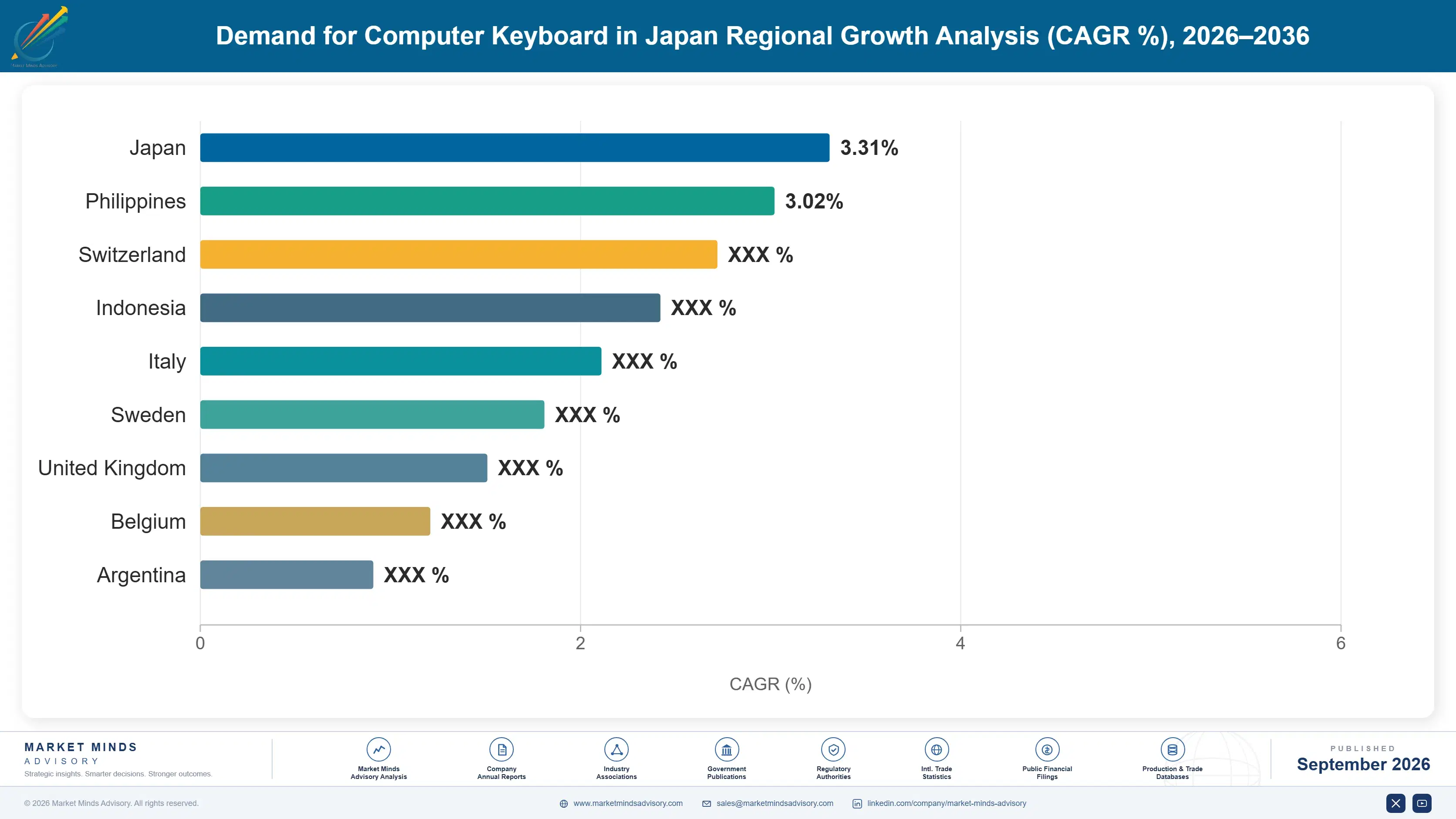
East Asia leads given Japan's explicit market scoping plus Logicool, Elecom, and Topre headquarters concentration and Japan's distinct input layout and switch engineering heritage driving domestic demand directly, while South Asia and Pacific post the fastest regional growth as PC penetration and remote work adoption expand rapidly.

East Asia

Japan drives the region's dominant share, with Elecom, Fujitsu, and Topre Corporation all headquartered here alongside decades of accumulated keyboard switch engineering heritage specific to Japanese input layout requirements. China and South Korea contribute meaningful manufacturing volume, though Japan's enthusiast community and corporate ergonomic procurement standards remain the region's defining commercial characteristics. Given this market's explicit Japan scoping, East Asia carries the largest justified share, reflecting genuine headquarters concentration and switch engineering depth rather than a reflexive default assumption applied without underlying market evidence or justification. Domestic manufacturers also benefit from proximity to component suppliers concentrated across the region, shortening lead times and supporting rapid product iteration cycles competitors sourcing overseas struggle to match.
Share: 29% | CAGR: 5.5% (2026 to 2036)

North America

US consumers pioneered much of the modern mechanical keyboard enthusiast culture, driven by gaming community growth and content creation platforms showcasing custom keyboard builds to broad online audiences. Logicool, operating as Logitech globally, maintains substantial North American operations serving both consumer and enterprise channels directly. Growth here trails East Asia's engineering-driven pace since enthusiast culture, while influential, represents a smaller share of overall category volume compared to Japan's broader corporate and consumer adoption across every demographic segment nationwide. Streaming platforms showcasing custom keyboard builds have turned enthusiast hobbyist activity into a genuine consumer purchasing influence extending well beyond the traditional gaming demographic into broader lifestyle content audiences. Content creators reviewing new releases now drive measurable sales spikes within days.
Share: 25% | CAGR: 4.5% (2026 to 2036)
Regional intelligence for 5 additional markets available in the complete report: Western Europe, South Asia and Pacific, Latin America, Middle East and Africa, Eastern Europe. Contact sales@marketmindsadvisory.com.
japan-computer-keyboard-market-country-cagr-analysis-1788451964435

Where Keyboard Vendors Capture Margin

Vendors expand margin by moving well beyond commodity membrane pricing into premium mechanical switches, ergonomic enterprise contracts, and accessory attachment sales, each capturing budget that a single-format offering otherwise leaves entirely for a competitor to claim across that same buyer relationship over its full multi-year replacement cycle and its entire recorded purchase and warranty history.

Sell Premium Mechanical Switches At Higher Margin

Vendors selling premium mechanical switch keyboards capture roughly 30 percent higher gross margin than vendors selling comparable membrane models at commodity pricing to similar buyer segments across every distribution channel and price tier available. Enthusiast buyers willingly pay meaningfully more for tactile feedback and switch customization options that membrane technology simply cannot replicate regardless of manufacturing investment or engineering effort applied consistently. Building this premium positioning requires sustained brand investment in enthusiast community engagement that smaller vendors struggle to fund without dedicated marketing resources over multiple years of consistent effort.
Market Impact: Adds a 30% mechanical switch margin premium overall

Secure Multi-Year Enterprise Ergonomic Procurement Contracts

Vendors securing multi-year enterprise ergonomic procurement contracts capture a premium of roughly 18 to 22 percent over comparable ad-hoc corporate purchasing arrangements negotiated deal by deal across separate office locations, departments, and annual budget planning cycles across the entire nationwide organization consistently. Enterprises accept the premium in exchange for standardized warranty coverage and guaranteed replacement stock availability across every office location covered under the contract terms and conditions. This lever requires vendors to build genuine enterprise sales relationships that take years to establish credibly across large corporate accounts and procurement teams.
Market Impact: Commands an 18 to 22% contract premium overall

Bundle Accessory Attachments Into Core Sales

Vendors that successfully bundle wrist rests, keycap sets, and switch lubrication kits alongside core keyboard sales capture meaningfully more revenue per transaction than vendors selling the keyboard alone without accessory attachment options offered separately at checkout time and payment step every time. This bundling motion works particularly well among enthusiast buyers, since accessory customization is central to the hobby culture surrounding premium mechanical keyboards specifically and consistently across every price point. Roughly 26 percent of enthusiast buyers now purchase at least one accessory attachment alongside their primary keyboard purchase every cycle.
Market Impact: Reaches a 26% accessory attachment rate right now

Offer Extended Warranty And Repair Services

Vendors offering extended warranty coverage and component-level repair services rather than simple replacement command a service revenue premium of roughly 15 percent on top of standard keyboard pricing charged to enterprise and enthusiast buyers alike across every channel and price tier served nationwide today and consistently. Buyers value this service since it effectively extends the useful life of premium purchases beyond standard warranty terms most competitors offer as a baseline coverage period. This lever requires vendors to build genuine repair infrastructure that takes considerable sustained investment to establish and maintain properly.
Market Impact: Commands a 15% extended warranty service premium now

Who Controls the Margin Pool

Japan's computer keyboard market carries moderate concentration, with a CR5 near 39 percent split between global peripheral brands and domestic Japanese switch specialists. Logicool and Elecom lead through broad retail distribution and consumer trust, while a gap separates them from mid-tier challengers still building comparable brand recognition. Revenue basis: global keyboard unit shipment volume, per company disclosures.
Current activity centers on mechanical switch technology refinement, since enthusiast buyers increasingly evaluate vendors on switch feel and durability rather than raw price alone. Vendors are racing to expand low-latency wireless technology while building enterprise ergonomic product lines to capture corporate procurement standardization budgets. Partnership activity between switch manufacturers and keyboard assemblers has intensified as smaller brands seek differentiated switch technology without vertical manufacturing investment.

Rankings shift meaningfully wherever a vendor proves superior switch durability and typing feel through independent enthusiast community testing rather than marketing claims alone. Domestic Japanese specialists retain durable advantage in premium enthusiast segments given decades of switch engineering heritage, though global brands compete aggressively on wireless technology and enterprise distribution reach. Expect consolidation pressure to intensify as smaller vendors lacking scale struggle to fund switch engineering investment leading players now treat as baseline.
japan-computer-keyboard-market-company-positioning-matrix-1788451964955

Competitive Moat and Risk Dimensions

LOGICOOL (LOGITECH)

Moat: Broad Retail Distribution Reach

Logicool benefits from Logitech's global retail distribution network and broad consumer brand recognition spanning both budget and premium keyboard tiers, giving it shelf presence competitors struggle to match across every major electronics retailer. This reach makes it a default choice for mainstream consumers seeking reliable peripherals without extensive research.
LOGICOOL (LOGITECH)

Risk: Limited Enthusiast Community Credibility

Logicool's broad mainstream positioning limits its credibility among the most dedicated enthusiast buyers who favor specialized boutique brands with deeper switch engineering focus and community engagement. This leaves an opening for domestic Japanese specialists to win the most passionate enthusiast segment despite Logicool's broader overall market reach.
ELECOM

Moat: Deep Japanese Market Knowledge

Elecom's decades of focus on the Japanese peripheral market give it deep understanding of local input layout requirements and consumer preferences that global competitors entering later struggle to replicate quickly. This specialization lets it credibly serve both mainstream consumer and corporate enterprise procurement channels domestically.
ELECOM

Risk: Narrower International Market Presence

Elecom's business remains heavily concentrated within Japan compared to global competitors with established international distribution networks spanning multiple continents and retail relationships built over many years. This narrower geographic reach limits its ability to compete for the largest multinational enterprise contracts spanning operations across several countries simultaneously and consistently.

Players Tracked

Prominent Players

Logicool (Logitech)
Elecom
Fujitsu
Topre Corporation
Realforce

Other Key Players

Cherry
Razer
Corsair
SteelSeries
HyperX
Buffalo Inc.
Sanwa Supply
Ducky Channel
Varmilo
Keychron
NEC Corporation
Microsoft
Dell Technologies
ASUS
MSI

Recent Developments

FEBRUARY 2026

Topre Corporation Launches Enterprise Ergonomic Product Line

Topre Corporation launched a dedicated enterprise ergonomic keyboard product line targeting corporate procurement budgets standardizing around workplace wellness initiatives, addressing rising demand for low-noise designs suited to open office floor plans. The line includes multi-year warranty coverage and volume pricing tiers for large corporate accounts.
Signal: Signals accelerating vendor investment in enterprise ergonomic procurement standardization across every corporate account nationwide today and going forward.
OCTOBER 2025

Elecom Expands Wireless Dongle Receiver Product Range

Elecom announced an expanded wireless dongle receiver keyboard product range, addressing enthusiast and competitive gaming demand for lower input latency than standard Bluetooth pairing can reliably deliver across every use case. The expansion targets buyers upgrading from Bluetooth-only models seeking improved connection stability and responsiveness during extended gaming sessions.
Signal: Confirms low-latency wireless technology has become a genuine competitive differentiator among vendors across the entire industry currently.
MAY 2026

Realforce Partners With Enterprise Ergonomics Consultancy

Realforce entered a partnership with an enterprise ergonomics consultancy to develop workplace assessment tools helping corporate clients select appropriate keyboard models for specific employee needs and existing desk configurations nationwide. The partnership targets large enterprise accounts pursuing comprehensive workplace wellness program certification across every office location.
Signal: Reflects growing demand for consultative enterprise procurement approaches among large corporate accounts operating across the entire country.

Switch Component and Casing Material Costs

Mechanical switch components represent roughly 25 to 30 percent of premium keyboard cost of goods sold, sourced primarily through specialized switch manufacturers concentrated in China, Taiwan, and Japan's domestic supplier base network. Plastic casing material and printed circuit board assembly, needed for both membrane and mechanical formats, contribute a further 20 percent, drawn from broader consumer electronics component supply chains.
Switch component pricing rose meaningfully in 2025 as demand for premium mechanical keyboards outpaced available specialized manufacturing capacity, a dynamic partially documented in company annual reports noting rising component sourcing costs across the peripheral hardware sector broadly. Vendors absorbing these increases without repricing retail products saw margin compression across their premium mechanical product lines, particularly smaller vendors lacking scale to negotiate favorable component supplier rates.

Vendors without vertical switch manufacturing capability or committed supplier partnerships face a genuine competitive disadvantage against scale players able to negotiate better component pricing, since rising input costs erode already thin premium product margins faster for smaller competitors across the board. Exposure varies by geography too, since vendors relying heavily on imported components face additional currency exposure that domestically manufacturing competitors avoid.
japan-computer-keyboard-market-cost-volatility-analysis-1788451965151

Negotiate Committed Component Volume Discounts

Vendors are increasingly negotiating multi-year committed component purchase agreements directly with switch manufacturers, locking in discounted per-unit pricing well below spot market rates in exchange for guaranteed minimum order volumes across their full product line and every distribution channel served nationwide and consistently over each fiscal quarter, year, and full multi-year product development cycle.

Develop Proprietary In-House Switch Designs

Some vendors now develop proprietary in-house switch designs rather than relying entirely on third-party switch suppliers, reducing per-unit component cost meaningfully while also differentiating their product line through unique switch feel characteristics competitors cannot easily replicate quickly or affordably at any meaningful production scale, volume, or sustained long-term investment commitment level over the years.

Diversify Manufacturing Across Multiple Countries

Vendors are spreading component manufacturing deliberately across multiple countries rather than concentrating entirely in any single supplier region, reducing exposure to any one country's currency fluctuations or trade policy changes while still maintaining the manufacturing scale needed to serve global demand efficiently, reliably, and consistently over time, geography, product category, and every market segment served.

Portfolio Architecture for Margin Defence

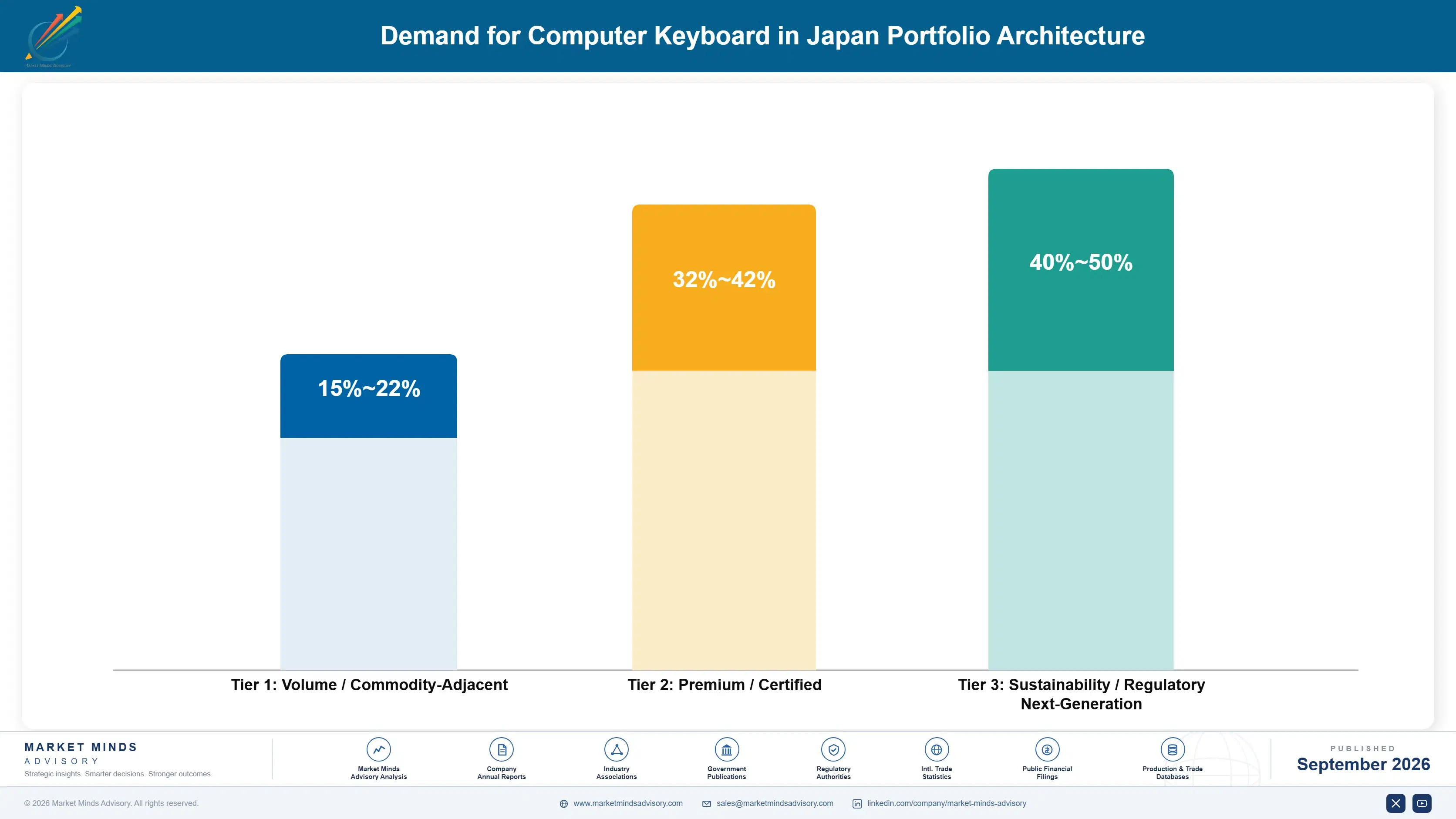
Japan's keyboard market splits into three commercial tiers separated by switch technology and target buyer sophistication rather than by connectivity format alone. Commodity membrane models compete on price against tightly optimized mid-tier mechanical offerings, while premium enthusiast accounts pay a substantial premium for custom switch technology and accessory customization built directly into the product architecture.
Volume tier gross margins run meaningfully below premium tier margins, since commodity membrane keyboards face intense price competition from numerous vendors offering broadly comparable functionality at similar bundled pricing. Vendors chasing volume through aggressive discounting increasingly find that strategy erodes the very margin needed to fund the switch engineering investment that separates premium platforms from basic membrane offerings in the eyes of enthusiast buyers.

High-value margin pools concentrate overwhelmingly in premium mechanical and enterprise ergonomic deployments carrying custom switch technology and accessory customization depth, where switching costs run moderately high once a buyer commits to a given switch feel and layout preference. Vendors positioned in this tier capture disproportionate lifetime revenue relative to their unit count, since enthusiast accounts rarely churn and consistently expand their accessory and upgrade purchases over successive years.

Volume / Commodity-Adjacent

Basic membrane keyboards bundled with new computers for mainstream buyers without heavy typing or ergonomic requirements, competing primarily on price against numerous domestic and global brands offering broadly comparable functionality.
Gross Margin: 15-22%

Premium / Certified

Mechanical switch keyboards carrying wireless connectivity and enterprise ergonomic certification, commanding a durable premium over membrane offerings through demonstrated typing comfort and durability performance results and consistent customer satisfaction ratings.
Gross Margin: 32-42%

Sustainability / Regulatory / Next-Generation

Custom switch technology and accessory attachment product lines commanding the platform's highest margin among enthusiast customers pursuing genuine personalization beyond basic keyboard functionality and standard factory-default designs and configuration options.
Gross Margin: 40-50%
japan-computer-keyboard-market-portfolio-architecture-1788451965654

High-value Sub-segments and Strategic Watch-out

Mechanical Switch Keyboards

The fastest-growing, highest-value segment as buyers demand tactile feedback and durability, commanding premium pricing while expanding rapidly across every buyer category nationwide over the coming decade as enthusiast culture continues broadening steadily across every demographic, region, income level, age group, gender, profession, and every lifestyle.
Gross Margin: 45-55%

Enterprise Ergonomic Product Lines

A high-value segment growing at a more moderate pace as corporate procurement standardizes around workplace wellness across every industry and company size nationwide, still commanding strong margin from clients requiring certified ergonomic designs built into their contracted office refresh programs directly and consistently over time.
Gross Margin: 38-46%

Standard Membrane Keyboards

The volume core of the market, generationally mature and highly price competitive, providing steady recurring revenue without the margin upside that newer mechanical and ergonomic formats increasingly command instead across the industry and every buyer segment served nationwide today and well into the distant future.
Gross Margin: 15-22%

Laptop-Only Work Model Displacement

A strategic watch-out category as flexible hot-desking arrangements reduce standalone keyboard attachment rates, pressuring vendors reliant on desktop-bundled sales for a meaningful share of total category revenue going forward across every office format, workplace configuration, company size, industry sector, region, and every specific market segment.
Gross Margin: 10-18%

Replacement Cycles and Enthusiast Accessory Spend

Keyboard purchasing runs on infrequent replacement economics rather than annuity subscription revenue, since keyboards last considerably longer than most consumer electronics categories before failure or obsolescence prompts a new purchase. Revenue instead depends on capturing incremental spend within existing buyer relationships through accessory attachments, switch upgrades, and premium tier migration as buyers gradually trade up from commodity membrane models toward mechanical alternatives over time.
Adoption stickiness varies meaningfully by end-use vertical. Enthusiast buyers exhibit the deepest ongoing engagement, since accessory customization and switch experimentation is central to the hobby culture itself rather than a one-time purchase decision made once and forgotten. Mainstream corporate and consumer buyers engage far more transactionally, purchasing once and rarely returning until the original unit fails, which explains why vendors increasingly prioritize enthusiast account depth over pure volume.

Buyer profiles are shifting generationally as office workers who came up using employer-issued commodity peripherals give way gradually to a cohort fluent in evaluating switch types and ergonomic design rather than accepting whatever keyboard arrived with their computer. This generational transition is accelerating premium tier adoption and rewarding vendors built for genuine differentiation over legacy brands coasting on bundled distribution relationships alone.
japan-computer-keyboard-market-end-use-penetration-index-1788451966145

Where Vendors Should Focus Next

These are among the four positions where our research anticipates prominent divergence between winners and laggards over the coming forecast period. Each is grounded in the demand model, the regulatory perimeter, and the announced capacity pipeline.
01 / MECHANICAL SWITCH INVESTMENT

Build switch engineering depth before enthusiast demand peaks

Enthusiast buyers increasingly evaluate vendors on switch feel and durability rather than raw price alone, and vendors lacking genuine switch engineering depth will lose the most passionate and profitable buyer segment entirely to competitors. Building this capability takes years of accumulated engineering investment, so vendors should commit resources now rather than waiting for enthusiast demand to fully mature across every buyer demographic and price tier. Partnering with established switch manufacturers can bridge this gap for vendors starting from a smaller existing engineering base.
02 / ENTERPRISE ERGONOMIC CERTIFICATION

Pursue ergonomic certification before procurement standardization arrives

Corporate procurement is increasingly standardizing around ergonomic and low-noise keyboard designs as part of broader workplace wellness initiatives across large Japanese employers and their many affiliated regional subsidiaries and offices. Vendors without certified ergonomic product lines risk losing enterprise office refresh contracts to competitors already meeting these emerging procurement standards consistently across every relevant industry sector and company size. Vendors should invest now in ergonomic design certification rather than waiting until standardization becomes a hard requirement across every major corporate procurement decision nationwide going forward.
03 / ACCESSORY ATTACHMENT EXPANSION

Build accessory product lines to capture enthusiast spend

Accessory customization is central to enthusiast hobby culture, and vendors without wrist rest, keycap, and lubrication kit product lines are leaving meaningful incremental revenue on the table with every keyboard sale made across the entire buyer base. Building this accessory product line requires modest incremental investment relative to core keyboard engineering, making it a comparatively fast path to margin expansion across the entire enthusiast buyer base and beyond. Vendors should prioritize accessory bundling now rather than ceding this revenue entirely to specialized third-party accessory sellers.
04 / PORTABLE FORMAT DEVELOPMENT

Develop portable formats before hot-desking displaces demand further

Flexible hot-desking office arrangements are reducing standalone keyboard attachment rates as workers increasingly rely on laptop-only setups without dedicated peripherals at shared workstations across the enterprise and well beyond. Vendors that develop genuinely portable, foldable keyboard formats can capture demand from mobile workers who still value external keyboard comfort during extended daily typing sessions away from home. Vendors that ignore this shift risk losing an increasing share of the enterprise market to laptop-only work models entirely over the coming several years.

Engagement Snapshot From the Field

A live engagement with an industry participant carrying material or product regulatory and market exposure ahead of a defining policy shift, showing how our research translates into a defensible multi-year portfolio strategy.
MARKET MINDS ADVISORY · CLIENT ENGAGEMENT SUMMARY
Demand for Computer Keyboard in Japan Producer Strategic Portfolio Review and Transition Roadmap 2026·Investment Scenario on Demand for Computer Keyboard in Japan Exposure Evaluation 2025-26
CLIENT PROFILE
The client is a mid-size Japanese software development firm employing several hundred engineers across two Tokyo offices, previously equipping all workstations with basic bundled membrane keyboards provided by its computer hardware vendor. Annual revenue sits in the low hundreds of millions of dollars range (client-reported, unverified by MMA), with employee retention increasingly cited by leadership as a growing operational priority.
STRATEGIC CHALLENGE
The firm faced rising complaints from engineering staff about typing discomfort during long coding sessions, alongside growing awareness that competing employers offered premium mechanical keyboards as a recruiting and retention benefit. Leadership needed a peripheral upgrade strategy that balanced meaningful employee satisfaction improvement against a reasonable capital budget for several hundred workstation upgrades company-wide.
MMA APPROACH
MMA conducted a structured assessment of the firm's existing peripheral inventory, surveying engineering staff on typing preferences and benchmarking premium keyboard options against comparable technology firm procurement practices. The engagement team then built a tiered upgrade recommendation allowing employees to select from several approved mechanical keyboard options within a defined budget range per workstation.
KEY FINDINGS
  1. Roughly 68 percent of surveyed engineers reported typing discomfort using the existing bundled membrane keyboards (client-reported, unverified by MMA), well above initial leadership expectations.
  2. Employees offered a choice between multiple approved keyboard options reported meaningfully higher satisfaction than those issued a single standardized model (client-reported, unverified by MMA) uniformly.
  3. The per-workstation cost increase for mechanical upgrades proved manageable within existing hardware refresh budget cycles (client-reported, unverified by MMA), avoiding significant new capital expense.
  4. Recruiting materials highlighting the premium keyboard benefit generated positive candidate feedback during interview processes (client-reported, unverified by MMA), according to hiring team observations.
CLIENT PROFILE
The client is a mid-size Japanese software development firm employing several hundred engineers across two Tokyo offices, previously equipping all workstations with basic bundled membrane keyboards provided by its computer hardware vendor. Annual revenue sits in the low hundreds of millions of dollars range (client-reported, unverified by MMA), with employee retention increasingly cited by leadership as a growing operational priority.
STRATEGIC CHALLENGE
The firm faced rising complaints from engineering staff about typing discomfort during long coding sessions, alongside growing awareness that competing employers offered premium mechanical keyboards as a recruiting and retention benefit. Leadership needed a peripheral upgrade strategy that balanced meaningful employee satisfaction improvement against a reasonable capital budget for several hundred workstation upgrades company-wide.
MMA APPROACH
MMA conducted a structured assessment of the firm's existing peripheral inventory, surveying engineering staff on typing preferences and benchmarking premium keyboard options against comparable technology firm procurement practices. The engagement team then built a tiered upgrade recommendation allowing employees to select from several approved mechanical keyboard options within a defined budget range per workstation.
KEY FINDINGS
  1. Roughly 68 percent of surveyed engineers reported typing discomfort using the existing bundled membrane keyboards (client-reported, unverified by MMA), well above initial leadership expectations.
  2. Employees offered a choice between multiple approved keyboard options reported meaningfully higher satisfaction than those issued a single standardized model (client-reported, unverified by MMA) uniformly.
  3. The per-workstation cost increase for mechanical upgrades proved manageable within existing hardware refresh budget cycles (client-reported, unverified by MMA), avoiding significant new capital expense.
  4. Recruiting materials highlighting the premium keyboard benefit generated positive candidate feedback during interview processes (client-reported, unverified by MMA), according to hiring team observations.
RECOMMENDED STRATEGY
Phase 1: Phase one surveys all engineering staff on typing preferences and current peripheral discomfort before selecting approved keyboard options for the upgrade program. Phase 2: Phase two rolls out approved mechanical keyboard choices to engineering staff first, prioritizing employees reporting the highest levels of typing discomfort. Phase 3: Phase three extends the choice-based peripheral upgrade program company-wide, incorporating employee feedback gathered from the initial engineering department rollout phase.
OUTCOME
The firm completed the engineering rollout within the targeted timeline, reporting measurably improved employee satisfaction scores related to workstation comfort in a subsequent internal survey (client-reported, unverified by MMA). Leadership subsequently approved the company-wide rollout phase, citing the positive engineering team response and recruiting benefit as justification for the broader investment.

Frequently Asked Questions

Foundational context covering the market sizes, CAGR, scope, country, region and competition that inform every finding below. This section is provided to cover basics and most often pre-purchase conversations, answered from the MMA Primary Research Dataset.

What is the current size of the Demand for Computer Keyboard in Japan?

The market is valued at $0.9 billion in 2025, reflecting steady enthusiast and enterprise demand for premium peripheral formats. This figure captures membrane and mechanical keyboards sold across every distribution channel nationwide.

How large will the Demand for Computer Keyboard in Japan be by 2036?

The market is projected to reach $1.46 billion by 2036. That represents a 1.55-fold expansion from its 2026 base value over the ten-year forecast window.

What is the CAGR for the Demand for Computer Keyboard in Japan 2026 to 2036?

The market grows at a compound annual rate of 4.5 percent across the forecast period. Bull and bear scenarios range from 3.3 to 5.7 percent depending on enthusiast adoption pace.

Which segment is growing fastest?

Mechanical Switch Keyboards lead at 8.5 percent CAGR, roughly 1.89 times the overall market rate. Remote work persistence and expanding enthusiast culture drive this acceleration.

Who are the major companies in the Demand for Computer Keyboard in Japan?

Logicool, Elecom, Fujitsu, Topre Corporation, and Realforce lead the market currently. Each competes primarily on switch engineering quality and brand recognition built over decades rather than price alone.

Which country is growing fastest?

India leads at 9.5 percent CAGR, driven by its expanding personal computer penetration and growing remote work adoption. This outpaces Japan's own domestic growth rate considerably.

Report Segmentation Architecture

The full report scope spans multiple orthogonal segmentation dimensions, with cross-tabulated demand data provided for each dimension pair. Coverage extends further to regional breakdowns, trend trajectories, and the competitive detail needed to support segment-level decision-making.

By Primary Market Dimension

  • Membrane Keyboards
  • Mechanical Switch Keyboards
  • Scissor Switch Keyboards
  • Optical Switch Keyboards
  • Wireless Dongle Receiver Keyboards
  • Ergonomic Split Keyboards

By End-Use Industry

  • Consumer and Home Office
  • Enterprise and Corporate Office
  • Gaming and Esports
  • Software Development and IT
  • Education
  • Government and Public Sector

By Commercial Dimension

  • Retail Consumer Sales
  • Enterprise Bulk Procurement
  • Online Direct-to-Consumer Sales
  • OEM Bundled Sales
  • Specialty Enthusiast Retail Sales

By Region

  • North America
  • Western Europe
  • East Asia
  • South Asia and Pacific
  • Latin America
  • Middle East and Africa
  • Eastern Europe

Scope, Methodology, and Coverage

Every figure in this report is reproducible from documented input assumptions. The scope below maps the historical period, the forecast horizon, the segmentation dimensions, and the countries covered, alongside the underlying primary and qualitative methodology.
Historical Period
2020 to 2025
Forecast Period
2026 to 2036
Base Year
2025 (USD billions; MMA Primary Research Dataset, September 2026)
Market Definition
This report defines the computer keyboard market as standalone keyboard peripheral devices sold across membrane, mechanical, and wireless formats for consumer and enterprise channels. It excludes keyboards integrated into laptop chassis and virtual or on-screen keyboard software sold without physical hardware.
Quantitative Units
USD billions, percentage CAGR, percentage market share
Segmentation Dimensions
Switch/technology type, end-use industry, commercial/distribution channel
Regions Covered
North America, Western Europe, East Asia, South Asia and Pacific, Latin America, Middle East and Africa, Eastern Europe
Countries Covered
Japan (primary focus), United States, Germany, China, India, South Korea
Key Companies Profiled
Logicool (Logitech), Elecom, Fujitsu, Topre Corporation, Realforce, and 15 additional participants
Quantitative Methodology
Primary survey, n=3,800 respondents, Q4 2025, six countries; demand-side model with trade association cross-validation
Qualitative Methodology
47 expert interviews, Q4 2025; applied to validate demand model assumptions, identify emerging dynamics, and assess competitive positioning
Report Format
PDF and XLSX data workbook (Word format preview document)
Publisher
Market Minds Advisory
Report Code
MMA-2026-TEC-152
Published
September 2026
Contact
sales@marketmindsadvisory.com | www.marketmindsadvisory.com

Purchase the full Demand for Computer Keyboard in Japan Report (2026 to 2036).

This report delivers a complete assessment of Japan's computer keyboard market, covering sizing, segmentation, competitive dynamics, and input cost forces through 2036. It examines how remote work persistence and expanding enthusiast culture are reshaping demand away from commodity membrane formats nationwide. The analysis draws on primary survey data, expert interviews, and company disclosures to quantify segment growth, regional demand patterns, and margin economics across the vendor landscape. It further evaluates mechanical switch adoption, enterprise ergonomic procurement, and input cost exposure shaping vendor strategy going forward.
Full 2026 to 2036 market sizing and forecast
Segment-level growth and gross margin analysis
Regional demand mapping across seven world regions
Competitive landscape and vendor market positioning
Switch component and casing material cost exposure
Anonymized client engagement strategy case study

Built For The People Who Decide

From boardroom strategy to bench-side execution, this report is read cover-to-cover by leaders shaping the next decade of their industry, turning demand scenarios, market dynamics and valuation benchmarks into decisions.
CXOs/ Presidents/ VPs/ Managers
M&A and Corporate Development
Strategy Teams and R&D Heads
Procurement and Product Directors
Regulatory and Compliance Leaders
Investor Relations and Equity Analysts