Market Minds Advisory
Computer Keyboard Market

Computer Keyboard Market: Computer Keyboard Market. Input Device Hardware for Gaming, Enterprise, and Consumer Computing

Expanding gaming culture, hybrid work ergonomics demands, and premium mechanical switch adoption push manufacturers toward differentiated keyboard designs that command meaningfully higher margins than commoditized membrane alternatives ever could today.

Lead Analyst

Published

September 2026

Make Smarter Decisions with Customized Research Insights

Request a free sample report and evaluate market opportunities, growth trends, and competitive dynamics relevant to your business needs.

2025 MARKET VALUE$8.5BMarket Size 2025
2036 FORECAST VALUE$16.1BBase Case , 2026 to 2036
CAGR 2026 TO 20366.0 %Bull 7.2% / Bear 4.8%
INCREMENTAL OPPORTUNITY$7.1BNet 10- year value creation
EXPANSION MULTIPLE1.79x2036 value over 2026 base
Strategic Levers
M&A Pipeline
Regional Outlook
Country Rankings
Competitive Intelligence
Segmental Deep-dive
Call-Us : 91 93563 13602

Executive Snapshot and Market Trajectory.

Computer keyboard demand is shifting from commodity membrane devices toward premium mechanical and ergonomic designs as gamers and hybrid workers alike pay more for tactile feel, build durability, and customization options once reserved for niche enthusiast markets before mainstream adoption accelerated across most retail channels and geographic markets covered worldwide.
Mechanical switch keyboards are pulling ahead of membrane designs as consumers chase gaming performance and typing satisfaction across both desktop and increasingly portable form factors. East Asia's concentrated manufacturing base and component supply chain keep the fastest deployment activity there, well ahead of comparable adoption in most other regions globally today, particularly among domestic gaming peripheral brands serving both local consumer demand and substantial export volume across neighboring markets worldwide.
Established peripheral brands compete against newer boutique mechanical keyboard makers winning deals on customization depth and community-driven design, but switch quality and build durability are becoming the decisive purchase criteria as consumers consolidate spending onto fewer, higher-quality keyboards each upgrade cycle, pressuring commodity membrane vendors to differentiate on price alone, an increasingly difficult position to sustain across most retail price segments, channels, and markets worldwide today.
Market Definition
The Computer Keyboard Market covers physical keyboard hardware for desktop and laptop computing, including membrane, mechanical, and ergonomic designs sold as standalone peripherals or bundled accessories. It excludes virtual and on-screen keyboards, laptop built-in keyboards sold as part of an integrated device, and industrial keypad controllers outside general computing use.
Base Year Value
$8.5B in 2025 (MMA Primary Research Dataset, September 2026)
Forecast Period
2026 to 2036, eleven discrete annual values
CAGR
6.0% base case. Bull 7.2%. Bear 4.8%.
Fastest Growth Segment
Premium Mechanical Switch Keyboards: 10.5% CAGR
Fastest Growth Country
India: 9.0% CAGR
Fastest Growth Region
South Asia and Pacific: 8.0% CAGR
Largest Region
East Asia: 30% of 2025 global value
Market Leaders
Logitech, Razer, Corsair, HyperX, and Microsoft lead the market. Source: MMA Analysis, July 2026.
Primary Survey
n=3,800 procurement and R&D decision-makers, Q4 2025, six countries
Methodology
Demand-side build-up, cross-validated against public data, 47 expert interviews

Computer Keyboard Market Forecast Scenarios

computing-device-keyboards-market-size-forecast-scenario-1789980308121
Computer keyboard demand grew steadily between 2020 and 2025 as remote work expansion and pandemic-era gaming growth pushed consumers to upgrade home office and entertainment setups simultaneously. Historical growth ran near 5.0 percent annually across that period, accelerating meaningfully as premium mechanical keyboard adoption spread beyond core gaming enthusiasts into mainstream consumer segments across most major retail markets.
The base case assumes sustained growth through 2036, driven by three commercial mechanisms working together. Expanding gaming culture and esports viewership continue normalizing premium peripheral spending among younger consumers. Ergonomic health awareness is pushing enterprise procurement toward differentiated keyboard designs beyond basic membrane units. Hybrid work arrangements continue sustaining demand for higher-quality home office equipment each budget cycle, particularly among enterprises reimagining workplace ergonomics standards across distributed and hybrid teams.
A bull case built on accelerated gaming culture expansion and premium peripheral adoption across emerging markets could push growth meaningfully above base case levels through the back half of the forecast period. A bear case tied to prolonged consumer electronics demand softness or return-to-office mandates reducing home office spending would slow keyboard replacement cycles considerably across price-sensitive consumer segments.

Switch Type Now Defines the Purchase Decision

Consumers are treating keyboard selection less like an afterthought accessory purchase and more like a deliberate ergonomic and performance decision, since switch type now shapes typing feel and gaming responsiveness in ways buyers actively research through online reviews and community forums before completing a purchase, a marked shift from the impulse-buy behavior that characterized this accessory category only a decade earlier, before switch terminology entered mainstream vocabulary.
MARKET CONCENTRATION38% CR5top five brands hold this combined participation share currently
AVERAGE SELLING PRICE$62 per unittypical blended average price across all covered keyboard categories
MECHANICAL SWITCH SHARE41%unit shipments using mechanical rather than membrane switch technology
AVERAGE PRODUCT LIFESPAN5 yearstypical usable service life before replacement under normal use
WIRELESS CONNECTIVITY SHARE54%shipments featuring wireless rather than wired connection technology
GAMING SEGMENT VOLUME SHARE33%total unit shipments destined specifically for gaming use cases
Commercially, the market splits between established peripheral brands defending large retail distribution relationships through deep partnerships with major electronics retailers, and newer boutique mechanical keyboard makers winning deals on customization depth, artisan keycap communities, and community-driven design engagement with enthusiast buyer segments that established brands have historically struggled to reach through conventional retail marketing channels alone today.
Over the coming decade, switch quality and wireless connectivity reliability will keep separating credible premium brands from commodity membrane makers that consumers increasingly find too basic to justify continued purchase consideration, pushing commodity vendors toward steadily eroding margin and shrinking retail shelf space over time relative to premium-positioned challenger brands gaining ground quickly among increasingly discerning consumer and enterprise buyers alike.
"People used to buy whatever keyboard came in the box. Now they read three thousand words of switch reviews before clicking purchase."
Director, Consumer Peripherals and Gaming Hardware Practice · MMA Consumer and Enterprise Computer Keyboard Hardware Practice · September 2026

Market Trends

Premium Mechanical Switches Become Mainstream Consumer Expectation

Mechanical switches, once a niche enthusiast preference, are becoming a mainstream consumer expectation as gaming culture normalizes tactile feedback and typing durability across broader demographic segments beyond core gamers. Roughly 41 percent of unit shipments now use mechanical rather than membrane switch technology, up meaningfully from prior years as manufacturing costs decline and consumer awareness spreads through online reviews and community discussion. This shift is compressing the competitive position of legacy membrane-only manufacturers unable to pivot production without substantial retooling investment, forcing many toward consolidation or exit from premium retail shelf space entirely.
Market Impact: 44 percent cite performance as driver

Wireless Connectivity Expands Beyond Basic Bluetooth

Wireless keyboard technology is expanding beyond basic Bluetooth pairing toward low-latency proprietary wireless protocols originally developed for competitive gaming, now migrating into mainstream productivity and enterprise keyboard lines as consumers demand cable-free desks without sacrificing responsiveness. Roughly 54 percent of new shipments now feature wireless connectivity, up meaningfully from a smaller share several years earlier when wired connections dominated most price tiers. This connectivity shift is pulling component suppliers and enterprise procurement teams into wireless-specific evaluation criteria earlier than the largely wired category history that traditionally characterized this market segment.
Market Impact: 29 percent of enterprises specify ergonomic

Market Opportunities and Growth Drivers

Gaming Culture Expansion Sustains Premium Peripheral Demand

Expanding esports viewership and competitive gaming participation continue normalizing premium peripheral spending among younger consumers who view keyboard quality as directly tied to gaming performance and competitive standing. This has pushed keyboard purchase decisions from a one-time accessory afterthought toward a considered performance investment that consumers research extensively before committing. Roughly 44 percent of surveyed gaming-focused consumers cite competitive performance as their primary keyboard purchase justification, ahead of general aesthetics or basic functionality alone, a reversal from survey results collected just a few years earlier when aesthetics and price still dominated purchase decisions overwhelmingly.
Market Impact: 5 months average lead time

Ergonomic Health Awareness Drives Enterprise Procurement Shifts

Rising awareness of repetitive strain injury and workplace ergonomic health has pushed enterprise procurement teams to specify ergonomic keyboard designs in workplace equipment standards rather than defaulting to basic commodity units purchased purely on lowest unit cost. Enterprises with formal ergonomic procurement standards report meaningfully lower reported employee discomfort complaints than those relying on ad hoc individual equipment requests. Roughly 29 percent of large enterprises now specify ergonomic keyboard requirements in standard workplace equipment policies, up meaningfully from participation levels observed just a few years earlier across most large corporate employers.
Market Impact: 16 percent of listings are counterfeit

Market Restraints and Challenges

Component Sourcing Concentration Creates Supply Chain Risk

Mechanical switch manufacturing remains heavily concentrated among a small number of specialized component suppliers located primarily in East Asia, forcing keyboard brands worldwide to compete for allocation during periods of high demand or supply disruption. The root cause is that switch manufacturing requires precise tooling investment that few suppliers have historically justified building at scale. This concentration extends average new product lead times to roughly five months during peak demand periods, well beyond the six-week timeline typical of markets with diversified component sourcing options. Brands increasingly qualify secondary switch suppliers and pursue vertical integration to reduce this recurring sourcing bottleneck.
Market Impact: 41 percent of shipments now mechanical

Counterfeit Products Undermine Premium Brand Positioning

Counterfeit and clone keyboards imitating popular premium designs continue circulating through online marketplaces, undermining legitimate brand positioning and creating consumer confusion about genuine product quality and switch authenticity. The underlying cause is that enforcement against individual online sellers remains inconsistent across jurisdictions, allowing counterfeit products to persist despite intellectual property protections. This counterfeiting problem accounts for roughly 16 percent of online marketplace keyboard listings in covered markets, according to brand protection audits reviewed. Legitimate brands increasingly invest in authentication features and marketplace enforcement partnerships to protect premium positioning and consumer trust.
Market Impact: 54 percent of shipments now wireless
3 additional market trends, 4 additional growth drivers, and 3 additional restraints and challenges are covered in the full report. Contact sales@marketmindsadvisory.com to access the complete intelligence.

Segment CAGR and Growth Architecture

This report segments the Computer Keyboard Market by switch technology, the clearest lens for near-term purchase decisions across both gaming and productivity contexts and every major price tier, since mechanical, membrane, and optical switches carry distinct pricing, performance characteristics, and buyer profiles despite often serving overlapping use cases within a single consumer purchase consideration.
computing-device-keyboards-market-market-share-analysis-1789980308676

Premium Mechanical Switch Keyboards

Premium mechanical switch keyboards use individual spring-loaded mechanisms beneath each key, delivering tactile feedback and durability that membrane alternatives cannot replicate, replacing the soft, mushy typing feel that dominated the category for decades. Demand for this segment is accelerating fastest among gaming enthusiasts and professional typists seeking both competitive performance and long-term product durability, where switch quality directly determines both gaming responsiveness and typing satisfaction. Vendors demonstrating switch durability above industry benchmarks are commanding premium pricing over membrane competitors, and consumers increasingly treat mechanical switches as a mandatory purchase requirement rather than an optional upgrade across most enthusiast buyer segments, particularly among younger consumers first entering the category through gaming culture exposure.
CAGR 10.5%

Wireless Low-Latency Gaming Keyboards

Wireless low-latency gaming keyboards use proprietary radio frequency protocols engineered specifically for competitive gaming responsiveness, delivering wired-equivalent input speed without the cable clutter that traditional wireless Bluetooth connections could never fully eliminate for serious competitive players. This segment is growing fastest among competitive gamers and streaming content creators who demand both cable-free desk setups and zero perceptible input lag during high-stakes gameplay sessions. Vendors increasingly bundle low-latency wireless technology with mechanical switch design, since serious gaming buyers rarely compromise on either dimension when making a premium purchase decision, creating a natural cross-sell path that pure wired specialists cannot easily replicate without acquiring dedicated wireless engineering capability through internal development or targeted acquisition.
CAGR 8.5%
Full segment breakdown across 6 segments available in the complete report.

Regional Architecture and Country Demand Map

East Asia leads on concentrated manufacturing capacity, component supply chain depth, and export competitiveness, North America follows closely on premium gaming culture, enterprise ergonomic spending, and major gaming brand headquarters presence today, and South Asia and Pacific grows fastest off a smaller installed base of premium units deployed.

North America

United States gaming culture and esports viewership remain among the most developed globally, sustaining strong demand for premium mechanical and wireless gaming keyboards across both retail and direct-to-consumer channels. Large enterprises concentrated in major metropolitan technology hubs lead ergonomic keyboard adoption, often driven by workplace wellness programs exceeding basic regulatory compliance minimums. Canada's gaming and enterprise sectors follow a similar trajectory at smaller scale. Concentrated presence of major gaming peripheral brand headquarters across this region sustains steady demand for early access to newest switch technology, since brands typically launch flagship products here before other covered markets receive them weeks or sometimes months later in the release cycle each product generation.
Share: 26% | CAGR: 6.5% (2026 to 2036)

Western Europe

Germany, France, and the United Kingdom's mature gaming and enterprise computing markets have shifted incremental demand toward premium mechanical and ergonomic keyboard categories as basic membrane replacement demand has largely plateaued across established consumer bases. The European Union's expanding workplace ergonomics guidance is gradually pushing enterprise procurement toward differentiated keyboard specifications beyond lowest-cost commodity units. Regional gaming peripheral retailers with deep expertise navigating fragmented national distribution networks hold a durable service advantage over foreign entrants unfamiliar with country-specific retail practices. Growth trails East Asia and North America since the region's gaming culture, while substantial, expanded somewhat later than comparable markets across other covered regions worldwide during the preceding decade of steady gaming culture growth.
Share: 20% | CAGR: 4.5% (2026 to 2036)
Regional intelligence for 5 additional markets available in the complete report: East Asia, South Asia and Pacific, Latin America, Middle East and Africa, Eastern Europe. Contact sales@marketmindsadvisory.com.
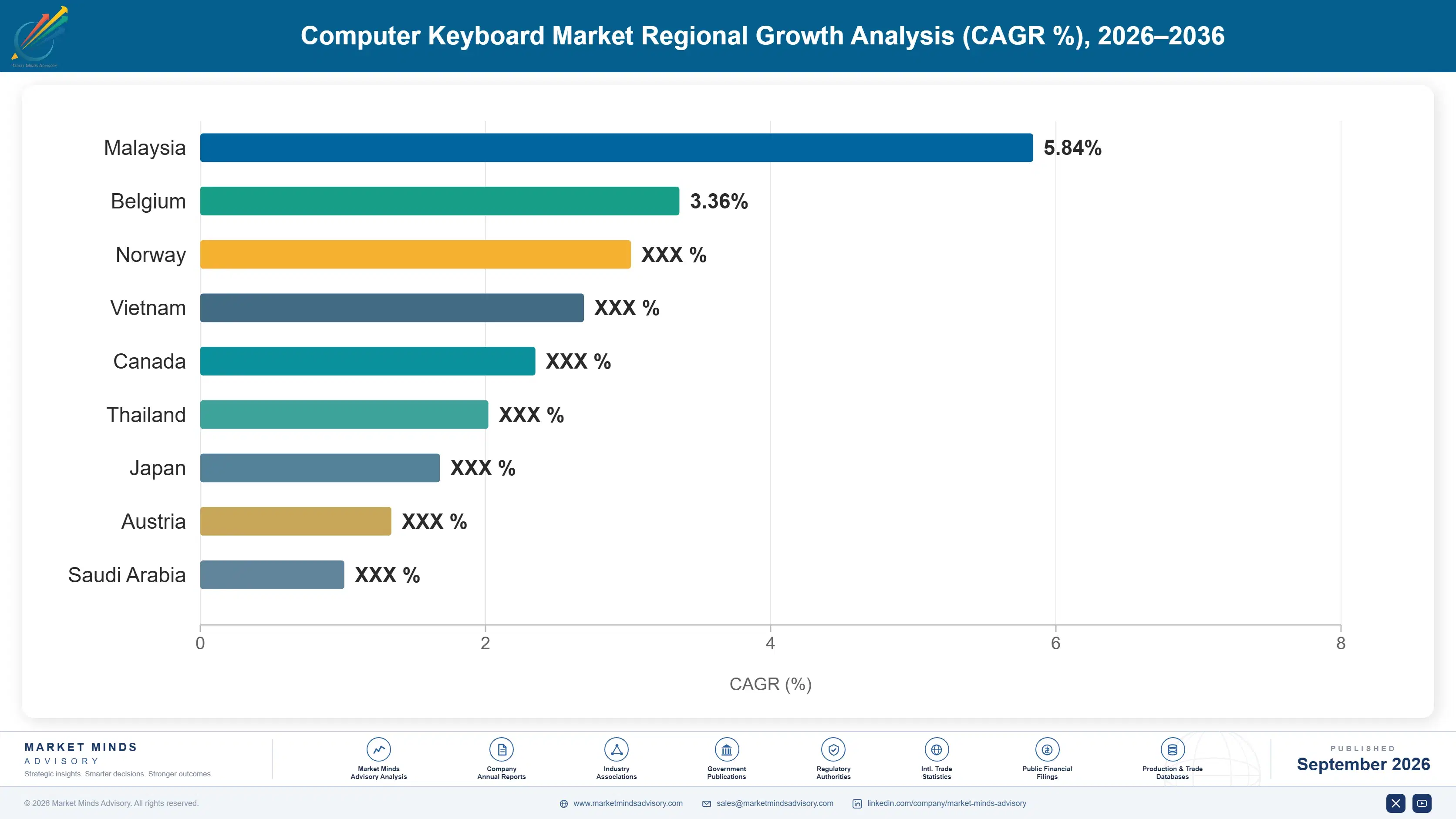
computing-device-keyboards-market-country-cagr-analysis-1789980309194

Monetizing Beyond the Base Hardware Sale

Beyond standard hardware sales, brands are building several distinct and increasingly important adjacent revenue streams around customization accessories, companion software subscriptions, extended warranty bundling, and proprietary switch design licensing arrangements that together capture considerably more of the total value their keyboards already deliver to consumers across price tiers, product categories, and geographies worldwide today.

Sell Artisan Keycap And Accessory Bundles Directly

Brands are pricing artisan keycap sets, wrist rests, and customization accessories as premium standalone add-ons rather than including them in base keyboard pricing, since the 41 percent of consumers now owning mechanical switch keyboards represent a growing addressable base actively seeking personalization options beyond stock configurations. This captures incremental accessory revenue per customer that flat hardware pricing alone would never generate. Enthusiast buyers purchasing accessory bundles generate meaningfully higher lifetime revenue per account than those buying hardware alone without ongoing accessory purchases across their broader collection built up over time and successive purchase cycles.
Market Impact: Captures value from the 41 percent mechanical segment

Offer Companion Software Customization Subscriptions Directly

Brands are bundling companion software subscriptions for advanced lighting customization, macro programming, and per-key configuration profiles alongside hardware sales, converting a one-time purchase into a recurring engagement relationship that also deepens brand loyalty across future purchase cycles. This addresses growing consumer demand for personalization using data the software already collects for configuration purposes, requiring minimal incremental engineering investment. Enthusiast buyers subscribing to companion software report repeat purchase rates roughly 24 percent higher than those using stock factory configurations without customization software attached to their base hardware purchase at any point after buying.
Market Impact: Captures a share of the 54 percent wireless base

Bundle Extended Warranty And Switch Replacement Plans

Brands are pricing extended warranty and individual switch replacement plans as a premium tier above standard one-year coverage, capturing incremental revenue from the 33 percent of shipments destined for gaming use cases where heavy daily use accelerates switch wear considerably faster than typical office use. This tiered approach lets brands monetize the durability concern directly rather than absorbing warranty risk into flat base pricing that fails to reflect actual usage intensity across different buyer segments and daily usage intensity profiles spanning casual weekend players to dedicated professional competitive gamers and streamers alike.
Market Impact: Captures value from the 33 percent gaming segment

License Switch Designs To Third-Party Manufacturers

Brands with proven mechanical switch designs are licensing their underlying switch mechanisms to third-party keyboard manufacturers and custom keyboard builders seeking proven, reliable components rather than developing proprietary switches from scratch at considerable engineering expense. This creates a component licensing revenue stream distinct from direct hardware sales, reaching new production channels brands could not otherwise efficiently serve. Given that mechanical switches already command the widest pricing premium of any covered segment, this licensing extends that proven advantage into channels reached only indirectly before, across roughly 9 active licensee partnerships currently in place.
Market Impact: Extends the pricing premium into 9 licensee channels

Who Controls the Margin Pool

The top five brands hold roughly 38 percent combined market participation, a fragmented concentration that leaves a wide gap open for a long tail of boutique mechanical keyboard makers and regional peripheral brands still building comparable retail distribution scale across major covered markets and geographies worldwide, particularly outside their traditional home territories and long-established retail relationships built over many years.
Current competitive activity centers on three fronts: mechanical switch durability claims validated against independent testing benchmarks, expanding wireless low-latency protocol portfolios covering both gaming and productivity use cases, and aggressive bundling of companion customization software into what were previously standalone hardware sales sold without ongoing software support, across most consumer account sizes and product tiers, from budget to flagship offerings.

Boutique mechanical keyboard makers without established retail distribution legacies are gaining ground fastest in direct-to-consumer and community-driven sales channels where no existing retail relationship favors an incumbent, and rankings could shift meaningfully if one of these challengers secures a landmark distribution partnership with a major electronics retailer during the coming several years of continued market expansion and steady consolidation activity across the broader competitive landscape.
computing-device-keyboards-market-company-positioning-matrix-1789980309715

Competitive Moat and Risk Dimensions

LOGITECH

Moat: Broad Retail Distribution Depth

Decades of retail distribution across major electronics chains and e-commerce platforms give Logitech direct access to mainstream consumer relationships that boutique challengers must build from nothing, shortening its sales cycles considerably relative to newer entrants lacking comparable retail shelf space and brand recognition built over many years of continuous retail presence and marketing investment.
LOGITECH

Risk: Enthusiast Community Engagement Gap

Boutique mechanical keyboard makers increasingly out-compete Logitech on enthusiast community engagement and customization depth, since its own product development historically prioritized broad mainstream appeal over the niche personalization features that dedicated enthusiast buyers increasingly demand from specialized vendors moving faster with narrower product focus and dedicated engineering resources.
RAZER

Moat: Gaming Brand Cultural Cachet

Decades of gaming culture positioning and esports sponsorship give Razer credibility and brand recognition among competitive gaming communities that mainstream peripheral vendors struggle to replicate quickly, particularly among younger consumers who prioritize gaming authenticity over broader productivity feature sets that mainstream vendors typically emphasize instead.
RAZER

Risk: Premium Pricing Vulnerability

Razer's premium pricing positioning leaves it more exposed to value-conscious challenger brands offering comparable switch technology and build quality at meaningfully lower price points, particularly during periods of broader consumer electronics spending caution across price-sensitive gaming segments and budget-constrained younger consumer demographics facing tighter household spending overall.

Players Tracked

Prominent Players

Logitech
Razer
Corsair
HyperX
Microsoft

Other Key Players

SteelSeries
ASUS ROG
Ducky
Keychron
Varmilo
Cherry
Roccat
Cooler Master
NZXT
Redragon
Glorious
Drop
Wooting
Akko
Royal Kludge

Recent Developments

MAY 2025

Logitech Launches Wireless Low-Latency Gaming Keyboard Line

Logitech introduced a new wireless low-latency gaming keyboard line designed to deliver wired-equivalent input speed without cable clutter, targeting competitive gamers seeking cable-free desk setups without requiring a separate standalone wired backup keyboard for tournament-grade responsiveness during high-stakes competitive matches and formal tournament play settings this season.
Signal: Signals established mainstream vendors racing to close the low-latency wireless gap against faster-moving gaming-focused challengers entering their core mainstream markets.
SEPTEMBER 2025

Razer Acquires Boutique Mechanical Switch Design Studio

Razer acquired a privately held boutique mechanical switch design studio to accelerate its custom switch engineering capability, folding the acquired team's expertise directly into its existing gaming peripheral portfolio rather than continuing to license third-party switch designs from external component suppliers going forward across its full product line.
Signal: Signals consolidation pressure building steadily as incumbents choose to buy switch design depth rather than license it externally over time.
JANUARY 2026

Corsair Signs Global Esports Sponsorship Partnership Agreement

Corsair signed a global esports sponsorship partnership agreement with a major competitive gaming league to jointly promote its keyboard product line to professional and amateur competitive gamers, expanding its brand visibility into audience segments it could not efficiently reach through traditional advertising channels alone in prior years.
Signal: Signals growing reliance on esports sponsorship partnerships to reach large, engaged competitive gaming audiences efficiently across the enthusiast segment.

Switch Component and Plastic Resin Exposure

Mechanical switch components and engineering-grade plastic resins together represent roughly 39 percent of cost of goods sold for keyboard manufacturers, with premium mechanical designs carrying the highest component intensity given the precision tooling required for individual switch assemblies compared to simpler membrane alternatives requiring far less precision assembly and component tooling investment across most product lines overall.
Petroleum-based plastic resin pricing rose noticeably during 2024 and 2025 amid broader petrochemical supply tightness affecting the consumer electronics sector, with unit pricing increasing by roughly 14 percent within a single fiscal year according to named resin supplier annual disclosures and IEA industrial materials cost benchmarking. Manufacturers passed a meaningful portion of this cost increase through to newly signed retail contracts across most affected product categories and consumer price tiers this year.

This cost exposure disadvantages smaller boutique manufacturers most severely, since they typically lack the purchasing scale and multi-year resin commitments that established incumbents negotiate directly with petrochemical suppliers at scale. Manufacturers producing premium mechanical keyboards face proportionally higher component cost exposure than those producing simpler membrane units with fewer precision-tooled parts required per finished unit shipped to retail and e-commerce customers.
computing-device-keyboards-market-cost-volatility-analysis-1789980309911

Negotiate Multi-Year Resin Supply Agreements Directly

Manufacturers committing to multi-year plastic resin purchasing volumes secure more predictable unit pricing from petrochemical suppliers, insulating margin from short-term pricing volatility that smaller competitors without comparable purchasing scale cannot avoid as easily during tight supply periods across the broader plastics and petrochemical component sector as a whole, particularly for smaller manufacturers lacking dedicated procurement teams.

Standardize Switch Housings Across Product Lines

Manufacturers are consolidating switch housing and casing designs across multiple product lines to increase purchasing volume per component and qualify for volume discount pricing tiers, reducing per-unit material costs considerably without requiring separate tooling investment for each individual product variant offered across the manufacturer's broader lineup and price tier offerings sold across most retail channels.

Shift Toward Recycled Plastic Material Sourcing

Manufacturers are increasingly sourcing recycled plastic resin blends for non-critical casing components, reducing exposure to virgin petrochemical price volatility while satisfying growing consumer sustainability preferences that increasingly influence purchase decisions across environmentally conscious buyer segments and younger demographics increasingly prioritizing sustainability claims during their purchase evaluation and brand comparison process across each successive shopping cycle.

Portfolio Architecture for Margin Defence

Computer keyboard margins split along a volume-to-premium axis similar to other consumer electronics categories. Basic membrane keyboards generate modest gross margins under intense retail price competition, while certified premium mechanical platforms and wireless gaming bundles command materially higher margins on the strength of switch durability and community brand loyalty that basic membrane units cannot replicate without significant, sustained additional engineering investment over time.
The volume tier serves budget-conscious consumers seeking baseline typing functionality, where retail price competition compresses standalone hardware margin and switching costs stay low. Premium tiers serving gaming enthusiasts and professional buyers carry meaningfully higher willingness to pay, since switch quality and customization depth at that tier make mechanical designs close to unavoidable, unlike casual buyers with lower performance expectations and simpler daily typing requirements.

High-value margin pools concentrate in customization accessories and companion software subscriptions, where demonstrated switch durability and community engagement justify premium pricing well above standard hardware sales, and where brands with proven enthusiast credibility increasingly capture disproportionate deal value relative to their overall unit shipment count, particularly among the largest enthusiast community brands with proven customization programs and loyal repeat buyers.

Basic Membrane Keyboard Units

Entry-level membrane keyboards serving budget-conscious consumers seeking baseline typing functionality under intense retail price competition and thin standalone hardware margin across most retail channels and geographic markets covered by this report's defined scope today.
Gross Margin: 18-26%

Certified Premium Mechanical Platforms

Gaming and professional platforms with certified switch durability commanding meaningfully higher willingness to pay from enthusiasts facing customization and competitive performance demands across most price tiers and consumer buying occasions today.
Gross Margin: 36-46%

Wireless Customization Bundle Systems

Mechanical platforms bundled with wireless low-latency technology and companion software serving enthusiast-driven, community-engaged buyer segments pursuing personalized setups across multiple product categories and price points across most retail channels simultaneously today.
Gross Margin: 46-56%
computing-device-keyboards-market-portfolio-architecture-1789980310418

High-value Sub-segments and Strategic Watch-out

Companion Software Subscription Bundles

High-value, high-growth pool serving enthusiasts seeking advanced lighting and macro customization, where bundled software features command premium engagement pricing well above standard hardware sales tiers, and deal size scales directly with customization depth and the specific subscription tier selected by the individual enthusiast buyer each year.
Gross Margin: 58-66%

Artisan Accessory And Customization Bundles

High-value, moderate-growth pool serving enthusiast buyers pursuing personalized setups, where bundled keycap and accessory sales generate durable recurring engagement revenue as customization culture continues expanding across most major covered markets and enthusiast buyer communities worldwide expanding steadily each successive year of enthusiast community growth and engagement.
Gross Margin: 48-56%

Single-Unit Budget Keyboards

Volume core segment serving budget-conscious consumers with straightforward typing needs, where retail price competition keeps standalone hardware pricing power limited despite steady replacement volume across the broader installed base heading into subsequent replacement cycles for most budget-conscious buyers replacing worn-out units on a regular basis.
Gross Margin: 18-25%

Legacy Wired Membrane Migration Deployments

Strategic watch-out segment where basic wired membrane units face growing obsolescence pressure from wireless and mechanical alternatives, threatening to strand existing retail inventory relative to premium systems built for current consumer expectations and standards adopted across most covered retail markets, product categories, and price tiers today.
Gross Margin: 20-28%

Upgrade Cycles Anchor Recurring Revenue

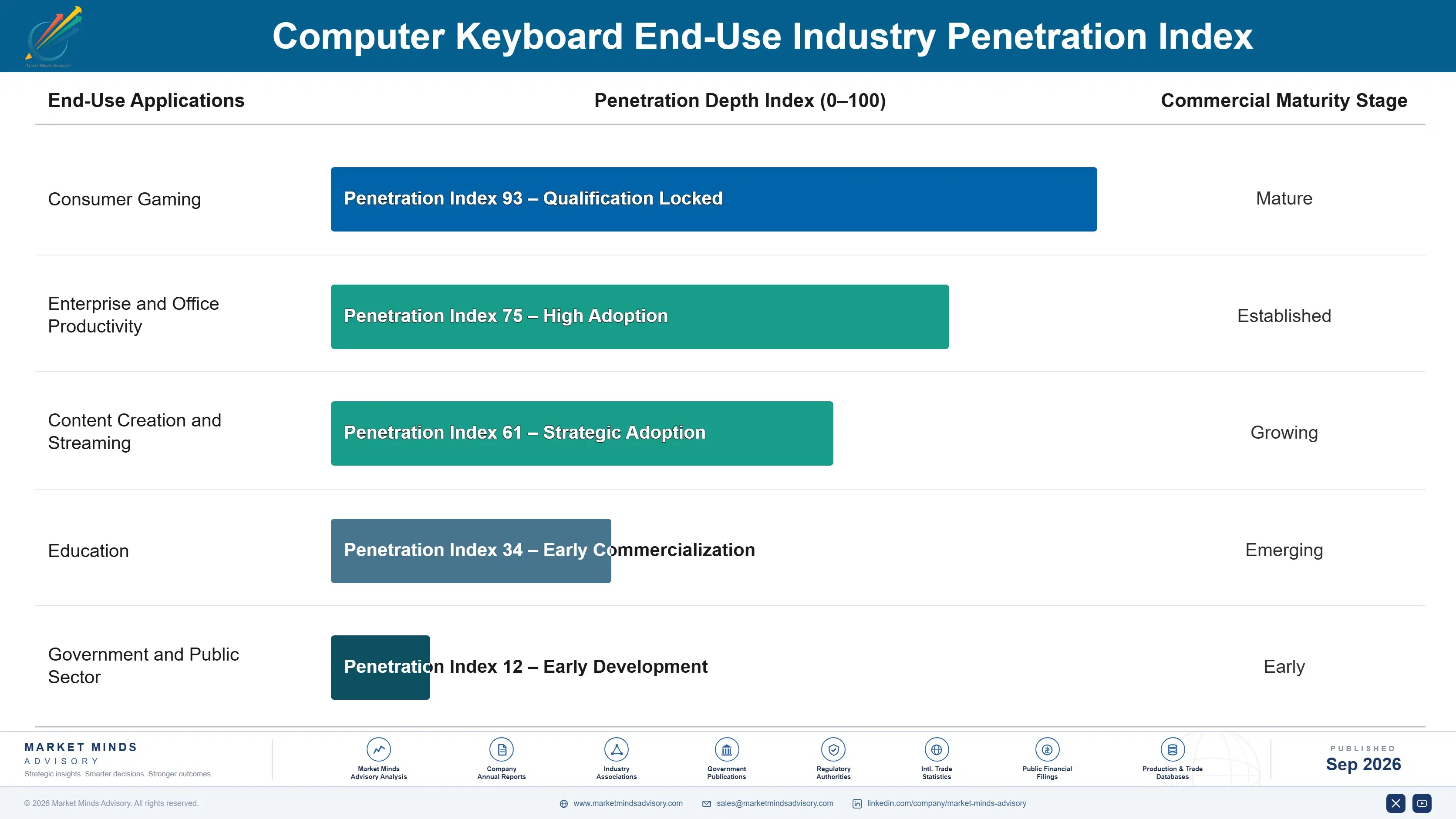
Computer keyboard revenue behaves less like a pure hardware annuity and more like a recurring upgrade relationship anchored to gaming culture trends and community-driven customization cycles. Once an enthusiast buyer invests in a brand's lineup of switches, keycaps, and companion software, switching brands means abandoning accumulated accessories and community standing, a costly and disruptive process most dedicated buyers avoid unless performance falls short considerably over several consecutive purchase cycles.
Adoption depth varies meaningfully by end-use vertical. Competitive gamers and professional typists show the deepest brand loyalty, since switch preference and customization investment built up over multiple purchase cycles become genuinely difficult to replicate with a new brand, while casual office buyers show comparatively weaker loyalty and shop more actively on price at each replacement point.

Buyer profiles are shifting generationally as younger, digitally native consumers who grew up immersed in gaming and streaming culture enter the market with materially higher performance and customization expectations than the office worker buyers who historically dominated this category, pushing average selling price and premium tier adoption steadily upward across the consumer buyer base as this generation gains purchasing power.
computing-device-keyboards-market-end-use-penetration-index-1789980310913

Where MMA Sees the Opportunity

These are among the four positions where our research anticipates prominent divergence between winners and laggards over the coming forecast period. Each is grounded in the demand model, the regulatory perimeter, and the announced capacity pipeline.
01 / MECHANICAL SWITCH INVESTMENT

Prioritize mechanical switch depth as the primary differentiator

Premium Mechanical Switch Keyboards is growing at roughly 10.5 percent annually against a market-wide 6.0 percent average, the widest gap of any covered segment. Brands that under-invest in switch durability will lose enthusiast deals to competitors offering demonstrably longer-lasting, more satisfying tactile feedback, since consumers increasingly benchmark brands directly against each other on independent durability testing. MMA views switch quality as the primary competitive battleground through 2036, ahead of pricing or brand recognition alone, since durability claims are now independently verifiable by third-party testing organizations.
02 / SOFTWARE BUNDLE EXPANSION

Build companion software revenue beyond core hardware

Companion software subscription bundles carry the industry's highest gross margins, well above standard hardware sales available to casual office buyers. Brands that pair core keyboards with customization software capture disproportionate deal value as enthusiast community engagement intensifies across major covered consumer markets worldwide. MMA expects software-attached revenue to outpace standalone hardware growth meaningfully across the coming decade for brands that execute this transition early and effectively, ahead of slower-moving competitors still reliant entirely on flat hardware pricing models with no attached software revenue.
03 / INDIA MARKET ENTRY

Prioritize India given its fastest national growth trajectory

India is growing at roughly 9.0 percent annually, the fastest of any covered country, driven by rapidly expanding gaming and esports participation alongside a growing organized retail electronics sector. Brands without localized distribution support risk ceding this expansion to regional specialists building compliant supply chains from the outset. MMA views early localized retail investment there as materially cheaper than later market entry once domestic incumbents establish local partnership networks and consumer trust that slower-moving latecomers will struggle to replicate quickly once the domestic market consolidates around early movers.
04 / RETENTION INFRASTRUCTURE INVESTMENT

Defend renewal economics through deeper loyalty lock-in

Switching cost from abandoning an accumulated collection of switches, keycaps, and companion software is the strongest retention lever available to incumbents, and it strengthens with every additional accessory purchase an enthusiast makes within one brand's product lineup. Brands should invest in deeper accessory and customization depth rather than competing purely on entry-level hardware pricing alone. MMA expects brands with the strongest customization depth to command premium renewal pricing well ahead of price-competitive challengers by 2036, particularly among the most dedicated enthusiast buyers.

Engagement Snapshot From the Field

A live engagement with an industry participant carrying material or product regulatory and market exposure ahead of a defining policy shift, showing how our research translates into a defensible multi-year portfolio strategy.
MARKET MINDS ADVISORY · CLIENT ENGAGEMENT SUMMARY
Computer Keyboard Producer Strategic Portfolio Review and Transition Roadmap 2026·Investment Scenario on Computer Keyboard Exposure Evaluation 2025-26
CLIENT PROFILE
The client is a global gaming peripheral brand selling keyboards, mice, and headsets across North America, Western Europe, and East Asia, with a product line historically anchored around mid-tier membrane and basic mechanical keyboards. Facing declining margin as competitors moved upmarket, the brand sought an independent assessment of premium repositioning options before committing capital to a full product line redesign.
STRATEGIC CHALLENGE
The brand's existing product line sat awkwardly between budget commodity offerings and premium enthusiast platforms, capturing neither price-sensitive buyers nor dedicated enthusiast loyalty effectively. Leadership needed clarity on whether a phased premium repositioning or continued mid-tier positioning better balanced brand risk against ongoing margin compression from both budget and premium directions simultaneously.
MMA APPROACH
MMA conducted structured interviews with product, marketing, and retail partnership leadership across four representative product categories, alongside a comparative technical assessment of five leading competitor brands' switch technology and community engagement strategies. The engagement benchmarked projected margin improvement against the brand's own historical retail sales data across the preceding two years.
KEY FINDINGS
  1. Mid-tier positioning captured a measurably smaller share of enthusiast repeat purchases than premium-positioned competitors offering comparable underlying switch technology and build quality.
  2. Product categories with the highest gaming focus showed the largest projected margin gains from premium repositioning relative to general productivity-focused categories in the portfolio.
  3. A phased premium repositioning reduced projected brand transition risk meaningfully compared to an abrupt full-line relaunch, per client-reported estimates shared during the engagement.
  4. Marketing staff reported measurably higher confidence in community engagement once premium positioning replaced the prior ambiguous, neither-budget-nor-premium brand messaging approach entirely across all channels.
CLIENT PROFILE
The client is a global gaming peripheral brand selling keyboards, mice, and headsets across North America, Western Europe, and East Asia, with a product line historically anchored around mid-tier membrane and basic mechanical keyboards. Facing declining margin as competitors moved upmarket, the brand sought an independent assessment of premium repositioning options before committing capital to a full product line redesign.
STRATEGIC CHALLENGE
The brand's existing product line sat awkwardly between budget commodity offerings and premium enthusiast platforms, capturing neither price-sensitive buyers nor dedicated enthusiast loyalty effectively. Leadership needed clarity on whether a phased premium repositioning or continued mid-tier positioning better balanced brand risk against ongoing margin compression from both budget and premium directions simultaneously.
MMA APPROACH
MMA conducted structured interviews with product, marketing, and retail partnership leadership across four representative product categories, alongside a comparative technical assessment of five leading competitor brands' switch technology and community engagement strategies. The engagement benchmarked projected margin improvement against the brand's own historical retail sales data across the preceding two years.
KEY FINDINGS
  1. Mid-tier positioning captured a measurably smaller share of enthusiast repeat purchases than premium-positioned competitors offering comparable underlying switch technology and build quality.
  2. Product categories with the highest gaming focus showed the largest projected margin gains from premium repositioning relative to general productivity-focused categories in the portfolio.
  3. A phased premium repositioning reduced projected brand transition risk meaningfully compared to an abrupt full-line relaunch, per client-reported estimates shared during the engagement.
  4. Marketing staff reported measurably higher confidence in community engagement once premium positioning replaced the prior ambiguous, neither-budget-nor-premium brand messaging approach entirely across all channels.
RECOMMENDED STRATEGY
Phase 1: Phase one: pilot premium repositioning across two representative product categories over four months, tracking margin and enthusiast community engagement gains closely. Phase 2: Phase two: expand premium positioning to remaining product categories across all covered regions while sunsetting mid-tier offerings incrementally across each product category. Phase 3: Phase three: negotiate expanded retail partnership agreements bundling companion software and community engagement programs across the entire product line going forward.
OUTCOME
The brand adopted the recommended phased premium repositioning, reporting a substantial improvement in gross margin within three quarters of full rollout (client-reported, unverified by MMA). Marketing staff previously consumed by ambiguous positioning messaging were redirected toward proactive community engagement work instead, strengthening overall brand loyalty.

Frequently Asked Questions

Foundational context covering the market sizes, CAGR, scope, country, region and competition that inform every finding below. This section is provided to cover basics and most often pre-purchase conversations, answered from the MMA Primary Research Dataset.

What is the current size of the Computer Keyboard Market?

The Computer Keyboard Market reached an estimated 8.5 billion dollars in 2025. Growth is driven by expanding gaming culture and premium mechanical switch adoption worldwide.

How large will the Computer Keyboard Market be by 2036?

MMA projects the market will reach approximately 16.14 billion dollars by 2036. This reflects sustained gaming culture growth and expanding ergonomic keyboard adoption across enterprises.

What is the CAGR for the Computer Keyboard Market 2026 to 2036?

The market is projected to grow at a 6.0 percent compound annual growth rate between 2026 and 2036. Bull and bear scenarios range from 4.8 to 7.2 percent.

Which segment is growing fastest?

Premium Mechanical Switch Keyboards is the fastest-growing segment, expanding at roughly 10.5 percent annually. This outpaces the overall market by nearly 1.8 times over the forecast period.

Who are the major companies in the Computer Keyboard Market?

Leading brands include Logitech, Razer, Corsair, HyperX, and Microsoft. Together these five brands hold an estimated 38 percent combined share on a market participation basis.

Which country is growing fastest?

India is the fastest-growing country, expanding at roughly 9.0 percent annually. Rapidly expanding gaming and esports participation is driving this accelerated growth trajectory across the region.

Report Segmentation Architecture

The full report scope spans multiple orthogonal segmentation dimensions, with cross-tabulated demand data provided for each dimension pair. Coverage extends further to regional breakdowns, trend trajectories, and the competitive detail needed to support segment-level decision-making.

By Switch Technology

  • Premium Mechanical Switch Keyboards
  • Wireless Low-Latency Gaming Keyboards
  • Membrane Switch Keyboards
  • Optical Switch Keyboards
  • Scissor Switch Keyboards
  • Hybrid Switch Keyboards

By End-Use Industry

  • Consumer Gaming
  • Enterprise and Office Productivity
  • Content Creation and Streaming
  • Education
  • Government and Public Sector

By Commercial Deployment Model

  • Direct Retail Hardware Sales
  • Companion Software Subscription Bundles
  • Extended Warranty and Accessory Bundles
  • Third-Party Switch Licensing Channels

By Region

  • North America
  • Western Europe
  • East Asia
  • South Asia and Pacific
  • Latin America
  • Middle East and Africa
  • Eastern Europe

Scope, Methodology, and Coverage

Every figure in this report is reproducible from documented input assumptions. The scope below maps the historical period, the forecast horizon, the segmentation dimensions, and the countries covered, alongside the underlying primary and qualitative methodology.
Historical Period
2020 to 2025
Forecast Period
2026 to 2036
Base Year
2025 (USD billions; MMA Primary Research Dataset, September 2026)
Market Definition
The Computer Keyboard Market covers physical keyboard hardware for desktop and laptop computing, including membrane, mechanical, and ergonomic designs sold as standalone peripherals or bundled accessories. It excludes virtual and on-screen keyboards, laptop built-in keyboards sold as part of an integrated device, and industrial keypad controllers outside general computing use.
Quantitative Units
USD billions, market share percent, CAGR percent
Segmentation Dimensions
Switch technology, end-use industry, commercial deployment model, region
Regions Covered
North America, Western Europe, East Asia, South Asia and Pacific, Latin America, Middle East and Africa, Eastern Europe
Countries Covered
United States, China, Germany, India, Japan, Brazil, and 14 additional countries across seven regions
Key Companies Profiled
Logitech, Razer, Corsair, HyperX, Microsoft, and 15 additional participants
Quantitative Methodology
Primary survey, n=3,800 respondents, Q4 2025, six countries; demand-side model with trade association cross-validation
Qualitative Methodology
47 expert interviews, Q4 2025; applied to validate demand model assumptions, identify emerging dynamics, and assess competitive positioning
Report Format
PDF and XLSX data workbook (Word format preview document)
Publisher
Market Minds Advisory
Report Code
MMA-2026-TEC-819
Published
September 2026
Contact
sales@marketmindsadvisory.com | www.marketmindsadvisory.com

Purchase the full Computer Keyboard Market Report (2026 to 2036).

This report delivers a complete assessment of the Computer Keyboard Market spanning sizing, segmentation, regional dynamics, and competitive positioning through 2036. It combines primary survey data from 3,800 respondents across six countries with 47 expert interviews conducted in the fourth quarter of 2025. Analysts detail segment-level growth drivers, regional demand mechanisms, and competitive moats among leading brands, alongside forward-looking scenario analysis. The report also profiles input cost exposure, portfolio economics, and companion software monetization strategies, supported by an anonymized client engagement case study drawn from a real advisory mandate.
Segment-level CAGR and market share breakdowns
Seven-region demand analysis with quantified drivers
Competitive landscape with moat and risk profiles
Input cost exposure and mitigation strategies
Portfolio tier economics and margin benchmarks
Anonymized client engagement case study analysis

Built For The People Who Decide

From boardroom strategy to bench-side execution, this report is read cover-to-cover by leaders shaping the next decade of their industry, turning demand scenarios, market dynamics and valuation benchmarks into decisions.
CXOs/ Presidents/ VPs/ Managers
M&A and Corporate Development
Strategy Teams and R&D Heads
Procurement and Product Directors
Regulatory and Compliance Leaders
Investor Relations and Equity Analysts