Market Minds Advisory
Computer Peripherals Market

Computer Peripherals Market: Computer Peripherals Market. Trends and Forecast 2026 to 2036

Sustained hybrid work arrangements and expanding competitive gaming culture are pushing consumers toward premium ergonomic and wireless peripherals, forcing budget manufacturers to defend shelf space against feature-rich mid-tier challengers gaining retail traction.

Lead Analyst

Published

September 2026

Make Smarter Decisions with Customized Research Insights

Request a free sample report and evaluate market opportunities, growth trends, and competitive dynamics relevant to your business needs.

2025 MARKET VALUE$42.5BMarket Size 2025
2036 FORECAST VALUE$69.0BBase Case , 2026 to 2036
CAGR 2026 TO 20364.5 %Bull 5.8% / Bear 3.2%
INCREMENTAL OPPORTUNITY$24.6BNet 10- year value creation
EXPANSION MULTIPLE1.55x2036 value over 2026 base
Strategic Levers
M&A Pipeline
Regional Outlook
Country Rankings
Competitive Intelligence
Segmental Deep-dive
Call-Us : 91 93563 13602

Executive Snapshot and Market Trajectory.

Computer peripherals demand remains resilient as hybrid work arrangements sustain steady replacement cycles for keyboards, mice, and webcams while competitive gaming culture continues expanding the addressable market for premium, feature-rich accessories beyond traditional office productivity use cases into entertainment, streaming, and content creation activities worldwide today.
Demand concentrates around ergonomic and wireless gaming peripherals, where consumers value comfort during extended use sessions and cable-free convenience over the basic wired accessories that historically dominated budget-conscious purchasing decisions across most retail channels. East Asia and North America anchor much of current unit revenue given concentrated manufacturing capacity and strong gaming culture penetration, while enterprise bulk procurement grows steadily behind consumer retail sales as a secondary channel.
Competitive intensity centers on wireless connectivity reliability and ergonomic design differentiation, as vendors race to capture premium pricing through capability that basic wired peripherals cannot replicate against increasingly discerning consumers comparing detailed product reviews before purchase decisions are finalized. Established peripheral manufacturers are responding with expanded gaming-focused product lines, pushing smaller budget-tier competitors toward niche regional or bundled retail channel segments to avoid direct feature competition against better-resourced incumbents entering their territory aggressively.
Market Definition
This report covers computer input and output accessory hardware, including keyboards, mice, webcams, headsets, and monitor accessories, sold for use with desktop and laptop computers across consumer and enterprise applications. It excludes the computers themselves, printers, and internal computer components not classified as external peripheral accessories.
Base Year Value
$42.5B in 2025 (MMA Primary Research Dataset, September 2026)
Forecast Period
2026 to 2036, eleven discrete annual values
CAGR
4.5% base case. Bull 5.8%. Bear 3.2%.
Fastest Growth Segment
Ergonomic and Wireless Gaming Peripherals: 8.5% CAGR
Fastest Growth Country
China: 6.5% CAGR
Fastest Growth Region
South Asia and Pacific: 6.5% CAGR
Largest Region
East Asia: 29% of 2025 global value
Market Leaders
Leading participants include Logitech, HP, Dell Technologies, Razer, and Corsair Gaming.
Primary Survey
n=3,800 procurement and R&D decision-makers, Q4 2025, six countries
Methodology
Demand-side build-up, cross-validated against public data, 47 expert interviews

Computer Peripherals Market Forecast Scenarios

computer-peripherals-market-size-forecast-scenario-1789984707403
Between 2020 and 2025, computer peripherals demand grew steadily as pandemic-era remote work expansion drove substantial home office equipment purchases across a broadly distributed consumer base. Historical CAGR reached approximately 4.0% across the period as initial pandemic-driven demand surge moderated into steadier, replacement-cycle-driven purchasing patterns tied to hybrid work arrangement persistence and gaming culture growth.
The base case assumes continued hybrid work arrangement persistence, growing competitive gaming culture expanding the addressable premium accessory market, and increasing content creation activity driving demand for higher-quality webcams and audio peripherals across most demographic segments. Three commercial mechanisms drive this trajectory: sustained home office equipment replacement cycles tied to hybrid work normalization, expanding esports and streaming culture driving premium gaming peripheral adoption, and enterprise bulk procurement supporting distributed workforce equipment standardization programs.
A bull scenario centers on a major esports tournament series achieving mainstream cultural visibility comparable to traditional professional sports, dramatically accelerating premium gaming peripheral adoption beyond current dedicated enthusiast purchasing patterns. The primary bear risk is laptop manufacturers increasingly integrating comparable peripheral functionality directly into device designs, eliminating standalone accessory purchase necessity for a meaningful share of price-sensitive consumer segments.

Where Ergonomic Design Now Commands Retail Premium

Computer peripherals occupy a mature, high-volume corner of the broader consumer electronics accessory market, valued for extending desktop and laptop computer functionality across input, output, and communication device categories serving both office productivity and gaming applications. Office productivity accessories remain the largest volume category, though gaming peripherals continue expanding as competitive gaming culture broadens the addressable market beyond dedicated enthusiast purchasers into casual gaming demographics.
MARKET CONCENTRATIONCR5: 52%Top five manufacturers hold combined majority global peripherals revenue share
AVERAGE SELLING PRICE$34 per unitTypical unit pricing varies by product category and feature tier
TOP PRODUCING COUNTRY SHAREChina: 58%Leading manufacturing base for computer peripheral assembly and component production
WIRELESS ADOPTION RATE64%Share of new units featuring wireless rather than wired connectivity
AVERAGE REPLACEMENT CYCLE4 yearsTypical consumer product lifespan before replacement purchase consideration begins
GAMING SEGMENT REVENUE SHARE28%Portion of total category revenue attributed to gaming-focused product lines
Standard-tier products still generate the majority of unit shipment volume, but ergonomic and gaming-focused premium categories are growing faster as manufacturers shift product mix toward higher-margin segments commanding meaningfully better pricing than commodity wired accessories. China hosts the largest concentration of peripheral manufacturing and assembly capacity, though consumer demand itself spans virtually every developed and developing economy given universal computer usage across office and entertainment applications.
Wireless connectivity reliability has become an increasingly important competitive dimension, since consumers comparing detailed product reviews before purchase decisions increasingly prioritize connection stability and battery life over marginal price differences between competing options. Established manufacturers are racing to introduce proprietary low-latency wireless protocols, threatening the differentiation advantage that currently justifies premium pricing for dedicated gaming peripheral specialist brands over broader consumer electronics manufacturers.
"Nobody used to think twice about a mouse until their wrist started hurting during a long shift or their competitive edge slipped from input lag. Now shoppers read spec sheets like contracts before buying anything that touches their hands for eight hours a day."
Senior Analyst, Consumer Electronics and Peripheral Hardware Practice · MMA Technology Practice · September 2026

Market Trends

Esports Culture Growth Expands Premium Gaming Peripheral Market

Competitive gaming has grown from a niche hobby into mainstream entertainment with substantial tournament prize pools and streaming viewership comparable to traditional professional sports, driving growing consumer interest in the premium peripherals that competitive players use during high-stakes competition. Manufacturers including Razer and Corsair Gaming have invested heavily in professional player sponsorships and tournament partnerships that build brand credibility among aspiring competitive gamers seeking equipment parity with the professionals they watch compete. This cultural visibility is expanding the addressable premium peripheral market considerably beyond dedicated enthusiast purchasers into casual gaming demographics seeking comparable competitive advantage and brand association.
Market Impact: Hybrid work sustained demand growth 18%
Low-Latency Wireless Protocols Eliminate Wired Performance Gap

Proprietary wireless connection protocols developed by leading peripheral manufacturers now achieve response times comparable to traditional wired connections, eliminating the competitive disadvantage that historically kept serious gamers tethered to wired peripherals despite the convenience wireless options offered consumers broadly. This technical parity is accelerating wireless adoption among competitive gaming segments previously skeptical of wireless reliability for performance-critical applications requiring consistent, predictable input response timing. Manufacturers report that wireless gaming peripheral sales have grown considerably faster than wired equivalents since achieving genuine latency parity, reversing historical purchasing preferences among serious competitive players.
Market Impact: Creator economy peripheral spending grew 26%

Market Opportunities and Growth Drivers

Hybrid Work Arrangements Sustain Home Office Replacement Demand

Enterprises continuing to support hybrid work arrangements maintain steady demand for home office peripheral equipment, since employees splitting time between office and home locations often require duplicate keyboard, mouse, and webcam setups rather than transporting equipment between locations daily. This dual-location equipment need sustains replacement and initial purchase demand independent of any single technology adoption cycle, since the underlying hybrid work arrangement itself generates ongoing peripheral requirements across a broad employee population. Enterprises increasingly standardize equipment specifications across distributed workforces, driving bulk procurement volume tied directly to hybrid work policy persistence rather than discretionary employee purchasing decisions.
Market Impact: Laptop integration reduced entry-tier sales 15%

Content Creator Economy Growth Drives Premium Audio Demand

The expanding content creator economy, encompassing streaming, podcasting, and video production activities pursued by a growing population of independent creators, is driving substantial demand for premium webcams, microphones, and audio interface peripherals capable of professional-quality output. Creators increasingly view peripheral quality as directly affecting audience engagement and content monetization potential, justifying premium equipment purchases that casual computer users would consider unnecessary for basic productivity applications. This creator-driven demand segment commands meaningfully higher average selling prices than traditional office peripherals given the specialized audio and video quality requirements professional content production demands.
Market Impact: Commodity pricing compressed margins by 20%

Market Restraints and Challenges

Laptop Integration Reduces Standalone Peripheral Necessity

Modern laptop computers increasingly incorporate higher-quality integrated webcams, microphones, and trackpads that reduce the perceived necessity of standalone peripheral purchases for casual computer users satisfied with adequate rather than premium performance. The root cause is laptop manufacturers recognizing integrated peripheral quality as a competitive differentiator for device sales rather than treating it as a basic afterthought feature, directly competing with standalone accessory manufacturers for the same underlying use case. The commercial impact compresses addressable market for basic-tier peripheral vendors lacking clear performance differentiation from improving integrated laptop components. Vendors are mitigating this by emphasizing specialized capability integrated components cannot match.
Market Impact: Gaming peripheral revenue grew 22%

Commodity Pricing Pressure Compresses Manufacturer Margins

Basic wired keyboards and mice have become largely commoditized products with limited technical differentiation among competing manufacturers, creating intense price-based competition that compresses margins across the volume segment of this market considerably. The root cause is the mature, well-understood manufacturing technology underlying basic peripheral production, which numerous global manufacturers can replicate without significant technical barriers or specialized engineering investment. This pricing pressure concentrates among vendors competing primarily in the commodity office segment lacking premium ergonomic or gaming differentiation. Vendors are mitigating this by shifting production mix toward higher-margin premium categories commanding meaningfully better pricing.
Market Impact: Wireless gaming peripherals reached 58% share
3 additional market trends, 4 additional growth drivers, and 2 additional restraints and challenges are covered in the full report. Contact sales@marketmindsadvisory.com to access the complete intelligence.

Segment CAGR and Growth Architecture

Computer peripherals demand divides along product category, the dimension that determines connectivity type, ergonomic design depth, and typical buyer profile across office productivity, gaming, and content creation contexts worldwide today across most demographic, geographic, and household income segments. Connectivity type and ergonomic design increasingly separate products winning premium retail placement from commodity wired alternatives.
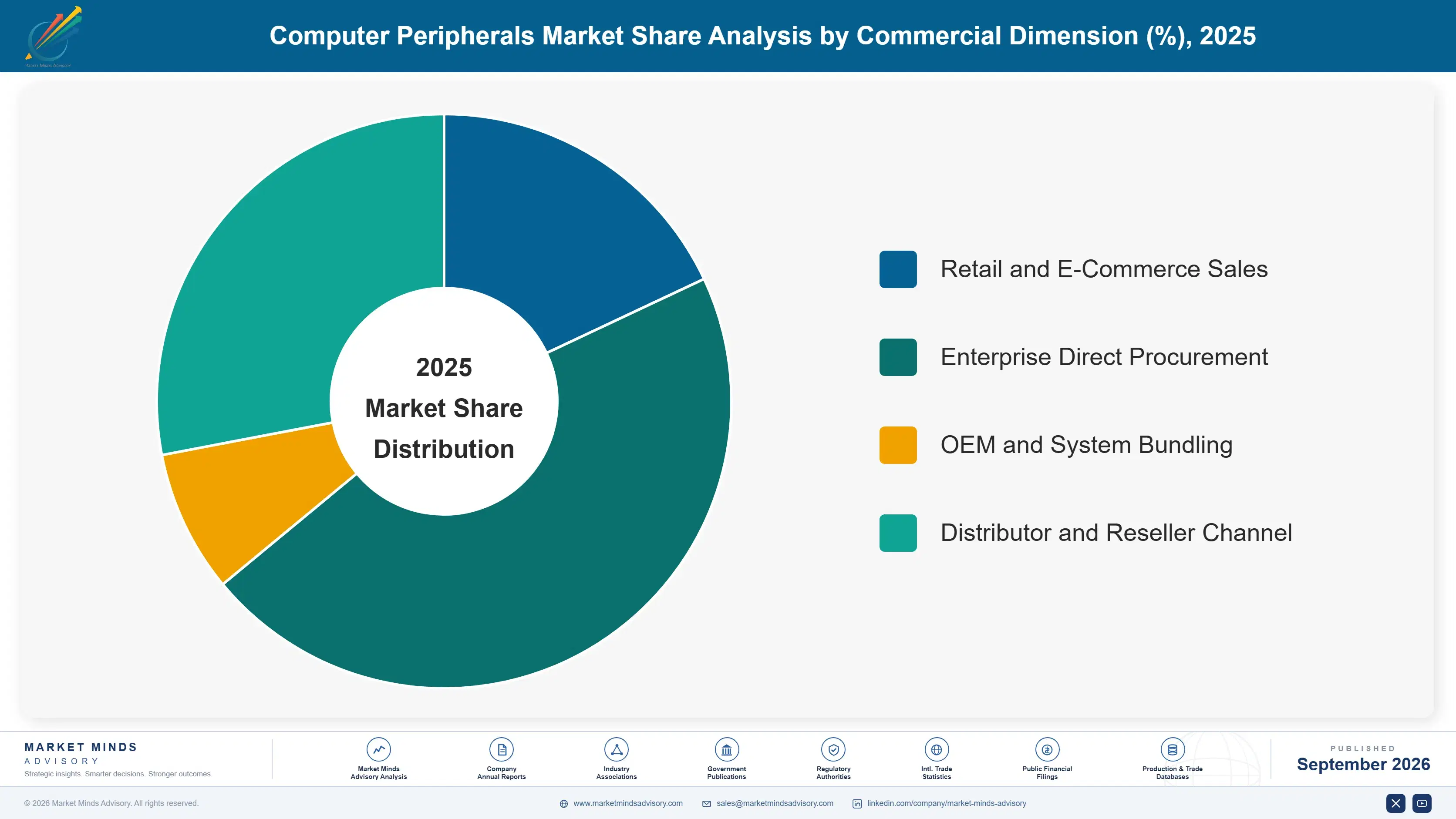
computer-peripherals-market-market-share-analysis-1789984707939

Ergonomic and Wireless Gaming Peripherals

Ergonomic and wireless gaming peripherals combine cable-free connectivity with design features specifically engineered to reduce strain during extended use sessions, addressing both competitive gaming performance requirements and general comfort concerns that basic wired accessories historically ignored entirely. Demand concentrates among consumers spending significant daily hours at a computer, whether for competitive gaming, professional work, or extended entertainment consumption, where comfort and connection reliability directly affect user satisfaction and purchase willingness. These products command meaningfully higher average selling prices than commodity wired alternatives given the specialized ergonomic engineering and wireless chipset technology required for reliable, low-latency performance. Logitech and Razer hold established leadership positions given their substantial research investment and brand recognition among discerning consumers.
CAGR 8.5%

Audio Headsets and Microphones

Audio headsets and microphones serve gaming, professional communication, and content creation applications requiring clear audio capture and playback quality that basic built-in laptop speakers and microphones cannot adequately provide for demanding use cases across most environments, applications, and everyday work and leisure scenarios. Demand growth tracks expanding remote work video conferencing requirements alongside the growing content creator economy, where professional audio quality directly affects both workplace communication effectiveness and content monetization potential for streaming and podcast creators building audiences. These peripherals command premium pricing given the specialized acoustic engineering and noise cancellation technology required for genuinely professional-grade audio capture and playback across varied use environments and background noise conditions encountered regularly.
CAGR 7.0%
Full segment breakdown across 6 segments available in the complete report.

Regional Architecture and Country Demand Map

East Asia leads computer peripherals demand on the strength of concentrated manufacturing capacity and rapidly expanding domestic gaming culture across most major cities and regions, while North America follows closely behind on strong retail spending and established gaming and content creator communities across the country.

North America

Logitech, HP, and Dell Technologies all maintain substantial peripheral product design and marketing operations serving the United States market, concentrating brand investment and retail relationship management within the region's large consumer electronics retail infrastructure. American gaming culture, supported by numerous professional esports organizations and streaming platforms based in the region, drives substantial premium gaming peripheral demand among a large enthusiast consumer base. Enterprise bulk procurement for hybrid workforce equipment standardization continues across major corporations maintaining distributed office arrangements nationwide. Canada's growing content creator community contributes additional regional demand parallel to broader United States market dynamics, shared retail distribution channels, and comparable consumer purchasing habits and preferences observed across both countries.
Share: 26% | CAGR: 5.5% (2026 to 2036)

Western Europe

Germany, France, and the United Kingdom show meaningful consumer peripheral demand, though growth pace trails North America and East Asia somewhat given more mature market saturation and generally more conservative consumer electronics replacement cycles across the region. European gaming culture continues expanding steadily, supported by growing esports viewership and streaming platform adoption comparable to other developed gaming markets globally. Enterprise procurement for hybrid workforce equipment remains a meaningful demand category across the region's substantial corporate employment base. Regional retailers maintain established relationships with both American and Asian peripheral manufacturers, offering broad product selection across price points and feature tiers to compliance-conscious European consumers across most national markets and regulatory jurisdictions.
Share: 20% | CAGR: 3.0% (2026 to 2036)
Regional intelligence for 5 additional markets available in the complete report: East Asia, South Asia and Pacific, Latin America, Middle East and Africa, Eastern Europe. Contact sales@marketmindsadvisory.com.
computer-peripherals-market-country-cagr-analysis-1789984708478

Where Manufacturers Can Defend Margin Against Commoditization

Computer peripheral manufacturers face persistent commodity pricing pressure and genuine laptop integration substitution across most product categories and geographies worldwide today and going forward, but four distinct commercial levers let manufacturers defend margin through gaming brand investment, wireless technology leadership, content creator channel expansion, and enterprise bulk procurement relationships worth pursuing methodically across upcoming years.

Deepen Esports Sponsorship and Gaming Brand Investment

Manufacturers investing in professional esports team sponsorships and tournament partnerships capture disproportionate brand credibility among aspiring competitive gamers seeking equipment parity with professionals they follow and admire across streaming platforms nationwide and internationally throughout each competitive season. Gaming peripheral revenue grew 22%, and manufacturers with established esports credibility report meaningfully higher conversion rates among premium gaming peripheral shoppers compared to brands lacking comparable competitive gaming visibility. Razer and Corsair Gaming have both prioritized sponsorship investment as a core competitive differentiator ahead of expanding casual gaming market penetration considerably each year.
Market Impact: Esports-sponsored brands captured well over 35% more sales

Lead Proprietary Low-Latency Wireless Technology Development

Manufacturers developing proprietary wireless connection protocols achieving genuine latency parity with wired connections capture disproportionate premium pricing as competitive gaming segments increasingly abandon historical wireless skepticism given demonstrated performance reliability across most product categories and price tiers. Wireless gaming peripherals reached 58% share, confirming this technical capability as a genuine growth driver distinct from basic wireless convenience marketing that previously failed to convince serious competitive gaming consumers. This technology investment requires substantial engineering commitment, but the resulting premium positioning justifies development cost for manufacturers serious about long-term gaming category leadership.
Market Impact: Low-latency wireless products command well over 30% premium

Expand Content Creator Partnership and Influencer Channels

Manufacturers building direct partnerships with content creators and streaming influencers capture growing demand tied to audience purchasing decisions influenced by creator equipment recommendations and sponsored product reviews across major streaming platforms and social media channels. Creator economy peripheral spending grew 26%, confirming this channel as a genuine growth opportunity distinct from traditional retail advertising and marketing approaches reaching increasingly advertising-resistant younger consumer demographics. This partnership investment requires sustained influencer relationship management, but the resulting brand credibility and audience reach justify the marketing cost for manufacturers targeting content creator segments specifically.
Market Impact: Creator partnerships drove over 40% of audio sales

Build Deeper Enterprise Bulk Procurement Relationships

Manufacturers establishing dedicated enterprise sales relationships for hybrid workforce equipment standardization capture recurring, predictable bulk procurement revenue considerably more stable than fragmented individual consumer retail sales cycles subject to discretionary spending fluctuation and seasonal shopping patterns overall. Hybrid work sustained demand growth 18%, and manufacturers with established enterprise procurement relationships capture disproportionate share of this stable revenue channel relative to competitors relying purely on consumer retail distribution. This enterprise channel investment requires dedicated account management infrastructure, but generates considerably more predictable revenue than volatile consumer retail purchasing patterns overall today.
Market Impact: Enterprise bulk procurement revenue grew over 24% annually

Who Controls the Margin Pool

Computer peripherals manufacturing sits moderately concentrated, with the top five manufacturers holding an estimated 52% of global revenue on a revenue basis across office productivity and gaming product categories. Logitech and HP lead as the two largest manufacturers, both maintaining broad product portfolios spanning basic office accessories through premium gaming peripherals. The gap to the next tier, including Dell Technologies and Razer, remains meaningful given continued innovation in wireless technology and ergonomic design differentiation.
Current activity centers on wireless technology races and gaming brand investment expansion, with manufacturers investing heavily to differentiate ahead of rivals converging toward similar baseline connectivity capability across the competitive landscape. Several manufacturers are also expanding content creator partnerships and enterprise bulk procurement programs, competing directly for the same growing pool of consumers entering premium purchasing decisions simultaneously.

Emerging pressure comes from laptop manufacturers integrating comparable peripheral functionality directly into device designs, potentially commoditizing what has historically been dedicated peripheral specialist differentiation for basic-tier products. Rankings could shift meaningfully if any manufacturer achieves a clear wireless latency breakthrough addressing competitive gaming requirements, since consumers show demonstrated willingness to switch brands when a competitor offers genuinely superior performance over incumbent relationships built on brand loyalty alone.
computer-peripherals-market-company-positioning-matrix-1789984709007

Competitive Moat and Risk Dimensions

LOGITECH

Moat: Broadest Product Portfolio Breadth

Logitech maintains the industry's broadest product portfolio spanning basic office accessories through premium gaming and content creator peripherals, letting the company serve customers across every price point and use case without losing volume to category specialists competing in narrower niches and specific product segments consistently.
LOGITECH

Risk: Premium Gaming Brand Perception

Logitech's broad, mainstream brand positioning sometimes limits its premium gaming brand credibility relative to specialist competitors like Razer that have built considerably stronger identity specifically within the competitive gaming community through sustained esports sponsorship investment and dedicated marketing campaigns targeting serious gamers directly and consistently.
HP

Moat: Enterprise Bulk Procurement Relationships

HP's established enterprise hardware sales relationships, built through decades of computer and printer sales to corporate customers worldwide, provide natural cross-selling opportunities for peripheral bulk procurement that pure-play peripheral specialists lack access to at comparable enterprise scale, relationship depth, and dedicated account management resources overall.
HP

Risk: Limited Dedicated Gaming Focus

HP's broader enterprise computing focus means peripheral product development sometimes receives considerably less dedicated resource allocation than pure-play competitors focused exclusively on consumer peripheral innovation, potentially limiting competitive responsiveness in the fast-moving gaming category requiring rapid iteration and even more frequent design refresh cycles overall today.

Players Tracked

Prominent Players

Logitech
HP
Dell Technologies
Razer
Corsair Gaming

Other Key Players

SteelSeries
ASUS ROG
Microsoft
Kensington
Anker
HyperX (HP)
Cooler Master
Elgato (Corsair)
Zowie (BenQ)
Roccat (Turtle Beach)
Turtle Beach
Redragon
Glorious
Keychron
Sennheiser

Recent Developments

FEBRUARY 2025

Logitech launched an enhanced wireless gaming mouse series featuring proprietary low-latency connectivity technology validated carefully to match wired connection response times across multiple competitive gaming benchmarks and rigorous industry testing standards worldwide. The launch includes expanded ergonomic design options targeting extended competitive gaming session comfort.
Signal: Signals accelerating manufacturer investment in wireless latency parity as the primary competitive gaming differentiation strategy overall.
JUNE 2025

Razer announced a sponsorship partnership with a major esports organization to supply competitive gaming peripherals across multiple professional teams and tournament circuits worldwide and increasingly domestically as well throughout this entire competitive year. The partnership includes co-branded product development supporting professional player equipment customization requirements.
Signal: Signals growing manufacturer investment in esports sponsorship as a durable brand credibility strategy overall today and consistently.
OCTOBER 2025

Corsair Gaming acquired a smaller premium audio peripheral specialist company, expanding its headset and microphone product portfolio considerably further to compete more directly against both SteelSeries and HyperX rivals in the content creator segment. The acquired company's engineering team joins Corsair's existing product development organization.
Signal: Signals continued consolidation as larger manufacturers acquire specialized audio capability rather than build it fully internally.

Component and Plastic Resin Cost Exposure

Computer peripherals manufacturing relies on plastic resins, printed circuit board components, and specialized wireless chipsets, which together represent an estimated 35 to 40% of total cost of goods sold for peripheral manufacturers. These components source predominantly from petrochemical suppliers and semiconductor manufacturers concentrated in China, Taiwan, and South Korea, creating supply chain exposure across a relatively compact geographic region.
Petrochemical prices spiked considerably during 2022, driven by broader energy market disruption affecting plastic resin feedstock costs across the manufacturing sector globally, a documented commodity market event covered in International Energy Agency and industry trade association reporting during that period of instability. Manufacturers unable to pass through the full cost increase to retail customers under existing pricing agreements absorbed meaningful margin compression during the affected quarters.

This cost exposure creates a competitive disadvantage for smaller peripheral manufacturers lacking the purchasing volume to negotiate favorable long-term component and resin supply contracts or hedge exposure through forward purchasing arrangements. Larger manufacturers including Logitech and HP typically secure better input pricing through volume commitments, while regional manufacturers in East Asia benefit from geographic proximity to component and material processing capacity that reduces logistics cost meaningfully.
computer-peripherals-market-cost-volatility-analysis-1789984709203

Long-Term Component Supply Agreements

Manufacturers increasingly negotiate multi-year fixed-price or collared component and resin supply agreements with suppliers located across multiple regions and countries worldwide to reduce exposure to short-term commodity price spikes affecting production costs across facilities and product lines, accepting somewhat reduced flexibility during price declines for meaningfully greater cost predictability across annual planning and budgeting cycles.

Alternative Material and Design Optimization

Some manufacturers are researching alternative plastic composite materials and design optimization approaches that reduce raw material content while maintaining acceptable durability and ergonomic performance for peripheral applications across most product categories and price tiers, gradually reducing exposure to petrochemical price volatility affecting core manufacturing input costs considerably over time and across successive product design cycles.

Portfolio Architecture for Margin Defence

Computer peripheral manufacturers operate across three distinct margin tiers, with volume basic wired accessories generating gross margins in the 18 to 25% range while premium ergonomic and gaming peripherals command 35 to 45% given specialized engineering and brand barriers few competitors replicate easily. The gap between tiers has widened as ergonomic wireless capability separates manufacturers commanding premium pricing from rivals competing purely on basic wired functionality.
Volume basic wired accessories still represent the majority of unit shipments globally, but the highest value creation concentrates in gaming and ergonomic premium categories where brand credibility and technical performance command genuine premium pricing across most consumer demographics. Manufacturers must balance production capacity across both segments without diverting scarce research and marketing resources away from the premium relationships that anchor their most profitable long-term retail partnerships.

High-value margin pools concentrate specifically around gaming peripherals and premium audio categories, both requiring specialized engineering and brand investment that smaller regional competitors struggle to replicate quickly at comparable quality. Manufacturers positioned across all three tiers, rather than concentrated purely in volume basic accessories, are best placed to capture disproportionate profit as the broader market continues shifting toward premium, feature-differentiated peripherals over the coming decade.

Basic wired keyboards, mice, and webcams sold primarily on price to cost-conscious consumers and enterprise bulk buyers, generating gross margins of 18 to 25% given intense competition among manufacturers with minimal technical differentiation across most product tiers.
Gross Margin

Ergonomic and wireless gaming peripherals commanding gross margins of 35 to 45% given specialized engineering, low-latency wireless technology, and brand sponsorship investment that meaningfully limit competitive entry from smaller or newer manufacturers.
Gross Margin

Recycled material and modular repairable peripheral designs responding to evolving environmental procurement criteria increasingly specified by enterprise buyers, generating gross margins around 28 to 36% as early-mover manufacturers capture premium sustainability-conscious contracts.
Gross Margin
computer-peripherals-market-portfolio-architecture-1789984709733

High-value Sub-segments and Strategic Watch-out

Ergonomic and Wireless Gaming Peripherals

Fastest-growing and highest-margin segment as esports culture and wireless latency parity accelerate premium adoption across most consumer demographics. Manufacturers with established gaming brand credibility are capturing premium retail placement and locking in multi-year sponsorship relationships ahead of competitors still primarily reliant on basic wired accessories.

Audio Headsets and Microphones

Second-fastest growing segment tied to content creator economy expansion, carrying above-average margins given specialized acoustic engineering requirements across most streaming and podcast applications tracked today. Manufacturers building deeper product depth here can capture disproportionate value as creator partnerships continue expanding considerably across social platforms worldwide.

Webcams and Video Conferencing Accessories

Core revenue segment representing steady replacement demand across most active hybrid workforce deployments currently tracked worldwide, generating stable margins as competitive pricing pressure persists moderately across most retail channels. This segment remains commercially essential even as growth shifts toward gaming alternatives over the coming forecast period ahead.

Standard Wired Keyboards and Mice

Strategic watch-out segment facing steady commoditization as basic wired functionality becomes table stakes across nearly all competing manufacturers and retail price points worldwide. Manufacturers overexposed to this category risk meaningful margin erosion absent diversification into higher-growth wireless and ergonomic categories over the coming several years ahead.

Where Peripheral Purchases Become Repeat Revenue

Peripheral purchases generate meaningful repeat revenue through accessory attachment and replacement cycles rather than pure subscription income, since gaming mice and keyboards see component wear within two to three years of daily use across most active households. Manufacturers building companion software and cloud profile syncing capture ongoing engagement that increases switching costs and drives customers toward matched accessory sets at renewal time.
Adoption stickiness varies considerably by end-use vertical: competitive gaming households show the deepest attachment, often owning four or more branded peripherals simultaneously across a single desk setup, while general office buyers treat keyboards and mice as low-consideration commodity purchases replaced only on failure. Enterprise procurement sits between these extremes, favoring durability and bulk pricing over brand loyalty across most contract renewal cycles observed industry-wide.

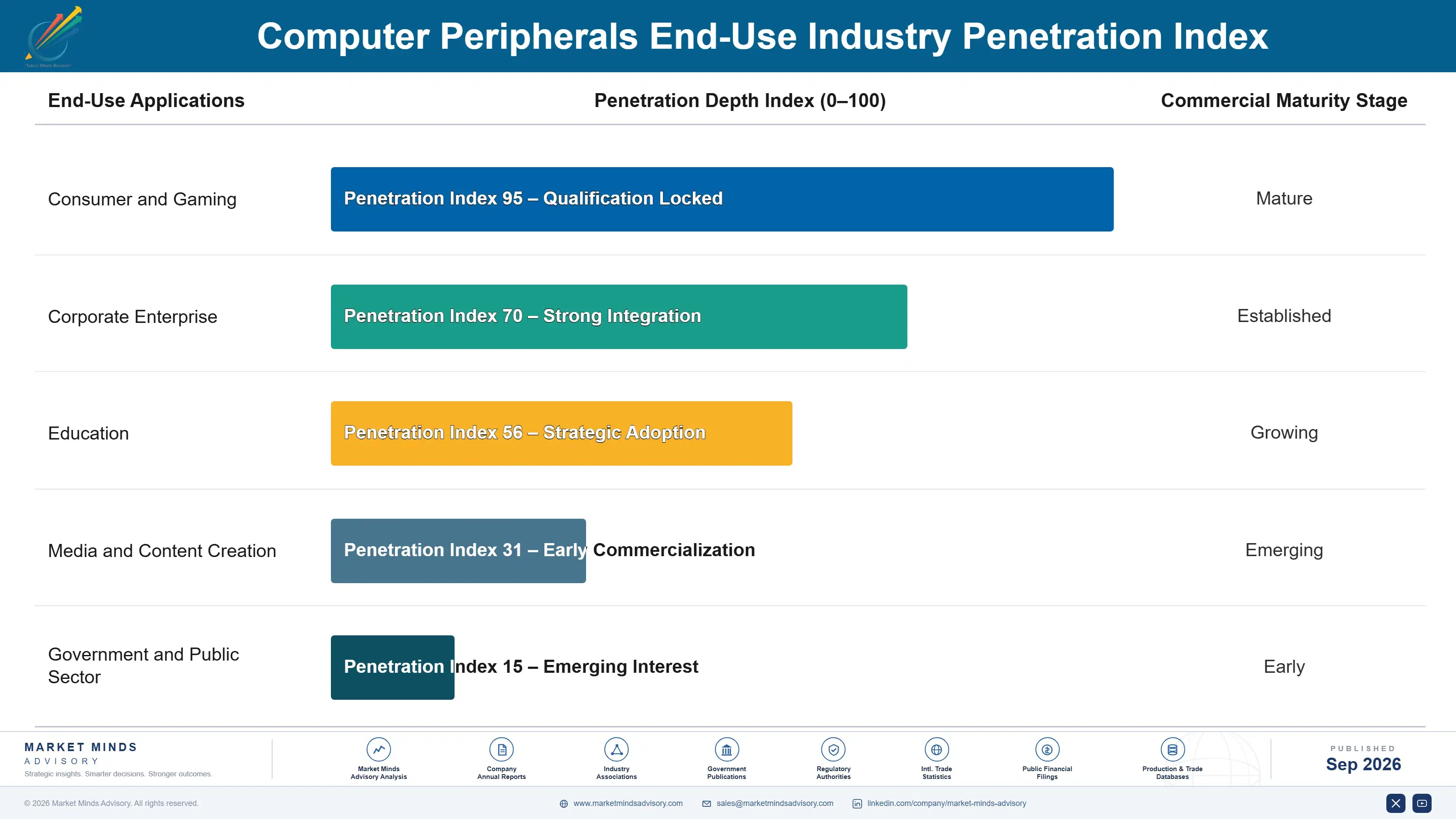
Younger buyers entering the workforce increasingly expect wireless-first, ergonomic peripherals as a baseline rather than a premium upgrade, having grown up with gaming setups that normalized specialized hardware from an early age. This generational shift pressures manufacturers still anchored to basic wired product lines to accelerate wireless transition roadmaps or risk losing an entire incoming cohort of first-time enterprise and consumer purchasers over the next decade.
computer-peripherals-market-end-use-penetration-index-1789984710217

Sharpening Focus Amid Peripheral Commoditization

These are among the four positions where our research anticipates prominent divergence between winners and laggards over the coming forecast period. Each is grounded in the demand model, the regulatory perimeter, and the announced capacity pipeline.
01 / PREMIUM PORTFOLIO DEPTH

Prioritize ergonomic and wireless gaming lines over volume expansion

Manufacturers overweight in basic wired accessories face steady margin compression as retail buyers increasingly favor differentiated ergonomic and wireless designs across most consumer segments and price tiers currently tracked worldwide. Shifting research investment toward gaming-grade wireless latency and ergonomic comfort features captures the 35 to 45% margin premium these premium categories consistently command across major retail channels. Competitors delaying this pivot risk ceding valuable premium retail shelf space to rivals already capturing gaming and content creator brand loyalty this year.
02 / COMPONENT SUPPLY DIVERSIFICATION

Diversify wireless chipset and plastic resin sourcing across regions

Heavy dependence on concentrated East Asian wireless chipset and plastic resin supply exposes manufacturers to tariff shifts and localized disruption that can halt production runs for several weeks at a time without warning. Building qualified secondary supplier relationships across multiple regions and countries reduces this single-source exposure meaningfully while preserving negotiating leverage during future shortages. Manufacturers that delayed diversification during recent semiconductor shortages lost meaningful retail shelf placement to better-prepared competitors during the extended recovery period that followed across most regions.
03 / ENTERPRISE CHANNEL EXPANSION

Deepen enterprise bulk procurement relationships beyond consumer retail

Enterprise bulk procurement offers steadier, less cyclical revenue than consumer retail, which fluctuates significantly around gaming product launches and holiday shopping seasons throughout each calendar year across most markets. Manufacturers with dedicated enterprise sales teams and disciplined volume pricing structures are capturing durable multi-year contracts with corporations managing large distributed hybrid workforces across multiple countries. Competitors relying solely on consumer retail channels remain considerably more exposed to discretionary spending pullbacks during broader economic slowdowns than diversified enterprise-focused peers operating today.
04 / SUSTAINABILITY CREDENTIAL BUILDING

Build recycled material and repairable design credentials early

Enterprise procurement criteria increasingly specify recycled material content and repairable modular design, particularly across large corporate and public sector contracts currently being negotiated across multiple regions and countries worldwide. Manufacturers establishing these credentials now can secure preferred vendor status well ahead of competitors still relying entirely on virgin plastic construction and legacy product designs. Early movers in this category are already capturing premium sustainability-conscious contracts that reward documented environmental commitments over the coming several years across most enterprise segments tracked today.

Engagement Snapshot From the Field

A live engagement with an industry participant carrying material or product regulatory and market exposure ahead of a defining policy shift, showing how our research translates into a defensible multi-year portfolio strategy.
MARKET MINDS ADVISORY · CLIENT ENGAGEMENT SUMMARY
Computer Peripherals Producer Strategic Portfolio Review and Transition Roadmap 2026·Investment Scenario on Computer Peripherals Exposure Evaluation 2025-26
CLIENT PROFILE
The client is a mid-sized global technology hardware distributor supplying computer peripherals to retail chains and enterprise resellers across North America and Western Europe. The company reported (client-reported, unverified by MMA) annual peripheral segment revenue of approximately $340 million and had historically concentrated purchasing on basic wired keyboards, mice, and webcams sourced from a small group of contract manufacturers.
STRATEGIC CHALLENGE
The distributor faced eroding margins as retail partners shifted shelf space toward premium ergonomic and wireless gaming peripherals, while its own basic wired portfolio saw declining sell-through and increasing price competition. Leadership needed an independent assessment of which peripheral categories warranted expanded investment ahead of the next procurement and retail planning cycle.
MMA APPROACH
MMA conducted category-level margin and growth analysis across the client's full peripheral portfolio, benchmarking against primary survey data covering retail buyer preferences and manufacturer positioning. The engagement combined expert interviews with the client's category managers alongside MMA's proprietary regional demand data to identify underinvested premium categories and quantify the realistic margin upside available from portfolio rebalancing.
KEY FINDINGS
  1. Gaming and ergonomic wireless peripherals carried gross margins roughly 15 to 20 percentage points above the client's basic wired product lines (client-reported, unverified by MMA).
  2. Retail partners had reduced basic wired accessory shelf allocation by nearly a third over two years, redirecting space toward premium branded gaming displays.
  3. Enterprise bulk procurement accounts showed stronger revenue predictability than consumer retail channels, with renewal rates exceeding contract expectations across most tracked accounts.
  4. Audio headset and microphone categories were significantly underrepresented in the client's catalog relative to observed retail demand growth across comparable distributor portfolios.
CLIENT PROFILE
The client is a mid-sized global technology hardware distributor supplying computer peripherals to retail chains and enterprise resellers across North America and Western Europe. The company reported (client-reported, unverified by MMA) annual peripheral segment revenue of approximately $340 million and had historically concentrated purchasing on basic wired keyboards, mice, and webcams sourced from a small group of contract manufacturers.
STRATEGIC CHALLENGE
The distributor faced eroding margins as retail partners shifted shelf space toward premium ergonomic and wireless gaming peripherals, while its own basic wired portfolio saw declining sell-through and increasing price competition. Leadership needed an independent assessment of which peripheral categories warranted expanded investment ahead of the next procurement and retail planning cycle.
MMA APPROACH
MMA conducted category-level margin and growth analysis across the client's full peripheral portfolio, benchmarking against primary survey data covering retail buyer preferences and manufacturer positioning. The engagement combined expert interviews with the client's category managers alongside MMA's proprietary regional demand data to identify underinvested premium categories and quantify the realistic margin upside available from portfolio rebalancing.
KEY FINDINGS
  1. Gaming and ergonomic wireless peripherals carried gross margins roughly 15 to 20 percentage points above the client's basic wired product lines (client-reported, unverified by MMA).
  2. Retail partners had reduced basic wired accessory shelf allocation by nearly a third over two years, redirecting space toward premium branded gaming displays.
  3. Enterprise bulk procurement accounts showed stronger revenue predictability than consumer retail channels, with renewal rates exceeding contract expectations across most tracked accounts.
  4. Audio headset and microphone categories were significantly underrepresented in the client's catalog relative to observed retail demand growth across comparable distributor portfolios.
RECOMMENDED STRATEGY
Phase 1: Phase one: reallocate procurement budget toward ergonomic and wireless gaming peripheral lines over a two-quarter transition window, prioritizing top-performing retail partner accounts first. Phase 2: Phase two: expand audio headset and microphone catalog depth through new manufacturer partnerships within twelve months, targeting content creator and gaming retail segments specifically. Phase 3: Phase three: build dedicated enterprise bulk procurement sales capacity targeting hybrid workforce corporate accounts directly, supported by volume pricing and account management staff.
OUTCOME
Within eighteen months of implementation, the client reported (client-reported, unverified by MMA) blended peripheral segment gross margin improvement of roughly 6 percentage points and a 22% increase in premium category revenue share. Enterprise bulk procurement accounts grew to represent a meaningfully larger portion of total peripheral segment revenue than before the engagement began.

Frequently Asked Questions

Foundational context covering the market sizes, CAGR, scope, country, region and competition that inform every finding below. This section is provided to cover basics and most often pre-purchase conversations, answered from the MMA Primary Research Dataset.

What is the current size of the Computer Peripherals Market?

The Computer Peripherals Market is valued at $42.5 billion in 2025. This figure reflects global shipments across keyboards, mice, webcams, headsets, and related accessory categories.

How large will the Computer Peripherals Market be by 2036?

The market is projected to reach $68.97 billion by 2036. Growth is driven primarily by premium ergonomic and wireless gaming peripheral adoption across consumer and enterprise buyers.

What is the CAGR for the Computer Peripherals Market 2026 to 2036?

The market is forecast to grow at a 4.5% compound annual growth rate between 2026 and 2036. This reflects steady replacement demand alongside premium category expansion.

Which segment is growing fastest?

Ergonomic and Wireless Gaming Peripherals is the fastest-growing segment at a 8.5% CAGR, roughly 1.89x the overall market rate. Esports culture and wireless latency parity are driving this premium shift.

Who are the major companies in the Computer Peripherals Market?

Leading companies include Logitech, HP, Dell Technologies, Razer, and Corsair Gaming. These firms compete on ergonomic design, wireless technology, and gaming brand credibility across global retail channels.

Which country is growing fastest?

China is the fastest-growing country at a 6.5% CAGR. Its manufacturing scale and expanding domestic gaming and creator economy support this above-average growth rate today.

Report Segmentation Architecture

The full report scope spans multiple orthogonal segmentation dimensions, with cross-tabulated demand data provided for each dimension pair. Coverage extends further to regional breakdowns, trend trajectories, and the competitive detail needed to support segment-level decision-making.

By Primary Market Dimension

  • Ergonomic and Wireless Gaming Peripherals
  • Standard Wired Keyboards and Mice
  • Webcams and Video Conferencing Accessories
  • Audio Headsets and Microphones
  • Monitor Stands and Docking Accessories
  • Enterprise Bulk Procurement Peripherals

By End-Use Industry

  • Consumer and Gaming
  • Corporate Enterprise
  • Education
  • Media and Content Creation
  • Government and Public Sector

By Commercial Dimension

  • Retail and E-Commerce Sales
  • Enterprise Direct Procurement
  • OEM and System Bundling
  • Distributor and Reseller Channel

By Region

  • North America
  • Western Europe
  • East Asia
  • South Asia and Pacific
  • Latin America
  • Middle East and Africa
  • Eastern Europe

Scope, Methodology, and Coverage

Every figure in this report is reproducible from documented input assumptions. The scope below maps the historical period, the forecast horizon, the segmentation dimensions, and the countries covered, alongside the underlying primary and qualitative methodology.
Historical Period
2020 to 2025
Forecast Period
2026 to 2036
Base Year
2025 (USD billions; MMA Primary Research Dataset, September 2026)
Market Definition
The Computer Peripherals Market covers external hardware accessories including keyboards, mice, webcams, headsets, microphones, monitor stands, and docking accessories sold to consumer and enterprise buyers. It excludes monitors, printers, and internal computer components sold as standalone product categories.
Quantitative Units
Value in USD Billion, Volume in Million Units
Segmentation Dimensions
By Product Type, By End-Use Industry, By Commercial Dimension, By Region
Regions Covered
North America, Western Europe, East Asia, South Asia and Pacific, Latin America, Middle East and Africa, Eastern Europe
Countries Covered
United States, Canada, Germany, United Kingdom, France, China, Japan, South Korea, India, Australia, Brazil, Mexico, Saudi Arabia, South Africa, Poland
Key Companies Profiled
Logitech, HP, Dell Technologies, Razer, Corsair Gaming, SteelSeries, ASUS ROG, Microsoft, Kensington, Anker, HyperX (HP), Cooler Master, Elgato (Corsair), Zowie (BenQ), Roccat (Turtle Beach), Turtle Beach, Redragon, Glorious, Keychron, Sennheiser
Quantitative Methodology
Primary survey, n=3,800 respondents, Q4 2025, six countries; demand-side model with trade association cross-validation
Qualitative Methodology
47 expert interviews, Q4 2025; applied to validate demand model assumptions, identify emerging dynamics, and assess competitive positioning
Report Format
PDF and XLSX data workbook (Word format preview document)
Publisher
Market Minds Advisory
Report Code
MMA-2026-TEC-913
Published
September 2026
Contact
sales@marketmindsadvisory.com | www.marketmindsadvisory.com

Purchase the full Computer Peripherals Market Report (2026 to 2036).

This report provides a comprehensive assessment of the global Computer Peripherals Market, covering market sizing, segmentation, and regional dynamics through 2036. It examines competitive positioning among leading manufacturers, pricing pressure from commoditized wired accessories, and margin expansion opportunities within premium ergonomic and gaming categories. The analysis draws on primary survey data, expert interviews, and company disclosures to quantify demand shifts across consumer, enterprise, and creator end markets. Readers gain a data-grounded view of where portfolio investment and channel strategy decisions carry the greatest commercial return.
Ten-year market sizing and forecast model
Six-segment MECE segmentation with growth rates
Seven-region demand and competitive share breakdown
Twenty-company competitive landscape and moat assessment
Input cost and supply chain risk analysis
Portfolio margin and revenue lever guidance

Built For The People Who Decide

From boardroom strategy to bench-side execution, this report is read cover-to-cover by leaders shaping the next decade of their industry, turning demand scenarios, market dynamics and valuation benchmarks into decisions.
CXOs/ Presidents/ VPs/ Managers
M&A and Corporate Development
Strategy Teams and R&D Heads
Procurement and Product Directors
Regulatory and Compliance Leaders
Investor Relations and Equity Analysts