Market Minds Advisory
Fluoropolymers Market

Fluoropolymers Market: A Producer Walking Away, Battery Binder Overbuild, and Fluorspar Nobody Can Hedge

One of the five largest producers announced it was leaving the business entirely on its own initiative. In a market running at 71% utilisation with concentrated feedstock, that decision reshapes everything downstream.

Lead Analyst

Bilal Shaikh

Published

September 2026

Make Smarter Decisions with Customized Research Insights

Request a free sample report and evaluate market opportunities, growth trends, and competitive dynamics relevant to your business needs.

2025 MARKET VALUE$9.4BMarket Size 2025
2036 FORECAST VALUE$17.8BBase Case , 2026 to 2036
CAGR 2026 TO 20366.0 %Bull 7.2% / Bear 4.8%
INCREMENTAL OPPORTUNITY$7.9BNet 10- year value creation
EXPANSION MULTIPLE1.79x2036 value over 2026 base
Strategic Levers
M&A Pipeline
Regional Outlook
Country Rankings
Competitive Intelligence
Segmental Deep-dive
Call-Us : 91 93563 13602

Executive Snapshot and Market Trajectory

A major producer deciding to exit an industry on reputational grounds rather than commercial ones is rare, and this market has just watched it happen. That withdrawal removes real capacity from a business already running at 71% utilisation with feedstock nobody can hedge. Nobody had expected that particular exit.
Commercial advantage belongs to producers with upstream fluorine integration and applications where substitution is genuinely impossible, because everything else in this portfolio faces either regulatory or Chinese cost pressure. PVDF resin grows fastest at 8.8%, roughly 1.47 times the market. East Asia holds the largest position at 33% of value, above the standard band, on Chinese capacity built through the past decade.
Concentration is high at roughly 54% for the top five, sustained by fluorine chemistry very few companies operate safely. PTFE alone accounts for 55% of tonnage and grows slowly. Battery binder demand took 14% of PVDF consumption and then met capacity built for a much faster electric vehicle ramp than actually arrived. Absorbing capacity built for a faster ramp will occupy several years of growth that producers had planned to spend on margin recovery.
Market Definition
The market comprises fluoropolymer resins supplied in pellet, powder, granule, and dispersion form to converters and compounders, covering PTFE resin, PVDF resin, FEP and PFA resins, ETFE and ECTFE resins, fluoroelastomers, and fluoropolymer dispersions for coating. Value is measured at resin producer level. Converted film, sheet, tubing and moulded parts, applied coatings and finished linings, fluorinated gases and refrigerants, fluorosurfactants and processing aids sold separately, and non-fluorinated engineering polymers fall outside scope.
Base Year Value
$9.4B in 2025 (MMA Primary Research Dataset, August 2026)
Forecast Period
2026 to 2036, eleven discrete annual values
CAGR
6.0% base case. Bull 7.2%. Bear 4.8%.
Fastest Growth Segment
PVDF Resin: 8.8% CAGR
Fastest Growth Country
India: 9.4% CAGR
Fastest Growth Region
South Asia and Pacific: 8.2% CAGR
Largest Region
East Asia: 33% of 2025 global value
Market Leaders
Chemours, Daikin Industries, Syensqo, AGC, and 3M lead on fluoropolymer resin capacity and revenue. Source: company annual reports and MMA Analysis, July 2026.
Primary Survey
n=3,800 procurement and R&D decision-makers, Q4 2025, six countries
Methodology
Demand-side build-up, cross-validated against public data, 47 expert interviews

Fluoropolymers Market Forecast Scenarios

fluoropolymers-market-size-forecast-scenario-1787551425061
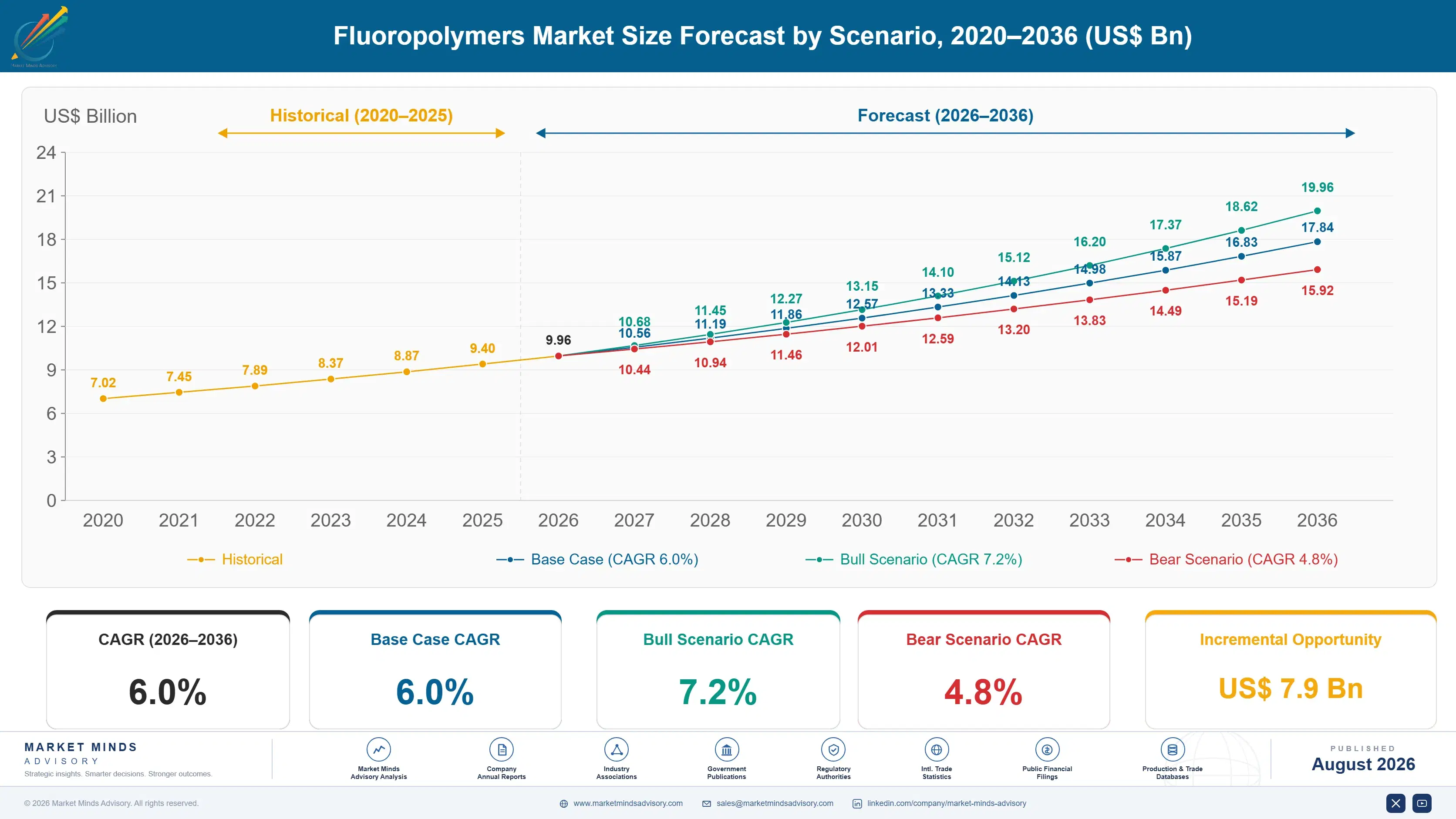
The 2020 to 2025 period delivered a demand boom and a reputational crisis at the same time. Lithium battery binder pulled PVDF demand up sharply, producers built capacity against electric vehicle forecasts that proved optimistic, and pricing collapsed when the lines started. A major producer announced its exit from the entire substance class. The 4.7% historical rate averages genuine growth against an industry questioning its future in some jurisdictions.
The 6.0% base case rests on three mechanisms. Semiconductor manufacture keeps expanding into fluoroelastomer and high-purity resin demand that no alternative chemistry serves at all. Chemical process, hydrogen, and energy infrastructure investment pulls lining and membrane resin steadily. And electric vehicle production continues growing even at moderated rates, which slowly absorbs the PVDF capacity that overshot the original demand curve. None of the three depends on the regulatory question resolving favourably.
The 7.2% bull case assumes regulators exempt high molecular weight polymers while battery demand recovers toward earlier projections. The 4.8% bear case reflects a European restriction capturing fluoropolymers directly, further battery capacity additions in China depressing PVDF pricing, and customers in less demanding applications substituting away simply to remove regulatory uncertainty from their own supply chains.

Concentrated Chemistry Under Pressure

PTFE dominates tonnage at 55% and contributes very little of the growth, which distorts how this market gets described. It is mature, widely produced, and increasingly supplied from China at prices Western producers meet only in the highest specification grades. Everything interesting is happening in the other 45%: PVDF, fluoroelastomers, and the high-purity grades that semiconductor and chemical process customers cannot source anywhere else.
TOP-FIVE CONCENTRATION54%Combined share of resin capacity held by leading producers
PTFE VOLUME SHARE55%Portion of total tonnage accounted for by one polymer
AVERAGE REALISED PRICEUSD 21 per kilogramBlended across resin grades and polymer types sold
BATTERY BINDER DEMAND SHARE14%Portion of PVDF consumption entering lithium cell manufacture
FLUORSPAR COST SHARE27%Portion of production cost traced to upstream mineral feedstock
CAPACITY UTILISATION71%Average operating rate measured across all global polymerisation assets
Battery binder was the growth story and it became a capacity lesson. PVDF binds cathode material in lithium cells and demand rose fast enough that producers on three continents committed new lines simultaneously against electric vehicle forecasts. Those forecasts moderated, the lines started anyway, and pricing fell hard. Battery binder still takes 14% of PVDF consumption and the capacity built for it will take years to absorb.
Underneath all of it sits fluorspar at 27% of production cost, concentrated in China and Mexico, priced by export policy rather than by any market mechanism, and impossible to hedge through any financial instrument. Producers with upstream integration treat that as an internal transfer. Everybody else carries a commodity exposure they never deliberately chose and cannot lay off anywhere.
"The industry keeps explaining that its polymers are chemically inert and biologically unavailable, which is true and has not helped much. Regulators are looking at the manufacturing, the disposal, and the substance class as a whole, and a producer walking away entirely was a more persuasive argument than anything the technical papers said."
Practice Director, High-Performance Polymers and Fluorochemicals · MMA High-Performance Polymers Practice · August 2026

Market Trends

A Major Producer Exits on Reputational Rather Than Commercial Grounds

Announcing withdrawal from an entire substance class while the business remains profitable is not a normal industrial decision, and it removes capacity from a market already concentrated among very few operators. Customers holding qualified positions on that supply face requalification measured in years rather than months. Remaining producers gain volume and inherit the question of whether they will face the same pressure themselves. Capacity utilisation at 71% masks how tight specific high-purity grades have become since the announcement. Nobody in this industry has a precedent for how to plan around a competitor leaving voluntarily.
Market Impact: Seals command 40 times commodity pricing
Battery Binder Capacity Overshot the Electric Vehicle Ramp

PVDF demand for lithium cathode binder rose fast enough that producers across three continents committed new polymerisation capacity within roughly the same eighteen months, all sized against electric vehicle forecasts that subsequently moderated. The lines started regardless, because polymerisation capital cannot be paused halfway. Pricing fell sharply and has not recovered. Battery binder still takes 14% of PVDF consumption and continues growing, but absorbing the capacity built for a faster ramp will occupy several years of that growth. Polymerisation assets cannot be idled economically once commissioned, which makes overbuild corrections in this industry unusually prolonged.
Market Impact: East Asia holds 33% of value

Market Opportunities and Growth Drivers

Semiconductor Manufacture Requires Chemistry With No Substitute

Wafer fabrication uses fluoroelastomer seals in plasma etch chambers and high-purity fluoropolymer resin throughout wet chemical handling, and neither has any alternative material that survives the conditions. Perfluoroelastomer seals in particular price at levels that look absurd until you consider what a chamber contamination event costs. Advanced node capacity expansion across Taiwan, Korea, Japan, and the United States pulls this demand steadily. Qualification runs for years, which protects incumbent positions once they are properly established. Perfluoroelastomer components price at roughly 40 times commodity resin and customers barely negotiate, because the alternative is a contamination event.
Market Impact: Precautionary switching affects 11% of demand

Chinese Capacity Sets Pricing Across Commodity Grades

Dongyue, Juhua, and Shanghai 3F built substantial fluoropolymer capacity through the past decade and now supply PTFE and increasingly PVDF at prices Western producers cannot approach on a comparable cost base. That capacity sits alongside domestic fluorspar and hydrofluoric acid supply, which compounds the advantage considerably. East Asia holds 33% of value, above the standard regional band, largely because of it. Western producers respond by retreating into high-purity and specialty grades where qualification still matters. Retreating into specialty grades improves mix and worsens fixed cost absorption at the same time, which is an uncomfortable trade.
Market Impact: Feedstock is 27% of production cost

Market Restraints and Challenges

Regulatory Uncertainty Alone Drives Precautionary Customer Substitution

Customers in less demanding applications are switching away from fluoropolymers not because an alternative performs better but because they want the regulatory question out of their own supply chain entirely. The root cause is uncertainty rather than any restriction actually in force. Producers mitigate by documenting surfactant-free manufacturing rather than describing it, by supporting the scientific case for high molecular weight polymers explicitly, and by concentrating on applications where substitution is genuinely impossible rather than merely inconvenient. The easy volume leaves first while genuinely irreplaceable applications stay entirely intact, which improves mix and reduces tonnage together.
Market Impact: Removes capacity at 71% utilisation

Fluorspar Concentration Cannot Be Hedged Financially

Feedstock at 27% of production cost traces to mineral supply concentrated in China and Mexico, with pricing driven by export policy and environmental enforcement rather than by any exchange-traded mechanism. No instrument exists to hedge it. The root cause is geological concentration compounded by policy. Producers mitigate through upstream hydrofluoric acid integration, through multi-year mineral supply agreements, and by recovering fluorine from process streams and end-of-life material that was previously discarded without any recovery attempt. Producers buying monomer on spot terms are carrying an unhedged commodity position they never deliberately decided to hold at all.
Market Impact: Binder takes 14% of PVDF volume
4 additional market trends, 3 additional growth drivers, and 2 additional restraints and challenges are covered in the full report. Contact sales@marketmindsadvisory.com to access the complete intelligence.

Segment CAGR and Growth Architecture

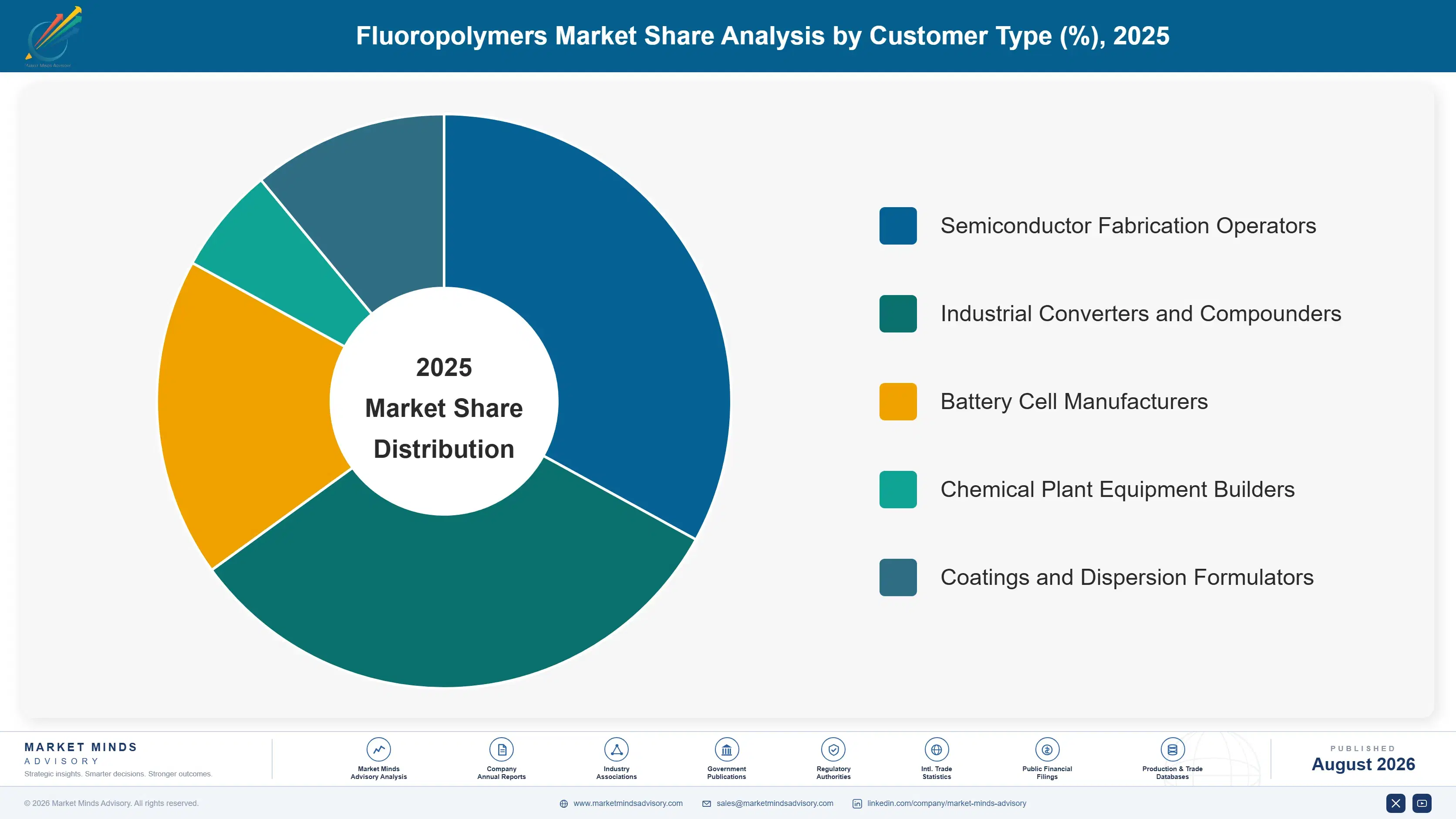
Segmentation follows polymer type, because each fluoropolymer carries a distinct processing route, temperature capability, and application set that determines both its growth rate and its exposure to substitution. Six types cover commercial supply, and the divide between mature high-tonnage PTFE and the specialty grades carrying nearly all the growth matters more than any property comparison between them.
fluoropolymers-market-market-share-analysis-1787551425628

PVDF Resin

The fastest type at 8.8%, roughly 1.47 times the market, and the one that taught this industry an expensive lesson about capacity timing. Lithium cathode binder demand rose sharply, producers on three continents committed lines within eighteen months of each other, and pricing collapsed when they all started against a moderated electric vehicle ramp. Binder still takes 14% of PVDF consumption and grows steadily. Architectural coating resin, chemical process linings, membrane applications, and separator coating all contribute demand that faces no comparable capacity overhang at present. Architectural coating resin in particular has grown steadily without any of the volatility that battery demand introduced, which makes it a useful counterweight inside the same polymer line.
CAGR 8.8%

ETFE and ECTFE Resins

Second fastest at 7.6%, serving architectural membrane structures, chemical process equipment lining, and wire insulation in demanding environments. ETFE carries the architectural growth on large-span stadium, transport, and atrium projects where lightweight transparency has no practical substitute available. ECTFE serves chemical containment and semiconductor fabrication lining where permeation resistance matters more than clarity. Both are produced by very few companies at genuinely commercial scale. Project-driven demand makes forecasting harder than volume markets, though pipelines are visible several years ahead. Producing either at commercial scale requires copolymerisation control that very few operators have mastered, and the resulting supply concentration is considerably tighter than the volume figures alone would suggest to anybody reading them.
CAGR 7.6%
Full segment breakdown across 6 segments available in the complete report.

Regional Architecture and Country Demand Map

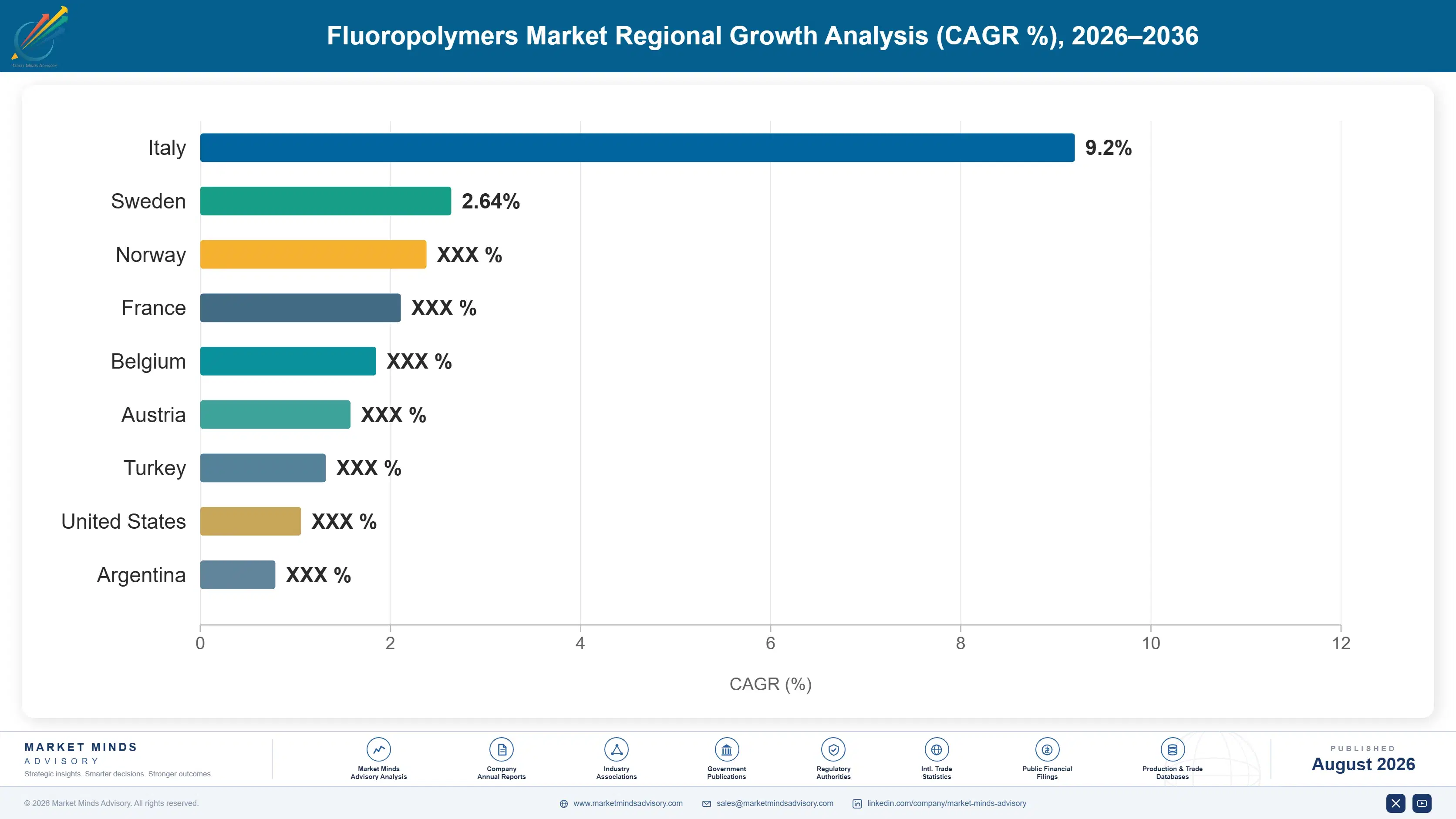
Regional shares follow polymerisation capacity and the electronics, energy, and process industry demand around it. East Asia sits above the standard band for the reason stated below, and every other region falls inside its range throughout the forecast period. Capacity location predicts value better than demand does.

North America

Semiconductor fabrication expansion under domestic manufacturing incentives pulls the highest-value resin and fluoroelastomer demand anywhere, at pricing that reflects the absence of any substitute material. Chemours operates significant integrated capacity with upstream fluorine chemistry attached. The producer exit announcement originated here and its capacity withdrawal affects North American customers most directly, since requalification runs for years. Chemical process, aerospace, and oil and gas applications add steady volume. Growth of 5.8% depends on semiconductor conversion offsetting commodity grade pressure from imported material. Fluoroelastomer demand for plasma etch chamber seals is the highest-value volume in the region by a considerable margin, and qualification with each tool platform runs independently. Pricing barely features in those discussions.
Share: 22% | CAGR: 5.8% (2026 to 2036)

Western Europe

Regulatory uncertainty over the proposed universal restriction shapes commercial behaviour more than demand does, with customers in less demanding applications substituting away simply to remove the question from their supply chains. Syensqo and Arkema hold established production positions and engage directly in the regulatory process. Semiconductor, pharmaceutical equipment, and hydrogen electrolyser membrane demand all remain strong where no alternative exists. Energy costs add a further competitive burden against Asian producers. Growth of 4.4% is the slowest anywhere, held back by precautionary substitution rather than any application decline. Hydrogen electrolyser membrane demand is growing from a small base and represents one of the few applications where European policy actively creates fluoropolymer demand rather than questioning it.
Share: 19% | CAGR: 4.4% (2026 to 2036)
Regional intelligence for 5 additional markets available in the complete report: East Asia, South Asia and Pacific, Latin America, Middle East and Africa, Eastern Europe. Contact sales@marketmindsadvisory.com.
fluoropolymers-market-country-cagr-analysis-1787551426164

Four Moves Worth Real Capital

Advantage here comes from owning fluorine upstream, holding applications where nothing else works, and answering a regulatory question with evidence rather than argument. Four moves justify capital across the forecast period, and the first addresses the exposure that no commercial arrangement can offset. Three of the four assume the regulatory question stays unresolved for years.

Integrate upstream into the fluorine chemistry chain

Feedstock at 27% of production cost traces to fluorspar concentrated in China and Mexico, priced by export policy rather than by any market mechanism, with no financial instrument available to hedge it. Producers holding hydrofluoric acid and monomer capacity treat that as an internal transfer while everybody else carries an unhedgeable commodity position. Integration is expensive and slow, and multi-year mineral agreements plus process stream recovery close part of the gap for producers who cannot build it. Recovery of fluorine from process and end-of-life streams closes a further part of the gap at moderate capital cost.
Market Impact: Removes the 27% of cost sitting upstream entirely

Capture requalification demand from the exit

A major producer withdrawing removes qualified supply that customers cannot replace quickly, since requalification in semiconductor, medical, and aerospace applications runs for years rather than months. Those customers are actively seeking alternatives now and will hold the resulting positions for a decade. Producers who move quickly on qualification support, sampling, and technical documentation capture volume that will not come up again. Utilisation at 71% means the capacity exists to serve it without any new investment at all. Customers have in several cases offered to fund the qualification work themselves, which is not something this industry usually sees.
Market Impact: Fills the capacity sitting idle at 71% utilisation

Publish manufacturing evidence, not position papers

Customers substituting away are responding to regulatory uncertainty rather than to any performance question, and 11% of demand is exposed to that precautionary behaviour. Documented surfactant-free polymerisation with published emissions data addresses it in a way industry advocacy does not. Producers who converted early can show results while competitors describe intentions. The conversion costs process development over 18 to 24 months and it removes the only criticism of this industry that has no technical answer available. Verified third-party confirmation carries considerably more weight with a procurement risk function than any internal declaration ever manages to.
Market Impact: Addresses the 11% of demand facing precautionary substitution

Retreat deliberately into the irreplaceable applications instead

PTFE at 55% of tonnage is increasingly Chinese-supplied at prices Western producers cannot match, and defending that volume consumes capital better spent elsewhere. Semiconductor fluoroelastomer seals, high-purity handling resin, and hydrogen membrane grades all price on the absence of alternatives rather than on cost. Perfluoroelastomer seals command roughly 40 times commodity resin pricing for exactly that reason. Retreating deliberately is a strategy; retreating because volume left is simply a slower version of the same outcome. Reconfiguring the affected polymerisation assets rather than simply idling them is what separates a managed retreat from a slow decline.
Market Impact: Exits the contested 55% of total global tonnage

Who Controls the Margin Pool

Concentration is high at roughly 54% for the top five on resin capacity and revenue, sustained by fluorine chemistry that very few organisations operate safely and by decades of accumulated qualification. Chemours and Daikin lead across the broadest ranges with upstream integration. Syensqo holds strong European and PVDF positions, AGC anchors ETFE and electronic grades, and 3M remains a top-five producer while executing its announced withdrawal.
Competition runs on three dimensions. Upstream fluorine integration is the first, since it determines who carries feedstock exposure and who does not. Application irreplaceability is the second, because pricing follows the absence of alternatives rather than cost. Regulatory documentation is the third, and it now decides accounts that used to turn on technical performance alone. Technical performance now decides fewer accounts than it used to.

Pressure is building from two directions nobody in the industry controls. European regulatory decisions will determine market access there regardless of any commercial response. Chinese producers with integrated fluorspar supply set pricing across commodity grades permanently. Rankings will shift toward producers holding integration and irreplaceable applications together rather than toward whoever polymerises the most tonnage. Polymerisation tonnage has stopped being a useful measure of anything here.
fluoropolymers-market-company-positioning-matrix-1787551426700

Competitive Moat and Risk Dimensions

CHEMOURS

Moat: Upstream fluorine integration and breadth

Chemours operates fluorspar-derived chemistry through to finished resin, which converts the industry's largest unhedgeable cost exposure into an internal transfer. Product breadth across PTFE, PFA, FEP, and PVDF serves customers needing several qualified materials from one source. Qualification histories accumulated across semiconductor, chemical, and industrial applications over decades cannot be purchased or accelerated by anybody arriving now.
CHEMOURS

Risk: Legacy chemistry litigation exposure

Historical fluorosurfactant use carries litigation and remediation liability that colours how regulators and customers assess the company independently of current manufacturing practice. That association weakens the industry argument that modern production belongs outside a universal restriction. Competitors without comparable history make the same case more credibly, whatever the underlying technical merits of either position happen to be.
DAIKIN INDUSTRIES

Moat: Integrated fluorochemical and application breadth

Daikin runs fluorine chemistry from feedstock through refrigerants, resins, and elastomers, which spreads fixed cost across product lines and secures monomer supply internally. Strong positions in semiconductor-grade materials and fluoroelastomers reach exactly the applications where substitution is impossible and pricing reflects it. Japanese and Korean fab relationships are difficult for any outside producer to approach at all.
DAIKIN INDUSTRIES

Risk: Chinese commodity grade pressure

PTFE and standard grades face Chinese producers with integrated domestic fluorspar supply at cost positions Daikin cannot match on any comparable basis. That volume still absorbs meaningful fixed cost across polymerisation assets. Ceding it improves mix and worsens utilisation simultaneously, which is a genuinely difficult trade to manage across a heavily capital-intensive production base.

Players Tracked

Prominent Players

Chemours
Daikin Industries
Syensqo
AGC
3M

Other Key Players

Arkema
Gujarat Fluorochemicals
Dongyue Group
Juhua Group
Shanghai 3F New Materials
HaloPolymer
Kureha
Zhonghao Chenguang
Sinochem Lantian
Fluorten
Guarniflon
Zeus Industrial Products
Saint-Gobain Performance Plastics
Nichias
Polyflon

Recent Developments

JANUARY 2025

Semiconductor customer begins multi-year requalification programme

An advanced node fabrication operator started requalifying fluoroelastomer seal and high-purity resin supply following the announced producer withdrawal, budgeting several years for approval across affected process tools. Pricing formed no part of the supplier evaluation criteria at any stage of the process. Budget approval was immediate.
Signal: Exit-driven requalification is creating decade-long positions for whichever producers move on qualification support fastest of all
MAY 2025

PVDF pricing falls as battery capacity additions complete

Polyvinylidene fluoride pricing declined sharply as new polymerisation capacity across three regions reached commercial operation into an electric vehicle market growing more slowly than the original investment cases had assumed. Producers cannot idle polymerisation assets economically once commissioned. Contract renegotiation followed quickly right across the sector.
Signal: Capacity committed against forecast demand arrives regardless of conditions, which makes overbuild corrections here unusually prolonged
SEPTEMBER 2025

Chemical processor substitutes away on regulatory grounds alone

A European chemical manufacturer replaced fluoropolymer gaskets and lining in moderate-service applications with alternative materials, citing supply chain regulatory uncertainty rather than any performance requirement or cost saving. Demanding applications on the same site were retained without any change. Product performance had not been questioned at any point.
Signal: Precautionary substitution is removing the easy volume first while leaving genuinely irreplaceable applications entirely intact behind it

What Sits Under the Resin

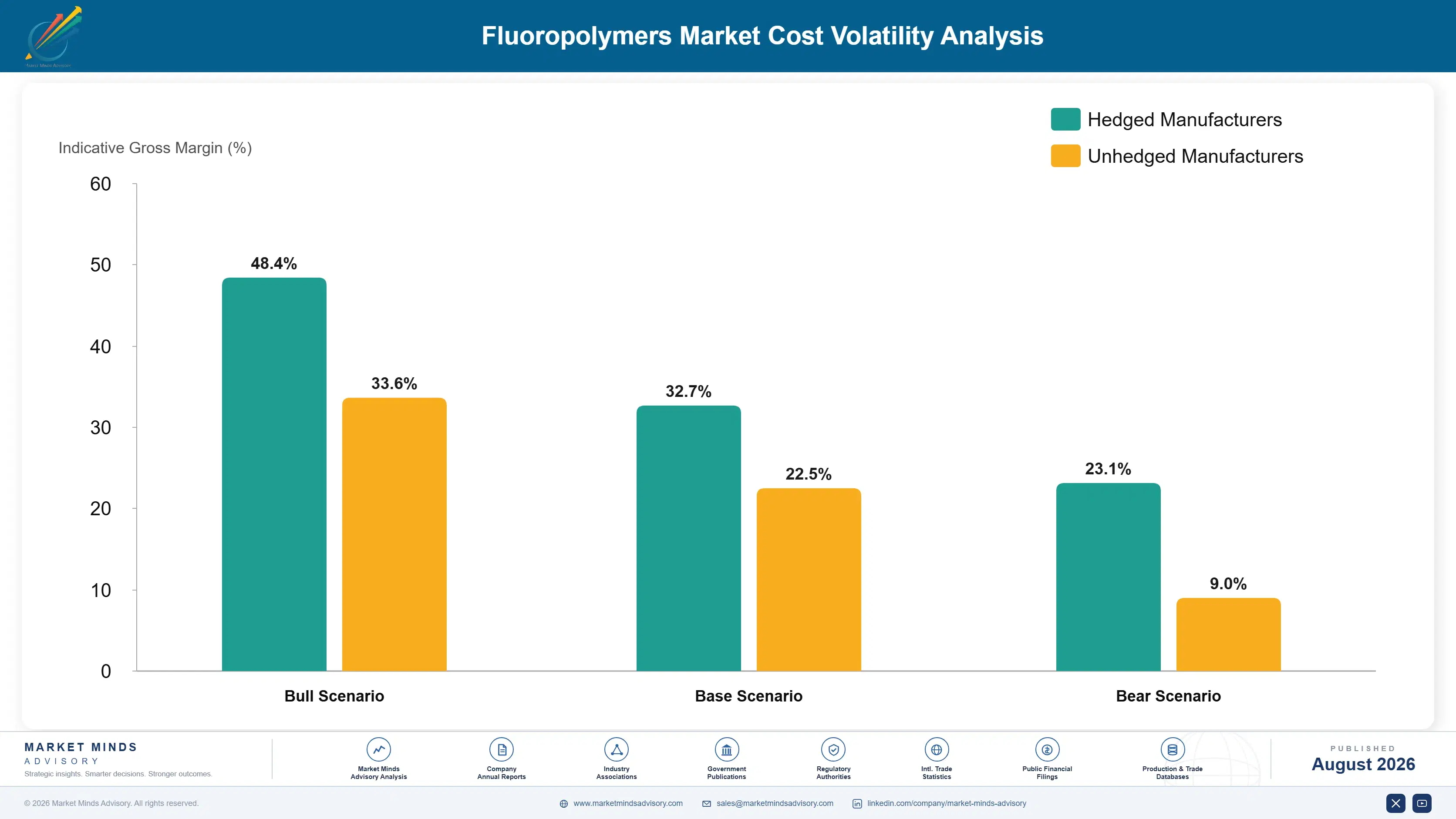
Fluorspar-derived feedstock accounts for roughly 27% of production cost, traced through hydrofluoric acid and monomer synthesis to mineral supply concentrated in China and Mexico. Energy for polymerisation absorbs a further 19%, since these reactions run under conditions considerably more demanding than commodity polymer production. Emissions abatement and process safety take 15%. Skilled operating labour and the maintenance of qualification documentation carry most of the remaining cost.
Fluorspar and hydrofluoric acid pricing moved sharply through 2022 and 2023 on Chinese export policy and environmental enforcement rather than on any demand signal, and producers without upstream positions absorbed it directly. Chemours and Daikin both discussed feedstock cost pressure in their reporting for those years. European energy costs compounded the burden regionally, since fluoropolymer polymerisation is genuinely energy intensive compared with conventional plastics manufacture.

Exposure divides on integration and product mix rather than on scale. Producers running their own fluorine chemistry see feedstock movement as an internal transfer with no external cash effect. Those buying monomer face concentrated pricing they cannot hedge through any instrument. Product mix matters equally: semiconductor and specialty grades absorb input movement comfortably, while PTFE competing against Chinese supply at 55% of tonnage has essentially no headroom left.
fluoropolymers-market-cost-volatility-analysis-1787551426895

Contract fluorspar supply on multi-year terms

Feedstock at 27% of production cost is priced by export policy rather than by any tradeable mechanism, which leaves contracting and integration as the only genuine responses available. Multi-year mineral agreements with volume floors give producers something to plan against through policy changes. Buying monomer on spot terms into a concentrated market is an unhedged position nobody chose.

Recover fluorine from process and end-of-life streams

Fluorinated process streams and end-of-life polymer were historically discarded, and recovery routes now return usable fluorine into the chain at costs well below fresh feedstock. The environmental case runs alongside the economic one, which carries real weight during regulatory scrutiny. Capital requirements are moderate and payback improves each time fluorspar pricing moves upward, which it has done repeatedly.

Weight production toward scarcity-priced grades

Semiconductor, fluoroelastomer, and high-purity grades price on the absence of alternatives and absorb feedstock and energy movement without difficulty at all. PTFE competing against integrated Chinese supply has no headroom, so every input increase lands directly on margin. Mix shift is the only cost defence that also addresses the competitive pressure arriving from the same direction simultaneously.

Portfolio Architecture for Margin Defence

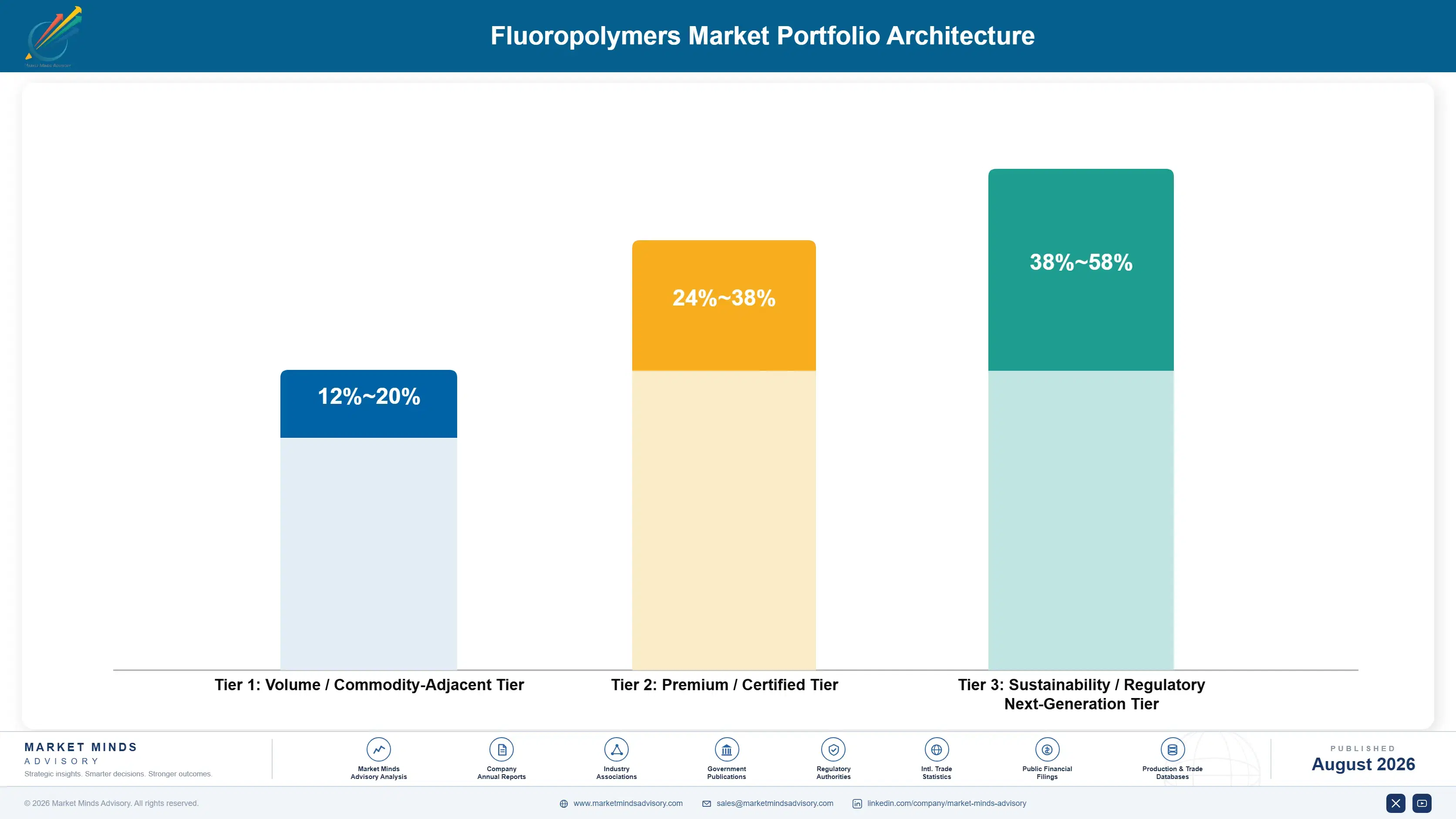
Margin architecture divides sharply between what China supplies well and what it does not yet supply at all. PTFE and standard grades at 55% of tonnage compete against integrated Chinese producers and earn very little for anybody outside that cost structure. Specialty resins earn considerably more on processing difficulty and qualification. Semiconductor fluoroelastomers earn most by a wide margin, with perfluoroelastomer seals pricing around 40 times commodity resin.
The volume and premium tension is genuinely awkward because tonnage absorbs fixed cost. Polymerisation assets carry heavy capital charges and utilisation at 71% is already uncomfortable, so abandoning commodity volume improves mix and worsens absorption at the same time. Producers who retreat deliberately and reconfigure capacity manage that trade. Those who simply lose volume experience both effects without any of the benefit.

High-value pools concentrate in semiconductor fluoroelastomers and handling resin, hydrogen and electrolyser membrane grades, and any application where a customer's alternative is redesigning their process rather than changing supplier. Each is defended by qualification and irreplaceability rather than by cost position, which is the only defence available against integrated Chinese capacity. Cost position stopped being available as a defence some time ago.

Volume / Commodity-Adjacent Tier

PTFE granular and fine powder plus standard grades competing directly against integrated Chinese producers holding domestic fluorspar supply. Pricing is set outside the producer's control entirely. Tonnage absorbs fixed cost and returns very little else.
Gross Margin: 12%-20%

Premium / Certified Tier

PVDF, ETFE, ECTFE, FEP, and PFA grades where processing difficulty and application qualification limit credible competition. Battery binder currently sits under capacity overhang. The range reflects wide variation between overbuilt and genuinely tight polymer types.
Gross Margin: 24%-38%

Sustainability / Regulatory / Next-Generation Tier

Semiconductor fluoroelastomers, high-purity handling resin, hydrogen membrane grades, and surfactant-free production documented against regulatory scrutiny. Irreplaceability and evidence both defend pricing. The range is wide because seal and membrane economics differ substantially from one another.
Gross Margin: 38%-58%
fluoropolymers-market-portfolio-architecture-1787551427387

High-value Sub-segments and Strategic Watch-out

Semiconductor Fluoroelastomer Seals

Perfluoroelastomer components price at roughly 40 times commodity resin because a chamber contamination event costs vastly more than the seal. Qualification runs for years and protects the position completely once properly established anywhere. Advanced node capacity expansion across four separate regions keeps pulling this demand steadily.
Gross Margin: 44%-58%

Exit-Driven Requalification Volume

A major producer withdrawing leaves qualified customers requalifying across years, and whoever supports that process holds the resulting position for a decade. Utilisation at 71% means the capacity to serve it already exists. Several customers have offered to fund the qualification work themselves, which is unusual.
Gross Margin: 34%-48%

Hydrogen and Membrane Grades

Electrolyser membranes and hydrogen infrastructure lining need chemistry no alternative material provides, and Gulf and European project investment keeps pulling volume. Qualification with equipment builders is demanding and holds firmly afterwards. European policy actively creates this particular demand rather than questioning it, which is rare.
Gross Margin: 32%-46%

PTFE Commodity Grades

The strategic watch-out. Integrated Chinese producers with domestic fluorspar set the price on 55% of global tonnage, and no procurement discipline or process improvement closes a cost gap built upstream of the polymer itself. Retreating from it deliberately is a strategy, while losing it slowly is not.
Gross Margin: 12%-20%

How Resin Positions Are Held

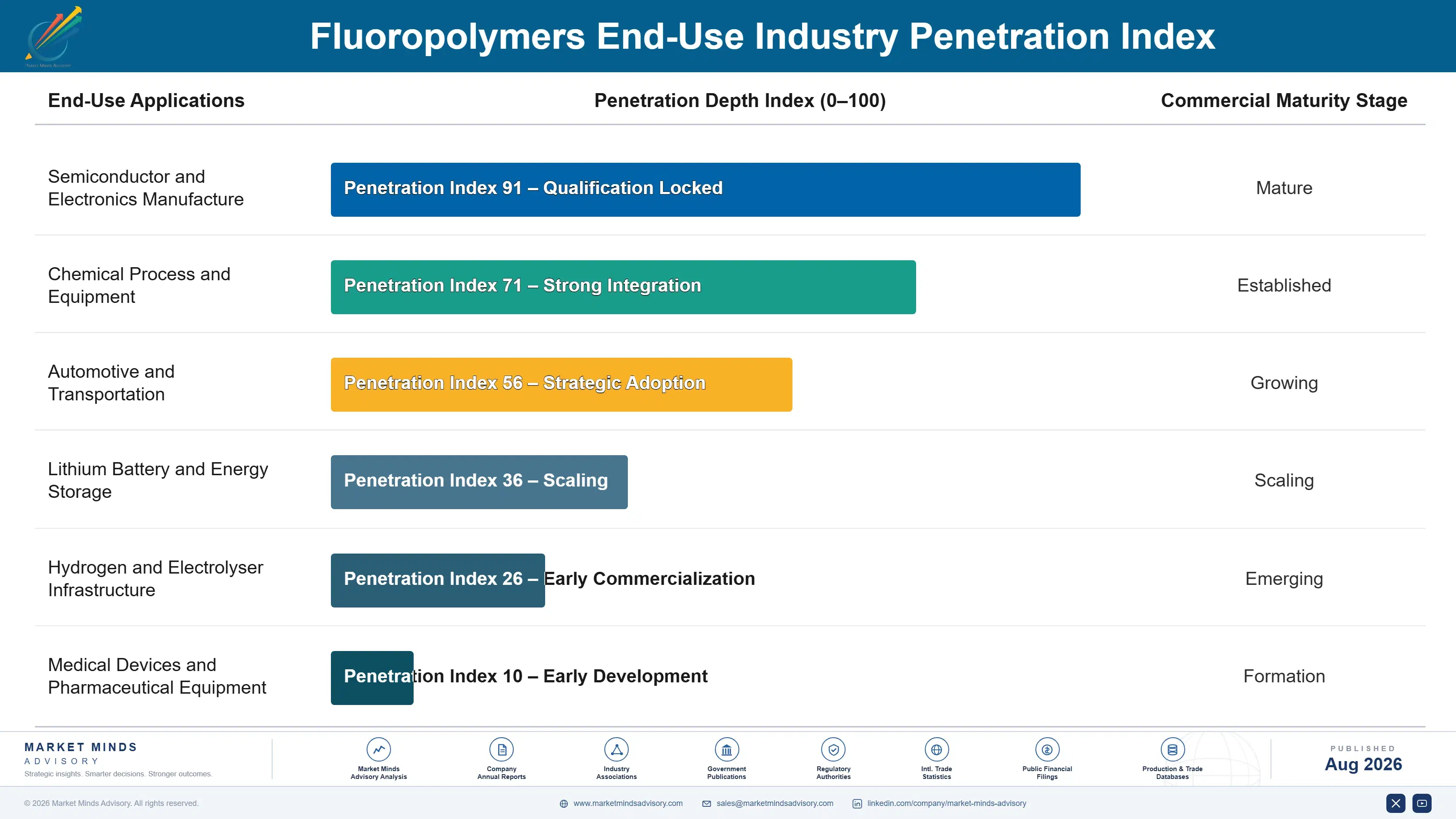
Demand reaches producers through qualification and then almost never revisits the decision. A semiconductor fab, medical device maker, or chemical processor tests a resin against its own conditions over months or years, writes it into a specification or a regulatory filing, and reorders indefinitely. Commodity PTFE buyers behave completely differently, tendering annually against integrated Chinese supply on delivered price with no qualification barrier protecting anybody at all.
Stickiness follows how expensive the alternative is. Semiconductor and medical positions hold because requalification costs years and carries genuine risk. Chemical process positions hold until a plant turnaround creates a natural moment to reconsider. Commodity grades hold until the next tender closes, which is usually within twelve months. Nothing about the resin itself creates any of that durability.

The deciding buyer has shifted noticeably toward supply chain risk and regulatory compliance functions over the past three years. Those people ask about manufacturing emissions, jurisdiction exposure, and continuity of supply under restriction scenarios. Process engineering still validates performance, and increasingly validates a supplier somebody else has already shortlisted for entirely non-technical reasons. Producers organised entirely around technical selling are arriving after the shortlist has closed.
fluoropolymers-market-end-use-penetration-index-1787551427895

What Producers Should Do Now

These are among the four positions where our research anticipates prominent divergence between winners and laggards over the coming forecast period. Each is grounded in the demand model, the regulatory perimeter, and the announced capacity pipeline.
01 / UPSTREAM FLUORINE INTEGRATION

Own the feedstock or contract it long

Fluorspar-derived feedstock represents roughly 27% of production cost, sits in mineral supply concentrated across China and Mexico, and is priced by export policy rather than by any tradeable market mechanism anybody outside Beijing can influence. No financial instrument hedges that exposure in any form currently available. Producers with hydrofluoric acid and monomer capacity treat the movement as an internal transfer, while everybody else carries an unhedgeable commodity position they never deliberately decided to take on in the first place at all.
02 / REQUALIFICATION CAPTURE SPEED

Move fast on the vacated qualified positions

A major producer withdrawing from the substance class removes qualified supply entirely that semiconductor, medical, and aerospace customers cannot replace inside months, since requalification in those applications runs for years and carries genuine process risk alongside it. Those customers are actively evaluating alternatives right now and will hold whatever position results for the better part of a decade afterwards. Utilisation sitting at 71% means the capacity to serve them already exists without any new investment being required from anybody at all.
03 / MANUFACTURING EVIDENCE PUBLICATION

Show the emissions data, skip the advocacy

Roughly 11% of demand is exposed to precautionary substitution by customers removing regulatory uncertainty from their own supply chains rather than responding to any performance or cost question of any kind. Documented surfactant-free polymerisation with published emissions data addresses that directly in a way industry position papers demonstrably have not managed to. Conversion takes 18 to 24 months of process development and removes the single criticism of this industry that currently has no technical answer available to it at present.
04 / DELIBERATE COMMODITY RETREAT

Choose to leave PTFE before it leaves you

PTFE at 55% of global tonnage is increasingly supplied by integrated Chinese producers with domestic fluorspar at cost positions no Western producer can approach through procurement or any process improvement available. Semiconductor fluoroelastomers, high-purity handling grades, and hydrogen membranes all price on irreplaceability instead, with perfluoroelastomer seals commanding roughly 40 times commodity resin on a weight basis. Retreating deliberately and reconfiguring capacity is a strategy, while losing the volume slowly is the same outcome without any of the benefit attached.

Engagement Snapshot From the Field

A live engagement with an industry participant carrying material or product regulatory and market exposure ahead of a defining policy shift, showing how our research translates into a defensible multi-year portfolio strategy.
MARKET MINDS ADVISORY · CLIENT ENGAGEMENT SUMMARY
Fluoropolymers Producer Strategic Portfolio Review and Transition Roadmap 2026·Investment Scenario on Fluoropolymers Exposure Evaluation 2025-26
CLIENT PROFILE
A European fluoropolymer resin producer with revenue near EUR 420 million (client-reported, unverified by MMA), supplying PTFE, PVDF, and specialty grades to industrial, chemical, and electronics converters. Monomer was purchased rather than produced, semiconductor qualification was limited, and PVDF pricing had fallen sharply following the battery capacity wave. Upstream integration had never been evaluated seriously.
STRATEGIC CHALLENGE
Chinese producers with integrated fluorspar supply were undercutting PTFE below the client's variable cost while European customers substituted away from moderate-service applications on regulatory grounds. No published emissions documentation existed. Two customers of the exiting producer had approached the business and the qualification capability to serve them was thin. Nothing in the portfolio was clearly defensible.
MMA APPROACH
MMA rebuilt margin by polymer type and application against realised pricing, sized the requalification opportunity created by the announced producer exit, and assessed monomer contracting against integration capital. Forty-seven expert interviews with semiconductor process engineers, chemical plant operators, converters, and regulatory specialists established where demand genuinely persists and why. Six quarters of grade-level margin data were rebuilt from cost records.
KEY FINDINGS
  1. PTFE commodity grades had been loss-making at realised prices for six consecutive quarters, and continued production was sustained purely by fixed cost absorption arguments nobody had tested properly.
  2. Two semiconductor customers displaced by the producer exit were willing to fund qualification work directly, and neither had raised pricing as a consideration at any point.
  3. European customers substituting away were doing so on documentation grounds specifically, and every one of them had asked for emissions data the client could not produce.
  4. Monomer purchasing at spot terms had cost more across three years than a long-term supply agreement would have, even before accounting for the volatility carried.
CLIENT PROFILE
A European fluoropolymer resin producer with revenue near EUR 420 million (client-reported, unverified by MMA), supplying PTFE, PVDF, and specialty grades to industrial, chemical, and electronics converters. Monomer was purchased rather than produced, semiconductor qualification was limited, and PVDF pricing had fallen sharply following the battery capacity wave. Upstream integration had never been evaluated seriously.
STRATEGIC CHALLENGE
Chinese producers with integrated fluorspar supply were undercutting PTFE below the client's variable cost while European customers substituted away from moderate-service applications on regulatory grounds. No published emissions documentation existed. Two customers of the exiting producer had approached the business and the qualification capability to serve them was thin. Nothing in the portfolio was clearly defensible.
MMA APPROACH
MMA rebuilt margin by polymer type and application against realised pricing, sized the requalification opportunity created by the announced producer exit, and assessed monomer contracting against integration capital. Forty-seven expert interviews with semiconductor process engineers, chemical plant operators, converters, and regulatory specialists established where demand genuinely persists and why. Six quarters of grade-level margin data were rebuilt from cost records.
KEY FINDINGS
  1. PTFE commodity grades had been loss-making at realised prices for six consecutive quarters, and continued production was sustained purely by fixed cost absorption arguments nobody had tested properly.
  2. Two semiconductor customers displaced by the producer exit were willing to fund qualification work directly, and neither had raised pricing as a consideration at any point.
  3. European customers substituting away were doing so on documentation grounds specifically, and every one of them had asked for emissions data the client could not produce.
  4. Monomer purchasing at spot terms had cost more across three years than a long-term supply agreement would have, even before accounting for the volatility carried.
RECOMMENDED STRATEGY
Phase 1: Phase one: exit the loss-making PTFE commodity grades deliberately, and reconfigure the affected polymerisation assets toward specialty grade production instead of idling. Phase 2: Phase two: accept the customer-funded semiconductor qualification work immediately, since exit-driven positions of this kind will not become available a second time. Phase 3: Phase three: convert polymerisation to surfactant-free routes and publish independently verified emissions data, then contract monomer supply on firm multi-year terms.
OUTCOME
The client exited two commodity PTFE grades and redirected capacity within a year. Semiconductor qualification began with customer funding, surfactant-free conversion completed at one site, and blended gross margin improved 9.2 percentage points despite lower total tonnage (client-reported, unverified by MMA). Monomer contracting negotiations opened shortly afterwards.

Frequently Asked Questions

Foundational context covering the market sizes, CAGR, scope, country, region and competition that inform every finding below. This section is provided to cover basics and most often pre-purchase conversations, answered from the MMA Primary Research Dataset.

What is the current size of the Fluoropolymers Market?

The market was valued at USD 9.4 billion in 2025, rising to an estimated USD 9.96 billion in 2026. East Asia holds the largest regional share at 33% of value.

How large will the Fluoropolymers Market be by 2036?

MMA forecasts USD 17.84 billion by 2036 under the base case, an expansion multiple of 1.79 times the 2026 value. That represents USD 7.88 billion of incremental value.

What is the CAGR for the Fluoropolymers Market 2026 to 2036?

The base case CAGR is 6.0%, with a bull case of 7.2% and a bear case of 4.8%. The spread reflects uncertainty over PFAS regulation and battery capacity absorption.

Which segment is growing fastest?

PVDF resin grows fastest at 8.8%, roughly 1.47 times the market rate, despite battery binder capacity overhang. ETFE and ECTFE resins follow at 7.6% on architectural demand.

Who are the major companies in the Fluoropolymers Market?

Chemours, Daikin Industries, Syensqo, AGC, and 3M lead, holding roughly 54% between them. Fluorine chemistry capability rather than polymerisation scale sustains that concentration rather than polymerisation scale or capital.

Which country is growing fastest?

India grows fastest at 9.4%, as domestic producers build genuine international capability alongside chemical process expansion and emerging battery cell manufacture under production-linked incentives. Chemical process expansion adds steady demand.

Report Segmentation Architecture

The full report scope spans multiple orthogonal segmentation dimensions, with cross-tabulated demand data provided for each dimension pair. Coverage extends further to regional breakdowns, trend trajectories, and the competitive detail needed to support segment-level decision-making.

By Polymer Type

  • PTFE Resin
  • PVDF Resin
  • FEP and PFA Resins
  • ETFE and ECTFE Resins
  • Fluoroelastomers
  • Fluoropolymer Dispersions for Coating

By End-Use Industry

  • Semiconductor and Electronics Manufacture
  • Chemical Process and Equipment
  • Automotive and Transportation
  • Lithium Battery and Energy Storage
  • Hydrogen and Electrolyser Infrastructure
  • Medical Devices and Pharmaceutical Equipment

By Customer Type

  • Semiconductor Fabrication Operators
  • Industrial Converters and Compounders
  • Battery Cell Manufacturers
  • Chemical Plant Equipment Builders
  • Coatings and Dispersion Formulators

By Region

  • North America
  • Western Europe
  • East Asia
  • South Asia and Pacific
  • Latin America
  • Middle East and Africa
  • Eastern Europe

Scope, Methodology, and Coverage

Every figure in this report is reproducible from documented input assumptions. The scope below maps the historical period, the forecast horizon, the segmentation dimensions, and the countries covered, alongside the underlying primary and qualitative methodology.
Historical Period
2020 to 2025
Forecast Period
2026 to 2036
Base Year
2025 (USD billions; MMA Primary Research Dataset, August 2026)
Market Definition
The market comprises fluoropolymer resins supplied in pellet, powder, granule, and dispersion form to converters and compounders, covering PTFE resin, PVDF resin, FEP and PFA resins, ETFE and ECTFE resins, fluoroelastomers, and fluoropolymer dispersions for coating. Value is measured at resin producer level across electronics, chemical process, automotive, energy, and medical applications. Converted film, sheet, tubing and moulded parts, applied coatings and finished linings, fluorinated gases and refrigerants, fluorosurfactants and processing aids sold separately, and non-fluorinated engineering polymers fall outside scope.
Quantitative Units
USD billions (current prices); thousand tonnes of resin produced annually; USD per kilogram by polymer type and grade
Segmentation Dimensions
By Polymer Type; By End-Use Industry; By Customer Type; By Region
Regions Covered
North America, Western Europe, East Asia, South Asia and Pacific, Latin America, Middle East and Africa, Eastern Europe
Countries Covered
China, Japan, South Korea, Taiwan, India, Singapore, Malaysia, Thailand, Australia, United States, Canada, Mexico, Germany, France, Belgium, Italy, Netherlands, United Kingdom, Spain, Switzerland, Poland, Hungary, Czechia, Russia, Brazil, Chile, Argentina, Saudi Arabia, United Arab Emirates, South Africa
Key Companies Profiled
Chemours, Daikin Industries, Syensqo, AGC, 3M, Arkema, Gujarat Fluorochemicals, Dongyue Group, Juhua Group, Shanghai 3F New Materials, HaloPolymer, Kureha, Zhonghao Chenguang, Sinochem Lantian, Fluorten, Guarniflon, Zeus Industrial Products, Saint-Gobain Performance Plastics, Nichias, Polyflon
Quantitative Methodology
Primary survey, n=3,800 respondents, Q4 2025, six countries; demand-side model with trade association cross-validation
Qualitative Methodology
47 expert interviews, Q4 2025; applied to validate demand model assumptions, identify emerging dynamics, and assess competitive positioning
Report Format
PDF and XLSX data workbook (Word format preview document)
Publisher
Market Minds Advisory
Report Code
MMA-2026-CHM-384
Published
August 2026
Contact
sales@marketmindsadvisory.com | www.marketmindsadvisory.com

Purchase the full Fluoropolymers Market Report (2026 to 2036).

The full report sizes fluoropolymer resin demand across six polymer types, six end-use industries, and seven regions with 2026 to 2036 forecasts under base, bull, and bear cases. It separates commodity PTFE tonnage from specialty and irreplaceable grades, since the two face entirely different competitive and regulatory pressures. Competitive profiles cover twenty producers assessed consistently on resin capacity and revenue, upstream fluorine integration, and qualification depth. Cost analysis traces fluorspar, energy, and abatement exposure against integration position. Commercial guidance addresses upstream integration, requalification capture, manufacturing evidence, and deliberate commodity retreat.
Six polymer types sized separately by region
Commodity PTFE separated from irreplaceable specialty grades
Producer exit modelled as requalification demand by application
Battery binder capacity overhang quantified against absorption rates
Fluorspar supply concentration traced through the production chain
Precautionary substitution assessed by application and jurisdiction

Built For The People Who Decide

From boardroom strategy to bench-side execution, this report is read cover-to-cover by leaders shaping the next decade of their industry, turning demand scenarios, market dynamics and valuation benchmarks into decisions.
CXOs/ Presidents/ VPs/ Managers
M&A and Corporate Development
Strategy Teams and R&D Heads
Procurement and Product Directors
Regulatory and Compliance Leaders
Investor Relations and Equity Analysts