Market Minds Advisory
Electronic Skin Market

Electronic Skin Market: Electronic Skin: The Sensing Was Never the Problem, and the Wire Between Flexible and Rigid Still Is

Roughly 64% of device failures happen where the flexible sensing layer meets rigid readout electronics, which is a packaging problem the field keeps treating as a materials one instead of solving.

Lead Analyst

Published

September 2026

Make Smarter Decisions with Customized Research Insights

Request a free sample report and evaluate market opportunities, growth trends, and competitive dynamics relevant to your business needs.

2025 MARKET VALUE$0.9BMarket Size 2025
2036 FORECAST VALUE$5.0BBase Case , 2026 to 2036
CAGR 2026 TO 203616.8 %Bull 18.0% / Bear 15.4%
INCREMENTAL OPPORTUNITY$3.9BNet 10- year value creation
EXPANSION MULTIPLE4.72x2036 value over 2026 base
Strategic Levers
M&A Pipeline
Regional Outlook
Country Rankings
Competitive Intelligence
Segmental Deep-dive
Call-Us : 91 93563 13602

Executive Snapshot and Market Trajectory.

Electronic skin has been close to arriving for fifteen years and the sensing was never what held it back. About 64% of device failures occur at the junction between the flexible sensing layer and the rigid electronics reading it. That is packaging, not materials. Nobody publishes on connectors.
Robotic and prosthetic tactile sensing grows at 25.2%, half again the market rate of 16.8%, because a gripper needs force and slip detection in a fixed geometry rather than anything resembling skin. Continuous physiological monitoring patches follow at 19.6%. East Asia takes 38% of value on robotics manufacture and flexible electronics capability sitting in the same countries. Wound assessment sensing at 16.2% addresses a hospital cost that procurement can actually verify itself.
Concentration sits near 22% across the top five on measured device and sensing revenue, the most fragmented picture in medical sensing. Clinical buyers pay around USD 320 for a device that need only last 14 days, which is why medical applications ship and consumer ones do not. Consumer requires multi-year durability at consumer prices. Development capital keeps going to the sensing layer that already works well enough.
Market Definition
This market covers conformal and stretchable sensing devices that interface directly with skin or contact surfaces, spanning robotic and prosthetic tactile sensing, continuous physiological monitoring patches, wound assessment and care sensing, rehabilitation and motion sensing, consumer wearable skin interfaces, and industrial and safety contact sensing. Revenue is measured as device, sensing array and attributable module value at supplier level. Rigid wearable devices worn on the wrist or ear, implanted sensors, textile-integrated garments without conformal sensing layers, and imaging or diagnostic equipment are excluded.
Base Year Value
$0.9B in 2025 (MMA Primary Research Dataset, September 2026)
Forecast Period
2026 to 2036, eleven discrete annual values
CAGR
16.8% base case. Bull 18.0%. Bear 15.4%.
Fastest Growth Segment
Robotic and Prosthetic Tactile Sensing: 25.2% CAGR
Fastest Growth Country
South Korea: 19.8% CAGR
Fastest Growth Region
South Asia and Pacific: 19.0% CAGR
Largest Region
East Asia: 38% of 2025 global value
Market Leaders
iRhythm Technologies, Tekscan, VivaLNK, Interlink Electronics and BeBop Sensors lead on measured device and sensing revenue. Source: MMA Primary Research Dataset, July 2026.
Primary Survey
n=3,800 procurement and R&D decision-makers, Q4 2025, six countries
Methodology
Demand-side build-up, cross-validated against public data, 47 expert interviews

Electronic Skin Market Forecast Scenarios

electronic-skin-market-size-forecast-scenario-1788427294465
Growth ran at 15.6% from 2020 to 2025 and almost all of the revenue came from medical applications rather than from anything the research literature emphasised. Continuous cardiac monitoring patches established that a clinical buyer will pay several hundred dollars for a device worn for a fortnight and then discarded. Consumer applications were announced repeatedly and shipped very little, because durability requirements and price expectations pull against each other.
The base case at 16.8% rests on three mechanisms. Robotic tactile sensing needs force and slip detection across around 2 million contact cycles in a fixed geometry, which is far easier than skin conformity and carries real industrial demand. Clinical monitoring continues expanding because reimbursement now exists for remote cardiac and respiratory monitoring. Third, wound assessment sensing addresses a cost problem hospitals can quantify precisely rather than a capability they merely want.
The bull case at 18.0% assumes interconnect reliability improves enough for consumer durability requirements, which would open volumes the medical market cannot approach. The bear case at 15.4% is that consumer applications keep failing at the same junction, leaving the market confined to medical and robotic uses that are genuine, growing and considerably smaller than published forecasts assume.

Everything Breaks at the Same Place

Read the research output and you would conclude the difficult part is sensing. It is not, and has not been for a decade. Laboratory arrays detect pressure, strain and temperature well. About 64% of real failures happen at the interconnect where the flexible layer meets rigid silicon, and that junction faces stretch cycles, sweat ingress and adhesive fatigue at once. It is a packaging problem the field keeps treating as a materials one.
TOP FIVE CONCENTRATION22%Highly fragmented across medical and sensing specialist suppliers
INTERCONNECT FAILURE SHARE64%Device failures originating at the flexible to rigid junction
WEAR DURATION ACHIEVED14 daysTypical adhesion period before a patch requires replacement
SINGLE USE DEVICE PRICEUSD 320Typical price a clinical buyer pays per device
CONTACT CYCLE ENDURANCE2 millionTouch cycles a robotic sensing surface survives reliably
CLINICAL APPROVAL DURATION23 monthsPeriod to obtain regulatory clearance for a monitoring device
That explains why medical applications ship and consumer ones do not. A clinical patch is worn around 14 days, costs near USD 320 and is discarded, so an interconnect surviving a fortnight is adequate. A consumer device must survive months of wear, washing and handling at a fraction of that price. Those requirements are separated by engineering nobody has completed, which is why announcements outrun shipments.
Robotic tactile sensing is the part that works and it is rarely described accurately. A gripper needs force and slip detection surviving around 2 million contact cycles in a geometry that does not stretch, which is easier and carries genuine industrial demand. The segment grows at 25.2% and its buyers evaluate cycle endurance rather than anything the literature considers important.
"Fifteen years of papers have improved sensing that was already good enough and largely ignored the wire. If somebody solved the flexible to rigid junction properly, three quarters of the applications this field keeps promising would ship within two years. Nobody publishes on connectors."
Director, Medical Sensing and Wearable Systems Practice · MMA Medical Devices Practice · September 2026

Market Trends

Robotics Buys Sensing Without Needing Skin

Warehouse and manufacturing robots need force and slip detection to handle varied objects without crushing or dropping them, and a gripper surface does not stretch, does not sweat and does not need to look like anything. That removes almost every failure mode that defeats skin-worn devices, leaving a durability requirement of roughly 2 million contact cycles that is genuinely achievable. Robotic tactile sensing grows at 25.2%, faster than anything else here. Buyers evaluate cycle endurance and force resolution rather than conformity or biocompatibility. Nothing about this application requires the word skin at all really.
Market Impact: Survives only 14 days needed

Reimbursement Rather Than Technology Opened Clinical Monitoring

Remote cardiac and respiratory monitoring became commercially viable when payers began reimbursing it, not when the sensing improved, and the devices shipping today use approaches demonstrated years earlier. A clinical buyer paying around USD 320 for a device worn 14 days does not require durability that consumer applications demand. Approval takes about 23 months and then protects the position for the product's life. Suppliers who pursued reimbursement pathways early hold positions competitors cannot contest without repeating both processes. The devices shipping today would have shipped several years earlier had payers moved sooner. Nothing technical changed.
Market Impact: Avoids disturbing healing 100% of assessments

Market Opportunities and Growth Drivers

Disposable Clinical Economics Forgive Short Lifetimes

A monitoring patch worn for around 14 days and then discarded needs an interconnect that survives a fortnight rather than years, which is the difference between a shipping product and a research demonstration. Clinical buyers pay near USD 320 per device because the alternative is a hospital stay or an inconclusive test, so the price supports materials and assembly that consumer applications could never fund. Disposability is the commercial insight this field took years to accept. It converts the hardest engineering constraint into a manageable one. Research groups took several years to accept this framing.
Market Impact: Causes 64% of device failures

Wound Assessment Addresses a Quantified Hospital Cost

Chronic wounds consume nursing time, dressing materials and bed days that hospitals measure precisely, and assessment currently requires removing a dressing to look at the wound, which disturbs healing every time it happens. Sensing beneath the dressing reports moisture, temperature and infection markers without disturbance, and the saving is calculable rather than aspirational. Wound sensing grows at 16.2% on arithmetic clinical procurement can verify. It is unglamorous work that will probably reach more patients than anything else this field produces. Procurement approves it on the measured saving rather than on any clinical argument.
Market Impact: Costs a fraction of USD 320

Market Restraints and Challenges

The Flexible to Rigid Junction Keeps Failing

About 64% of device failures occur where a stretchable sensing layer connects to rigid readout electronics, because that junction experiences strain concentration, moisture ingress and thermal cycling at once and every material transition creates a stress point. The root cause is geometric rather than chemical, which is why fifteen years of materials research has not resolved it. Commercially this caps achievable wear duration and confines the market to applications tolerant of short lifetimes. Mitigation runs through strain relief geometries and island-bridge layouts, which help genuinely without solving it. Fifteen years of papers have not moved it.
Market Impact: Endures 2 million contact cycles

Consumer Durability and Consumer Pricing Are Incompatible

A consumer device must survive months of wear, washing and rough handling while costing a fraction of the USD 320 a clinical buyer pays, and those two requirements pull directly against each other at the interconnect. The root cause is that durability at this junction currently costs money in materials and assembly steps that consumer price points cannot absorb. Commercially this is why consumer applications have been announced repeatedly and shipped almost nothing. Suppliers mitigate by targeting clinical and industrial buyers instead, which is sensible and much smaller. Announcements have consistently outrun shipments for that reason.
Market Impact: Approval consumes 23 months
4 additional market trends, 3 additional growth drivers, and 2 additional restraints and challenges are covered in the full report. Contact sales@marketmindsadvisory.com to access the complete intelligence.

Segment CAGR and Growth Architecture

Segmentation follows the application, because application determines how long a device must survive and who pays for it. Those two facts decide everything about whether a product can exist. A fortnight of clinical wear, two million industrial contact cycles and three years of consumer handling are entirely different engineering problems wearing the same name.
electronic-skin-market-market-share-analysis-1788427295024

Robotic and Prosthetic Tactile Sensing

Robotic and prosthetic sensing grows at 25.2%, half again the market rate of 16.8%, and it succeeds precisely because it abandons the skin analogy. A gripper surface does not stretch, sweat or need to look like anything, which removes almost every failure mode that defeats worn devices and leaves an endurance requirement near 2 million contact cycles that is genuinely achievable today. Industrial buyers evaluate force resolution and cycle life rather than conformity. Prosthetic applications carry smaller volumes and much higher willingness to pay, since feedback determines whether a device gets worn at all. Prosthetic reimbursement varies enormously by country, which determines where this demand actually appears rather than where the clinical need exists.
CAGR 25.2%

Continuous Physiological Monitoring Patches

Monitoring patches grow at 19.6% and are where most of this market's current revenue actually sits, having established that a clinical buyer will pay around USD 320 for a device worn 14 days and discarded. Disposability is what makes the engineering tractable, since an interconnect surviving a fortnight is achievable where one surviving years is not. Regulatory clearance takes about 23 months and then protects the position for the product's commercial life. Reimbursement rather than sensing capability opened this segment, and it will determine how far the same approach extends into respiratory, neurological and metabolic monitoring. Analysis services attached to the device generate revenue the hardware alone would never produce, which several suppliers discovered late.
CAGR 19.6%
Full segment breakdown across 6 segments available in the complete report.

Regional Architecture and Country Demand Map

Value follows two distinct concentrations that rarely overlap: clinical monitoring revenue where reimbursement exists, and robotic sensing where robots are built. Research output is distributed far more evenly than either and predicts neither at all. Publication counts predict none of this and get quoted constantly anyway.

East Asia

East Asia holds 38%, above the regional band, because industrial robot manufacture, flexible electronics capability and medical device production all sit within the same few countries and reinforce one another. South Korea is the fastest-growing country at 19.8%, combining display-derived flexible substrate manufacturing with a robotics industry buying tactile sensing at volume. Japanese materials suppliers provide the adhesives, films and conductive inks that this field depends on worldwide. Chinese robotics deployment is expanding faster than anywhere and buys tactile sensing on cycle endurance rather than on any medical specification. Interconnect and packaging capability sits alongside the substrate manufacturing, which is why regional suppliers reach durability figures that research-derived competitors elsewhere have not matched.
Share: 38% | CAGR: 17.8% (2026 to 2036)

North America

American value is concentrated in clinical monitoring, where reimbursement for remote cardiac and respiratory monitoring exists at levels no other market matches and where the largest shipping products were developed. Regulatory clearance taking around 23 months is well understood by suppliers here, which shortens practical timelines against competitors learning the process. Robotics demand is growing through warehouse automation, though sensing is frequently sourced from Asian suppliers. Prosthetic applications benefit from veterans health funding that supports device categories commercial insurance would not reimburse. Interconnect engineering capability is thinner here than the research output suggests, since most participants are research spin-outs staffed by materials scientists rather than packaging engineers. Wound sensing adoption lags Europe considerably.
Share: 28% | CAGR: 17.6% (2026 to 2036)
Regional intelligence for 5 additional markets available in the complete report: Western Europe, South Asia and Pacific, Latin America, Middle East and Africa, Eastern Europe. Contact sales@marketmindsadvisory.com.
electronic-skin-market-country-cagr-analysis-1788427295544

Building What Can Actually Ship

This field has spent fifteen years improving the part that already worked. The levers that matter attack the interconnect, choose applications whose lifetime requirements are achievable today, and stop pursuing consumer volumes that the engineering cannot yet support at any credible price point anywhere. The order in which these are addressed matters more than anything else does.

Engineer the Interconnect Before the Sensor

About 64% of device failures occur at the flexible to rigid junction and almost no development effort goes there, because sensing is publishable and connectors are not. Suppliers investing in strain relief geometry, island-bridge layouts and encapsulation at that junction extend achievable wear duration by roughly 60% against comparable sensing performance. That extension is what moves a product from clinical disposable toward longer-wear applications. It requires packaging engineers rather than materials scientists, which is a hiring decision most of this field has not made. Nobody in this field publishes on connectors, which is precisely the problem.
Market Impact: Extends achievable wear duration by roughly 60% overall

Choose Applications Matching Achievable Device Lifetimes

A device surviving 14 days serves clinical monitoring perfectly and cannot serve consumer wear at all, so application selection is really a lifetime decision made before any engineering begins. Suppliers matching target application to demonstrated endurance reach market roughly 3 times faster than those attempting to stretch a design into requirements it cannot meet. The discipline sounds obvious and is routinely ignored, because consumer volumes look larger in a business plan. Most failed products in this field were aimed at the wrong lifetime from the start. That lifetime decision precedes every other decision in this field.
Market Impact: Reaches the market roughly 3 times faster overall

Pursue Reimbursement Pathways Alongside Regulatory Clearance

Regulatory clearance takes about 23 months and reimbursement coverage takes longer still, and a cleared device without reimbursement sells to almost nobody in most health systems. Suppliers running both processes in parallel reach revenue years earlier than those treating reimbursement as a subsequent step. Clinical monitoring became viable when payers began covering it rather than when sensing improved, which is the pattern this segment has followed throughout. It requires health economics capability that device engineering organisations rarely build early enough. A cleared device without coverage is a demonstration with paperwork attached to it.
Market Impact: Regulatory clearance alone consumes about 23 months beforehand

Sell Cycle Endurance to Industrial Buyers

Robotic buyers evaluate force resolution and contact cycle life near 2 million cycles, and have no interest in conformity, biocompatibility or anything resembling skin. Suppliers presenting medical framing to industrial buyers lose to competitors who quote endurance data in the terms a maintenance engineer uses. The segment grows at 25.2% and carries gross margins around 14 percentage points above clinical disposables once volume is reached. The engineering is easier and the sales approach is completely different, which is why few suppliers serve both properly. A maintenance engineer will ask about mean cycles between failure.
Market Impact: Holds roughly 14 points more gross margin overall

Who Controls the Margin Pool

Concentration sits near 22% across the top five on measured device and sensing revenue, the most fragmented picture in medical sensing, and fragmentation persists because the field is populated by research spin-outs pursuing different applications with incompatible technology. A monitoring patch company and a robotic tactile sensing company share a literature and essentially no commercial overlap. Nobody has assembled a position across applications, and it is unclear that anybody should.
Competition runs on three dimensions. Interconnect reliability is first and rarely discussed, since it determines achievable wear duration and therefore which applications a supplier can serve at all. Second is regulatory and reimbursement position in clinical applications, where clearance takes around 23 months and coverage takes longer. Third is manufacturing capability, because flexible substrate assembly at volume is genuinely difficult and most participants outsource it.

Two pressures will reshape positions. Robotic tactile sensing is growing faster than clinical applications and rewards suppliers who abandoned the skin analogy entirely, which most research-derived companies find culturally difficult. Meanwhile Asian materials and display manufacturers hold flexible substrate capability at a scale specialist suppliers cannot approach, and several are moving from supplying materials toward supplying finished sensing modules.
electronic-skin-market-company-positioning-matrix-1788427296069

Competitive Moat and Risk Dimensions

IRHYTHM TECHNOLOGIES

Moat: Clinical evidence and reimbursement

iRhythm holds regulatory clearance and reimbursement coverage built over years for skin-worn cardiac monitoring, which competitors must replicate through processes taking around 23 months for clearance and considerably longer for payer coverage. Clinical evidence accumulated across large patient populations supports both. Its analysis service attached to the device creates revenue that hardware alone would never produce.
IRHYTHM TECHNOLOGIES

Risk: Single application concentration

The business rests on one clinical application in one body system, so any reimbursement change or competing modality affects the whole company rather than a division. Robotic tactile sensing grows faster and requires capability the organisation has no reason to hold. Extending into respiratory or neurological monitoring means repeating clearance and reimbursement work from the beginning in each case.
TEKSCAN

Moat: Pressure sensing application breadth

Tekscan supplies thin film pressure and force sensing across industrial, research, dental and gait applications, which spreads exposure across buyer groups whose purchasing cycles do not move together. Long experience with contact sensing durability translates directly into the cycle endurance requirements robotic buyers evaluate. Its industrial sales approach speaks the language maintenance and automation engineers actually use.
TEKSCAN

Risk: Clinical monitoring absence

Continuous physiological monitoring carries most of this market's current revenue and requires regulatory clearance and reimbursement capability the company has not built. Entering means around 23 months of clearance work before any payer conversation begins. Meanwhile Asian materials manufacturers are moving toward finished sensing modules at manufacturing scale that specialist suppliers cannot match on cost.

Players Tracked

Prominent Players

iRhythm Technologies
Tekscan
VivaLNK
Interlink Electronics
BeBop Sensors

Other Key Players

Xenoma
NextFlex
DuPont
Panasonic
Nitto Denko
Murata Manufacturing
TE Connectivity
Contactile
Touchlab
SynTouch
Pressure Profile Systems
MedTrum
Smith and Nephew
Coloplast
Nissha

Recent Developments

FEBRUARY 2025

Robotics manufacturers specify tactile sensing on cycle endurance data

Industrial robot builders began evaluating gripper sensing against contact cycle life and force resolution rather than against conformity or biocompatibility claims carried over from medical framing. Suppliers presenting medical specifications lost selections to those quoting endurance in maintenance engineering terms. Medical framing had been carried over without examination.
Signal: Industrial buyers reject the skin analogy entirely, and suppliers who kept using it lost the selections.
JUNE 2025

Wound sensing adoption follows measured dressing change cost savings

Hospital groups adopted sensing beneath wound dressings after quantifying nursing time and materials saved by avoiding routine dressing removal for assessment. Procurement approved on measured cost per wound rather than on any clinical capability argument the suppliers had presented. Clinical capability had never been the obstacle here.
Signal: Wound sensing sells on arithmetic that procurement can verify rather than on clinical capability nobody disputes.
OCTOBER 2025

Consumer skin interface programmes deferred over durability shortfalls

Several consumer electronics programmes postponed skin-interface sensing features after devices failed wear and washing testing at the flexible to rigid junction. Sensing performance had met requirements throughout, and the failures were confined to interconnect and encapsulation. Programmes had been announced publicly well before that testing was complete.
Signal: Consumer applications keep failing at the same junction, and no amount of sensing improvement addresses it.

What a Conformal Device Costs

Cost structure is dominated by assembly rather than by sensing materials. Flexible substrate, conductive traces and the sensing layer together account for roughly 29% of device cost, while assembly, interconnect bonding, encapsulation and test consume most of the remainder. Yield at the interconnect step governs cost more than any material choice does, because a failed bond discards the whole device.
Specialist adhesive and film supply has been the sharpest pressure. Skin-contact adhesives and stretchable encapsulation films come from a small producer group also serving medical dressing and display markets at far larger volumes, and availability tightened through 2024 and 2025. Nitto Denko and TE Connectivity both referenced materials and component cost conditions in recent annual reporting. Device suppliers absorbed most of it, since clinical pricing is set by reimbursement and cannot be adjusted quickly.

Exposure varies by manufacturing position rather than by scale. Suppliers with in-house flexible assembly control interconnect yield, which is the variable that governs cost. Those outsourcing assembly carry yield they cannot influence and lead times they cannot compress. Clinical suppliers face reimbursement-set pricing that absorbs no cost increase at all, while industrial suppliers pass changes through more readily, since robotic buyers negotiate against value.
electronic-skin-market-cost-volatility-analysis-1788427296263

Bring interconnect bonding in house before scaling volume

Yield at the flexible to rigid bond determines device cost more than any material selection, and outsourcing it means carrying a yield a supplier cannot influence. Bringing that single step in house while leaving the rest outsourced captures the variable that matters without the capital of full assembly. Suppliers who did this early hold cost positions contract assembly cannot match.

Qualify alternate skin-contact adhesives during development

Skin-contact adhesives come from few producers who also serve medical dressing and display markets ordering far larger volumes, so availability tightens without warning and qualified devices cannot substitute without repeating testing. Qualifying alternates during development costs testing effort and removes an exposure that has interrupted supply repeatedly. It has to happen before clearance closes, when it looks like avoidable expense.

Price industrial supply against value rather than cost

Robotic buyers evaluate sensing against the cost of a dropped or crushed object and the downtime that follows, which is far larger than any component price quoted. Pricing against that avoided cost rather than against manufacturing cost plus margin recovers value the application genuinely supports. Suppliers extending clinical cost-plus logic into industrial sales leave most of the margin unclaimed.

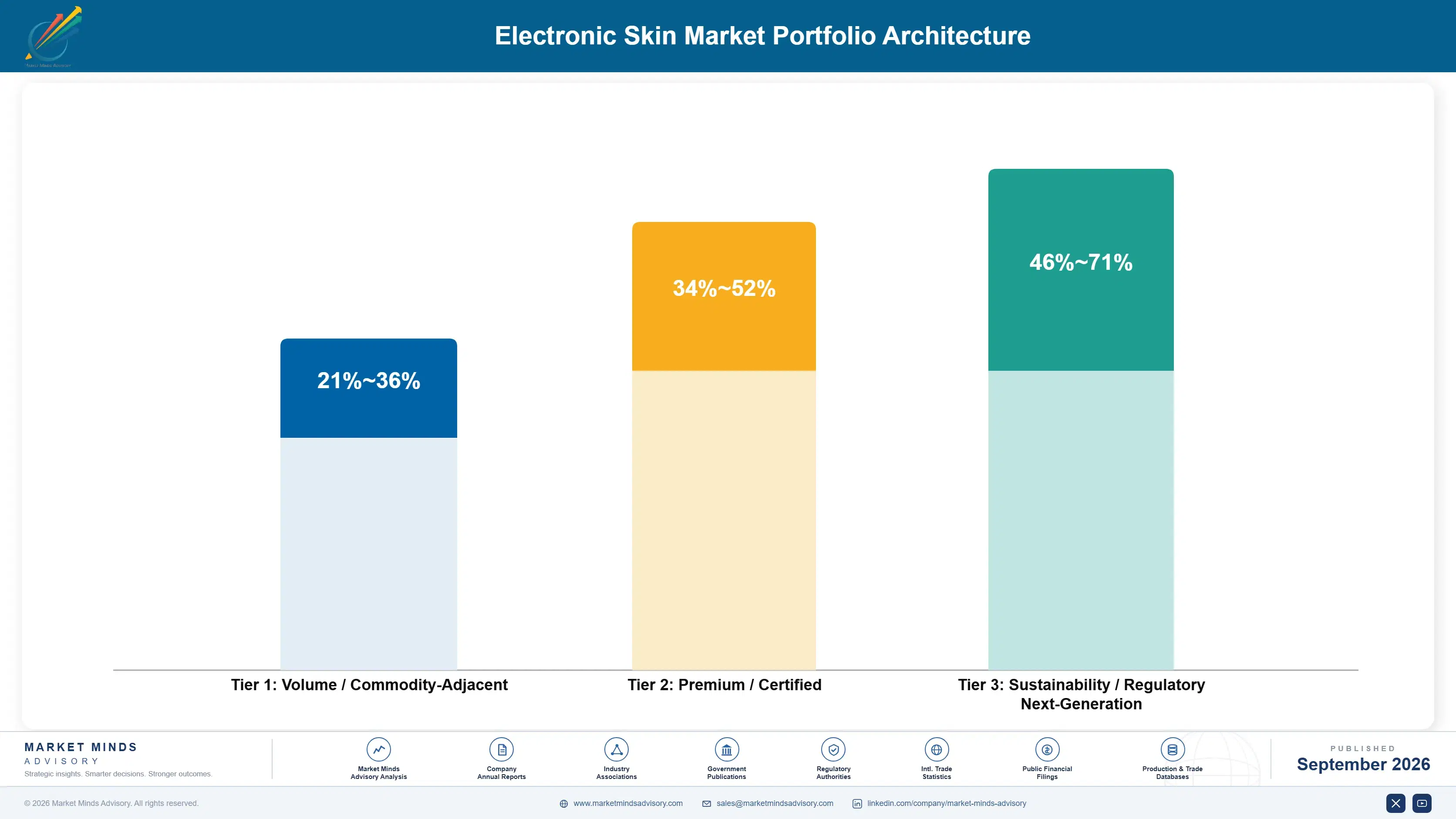
Portfolio Architecture for Margin Defence

Margin architecture separates on who sets the price. Clinical monitoring devices are priced by reimbursement schedules rather than by suppliers, which caps margin regardless of manufacturing efficiency and makes cost control the only available lever. Industrial and robotic sensing is priced against avoided downtime, which is a far larger number and gives suppliers pricing latitude that clinical applications never offer. Prosthetic applications sit between the two.
The tension runs between volume applications and achievable ones. Consumer wearable interfaces represent the volumes everybody wants and durability nobody has delivered, so pursuing them consumes development capital against products that do not ship. Clinical and industrial applications are achievable today at volumes an order of magnitude smaller. Suppliers dividing effort between the two generally deliver neither well, and the consumer work absorbs the engineering attention the interconnect problem actually needs.

High-value revenue concentrates in industrial and robotic sensing and in clinical applications with attached analysis services. Both are defended by capability rather than by product: cycle endurance data in one case, regulatory and reimbursement position in the other. Wound sensing is the underdeveloped pool, addressing a cost hospitals measure precisely while receiving a fraction of the attention consumer applications continue to absorb.

Volume / Commodity-Adjacent

Consumer skin interface components and basic contact sensing sold into applications with no regulatory barrier. The range separates suppliers with in-house assembly from those outsourcing it. Durability requirements here exceed what most designs currently achieve reliably.
Gross Margin: 21-36%

Premium / Certified

Clinical monitoring patches and wound sensing devices priced by reimbursement schedules rather than by suppliers. Margin depends almost entirely on interconnect yield, since pricing cannot move. Regulatory clearance protects the position for a product's commercial life.
Gross Margin: 34-52%

Sustainability / Regulatory / Next-Generation

Industrial and robotic tactile sensing priced against avoided downtime, plus clinical devices with attached analysis services. The widest range in the portfolio, reflecting application value and service attachment. Highest margin and the easiest engineering in this market.
Gross Margin: 46-71%
electronic-skin-market-portfolio-architecture-1788427296767

High-value Sub-segments and Strategic Watch-out

Robotic Tactile Sensing

High value with the fastest growth at 25.2%, priced against avoided downtime rather than component cost and requiring endurance near 2 million cycles that is achievable today. The range reflects volume and integration depth. It rewards suppliers who abandoned the skin analogy that research-derived competitors cannot let go of.
Gross Margin: 48-71%

Clinical Monitoring With Analysis

High value with strong growth at 19.6%, where attached analysis services generate revenue the device alone never would and reimbursement protects the position. The range reflects service content by application. Clearance takes around 23 months and reimbursement longer, which keeps the qualified competitor list very short.
Gross Margin: 42-63%

Disposable Monitoring Devices

The volume core in clinical terms, priced by reimbursement schedules that suppliers cannot influence and where interconnect yield is the only real margin lever available. The range separates in-house assembly from outsourced. It carries most of this market's current revenue despite that pricing constraint. Cost is everything.
Gross Margin: 33-51%

Consumer Skin Interfaces

The strategic watch-out, requiring months of wear and washing durability at a fraction of clinical pricing, which the interconnect cannot currently deliver. Programmes have been announced and deferred repeatedly on exactly this failure. Development capital spent here is capital not spent on the junction that would make it possible.
Gross Margin: 0-19%

How This Demand Repeats

Recurrence divides sharply between consumable and capital purchasing. Clinical monitoring patches are disposable, worn around 14 days and replaced, which produces consumable economics tied to patient volume rather than to any purchasing cycle. Robotic sensing surfaces are capital items replaced after roughly 2 million contact cycles, which for a working robot means every year or two. Wound sensing sits with the consumables and recurs with wound caseload.
Adoption depth varies with clinical and operational integration. A monitoring patch integrated into a cardiology pathway, with analysis feeding directly into clinical reporting, becomes genuinely difficult to displace because the workflow was built around it. A sensing surface bolted onto a gripper can be swapped at the next maintenance interval. Wound sensing sits deepest of all once nursing protocols change around it, since reverting means retraining staff.

The buyer differs completely by application rather than having shifted over time. Clinical devices are specified by physicians, bought by hospital procurement and paid for by insurers, which is three separate approvals for one purchase. Robotic sensing is specified and bought by automation engineers against downtime arithmetic. Suppliers organised around one of these address a fraction of a market whose applications share technology and nothing commercial.
electronic-skin-market-end-use-penetration-index-1788427297254

Where This Field Delivers

These are among the four positions where our research anticipates prominent divergence between winners and laggards over the coming forecast period. Each is grounded in the demand model, the regulatory perimeter, and the announced capacity pipeline.
01 / INTERCONNECT ENGINEERING PRIORITY

Fund the junction, not another sensing improvement

Roughly 64% of device failures occur where the flexible sensing layer meets rigid readout electronics, and almost no development effort goes there because sensing is publishable while connectors are not, and never have been. Suppliers investing in strain relief geometry, island-bridge layouts and encapsulation at that junction extend achievable wear duration by around 60% at identical sensing performance across the board. It requires packaging engineers rather than materials scientists, which is a hiring decision most organisations in this field have simply never made at any point.
02 / LIFETIME MATCHED SELECTION

Pick applications your device can actually survive

A device surviving 14 days serves clinical monitoring perfectly and cannot serve consumer wear at all, which makes application selection a lifetime decision taken before any engineering work properly begins on it. Suppliers matching target application to demonstrated endurance reach market roughly 3 times faster than those stretching a design toward requirements it will never meet at any cost. The discipline sounds obvious and gets ignored constantly, because consumer volumes always look larger in a business plan than clinical ones ever do on paper.
03 / PARALLEL PAYER PATHWAYS

Run reimbursement work alongside regulatory clearance

Regulatory clearance takes around 23 months and payer coverage generally takes longer still, and a cleared device without reimbursement sells to very nearly nobody across most health systems in the world today. Suppliers running both processes in parallel reach revenue years earlier than those treating reimbursement as a step that follows clearance afterwards. Clinical monitoring became commercially viable when payers began covering it rather than when the sensing improved, which is the pattern this whole segment has followed from the start.
04 / INDUSTRIAL FRAMING DISCIPLINE

Drop the skin analogy when selling to engineers

Robotic buyers evaluate force resolution and contact cycle life near 2 million cycles in fixed geometry and have no interest whatsoever in conformity, biocompatibility or anything resembling human skin at all. Suppliers carrying medical framing into industrial selections lose to competitors quoting endurance data in the terms a maintenance engineer actually uses in daily operation. The segment grows at 25.2% and carries gross margins around 14 percentage points above clinical disposables, on engineering that is genuinely easier to deliver reliably.

Engagement Snapshot From the Field

A live engagement with an industry participant carrying material or product regulatory and market exposure ahead of a defining policy shift, showing how our research translates into a defensible multi-year portfolio strategy.
MARKET MINDS ADVISORY · CLIENT ENGAGEMENT SUMMARY
Electronic Skin Producer Strategic Portfolio Review and Transition Roadmap 2026·Investment Scenario on Electronic Skin Exposure Evaluation 2025-26
CLIENT PROFILE
A flexible sensing developer with approximately 40 staff and eleven years of research behind a stretchable pressure sensing array (client-reported, unverified by MMA). It had pursued consumer wearable applications throughout, signing three development agreements with consumer electronics companies, none of which had reached production despite meeting every sensing specification put in front of them. Nobody asked why.
STRATEGIC CHALLENGE
The company had consumed roughly USD 34 million in funding with no shipping product (client-reported, unverified by MMA) and one funding round remaining. The board attributed the failures to partner indecision. Nobody had systematically examined why three separate consumer programmes had each stalled at exactly the same stage of qualification testing.
MMA APPROACH
MMA analysed the failure reports from all three stalled programmes rather than the sensing performance data, which the client had presented exhaustively. We reviewed test results, interviewed 12 engineering staff and three former partner contacts, and assessed the technology against endurance requirements in clinical, industrial and consumer applications separately against demonstrated data.
KEY FINDINGS
  1. All three consumer programmes failed at the flexible to rigid interconnect during wear and washing testing, and none failed on sensing performance at any point.
  2. Demonstrated endurance reached about 40,000 flex cycles, adequate for a fortnight of clinical wear and far short of consumer durability requirements by two orders of magnitude.
  3. The same array met robotic gripper requirements comfortably in fixed geometry, where stretch cycling does not occur and endurance is measured in contact rather than flex.
  4. No member of the engineering team had packaging or interconnect experience, and all eleven years of development had gone into the sensing layer itself.
CLIENT PROFILE
A flexible sensing developer with approximately 40 staff and eleven years of research behind a stretchable pressure sensing array (client-reported, unverified by MMA). It had pursued consumer wearable applications throughout, signing three development agreements with consumer electronics companies, none of which had reached production despite meeting every sensing specification put in front of them. Nobody asked why.
STRATEGIC CHALLENGE
The company had consumed roughly USD 34 million in funding with no shipping product (client-reported, unverified by MMA) and one funding round remaining. The board attributed the failures to partner indecision. Nobody had systematically examined why three separate consumer programmes had each stalled at exactly the same stage of qualification testing.
MMA APPROACH
MMA analysed the failure reports from all three stalled programmes rather than the sensing performance data, which the client had presented exhaustively. We reviewed test results, interviewed 12 engineering staff and three former partner contacts, and assessed the technology against endurance requirements in clinical, industrial and consumer applications separately against demonstrated data.
KEY FINDINGS
  1. All three consumer programmes failed at the flexible to rigid interconnect during wear and washing testing, and none failed on sensing performance at any point.
  2. Demonstrated endurance reached about 40,000 flex cycles, adequate for a fortnight of clinical wear and far short of consumer durability requirements by two orders of magnitude.
  3. The same array met robotic gripper requirements comfortably in fixed geometry, where stretch cycling does not occur and endurance is measured in contact rather than flex.
  4. No member of the engineering team had packaging or interconnect experience, and all eleven years of development had gone into the sensing layer itself.
RECOMMENDED STRATEGY
Phase 1: Redirect entirely toward robotic tactile sensing, where the existing array already meets requirements in fixed geometry without further development work. Phase 2: Recruit packaging and interconnect engineering capability, since the junction rather than the sensor has caused every commercial failure to date. Phase 3: Abandon consumer wearable development completely, as the endurance gap is roughly two orders of magnitude and no funding round will close it.
OUTCOME
The company shipped robotic gripper sensing within nine months using the existing array unchanged (client-reported, unverified by MMA), reaching approximately USD 4 million of annualised revenue. Two packaging engineers were recruited, and interconnect endurance in subsequent testing improved by roughly 70% against the original design.

Frequently Asked Questions

Foundational context covering the market sizes, CAGR, scope, country, region and competition that inform every finding below. This section is provided to cover basics and most often pre-purchase conversations, answered from the MMA Primary Research Dataset.

What is the current size of the Electronic Skin Market?

The market was worth USD 0.9 billion in 2025 and reaches USD 1.05 billion in 2026. Most current revenue comes from clinical monitoring rather than consumer applications.

How large will the Electronic Skin Market be by 2036?

MMA forecasts USD 4.96 billion by 2036, an expansion of 4.72 times over the forecast period. That represents USD 3.91 billion of incremental annual revenue against 2026.

What is the CAGR for the Electronic Skin Market 2026 to 2036?

The base case is 16.8% compound annual growth, with a bull case at 18.0% and a bear case at 15.4%. Whether interconnect reliability reaches consumer durability separates the scenarios.

Which segment is growing fastest?

Robotic and prosthetic tactile sensing grows at 25.2%, half again the market rate of 16.8%. A gripper surface does not stretch or sweat, which removes most failure modes.

Who are the major companies in the Electronic Skin Market?

iRhythm Technologies, Tekscan, VivaLNK, Interlink Electronics and BeBop Sensors lead on measured device and sensing revenue. Together they hold roughly 22%, the most fragmented picture in medical sensing.

Which country is growing fastest?

South Korea grows fastest at 19.8%, combining display-derived flexible substrate manufacturing with a robotics industry buying tactile sensing at genuine volume rather than in trials.

Report Segmentation Architecture

The full report scope spans multiple orthogonal segmentation dimensions, with cross-tabulated demand data provided for each dimension pair. Coverage extends further to regional breakdowns, trend trajectories, and the competitive detail needed to support segment-level decision-making.

By Primary Market Dimension

  • Robotic and Prosthetic Tactile Sensing
  • Continuous Physiological Monitoring Patches
  • Wound Assessment and Care Sensing
  • Rehabilitation and Motion Sensing
  • Consumer Wearable Skin Interfaces
  • Industrial and Safety Contact Sensing

By End-Use Industry

  • Hospitals and Clinical Care
  • Industrial Robotics and Automation
  • Prosthetics and Orthotics
  • Sports and Rehabilitation
  • Consumer Electronics
  • Research and Academic Institutions

By Commercial Dimension

  • Reimbursed Clinical Supply
  • Hospital Direct Procurement
  • Robot Manufacturer Integration
  • Original Equipment Module Supply
  • Research and Development Contracts
  • Distributor and Reseller Channels

By Region

  • East Asia
  • North America
  • Western Europe
  • South Asia and Pacific
  • Latin America
  • Middle East and Africa
  • Eastern Europe

Scope, Methodology, and Coverage

Every figure in this report is reproducible from documented input assumptions. The scope below maps the historical period, the forecast horizon, the segmentation dimensions, and the countries covered, alongside the underlying primary and qualitative methodology.
Historical Period
2020 to 2025
Forecast Period
2026 to 2036
Base Year
2025 (USD billions; MMA Primary Research Dataset, September 2026)
Market Definition
This market covers conformal, flexible and stretchable sensing devices that interface directly with skin or with contact surfaces, spanning robotic and prosthetic tactile sensing, continuous physiological monitoring patches, wound assessment and care sensing, rehabilitation and motion sensing, consumer wearable skin interfaces, and industrial and safety contact sensing. Revenue is measured as device, sensing array and attributable module value at supplier level, including attached analysis services where sold with the device. Rigid wearable devices worn on the wrist or ear, implanted and ingestible sensors, textile garments without conformal sensing layers, imaging and diagnostic equipment, and laboratory instrumentation are excluded from scope.
Quantitative Units
USD billions, device, sensing array and attributable module revenue at supplier level
Segmentation Dimensions
Application, end-use industry, commercial channel, region
Regions Covered
East Asia, North America, Western Europe, South Asia and Pacific, Latin America, Middle East and Africa, Eastern Europe
Countries Covered
South Korea, Japan, China, Taiwan, Singapore, India, Australia, Vietnam, Malaysia, United States, Canada, Mexico, Brazil, Chile, Colombia, Germany, Switzerland, Netherlands, Denmark, Sweden, United Kingdom, France, Italy, Ireland, Poland, Czechia, Hungary, United Arab Emirates, Saudi Arabia, South Africa, Egypt
Key Companies Profiled
iRhythm Technologies, Tekscan, VivaLNK, Interlink Electronics, BeBop Sensors, Xenoma, NextFlex, DuPont, Panasonic, Nitto Denko, Murata Manufacturing, TE Connectivity, Contactile, Touchlab, SynTouch, Pressure Profile Systems, MedTrum, Smith and Nephew, Coloplast, Nissha
Quantitative Methodology
Primary survey, n=3,800 respondents, Q4 2025, six countries; demand-side model with trade association cross-validation
Qualitative Methodology
47 expert interviews, Q4 2025; applied to validate demand model assumptions, identify emerging dynamics, and assess competitive positioning
Report Format
PDF and XLSX data workbook (Word format preview document)
Publisher
Market Minds Advisory
Report Code
MMA-2026-MED-151
Published
September 2026
Contact
sales@marketmindsadvisory.com | www.marketmindsadvisory.com

Purchase the full Electronic Skin Market Report (2026 to 2036).

The full MMA report locates the failure that has held this field back for fifteen years, which sits at the flexible to rigid interconnect rather than anywhere in the sensing itself. It sizes the market to 2036 across six applications, seven regions and 31 countries, with segment growth rates and regional demand mechanisms set out throughout. Competitive analysis covers 20 suppliers assessed on measured device and sensing revenue, with moat and risk assessment for the two leaders. The report quantifies assembly cost structure, reimbursement pricing constraints and margin architecture across three portfolio tiers. It closes with four verdicts and an anonymised sensing developer engagement.
Six applications sized in detail through 2036
Seven regions with demand mechanism analysis
Twenty suppliers on consistent revenue basis
Endurance, wear duration and clearance benchmarks
Margin architecture across three portfolio tiers
Anonymised flexible sensing application strategy engagement

Built For The People Who Decide

From boardroom strategy to bench-side execution, this report is read cover-to-cover by leaders shaping the next decade of their industry, turning demand scenarios, market dynamics and valuation benchmarks into decisions.
CXOs/ Presidents/ VPs/ Managers
M&A and Corporate Development
Strategy Teams and R&D Heads
Procurement and Product Directors
Regulatory and Compliance Leaders
Investor Relations and Equity Analysts