Market Minds Advisory
Flexible Electronic Market

Flexible Electronic Market: Flexible Electronic Market. Foldable Display Adoption Reshapes Consumer Device Design

Foldable and rollable displays are pulling flexible electronics out of niche wearable prototypes and into mainstream smartphone design, forcing rigid-circuit suppliers to relearn most of their manufacturing almost entirely from scratch.

Lead Analyst

Published

September 2026

Make Smarter Decisions with Customized Research Insights

Request a free sample report and evaluate market opportunities, growth trends, and competitive dynamics relevant to your business needs.

2025 MARKET VALUE$28.0BMarket Size 2025
2036 FORECAST VALUE$91.8BBase Case , 2026 to 2036
CAGR 2026 TO 203611.4 %Bull 12.7% / Bear 10.1%
INCREMENTAL OPPORTUNITY$60.6BNet 10- year value creation
EXPANSION MULTIPLE2.94x2036 value over 2026 base
Strategic Levers
M&A Pipeline
Regional Outlook
Country Rankings
Competitive Intelligence
Segmental Deep-dive
Call-Us : 91 93563 13602

Executive Snapshot and Market Trajectory.

Flexible electronics have moved from a wearable-device curiosity to a mainstream design element that premium smartphone and display manufacturers increasingly treat as a competitive requirement. Device designers now specify bend-cycle durability before finalizing form factor, a reversal barely seen when flexible meant a niche sensor.
Flexible OLED display panels are growing fastest as smartphone manufacturers race to differentiate foldable and rollable form factors, while flexible printed circuit boards consolidate a separate but adjacent interconnect budget line concentrated in East Asia's dense display manufacturing base and South Korea's advanced panel fabrication capability. Consumer electronics buyers increasingly demand documented bend-cycle data across multiple fold counts, barely scrutinized five years ago. That evidence now shapes procurement.
Dozens of specialized material science vendors compete against a handful of large display manufacturing giants now bundling flexible substrates into broader panel supply contracts, and rising demand for measurable bend-cycle durability data is starting to separate vendors with genuine field-proven materials from those still selling on laboratory demonstrations alone. Vendors that can document concrete durability data are winning larger multi-year supply contracts that smaller prototype-stage competitors increasingly cannot match on credibility alone.
Market Definition
This report defines the Flexible Electronic Market as bendable displays, circuits, sensors, and energy components manufactured on flexible substrates rather than rigid materials. It excludes conformable but non-bendable curved rigid devices and standard rigid printed circuit boards.
Base Year Value
$28.0B in 2025 (MMA Primary Research Dataset, September 2026)
Forecast Period
2026 to 2036, eleven discrete annual values
CAGR
11.4% base case. Bull 12.7%. Bear 10.1%.
Fastest Growth Segment
Flexible OLED Display Panels: 18.2% CAGR
Fastest Growth Country
South Korea: 15.2% CAGR
Fastest Growth Region
South Asia and Pacific: 13.4% CAGR
Largest Region
East Asia: 30% of 2025 global value
Market Leaders
Samsung Display, LG Display, BOE Technology Group, Royole Corporation, and DuPont. Source: MMA Analysis based on company disclosures and shipment volume estimates.
Primary Survey
n=3,800 procurement and R&D decision-makers, Q4 2025, six countries
Methodology
Demand-side build-up, cross-validated against public data, 47 expert interviews

Flexible Electronic Market Forecast Scenarios

global-flexible-electronics-market-size-forecast-scenario-1789988667106
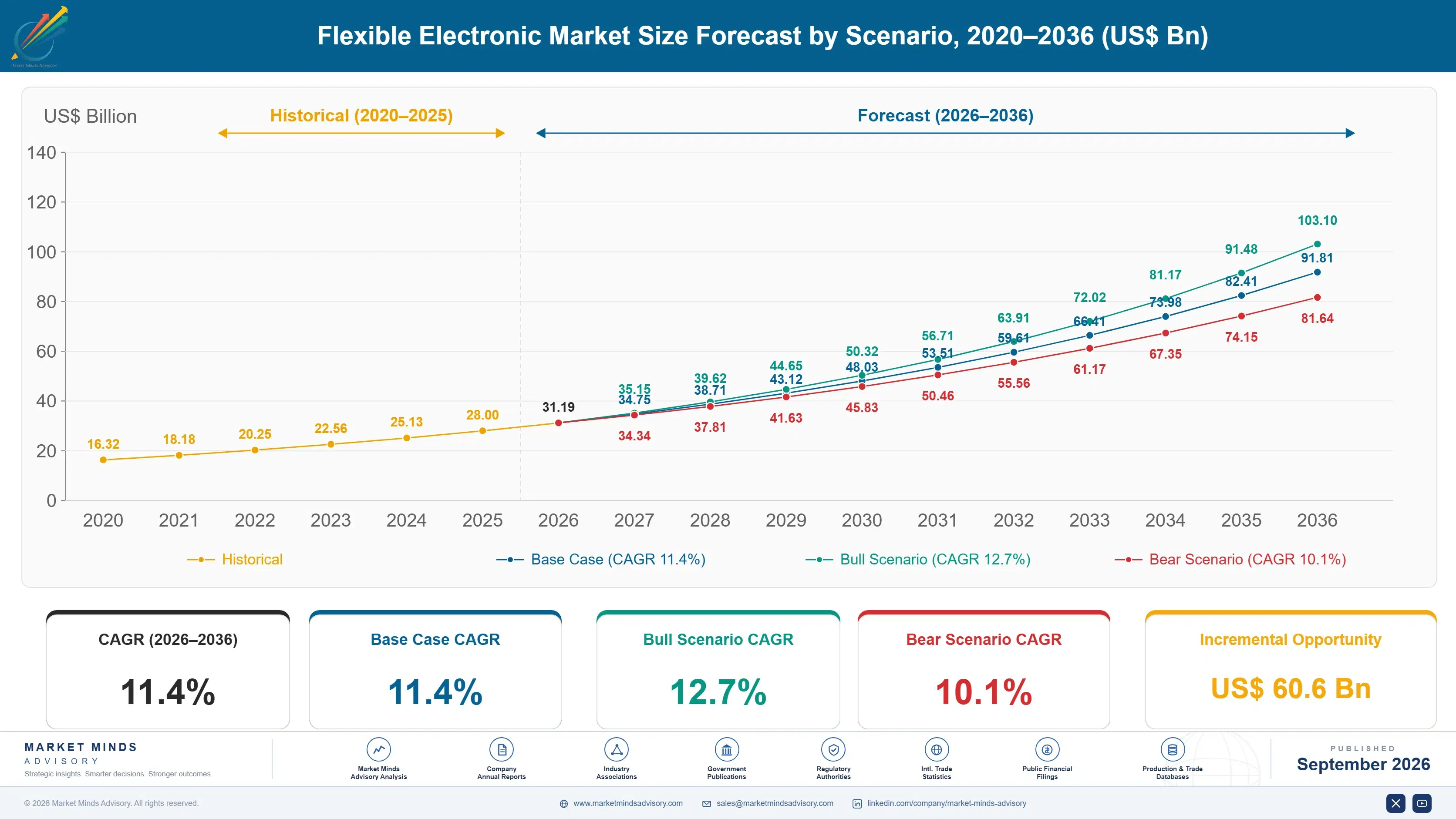
Between 2020 and 2025 the market accelerated as foldable smartphones moved from experimental flagship showcases into genuine mass-market product lines, expanding at roughly 10.2% annually as flexible display manufacturing yields improved enough to support commercial volume production. Several major display manufacturers established dedicated flexible substrate business units during this period. That shift signaled genuine long-term commercial commitment.
MMA's base case assumes 11.4% annual growth through 2036, anchored to three mechanisms: expanding foldable and rollable smartphone adoption pushing flexible OLED panels into mainstream price tiers, rising wearable device demand requiring flexible sensors and circuits that conform to the human body, and steady improvement in bend-cycle durability testing enabling broader consumer confidence in long-term reliability. Vendors demonstrating documented bend-cycle reliability are winning larger contracts. Smaller unproven competitors increasingly cannot compete for these larger contracts.
The bull case rests on foldable device adoption accelerating fast enough to become the default premium smartphone form factor rather than a niche alternative. The bear case centers on manufacturing yield challenges persisting longer than expected, keeping flexible component costs too high for mainstream price-tier adoption. That risk is most acute for vendors concentrated heavily on premium smartphones alone.

From Rigid Panels to Bendable Substrates

Flexible electronics began as laboratory demonstrations of bendable circuits valued mainly for theoretical possibility rather than commercial manufacturing viability. Vendors have since layered on polyimide substrate engineering, ultra-thin encapsulation layers, and bend-cycle durability testing, turning a research curiosity into a design-critical component that determines whether a foldable device can survive years of daily use.
AVERAGE PANEL PRICE$85Typical unit price for a mid-tier flexible OLED panel
BEND CYCLE RATING200,000Typical number of fold cycles before performance degradation
TOP PRODUCING COUNTRY SHARE32%South Korea share of global flexible display production
MANUFACTURING YIELD RATE78%Typical share of flexible panels passing final quality inspection
AVERAGE PRODUCT LIFESPAN4 yearsTypical usage period before device replacement or upgrade decision
FEEDSTOCK COST SHARE48%Polyimide film and specialty material share of production cost
Pricing now varies sharply by bend-cycle rating and display resolution. Basic single-fold panels charge moderate unit prices, while premium multi-fold and rollable panels command pricing that scales with documented durability testing, and device manufacturers increasingly accept higher component costs after a field failure convinces procurement that durability depth is worth paying for. Premium device manufacturers occupy a distinct tier entirely, paying per-panel fees justified by measurable bend-cycle and reliability gains over legacy rigid alternatives.
Large display manufacturing giants are acquiring specialized material science startups rather than building comparable substrate expertise in-house, buying polyimide formulation know-how and existing manufacturing process patents rather than production capacity alone. That acquisition pattern is starting to squeeze independent boutique vendors that lack the scale to invest in comparable durability testing infrastructure their larger competitors now offer as standard. Independent vendors that survive increasingly specialize in a niche larger platforms overlook.
"Nobody switches substrate suppliers over a spec sheet number. They switch after a hinge failure during a live product demo teaches them what the spec sheet didn't say."
Director, Advanced Materials and Display Technology Practice · MMA Technology Practice · September 2026

Market Trends

Multi-Fold Displays Push Manufacturing Yield Requirements Higher

Smartphone manufacturers are increasingly launching multi-fold devices requiring flexible panels to survive bend points at multiple locations simultaneously, a manufacturing challenge significantly more demanding than the single-fold designs that dominated early foldable device generations. This shift accelerated sharply once several major manufacturers publicly disclosed successful multi-fold commercial launches, proving the manufacturing challenge could be solved at commercial scale. Roughly 78% of flexible panels now pass final quality inspection, a figure that continues rising steadily each product generation as manufacturing processes mature. Vendors lacking documented multi-fold durability capability risk being left out of the largest new smartphone design cycles.
Market Impact: Foldable shipments grew over 35% yearly

Wearable Device Adoption Expands Flexible Sensor Demand

Wearable health monitoring devices increasingly require flexible sensors and circuits that conform comfortably to the human body, a requirement rigid electronics fundamentally cannot satisfy regardless of miniaturization progress. This shift reflects broader consumer demand for continuous health monitoring devices that remain comfortable during extended daily wear rather than bulky rigid alternatives. Vendors lacking dedicated flexible sensor capability increasingly lose competitive bids to platforms that can demonstrate concrete comfort and durability advantages tied directly to extended wear time. Vendors offering rigid-only solutions increasingly lose bids against flexible competitors demonstrating concrete comfort advantages.
Market Impact: Wearable shipments grew over 20%

Market Opportunities and Growth Drivers

Foldable Smartphone Adoption Expands Panel Demand

Global foldable smartphone shipment volume continues expanding as manufacturers introduce models across a wider range of price tiers rather than concentrating exclusively on ultra-premium flagship devices. Component suppliers increasingly qualify multiple flexible panel manufacturers per device platform to reduce single-source supply risk, a diversification pattern that expands the addressable vendor base beyond incumbent relationships. Vendors with demonstrated manufacturing yield credentials increasingly capture design wins across multiple device platforms simultaneously rather than single programs. Some vendors now maintain dedicated smartphone account teams purely to serve this growing multi-supplier qualification demand across major device platforms worldwide.
Market Impact: Manufacturing yields remain 22% lower

Wearable Health Monitoring Growth Drives Sensor Demand

Wearable health monitoring device adoption continues expanding as consumers seek continuous tracking of vital signs beyond what periodic clinical visits can provide. Device manufacturers increasingly recognize that flexible sensor designs achieve meaningfully better skin contact consistency and comfort than rigid alternatives during extended daily wear. Vendors serving this segment report meaningfully stronger order visibility than those focused purely on display applications. Several vendors have hired dedicated wearable application engineers purely to serve this growing sensor demand across major consumer health monitoring device categories. That order visibility helps vendors plan capacity investment with meaningfully more confidence over multi-year horizons.
Market Impact: Trust concerns affect 28% of buyers

Market Restraints and Challenges

Manufacturing Yield Challenges Limit Cost Competitiveness

Flexible panel manufacturing still produces meaningfully lower yields than mature rigid display production, forcing manufacturers to price flexible components at a premium that limits adoption among cost-sensitive mainstream device tiers. The root cause is that flexible substrate manufacturing requires precision control over material properties that rigid glass substrates never demanded, a manufacturing complexity the industry has not yet fully mastered. The commercial impact is component costs that remain meaningfully higher than comparable rigid alternatives. Some manufacturers are now investing in automated inspection systems specifically to improve yield consistency. That investment has proven partially effective at narrowing the yield gap.
Market Impact: 78% of panels pass inspection

Bend-Cycle Durability Concerns Limit Consumer Trust

Some consumers remain hesitant to purchase foldable devices due to persistent concerns about hinge and display durability over years of daily use, despite meaningful improvements in bend-cycle testing standards. The root cause is that early foldable device generations experienced well-publicized durability failures that continue to shape broader consumer perception even as manufacturing quality has genuinely improved since those early launches. The commercial impact is slower mainstream adoption than premium pricing alone would predict. Some manufacturers are now offering extended warranty programs specifically to address this trust gap. Early results suggest these warranty programs meaningfully improve purchase confidence among hesitant buyers.
Market Impact: Wearable sensor demand grew 32%
4 additional market trends, 3 additional growth drivers, and 3 additional restraints and challenges are covered in the full report. Contact sales@marketmindsadvisory.com to access the complete intelligence.

Segment CAGR and Growth Architecture

The market spans six categories organized by component type, from flexible OLED displays through flexible RFID electronics. Growth concentrates in categories serving consumer device differentiation, while legacy packaging categories grow slowest. Flexible sensor and photovoltaic film categories occupy the pricing middle, while battery storage and RFID electronics round out the categories at lower prices.
global-flexible-electronics-market-market-share-analysis-1789988667698

Flexible OLED Display Panels

Flexible OLED Display Panels combine ultra-thin polyimide substrates with organic light-emitting diode technology to survive repeated folding without image degradation, growing at roughly 18.2% annually as smartphone manufacturers push foldable and rollable form factors into mainstream price tiers. Adoption started among ultra-premium flagship devices willing to pay for differentiation, but improving manufacturing yields have pulled mid-range smartphones into the category over the past two years. The segment increasingly competes on documented bend-cycle durability rather than raw resolution alone, since hinge failures directly cost manufacturers warranty expense and reputational damage. Vendors that can document bend-cycle ratings above documented thresholds hold a durable pricing advantage over rivals still refining their substrate formulation.
CAGR 18.2%

Flexible Printed Circuit Boards

Flexible Printed Circuit Boards provide the bendable interconnect layer that connects flexible display and sensor components without rigid circuit board constraints, growing at roughly 14.6% annually as device manufacturers seek thinner and more compact form factors. This segment carries a broader customer base than display panels because it serves wearables, automotive, and industrial applications beyond consumer smartphones. Manufacturing precision requirements increasingly shape vendor selection, pushing suppliers toward automated inspection systems competitors have not yet fully matched. Retention in this segment consistently outperforms rigid circuit board contracts, since ripping out a certified flexible interconnect mid-design is far more disruptive than swapping a simpler component. Several manufacturers now publish audited durability benchmarks to reassure device buyers evaluating competing suppliers.
CAGR 14.6%
Full segment breakdown across 6 segments available in the complete report.

Regional Architecture and Country Demand Map

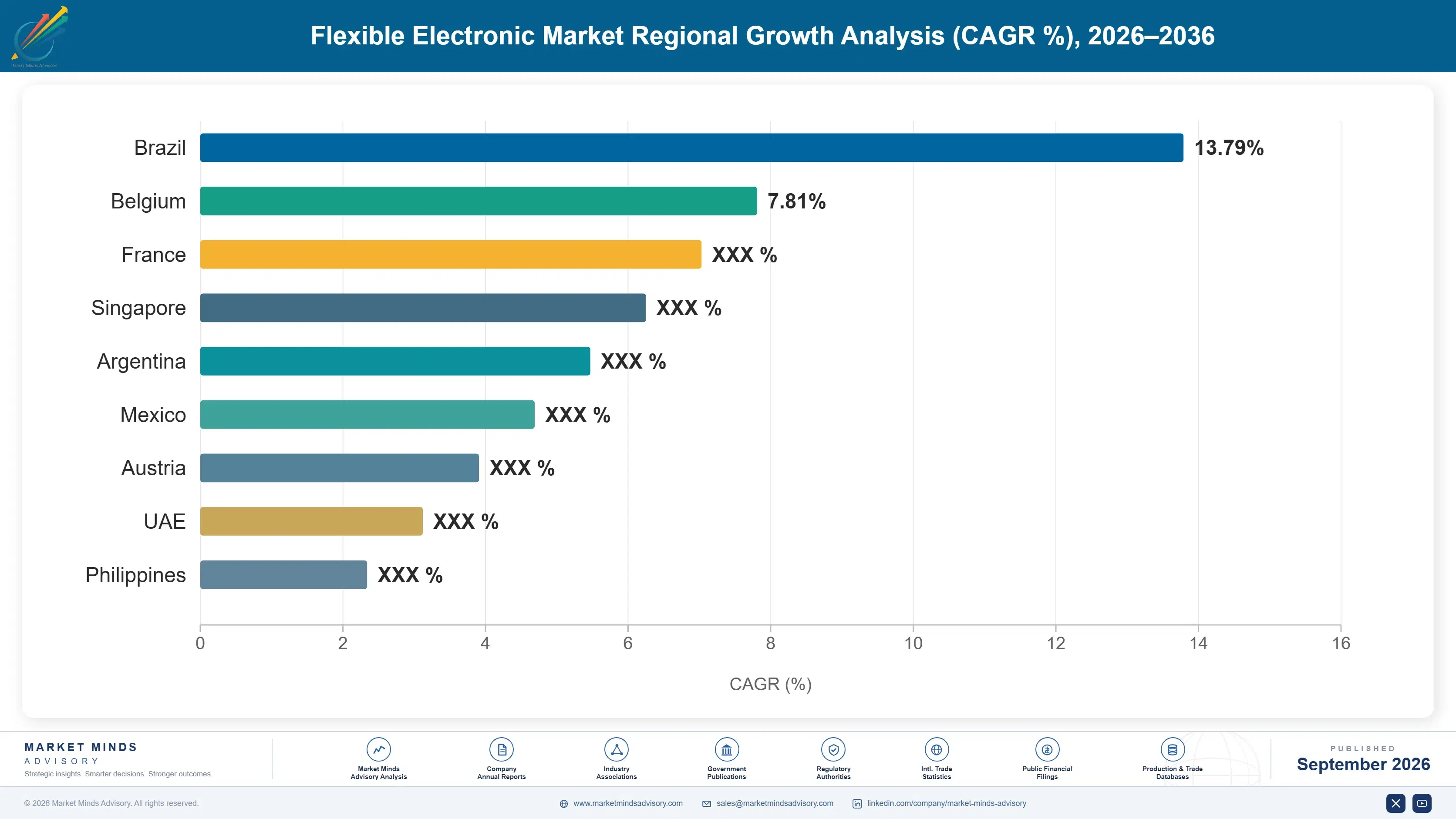
East Asia leads on display manufacturing concentration and South Korea's advanced panel fabrication capability, while South Asia and Pacific grows fastest as India's expanding smartphone assembly base scales rapidly. North America follows closely as premium device brands headquartered there drive early foldable adoption and design specification.

North America

North America holds a meaningful secondary share, supported by premium device brands headquartered domestically that specify flexible display and sensor requirements early in product development cycles. The United States hosts most of the category's largest wearable device and smartphone brand headquarters, whose design specifications shape flexible component requirements globally even though manufacturing happens elsewhere. Material science research institutions, concentrated here, add meaningful innovation pipeline activity few other markets currently match. Growth trails the global rate slightly since design specification activity here does not translate directly into proportional manufacturing volume, which remains concentrated in East Asia. Canadian material science startups are also emerging as a modest secondary growth pocket within the broader region.
Share: 23% | CAGR: 10.8% (2026 to 2036)

Western Europe

Western Europe's automotive and industrial electronics tradition, particularly strong in Germany, supports a steady base of flexible sensor and circuit demand distinct from purely consumer-display-focused demand elsewhere. The United Kingdom and France add meaningful wearable health monitoring device demand concentrated among medical technology companies headquartered in the region. Regulatory attention to medical device certification here is somewhat stricter than in North America, pushing vendors to build additional compliance documentation into standard product lines. Growth trails the global average as the region's consumer electronics manufacturing base has largely relocated to East Asia over past decades. Scandinavia's smaller but technologically advanced wearable device sector is emerging as a modest secondary growth pocket.
Share: 19% | CAGR: 9.8% (2026 to 2036)
Regional intelligence for 5 additional markets available in the complete report: East Asia, South Asia and Pacific, Latin America, Middle East and Africa, Eastern Europe. Contact sales@marketmindsadvisory.com.
global-flexible-electronics-market-country-cagr-analysis-1789988668266

Durability Data Commands Design-In Premium

Standard panel pricing is thin and falling, pushing vendors to build recurring revenue around durability certification and yield improvement services customers actually value. Bend-cycle testing and manufacturing process licensing now generate most incremental revenue. Vendors that diversify beyond one-off panel sales into these channels post materially stronger long-term revenue growth. Enterprise clients increasingly value this diversified capability.

Bend-Cycle Durability Certification Service Programs Nationwide

Vendors are building dedicated testing labs to offer accelerated durability certification services that device manufacturers can purchase alongside standard panel orders, proving reliability data justifies premium pricing above catalog components. Certification services now generate roughly 14% of total vendor revenue, up from near zero four years ago, and carry meaningfully lower churn than one-off component sales since the testing relationship deepens customer dependence. Several leading vendors have publicly disclosed certification pipeline growth exceeding 18% year over year as more clients sign on. This growth trend shows no signs of slowing across the broader flexible electronics industry.
Market Impact: Certification services now reach roughly 14% of revenue

Premium Multi-Fold Panel Upgrade Pathway Programs

Vendors increasingly design upgrade paths that convert standard single-fold customers into multi-fold panel relationships after demonstrating measurable durability improvement from advanced substrate engineering. These multi-fold panels now command roughly double the average unit price and represent the fastest-growing revenue segment within existing customer relationships. Application engineers also generate valuable customer insight vendors use to refine which accounts are likeliest to upgrade toward premium designs. Roughly 2 in 5 clients who try a multi-fold upgrade retain the expanded panel design permanently rather than reverting. Vendors view this recurring premium relationship as more durable than standard panel contracts alone.
Market Impact: Multi-fold panels now command roughly 2x pricing today

White-Label Manufacturing Process Licensing Partnership Programs

Some vendors now license their proprietary substrate manufacturing processes directly to contract manufacturers building custom flexible components, a distribution channel that bypasses direct panel sales entirely. Early licensing deals report meaningfully higher margin than comparable direct sales contracts, since the underlying process development cost is already covered by the vendor's own manufacturing investment. Contract manufacturers value gaining proven yield capability without building comparable expertise in-house. Roughly 3 in 10 contract manufacturers report measurably faster yield improvement after adopting the licensed process. Vendors increasingly treat this licensing channel as a genuine second business line.
Market Impact: Process licensing revenue now grows roughly 26% yearly

Medical Device Compliance Advisory Service Programs

Some vendors now offer paid medical device compliance advisory services helping wearable manufacturers navigate certification standards across multiple regulatory frameworks for their flexible sensor deployments specifically. This advisory revenue remains small but carries extremely high margin since the compliance methodology is already built for internal vendor certification purposes. Wearable manufacturers increasingly view certified advisory partners as essential resources they cannot otherwise assemble independently. Roughly 1 in 4 advisory clients expand into a full compliance package within their first year of engagement. That expansion pattern makes advisory services a genuinely durable revenue growth path.
Market Impact: Compliance advisory now adds roughly 3% of revenue

Who Controls the Margin Pool

The market is concentrated, with a cr5 of roughly 54%, reflecting decades of display manufacturing consolidation around a handful of major Korean and Chinese panel makers. The leading player holds a meaningful lead over its nearest challenger, with material-science-focused entrants closing the gap through documented durability data. The gap is measured in manufacturing yield data rather than production capacity, since buyers research before committing.
Current competition centers on bend-cycle durability disclosures, manufacturing yield announcements, and smartphone design-win partnerships, with vendors racing to secure large device manufacturer contracts before rivals establish similar credibility. Several vendors are also acquiring smaller material science specialists, and some now run dedicated smartphone account teams purely to capture certification revenue. International expansion into South Asia and Latin America has become a visible proxy battleground for investor confidence in this category.

Emerging pressure comes from Chinese domestic display manufacturers expanding production scale and price competitiveness, threatening to erode Korean vendors' historical margin advantage in cost-sensitive mid-tier device segments. Rankings could shift meaningfully if a well-capitalized domestic entrant secures a major national smartphone brand partnership. Legacy Korean vendors bring deep manufacturing expertise that domestic entrants still lack. That advantage narrows with each production cycle domestic entrants complete.
global-flexible-electronics-market-company-positioning-matrix-1789988668802

Competitive Moat and Risk Dimensions

SAMSUNG DISPLAY

Moat: Flexible OLED Manufacturing Scale

Samsung Display holds the deepest flexible OLED manufacturing scale of any panel maker, having built out production capacity and process expertise across more than a decade of continuous flexible display investment. Competitors attempting to displace this depth face years of manufacturing process lead time before reaching comparable yield consistency.
SAMSUNG DISPLAY

Risk: Premium Segment Dependency Risk

Samsung Display's scale advantage depends heavily on maintaining premium smartphone design wins that justify continued capital investment in flexible manufacturing capacity. A sudden shift in flagship device demand could strand significant manufacturing capacity built for that segment specifically. Some product lines have already seen capacity utilization dip noticeably as flagship device demand fluctuates from year to year.
LG DISPLAY

Moat: Diversified Application Durability Focus

LG Display built its brand around plastic OLED technology optimized for automotive and industrial applications beyond pure smartphone displays, creating a differentiated positioning that appeals to buyers wanting proven durability in demanding environments. That durability focus has attracted partnerships with several major automotive manufacturers directly.
LG DISPLAY

Risk: Mobile Design-Win Concentration Gap

LG Display's diversified application focus carries less concentrated smartphone design-win depth than competitors focused exclusively on consumer mobile devices. Faster-moving mobile-focused rivals could capture premium smartphone contracts requiring the newest display technology first. A sudden acceleration in mobile display innovation cycles could compress LG Display's competitive positioning faster than its diversification strategy can offset.

Players Tracked

Prominent Players

Samsung Display
LG Display
BOE Technology Group
Royole Corporation
DuPont

Other Key Players

Visionox
Tianma Microelectronics
AU Optronics
Innolux Corporation
Universal Display Corporation
3M Company
Sumitomo Chemical
Toray Industries
Kaneka Corporation
Shin-Etsu Chemical
Nissha Co
Ichia Technologies
Interflex Co
Young Poong Electronics
TPK Holding

Recent Developments

JANUARY 2026

Samsung Display announced an expanded manufacturing yield partnership with a major smartphone brand, integrating optimized multi-fold panel designs directly into the brand's next-generation flagship device platform. The agreement extends a pilot program launched the prior year and reflects growing brand confidence in documented bend-cycle reliability.
Signal: Manufacturer yield partnerships are steadily becoming the primary channel for premium panel design wins right now.
SEPTEMBER 2025

LG Display acquired a smaller specialist developer focused on flexible sensor integration technology, absorbing its existing intellectual property and small engineering team. The deal expands LG Display's capability into wearable health monitoring applications where it previously had limited presence. Leadership expects this to accelerate its wearable roadmap.
Signal: Consolidation of smaller flexible sensor specialist developers is clearly accelerating as vendors seek capability right now.
APRIL 2025

BOE Technology Group entered a joint venture with an Indian electronics assembly company to co-develop localized flexible display manufacturing capacity supporting the country's expanding smartphone assembly requirements. The partnership marks BOE's first meaningful manufacturing investment in India specifically. Both companies expect the facility to open within roughly two years.
Signal: International expansion into India increasingly relies on local assembly partnerships for genuinely successful entry right now.

Polyimide Film Cost Exposure

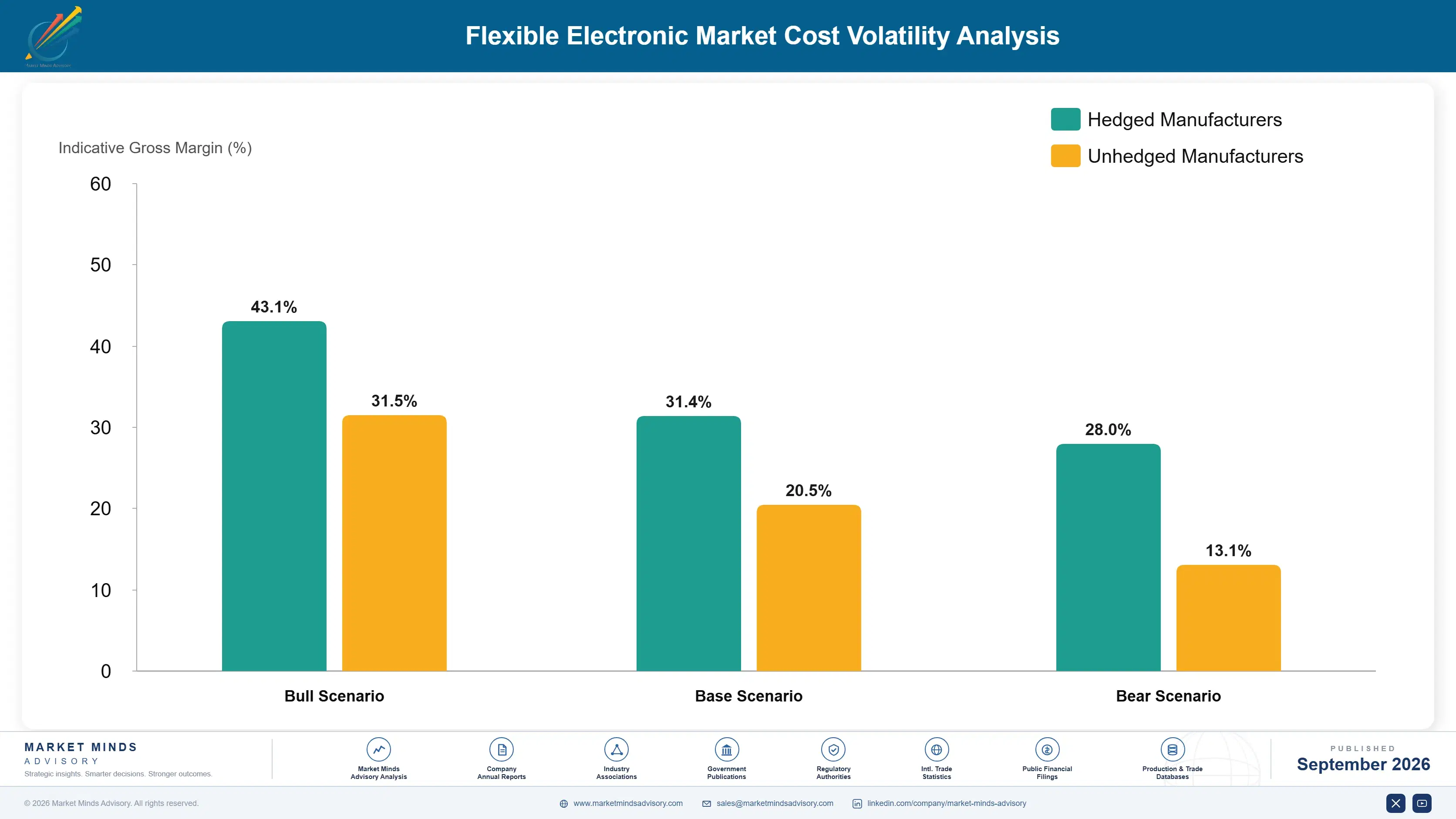
Polyimide film and specialty encapsulation materials together represent roughly forty-eight percent of flexible component cost of goods, with the remainder split between organic light-emitting diode materials and assembly labor. Most high-grade polyimide capacity is sourced from a small number of major chemical suppliers, concentrating supply risk in a narrow set of vendors globally. This concentration means a disruption can ripple through pricing quickly.
A 2025 polyimide supply disruption, documented in a major supplier's annual report, forced several smaller vendors to delay new panel shipments by roughly two months, temporarily slowing device manufacturer production schedules in affected market segments. Larger vendors with pre-negotiated volume contracts largely avoided the disruption entirely, widening the competitive gap. The episode pushed affected vendors to diversify polyimide sourcing across additional suppliers going forward. Some smaller vendors also began stockpiling additional polyimide inventory as a further precaution.

Smaller vendors without volume purchasing power face materially higher per-unit material costs than the largest three vendors, a disadvantage that compounds over time as scale advantages widen with each product generation. Vendors concentrated in East Asia face comparatively less currency risk than those pricing across multiple international currencies simultaneously. That gap is why smaller vendors seek acquisition by larger platforms.
global-flexible-electronics-market-cost-volatility-analysis-1789988669000

Diversified Multi-Supplier Polyimide Sourcing Agreements

Larger vendors are qualifying secondary polyimide film suppliers to reduce exposure to any single supplier's pricing changes or capacity constraints. This diversification adds modest qualification cost upfront but meaningfully shortens recovery time during future material shortages. Several vendors have already qualified alternate suppliers as part of this broader diversification push across their production planning process.

Long-Term Volume Purchase Commitments

Vendors with sufficient scale are negotiating multi-year polyimide purchase agreements that lock in favorable pricing ahead of demand spikes across the specialty film market. Smaller vendors lacking this leverage remain more exposed to spot market price swings during periods of tight material availability. These agreements typically span two to three years and are increasingly bundled with priority allocation commitments.

In-House Material Processing Capability Investment

Some vendors are investing in in-house material processing capability to reduce dependence on external suppliers for critical production steps. This investment requires meaningful upfront capital but reduces long-term exposure to third-party pricing and availability fluctuations. Vendors pursuing this path typically expect payback within roughly three to four years of sustained production volume growth overall.

Portfolio Architecture for Margin Defence

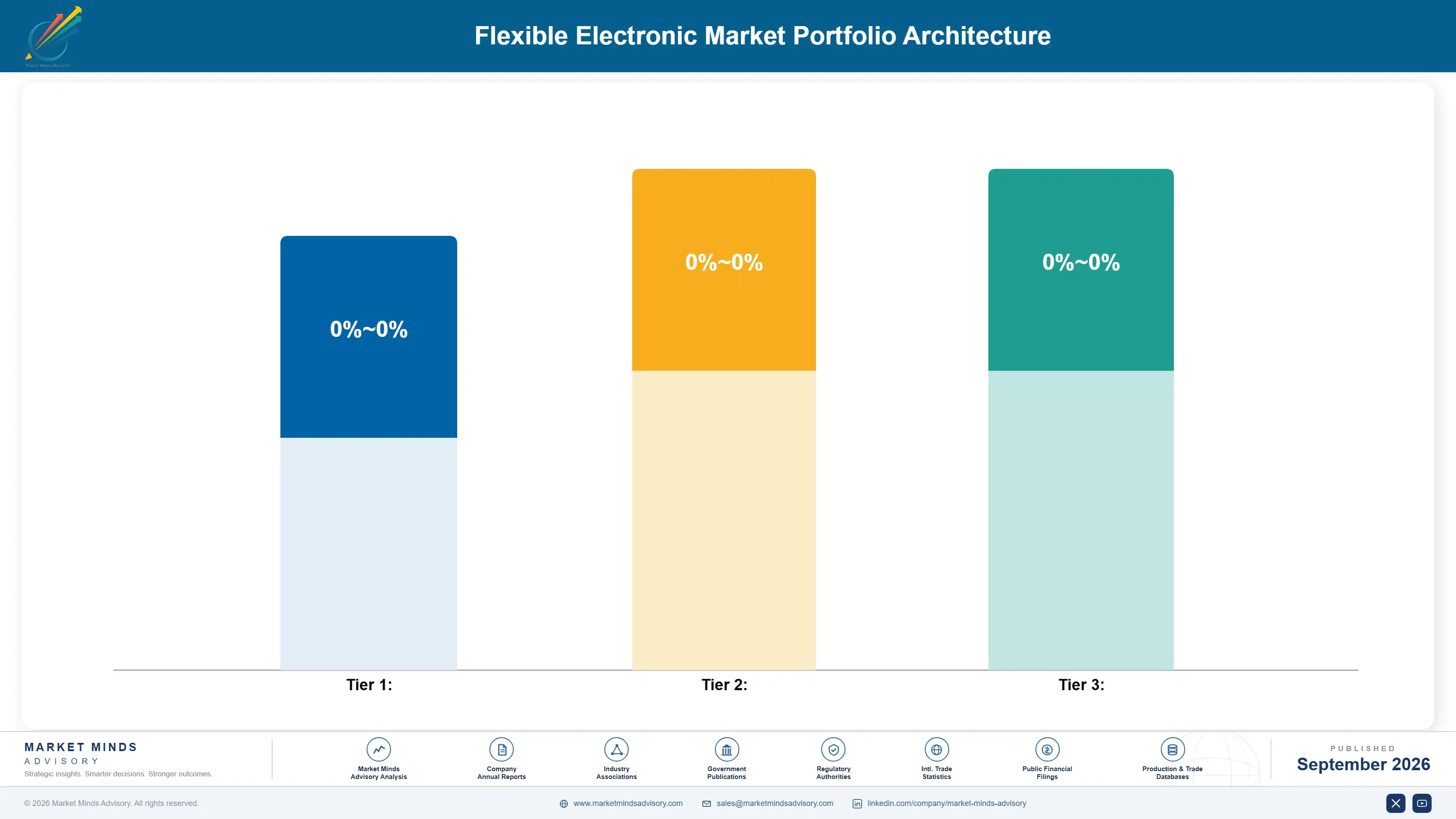
The market splits across three tiers by margin structure. Volume tier basic flexible circuits carry thin margins typical of commodity electronics, while premium tiers bundling multi-fold displays and durability certification command substantially higher margins closer to specialty materials businesses. Sustainability and next-generation tiers, built around rollable display technology and manufacturing process licensing, are still small but carry the highest long-term margin potential of the three.
Volume and premium tiers pull the market in opposite directions commercially. Volume growth depends on standard mid-range device applications holding steady, while premium growth depends on convincing flagship device manufacturers that documented durability data justifies a higher unit price. Most established vendors now run both tiers under a single brand, using standard clients as a funnel that converts a share into premium upgrades after a well-executed multi-fold demonstration.

High-value margin pools concentrate almost entirely in the multi-fold display and certification service tiers, where vendors capture both a premium unit price and a lower acquisition cost through recurring design-in relationships rather than one-off component sales. Volume tier standard circuits generate the bulk of total unit count but contribute proportionally less to profitability, making it valuable mainly as a funnel into higher-margin offerings.

Basic flexible circuits sold at thin margins comparable to commodity electronics, competing primarily on price and reliable supply availability rather than durability certification depth. Churn risk is highest here since switching costs are minimal and price comparison across vendors is straightforward for cost-conscious device manufacturers.
Gross Margin

Multi-fold display and durability-certified tiers commanding meaningfully higher margins, priced closer to a specialty materials relationship than commodity components, sustained by documented reliability. Retention outperforms volume tier customers, since requalifying a certified multi-fold design mid-program is far more disruptive than swapping a commodity part.
Gross Margin

Rollable display technology and manufacturing process licensing offerings carrying the highest long-term margin potential, dependent on qualification data that remains costly for smaller vendors to assemble. Adoption remains gradual as device buyers demand multi-year field data before committing to broader technology expansion.
Gross Margin
global-flexible-electronics-market-portfolio-architecture-1789988669502

High-value Sub-segments and Strategic Watch-out

Flexible OLED Display Panels

The fastest-growing and highest-value segment, benefiting directly from foldable smartphone adoption and improving manufacturing yields that continue to widen its addressable mainstream device customer base. Vendors documenting audited bend-cycle benchmarks are best positioned to capture flagship design-in wins ahead of competitors still building comparable evidence.

Flexible Printed Circuit Boards

A high-value, moderate-growth segment anchored by broad application diversity and strong retention, expanding steadily as wearables, automotive, and industrial applications demand compact interconnects. This segment carries the category's broadest end-market diversity and the lowest churn of any tier currently tracked across all vendors globally today.

Flexible Sensors and Wearable Substrates

The volume core of the market, generating growing unit count and margins, competing mainly on comfort and reliable skin contact rather than differentiated processing feature depth. Falling material costs are the main lever pulling budget-conscious wearable manufacturers into this segment for the very first time.

Flexible Battery and Energy Storage Films

A strategic watch-out segment facing pressure from rigid battery alternatives, as energy density improvements in conventional batteries continue narrowing the case for flexible energy storage adoption. Standalone flexible-only battery vendors without a rigid product alternative face genuine pressure to diversify very soon or be quietly acquired.

Design Wins Anchor Multi-Year Cycles

The annuity economics here differ from typical consumer software because renewal depends on multi-year device product cycles rather than continuous daily engagement. Renewal requires sustained proof that the component performs reliably across the full device lifespan, not habitual usage patterns the way consumer software retains subscribers. Vendors win renewals by demonstrating documented durability data that reassures the design engineer. Not by end-user engagement with the underlying product.
Adoption stickiness varies by end-use vertical. Premium smartphone customers show the deepest engagement, since requalifying a display design mid-product-cycle carries enormous cost and schedule risk, while wearable device customers churn more readily once a cheaper alternative passes basic testing. Automotive display customers sit between these extremes, tied closely to vehicle model refresh cycles rather than the flexible electronics category itself.

A generational shift is underway in who initiates these purchases. Younger device engineers, trained on flexible substrate design principles from the start of their careers, increasingly specify multi-fold components by default rather than defaulting to legacy rigid platforms, favoring vendors with strong application engineering support. That cohort is more willing to switch vendors if a competitor demonstrates better durability. Brand loyalty here is considerably weaker than among the first wave of rigid-focused engineers.
global-flexible-electronics-market-end-use-penetration-index-1789988669988

Where Durability Data Beats Manufacturing Scale

These are among the four positions where our research anticipates prominent divergence between winners and laggards over the coming forecast period. Each is grounded in the demand model, the regulatory perimeter, and the announced capacity pipeline.
01 / BEND-CYCLE CERTIFICATION POSITIONING

Build documented durability data before rivals win the design

Durability certification is becoming the single largest lever separating category leaders from the rest of the field, more so than raw manufacturing scale or basic price ever were in this market's earlier years. Vendors that invest early in dedicated bend-cycle testing infrastructure are locking in multi-year design contracts that competitors cannot easily displace once qualified and shipping. Vendors still selling purely on manufacturing scale risk permanent disadvantage as roughly a fifth of all device bids already require documented durability evidence today.
02 / MULTI-FOLD PANEL EXPANSION

Convert single-fold customers into multi-fold panel relationships

Multi-fold panels carry the highest margins and the lowest churn in this category by a wide margin, outperforming single-fold displays on nearly every retention metric vendors track internally today. The strongest commercial opportunity available right now is converting existing single-fold customers into multi-fold relationships after demonstrating measurable durability improvement from advanced substrate engineering. Vendors without a credible, well-built multi-fold platform will increasingly struggle to capture this upgrade revenue regardless of how established or extensive their overall manufacturing scale actually is.
03 / WEARABLE SENSOR TECHNOLOGY INVESTMENT

Build flexible sensor expertise before demand outpaces supply

Wearable health monitoring demand for flexible sensors is accelerating faster than most vendors' internal engineering capacity to serve it, creating a genuine talent and capability bottleneck across the industry. Vendors that build dedicated flexible sensor engineering teams early lock in design wins that rigid-focused competitors cannot easily replicate without years of specialized materials science and comfort engineering expertise of their own. Vendors without a credible flexible sensor strategy risk losing the fastest-growing segment of this market entirely to better-prepared rivals.
04 / MATERIAL COST DIVERSIFICATION STRATEGY

Diversify polyimide sourcing to defend margin against suppliers

Material cost concentration leaves smaller vendors disproportionately exposed to pricing changes from a small number of dominant polyimide film suppliers who control most global capacity today. Vendors that diversify sourcing earlier or negotiate multi-year purchase agreements with backup suppliers recover faster from price shocks and maintain pricing stability that reassures cost-sensitive device manufacturers considering their first multi-year design commitment. This positioning matters more with each new product generation as material intensity keeps rising steadily across an increasingly sophisticated and expanding product lineup.

Engagement Snapshot From the Field

A live engagement with an industry participant carrying material or product regulatory and market exposure ahead of a defining policy shift, showing how our research translates into a defensible multi-year portfolio strategy.
MARKET MINDS ADVISORY · CLIENT ENGAGEMENT SUMMARY
Flexible Electronic Producer Strategic Portfolio Review and Transition Roadmap 2026·Investment Scenario on Flexible Electronic Exposure Evaluation 2025-26
CLIENT PROFILE
The client is a mid-size wearable device manufacturer evaluating flexible sensor vendors for its first continuous health monitoring product line, a new capability the company had never previously offered. Engineering leadership had relied on rigid sensor components for a decade. The manufacturer had never previously designed a flexible sensor product and lacked internal precedent for comparing vendors on a consistent technical basis.
STRATEGIC CHALLENGE
Engineering leadership needed to select a vendor from a crowded field of similar-sounding sensor suppliers without deep internal flexible materials expertise to evaluate competing comfort and durability claims independently. A wrong choice risked locking the company into a costly redesign if the chosen sensor failed skin-contact reliability testing. Board members were also concerned about committing engineering resources to an unproven vendor relationship without independent validation.
MMA APPROACH
MMA analysts benchmarked five leading vendors against a consistent commercially relevant basis covering documented comfort testing, bend-cycle durability, and existing wearable device references. Analysts also interviewed reference clients directly to validate vendor marketing claims independently before finalizing a recommendation. This cross-referencing surfaced meaningful discrepancies between vendor-reported comfort testing and what comparable wearable clients had actually experienced.
KEY FINDINGS
  1. Only two of five evaluated vendors had independently verified comfort and durability data credible enough to support design planning. The remaining three relied primarily on internal laboratory testing rather than verified field performance data.
  2. Application engineering support varied enormously across vendors, with the strongest candidate offering dedicated on-body testing assistance. That on-body testing translated directly into faster design iteration and fewer comfort-related returns during the pilot phase.
  3. Vendor pricing models diverged sharply between flat catalog pricing and volume-tiered material licensing bundles. The volume-tiered structure ultimately proved more predictable given the manufacturer's uncertain first-year production volume.
  4. Two vendors lacked prior experience with continuous health monitoring applications specifically, requiring a longer testing cycle. Onboarding gaps would have required additional weeks of preparation before either vendor could support confidently.
CLIENT PROFILE
The client is a mid-size wearable device manufacturer evaluating flexible sensor vendors for its first continuous health monitoring product line, a new capability the company had never previously offered. Engineering leadership had relied on rigid sensor components for a decade. The manufacturer had never previously designed a flexible sensor product and lacked internal precedent for comparing vendors on a consistent technical basis.
STRATEGIC CHALLENGE
Engineering leadership needed to select a vendor from a crowded field of similar-sounding sensor suppliers without deep internal flexible materials expertise to evaluate competing comfort and durability claims independently. A wrong choice risked locking the company into a costly redesign if the chosen sensor failed skin-contact reliability testing. Board members were also concerned about committing engineering resources to an unproven vendor relationship without independent validation.
MMA APPROACH
MMA analysts benchmarked five leading vendors against a consistent commercially relevant basis covering documented comfort testing, bend-cycle durability, and existing wearable device references. Analysts also interviewed reference clients directly to validate vendor marketing claims independently before finalizing a recommendation. This cross-referencing surfaced meaningful discrepancies between vendor-reported comfort testing and what comparable wearable clients had actually experienced.
KEY FINDINGS
  1. Only two of five evaluated vendors had independently verified comfort and durability data credible enough to support design planning. The remaining three relied primarily on internal laboratory testing rather than verified field performance data.
  2. Application engineering support varied enormously across vendors, with the strongest candidate offering dedicated on-body testing assistance. That on-body testing translated directly into faster design iteration and fewer comfort-related returns during the pilot phase.
  3. Vendor pricing models diverged sharply between flat catalog pricing and volume-tiered material licensing bundles. The volume-tiered structure ultimately proved more predictable given the manufacturer's uncertain first-year production volume.
  4. Two vendors lacked prior experience with continuous health monitoring applications specifically, requiring a longer testing cycle. Onboarding gaps would have required additional weeks of preparation before either vendor could support confidently.
RECOMMENDED STRATEGY
Phase 1: Select the vendor with the strongest verified comfort data and negotiate a volume-tiered licensing structure rather than flat rates. This ensures accurate multi-year cost forecasting as production volume scales. Phase 2: Launch a limited pilot production run before committing to the full product line rollout planned. This limits risk while generating enough field data to validate comfort claims. Phase 3: Require quarterly durability reporting and build a redesign support clause if performance targets are not consistently met. This protects the manufacturer if real-world durability diverges from the vendor's initial demonstration.
OUTCOME
The manufacturer selected its preferred vendor and launched a pilot production run in early 2026, reporting stable sensor performance within the first quarter of field deployment. Leadership credited the independent vendor comparison with avoiding a costly commitment to a less proven competitor. The pilot's volume-tiered structure also meant the manufacturer faced predictable costs during this initial evaluation period.

Frequently Asked Questions

Foundational context covering the market sizes, CAGR, scope, country, region and competition that inform every finding below. This section is provided to cover basics and most often pre-purchase conversations, answered from the MMA Primary Research Dataset.

What is the current size of the Flexible Electronic Market?

The Flexible Electronic Market reached roughly 28.0 billion dollars in 2025. Rising foldable smartphone adoption and expanding wearable device demand continue driving market growth steadily.

How large will the Flexible Electronic Market be by 2036?

MMA projects the market will reach approximately 91.81 billion dollars by 2036. That represents roughly 2.94 times its 2026 value, driven by multi-fold and sensor technology expansion.

What is the CAGR for the Flexible Electronic Market 2026 to 2036?

The market is projected to grow at an 11.4% compound annual rate between 2026 and 2036. Foldable smartphone adoption and wearable device demand both support this sustained growth pace.

Which segment is growing fastest?

Flexible OLED Display Panels are growing fastest, at roughly 18.2% annually, about 1.6 times the overall market rate. Foldable smartphone differentiation is the primary driver behind this pace.

Who are the major companies in the Flexible Electronic Market?

Samsung Display, LG Display, BOE Technology Group, Royole Corporation, and DuPont lead the market. Together these five companies hold roughly 54% combined share on a shipment volume basis.

Which country is growing fastest?

South Korea is growing fastest, at roughly 15.2% annually, as its advanced panel fabrication capability and dominant flexible display manufacturing base continue expanding across the industry.

Report Segmentation Architecture

The full report scope spans multiple orthogonal segmentation dimensions, with cross-tabulated demand data provided for each dimension pair. Coverage extends further to regional breakdowns, trend trajectories, and the competitive detail needed to support segment-level decision-making.

By Primary Market Dimension

  • Flexible OLED Display Panels
  • Flexible Printed Circuit Boards
  • Flexible Sensors and Wearable Substrates
  • Flexible Photovoltaic and Energy Harvesting Films
  • Flexible Battery and Energy Storage Films
  • Flexible RFID and Smart Packaging Electronics

By End-Use Industry

  • Consumer Electronics and Smartphones
  • Wearable Health Monitoring Devices
  • Automotive Displays and Sensors
  • Industrial and Aerospace Electronics
  • Medical Devices and Diagnostics

By Commercial Dimension

  • Direct OEM Design-In Channels
  • Contract Manufacturer Channels
  • Process Licensing Channels
  • Distributor and Reseller Channels

By Region

  • North America
  • Western Europe
  • East Asia
  • South Asia and Pacific
  • Latin America
  • Middle East and Africa
  • Eastern Europe

Scope, Methodology, and Coverage

Every figure in this report is reproducible from documented input assumptions. The scope below maps the historical period, the forecast horizon, the segmentation dimensions, and the countries covered, alongside the underlying primary and qualitative methodology.
Historical Period
2020 to 2025
Forecast Period
2026 to 2036
Base Year
2025 (USD billions; MMA Primary Research Dataset, September 2026)
Market Definition
This report defines the Flexible Electronic Market as bendable displays, circuits, sensors, and energy components manufactured on flexible substrates rather than rigid materials. It excludes conformable but non-bendable curved rigid devices and standard rigid printed circuit boards.
Quantitative Units
USD billions, unit shipment volumes, and percentage share
Segmentation Dimensions
Component type, end-use industry, and commercial dimension
Regions Covered
North America, Western Europe, East Asia, South Asia and Pacific, Latin America, Middle East and Africa, Eastern Europe
Countries Covered
South Korea, China, United States, Japan, Germany, India, and 21 additional countries
Key Companies Profiled
Samsung Display, LG Display, BOE Technology Group, Royole Corporation, DuPont, and 15 additional companies
Quantitative Methodology
Primary survey, n=3,800 respondents, Q4 2025, six countries; demand-side model with trade association cross-validation
Qualitative Methodology
47 expert interviews, Q4 2025; applied to validate demand model assumptions, identify emerging dynamics, and assess competitive positioning
Report Format
PDF and XLSX data workbook (Word format preview document)
Publisher
Market Minds Advisory
Report Code
MMA-2026-TEC-237
Published
September 2026
Contact
sales@marketmindsadvisory.com | www.marketmindsadvisory.com

Purchase the full Flexible Electronic Market Report (2026 to 2036).

This report gives device manufacturers and materials procurement teams a complete view of the Flexible Electronic Market through 2036. It covers segment-level growth, regional demand shifts, and competitive positioning across display, circuit, and sensor product lines. Input cost exposure and margin architecture are analyzed in detail, with particular attention to how polyimide film cost volatility is reshaping vendor pricing and consolidation across every major regional market. Readers get actionable guidance on where to concentrate commercial investment over the next decade of accelerating foldable device adoption.
Ten-year global revenue and unit volume forecasts
Seven-region demand, pricing, and adoption breakdown
Competitive benchmarking across the top twenty vendors
Polyimide film cost exposure analysis and mitigation guidance
Segment-level margin architecture and pricing tier analysis
Anonymized client vendor selection engagement case study

Built For The People Who Decide

From boardroom strategy to bench-side execution, this report is read cover-to-cover by leaders shaping the next decade of their industry, turning demand scenarios, market dynamics and valuation benchmarks into decisions.
CXOs/ Presidents/ VPs/ Managers
M&A and Corporate Development
Strategy Teams and R&D Heads
Procurement and Product Directors
Regulatory and Compliance Leaders
Investor Relations and Equity Analysts