Market Minds Advisory
Curing Oven Market

Curing Oven Market: Cure Technology Depth and Energy Efficiency Strategy

Automotive and appliance coating lines are replacing legacy convection curing ovens with UV and infrared systems as faster cure cycles and VOC emissions regulation converge to make advanced curing technology a standard production line specification.

Lead Analyst

David Horsley

Published

September 2026

Make Smarter Decisions with Customized Research Insights

Request a free sample report and evaluate market opportunities, growth trends, and competitive dynamics relevant to your business needs.

2025 MARKET VALUE$2.9BMarket Size 2025
2036 FORECAST VALUE$5.9BBase Case , 2026 to 2036
CAGR 2026 TO 20366.6 %Bull 7.9% / Bear 5.3%
INCREMENTAL OPPORTUNITY$2.8BNet 10- year value creation
EXPANSION MULTIPLE1.90x2036 value over 2026 base
Strategic Levers
M&A Pipeline
Regional Outlook
Country Rankings
Competitive Intelligence
Segmental Deep-dive
Call-Us : 91 93563 13602

Executive Snapshot and Market Trajectory

Curing ovens have moved from a generic thermal processing box into a precision production line asset. Manufacturers increasingly specify UV and infrared curing systems because cycle time, energy consumption per part, and VOC emissions compliance now directly affect both production throughput and regulatory permitting costs across every facility.
UV curing ovens are growing fastest, pulled by manufacturers' need for near-instant cure times and lower energy consumption on high-volume coating and adhesive bonding lines, expanding roughly 58% faster than the category average. East Asia retains the largest regional share, supported by China's dominant automotive and appliance manufacturing base, expanding electronics coating capacity, and the region's deep concentration of thermal processing equipment suppliers.
Competitive intensity centers on cure technology depth and energy efficiency rather than raw oven output. Despatch and Nordson are racing regional specialists to bundle UV LED emitters, infrared zone control, and predictive maintenance sensors into single validated curing platforms. Regulatory pressure, expanding VOC emissions standards in the United States and EU industrial emissions directives, is pulling upgrade demand forward faster than equipment failure rates alone would explain across most automotive and appliance coating categories worldwide.
Market Definition
The Curing Oven market covers industrial thermal processing equipment used to cure coatings, paints, adhesives, and composite materials through convection, infrared, or ultraviolet energy, including batch, conveyor, and continuous curing oven configurations sold to automotive, appliance, aerospace, and electronics manufacturers. It excludes sterilization ovens, food processing ovens, and kilns used for ceramic or refractory material firing.
Base Year Value
$2.9B in 2025 (MMA Primary Research Dataset, August 2026)
Forecast Period
2026 to 2036, eleven discrete annual values
CAGR
6.6% base case. Bull 7.9%. Bear 5.3%.
Fastest Growth Segment
UV Curing Ovens: 10.4% CAGR
Fastest Growth Country
Mexico: 9.6% CAGR
Fastest Growth Region
South Asia and Pacific: 8.8% CAGR
Largest Region
East Asia: 29% of 2025 global value
Market Leaders
Despatch Industries (Illinois Tool Works), Wisconsin Oven Corporation, Grieve Corporation, Thermal Product Solutions LLC, Nordson Corporation. Source: MMA Analysis based on company annual reports.
Primary Survey
n=3,800 procurement and R&D decision-makers, Q4 2025, six countries
Methodology
Demand-side build-up, cross-validated against public data, 47 expert interviews

Curing Oven Market Forecast Scenarios

curing-oven-market-size-forecast-scenario-1787301977756
Curing oven demand grew steadily through 2020 to 2025, slowed briefly in 2020 as automotive and appliance manufacturing paused during the pandemic, then accelerated as production capacity expansion resumed and UV curing technology adoption broadened across more coating applications. UV curing oven adoption accelerated faster than the category as energy efficiency and VOC compliance requirements intensified, producing a historical CAGR of 5.7% that understates the acceleration underway.
The base case assumes 6.6% annual growth through 2036, driven by three mechanisms. First, expanding VOC emissions regulations require faster-curing, lower-emission coating technology across more manufacturing jurisdictions than in the past. Second, EV battery and composite manufacturing capacity expansion requires specialized infrared and induction curing equipment that traditional convection ovens cannot adequately support. Third, new automotive and appliance manufacturing capacity across Asia, North America, and Mexico requires initial curing oven procurement rather than replacement of existing equipment.
The bull case assumes faster VOC regulation enforcement and accelerated EV battery manufacturing capacity growth pull growth toward 7.9%. The bear case centers on delayed regulatory implementation and continued reliance on legacy convection ovens in cost-constrained markets, pulling growth down toward 5.3% if global manufacturing capital spending disappoints relative to current producer project pipelines.

Cure Technology Depth and Energy Efficiency Economics

Curing oven selection has become a throughput and compliance decision as much as a thermal one. Manufacturers increasingly specify UV and infrared systems because cycle time and VOC emissions compliance now directly affect production line output and regulatory permitting costs that plant managers track closely.
CR5 CONCENTRATION37%Reflects moderate consolidation among global curing oven manufacturers
UV SYSTEM PRICE PREMIUM45-70%Premium buyers pay over standard convection curing ovens
CHINA MANUFACTURING SHARE27%Share of global curing oven production located there currently
CURE CYCLE TIME REDUCTION50-75%Typical time savings achieved through UV curing conversion
COMPONENT COST SHARE30-40%Portion of unit cost tied to emitters and controls
AVERAGE EQUIPMENT SERVICE LIFE15-20 yearsTypical operational lifespan before major overhaul or replacement
China generates roughly 27% of global curing oven production, reflecting both its dominant automotive and appliance manufacturing base and its deep concentration of thermal processing equipment suppliers relative to other regions still importing most specialty curing technology. Manufacturers price accordingly, charging meaningfully more for fully featured UV and infrared systems sold into premium automotive and electronics applications than into cost-constrained regions still relying primarily on basic convection ovens.
The next decade will reward manufacturers that integrate UV LED emitters, infrared zone control, and predictive maintenance sensors into validated curing platforms faster than those still selling standalone convection ovens. Regulatory pressure, more than thermal output, will set the pace of UV and infrared conversion in cost-constrained markets still running legacy convection systems. Expect cure cycle attachment rates to keep rising as VOC and energy efficiency mandates expand, compressing manufacturer hardware margins even as total category revenue expands across every major automotive and appliance coating market worldwide.
"A plant manager doesn't switch to UV curing because it's trendy, they switch because it cuts their cure cycle from twenty minutes to ninety seconds and that changes their entire line throughput math."
Director, Industrial Thermal Processing and Coatings Practice · MMA Construction

Market Trends

UV LED Curing Systems Replace Convection Cure Ovens

Manufacturers increasingly specify UV LED curing systems rather than traditional convection ovens, since UV curing completes in seconds rather than the minutes convection thermal curing requires, letting production lines run significantly faster without expanding oven footprint. This throughput advantage matters more as manufacturers face rising labor and floor space costs that make faster-curing equipment more valuable per square foot of production line. Manufacturers are responding by embedding UV LED emitter arrays with programmable intensity control directly into standard curing platforms rather than offering them as specialty add-ons, reducing energy consumption and cycle time for producers managing high-volume coating lines.
Market Impact: Adds regulation-driven demand 12-18

VOC Emissions Regulations Accelerate Low-Emission Curing Adoption

Expanding VOC emissions regulations, including updated US EPA air quality permitting requirements and the EU's Industrial Emissions Directive, are pushing manufacturers to replace legacy convection curing ovens with UV and infrared systems capable of lower solvent emissions and reduced energy consumption per cured part. Compliance timelines vary by jurisdiction, but the direction is consistent across major manufacturing markets, giving manufacturers a reliable multi-year replacement demand signal independent of underlying equipment failure rates. Manufacturers increasingly bundle curing oven conversion with broader emissions compliance programs to capture efficiency from combined permitting and installation site visits.
Market Impact: Adds EV-driven demand 16-24% annual

Market Opportunities and Growth Drivers

VOC Emissions Regulation Requires Low-Emission Curing Technology

Environmental regulations increasingly require manufacturers to reduce solvent-based coating emissions before facilities can obtain or renew air quality permits, and UV and infrared curing systems deliver lower emissions profiles than traditional convection thermal curing that relies on higher processing temperatures and longer cycle times. Manufacturers in jurisdictions adopting stricter emissions standards face permitting deadlines that create concentrated, time-bound replacement demand independent of the broader manufacturing capital spending cycle. Equipment makers report that regulation-driven projects increasingly specify UV or infrared configurations rather than conventional convection ovens, since lower emissions profiles simplify the permitting documentation regulators now require manufacturers to maintain.
Market Impact: Raises capital cost by 45-70%

EV Battery and Composite Manufacturing Drives Specialized Curing Demand

EV battery and composite material manufacturers increasingly require specialized infrared and induction curing equipment capable of precise temperature control that traditional convection ovens cannot deliver consistently across battery cell coating and composite resin curing applications. This specialized manufacturing trend benefits equipment makers directly, since EV and composite manufacturers typically specify dedicated curing lines built for their specific process requirements rather than adapting general-purpose convection equipment. Manufacturers report that EV-driven curing installations increasingly bundle process monitoring software and predictive maintenance integration, since the incremental cost of specialized curing capability is small relative to the production line investment overall.
Market Impact: Extends delivery lead times 3-5 mon

Market Restraints and Challenges

Higher UV System Cost Slows Smaller Manufacturer Adoption

Fully featured UV curing systems carry capital costs that can exceed the annual equipment budget of many smaller manufacturers, particularly given the specialized emitter and control technology required compared to conventional convection oven construction. The root cause is that UV LED emitter arrays and programmable control systems add meaningful cost on top of the base oven structure, and smaller manufacturers often cannot justify that premium against their smaller production volume and lower regulatory exposure. Smaller manufacturers unable to justify full UV conversion are responding by retrofitting existing convection ovens with partial UV capability rather than replacing entire curing lines simultaneously.
Market Impact: Cuts cure cycle time by 50-75%

Emitter Component Supply Constraints Extend Delivery Lead Times

UV LED emitters, infrared elements, and precision control components account for 30 to 40% of curing oven manufacturing cost, and semiconductor supply constraints during 2021 and 2022 extended manufacturer delivery lead times meaningfully across most major manufacturing regions. The root cause is that UV LED emitter components require specialized semiconductor content that competes for the same limited manufacturing capacity as components used across a much broader range of industrial and consumer electronics categories. Manufacturers are responding by qualifying multiple emitter suppliers and redesigning certain configurations to use more widely available alternative component families.
Market Impact: Cuts VOC emissions by 40-65%
3 additional market trends, 3 additional growth drivers, and 2 additional restraints and challenges are covered in the full report. Contact sales@marketmindsadvisory.com to access the complete intelligence.

Segment CAGR and Growth Architecture

This report segments the curing oven market by cure technology type across UV curing ovens, infrared curing ovens, conveyor and continuous curing ovens, convection curing ovens, induction curing ovens, and batch and box curing ovens. Technology type was chosen over end-use industry because purchasing decisions follow cure mechanism capability rather than the specific manufacturing sector the oven ultimately serves.
curing-oven-market-market-share-analysis-1787301978302

UV Curing Ovens

UV curing ovens are the fastest-growing category at 10.4% annually, roughly 58% faster than the market average. Faster cure cycle requirements and VOC emissions reduction targets are the primary demand drivers, since UV LED technology delivers the near-instant curing and lower energy consumption that convection systems cannot provide across high-volume automotive and electronics coating applications. Manufacturers converting to UV systems report meaningfully faster production line throughput, letting plant managers reduce floor space requirements per unit of output. Despatch and Nordson lead this category, with programmable UV intensity control increasingly differentiating premium configurations from basic UV systems on cure uniformity and component durability under continuous operation.
CAGR 10.4%

Infrared Curing Ovens

Infrared curing ovens, the second-fastest category at 8.7% annually, benefit from their ability to deliver precise, zone-controlled temperature profiles that EV battery coating and composite resin curing applications increasingly require, making them the preferred choice for demanding manufacturing processes where conventional convection heating cannot achieve adequate temperature uniformity. Manufacturers in these sectors increasingly specify infrared systems as standard equipment for battery cell and composite curing production lines. Equipment makers report infrared configurations increasingly specified alongside UV curing capability, since many production facilities carry both coating and composite curing requirements simultaneously. Adoption is concentrated among larger manufacturers with the capital and technical sophistication to specify process-appropriate curing technology by application.
CAGR 8.7%
Full segment breakdown across 6 segments available in the complete report.

Regional Architecture and Country Demand Map

East Asia retains the largest regional share on China's automotive and appliance manufacturing scale, with South Asia and Pacific expanding fastest as industrial manufacturing and emissions regulation enforcement both accelerate. North America and Western Europe follow, while other regions remain earlier-stage markets for advanced conversion.

North America

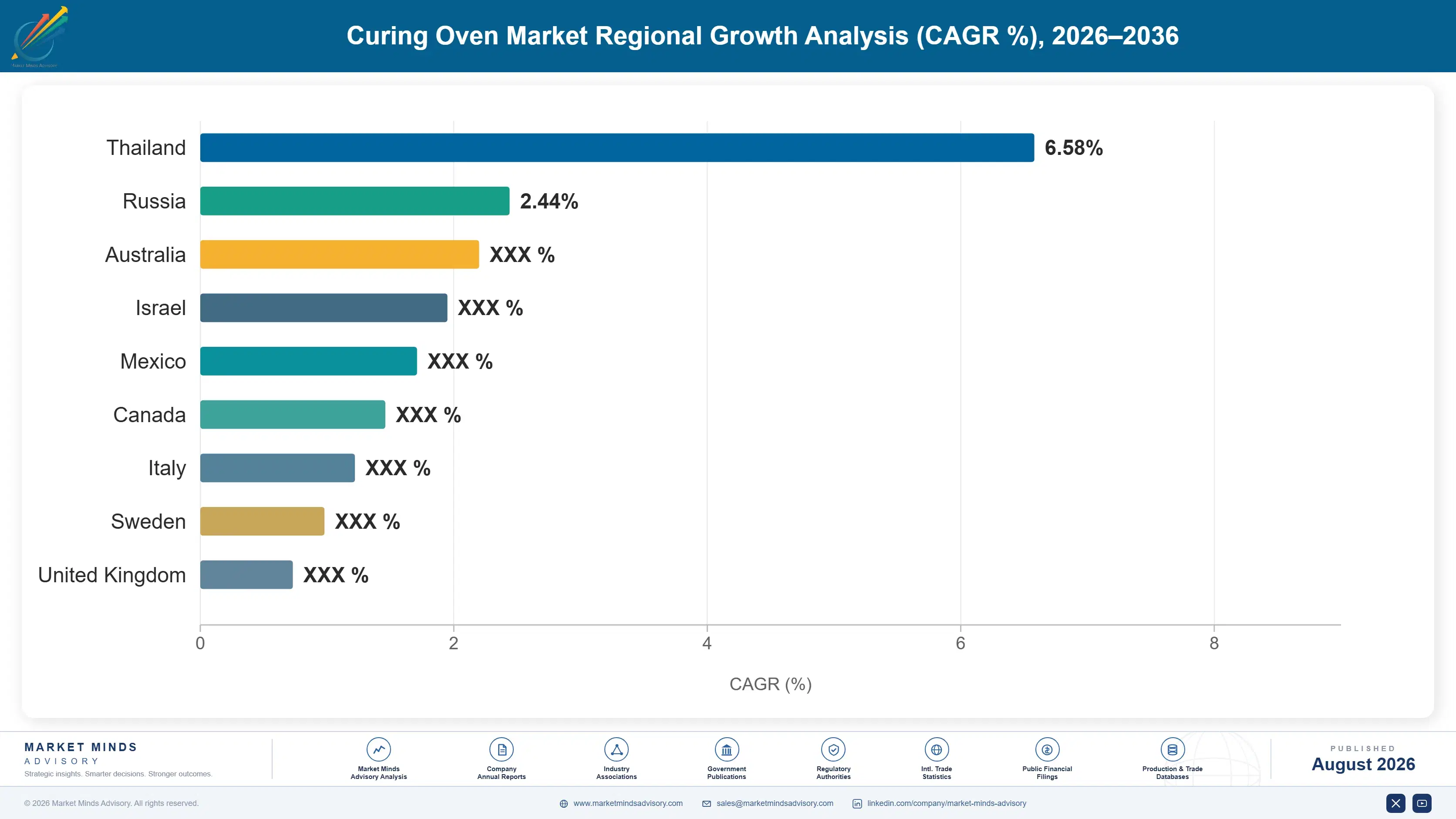
US automotive and appliance manufacturers are converting legacy convection ovens to UV and infrared systems, driven primarily by VOC emissions permitting requirements and production throughput pressure rather than broader capacity expansion, since US manufacturing capacity has grown only modestly in recent years. Mexico's manufacturing sector, boosted by nearshoring investment and proximity to the US market, is generating meaningful new equipment demand tied to new and expanding automotive production facilities. Canada's manufacturing base remains comparatively small, generating limited independent demand beyond occasional replacement equipment purchases. Regional equipment makers and distributors increasingly compete on service and rapid parts availability rather than price alone, given the relatively small number of large manufacturing customers across the region.
Share: 24% | CAGR: 6.0% (2026 to 2036)

Western Europe

Germany and France host meaningful curing oven manufacturing capacity and serve as the primary source of premium UV and infrared equipment for European manufacturers, even as much of the region's own automotive production capacity has consolidated or relocated to lower-cost markets in recent years. Germany's precision engineering tradition gives it particular strength in UV and infrared curing categories specifically, supporting both domestic demand and meaningful export volume. The UK's manufacturing base remains limited, generating modest independent equipment demand relative to its role as an equipment export market. Southern European markets including Spain and Italy host smaller manufacturing facilities generating steady but limited replacement equipment demand.
Share: 19% | CAGR: 5.0% (2026 to 2036)
Regional intelligence for 5 additional markets available in the complete report: East Asia, South Asia and Pacific, Latin America, Middle East and Africa, Eastern Europe. Contact sales@marketmindsadvisory.com.
curing-oven-market-country-cagr-analysis-1787301978810

Where Curing Oven Margins Concentrate

Margin in this market increasingly sits in UV LED technology, zone-controlled infrared systems, and process monitoring software rather than the base oven structure alone. Four levers explain most of the gap between manufacturers still competing purely on unit price and those capturing recurring revenue across the full equipment lifecycle from installation through ongoing production line operation.

Bundling UV Emitters and Zone Control Systems

Manufacturers offering integrated packages that bundle UV LED emitters, zone-controlled infrared elements, and predictive maintenance sensors into a single validated curing platform command 45 to 70% price premiums over standalone convection ovens, since manufacturers increasingly value faster cycle times and reduced emissions compliance risk over marginal component-level cost savings. This bundling also reduces the specialized engineering hours manufacturers need per installation, since pre-engineered platforms require less custom integration work than specifying components independently for each production line. Manufacturers without bundling capability increasingly lose specification to competitors offering validated platforms, particularly on new plant construction projects with compressed commissioning timelines.
Market Impact: Commands a 45-70% premium over conv

Monetizing Process Monitoring Software Subscriptions

Manufacturers increasingly bundle cloud-based process monitoring software subscriptions with curing oven sales, charging producers an ongoing per-line fee for temperature profile tracking, cure quality analytics, and predictive maintenance scheduling layered on top of the physical equipment sale. This subscription revenue carries margins closer to enterprise software than industrial equipment, and attachment rates are rising above 38% on new UV and infrared installations as manufacturers increasingly view predictive maintenance as essential given how directly unplanned downtime affects production throughput. Manufacturers with the most capable monitoring platforms report meaningfully higher customer retention across their installed base.
Market Impact: Monitoring subscription attachment

Expanding Service and Spare Parts Contracts

Manufacturers increasingly purchase multi-year service and spare parts contracts alongside curing oven installation, since maintaining cure uniformity requires periodic calibration and emitter replacement that many manufacturers lack the in-house specialized expertise to perform independently. These service contracts carry margins meaningfully above the equipment sale itself, and equipment makers with dedicated field service organizations report renewal rates above 54% as manufacturers increasingly value guaranteed response times to minimize production line downtime. Equipment makers without extensive service infrastructure are increasingly losing installed-base service revenue to independent machinery service companies specializing in multi-vendor curing equipment maintenance.
Market Impact: Service contract renewal rates now

Winning New Plant Construction Specifications Early

Equipment makers that engage manufacturers early in new plant construction planning, before formal equipment specifications are finalized, capture disproportionate specification share since early engagement lets them influence technical requirements toward their own curing technology capabilities rather than competing purely on price against a fixed specification written by a competitor. This early engagement advantage compounds across a manufacturer's broader capacity expansion program, since equipment makers that win early plant orders build reference installations and customer relationships that support winning subsequent plant orders. Equipment makers without dedicated development resources increasingly lose roughly 19% of available specification value to competitors with more proactive relationships.
Market Impact: Captures a 19%+ share of new plant

Who Controls the Margin Pool

CR5 concentration sits at 37%, reflecting moderate consolidation among established equipment makers. Despatch and Nordson lead on installation scale and manufacturer relationships, but the gap to challengers including Wisconsin Oven and Grieve remains meaningful, since oven assembly itself requires less capital intensity than precision UV and infrared component manufacturing, letting smaller specialists compete effectively on price.
Competitive activity plays out on three fronts. Pre-engineered curing platform bundling is the most visible, with nearly every major manufacturer now offering validated UV-infrared-monitoring configurations. Process monitoring software is the second front, where Despatch and Nordson use their cloud platform investment to differentiate beyond oven hardware alone. New plant construction specification is the third front, where manufacturers compete for early customer engagement that determines specification advantage across an entire capacity expansion program.

Pressure is building from two directions rankings have not caught up with. Chinese domestic manufacturers have moved from budget alternatives into genuine technical competitors specifically on UV curing systems, taking share from established Western and Japanese suppliers in price-sensitive expansion markets. Coatings suppliers are simultaneously expanding into process monitoring software and application engineering services, threatening to disintermediate equipment makers from the manufacturer relationship they have traditionally controlled.
curing-oven-market-company-positioning-matrix-1787301979325

Competitive Moat and Risk Dimensions

DESPATCH INDUSTRIES (ILLINOIS TOOL WORKS)

Moat: Broadest Thermal Processing Portfolio

Despatch's position as a full-line thermal processing equipment supplier, spanning convection through advanced UV and infrared curing categories, gives it cross-selling access to manufacturer capital budgets that pure-play curing specialists cannot match, letting it win integrated production line orders spanning multiple equipment categories simultaneously across a single customer relationship.
DESPATCH INDUSTRIES (ILLINOIS TOOL WORKS)

Risk: Premium Pricing Limits Access

Despatch's premium positioning and full-line engineering overhead translate into pricing that smaller regional manufacturers increasingly find difficult to justify relative to competitively priced Chinese alternatives offering comparable core curing functionality without the broader integrated production line capability those larger manufacturers actually value most in their own capital planning.
NORDSON CORPORATION

Moat: Deep UV Curing Technology Heritage

Nordson's decades of UV curing and dispensing technology engineering experience give its systems a cure uniformity reputation in demanding automotive and electronics applications that newer competitors, despite closing the price gap significantly, have not yet fully matched in the eyes of the most quality-conscious manufacturers.
NORDSON CORPORATION

Risk: Slower Cost-Competitive Product Response

Nordson has moved more slowly than Chinese competitors to develop lower-cost curing configurations for price-sensitive expansion markets, leaving it more exposed to losing volume specification share in Southeast Asia and India to competitors offering adequate precision at meaningfully lower capital cost and delivery lead time.

Players Tracked

Prominent Players

Despatch Industries (Illinois Tool Works)
Wisconsin Oven Corporation
Grieve Corporation
Thermal Product Solutions LLC
Nordson Corporation

Other Key Players

SPX Thermal Equipment and Services
Baker Furnace Inc.
L.A.C. Corporation
Heraeus Noblelight GmbH
Phoseon Technology Inc.
IST METZ GmbH
UVITRON International Inc.
Dynatronix Inc.
Radyne Corporation
Ambix Instruments LLC
Cress Manufacturing Company Inc.
Lewco Inc.
JPW Industries
Torvac Ovens Ltd.
Qualitest International Inc.

Recent Developments

APRIL 2025

Despatch Expands Continuous Curing Oven Manufacturing Capacity

Despatch completed an organic capacity expansion at its continuous conveyor curing oven manufacturing facility to add dedicated UV and infrared production lines, responding to rising demand from automotive and electronics manufacturers seeking faster delivery lead times on new equipment orders across North American and Asian markets currently expanding capacity.
Signal: Signals Despatch is committing manufacturi
AUGUST 2025

Nordson Acquires UV LED Curing Technology Startup

Nordson acquired a specialist UV LED emitter and process control software startup to strengthen its curing platform's cure uniformity capability and reduce energy consumption for manufacturing customers, adding engineering talent it previously lacked in-house for rapid feature development and faster commercial deployment across its portfolio.
Signal: Indicates equipment makers are increasingl
JANUARY 2026

Wisconsin Oven Signs Supply Agreement With Automotive Coatings Supplier

Wisconsin Oven signed a multi-year supply agreement with a major automotive coatings tier-1 supplier to provide curing ovens and technical support across the supplier's production facility expansion program, replacing a prior project-by-project procurement approach with a single qualified supplier relationship covering multiple new plants.
Signal: Confirms that expanding manufacturers are

Emitter and Control Component Exposure

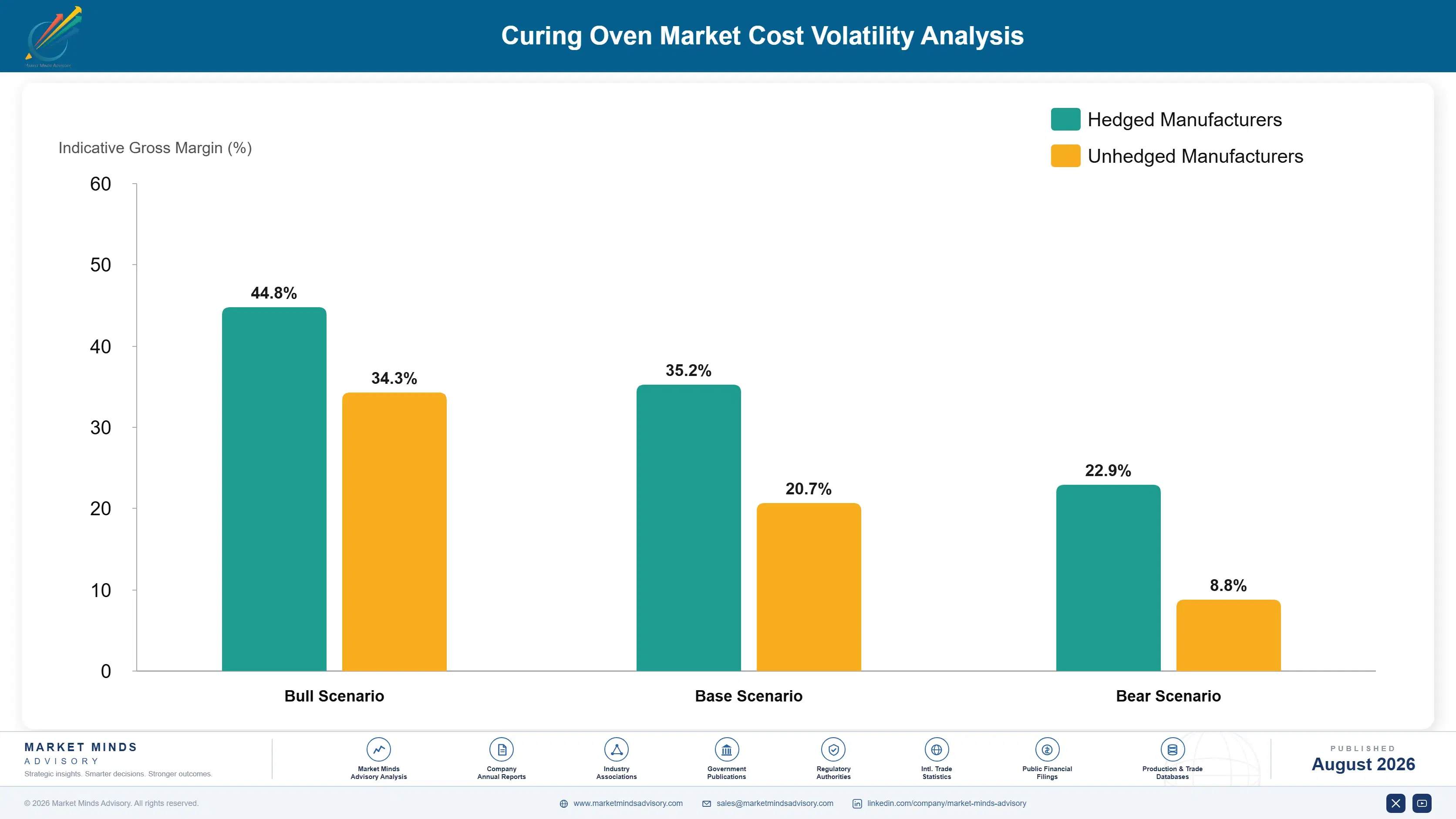
UV LED emitters, infrared elements, and precision control components account for 30 to 40% of curing oven manufacturing cost, with steel frames and mechanical hardware making up most of the remainder. Emitter and control components are sourced from a concentrated group of major automation suppliers, while steel frames and mechanical hardware draw on a broader, more fragmented industrial fabrication supply base.
Emitter and precision component prices rose more than 22% within three quarters during 2021 as broader semiconductor supply chain disruption spilled into industrial automation component availability, according to company annual report disclosures from major equipment makers. That constraint forced several manufacturers to extend delivery lead times and, in some cases, substitute alternative emitter component models mid-project, an unusual compromise for equipment where precision component specification typically requires extensive advance validation.

Scale manufacturers like Despatch and Nordson negotiate emitter and component supply contracts across their full global equipment portfolio, giving them better pricing than smaller regional specialists buying components at lower volumes. Manufacturers with long-standing emitter supplier relationships carry a durable cost and availability advantage over competitors relying on spot-market purchasing, reshaping which manufacturers can credibly commit to new plant construction delivery timelines.
curing-oven-market-cost-volatility-analysis-1787301979523

Qualifying Multiple Emitter Suppliers

Manufacturers are qualifying UV LED emitter and control component suppliers across multiple regions rather than relying on a single automation brand, reducing exposure to any single supplier's capacity constraints or allocation decisions during shortages. This adds design and certification complexity but has measurably reduced delivery delays passed through to manufacturer customers during recent semiconductor supply disruptions.

Locking Multi-Year Emitter Supply Agreements

Larger manufacturers are negotiating multi-year fixed-price emitter and control component supply agreements directly with automation suppliers, trading some upside if prices fall for protection against sudden spikes tied to broader semiconductor market volatility. Smaller manufacturers without comparable purchasing volume typically cannot access these terms and remain more exposed to spot component pricing swings throughout the year.

Building Component Inventory Buffer Stock

Several manufacturers are maintaining larger buffer inventory of critical emitter and control components rather than ordering strictly against confirmed customer orders, trading working capital investment for delivery reliability during supply disruptions. Smaller manufacturers without comparable working capital access typically cannot pursue this path and remain more exposed to component availability and pricing constraints.

Portfolio Architecture for Margin Defence

Portfolio economics split into three tiers. Volume commodity-adjacent ovens, primarily basic convection and box configurations, run on thin margins driven by intense price competition among regional manufacturers and increasingly capable Chinese component suppliers. Premium and certified ovens, carrying UV and infrared technology and validated cure performance data, command meaningfully better margins because manufacturers pay for reduced cycle time and faster production throughput capability.
The tension between volume and premium runs deep, since cost-constrained regional manufacturers want the lowest acquisition cost per oven while premium automotive and electronics manufacturers increasingly demand the cure capability that only UV and infrared-tier configurations deliver consistently. Despatch and Nordson manage this by maintaining separate standard and premium product lines, letting manufacturers choose configuration based on their specific process requirements, regulatory exposure, and available budget.

High-value pools concentrate in UV and infrared curing systems, where emitter technology and software capability both support pricing power that ordinary convection equipment cannot replicate. Capital is flowing fastest into process monitoring software development and emitter engineering, as manufacturers race to establish the technology position that will define premium competitiveness through the next decade across every major regional market worldwide.

Volume / Commodity-Adjacent Tier

Basic convection and box curing ovens without UV or infrared technology, priced primarily on unit cost and competing mainly on delivery speed and basic reliability across high-volume, price-sensitive light manufacturing applications.
Gross Margin: 16-22%

Premium / Certified Tier

UV and infrared curing ovens bundled with validated cure performance data and service contracts that automotive and electronics manufacturers value for reduced cycle time and predictable long-term production quality across their full operating life.
Gross Margin: 26-32%

Sustainability / Regulatory / Next-Generation Tier

Fully automated UV LED platforms with zone control and predictive maintenance capability addressing tightening emissions standards, where software capability and early-mover advantage both support the strongest pricing power in the category currently.
Gross Margin: 34-40%
curing-oven-market-portfolio-architecture-1787301980023

How Curing Oven Demand Recurs

Curing oven demand carries a genuine annuity quality through service contracts, spare emitter parts, and process monitoring subscriptions layered on top of the initial equipment sale. Manufacturers require ongoing calibration and component replacement to maintain cure uniformity regardless of capital spending cycles, and service contract renewal rates above 54% give equipment makers a recurring revenue stream that persists independent of new equipment sales cycles.
Adoption depth varies meaningfully by manufacturing category. Automotive and electronics production shows the deepest UV and infrared adoption, since cycle time and emissions compliance requirements are both most demanding there. Appliance and general industrial production shows growing but more varied adoption, tracking sector-specific capital investment cycles more closely. Furniture and light manufacturing production remains earlier-stage, since basic convection technique still dominates those lower-volume, more price-sensitive applications.

A younger generation of plant engineers, trained on programmable UV emitter control and data-driven quality monitoring rather than manual convection oven tending routines, is accelerating demand for advanced curing platforms. That generational shift is reshaping which equipment makers even get invited into new plant construction capital equipment evaluation processes, and which get quietly excluded.
curing-oven-market-end-use-penetration-index-1787301980517

What Wins in Curing Ovens

These are among the four positions where our research anticipates prominent divergence between winners and laggards over the coming forecast period. Each is grounded in the demand model, the regulatory perimeter, and the announced capacity pipeline.
01 / UV TECHNOLOGY INVESTMENT

Invest in UV curing technology before it becomes standard equipment

Equipment makers that invest in UV curing technology ahead of it becoming standard equipment capture premium pricing and emissions-driven specification access before that becomes a baseline market expectation rather than a differentiator. Waiting until UV curing becomes standard means competing for manufacturer capital budgets against makers that built their technology reputation years earlier, at a moment when demand is accelerating across the entire category simultaneously. Early movers are also better positioned to win new plant construction specifications that increasingly specify UV compatibility as an evaluation criterion.
02 / NEW PLANT ENGAGEMENT TIMING

Engage manufacturers early in new plant construction planning cycles

Equipment makers that engage manufacturers early in new plant construction planning capture disproportionate specification share since early engagement lets them influence technical requirements before a competitor writes a fixed specification favoring their own products. Waiting until formal specifications are published means competing purely on price against requirements a competitor may have already shaped in their own favor. The window to establish these early relationships narrows as capacity expansion programs mature and manufacturers develop established vendor relationships that become harder to displace over subsequent expansion phases.
03 / PROCESS MONITORING INVESTMENT

Build proprietary monitoring software rather than relying on third parties

Equipment makers that build proprietary process monitoring software capture recurring subscription revenue that persists independent of new equipment sales cycles, unlike those relying on third-party monitoring platforms that capture much of that margin instead. Despatch's and Nordson's monitoring subscription attachment rates above 38% demonstrate how sticky this revenue becomes once manufacturers build maintenance workflows around a specific platform's dashboard and alerting configuration. The window for proprietary monitoring software to function as genuine differentiation narrows as third-party platforms become more capable and cheaper to integrate.
04 / COST-COMPETITIVE PRODUCT STRATEGY

Develop lower-cost configurations to compete in price-sensitive expansion markets

Equipment makers that develop lower-cost UV configurations for price-sensitive expansion markets in India and Southeast Asia capture volume specification share that premium-only product lines cannot access, protecting market position as Chinese competitors close the technology gap while maintaining meaningfully lower pricing. Manufacturers that rely exclusively on premium-tier products risk ceding entire expansion markets to competitors offering adequate technology at more accessible capital cost. The window to develop this cost-competitive positioning narrows as expansion markets mature and vendor relationships solidify around early entrants.

Engagement Snapshot From the Field

A live engagement with an industry participant carrying material or product regulatory and market exposure ahead of a defining policy shift, showing how our research translates into a defensible multi-year portfolio strategy.
MARKET MINDS ADVISORY · CLIENT ENGAGEMENT SUMMARY
Curing Oven Producer Strategic Portfolio Review and Transition Roadmap 2026·Investment Scenario on Curing Oven Exposure Evaluation 2025-26
CLIENT PROFILE
The client is a Mexican automotive coatings supplier operating 4 production facilities with plans for a fifth, currently coating more than 2.8 million vehicle components annually with an aging curing equipment base averaging 16 years old, and evaluating an equipment modernization capital budget exceeding US$18 million (client-reported, unverified by MMA). The supplier was evaluating vendor selection and technology tier standardization ahead of its planned capacity expansion.
STRATEGIC CHALLENGE
The client needed to determine which curing technology and vendor would deliver sufficient cycle time and emissions compliance to support both its existing coating lines and planned nearshoring-driven capacity expansion, given budget constraints that made full UV conversion across all facilities simultaneously financially impractical within the current capital planning cycle.
MMA APPROACH
MMA conducted a facility-by-facility analysis correlating current equipment condition, production mix, and planned emissions compliance requirements against available technology tier options and financing structures. The engagement combined primary interviews with the client's production engineers and comparative benchmarking against peer Mexican manufacturers that had already begun UV conversion programs of their own.
KEY FINDINGS
  1. Roughly 42% of the client's existing curing ovens could not reliably meet the emissions and cycle time requirements planned for the new nearshoring-driven production line without significant retrofit investment.
  2. UV conversion at the client's highest-volume facility alone would generate enough cycle time and throughput savings to justify the equipment investment within approximately three years.
  3. Infrared retrofit of existing convection ovens at secondary facilities offered meaningfully better near-term return on investment than full UV replacement given the client's budget constraints.
  4. Peer benchmarking showed manufacturers that phased UV conversion by production line priority achieved better overall program returns than those attempting uniform facility-wide conversion.
CLIENT PROFILE
The client is a Mexican automotive coatings supplier operating 4 production facilities with plans for a fifth, currently coating more than 2.8 million vehicle components annually with an aging curing equipment base averaging 16 years old, and evaluating an equipment modernization capital budget exceeding US$18 million (client-reported, unverified by MMA). The supplier was evaluating vendor selection and technology tier standardization ahead of its planned capacity expansion.
STRATEGIC CHALLENGE
The client needed to determine which curing technology and vendor would deliver sufficient cycle time and emissions compliance to support both its existing coating lines and planned nearshoring-driven capacity expansion, given budget constraints that made full UV conversion across all facilities simultaneously financially impractical within the current capital planning cycle.
MMA APPROACH
MMA conducted a facility-by-facility analysis correlating current equipment condition, production mix, and planned emissions compliance requirements against available technology tier options and financing structures. The engagement combined primary interviews with the client's production engineers and comparative benchmarking against peer Mexican manufacturers that had already begun UV conversion programs of their own.
KEY FINDINGS
  1. Roughly 42% of the client's existing curing ovens could not reliably meet the emissions and cycle time requirements planned for the new nearshoring-driven production line without significant retrofit investment.
  2. UV conversion at the client's highest-volume facility alone would generate enough cycle time and throughput savings to justify the equipment investment within approximately three years.
  3. Infrared retrofit of existing convection ovens at secondary facilities offered meaningfully better near-term return on investment than full UV replacement given the client's budget constraints.
  4. Peer benchmarking showed manufacturers that phased UV conversion by production line priority achieved better overall program returns than those attempting uniform facility-wide conversion.
RECOMMENDED STRATEGY
Phase 1: Phase 1 (Months 1-3): Prioritize UV conversion at the highest-volume facility identified through the throughput and payback analysis conducted earlier. Phase 2: Phase 2 (Months 4-14): Retrofit secondary facility ovens with infrared upgrades, sequencing rollout by production line priority and available capital. Phase 3: Phase 3 (Months 15-24): Evaluate conversion performance against cycle time and emissions assumptions, then finalize remaining facility upgrade timelines.
OUTCOME
The client's phased conversion program reduced cycle times at the priority facility meaningfully within the first operating year, exceeding its internal base case projection (client-reported, unverified by MMA). Sequencing conversion by production line priority rather than uniform facility-wide investment reduced total capital deployment meaningfully compared to the client's original modernization plan.

Frequently Asked Questions

Foundational context covering the market sizes, CAGR, scope, country, region and competition that inform every finding below. This section is provided to cover basics and most often pre-purchase conversations, answered from the MMA Primary Research Dataset.

What is the current size of the Curing Oven Market?

The market was valued at US$2.9 billion in 2025 and is projected to reach US$3.1 billion in 2026 as automotive manufacturing and VOC emissions regulation continue accelerating.

How large will the Curing Oven Market be by 2036?

MMA projects the market will reach US$5.9 billion by 2036, roughly 1.90 times its 2026 value, driven by UV conversion and new manufacturing plant construction.

What is the CAGR for the Curing Oven Market 2026 to 2036?

The market is projected to grow at a 6.6% CAGR between 2026 and 2036, with a bull case of 7.9% and a bear case of 5.3%.

Which segment is growing fastest?

UV curing ovens are the fastest-growing segment at 10.4% annually, roughly 58% faster than the category average, driven by faster cycle time and VOC compliance requirements.

Who are the major companies in the Curing Oven Market?

Leading manufacturers include Despatch, Wisconsin Oven, Grieve, Thermal Product Solutions, and Nordson, which together hold roughly two-fifths of category revenue on a disclosed-revenue basis.

Which country is growing fastest?

Mexico leads country-level growth at an estimated 9.6% annually, supported by rapidly expanding nearshoring-driven automotive manufacturing capacity investment nationwide.

Report Segmentation Architecture

The full report scope spans multiple orthogonal segmentation dimensions, with cross-tabulated demand data provided for each dimension pair. Coverage extends further to regional breakdowns, trend trajectories, and the competitive detail needed to support segment-level decision-making.

By Cure Technology Type

  • UV Curing Ovens
  • Infrared Curing Ovens
  • Conveyor and Continuous Curing Ovens
  • Convection Curing Ovens
  • Induction Curing Ovens
  • Batch and Box Curing Ovens

By End-Use Industry

  • Automotive
  • Appliance Manufacturing
  • Aerospace and Composites
  • Electronics
  • General Industrial Coating

By Commercial Dimension

  • Manufacturer Direct
  • Equipment Integrator
  • Retrofit and Upgrade Services
  • Distribution Channel

By Region

  • North America
  • Western Europe
  • East Asia
  • South Asia and Pacific
  • Latin America
  • Middle East and Africa
  • Eastern Europe

Scope, Methodology, and Coverage

Every figure in this report is reproducible from documented input assumptions. The scope below maps the historical period, the forecast horizon, the segmentation dimensions, and the countries covered, alongside the underlying primary and qualitative methodology.
Historical Period
2020 to 2025
Forecast Period
2026 to 2036
Base Year
2025 (USD billions; MMA Primary Research Dataset, August 2026)
Market Definition
The Curing Oven market covers industrial thermal processing equipment used to cure coatings, paints, adhesives, and composite materials through convection, infrared, or ultraviolet energy, including batch, conveyor, and continuous curing oven configurations sold to automotive, appliance, aerospace, and electronics manufacturers. It excludes sterilization ovens, food processing ovens, and kilns used for ceramic or refractory material firing.
Quantitative Units
USD billions (current prices); unit shipments in hundreds where disclosed by segment
Segmentation Dimensions
By Cure Technology Type; By End-Use Industry; By Commercial Dimension; By Region
Regions Covered
North America, Western Europe, East Asia, South Asia and Pacific, Latin America, Middle East and Africa, Eastern Europe
Countries Covered
USA, China, Germany, France, UK, Japan, South Korea, India, Australia, Canada, Brazil, Mexico, Indonesia, Vietnam, Thailand, Malaysia, UAE, Saudi Arabia, South Africa, Nigeria, Turkey, Poland, Netherlands, Italy, Spain, Sweden, Switzerland, Argentina, Colombia, Singapore, and additional markets relevant to this sector
Key Companies Profiled
Despatch Industries (Illinois Tool Works), Wisconsin Oven Corporation, Grieve Corporation, Thermal Product Solutions LLC, Nordson Corporation, SPX Thermal Equipment and Services, Baker Furnace Inc., L.A.C. Corporation, Heraeus Noblelight GmbH, Phoseon Technology Inc., IST METZ GmbH, UVITRON International Inc., Dynatronix Inc., Radyne Corporation, Ambix Instruments LLC
Quantitative Methodology
Primary survey, n=3,800 respondents, Q4 2025, six countries; demand-side model with trade association cross-validation
Qualitative Methodology
47 expert interviews, Q4 2025; applied to validate demand model assumptions, identify emerging dynamics, and assess competitive positioning
Report Format
PDF and XLSX data workbook (Word format preview document)
Publisher
Market Minds Advisory
Report Code
MMA-2026-CON-125
Published
August 2026
Contact
sales@marketmindsadvisory.com | www.marketmindsadvisory.com

Purchase the full Curing Oven Market Report (2026 to 2036).

The full report delivers a complete quantitative and qualitative assessment of the curing oven market through 2036, including technology-type and country-level forecasts across all seven MMA-tracked regions. It profiles the twenty leading manufacturers shaping competitive dynamics, with detailed moat and risk analysis for the top two players and a full development timeline of recent corporate activity. The report includes primary survey data from 3,800 respondents and 47 expert interviews conducted in Q4 2025, alongside a dedicated input cost and manufacturing capacity expansion analysis. Buyers receive segmentation, regional, and competitive datasets formatted for direct integration into internal strategic planning models.
Technology-type and regional forecasts through 2036 inclusive
Competitive profiles of twenty leading global manufacturers
Primary survey data from 3,800 global respondents
Expert interview insights from 47 industry practitioners
Input cost and manufacturing capacity expansion risk analysis
Editable data tables for internal strategic modeling

Built For The People Who Decide

From boardroom strategy to bench-side execution, this report is read cover-to-cover by leaders shaping the next decade of their industry, turning demand scenarios, market dynamics and valuation benchmarks into decisions.
CXOs/ Presidents/ VPs/ Managers
M&A and Corporate Development
Strategy Teams and R&D Heads
Procurement and Product Directors
Regulatory and Compliance Leaders
Investor Relations and Equity Analysts