Market Minds Advisory
APAC Heart Health Functional Food Market

APAC Heart Health Functional Food Market: Cholesterol Management, Sodium Reduction, and Clinical Claims Through 2036

Rising cardiovascular disease rates across China and Southeast Asia are pushing plant sterol and omega-3 ingredients into mainstream packaged food, while government dietary programs create a second, policy-driven demand channel suppliers now race to serve.

Lead Analyst

Lisa Gevelber

Published

September 2026

Make Smarter Decisions with Customized Research Insights

Request a free sample report and evaluate market opportunities, growth trends, and competitive dynamics relevant to your business needs.

2025 MARKET VALUE$3.6BMarket Size 2025
2036 FORECAST VALUE$9.1BBase Case , 2026 to 2036
CAGR 2026 TO 20368.8 %Bull 10.0% / Bear 7.5%
INCREMENTAL OPPORTUNITY$5.2BNet 10- year value creation
EXPANSION MULTIPLE2.32x2036 value over 2026 base
Strategic Levers
M&A Pipeline
Regional Outlook
Country Rankings
Competitive Intelligence
Segmental Deep-dive
Call-Us : 91 93563 13602

Executive Snapshot and Market Trajectory

Cardiovascular disease has become the leading cause of death across much of Asia-Pacific, and that grim statistic is now the single biggest driver behind plant sterol, omega-3, and sodium-reduction ingredient adoption in mainstream packaged food across the region's largest cities and directly threatens future generations.
China and Japan lead on both clinical research infrastructure and consumer willingness to pay a premium for cholesterol-lowering and blood-pressure-supporting claims, while India and Southeast Asian markets are earlier in their adoption curve but growing faster off a much smaller base. Government dietary intervention programs targeting sodium reduction and cardiovascular risk add a policy-driven demand channel that operates alongside, and increasingly ahead of, purely consumer-driven wellness spending and that gap keeps widening each successive year.
Multinational ingredient suppliers are directing clinical trial investment toward Asian cardiovascular risk profiles rather than simply importing formulations validated on Western populations, since regulators and consumers increasingly expect locally relevant evidence. That shift is raising the cost of market entry for smaller suppliers while rewarding established players who can fund the multi-year clinical work regional health authorities now expect before approving a cardiovascular health claim.
Market Definition
The APAC heart health functional food market covers plant sterol and stanol fortified foods, omega-3 enriched foods and beverages, beta-glucan soluble fiber products, potassium-based sodium reduction products, CoQ10 fortified foods, and plant-based protein cardio snacks marketed on a specific cardiovascular health benefit. It excludes standalone cardiovascular pharmaceuticals and supplements sold outside a food matrix.
Base Year Value
$3.6B in 2025 (MMA Primary Research Dataset, August 2026)
Forecast Period
2026 to 2036, eleven discrete annual values
CAGR
8.8% base case. Bull 10.0%. Bear 7.5%.
Fastest Growth Segment
Omega-3 Enriched Foods and Beverages: 11.8% CAGR
Fastest Growth Country
China: 11.0% CAGR
Fastest Growth Region
South Asia and Pacific: 10.8% CAGR
Largest Region
East Asia: 28% of 2025 global value
Market Leaders
DSM-Firmenich, Cargill, BASF, Danone, Upfield. Source: MMA Analysis based on company annual reports.
Primary Survey
n=3,800 procurement and R&D decision-makers, Q4 2025, six countries
Methodology
Demand-side build-up, cross-validated against public data, 47 expert interviews

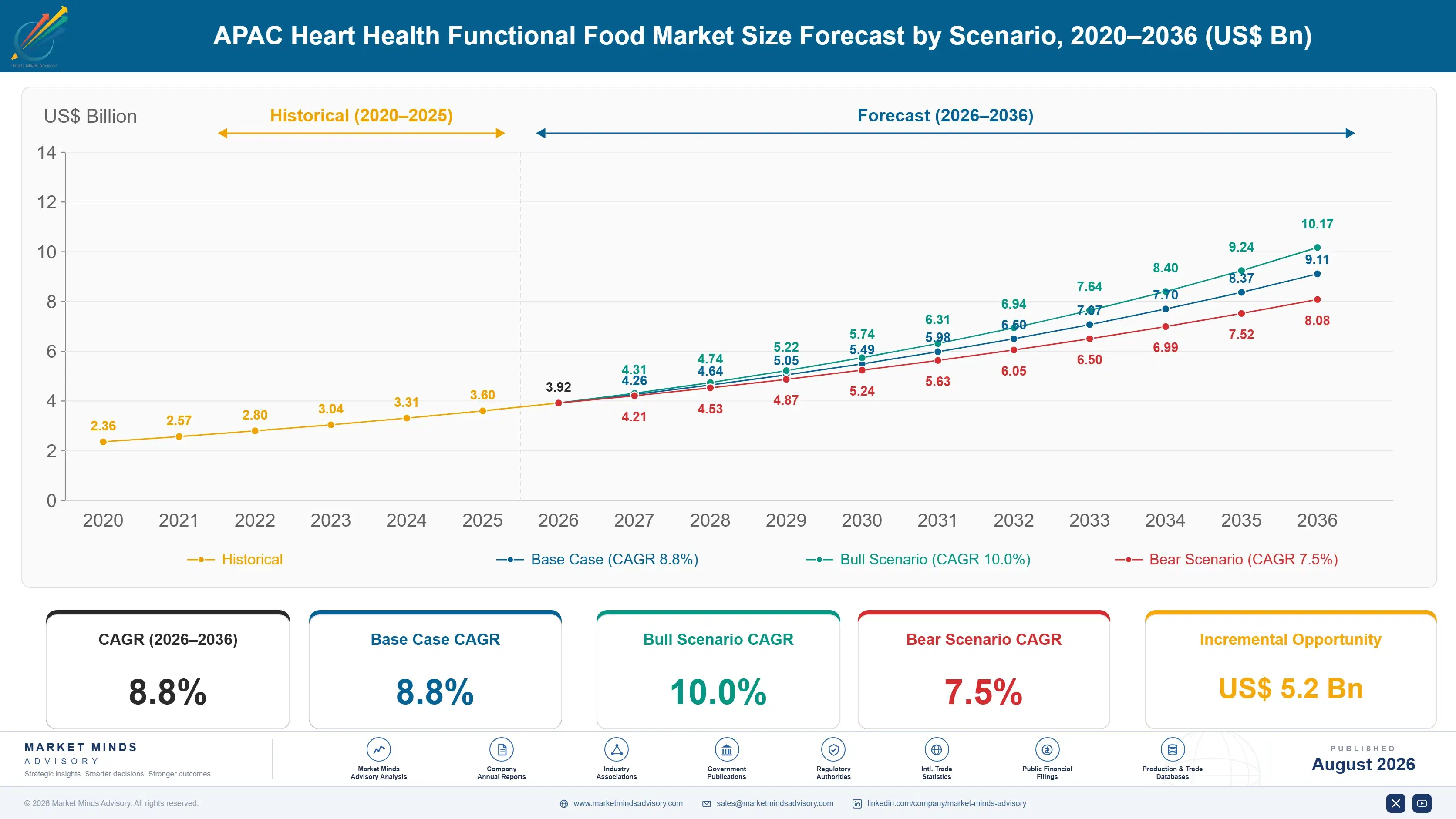
APAC Heart Health Functional Food Market Forecast Scenarios

apac-heart-health-functional-food-market-size-forecast-scenario-1787461292919
Between 2020 and 2025 the market grew at roughly 7.6 percent a year, with early pandemic health anxiety briefly accelerating demand for immune and cardiovascular support claims before growth settled into a steadier pace tied more closely to underlying cardiovascular disease prevalence trends and government dietary policy rollouts across the wider region. Consumer trust also took time to rebuild after early supply disruptions.
The base case assumes 8.8 percent annual growth to 2036, built on three mechanisms: rising cardiovascular disease prevalence across China and Southeast Asia pushing both consumer and government demand for heart-healthy reformulation, expanding clinical substantiation infrastructure that lets suppliers support stronger health claims, and government sodium reduction mandates creating a policy-driven demand floor independent of consumer discretionary spending. Together these three mechanisms sustain growth well above general packaged food volume trends across the region.
A bull case near 10.0 percent depends on additional governments adopting mandatory sodium reduction targets faster than currently planned, forcing accelerated reformulation across packaged food categories nationwide. The bear case near 7.5 percent assumes clinical substantiation costs rise enough that smaller suppliers exit the category, slowing the pace of new product introductions across the region.

Clinical Substantiation and Government Policy Convergence

Heart health functional food has moved from a Western supermarket niche into a mainstream reformulation priority across Asia-Pacific's largest food manufacturers, who now treat cholesterol and blood pressure claims as a genuine product differentiator rather than a specialty add-on reserved for premium brands. That shift has pulled ingredient suppliers deeper into clinical partnership work, since winning a formulation slot increasingly requires locally relevant trial data rather than imported Western evidence alone.
PRODUCER CONCENTRATIONCR5 35%top five hold roughly a third of category revenue
AVERAGE SELLING PRICE$32/kgblended price across major heart health ingredient categories
CHINA DEMAND SHARE31%share of Asia-Pacific heart health ingredient demand originating here
CLAIM APPROVAL RATE58%share of submitted cardiovascular claims approved on first review
TRADE INTENSITY40%share of volume crossing a border before final formulation
CLINICAL TRIAL COST SHARE20% of revenueresearch and substantiation spending burden across major suppliers
Commercially, the market splits between standardized plant sterol and fiber ingredients sold at volume to large food manufacturers and specialized, clinically substantiated formulations developed jointly with regional brands navigating stricter local health-claim requirements. Margins concentrate heavily in the specialized tier, where suppliers with in-house cardiovascular clinical research capability capture value that commodity ingredient producers cannot easily replicate particularly across dairy and beverage categories.
Over the next decade, clinical substantiation depth and government policy alignment will matter more to competitive position than raw ingredient production scale, since extraction and fortification technology for most cardiovascular ingredients is now widely accessible across multiple large suppliers competing for the same regional accounts and shelf space. across every product category and retail shelf placement decisions.
"A cholesterol claim on a supermarket shelf in Shanghai now needs the same clinical rigor a pharmaceutical company would want. Suppliers who treated that as a formality are finding out the hard way that regulators mean it."
Director, Food and Beverage Ingredients Practice · MMA Food and Beverage Ingredients Practice · August 2026

Market Trends

Government Sodium Reduction Mandates Reshape Packaged Food

National governments across China, Japan, and Southeast Asia have introduced voluntary and mandatory sodium reduction targets covering processed and packaged food, with several major markets requiring reformulation timelines that food manufacturers must meet within the next few years to retain market access for flagship product lines. Potassium-based salt substitutes have become the primary technical solution manufacturers reach for, since they preserve flavor profiles that consumers expect while meaningfully cutting sodium content per serving. Cargill and Kerry Group have both expanded potassium chloride blend production specifically to serve this regulatory-driven reformulation wave across the region.
Market Impact: CVD risk up 15% regionally
Omega-3 Fortification Spreads Beyond Dairy Into Broader Categories

Omega-3 fortified foods have expanded well beyond their original dairy and infant formula base into bread, eggs, and ready-to-drink beverages as manufacturers seek cardiovascular health claims that resonate with aging populations across Japan, South Korea, and increasingly urban China. GC Rieber Oils and Croda International have both expanded regional supply specifically to meet this broadening application base, offering microencapsulated omega-3 formats that avoid the fishy taste and odor that historically limited fortification beyond dairy. This category broadening is pulling omega-3 demand growth well above the pace of the fish oil supplement market it originally grew alongside.
Market Impact: Local trials support 30-40% pricing premium

Market Opportunities and Growth Drivers

Rising Cardiovascular Disease Prevalence Drives Reformulation Urgency

Cardiovascular disease has become the leading cause of death across much of Asia-Pacific, with prevalence rising fastest in urbanizing markets where dietary patterns have shifted toward processed food and higher sodium intake over the past two decades. Public health authorities in China and India have both published national cardiovascular risk reduction strategies that explicitly reference functional food reformulation as a policy lever alongside clinical intervention. This public health urgency is giving heart-healthy reformulation a legitimacy and government backing that other functional food categories focused on discretionary wellness spending simply do not carry to the same degree across the region.
Market Impact: Trials exceed $3 million

Clinical Substantiation Investment Enables Premium Positioning

Suppliers who invest in locally relevant clinical trials demonstrating cholesterol or blood pressure benefits among Asian populations can command a premium of 30 to 40 percent over ingredients supported only by imported Western trial data, since regulators and increasingly sophisticated consumers view locally validated evidence as more credible and relevant. DSM-Firmenich and BASF have both funded regional clinical trials specifically to support this premium positioning, treating the trial cost as a multi-year investment in claim credibility rather than a one-time regulatory hurdle to clear before entering a new market. before broader adoption follows.
Market Impact: Adoption slows 2-3 years

Market Restraints and Challenges

High Clinical Trial Costs Exclude Smaller Suppliers

Demonstrating a credible cardiovascular health claim increasingly requires clinical trials costing several million dollars and running multiple years, and the underlying cause is that regulators across Japan, China, and South Korea have raised evidentiary standards following past controversies over unsubstantiated health marketing claims. The commercial impact falls hardest on smaller specialty ingredient producers who cannot fund trials at this scale, effectively locking them out of the premium clinically substantiated tier of the market. Mitigation efforts include smaller suppliers licensing established claim substantiation from larger partners or pooling trial costs through industry consortiums.
Market Impact: Sodium mandates now cover 600M+ consumers

Consumer Skepticism Toward Health Claims Persists in Some Markets

Consumer trust in functional food health claims varies significantly across Asia-Pacific markets, and the underlying cause is a history of overstated or poorly substantiated claims in earlier decades that left lasting skepticism among older consumer cohorts in several countries. The commercial impact shows up as slower category adoption in markets where this skepticism runs deepest, forcing manufacturers to invest more heavily in consumer education alongside product reformulation than they would in markets with higher baseline trust. Suppliers are mitigating this through third-party certification partnerships that lend independent credibility to health claims consumers might otherwise doubt.
Market Impact: Omega-3 now spans 5+ formats
3 additional market trends, 3 additional growth drivers, and 3 additional restraints and challenges are covered in the full report. Contact sales@marketmindsadvisory.com to access the complete intelligence.

Segment CAGR and Growth Architecture

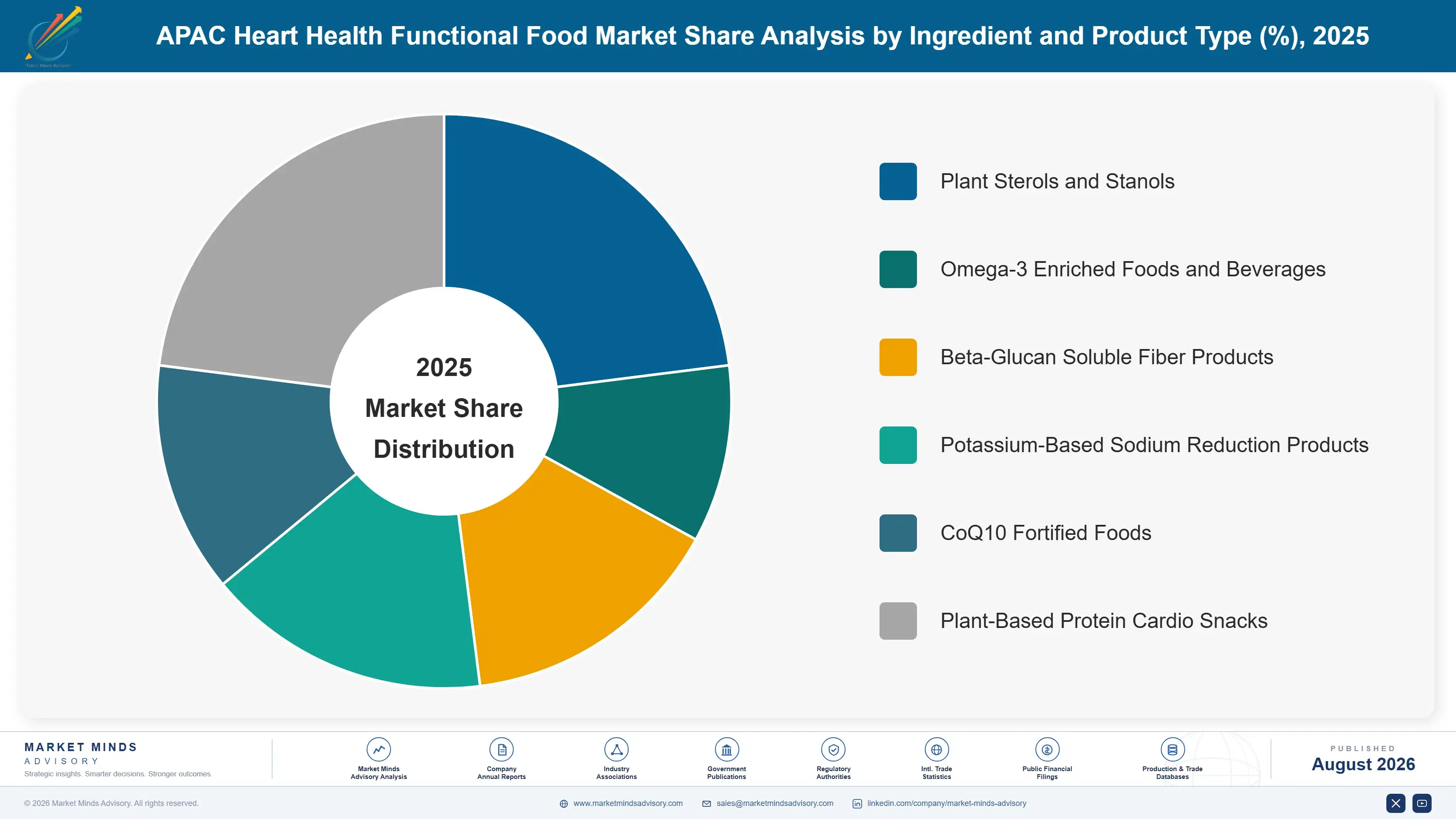
The market segments by ingredient and product type rather than distribution channel, since a single cardiovascular ingredient such as a plant sterol or omega-3 concentrate typically serves multiple food and beverage formats interchangeably depending on the specific claim a manufacturer wants to carry across retail categories and consumer segments each year. across the whole region.
apac-heart-health-functional-food-market-market-share-analysis-1787461293453

Omega-3 Enriched Foods and Beverages

Omega-3 enriched foods and beverages are the fastest-growing segment as manufacturers expand fortification well beyond dairy into bread, eggs, and ready-to-drink formats aimed at aging populations across Japan, South Korea, and increasingly urban China. Demand is concentrated among manufacturers targeting cardiovascular and cognitive health claims simultaneously, since omega-3 fatty acids carry credible evidence for both benefits among regional regulators. GC Rieber Oils and Croda International both lead regional supply, offering microencapsulated formats that avoid the fishy taste historically limiting fortification beyond dairy applications. Pricing carries a meaningful premium over undifferentiated fat and oil ingredients, reflecting both the encapsulation technology required and the clinical substantiation increasingly demanded by regional health authorities.
CAGR 11.8%

Plant Sterol and Stanol Fortified Foods

Plant sterol and stanol fortified foods are climbing as cholesterol management becomes a mainstream dietary concern across aging and increasingly overweight urban populations in China, Japan, and South Korea. Raisio's Benecol brand and DSM-Firmenich's ingredient supply have both expanded regional partnerships with local dairy and spread manufacturers seeking an established, clinically validated cholesterol-lowering claim rather than developing their own substantiation from scratch. Regulatory approval for plant sterol health claims varies significantly across the region, with Japan and South Korea furthest along and several Southeast Asian markets still developing formal review frameworks. Supply remains concentrated among a handful of established phytosterol processors with the extraction technology this category requires at commercial scale.
CAGR 10.5%
Full segment breakdown across 6 segments available in the complete report.

Regional Architecture and Country Demand Map

East Asia holds the largest regional share on the strength of China's sheer demand scale and Japan's clinical research sophistication, with South Asia and Pacific posting the fastest growth as cardiovascular disease prevalence rises quickly across a much larger and younger population base. still ahead.

North America

The United States built the earliest formal cholesterol-lowering health claim framework under FDA review decades ago, giving American manufacturers a mature regulatory pathway that Asian regulators now partially reference when designing their own cardiovascular claim systems. Retail demand concentrates in plant sterol spreads, omega-3 fortified dairy, and potassium-based reduced sodium products sold through mainstream grocery chains rather than specialty wellness retailers alone. Growth here trails the global average because much of the initial adoption wave already happened in the years following the early 2000s plant sterol spread launches, leaving less headroom than Asian markets earlier in their own adoption curve. Multinational suppliers increasingly direct new clinical research investment toward Asian cardiovascular risk profiles rather than incremental domestic reformulation.
Share: 24% | CAGR: 8.5% (2026 to 2036)

Western Europe

European regulators built one of the earliest formal cardiovascular health claim frameworks under European Food Safety Authority review, and Benecol and Flora ProActiv both launched in this region decades before spreading to other markets worldwide. Finnish, German, and UK manufacturers lead regional plant sterol and omega-3 reformulation, particularly across dairy and spread categories where consumer trust in cardiovascular claims remains comparatively high relative to other regions in this analysis. Growth trails the global average since much of the region's functional food adoption occurred over the past two decades under the existing EFSA framework, leaving proportionally less new formulation headroom than markets still building out their regulatory and consumer awareness infrastructure from a much earlier stage of development.
Share: 20% | CAGR: 7.3% (2026 to 2036)
Regional intelligence for 5 additional markets available in the complete report: East Asia, South Asia and Pacific, Latin America, Middle East and Africa, Eastern Europe. Contact sales@marketmindsadvisory.com.
apac-heart-health-functional-food-market-country-cagr-analysis-1787461294044

Where Heart Health Suppliers Can Capture Value

Suppliers who move beyond standardized ingredient sales toward locally relevant clinical trials, government policy partnerships, and regional manufacturing proximity capture materially better margins than those competing purely on price for commodity plant sterols and fiber sold without any substantiation attached at all across every product category tracked. and every regional market this analysis covers in depth.

Locally Relevant Clinical Trial Investment Programs

Funding clinical trials conducted specifically on Asian populations lets suppliers charge a premium of 30 to 40 percent over ingredients supported only by imported Western trial data, since regulators and increasingly sophisticated consumers view locally validated evidence as more credible. DSM-Firmenich and BASF have both expanded regional clinical research capability specifically to support this positioning, treating the trial cost as a multi-year investment in claim credibility rather than a one-time regulatory hurdle. The approach works especially well for suppliers targeting Japan, China, and South Korea, where regulatory sophistication rewards documented local evidence over generic imported claims.
Market Impact: Adds a 30 to 40 percent pricing premium

Government Sodium Reduction Program Partnership Development

Partnering directly with government sodium reduction programs that already cover more than 600 million consumers across the region gives suppliers demand visibility that purely consumer-driven wellness categories cannot match, since these programs operate independently of discretionary spending cycles affecting other functional food categories more broadly across the region. Suppliers with established regulatory relationships and proven potassium chloride formulation expertise win renewal contracts more easily than new entrants, creating durable revenue that smooths volatility from more discretionary omega-3 and plant sterol categories competing for premium retail shelf space nationwide. throughout the fiscal year.
Market Impact: Reaches more than 600 million program consumers today

Regional Encapsulation and Extraction Facility Investment

Building omega-3 encapsulation and plant sterol extraction capacity closer to fast-growing Chinese and Southeast Asian demand rather than exporting from Western production centers cuts freight cost and lead time by an estimated 15 to 20 percent compared with long-distance shipping routes currently serving much of the region. Suppliers making this move early capture long-term contracts with regional manufacturers before local competitors scale enough capacity to compete directly on cost and delivery speed. The capital outlay for a regional facility is meaningful but typically pays back within a small number of years given the contract volume such proximity attracts.
Market Impact: Cuts landed cost by 15 to 20 percent

Third-Party Certification and Consumer Trust Programs

Investing in third-party certification partnerships that lend independent credibility to cardiovascular health claims helps suppliers overcome the consumer skepticism that persists in several markets following past decades of overstated health marketing. Suppliers who fund consumer education alongside product reformulation see adoption rates climb faster than those relying on packaging claims alone, cutting the 2 to 3 year adoption lag that skepticism otherwise imposes on new product categories. This investment particularly benefits suppliers entering markets where consumer trust in functional food claims remains comparatively low relative to more established Asian markets.
Market Impact: Cuts adoption lag by 2 to 3 years

Who Controls the Margin Pool

CR5 sits near 35 percent, reflecting a category fragmented across many ingredient types where no single supplier dominates every cardiovascular claim simultaneously across every regional market. The gap between the largest diversified suppliers and specialized regional producers is wide on clinical research depth, though considerably narrower on raw ingredient production cost across most commodity categories tracked here today across nearly every product category.
Current competitive activity centers on three fronts: clinical research capability expansion by large suppliers to support tightening cardiovascular claim regulations across Japan, China, and South Korea, government sodium reduction partnership wins across multiple national programs, and regional manufacturing capacity investment by suppliers seeking to serve fast-growing Chinese and Southeast Asian demand without relying on long-distance imports from Western production centers.

Emerging pressure comes from domestic Chinese and Indian ingredient producers scaling extraction and fortification capacity to serve their own rapidly growing markets, potentially challenging multinational suppliers on cost within these home markets over the next decade. Rankings among the largest global suppliers are unlikely to shift quickly given their clinical research advantage, but regional producers are gaining ground faster domestically than in export competition elsewhere.
apac-heart-health-functional-food-market-company-positioning-matrix-1787461294567

Competitive Moat and Risk Dimensions

DSM-FIRMENICH

Moat: Broad clinical research infrastructure

DSM-Firmenich's extensive clinical research infrastructure spanning plant sterols and multiple cardiovascular ingredient categories lets it substantiate health claims faster and more credibly than smaller specialty producers, giving it a durable advantage as regulators across Asia tighten evidence requirements each passing year for new approvals and jurisdictions.
DSM-FIRMENICH

Risk: High fixed research cost base

Maintaining research infrastructure across many cardiovascular ingredient categories simultaneously creates a high fixed cost base that smaller, more focused competitors avoid entirely, pressuring margins during periods when new product approval volume slows across major Asian regulatory markets and jurisdictions each fiscal cycle and beyond too.
CARGILL

Moat: Integrated potassium and lipid supply

Cargill's integrated agricultural and mineral supply chain gives it cost visibility across both potassium-based sodium reduction and plant-based lipid ingredients that competitors dependent on open-market purchasing cannot match, particularly across sodium reduction contracts tied to government programs across multiple regions as well too consistently each cycle.
CARGILL

Risk: Limited clinical substantiation depth

Cargill's cardiovascular ingredient business carries less dedicated clinical research infrastructure than pure-play nutrition suppliers, potentially limiting its ability to substantiate premium health claims as quickly as competitors with deeper research investment across comparable categories over time industry wide in most cases as well too every time.

Players Tracked

Prominent Players

DSM-Firmenich
Cargill
BASF
Danone
Upfield

Other Key Players

ADM
Kerry Group
Corbion
Croda International
GC Rieber Oils
Kaneka Corporation
Nisshin Pharma
Beneo
Tate and Lyle
Roquette
AAK
Meiji Holdings
Otsuka Pharmaceutical
Nestlé Health Science
Raisio

Recent Developments

MARCH 2026

Cargill Expands Potassium Chloride Blend Production in China

Cargill completed a capacity expansion at its Chinese potassium chloride blending facility, adding output aimed at manufacturers reformulating packaged food to meet government sodium reduction targets. The expansion followed eighteen months of construction and regulatory coordination with local authorities across several provinces nationwide too overall.
Signal: Dedicated Chinese capacity growth signals sodium reduction reformulation has moved well past a temporary policy trend
OCTOBER 2025

Raisio Signs Benecol Licensing Agreement With Southeast Asian Manufacturer

Raisio entered a licensing agreement allowing a major Southeast Asian dairy manufacturer to produce Benecol-branded plant stanol products locally, extending the brand's established cholesterol-lowering claim into a market without prior direct access to comparable clinical substantiation of its own previously in that market until now.
Signal: Licensing established Western health claims is becoming a faster path to market than independent local substantiation
JANUARY 2026

Kaneka Corporation Expands CoQ10 Manufacturing Capacity in Japan

Kaneka Corporation announced an expansion of its domestic CoQ10 manufacturing capacity, adding output aimed at both nutraceutical and functional food customers pursuing cardiovascular health positioning across Japan and export markets throughout the wider region as well this year too and beyond that broadly region wide.
Signal: CoQ10 capacity growth signals suppliers are positioning for demand beyond the traditional supplement channel alon nationwidee

Clinical Research and Feedstock Cost Exposure

Clinical trial and substantiation spending represents roughly 20 percent of revenue for the largest cardiovascular ingredient suppliers, while feedstock costs vary significantly by category, with plant sterols depending on vegetable oil byproduct availability, omega-3 depending on fish oil and algae feedstock, and potassium chloride depending on mineral mining output across a small number of producing countries worldwide.
Fish oil prices rose more than 25 percent during a 2023 anchovy catch shortfall off the coast of Peru, according to industry reporting on that season's fishing quotas, and that shortage passed through to omega-3 ingredient contracts within roughly two quarters as suppliers renegotiated pricing with manufacturers already committed to fortified product lines. Suppliers without diversified feedstock sourcing, including algae-based omega-3 alternatives, absorbed the sharpest cost increases during that period, while larger diversified suppliers spread the impact more broadly.

Smaller specialty ingredient producers without diversified feedstock sourcing or dedicated clinical research budgets absorb cost and substantiation risk directly, while larger diversified suppliers with both capabilities smooth pricing and regulatory timelines for their downstream manufacturer customers. That gap in resilience increasingly determines which suppliers can offer multi-year fixed-price, pre-substantiated contracts that large regional manufacturers now prefer.
apac-heart-health-functional-food-market-cost-volatility-analysis-1787461294763

Algae-Based Omega-3 Feedstock Diversification

Suppliers are expanding algae-based omega-3 production as an alternative to fish oil, reducing exposure to fishing quota disruptions and appealing to plant-based consumer segments simultaneously, though production costs still trail traditional fish oil extraction in most current commercial operations a shift several major suppliers have already committed meaningful capital toward across several major markets.

Shared Clinical Trial Cost Consortiums

Mid-sized producers are pooling clinical trial costs through industry consortiums and co-funded studies to reduce the per-product cost of cardiovascular claim substantiation, an approach that helps smaller suppliers compete with larger rivals' in-house research budgets particularly across Japan, China, and the broader Southeast Asian trading bloc where filing standards can differ meaningfully and regulatory frameworks.

Licensed Health Claim Partnerships

Some smaller suppliers are licensing established cardiovascular health claims from larger partners such as Raisio's Benecol brand rather than commissioning independent clinical trials, reducing upfront research cost while still meeting regulatory documentation requirements a model that has grown more common as regulatory scrutiny intensifies further across nearly every ingredient category tracked and geographies today.

Portfolio Architecture for Margin Defence

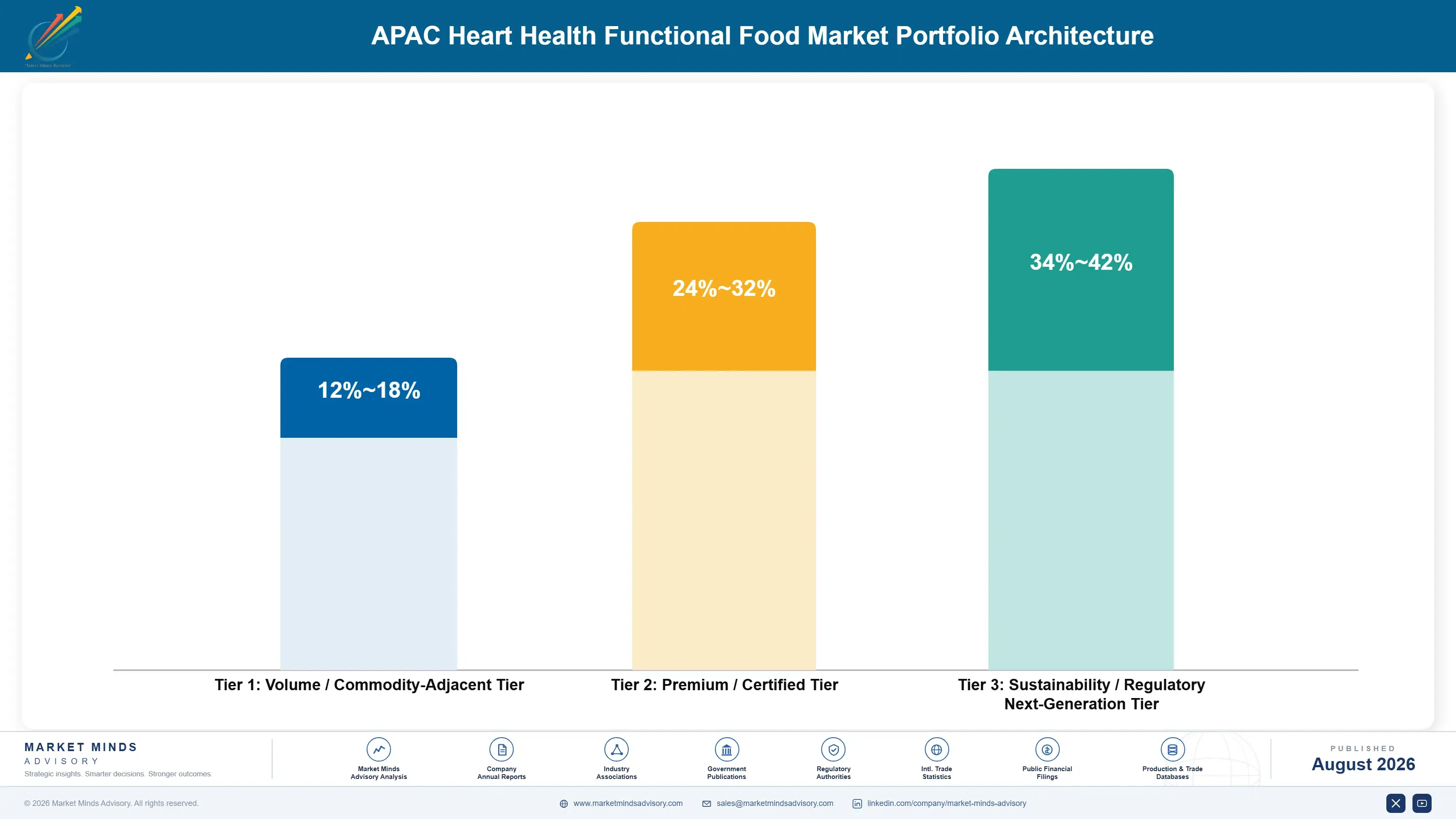
The market splits across three tiers: standardized commodity potassium chloride and fiber sold on thin margins against government and industrial volume contracts, certified and clinically substantiated plant sterol and omega-3 formulations sold at a premium, and an emerging tier of precision cardiovascular nutrition ingredients commanding the highest margins as regional research capability matures a structure that mirrors the broader specialty nutrition sector worldwide.
Volume sits overwhelmingly in the commodity tier, where standardized sodium reduction and fiber contracts with governments and large manufacturers generate revenue scale but comparatively thin margins. Premium tension is sharpest in plant sterols and omega-3, where clinically substantiated formulations earn meaningfully better margins than undocumented equivalents, pulling supplier investment toward research capability that can serve both tiers simultaneously without compromising either segment's distinct commercial requirements.

High-value margin pools concentrate in clinically substantiated plant sterol and omega-3 formulations sold to premium dairy and beverage brands, categories still small relative to total volume but growing faster than the commodity fortification base and attracting disproportionate research investment from the leading global suppliers each year particularly among suppliers already serving the largest premium retail accounts particularly among suppliers already serving premium retail brands.

Volume / Commodity-Adjacent Tier

Standardized potassium chloride and soluble fiber ingredients sold on multi-year contracts to governments and large manufacturers, competing primarily on price and reliability Suppliers here typically operate on thin single-digit to low double-digit margins overall.
Gross Margin: 12%-18%

Premium / Certified Tier

Clinically substantiated plant sterol and omega-3 formulations sold with regulatory documentation support, commanding a service premium over undocumented commodity ingredient pricing Suppliers with strong research teams typically win this business over price-only competitors.
Gross Margin: 24%-32%

Sustainability / Regulatory / Next-Generation Tier

Precision cardiovascular nutrition ingredients tied to emerging regional research capability, sold into the industry's highest-margin reformulation contracts available today This tier remains small in volume but is expanding fastest across every region tracked.
Gross Margin: 34%-42%
apac-heart-health-functional-food-market-portfolio-architecture-1787461295263

High-value Sub-segments and Strategic Watch-out

Clinically Substantiated Plant Sterols

Plant sterol formulations with documented cholesterol-lowering outcomes command the category's highest margins and are growing fastest as regulators tighten evidence requirements across Japan, China, and South Korea each year Suppliers with existing clinical libraries hold a clear early advantage here and continue investing heavily each year.
Gross Margin: 34%-40%

Government Sodium Reduction Contracts

Potassium chloride sold under multi-year government sodium reduction contracts commands steady, durable revenue insulated from consumer spending cycles, growing reliably as programs expand across additional countries region wide Suppliers with proven compliance track records win the bulk of renewal contracts across every program renewal cycle.
Gross Margin: 12%-16%

Standardized Fiber Blends

The largest volume pool by far, standardized fiber blends generate scale revenue for top suppliers but offer little margin expansion room given intense multi-year price competition among established fortification producers Suppliers here compete mainly on manufacturing scale rather than technical differentiation across nearly every contract negotiation.
Gross Margin: 12%-16%

Domestic Chinese and Indian Producers

Domestic Chinese and Indian ingredient producers scaling extraction and fortification capacity could challenge multinational suppliers on cost within their home markets over the next decade, a shift worth monitoring closely Multinational suppliers are responding by deepening local research partnerships instead rather than competing purely on unit price.
Gross Margin: 16%-22%

Substantiation Cycles and Policy Alignment

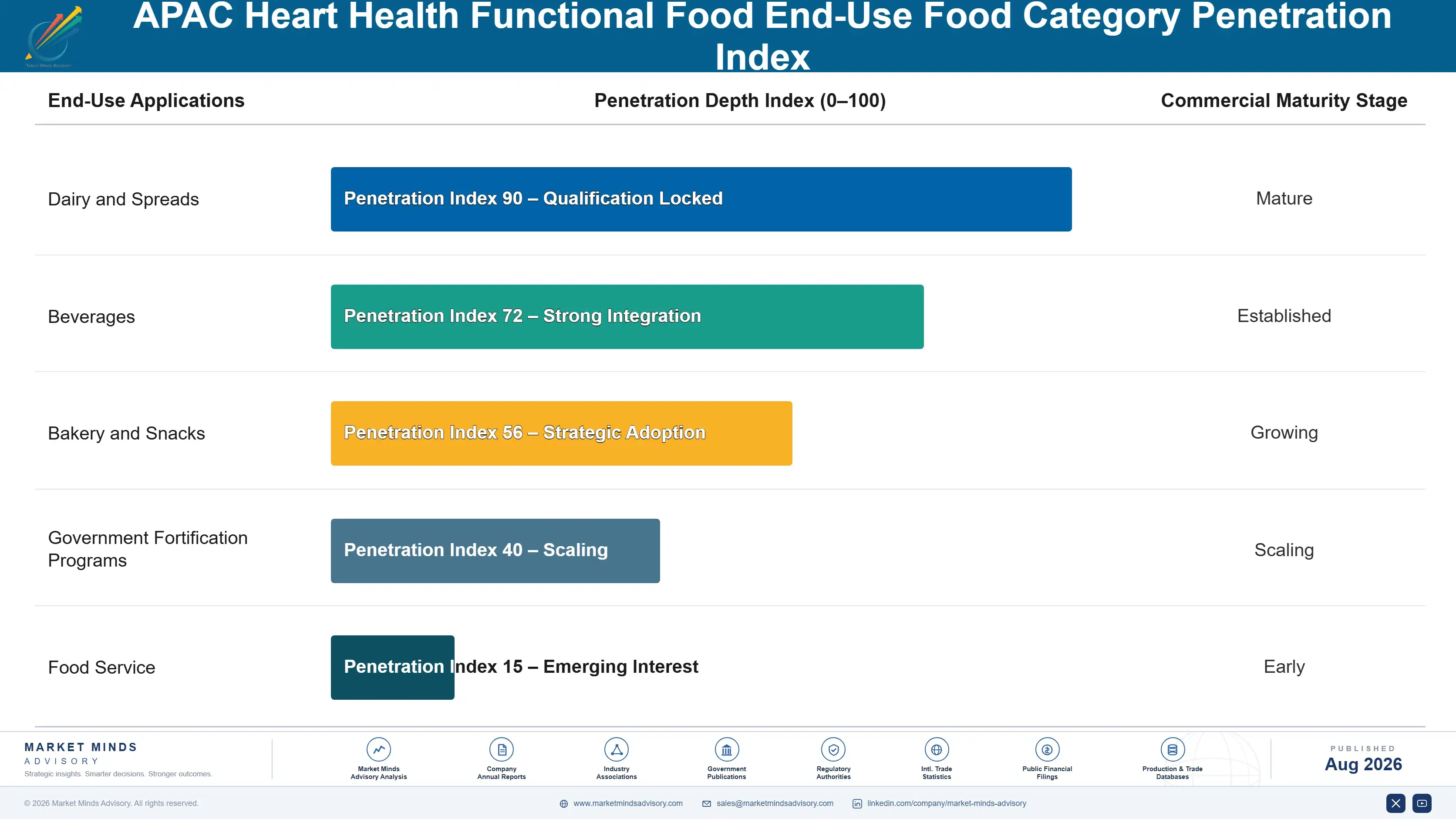
Cardiovascular ingredient demand behaves like an annuity once a manufacturer locks a clinically substantiated formulation into production, since changing suppliers again requires repeating regulatory documentation and often clinical trials that most manufacturers avoid unless supply is disrupted, giving incumbent suppliers durable multi-year volume once they win the initial reformulation contract and pass the first renewal cycle Suppliers who lose that initial contract rarely win it back from a satisfied manufacturer.
Adoption depth varies by vertical: government sodium reduction programs show the deepest supplier stickiness given the multi-year public procurement cycles involved, while premium plant sterol and omega-3 brands switch suppliers more readily as new clinical evidence and formulation innovations emerge, creating more frequent re-bid opportunities for challenger suppliers able to demonstrate superior substantiation This split shapes how suppliers allocate their regional account and research teams.

A generational shift among younger Asian consumers toward transparent, scientifically substantiated cardiovascular claims rather than traditional dietary beliefs is pulling ingredient selection earlier into product development, giving clinically differentiated suppliers a seat at the table that legacy commodity vendors historically never had That shift favors suppliers who invest early in consumer-facing scientific credibility and trust.
apac-heart-health-functional-food-market-end-use-penetration-index-1787461295754

Positioning Across the Region

These are among the four positions where our research anticipates prominent divergence between winners and laggards over the coming forecast period. Each is grounded in the demand model, the regulatory perimeter, and the announced capacity pipeline.
01 / CLINICAL RESEARCH INVESTMENT

Build locally relevant clinical evidence ahead of tightening claim rules

Regulators across Japan, China, and South Korea are steadily raising the evidentiary bar for cardiovascular claims, and suppliers without dedicated clinical research infrastructure cannot offer the locally validated substantiation manufacturers now require before committing to a reformulation. DSM-Firmenich and BASF already capture premium contracts on this basis, leaving specialty producers without comparable research budgets at a compounding cost disadvantage that widens every year new claim standards take effect. Building or licensing substantiation capability now positions a supplier to compete for the highest-margin reformulation contracts before this gap grows further.
02 / GOVERNMENT PROGRAM PARTNERSHIP

Pursue government sodium reduction contracts for durable revenue

Government sodium reduction programs already cover more than 600 million consumers across the region and generate demand that persists regardless of consumer discretionary spending cycles, unlike premium plant sterol and omega-3 categories more exposed to economic downturns. Suppliers with proven regulatory compliance and established government relationships win contract renewals more easily than new entrants, creating a durable revenue base that smooths broader portfolio volatility. Pursuing these contracts now, before program expansion attracts more competitive bidding, secures multi-year volume commitments other suppliers will find harder to displace later.
03 / REGIONAL MANUFACTURING EXPANSION

Expand manufacturing proximity to Chinese and Southeast Asian demand

China's rapidly rising cardiovascular disease prevalence and sheer manufacturing scale make it the largest single demand pool in this analysis, yet much of current supply still ships from Western production centers at meaningful freight cost and lead time. Suppliers building regional encapsulation and extraction capacity now can offer Chinese and Southeast Asian manufacturers faster delivery and lower landed cost than distant competitors still serving the region through long-distance exports. This proximity advantage compounds over time as domestic Chinese producers build their own competing capacity.
04 / CONSUMER TRUST BUILDING

Invest in third-party certification to overcome consumer skepticism

Consumer trust in functional food health claims varies significantly across Asia-Pacific markets, and lingering skepticism from past decades of overstated marketing claims slows category adoption in several countries even where cardiovascular disease risk is rising sharply. Suppliers who fund third-party certification and consumer education alongside product reformulation see adoption rates climb faster than those relying on packaging claims alone, cutting the multi-year adoption lag skepticism otherwise imposes. This investment particularly benefits suppliers entering markets where trust in functional food claims remains comparatively low.

Engagement Snapshot From the Field

A live engagement with an industry participant carrying material or product regulatory and market exposure ahead of a defining policy shift, showing how our research translates into a defensible multi-year portfolio strategy.
MARKET MINDS ADVISORY · CLIENT ENGAGEMENT SUMMARY
APAC Heart Health Functional Food Producer Strategic Portfolio Review and Transition Roadmap 2026·Investment Scenario on APAC Heart Health Functional Food Exposure Evaluation 2025-26
CLIENT PROFILE
A regional dairy manufacturer with cholesterol-management yogurt and milk drink brands sold across China and Southeast Asia engaged MMA to guide a clinical substantiation strategy after regulators tightened evidentiary requirements for its core cardiovascular health claim. The client's annual plant sterol ingredient procurement spend exceeded 22 million dollars (client-reported, unverified by MMA), making claim continuity a material commercial risk for its senior leadership team.
STRATEGIC CHALLENGE
The client's existing cholesterol-lowering claim relied on imported Western clinical trial data that Chinese regulators signaled they would no longer accept without supplementary local evidence, threatening the client's ability to maintain its flagship health claim across a product line generating a significant share of total company revenue and pricing power.
MMA APPROACH
MMA benchmarked alternative plant sterol suppliers with existing Asian clinical trial data, modeled the cost and timeline of commissioning supplementary local trials directly, and structured a phased approach that maintained the client's existing claim while new local evidence was generated in parallel and secured board-level agreement before implementation began across every relevant department.
KEY FINDINGS
  1. One candidate supplier already held Chinese clinical trial data sufficient to support the client's existing cholesterol claim without new trials immediately and at lower cost.
  2. Commissioning independent local trials would have cost significantly more and taken considerably longer than switching to an already-substantiated supplier internally and externally.
  3. A phased transition plan preserved the client's retail claim continuity while the supplier switch was implemented across production facilities smoothly without disruption.
  4. The new supplier's pricing carried a modest premium that was more than offset by avoided independent clinical trial costs over time and beyond.
CLIENT PROFILE
A regional dairy manufacturer with cholesterol-management yogurt and milk drink brands sold across China and Southeast Asia engaged MMA to guide a clinical substantiation strategy after regulators tightened evidentiary requirements for its core cardiovascular health claim. The client's annual plant sterol ingredient procurement spend exceeded 22 million dollars (client-reported, unverified by MMA), making claim continuity a material commercial risk for its senior leadership team.
STRATEGIC CHALLENGE
The client's existing cholesterol-lowering claim relied on imported Western clinical trial data that Chinese regulators signaled they would no longer accept without supplementary local evidence, threatening the client's ability to maintain its flagship health claim across a product line generating a significant share of total company revenue and pricing power.
MMA APPROACH
MMA benchmarked alternative plant sterol suppliers with existing Asian clinical trial data, modeled the cost and timeline of commissioning supplementary local trials directly, and structured a phased approach that maintained the client's existing claim while new local evidence was generated in parallel and secured board-level agreement before implementation began across every relevant department.
KEY FINDINGS
  1. One candidate supplier already held Chinese clinical trial data sufficient to support the client's existing cholesterol claim without new trials immediately and at lower cost.
  2. Commissioning independent local trials would have cost significantly more and taken considerably longer than switching to an already-substantiated supplier internally and externally.
  3. A phased transition plan preserved the client's retail claim continuity while the supplier switch was implemented across production facilities smoothly without disruption.
  4. The new supplier's pricing carried a modest premium that was more than offset by avoided independent clinical trial costs over time and beyond.
RECOMMENDED STRATEGY
Phase 1: Phase 1 (Months 1-3): Qualify a plant sterol supplier with existing Chinese clinical trial documentation and clinical files before signing. Phase 2: Phase 2 (Months 4-6): Transition core product lines to the new supplier without disrupting existing retail claims or delays of any kind. Phase 3: Phase 3 (Months 7-9): Confirm regulatory acceptance and monitor consumer response across key retail markets and adjust as needed each quarter.
OUTCOME
The client maintained uninterrupted retail health claims throughout the transition and completed the supplier switch within the recommended nine-month window, reporting a meaningful reduction in regulatory risk exposure (client-reported, unverified by MMA) alongside a modest net cost saving versus its original independent trial commissioning plan.

Frequently Asked Questions

Foundational context covering the market sizes, CAGR, scope, country, region and competition that inform every finding below. This section is provided to cover basics and most often pre-purchase conversations, answered from the MMA Primary Research Dataset.

What is the current size of the APAC Heart Health Functional Food Market?

The global heart health functional food market was valued at approximately $3.6 billion in 2025. East Asia accounts for the largest regional share of category revenue.

How large will the APAC Heart Health Functional Food Market be by 2036?

MMA projects the global market will reach approximately $9.11 billion by 2036, roughly 2.32 times its 2026 value. Asia-Pacific demand drives much of this growth.

What is the CAGR for the APAC Heart Health Functional Food Market 2026 to 2036?

The market is projected to grow at an 8.8 percent compound annual rate between 2026 and 2036. Bull and bear scenarios range from 7.5 to 10.0 percent.

Which segment is growing fastest?

Omega-3 enriched foods and beverages are the fastest-growing segment at an 11.8 percent CAGR, well above the overall market rate. Expansion into bread, eggs, and beverages drives this gap.

Who are the major companies in the APAC Heart Health Functional Food Market?

Leading producers include DSM-Firmenich, Cargill, BASF, Danone, and Upfield. Together they hold a CR5 near 35 percent of global category revenue and market influence across the region.

Which country is growing fastest?

China posts the fastest national growth at roughly 11.0 percent, driven by rapidly rising cardiovascular disease prevalence and sheer manufacturing scale. Domestic reformulation is accelerating across major brands.

Report Segmentation Architecture

The full report scope spans multiple orthogonal segmentation dimensions, with cross-tabulated demand data provided for each dimension pair. Coverage extends further to regional breakdowns, trend trajectories, and the competitive detail needed to support segment-level decision-making.

By Ingredient and Product Type

  • Plant Sterols and Stanols
  • Omega-3 Enriched Foods and Beverages
  • Beta-Glucan Soluble Fiber Products
  • Potassium-Based Sodium Reduction Products
  • CoQ10 Fortified Foods
  • Plant-Based Protein Cardio Snacks

By End-Use Food Category

  • Dairy and Spreads
  • Beverages
  • Bakery and Snacks
  • Government Fortification Programs
  • Food Service

By Distribution Channel

  • Direct Contract Supply
  • Government Program Procurement
  • Distributor Networks
  • Private Label Manufacturers

By Region

  • North America
  • Western Europe
  • East Asia
  • South Asia and Pacific
  • Latin America
  • Middle East and Africa
  • Eastern Europe

Scope, Methodology, and Coverage

Every figure in this report is reproducible from documented input assumptions. The scope below maps the historical period, the forecast horizon, the segmentation dimensions, and the countries covered, alongside the underlying primary and qualitative methodology.
Historical Period
2020 to 2025
Forecast Period
2026 to 2036
Base Year
2025 (USD billions; MMA Primary Research Dataset, August 2026)
Market Definition
The APAC heart health functional food market covers plant sterol and stanol fortified foods, omega-3 enriched foods and beverages, beta-glucan soluble fiber products, potassium-based sodium reduction products, CoQ10 fortified foods, and plant-based protein cardio snacks marketed on a specific cardiovascular health benefit. It excludes standalone cardiovascular pharmaceuticals and supplements sold outside a food matrix.
Quantitative Units
USD billions (current prices); metric tonnes for volume detail
Segmentation Dimensions
By Ingredient and Product Type; By End-Use Food Category; By Distribution Channel; By Region
Regions Covered
North America, Western Europe, East Asia, South Asia and Pacific, Latin America, Middle East and Africa, Eastern Europe
Countries Covered
USA, China, Germany, France, UK, Japan, South Korea, India, Australia, Canada, Brazil, Mexico, Indonesia, Vietnam, Thailand, Malaysia, UAE, Saudi Arabia, South Africa, Nigeria, Turkey, Poland, Netherlands, Italy, Spain, Sweden, Switzerland, Argentina, Colombia, Singapore, and additional markets relevant to this sector
Key Companies Profiled
DSM-Firmenich, Cargill, BASF, Danone, Upfield, ADM, Kerry Group, Corbion, Croda International, GC Rieber Oils, Kaneka Corporation, Nisshin Pharma, Beneo, Tate and Lyle, Roquette, AAK, Meiji Holdings, Otsuka Pharmaceutical, Nestlé Health Science, Raisio
Quantitative Methodology
Primary survey, n=3,800 respondents, Q4 2025, six countries; demand-side model with trade association cross-validation
Qualitative Methodology
47 expert interviews, Q4 2025; applied to validate demand model assumptions, identify emerging dynamics, and assess competitive positioning
Report Format
PDF and XLSX data workbook (Word format preview document)
Publisher
Market Minds Advisory
Report Code
MMA-2026-AGR-105
Published
August 2026
Contact
sales@marketmindsadvisory.com | www.marketmindsadvisory.com

Purchase the full APAC Heart Health Functional Food Market Report (2026 to 2036).

The full APAC Heart Health Functional Food Market report delivers a comprehensive 2026 to 2036 forecast across six ingredient and product types, seven regions, and twenty profiled companies active in this category. It includes detailed segmentation by end-use food category, clinical research and feedstock cost modeling, and competitive benchmarking measured against a single consistent basis throughout. Analysts document the government policy and clinical substantiation trends reshaping supplier positioning across the region. Buyers receive full access to the underlying data tables, regional breakouts, and a customizable Excel model built for scenario planning.
2026-2036 volume and value forecasts by segment
Six-segment ingredient and product type breakdown analysis
Seven-region market sizing and share detail
Twenty-company competitive profiles and full benchmarking
Clinical research and feedstock cost sensitivity modeling
Editable Excel forecast workbook with scenario toggles

Built For The People Who Decide

From boardroom strategy to bench-side execution, this report is read cover-to-cover by leaders shaping the next decade of their industry, turning demand scenarios, market dynamics and valuation benchmarks into decisions.
CXOs/ Presidents/ VPs/ Managers
M&A and Corporate Development
Strategy Teams and R&D Heads
Procurement and Product Directors
Regulatory and Compliance Leaders
Investor Relations and Equity Analysts