Market Minds Advisory
Omega-3 Market

Omega-3 Market: Algal Oil, Prescription EPA, and Sustainable Marine Sourcing Demand Through 2036

A supplement brand switching its flagship formula from fish oil to algal-derived omega-3 discovers the sourcing change reshapes its entire supply chain, from harvest contracts to shelf-stability testing protocols across every future product line.

Lead Analyst

Lisa Gevelber

Published

September 2026

Make Smarter Decisions with Customized Research Insights

Request a free sample report and evaluate market opportunities, growth trends, and competitive dynamics relevant to your business needs.

2025 MARKET VALUE$8.4BMarket Size 2025
2036 FORECAST VALUE$22.6BBase Case , 2026 to 2036
CAGR 2026 TO 20369.4 %Bull 10.6% / Bear 8.2%
INCREMENTAL OPPORTUNITY$13.4BNet 10- year value creation
EXPANSION MULTIPLE2.46x2036 value over 2026 base
Strategic Levers
M&A Pipeline
Regional Outlook
Country Rankings
Competitive Intelligence
Segmental Deep-dive
Call-Us : 91 93563 13602

Executive Snapshot and Market Trajectory

Omega-3 has shifted from a fish-oil supplement commodity into a sourcing-differentiated pharmaceutical and nutraceutical category, as brands and prescribers increasingly specify algal or pharmaceutical-grade material over conventional marine oil for sustainability and purity reasons legacy sourcing cannot satisfy. That shift is reshaping which suppliers win premium formulation contracts.
Algal oil-derived omega-3 now leads segment growth at 13.8% annually, close to half again faster than the wider market's 9.4% pace, as supplement and food brands scale vegan and sustainably sourced formulations that conventional fish oil increasingly cannot match on traceability or supply resilience. North America anchors the largest regional share through its concentrated dietary supplement culture and prescription omega-3 drug approvals, while China's expanding nutraceutical manufacturing sector pulls country-level growth meaningfully higher each year.
Competitive intensity remains moderate, with integrated marine ingredient majors competing against algal and pharmaceutical-grade specialists on purity documentation and sourcing sustainability. Documented pharmaceutical-grade purification capability and algal production scale increasingly separate suppliers capturing premium prescription and vegan-formulation contracts from those confined to commodity fish oil volume. Backward integration into marine harvesting or algal fermentation is emerging as a separator, since it insulates margin from material volatility smaller blenders cannot avoid.
Market Definition
The omega-3 market covers commercial production and sale of omega-3 fatty acid ingredients derived from fish oil, algal oil, krill oil, and plant-based sources, including prescription pharmaceutical formulations and fortified food applications. It excludes finished dietary supplement products, pharmaceutical drugs, and fortified foods manufactured beyond the omega-3 ingredient stage itself.
Base Year Value
$8.4B in 2025 (MMA Primary Research Dataset, August 2026)
Forecast Period
2026 to 2036, eleven discrete annual values
CAGR
9.4% base case. Bull 10.6%. Bear 8.2%.
Fastest Growth Segment
Algal Oil-Derived Omega-3: 13.8% CAGR
Fastest Growth Country
China: 10.8% CAGR
Fastest Growth Region
South Asia and Pacific: 11.4% CAGR
Largest Region
North America: 30% of 2025 global value
Market Leaders
DSM-Firmenich AG, BASF SE, Croda International plc, Omega Protein Corporation, KD Pharma Group. Source: MMA Analysis based on company annual reports.
Primary Survey
n=3,800 procurement and R&D decision-makers, Q4 2025, six countries
Methodology
Demand-side build-up, cross-validated against public data, 47 expert interviews

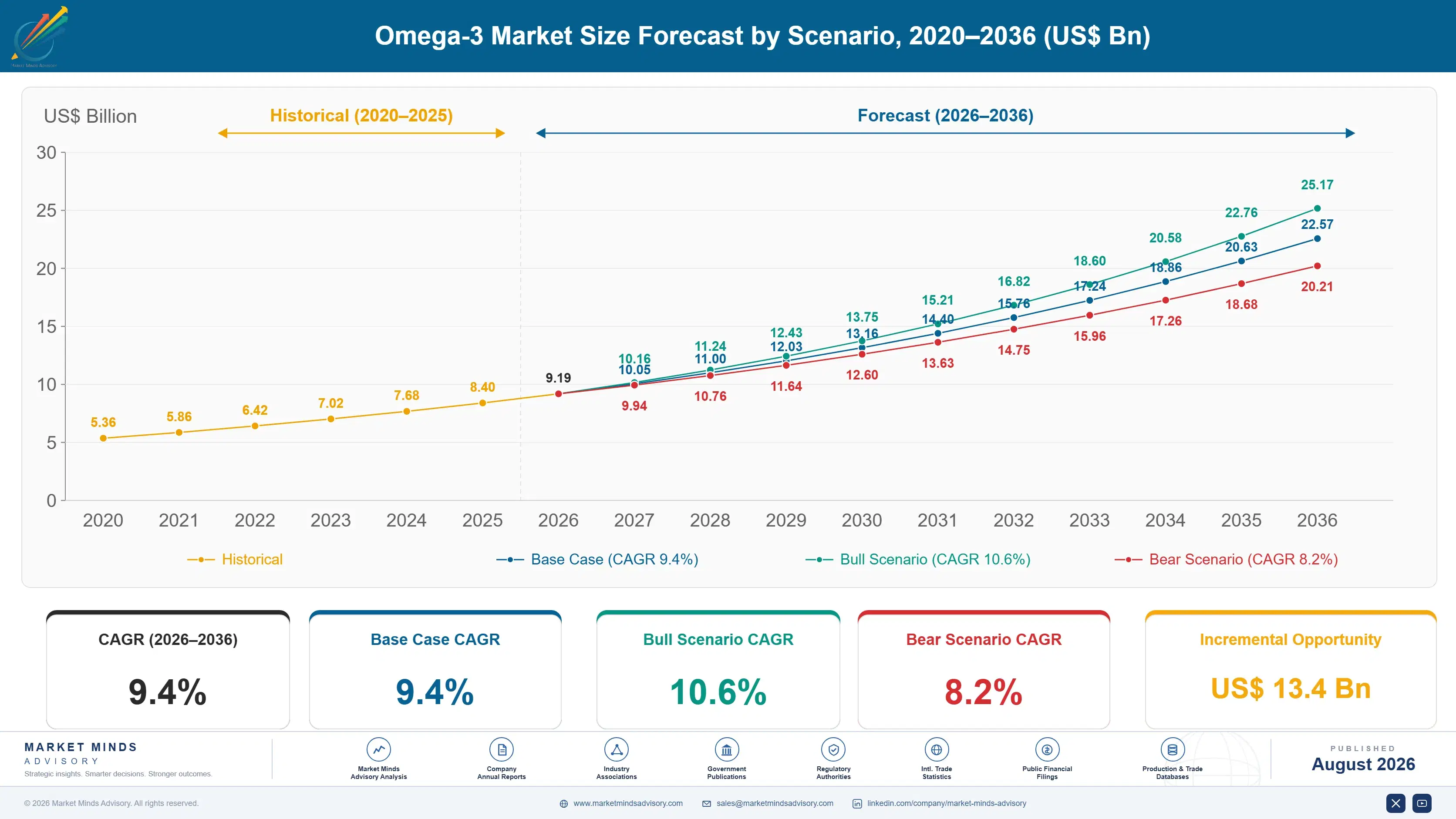
Omega-3 Market Forecast Scenarios

omega-3-market-trends-forecast-size-forecast-scenario-1787560038996
Omega-3 demand grew steadily from 2020 to 2025, with a modest pandemic-era supply disruption followed by accelerating algal and pharmaceutical-grade demand from 2023 onward. The market grew at an 8.2% historical CAGR, trailing the forecast pace as algal oil capacity only scaled meaningfully in the final two years. Buyers report growing confidence in multi-year sourcing contracts.
The base case carries omega-3 to a 9.4% CAGR through 2036 on three mechanisms. First, supplement and food brands keep expanding sustainable algal sourcing across mainstream product lines. Second, pharmaceutical prescribers keep expanding documented cardiovascular indication use for prescription EPA formulations. Third, aquaculture feed producers keep scaling omega-3 fortification to meet growing farmed fish nutrition demand worldwide. Together these mechanisms reinforce each other across multiple downstream industries. Formulators increasingly treat sustainable sourcing as a permanent baseline rather than a passing trend.
The bull case, 10.6%, assumes algal and pharmaceutical demand accelerates faster than currently projected as more brands commit to fully traceable sourcing. The bear case, 8.2%, assumes marine feedstock cost volatility and synthetic alternative competition cap sourcing economics, keeping growth concentrated in standard fish oil volume alone. Either outcome depends heavily on relative algal and marine feedstock pricing.

Traceability Becomes the Defining Commercial Constraint

Omega-3 now splits along a traceability and purity line rather than a purely marine-versus-plant one. Standard fish oil, the volume backbone of the category, meets baseline supplement and feed requirements at pricing tied closely to underlying marine feedstock costs. Algal oil and certified pharmaceutical-grade material instead serve brands demanding documented sustainability and purity, commanding meaningfully higher pricing for that differentiation.
MARKET CONCENTRATIONCR5: 40%Top five producers hold under half of global sales
AVERAGE SELLING PRICEUSD 68 per kilogram pharmaceutical gradePricing varies sharply between commodity and pharma grades
TOP PRODUCING COUNTRYPeru: 21% of global fish oil productionConcentrated anchovy fishery base anchors global output share
MARINE FEEDSTOCK COST SHARE40% to 50% of COGSMarine and algal feedstock pricing drives considerable cost volatility
TRADE INTENSITY54% of output crosses a borderCross border trade links harvest regions to formulator buyers
AVERAGE PROCESSING FACILITY UTILIZATION70% across major producersUtilization rate shapes near-term pricing power and margin
Buyers split sharply by application criticality and sourcing exposure. Pharmaceutical manufacturers and premium supplement brands specify certified pharmaceutical-grade or algal material engineered for documented consistency to protect clinical and product claims, requiring supply chain documentation that standard marine oil producers struggle to match consistently. Standard supplement and feed formulators instead specify conventional fish oil, competing largely on price per kilogram rather than deep traceability differentiation across most procurement decisions.
Over the next decade, algal oil and certified pharmaceutical-grade material should keep pulling value toward higher-margin application tiers, while conventional fish oil keeps driving the largest underlying volume for mainstream supplement and feed demand. Documented sourcing sustainability, not extraction scale alone, increasingly looks like the most durable driver of category-wide procurement strategy across downstream applications. That shift will keep reshaping supplier qualification criteria for buyers across every major consumer market.
"Brands used to buy omega-3 purely on price per kilogram. Now formulation teams ask for three years of traceable harvest documentation before they'll even sample a new supplier."
Director, Nutraceuticals and Functional Ingredients Practice · MMA Healthcare Practice · August 2026

Market Trends

Supplement Brands Shift Flagship Formulas Toward Algal Sourcing

Global supplement manufacturers have increasingly prioritized reformulating flagship, high-volume product lines toward algal-derived omega-3 rather than reserving sustainable sourcing for premium or vegan-only offerings alone, treating traceable sourcing as a defining brand consideration rather than a secondary marketing detail handled after core formulation planning. Several major supplement producers now require multi-year sustainability documentation before finalizing new omega-3 supply contracts, rather than accepting single-batch qualification common across earlier procurement programs. Suppliers including DSM-Firmenich and Croda have invested in dedicated algal fermentation infrastructure, recognizing that large supplement contracts increasingly hinge on demonstrated documentation depth rather than price per kilogram alone.
Market Impact: Clinical evidence adds 16% prescribing volume
Prescription Cardiovascular Indications Expand Pharmaceutical Demand

Prescription omega-3 pharmaceutical formulations, once concentrated almost entirely in niche lipid-lowering applications, have expanded meaningfully into mainstream cardiovascular risk reduction prescribing, since expanded clinical trial evidence and favorable regulatory positioning have made documented purity pharmaceutical-grade material commercially viable across a considerably broader range of prescribing scenarios than earlier generations supported. Several pharmaceutical manufacturers have launched dedicated prescription-grade product lines priced within reach of mainstream cardiovascular patients, reflecting genuine clinical adoption rather than incremental marketing expansion. Suppliers with established pharmaceutical purification capability are capturing these contracts well ahead of competitors still building comparable regulatory expertise.
Market Impact: Feed fortification adds 12% sourcing demand

Market Opportunities and Growth Drivers

Cardiovascular Clinical Evidence Expands Prescribing Volume

Major cardiology and lipid management prescribers continue expanding documented use of prescription omega-3 formulations across established and emerging patient populations, driving dedicated pharmaceutical-grade demand well beyond levels seen in earlier forecast periods historically as clinical guidelines tighten cardiovascular risk reduction recommendations. Several major health systems have announced expanded prescription omega-3 formulary commitments through the current forecast period specifically, giving suppliers a durable, quantified demand timeline that shapes multi-year production capacity investment rather than one-off order response. That durability distinguishes pharmaceutical-grade demand from more cyclical standard supplement capital spending elsewhere in nutraceuticals.
Market Impact: Feedstock volatility compresses margins 14%

Aquaculture Feed Fortification Expands Marine Sourcing Demand

Global aquaculture feed producers continue expanding omega-3 fortification across established and emerging farmed fish and shrimp production, lifting demand for marine and algal omega-3 well beyond levels seen in earlier forecast periods historically as feed formulation specifications tighten across aquaculture operations. Several major feed producers have expanded dedicated omega-3 procurement capacity through the current forecast period specifically, a pace of capacity expansion that barely existed at current scope before 2023 and now shapes procurement decisions among feed formulators specifically. Several producers have expanded dedicated sourcing agreements to meet this aquaculture-driven demand segment.
Market Impact: Synthetic competition limits pricing power 13%

Market Restraints and Challenges

Marine Feedstock Volatility Compresses Producer Margins

Anchovy, sardine, and other marine feedstock accounts for over two-fifths of production cost for fish oil-derived omega-3, and feedstock prices face significant volatility tied to broader fishery yield fluctuations and climate patterns that producers cannot easily hedge through long-term contracts alone. The underlying cause is that marine harvest volumes are tied closely to ocean temperature cycles and fishery quota adjustments, giving producers limited independent control over feedstock availability. Producers are responding by diversifying into algal fermentation capacity to smooth exposure. That shift takes years to complete, leaving near-term margins exposed to whatever fishery swings marine markets experience next.
Market Impact: Algal-sourced reformulation reaches 22% of volume

Synthetic Alternative Competition Limits Pricing Power

Synthetic and semi-synthetic omega-3 formulations remain meaningfully cheaper than natural marine or algal alternatives across most standard applications, across several recent pricing cycles, creating persistent price competition that limits how quickly formulators pay premiums for natural sourcing even where consumer preference is documented. The underlying cause is that synthetic formulations benefit from decades of established, larger-scale production infrastructure that natural omega-3 producers cannot yet fully replicate at comparable cost. Producers are responding by emphasizing documented bioavailability and consumer preference data over price parity. That pivot takes considerable marketing investment, and producers without existing clinical data risk losing ground.
Market Impact: Prescription demand reaches 19% of volume
3 additional market trends, 4 additional growth drivers, and 2 additional restraints and challenges are covered in the full report. Contact sales@marketmindsadvisory.com to access the complete intelligence.

Segment CAGR and Growth Architecture

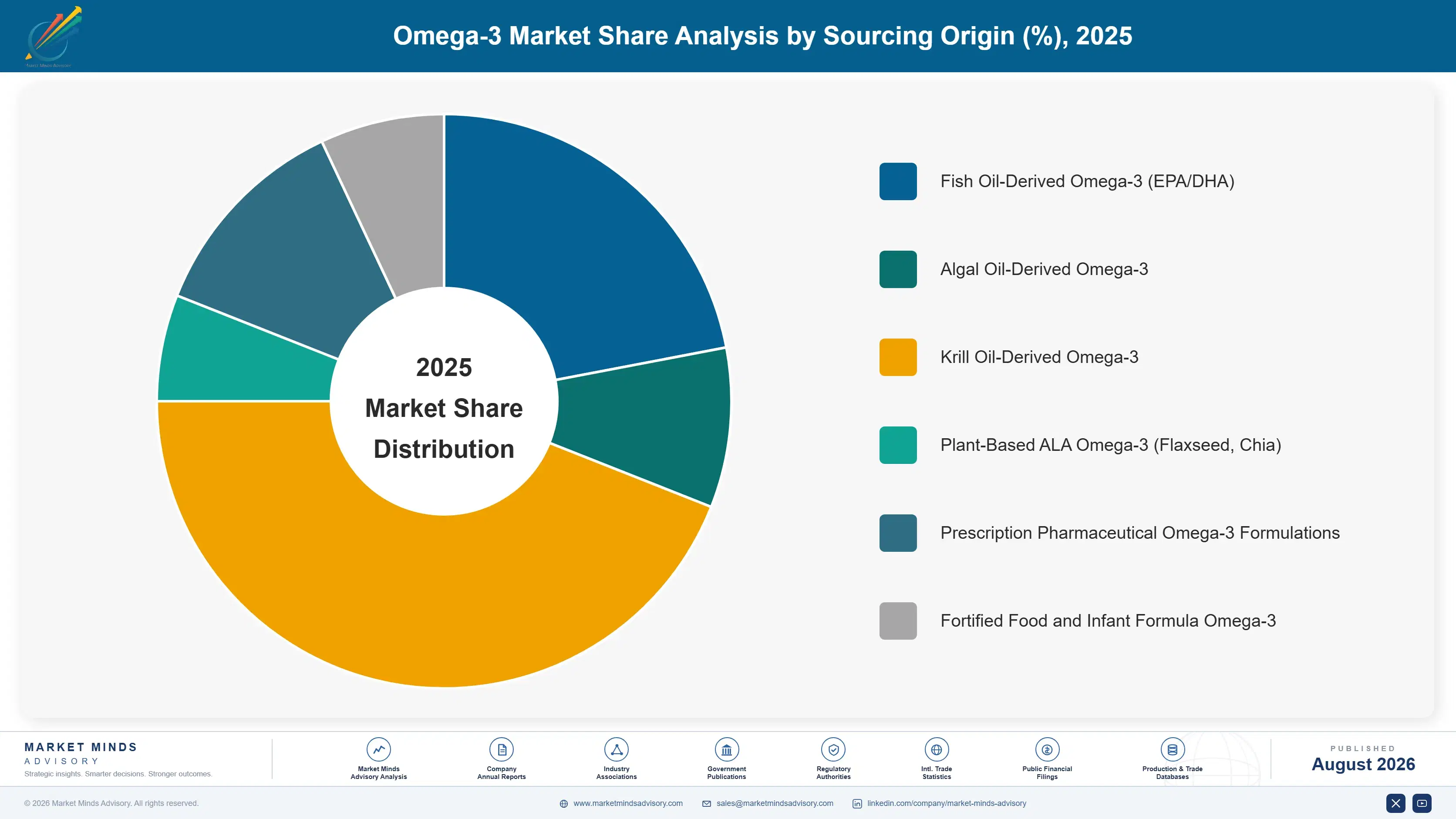
Segmentation follows sourcing origin, a single classification logic separating omega-3 by material source rather than by application, packaging format, or distribution channel. Fish oil, algal, krill, plant-based, pharmaceutical, and fortified food sources each carry distinct sourcing and processing requirements, keeping upstream extraction and downstream formulation from blurring together across segments, each occupying a distinct commercial position.
omega-3-market-trends-forecast-market-share-analysis-1787560039527

Algal Oil-Derived Omega-3

Algal oil-derived omega-3 is growing at 13.8% annually, close to half again faster than the wider market's 9.4% pace, as supplement and food brands scale vegan and sustainably sourced formulations that conventional fish oil increasingly cannot match on traceability or supply resilience. This segment requires certified fermentation infrastructure and consistency documentation distinct from conventional marine extraction, since matching algal-grade purity to established quality benchmarks demands considerable process investment across fermentation and purification infrastructure. Pricing for certified algal-grade material runs well above standard fish oil bulk, reflecting production investment and buyer willingness to pay for documented sustainability credentials. DSM-Firmenich and Croda have both prioritized capital investment in dedicated algal production, positioning the segment to capture continuing sustainability-driven growth.
CAGR 13.8%

Prescription Pharmaceutical Omega-3 Formulations

Prescription pharmaceutical omega-3 formulations grow at 11.2% annually, driven by expanding cardiovascular clinical indication use that increasingly displaces generic supplement-grade material across prescribing scenarios where documented purity and dosing matter most. This segment commands regulatory-intensive economics distinct from bulk supplement material, since matching consistent pharmaceutical-grade purity to clinical trial and regulatory approval requirements demands considerable process investment from suppliers. Several pharmaceutical manufacturers have expanded dedicated long-term sourcing programs, extending a relationship once managed through commodity purchasing into planned multi-year regulatory-grade supply agreements. Capacity expansion has proceeded among established pharmaceutical-grade producers, though regulatory approval requirements limit how quickly new entrants can credibly compete in this compliance-intensive segment. That barrier protects incumbents' margins for years to come.
CAGR 11.2%
Full segment breakdown across 6 segments available in the complete report.

Regional Architecture and Country Demand Map

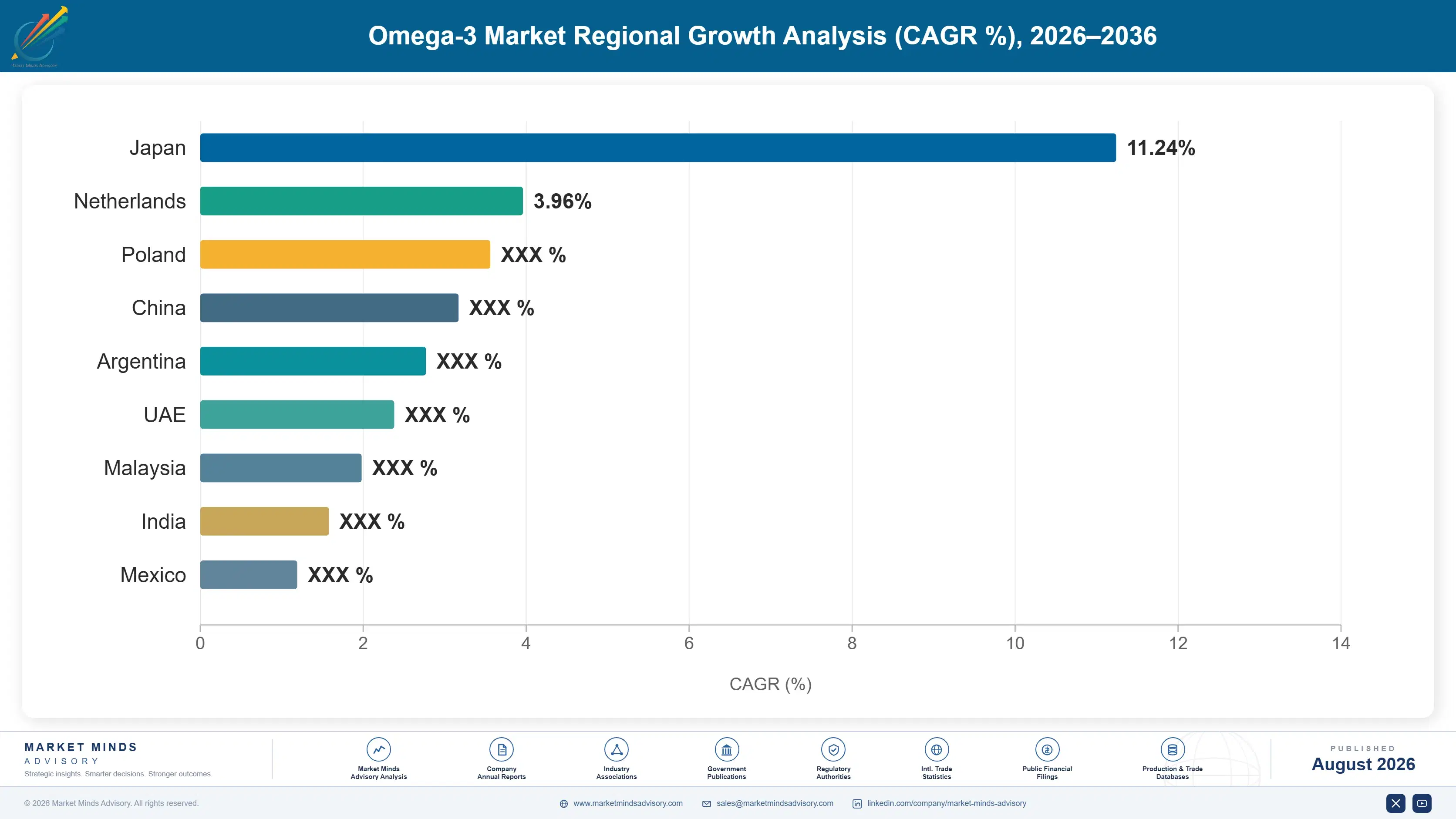
North America anchors global omega-3 demand through its concentrated dietary supplement culture and prescription omega-3 drug approvals, the largest single regional share within the normal band. China carries the fastest country-level growth, as its expanding nutraceutical manufacturing sector pulls demand higher. That gap should persist through the decade.

North America

United States dietary supplement brands anchor North American omega-3 demand, with several major producers maintaining domestic algal fermentation and pharmaceutical purification capacity to serve the region's large consumer supplement base directly. Canadian marine harvesting contributes steady supply tied to established fishery infrastructure. Growing prescription cardiovascular indication use across the region continues lifting demand for pharmaceutical-grade material meaningfully faster than the broader regional average currently suggests. Supply chain traceability planning increasingly shapes which producers win long-term contracts across the region's largest supplement and pharmaceutical manufacturers overall. Domestic algal capacity investment has accelerated as manufacturers seek to reduce dependence on imported marine material, and several producers have announced expansion plans through the current forecast period.
Share: 30% | CAGR: 9.9% (2026 to 2036)

Western Europe

Germany, France, and the United Kingdom anchor Western European omega-3 demand, reflecting the region's established supplement, pharmaceutical, and functional food manufacturing base. BASF and Croda maintain substantial regional supply relationships serving both mainstream supplement and certified pharmaceutical-grade channels across the region's dense health ingredient base. Strict European pharmaceutical and novel food regulation pushes buyers toward certified pure material at a meaningfully faster pace than less-regulated markets allow globally. Growth here trails the global average, reflecting a mature, already well-supplied buyer base with less remaining headroom for further capacity investment currently. Certification requirements tied to European pharmaceutical safety standards keep pushing buyers toward suppliers with documented purity track records, a preference that increasingly shapes which producers retain long-term regional contracts.
Share: 22% | CAGR: 7.9% (2026 to 2036)
Regional intelligence for 5 additional markets available in the complete report: East Asia, South Asia and Pacific, Latin America, Middle East and Africa, Eastern Europe. Contact sales@marketmindsadvisory.com.
omega-3-market-trends-forecast-country-cagr-analysis-1787560040037

Where Producers Can Capture Margin

Margin defense in omega-3 increasingly depends on moving beyond commodity fish oil pricing toward positioning that lets a producer charge for documented algal sustainability, pharmaceutical-grade purity, or scalable production capacity, each targeting a distinct buyer purchase behavior. The four moves below target the fastest-growing buyer segments most willing to pay well above standard pricing for genuine differentiation.

Build Algal Fermentation Production Capacity Now

Algal-derived omega-3 backed by documented sustainability testing commands pricing running well above standard fish oil, and demand from major supplement and food brands has grown faster than the industry's dedicated fermentation capacity currently available across established producers. Producers that invest in algal capacity now capture premium contracts before competitors establish comparable production scale, since manufacturers increasingly push suppliers toward documented sustainability as a baseline qualification requirement. The fermentation investment requires meaningful capital, but the roughly 34% margin uplift over standard formats justifies the cost for established producers. That uplift compounds quickly across large contract volumes.
Market Impact: Algal production typically commands a notable 34% premium

Secure Pharmaceutical-Grade Purification Capacity Investment Now

Pharmaceutical-grade omega-3 backed by documented purity testing commands pricing running well above standard supplement-grade material, and demand from major pharmaceutical manufacturers has grown faster than the industry's dedicated purification capacity currently available across established producers. Producers that invest in pharmaceutical-grade capacity now capture premium contracts before competitors establish comparable production scale, since prescribers increasingly push suppliers toward documented purity as a baseline regulatory requirement. The purification investment requires meaningful capital, but the roughly 26% cost advantage this approach delivers justifies the cost for producers pursuing margin-linked growth. That advantage compounds quickly across large contract volumes.
Market Impact: Pharmaceutical-grade purification typically lowers regulatory risk by 26%

Expand Sustainability Certification Support Programs Now

Producers offering documented sustainability certification support command substantially stronger customer retention than transactional marine oil suppliers, since brand formulators increasingly value traceability collaboration over pure price competition given rising labeling scrutiny across major consumer markets. Producers that build certification support capability now capture deeper customer relationships before competitors establish comparable regulatory capacity, since brands rarely switch suppliers once a certification relationship has been validated. The support investment requires meaningful capital deployment, but the roughly 19% higher contract value this approach generates justifies the cost for producers targeting mainstream brand accounts.
Market Impact: Certification support programs increase contract value by 19%

Develop Long-Term Aquaculture Feed Agreements Now

Aquaculture feed producers increasingly prefer multi-year omega-3 supply commitments over spot purchasing across major production programs, since supply disruption during continuous feed production runs carries operational continuity risk that producers cannot easily absorb given tightly coordinated manufacturing scheduling. Producers that secure these contracts now lock in demand and pricing before competitors capture the same feed accounts, since feed producers rarely switch suppliers once a supply relationship has been validated. The contracting investment requires meaningful working capital, but the multi-year revenue visibility, typically locking in roughly 16% more contracted volume than spot sourcing, justifies the cost for established producers.
Market Impact: Long-term feed contracts typically lock in 16% more volume

Who Controls the Margin Pool

Competitive concentration sits at a moderate CR5 of 40%, reflecting a market split between integrated marine ingredient majors competing on harvest scale and algal or pharmaceutical-grade specialists competing on documented purity and sustainability depth. The gap between category leaders and mid-tier challengers remains built on decades of marine sourcing relationships and processing infrastructure across most established markets.
Competitive activity currently runs along three lines. Integrated marine ingredient majors compete on harvest scale and cross-application processing expertise, applying scale advantages smaller specialized competitors cannot easily replicate. Algal and pharmaceutical-grade specialists compete on documented purity and sustainability depth. Regional fishery-based producers compete on integrated harvest sourcing and export logistics positioning, since access to competitive feedstock increasingly determines who wins premium export contracts.

Pressure is building from two directions. Algal specialists are moving upmarket into certified sustainability and traceability territory once defensible mainly through decades of harvest scale held by global marine majors. Pharmaceutical-grade purification is becoming a differentiator, rewarding producers willing to fund regulatory infrastructure over those competing on generic fish oil pricing. Rankings will favor whoever combines harvest scale with credible algal and pharmaceutical capability. That combination increasingly determines who wins the largest mainstream pharmaceutical and supplement contracts.
omega-3-market-trends-forecast-company-positioning-matrix-1787560040557

Competitive Moat and Risk Dimensions

DSM-FIRMENICH AG

Moat: Integrated global production scale

DSM-Firmenich holds substantial vertically integrated algal fermentation and marine processing capacity across multiple global regions that newer entrants, domestic or international, cannot replicate on any reasonable timeline, giving it sourcing cost and supply resilience advantages that smaller specialized competitors genuinely struggle to match across both commodity and certified premium segments. Long-standing brand relationships reinforce this position further.
DSM-FIRMENICH AG

Risk: Exposed to synthetic price pressure

DSM-Firmenich's substantial standard fish oil revenue base remains exposed to continuing pricing pressure from lower-cost synthetic alternatives, and the company must increasingly rely on algal and pharmaceutical-grade segment growth to offset that persistent margin headwind facing its largest historical revenue category. That exposure will persist until premium-tier revenue reaches sufficient scale.
CRODA INTERNATIONAL PLC

Moat: Deep pharmaceutical regulatory depth

Croda maintains substantial pharmaceutical regulatory support infrastructure built through decades of health ingredient industry presence, giving it commercial relationship advantages and program access that competitors lacking comparable regulatory infrastructure cannot easily replicate across similarly demanding pharmaceutical qualification programs across major regional markets. That depth compounds with each new pharmaceutical relationship secured.
CRODA INTERNATIONAL PLC

Risk: Limited algal-grade brand depth

Croda's more limited direct algal-grade brand relationship depth relative to specialized fermentation producers limits how quickly it can capture premium algal contracts, potentially constraining its ability to capture the full sustainability growth opportunity without additional fermentation and brand-facing investment. Closing that gap will require sustained capital commitment well beyond current spending levels.

Players Tracked

Prominent Players

DSM-Firmenich AG
BASF SE
Croda International plc
Omega Protein Corporation
KD Pharma Group

Other Key Players

Aker BioMarine AS
Golden Omega S.A.
Nordic Naturals Inc
GC Rieber Oils AS
Epax Norway AS
Wanma Biotechnology Co Ltd
Copeinca ASA
Pelagia AS
Cargill Incorporated
Corbion N.V.
Polaris Nutritional Lipids
BioProcess Algae LLC
TerraVia Holdings Inc
Neptune Wellness Solutions Inc
Marine Ingredients Australasia Pty Ltd

Recent Developments

APRIL 2024

DSM-Firmenich expands algal fermentation production capacity

DSM-Firmenich expanded dedicated algal fermentation omega-3 production capacity at its North American facilities, responding directly to growing supplement buyer demand for documented sustainability ahead of tightening reformulation requirements. The expansion was an organic capacity investment, not a joint venture or acquisition of any competing producer regionally.
Signal: Signals established marine majors investing directly in certified capacity ahead of confirmed buyer sourcing mandates across the region.
SEPTEMBER 2024

Croda signs long-term supply agreement with major pharmaceutical manufacturer

Croda signed a multi-year supply agreement with a major global pharmaceutical manufacturer to provide certified pharmaceutical-grade omega-3 across multiple production facilities. The transaction was a supply agreement, not a joint venture, acquisition, or merger of any kind between the two companies. The agreement reflects growing demand certainty.
Signal: Signals established producers securing long-term pharmaceutical demand commitments ahead of continued regulatory capacity growth broadly across the industry.
FEBRUARY 2025

BASF acquires regional algal production specialist

BASF acquired a regional algal production specialist to expand its sustainability certification capability ahead of anticipated vegan formulation demand growth across major markets. The transaction was a full acquisition of the target company, not a joint venture or minority equity stake arrangement. The deal signals rising sustainability investment.
Signal: Signals established marine ingredient majors expanding directly into certified sustainability specialization well ahead of broader industry adoption globally.

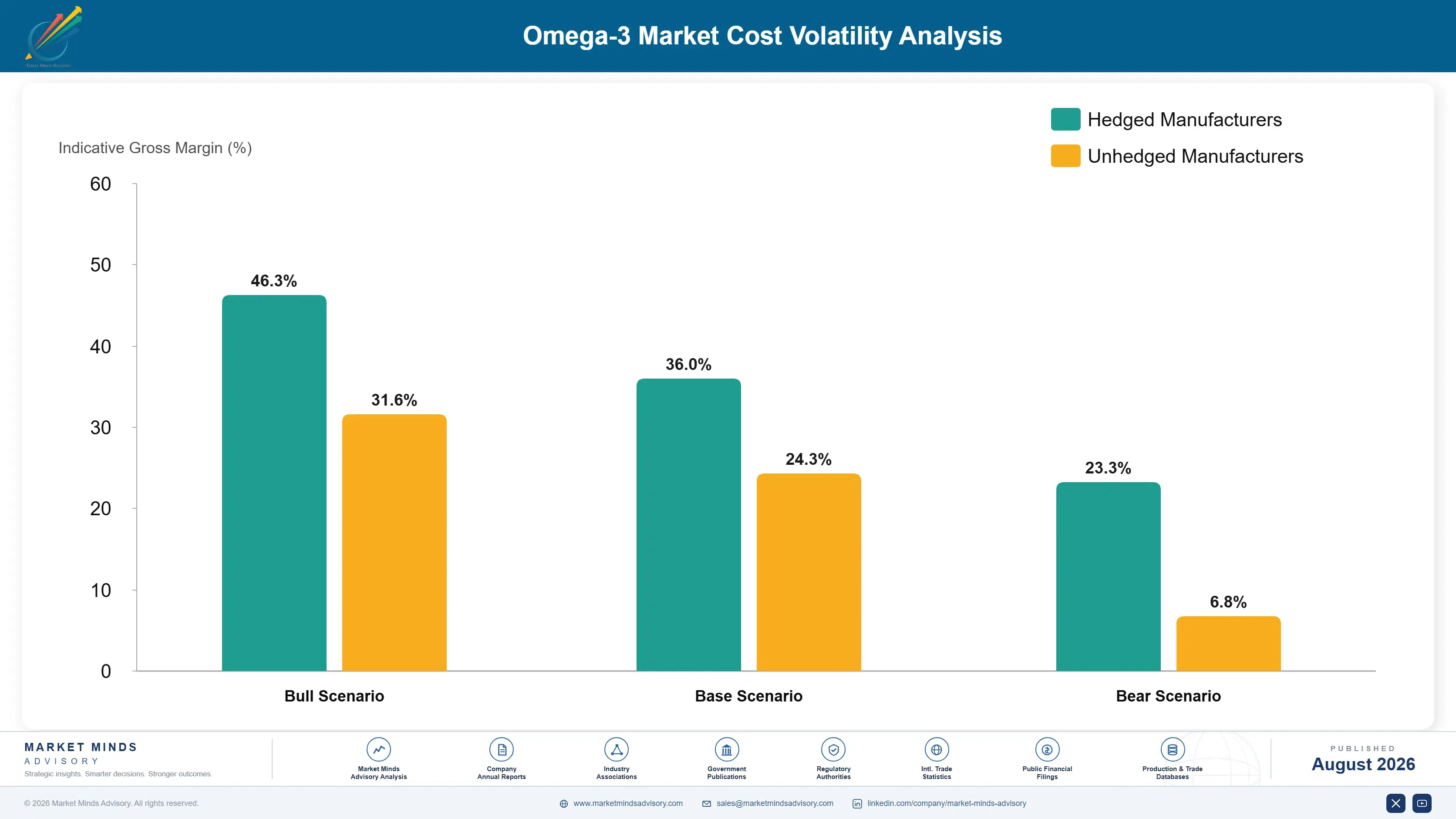
Marine Feedstock Sets the Floor

Anchovy, sardine, and other marine feedstock accounts for 40% to 50% of production cost for fish oil-derived omega-3, sourced from fishery harvest regions whose pricing tracks broader ocean climate and quota conditions rather than any omega-3-specific supply and demand pattern. Algal-grade formulations carry an additional cost component tied to specialized fermentation infrastructure. That added cost varies by supplier depending on in-house fermentation versus outsourced processing arrangements.
The 2023 Peruvian anchovy quota reduction illustrated feedstock cost exposure directly. Industry data recorded fish oil availability tightening sharply through this period as El Niño-linked ocean warming disrupted major fishery grounds responsible for a substantial share of global anchovy supply. Producers without hedged contracts or diversified sourcing absorbed significant cost increases, passing some cost through to supplement and feed customers who had few alternative sourcing options at the time.

Exposure falls hardest on smaller regional producers without long-term fishery supply contracts or diversified sourcing relationships, who must buy marine feedstock closer to spot pricing and absorb whatever margin compression results from climate-driven volatility. Larger diversified producers with integrated algal fermentation and geographic sourcing diversification smooth that volatility considerably better than smaller, less capitalized regional competitors currently exposed to full commodity market swings.
omega-3-market-trends-forecast-cost-volatility-analysis-1787560040751

Lock Long-Term Fishery Supply Contracts

Producers negotiating multi-year marine feedstock supply agreements convert volatile spot pricing into a planned input cost, protecting downstream omega-3 pricing that resists frequent adjustments across long formulator contract cycles. This favors larger established producers with existing fishery relationships, but smaller producers can access similar terms through regional purchasing consortia across multiple cycles. That access narrows the gap with larger competitors.

Diversify Sourcing Across Fishery Regions

Producers reduce single-region climate exposure by sourcing marine feedstock across multiple geographic fishery regions rather than depending entirely on any single supplier for the majority of feedstock volume. That diversification smooths input availability across different regional harvest cycles, though it adds supplier qualification complexity across each additional relationship a producer incorporates. That complexity pays off during regional disruption events.

Invest in Algal Fermentation Production Capacity

Producers reduce marine dependence by acquiring direct algal fermentation production capacity, capturing cost stability that pure fishery-based sourcing cannot achieve at comparable scale. This integration strategy suits larger producers with meaningful capital access best, but delivers durable cost stability that persists regardless of future climate market volatility across multiple product segments. That stability compounds over multiple investment cycles.

Portfolio Architecture for Margin Defence

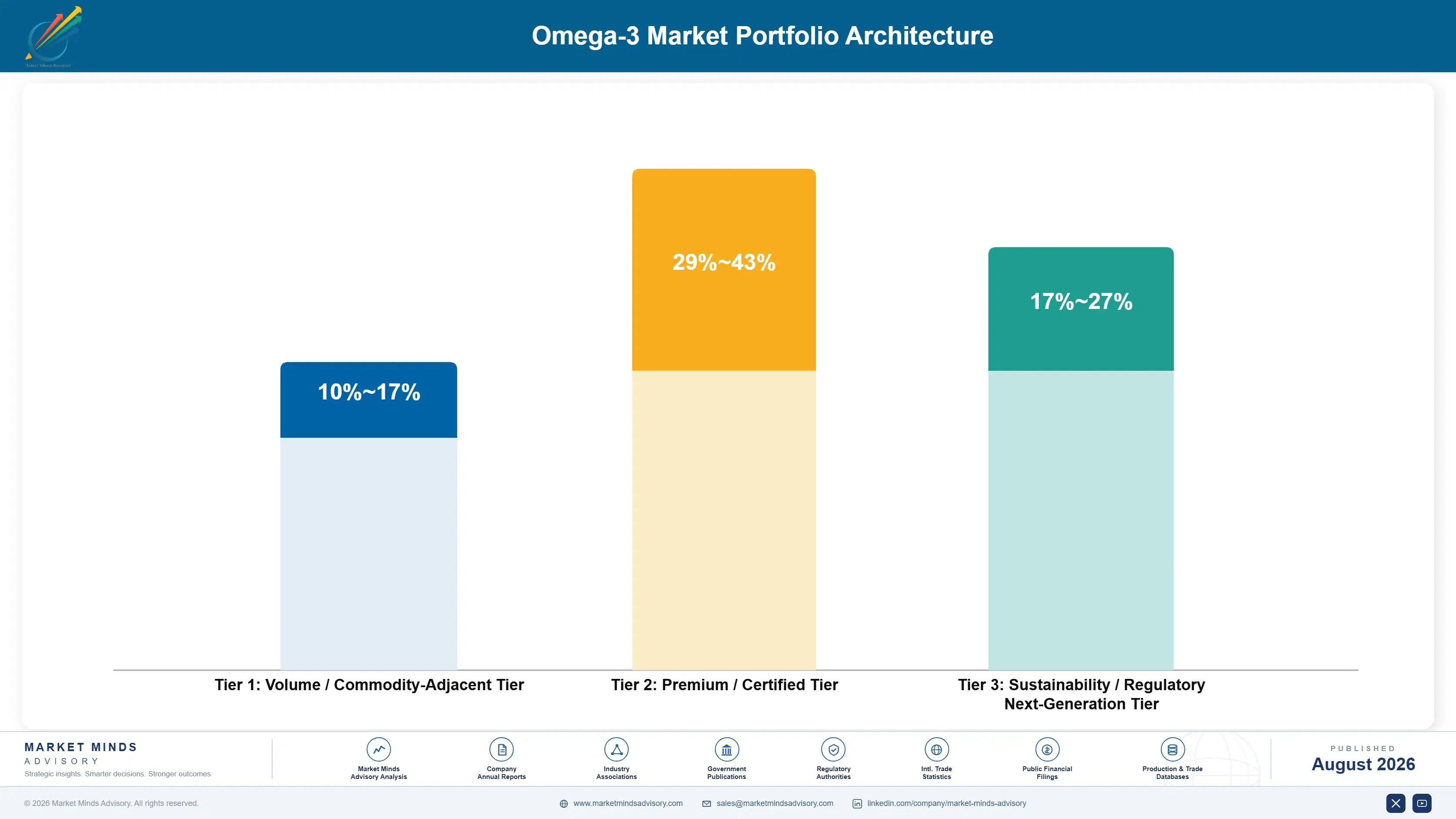
Omega-3's portfolio splits into three tiers with meaningfully different margin economics. Volume standard fish oil, sold through established supplement and feed distribution channels on price and delivered volume, compete on cost and earn steady but thin margins. Algal oil and certified pharmaceutical-grade material earns substantially more, since documented sustainability and purity differentiation create switching costs commodity producers cannot replicate quickly.
The tension for producers is capital allocation between two economics. Volume standard extraction generates dependable cash flow that funds operations and fermentation research, while algal oil and pharmaceutical-grade capacity requires meaningful capital and technical investment before generating comparable returns at much higher margin. Producers leaning entirely on standard volume risk losing share to faster-growing differentiated competitors, while premium investment risks underutilized capacity if certified-grade demand proves slower than currently projected.

High-value margin pools concentrate in algal oil and certified pharmaceutical-grade material carrying genuine sustainability or purity differentiation that standard formats cannot match. Frontier opportunity sits in combining verified algal production with credible pharmaceutical-grade purification, letting producers capture premium pricing from both vegan formulation and pharmaceutical channels while retaining steady standard volume revenue simultaneously. That combination should compound advantage over the next decade.

Volume / Commodity-Adjacent Tier

Standard fish oil sold through established supplement and feed distribution channels on price and delivered volume, priced close to underlying marine feedstock costs with minimal differentiation between competing regional producers, particularly across feed-focused channels.
Gross Margin: 10-17%

Premium / Certified Tier

Algal oil and certified pharmaceutical-grade material carrying documented sustainability testing and purity validation that commands sustained premiums over standard formats across major supplement and pharmaceutical brands worldwide. Pricing reflects genuine differentiation rather than marketing positioning alone.
Gross Margin: 29-43%

Sustainability / Regulatory / Next-Generation Tier

Emerging precision fermentation and next-generation algal strain formats designed to serve increasingly demanding sustainability and regulatory requirements ahead of continued industry evolution, though large-scale production economics remain largely unproven at full commercial volume today.
Gross Margin: 17-27%
omega-3-market-trends-forecast-portfolio-architecture-1787560041251

High-value Sub-segments and Strategic Watch-out

Algal Oil-Derived Omega-3

Algal-grade demand grows fastest at 13.8% annually and already commands pricing well above conventional formulations. Brands investing in documented sustainability chemistry keep expanding, and rising formulation performance pressure should keep margin strong through the forecast period ahead across every major market. Demand visibility remains strong overall.
Gross Margin: 29-43%

Prescription Pharmaceutical Omega-3 Formulations

Prescription demand grows at a healthy 11.2% annually, driven by expanding cardiovascular clinical indication use, though regulatory approval requirements limit how quickly new entrants can credibly compete in this compliance-intensive segment currently commanding solid margins globally. Demand visibility remains strong. Demand visibility remains strong across every major region.
Gross Margin: 24-34%

Fish Oil-Derived Omega-3 (EPA/DHA)

Fish oil demand remains the largest format by volume, anchored by decades of established supplement and feed formulation specification across mainstream production operations regionally. Margins stay steady but moderate, competing on price and delivered volume rather than differentiation, anchoring meaningful category revenue overall. That revenue base stays dependable.
Gross Margin: 10-17%

Plant-Based ALA Omega-3 (Flaxseed, Chia)

Plant-based ALA demand faces gradual competitive pressure as algal EPA/DHA formats increasingly match comparable bioavailability at considerably better clinical positioning, narrowing the addressable market for legacy plant-based formats. Producers concentrated purely in this segment risk volume erosion absent diversification into premium formats. That risk grows each year.
Gross Margin: 12-19%

Why Pharmaceutical Contracts Run Long

Omega-3 demand behaves like an annuity within pharmaceutical and premium supplement customer relationships, since manufacturers validate a specific supplier through extended purity and stability testing and then source against that relationship for continuous production runs rather than re-tendering routinely, given the disruption risk of switching mid-production. Standard commodity buyers behave differently, since purchasing decisions follow individual budget cycles rather than pure continuous-production supply commitment.
Stickiness varies sharply by buyer type and application criticality. Pharmaceutical manufacturers rarely switch omega-3 suppliers once a supply relationship has been qualified for continuous production, given the disruption and requalification risk involved in switching mid-program across a multi-year manufacturing cycle. Premium supplement brands show different loyalty patterns, favoring suppliers with documented sustainability credentials over pure price competition. Standard feed buyers sit in between, valuing reliable delivery without full continuous-production supplier lock-in.

Buyer profiles are shifting generationally within both certified and standard channels specifically. Procurement and formulation officers increasingly treat documented traceability as a non-negotiable sourcing criterion rather than a routine procurement decision, a shift that favors producers offering validated certified-grade supply over those competing purely on generic price alone. That shift is visible in how large brands structure new contracts.
omega-3-market-trends-forecast-end-use-penetration-index-1787560041738

Where Producers Should Bet

These are among the four positions where our research anticipates prominent divergence between winners and laggards over the coming forecast period. Each is grounded in the demand model, the regulatory perimeter, and the announced capacity pipeline.
01 / ALGAL SUSTAINABILITY PRIORITY

Build fermentation capability before buyer demand outpaces supply

Algal-grade demand is growing close to half again faster than the wider market's pace, and premium material already commands meaningful pricing above standard formats, yet most producers still lack dedicated fermentation infrastructure at meaningful commercial scale. Producers that invest now in algal capacity position ahead of continuing buyer-driven demand growth across every major supplement market globally. Waiting risks ceding the category's fastest-growing and highest-margin segment permanently to competitors currently building that capability well ahead of broader industry adoption across every major market.
02 / PHARMACEUTICAL-GRADE PURIFICATION STRATEGY

Secure regulatory advantage before compliance demands intensify further

Producers with pharmaceutical-grade purification command meaningful regulatory and margin advantages, and demand for that documented purity has grown considerably faster than the industry's dedicated purification capacity currently available across established producers. Producers that invest now in purification lock in regulatory certainty before competitors face comparable qualification exposure, since prescribers increasingly favor suppliers offering validated clinical-grade material. Every producer relying purely on commodity purchasing risks missing this durable regulatory advantage entirely, ceding ground permanently to better-positioned rivals already building comparable purification infrastructure.
03 / SUSTAINABILITY CERTIFICATION SUPPORT

Build traceability capability before compliance demands resurface further

Producers offering documented sustainability certification support command substantially stronger customer retention than transactional suppliers, and demand for that support has grown considerably faster than the industry's dedicated traceability capacity currently available across established producers. Producers that build certification capability now capture deeper customer relationships before competitors establish comparable traceability infrastructure across major mainstream and premium channels. Every producer relying purely on transactional selling risks missing this durable relationship advantage entirely, ceding ground permanently to better-prepared competitors already investing in compliance capability.
04 / LONG-TERM AQUACULTURE AGREEMENTS

Lock large feed producer relationships before rankings shift further

Aquaculture feed producers increasingly prefer multi-year omega-3 supply commitments over spot purchasing across continuous production programs, since supply disruption during production runs carries genuine operational continuity risk that producers cannot comfortably absorb given tightly coordinated manufacturing scheduling. Producers that secure these agreements now lock in demand and pricing before competitors capture the same feed accounts, since producers rarely switch suppliers once a relationship has been validated. Every producer relying purely on spot sales risks missing this durable revenue opportunity entirely across major markets.

Engagement Snapshot From the Field

A live engagement with an industry participant carrying material or product regulatory and market exposure ahead of a defining policy shift, showing how our research translates into a defensible multi-year portfolio strategy.
MARKET MINDS ADVISORY · CLIENT ENGAGEMENT SUMMARY
Omega-3 Producer Strategic Portfolio Review and Transition Roadmap 2026·Investment Scenario on Omega-3 Exposure Evaluation 2025-26
CLIENT PROFILE
A regional dietary supplement manufacturer operating multiple production lines across two manufacturing sites approached MMA while evaluating whether to reformulate its flagship omega-3 product line away from fish oil toward certified algal-derived material. The client reported annual omega-3 ingredient procurement spending near USD 34 million, with fish oil representing roughly 72% of current volume (client-reported, unverified by MMA).
STRATEGIC CHALLENGE
Management faced a strategic decision between a full reformulation toward algal-derived omega-3 across its flagship line or a phased approach limited to new vegan product launches only. The procurement team worried full reformulation would raise per-unit costs given premium algal pricing, while the marketing team worried a phased approach would leave the flagship line exposed to competitive sustainability positioning from rival brands already reformulated.
MMA APPROACH
MMA benchmarked reformulation cost premiums and typical consumer response outcomes across comparable supplement manufacturers that had completed similar algal sourcing transitions, assessed the client's existing supply chain flexibility relative to alternative supplier qualification requirements, and evaluated which supplier relationships offered the most commercially attractive combination of cost and consumer positioning given the client's brand scale.
KEY FINDINGS
  1. Comparable supplement manufacturers that reformulated flagship lines toward algal-derived omega-3 captured measurable consumer preference gains that value-tier manufacturers relying on standard fish oil did not achieve during recent sustainability positioning cycles.
  2. Reformulation cost premiums, while measurable, were considerably smaller than the brand equity gains documented across comparable manufacturers that completed similar algal sourcing transitions. That gap widened further during the most recent consumer preference survey cycle.
  3. The client's existing supply chain flexibility aligned closely with alternative supplier qualification requirements, reducing the incremental reformulation investment required compared with manufacturers needing extensive requalification.
  4. A phased reformulation approach targeting the client's highest-volume flagship product first allowed validation of the cost-positioning tradeoff before committing to broader portfolio-wide reformulation.
CLIENT PROFILE
A regional dietary supplement manufacturer operating multiple production lines across two manufacturing sites approached MMA while evaluating whether to reformulate its flagship omega-3 product line away from fish oil toward certified algal-derived material. The client reported annual omega-3 ingredient procurement spending near USD 34 million, with fish oil representing roughly 72% of current volume (client-reported, unverified by MMA).
STRATEGIC CHALLENGE
Management faced a strategic decision between a full reformulation toward algal-derived omega-3 across its flagship line or a phased approach limited to new vegan product launches only. The procurement team worried full reformulation would raise per-unit costs given premium algal pricing, while the marketing team worried a phased approach would leave the flagship line exposed to competitive sustainability positioning from rival brands already reformulated.
MMA APPROACH
MMA benchmarked reformulation cost premiums and typical consumer response outcomes across comparable supplement manufacturers that had completed similar algal sourcing transitions, assessed the client's existing supply chain flexibility relative to alternative supplier qualification requirements, and evaluated which supplier relationships offered the most commercially attractive combination of cost and consumer positioning given the client's brand scale.
KEY FINDINGS
  1. Comparable supplement manufacturers that reformulated flagship lines toward algal-derived omega-3 captured measurable consumer preference gains that value-tier manufacturers relying on standard fish oil did not achieve during recent sustainability positioning cycles.
  2. Reformulation cost premiums, while measurable, were considerably smaller than the brand equity gains documented across comparable manufacturers that completed similar algal sourcing transitions. That gap widened further during the most recent consumer preference survey cycle.
  3. The client's existing supply chain flexibility aligned closely with alternative supplier qualification requirements, reducing the incremental reformulation investment required compared with manufacturers needing extensive requalification.
  4. A phased reformulation approach targeting the client's highest-volume flagship product first allowed validation of the cost-positioning tradeoff before committing to broader portfolio-wide reformulation.
RECOMMENDED STRATEGY
Phase 1: Phase 1 (0 to 6 months): Reformulate the flagship product line to validate cost and consumer positioning assumptions under real market conditions. Phase 2: Phase 2 (6 to 18 months): Expand reformulation across the remaining core product lines based on validated performance from the initial transition. Phase 3: Phase 3 (18 to 36 months): Formalize long-term certified algal sourcing agreements to support continued production scale and brand positioning across both sites.
OUTCOME
The client completed its flagship product reformulation and recorded a measurable consumer preference improvement within the first six months of the engagement. The client is now extending reformulation across its remaining core product line based on the initial transition's documented positioning performance (client-reported, unverified by MMA).

Frequently Asked Questions

Foundational context covering the market sizes, CAGR, scope, country, region and competition that inform every finding below. This section is provided to cover basics and most often pre-purchase conversations, answered from the MMA Primary Research Dataset.

What is the current size of the Omega-3 Market?

The omega-3 market reached USD 9.19 billion in 2026, based on MMA Primary Research Dataset findings. Growth increasingly reflects algal-sourced and pharmaceutical-grade demand rather than standard fish oil volume alone.

How large will the Omega-3 Market be by 2036?

MMA's base case projects the market reaching USD 22.58 billion by 2036, an incremental opportunity of roughly USD 13.39 billion over the 2026 to 2036 forecast period.

What is the CAGR for the Omega-3 Market 2026 to 2036?

The base case CAGR is 9.4%, with a bull case of 10.6% and a bear case of 8.2% depending on sustainability adoption pace and marine feedstock cost conditions.

Which segment is growing fastest?

Algal oil-derived omega-3 leads at a 13.8% CAGR, close to half again faster than the overall market rate, as brands scale vegan and sustainably sourced formulations.

Who are the major companies in the Omega-3 Market?

Leading participants include DSM-Firmenich AG, BASF SE, Croda International plc, Omega Protein Corporation, and KD Pharma Group, assessed on production scale and purification capability. Competitive intensity remains moderate across the sector.

Which country is growing fastest?

China leads country-level growth at 10.8% annually, driven by its rapidly expanding nutraceutical manufacturing sector. Domestic producers are scaling capacity to meet this demand, narrowing the gap with North American production leaders over time.

Report Segmentation Architecture

The full report scope spans multiple orthogonal segmentation dimensions, with cross-tabulated demand data provided for each dimension pair. Coverage extends further to regional breakdowns, trend trajectories, and the competitive detail needed to support segment-level decision-making.

By Sourcing Origin

  • Fish Oil-Derived Omega-3 (EPA/DHA)
  • Algal Oil-Derived Omega-3
  • Krill Oil-Derived Omega-3
  • Plant-Based ALA Omega-3 (Flaxseed, Chia)
  • Prescription Pharmaceutical Omega-3 Formulations
  • Fortified Food and Infant Formula Omega-3

By End-Use Industry

  • Dietary Supplements
  • Pharmaceuticals
  • Aquaculture and Animal Feed
  • Fortified Food and Beverage
  • Infant Nutrition

By Commercial Dimension

  • Direct Producer Supply Contracts
  • Distributor and Channel Sales
  • Certified Sourcing Program Agreements
  • Long-Term Brand Manufacturer Partnerships

By Region

  • North America
  • Western Europe
  • East Asia
  • South Asia and Pacific
  • Latin America
  • Middle East and Africa
  • Eastern Europe

Scope, Methodology, and Coverage

Every figure in this report is reproducible from documented input assumptions. The scope below maps the historical period, the forecast horizon, the segmentation dimensions, and the countries covered, alongside the underlying primary and qualitative methodology.
Historical Period
2020 to 2025
Forecast Period
2026 to 2036
Base Year
2025 (USD billions; MMA Primary Research Dataset, August 2026)
Market Definition
The omega-3 market covers commercial production and sale of omega-3 fatty acid ingredients derived from fish oil, algal oil, krill oil, and plant-based sources, including prescription pharmaceutical formulations and fortified food applications. It excludes finished dietary supplement products, pharmaceutical drugs, and fortified foods manufactured beyond the omega-3 ingredient stage itself.
Quantitative Units
USD billions (current prices); metric tons of omega-3 ingredient produced and sold where applicable
Segmentation Dimensions
By Sourcing Origin; By End-Use Industry; By Commercial Dimension; By Region
Regions Covered
North America, Western Europe, East Asia, South Asia and Pacific, Latin America, Middle East and Africa, Eastern Europe
Countries Covered
United States, Canada, Germany, France, UK, China, Japan, South Korea, India, Vietnam, Peru, Brazil, Chile, Saudi Arabia, South Africa, Poland, and additional markets relevant to this sector
Key Companies Profiled
DSM-Firmenich AG, BASF SE, Croda International plc, Omega Protein Corporation, KD Pharma Group, Aker BioMarine AS, Golden Omega S.A., Nordic Naturals Inc, GC Rieber Oils AS, Epax Norway AS, Wanma Biotechnology Co Ltd, Copeinca ASA, Pelagia AS, Cargill Incorporated, Corbion N.V., Polaris Nutritional Lipids, BioProcess Algae LLC, TerraVia Holdings Inc, Neptune Wellness Solutions Inc, Marine Ingredients Australasia Pty Ltd
Quantitative Methodology
Primary survey, n=3,800 respondents, Q4 2025, six countries; demand-side model with trade association cross-validation
Qualitative Methodology
47 expert interviews, Q4 2025; applied to validate demand model assumptions, identify emerging dynamics, and assess competitive positioning
Report Format
PDF and XLSX data workbook (Word format preview document)
Publisher
Market Minds Advisory
Report Code
MMA-2026-HLT-101
Published
August 2026
Contact
sales@marketmindsadvisory.com | www.marketmindsadvisory.com

Purchase the full Omega-3 Market Report (2026 to 2036).

The full MMA Omega-3 report sizes the market across six sourcing-origin segments, five end-use industries, four commercial supply models, and all seven global regions through 2036. It profiles twenty participants on a consistent basis of production scale and purification capability across standard, algal, and pharmaceutical-grade formats, scoring each on documented sustainability depth, regulatory strength, and fermentation capacity. Scenario models quantify how cardiovascular clinical evidence, aquaculture feed fortification, and marine feedstock conditions move both category volume and pricing. The report includes feedstock cost modeling, a certification benchmark, and sustainability pathway assessment built for nutraceuticals and investment strategy teams.
Six-source demand model with certification-adjusted pricing
Marine feedstock cost volatility and hedging modeling
Algal fermentation pathway benchmarking and readiness model
Twenty-company competitive profiling on consistent program basis
Country-level demand map across all seven global regions
Sustainability sourcing and traceability pathway assessment

Built For The People Who Decide

From boardroom strategy to bench-side execution, this report is read cover-to-cover by leaders shaping the next decade of their industry, turning demand scenarios, market dynamics and valuation benchmarks into decisions.
CXOs/ Presidents/ VPs/ Managers
M&A and Corporate Development
Strategy Teams and R&D Heads
Procurement and Product Directors
Regulatory and Compliance Leaders
Investor Relations and Equity Analysts