Advanced Polymer Composites Market

Advanced Polymer Composites Market

Advanced Polymer Composites Market Outlook from 2026 to 2033

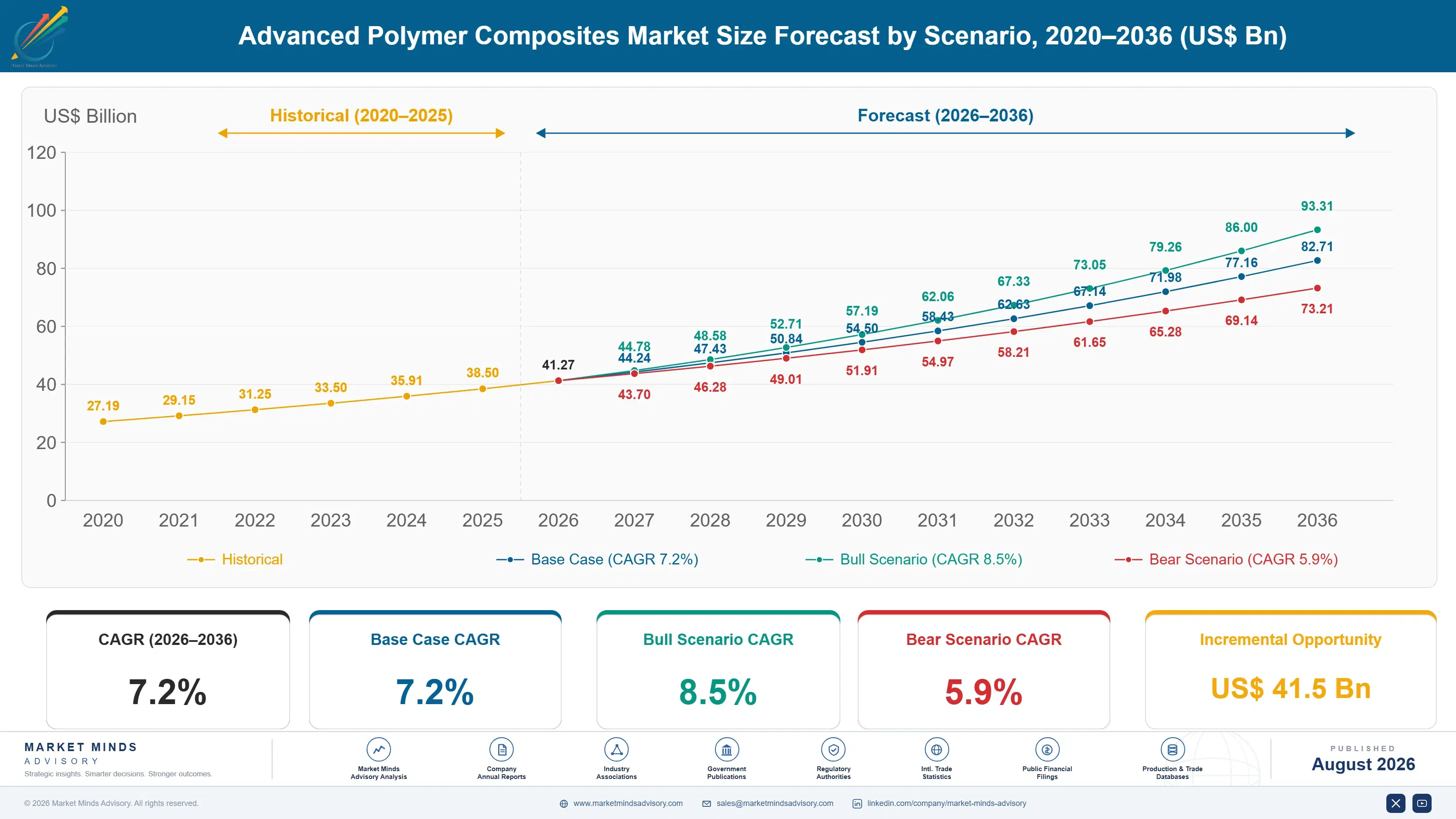
The advanced polymer composites market is poised for robust expansion, driven by increasing demand across aerospace, automotive, wind energy, and construction sectors. The market was valued at USD 13.2 billion in 2025 and is projected to reach USD 23.8 billion by 2033, registering a CAGR of 7.8% during the forecast period. The superior mechanical properties, lightweight nature, and corrosion resistance of advanced polymer composites are key factors fueling their adoption in high-performance applications. As industries strive for enhanced efficiency and sustainability, the integration of these composites into structural and functional components is expected to accelerate.

The market landscape is characterized by technological advancements, strategic collaborations, and a growing focus on sustainable materials. Manufacturers are investing in research and development to innovate new composite formulations and processing techniques, aiming to meet evolving industry standards and regulatory requirements. The Asia-Pacific region is emerging as a significant growth hub, supported by rapid industrialization and infrastructure development. Meanwhile, North America and Europe continue to lead in technological innovation and high-value applications, ensuring a dynamic and competitive market environment.

Advanced Polymer Composites Market

Advanced Polymer Composites Market Scenario & Strategic Insights

The advanced polymer composites market is witnessing a paradigm shift as end-user industries increasingly prioritize lightweight, high-strength materials to enhance product performance and reduce environmental impact. Aerospace and defense sectors remain the largest consumers, leveraging these composites for structural components that demand exceptional strength-to-weight ratios. The automotive industry is also a significant contributor, adopting advanced polymer composites to achieve fuel efficiency targets and comply with stringent emission regulations. The wind energy sector is another major growth avenue, utilizing these materials in turbine blades for improved durability and efficiency.

Strategic partnerships and mergers are shaping the competitive landscape, with key players focusing on expanding their product portfolios and global footprint. Investment in automation and digital manufacturing processes is enabling cost-effective production and customization, further driving market penetration. However, the market faces challenges related to high production costs and complex fabrication processes, necessitating continuous innovation and process optimization. Regulatory frameworks emphasizing sustainability and recyclability are influencing material selection and product development strategies, compelling manufacturers to explore bio-based and recyclable composite solutions.

The market’s future trajectory will be defined by the interplay of technological innovation, regulatory compliance, and evolving customer requirements. Companies that can effectively balance performance, cost, and sustainability will be well-positioned to capitalize on emerging opportunities in both established and nascent application areas.

Attribute2026 (USD Billion)2033 (USD Billion)CAGR (2026 – 2033)
Market Size14.223.87.8%

Advanced Polymer Composites Market Trends

  • Rising Adoption in Lightweight Automotive and Aerospace Applications

The trend toward lightweighting in automotive and aerospace industries is significantly boosting the demand for advanced polymer composites. These materials offer superior strength-to-weight ratios, enabling manufacturers to reduce vehicle and aircraft weight without compromising structural integrity. This not only enhances fuel efficiency and performance but also helps in meeting stringent emission and safety regulations. The integration of advanced polymer composites in electric vehicles, aircraft interiors, and structural components is expected to intensify as manufacturers seek to differentiate their offerings and achieve sustainability objectives.

  • Technological Advancements in Composite Manufacturing

Innovations in manufacturing processes, such as automated fiber placement, resin transfer molding, and additive manufacturing, are transforming the advanced polymer composites market. These advancements are enabling higher precision, reduced cycle times, and improved material utilization, making composite production more cost-effective and scalable. The development of new resin systems and reinforcement fibers, including thermoplastic matrices and carbon nanotubes, is further expanding the performance envelope of advanced polymer composites, opening up new application possibilities across diverse industries.

  • Sustainability and Circular Economy Initiatives

Environmental considerations are increasingly shaping the advanced polymer composites market. Manufacturers are focusing on developing bio-based resins, recyclable composites, and closed-loop manufacturing processes to minimize environmental impact. Regulatory pressures and consumer demand for sustainable products are driving the adoption of green materials and recycling technologies. Companies investing in sustainable composite solutions are gaining a competitive edge, particularly in regions with stringent environmental regulations such as Europe and North America.

Segment & Category Analysis for Advanced Polymer Composites Market

By Resin Type

  • Epoxy
  • Polyester
  • Polyimide
  • Polyetheretherketone (PEEK)
  • Others

The resin type segment is pivotal in determining the performance characteristics of advanced polymer composites. Epoxy resins dominate the market due to their excellent mechanical properties, chemical resistance, and versatility in aerospace and automotive applications. Polyester resins are widely used in construction and marine sectors for their cost-effectiveness and ease of processing. Polyimide and PEEK resins are gaining traction in high-temperature and high-performance applications, particularly in electronics and aerospace. The choice of resin significantly influences the composite’s durability, thermal stability, and application suitability.

Advanced Polymer Composites Market Resin Type

By Fiber Type

Fiber type is a critical determinant of composite strength, stiffness, and weight. Carbon fiber composites are renowned for their exceptional strength-to-weight ratio and are extensively used in aerospace, automotive, and sports equipment. Glass fiber composites offer a balance of performance and affordability, making them popular in construction, wind energy, and marine applications. Aramid fibers, known for their impact resistance and thermal stability, are preferred in defense and protective gear. The ongoing development of hybrid and nano-reinforced fibers is further enhancing the performance spectrum of advanced polymer composites.

By Application

  • Aerospace & Defense
  • Automotive
  • Wind Energy
  • Construction
  • Electrical & Electronics
  • Marine
  • Sporting Goods
  • Others

The application landscape for advanced polymer composites is diverse, with aerospace and defense accounting for the largest share due to stringent performance requirements. Automotive applications are expanding rapidly, driven by the need for lightweight and fuel-efficient vehicles. Wind energy is a significant growth area, with composites used in turbine blades for enhanced efficiency and longevity. Construction, electrical & electronics, marine, and sporting goods represent additional high-potential segments, each with unique performance and regulatory demands.

By Manufacturing Process

  • Lay-Up
  • Filament Winding
  • Injection Molding
  • Pultrusion
  • Resin Transfer Molding (RTM)
  • Others

The choice of manufacturing process impacts production efficiency, cost, and product quality. Lay-up and filament winding are commonly used for large, complex structures such as aircraft components and wind turbine blades. Injection molding and pultrusion are preferred for high-volume, consistent production of automotive and construction parts. Resin transfer molding (RTM) offers advantages in producing intricate shapes with high fiber content. Continuous innovation in manufacturing techniques is enabling greater design flexibility and cost competitiveness.

By End-Use Industry

  • Aerospace & Defense
  • Automotive & Transportation
  • Energy
  • Construction & Infrastructure
  • Consumer Goods
  • Industrial Equipment
  • Others

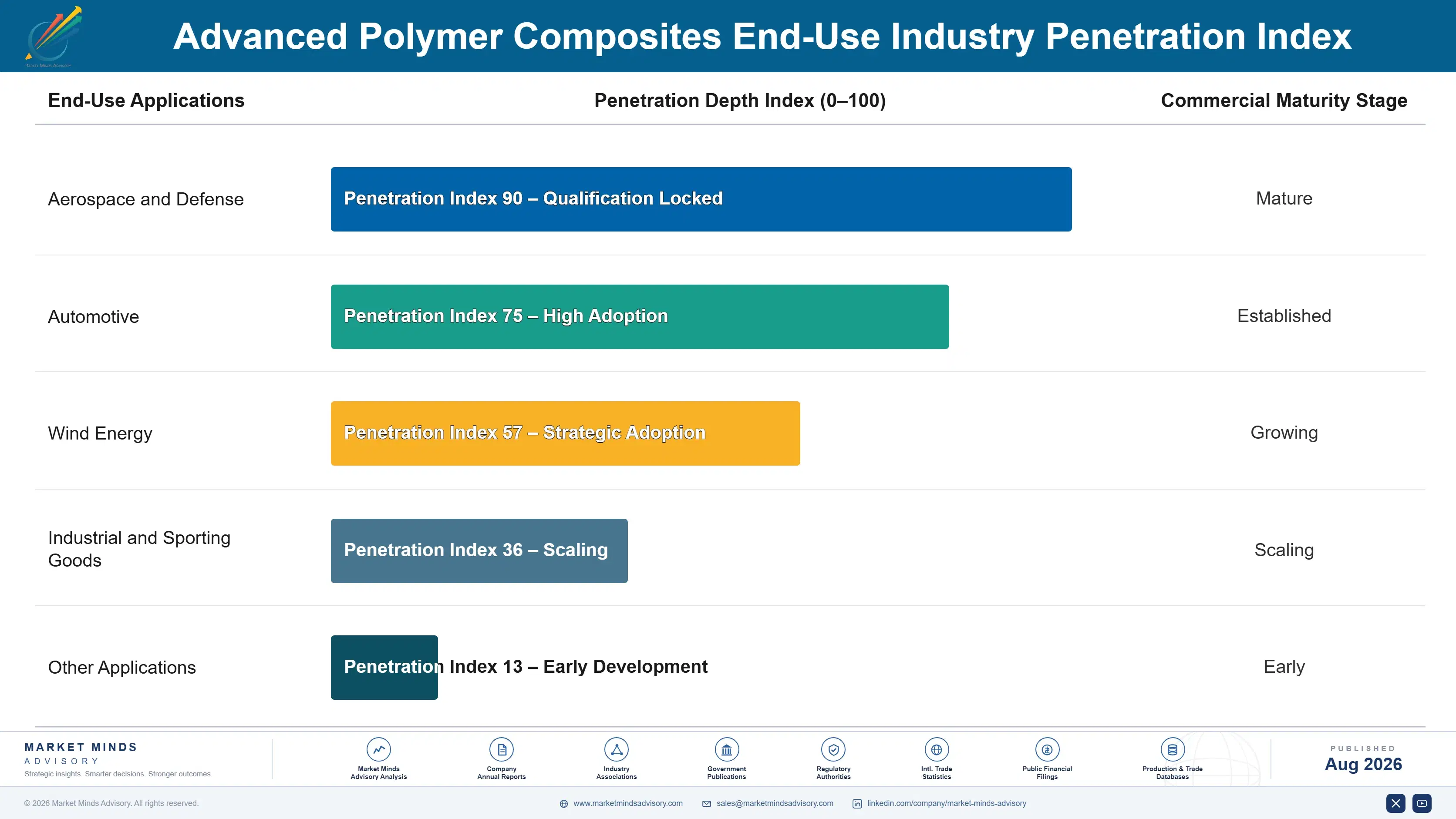
End-use industry segmentation highlights the broad applicability of advanced polymer composites. Aerospace & defense and automotive & transportation are the primary drivers, accounting for a significant portion of demand. The energy sector, particularly wind and solar, is emerging as a key growth area. Construction & infrastructure applications are expanding, supported by the need for durable, lightweight building materials. Consumer goods and industrial equipment represent additional opportunities, driven by the demand for high-performance, aesthetically appealing products.

Advanced Polymer Composites Market End-Use Industry

Growth Drivers and Opportunities in Advanced Polymer Composites Market

  • Increasing Demand for Lightweight and High-Performance Materials

The global shift toward lightweight and high-performance materials is a major growth driver for the advanced polymer composites market. Industries such as aerospace, automotive, and wind energy are under pressure to enhance efficiency, reduce emissions, and improve product performance. Advanced polymer composites offer superior strength-to-weight ratios, corrosion resistance, and design flexibility, making them ideal for these applications. The ongoing electrification of vehicles and the expansion of renewable energy infrastructure are expected to further boost demand for advanced composites.

  • Expansion in Emerging Markets and Infrastructure Development

Rapid industrialization and infrastructure development in emerging markets, particularly in Asia-Pacific and Latin America, present significant growth opportunities for advanced polymer composites. Governments and private sector players are investing in transportation, energy, and construction projects that require durable, lightweight materials. The increasing adoption of advanced composites in these regions is supported by favorable policies, rising disposable incomes, and growing awareness of the benefits of composite materials.

Emerging Opportunities for Advanced Polymer Composites Market

  • Development of Bio-Based and Recyclable Composites

The push for sustainability is creating new opportunities for bio-based and recyclable advanced polymer composites. Manufacturers are investing in the development of green resins and natural fiber reinforcements to reduce environmental impact and comply with regulatory requirements. The adoption of closed-loop recycling processes and the integration of recycled materials into composite production are expected to gain momentum, offering both environmental and economic benefits.

  • Integration of Smart and Functional Materials

The integration of smart and functional materials into advanced polymer composites is opening up new application possibilities. Innovations such as self-healing composites, embedded sensors, and conductive fibers are enabling the development of intelligent structures for aerospace, automotive, and infrastructure applications. These advancements are enhancing the value proposition of advanced polymer composites, driving adoption in high-tech and mission-critical environments.

Growth Restrain Factors and Challenges in Advanced Polymer Composites Market

  • High Production Costs and Complex Manufacturing Processes

The high cost of raw materials, particularly carbon fibers and specialty resins, remains a significant barrier to the widespread adoption of advanced polymer composites. Manufacturing processes are often complex and require specialized equipment and skilled labor, leading to elevated production costs. These factors limit the use of advanced composites in cost-sensitive applications and pose challenges for small and medium-sized enterprises. Continuous innovation in material science and process engineering is essential to reduce costs and improve scalability.

Additionally, the lack of standardized manufacturing protocols and quality control measures can result in variability in product performance. This poses challenges for industries with stringent safety and reliability requirements, such as aerospace and automotive. Addressing these issues requires collaboration between material suppliers, manufacturers, and regulatory bodies to establish industry-wide standards and best practices.

  • Recycling and End-of-Life Management Challenges

The recycling and end-of-life management of advanced polymer composites present significant challenges due to the heterogeneous nature of composite materials. Traditional recycling methods are often ineffective or economically unviable, leading to the accumulation of composite waste in landfills. The development of efficient recycling technologies and the adoption of design-for-recyclability principles are critical to addressing these challenges.

Furthermore, regulatory pressures and consumer expectations for sustainable products are intensifying, compelling manufacturers to invest in circular economy solutions. The transition to bio-based and recyclable composites is underway, but widespread adoption will require overcoming technical, economic, and logistical barriers. Industry stakeholders must collaborate to develop scalable recycling infrastructure and promote the use of recycled materials in new composite products.

Advanced Polymer Composites Market Regional Analysis

RegionMarket Share (2025)Key Market Highlight
Asia-Pacific37%Rapid industrialization, infrastructure growth, and expanding automotive sector
North America28%Strong aerospace and defense industry, technological innovation, sustainability focus
Europe22%Stringent regulations, advanced manufacturing, and renewable energy investments
South America7%Growing wind energy and construction applications
Middle East & Africa6%Infrastructure development and emerging industrial base

Asia-Pacific

Asia-Pacific is the fastest-growing region in the advanced polymer composites market, driven by rapid industrialization, urbanization, and infrastructure development. Countries such as China, India, and Japan are investing heavily in transportation, energy, and construction projects, creating substantial demand for lightweight and durable composite materials. The expanding automotive and wind energy sectors further contribute to market growth, supported by favorable government policies and increasing foreign investments.

North America

North America remains a key market for advanced polymer composites, underpinned by a strong aerospace and defense industry, technological innovation, and a focus on sustainability. The region is home to leading composite manufacturers and research institutions, driving advancements in material science and manufacturing processes. The automotive sector is also a major consumer, with manufacturers adopting advanced composites to meet fuel efficiency and emission standards.

Europe

Europe is characterized by stringent environmental regulations, advanced manufacturing capabilities, and significant investments in renewable energy. The region’s focus on sustainability and circular economy principles is driving the adoption of bio-based and recyclable composites. Aerospace, automotive, and wind energy are the primary application areas, with ongoing research and development activities aimed at enhancing composite performance and recyclability.

South America

South America is emerging as a growth market for advanced polymer composites, particularly in wind energy and construction applications. Brazil and Argentina are leading the adoption of composites in renewable energy projects, supported by favorable climatic conditions and government incentives. The construction sector is also witnessing increased use of composites for infrastructure development, driven by the need for durable and lightweight materials.

Middle East & Africa

The Middle East & Africa region is experiencing gradual growth in the advanced polymer composites market, supported by infrastructure development and an emerging industrial base. The construction and transportation sectors are the primary drivers, with increasing investments in large-scale infrastructure projects. The region’s focus on diversifying its industrial base and adopting advanced materials is expected to create new opportunities for composite manufacturers.

Advanced Polymer Composites Market Regional

Competition Landscape in Advanced Polymer Composites Market

The advanced polymer composites market is highly competitive, with a mix of global and regional players vying for market share. The competitive landscape is characterized by continuous innovation, strategic partnerships, and a focus on expanding product portfolios to cater to diverse end-use industries. Leading companies are investing in research and development to develop new composite formulations, improve manufacturing processes, and enhance sustainability. Mergers, acquisitions, and collaborations are common strategies employed to strengthen market presence and access new markets. The ability to offer customized solutions, maintain high quality standards, and ensure cost competitiveness is critical for success in this dynamic market.

Major Players in Advanced Polymer Composites Market

  • Hexcel Corporation
  • Toray Industries, Inc.
  • SGL Carbon SE
  • Solvay S.A.
  • Teijin Limited
  • Owens Corning
  • Mitsubishi Chemical Holdings Corporation
  • Cytec Industries Inc. (Solvay)
  • Gurit Holding AG
  • Huntsman Corporation
  • DuPont de Nemours, Inc.
  • BASF SE
  • SABIC
  • Arkema S.A.
  • TPI Composites, Inc.
  • Koninklijke DSM N.V.
  • RTP Company
  • Plasan Carbon Composites
  • Advanced Composites Inc.
  • Zoltek Companies, Inc. (Toray Group)

Recent Developments in Advanced Polymer Composites Market

  • In January 2024, Hexcel Corporation announced the launch of a new high-performance carbon fiber prepreg designed for aerospace and automotive applications, offering enhanced strength and reduced weight.
  • In November 2023, Toray Industries, Inc. expanded its production capacity for thermoplastic composites in Europe to meet growing demand from the automotive and industrial sectors.
  • In September 2023, Solvay S.A. introduced a new range of bio-based epoxy resins aimed at improving the sustainability profile of advanced polymer composites.
  • In July 2023, Owens Corning acquired a leading glass fiber manufacturer in Asia-Pacific to strengthen its regional presence and supply chain capabilities.
  • In May 2023, Teijin Limited partnered with a major automotive OEM to develop lightweight composite components for next-generation electric vehicles.
  • In March 2023, SGL Carbon SE unveiled a new recycling process for carbon fiber composites, supporting circular economy initiatives in the industry.

FAQ for Advanced Polymer Composites Market

  1. What are advanced polymer composites and where are they commonly used?

Advanced polymer composites are high-performance materials made by combining polymer matrices with reinforcing fibers such as carbon, glass, or aramid. They are widely used in aerospace, automotive, wind energy, construction, and sporting goods due to their superior strength-to-weight ratio, durability, and corrosion resistance.

  1. What is driving the growth of the advanced polymer composites market?

The primary growth drivers include increasing demand for lightweight and high-strength materials in aerospace and automotive industries, expansion of renewable energy infrastructure, and advancements in composite manufacturing technologies. Sustainability initiatives and regulatory pressures are also encouraging the adoption of advanced polymer composites.

  1. What are the major challenges facing the advanced polymer composites market?

Key challenges include high production costs, complex manufacturing processes, and difficulties in recycling and end-of-life management. The lack of standardized protocols and quality control measures can also hinder market growth, particularly in safety-critical applications.

  1. Which regions are expected to witness the highest growth in the advanced polymer composites market?

Asia-Pacific is expected to witness the highest growth, driven by rapid industrialization, infrastructure development, and expanding automotive and wind energy sectors. North America and Europe will continue to lead in technological innovation and high-value applications.

  1. How are companies addressing sustainability in the advanced polymer composites market?

Companies are investing in the development of bio-based and recyclable composites, adopting closed-loop manufacturing processes, and integrating recycled materials into new products. These efforts are aimed at reducing environmental impact and complying with stringent regulatory requirements, particularly in Europe and North America.

Take action now! Contact us today to access the full report and propel your business forward.