Market Minds Advisory
Aramid Fiber Market

Aramid Fiber Market: Ballistic Protection and EV Battery Demand Reset Capacity Investment Decisions

Expanding ballistic protection procurement and electric vehicle battery separator demand are pulling aramid fiber production toward Chinese capacity expansion, forcing Western producers to defend certification-backed share against fast-improving Asian competitors on cost.

Lead Analyst

Bilal Shaikh

Published

September 2026

Make Smarter Decisions with Customized Research Insights

Request a free sample report and evaluate market opportunities, growth trends, and competitive dynamics relevant to your business needs.

2025 MARKET VALUE$4.1BMarket Size 2025
2036 FORECAST VALUE$8.5BBase Case , 2026 to 2036
CAGR 2026 TO 20366.9 %Bull 8.2% / Bear 5.5%
INCREMENTAL OPPORTUNITY$4.2BNet 10- year value creation
EXPANSION MULTIPLE1.95x2036 value over 2026 base
Strategic Levers
M&A Pipeline
Regional Outlook
Country Rankings
Competitive Intelligence
Segmental Deep-dive
Call-Us : 91 93563 13602

Executive Snapshot and Market Trajectory

Chinese capacity expansion is quietly rewriting decades-old aramid fiber supply relationships, as domestic producers scale para-aramid output fast enough to challenge certification-backed Western incumbents on price and increasingly on consistency across most export markets tracked closely by industry analysts this cycle and beyond.
Para-aramid fiber still anchors the bulk of installed volume through ballistic protection and tire reinforcement demand, but copolymer and modified aramid grades carry the specification premium that producers increasingly chase as electric vehicle battery separator and 5G cabling applications expand rapidly worldwide. East Asia alone accounts for more than a third of global demand, reflecting China's aggressive domestic capacity buildout alongside Japan's and South Korea's established production bases and export infrastructure built over several decades.
Competition remains moderately concentrated at 54 percent five-firm share, leaving established Western and Japanese producers defending certification depth and ballistic testing credentials against Chinese competitors closing the quality gap fast across most contested export segments and territories worldwide. Defense procurement standards and battery separator specification requirements are simultaneously reshaping which fiber grade wins each new industrial supply contract issued across the wider sector and its many buyers and long-standing institutional customers.
Market Definition
The aramid fiber market covers para-aramid, meta-aramid, and copolymer aramid fibers produced for ballistic protection, aerospace, automotive, electrical, and industrial reinforcement applications, spanning filament yarn, staple fiber, and pulp forms. It excludes downstream finished composite products, body armor panels, and woven fabric goods not sold as raw fiber or yarn.
Base Year Value
$4.1B in 2025 (MMA Primary Research Dataset, August 2026)
Forecast Period
2026 to 2036, eleven discrete annual values
CAGR
6.9% base case. Bull 8.2%. Bear 5.5%.
Fastest Growth Segment
Copolymer and Modified Aramid Fiber: 9.4% CAGR
Fastest Growth Country
India: 10.2% CAGR
Fastest Growth Region
South Asia and Pacific: 9.0% CAGR
Largest Region
East Asia: 36% of 2025 global value
Market Leaders
DuPont de Nemours Inc, Teijin Limited, Kolon Industries Inc, Yantai Tayho Advanced Materials Co Ltd, Toray Industries Inc. Source: MMA Analysis based on company annual reports.
Primary Survey
n=3,800 procurement and R&D decision-makers, Q4 2025, six countries
Methodology
Demand-side build-up, cross-validated against public data, 47 expert interviews

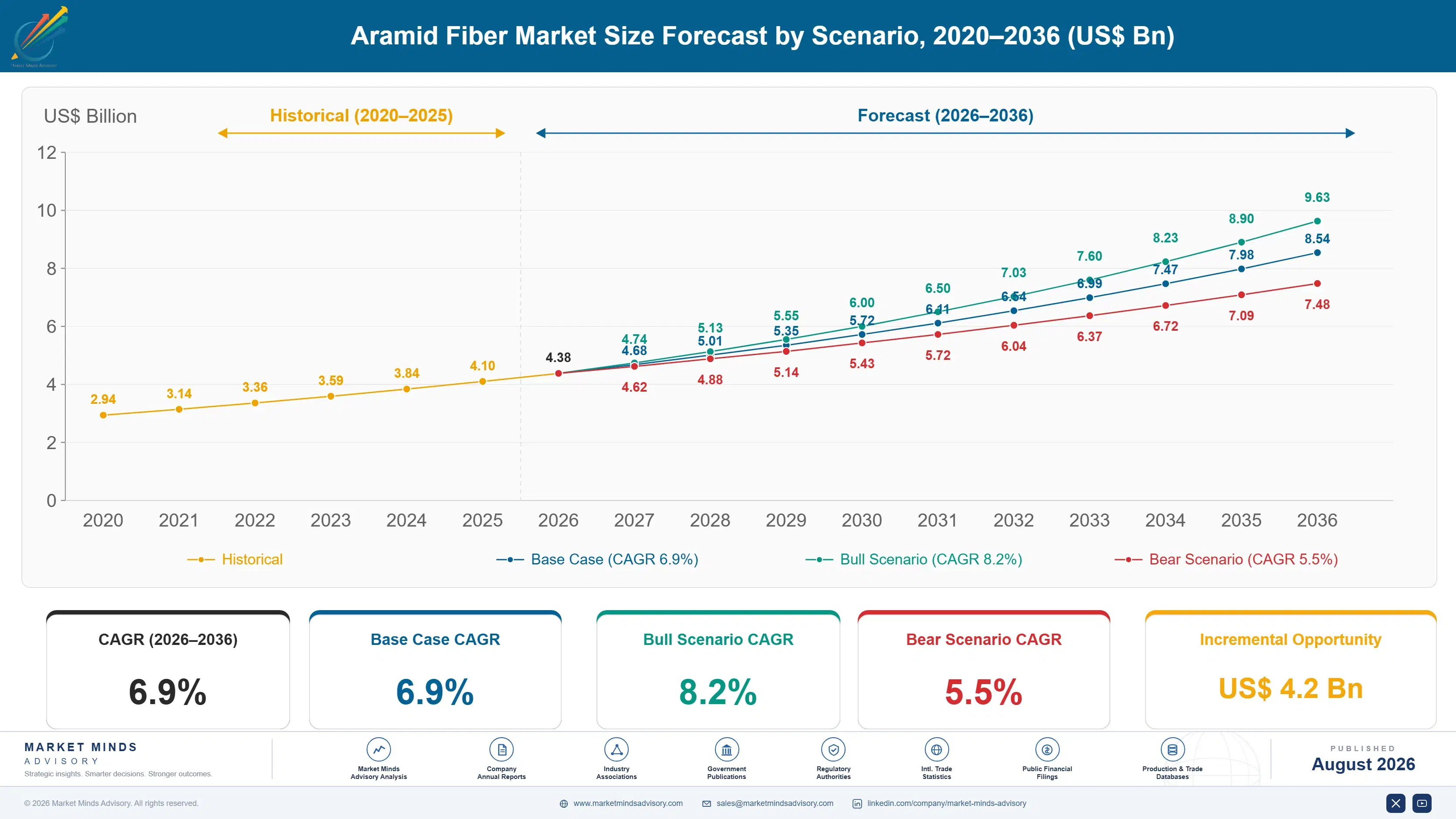
Aramid Fiber Market Forecast Scenarios

aramid-fiber-market-size-forecast-scenario-1787300556234
Between 2020 and 2025 the market grew at a steady 5.9 percent as ballistic protection procurement and industrial reinforcement demand recovered from pandemic-era supply disruption across most producing regions tracked closely by industry associations. Growth accelerated meaningfully in the final two years as electric vehicle battery separator applications began generating genuinely new demand beyond traditional protective and aerospace end uses.
The base case assumes continued global defense procurement spending sustaining ballistic protection demand, rapid electric vehicle production growth driving battery separator and lightweighting applications, and steady Chinese capacity expansion that keeps overall supply growing faster than mature Western production bases alone could support across most tracked markets. These three mechanisms together sustain above-historical growth through 2036 even as North American demand growth settles closer to defense-budget-linked replacement rates over the coming decade.
A bull scenario depends on accelerated electric vehicle production growth pulling battery separator-grade aramid demand meaningfully ahead of current forecasts across every major automotive market simultaneously. The bear case centers on a defense procurement contraction that delays ballistic protection purchasing across budget-constrained government buyers that represent a substantial share of the addressable customer base globally.

Capacity Expansion Reshapes Fiber Specification Economics

Three forces are converging on this historically stable category at once. Chinese capacity expansion is scaling faster than global demand growth alone would justify, pressuring pricing across commodity-grade applications worldwide and across most export destinations. Electric vehicle battery separator and lightweighting applications are creating genuinely new demand pools that barely existed as commercial categories five years ago at any meaningful scale. And defense procurement modernization is
MARKET CONCENTRATIONCR5 54%moderately concentrated among established Western and Asian producers
AVERAGE SELLING PRICEUSD 22/kgblended price masks wide spread across grade and certification tiers
TOP PRODUCING COUNTRY SHAREChina 24%concentrated manufacturing capacity serves both domestic and export demand
CAPACITY UTILISATION79%meaningful headroom remains before new plant investment triggers
TRADE INTENSITY44% exportedsubstantial cross-border flow from Asian and European manufacturing hubs
FEEDSTOCK COST SHARE48% of COGSpara-phenylenediamine and terephthaloyl chloride volatility compresses margins directly
Commercially, the market splits cleanly between a high-volume, increasingly price-competitive commodity fiber segment where Chinese capacity dominates, and a lower-volume, substantially higher-margin certified and specialty grade segment where Western and Japanese incumbents defend share through ballistic testing credentials and automotive qualification most regional competitors cannot yet match at comparable scale, speed, or contractual depth.
The next decade will be defined by how fast Chinese producers close the remaining quality gap in certified ballistic and aerospace grades, and by how aggressively electric vehicle battery separator demand expands beyond its current early-stage commercial base into a mainstream volume category across most major automotive markets tracked closely by industry participants and analysts.
"Aramid fiber used to be the most predictable line item in a defense contractor's supply chain. Chinese capacity expansion and battery separator demand just made fiber sourcing a genuinely strategic decision for the first time in decades."
Director, Chemicals and Materials Practice · MMA Chemicals and Materials / High-

Market Trends

Chinese Capacity Expansion Compresses Commodity Grade Pricing

Chinese para-aramid producers including Yantai Tayho and Sinochem-affiliated manufacturers have added substantial new production capacity since 2023, according to national chemical industry association capacity tracking data covering major domestic facilities and their announced expansion timelines. Domestic Chinese output now meets a growing share of global commodity-grade demand at price points Western and Japanese incumbents cannot match without accepting meaningfully compressed margins on comparable volume produced. This capacity growth has pushed commodity-grade pricing down across export markets even as certified ballistic and aerospace grades remain comparatively insulated from the same competitive pressure entirely today.
Market Impact: Adds 1.3 points to base CAGR
Electric Vehicle Battery Separators Create New Demand Pool

Battery manufacturers have expanded aramid-coated separator production meaningfully since 2024, according to industry association tracking of electric vehicle battery component supply chains across major automotive manufacturing regions and their tier-one suppliers. Aramid coating improves separator thermal stability and puncture resistance in ways conventional polyolefin separators alone cannot match, a performance advantage battery makers increasingly specify for premium and long-range vehicle platforms specifically. This application barely existed as a meaningful commercial category five years ago and now represents a genuinely distinct growth vector for fiber producers with proven battery-grade qualification credentials already secured.
Market Impact: Adds 1.1 points to base CAGR

Market Opportunities and Growth Drivers

Global Defense Modernization Sustains Ballistic Protection Demand

NATO member states and allied governments have expanded defense procurement budgets meaningfully since 2023, according to national defense ministry disclosures tracking body armor and vehicle protection contract volume across participating countries. Ballistic protection represents the single largest end-use application for para-aramid fiber, and rising personal protective equipment procurement across military and law enforcement agencies sustains demand independent of any single national budget cycle or geopolitical development. Aging protective equipment fleets across major military forces are compounding this baseline demand growth as replacement cycles come due across multiple simultaneous procurement programs.
Market Impact: Compresses gross margin 4 points

Electric Vehicle Production Growth Drives Lightweighting Demand

Global electric vehicle production has continued climbing steadily according to industry association tracking, sustaining aramid fiber demand across battery separator, structural reinforcement, and cable insulation applications that represent a rapidly expanding end-use category for the fiber industry overall and its many downstream buyers. Automakers increasingly specify aramid-reinforced composites for structural lightweighting applications that reduce vehicle weight without compromising crash safety performance, a requirement conventional glass fiber alternatives cannot match at comparable weight savings achieved. This demand pool is still relatively small but growing meaningfully faster than the category's traditional ballistic and industrial base.
Market Impact: Threatens 6 points of commodity margin

Market Restraints and Challenges

Feedstock Price Volatility Compresses Producer Margins

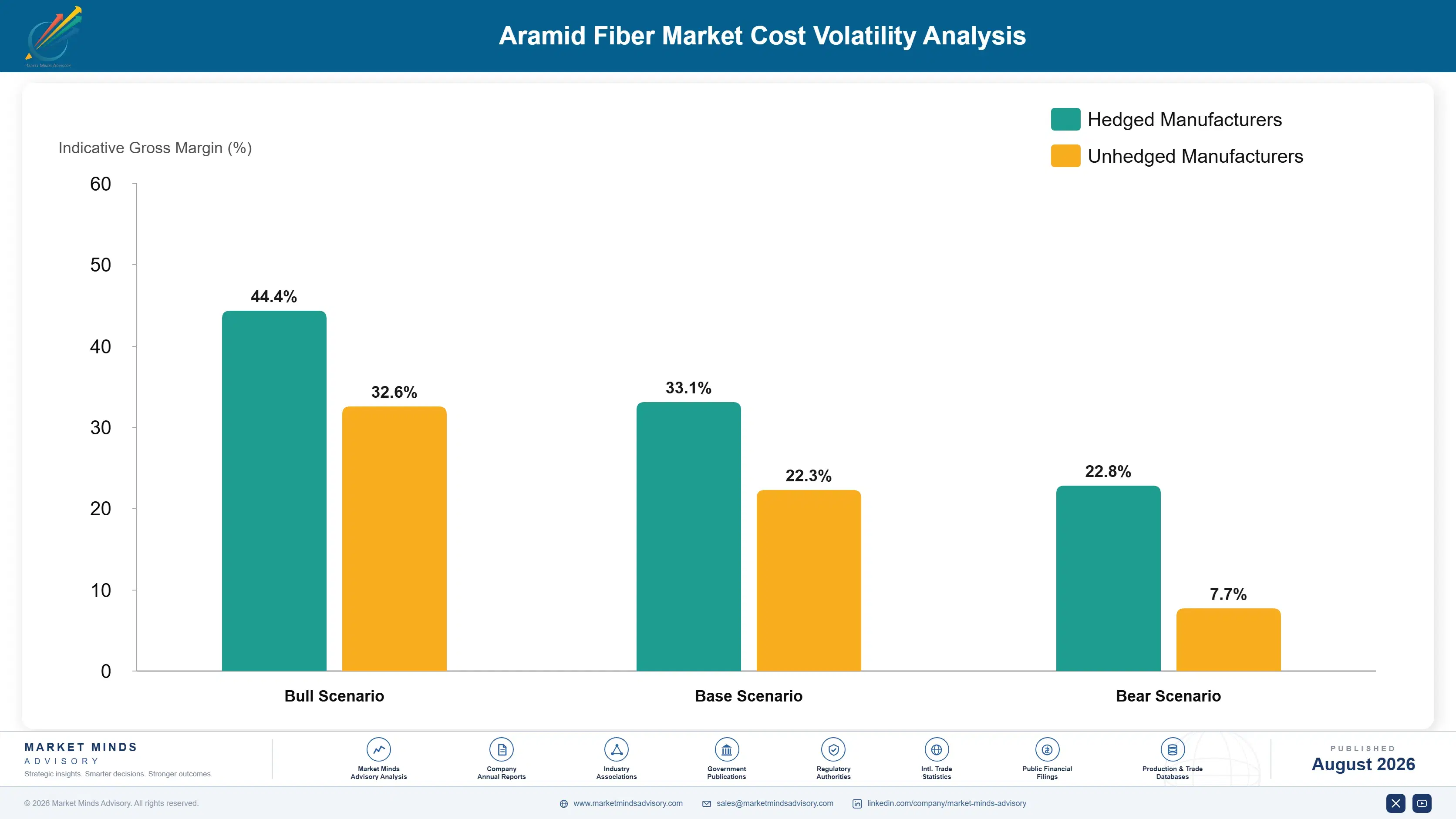
Para-phenylenediamine and terephthaloyl chloride together represent roughly 48 percent of cost of goods sold for a typical aramid fiber production run, and these petrochemical-derived inputs have shown meaningful price volatility within single years recently. The root cause is direct exposure to broader petrochemical feedstock cycles that smaller regional producers cannot meaningfully hedge without long-term contracts the largest incumbents can negotiate but smaller competitors typically cannot. The impact falls hardest on producers bidding fixed-price contracts months before actual feedstock costs are known. Several larger producers now include quarterly price adjustment clauses rather than accepting fixed exposure.
Market Impact: Commodity pricing down 11 points

Chinese Overcapacity Threatens Established Producer Pricing

Rapid Chinese capacity additions have created meaningful oversupply risk in commodity-grade fiber segments, a dynamic smaller Western and Japanese producers, which represent a substantial share of the established certified supplier base, increasingly cannot price around without ceding volume entirely. The root cause is that Chinese capacity investment decisions were made independent of any coordinated global demand forecast, creating a supply overhang that pricing alone cannot immediately absorb. The impact shows up as margin compression across commodity grades even as certified specialty grades remain comparatively insulated. Several producers are piloting deeper specialization into certified niches as an emerging mitigation pathway.
Market Impact: Battery separator demand up 9 points
3 additional market trends, 3 additional growth drivers, and 4 additional restraints and challenges are covered in the full report. Contact sales@marketmindsadvisory.com to access the complete intelligence.

Segment CAGR and Growth Architecture

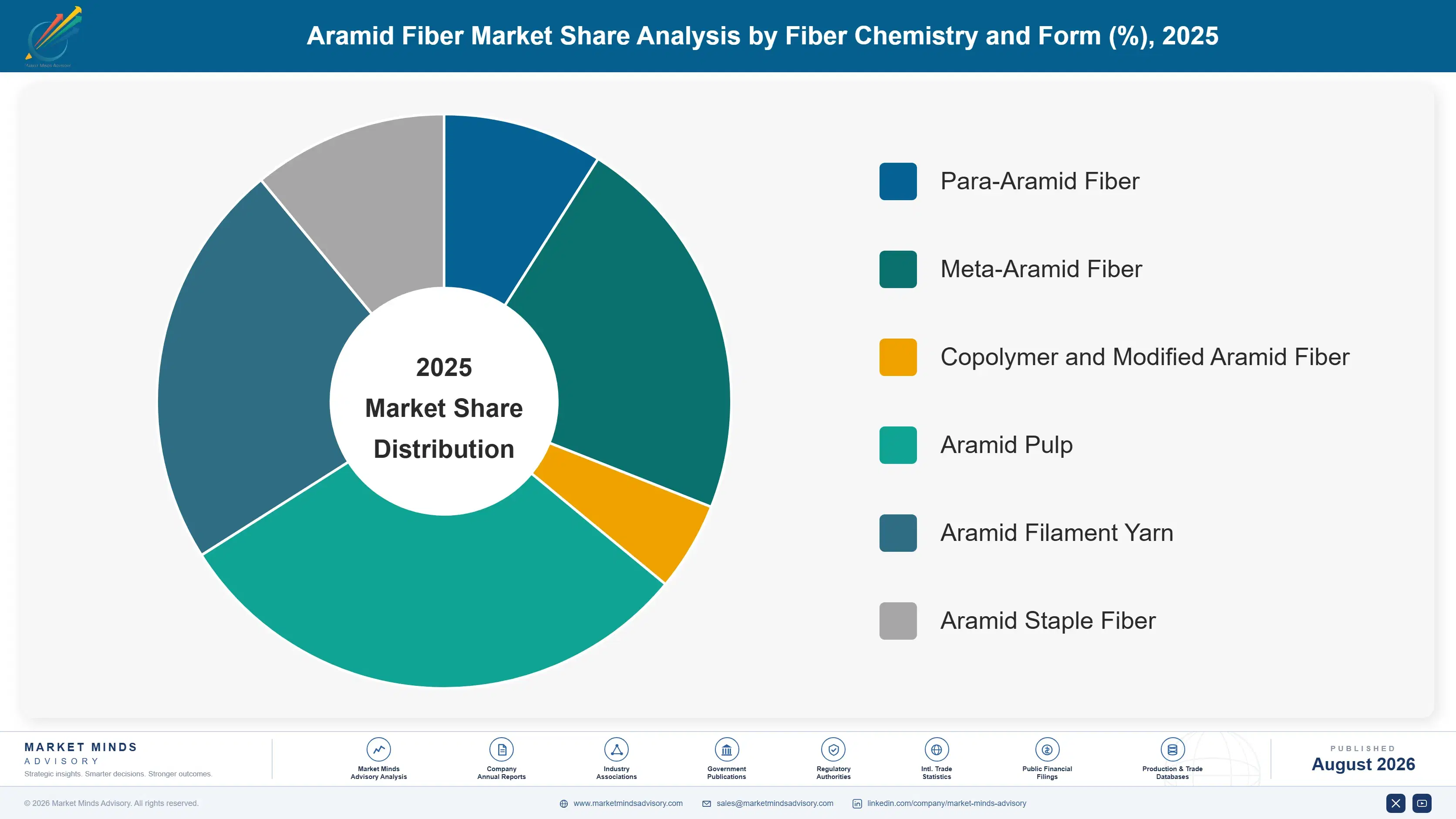
Segmentation follows fiber chemistry and physical production form, the classification producers and industrial buyers actually specify against strength, heat resistance, and application requirements, distinguishing para-aramid, meta-aramid, and specialty grades across every end-use vertical, geography, and commercial channel served by producers worldwide today across all buyer segments, certification tiers, and procurement pathways tracked closely by analysts.
aramid-fiber-market-market-share-analysis-1787300556765

Copolymer and Modified Aramid Fiber

Copolymer and modified aramid fibers are the category's clearest growth story, expanding fastest wherever electric vehicle battery separator and 5G cabling applications require performance characteristics conventional para-aramid and meta-aramid grades alone cannot deliver. Battery manufacturers have compressed the gap between modified aramid coatings as an experimental niche and treating them as a mainstream separator specification requirement, a threshold that has genuinely changed automotive supplier purchasing psychology toward these grades. Producers who paired copolymer chemistry development with battery industry qualification testing report the strongest order growth, since this removes the certification barrier that previously limited adoption to only the most sophisticated battery manufacturers. Supply chains favor producers with proven specialty chemistry development over commodity specialists lacking comparable depth.
CAGR 9.4%

Aramid Staple Fiber

Aramid staple fiber is benefiting from two converging forces: industrial filtration and friction material manufacturers seeking cost-effective reinforcement that continuous filament yarn cannot economically provide at comparable volume, and protective apparel manufacturers requiring the processability staple fiber offers for blended fabric construction conventional yarn cannot match. Manufacturers increasingly specify staple fiber for industrial applications precisely because processing economics favor shorter fiber lengths over continuous filament for high-volume commodity uses. Producers serving this segment compete heavily on fiber consistency and blending performance, since these characteristics directly determine downstream processing efficiency for textile and filtration manufacturers. The segment carries meaningfully lower average selling prices than filament yarn but benefits from substantially higher volume across industrial applications.
CAGR 8.6%
Full segment breakdown across 6 segments available in the complete report.

Regional Architecture and Country Demand Map

East Asia leads decisively on China's aggressive capacity expansion and established Japanese and Korean production, South Asia and Pacific posts the fastest growth on India's defense and industrial demand, and North America defends certified specialty share nationwide across most defense accounts and industrial buyers today.

North America

The United States anchors regional demand through DuPont's established Kevlar production base and the world's largest single defense procurement budget, sustaining ballistic protection demand across military and law enforcement agencies nationwide at substantial and growing scale. Domestic producers defend share primarily through certified specialty grades where ballistic testing credentials and long-standing government supplier relationships matter more than unit price alone. Canada's industrial and aerospace sector sustains steady demand tied to its own defense procurement and aerospace manufacturing programs and priorities. Growth trails East Asia because the region's demand is concentrated in mature, certification-driven segments rather than the rapid volume expansion happening across Asian markets, particularly in commodity and electric vehicle applications.
Share: 22% | CAGR: 5.9% (2026 to 2036)

Western Europe

Netherlands-based Teijin production and Germany's advanced automotive and industrial manufacturing base anchor regional demand, with European Union defense modernization spending sustaining ballistic protection procurement across member state military forces and their allied programs and partnerships. France's aerospace sector, concentrated around major manufacturers, drives steady demand for certified aerospace-grade fiber tied to structural composite applications across multiple platform programs and production lines. The region's regulatory and certification standards favor established, validated fiber grades over experimental chemistries, sustaining demand for proven products longer than in more rapidly evolving markets elsewhere. Growth trails East Asia and South Asia because the region's production base is not expanding capacity as aggressively as Chinese domestic manufacturers currently are doing.
Share: 18% | CAGR: 5.3% (2026 to 2036)
Regional intelligence for 5 additional markets available in the complete report: East Asia, South Asia and Pacific, Latin America, Middle East and Africa, Eastern Europe. Contact sales@marketmindsadvisory.com.
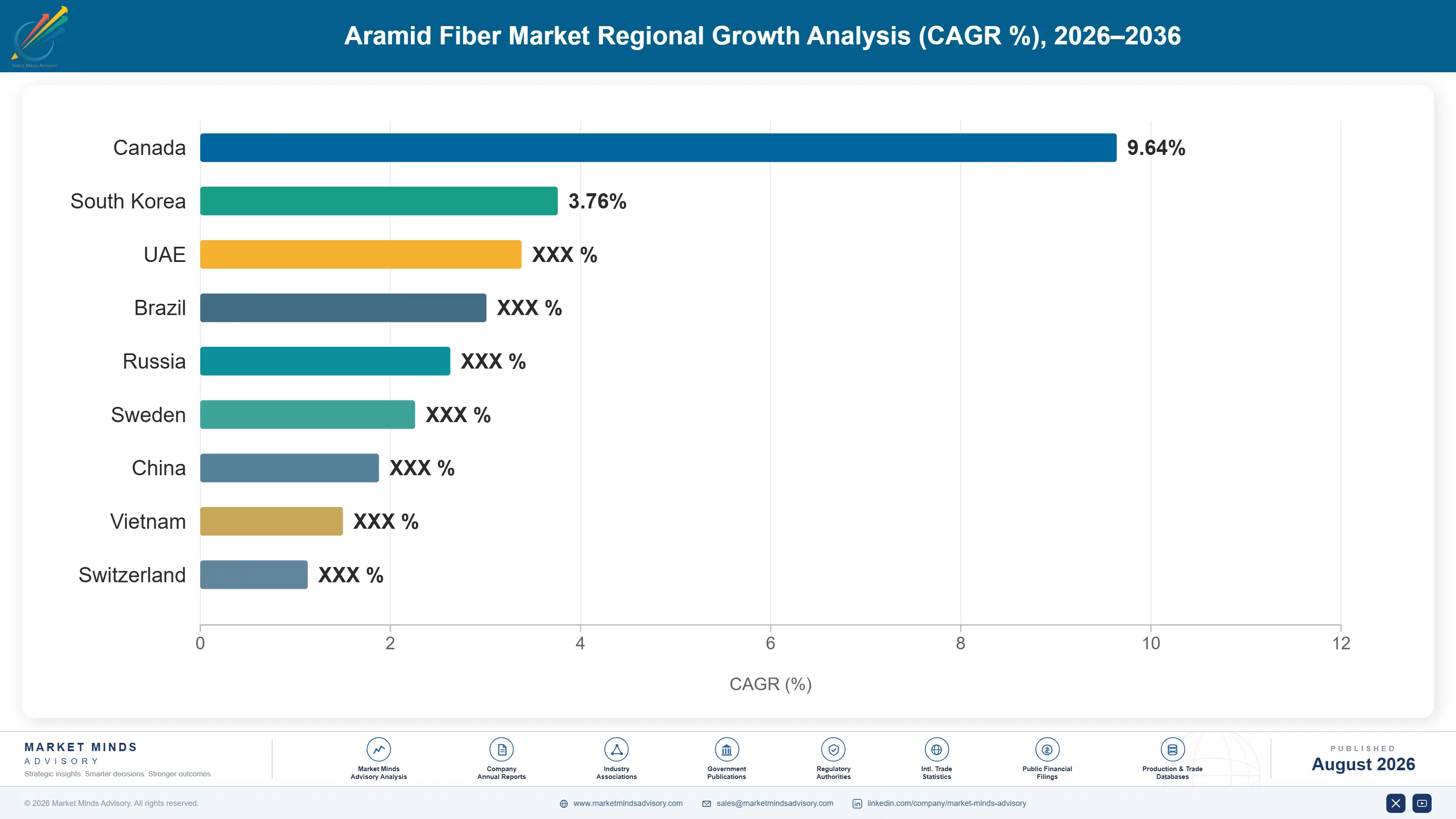
aramid-fiber-market-country-cagr-analysis-1787300557281

Where Fiber Producers Can Expand Margin

Producers face a market splitting between price-driven commodity volume dominated by Chinese capacity and specification-driven certified and specialty demand, creating several distinct paths to margin expansion beyond simply competing on price per kilogram across every industrial contract, geography, and certification tier served today across the wider sector, its buyers, and evolving standards worldwide each cycle.

Develop Battery Separator Grade Qualification Programs

Securing battery manufacturer qualification for modified aramid separator coating grades opens access to premium electric vehicle supply contracts that generic commodity fiber producers cannot credibly bid against, since battery makers increasingly specify proven thermal stability and puncture resistance credentials explicitly in supplier qualification decisions. Producers with proven battery-grade qualification report average selling prices roughly 38 percent above standard commodity lines across most tracked contracts. The qualification investment is meaningful but pays back quickly once a producer wins its first several major contracts, since reference qualifications then become the credibility basis for future sales.
Market Impact: Battery-grade ASP runs 38 points higher on average

Expand Ballistic Certification Across New Markets

Securing ballistic testing certification across additional national defense procurement standards captures government contracts that uncertified competitors cannot access regardless of underlying fiber quality, since defense agencies almost universally require documented certification before considering any supplier for procurement evaluation. Producers with certification across multiple national standards report contract values roughly 3 times larger than single-market certified competitors, since multi-market certification opens access to a substantially broader base of government buyers. The certification investment is meaningful but pays back over defense contract relationships that typically run considerably longer than commercial industrial sales cycles once secured.
Market Impact: Wins contracts 3x larger than single-market deals overall

Localize Production Inside High-Growth Asian Markets

Establishing dedicated manufacturing operations within India or Southeast Asia directly reduces import tariff exposure and shipping cost while positioning producers to serve the fastest-growing regional demand markets without the localization disadvantage international competitors face competing purely from Western or established Asian headquarters. Producers with local manufacturing presence report winning 2 to 3 times more regional industrial and defense contracts than pure exporters competing from outside the country entirely. The upfront capital investment is substantial, but producers moving early are securing preferred supplier relationships before competitors catch up to the same regional opportunity.
Market Impact: Wins 2 to 3x more regional contracts overall

Bundle Fiber Supply With Technical Design Support

Providing industrial customers with dedicated composite design and application engineering support alongside fiber supply builds switching costs and deepens customer relationships ahead of the next annual contract renewal, since manufacturers increasingly value producers who can help optimize fiber usage and reduce total material cost per finished component. Producers offering integrated technical support report contract renewal rates roughly 19 percentage points higher than fiber-only suppliers, since customers value the engineering relationship highly enough to prefer a single integrated vendor over managing multiple suppliers. This lever requires dedicated technical staff investment that favors established incumbents over new entrants lacking similar resources.
Market Impact: Lifts renewal rate by 19 total points overall

Who Controls the Margin Pool

Five companies hold 54 percent of the category, a moderately concentrated market where established Western and Japanese incumbents maintain meaningful advantages in certified specialty grades while Chinese challengers close the gap rapidly in commodity segments. Assessment here rests on annual production volume and installed capacity, and on that basis the leaders defend durable positions in ballistic certification and automotive qualification depth that regional competitors struggle to replicat
Competitive activity currently plays out across three dimensions: battery separator grade qualification as producers race to capture the fastest-growing electric vehicle demand segment, ballistic certification expansion to capture additional government defense procurement markets, and Chinese capacity investment continuing to pressure commodity-grade pricing across export markets globally. Established incumbents are increasingly investing in specialty chemistry development rather than competing head-to-head with Chinese producers on commodity volume alone.

Pressure is building most visibly from Chinese producers closing the quality gap against established Western and Japanese incumbents while expanding export volume at price points competitors cannot match without local production presence. At the same time, battery separator qualification is attracting new specialty chemistry investment from established leaders, a dynamic that could reshape competitive rankings within the next several years as electric vehicle demand continues scaling.
aramid-fiber-market-company-positioning-matrix-1787300557799

Competitive Moat and Risk Dimensions

DUPONT DE NEMOURS INC

Moat: Ballistic certification and brand depth

DuPont's Kevlar brand carries decades of ballistic testing credibility and certification depth across nearly every major national defense procurement standard, giving it distribution advantages regional competitors struggle to replicate, particularly reaching government buyers requiring documented multi-decade performance track records, proven supplier reliability, and long-standing references.
DUPONT DE NEMOURS INC

Risk: Commodity segment price pressure

DuPont's premium certified positioning leaves it exposed in price-sensitive commodity and industrial segments where Chinese producers increasingly compete on both price and improving quality, forcing difficult decisions about where to defend margin versus where to concede volume entirely across contested export markets, territories, and account relationships.
TEIJIN LIMITED

Moat: Aerospace and automotive qualification depth

Teijin has built deep qualification credibility across aerospace structural composite and automotive lightweighting applications, resonating strongly with manufacturers facing strict performance and safety requirements, giving it a genuine technical edge in specification-driven contracts where documented qualification outweighs upfront price considerations by a wide and steadily growing margin.
TEIJIN LIMITED

Risk: Slower battery separator pivot pace

Teijin's aerospace and automotive structural focus leaves it less positioned than dedicated battery materials specialists to move quickly on the fastest-growing separator segment of the category, risking share loss to competitors already investing heavily in dedicated battery chemistry research teams and highly specialized talent pools.

Key Players

DuPont de Nemours Inc
Teijin Limited
Kolon Industries Inc
Yantai Tayho Advanced Materials Co Ltd
Toray Industries Inc

Others

Bluestar Chengrand Co Ltd
Hyosung Advanced Materials Corporation
Huvis Corporation
Kermel SAS
X-Fiper New Material Co Ltd
Zhejiang Yiyang New Material Co Ltd
Guangdong Charming Chemical Co Ltd
Kamenskvolokno JSC
Huafon Chemical Co Ltd
Toyobo Co Ltd
Kuraray Co Ltd
Jiangsu Xiandai Composite Material Co Ltd
Kaiping Aramid Materials Co Ltd
Fujian Fujin New Materials Co Ltd
Cristex Composite Materials Ltd

Recent Developments

FEBRUARY 2026

DuPont Expands Battery Separator Qualification Program

DuPont launched an expanded battery separator qualification program specifically targeting electric vehicle manufacturers facing thermal stability requirements that conventional separator materials increasingly cannot meet, adding validated performance credentials ahead of the next major automotive platform design cycle across multiple manufacturer partnerships, supplier agreements, and regional distribution networks.
Signal: Confirms battery separator qualification as the required strategy for competing in the fastest-growing segment today and beyond.
SEPTEMBER 2025

Teijin Acquires Specialty Chemistry Research Firm

Teijin completed the acquisition of a privately held specialty polymer chemistry research company, adding modified aramid development capability to its fiber portfolio across North American and European automotive and aerospace accounts already using its existing certified product lines and long-standing technical support agreements signed previously.
Signal: Signals specialty chemistry development is shifting from a research niche to genuine strategic investment priority today.
MAY 2025

Yantai Tayho Signs Distribution Agreement in India

Yantai Tayho signed a multi-year distribution and technical support agreement with an Indian industrial textile distributor network, positioning the Chinese manufacturer to compete directly for growing defense and industrial fiber demand across India's expanding domestic manufacturing infrastructure programs and adjacent regional export markets nearby and beyond.
Signal: Marks accelerating Chinese manufacturer expansion into India's defense and industrial fiber markets and distribution networks steadily.

Petrochemical Feedstock and Solvent Exposure

Para-phenylenediamine and terephthaloyl chloride together represent roughly 48 percent of cost of goods sold for a typical aramid fiber production run, sourced primarily from petrochemical producers across China, the United States, and Japan. Sulfuric acid and specialty solvent inputs add a further 16 percent combined, giving producers with diversified sourcing a genuine hedge against single-supplier price volatility that smaller specialists cannot avoid.
Feedstock costs rose approximately 18 percent through 2024 as broader petrochemical demand competed directly with fiber producers for constrained precursor supply, according to DuPont's 2024 annual report, which specifically cited raw material cost inflation as a meaningful margin headwind across its performance materials segment. This overlap between general petrochemical demand cycles and specialized aramid precursor chemicals is a genuinely new dynamic producers had not previously priced into planning.

Exposure varies considerably by producer scale and vertical integration. Large incumbents with long-term feedstock supply contracts and vertical integration into precursor chemical production have absorbed volatility more effectively than smaller specialized producers purchasing on spot markets, widening the cost gap between established leaders and price-competitive smaller entrants. Producers with in-house precursor manufacturing capability retain more pricing control than those dependent entirely on third-party suppliers exposed to broader petrochemical cycles.
aramid-fiber-market-cost-volatility-analysis-1787300557994

Long-Term Feedstock Supply Contracts

Locking multi-year fixed-volume agreements with petrochemical suppliers reduces spot market exposure meaningfully, though it requires balance sheet commitment that smaller specialized producers often cannot match against larger incumbents with stronger credit access and negotiating leverage across global sourcing relationships spanning multiple regions, currencies, and supplier networks simultaneously each fiscal year and renewal cycle tracked.

Vertical Integration Into Precursor Chemicals

Bringing para-phenylenediamine production in-house reduces dependency on third-party petrochemical suppliers exposed to broader feedstock cycles, a strategy several mid-sized producers have accelerated specifically in response to recent price volatility across the category and its many exposed product lines, subsidiaries, export markets, regional partnerships, and long-standing joint ventures established worldwide today across several overlapping supply agreements.

Feedstock Cost Pass-Through Clauses

Including quarterly feedstock price adjustment clauses in multi-year industrial contracts protects margin against precursor volatility between contract signing and actual production, a practice increasingly standard among larger producers but still resisted by some cost-conscious industrial buyers evaluating bids each budget cycle nationwide, regionally, and even well beyond their own national borders, jurisdictions, and territories.

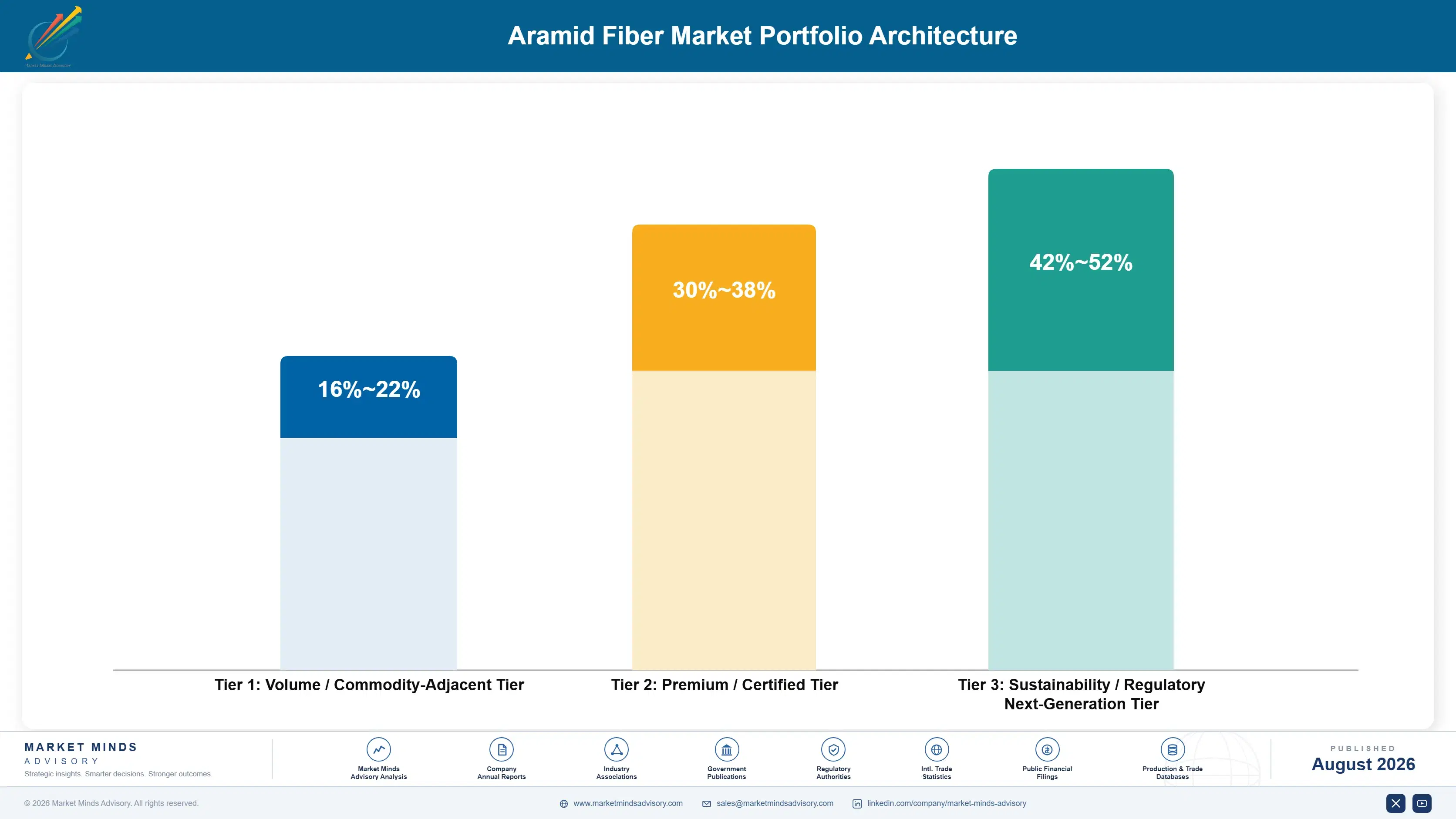
Portfolio Architecture for Margin Defence

Three tiers structure producer portfolios today, each serving genuinely different buyers with distinct purchasing logic and certification requirements applied at the point of industrial contract award and renewal review. Commodity-adjacent standard para-aramid and meta-aramid fiber sits at the volume base with thin margins, certified ballistic and automotive-qualified grades occupy a specification-driven middle tier, and battery separator and aerospace-validated systems anchor a next-generation
The tension between volume and premium shows up clearly in how producers allocate capital: Chinese players chase commodity fiber volume through aggressive capacity expansion and pricing while established Western and Japanese incumbents concentrate investment in battery separator qualification, ballistic certification, and aerospace validation that justify premium positioning against increasingly capable low-cost competitors entering steadily from Asia.

High-value margin pools concentrate in battery separator grades and certified ballistic fiber carrying multi-year defense and automotive contract attachments, where gross margins run meaningfully above the category average across nearly every tracked region and application type. Standard commodity fiber increasingly competes on price alone as Chinese manufacturing capacity continues expanding rapidly across export markets worldwide today and tomorrow.

Volume / Commodity-Adjacent Tier

Standard para-aramid and meta-aramid fiber sold primarily on price per kilogram into generalist industrial and textile channels, with limited technical differentiation across most price-sensitive regional markets, tenders, and distribution networks worldwide.
Gross Margin: 16-22%

Premium / Certified Tier

Ballistic-certified and automotive-qualified fiber grades carrying documented testing credentials, positioned for defense and industrial contracts requiring multi-year supplier certification and service commitments from established, well-capitalized producers with proven track records.
Gross Margin: 30-38%

Sustainability / Regulatory / Next-Generation Tier

Battery separator and aerospace-validated specialty grades with proven qualification credentials, priced at the top of the category range consistently across nearly every geography and application segment served by producers today.
Gross Margin: 42-52%
aramid-fiber-market-portfolio-architecture-1787300558495

High-value Sub-segments and Strategic Watch-out

Battery Separator-Grade Modified Aramid

Highest growth and highest margin combination anywhere in the category, favored wherever electric vehicle manufacturers require proven thermal stability and puncture resistance credentials across major automotive platforms tracked closely by MMA analysts each fiscal quarter reviewed and updated regularly across the sector and its many partners.
Gross Margin: 44-52%

Ballistic-Certified Para-Aramid Fiber

Strong growth with solid margins, driven by expanding global defense procurement forcing suppliers toward multi-standard certified grades that command meaningfully higher specification-driven pricing across most tracked government contracts today and reviewed annually by national regulators, auditors, and independent testing bodies evaluating full compliance carefully each cycle.
Gross Margin: 34-42%

Standard Commodity Para-Aramid Fiber

The volume core of the category, generating stable revenue but facing continuous margin compression as Chinese manufacturing capacity expands and price competition intensifies across every distribution channel and export territory served worldwide today and increasingly tomorrow as demand keeps steadily growing further each fiscal quarter tracked.
Gross Margin: 16-22%

Legacy Uncertified Meta-Aramid Grades

A strategic watch-out segment: cheaper upfront but increasingly excluded from defense and automotive tenders specifying multi-standard certification, eroding demand for producers still relying on outdated qualification pathways broadly across smaller regional markets and rural territories nationwide and increasingly further abroad across most tracked jurisdictions and export destinations.
Gross Margin: 12-18%

Recurring Contracts Anchor Category Volume

Aramid fiber demand behaves like a recurring supply relationship once a producer wins a defense or automotive customer's certification and qualification review. A typical certified supply contract runs three to five years before renewal or requalification triggers a reevaluation, generating predictable recurring volume that dwarfs any single new project launch and that renews automatically as long as certification and quality performance holds firm.
Adoption depth varies sharply by end-use vertical across the category and its many distinct buyer types. Large defense contractors and automotive manufacturers adopt certified and battery-grade fiber fastest because regulatory compliance and competitive product performance carry direct commercial consequences, industrial manufacturers adopt more gradually as cost pressure and application requirements slowly shift purchasing psychology, and smaller textile and filtration producers lag furthest behind, often defaulting to whatever commodity grade their distributor recommended previously.

A generational shift is underway in buyer profiles: younger procurement engineers increasingly evaluate total lifecycle performance and sustainability credentials alongside cost per kilogram when specifying fiber grades, a meaningful departure from the pure price-minimization purchasing pattern that dominated industrial procurement for decades, and this cohort weighs certification depth far more heavily than their predecessors ever did.
aramid-fiber-market-end-use-penetration-index-1787300558982

Where MMA Sees the Category Heading

These are among the four positions where our research anticipates prominent divergence between winners and laggards over the coming forecast period. Each is grounded in the demand model, the regulatory perimeter, and the announced capacity pipeline.
01 / BATTERY SEPARATOR QUALIFICATION

Producers without battery-grade credentials risk losing the fastest segment

Electric vehicle battery manufacturers increasingly specify proven thermal stability and puncture resistance credentials as a baseline procurement requirement, not an optional premium feature producers can simply add later once competitive pressure forces the issue. Any producer whose portfolio depends entirely on conventional commodity fiber should expect to lose access steadily to exactly the markets generating the fastest unit volume growth in the category globally. Building genuine battery chemistry qualification credentials, not just licensing a third-party coating technology, is close to a survival requirement in these markets now.
02 / BALLISTIC CERTIFICATION EXPANSION

Multi-market certification offers the most defensible defense revenue

Conventional commodity fiber sales have become a genuinely commoditized business where Chinese capacity increasingly decides pricing outcomes regardless of brand reputation built over decades of prior client relationships and shared history. Ballistic certification across multiple national defense standards opens access to a substantially broader base of government buyers who cannot consider uncertified suppliers regardless of price competitiveness offered elsewhere. Producers investing in this certification breadth now are building genuine competitive moats before more generalist competitors catch up to the same opportunity.
03 / CHINESE MARKET INVESTMENT

Local presence offers the most defensible growth in Asia

China's enormous and rapidly maturing industrial and defense sector represents genuinely underserved demand that Western exporters cannot capture profitably without local manufacturing presence to address cost and localization disadvantages against increasingly capable domestic competitors expanding capacity nearby. Producers establishing local operations now, ahead of competitors, are securing preferred customer relationships that will be difficult and costly for latecomers to dislodge once firmly established. This has become a genuine market access decision as much as a manufacturing cost decision for most global incumbents today.
04 / FEEDSTOCK COST MANAGEMENT

Petrochemical exposure will keep separating winners from laggards

Rising precursor chemical prices driven by overlapping petrochemical demand cycles are compressing margins hardest for producers without long-term supply contracts or vertically integrated precursor manufacturing capability already in place at meaningful scale. This cost asymmetry will keep widening the margin gap between well-hedged incumbents and exposed regional competitors over successive fiscal years and commodity cycles that lie ahead of us. Vertical integration and pass-through clauses both offer partial relief, but neither fully eliminates the underlying exposure facing the category overall today.

Engagement Snapshot From the Field

A live engagement with an industry participant carrying material or product regulatory and market exposure ahead of a defining policy shift, showing how our research translates into a defensible multi-year portfolio strategy.
MARKET MINDS ADVISORY · CLIENT ENGAGEMENT SUMMARY
Aramid Fiber Producer Strategic Portfolio Review and Transition Roadmap 2026·Investment Scenario on Aramid Fiber Exposure Evaluation 2025-26
CLIENT PROFILE
The client manufactures body armor and vehicle protection systems for military and law enforcement customers across twelve countries, with annual fiber procurement volume exceeding 1,800 metric tons (client-reported, unverified by MMA), operating a supply chain spanning three regional manufacturing facilities that required substantial modernization to meet expanding multi-national certification and compliance requirements each fiscal year.
STRATEGIC CHALLENGE
The company faced escalating fiber costs under its existing single-supplier arrangement while growing customer certification requirements across new national defense markets required qualification pathways its existing supplier relationship had not been structured to support efficiently or cost-effectively at meaningful scale nationwide across multiple jurisdictions, agencies, and international procurement boards reviewing bids.
MMA APPROACH
MMA benchmarked the client's existing supply arrangement against current multi-supplier certification strategies, modeled total cost of ownership across three sourcing pathways weighted by certification breadth and supply chain resilience, and evaluated supplier partnership structures including volume commitments tied to measured quality performance achieved during multi-site testing programs conducted onsite over months.
KEY FINDINGS
  1. The existing single-supplier arrangement left the company unable to bid on contracts in three major markets requiring certification credentials its current fiber supplier had not obtained for those specific jurisdictions.
  2. Diversifying to a dual-supplier strategy carried modest cost premiums but expanded addressable contract eligibility by an estimated 40 percent across the company's target government customer base.
  3. Supplier certification timelines varied far more than expected across the three evaluated producers, with meaningful differences in documentation support during new market qualification specifically identified.
  4. Contract eligibility expansion, not procurement price itself, emerged as the primary factor driving management enthusiasm for supply chain diversification across the company's growth strategy.
CLIENT PROFILE
The client manufactures body armor and vehicle protection systems for military and law enforcement customers across twelve countries, with annual fiber procurement volume exceeding 1,800 metric tons (client-reported, unverified by MMA), operating a supply chain spanning three regional manufacturing facilities that required substantial modernization to meet expanding multi-national certification and compliance requirements each fiscal year.
STRATEGIC CHALLENGE
The company faced escalating fiber costs under its existing single-supplier arrangement while growing customer certification requirements across new national defense markets required qualification pathways its existing supplier relationship had not been structured to support efficiently or cost-effectively at meaningful scale nationwide across multiple jurisdictions, agencies, and international procurement boards reviewing bids.
MMA APPROACH
MMA benchmarked the client's existing supply arrangement against current multi-supplier certification strategies, modeled total cost of ownership across three sourcing pathways weighted by certification breadth and supply chain resilience, and evaluated supplier partnership structures including volume commitments tied to measured quality performance achieved during multi-site testing programs conducted onsite over months.
KEY FINDINGS
  1. The existing single-supplier arrangement left the company unable to bid on contracts in three major markets requiring certification credentials its current fiber supplier had not obtained for those specific jurisdictions.
  2. Diversifying to a dual-supplier strategy carried modest cost premiums but expanded addressable contract eligibility by an estimated 40 percent across the company's target government customer base.
  3. Supplier certification timelines varied far more than expected across the three evaluated producers, with meaningful differences in documentation support during new market qualification specifically identified.
  4. Contract eligibility expansion, not procurement price itself, emerged as the primary factor driving management enthusiasm for supply chain diversification across the company's growth strategy.
RECOMMENDED STRATEGY
Phase 1: Phase 1 (Months 1 to 4): Qualify a second certified fiber supplier for the two highest-priority new markets identified in the addressable contract analysis. Phase 2: Phase 2 (Months 5 to 12): Expand certification across the remaining target markets while negotiating volume-based pricing tied to combined supplier performance. Phase 3: Phase 3 (Months 13 to 18): Integrate the dual-supplier framework into standard procurement policy for all future market entry decisions.
OUTCOME
Within eighteen months of beginning supply chain diversification, the company reported successful certification in two new national markets and measurably expanded contract bidding eligibility across its target customer base (client-reported, unverified by MMA), while management reported greater confidence in long-term growth planning under the new sourcing framework MMA helped establish.

Frequently Asked Questions

Foundational context covering the market sizes, CAGR, scope, country, region and competition that inform every finding below. This section is provided to cover basics and most often pre-purchase conversations, answered from the MMA Primary Research Dataset.

What is the current size of the Aramid Fiber Market?

The global aramid fiber market reached an estimated USD 4.1 billion in 2025, spanning para-aramid, meta-aramid, and copolymer fiber grades across ballistic, aerospace, automotive, and industrial applications.

How large will the Aramid Fiber Market be by 2036?

MMA projects the market will reach approximately USD 8.53 billion by 2036, roughly doubling from its 2026 base as electric vehicle demand and defense procurement both accelerate fiber consumption significantly.

What is the CAGR for the Aramid Fiber Market 2026 to 2036?

The base case CAGR is 6.9 percent, with a bull scenario of 8.2 percent and a bear scenario of 5.5 percent depending largely on defense procurement funding trajectories.

Which segment is growing fastest?

Copolymer and modified aramid fiber is growing fastest at a 9.4 percent CAGR, roughly 1.36 times the overall market rate, as electric vehicle battery separator demand continues expanding.

Who are the major companies in the Aramid Fiber Market?

DuPont, Teijin, Kolon Industries, Yantai Tayho, and Toray lead the category, together holding just over half of global market share across all fiber grades and applications.

Which country is growing fastest?

India is growing fastest at an estimated 10.2 percent CAGR, driven by expanding defense procurement and government investment in indigenous ballistic protection manufacturing across the country.

Report Segmentation Architecture

The full report scope spans multiple orthogonal segmentation dimensions, with cross-tabulated demand data provided for each dimension pair. Coverage extends further to regional breakdowns, trend trajectories, and the competitive detail needed to support segment-level decision-making.

By Fiber Chemistry and Form

  • Para-Aramid Fiber
  • Meta-Aramid Fiber
  • Copolymer and Modified Aramid Fiber
  • Aramid Pulp
  • Aramid Filament Yarn
  • Aramid Staple Fiber

By End-Use Industry

  • Ballistic Protection and Defense
  • Aerospace and Structural Composites
  • Automotive and Electric Vehicles
  • Electrical and Electronics
  • Industrial Filtration and Friction

By Commercial Dimension

  • Direct Industrial Supply Contracts
  • Government and Defense Procurement
  • Distributor and Trading Channels
  • OEM Qualification Programs

By Region

  • North America
  • Western Europe
  • East Asia
  • South Asia and Pacific
  • Latin America
  • Middle East and Africa
  • Eastern Europe

Scope, Methodology, and Coverage

Every figure in this report is reproducible from documented input assumptions. The scope below maps the historical period, the forecast horizon, the segmentation dimensions, and the countries covered, alongside the underlying primary and qualitative methodology.
Historical Period
2020 to 2025
Forecast Period
2026 to 2036
Base Year
2025 (USD billions; MMA Primary Research Dataset, August 2026)
Market Definition
The aramid fiber market covers para-aramid, meta-aramid, and copolymer aramid fibers produced for ballistic protection, aerospace, automotive, electrical, and industrial reinforcement applications, spanning filament yarn, staple fiber, and pulp forms. It excludes downstream finished composite products, body armor panels, and woven fabric goods not sold as raw fiber or yarn.
Quantitative Units
USD billions (current prices); volumes in thousands of metric tons where applicable
Segmentation Dimensions
By Fiber Chemistry and Form; By End-Use Industry; By Commercial Dimension; By Region
Regions Covered
North America, Western Europe, East Asia, South Asia and Pacific, Latin America, Middle East and Africa, Eastern Europe
Countries Covered
USA, China, Germany, France, UK, Japan, South Korea, India, Australia, Canada, Brazil, Mexico, Indonesia, Vietnam, Thailand, Malaysia, UAE, Saudi Arabia, South Africa, Nigeria, Turkey, Poland, Netherlands, Italy, Spain, Sweden, Switzerland, Argentina, Colombia, Singapore, and additional markets relevant to this sector
Key Companies Profiled
DuPont de Nemours Inc, Teijin Limited, Kolon Industries Inc, Yantai Tayho Advanced Materials Co Ltd, Toray Industries Inc, Bluestar Chengrand Co Ltd, Hyosung Advanced Materials Corporation, Huvis Corporation, Kermel SAS, X-Fiper New Material Co Ltd, Zhejiang Yiyang New Material Co Ltd, Guangdong Charming Chemical Co Ltd, Kamenskvolokno JSC, Huafon Chemical Co Ltd, Toyobo Co Ltd, Kuraray Co Ltd, Jiangsu Xiandai Composite Material Co Ltd, Kaiping Aramid Materials Co Ltd, Fujian Fujin New Materials Co Ltd, Cristex Composite Materials Ltd
Quantitative Methodology
Primary survey, n=3,800 respondents, Q4 2025, six countries; demand-side model with trade association cross-validation
Qualitative Methodology
47 expert interviews, Q4 2025; applied to validate demand model assumptions, identify emerging dynamics, and assess competitive positioning
Report Format
PDF and XLSX data workbook (Word format preview document)
Publisher
Market Minds Advisory
Report Code
MMA-2026-CHM-108
Published
August 2026
Contact
sales@marketmindsadvisory.com | www.marketmindsadvisory.com

Purchase the full Aramid Fiber Market Report (2026 to 2036).

The full report delivers a complete competitive and commercial analysis of the aramid fiber market across all seven regions and six fiber grade segments tracked closely. It includes detailed company profiles for twenty producers, defense procurement and electric vehicle battery separator demand tracking across major markets, and a ten-year forecast model with bull and bear scenario sensitivity built in. Buyers receive underlying segmentation data by country and fiber grade alongside the full qualitative analysis. A dedicated appendix tracks recent capacity expansions, certifications, and supply agreements relevant to competitive strategy planning.
Ten-year revenue and volume forecast model
Defense procurement and EV demand tracker
Twenty-company competitive profile database and scorecard
Grade-level segmentation broken out by country
Feedstock cost sensitivity model and forecast
Quarterly market update subscription option for buyers

Built For The People Who Decide

From boardroom strategy to bench-side execution, this report is read cover-to-cover by leaders shaping the next decade of their industry, turning demand scenarios, market dynamics and valuation benchmarks into decisions.
CXOs/ Presidents/ VPs/ Managers
M&A and Corporate Development
Strategy Teams and R&D Heads
Procurement and Product Directors
Regulatory and Compliance Leaders
Investor Relations and Equity Analysts