Market Minds Advisory
Yeast Infection Treatment Market

Yeast Infection Treatment Market: The Common Case Is Trivialised And The Difficult One Was Ignored

An uncomplicated episode costs a few dollars over the counter, which persuaded everybody the problem was solved and left recurrent disease without a licensed treatment for something close to three decades.

Lead Analyst

Published

September 2026

Make Smarter Decisions with Customized Research Insights

Request a free sample report and evaluate market opportunities, growth trends, and competitive dynamics relevant to your business needs.

2025 MARKET VALUE$2.1BMarket Size 2025
2036 FORECAST VALUE$4.5BBase Case , 2026 to 2036
CAGR 2026 TO 20367.2 %Bull 8.4% / Bear 6.0%
INCREMENTAL OPPORTUNITY$2.3BNet 10- year value creation
EXPANSION MULTIPLE2.00x2036 value over 2026 base
Strategic Levers
M&A Pipeline
Regional Outlook
Country Rankings
Competitive Intelligence
Segmental Deep-dive
Call-Us : 91 93563 13602

Executive Snapshot and Market Trajectory

Around 68% of episodes are treated without any clinical consultation, using inexpensive topical products bought from a shelf. That convenience persuaded the system the problem was handled. Around 9% of women experience four or more episodes a year, and until recently nothing was licensed specifically for them at all.
Suppression with generic fluconazole works while it continues and relapses in about 57% of cases within six months of stopping, which is management rather than treatment. Two genuinely new mechanisms arrived after decades of nothing, and novel oral antifungals grow fastest at 10.8%, half again the market rate, from a base small enough that adoption registers immediately. Awareness rather than evidence limits it.
Resistance has finally brought attention to a class that stewardship largely ignored. Roughly 24% of isolates come from species with reduced azole susceptibility, and multidrug resistant organisms spreading in hospitals changed the conversation entirely. Diagnosis remains the weak point, since self diagnosis is correct around 34% of the time and failure gets blamed on the medicine. Failure attributed to the wrong cause damages every product in the category. Nobody has fixed that yet.
Market Definition
Therapies for candidiasis across vulvovaginal, oral, oesophageal, cutaneous and invasive disease, covering topical azoles, oral fluconazole and generic azoles, novel oral antifungals, echinocandins, polyenes, and combination and adjunct therapies. Measured at treatment value. Probiotic and microbiome products, dermatophyte antifungals for tinea infections, antibacterial treatments for bacterial vaginosis, and diagnostic tests are excluded from scope.
Base Year Value
$2.1B in 2025 (MMA Primary Research Dataset, August 2026)
Forecast Period
2026 to 2036, eleven discrete annual values
CAGR
7.2% base case. Bull 8.4%. Bear 6.0%.
Fastest Growth Segment
Novel Oral Antifungals: 10.8% CAGR
Fastest Growth Country
India: 10.8% CAGR
Fastest Growth Region
South Asia and Pacific: 9.4% CAGR
Largest Region
North America: 32% of 2025 global value
Market Leaders
Bayer, Pfizer, Astellas Pharma, Scynexis, Organon. Source: MMA Primary Research Dataset, July 2026.
Primary Survey
n=3,800 procurement and R&D decision-makers, Q4 2025, six countries
Methodology
Demand-side build-up, cross-validated against public data, 47 expert interviews

Yeast Infection Treatment Market Forecast Scenarios

yeast-infection-treatment-market-size-forecast-scenario-1787665222659
The five years to 2025 finally produced new mechanisms after a long period in which nothing arrived. Two agents licensed specifically for recurrent vulvovaginal candidiasis reached market, while resistance concerns brought antifungals onto stewardship agendas that had previously focused almost entirely on antibacterials. The 6.0% historical rate reflects a large generic base growing slowly alongside a small specialty one starting from very little.
The 7.2% base case rests on three mechanisms. Novel oral antifungals grow at 10.8% as recurrent disease finally has licensed options and awareness follows. Echinocandins grow at 8.6% on invasive candidiasis and dosing schedules that permit outpatient completion. And Indian volumes grow at 10.8%, faster than any market covered, on pharmacy access and rising diagnosis in a very large population. Genuine unmet need, dosing convenience and geographic access, all together.
The 8.4% bull case turns on treatment guidelines formally recommending mechanism specific therapy for recurrent disease rather than continued azole suppression, which would convert a niche launch into a standard of care. The 6.0% bear case is diagnosis: self diagnosis is correct around 34% of the time, and treatment failure attributed to drugs that were never treating the right condition damages every product involved.

Cheap, Common And Quietly Neglected

The commercial history here is unusual because a genuinely effective cheap treatment concealed an unmet need for decades. Around 68% of episodes are managed without any clinical consultation, using topical azoles that resolve uncomplicated disease reliably and cost very little. That worked and nobody examined the group it did not work for, which is roughly 9% of women experiencing four or more episodes each year.
TOP FIVE CONCENTRATION42%Combined treatment value held by the leading suppliers
RECURRENT CASE PROPORTION9%Women experiencing four or more separate episodes annually
SELF DIAGNOSIS ACCURACY34%Purchasers correctly identifying the condition without any testing
NON-ALBICANS SPECIES SHARE24%Isolates from species showing reduced azole susceptibility overall
SUPPRESSION RELAPSE RATE57%Recurrence within six months of stopping maintenance treatment
OVER THE COUNTER SHARE68%Episodes treated without any clinical consultation at all
For that group the standard approach was long term fluconazole suppression, which controls symptoms while it continues and relapses in about 57% of cases within six months of stopping. Calling that a treatment was always generous. Two mechanistically distinct agents licensed specifically for recurrent disease finally arrived after a long gap, which is why a small segment is growing at more than ten per cent while the large generic base barely moves.
Resistance brought the second change in attention. Around 24% of isolates now come from species with reduced azole susceptibility, and multidrug resistant organisms spreading within hospitals moved antifungals onto stewardship agendas that had been almost entirely antibacterial. Diagnosis remains the weakest link throughout, since self diagnosis is accurate around 34% of the time and failures get attributed to medicines treating the wrong condition.
"A cheap effective treatment for the easy version of a condition is the most reliable way to make everybody stop thinking about the hard version. That is exactly what happened here, for about thirty years."
Director, Anti-Infectives and Women's Health Practice · MMA Pharmaceuticals and Anti-Infectives Practice · August 2026

Market Trends

Recurrent Disease Finally Has Licensed Mechanistic Options

Around 9% of women experience four or more episodes annually, and for decades the only approach was extended fluconazole suppression that relapses in roughly 57% of cases within six months of stopping. Two mechanistically distinct agents licensed specifically for recurrent disease changed that after a very long gap during which nothing arrived. Novel oral antifungals grow at 10.8% against a market rate of 7.2%, the fastest class in the category. Awareness among clinicians and patients lags the availability considerably, which is the current commercial constraint. Nobody looked at that group for decades.
Market Impact: India grows at 10.8% annually
Antifungal Resistance Reaches Stewardship Agendas Belatedly

Roughly 24% of isolates come from species with reduced azole susceptibility, multidrug resistant organisms have spread within hospital environments, and agricultural azole use has been implicated in selecting environmental resistance. Antimicrobial stewardship programmes built almost entirely around antibacterials have started addressing antifungals as a result. That brings hospital pharmacy and infection control into decisions previously left to prescribing clinicians, and it favours agents with distinct mechanisms over further azole variations. That audience evaluates mechanism and resistance profile rather than prescriber familiarity, which is a different argument entirely from the one this class has made before.
Market Impact: Echinocandins grow at 8.6% annually

Market Opportunities and Growth Drivers

Indian Pharmacy Access Reaches A Very Large Population

Indian pharmacy networks reach an enormous population directly, and pharmacist recommendation carries considerable weight in a market where clinical consultation for this condition is frequently skipped entirely. India grows at 10.8%, faster than any market covered. Domestic manufacturers including Sun Pharmaceutical, Cipla and Glenmark supply most volume across topical and oral generics at prices international suppliers cannot approach. Rising diagnosis and treatment seeking among urban women adds volume on top of an already substantial base. Pharmacist recommendation reaches people who would not otherwise seek treatment at all anywhere. That is genuine market expansion.
Market Impact: Self diagnosis correct 34% of attempts

Outpatient Dosing Extends Echinocandin Use Beyond Hospitals

Echinocandins are first line for invasive candidiasis and were confined to inpatient settings by daily intravenous administration, which tied treatment to a hospital bed for the full course. Extended interval dosing permits completion in outpatient and infusion centre settings, releasing bed days that carry real cost. Echinocandins grow at 8.6%, second fastest in the category, on that basis alongside continued invasive disease incidence. Hospital pharmacy evaluates the total episode cost rather than the drug price when making that comparison. Resistance to this class remains uncommon, which matters increasingly as azole susceptibility declines.
Market Impact: Retail covers 68% of all episodes

Market Restraints and Challenges

Self Diagnosis Accuracy Undermines Treatment Outcomes Broadly

Self diagnosis is correct around 34% of the time, which means a substantial proportion of people buying antifungal products do not have candidiasis and will not improve regardless of what they take. The root cause is that symptoms overlap heavily with bacterial vaginosis and other conditions requiring entirely different treatment. Commercially this generates treatment failures attributed to medicines that were never treating the right condition. Participants respond by supporting point of care testing and pharmacist assessment, which reaches only part of the channel. The medicine gets blamed for a diagnosis nobody made.
Market Impact: Recurrence affects 9% of women

Generic Pricing Anchors Expectations Across The Whole Category

Uncomplicated episodes are treated with topical products costing a few dollars, which sets a price expectation patients and payers then apply to conditions those products do not address. The root cause is that the same word describes an uncomplicated single episode and a chronic relapsing condition requiring specific therapy. Commercially this makes novel agents look expensive against a comparison that was never relevant. Participants respond with health economic evidence on recurrent disease burden, which persuades payers more readily than patients. One word describing two very different conditions is the underlying problem here.
Market Impact: Reduced susceptibility in 24% of isolates
3 additional market trends, 4 additional growth drivers, and 2 additional restraints and challenges are covered in the full report. Contact sales@marketmindsadvisory.com to access the complete intelligence.

Segment CAGR and Growth Architecture

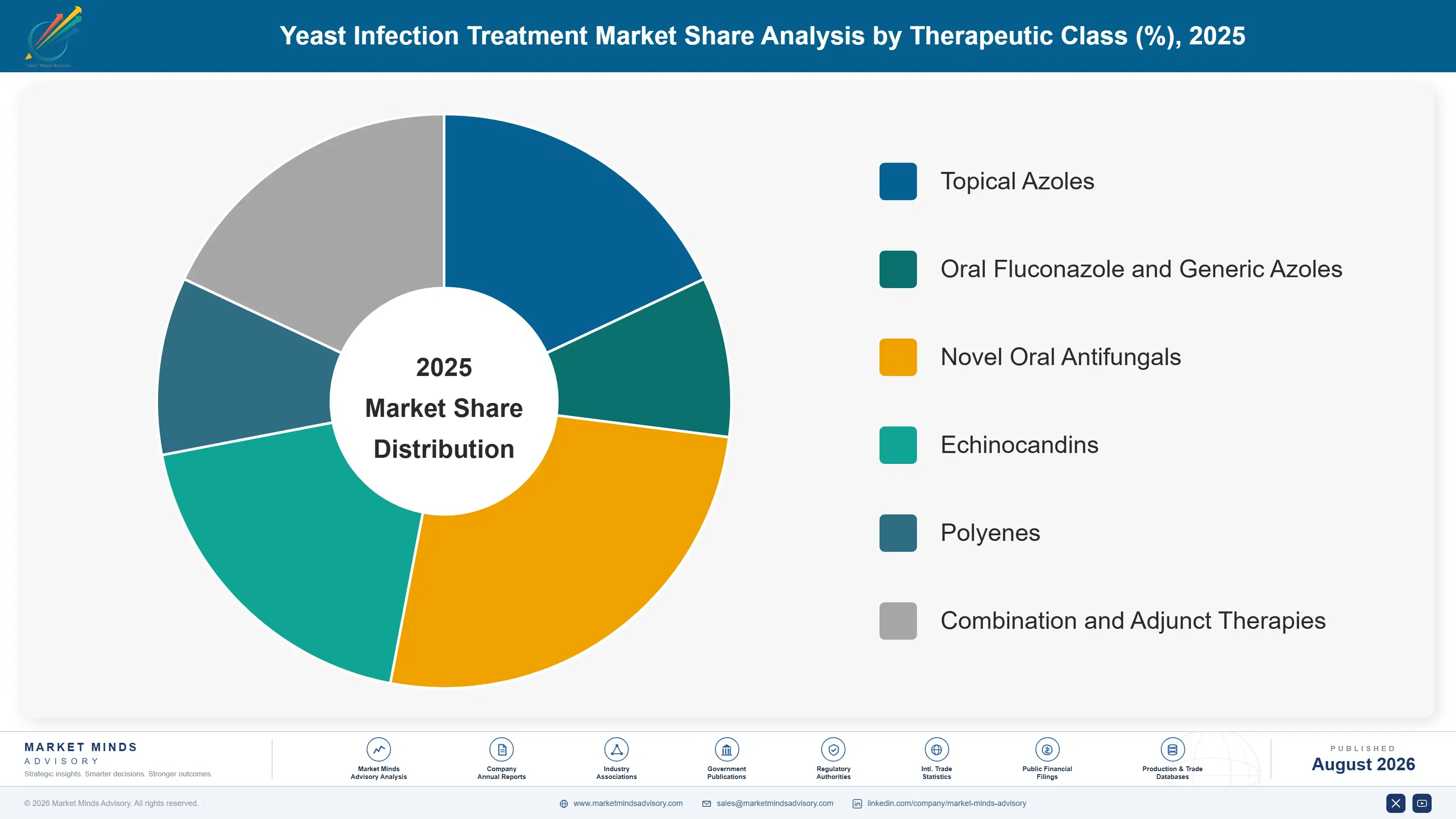
Segmentation follows therapeutic class, since class determines which disease presentation it addresses, whether a prescription is required, what resistance exposure it carries and which channel supplies it. Six classes cover treatment as practised. Growth concentrates where disease was previously unaddressed rather than where episode volumes are largest. Unmet need rather than episode volume drives it here.
yeast-infection-treatment-market-market-share-analysis-1787665223245

Novel Oral Antifungals

Recently licensed oral agents with mechanisms distinct from the azole class, developed specifically for recurrent vulvovaginal candidiasis in a population that had no licensed option for decades. At 10.8% this is the fastest growing class, half again the market rate of 7.2%, and unmet need rather than superiority over acute treatment explains it. Around 9% of women experience four or more episodes annually, and fluconazole suppression relapses in roughly 57% of cases within six months of stopping. Clinician and patient awareness lags availability substantially, which is the commercial constraint rather than any clinical doubt. Nobody examined the population where the cheap treatment did not work, because the cheap treatment worked.
CAGR 10.8%

Echinocandins

Intravenous agents targeting fungal cell wall synthesis, first line for invasive candidiasis and unaffected by the azole resistance mechanisms that compromise other classes. Growth of 8.6% is second fastest in the category, driven by invasive disease incidence and by extended interval dosing that permits treatment completion outside a hospital bed. That releases bed days carrying real cost, which is how hospital pharmacy evaluates the comparison rather than on drug price alone. Resistance to this class remains uncommon, which makes it the reliable option as azole susceptibility declines across several species. Hospital pharmacy rather than the prescribing physician increasingly decides which agent a formulary carries at all. Stewardship changed that balance.
CAGR 8.6%
Full segment breakdown across 6 segments available in the complete report.

Regional Architecture and Country Demand Map

North America holds 32% on the largest over the counter market and first launch of the new agents. Western Europe follows at 24% and East Asia at 19%. India grows fastest at 10.8% on pharmacy access across a very large population. Treatment seeking behaviour shapes these.

North America

A 32% share reflects the largest over the counter antifungal market anywhere combined with first launch of the new agents licensed for recurrent disease. Retail pharmacy access is broad and self treatment is culturally established, which produces the high proportion of episodes managed without consultation. Payer coverage for novel agents is negotiated individually and remains the commercial constraint on adoption. Telehealth prescribing has expanded access to consultation for a condition many people prefer not to discuss in person. Growth of 6.2% reflects specialty adoption against a flat generic base. Self treatment culture rather than disease incidence is what produces this share. Payer coverage remains the constraint on novel agent adoption.
Share: 32% | CAGR: 6.2% (2026 to 2036)

Western Europe

A 24% share reflects broad pharmacy access and prescribing patterns that vary considerably between member states, with topical azoles available without prescription in most markets. National assessment of novel agents is slower than North American payer negotiation, which delays adoption in a category where the incremental cost against generic suppression is easy to question. Antimicrobial stewardship programmes here have been among the first to address antifungals seriously. Pharmacist assessment before supply is more common than elsewhere. Growth of 5.6% is the lowest of the seven regions. National assessment timelines rather than clinical doubt are what delay novel agent adoption here. Stewardship attention arrived considerably earlier than in most regions. That helps.
Share: 24% | CAGR: 5.6% (2026 to 2036)
Regional intelligence for 5 additional markets available in the complete report: East Asia, South Asia and Pacific, Latin America, Middle East and Africa, Eastern Europe. Contact sales@marketmindsadvisory.com.
yeast-infection-treatment-market-country-cagr-analysis-1787665223761

Where This Category Actually Earns

Nothing here is won on treating uncomplicated episodes, because generics do that reliably for a few dollars and always will. Value accrues to whoever treats the recurrent population, whoever fixes diagnosis, whoever engages stewardship, and whoever reaches patients who avoid consultation. Four routes carry weight and none competes with a topical azole. Unmet need is the opportunity.

Treat The Recurrence Nobody Licensed For

Around 9% of women experience four or more episodes annually, and for decades the only approach was extended fluconazole suppression relapsing in roughly 57% of cases within six months of stopping. That population was ignored because the acute condition was cheaply and reliably solved, which persuaded everybody the whole problem was handled. Novel oral antifungals grow at 10.8% against a market rate of 7.2% precisely because that assumption was wrong, and awareness rather than evidence is the current constraint. Around 57% relapse after suppression stops, which patients frequently read as personal failure.
Market Impact: Serves the 9% of women with recurrent disease

Fix Diagnosis Before Blaming The Drug

Self diagnosis is correct around 34% of the time, so a substantial share of people buying antifungal products do not have candidiasis and will not improve whatever they take. Those failures get attributed to medicines that were never treating the right condition, damaging products and prescriber confidence alike. Supporting point of care testing and pharmacist assessment costs money and improves outcomes for everybody selling into the category, which is an unusual and rarely funded kind of investment. Around 68% of episodes never reach anybody able to make that assessment in the first place.
Market Impact: Corrects diagnosis currently failing 66% of all attempts

Follow Resistance Onto Antimicrobial Stewardship Agendas

Roughly 24% of isolates come from species with reduced azole susceptibility, multidrug resistant organisms spread in hospitals, and agricultural azole use has been implicated in environmental resistance selection. Stewardship programmes built around antibacterials have begun addressing antifungals as a result, bringing hospital pharmacy and infection control into decisions prescribers previously made alone. That audience evaluates mechanism and resistance profile rather than familiarity, which favours anything distinct from another azole variation. Around 24% of isolates already show reduced susceptibility, and agricultural use continues selecting for more of it. Nobody expects that to reverse.
Market Impact: Addresses the 24% of isolates with reduced susceptibility

Reach The Consultation That Never Happens

Around 68% of episodes are treated without any clinical consultation, which means most patients never encounter a prescriber who could identify recurrent disease or consider a licensed option for it. Telehealth, pharmacist assessment and structured symptom triage all create a consultation where none existed, and each reaches a population that actively avoids discussing the condition in person. Building that access is a market expansion activity rather than a share contest, which changes how the investment should be justified. Around 68% of episodes bypass the clinical system entirely, which is where the population sits.
Market Impact: Reaches the 68% of episodes avoiding any consultation

Who Controls the Margin Pool

Concentration is moderate and splits by disease presentation rather than by company scale. The top five hold 42% of treatment value, the basis applied consistently throughout this section, across consumer health companies owning over the counter brands, pharmaceutical companies holding hospital antifungals, and specialty developers with the newly licensed recurrent disease agents. Bayer leads on over the counter brand position, which reflects retail presence rather than any clinical differentiation.
Competition runs on three fronts that barely overlap. Consumer health companies compete for pharmacy shelf and brand recognition in uncomplicated episodes where products are interchangeable. Hospital antifungal suppliers compete on resistance profile, dosing convenience and formulary position. And specialty developers compete for awareness in a recurrent disease population that most prescribers have never treated with anything specific.

Rankings will move with guideline recognition of recurrent disease rather than with promotional activity, since a formal recommendation would convert a niche launch into standard practice across a large population. The other pressure point is diagnosis, which determines whether treatment failures continue being attributed to drugs rather than to the conditions that they were never intended to treat at all.
yeast-infection-treatment-market-company-positioning-matrix-1787665224281

Competitive Moat and Risk Dimensions

BAYER

Moat: Over The Counter Brand Position

Established consumer brand recognition in a category where purchasers cannot evaluate products before use and buy on familiarity provides pricing power that no clinical distinction would generate. Pharmacy shelf position and pharmacist familiarity across decades reach the roughly 68% of episodes treated without any consultation at all.
BAYER

Risk: Uncomplicated Episode Confinement

Strength sits entirely in acute uncomplicated disease treated cheaply, while the growth in this category is in recurrent disease requiring prescription agents and clinical involvement. A consumer health position does not reach prescribers, and the diagnostic inaccuracy in self treatment channels creates failures attributed to the brand.
ASTELLAS PHARMA

Moat: Hospital Antifungal Formulary Presence

Established echinocandin position across hospital formularies provides relationships with infectious disease physicians and hospital pharmacy exactly as antifungal stewardship becomes a formal programme rather than an afterthought. Resistance profile advantages become more valuable as azole susceptibility declines across several of the clinically significant Candida species today.
ASTELLAS PHARMA

Risk: Generic Entry Exposure

Established echinocandins face generic competition that erodes price in a hospital channel where formulary decisions weigh acquisition cost heavily once clinical equivalence is accepted. Newer agents with extended dosing intervals compete on total episode cost rather than drug price, which requires a different commercial argument entirely.

Players Tracked

Prominent Players

Bayer
Pfizer
Astellas Pharma
Scynexis
Organon

Other Key Players

Merck
Gilead Sciences
Basilea Pharmaceutica
Cidara Therapeutics
Mundipharma
Sanofi
Reckitt
Perrigo
Teva Pharmaceutical Industries
Sun Pharmaceutical
Cipla
Glenmark Pharmaceuticals
Viatris
Fresenius Kabi
F2G

Recent Developments

FEBRUARY 2025

Guideline review examines recurrent disease treatment recommendations

A clinical guideline review examined treatment recommendations for recurrent vulvovaginal candidiasis, considering licensed mechanistic options against extended azole suppression. Suppression relapses in around 57% of cases within six months of stopping, which has been the accepted standard despite that outcome for a very long time.
Signal: A guideline recommendation would convert a niche launch into standard practice quickly across a very large population
MAY 2025

Stewardship programme extends formal review to antifungal prescribing

A hospital antimicrobial stewardship programme extended formal review to antifungal prescribing, having previously addressed antibacterials almost exclusively. Around 24% of isolates come from species with reduced azole susceptibility, and multidrug resistant organisms have spread within hospital environments across several countries. Antifungals had been outside the programme entirely.
Signal: Antifungals joining stewardship brings pharmacy into decisions prescribers made alone for the very first time anywhere
SEPTEMBER 2025

Pharmacy assessment programme improves diagnostic accuracy before supply

A pharmacy assessment programme introduced structured symptom evaluation before supplying antifungal products, addressing self diagnosis accuracy running around 34%. Symptoms overlap heavily with bacterial vaginosis and other conditions requiring completely different treatment, which produces failures attributed to the wrong cause. Assessment before supply changes the outcome.
Signal: Fixing diagnosis improves outcomes for everybody selling into this category at once rather than only one participant

What Antifungal Treatment Costs

Active ingredient cost differs enormously across the category. Azole synthesis is straightforward small molecule chemistry costing very little per course, while echinocandins are semi-synthetic lipopeptides requiring fermentation and multi-step modification that dominates their cost structure entirely. Azole active ingredient supply concentrates heavily in Indian and Chinese manufacturing, and echinocandin fermentation capacity sits with a limited number of qualified facilities worldwide.
Active ingredient supply concentration produced disruption during the last period of manufacturing constraint. FDA inspection findings and import alerts affecting individual facilities removed supply from markets dependent on single sources, and pharmaceutical company annual reports documented shortages, qualification of alternative sources and the time that requalification actually takes. Generic azoles were affected more than branded products, because margins do not support holding redundant qualified capacity.

Exposure divides by product tier rather than by scale. Generic azole suppliers operate on margins that make dual sourcing difficult to justify commercially, which leaves them exposed to any single facility problem. Echinocandin suppliers carry fermentation capacity risk on a much higher value product where redundancy is affordable. Novel agents carry neither exposure meaningfully, since volumes are small and manufacturing cost is immaterial against the price.
yeast-infection-treatment-market-cost-volatility-analysis-1787665224478

Qualify alternative active ingredient sources despite thin margins

Generic azole margins make dual sourcing difficult to justify, which leaves supply exposed to inspection findings and import alerts affecting single facilities. Requalification takes months that a shortage does not allow. The cost of redundancy is real and the cost of losing a market position during a supply gap is considerably larger, since prescribers substitute and rarely return afterwards.

Fund diagnostic accuracy as a category level investment

Self diagnosis is correct around 34% of the time, which means most treatment failures involve products that were never treating the right condition at all. Those failures damage every participant, including those whose product would have worked. Supporting pharmacist assessment and point of care testing improves outcomes across the whole category, which makes it worth funding collectively rather than individually.

Build health economic evidence on recurrent disease burden

Novel agents are compared against topical products costing a few dollars, a comparison that was never relevant to a chronic relapsing condition requiring different therapy. Payers respond to burden of illness evidence covering lost work, repeated consultations and quality of life rather than to acute episode pricing. Building that evidence is what converts a distinct product into a reimbursed one.

Portfolio Architecture for Margin Defence

Margin architecture divides on whether a prescription is involved. Over the counter topical products earn moderate consumer health margins on enormous volumes and compete on brand rather than performance, since the products themselves are interchangeable. Generic oral azoles earn least, being commodity molecules supplied at tender pricing. Hospital antifungals earn considerably better, and novel agents for recurrent disease earn best because nothing else is licensed for the indication.
The tension runs between volume and unmet need. The over the counter half reaches around 68% of episodes and generates predictable revenue from a condition that resolves whatever anybody does. The prescription half reaches far fewer patients and addresses disease that actually needs treating. Companies holding both frequently find the consumer business funds everything and the specialty business justifies the strategy.

High value pools concentrate in recurrent disease and in hospital antifungals with favourable resistance profiles, neither of which is a retail position. Everything sold over a counter competes on brand recognition against products that work identically. The businesses worth building are those addressing patients for whom current treatment demonstrably fails, which is a smaller population and the only one with an unmet clinical need behind it.

Generic Oral And Topical Azoles

Commodity molecules supplied at tender and retail generic pricing across enormous volumes with no differentiation available. The range is wide because branded over the counter positions earn considerably more than tendered generic supply does.
Gross Margin: 22-30%

Hospital Antifungal Agents

Echinocandins and other hospital agents competing on resistance profile, dosing convenience and total episode cost within formulary decisions. Generic entry erodes pricing once clinical equivalence is broadly accepted by pharmacy committees.
Gross Margin: 44-52%

Licensed Recurrent Disease Therapies

Mechanistically distinct agents licensed specifically for recurrent vulvovaginal candidiasis, where nothing else holds the indication. Margin is highest because no comparable licensed alternative exists and the population was previously unserved.
Gross Margin: 72-80%
yeast-infection-treatment-market-portfolio-architecture-1787665225007

High-value Sub-segments and Strategic Watch-out

Novel Oral Antifungals

Fastest growing class at 10.8% because a population affecting around 9% of women finally has licensed options after decades without any. Awareness rather than clinical evidence is the constraint on adoption at present. Awareness among clinicians rather than clinical evidence limits adoption levels at present.
Gross Margin: 72-80%

Echinocandins

Second fastest at 8.6% on invasive disease and extended dosing that releases hospital bed days carrying real cost. Resistance remains uncommon here, which makes the class more valuable as azole susceptibility declines across species. Hospital pharmacy evaluates the total episode cost rather than drug price.
Gross Margin: 44-52%

Topical Azoles

Growing at 3.6% and carrying the largest episode volume in the category, which makes it the retail core rather than the growth story. Products are interchangeable and brand recognition rather than performance decides purchases entirely. Volume rather than value is what this segment actually delivers.
Gross Margin: 26-32%

Oral Fluconazole and Generic Azoles

Growing at only 2.8% as commodity molecules supplied at tender pricing with no differentiation available to anybody. Suppression use in recurrent disease is precisely what the newly licensed agents were developed to displace. Tender pricing decides everything here and nothing else really enters the discussion.
Gross Margin: 18-24%

How Treatment Demand Actually Forms

Most demand here never passes a clinician at all. Around 68% of episodes are treated after a symptom is recognised and a product bought from a shelf, which makes retail availability and brand familiarity the entire mechanism for that half of the market. It also means nobody records the episode, nobody confirms the diagnosis, and a person having their fifth episode in a year looks identical to somebody having their first.
Recurrent disease therefore reaches clinical attention only when a patient decides to raise it, which many do not. Self treatment that partially works delays presentation, and a condition many people find difficult to discuss delays it further. Suppression with generic fluconazole then becomes the default response, relapsing in around 57% of cases within six months of stopping, which patients frequently interpret as their own failure rather than the treatment's.

The commercial consequence is that market expansion here means creating consultations rather than winning share. Telehealth, pharmacist assessment and structured symptom triage each generate a clinical encounter where none previously existed, and each reaches a population that avoids discussing this condition in person. That investment behaves differently from promotion, since it grows the treated population rather than redistributing it.
yeast-infection-treatment-market-end-use-penetration-index-1787665225516

Where This Category Rewards Focus

These are among the four positions where our research anticipates prominent divergence between winners and laggards over the coming forecast period. Each is grounded in the demand model, the regulatory perimeter, and the announced capacity pipeline.
01 / RECURRENT DISEASE FOCUS

The easy cure hid the hard problem

Around 68% of episodes are treated over a counter with inexpensive products that resolve uncomplicated disease reliably, which persuaded the entire system the problem was handled and nobody looked further. Roughly 9% of women experience four or more episodes annually, and for decades the only approach was fluconazole suppression relapsing in about 57% of cases within six months of stopping. Novel agents grow at 10.8% precisely because that assumption was wrong, and awareness rather than evidence is now the binding constraint.
02 / DIAGNOSTIC ACCURACY INVESTMENT

Most failures involve the wrong condition entirely

Self diagnosis is correct around 34% of the time, which means a substantial share of people buying antifungal products do not have candidiasis and will not improve whatever they take at all. Those failures get attributed to medicines that were never treating the right condition, damaging product reputation and prescriber confidence together. Supporting pharmacist assessment and point of care testing improves outcomes for everybody selling into this category, which makes it worth funding collectively rather than by any one participant alone.
03 / RESISTANCE AGENDA ACCESS

Stewardship finally noticed the fungi

Roughly 24% of isolates come from species with reduced azole susceptibility, multidrug resistant organisms have spread within hospital environments, and agricultural azole use has been implicated in selecting environmental resistance. Stewardship programmes built almost entirely around antibacterials have begun addressing antifungals seriously as a direct result of that. Hospital pharmacy and infection control now enter decisions prescribers previously made alone, and they evaluate mechanism and resistance profile rather than prescriber familiarity, which strongly favours anything mechanistically distinct from another azole variation.
04 / CONSULTATION CHANNEL DESIGN

Create the appointment that never happened

Around 68% of episodes are treated without any clinical consultation, which means most patients never encounter a prescriber who could identify recurrent disease or consider a licensed option developed for it. Telehealth, pharmacist assessment and structured symptom triage each create a clinical encounter where none previously existed, reaching people who actively avoid discussing this particular condition face to face. That kind of investment grows the treated population rather than redistributing it, which changes entirely how the investment should be justified internally.

Engagement Snapshot From the Field

A live engagement with an industry participant carrying material or product regulatory and market exposure ahead of a defining policy shift, showing how our research translates into a defensible multi-year portfolio strategy.
MARKET MINDS ADVISORY · CLIENT ENGAGEMENT SUMMARY
Yeast Infection Treatment Producer Strategic Portfolio Review and Transition Roadmap 2026·Investment Scenario on Yeast Infection Treatment Exposure Evaluation 2025-26
CLIENT PROFILE
A specialty pharmaceutical company commercialising a newly licensed oral agent for recurrent vulvovaginal candidiasis across North America and selected European markets. Annual revenue was approximately 43 million dollars (client-reported, unverified by MMA), from a patient population far smaller than epidemiology suggested was eligible. Commercial resources were directed at gynaecologists almost exclusively at that particular stage.
STRATEGIC CHALLENGE
Uptake was running well below the eligible population despite clear differentiation from azole suppression, and management could not identify where patients were being lost. Payers were comparing the agent against products costing a few dollars, a comparison the company had not addressed. Nobody had mapped how a recurrent patient actually reaches a prescriber in the first place.
MMA APPROACH
MMA mapped the patient pathway from first symptom through repeated episodes to any clinical consultation, identifying where recurrent patients leave the system. Payer objections were analysed against the evidence submitted. Forty-seven expert interviews with gynaecologists, primary care physicians, pharmacists, telehealth prescribers and payer assessors established how these patients are actually reached, alongside survey work across six countries.
KEY FINDINGS
  1. Roughly 70% of recurrent patients had never discussed the condition with any clinician, self treating repeatedly and interpreting relapse as personal failure rather than treatment failure.
  2. Pharmacists identified recurrent patients in 6 of every 10 cases where they conducted any structured assessment, and the client had no pharmacy engagement at all.
  3. Payer assessors in 5 of the 6 markets reviewed compared the agent against topical products, and burden of illness evidence had never been submitted to any of them.
  4. Telehealth prescribing reached 3 times the proportion of recurrent patients that gynaecology referral did, in a condition many patients prefer not to discuss in person.
CLIENT PROFILE
A specialty pharmaceutical company commercialising a newly licensed oral agent for recurrent vulvovaginal candidiasis across North America and selected European markets. Annual revenue was approximately 43 million dollars (client-reported, unverified by MMA), from a patient population far smaller than epidemiology suggested was eligible. Commercial resources were directed at gynaecologists almost exclusively at that particular stage.
STRATEGIC CHALLENGE
Uptake was running well below the eligible population despite clear differentiation from azole suppression, and management could not identify where patients were being lost. Payers were comparing the agent against products costing a few dollars, a comparison the company had not addressed. Nobody had mapped how a recurrent patient actually reaches a prescriber in the first place.
MMA APPROACH
MMA mapped the patient pathway from first symptom through repeated episodes to any clinical consultation, identifying where recurrent patients leave the system. Payer objections were analysed against the evidence submitted. Forty-seven expert interviews with gynaecologists, primary care physicians, pharmacists, telehealth prescribers and payer assessors established how these patients are actually reached, alongside survey work across six countries.
KEY FINDINGS
  1. Roughly 70% of recurrent patients had never discussed the condition with any clinician, self treating repeatedly and interpreting relapse as personal failure rather than treatment failure.
  2. Pharmacists identified recurrent patients in 6 of every 10 cases where they conducted any structured assessment, and the client had no pharmacy engagement at all.
  3. Payer assessors in 5 of the 6 markets reviewed compared the agent against topical products, and burden of illness evidence had never been submitted to any of them.
  4. Telehealth prescribing reached 3 times the proportion of recurrent patients that gynaecology referral did, in a condition many patients prefer not to discuss in person.
RECOMMENDED STRATEGY
Phase 1: Phase one: submit burden of illness evidence to payers, since assessors in 5 of 6 markets were comparing against irrelevant topical pricing. Phase 2: Phase two: build pharmacist engagement, which identified recurrent patients in 6 of 10 structured assessments the client was not part of. Phase 3: Phase three: prioritise telehealth prescribing channels, reaching 3 times the recurrent patient proportion that gynaecology referral actually managed to achieve.
OUTCOME
The client submitted burden of illness evidence and payer positions improved in several markets where the comparison had previously been against topical pricing. Pharmacy engagement and telehealth prioritisation both raised identified patient numbers materially, and the eligible population finally began reaching a prescriber who could act (client-reported, unverified by MMA).

Frequently Asked Questions

Foundational context covering the market sizes, CAGR, scope, country, region and competition that inform every finding below. This section is provided to cover basics and most often pre-purchase conversations, answered from the MMA Primary Research Dataset.

What is the current size of the Yeast Infection Treatment Market?

The market was valued at 2.1 billion dollars in 2025, covering therapies for candidiasis across vulvovaginal, oral, cutaneous and invasive disease worldwide. It reaches an estimated 2.25 billion dollars during 2026.

How large will the Yeast Infection Treatment Market be by 2036?

MMA forecasts 4.51 billion dollars by 2036, an increase of 2.26 billion dollars over the 2026 base. That represents an expansion multiple of 2.00 times across the forecast period.

What is the CAGR for the Yeast Infection Treatment Market 2026 to 2036?

The base case compound annual growth rate is 7.2%, with a bull case of 8.4% and a bear case of 6.0%. Guideline recognition and diagnostic accuracy separate those two scenarios.

Which segment is growing fastest?

Novel oral antifungals grow at 10.8%, half again the market rate of 7.2%, because recurrent disease finally has licensed options. Echinocandins follow at 8.6% on invasive disease.

Who are the major companies in the Yeast Infection Treatment Market?

Bayer, Pfizer, Astellas Pharma, Scynexis and Organon lead on treatment value across consumer, hospital and specialty positions. Together they account for 42% of the global market.

Which country is growing fastest?

India grows fastest at 10.8%, because pharmacy networks reach an enormous population directly and treatment seeking among urban women continues rising steadily across urban markets.

Report Segmentation Architecture

The full report scope spans multiple orthogonal segmentation dimensions, with cross-tabulated demand data provided for each dimension pair. Coverage extends further to regional breakdowns, trend trajectories, and the competitive detail needed to support segment-level decision-making.

By Therapeutic Class

  • Topical Azoles
  • Oral Fluconazole and Generic Azoles
  • Novel Oral Antifungals
  • Echinocandins
  • Polyenes
  • Combination and Adjunct Therapies

By End-Use Industry

  • Community Pharmacy and Retail
  • Primary Care
  • Gynaecology Services
  • Hospital Inpatient Care
  • Intensive Care Units
  • Immunocompromised Patient Services

By Commercial Dimension

  • Over The Counter Retail
  • Prescription Pharmacy
  • Hospital Formulary Supply
  • Specialist Clinic Supply
  • Ecommerce and Telehealth
  • Public Tender Procurement

By Region

  • North America
  • Western Europe
  • East Asia
  • South Asia and Pacific
  • Latin America
  • Middle East and Africa
  • Eastern Europe

Scope, Methodology, and Coverage

Every figure in this report is reproducible from documented input assumptions. The scope below maps the historical period, the forecast horizon, the segmentation dimensions, and the countries covered, alongside the underlying primary and qualitative methodology.
Historical Period
2020 to 2025
Forecast Period
2026 to 2036
Base Year
2025 (USD billions; MMA Primary Research Dataset, August 2026)
Market Definition
Therapies for candidiasis worldwide across vulvovaginal, oral, oesophageal, cutaneous and invasive disease presentations, covering topical azoles, oral fluconazole and other generic azoles, novel oral antifungals licensed for recurrent disease, echinocandins, polyenes, and combination and adjunct therapies, measured at treatment value across prescription and over the counter channels. Probiotic and microbiome products, dermatophyte antifungals for tinea and nail infections, antibacterial treatments for bacterial vaginosis, and diagnostic tests and devices are excluded from scope entirely.
Quantitative Units
USD billions (treatment value); treatment courses; USD per course by class
Segmentation Dimensions
Therapeutic class; end-use industry; commercial dimension; region
Regions Covered
North America, Western Europe, East Asia, South Asia and Pacific, Latin America, Middle East and Africa, Eastern Europe
Countries Covered
United States, Canada, United Kingdom, Germany, France, Italy, Spain, Netherlands, Sweden, China, Japan, South Korea, Taiwan, India, Australia, Indonesia, Thailand, Brazil, Mexico, Saudi Arabia, South Africa, Poland
Key Companies Profiled
Bayer, Pfizer, Astellas Pharma, Scynexis, Organon, Merck, Gilead Sciences, Basilea Pharmaceutica, Cidara Therapeutics, Mundipharma, Sanofi, Reckitt, Perrigo, Teva Pharmaceutical Industries, Sun Pharmaceutical, Cipla, Glenmark Pharmaceuticals, Viatris, Fresenius Kabi, F2G
Quantitative Methodology
Primary survey, n=3,800 respondents, Q4 2025, six countries; demand-side model with trade association cross-validation
Qualitative Methodology
47 expert interviews, Q4 2025; applied to validate demand model assumptions, identify emerging dynamics, and assess competitive positioning
Report Format
PDF and XLSX data workbook (Word format preview document)
Publisher
Market Minds Advisory
Report Code
MMA-2026-HLT-152
Published
August 2026
Contact
sales@marketmindsadvisory.com | www.marketmindsadvisory.com

Purchase the full Yeast Infection Treatment Market Report (2026 to 2036).

The full report explains how a cheap effective treatment for uncomplicated disease concealed an unmet need in recurrent candidiasis for three decades, and what changed when licensed options finally arrived. It sizes all six therapeutic classes independently through 2036, models the recurrent population against actual treatment rates, and quantifies how self diagnosis accuracy affects outcomes attributed to medicines. Regional chapters cover all seven regions, with over the counter treatment patterns assessed separately from prescription pathways. Competitive profiling covers 20 participants on one consistent treatment value measure.
Six therapeutic classes sized independently through 2036
Recurrent disease population modelled against actual treatment rates
Self diagnosis accuracy quantified against treatment failure attribution
Antifungal resistance tracked against stewardship programme adoption
Consultation access analysed across telehealth and pharmacy channels
Twenty participants profiled on one consistent treatment measure

Built For The People Who Decide

From boardroom strategy to bench-side execution, this report is read cover-to-cover by leaders shaping the next decade of their industry, turning demand scenarios, market dynamics and valuation benchmarks into decisions.
CXOs/ Presidents/ VPs/ Managers
M&A and Corporate Development
Strategy Teams and R&D Heads
Procurement and Product Directors
Regulatory and Compliance Leaders
Investor Relations and Equity Analysts