Clostridium Difficile Infection (CDI) Treatment Market
Clostridium Difficile Infection (CDI) Treatment Market: Iatrogenic Disease, Recurrence Economics, and Microbiome Restoration
This is a disease caused by antibiotics and treated with antibiotics, which is why the first approved microbiome medicines matter commercially far more than their modest revenue currently suggests to observers.
2025 MARKET VALUE$1.4BMarket Size 2025
2036 FORECAST VALUE$3.6BBase Case , 2026 to 2036
CAGR 2026 TO 20369.0 %Bull 10.2% / Bear 7.8%
INCREMENTAL OPPORTUNITY$2.1BNet 10- year value creation
EXPANSION MULTIPLE2.36x2036 value over 2026 base
Strategic Levers
M&A Pipeline
Regional Outlook
Country Rankings
Competitive Intelligence
Segmental Deep-dive
Executive Snapshot and Market Trajectory
Clostridioides difficile infection is caused by antibiotics destroying gut flora, and standard treatment is more antibiotics. That circularity is why roughly a quarter of patients relapse, and why restoring the microbiome rather than suppressing the organism became the field's central commercial idea. Nothing else in infectious disease has this shape.
Live biotherapeutic products compound at 13.5%, a full 1.50x the market rate, following the first microbiome medicines ever approved by a major regulator, priced in the thousands per course against generic vancomycin at around USD 180. North America holds the largest share at 34%, above the standard regional band, because both approved live biotherapeutics are commercially available only there and hospital-onset diagnosis rates are the highest measured anywhere.
Concentration is high at 74%, with Ferring and Astellas leading on very different products. An approved monoclonal antibody for recurrence prevention was discontinued despite working, which tells you most of what matters about reimbursement here. Infection prevention programmes have cut hospital-onset incidence, shrinking the market's own volume base, so growth must come from recurrence value and from markets only now acquiring diagnostic capability. That is an excellent public health outcome and an awkward commercial one.
Market Definition
This market covers therapeutics indicated for the treatment of Clostridioides difficile infection or the prevention of its recurrence, spanning glycopeptide antibiotics, macrocyclic antibiotics, nitroimidazole antibiotics, live biotherapeutic products and monoclonal antibody therapeutics, measured at manufacturer revenue. Diagnostic testing, infection prevention products and environmental disinfection, probiotics and supplements without an approved indication, investigational vaccines, and hospital service or procedure revenue associated with administration are excluded.
Base Year Value
$1.4B in 2025 (MMA Primary Research Dataset, August 2026)
Forecast Period
2026 to 2036, eleven discrete annual values
CAGR
9.0% base case. Bull 10.2%. Bear 7.8%.
Fastest Growth Segment
Live Biotherapeutic Products: 13.5% CAGR
Fastest Growth Country
China: 13.8% CAGR
Fastest Growth Region
South Asia and Pacific: 11.2% CAGR
Largest Region
North America: 34% of 2025 global value
Market Leaders
Ferring Pharmaceuticals, Astellas Pharma, Nestlé Health Science, Merck and Co., and ANI Pharmaceuticals. Source: MMA Primary Research Dataset, July 2026.
Primary Survey
n=3,800 procurement and R&D decision-makers, Q4 2025, six countries
Methodology
Demand-side build-up, cross-validated against public data, 47 expert interviews
Clostridium Difficile Infection (CDI) Treatment Market Forecast Scenarios

Growth ran near 7.6% from 2020 to 2025 through a period that reshaped the category twice. Hospital antimicrobial stewardship and cleaning improvements cut hospital-onset incidence meaningfully, removing volume. Then two live biotherapeutic products reached approval in 2022 and 2023, the first microbiome medicines any major regulator had ever cleared, introducing price points several orders of magnitude above the generic antibiotics beside them.
Base case growth of 9.0% rests on three mechanisms. Live biotherapeutic uptake continues building as payers accept the recurrence-avoidance argument that hospitalisation cost data supports. Treatment guidelines now favour fidaxomicin over vancomycin for initial episodes, which shifts volume toward a branded product from a cheap generic one. And diagnosis rates outside North America keep rising as testing capability spreads through hospital laboratories across Asia and Latin America. None of the three depends on the others arriving first.
The bull case at 10.2% assumes payers reimburse live biotherapeutics broadly on avoided-hospitalisation economics, converting a narrow specialist product into standard practice for recurrent disease. The bear case at 7.8% is continued success in prevention: stewardship and environmental control keep cutting incidence, two-step diagnostic algorithms reduce treated cases further, and volume declines faster than premium pricing can compensate.
Base case growth of 9.0% rests on three mechanisms. Live biotherapeutic uptake continues building as payers accept the recurrence-avoidance argument that hospitalisation cost data supports. Treatment guidelines now favour fidaxomicin over vancomycin for initial episodes, which shifts volume toward a branded product from a cheap generic one. And diagnosis rates outside North America keep rising as testing capability spreads through hospital laboratories across Asia and Latin America. None of the three depends on the others arriving first.
The bull case at 10.2% assumes payers reimburse live biotherapeutics broadly on avoided-hospitalisation economics, converting a narrow specialist product into standard practice for recurrent disease. The bear case at 7.8% is continued success in prevention: stewardship and environmental control keep cutting incidence, two-step diagnostic algorithms reduce treated cases further, and volume declines faster than premium pricing can compensate.
CDI Treatment: Recurrence, Restoration and Reimbursement
Few diseases are as neatly self-inflicted by medicine as this one. Broad-spectrum antibiotics wipe out the gut flora that normally keeps Clostridioides difficile in check, the organism expands, and the standard treatment is a further course of antibiotics. It works, and it also leaves the microbiome no better defended than before, which is why roughly 25% of patients relapse after a first episode and considerably more after a second.
TOP FIVE CONCENTRATION74%Concentrated across microbiome specialists and branded antibiotic holders
FIRST EPISODE RECURRENCE25%Patients relapsing after apparently successful treatment of an initial episode
BIOTHERAPEUTIC COURSE COSTUSD 13,000Blended price of an approved live biotherapeutic treatment course
VANCOMYCIN COURSE COSTUSD 180Typical generic oral course, the reference price payers apply
HOSPITAL ONSET SHARE62%Infections acquired during or shortly following an inpatient stay
ATTRIBUTABLE MORTALITY RATE6.5%Deaths attributed directly to the infection among diagnosed adult cases
That recurrence pattern is the commercial market. A first episode costs around USD 180 to treat with generic oral vancomycin, so almost no revenue sits there. Recurrent disease is where fidaxomicin, and now live biotherapeutic products priced near USD 13,000 a course, actually earn. The economic argument turns entirely on avoided hospitalisation, since a relapse requiring readmission costs a health system far more than either drug does.
Two facts complicate the outlook considerably. Infection prevention has genuinely worked, cutting hospital-onset incidence and shrinking the addressable population, which is an excellent public health outcome and an awkward commercial one. And an approved monoclonal antibody for recurrence prevention was discontinued commercially despite demonstrated efficacy, because payers would not fund it at the price required. Approval and viability are separate questions here.
"The field spent forty years getting better at killing this organism and the answer turned out to be putting the gut flora back. What nobody solved is how you charge thirteen thousand dollars for something hospitals were doing informally with donor stool for nothing."
Market Trends
Two live biotherapeutic products reached approval in 2022 and 2023, the first microbiome medicines any major regulator had cleared, both indicated to prevent recurrence rather than to treat an acute episode. One is administered rectally and one orally, which matters commercially because administration route determines whether a product can be given outside a procedural setting. The segment compounds at 13.5%. Uptake has lagged forecasts because payers compare the price against donor-derived transplantation that hospitals previously performed informally. Clinicians accept the evidence readily; pharmacy committees weighing a course priced near USD 13,000 have proved considerably harder to persuade.
Market Impact: Recurrence affecting 25% of patient
Guidelines move volume from cheap generic toward branded therapy
Current treatment guidance favours fidaxomicin over oral vancomycin for initial episodes on recurrence-reduction grounds, and has removed metronidazole from recommended first-line use entirely. This is an unusual direction of travel: guidelines ordinarily push prescribing toward the cheaper option rather than away from it. A generic course costs around USD 180 against several thousand for the branded alternative, which means adherence to guidance carries a real budget consequence that pharmacy committees are actively debating. Formulary decisions have accordingly diverged from guidance across many institutions, and real-world institutional data moves them where published guidance has not.
Market Impact: China compounding at 13.8% annually
Market Opportunities and Growth Drivers
Recurrence economics justify premium therapy on avoided admissions
Roughly 25% of patients relapse after a first episode and the proportion climbs sharply after a second, with each recurrence carrying a meaningful probability of readmission. A hospital stay for recurrent infection costs a health system substantially more than any available therapy, which is the entire economic argument for premium recurrence prevention. Health economic modelling supports it consistently. Payer acceptance has nonetheless been slower than the arithmetic implies, because budgets sit in pharmacy while savings appear in inpatient care. Outcomes-based contracting and institution-level budget impact modelling both address that split directly.
Market Impact: Hospital onset covering 62% of case
Diagnostic capability spreads well beyond established markets
Detection has historically been concentrated in North American and European hospitals with established testing protocols, and much of the world simply did not measure the disease. China compounds at 13.8% as hospital laboratories add toxin and molecular testing capability, and comparable expansion is underway across India, Brazil and Southeast Asia. Measured incidence rises sharply wherever testing arrives, which reflects detection rather than any genuine epidemiological change. Treated case volume follows the testing rather than the other way around. Planning built around burden estimates rather than testing penetration consistently misjudges launch timing.
Market Impact: Removed 1 of 5 classes
Market Restraints and Challenges
Infection prevention success shrinks the addressable patient population
Antimicrobial stewardship programmes, environmental cleaning protocols and isolation practices have cut hospital-onset incidence meaningfully across developed health systems over the past decade. The root cause of the commercial problem is that this market's best public health outcome directly removes its own volume. Hospital-onset cases still represent 62% of diagnosed infection, so further prevention gains bite hard. Participants are responding by focusing on community-onset disease, on recurrence prevention value and on markets where diagnosis is only now expanding. None of those responses restores the volume that prevention has already removed from developed health systems.
Market Impact: Compounding at 13.5% each year
Payer reimbursement fails products that demonstrably work
An approved monoclonal antibody indicated for recurrence prevention was discontinued commercially despite efficacy nobody disputed, because reimbursement at the required price never materialised at sufficient scale. The root cause is a budget structure where pharmacy pays and inpatient care saves, so the party funding the therapy never sees the benefit. Commercial impact removed a whole treatment modality. Outcomes-based contracting, hospital budget-impact modelling and bundled payment arrangements are the pathways participants are now testing. Whether any of them scales sufficiently to support premium pricing across a fragmented payer base remains genuinely unresolved, and the discontinuation suggests caution is warranted.
Market Impact: Price gap exceeding 20x per course
3 additional market trends, 4 additional growth drivers, and 2 additional restraints and challenges are covered in the full report. Contact sales@marketmindsadvisory.com to access the complete intelligence.
Segment CAGR and Growth Architecture
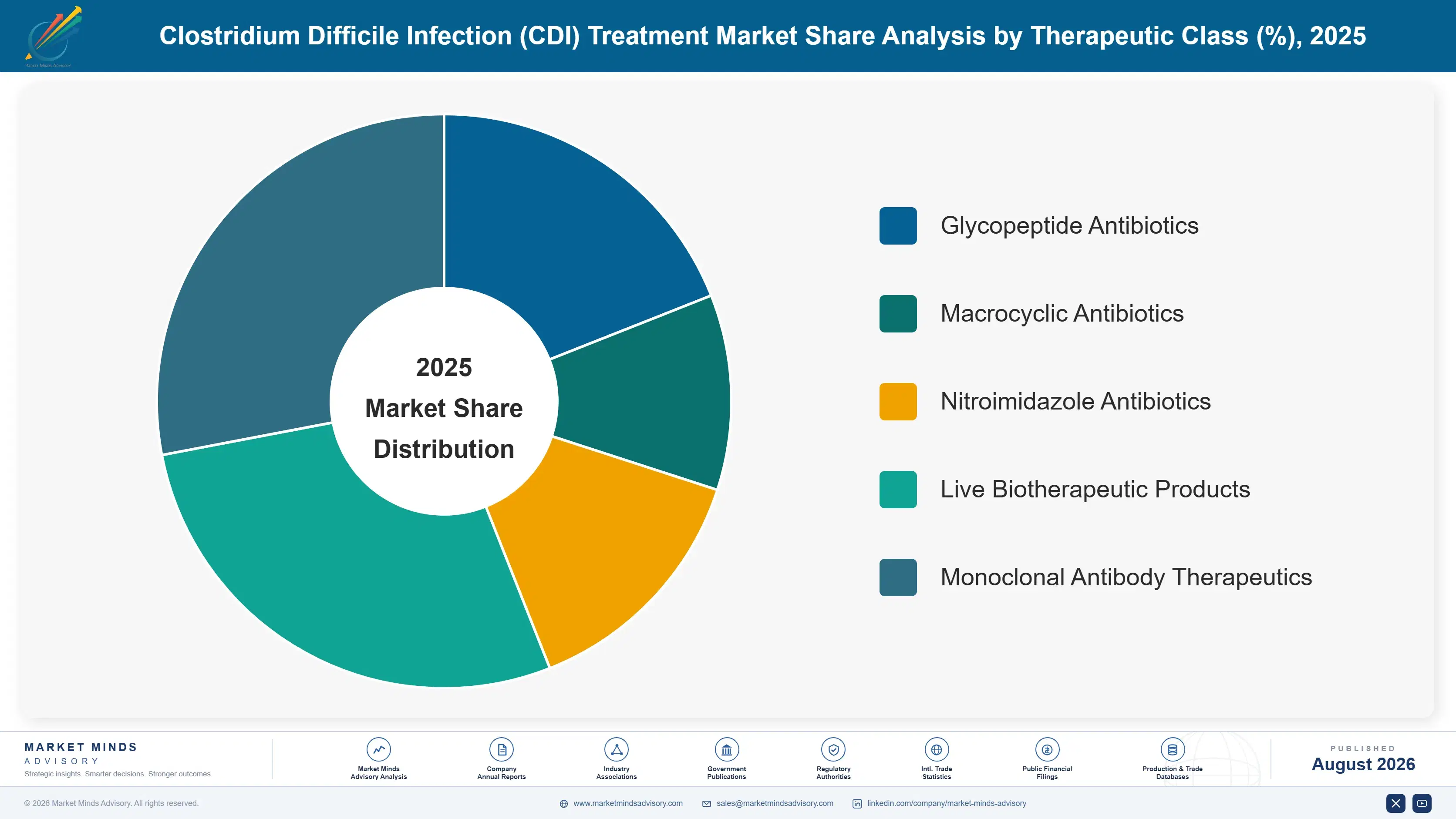
Segmentation follows therapeutic class, because class determines the mechanism, the regulatory pathway, the manufacturing base and the price a product can command. Five therapeutic classes cover treatment supply without overlap between them. Episode type, whether initial or recurrent, and care setting both cut across every class at once and are treated here as use attributes rather than as segments.

Live Biotherapeutic Products
Growing at 13.5%, a full 1.50x the market rate, live biotherapeutics restore the gut flora that antibiotics destroyed rather than suppressing the organism further, which addresses the actual cause of recurrence for the first time. Two products hold approval, administered rectally and orally respectively, and route matters commercially because it determines whether treatment requires a procedural setting or a prescription. Manufacturing is genuinely difficult, involving donor screening, characterisation and consistency requirements no small molecule faces. Payer resistance has been the binding constraint rather than clinical acceptance, which clinicians find frustrating. Donor screening attrition, rather than any processing step, is what makes supply genuinely hard to scale reliably. Most prospective donors fail expanded pathogen screening.
CAGR 13.5%
Macrocyclic Antibiotics
Macrocyclic therapy grows at 8.4% on guideline support rather than on novelty, since fidaxomicin has been available for well over a decade. Its narrower spectrum spares more of the surrounding gut flora than vancomycin does, which translates into lower recurrence, and current guidance favours it for initial episodes on exactly that basis. The commercial obstacle is price: a course costs several thousand dollars against roughly USD 180 for generic oral vancomycin, and pharmacy committees weighing a twentyfold difference frequently reach a different conclusion from the guideline authors did. Patent position and eventual generic entry both constrain the horizon over which the current commercial position can hold, which shapes how aggressively the class is being defended today.
CAGR 8.4%
Full segment breakdown across 5 segments available in the complete report.
Regional Architecture and Country Demand Map
Regional value follows diagnostic intensity and reimbursement willingness rather than underlying disease burden, and those two things diverge sharply. Much of the world has the infection and simply does not measure it in any systematic way. Underlying burden tells you remarkably little about where revenue sits.
North America
North America holds 34% of value. Note: this sits above the standard regional band because both approved live biotherapeutic products are commercially available only in the United States, and hospital-onset diagnosis rates here are the highest measured anywhere, reflecting testing intensity as much as disease burden. Fidaxomicin uptake following guideline change has been faster than in any other region. Recurrence prevention economics are actively debated between pharmacy and inpatient budget holders, and the monoclonal antibody discontinuation was felt most sharply here because United States centres had built protocols around it. Long-term care access remains poor despite carrying the highest recurrence risk population anywhere. Two-step diagnostic algorithms are applied less consistently than in Europe, which inflates treated case counts.
Share: 34% | CAGR: 8.6% (2026 to 2036)
Western Europe
Twenty-four per cent of value, growing at 7.6%, the slowest of the seven regions. Diagnostic protocols are well established and two-step algorithms distinguishing colonisation from active disease are more widely applied than in North America, which reduces treated case counts materially. Neither live biotherapeutic product holds European marketing authorisation, so recurrence management relies on fidaxomicin and on donor-derived transplantation performed under national frameworks that vary considerably by country. Antimicrobial stewardship programmes are mature and have cut hospital-onset incidence across most member states. National formulary decisions rather than clinical preference determine fidaxomicin access, and those decisions vary considerably between neighbouring health systems in ways that clinicians find difficult to justify to patients.
Share: 24% | CAGR: 7.6% (2026 to 2036)
Regional intelligence for 5 additional markets available in the complete report: East Asia, South Asia and Pacific, Latin America, Middle East and Africa, Eastern Europe. Contact sales@marketmindsadvisory.com.

Where CDI Therapy Value Can Be Captured
A first episode costs almost nothing to treat, so value sits entirely in preventing recurrence and in reaching populations that have only just started measuring the disease. Both require solving a reimbursement problem rather than a clinical one, which is where most of the commercial difficulty in this category actually lies. Clinical evidence is largely settled already.
Sell recurrence prevention on avoided admission economics
Roughly 25% of patients relapse after a first episode and readmission for recurrent disease costs a health system far more than any available therapy, which is the only argument that supports premium pricing here. The obstacle is budgetary rather than clinical: pharmacy funds the drug while inpatient care collects the saving. Outcomes-based contracts, budget-impact modelling built for hospital finance rather than for clinicians, and bundled payment arrangements each address that split directly, and none of them requires new clinical evidence. Clinical efficacy is largely settled, so further trial investment answers a question nobody is asking.
Market Impact: Prevents relapse across 25% of all
Match administration route to the care setting that pays
One approved live biotherapeutic requires rectal administration in a procedural setting and one is taken orally, and that difference decides which prescriber can use the product and which budget funds it. Oral administration reaches outpatient and community-onset disease, which represents 38% of diagnosed cases and sits outside the hospital budget entirely. Route is not a convenience feature in this category; it determines addressable population. Development programmes treating it as secondary are constraining their own commercial ceiling from the outset. Long-term care carries the highest recurrence risk of any setting and the poorest access to premium therapy anywhere.
Market Impact: Reaches the 38% of cases arising in
Follow diagnostic expansion into newly measuring markets
Measured incidence rises sharply wherever hospital laboratories add toxin and molecular testing, and China compounds at 13.8% on exactly that effect rather than on any epidemiological change. Treated case volume follows testing capability with a predictable lag, which makes diagnostic rollout an unusually reliable leading indicator for therapy demand. Commercial planning built around disease burden estimates rather than testing penetration consistently misjudges timing, and in this category timing decides whether a launch reaches a market that can identify patients. Diagnostic rollout is therefore an unusually reliable leading indicator for therapy demand planning purposes.
Market Impact: Chinese treated volume is expanding
Defend guideline position against the generic price gap
Current guidance favours fidaxomicin over oral vancomycin on recurrence grounds, but a course costs several thousand dollars against roughly USD 180 for the generic, and pharmacy committees weighing that gap frequently reach a different conclusion. Guideline endorsement alone does not convert into prescribing when the price differential exceeds twentyfold. Real-world recurrence data assembled at individual hospital level, showing the readmission cost avoided within that institution's own figures, moves formulary decisions in a way published guidance has not. Guideline endorsement alone has not converted into prescribing at this differential, and it will not.
Market Impact: Overcomes a 20x per course price di
Who Controls the Margin Pool
Concentration is high at 74% across the top five, measured on annual revenue from products indicated for infection treatment or recurrence prevention, the single basis applied throughout. Ferring and Astellas lead on entirely different products, one a live biotherapeutic and the other a branded narrow-spectrum antibiotic. Nestlé Health Science, Merck and ANI Pharmaceuticals hold the remaining leading positions across microbiome, monoclonal and generic vancomycin supply respectively.
Competition runs on three dimensions with almost nothing in common. Live biotherapeutic developers compete on payer access and administration route rather than on efficacy, which clinical trials have largely settled. Branded antibiotic holders compete against a generic priced at a small fraction of their own, using guideline endorsement and recurrence data. Generic vancomycin suppliers compete on manufacturing cost and formulation, an ordinary commodity contest separate from the rest.
Pressure builds from a direction that is unusual for a therapeutic market. Successful infection prevention keeps removing the patients everybody is competing for, and hospital-onset cases still represent 62% of diagnosed disease. Separately, donor-derived transplantation performed informally at academic centres remains a free alternative that payers reference when assessing premium products. Rankings shift most where a live biotherapeutic achieves broad reimbursement, which nobody has yet managed.

Competitive Moat and Risk Dimensions
Moat: First approved microbiome medicine
Holding the first live biotherapeutic ever approved by a major regulator brought manufacturing capability, donor screening infrastructure and regulatory precedent that took years to establish and cannot be replicated quickly. Clinical relationships built through the approval process give access to the recurrent disease centres where premium therapy decisions are actually made.
Risk: Rectal administration setting constraint
Administration in a procedural setting restricts which prescribers can use the product and confines it largely to hospital budgets, leaving community-onset disease substantially unaddressed. Oral competition reaches populations this route cannot. Payer resistance to course pricing near USD 13,000 has slowed uptake well below the forecasts that supported the original investment.
Moat: Guideline-endorsed narrow-spectrum antibiotic
Fidaxomicin holds guideline preference over vancomycin for initial episodes on recurrence-reduction grounds, which is unusual support for a branded product against a cheap generic and gives prescribers clinical cover for the cost. More than a decade of real-world use provides an evidence base that newer entrants cannot assemble quickly at comparable scale.
Risk: Twentyfold generic price differential
A course costs several thousand dollars against roughly USD 180 for generic oral vancomycin, and pharmacy committees weighing that differential frequently override guideline preference on budget grounds. Live biotherapeutics address recurrence more directly. Patent position and eventual generic entry constrain the horizon over which the current position holds.
Players Tracked
Prominent Players
Ferring Pharmaceuticals
Astellas Pharma
Nestlé Health Science
Merck and Co.
ANI Pharmaceuticals
Other Key Players
Seres Therapeutics
Tillotts Pharma
Azurity Pharmaceuticals
Vedanta Biosciences
Destiny Pharma
Acurx Pharmaceuticals
Summit Therapeutics
Da Volterra
MaaT Pharma
Finch Therapeutics
Fresenius Kabi
Sandoz
Teva Pharmaceutical Industries
Xellia Pharmaceuticals
Nabriva Therapeutics
Recent Developments
Monoclonal antibody for recurrence prevention discontinued on commercial grounds
An approved monoclonal antibody indicated for preventing recurrence was withdrawn commercially despite efficacy that clinicians did not dispute, a discontinuation decision driven by reimbursement that never reached the scale the price required across major markets. Treating centres had built recurrence protocols around the product in question.
Signal: Regulatory approval and commercial viabili
Live biotherapeutic uptake continues trailing original launch forecasts
Both approved live biotherapeutic products recorded uptake below the trajectories that supported their development investment, an organic commercial pattern reflecting payer resistance to course pricing rather than any clinical concern raised by treating physicians. Several health systems cited institutional transplantation programmes as a comparator during formulary review.
Signal: Payers keep comparing premium microbiome t
Diagnostic testing expansion lifts measured incidence across Asian hospitals
Hospital laboratories across China, India and Southeast Asia continued adding toxin and molecular testing capability, an organic capability expansion that lifted measured incidence sharply in newly testing institutions without any underlying epidemiological change occurring. Treatment volumes followed the new testing capability with a predictable lag of several quarters.
Signal: Treated case volume in this category follo
Donor Screening, Fermentation and Evidence Costs
Cost structures diverge more sharply here than in most therapeutic categories. Generic oral vancomycin is straightforward fermentation and formulation, with active ingredient and packaging accounting for roughly 58% of cost of goods, sourced predominantly from Chinese and Indian fermentation capacity. Live biotherapeutics carry donor recruitment, extensive screening, characterisation and cold chain requirements that together dominate their cost base and have no equivalent in small molecule manuf
Donor screening cost rose materially as pathogen testing requirements expanded following early safety signals in faecal transplantation, and manufacturers now screen for a considerably wider panel than originally anticipated. Company reporting across recent years documented both the screening burden and the donor attrition rate, with a substantial majority of prospective donors excluded. That attrition, rather than any processing step, makes supply genuinely difficult to scale.
Exposure varies enormously by product class and by geography. Generic suppliers face ordinary commodity input pressure and compete on manufacturing cost alone, while live biotherapeutic developers carry a cost base that cannot be reduced through volume in the way fermentation can. Chinese and Indian vancomycin producers operate at cost structures Western manufacturers abandoned years ago, which is why generic pricing sits where it does.

Expand donor recruitment pipelines ahead of screening attrition
A substantial majority of prospective donors fail expanded pathogen screening, and that attrition rather than any processing constraint is what limits live biotherapeutic supply reliability. Recruitment pipelines sized against final yield rather than against applicant numbers avoid the shortfalls several programmes encountered. Recruitment cost is modest compared with the cost of a supply interruption during launch.
Build hospital-level budget impact evidence rather than trial data
Clinical efficacy is largely settled in this category and payer resistance concerns cost rather than performance, so further trial investment answers a question nobody is asking. Real-world readmission and cost data assembled at individual institution level moves formulary decisions in ways published guidance has not. That evidence costs a fraction of a trial and addresses the actual obstacle directly.
Secure diversified active ingredient supply for generic formulations
Generic vancomycin active ingredient comes predominantly from a concentrated Chinese and Indian fermentation base, and single-sourcing that input exposes suppliers to disruption they cannot absorb at generic margins. Qualifying second sources costs regulatory filing work rather than capital. The exposure is easy to overlook precisely because the input has been reliably cheap for years.
Portfolio Architecture for Margin Defence
Margin architecture divides on whether a product addresses recurrence. Generic oral vancomycin treats the acute episode at around USD 180 a course and earns commodity margins on manufacturing efficiency alone. Branded narrow-spectrum antibiotics earn considerably better on guideline endorsement and a recurrence-reduction claim. Live biotherapeutics carry the highest headline pricing and a cost base heavy enough, between donor screening and cold chain, that realised margin lags the price point su
The volume against premium tension here is unusually clean. Generic antibiotics treat almost every diagnosed patient and generate almost no revenue, while premium therapy reaches a small recurrent-disease population and generates most of the value. There is no middle ground and no natural progression between them, since the decision to escalate is made by a pharmacy committee weighing a twentyfold price difference rather than by any clinical gradient.
High-value pools concentrate around recurrence prevention and around markets where diagnosis is only now expanding. Live biotherapeutics with oral administration, branded therapy with institution-level cost evidence behind it, and early positions in newly testing Asian markets all have paths to premium. Acute episode treatment competes on manufacturing cost against producers operating at cost structures Western manufacturers left behind.
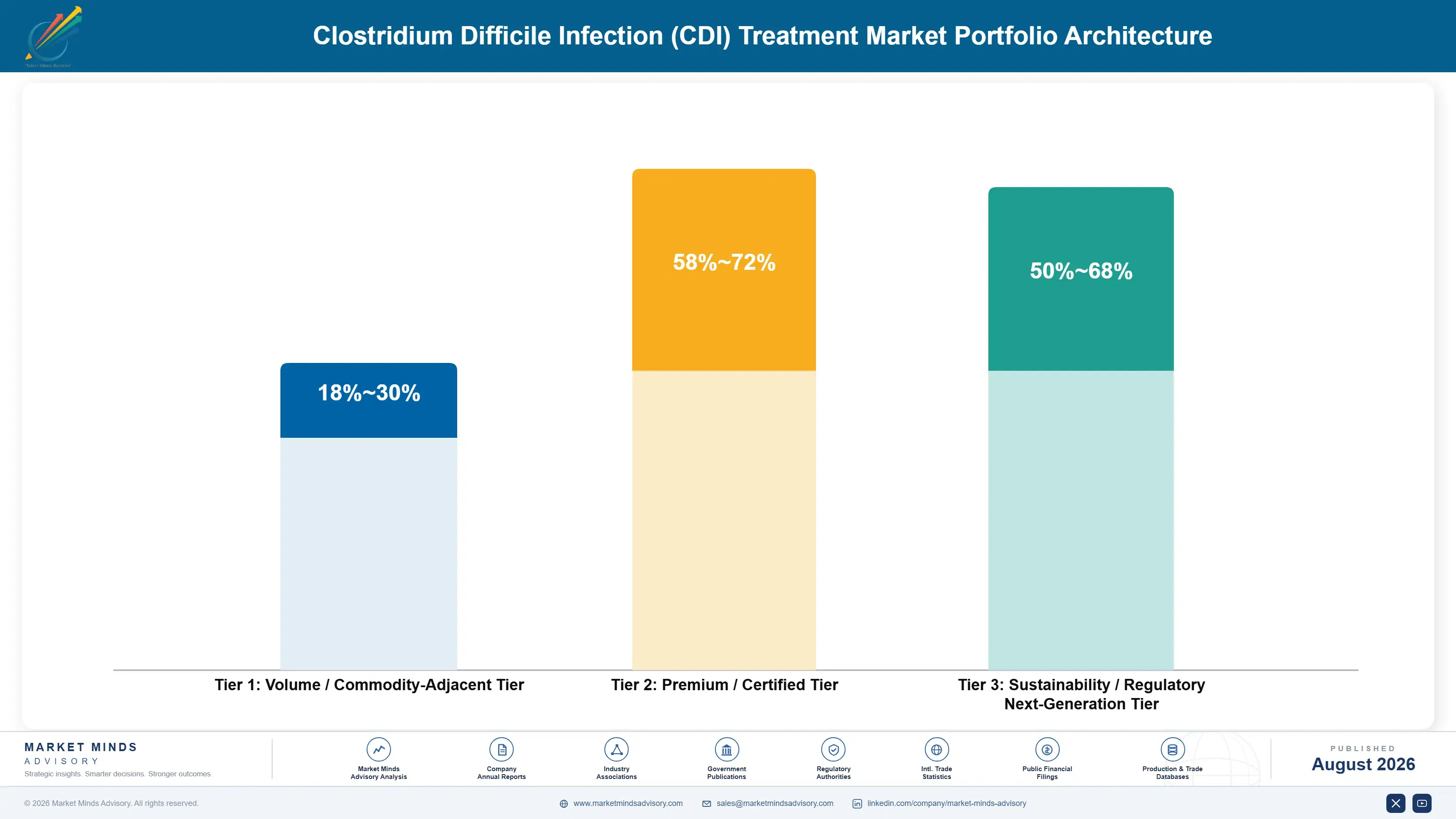
Volume / Commodity-Adjacent Tier
Generic oral vancomycin and metronidazole formulations treating acute episodes, competing purely on manufacturing cost against concentrated Chinese and Indian fermentation capacity operating at long-established cost advantages. Volume is enormous and value negligible.
Gross Margin: 18-30%
Premium / Certified Tier
Branded narrow-spectrum antibiotics holding guideline preference on recurrence-reduction grounds, protected by more than a decade of real-world evidence and by clinical cover that justifies the cost to prescribers. Generic entry eventually constrains the position.
Gross Margin: 58-72%
Sustainability / Regulatory / Next-Generation Tier
Approved live biotherapeutic products restoring gut flora rather than suppressing the organism, protected by manufacturing capability, donor infrastructure and regulatory precedent that competitors cannot assemble quickly. Donor screening attrition limits how quickly supply can scale.
Gross Margin: 50-68%

Episode Treatment Against Recurrence Prevention
Demand here is episodic rather than chronic, which removes the annuity that most therapeutic categories rely upon. A patient is diagnosed, treated for a defined course and either recovers or relapses, and nobody takes these products continuously. What recurs is the patient rather than the prescription, with roughly 25% relapsing after a first episode, and that relapse pattern is what creates repeat demand at considerably higher value.
Adoption depth varies sharply by institution rather than by geography. Academic tertiary centres with infectious disease services and dedicated antimicrobial stewardship teams adopt guideline-preferred and premium recurrence therapy readily, and several run donor transplantation programmes alongside. Community hospitals treat almost exclusively with generic vancomycin on cost grounds. Long-term care facilities, holding the frailest patients and highest recurrence risk, have the least access of any setting.
Prescriber profiles have shifted in a way that matters commercially. Infectious disease specialists once made most treatment decisions in referral centres; gastroenterologists now hold a substantial role given the microbiome mechanism and the procedural administration some products require. Pharmacy and therapeutics committees have become the effective decision makers on premium products, weighing budget impact rather than clinical preference, and that is who commercial teams must now actually persuade.

Where CDI Treatment Strategy Lands
These are among the four positions where our research anticipates prominent divergence between winners and laggards over the coming forecast period. Each is grounded in the demand model, the regulatory perimeter, and the announced capacity pipeline.
The first episode generates almost no revenue at all
A first episode is treated with generic oral vancomycin at around USD 180 a course, so essentially none of this category's value sits in acute treatment despite acute treatment covering nearly every diagnosed patient. Recurrent disease, affecting roughly 25% of patients after a first episode and considerably more thereafter, is where branded and premium therapy actually earn their pricing. Commercial strategy built around total diagnosed incidence rather than the recurrent patient population consistently misreads where the addressable revenue in this category genuinely lies.
Pharmacy pays while inpatient care collects the saving
An approved monoclonal antibody with efficacy nobody disputed was discontinued commercially because reimbursement never reached the scale its price required across the major markets it needed. The budgetary obstacle is that hospital pharmacy funds recurrence prevention while the avoided readmission cost accrues entirely to inpatient care, so the party paying for the therapy never observes the benefit it produces. Outcomes-based contracting and hospital-level budget impact modelling both address that split directly, and neither of them requires any further clinical evidence to be generated first.
Route determines addressable population, not just convenience
One approved live biotherapeutic requires rectal administration in a procedural setting while the other is taken orally, and that single difference decides which prescribers can use each product and which budget funds the treatment course. Community-onset disease represents 38% of all diagnosed cases and sits entirely outside the hospital procedural setting that rectal administration necessarily requires for delivery. Development programmes treating administration route as a secondary formulation question are constraining their own commercial ceiling from the very outset of a programme.
This market's best outcome shrinks its own base
Antimicrobial stewardship, environmental cleaning and two-step diagnostic algorithms distinguishing colonisation from active disease have all cut treated case volume meaningfully across developed health systems over the past decade. Hospital-onset infection still represents 62% of diagnosed cases, which means further prevention success bites directly into the addressable population that every participant is competing for. Growth must therefore come from recurrence value and from markets only now acquiring the diagnostic capability to identify patients, rather than from any rise in underlying incidence.
Engagement Snapshot From the Field
A live engagement with an industry participant carrying material or product regulatory and market exposure ahead of a defining policy shift, showing how our research translates into a defensible multi-year portfolio strategy.
MARKET MINDS ADVISORY · CLIENT ENGAGEMENT SUMMARY
Clostridium Difficile Infection (CDI) Treatment Producer Strategic Portfolio Review and Transition Roadmap 2026·Investment Scenario on Clostridium Difficile Infection (CDI) Treatment Exposure Evaluation 2025-26
CLIENT PROFILE
A microbiome therapeutics company holding an approved live biotherapeutic product for recurrence prevention, with commercial operations in a single major market and manufacturing built around donor recruitment and screening. Annual product revenue was approximately USD 85 million (client-reported, unverified by MMA), running materially below the trajectory that had supported the original development investment case. Donor screening attrition constrained supply planning throughout.
STRATEGIC CHALLENGE
Payer resistance to course pricing had slowed uptake well below forecast, with several health systems referencing donor-derived transplantation performed informally at academic centres as a free comparator. The board needed to determine whether the access problem required price concession, a different evidence strategy, or a change in how the product was positioned against the recurrent disease population entirely.
MMA APPROACH
MMA conducted 47 expert interviews spanning infectious disease physicians, gastroenterologists, hospital pharmacy directors, pharmacy and therapeutics committee members, payer medical directors and long-term care clinical leads across six countries. A quantitative survey of 3,800 respondents established treatment escalation behaviour, recurrence experience and institutional decision authority. We then modelled uptake and revenue outcomes under price concession against an institution-level evidence strategy using observed formulary decisions.
KEY FINDINGS
- Pharmacy and therapeutics committees, not clinicians, held effective decision authority on the product in five of six markets, and most had never seen institution-specific cost data.
- Clinicians uniformly accepted the efficacy evidence and reported that price rather than performance was the obstacle raised in every formulary discussion they attended.
- Long-term care facilities held the highest recurrence risk population and the poorest access to premium therapy, a mismatch nobody in the commercial organisation had quantified.
- Donor-derived transplantation was referenced as a comparator far more often by payers than by treating clinicians, who cited standardisation and safety concerns about it.
CLIENT PROFILE
A microbiome therapeutics company holding an approved live biotherapeutic product for recurrence prevention, with commercial operations in a single major market and manufacturing built around donor recruitment and screening. Annual product revenue was approximately USD 85 million (client-reported, unverified by MMA), running materially below the trajectory that had supported the original development investment case. Donor screening attrition constrained supply planning throughout.
STRATEGIC CHALLENGE
Payer resistance to course pricing had slowed uptake well below forecast, with several health systems referencing donor-derived transplantation performed informally at academic centres as a free comparator. The board needed to determine whether the access problem required price concession, a different evidence strategy, or a change in how the product was positioned against the recurrent disease population entirely.
MMA APPROACH
MMA conducted 47 expert interviews spanning infectious disease physicians, gastroenterologists, hospital pharmacy directors, pharmacy and therapeutics committee members, payer medical directors and long-term care clinical leads across six countries. A quantitative survey of 3,800 respondents established treatment escalation behaviour, recurrence experience and institutional decision authority. We then modelled uptake and revenue outcomes under price concession against an institution-level evidence strategy using observed formulary decisions.
KEY FINDINGS
- Pharmacy and therapeutics committees, not clinicians, held effective decision authority on the product in five of six markets, and most had never seen institution-specific cost data.
- Clinicians uniformly accepted the efficacy evidence and reported that price rather than performance was the obstacle raised in every formulary discussion they attended.
- Long-term care facilities held the highest recurrence risk population and the poorest access to premium therapy, a mismatch nobody in the commercial organisation had quantified.
- Donor-derived transplantation was referenced as a comparator far more often by payers than by treating clinicians, who cited standardisation and safety concerns about it.
RECOMMENDED STRATEGY
Phase 1: Phase one: build institution-level readmission and cost evidence for target hospitals, addressing the pharmacy committee audience rather than the clinical one. Phase 2: Phase two: hold list price and pursue outcomes-based contracts that shift risk, since concession without evidence resets the reference point permanently. Phase 3: Phase three: develop a long-term care access route, where recurrence risk is highest and no participant currently competes for the population.
OUTCOME
The client held list price, redirected roughly USD 12 million from further trial work into institution-level evidence generation (client-reported, unverified by MMA), and established a long-term care commercial programme. Formulary additions accelerated across target hospitals within three quarters, and the long-term care channel delivered volume the original plan had not counted at all.
Frequently Asked Questions
Foundational context covering the market sizes, CAGR, scope, country, region and competition that inform every finding below. This section is provided to cover basics and most often pre-purchase conversations, answered from the MMA Primary Research Dataset.
What is the current size of the Clostridium Difficile Infection (CDI) Treatment Market?
The global CDI treatment market was valued at USD 1.4 billion in 2025, spanning glycopeptide, macrocyclic and nitroimidazole antibiotics, live biotherapeutics and monoclonal antibodies. Roughly 62% of diagnosed infections are hospital-onset.
How large will the Clostridium Difficile Infection (CDI) Treatment Market be by 2036?
MMA forecasts the market at USD 3.61 billion by 2036, expanding 2.36 times from the 2026 base of USD 1.53 billion. That represents roughly USD 2.08 billion of incremental value across the forecast decade.
What is the CAGR for the Clostridium Difficile Infection (CDI) Treatment Market 2026 to 2036?
The base case compound annual growth rate is 9.0%, with a bull case of 10.2% and a bear case of 7.8%. The bull case assumes payers reimburse live biotherapeutics broadly on avoided-hospitalisation economics.
Which segment is growing fastest?
Live biotherapeutic products grow at 13.5%, a full 1.50x the overall market rate. Restoring gut flora addresses the actual cause of recurrence rather than suppressing the organism with further antibiotics.
Who are the major companies in the Clostridium Difficile Infection (CDI) Treatment Market?
Ferring Pharmaceuticals, Astellas Pharma, Nestlé Health Science, Merck and ANI Pharmaceuticals together hold 74% of revenue. They lead on entirely different product classes, from live biotherapeutics to generic vancomycin.
Which country is growing fastest?
China grows fastest at 13.8%, as hospital laboratories add toxin and molecular testing capability and measured incidence rises accordingly. North America remains the largest region at 34% of value.
Report Segmentation Architecture
The full report scope spans multiple orthogonal segmentation dimensions, with cross-tabulated demand data provided for each dimension pair. Coverage extends further to regional breakdowns, trend trajectories, and the competitive detail needed to support segment-level decision-making.
By Therapeutic Class
- Glycopeptide Antibiotics
- Macrocyclic Antibiotics
- Nitroimidazole Antibiotics
- Live Biotherapeutic Products
- Monoclonal Antibody Therapeutics
By End-Use Industry
- Academic and Tertiary Hospitals
- Community and District Hospitals
- Long-Term Care Facilities
- Outpatient Infectious Disease Services
- Gastroenterology Practices
- Retail and Specialty Pharmacy
By Commercial Dimension
- Hospital Formulary Contracting
- Outcomes-Based and Risk-Sharing Agreements
- Retail and Specialty Pharmacy Dispensing
- Group Purchasing Organisation Supply
- National Tender and Reimbursement Listing
- Compassionate and Named-Patient Access
By Region
- North America
- Western Europe
- East Asia
- South Asia and Pacific
- Latin America
- Middle East and Africa
- Eastern Europe
Scope, Methodology, and Coverage
Every figure in this report is reproducible from documented input assumptions. The scope below maps the historical period, the forecast horizon, the segmentation dimensions, and the countries covered, alongside the underlying primary and qualitative methodology.
Historical Period
2020 to 2025
Forecast Period
2026 to 2036
Base Year
2025 (USD billions; MMA Primary Research Dataset, August 2026)
Market Definition
This market comprises therapeutics indicated for the treatment of Clostridioides difficile infection or for the prevention of its recurrence, measured at manufacturer revenue across hospital formulary contracting, outcomes-based agreements, retail and specialty pharmacy dispensing, group purchasing supply, national tender listing and named-patient access. Coverage spans glycopeptide antibiotics including oral vancomycin formulations, macrocyclic antibiotics, nitroimidazole antibiotics, approved live biotherapeutic products administered by oral or rectal route, and monoclonal antibody therapeutics indicated for recurrence prevention. Diagnostic testing products and laboratory services, infection prevention and environmental disinfection products, probiotics and dietary supplements without an approved indication, investigational vaccines, donor-derived faecal transplantation performed under institutional protocols without a marketed product, and hospital service or procedure revenue associated with administration fall outside scope.
Quantitative Units
USD millions (current prices); treatment courses supplied by class; diagnosed and treated case volumes; average course price; recurrence rate; hospital-onset share; formulary listings held
Segmentation Dimensions
By Therapeutic Class; By End-Use Industry; By Commercial Dimension; By Region
Regions Covered
North America, Western Europe, East Asia, South Asia and Pacific, Latin America, Middle East and Africa, Eastern Europe
Countries Covered
United States, Canada, Mexico, Germany, France, United Kingdom, Italy, Spain, Netherlands, Sweden, Denmark, China, Japan, South Korea, Taiwan, India, Australia, Thailand, Indonesia, Brazil, Argentina, Colombia, Chile, Saudi Arabia, United Arab Emirates, Israel, South Africa, Poland, Czechia, Hungary, Romania, and additional markets relevant to infectious disease therapy analysis
Key Companies Profiled
Ferring Pharmaceuticals, Astellas Pharma, Nestlé Health Science, Merck and Co., ANI Pharmaceuticals, Seres Therapeutics, Tillotts Pharma, Azurity Pharmaceuticals, Vedanta Biosciences, Destiny Pharma, Acurx Pharmaceuticals, Summit Therapeutics, Da Volterra, MaaT Pharma, Finch Therapeutics, Fresenius Kabi, Sandoz, Teva Pharmaceutical Industries, Xellia Pharmaceuticals, Nabriva Therapeutics
Quantitative Methodology
Primary survey, n=3,800 respondents, Q4 2025, six countries; demand-side model with trade association cross-validation
Qualitative Methodology
47 expert interviews, Q4 2025; applied to validate demand model assumptions, identify emerging dynamics, and assess competitive positioning
Report Format
PDF and XLSX data workbook (Word format preview document)
Publisher
Market Minds Advisory
Report Code
MMA-2026-HLT-269
Published
August 2026
Contact
sales@marketmindsadvisory.com | www.marketmindsadvisory.com
Purchase the full Clostridium Difficile Infection (CDI) Treatment Market Report (2026 to 2036).
The full MMA report separates acute episode treatment, which generates almost no revenue, from recurrence prevention, where essentially all of this category's value sits. It sizes five therapeutic classes and seven regions to 2036, modelling treated case volumes, course pricing, recurrence rates, diagnostic penetration and formulary access separately so that premium therapy demand can be assessed on its own terms. Competitive assessment covers twenty developers and suppliers on one consistent revenue basis. Cost exposure is traced through donor screening, fermentation and evidence generation. Four commercial levers and a strategic verdict close the report, grounded in 47 expert interviews and a 3,800-respondent survey.
Five therapeutic classes sized separately through 2036
Recurrence population modelled apart from total diagnosed incidence
Diagnostic penetration mapped against treated case volume growth
Twenty suppliers assessed on one consistent revenue basis
Payer access barriers quantified by institution type and geography
Anonymised client engagement with tested strategic recommendations
Built For The People Who Decide
From boardroom strategy to bench-side execution, this report is read cover-to-cover by leaders shaping the next decade of their industry, turning demand scenarios, market dynamics and valuation benchmarks into decisions.
CXOs/ Presidents/ VPs/ Managers
M&A and Corporate Development
Strategy Teams and R&D Heads
Procurement and Product Directors
Regulatory and Compliance Leaders
Investor Relations and Equity Analysts