Market Minds Advisory
Tricalcium Citrate Market

Tricalcium Citrate Market: Defined by Who Cannot Use the Alternative

It costs about four times the carbonate salt and carries half the calcium per gram, and the entire commercial case rests on people whose stomachs cannot absorb the cheaper option at all.

Lead Analyst

Bilal Shaikh

Published

September 2026

Make Smarter Decisions with Customized Research Insights

Request a free sample report and evaluate market opportunities, growth trends, and competitive dynamics relevant to your business needs.

2025 MARKET VALUE$0.4BMarket Size 2025
2036 FORECAST VALUE$0.8BBase Case , 2026 to 2036
CAGR 2026 TO 20366.4 %Bull 7.6% / Bear 5.2%
INCREMENTAL OPPORTUNITY$0.4BNet 10- year value creation
EXPANSION MULTIPLE1.87x2036 value over 2026 base
Strategic Levers
M&A Pipeline
Regional Outlook
Country Rankings
Competitive Intelligence
Segmental Deep-dive
Call-Us : 91 93563 13602

Executive Snapshot and Market Trajectory

On every measure the ingredient industry usually competes on, this product loses. It costs around four times calcium carbonate and delivers only 21% elemental calcium against roughly 40%, so cost per milligram of usable calcium is not a comparison worth having at all. Formulators reach the obvious conclusion.
The case rests entirely on people who cannot absorb the cheaper salt. Carbonate needs gastric acid and citrate does not, which matters for the roughly 18% of older adults on continuous acid suppression, for bariatric surgery patients and for anybody with reduced stomach acid. That is a prescribing pattern in another industry defining an ingredient market. Suppliers watching supplement category growth are monitoring the wrong indicator entirely.
Physical bulk rather than price is the practical constraint on formulation. Delivering a standard calcium serving takes about 2.4 grams of material, which makes a large tablet. Granulated and direct compression grades grow at 9.6%, half again the market rate of 6.4%, because better compressibility is the only route to a swallowable dose. Formulators describe finished tablet size rather than ingredient cost as the binding constraint. Tablet size decides whether patients keep taking it.
Market Definition
Tricalcium dicitrate supplied as a calcium source ingredient, covering food grade powder, pharmaceutical grade, granulated and direct compression grades, micronised and fine particle grades, beverage soluble grades, and feed and technical grades. Measured at producer selling value. Excludes calcium carbonate and other calcium salts, citric acid and citrate salts of other metals, finished supplement and pharmaceutical products, and fortified foods measured at retail.
Base Year Value
$0.4B in 2025 (MMA Primary Research Dataset, August 2026)
Forecast Period
2026 to 2036, eleven discrete annual values
CAGR
6.4% base case. Bull 7.6%. Bear 5.2%.
Fastest Growth Segment
Granulated and Direct Compression Grades: 9.6% CAGR
Fastest Growth Country
India: 10.2% CAGR
Fastest Growth Region
South Asia and Pacific: 8.4% CAGR
Largest Region
North America: 30% of 2025 global value
Market Leaders
Jungbunzlauer, Gadot Biochemical Industries, Dr Paul Lohmann, Global Calcium, Sucroal. Source: MMA Primary Research Dataset, July 2026.
Primary Survey
n=3,800 procurement and R&D decision-makers, Q4 2025, six countries
Methodology
Demand-side build-up, cross-validated against public data, 47 expert interviews

Tricalcium Citrate Market Forecast Scenarios

tricalcium-citrate-market-trends-size-forecast-scenario-1787640187723
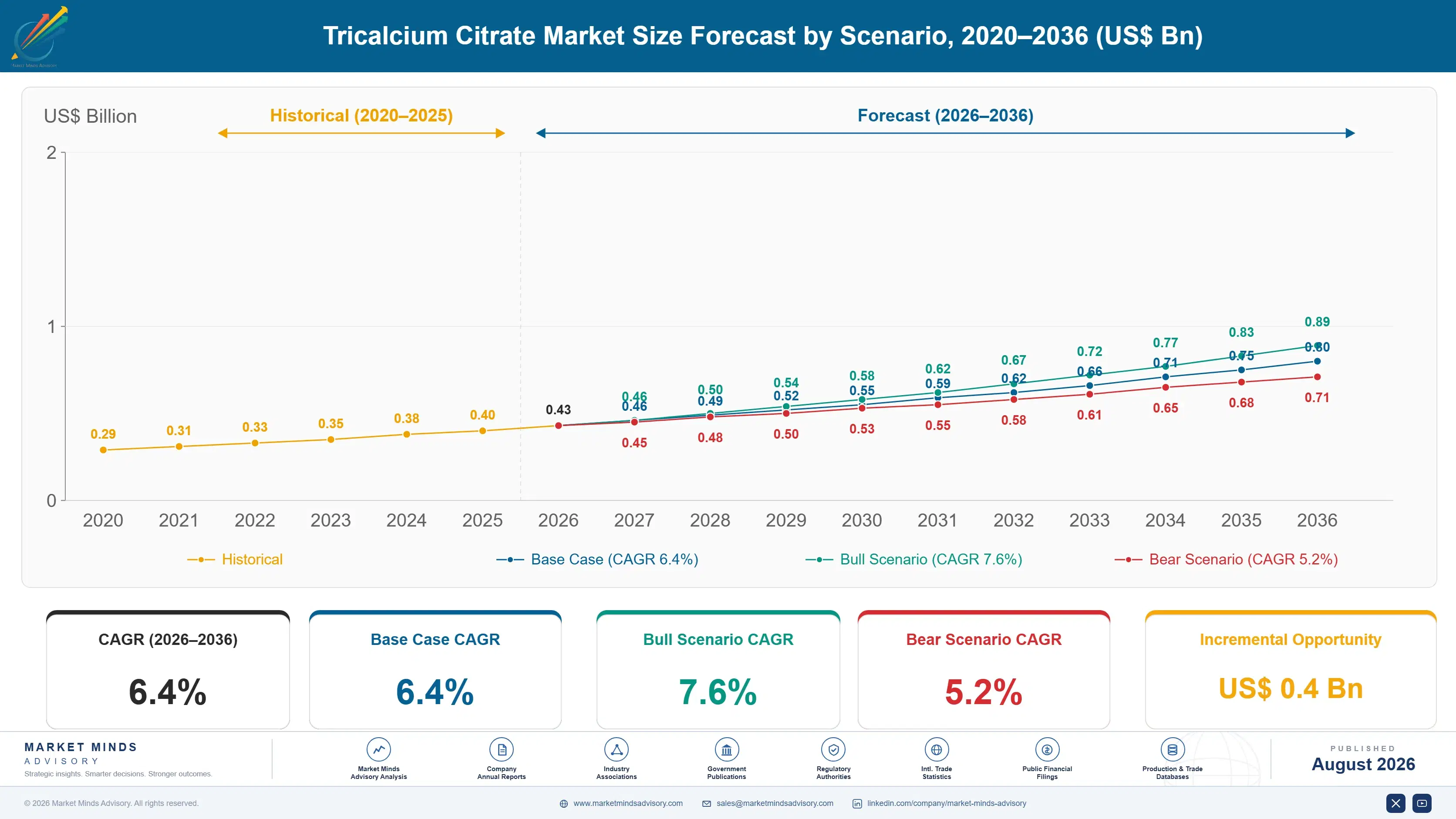
Growth ran near 5.0% between 2020 and 2025 as supplement formulators moved toward citrate for older adult and post-surgical products where absorption arguments hold. Beverage fortification grew faster than tablet applications throughout, particularly across plant based milks where sedimentation decides the formulation. Chinese citrate production capacity expanded considerably, which held pricing down against a demand base growing steadily.
Base case 6.4% rests on three mechanisms. Granulated and direct compression grades grow at 9.6% because tablet bulk rather than cost is what actually limits formulation. Micronised grades grow at 8.2% on beverage suspension and mouthfeel requirements. And India grows fastest of any country at 10.2% on supplement market expansion, domestic manufacturing and very high acid suppression prescribing all coinciding. None depends on calcium consumption rising, which moves very slowly.
The bull case at 7.6% assumes acid suppression prescribing continuing to widen in older populations, which would expand the group unable to absorb carbonate and reset the addressable base upward. The bear case at 5.2% is carbonate formulations improving absorption through co-factors or delivery systems, since a cheaper salt that solved its own absorption problem would remove most of this market's reason to exist.

Sold on a Stomach That Does Not Work

Nobody buys this ingredient on the metrics an ingredient is normally judged by. It costs roughly four times calcium carbonate and contains 21% elemental calcium against carbonate's 40%, so a formulator paying attention to cost per milligram of delivered calcium reaches an obvious conclusion and buys the other one. The comparison only inverts when the person swallowing it cannot absorb carbonate.
TOP FIVE CONCENTRATION52%Citrate producers and specialist salt makers hold different positions
ELEMENTAL CALCIUM CONTENT21%Share of the salt that is actually usable calcium
CARBONATE COST MULTIPLE4xPrice against the carbonate salt it competes with
ABSORPTION WITHOUT ACID24%Uptake carbonate achieves when gastric acid is absent
MATERIAL PER STANDARD DOSE2.4 gramsSalt needed to deliver one standard calcium serving
CONTINUOUS ACID SUPPRESSION18%Older adults on long term proton pump inhibitor therapy
That condition is more common than the ingredient industry generally appreciates. Carbonate requires gastric acid to dissolve, and absorption falls to around 24% when acid is suppressed. Roughly 18% of older adults take continuous proton pump inhibitors, bariatric surgery permanently alters gastric acid production, and achlorhydria rises with age regardless. The addressable population for this ingredient is therefore defined by prescribing patterns in an entirely different industry.
The practical constraint on using it is physical rather than commercial. Delivering a standard calcium serving requires around 2.4 grams of tricalcium citrate, which makes a tablet large enough that patients split doses or stop taking it. Granulated and direct compression grades grow at 9.6% because compressibility determines how small that tablet can be made. Bulk, not price, is what formulators actually struggle with here.
"The whole market exists because a lot of people are taking something that stops their stomach making acid. Nobody selling this ingredient watches prescribing data, which is odd, because that data is the market."
Director, Nutrition Ingredients and Mineral Salts Practice · MMA Chemicals and Materials Practice · August 2026

Market Trends

Acid suppression prescribing defining the addressable population

Carbonate absorption falls to around 24% without gastric acid, and roughly 18% of older adults take continuous proton pump inhibitors, which makes the addressable base for citrate a function of prescribing rather than of nutrition trends. Suppliers tracking supplement category growth are watching the wrong indicator entirely. Prescribing data is published, widely available and predicts this market considerably better than anything the ingredient industry currently monitors. Bariatric surgery volumes and age related achlorhydria widen the same group further, and neither appears in supplement market data anywhere. Nobody in this industry watches prescribing.
Market Impact: India growing fastest at 10.2%
Tablet bulk driving demand toward compressible grades

Delivering a standard calcium serving takes about 2.4 grams of material at 21% elemental content, which produces a tablet large enough that patients split doses or abandon them entirely. Granulated and direct compression grades grow at 9.6% because compressibility is the only lever available on finished tablet size. Formulators describe bulk rather than ingredient cost as the binding constraint, which reframes what a supplier should actually be selling. Suppliers competing on purity specification are answering a question formulators settled years ago and no longer discuss at all. Bulk density and flow decide selection.
Market Impact: Micronised grades growing 8.2%

Market Opportunities and Growth Drivers

Supplement expansion coinciding with heavy acid suppression use

India grows fastest of any country at 10.2% as supplement market expansion, domestic ingredient manufacturing and unusually heavy proton pump inhibitor prescribing all coincide in the same market. Each factor alone would produce moderate growth and together they compound. Suppliers organised around established supplement geographies are covering markets where both the population and the prescribing base stopped expanding some years ago. Identifying where the three factors overlap is straightforward from published data, and almost nobody does it systematically at all. Each factor alone would produce only moderate growth, and the three together compound into something considerably more interesting.
Market Impact: Costs about 4 times carbonate

Beverage fortification rewarding suspension and clarity behaviour

Micronised grades grow at 8.2% because calcium fortified plant milks and clear beverages fail commercially on sedimentation and chalky mouthfeel long before anybody assesses the nutrition. Citrate suspends considerably better than carbonate at equivalent calcium loading. That is a physical formulation property rather than a nutritional one, and it wins applications where the absorption argument carries no weight at all with the buyer. Particle size distribution rather than chemistry decides suspension behaviour, which makes this a separate technical conversation from the supplement argument entirely. Absorption carries no weight with these buyers.
Market Impact: Carbonate holds 40% elemental calcium

Market Restraints and Challenges

Cost per unit of calcium losing every unconstrained comparison

Tricalcium citrate costs around four times carbonate and delivers 21% elemental calcium against roughly 40%, so cost per milligram of usable calcium runs many times higher. The root cause is chemistry rather than any production inefficiency. Commercially it confines the ingredient to applications where absorption or suspension genuinely matters. Population specific positioning and formulation support are the only mitigations, since no process improvement closes that gap. The comparison only inverts where the person swallowing it cannot absorb the cheaper salt at all. Chemistry rather than efficiency sets that gap, and no process improvement closes it.
Market Impact: Absorption falls to 24% without acid

Carbonate absorption improvements threatening the whole rationale

The market exists because carbonate needs gastric acid, and delivery systems or co-factors improving carbonate uptake without acid would remove most of the reason to pay four times more. The root cause is that the advantage rests on a single mechanism rather than several. Commercially it is a concentrated risk. Broadening into suspension and formulation properties that carbonate cannot match regardless is the practical hedge available. Suspension and mouthfeel depend on particle physics that carbonate cannot match whatever happens to dissolution. Beverage positions are the practical hedge. Diversification differs from hedging.
Market Impact: Needs 2.4 grams per dose
4 additional market trends, 3 additional growth drivers, and 2 additional restraints and challenges are covered in the full report. Contact sales@marketmindsadvisory.com to access the complete intelligence.

Segment CAGR and Growth Architecture

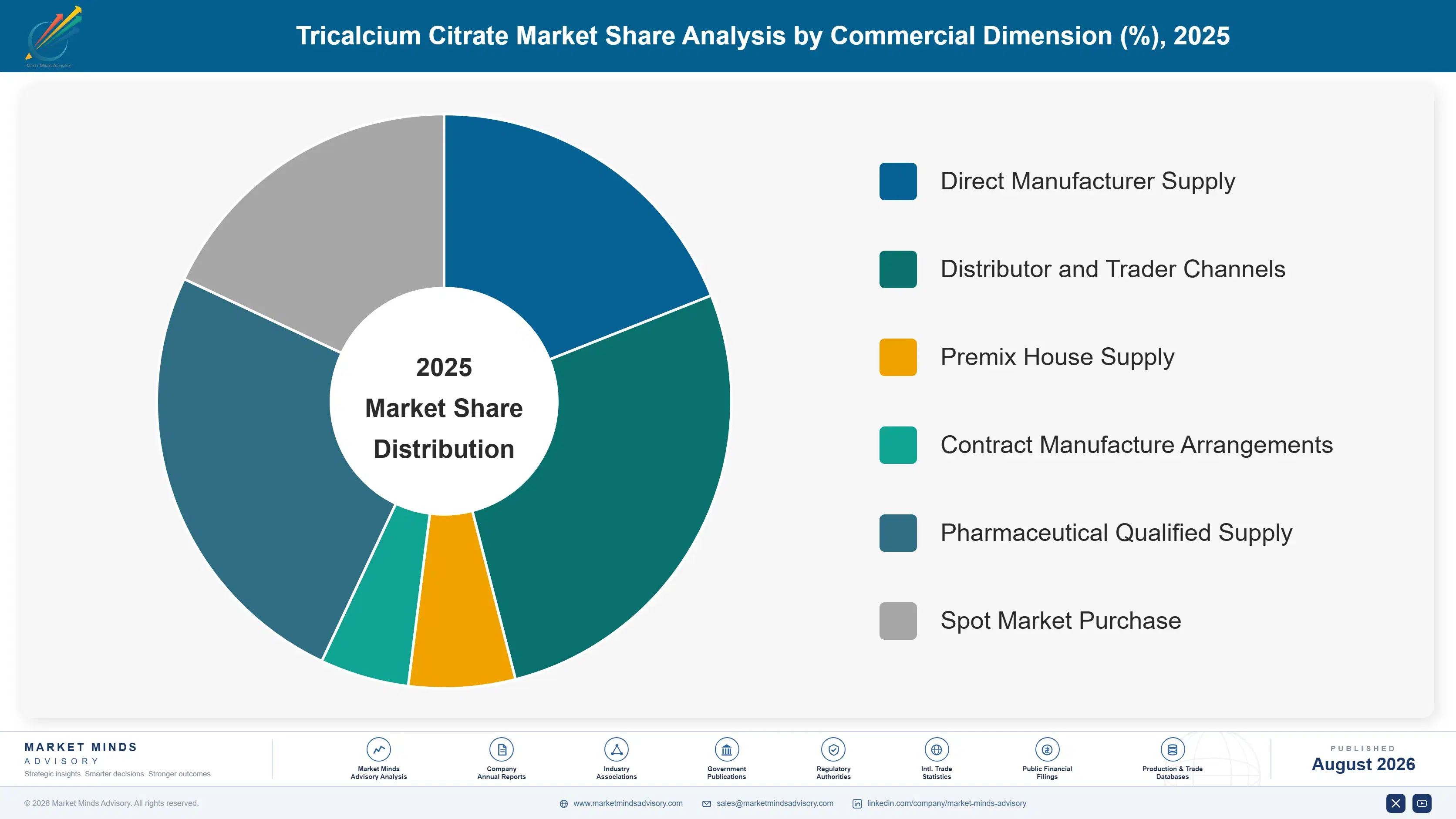
Six segments split by grade as supplied, because grade determines the particle behaviour delivered, the formulation problem it solves, the regulatory documentation attached and the price it commands. Packaging and purity variants sit inside each grade. Application and channel dimensions are handled separately within the framework here. Grade decides the commercial position, since the molecule is identical everywhere.
tricalcium-citrate-market-trends-market-share-analysis-1787640188280

Granulated and Direct Compression Grades

Growing at 9.6%, half again the market rate of 6.4%, granulated and direct compression grades address the binding constraint in tablet formulation, which is bulk rather than cost. A standard calcium serving needs around 2.4 grams of material at 21% elemental content, and compressibility determines whether that becomes a swallowable tablet or one patients abandon. Suppliers selling on purity specification are answering a question formulators stopped asking, while bulk density and flow decide the actual selection. Patients who abandon a tablet because it is too large deliver no clinical benefit and no repeat purchase either, which makes adherence a commercial variable rather than merely a clinical one. Bulk is the binding constraint.
CAGR 9.6%

Micronised and Fine Particle Grades

At 8.2% micronised grades serve beverage fortification where sedimentation and chalky mouthfeel kill products long before anybody evaluates the nutrition label. Particle size distribution rather than chemistry decides suspension behaviour, and calcium fortified plant milks have become the largest growth application. The absorption argument carries no weight with these buyers at all, which makes this a genuinely separate commercial conversation from the supplement and pharmaceutical positions entirely. Calcium fortified plant milks have become the largest growth application, and sedimentation kills those products commercially long before anybody reads the nutrition panel on the carton. Mouthfeel matters more than milligrams here, which makes it a wholly separate commercial conversation from the supplement position.
CAGR 8.2%
Full segment breakdown across 6 segments available in the complete report.

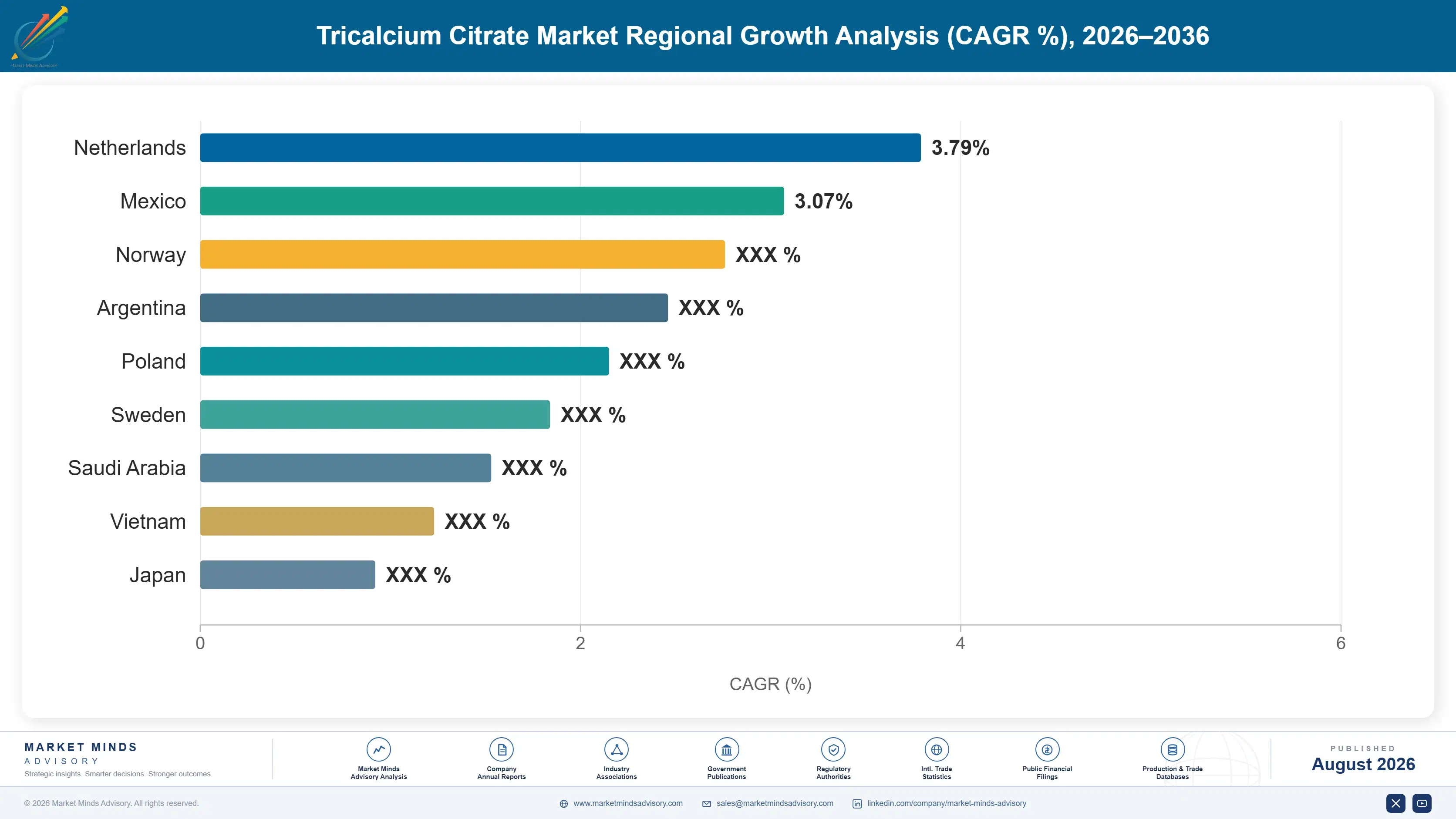
Regional Architecture and Country Demand Map

North America holds 30% of value on supplement consumption per head and heavy acid suppression prescribing together. East Asia follows at 26% on citrate production capacity and expanding domestic supplement demand. South Asia and Pacific grows fastest of the seven regions covered here. Prescribing drives both.

North America

Supplement consumption per head is the highest anywhere and proton pump inhibitor prescribing in older adults is heavy enough to define a substantial addressable population on its own. Bariatric surgery volumes are also the largest globally, and post-surgical calcium protocols specify citrate rather than carbonate as standard practice. Beverage fortification is well established. Growth at 5.4% reflects a mature consumption base rather than any limit on the underlying argument. Post-surgical calcium protocols specify citrate as standard rather than as a preference, which makes clinical guidance rather than consumer choice the decisive factor there. Bariatric surgery volumes are the largest globally, which adds a substantial permanently acid altered population to the base.
Share: 30% | CAGR: 5.4% (2026 to 2036)

Western Europe

Clinical guidance on calcium supplementation in acid suppressed patients is more explicit here than in most regions, which supports citrate specification in medical nutrition and pharmacy channels. Supplement consumption is lower per head than North America and more concentrated in pharmacy rather than retail. Plant based beverage fortification is growing quickly. Regional growth of 5.0% is the slowest anywhere on mature supplement consumption and stable populations. Pharmacy channels rather than general retail carry most bone health products, which favours clinical specification over price comparison at the point of sale. Clinical guidance on supplementation in acid suppressed patients is more explicit here than in most regions, which supports citrate specification directly.
Share: 22% | CAGR: 5.0% (2026 to 2036)
Regional intelligence for 5 additional markets available in the complete report: East Asia, South Asia and Pacific, Latin America, Middle East and Africa, Eastern Europe. Contact sales@marketmindsadvisory.com.
tricalcium-citrate-market-trends-country-cagr-analysis-1787640188821

Four Moves Around an Expensive Salt

This ingredient cannot win a cost comparison and does not need to, because its buyers are defined by a physiological condition rather than by a price point. What remains available is tracking the prescribing that creates the market, selling bulk rather than purity, and holding the properties carbonate cannot copy. Purchasing is the wrong audience entirely.

Track prescribing data rather than supplement categories

Carbonate absorption falls to around 24% without gastric acid and roughly 18% of older adults take continuous acid suppression, which makes prescribing the true demand indicator. Suppliers watching supplement category growth are monitoring something only loosely related to their own addressable base. Prescribing data is published and freely available, and remarkably nobody in this ingredient industry uses it for commercial planning at all. The market is defined elsewhere. Achlorhydria rises with age regardless of medication, and bariatric surgery alters gastric acid production permanently, which widens the same population further. Nobody tracks it.
Market Impact: Tracks the 18% on continuous acid suppression therapy

Sell bulk density rather than purity specification

A standard calcium serving needs about 2.4 grams of material, and formulators describe tablet size rather than ingredient cost as their binding constraint. Suppliers competing on purity specification are answering a question that was settled years ago. Granulated and direct compression grades growing at 9.6% address what actually limits the formulation, and selling compressibility data reaches the formulator rather than the purchasing department. Purchasing departments compare specifications while formulation scientists compare behaviour, and only one of those conversations can be won on this ingredient. Only one of those conversations is winnable.
Market Impact: Reduces the whole 2.4 gram tablet dose bulk

Hold the physical properties carbonate cannot match

Suspension behaviour and mouthfeel in fortified beverages depend on particle physics rather than on absorption, and carbonate cannot match citrate there whatever happens to its dissolution chemistry. Micronised grades grow at 8.2% on that basis. Building position in beverage applications hedges the concentrated risk that improved carbonate delivery would otherwise pose to a market resting on one physiological mechanism. Concentrated risk in one mechanism is uncomfortable however good the science supporting it currently is. Particle physics does not change when dissolution chemistry improves, which makes beverage positions durable in a way the supplement argument is not.
Market Impact: Micronised grades growing at 8.2% each single year

Follow markets where three drivers coincide at once

India grows fastest at 10.2% because supplement expansion, domestic manufacturing and heavy acid suppression prescribing all coincide, and each alone would produce only moderate growth. Suppliers organised around established supplement geographies are covering markets where both population and prescribing stopped expanding years ago. Identifying where the three overlap is straightforward from published data and almost nobody does it systematically. Each factor alone produces only moderate growth, and together they compound into something considerably more interesting. Published data makes the overlap easy to find, and almost nobody looks for it. Coverage rarely follows.
Market Impact: Follows the 10.2% Indian ingredient demand growth rate

Who Controls the Margin Pool

Participation is measured on annual revenue from tricalcium citrate production and supply, and the top five hold 52%. Concentration is moderate because integrated citric acid producers and specialist mineral salt makers compete from quite different cost positions on the same product. The gap to challengers is citrate integration in commodity grades and engineering capability in the rest, which are entirely different sources of advantage.
Competition runs on three fronts. Citrate integration decides base cost, where producers making their own citric acid hold clear advantage. Grade capability decides access to tablet and beverage applications. And documentation depth decides pharmaceutical positions, where qualification takes months. Each front rewards a different capability, and very few participants hold all three of them properly.

Pressure ahead comes from formulators buying on bulk density and from beverage applications growing faster than tablets. Expect suppliers with grade engineering capability to gain against commodity producers. Rankings shift on whoever sells the formulation problem rather than the specification. Concentration should stay moderate given the split positions. Merchant citrate buyers without grade engineering capability look most exposed, since they carry the input cost and hold none of the differentiation.
tricalcium-citrate-market-trends-company-positioning-matrix-1787640189363

Competitive Moat and Risk Dimensions

JUNGBUNZLAUER

Moat: Citrate integration and grade breadth

Producing citric acid upstream of the calcium salt gives a cost position that buyers of merchant citrate cannot match, particularly on an ingredient where raw material dominates cost. Grade breadth across food, pharmaceutical and beverage applications also lets the business serve a formulator's whole requirement rather than competing for one specification at a time.
JUNGBUNZLAUER

Risk: Single mechanism market dependence

The commercial case rests almost entirely on carbonate requiring gastric acid, and any delivery system improving carbonate absorption without acid would remove most of the reason to pay four times more. That risk is concentrated in one mechanism rather than spread across several, which makes it unusually difficult to hedge from inside the product itself.
GADOT BIOCHEMICAL INDUSTRIES

Moat: Mineral salt specialisation and documentation

Deep specialisation across mineral salts supports pharmaceutical and clinical nutrition positions where documentation, qualification and consistency matter more than delivered price. Those qualifications take months to establish and customers rarely revisit them, which converts technical depth into positions considerably more durable than any cost advantage would be.
GADOT BIOCHEMICAL INDUSTRIES

Risk: Chinese citrate cost pressure

Chinese citrate capacity supplies much of the world and sets reference pricing that reaches every market through trade, which compresses margin on food grade material where documentation carries less weight. Defending it requires grade engineering and application support that commodity buyers frequently decline to pay for at all.

Players Tracked

Prominent Players

Jungbunzlauer
Gadot Biochemical Industries
Dr Paul Lohmann
Global Calcium
Sucroal

Other Key Players

Tate and Lyle
Cargill
Anhui Xingzhou Medicine Food
Weifang Ensign Industry
RZBC Group
TTCA
COFCO Biochemical
Merck KGaA
Thermo Fisher Scientific
Spectrum Chemical
Nikunj Chemicals
Krishna Chemicals
Balchem
Innophos
Prinova Group

Recent Developments

MARCH 2026

Supplement brand reformulates for acid suppressed consumers

A supplement brand launched a calcium range formulated specifically for consumers on long term acid suppression therapy, positioning against a physiological condition rather than an age group and citing absorption evidence directly on pack. Retail placement followed pharmacy recommendation rather than general supplement shelving. The positioning proved unusually precise.
Signal: Prescribing patterns in an entirely separate industry come to define this ingredient's addressable population almost completely
SEPTEMBER 2025

Formulator selects grade on compressibility rather than purity

A tablet formulator selected its calcium citrate grade on bulk density and compression behaviour rather than on purity specification, having concluded that finished tablet size determined patient adherence more than any other variable. Purity had been identical across every grade evaluated. Bulk density varied considerably between suppliers.
Signal: Formulators buy the bulk behaviour while their suppliers keep on competing over purity specifications nobody reads
JANUARY 2026

Plant milk producer switches calcium source over sedimentation

A plant based beverage producer switched its calcium source to a micronised citrate grade after persistent sedimentation and chalky mouthfeel affected consumer acceptance, with nutritional equivalence never in question at any point. Nutritional equivalence was never questioned at any stage. Consumer acceptance decided everything. Reformulation took one quarter.
Signal: Physical behaviour rather than nutrition ultimately decided the selection of a nutrition ingredient in this case

Citric Acid and Lime

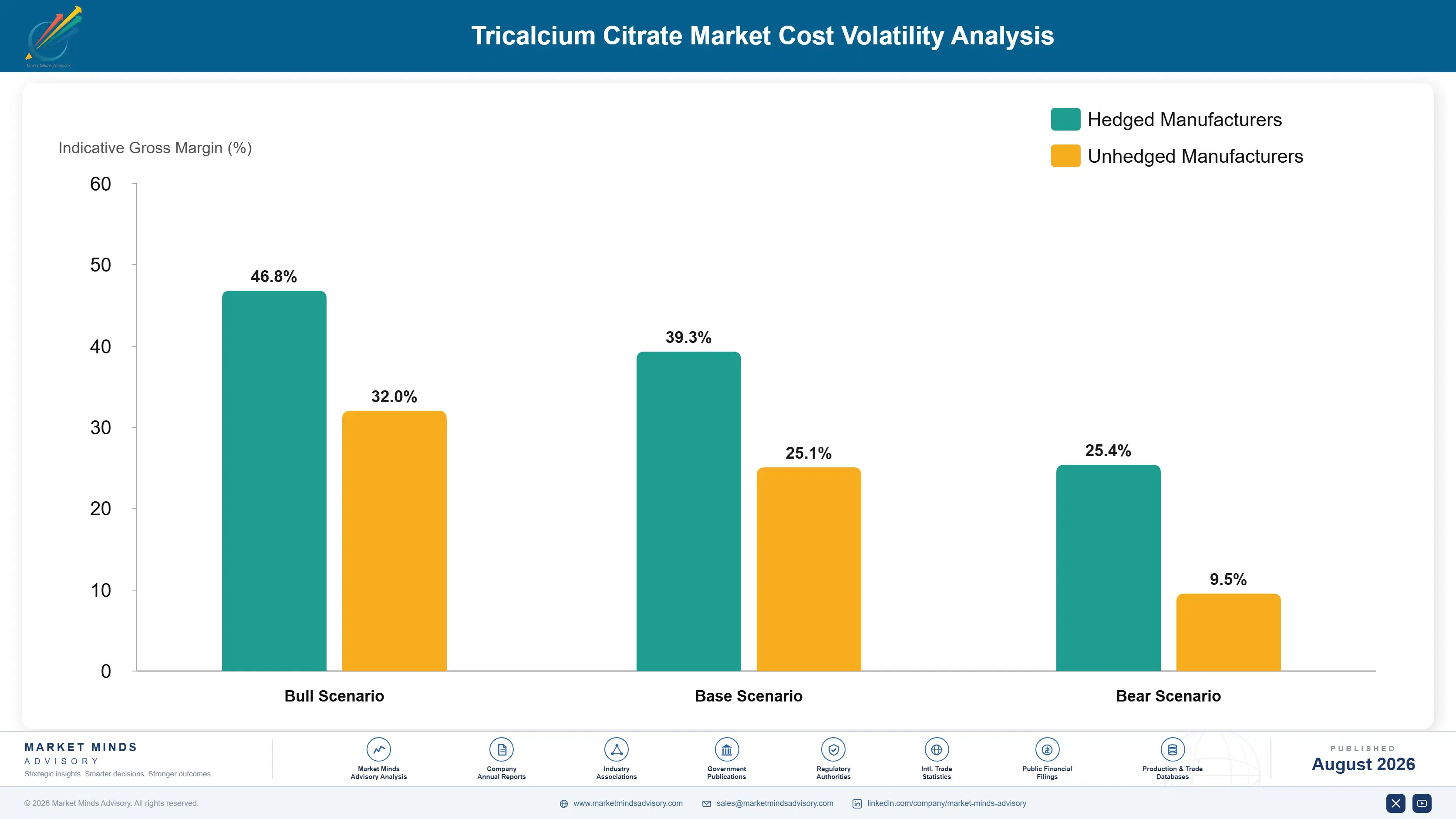
Citric acid carries around 58% of production cost, produced by fermentation from glucose feedstock in capacity concentrated heavily in China. Calcium hydroxide and limestone absorb roughly 9%, sourced locally and cheaply almost everywhere. Fermentation energy, crystallisation, drying and milling take about 16%. Packaging, quality documentation, regulatory maintenance and freight account for the balance. Feedstock concentration is the governing feature.
Citric acid pricing moved sharply across recent years on Chinese capacity utilisation and glucose feedstock costs, per published fermentation chemical market reporting and Jungbunzlauer annual reporting for 2025 on input cost commentary. Integrated producers absorbed movements internally while merchant buyers passed considerably more through, which split competitive positions during volatile periods rather than evenly across the industry. Integrated producers hold a durable advantage during volatile periods that merchant buyers simply cannot replicate.

Exposure divides on integration rather than on scale. An integrated producer making its own citric acid carries fermentation cost with internal transfer pricing and considerable buffering. A merchant buyer carries citric acid across well over half of cost with no protection at all. A specialist grade producer carries the same input cost but supports pricing through documentation and application capability that commodity suppliers cannot access.
tricalcium-citrate-market-trends-cost-volatility-analysis-1787640189569

Secure citric acid supply on multi-year contracted terms

Citric acid carries well over half of production cost and comes from capacity concentrated in a single country where utilisation swings sharply between years. Multi-year supply agreements secure both price and availability, and the volume commitment is straightforward given calcium citrate demand grows steadily rather than cyclically across most applications. Utilisation swings are the real risk.

Invest in grade engineering rather than purity improvement

Formulators select on bulk density, compressibility and particle size distribution rather than on purity, which was settled years ago as a specification. Grade engineering capability supports pricing that commodity material cannot reach and reaches the formulator directly rather than the purchasing department that compares specifications. Behaviour rather than specification is what actually gets compared by the people who decide.

Build beverage positions to hedge the absorption argument

The supplement case rests on a single physiological mechanism that improved carbonate delivery could undermine. Suspension and mouthfeel behaviour in fortified beverages depends on particle physics carbonate cannot match whatever happens to its dissolution, which makes beverage position a genuine hedge rather than merely a diversification. Physics does not change. Diversification and hedging differ here.

Portfolio Architecture for Margin Defence

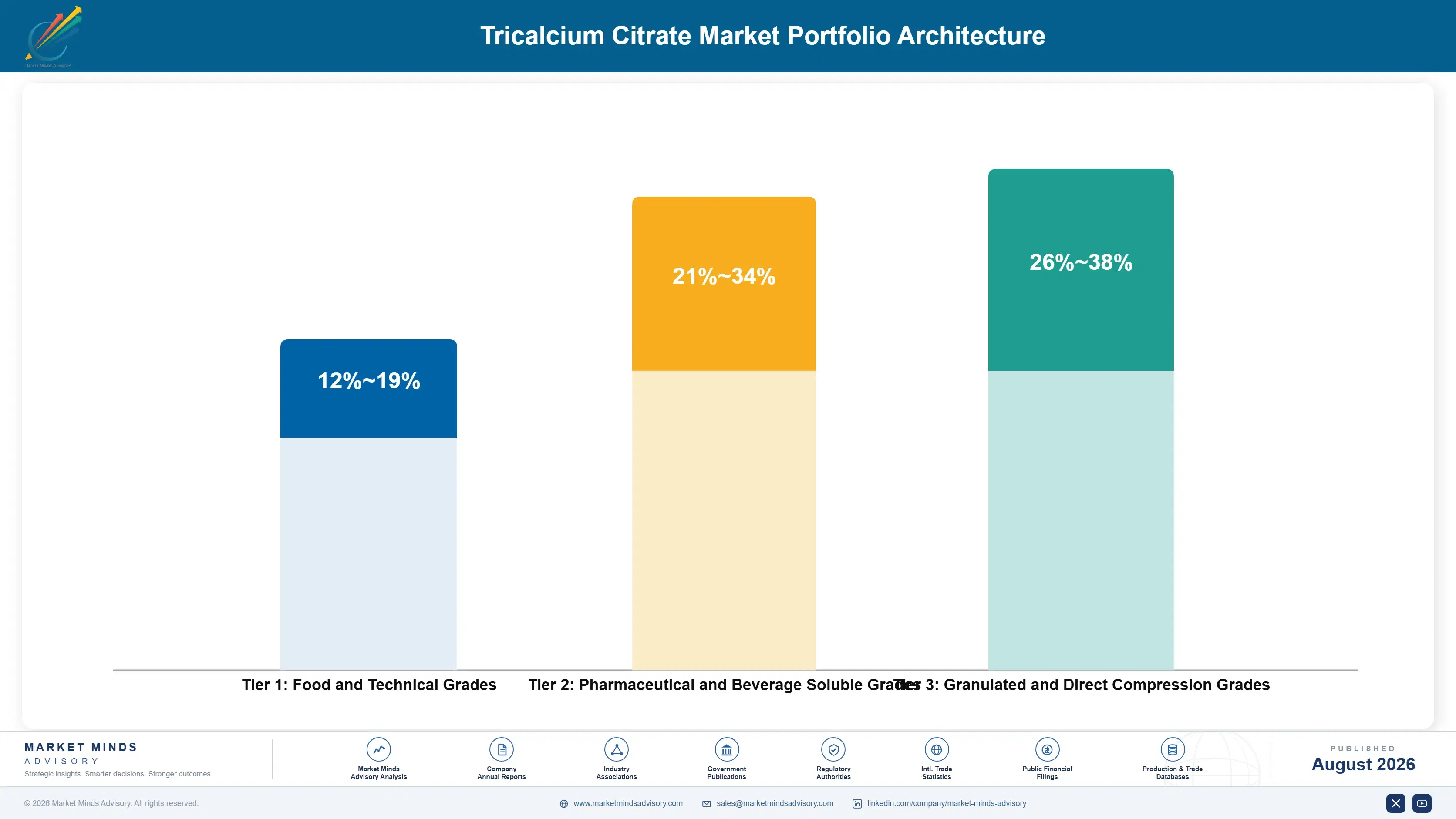
Margin here follows grade engineering rather than chemistry, because the molecule is identical from every supplier and buyers who want only the specification buy on delivered price. Food and technical grades earn margins in the low to high teens, where Chinese citrate pricing sets the reference and no differentiation is available to defend against it. Buyers who want only a specification buy on delivered price, and they are entirely right to.
Pharmaceutical and beverage soluble grades do better in the low twenties to mid thirties, because documentation depth and particle specification both narrow the field of suppliers a customer can actually qualify. Qualification takes months and customers rarely revisit it afterwards.

Granulated and direct compression grades hold the strongest position, reaching into the high thirties, where compressibility solves the bulk problem that limits tablet formulation and few producers can engineer it consistently. Those margins depend on selling to formulators rather than to purchasing departments, and compress toward commodity levels wherever a buyer treats the grade as a specification to be matched. Selling to formulators rather than to purchasing is what sustains them, and the distinction decides the outcome entirely.

Food and Technical Grades

Material meeting an identical specification from many producers where buyers compare on delivered price. The seven point range reflects citrate integration position rather than any product difference between suppliers. Integration is the only defence.
Gross Margin: 12-19%

Pharmaceutical and Beverage Soluble Grades

Grades where documentation depth and particle specification narrow the qualified supplier field. The thirteen point range reflects regulatory documentation breadth and how demanding the particle requirement actually is. Qualification protects incumbents here.
Gross Margin: 21-34%

Granulated and Direct Compression Grades

Engineered grades solving the tablet bulk problem that limits calcium formulation. The twelve point range reflects whether the supplier reaches formulators directly or sells through purchasing against a specification. Formulation access decides everything.
Gross Margin: 26-38%
tricalcium-citrate-market-trends-portfolio-architecture-1787640190119

High-value Sub-segments and Strategic Watch-out

Granulated and Direct Compression Grades

High value and the fastest growth at 9.6%, addressing tablet bulk which formulators describe as their binding constraint. Selling compressibility data reaches formulators rather than purchasing departments comparing specifications. Adherence is a commercial variable rather than merely a clinical one, since abandoned tablets generate no repeat purchase.
Gross Margin: 26-38%

Micronised and Fine Particle Grades

High value and growing at 8.2% on suspension and mouthfeel in fortified beverages. Physical behaviour rather than absorption decides these applications, which makes them a genuine hedge against carbonate improvement. Plant based milks have become the largest growth application, and sedimentation kills them commercially before nutrition is assessed.
Gross Margin: 24-36%

Food Grade Powder

The volume core, meeting an identical specification from many producers where Chinese citrate pricing sets the reference. Integration into citric acid production is the only defence available against that pressure. No differentiation exists to defend against imported material at all, which makes this volume genuinely difficult to hold.
Gross Margin: 12-19%

Single Mechanism Dependence

The strategic watch-out. The supplement case rests on carbonate needing gastric acid, and the range reflects whether a supplier holds beverage and formulation positions or depends entirely on that one argument. Improved carbonate delivery would remove most of the reason to pay four times more for the same calcium.
Gross Margin: 0-35%

Chosen Once Per Formulation

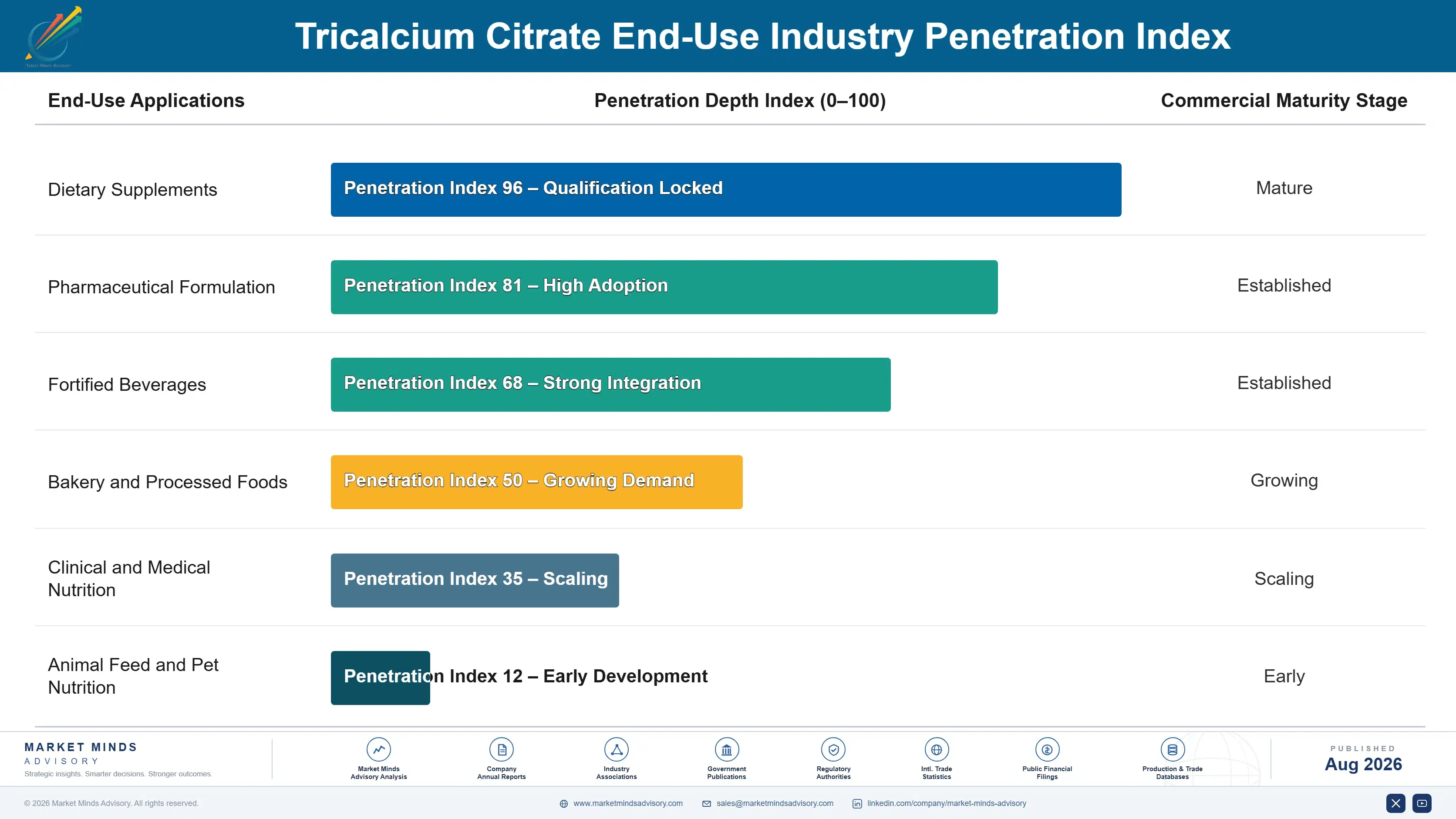
Demand here follows finished product formulation rather than any consumption pattern of its own, which makes formulation approval the commercial event and everything afterwards delivery. A supplement or beverage formulated around a specific grade continues buying it for the product's commercial life, since changing means reformulating, re-testing stability and frequently redoing consumer acceptance work nobody wants to repeat. Approval is the commercial event.
Stickiness therefore varies with how much of the formulation depends on the ingredient. A tablet designed around a particular compressibility profile holds firmly, because changing grade alters tablet size and dissolution together. Beverage formulations hold similarly on sedimentation behaviour. Food grade powder used as a straightforward calcium source reopens on every contract, since equivalence is real and buyers know it. Buyers know exactly which grades are interchangeable.

The deciding function differs sharply between those cases and most suppliers reach only one of them. Formulation scientists decide engineered grades on physical behaviour. Purchasing decides commodity powder on delivered price. Clinical and regulatory functions decide pharmaceutical grades on documentation. A commercial organisation built around purchasing relationships reaches the least valuable of the three. Most suppliers reach only one function.
tricalcium-citrate-market-trends-end-use-penetration-index-1787640190634

Where We Would Put Effort

These are among the four positions where our research anticipates prominent divergence between winners and laggards over the coming forecast period. Each is grounded in the demand model, the regulatory perimeter, and the announced capacity pipeline.
01 / PRESCRIBING DATA TRACKING

Another industry defines your market

Calcium carbonate absorption falls to around 24% in the absence of gastric acid, and roughly 18% of older adults take continuous proton pump inhibitors, which together make prescribing behaviour the genuine demand indicator for this particular ingredient. Suppliers watching supplement category growth figures are monitoring something only loosely connected to their own addressable patient population. Prescribing data is published openly, freely available and updated regularly every year, and remarkably nobody in this ingredient industry uses it for commercial planning at all.
02 / BULK PROPERTY SELLING

Purity was settled years ago

A standard calcium serving requires around 2.4 grams of material given the 21% elemental content, and formulators consistently describe the finished tablet size rather than ingredient cost as their real binding constraint. Suppliers still competing on purity specification are answering a question that formulators resolved long ago and no longer discuss. Granulated and direct compression grades growing at 9.6% address the thing that genuinely limits the formulation, and compressibility data reaches formulation scientists rather than the purchasing departments comparing specifications.
03 / MECHANISM RISK HEDGING

One mechanism carries the whole case

The whole supplement argument rests almost entirely on calcium carbonate requiring gastric acid to dissolve, and any delivery system improving carbonate uptake without acid present would remove most of the reason anybody pays four times more. Suspension and mouthfeel behaviour in fortified beverages depends on something else instead, on particle physics that carbonate cannot match whatever happens to its dissolution chemistry. Building a beverage position is therefore a genuine hedge against that concentrated single mechanism risk rather than merely a diversification exercise.
04 / DRIVER CONVERGENCE TARGETING

Look for three things happening together

India grows fastest of any country covered here at 10.2% precisely because supplement market expansion, domestic ingredient manufacturing and unusually heavy acid suppression prescribing all coincide within the same market at once. Each of those three factors alone would produce only moderate growth, and taken together they compound into something considerably larger than any of them. Suppliers still organised around the established supplement geographies are covering markets where both the population and the prescribing base stopped expanding several years ago now.

Engagement Snapshot From the Field

A live engagement with an industry participant carrying material or product regulatory and market exposure ahead of a defining policy shift, showing how our research translates into a defensible multi-year portfolio strategy.
MARKET MINDS ADVISORY · CLIENT ENGAGEMENT SUMMARY
Tricalcium Citrate Producer Strategic Portfolio Review and Transition Roadmap 2026·Investment Scenario on Tricalcium Citrate Exposure Evaluation 2025-26
CLIENT PROFILE
A mineral salt producer supplying calcium citrate and related salts to supplement, pharmaceutical and food manufacturers across European and Asian markets, at annual revenue near 96 million dollars (client-reported, unverified by MMA). Grade engineering capability was limited and selling ran through purchasing contacts. Absorption evidence was being presented to buyers who had no interest in it.
STRATEGIC CHALLENGE
Food grade volumes were being lost to Chinese material on delivered price while the client believed its absorption argument should command a premium. Management wanted to understand why a genuine scientific advantage was not converting into commercial position anywhere. Premium pricing had never materialised despite the science being genuinely sound.
MMA APPROACH
MMA traced formulation decisions across supplement and beverage customers to establish what actually decided grade selection, quantified the addressable population against acid suppression prescribing data, assessed beverage application requirements separately, and mapped commercial coverage against decision functions. Interviews with 47 experts covered supplement formulation, beverage development, clinical nutrition and ingredient purchasing.
KEY FINDINGS
  1. Formulators selected grades on bulk density and compressibility rather than on purity or absorption, and the client had been presenting purity data to people who had stopped caring.
  2. The addressable population tracked proton pump inhibitor prescribing far more closely than supplement category growth, and the client had never examined prescribing data at all.
  3. Beverage applications selected on suspension behaviour with absorption playing no part, which made them a separate commercial conversation the client was not having.
  4. Commercial coverage reached purchasing departments almost exclusively, the function least interested in the properties that actually differentiated the client's material. Formulators were never contacted.
CLIENT PROFILE
A mineral salt producer supplying calcium citrate and related salts to supplement, pharmaceutical and food manufacturers across European and Asian markets, at annual revenue near 96 million dollars (client-reported, unverified by MMA). Grade engineering capability was limited and selling ran through purchasing contacts. Absorption evidence was being presented to buyers who had no interest in it.
STRATEGIC CHALLENGE
Food grade volumes were being lost to Chinese material on delivered price while the client believed its absorption argument should command a premium. Management wanted to understand why a genuine scientific advantage was not converting into commercial position anywhere. Premium pricing had never materialised despite the science being genuinely sound.
MMA APPROACH
MMA traced formulation decisions across supplement and beverage customers to establish what actually decided grade selection, quantified the addressable population against acid suppression prescribing data, assessed beverage application requirements separately, and mapped commercial coverage against decision functions. Interviews with 47 experts covered supplement formulation, beverage development, clinical nutrition and ingredient purchasing.
KEY FINDINGS
  1. Formulators selected grades on bulk density and compressibility rather than on purity or absorption, and the client had been presenting purity data to people who had stopped caring.
  2. The addressable population tracked proton pump inhibitor prescribing far more closely than supplement category growth, and the client had never examined prescribing data at all.
  3. Beverage applications selected on suspension behaviour with absorption playing no part, which made them a separate commercial conversation the client was not having.
  4. Commercial coverage reached purchasing departments almost exclusively, the function least interested in the properties that actually differentiated the client's material. Formulators were never contacted.
RECOMMENDED STRATEGY
Phase 1: Phase one: build compressibility and bulk density data, since that is what formulators use to select and purity is not. Phase 2: Phase two: reallocate commercial coverage toward formulation scientists rather than purchasing, because the differentiation is invisible to procurement. Procurement cannot see it. Phase 3: Phase three: develop beverage grade positions, which hedge a supplement case resting on one physiological mechanism. Beverage buyers ignore absorption entirely.
OUTCOME
The producer generated compressibility data during 2026 and won tablet formulations previously lost on price (client-reported, unverified by MMA). Coverage was reallocated toward formulation functions, and beverage grade development began the following quarter. Purity based marketing was withdrawn from formulation conversations entirely across all markets.

Frequently Asked Questions

Foundational context covering the market sizes, CAGR, scope, country, region and competition that inform every finding below. This section is provided to cover basics and most often pre-purchase conversations, answered from the MMA Primary Research Dataset.

What is the current size of the Tricalcium Citrate Market?

MMA sizes it at USD 0.42 billion in 2025, rising to USD 0.45 billion in 2026. The figure covers tricalcium dicitrate supplied as a calcium source ingredient at producer selling value.

How large will the Tricalcium Citrate Market be by 2036?

USD 0.84 billion by 2036, an incremental USD 0.39 billion over the 2026 base and an expansion multiple of 1.87 times. Engineered grades carry most of that gain.

What is the CAGR for the Tricalcium Citrate Market 2026 to 2036?

6.4% in the base case, with a bull case at 7.6% and a bear case at 5.2%. Acid suppression prescribing trends drive most of the spread between them.

Which segment is growing fastest?

Granulated and direct compression grades at 9.6%, half again the market rate of 6.4%. They address tablet bulk, which formulators describe as their binding constraint.

Who are the major companies in the Tricalcium Citrate Market?

Jungbunzlauer, Gadot Biochemical Industries, Dr Paul Lohmann, Global Calcium and Sucroal lead on production revenue. Fifteen further participants are profiled in the full report on the same consistent basis.

Which country is growing fastest?

India at 10.2%, where supplement market expansion, domestic ingredient manufacturing and heavy acid suppression prescribing all coincide in the same market at once, compounding each other considerably.

Report Segmentation Architecture

The full report scope spans multiple orthogonal segmentation dimensions, with cross-tabulated demand data provided for each dimension pair. Coverage extends further to regional breakdowns, trend trajectories, and the competitive detail needed to support segment-level decision-making.

By Grade Supplied

  • Food Grade Powder
  • Pharmaceutical Grade
  • Granulated and Direct Compression Grades
  • Micronised and Fine Particle Grades
  • Beverage Soluble Grades
  • Feed and Technical Grades

By End-Use Industry

  • Dietary Supplements
  • Pharmaceutical Formulation
  • Fortified Beverages
  • Bakery and Processed Foods
  • Clinical and Medical Nutrition
  • Animal Feed and Pet Nutrition

By Commercial Dimension

  • Direct Manufacturer Supply
  • Distributor and Trader Channels
  • Premix House Supply
  • Contract Manufacture Arrangements
  • Pharmaceutical Qualified Supply
  • Spot Market Purchase

By Region

  • North America
  • Western Europe
  • East Asia
  • South Asia and Pacific
  • Latin America
  • Middle East and Africa
  • Eastern Europe

Scope, Methodology, and Coverage

Every figure in this report is reproducible from documented input assumptions. The scope below maps the historical period, the forecast horizon, the segmentation dimensions, and the countries covered, alongside the underlying primary and qualitative methodology.
Historical Period
2020 to 2025
Forecast Period
2026 to 2036
Base Year
2025 (USD billions; MMA Primary Research Dataset, August 2026)
Market Definition
Tricalcium dicitrate supplied as a calcium source ingredient, covering food grade powder, pharmaceutical grade, granulated and direct compression grades, micronised and fine particle grades, beverage soluble grades, and feed and technical grades. Measured at producer selling value. Calcium carbonate and other calcium salts, citric acid and citrate salts of other metals, finished supplement and pharmaceutical products, and fortified foods measured at retail are excluded from scope.
Quantitative Units
USD billions (current prices); metric tonnes shipped; USD per kilogram by grade
Segmentation Dimensions
Grade supplied; end-use industry; commercial dimension; region
Regions Covered
North America, Western Europe, East Asia, South Asia and Pacific, Latin America, Middle East and Africa, Eastern Europe
Countries Covered
United States, Canada, Mexico, Germany, France, United Kingdom, Netherlands, Switzerland, China, Japan, South Korea, Taiwan, India, Indonesia, Australia, Brazil, Argentina, Saudi Arabia, South Africa, Poland
Key Companies Profiled
Jungbunzlauer, Gadot Biochemical Industries, Dr Paul Lohmann, Global Calcium, Sucroal, Tate and Lyle, Cargill, Anhui Xingzhou Medicine Food, Weifang Ensign Industry, RZBC Group, TTCA, COFCO Biochemical, Merck KGaA, Thermo Fisher Scientific, Spectrum Chemical, Nikunj Chemicals, Krishna Chemicals, Balchem, Innophos, Prinova Group
Quantitative Methodology
Primary survey, n=3,800 respondents, Q4 2025, six countries; demand-side model with trade association cross-validation
Qualitative Methodology
47 expert interviews, Q4 2025; applied to validate demand model assumptions, identify emerging dynamics, and assess competitive positioning
Report Format
PDF and XLSX data workbook (Word format preview document)
Publisher
Market Minds Advisory
Report Code
MMA-2026-CHM-147
Published
August 2026
Contact
sales@marketmindsadvisory.com | www.marketmindsadvisory.com

Purchase the full Tricalcium Citrate Market Report (2026 to 2036).

The full report treats tricalcium citrate as an ingredient defined by who cannot use the cheaper alternative, which makes prescribing behaviour in another industry the truest demand indicator available. It sizes all six grades independently through 2036, quantifies the addressable population against acid suppression prescribing, and models tablet bulk against formulation constraints. Regional chapters cover all seven regions with prescribing patterns assessed separately from supplement consumption. Competitive profiling covers 20 participants on one consistent production revenue basis. Grade selection criteria are traced by decision function throughout the analysis.
Six grades sized independently through 2036
Addressable population quantified against acid suppression prescribing data
Tablet bulk modelled against formulation and adherence constraints
Prescribing patterns assessed separately from supplement consumption by region
Beverage suspension requirements benchmarked against supplement absorption arguments
Twenty participants profiled on one consistent production basis

Built For The People Who Decide

From boardroom strategy to bench-side execution, this report is read cover-to-cover by leaders shaping the next decade of their industry, turning demand scenarios, market dynamics and valuation benchmarks into decisions.
CXOs/ Presidents/ VPs/ Managers
M&A and Corporate Development
Strategy Teams and R&D Heads
Procurement and Product Directors
Regulatory and Compliance Leaders
Investor Relations and Equity Analysts