Market Minds Advisory
Proton Pump Inhibitors Market

Proton Pump Inhibitors Market: Deprescribing Pressure, Potassium-Competitive Rivals and Value That Has Left the Molecule

Proton pump inhibitors are among the most prescribed drugs on earth and among the most prescribed without a current reason, which makes deprescribing a bigger commercial threat than any competitor molecule.

Lead Analyst

Alice Ballenger

Published

September 2026

Make Smarter Decisions with Customized Research Insights

Request a free sample report and evaluate market opportunities, growth trends, and competitive dynamics relevant to your business needs.

2025 MARKET VALUE$3.6BMarket Size 2025
2036 FORECAST VALUE$5.4BBase Case , 2026 to 2036
CAGR 2026 TO 20363.8 %Bull 5.0% / Bear 2.6%
INCREMENTAL OPPORTUNITY$1.7BNet 10- year value creation
EXPANSION MULTIPLE1.45x2036 value over 2026 base
Strategic Levers
M&A Pipeline
Regional Outlook
Country Rankings
Competitive Intelligence
Segmental Deep-dive
Call-Us : 91 93563 13602

Executive Snapshot and Market Trajectory

The molecule stopped being the asset years ago. Generics hold 96% of volume and a tablet costs pennies, so whatever value remains sits in consumer brand equity, hospital injectable use and the small number of markets where prescribing is still expanding rather than being reviewed.
Esomeprazole compounds at 5.7%, exactly 1.50 times the market, on over-the-counter brand strength rather than clinical advantage. East Asia holds 33% of value, above the standard band, because Chinese hospital injectable use and Japanese and Korean prescribing volumes exceed every other region combined. Injectable formulations account for 23% of value. A familiar box on a pharmacy shelf commands roughly eleven times the price of the identical generic beside it.
Five companies hold 34%, which is low for a class this large and entirely expected after genericisation. What threatens the class is not another proton pump inhibitor. It is potassium-competitive acid blockers, and deprescribing programmes reviewing the 41% of patients on long-term therapy without a documented indication. Deprescribing is the larger threat, because a review ends therapy outright rather than moving it to a competitor. Neither can be answered with a price cut.
Market Definition
The market covers proton pump inhibitor active molecules across oral and intravenous formulations and prescription and consumer channels, spanning omeprazole, esomeprazole, pantoprazole, lansoprazole, dexlansoprazole and rabeprazole. Potassium-competitive acid blockers, histamine H2 receptor antagonists, antacids and alginates, Helicobacter pylori combination kits sold as fixed regimens, and prokinetic agents are excluded.
Base Year Value
$3.6B in 2025 (MMA Primary Research Dataset, August 2026)
Forecast Period
2026 to 2036, eleven discrete annual values
CAGR
3.8% base case. Bull 5.0%. Bear 2.6%.
Fastest Growth Segment
Esomeprazole: 5.7% CAGR
Fastest Growth Country
India: 6.4% CAGR
Fastest Growth Region
South Asia and Pacific: 6.0% CAGR
Largest Region
East Asia: 33% of 2025 global value
Market Leaders
Viatris, Takeda Pharmaceutical, AstraZeneca, Dr. Reddy's Laboratories, Haleon. Source: MMA Analysis based on company annual reports.
Primary Survey
n=3,800 procurement and R&D decision-makers, Q4 2025, six countries
Methodology
Demand-side build-up, cross-validated against public data, 47 expert interviews

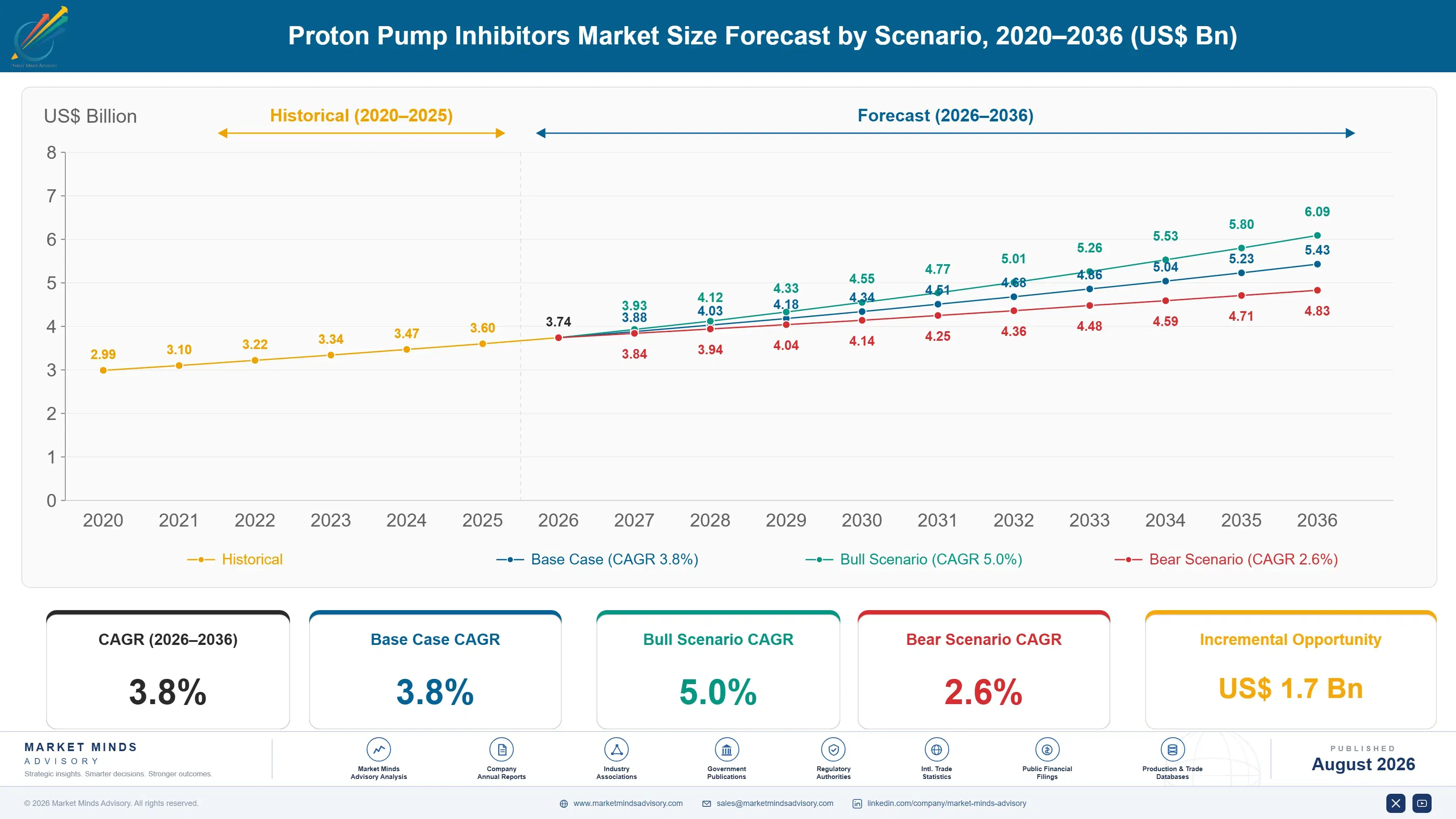
Proton Pump Inhibitors Market Forecast Scenarios

proton-pump-inhibitors-market-size-forecast-scenario-1787309218886
Growth of 3.3% across 2020 to 2025 was almost entirely Asian and almost entirely injectable. Developed market oral pricing kept falling, over-the-counter conversion moved volume to lower-value retail, and deprescribing began removing long-term users. Against that, Chinese hospital use of intravenous pantoprazole and esomeprazole grew steadily, and Indian and Southeast Asian oral volumes rose as access broadened.
The base case of 3.8% rests on three mechanisms pulling in different directions. Asian hospital injectable use continues expanding, at realised prices well above oral generics and with tender rather than retail dynamics. Over-the-counter conversion keeps moving volume out of reimbursed channels, which lifts units and lowers value per dose. And deprescribing pressure keeps building, with formal withdrawal review now reaching 19% of long-term users and rising as guideline bodies address inappropriate continuation directly.
The bull case of 5.0% assumes Asian injectable growth continues without volume-based procurement compressing prices further, which would preserve the only genuinely profitable part of the category. The bear case of 2.6% reflects two pressures arriving together: potassium-competitive acid blockers taking share in Japan, Korea and China where they are established, and deprescribing extending from pilots into routine primary care review across developed systems.

A Class Defending Value It No Longer Earns

Almost nothing about this market runs on the pharmacology any more. Six molecules with broadly interchangeable acid suppression sit at 96% generic volume, priced at a few cents a tablet in the largest volume markets. Value has migrated to places the molecule does not explain: a branded consumer pack commanding roughly eleven times the prescription generic price, and hospital injectable use holding 23% of value.
TOP FIVE CONCENTRATION34%Combined share held by the five largest participating companies
GENERIC VOLUME SHARE96%Proportion of units supplied as unbranded generic product
LONG-TERM USE WITHOUT INDICATION41%Share of chronic users lacking a documented current indication
INJECTABLE SHARE OF VALUE23%Proportion of market value from intravenous hospital formulations
CONSUMER CHANNEL PRICE PREMIUM11 timesRealised price against equivalent prescription generic supply cost
POOR METABOLISER PREVALENCE19% East AsiaPopulation share with reduced enzyme activity affecting drug response
The class also carries an unusual liability. Roughly 41% of long-term users have no documented current indication, a legacy of prescriptions started for a defined course and never reviewed. That is not a marketing problem to be managed. It is a large share of volume that a deprescribing programme can remove with a single medication review, and health systems across Europe and North America have started running exactly those reviews.
Genetics matter more here than the marketing suggests. Around 19% of East Asian populations are cytochrome P450 2C19 poor metabolisers, which alters exposure and partly explains both rabeprazole preference and the speed with which potassium-competitive acid blockers have taken Japanese and Korean share. That mechanism is the real competitive threat, and it arrived from an adjacent class rather than from within.
"Every commercial plan I see for this class is about channel and geography, which is correct, and none of them models what happens when a health system decides to review its long-term users. That single decision removes more volume than any competitor ever will."
Principal, Gastrointestinal and Primary Care Therapeutics Practice · MMA Gastroi

Market Trends

Potassium-Competitive Acid Blockers Take Share From Within Asia

Vonoprazan, tegoprazan and related agents suppress acid faster, hold nocturnal control better and do not depend on cytochrome P450 2C19 activation, which matters where roughly 19% of the population are poor metabolisers. Japanese and Korean prescribing has already shifted substantially, and Chinese uptake is following. The class advantage is genuine rather than promotional, particularly in erosive oesophagitis healing and Helicobacter pylori eradication, and it arrived from an adjacent mechanism rather than from any competing proton pump inhibitor. Japanese and Korean substitution is the clearest available signal of where the whole class is heading over the next decade.
Market Impact: India compounding at 6.4% annually
Consumer Channel Conversion Defends Value Against Genericisation

A branded over-the-counter pack realises roughly eleven times the price of the equivalent prescription generic, because the consumer is buying a recognised name and immediate access rather than a molecule. That conversion is the single most effective value defence available to a class at 96% generic volume, and it explains why esomeprazole compounds at 5.7% against a market at 3.8%. Consumer brand equity rather than clinical differentiation determines who captures that premium. A name cannot be genericised the way a molecule can, which makes the consumer asset unusually durable. Prescription supply has no comparable defence.
Market Impact: Injectables holding 23% of value

Market Opportunities and Growth Drivers

Emerging Market Volume Growth Outpaces Developed Value Decline

Reflux disease diagnosis is rising across India, Southeast Asia, Latin America and the Middle East as primary care access widens and as endoscopy becomes available outside tertiary centres. Those markets add units at low realised price, while developed markets lose value through deprescribing and continued generic erosion. India compounds at 6.4%, the fastest national market, on volume rather than price. Net class growth of 3.8% is entirely the arithmetic of those two movements against each other. Neither movement is close to complete, which makes the net figure unusually sensitive to how fast deprescribing spreads.
Market Impact: Reviews targeting 41% of users

Hospital Injectable Use Holds Value Despite Stewardship Pressure

Intravenous formulations account for 23% of market value on a fraction of the units, and Chinese hospital practice in particular uses injectable proton pump inhibitors far more extensively than guidelines support. Upper gastrointestinal bleeding and perioperative prophylaxis are the legitimate indications, and use extends well beyond them. Stewardship programmes are targeting this directly, though injectable value has proved considerably more durable than the oral prescription segment across every market where reviews have run. Formulary listing rather than prescriber preference is what actually holds those positions, which changes who a supplier needs to convince entirely.
Market Impact: Associations spanning 4 safety doma

Market Restraints and Challenges

Deprescribing Programmes Remove Volume a Competitor Never Could

Roughly 41% of long-term users have no documented current indication, and a single structured medication review removes that patient from therapy permanently. The root cause is that prescriptions begun for a defined course are rarely reviewed once repeat dispensing starts. Participants have no real mitigation available on the prescription side, and the practical response has been to shift emphasis toward consumer channel value and toward markets where prescribing is still expanding rather than being audited. European health systems have moved furthest, with explicit national review requirements now in force across several of them.
Market Impact: Poor metabolisers reaching 19% prev

Long-Term Safety Associations Keep Reaching Prescribers

Observational associations with fracture risk, chronic kidney disease, enteric infection and micronutrient deficiency continue to appear in the literature and in prescribing guidance, and confounding is severe enough that causation remains genuinely unresolved. The root cause is that long-term users are systematically sicker than comparators. Participants mitigate by supporting better designed studies and by supplying lower-dose and step-down formats, though the accumulated signal is what gives deprescribing programmes their clinical mandate. Confounding remains the honest answer rather than a defence. The accumulated signal is what gives deprescribing programmes their clinical mandate, whatever the causal position turns out to be.
Market Impact: Premium reaching 11 times generic
3 additional market trends, 4 additional growth drivers, and 2 additional restraints and challenges are covered in the full report. Contact sales@marketmindsadvisory.com to access the complete intelligence.

Segment CAGR and Growth Architecture

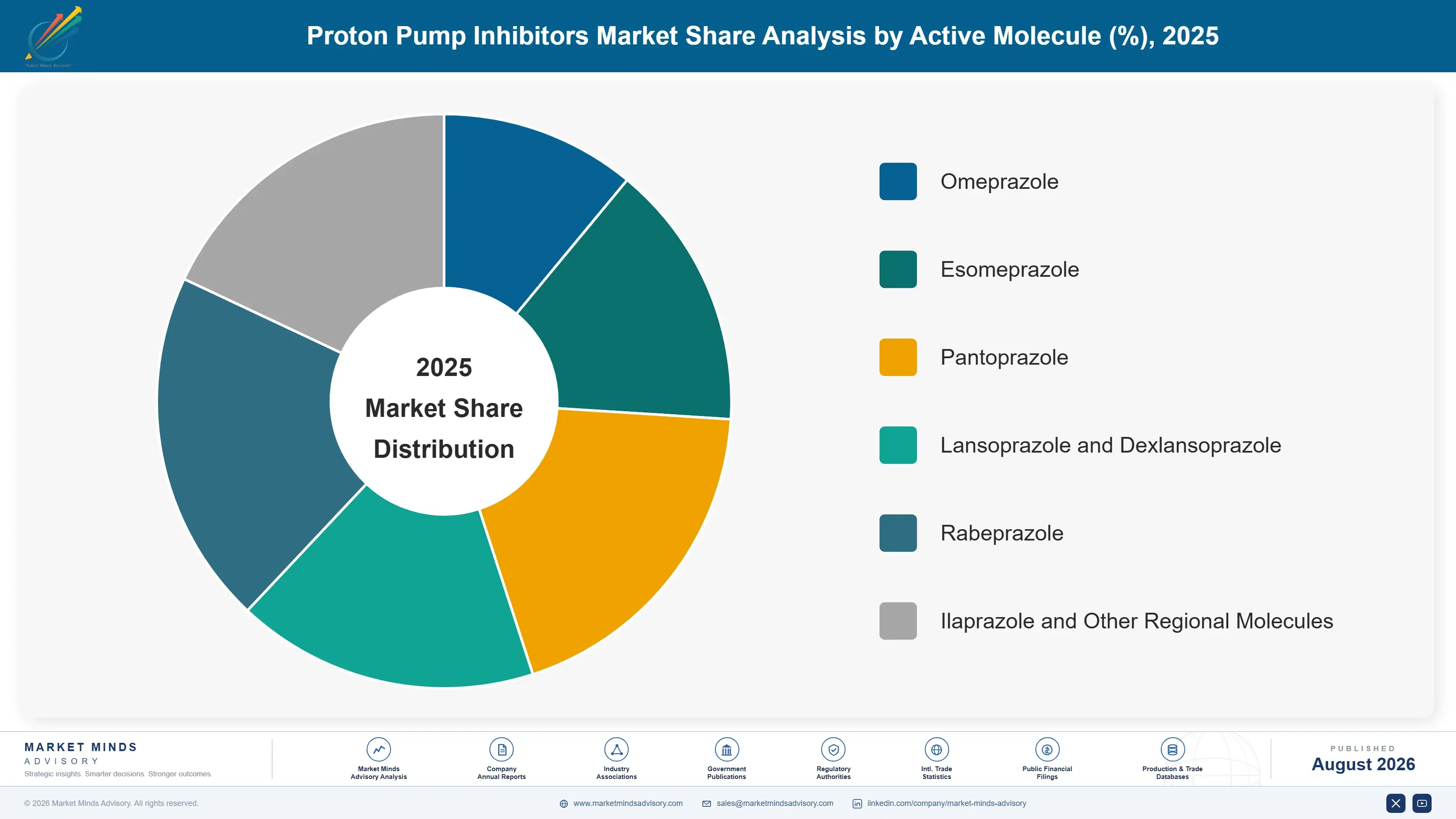
Segmentation follows active molecule, because pricing, channel position and regional preference differ sharply between six agents whose acid suppression is broadly interchangeable. A market where the pharmacology barely differentiates makes brand history, formulation patents and metaboliser genetics the operative distinctions instead. Six molecules sit here, and the differences between them are commercial rather than pharmacological.
proton-pump-inhibitors-market-market-share-analysis-1787309219445

Esomeprazole

Esomeprazole compounds at 5.7%, exactly 1.50 times the market, and almost none of that comes from clinical advantage over racemic omeprazole. It comes from consumer channel position: the branded over-the-counter pack realises roughly eleven times the equivalent prescription generic price, and the brand recognition supporting that premium was built over two decades of promotion. Emerging market prescription volume adds further growth at very low realised price. The molecule is fully genericised and the premium is entirely a marketing asset, which makes it durable in a quite different way from patent protection: nobody can copy the name, and a consumer reaching for a familiar box is not comparing molecules at all.
CAGR 5.7%

Pantoprazole

Pantoprazole grows at 4.9% on hospital injectable use, where it holds the strongest position of any molecule in the class. Injectable formulations account for 23% of market value on a small share of units, and Chinese hospital practice uses them extensively, well beyond what upper gastrointestinal bleeding and perioperative prophylaxis indications support. Pantoprazole also carries the least cytochrome P450 interaction of the older agents, which matters in polypharmacy patients and in poor metaboliser populations. Stewardship programmes are targeting injectable overuse directly, and this is the segment most exposed to them, though injectable value has proved more durable than oral prescription value in every market reviewed so far. Formulary access decides the outcome.
CAGR 4.9%
Full segment breakdown across 6 segments available in the complete report.

Regional Architecture and Country Demand Map

Demand follows prescribing volume and channel structure rather than reflux prevalence, since a genericised class earns value where units are large or where consumer branding survives. Deprescribing intensity then determines which markets shrink. East Asia leads on units and Western Europe is shrinking fastest. Reviews decide which markets shrink.

East Asia

East Asia holds 33% of value, the largest regional share, growing at 4.6%. Note: this exceeds the standard band because Chinese hospital injectable proton pump inhibitor use is extraordinarily large by international comparison, and Japanese and Korean prescribing volumes are high relative to population, which together give the region more units than any other. Around 19% of the population are cytochrome P450 2C19 poor metabolisers, which shaped rabeprazole preference and is now accelerating potassium-competitive acid blocker adoption. Japan and Korea are the most advanced markets anywhere in that substitution, and they are the clearest signal of where the class is heading. Chinese stewardship programmes are beginning to restrict injectable use, which is the largest single risk to regional value.
Share: 33% | CAGR: 4.6% (2026 to 2036)

South Asia and Pacific

The fastest growing region at 6.0%, with India compounding at 6.4%, South Asia and Pacific accounts for 14% of value. Note: this sits above the standard band because Indian proton pump inhibitor volumes are among the largest in the world, sustained by very low unit pricing, extensive over-the-counter availability and rising reflux diagnosis as endoscopy spreads beyond tertiary centres. Indian manufacturers also supply much of the world's generic proton pump inhibitor volume. Australian prescribing is mature and subject to active deprescribing guidance. Southeast Asian volumes are growing steadily on widening primary care access. Indian manufacturers also supply much of the world's generic proton pump inhibitor volume, which makes the region a production centre as well as a consumption one.
Share: 14% | CAGR: 6.0% (2026 to 2036)
Regional intelligence for 5 additional markets available in the complete report: North America, Western Europe, Latin America, Middle East and Africa, Eastern Europe. Contact sales@marketmindsadvisory.com.
proton-pump-inhibitors-market-country-cagr-analysis-1787309219949

Where Value Survives Full Genericisation

A class at 96% generic volume cannot defend value on the molecule, so every position worth holding sits in channel, formulation or geography instead. Four qualify, and one of them is essentially about leaving before the deprescribing programmes arrive. Two concern channel, one concerns geography, and one concerns a genetic argument most suppliers never make at all.

Convert Prescription Volume Into Consumer Channel Value

A branded over-the-counter pack realises roughly eleven times the price of the equivalent prescription generic, and the consumer buying it is not comparing molecules at all. Building or acquiring that brand position is the single most effective value defence available in a class at 96% generic volume, and it is why esomeprazole compounds at 5.7% against a market at 3.8%. The asset is a name rather than a patent, which makes it considerably more durable than exclusivity ever was. Registration and promotion cost is real, and it is recovered many times over.
Market Impact: Consumer channel realising 11 times

Hold Hospital Injectable Positions Through Stewardship Pressure

Intravenous formulations account for 23% of market value on a small fraction of units, and the position is defended by hospital formulary inclusion rather than by prescriber preference. Stewardship programmes are targeting injectable overuse, and injectable value has still proved more durable than oral prescription value in every market where reviews have run. Suppliers who engage formulary committees with appropriate-use protocols retain listing where those refusing to acknowledge overuse are removed outright. Chinese and Southeast Asian committees have moved first on this. Each retained listing is disproportionately valuable to a supplier.
Market Impact: Injectables at 23% of the total cla

Prioritise Markets Where Prescribing Is Still Expanding

Deprescribing removes the 41% of long-term users lacking a current indication permanently, and no commercial response prevents it once a health system commits. Indian, Southeast Asian, Latin American and Middle Eastern prescribing is still expanding on rising diagnosis rather than being audited, and India alone compounds at 6.4%. Reallocating commercial effort toward those markets ahead of the review cycles reaching them is the difference between growth and managed decline. European volume contraction is not reversible by any commercial action a supplier can take. India alone compounds at 6.4%, and reallocating ahead of the review cycles separates growth from managed decline.
Market Impact: Deprescribing now targeting 41% of

Position Against Metaboliser Genetics Rather Than Ignore Them

Around 19% of East Asian populations are cytochrome P450 2C19 poor metabolisers, which alters proton pump inhibitor exposure and is a substantial part of why potassium-competitive acid blockers took Japanese and Korean share so quickly. Agents least dependent on that pathway, pantoprazole and rabeprazole among them, have a genuine argument in those populations. Suppliers who make it explicitly hold ground; those competing purely on price lose it to an adjacent class entirely. Price competition cannot substitute for a mechanistic argument. Pantoprazole and rabeprazole both carry a defensible position in those populations that suppliers routinely fail to articulate at all.
Market Impact: Affecting 19% of East Asian patient

Who Controls the Margin Pool

Five companies hold 34% measured on proton pump inhibitor revenue, the basis used throughout this section. Concentration is low and unremarkable for a fully genericised class. What is unusual is the composition: a consumer health company, a large generics supplier, two originators and an Indian manufacturer, competing on entirely different bases within the same molecules.
Competition runs on three dimensions rather than on product. Consumer brand equity decides who captures the eleven-fold channel premium. Hospital formulary access decides who holds the 23% of value in injectables. And manufacturing cost position decides who survives in prescription generics where price is the only variable anybody considers. None of the three is decided by the acid suppression the molecules actually provide.

The pressure reshaping this class comes from outside it. Potassium-competitive acid blockers are taking Japanese and Korean share on a genuine mechanistic advantage, and Takeda holds both a proton pump inhibitor franchise and the leading agent displacing it. Rankings will shift toward whoever holds consumer brands rather than prescription volume. Owning both sides of a class transition is a rare position and an uncomfortable one, since every prescription gained on the successor is one lost on the incumbent franchise.
proton-pump-inhibitors-market-company-positioning-matrix-1787309220505

Competitive Moat and Risk Dimensions

ASTRAZENECA

Moat: Esomeprazole consumer brand equity

Two decades of promotion built brand recognition around esomeprazole that survives full genericisation, because a consumer reaching for a familiar pack is not comparing active molecules. That recognition supports roughly eleven times the prescription generic price in the consumer channel, and no competitor can replicate a name rather than a formulation.
ASTRAZENECA

Risk: Prescription franchise fully eroded

The prescription business behind the brand has gone entirely, and what remains is a consumer asset in a category where deprescribing guidance and safety commentary reach the same consumers who buy the pack. A class-level reputational shift affects brand equity in a way it never affected patent-protected prescription volume.
TAKEDA PHARMACEUTICAL

Moat: Both franchise and successor class

Takeda holds the lansoprazole and dexlansoprazole heritage alongside vonoprazan, the potassium-competitive acid blocker taking share from proton pump inhibitors across Japan and Korea. Owning both sides of a class transition is a rare position, and it lets the company manage the timing of its own cannibalisation rather than have a competitor set it.
TAKEDA PHARMACEUTICAL

Risk: Successor cannibalises own volume

The same position cuts the other way. Every vonoprazan prescription in Japan or Korea displaces proton pump inhibitor volume Takeda might otherwise have retained, and the transition is proceeding faster than the company's proton pump inhibitor franchise can be harvested. Managing that trade-off across markets at different adoption stages is genuinely difficult.

Players Tracked

Prominent Players

Viatris
Takeda Pharmaceutical
AstraZeneca
Dr. Reddy's Laboratories
Haleon

Other Key Players

Teva Pharmaceutical Industries
Sun Pharmaceutical Industries
Aurobindo Pharma
Cipla
Zydus Lifesciences
Hikma Pharmaceuticals
Sandoz
Eisai
Daiichi Sankyo
Procter & Gamble
Perrigo Company
Lupin
Torrent Pharmaceuticals
Sichuan Kelun Pharmaceutical
Jiangsu Hansoh Pharmaceutical

Recent Developments

MARCH 2025

National deprescribing guidance targets long-term proton pump inhibitor users

Primary care guidance across several European health systems set explicit review requirements for patients on continuous therapy beyond twelve months without a documented indication. These were clinical guideline revisions rather than regulatory actions or commercial developments among the suppliers affected. Implementation dates were published well in advance in most systems.
Signal: A structured medication review removes lon
JULY 2025

Potassium-competitive acid blocker share rises across Japanese prescribing

Vonoprazan and related agents continued displacing proton pump inhibitor prescriptions in Japanese erosive oesophagitis and Helicobacter pylori eradication, supported by faster onset and independence from cytochrome P450 activation. This reflects prescribing behaviour rather than any transaction among the companies involved. Chinese uptake has begun following the same pattern more slowly.
Signal: A mechanistic advantage in poor metabolise
NOVEMBER 2025

Hospital stewardship programmes restrict intravenous acid suppression use

Formulary committees across Chinese and Southeast Asian hospitals introduced appropriate-use protocols restricting intravenous proton pump inhibitor prescribing to documented bleeding and perioperative indications. These were institutional protocol decisions rather than corporate developments among suppliers, and audit findings rather than cost pressure prompted them. Prescribing had extended well beyond guideline-supported indications.
Signal: Injectable value survives stewardship bett

Active Ingredient, Formulation and Channel

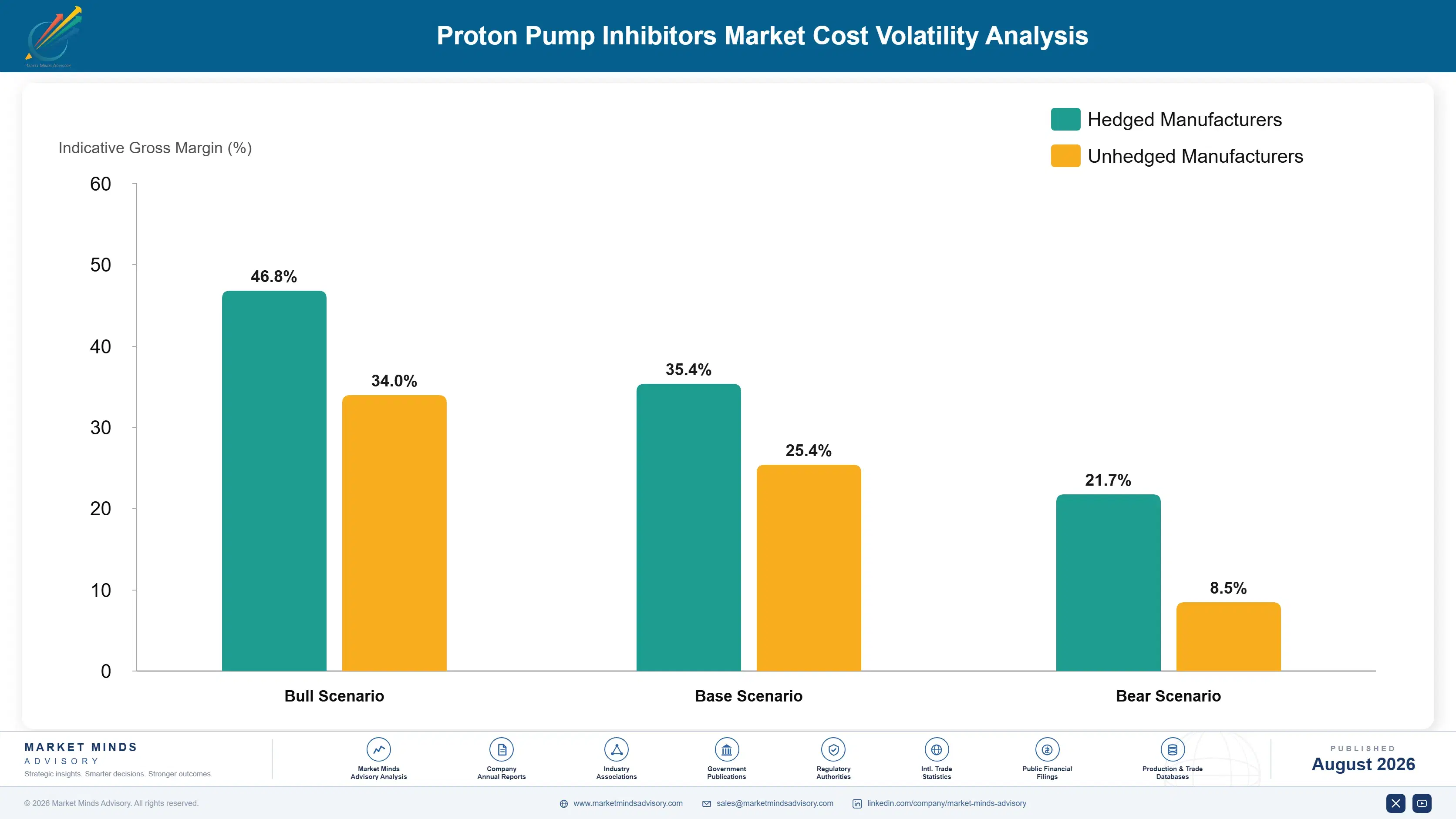
Active pharmaceutical ingredient accounts for roughly 21% of cost of goods for oral generic supply, sourced predominantly from Indian and Chinese manufacturers. Enteric coating, excipients and packaging add about 34%, and the coating is not trivial since these molecules degrade in gastric acid and require reliable delayed release. Consumer channel product carries substantial promotional cost outside cost of goods entirely.
Active ingredient and enteric polymer costs rose through 2021 and 2022 on intermediate supply disruption and freight, and generic suppliers absorbed most of it against tendered prices that cannot be reopened mid-contract. Company annual reports across the generic manufacturers disclose the resulting margin compression in gastrointestinal portfolios. World Health Organization reporting on essential medicine supply documents the concentration of proton pump inhibitor ingredient manufacture. Several suppliers exited presentations rather than continue.

Exposure divides sharply by channel rather than by scale. Prescription generic suppliers carry the entire input cost against tendered pricing with no pass-through mechanism at all, which is why several have exited low-value presentations. Consumer channel participants carry promotional cost instead and realise roughly eleven times the price, so ingredient movement is close to immaterial to them. Injectable suppliers sit between, with sterile manufacturing cost dominating.
proton-pump-inhibitors-market-cost-volatility-analysis-1787309220699

Qualify dual ingredient sources across India and China

Active ingredient manufacture for this class is concentrated in a small number of Indian and Chinese sites, and a single-source position becomes a supply failure whenever one is inspected or reallocated. Qualifying a second source ahead of need costs one regulatory variation and preserves tender eligibility that a stock-out removes for the whole contract period.

Exit prescription presentations that cannot recover input movement

Tendered prescription pricing offers no pass-through when ingredient or coating polymer costs move, and several suppliers have already withdrawn from the lowest-value presentations rather than supply below cost. Reviewing the portfolio presentation by presentation, and exiting deliberately rather than through stock-out, protects the remaining positions and the customer relationships around them. A stock-out costs the whole contract.

Fund consumer promotion from channel premium not portfolio margin

Consumer channel product realises roughly eleven times prescription generic price, and that premium exists only while brand recognition is maintained. Funding promotion from the channel premium itself rather than from group portfolio margin keeps the economics honest, and it makes clear when a brand has stopped justifying the investment behind it. Group margin should not subsidise a fading name.

Portfolio Architecture for Margin Defence

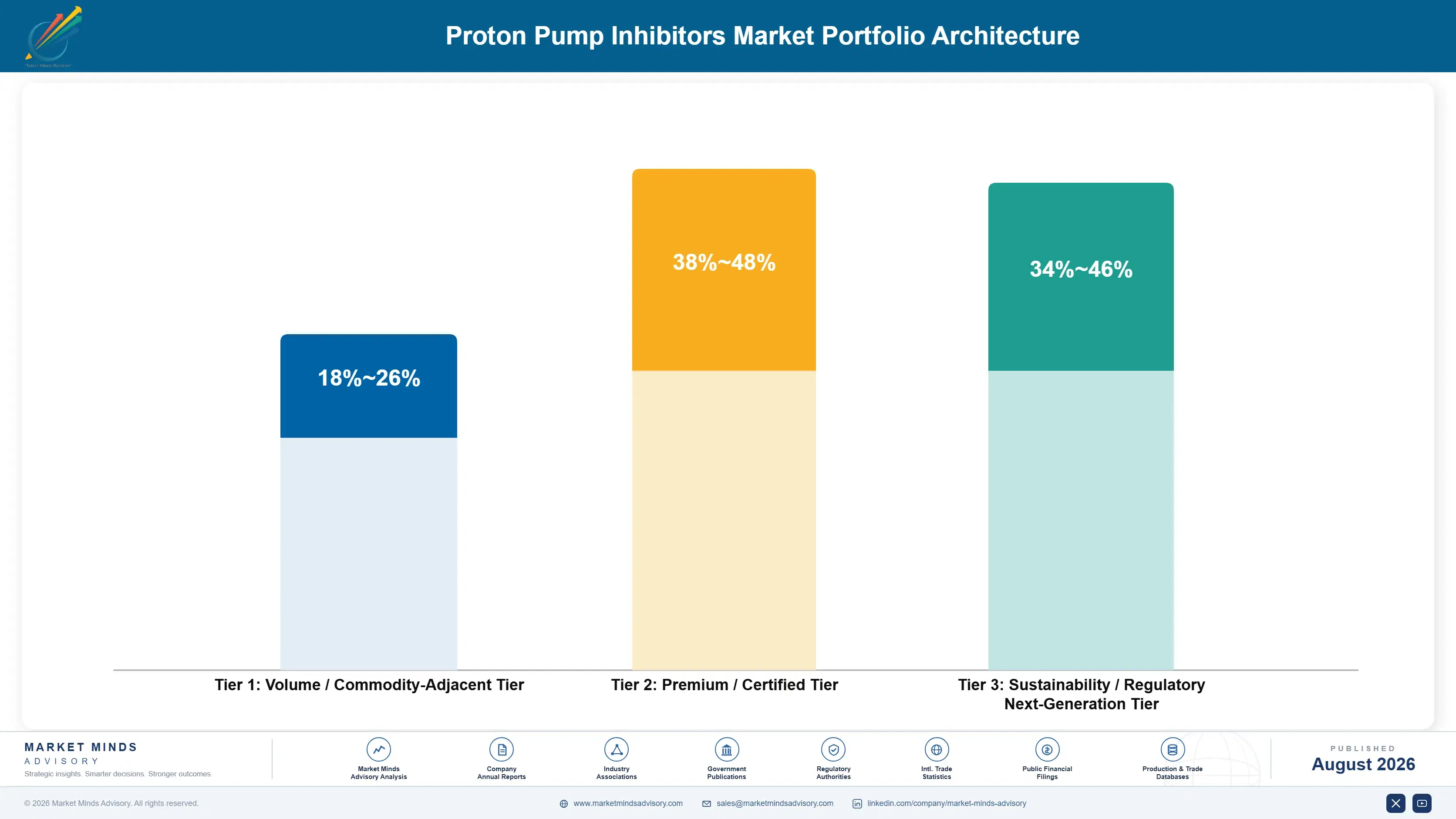
The portfolio separates by channel rather than by molecule, which is unusual and follows directly from genericisation. Prescription oral generics are commodity supply won on tendered price. Hospital injectables carry sterile manufacturing requirements and formulary access. Consumer branded formats carry promotional cost and eleven-fold realised pricing. Differentiated modified-release formats sit apart, defending small positions on formulation patents.
The tension is that the largest volume pool generates the least value. Prescription oral generics dominate units and contribute almost nothing after tendering, while consumer branded product on a fraction of the volume carries most of the realised margin. Suppliers weighted toward prescription volume are running a manufacturing business with no pricing power; those weighted toward consumer channels are running a marketing business.

High-value pools concentrate where the molecule is not what is being bought. Consumer branded formats, hospital injectable positions and modified-release presentations all qualify, and none of them competes on the acid suppression the class actually provides. What they share is that the buyer is choosing a brand, a formulary listing or a release profile rather than an active ingredient, and that is the only place pricing power still exists in this class.

Volume / Commodity-Adjacent Tier

Prescription oral generic omeprazole, pantoprazole and lansoprazole supplied against national and hospital tenders. Price is the only variable considered, input cost movement cannot be recovered, and suppliers exit presentations rather than supply below cost.
Gross Margin: 6-14%

Premium / Certified Tier

Hospital intravenous formulations requiring sterile manufacture and formulary listing, holding 23% of market value on a small share of units. Appropriate-use engagement with stewardship committees increasingly decides who retains listing at all.
Gross Margin: 26-40%

Sustainability / Regulatory / Next-Generation Tier

Consumer branded over-the-counter formats and differentiated modified-release presentations. The wide margin range separates established brand equity realising eleven times generic price from formulation patents that defend increasingly narrow clinical positions.
Gross Margin: 34-68%
proton-pump-inhibitors-market-portfolio-architecture-1787309221201

High-value Sub-segments and Strategic Watch-out

Consumer Branded Formats

The most defensible position in the class, realising roughly eleven times prescription generic price on brand recognition rather than pharmacology. Esomeprazole compounds at 5.7% almost entirely on this, and a name cannot be genericised the way a molecule can. Promotion has to be funded from the premium itself.
Gross Margin: 44-68%

Hospital Intravenous Formulations

Holding 23% of market value on a small fraction of units, defended by formulary listing rather than prescriber preference. Stewardship programmes are targeting overuse directly, though injectable value has outlasted oral prescription value in every reviewed market. Appropriate-use engagement with committees decides who keeps a listing at all.
Gross Margin: 26-40%

Prescription Oral Generics

The volume core at 2.1%, supplied against tenders where price is the only consideration and input movement cannot be passed through. It carries the units and almost none of the value, and suppliers are exiting the weakest presentations deliberately. Exiting deliberately beats exiting through a stock-out.
Gross Margin: 6-14%

Modified-Release Presentations

The strategic watch-out. Dual-release and delayed-release formats defend narrow positions on formulation patents, and potassium-competitive acid blockers address the same nocturnal control problem more convincingly through mechanism rather than through release profile. Release profile is a weaker argument than mechanism, and the adjacent class has the mechanism.
Gross Margin: 30-56%

Repeat Prescriptions Nobody Reviews

The annuity here is unusually literal and unusually fragile. A patient started on therapy for a defined course frequently continues indefinitely through repeat dispensing, and roughly 41% of long-term users have no documented current indication. That produces genuinely predictable volume with no ongoing clinical decision behind it, which is excellent revenue until a health system runs a structured medication review and removes it in one exercise. Predictability and fragility are the same propert
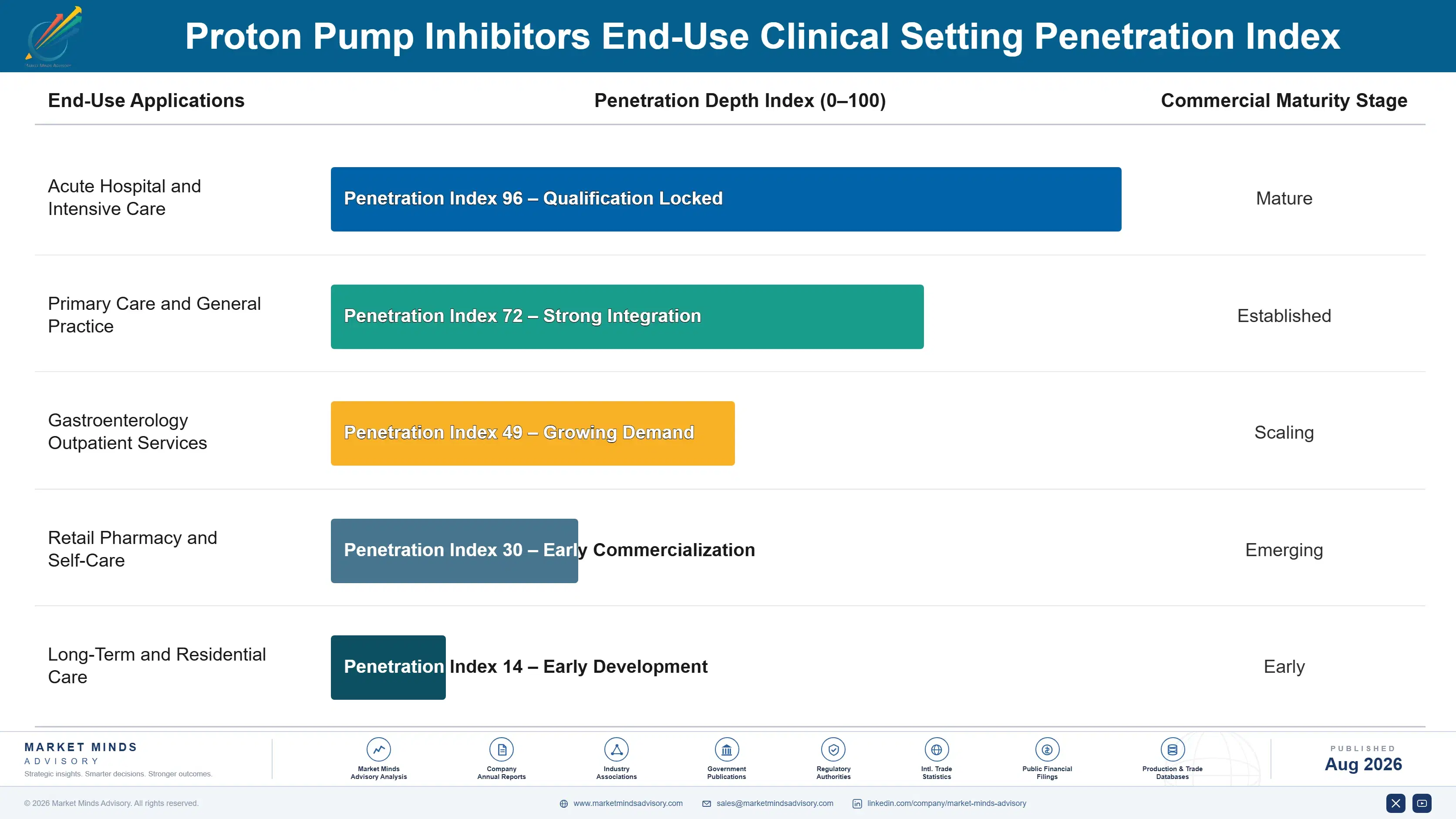
Depth varies by indication and by whether anybody is checking. Barrett's oesophagus, Zollinger-Ellison syndrome and confirmed erosive disease patients need continuous therapy and are entirely secure. Functional dyspepsia and unreviewed reflux patients are the deprescribing target. Hospital injectable use is episodic and formulary-driven. Consumer channel purchasing is intermittent, self-directed and unaffected by prescribing guidance altogether.

The deciding population has changed more than the class has. Gastroenterologists once set prescribing patterns; primary care now writes the overwhelming majority of prescriptions and increasingly operates within quality frameworks that count long-term users as a problem to be reduced. In the consumer channel there is no prescriber at all, which is precisely why value has migrated there.
proton-pump-inhibitors-market-end-use-penetration-index-1787309221747

Where Suppliers Retain Value

These are among the four positions where our research anticipates prominent divergence between winners and laggards over the coming forecast period. Each is grounded in the demand model, the regulatory perimeter, and the announced capacity pipeline.
01 / CONSUMER BRAND OWNERSHIP

A name cannot be genericised the way a molecule can

Branded over-the-counter packs realise roughly eleven times the equivalent prescription generic price, and the consumer reaching for a familiar box is not comparing active ingredients at all. That premium rests on two decades of accumulated recognition rather than on any patent, which makes it more durable than exclusivity ever was. Esomeprazole compounding at 5.7% against a market at 3.8% is almost entirely this effect rather than anything clinical, and no competitor can copy a name the way it copies a formulation.
02 / DEPRESCRIBING EXPOSURE MANAGEMENT

One medication review removes what no rival could

Roughly 41% of long-term users hold no documented current indication, and a single structured review ends that therapy permanently rather than switching it to a competitor. No commercial response prevents this once a health system commits to the programme. Reallocating effort toward Indian, Southeast Asian and Latin American markets where prescribing is still expanding, rather than being audited, is the only real defence available to any supplier, and the implementation dates are published years ahead for anyone willing to read them.
03 / FORMULARY ACCESS RETENTION

Injectable value survives what oral prescription value does not

Intravenous formulations hold 23% of market value on a small fraction of the units, and they are defended by hospital formulary listing rather than by prescriber preference or by price. Stewardship programmes targeting injectable overuse are genuine enough, and injectable value has still outlasted oral prescription value in every single market where reviews have actually run. Suppliers engaging committees with appropriate-use protocols keep listing where those denying the overuse get removed, which makes committee engagement the highest-return commercial activity available in the class.
04 / METABOLISER GENETICS POSITIONING

The real competitor came from an adjacent mechanism

Around 19% of East Asian populations are cytochrome P450 2C19 poor metabolisers, which alters proton pump inhibitor exposure and explains much of how quickly potassium-competitive acid blockers took Japanese and Korean share. Agents least dependent on that activation pathway have a genuine argument in those populations that price competition cannot substitute for. Suppliers who never make it lose the ground to a different class entirely rather than to a rival molecule, and losing share to a different mechanism is considerably harder to recover from.

Engagement Snapshot From the Field

A live engagement with an industry participant carrying material or product regulatory and market exposure ahead of a defining policy shift, showing how our research translates into a defensible multi-year portfolio strategy.
MARKET MINDS ADVISORY · CLIENT ENGAGEMENT SUMMARY
Proton Pump Inhibitors Producer Strategic Portfolio Review and Transition Roadmap 2026·Investment Scenario on Proton Pump Inhibitors Exposure Evaluation 2025-26
CLIENT PROFILE
A mid-sized generic pharmaceutical manufacturer supplying oral proton pump inhibitors across fourteen markets in Europe, the Middle East and Southeast Asia, with roughly EUR 620 million in revenue of which gastrointestinal products represented a fifth (client-reported, unverified by MMA). The portfolio was almost entirely tendered prescription supply with no consumer channel presence anywhere. Two dormant brand assets sat unused on the balance sheet.
STRATEGIC CHALLENGE
Gastrointestinal segment margin had fallen for four consecutive years, and the commercial response had been to bid harder on tenders to hold volume. Leadership attributed the decline to generic competition. Nobody had separated the effect of price erosion from the effect of prescribing volume actually contracting in the European markets.
MMA APPROACH
MMA decomposed four years of revenue decline into price, volume and mix effects by market, then compared prescribing volume trends against national deprescribing guidance implementation dates. Consumer channel realised pricing was benchmarked in the three markets where the client held suitable brand assets. Fully absorbed cost was reconstructed for every market presentation in the portfolio, which had not been done since the assets were acquired.
KEY FINDINGS
  1. Volume contraction rather than price erosion accounted for 61% of the European decline, and it tracked deprescribing guidance implementation dates closely in the Netherlands, Denmark and the United Kingdom.
  2. Southeast Asian and Middle Eastern volumes had grown 34% across the same period at low realised price, and the commercial organisation had allocated no incremental resource to them at all.
  3. Two dormant brand assets acquired in an earlier transaction were suitable for consumer channel registration in three markets, where benchmark realised pricing ran roughly nine times the client's tendered prescription price.
  4. Four of the fourteen market presentations were being supplied below fully absorbed cost, sustained only because exiting was assumed to jeopardise unrelated tender relationships.
CLIENT PROFILE
A mid-sized generic pharmaceutical manufacturer supplying oral proton pump inhibitors across fourteen markets in Europe, the Middle East and Southeast Asia, with roughly EUR 620 million in revenue of which gastrointestinal products represented a fifth (client-reported, unverified by MMA). The portfolio was almost entirely tendered prescription supply with no consumer channel presence anywhere. Two dormant brand assets sat unused on the balance sheet.
STRATEGIC CHALLENGE
Gastrointestinal segment margin had fallen for four consecutive years, and the commercial response had been to bid harder on tenders to hold volume. Leadership attributed the decline to generic competition. Nobody had separated the effect of price erosion from the effect of prescribing volume actually contracting in the European markets.
MMA APPROACH
MMA decomposed four years of revenue decline into price, volume and mix effects by market, then compared prescribing volume trends against national deprescribing guidance implementation dates. Consumer channel realised pricing was benchmarked in the three markets where the client held suitable brand assets. Fully absorbed cost was reconstructed for every market presentation in the portfolio, which had not been done since the assets were acquired.
KEY FINDINGS
  1. Volume contraction rather than price erosion accounted for 61% of the European decline, and it tracked deprescribing guidance implementation dates closely in the Netherlands, Denmark and the United Kingdom.
  2. Southeast Asian and Middle Eastern volumes had grown 34% across the same period at low realised price, and the commercial organisation had allocated no incremental resource to them at all.
  3. Two dormant brand assets acquired in an earlier transaction were suitable for consumer channel registration in three markets, where benchmark realised pricing ran roughly nine times the client's tendered prescription price.
  4. Four of the fourteen market presentations were being supplied below fully absorbed cost, sustained only because exiting was assumed to jeopardise unrelated tender relationships.
RECOMMENDED STRATEGY
Phase 1: Phase 1 (months 1 to 5): Exit the four loss-making presentations deliberately and reallocate the freed commercial resource toward growing Asian and Middle Eastern markets. Phase 2: Phase 2 (months 5 to 14): Register the two dormant brand assets for consumer channel supply in the three suitable markets. Phase 3: Phase 3 (months 14 to 24): Rebuild market prioritisation around prescribing volume trajectory rather than around the tender volume nominally available.
OUTCOME
Gastrointestinal segment margin recovered by approximately 4.2 percentage points within a year, entirely from exiting loss-making presentations and reallocating resource (client-reported, unverified by MMA). Consumer channel registration completed in two of the three markets, with realised pricing above seven times the tendered equivalent (client-reported, unverified by MMA). Market prioritisation now weights prescribing trajectory ahead of available tender volume.

Frequently Asked Questions

Foundational context covering the market sizes, CAGR, scope, country, region and competition that inform every finding below. This section is provided to cover basics and most often pre-purchase conversations, answered from the MMA Primary Research Dataset.

What is the current size of the Proton Pump Inhibitors Market?

The global market was worth USD 3.6 billion in 2025, reaching USD 3.74 billion in 2026. East Asia holds the largest regional share at 33% of value.

How large will the Proton Pump Inhibitors Market be by 2036?

MMA forecasts USD 5.43 billion by 2036, an expansion multiple of 1.45 times the 2026 base. That represents roughly USD 1.69 billion of incremental value.

What is the CAGR for the Proton Pump Inhibitors Market 2026 to 2036?

The base case compounds at 3.8% annually, with a bull case of 5.0% and a bear case of 2.6%. Historical growth from 2020 to 2025 ran at 2.7%.

Which segment is growing fastest?

Esomeprazole compounds at 5.7%, exactly 1.50 times the market rate. Consumer channel brand equity rather than any clinical advantage drives that entire growth rate forward.

Who are the major companies in the Proton Pump Inhibitors Market?

Viatris, Takeda, AstraZeneca, Haleon and Dr Reddy's Laboratories hold a combined 34% of the market. They compete on entirely different bases within the same genericised molecules.

Which country is growing fastest?

India compounds at 6.4%, ahead of every other national market. Rising reflux diagnosis and very wide over-the-counter availability together drive that volume growth steadily upward.

Report Segmentation Architecture

The full report scope spans multiple orthogonal segmentation dimensions, with cross-tabulated demand data provided for each dimension pair. Coverage extends further to regional breakdowns, trend trajectories, and the competitive detail needed to support segment-level decision-making.

By Active Molecule

  • Omeprazole
  • Esomeprazole
  • Pantoprazole
  • Lansoprazole
  • Dexlansoprazole
  • Rabeprazole

By End-Use Industry

  • Primary Care and General Practice
  • Gastroenterology Specialist Practice
  • Hospital Inpatient and Critical Care
  • Consumer Self-Medication
  • Long-Term Care Facilities

By Commercial Dimension

  • Prescription Tender and Reimbursed Supply
  • Consumer Over-the-Counter Channel
  • Hospital Formulary Supply
  • Contract Manufacturing and Private Label

By Region

  • North America
  • Western Europe
  • East Asia
  • South Asia and Pacific
  • Latin America
  • Middle East and Africa
  • Eastern Europe

Scope, Methodology, and Coverage

Every figure in this report is reproducible from documented input assumptions. The scope below maps the historical period, the forecast horizon, the segmentation dimensions, and the countries covered, alongside the underlying primary and qualitative methodology.
Historical Period
2020 to 2025
Forecast Period
2026 to 2036
Base Year
2025 (USD billions; MMA Primary Research Dataset, August 2026)
Market Definition
The market covers proton pump inhibitor active molecules across oral and intravenous formulations and prescription and consumer channels, spanning omeprazole, esomeprazole, pantoprazole, lansoprazole, dexlansoprazole and rabeprazole, together with modified-release and delayed-release presentations of those molecules. Potassium-competitive acid blockers including vonoprazan and tegoprazan, histamine H2 receptor antagonists, antacids and alginates, sucralfate and mucosal protectants, Helicobacter pylori combination kits sold as fixed regimens, and prokinetic agents are excluded. Sizing is measured at manufacturer revenue in current prices.
Quantitative Units
USD billions (current prices); standard units, defined daily doses and treatment courses where applicable
Segmentation Dimensions
By Active Molecule; By End-Use Industry; By Commercial Dimension; By Region
Regions Covered
North America, Western Europe, East Asia, South Asia and Pacific, Latin America, Middle East and Africa, Eastern Europe
Countries Covered
China, India, USA, Japan, Germany, Brazil, South Korea, France, UK, Italy, Spain, Canada, Mexico, Indonesia, Vietnam, Thailand, Philippines, Australia, Turkey, Egypt, Saudi Arabia, UAE, South Africa, Nigeria, Poland, Czech Republic, Netherlands, Sweden, Denmark, Argentina, and additional markets relevant to this sector
Key Companies Profiled
Viatris, Takeda Pharmaceutical, AstraZeneca, Dr. Reddy's Laboratories, Haleon, Teva Pharmaceutical Industries, Sun Pharmaceutical Industries, Aurobindo Pharma, Cipla, Zydus Lifesciences, Hikma Pharmaceuticals, Sandoz, Eisai, Daiichi Sankyo, Procter & Gamble, Perrigo Company, Lupin, Torrent Pharmaceuticals, Sichuan Kelun Pharmaceutical, Jiangsu Hansoh Pharmaceutical
Quantitative Methodology
Primary survey, n=3,800 respondents, Q4 2025, six countries; demand-side model with trade association cross-validation
Qualitative Methodology
47 expert interviews, Q4 2025; applied to validate demand model assumptions, identify emerging dynamics, and assess competitive positioning
Report Format
PDF and XLSX data workbook (Word format preview document)
Publisher
Market Minds Advisory
Report Code
MMA-2026-HLT-892
Published
August 2026
Contact
sales@marketmindsadvisory.com | www.marketmindsadvisory.com

Purchase the full Proton Pump Inhibitors Market Report (2026 to 2036).

The full report sizes proton pump inhibitors across six active molecules, three commercial dimensions and seven regions, with annual forecasts to 2036 under base, bull and bear scenarios. Deprescribing programme implementation is tracked by country against measured prescribing volume contraction, which is the mechanism removing more volume than any competitor class. Consumer channel realised pricing is benchmarked against prescription generic supply in every market where both exist. Potassium-competitive acid blocker substitution rates are quantified by indication and metaboliser population. Twenty companies are profiled on a consistent proton pump inhibitor revenue basis.
Deprescribing implementation tracked against measured prescribing volume contraction
Consumer channel realised pricing benchmarked against prescription generic supply
Potassium-competitive substitution quantified by indication and metaboliser population
Injectable use assessed against documented appropriate-use indications
Tender pricing and input cost recovery compared across generic suppliers
Long-term user populations segmented by documented indication status

Built For The People Who Decide

From boardroom strategy to bench-side execution, this report is read cover-to-cover by leaders shaping the next decade of their industry, turning demand scenarios, market dynamics and valuation benchmarks into decisions.
CXOs/ Presidents/ VPs/ Managers
M&A and Corporate Development
Strategy Teams and R&D Heads
Procurement and Product Directors
Regulatory and Compliance Leaders
Investor Relations and Equity Analysts