Market Minds Advisory
Temperature Detection Screen Market

Temperature Detection Screen Market: Temperature Detection Screen Market. Trends and Forecast 2026 to 2036

Airports, factories, and schools that installed fever-screening cameras during the pandemic are now folding those sensors into everyday access control, forcing camera makers to prove year-round workplace safety value beyond a single emergency.

Lead Analyst

Published

September 2026

Make Smarter Decisions with Customized Research Insights

Request a free sample report and evaluate market opportunities, growth trends, and competitive dynamics relevant to your business needs.

2025 MARKET VALUE$2.4BMarket Size 2025
2036 FORECAST VALUE$4.8BBase Case , 2026 to 2036
CAGR 2026 TO 20366.5 %Bull 7.7% / Bear 5.3%
INCREMENTAL OPPORTUNITY$2.2BNet 10- year value creation
EXPANSION MULTIPLE1.88x2036 value over 2026 base
Strategic Levers
M&A Pipeline
Regional Outlook
Country Rankings
Competitive Intelligence
Segmental Deep-dive
Call-Us : 91 93563 13602

Executive Snapshot and Market Trajectory.

Temperature screening equipment survived the pandemic's end by quietly becoming part of routine building access infrastructure rather than emergency medical equipment. Facility managers who once viewed thermal cameras as a temporary crisis purchase now integrate them into standard entry control systems, treating fever detection as one input among several.
AI-integrated multi-person screening kiosks lead current spending, concentrated most heavily among large facilities needing to screen high volumes of employees or visitors without creating bottlenecks at entry points. East Asia and North America account for the bulk of current deployment, reflecting both large existing thermal camera manufacturing capacity and, across large corporate campuses, sustained workplace safety compliance investment nationwide. Corporate safety budgets reinforce this pattern.
Security camera manufacturers historically selling standard surveillance hardware are racing to add thermal sensing capability before specialized fever-detection startups capture the entire facility relationship for themselves. Workplace safety compliance requirements are compounding this competitive pressure, pushing facility managers toward vendors offering validated measurement accuracy that differentiates compliant products from less rigorous competing offerings still relying on unvalidated consumer-grade sensors. Vendors report faster facility procurement cycles once accuracy validation data is embedded directly into product specifications.
Market Definition
The Temperature Detection Screen Market covers non-contact thermal imaging devices and kiosks used for body temperature screening at building entrances and access points, measured by device and software revenue. It excludes contact thermometers, wearable temperature sensors, and general-purpose thermal imaging cameras sold for industrial inspection applications outside human screening.
Base Year Value
$2.4B in 2025 (MMA Primary Research Dataset, September 2026)
Forecast Period
2026 to 2036, eleven discrete annual values
CAGR
6.5% base case. Bull 7.7%. Bear 5.3%.
Fastest Growth Segment
AI-Integrated Multi-Person Screening Kiosks: 10.5% CAGR
Fastest Growth Country
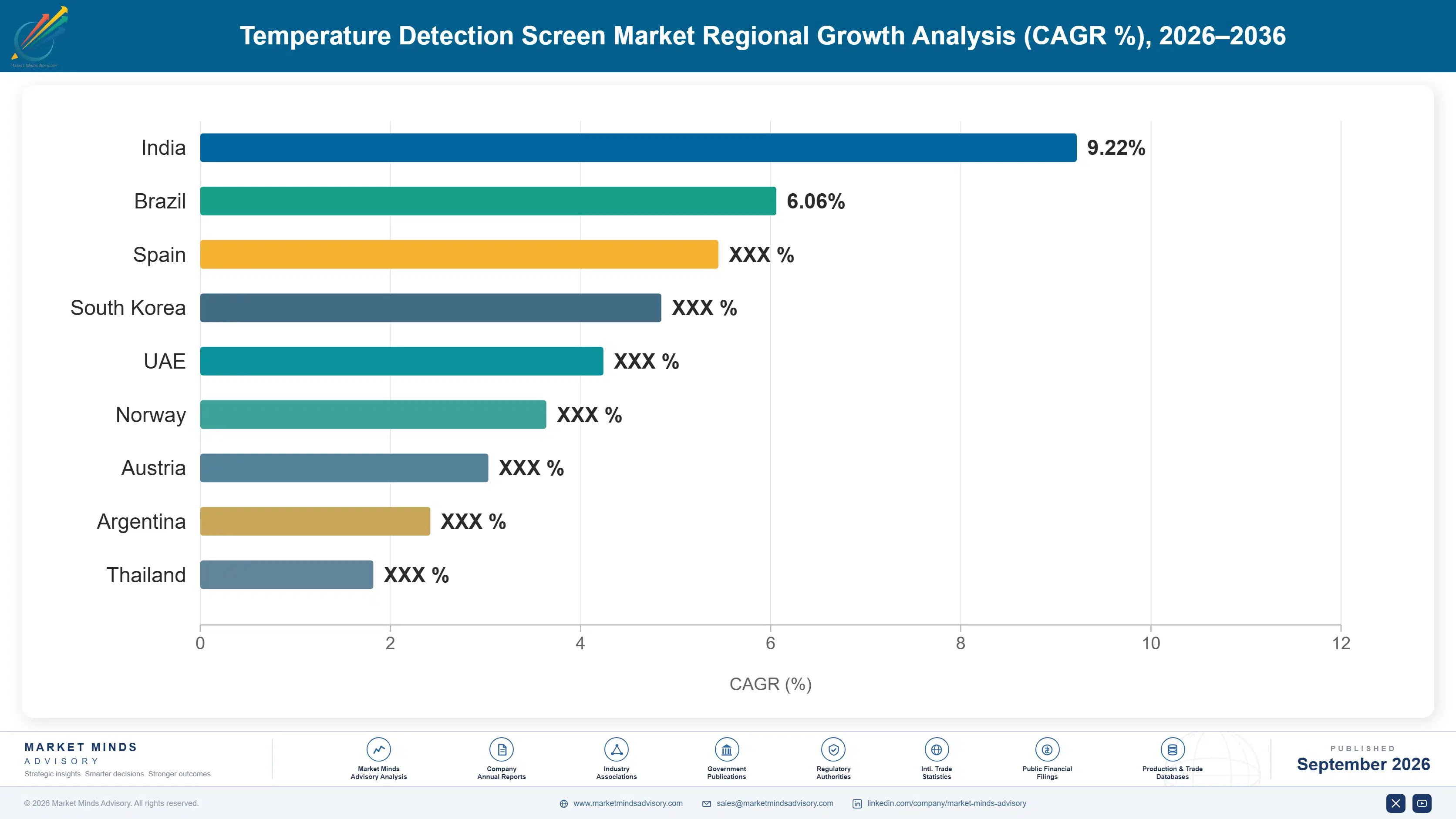
India: 9.0% CAGR
Fastest Growth Region
South Asia and Pacific: 8.5% CAGR
Largest Region
East Asia: 30% of 2025 global value
Market Leaders
Leading participants include Hikvision, Dahua Technology, FLIR Systems, Honeywell, and Athena Security.
Primary Survey
n=3,800 procurement and R&D decision-makers, Q4 2025, six countries
Methodology
Demand-side build-up, cross-validated against public data, 47 expert interviews

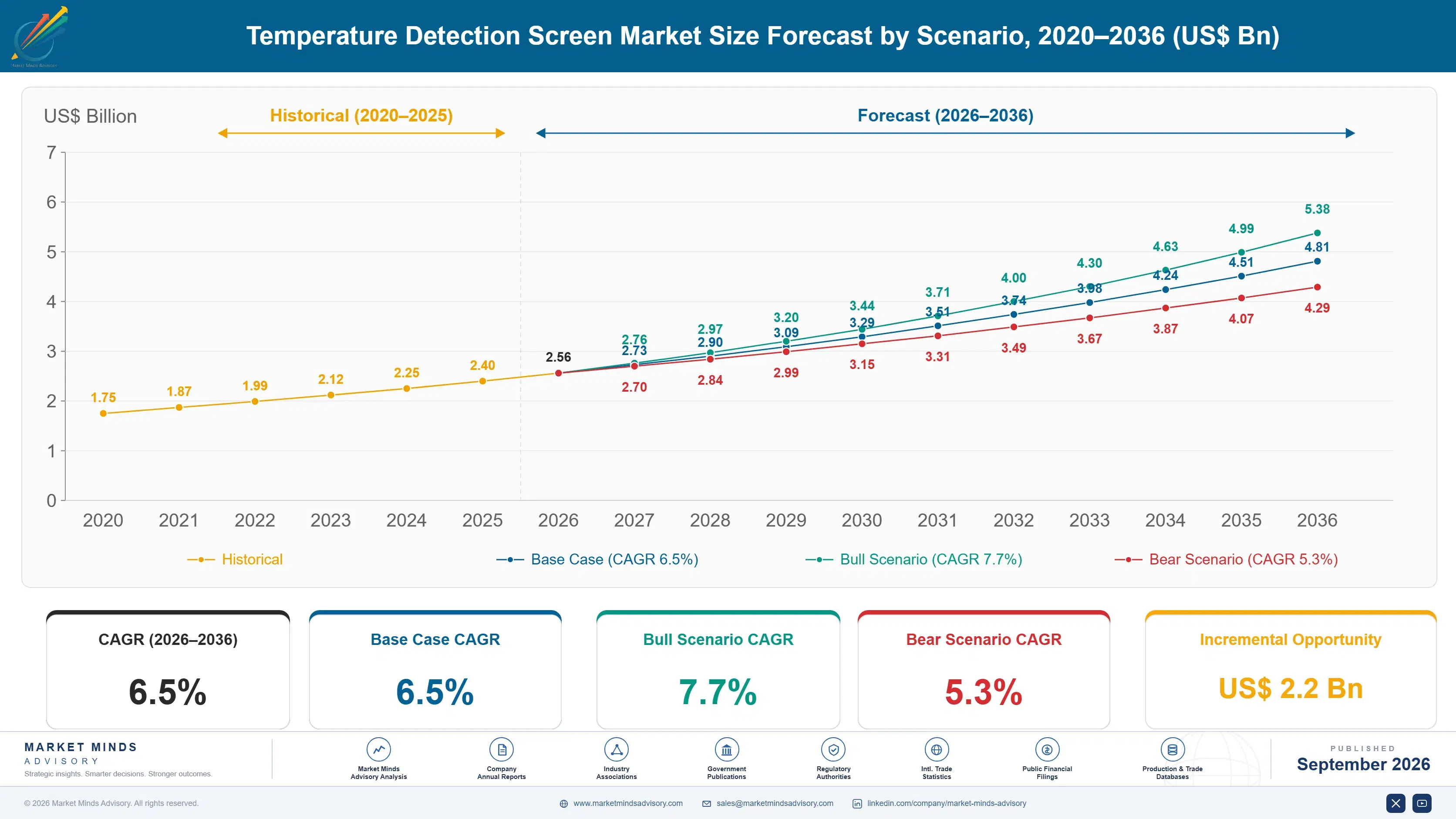
Temperature Detection Screen Market Forecast Scenarios

temperature-detection-screen-market-size-forecast-scenario-1788421633314
Temperature detection screen demand spiked sharply in 2020 and 2021 as the pandemic forced rapid deployment across airports, offices, and schools, then settled into a lower but more stable baseline from 2022 through 2025 as emergency purchasing gave way to considered facility investment. Growth continued at a more moderate pace once vendors integrated thermal sensing into standard access control products, growing at an estimated 5.5% annual rate historically.
MMA's base case rests on three compounding mechanisms: workplace safety compliance programs increasingly bundle temperature screening into broader access control requirements, falling thermal sensor costs make integrated kiosks commercially viable for smaller facilities, and infectious disease surveillance programs maintain baseline demand independent of any single pandemic event. Together these mechanisms push adoption beyond emergency crisis purchasing into steady facility infrastructure procurement across most commercial and institutional building categories. Corporate compliance mandates reinforce this momentum.
The bull case centers on a single catalyst: a future infectious disease outbreak driving renewed emergency procurement comparable to 2020 deployment levels. The bear risk is integration commoditization, where general security camera vendors bundle thermal sensing as a free feature within broader surveillance packages, eroding the standalone pricing power specialized vendors currently command across this equipment category.

Fever Screening Becomes Permanent Access Infrastructure

Temperature detection screens found a durable niche once vendors stopped marketing them purely as pandemic emergency equipment and started positioning thermal sensing as one input within broader workplace safety and access control systems. Facilities piloting integrated kiosks report measurable throughput improvement within a single deployment quarter, which is convincing skeptical facility managers who initially viewed the category as a temporary crisis-driven purchase rather than permanent infrastructure.
MARKET CONCENTRATION44% CR5Top five vendors hold this combined revenue share currently
AVERAGE KIOSK PRICE$3,200 per unitTypical retail price point for a standalone screening kiosk
TOP PRODUCING COUNTRY36% ChinaShare of global thermal screening device manufacturing volume reported
MEASUREMENT ACCURACY RATE98% accurateEstimated temperature reading accuracy versus clinical thermometer reference standards
FACILITY ADOPTION RATE22% of large facilitiesShare of large facilities maintaining permanent screening equipment today
SCREENING THROUGHPUT RATE40 people per minuteTypical multi-person kiosk screening capacity reported by manufacturers
Procurement now runs through facility safety and security committees rather than individual department heads responding to acute health concerns independently, reflecting growing awareness that screening equipment choices carry accuracy validation and liability implications extending well beyond any single entry point's immediate needs. This shift toward centralized procurement is consolidating vendor relationships around platforms offering comprehensive accuracy documentation, favoring established security camera manufacturers over smaller pandemic-era startups lacking sustained product support.
Measurement accuracy validation is emerging as a genuine competitive differentiator between screening vendors, since facilities increasingly scrutinize false positive and false negative rates that determine whether the equipment delivers practical value or simply generates entry point friction. Vendors offering credible clinical-grade accuracy validation report meaningfully higher contract renewal rates than those selling consumer-grade sensors repurposed from general security camera product lines without proper calibration.
"Nobody installs a fever camera anymore just because there's a pandemic. They install it because the insurance company and the safety officer both want it there."
Senior Analyst, Building Security and Safety Technology Practice · MMA Technology Practice · September 2026

Market Trends

AI Integration Enables Multi-Person Simultaneous Screening

Artificial intelligence facial detection algorithms can now identify and measure temperature for multiple people simultaneously as they pass through an entry point, eliminating the single-file bottleneck that early pandemic-era screening equipment created at building entrances during peak arrival periods. This multi-person capability is the single biggest reason large facilities now consider integrated kiosks practical permanent infrastructure rather than a temporary crisis measure that slowed daily operations considerably. Vendors report meaningfully higher throughput with AI-integrated kiosks versus earlier single-person screening devices. This capability gap continues widening as newer camera generations ship with faster detection algorithms.
Market Impact: Compliance programs cover 28% of facilities
Integration With Access Control Systems Expands Use Cases

Temperature detection screens increasingly integrate directly with building access control and badge systems, automatically denying entry to individuals showing elevated readings rather than relying on a security guard to manually intervene based on a visual display alert. This integration capability transforms screening equipment from a standalone monitoring display into an automated access control component, expanding the addressable market beyond dedicated health screening budgets into broader building security capital expenditure. Vendors report meaningfully higher contract values for integrated access control deployments. Vendors expect this trend to continue as access control system integration standards mature further.
Market Impact: Sensor costs fell roughly 40%

Market Opportunities and Growth Drivers

Workplace Safety Compliance Programs Bundle Screening Requirements

Corporate workplace safety programs increasingly bundle temperature screening into broader access control and occupational health compliance requirements, treating fever detection as one component of a comprehensive facility safety program rather than a standalone pandemic response measure that existed independently of routine safety infrastructure. Facility safety officers facing these bundled requirements increasingly treat screening equipment budget as part of routine capital expenditure rather than emergency procurement layered on top of adequate existing security infrastructure. Several large employers report meaningfully expanded screening deployment after formal safety program integration. MMA expects this bundling pattern to deepen as compliance frameworks formalize further.
Market Impact: Hardware replacement cycles extended 2 years

Falling Thermal Sensor Costs Expand Addressable Facility Market

Thermal sensor component costs have fallen considerably as manufacturing volume scaled during the pandemic response period, making integrated screening kiosks commercially viable for smaller facilities that previously could not justify the equipment cost for a single entry point. Smaller businesses and schools that once relied on handheld thermometers are increasingly adopting fixed kiosk systems, since the total cost of ownership calculation now favors permanent installation even for modest daily visitor volume. Several manufacturers report meaningfully expanded small business customer bases following these recent cost declines across most facility segments overall.
Market Impact: Only 55% report full trust

Market Restraints and Challenges

Post-Pandemic Demand Normalization Limits Growth Ceiling

Emergency pandemic-era procurement volume has not been replicated since normalization began in 2022, leaving many facilities that purchased equipment during the crisis period without an immediate need to expand or replace existing screening infrastructure for several more years given typical equipment lifespans. The root cause traces to the emergency's temporary nature, which pulled forward years of anticipated future demand into a compressed two-year purchasing window that the market has not fully absorbed. Vendors are exploring subscription and software-driven revenue models to reduce dependency on cyclical hardware replacement purchasing patterns. overall.
Market Impact: Screening throughput rose roughly 60% recently

Accuracy Skepticism Limits Trust in Screening Results

Some facility managers and employees remain skeptical that non-contact thermal screening delivers clinically reliable results, particularly following widely reported instances of inaccurate readings from poorly calibrated pandemic-era equipment deployed hastily without proper validation protocols in place at the time. The underlying cause is inconsistent quality standards across the many vendors that entered the market rapidly during the initial emergency, leaving a legacy of consumer distrust that established vendors must now actively work to overcome. Manufacturers are increasingly pursuing third-party accuracy certification to rebuild confidence among skeptical facility decision makers. overall.
Market Impact: Integrated deployments command roughly 35% premiums
3 additional market trends, 4 additional growth drivers, and 2 additional restraints and challenges are covered in the full report. Contact sales@marketmindsadvisory.com to access the complete intelligence.

Segment CAGR and Growth Architecture

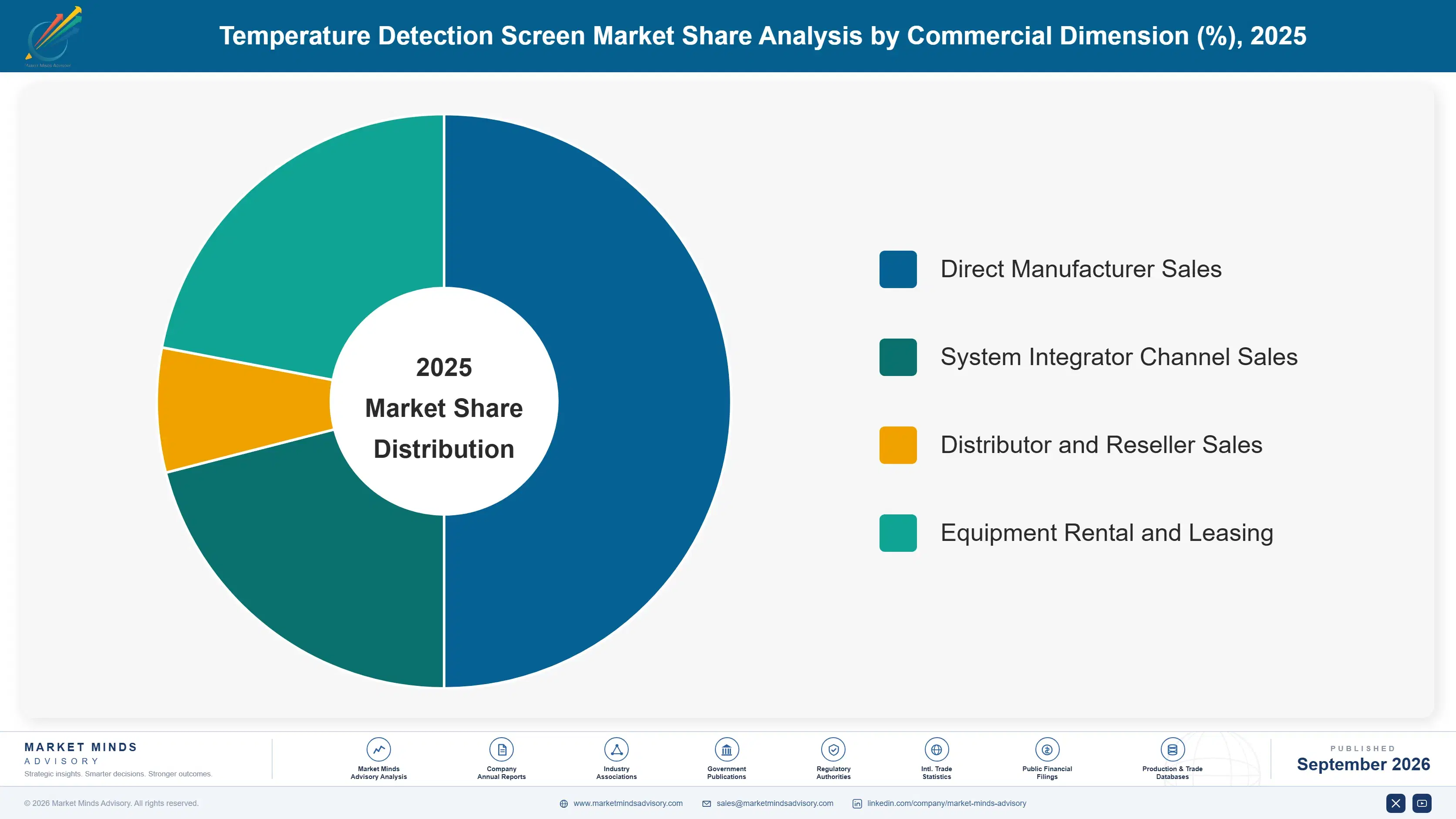
The Temperature Detection Screen Market splits into six product-defined segments spanning kiosk format and integration depth. AI-integrated multi-person screening kiosks lead growth as large facilities prioritize throughput at scale, followed closely by access control integrated systems, since both categories directly address the entry point efficiency pressures driving procurement nationwide. Vehicle-mounted units and management software round out the segment mix.
temperature-detection-screen-market-market-share-analysis-1788421633861

AI-Integrated Multi-Person Screening Kiosks

AI-integrated multi-person screening kiosks lead all segments because they concentrate the exact use case driving current facility procurement: eliminating the single-file bottleneck that early screening equipment created at building entrances during peak arrival periods, when hundreds of employees or visitors arrive within a compressed morning window. Facilities favor this segment since it directly addresses throughput pressure that increasingly shapes entry point design decisions, capturing measurable operational efficiency within a single deployment quarter. Large corporate campuses managing multiple building entrances are increasingly standardizing on this segment across their entire facility security portfolio. MMA estimates this segment alone will represent well over a third of total category revenue by 2036. Facility research supports this projection.
CAGR 10.5%

Access Control Integrated Screening Systems

Access control integrated screening systems rank second in growth as facilities seek to translate temperature readings into automated entry decisions rather than relying on a security guard to manually intervene based on a visual display alert at the entrance. These systems let facility managers automate access decisions that previously required manual judgment, closely matching the consistency an experienced security officer would provide but without requiring continuous staffing at every entry point. Facilities increasingly cite integration capability directly within building security capital planning rather than treating screening as a standalone technology purchase. MMA expects this category to scale steadily as automated entry decisions continue gaining facility manager trust. Growth here should remain strong through most of the decade.
CAGR 9.0%
Full segment breakdown across 6 segments available in the complete report.

Regional Architecture and Country Demand Map

East Asia leads the Temperature Detection Screen Market given China's dominant thermal camera manufacturing base and global export scale, while North America follows closely through sustained corporate workplace safety compliance investment and steady access control integration across large commercial facilities and government office buildings nationwide.

North America

United States corporate campuses and government buildings drive the bulk of regional demand, integrating temperature screening into broader workplace safety compliance programs across large employer facilities nationwide. Canadian facilities are following a similar pattern, particularly among healthcare and government institutions maintaining permanent screening infrastructure. Honeywell and Athena Security, both headquartered in the region, maintain deep facility management relationships that accelerate integrated kiosk adoption across large corporate campus and institutional building portfolios alike. Facility procurement cycles in the region also tend to move faster than in more fragmented regulatory environments, letting vendors close large multi-year contracts within a single fiscal budget cycle rather than waiting years for staged rollout approval across office networks and campuses.
Share: 27% | CAGR: 6.0% (2026 to 2036)

Western Europe

Germany and the United Kingdom lead regional adoption, integrating screening equipment into workplace safety modernization programs already well underway across each country's large employer base. France and the Netherlands follow through healthcare facility deployment requiring sustained infection control infrastructure investment. Regional data protection rules add meaningful compliance overhead for vendors processing facial recognition and thermal imaging data across multiple national jurisdictions simultaneously. Regional vendors increasingly bundle screening equipment with broader facility security consulting services, letting institutions address health monitoring, compliance, and infrastructure planning within a single coordinated vendor engagement rather than separate procurement tracks. Vendors report this bundling meaningfully improves subscription retention across the region's largest institutional and healthcare markets specifically.
Share: 19% | CAGR: 5.5% (2026 to 2036)
Regional intelligence for 5 additional markets available in the complete report: East Asia, South Asia and Pacific, Latin America, Middle East and Africa, Eastern Europe. Contact sales@marketmindsadvisory.com.
temperature-detection-screen-market-country-cagr-analysis-1788421634386

How Vendors Capture Facility Screening Value

Vendors capture value across four distinct commercial mechanisms as screening equipment moves from emergency purchase toward permanent facility infrastructure, extending revenue well beyond a hardware unit sale into recurring software, integration, certification, and fleet management relationships that compound steadily over each facility's equipment lifecycle and renewal cycle. Vendors executing all four consistently pull ahead of single-mechanism rivals in retention.

Access Control Integration Licensing Fee Model

Vendors charge a dedicated integration licensing fee for connecting screening equipment directly with existing building access control and badge systems, capturing recurring revenue beyond the initial hardware sale that a standalone display-only kiosk could never generate. This pricing model anchors baseline recurring revenue, since facilities rarely disconnect integrated systems once automated entry decisions become part of daily security operations. Integrated deployments typically carry contract values roughly 35% above standalone kiosk pricing given the added automation capability. Vendors report this integration revenue carries meaningfully higher lifetime value than the standalone hardware sale alone.
Market Impact: Integrated deployments command roughly 35% premium pricing overall

Screening Data Management Software Subscription Plans

Vendors increasingly sell dedicated software subscriptions covering screening event logging, compliance reporting, and multi-site dashboard access, converting what was once a one-time hardware purchase into an ongoing software relationship. This subscription revenue carries meaningfully higher margins than the underlying hardware sale itself, since the software platform serves many customer sites simultaneously at low incremental delivery cost. Some vendors now generate roughly 18% of total account revenue from these software subscriptions. Enterprises increasingly bundle this subscription into initial procurement negotiations rather than purchasing it separately later. Vendors report meaningfully higher retention once customers adopt this subscription.
Market Impact: Software subscriptions add roughly 18% of total revenue

Accuracy Certification and Calibration Service Contracts

Vendors sell dedicated accuracy certification and periodic calibration services that maintain measurement reliability over the equipment's operating life, since thermal sensor drift can degrade accuracy without regular professional recalibration that most facilities lack the technical expertise to perform internally. This certification revenue carries meaningfully higher margins than the underlying hardware subscription itself, drawing on specialized calibration expertise vendors have developed over years. Some vendors now generate roughly 12% of total account revenue from these certification services. Facilities often renew these certification engagements annually as equipment ages and calibration requirements increase.
Market Impact: Certification services add roughly 12% of total revenue

Multi-Site Facility Fleet Management Contract Bundles

Vendors bundle multi-site fleet management contracts for large enterprise customers operating dozens of facilities, providing centralized monitoring and maintenance coordination that individual site-by-site service contracts cannot deliver as efficiently. This bundled offering carries substantially higher contract values than individual facility agreements, since enterprise customers value centralized vendor accountability across their entire facility portfolio. Enterprise fleet contracts typically carry values running roughly 2 times higher than the sum of equivalent individual site agreements. Vendors are actively expanding this fleet model into additional customer segments given its strong retention appeal. overall. entirely.
Market Impact: Fleet contracts run roughly 2 times larger overall

Who Controls the Margin Pool

Five vendors, evaluated on annual product revenue from thermal screening hardware and software, together account for an estimated 44% of tracked market revenue, leaving a long tail of regional specialists competing for remaining facility budget. Hikvision leads through thermal camera manufacturing scale and cost advantage, while Dahua Technology and FLIR Systems compete closely for enterprise integration contracts that neither incumbent fully dominates across every facility segment.
Current competitive activity centers on access control integration expansion, as every major vendor races to differentiate screening platforms through deeper building security system connectivity rather than competing purely on hardware pricing alone. Partnership announcements between thermal camera manufacturers and access control system vendors have become a common deal structure over the past two years, extending platform capability without requiring vendors to build comparable integration entirely from scratch internally.

Emerging pressure comes from general security camera manufacturers who could bundle thermal sensing as a free feature within broader surveillance packages, potentially disintermediating standalone screening vendors for cost-conscious facility managers. Rankings could shift meaningfully if a major building security platform provider acquires a leading thermal screening specialist outright, combining sensor technology with existing facility management software relationships that smaller specialists currently cannot match alone.
temperature-detection-screen-market-company-positioning-matrix-1788421634909

Competitive Moat and Risk Dimensions

HIKVISION

Moat: Dominant Thermal Camera Manufacturing Scale

Hikvision's manufacturing scale, built originally to serve the broader video surveillance market, gives it cost advantages in thermal sensor production that specialized screening-only competitors cannot match easily. This scale advantage lets Hikvision price screening equipment competitively while maintaining margins comparable to its much larger core surveillance camera business.
HIKVISION

Risk: Trade Restriction Exposure Risk

Hikvision faces trade restrictions and procurement bans in several government and defense-adjacent markets due to security concerns raised by some national governments, limiting its addressable customer base in these specific regions regardless of product quality or pricing competitiveness. This restriction exposure could meaningfully limit growth in politically sensitive facility segments.
FLIR SYSTEMS

Moat: Established Thermal Imaging Brand Trust

FLIR Systems' decades-long reputation in thermal imaging technology gives it credibility among facility managers wary of newer entrants whose thermal calibration and accuracy claims lack comparable independent validation history. This trust advantage wins accounts specifically seeking proven measurement accuracy rather than untested newer alternatives. Facilities value this proven track record.
FLIR SYSTEMS

Risk: Higher Pricing Than Regional Competitors

FLIR Systems' premium positioning and established brand carry meaningfully higher pricing than regional manufacturers competing primarily on cost, potentially limiting its addressable market among smaller facilities and cost-sensitive customers in price-competitive emerging market segments where cheaper alternatives increasingly satisfy basic screening requirements. FLIR competes primarily on accuracy and support quality instead.

Players Tracked

Prominent Players

Hikvision
Dahua Technology
FLIR Systems
Honeywell
Athena Security

Other Key Players

Axis Communications
Bosch Security Systems
Uniview
Kogniz
Feevr
InfraredCameras Inc
Seek Thermal
Guardline Security
Thermoteknix Systems
Sunell Technology
Wisenet (Hanwha Vision)
CEM Systems
Suprema
Zkteco
IdentyTech Solutions

Recent Developments

FEBRUARY 2025

Hikvision launched an enhanced AI-integrated multi-person screening kiosk with expanded simultaneous detection capability, letting large facilities screen significantly more people per minute at entry points without creating queuing bottlenecks during peak arrival periods. The upgraded kiosk targets large campuses and transportation hubs managing high daily visitor traffic volume.
Signal: Signals hardware manufacturers are now increasingly prioritizing throughput as facilities standardize on permanent kiosk installations overall.
JUNE 2025

FLIR Systems announced a strategic partnership with a major building access control software provider to enable direct integration between thermal screening data and automated entry decision systems across enterprise facility networks. The partnership initially covers select major enterprise accounts with plans for broader platform availability expansion.
Signal: Signals thermal imaging specialists are increasingly pursuing access control partnerships to expand beyond standalone hardware sales.
SEPTEMBER 2025

Honeywell acquired a smaller screening data analytics startup specializing in multi-site compliance reporting software, adding centralized fleet management capability to its existing building security product portfolio ahead of planned broader integration. The acquired team will be integrated into Honeywell's existing product engineering and building technologies division.
Signal: Signals established security vendors are increasingly acquiring software capability rather than building it entirely internally now.

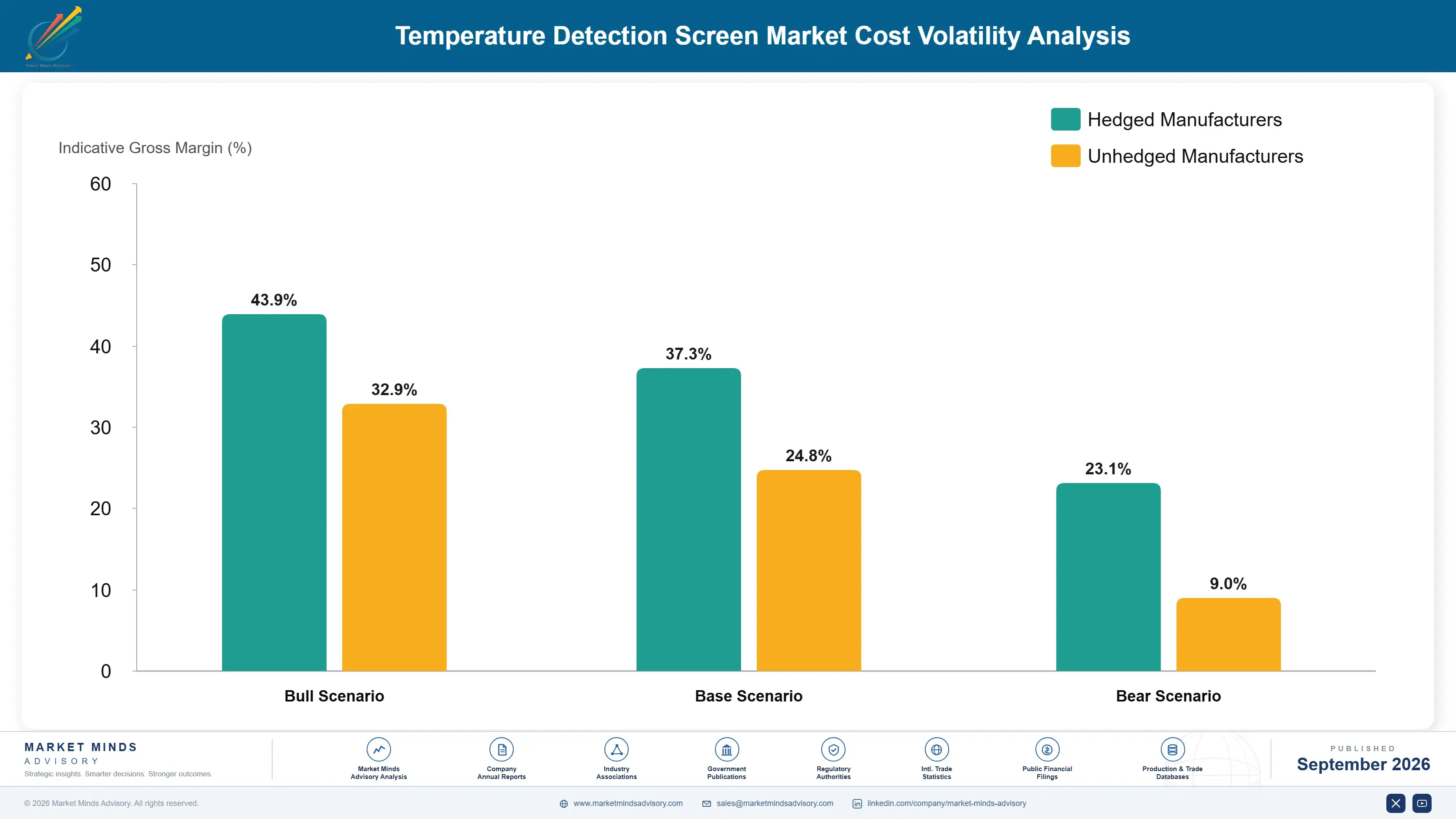
Infrared Sensor and Optics Cost Exposure

Infrared microbolometer sensors account for an estimated 35% of total cost of goods sold for temperature detection screens, sourced primarily from a limited number of specialized sensor manufacturers concentrated in China, France, and the United States. Optical lens assemblies used for thermal focusing represent a second meaningful cost input, particularly for higher-accuracy clinical-grade devices. overall.
A notable microbolometer sensor pricing increase during a broader specialty component supply tightening in early 2025, documented in multiple manufacturer investor filings, pushed several screening equipment vendors to renegotiate supplier contracts or qualify alternative sensor sources entirely. Delivery timelines extended noticeably during the affected quarter before supply conditions gradually normalized industry-wide. Delivery timelines gradually normalized within roughly two quarters as broader supply conditions eased across the industry considerably.

Smaller screening equipment vendors lacking direct relationships with specialized sensor manufacturers pay meaningfully higher per-unit component costs than larger competitors who can commit to substantial multi-year volume agreements locking in preferential pricing terms. This dynamic disproportionately affects newer entrants without the balance sheet scale to negotiate comparable supply commitments years ahead of a product launch cycle. Vendors with existing scale weathered the recent tightening better than newer entrants.
temperature-detection-screen-market-cost-volatility-analysis-1788421635111

Multi-Year Sensor Supplier Agreements

Leading manufacturers increasingly sign multi-year microbolometer supply agreements years ahead of a product launch, locking in pricing and priority allocation during periods of broader specialty component supply tightness. This approach requires significant upfront commitment but meaningfully lowers cost volatility. Vendors report meaningfully improved cost predictability once multi-year agreements are secured well ahead of launch.

Dual Sourcing Across Optics Suppliers

Some manufacturers now qualify at least two optical lens suppliers per product line to reduce dependency on any single component relationship and preserve negotiating leverage during price renewal discussions. This redundancy improves supply resilience considerably. Several manufacturers expect this approach to meaningfully reduce total component supply risk over successive product cycles. across most product categories overall.

Portfolio Architecture for Margin Defence

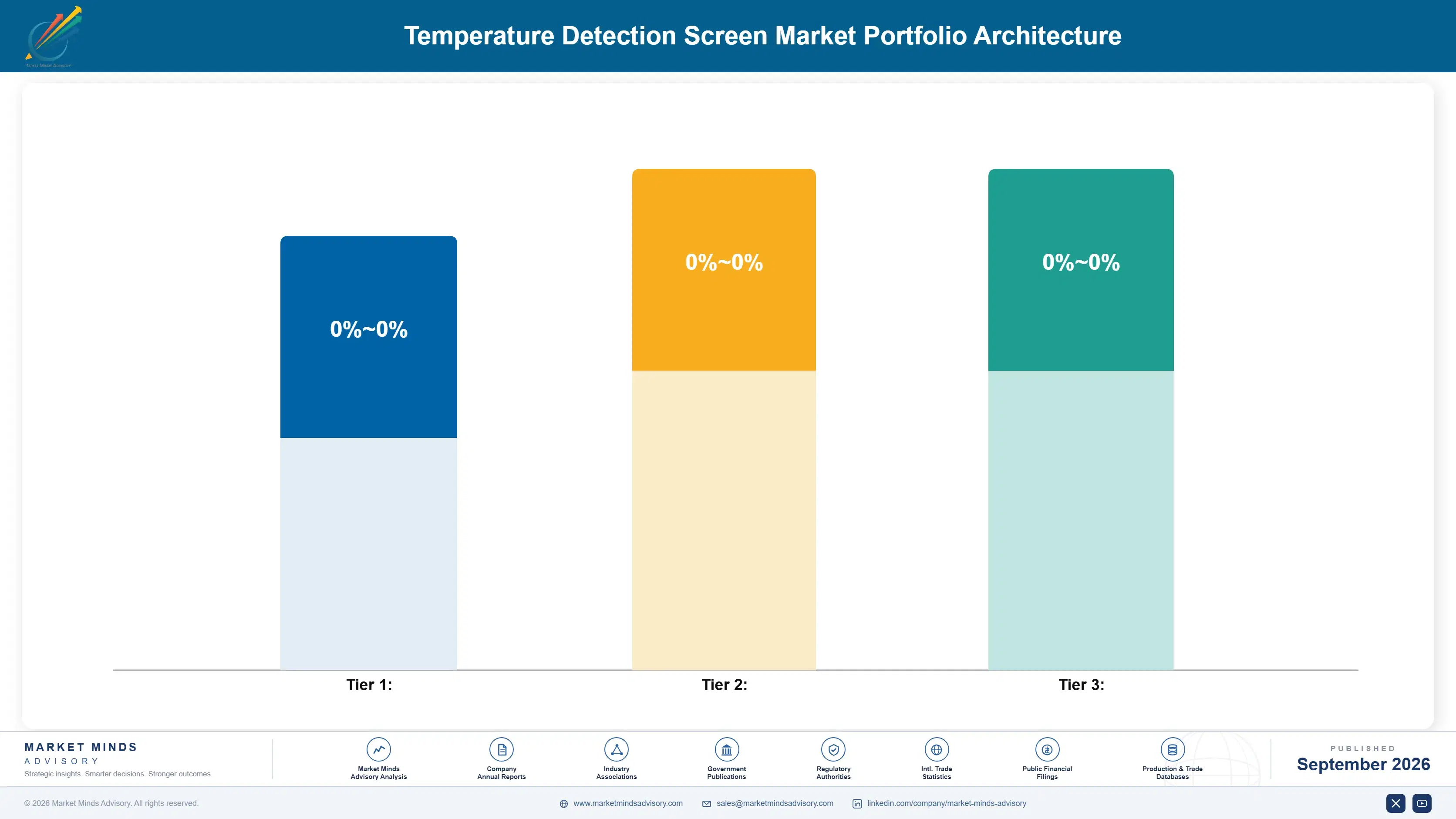
Vendors architect pricing around three distinct tiers separating basic single-person cameras from certified integrated access control kiosks and next-generation AI-powered multi-person systems still scaling from broader deployment. Gross margins widen considerably as revenue moves up this tier structure, since higher tiers embed proprietary integration software and accuracy certification competitors cannot easily replicate without comparable engineering investment. Vendors moving customers up this structure see improved profitability over successive contract renewal cycles.
Basic single-person camera revenue carries margins comparable to conventional security equipment, while premium tiers bundling access control integration and AI-powered multi-person capability command noticeably higher per-unit pricing. This tension between hardware volume and premium differentiation shapes most vendor roadmap decisions currently. Vendors design roadmaps to nudge volume-tier customers upward through bundled trial access to integration features.

The highest-value pools concentrate among large facilities willing to pay for integrated systems that connect directly with access control and compliance reporting platforms rather than functioning as standalone display hardware. Smaller vendors without this integration capability increasingly compete on price within the volume tier alone, ceding higher-margin premium facility accounts to larger established platform incumbents. Vendors investing early in integration are positioned to capture outsized share of this pool.

Basic single-person thermal cameras priced comparably to standard security equipment, targeting cost-sensitive smaller facilities without complex compliance documentation or access control integration requirements attached. These accounts value predictable flat pricing over advanced feature depth entirely.
Gross Margin

Integrated access control kiosks bundling accuracy certification and reporting capability, targeting large facilities commanding meaningfully higher recurring margins given embedded automation and compliance functionality. Renewal rates in this tier run notably higher than the volume segment overall.
Gross Margin

AI-powered multi-person screening systems with expanded throughput capability, still scaling from broader deployment, priced at the highest premium given differentiated proprietary technology and integration depth involved. Commercial availability remains limited to a handful of early adopters currently.
Gross Margin
temperature-detection-screen-market-portfolio-architecture-1788421635622

High-value Sub-segments and Strategic Watch-out

AI-Integrated Multi-Person Screening Kiosks

This segment combines the fastest growth rate in the market with the strongest margin profile, as large facilities prioritize throughput at scale while paying premium pricing for automation that materially reduces entry point congestion. MMA rates this segment the strongest combined opportunity in the entire portfolio.

Access Control Integrated Screening Systems

Strong growth continues here as automated entry decisions mature, though margins run somewhat thinner than multi-person kiosks given intensifying competition among vendors offering broadly comparable integration capability. Vendors should still prioritize investment here given the large addressable facility base. Early results show strong customer satisfaction.

Standalone Single-Person Thermal Cameras

This established segment anchors reliable core revenue for vendors serving smaller facilities, growing more slowly than integrated alternatives but maintaining loyal customers with long-standing procurement relationships and lower switching incentive. This segment remains a dependable core revenue source for established vendors. Loyal customers renew consistently.

Handheld Non-Contact Thermometers

Growth here trails the broader market meaningfully, and vendors should watch closely for signs of accelerating displacement by fixed kiosk categories that offer comparable measurement without requiring dedicated staff operation. Vendors should monitor renewal rates closely for early signs of accelerating decline. Early signals matter.

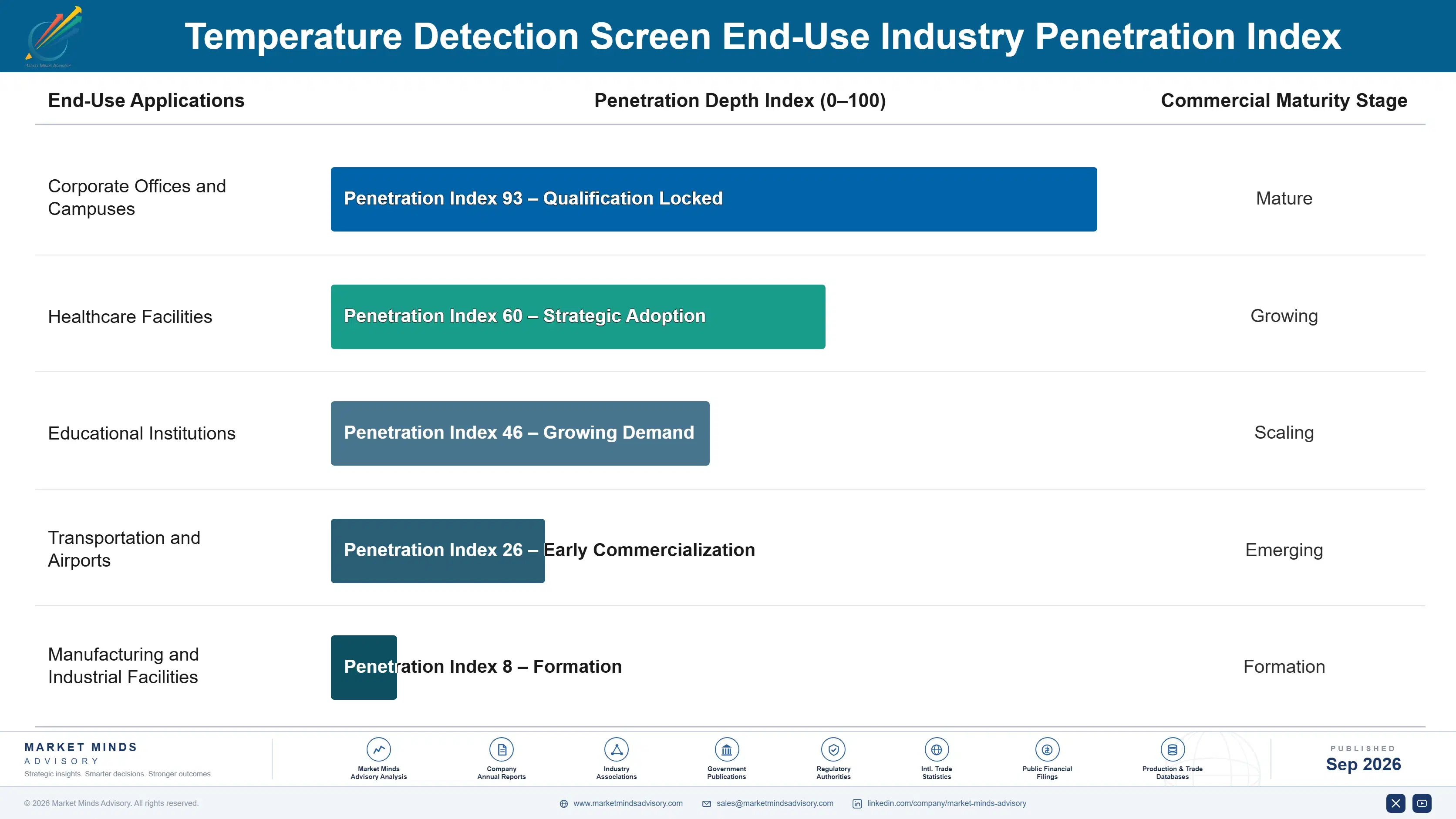
The Compliance Annuity Behind Access Screening

Screening equipment maintenance and software contracts function much like a compliance annuity, since renewal happens automatically each budget cycle once a facility's safety teams depend on documented screening records for liability protection. This gives vendors predictable revenue visibility once a facility completes initial deployment. Churn for fully deployed facilities runs notably lower than typical security equipment, since switching cost grows each renewal year. overall.
Adoption depth varies meaningfully by end-use vertical: healthcare and corporate campus facilities embed screening deeply given clear liability and compliance benefits, while smaller retail and hospitality facilities often see lighter deployment, leaving those entry points on manual screening methods considerably longer. Manufacturing facilities occupy a middle ground, adopting screening selectively during periods of heightened public health awareness. overall.

Buyer profiles are shifting generationally as facility managers who built careers on manual security protocols give way to a newer cohort trained on automated building systems from early in their careers. This shift accelerates procurement, since newer buyers arrive already comfortable evaluating screening dashboards. Vendors report shorter sales cycles engaging this cohort, since advocacy increasingly comes from within operations teams rather than executives.
temperature-detection-screen-market-end-use-penetration-index-1788421636120

Where Vendors Should Focus Next

These are among the four positions where our research anticipates prominent divergence between winners and laggards over the coming forecast period. Each is grounded in the demand model, the regulatory perimeter, and the announced capacity pipeline.
01 / ACCESS CONTROL INTEGRATION

Deepen access control integration before rivals close gap

Access control integration increasingly determines which screening vendor captures the highest-value facility contracts, since facility managers now compare automated entry decision capability across competing platforms rather than a single flat hardware price point. Vendors offering deeper integration capability convert casual hardware buyers into premium platform buyers meaningfully faster than those offering only standalone display units without connectivity. This approach matters most for vendors competing directly against rivals with more established building security software relationships and considerably deeper existing facility partnerships.
02 / ACCURACY CERTIFICATION INVESTMENT

Pursue third-party accuracy certification to rebuild market trust

Accuracy skepticism remains a genuine barrier limiting broader adoption among facility managers who witnessed unreliable pandemic-era equipment deployed hastily without proper validation protocols during the initial emergency response period. Vendors pursuing credible third-party accuracy certification can rebuild market trust meaningfully faster than competitors relying solely on marketing claims without independent validation, capturing skeptical facility accounts that otherwise default to established competitors. This approach matters most for newer vendors lacking established reputation and track record among quite skeptical facility decision makers.
03 / SOFTWARE SUBSCRIPTION EXPANSION

Expand software subscription revenue ahead of hardware commoditization

Hardware commoditization risk remains a genuine threat as general security camera vendors increasingly bundle thermal sensing as a free feature within broader surveillance packages, eroding standalone pricing power for hardware-only vendors. Vendors expanding software subscription revenue covering compliance reporting and fleet management can build recurring revenue that hardware commoditization cannot easily erode, unlike vendors depending entirely on one-time equipment sales for revenue. This approach matters most for vendors currently dependent primarily on hardware transaction revenue alone without recurring software income.
04 / SENSOR SUPPLY DIVERSIFICATION

Qualify multiple sensor suppliers before component shortages hit

Screening equipment manufacturers depending on a single microbolometer sensor supplier risk production disruption whenever broader specialty component supply tightens, as several manufacturers already experienced during the recent sensor pricing spike affecting the industry. Manufacturers qualifying at least two sensor suppliers per product line preserve negotiating leverage and protect delivery reliability during unexpected supply disruptions that competitors relying on single sourcing cannot easily absorb without delay. This diversification investment pays off most clearly during periods of broader industry supply tension and heightened trade uncertainty.

Engagement Snapshot From the Field

A live engagement with an industry participant carrying material or product regulatory and market exposure ahead of a defining policy shift, showing how our research translates into a defensible multi-year portfolio strategy.
MARKET MINDS ADVISORY · CLIENT ENGAGEMENT SUMMARY
Temperature Detection Screen Producer Strategic Portfolio Review and Transition Roadmap 2026·Investment Scenario on Temperature Detection Screen Exposure Evaluation 2025-26
CLIENT PROFILE
A corporate campus operator managing several large office buildings and a manufacturing facility faced growing employee concerns about workplace health safety following a period of elevated seasonal illness that disrupted normal operations across multiple departments. Leadership needed to standardize temperature screening across all facility entrances without creating entry bottlenecks during peak morning arrival periods, and faced pressure to demonstrate measurable safety improvement ahead of an upcoming employee satisfaction survey.
STRATEGIC CHALLENGE
Leadership needed to determine whether integrated multi-person screening kiosks could meaningfully reduce entry point congestion while maintaining measurement accuracy comparable to individual handheld screening previously used, and faced pressure to complete deployment across all facility entrances within a single fiscal quarter to support the upcoming employee survey. Board members also wanted assurance the transition would not slow daily employee arrival flow.
MMA APPROACH
MMA benchmarked three candidate screening vendors against the operator's specific throughput requirements, existing access control system compatibility, and facility layout constraints, then modeled expected entry point congestion reduction and full multi-year total cost of ownership across each vendor option under consideration for this particular campus. Findings were shared with the operator's facilities leadership ahead of final vendor selection and contract signing.
KEY FINDINGS
  1. Integrated multi-person kiosks reduced entry point congestion meaningfully within the first month of deployment (client-reported, unverified by MMA) across all facility entrances.
  2. Measurement accuracy remained comparable to previous handheld screening methods across all validated testing scenarios conducted internally. Facility engineers confirmed this accuracy held consistent across multiple testing sessions and conditions.
  3. Employee satisfaction survey results showed improved perception of workplace safety following the standardized screening deployment across facilities. Employees specifically cited the standardized screening process as a meaningful improvement overall.
  4. Facility security staff reported reduced manual screening workload, freeing capacity for other building security responsibilities daily. This freed capacity meaningfully improved overall building security coverage during business hours.
CLIENT PROFILE
A corporate campus operator managing several large office buildings and a manufacturing facility faced growing employee concerns about workplace health safety following a period of elevated seasonal illness that disrupted normal operations across multiple departments. Leadership needed to standardize temperature screening across all facility entrances without creating entry bottlenecks during peak morning arrival periods, and faced pressure to demonstrate measurable safety improvement ahead of an upcoming employee satisfaction survey.
STRATEGIC CHALLENGE
Leadership needed to determine whether integrated multi-person screening kiosks could meaningfully reduce entry point congestion while maintaining measurement accuracy comparable to individual handheld screening previously used, and faced pressure to complete deployment across all facility entrances within a single fiscal quarter to support the upcoming employee survey. Board members also wanted assurance the transition would not slow daily employee arrival flow.
MMA APPROACH
MMA benchmarked three candidate screening vendors against the operator's specific throughput requirements, existing access control system compatibility, and facility layout constraints, then modeled expected entry point congestion reduction and full multi-year total cost of ownership across each vendor option under consideration for this particular campus. Findings were shared with the operator's facilities leadership ahead of final vendor selection and contract signing.
KEY FINDINGS
  1. Integrated multi-person kiosks reduced entry point congestion meaningfully within the first month of deployment (client-reported, unverified by MMA) across all facility entrances.
  2. Measurement accuracy remained comparable to previous handheld screening methods across all validated testing scenarios conducted internally. Facility engineers confirmed this accuracy held consistent across multiple testing sessions and conditions.
  3. Employee satisfaction survey results showed improved perception of workplace safety following the standardized screening deployment across facilities. Employees specifically cited the standardized screening process as a meaningful improvement overall.
  4. Facility security staff reported reduced manual screening workload, freeing capacity for other building security responsibilities daily. This freed capacity meaningfully improved overall building security coverage during business hours.
RECOMMENDED STRATEGY
Phase 1: Phase one selected a vendor meeting both throughput requirements and existing access control system compatibility precisely. and existing budget parameters closely. Phase 2: Phase two piloted the kiosks at a single building entrance before expanding to the full campus footprint. to validate throughput first. Phase 3: Phase three trained security staff on the new kiosks' operational and maintenance procedures thoroughly and consistently. and new reporting workflows used.
OUTCOME
The operator reduced entry point congestion and improved employee safety perception across its campus facilities (client-reported, unverified by MMA), while freeing security staff capacity for other building safety responsibilities during the deployment period. Facility leadership credited the standardized deployment with meaningfully improving overall employee confidence in workplace safety.

Frequently Asked Questions

Foundational context covering the market sizes, CAGR, scope, country, region and competition that inform every finding below. This section is provided to cover basics and most often pre-purchase conversations, answered from the MMA Primary Research Dataset.

What is the current size of the Temperature Detection Screen Market?

The Temperature Detection Screen Market reached an estimated $2.4 billion in global revenue in 2025. This covers non-contact thermal imaging devices and kiosks used for body temperature screening worldwide.

How large will the Temperature Detection Screen Market be by 2036?

MMA projects the market will reach approximately $4.80 billion by 2036, driven mainly by access control integration and workplace safety compliance. That represents roughly a 1.88 fold expansion from 2026 levels.

What is the CAGR for the Temperature Detection Screen Market 2026 to 2036?

The market is forecast to grow at a 6.5% compound annual rate between 2026 and 2036. Bull and bear scenarios range between roughly 5.3% and 7.7% depending on future outbreak risk.

Which segment is growing fastest?

AI-integrated multi-person screening kiosks lead all segments, expanding at an estimated 10.5% annually. That is well above the overall market's 6.5% average growth rate through the forecast period to 2036.

Who are the major companies in the Temperature Detection Screen Market?

Hikvision, Dahua Technology, FLIR Systems, Honeywell, and Athena Security form the five leading vendors tracked in this report. Together they hold an estimated 44% combined share of tracked revenue.

Which country is growing fastest?

India posts the fastest national growth rate in the study, expanding at an estimated 9.0% annually. Its expanding corporate and healthcare facility construction drives unusually rapid screening equipment adoption there.

Report Segmentation Architecture

The full report scope spans multiple orthogonal segmentation dimensions, with cross-tabulated demand data provided for each dimension pair. Coverage extends further to regional breakdowns, trend trajectories, and the competitive detail needed to support segment-level decision-making.

By Primary Market Dimension

  • AI-Integrated Multi-Person Screening Kiosks
  • Access Control Integrated Screening Systems
  • Standalone Single-Person Thermal Cameras
  • Handheld Non-Contact Thermometers
  • Vehicle-Mounted Drive-Through Screening Units
  • Screening Data Management Software

By End-Use Industry

  • Corporate Offices and Campuses
  • Healthcare Facilities
  • Educational Institutions
  • Transportation and Airports
  • Manufacturing and Industrial Facilities

By Commercial Dimension

  • Direct Manufacturer Sales
  • System Integrator Channel Sales
  • Distributor and Reseller Sales
  • Equipment Rental and Leasing

By Region

  • North America
  • Western Europe
  • East Asia
  • South Asia and Pacific
  • Latin America
  • Middle East and Africa
  • Eastern Europe

Scope, Methodology, and Coverage

Every figure in this report is reproducible from documented input assumptions. The scope below maps the historical period, the forecast horizon, the segmentation dimensions, and the countries covered, alongside the underlying primary and qualitative methodology.
Historical Period
2020 to 2025
Forecast Period
2026 to 2036
Base Year
2025 (USD billions; MMA Primary Research Dataset, September 2026)
Market Definition
The Temperature Detection Screen Market covers non-contact thermal imaging devices and kiosks used for body temperature screening at building entrances and access points, measured by device and software revenue. It excludes contact thermometers, wearable temperature sensors, and general-purpose thermal imaging cameras sold for industrial inspection applications outside human screening.
Quantitative Units
USD Billion, CAGR (%), Share (%), 2020 to 2036
Segmentation Dimensions
By Primary Market Dimension; By End-Use Industry; By Commercial Dimension; By Region
Regions Covered
North America, Western Europe, East Asia, South Asia and Pacific, Latin America, Middle East and Africa, Eastern Europe
Countries Covered
United States, Canada, United Kingdom, Germany, France, Netherlands, China, Japan, South Korea, India, Australia, Brazil, Mexico, Saudi Arabia, United Arab Emirates, South Africa, Poland
Key Companies Profiled
Hikvision, Dahua Technology, FLIR Systems, Honeywell, Athena Security, Axis Communications, Bosch Security Systems, Uniview, Kogniz, Feevr, InfraredCameras Inc, Seek Thermal, Guardline Security, Thermoteknix Systems, Sunell Technology, Wisenet (Hanwha Vision), CEM Systems, Suprema, Zkteco, IdentyTech Solutions
Quantitative Methodology
Primary survey, n=3,800 respondents, Q4 2025, six countries; demand-side model with trade association cross-validation
Qualitative Methodology
47 expert interviews, Q4 2025; applied to validate demand model assumptions, identify emerging dynamics, and assess competitive positioning
Report Format
PDF and XLSX data workbook (Word format preview document)
Publisher
Market Minds Advisory
Report Code
MMA-2026-TEC-623
Published
September 2026
Contact
sales@marketmindsadvisory.com | www.marketmindsadvisory.com

Purchase the full Temperature Detection Screen Market Report (2026 to 2036).

The full report delivers a comprehensive analysis of the Temperature Detection Screen Market, covering historical performance from 2020 through 2025 and forecasts extending to 2036. It provides detailed segmentation across six primary product categories, seven regional markets, and competitive profiles of the twenty leading manufacturers shaping industry structure. Readers gain access to quantified demand drivers, restraints, and revenue lever analysis grounded in primary survey data and expert interviews. The report also includes a detailed input cost exposure assessment and portfolio tier framework for strategic planning purposes.
Seven-region market sizing and forecast data
Twenty manufacturer competitive profiles and positioning
Segment-level CAGR and revenue projections through 2036
Primary survey data from 3,800 respondents
Expert interview insights from 47 industry specialists
Revenue lever and portfolio tier strategic frameworks

Built For The People Who Decide

From boardroom strategy to bench-side execution, this report is read cover-to-cover by leaders shaping the next decade of their industry, turning demand scenarios, market dynamics and valuation benchmarks into decisions.
CXOs/ Presidents/ VPs/ Managers
M&A and Corporate Development
Strategy Teams and R&D Heads
Procurement and Product Directors
Regulatory and Compliance Leaders
Investor Relations and Equity Analysts