Market Minds Advisory
Dual Screen Laptops Market

Dual Screen Laptops Market: Dual Screen Laptops Market. Foldable And Dual-Display Portable Computing Devices

Foldable OLED panel costs are finally falling fast enough to pull dual-screen laptops out of the premium niche, forcing mainstream PC makers to decide whether a second display justifies the added engineering complexity.

Lead Analyst

Published

September 2026

Make Smarter Decisions with Customized Research Insights

Request a free sample report and evaluate market opportunities, growth trends, and competitive dynamics relevant to your business needs.

2025 MARKET VALUE$1.9BMarket Size 2025
2036 FORECAST VALUE$9.2BBase Case , 2026 to 2036
CAGR 2026 TO 203615.5 %Bull 16.8% / Bear 14.2%
INCREMENTAL OPPORTUNITY$7.1BNet 10- year value creation
EXPANSION MULTIPLE4.22x2036 value over 2026 base
Strategic Levers
M&A Pipeline
Regional Outlook
Country Rankings
Competitive Intelligence
Segmental Deep-dive
Call-Us : 91 93563 13602

Executive Snapshot and Market Trajectory.

Foldable OLED panel costs are dropping fast enough to pull dual-screen laptops out of the premium niche, pushing mainstream PC makers to weigh a second display against the added engineering weight and battery drain it introduces across everyday carry and travel usage scenarios.
Creative professionals and mobile business users adopt dual-screen devices fastest, driven respectively by multitasking workflow demand and increasingly powerful reference platforms, and East Asia leads production given its concentration of both panel suppliers and contract manufacturers, with consumers increasingly comparing dual-screen laptops directly against foldable tablets and premium ultrabooks rather than treating the category as a standalone niche purchase reserved only for early technology adopters willing to pay a steep premium for the multitasking convenience.
Competitive intensity now centers on hinge durability and panel seam quality rather than raw specification sheets, as Lenovo and ASUS defend leading dual-screen product lines while Intel pushes reference designs to broaden OEM participation, and evolving component cost dynamics across foldable OLED supply chains increasingly shape which vendors can price competitively against conventional single-screen laptops at comparable overall specification, weight, and build quality levels across the same price bracket.
Market Definition
The Dual Screen Laptops market covers portable computing devices featuring two integrated display panels, including foldable single-panel devices that function as dual screens and fixed dual-panel clamshell designs. It excludes laptops with a single primary display paired with a small secondary touch bar, external monitor accessories sold separately, and tablet devices without an attached physical keyboard.
Base Year Value
$1.9B in 2025 (MMA Primary Research Dataset, September 2026)
Forecast Period
2026 to 2036, eleven discrete annual values
CAGR
15.5% base case. Bull 16.8%. Bear 14.2%.
Fastest Growth Segment
Foldable OLED Dual-Screen Laptops: 24.0% CAGR
Fastest Growth Country
China: 16.8% CAGR
Fastest Growth Region
South Asia and Pacific: 17.8% CAGR
Largest Region
East Asia: 29% of 2025 global value
Market Leaders
Lenovo, ASUS, Intel, Dell Technologies, HP. Source: MMA Analysis based on company annual reports.
Primary Survey
n=3,800 procurement and R&D decision-makers, Q4 2025, six countries
Methodology
Demand-side build-up, cross-validated against public data, 47 expert interviews

Dual Screen Laptops Market Forecast Scenarios

dual-screen-laptops-market-size-forecast-scenario-1789989680929
Between 2020 and 2025 dual-screen laptop adoption moved from experimental concept devices to a small but established premium product category, accelerated by falling foldable OLED panel costs and a historical CAGR near fourteen and a half percent that established credibility for the category among mainstream PC buyers who had previously dismissed the category as an unnecessary gimmick.
The base case assumes continued foldable OLED cost declines as panel manufacturing scales across additional suppliers, expanding creative professional demand for multitasking screen real estate, and rising OEM willingness to extend dual-screen designs into mid-range price tiers rather than premium flagships alone, three mechanisms that together sustain rapid expansion through 2036 without requiring a fundamentally new form factor to emerge beyond the multitasking productivity case already driving most current category interest.
A bull scenario hinges on foldable OLED costs falling faster than expected, pulling dual-screen designs into mainstream laptop price bands within a few years. The bear case centers on persistent hinge durability concerns and battery life tradeoffs that keep dual-screen laptops confined to a narrow enthusiast and creative professional niche for the foreseeable future rather than a genuinely mainstream form factor.

Foldable Panel Economics Reshaping Premium Laptop Design

Dual-screen laptops sit at the convergence of two previously separate product categories, the productivity ultrabook and the foldable display experiment, and vendors that can deliver a genuinely durable hinge now win reviews and repeat purchases that a merely novel form factor cannot sustain on its own once initial curiosity from early reviewers fades and daily usability becomes the deciding factor for repeat buyers making a second purchase.
MARKET CONCENTRATIONCR5 62%top five participants hold nearly two thirds of spend
AVERAGE SELLING PRICE$1,850typical retail price point across current dual-screen laptop models
FOLDABLE PANEL COST SHARE38%share of unit bill of materials attributable to the display
HINGE FAILURE RETURN RATE6%share of units returned due to hinge mechanism defects
CREATIVE PROFESSIONAL BUYER SHARE44%share of unit sales purchased for content creation work
BATTERY LIFE VERSUS STANDARD-22%reduction in rated battery life compared with single-screen equivalents
Commercially the category behaves like premium consumer electronics rather than a mass-market laptop refresh cycle: high average selling prices, thin unit volumes relative to conventional laptops, and margin concentrated in the display and hinge assembly rather than the core computing components underneath, a cost structure closer to premium smartphones than to typical laptops, and margin pools reflect that unusual component mix directly.
Over the next decade, falling foldable OLED costs, maturing hinge engineering, and expanding creative software optimized for dual-screen workflows will separate vendors capable of scaling production from smaller players confined to low-volume specialty runs unable to justify mainstream retail distribution partnerships or the marketing spend needed to build category awareness among mainstream consumers still unfamiliar with the form factor.
"The hinge is the product. Everything else in a dual-screen laptop is a normal ultrabook until the moment you fold it, and that is exactly where most early designs failed."
Director, Consumer Electronics and Display Technology Practice · MMA Multi-Display Portable Computing Devices Practice · September 2026

Market Trends

Foldable OLED Panel Costs Falling Faster Than Expected

Panel manufacturers including Samsung Display and LG Display have expanded foldable OLED production capacity considerably faster than initial industry projections anticipated, driving unit costs down and enabling OEMs to introduce dual-screen models at price points that were commercially unviable just two years earlier. This cost decline is opening the category to mid-range laptop segments previously excluded entirely by premium panel pricing, and additional panel suppliers including Chinese manufacturers entering the foldable OLED market are accelerating the pace of price competition industry-wide. Vendors that locked in early supply agreements are capturing disproportionate share of the resulting cost advantage.
Market Impact: Adds 1.2 million hybrid-work unit sales
Creative Software Optimization Expands Practical Use Cases

Major creative software vendors are optimizing their applications specifically for dual-screen laptop workflows, letting users place reference material, timelines, or tool palettes on a secondary display rather than treating the second screen as an afterthought extension of the primary workspace. This optimization has meaningfully expanded the practical use case for dual-screen laptops beyond simple multitasking convenience into genuine productivity gains for video editors, illustrators, and software developers working across multiple contexts simultaneously. Vendors bundling optimized creative software licenses increasingly differentiate their dual-screen models in competitive retail comparisons against conventional single-screen alternatives.
Market Impact: Cuts lead times by 40 percent

Market Opportunities and Growth Drivers

Hybrid Work Sustains Demand For Portable Multi-Display Setups

Hybrid work arrangements have normalized working from varied locations without access to a fixed external monitor setup, pushing mobile professionals toward dual-screen laptops that replicate a multi-monitor workflow inside a single portable device. Business travelers and consultants who previously carried a separate portable monitor for presentations and reference material increasingly consolidate onto a single dual-screen device instead, reducing the number of items they must pack and manage during frequent travel. Corporate IT departments are beginning to include dual-screen options in premium employee equipment refresh programs for roles requiring frequent travel.
Market Impact: Cuts return concerns by 35 percent

Panel Manufacturer Capacity Expansion Cuts Component Lead Times

Samsung Display and LG Display have both announced expanded foldable OLED production lines specifically targeting laptop-sized panels rather than only smartphone-sized foldable displays, directly addressing the component supply constraint that limited OEM production volume in earlier years. This capacity expansion has cut typical panel lead times considerably, letting OEMs plan larger production runs with greater confidence in supply reliability. Additional panel suppliers entering the foldable laptop segment specifically are further easing the bottleneck that constrained the category's growth throughout its earliest years of commercial availability across the broader consumer and business market segments.
Market Impact: Cuts battery life by 22 percent

Market Restraints and Challenges

Hinge Durability Concerns Slow Mainstream Consumer Trust

Early dual-screen laptop models suffered visible screen creasing and hinge mechanism failures within normal warranty periods, generating negative reviews that continue circulating well after subsequent generations addressed the underlying engineering problems. The root cause is that folding a display thousands of times introduces mechanical stress that conventional laptop hinges were never engineered to withstand, requiring entirely new hinge architectures developed largely through trial and error. Vendors are mitigating this through extended warranty programs and independent durability certification testing that reassures skeptical buyers before they commit to the purchase decision at retail or online.
Market Impact: Cuts foldable panel costs by 30%

Battery Life Tradeoffs Limit All-Day Portable Use

Powering two displays simultaneously drains battery meaningfully faster than a comparable single-screen laptop, forcing buyers to choose between the productivity benefit of dual screens and the all-day battery life expected from a modern portable device. The root cause is that current battery energy density has not kept pace with the additional power draw that a second high-resolution display introduces to the overall system. Vendors are mitigating this through more efficient OLED panel technology and adaptive brightness software that reduces power draw when the secondary screen is not actively in use.
Market Impact: Raises creative workflow productivity by 25%
4 additional market trends, 3 additional growth drivers, and 4 additional restraints and challenges are covered in the full report. Contact sales@marketmindsadvisory.com to access the complete intelligence.

Segment CAGR and Growth Architecture

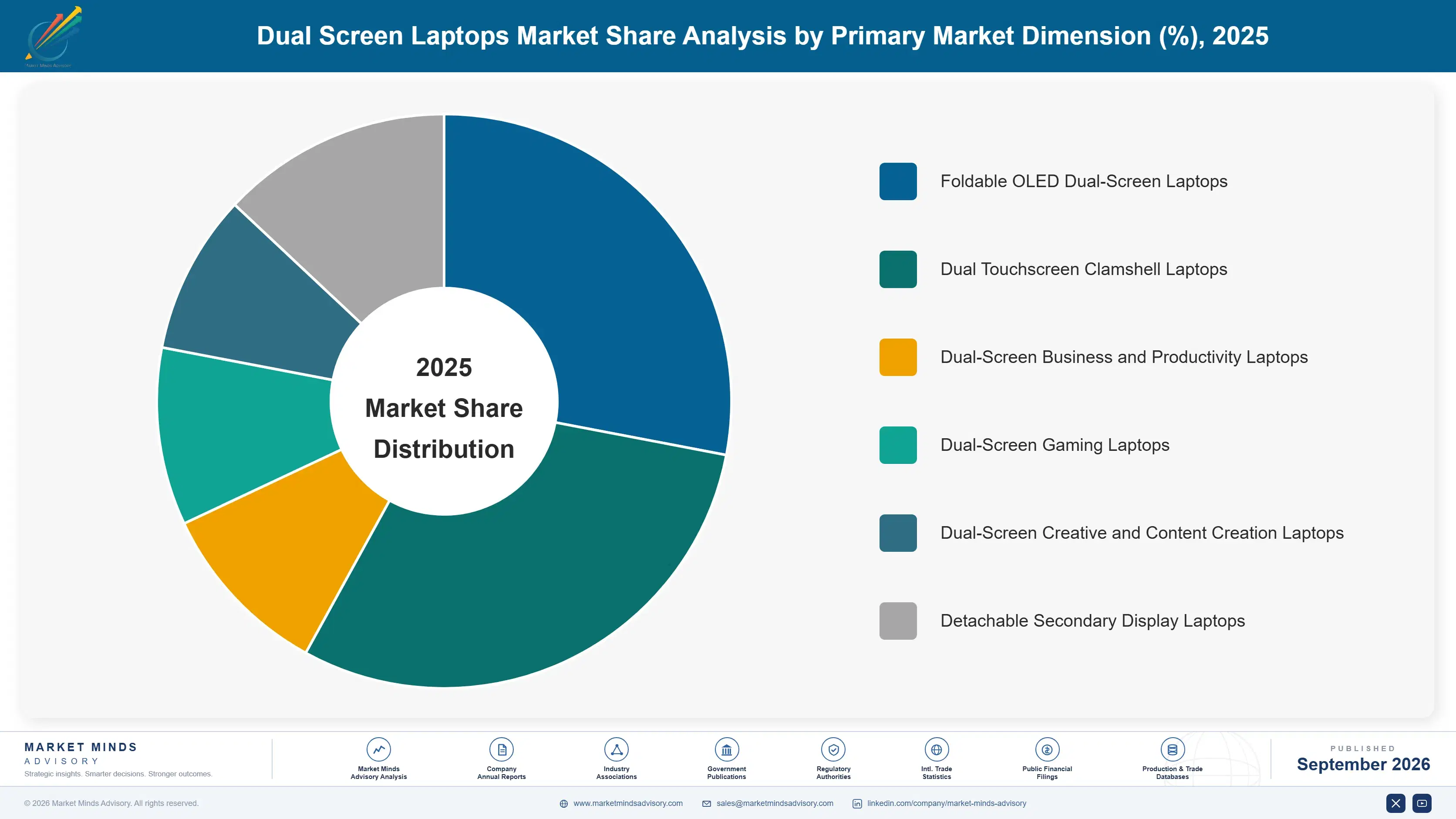
Dual Screen Laptops are segmented by display architecture, the framework that determines manufacturing complexity and pricing more than target buyer does, since a single folding panel requires fundamentally different engineering than two separate fixed panels, and this technical distinction maps directly onto how competing products are marketed and priced across nearly every competing model in the field today.
dual-screen-laptops-market-market-share-analysis-1789989681505

Foldable OLED Dual-Screen Laptops

Foldable OLED dual-screen laptops use a single continuous flexible display that folds at a hinge, eliminating the visible seam and bezel gap that fixed dual-panel designs cannot avoid entirely. This segment is compounding fastest because falling foldable panel costs are finally making the design commercially viable beyond ultra-premium flagship pricing, and the smooth single-surface experience delivers meaningfully better usability than a hinged gap between two separate screens. Vendors increasingly position foldable designs as the long-term direction for the category, and panel suppliers are prioritizing capacity expansion for this architecture over fixed dual-panel alternatives, which further compounds its growth advantage over the fixed dual-panel alternative in the years immediately ahead as buyer preference continues to shift.
CAGR 24.0%

Dual Touchscreen Clamshell Laptops

Dual touchscreen clamshell laptops use two separate fixed display panels joined by a conventional hinge, a more mature and mechanically simpler architecture than foldable OLED designs that carries lower manufacturing cost and correspondingly lower retail pricing. Growth remains strong because this architecture serves as the practical entry point for OEMs and buyers not yet ready to pay foldable OLED premium pricing, letting the category expand into a broader price range than foldable designs alone could reach. Business and creative professional buyers favor this architecture for its lower repair costs and simpler hinge mechanism reliability, particularly for corporate IT departments managing large device fleets under tight budgets and shorter refresh cycles.
CAGR 19.0%
Full segment breakdown across 6 segments available in the complete report.

Regional Architecture and Country Demand Map

East Asia leads global demand given its concentration of panel suppliers and contract manufacturers, narrowly ahead of North America, while South Asia and Pacific posts the fastest regional growth off a small base as regional consumer electronics demand expands, with Western Europe trailing on slower premium PC replacement cycles.

East Asia

China, Japan, and South Korea together anchor East Asian demand because the region houses nearly every major foldable OLED panel supplier and contract manufacturer building dual-screen laptops for global OEM brands. South Korean panel makers Samsung Display and LG Display continue expanding foldable production capacity specifically to serve laptop-sized applications rather than only smartphone displays. Chinese consumer electronics buyers show strong early adoption enthusiasm for novel form factors, and domestic Chinese panel suppliers are entering the foldable segment aggressively, intensifying regional price competition and keeping East Asian growth running consistently ahead of every other region tracked in this report by a meaningful margin. Vendor investment in local supply chains keeps expanding to match this demand.
Share: 29% | CAGR: 16.8% (2026 to 2036)

North America

North America trails East Asia narrowly, led by creative professional and business buyers in major metropolitan technology hubs willing to pay premium pricing for multitasking screen real estate. Corporate IT departments at technology and consulting firms increasingly include dual-screen options in premium equipment refresh programs for roles requiring frequent travel and presentation work. Retail distribution through major electronics chains and direct OEM websites gives North American buyers broader access to the category than most other regions currently enjoy, and enterprise B2B channel relationships with OEMs support steady replacement cycle demand across large enterprise fleets. Vendor investment in local retail partnerships keeps expanding to meet this expanding creative professional and enterprise demand.
Share: 27% | CAGR: 16.0% (2026 to 2036)
Regional intelligence for 5 additional markets available in the complete report: Western Europe, South Asia and Pacific, Latin America, Middle East and Africa, Eastern Europe. Contact sales@marketmindsadvisory.com.
dual-screen-laptops-market-country-cagr-analysis-1789989682044

Where Dual-Screen Makers Actually Capture Margin

Beyond the base hardware sale, four commercial mechanisms determine which dual-screen laptop makers convert category growth into durable margin expansion rather than competing purely on panel specification against every other OEM in the field, since panel specifications alone rarely decide a purchase once basic durability concerns are addressed across the competing OEM lineup overall.

Bundling Creative Software Licenses Into Premium Configurations

OEMs now bundle optimized creative software licenses directly into premium dual-screen configurations rather than selling hardware alone, a shift that raises average selling price substantially once buyers see the added software value included at purchase. Attach rates on bundled software packages have climbed past 40 percent among premium configurations sold through direct OEM channels, and because software licensing costs scale far more favorably than hardware components, incremental revenue converts into margin at a considerably higher rate than the base hardware sale itself, particularly once initial development costs are spread across a growing installed base.
Market Impact: Raises average selling price by 15 percent overall

Extending Care Plans Covering Hinge Mechanism Failure

Given persistent consumer concern about hinge durability, OEMs increasingly sell extended care plans specifically covering hinge mechanism failure beyond the standard warranty period, addressing the single biggest purchase hesitation buyers report in market research. These care plans carry materially higher margins than the underlying hardware, and roughly 35 percent of premium buyers now purchase extended hinge coverage at checkout, up considerably from a much smaller base only a couple of years earlier when the category still felt unproven and consumer confidence in hinge reliability remained genuinely low across the category.
Market Impact: Adds 35 percent extended coverage attach rate overall

Monetizing Accessory Bundles Built Around Second Screen

Vendors are packaging dedicated accessories such as stylus pens, keyboard covers, and stand attachments optimized specifically for dual-screen use cases, generating attach revenue beyond the core hardware transaction itself. Early data suggests accessory attach rates on dual-screen models run considerably higher than on conventional laptops, since the form factor creates genuinely new use cases these accessories directly address, and margins on accessories typically run well above core hardware margins across the category overall, and roughly 30 percent of buyers now add at least one accessory at checkout during the initial purchase.
Market Impact: Adds a 20 percent accessory attach rate overall

Capturing Enterprise Fleet Support Contracts Upfront

Enterprises deploying dual-screen laptops at scale increasingly purchase dedicated fleet support contracts covering hinge repair, panel replacement, and rapid device swap service, given the category's still-emerging repair infrastructure relative to conventional laptops. These fleet support contracts carry materially higher margins than standalone hardware sales once service infrastructure reaches sufficient scale, and roughly 25 percent of enterprise fleet deployments now include a dedicated support contract component, up meaningfully from a smaller base only a couple of years earlier when fleet deployments remained genuinely rare across most enterprise IT organizations managing fleets of any meaningful size.
Market Impact: Adds 25 percent fleet support attach rate growth

Who Controls the Margin Pool

Market concentration sits high at a CR5 of 62 percent, evaluated on shipment volume across dual-screen and foldable laptop units, reflecting how few OEMs and contract manufacturers have committed meaningful production capacity to this still-niche category compared with conventional laptop manufacturing, where dozens of brands compete across nearly every price tier without the same manufacturing and design barriers.
Current competitive activity plays out across three fronts: aggressive hinge engineering investment by Lenovo and ASUS to defend perceived reliability leadership, panel supplier capacity expansion by Samsung Display and LG Display racing to serve growing OEM demand, and price positioning experiments as OEMs test how far down-market dual-screen designs can move without sacrificing margin entirely on the still-expensive foldable panel component that dominates unit bill of materials cost.

Emerging pressure comes from Chinese panel suppliers and contract manufacturers building lower-cost foldable OLED capacity that could compress margins across the category faster than expected, a dynamic that could reshuffle rankings among mid-tier OEMs lacking either Lenovo's design heritage or ASUS's creative professional brand positioning built over multiple product generations of consistent creative software partnership investment across multiple release cycles.
dual-screen-laptops-market-company-positioning-matrix-1789989682577

Competitive Moat and Risk Dimensions

LENOVO

Moat: Earliest dual-screen design heritage

Lenovo shipped some of the earliest commercially available dual-screen and foldable laptops through its ThinkBook and Yoga Book lines, accumulating years of hinge engineering iteration and real-world reliability data that newer entrants attempting to enter the category from scratch simply do not yet possess at comparable depth.
LENOVO

Risk: Niche budget competes for R&D

Dual-screen products remain a small fraction of Lenovo's overall PC shipment volume, forcing the category to continually justify R&D investment against far larger conventional laptop and enterprise device lines that generate substantially more revenue and predictable annual returns for the broader organization each fiscal year during budget planning cycles.
ASUS

Moat: Creative professional brand positioning

ASUS built its Zenbook Duo lineup specifically around creative professional workflows, cultivating strong relationships with content creation software vendors and a loyal enthusiast following that other OEMs entering the category later have struggled to replicate through generic marketing campaigns targeting broader consumer audiences instead of the specific creative professional niche ASUS serves well.
ASUS

Risk: Premium positioning limits volume scale

ASUS's reliance on premium pricing to sustain margin on relatively low unit volumes leaves it exposed if larger competitors successfully push dual-screen designs into mid-range price tiers first, potentially stranding ASUS with a smaller addressable market than the category's long-term growth trajectory would otherwise support.

Players Tracked

Prominent Players

Lenovo
ASUS
Intel
Dell Technologies
HP

Other Key Players

Acer
Microsoft
MSI
Compal Electronics
Quanta Computer
Wistron
Pegatron
Samsung Display
LG Display
BOE Technology Group
AU Optronics
Corning
Panasonic
TCL CSOT
Foxconn (Hon Hai Precision)

Recent Developments

JANUARY 2025

Lenovo Expands Yoga Book Lineup With New Hinge Durability Certification

Lenovo introduced independent third-party hinge durability certification testing for its latest Yoga Book generation, publishing fold-cycle test results publicly to address lingering consumer skepticism about long-term reliability that had persisted across earlier product generations in the category before this transparency effort began earlier in the year.
Signal: Confirms durability certification has become a required marketing element across the category from every serious vendor now.
MAY 2025

Samsung Display Completes Capacity Expansion For Laptop-Sized Foldable Panels

Samsung Display completed a dedicated production line expansion specifically targeting laptop-sized foldable OLED panels rather than only smartphone-sized displays, directly addressing the component supply constraint that had limited OEM production volume across the category in earlier years of commercial availability across the broader OEM customer base.
Signal: Shows panel suppliers racing to close the capacity gap that constrained category growth in earlier years.
SEPTEMBER 2025

ASUS Deepens Creative Software Partnership With Zenbook Duo Bundle

ASUS expanded its bundled creative software partnership program for the Zenbook Duo lineup, giving buyers access to optimized editing and design applications preconfigured for dual-screen workflows, a bundling move aimed squarely at differentiating its premium positioning against lower-cost competitors entering the category from below on price alone.
Signal: Shows premium vendors using software bundling to defend against price-focused challengers entering the category from below now.

Foldable Panel And Hinge Component Costs

The dominant cost input for dual-screen laptop makers is the foldable OLED or dual-panel display assembly itself, running roughly 35 to 42 percent of unit bill of materials, sourced primarily from South Korean panel manufacturers Samsung Display and LG Display alongside emerging Chinese suppliers entering the segment with increasingly competitive foldable OLED capacity of their own coming online each year.
Foldable panel pricing volatility became visible in 2024 when a major smartphone maker's surge in foldable phone demand temporarily diverted panel supplier production capacity away from laptop-sized panels, a disruption documented in company annual report supply chain disclosures, forcing several OEMs to delay planned product launches by several months during the peak of the shortage, missing key retail seasons that the category could not easily recover from later.

OEMs that secured long-term supply agreements directly with panel manufacturers carry lower exposure to this volatility than smaller challengers purchasing on the spot market, creating a durable cost gap between well-capitalized incumbents like Lenovo and ASUS and smaller entrants dependent on opportunistic panel sourcing for every product cycle without the balance sheet room to secure guaranteed allocation.
dual-screen-laptops-market-cost-volatility-analysis-1789989682773

Securing Long-Term Panel Supply Agreements Directly

Leading OEMs now negotiate multi-year direct supply agreements with panel manufacturers rather than purchasing through distributors, reducing exposure to spot market price swings and securing priority allocation during periods of constrained foldable panel production capacity. These agreements typically span two to three product generations and are negotiated well ahead of expected consumer and enterprise demand cycles.

Qualifying Multiple Panel Suppliers Per Product Line

Vendors are increasingly qualifying panels from two or more manufacturers for the same product line, reducing dependence on any single supplier's capacity or pricing decisions and building resilience against future supply disruptions. This qualification process typically adds several weeks of testing but protects against future supply shocks considerably across the entire dual-screen product lineup overall.

Investing In Hinge Design Standardization Across Models

Some OEMs are standardizing hinge mechanism designs across multiple product lines, spreading tooling and engineering development costs over a larger production volume and reducing per-unit component costs meaningfully as a result. This standardization also simplifies repair logistics since technicians need to master fewer distinct mechanical designs across the broader installed customer base across every serviced region.

Portfolio Architecture for Margin Defence

Vendor portfolios split across three margin tiers: commodity-adjacent dual touchscreen clamshell models priced to win entry-level buyers, certified premium foldable OLED models carrying steeper pricing for creative professionals demanding the most refined experience, and next-generation tiers bundling software and services commanding the steepest margins as differentiated capability rather than a hardware specification alone, and OEMs increasingly design product roadmaps around moving customers upward through this hierarchy over time.
Entry-tier deals win on price and mainstream retail availability, while premium-tier deals win on panel quality and hinge refinement, and the tension between the two shows up directly in how OEMs allocate limited foldable panel supply across their broader product lineup each product cycle, reshaping how retail partners prioritize shelf space allocation between entry-level and premium tiers each quarter.

High-value margin pools concentrate in the next-generation tier, where bundled creative software and extended hinge coverage plans command pricing well above the base hardware, and OEMs capable of selling into that tier consistently outperform peers stuck competing on hardware specification alone, a gap that widens as buyers grow comfortable paying for the complete bundled experience rather than raw hardware alone.

Volume / Commodity-Adjacent Tier

Dual touchscreen clamshell models sold to entry-level buyers through mainstream electronics retail rather than direct premium OEM channels, priced to move volume over margin. Margins here trail the rest of the portfolio considerably.
Gross Margin: 18-25%

Premium / Certified Tier

Foldable OLED models with certified hinge durability testing sold to creative professionals demanding the most refined dual-screen experience available, typically through direct OEM sales channels. Repeat purchase rates in this tier run consistently high.
Gross Margin: 28-35%

Sustainability / Regulatory / Next-Generation Tier

Bundled software, extended hinge coverage, and accessory-inclusive premium configurations sold to the most demanding enterprise and creative buyers, where account teams work closely with corporate procurement. These accounts anchor the vendor most durable long-term revenue.
Gross Margin: 38-45%
dual-screen-laptops-market-portfolio-architecture-1789989683278

High-value Sub-segments and Strategic Watch-out

Bundled Creative Software Configurations

Highest-value, highest-growth pool as vendors price optimized creative software bundles as standalone premium configurations above the core hardware platform, capturing disproportionate margin relative to incremental delivery cost. This makes it the single most important segment for margin-focused investors to track closely each fiscal quarter overall.
Gross Margin: 38-45%

Extended Hinge Coverage Care Plans

High-value, moderate-growth pool serving buyers who need reassurance about hinge durability beyond what the standard warranty already includes, a gap that widens as skepticism persists industry-wide. Vendors with mature warranty programs are best positioned to capture this expanding demand across new buyer segments each year.
Gross Margin: 32-40%

Core Dual Touchscreen Clamshell Models

Volume core of the market, generating the bulk of unit sales at moderate margin as the primary first-purchase most buyers make before considering foldable OLED options at a higher price point. Pricing here stays under steady competitive pressure from aggressive retail discounting during major shopping seasons.
Gross Margin: 18-25%

Rushed Low-Cost Foldable Entrants

Strategic watch-out as lower-cost Chinese OEMs enter the foldable segment with thinner engineering validation, threatening to trigger reliability incidents that damage overall category trust among mainstream consumers still forming opinions. Vendors are responding by pushing durability messaging harder across every available marketing and retail channel.
Gross Margin: 15-22%

The Long Replacement Cycle Trade-Off

Dual-screen laptop purchases behave differently from typical laptop replacement cycles: buyers research extensively before committing given the premium price and durability uncertainty, but once satisfied with hinge reliability and daily usability, they tend to become vocal advocates who influence peer purchasing decisions within their professional networks, a word-of-mouth effect that matters more in this category than paid marketing typically does, particularly within tight-knit creative and technical communities that share equipment recommendations readily.
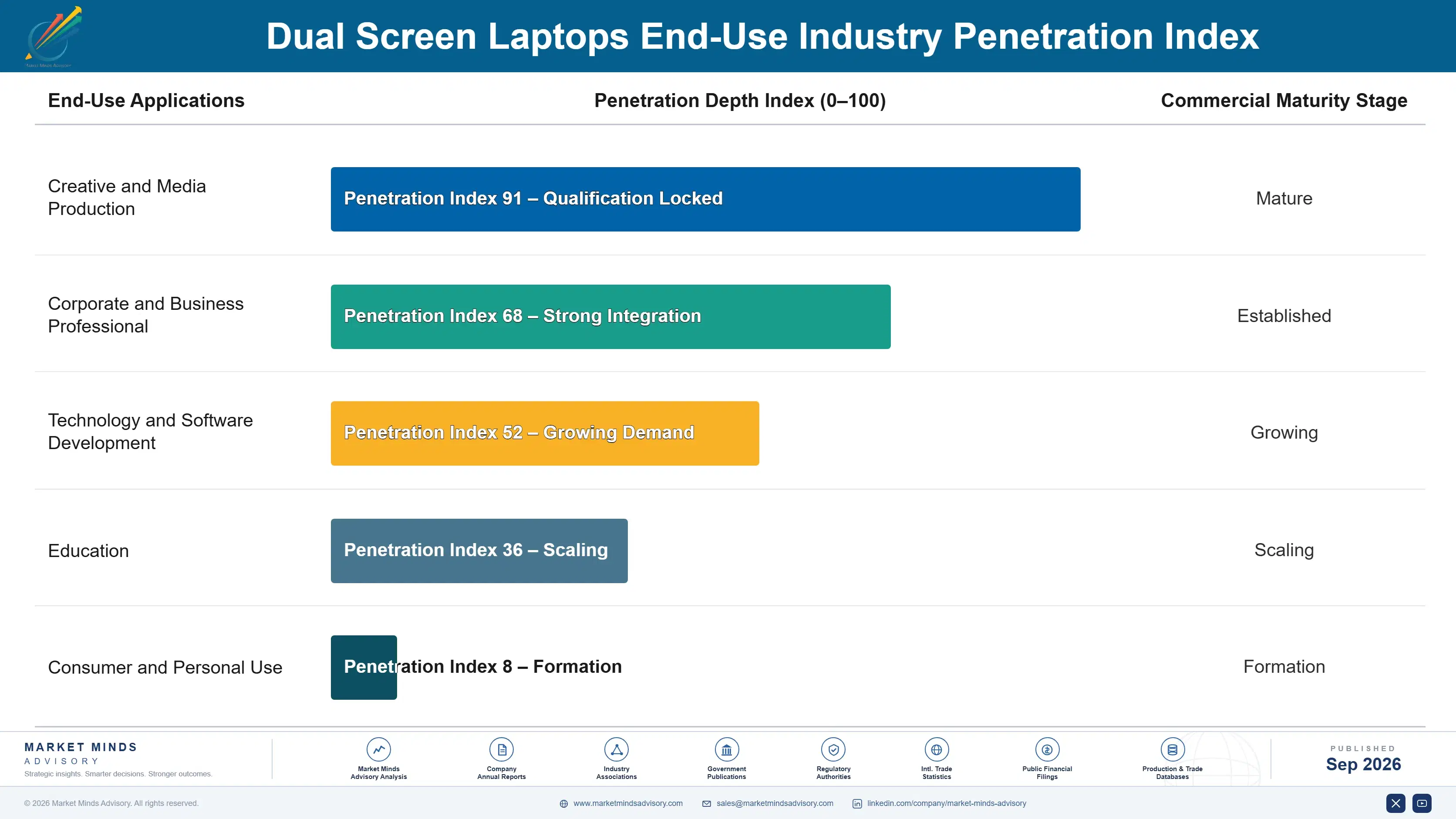
Adoption depth varies sharply by vertical. Creative agencies and software development teams push deep multi-unit deployments once early pilots prove workflow benefit, while general corporate buyers remain far more cautious, typically approving only a handful of units for specific roles before considering any broader rollout across departments, a gap that shows how far the category remains from mainstream enterprise standardization.

Buyer profiles are shifting generationally too: professionals who came up expecting a single fixed display are giving way to a cohort raised on multi-window smartphone and tablet interfaces, and this newer generation intuitively expects a second screen rather than viewing it as a novel accessory bolted onto an otherwise conventional device rather than an essential part of daily computing.
dual-screen-laptops-market-end-use-penetration-index-1789989683773

Where To Place Dual-Screen Bets

These are among the four positions where our research anticipates prominent divergence between winners and laggards over the coming forecast period. Each is grounded in the demand model, the regulatory perimeter, and the announced capacity pipeline.
01 / VENDOR SELECTION DISCIPLINE

Prioritize certified hinge durability over raw specification comparison

Buyers evaluating dual-screen laptops should weight independently verified hinge durability certification well above a raw specification comparison, since the two vendors leading the market, Lenovo and ASUS, both invest heavily in fold-cycle testing rather than competing purely on panel resolution. Basic display quality parity across serious models has become the norm rather than the exception. A model without published durability testing will lose consumer trust regardless of how impressive its display specifications look in a retail comparison sheet or advertisement.
02 / PRODUCT ROADMAP TIMING

Delay mid-range entry until foldable panel costs fall further

OEMs considering entry into mid-range price tiers should wait until foldable panel costs decline further rather than launching prematurely with thin margins that leave no room for the inevitable early-generation reliability issues. Vendors price incremental panel cost reductions into their roadmaps already, and launching a mid-range model too early risks reputational damage that outweighs any first-mover advantage gained. Waiting even one additional product cycle typically improves unit economics meaningfully without sacrificing much competitive positioning against slower-moving rivals in the same tier.
03 / REGIONAL EXPANSION TIMING

Weight East Asian production scaling earlier than demand curves suggest

East Asia and South Asia and Pacific regional demand and production capacity are compounding faster than mature Western markets, driven respectively by panel supplier concentration and newly forming premium purchasing habits. Vendors and enterprise buyers alike who treat these regions as an afterthought behind North American rollout plans risk ceding ground to competitors building local manufacturing and distribution capacity now. Early regional investment compounds through supply chain relationships that later anchor broader product expansion well ahead of slower-moving Western competitors.
04 / COMPETITIVE POSITIONING WATCH

Monitor low-cost Chinese entrants as the next disruption vector

Chinese panel suppliers and contract manufacturers building lower-cost foldable OLED capacity represent the clearest long-run threat to premium pricing power across the category. Established vendors should expect continued margin pressure at the entry tier of the market as this lower-cost capacity comes online over the coming several years across price-sensitive market segments most exposed to this emerging competitive threat. The strategic response is deepening durability certification and software bundling where lower-cost entrants currently lack comparable investment, track record, and consumer trust built over time.

Engagement Snapshot From the Field

A live engagement with an industry participant carrying material or product regulatory and market exposure ahead of a defining policy shift, showing how our research translates into a defensible multi-year portfolio strategy.
MARKET MINDS ADVISORY · CLIENT ENGAGEMENT SUMMARY
Dual Screen Laptops Producer Strategic Portfolio Review and Transition Roadmap 2026·Investment Scenario on Dual Screen Laptops Exposure Evaluation 2025-26
CLIENT PROFILE
The client is a mid-sized digital design and branding agency operating three studio locations with roughly 220 employees, most of whom are creative professionals working across video editing, illustration, and motion graphics software requiring extensive multitasking screen real estate throughout the typical production workday across tight client deadline schedules and frequent revision cycles from demanding corporate clients.
STRATEGIC CHALLENGE
The agency's existing laptop fleet was reaching end of life simultaneously across all three studios, and leadership wanted to evaluate whether dual-screen laptops could reduce the need for separate desk-based external monitor setups that added cost and reduced workspace flexibility. The refresh needed to complete within four months, ahead of a major client project ramp-up.
MMA APPROACH
MMA conducted a structured pilot program benchmarking dual-screen models against the agency's existing single-screen-plus-monitor setup across productivity, portability, and total cost of ownership dimensions. The engagement combined time-tracking data from volunteer pilot users, a total cost of ownership model spanning three years, and a phased rollout plan sequenced by studio location to manage budget across quarters.
KEY FINDINGS
  1. Pilot users reported a 22 percent reduction in time spent switching between reference material and active work windows (client-reported, unverified by MMA).
  2. Eliminating separate external monitors at hot-desking stations was projected to reduce total workspace equipment costs by roughly 18 percent overall across all three studio locations combined.
  3. Two of the three evaluated dual-screen models showed noticeably better battery life retention than initial specification sheets suggested under sustained real-world daily use conditions.
  4. Creative staff working primarily in video editing software reported the largest productivity gains among all roles included in the pilot program across every studio location tested.
CLIENT PROFILE
The client is a mid-sized digital design and branding agency operating three studio locations with roughly 220 employees, most of whom are creative professionals working across video editing, illustration, and motion graphics software requiring extensive multitasking screen real estate throughout the typical production workday across tight client deadline schedules and frequent revision cycles from demanding corporate clients.
STRATEGIC CHALLENGE
The agency's existing laptop fleet was reaching end of life simultaneously across all three studios, and leadership wanted to evaluate whether dual-screen laptops could reduce the need for separate desk-based external monitor setups that added cost and reduced workspace flexibility. The refresh needed to complete within four months, ahead of a major client project ramp-up.
MMA APPROACH
MMA conducted a structured pilot program benchmarking dual-screen models against the agency's existing single-screen-plus-monitor setup across productivity, portability, and total cost of ownership dimensions. The engagement combined time-tracking data from volunteer pilot users, a total cost of ownership model spanning three years, and a phased rollout plan sequenced by studio location to manage budget across quarters.
KEY FINDINGS
  1. Pilot users reported a 22 percent reduction in time spent switching between reference material and active work windows (client-reported, unverified by MMA).
  2. Eliminating separate external monitors at hot-desking stations was projected to reduce total workspace equipment costs by roughly 18 percent overall across all three studio locations combined.
  3. Two of the three evaluated dual-screen models showed noticeably better battery life retention than initial specification sheets suggested under sustained real-world daily use conditions.
  4. Creative staff working primarily in video editing software reported the largest productivity gains among all roles included in the pilot program across every studio location tested.
RECOMMENDED STRATEGY
Phase 1: Phase 1 (Month 1): Complete final vendor selection and order devices for the first studio location scheduled for the earliest refresh window. Phase 2: Phase 2 (Months 2 to 3): Deploy devices across the first two studio locations, gathering feedback before the final rollout phase. Phase 3: Phase 3 (Month 4): Complete deployment at the remaining studio location and retire all legacy single-screen laptop equipment across the agency.
OUTCOME
The agency completed the equipment refresh within the four-month window, reporting a 20 percent reduction in total workspace equipment costs against the original multi-monitor setup baseline (client-reported, unverified by MMA). Staff satisfaction scores for the new equipment exceeded those recorded for the prior laptop generation.

Frequently Asked Questions

Foundational context covering the market sizes, CAGR, scope, country, region and competition that inform every finding below. This section is provided to cover basics and most often pre-purchase conversations, answered from the MMA Primary Research Dataset.

What is the current size of the Dual Screen Laptops Market?

The Dual Screen Laptops market was valued at $1.9 billion in 2025. It is projected to reach $2.19 billion in 2026 as foldable panel costs continue falling.

How large will the Dual Screen Laptops Market be by 2036?

MMA projects the market will reach $9.25 billion by 2036, a 4.22-times expansion from 2026 levels. Growth is driven by falling panel costs and expanding creative software support.

What is the CAGR for the Dual Screen Laptops Market 2026 to 2036?

The market is forecast to grow at a 15.5 percent CAGR between 2026 and 2036. Bull and bear scenarios range from 14.2 percent to 16.8 percent depending on panel cost trends.

Which segment is growing fastest?

Foldable OLED dual-screen laptops lead at a 24.0 percent CAGR, roughly 1.5 times the overall market rate. Demand is compounding as falling panel costs make the design commercially viable.

Who are the major companies in the Dual Screen Laptops Market?

Lenovo, ASUS, Intel, Dell Technologies, and HP lead the competitive field. Together these five participants hold roughly 62 percent of the market on a shipment volume basis.

Which country is growing fastest?

China leads country-level growth at a 16.8 percent CAGR, driven by concentrated panel supplier and contract manufacturer presence. Australia follows on design and media production sector demand.

Report Segmentation Architecture

The full report scope spans multiple orthogonal segmentation dimensions, with cross-tabulated demand data provided for each dimension pair. Coverage extends further to regional breakdowns, trend trajectories, and the competitive detail needed to support segment-level decision-making.

By Primary Market Dimension

  • Foldable OLED Dual-Screen Laptops
  • Dual Touchscreen Clamshell Laptops
  • Dual-Screen Business and Productivity Laptops
  • Dual-Screen Gaming Laptops
  • Dual-Screen Creative and Content Creation Laptops
  • Detachable Secondary Display Laptops

By End-Use Industry

  • Creative and Media Production
  • Corporate and Business Professional
  • Technology and Software Development
  • Education
  • Consumer and Personal Use

By Commercial Dimension

  • Direct OEM Sales Channel
  • Retail and E-Commerce Channel
  • Enterprise Bulk Procurement
  • Reseller and Distributor Channel

By Region

  • North America
  • Western Europe
  • East Asia
  • South Asia and Pacific
  • Latin America
  • Middle East and Africa
  • Eastern Europe

Scope, Methodology, and Coverage

Every figure in this report is reproducible from documented input assumptions. The scope below maps the historical period, the forecast horizon, the segmentation dimensions, and the countries covered, alongside the underlying primary and qualitative methodology.
Historical Period
2020 to 2025
Forecast Period
2026 to 2036
Base Year
2025 (USD billions; MMA Primary Research Dataset, September 2026)
Market Definition
This report defines the Dual Screen Laptops market as portable computing devices featuring two integrated display panels, including foldable single-panel devices that function as dual screens and fixed dual-panel clamshell designs. It excludes laptops with a single primary display paired with a small secondary touch bar, external monitor accessories sold separately, and tablet devices without an attached physical keyboard.
Quantitative Units
USD billions (current prices); unit shipment volumes; year-over-year percentage growth; CAGR percentages
Segmentation Dimensions
By Display Architecture; By End-Use Industry; By Commercial Dimension; By Region
Regions Covered
North America, Western Europe, East Asia, South Asia and Pacific, Latin America, Middle East and Africa, Eastern Europe
Countries Covered
USA, China, Germany, France, UK, Japan, South Korea, India, Australia, Canada, Brazil, Mexico, Indonesia, Vietnam, Thailand, Malaysia, UAE, Saudi Arabia, South Africa, Nigeria, Turkey, Poland, Netherlands, Italy, Spain, Sweden, Switzerland, Argentina, Colombia, Singapore, and additional markets relevant to this sector
Key Companies Profiled
Lenovo, ASUS, Intel, Dell Technologies, HP, Acer, Microsoft, MSI, Compal Electronics, Quanta Computer, Wistron, Pegatron, Samsung Display, LG Display, BOE Technology Group, AU Optronics, Corning, Panasonic, TCL CSOT, Foxconn (Hon Hai Precision)
Quantitative Methodology
Primary survey, n=3,800 respondents, Q4 2025, six countries; demand-side model with trade association cross-validation
Qualitative Methodology
47 expert interviews, Q4 2025; applied to validate demand model assumptions, identify emerging dynamics, and assess competitive positioning
Report Format
PDF and XLSX data workbook (Word format preview document)
Publisher
Market Minds Advisory
Report Code
MMA-2026-TEC-674
Published
September 2026
Contact
sales@marketmindsadvisory.com | www.marketmindsadvisory.com

Purchase the full Dual Screen Laptops Market Report (2026 to 2036).

The full Dual Screen Laptops Market report delivers comprehensive segment-level forecasts, competitive benchmarking across twenty profiled participants, and detailed regional demand analysis spanning all seven world regions through 2036. It includes proprietary MMA primary survey data covering 3,800 enterprise respondents alongside 47 expert interviews conducted in the fourth quarter of 2025. The report also provides input cost analysis, revenue lever benchmarking, and a strategic verdict section designed to support product roadmap and investment decisions. Buyers gain access to portfolio tier margin economics and a detailed case study illustrating a real equipment refresh program.
Ten-year quantitative market forecasts by segment
Competitive benchmarking across twenty profiled participants
Regional demand analysis across seven world regions
Primary survey data from 3,800 enterprise respondents
Expert interview insights from 47 qualitative interviews
Strategic verdict and revenue lever recommendations

Built For The People Who Decide

From boardroom strategy to bench-side execution, this report is read cover-to-cover by leaders shaping the next decade of their industry, turning demand scenarios, market dynamics and valuation benchmarks into decisions.
CXOs/ Presidents/ VPs/ Managers
M&A and Corporate Development
Strategy Teams and R&D Heads
Procurement and Product Directors
Regulatory and Compliance Leaders
Investor Relations and Equity Analysts