Market Minds Advisory
Sports Replay System Market

Sports Replay System Market: Sports Replay System Market. Officiating Accuracy Demands Sustain Broadcast Technology Investment

Rising officiating scrutiny and fan expectations for broadcast-quality analysis are colliding as leagues and federations deploy multi-angle replay systems fast enough to keep decisions accurate without slowing live game flow.

Lead Analyst

Published

September 2026

Make Smarter Decisions with Customized Research Insights

Request a free sample report and evaluate market opportunities, growth trends, and competitive dynamics relevant to your business needs.

2025 MARKET VALUE$1.3BMarket Size 2025
2036 FORECAST VALUE$3.3BBase Case , 2026 to 2036
CAGR 2026 TO 20368.8 %Bull 10.1% / Bear 7.5%
INCREMENTAL OPPORTUNITY$1.9BNet 10- year value creation
EXPANSION MULTIPLE2.33x2036 value over 2026 base
Strategic Levers
M&A Pipeline
Regional Outlook
Country Rankings
Competitive Intelligence
Segmental Deep-dive
Call-Us : 91 93563 13602

Executive Snapshot and Market Trajectory.

Sports replay systems are shifting from officiating-only tools into integrated broadcast production assets as leagues combine review accuracy requirements with fan-facing highlight and analysis content generation. Leagues increasingly view review infrastructure and broadcast enhancement as a single integrated technology investment rather than two separate procurement categories requiring distinct vendor relationships.
Officiating bodies across major leagues and international federations are expanding video review scope beyond goal-line and boundary calls into broader judgment decisions, pulling established broadcast technology vendors into new certification programs while emerging leagues in cricket and football adopt review systems for the first time. Established suppliers with existing officiating certification credentials increasingly extend that trust into broadcast production contracts faster than newer specialized entrants lacking comparable regulatory relationships.
Competitive dynamics increasingly separate officiating-certified review platforms from broadcast-focused multi-angle production systems, with vendors capable of serving both use cases commanding meaningfully stronger positioning as leagues consolidate technology procurement around fewer, more capable suppliers. This consolidation trend increasingly favors vendors with proven multi-sport deployment experience over specialists serving only a single sport or narrow use case. Investors increasingly reward vendors demonstrating this dual capability across their broader product portfolio and customer relationships considerably.
Market Definition
This report covers video-based replay systems used for sports officiating review and broadcast production, including multi-camera capture, ball-tracking, and instant replay analysis technology, measured on a global installed-system basis. It excludes general-purpose broadcast cameras and production switching equipment not specifically configured for sports replay applications.
Base Year Value
$1.3B in 2025 (MMA Primary Research Dataset, September 2026)
Forecast Period
2026 to 2036, eleven discrete annual values
CAGR
8.8% base case. Bull 10.1%. Bear 7.5%.
Fastest Growth Segment
AI-Enhanced Highlight and Analysis Systems: 14.5% CAGR
Fastest Growth Country
India: 13.0% CAGR
Fastest Growth Region
South Asia and Pacific: 11.0% CAGR
Largest Region
North America: 32% of 2025 global value
Market Leaders
Hawk-Eye Innovations, EVS Broadcast Equipment, ChyronHego, Vizrt, Stats Perform
Primary Survey
n=3,800 procurement and R&D decision-makers, Q4 2025, six countries
Methodology
Demand-side build-up, cross-validated against public data, 47 expert interviews

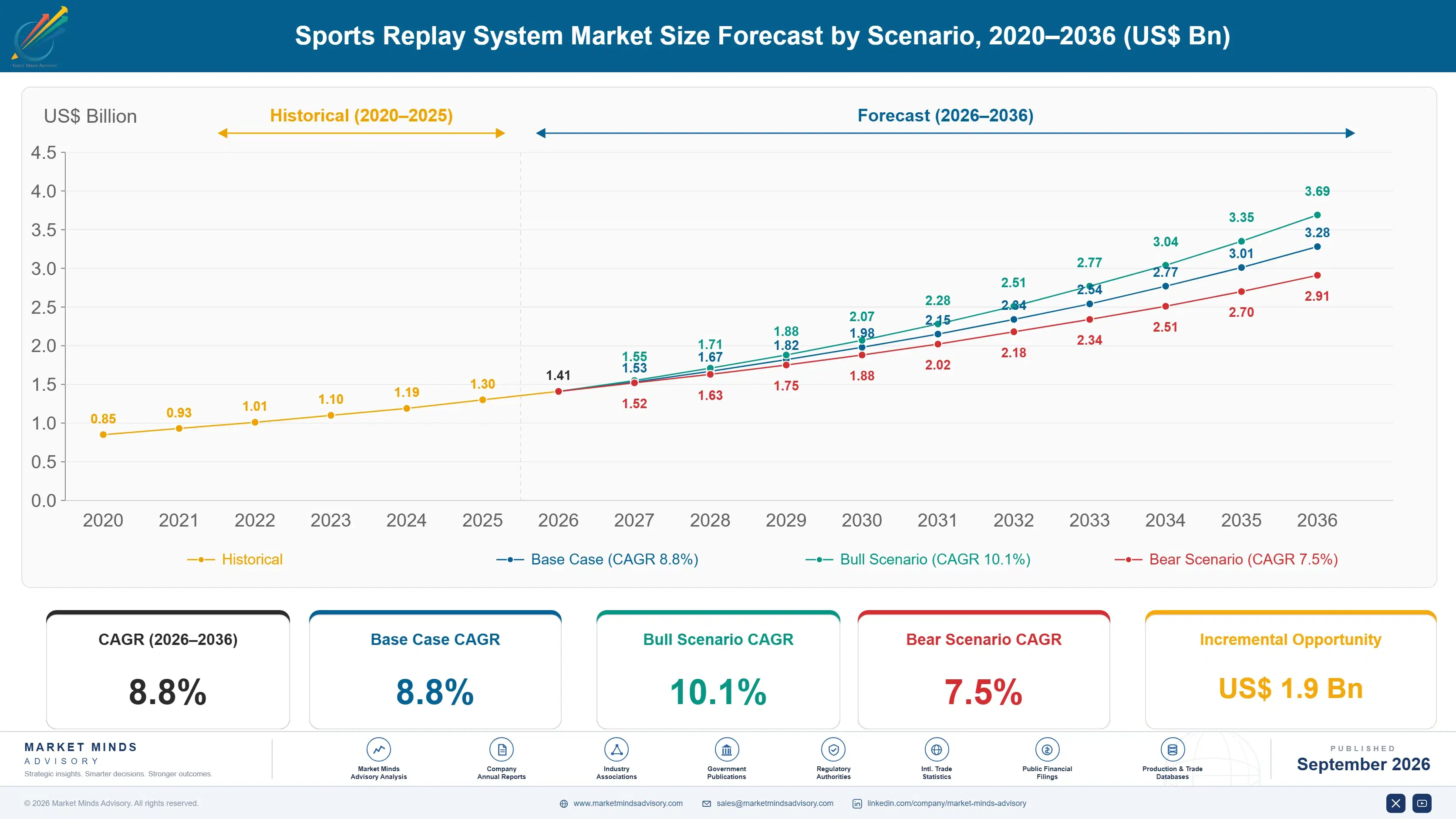
Sports Replay System Market Forecast Scenarios

sports-replay-system-market-size-forecast-scenario-1788413675196
Between 2020 and 2025, sports replay system adoption expanded from a handful of major professional leagues into broader use across international federations and lower-tier competitions as review technology costs declined and officiating accuracy scrutiny intensified globally. Established broadcast technology vendors used this period to expand certification credentials across multiple sports, laying the groundwork for the multi-sport deployment capability now increasingly demanded by leagues consolidating technology procurement decisions.
The base case rests on three mechanisms holding through the forecast window: continued expansion of video review scope across leagues that previously used only basic goal-line technology, growing fan demand for broadcast-quality highlight and analysis content, and expanding cricket and football adoption in fast-growing media markets pursuing broadcast production sophistication. These mechanisms reinforce each other, since vendors serving officiating review customers increasingly apply that certification credibility to win broadcast production business in adjacent applications requiring comparable reliability standards.
A bull scenario emerges if additional major sports federations mandate comprehensive video review faster than currently planned, while a bear risk centers on cost-conscious leagues delaying technology upgrades during periods of broader media rights revenue uncertainty affecting broadcast production budgets. Vendor diversification across officiating and broadcast applications cushions against single-category volatility. This diversification matters increasingly.

Officiating and Broadcast Demands Converge on One Platform

Officiating accuracy scrutiny, not raw broadcast production ambition, remains the primary driver behind most major replay system procurement decisions, since a high-profile missed call carries reputational and commercial consequences for leagues far exceeding any technology cost saved. Leagues routinely model the reputational and commercial cost of officiating controversy when justifying premium technology investment to budget-conscious ownership committees focused primarily on venue-level capital cost comparisons.
TOP REGION SHARE32%North America's share of global installed replay system base
VIDEO REVIEW ADOPTION68%Share of major professional leagues using comprehensive video review
AVERAGE SYSTEM COST$2.5MTypical installation cost for a top-tier league venue deployment
MARKET CONCENTRATION50%Combined installed-system share held by the top five vendors
MULTI-SPORT VENDOR SHARE35%Portion of vendors certified for review across multiple sports
AVERAGE DECISION LATENCY45 secTypical time required to complete a standard video review decision
Vendors increasingly differentiate through certification breadth across multiple sports and decision latency reduction rather than pursuing fundamentally new camera or tracking technology, since core ball-tracking and multi-angle capture methods have remained largely stable while supporting software continues advancing steadily. Decision latency reduction has become a particularly visible competitive dimension, since fans and broadcasters increasingly perceive lengthy review pauses as a broadcast quality failure regardless of decision accuracy.
Crossover demand from emerging cricket and football markets is pulling established North American and European vendors into new certification programs, applying comparable technology to leagues that historically lacked budget for comprehensive review infrastructure entirely. This crossover trend is reshaping which vendors win business in emerging application categories that previously favored smaller regional suppliers offering more basic review functionality entirely.
"The technology hasn't changed dramatically in a decade. What's changed is how little tolerance fans and leagues now have for a blown call."
Practice Lead, Sports Broadcast and Officiating Technology · MMA Broadcast Production and Sports Officiating Technology Practice · September 2026

Market Trends

AI-Enhanced Highlight Generation Expands Broadcast Value

Sports broadcasters are increasingly deploying AI-powered systems that automatically identify and package highlight-worthy moments from live replay feeds, reducing the manual editing labor traditionally required to produce social media and streaming content during live events. Vendors including Stats Perform have launched dedicated AI highlight generation modules that integrate directly with existing replay infrastructure, capturing roughly 30 percent faster content turnaround than manual editing workflows previously required. This capability is becoming a meaningful differentiator as broadcasters compete for younger audiences consuming short-form sports content across social platforms rather than traditional linear broadcast.
Market Impact: Review scope expanded 35% since 2020
Emerging Cricket and Football Markets Adopt Review Systems

Fast-growing cricket and football broadcast markets, particularly in South Asia and parts of Africa, are adopting comprehensive video review systems for the first time as domestic leagues pursue broadcast production sophistication comparable to established Western sports markets. India's Premier League cricket competition has expanded its video review technology investment considerably over the past several seasons, setting a regional benchmark that other domestic cricket leagues increasingly reference when evaluating their own technology procurement decisions. This adoption wave represents meaningful new addressable market for established vendors previously concentrated in mature Western sports markets.
Market Impact: Media rights grew 50%+ since 2015

Market Opportunities and Growth Drivers

Officiating Accuracy Scrutiny Drives Mandatory Review Expansion

Major sports leagues and international federations continue expanding mandatory video review scope beyond traditional goal-line and boundary decisions into broader judgment calls, driven by social media amplification of officiating controversies that intensify pressure on governing bodies to demonstrate decision accuracy. Leagues that delayed comprehensive review adoption have faced measurably greater public criticism during high-profile officiating disputes than leagues with established comprehensive review infrastructure already in place, creating a compelling reputational incentive for lagging leagues and federations to accelerate technology investment considerably. This dynamic has accelerated technology adoption considerably faster than purely voluntary upgrade cycles would have allowed.
Market Impact: Cuts delays by 20 to 30%

Media Rights Value Sustains Broadcast Production Investment

Sports media rights values have grown substantially across major leagues over the past decade, giving broadcasters and rights holders strong financial incentive to invest in production technology that differentiates their broadcast quality and justifies premium subscription and advertising pricing to increasingly discerning viewers. Broadcasters report that enhanced replay and analysis capability meaningfully influences viewer retention metrics during marquee events, sustaining continued capital investment in replay and highlight generation technology even during periods of broader media industry cost discipline and budget scrutiny. Rights holders increasingly view replay investment as inseparable from broader content monetization strategy across all channels.
Market Impact: Costs exceed $2M per venue install

Market Restraints and Challenges

Review Delays Frustrate Fans and Slow Game Flow

Extended video review pauses, sometimes lasting several minutes for complex judgment calls, increasingly frustrate fans and broadcasters who view lengthy delays as undermining the live viewing experience regardless of the accuracy benefit the review ultimately delivers. The root cause is that thorough review of complex judgment calls genuinely requires time for officials to examine multiple camera angles and consult with colleagues, a process that cannot be meaningfully compressed without risking decision accuracy. Vendors are responding by developing faster processing and AI-assisted decision support tools that reduce review time without compromising underlying accuracy.
Market Impact: Cuts content turnaround time by 30%

Smaller Leagues Face Prohibitive Deployment Cost Barriers

Comprehensive replay system deployment costs, often exceeding several million dollars per venue for top-tier installations, remain prohibitively expensive for smaller professional and semi-professional leagues lacking the media rights revenue that major leagues generate to fund such investment. The root cause is that camera infrastructure, tracking technology, and certified officiating integration all require substantial upfront capital investment regardless of league size or revenue scale. Vendors are responding by developing scaled-down, lower-cost system variants targeting smaller leagues without full top-tier functionality requirements. This price gap persists most stubbornly at the lowest professional competition tiers lacking meaningful media rights revenue.
Market Impact: Opens markets across 6+ countries
4 additional market trends, 3 additional growth drivers, and 3 additional restraints and challenges are covered in the full report. Contact sales@marketmindsadvisory.com to access the complete intelligence.

Segment CAGR and Growth Architecture

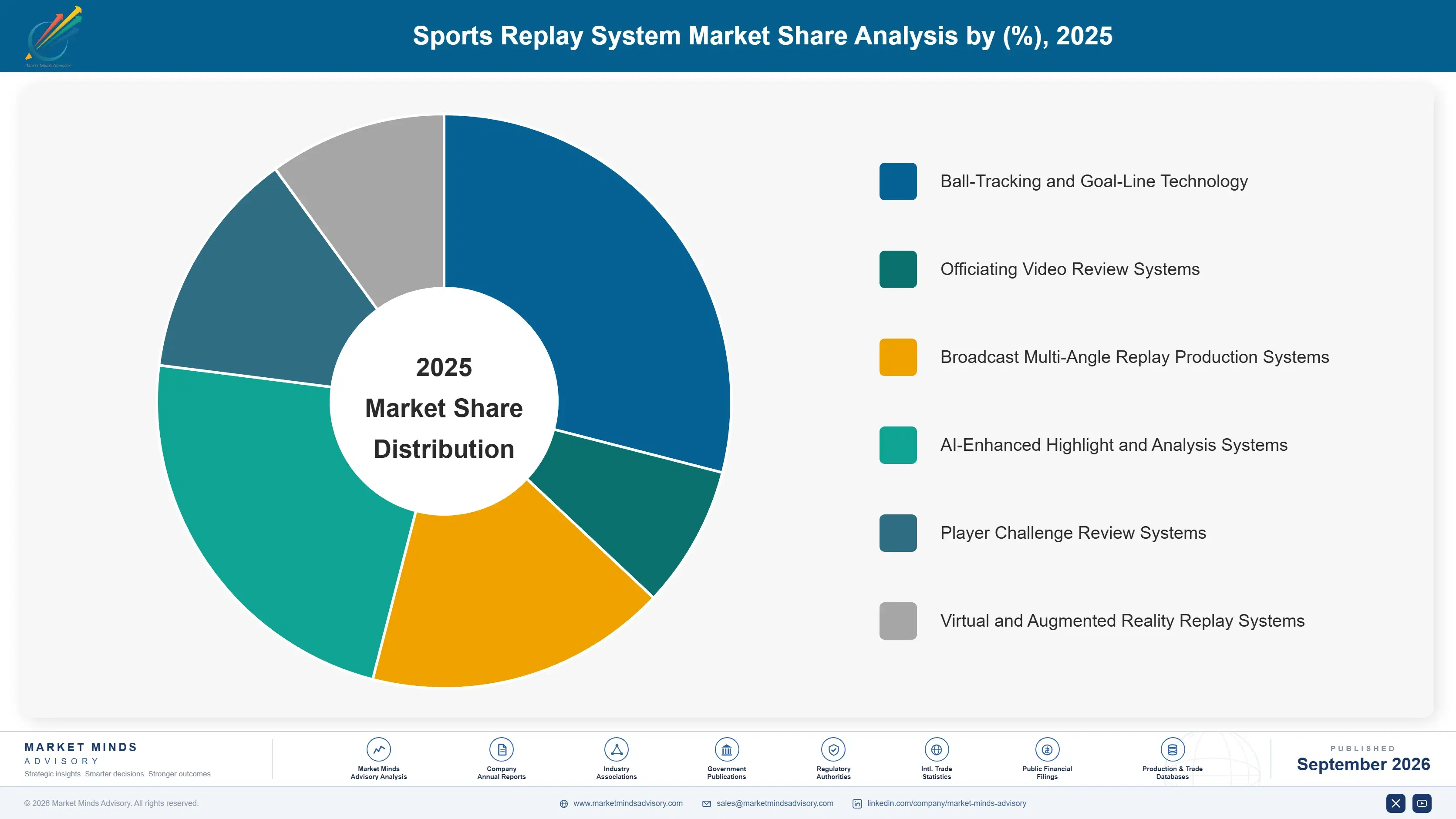
The sports replay system market splits into six technology-type segments defined by function and deployment scope, from mature ball-tracking systems through fast-growing AI-enhanced analysis and augmented reality replay categories. Growth diverges sharply as broadcast content demands increasingly shape technology investment alongside officiating accuracy requirements. These segment dynamics reflect diverging vendor investment priorities rather than a single dominant technology approach emerging.
sports-replay-system-market-market-share-analysis-1788413675731

AI-Enhanced Highlight and Analysis Systems

AI-enhanced highlight and analysis systems represent the fastest-growing segment, automatically identifying and packaging highlight-worthy moments from live replay feeds while generating statistical analysis content that traditionally required substantial manual production labor. Adoption concentrates among broadcasters competing for younger audiences consuming short-form sports content across social media platforms rather than exclusively through traditional linear broadcast channels. Vendors including Stats Perform have positioned themselves at the intersection of officiating technology and content production, betting that AI-driven content generation will become an essential broadcast capability rather than an optional enhancement over the coming years. Continued audience fragmentation seems highly likely to sustain this growth trajectory well into the coming decade. Interest keeps rising steadily.
CAGR 14.5%

Officiating Video Review Systems

Officiating video review systems provide certified decision-support technology for on-field officials reviewing contested calls, requiring rigorous accuracy validation and governing body certification before deployment in professional competition. This segment benefits from expanding mandatory review scope across major leagues and international federations pursuing greater officiating accuracy and reduced controversy exposure following high-profile disputed decisions. Vendors with established certification credentials across multiple sports increasingly capture disproportionate share of new league contracts as governing bodies consolidate technology procurement around fewer, more trusted suppliers with proven deployment track records. Growth remains steady as more leagues expand review scope beyond traditional goal-line and boundary decisions into broader judgment calls. Momentum remains solid across most competitions.
CAGR 10.2%
Full segment breakdown across 7 segments available in the complete report.

Regional Architecture and Country Demand Map

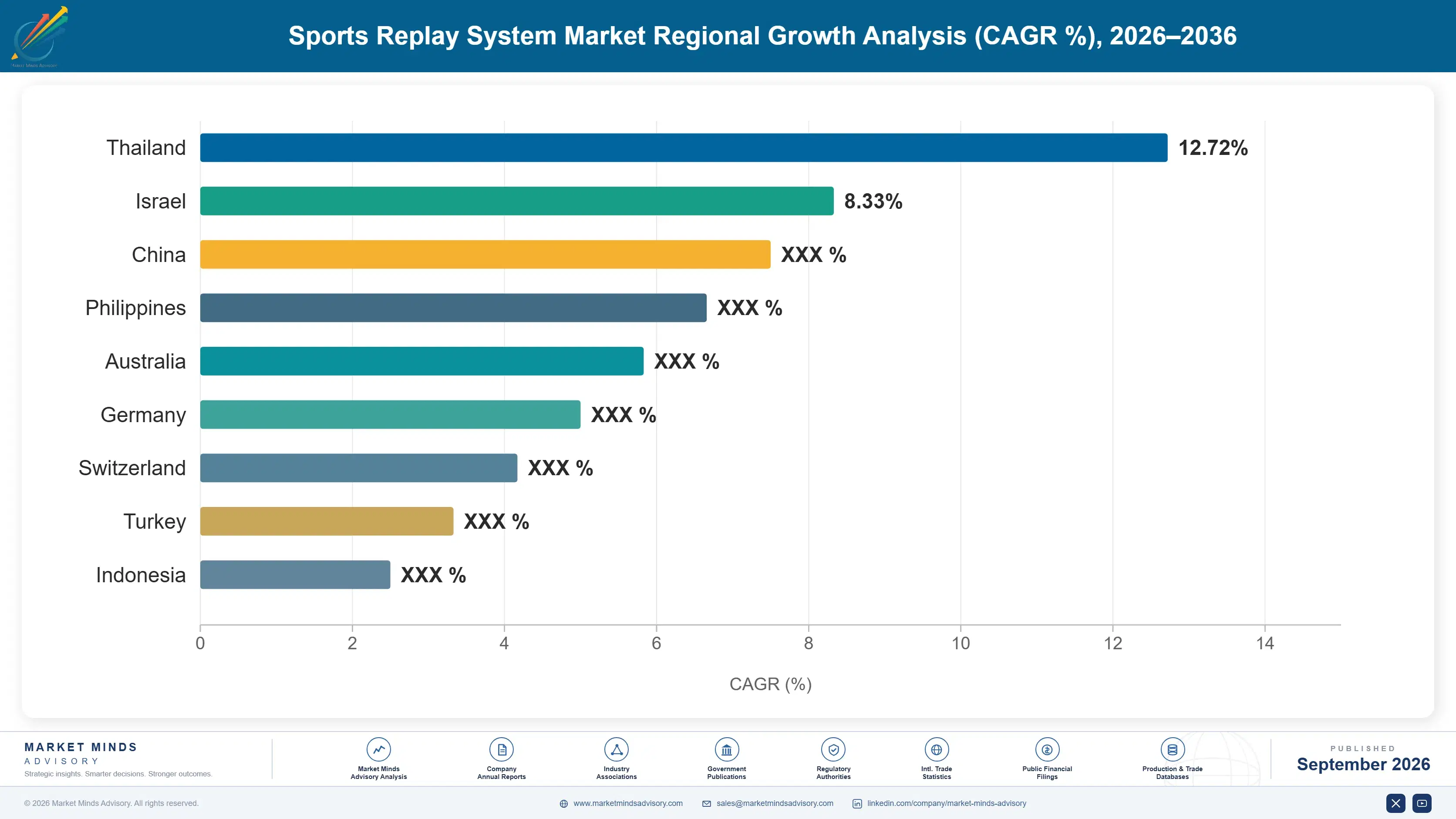
North America leads global sports replay system installations, anchored by major professional league scale and substantial broadcast production investment across multiple established sports leagues nationwide, while South Asia and Pacific posts the fastest regional growth rate as cricket broadcast sophistication expands rapidly through the 2036 horizon.

North America

The United States hosts the world's largest concentration of professional sports leagues, with the NFL, NBA, and MLB collectively operating extensive replay infrastructure across dozens of venues supported by substantial media rights revenue. Hawk-Eye and Sony maintain deep relationships with major American leagues, having built certification credentials over years of officiating partnership relationships. Canada's smaller market follows similar demand patterns tied to hockey and its shared broadcast technology relationships with American networks. College athletics increasingly adopts comparable technology as conference media rights deals expand, creating a growing secondary demand tier beyond professional leagues. Media rights renewal cycles continue shaping which venues receive the earliest technology upgrades. Momentum remains strong. Interest keeps rising.
Share: 32% | CAGR: 9.5% (2026 to 2036)

Western Europe

European football leagues, particularly the English Premier League and other top domestic competitions, anchor the region's substantial replay system demand through video assistant referee systems now mandatory across most top-tier competitions. Germany, France, and Italy host comparable domestic league deployments tied to their own broadcast rights and officiating governance requirements. International football federations headquartered in the region, including UEFA, drive continent-wide technology standardization requirements that shape procurement decisions across member competitions. Regulatory and governance body influence over technology standards remains considerably stronger here than in most other regions. Certification requirements under UEFA technology standards also raise entry barriers for lower-cost competitors. Momentum remains solid overall across most established competitions. Interest keeps rising.
Share: 24% | CAGR: 7.5% (2026 to 2036)
Regional intelligence for 5 additional markets available in the complete report: East Asia, South Asia and Pacific, Latin America, Middle East and Africa, Eastern Europe. Contact sales@marketmindsadvisory.com.
sports-replay-system-market-country-cagr-analysis-1788413676245

Multi-Sport Certification and AI Content Priorities

Vendors generate outsized returns not from single-sport hardware sales alone but from multi-sport certification breadth, AI content generation capability, and rapid decision latency reduction. Four levers stand out as the clearest paths to margin expansion across the forecast period, each requiring distinct technical and regulatory investment. Adoption timing and certification depth increasingly separate leading vendors from smaller regional competitors.

Expand Multi-Sport Officiating Certification Coverage Aggressively

Investing in certification credentials across multiple sports captures share of leagues consolidating technology procurement around fewer, more capable suppliers, since vendors serving only a single sport increasingly lose ground to competitors offering broader deployment experience across 35 percent of certified vendors currently. Manufacturers with existing certification infrastructure can extend that credibility into adjacent sports more efficiently than newer entrants building comparable regulatory relationships from scratch entirely. This crossover expertise increasingly determines which vendors win the largest multi-year league contracts across the industry. Fewer than a handful of vendors currently hold this preferred multi-sport status across leading professional leagues.
Market Impact: Targets a 35% share of certified vendors overall

Develop AI-Enhanced Content Generation Capability Broadly

Building AI-powered highlight and analysis generation capability captures premium pricing from broadcasters seeking to reduce manual editing labor while producing content 30 percent faster than traditional workflows require for social media and streaming distribution. This capability increasingly determines which vendors win broadcast production contracts beyond pure officiating review functionality, as broadcasters value integrated content generation considerably more than standalone review technology lacking comparable production value. Vendors with proven AI content generation track records increasingly win preferred-supplier status among major broadcasters. Broadcasters increasingly view this capability as essential rather than optional during vendor evaluation processes.
Market Impact: Cuts content turnaround time by roughly 30% overall

Accelerate Decision Latency Reduction Engineering Investment

Reducing the typical 45-second decision latency for standard video reviews through improved processing and AI-assisted decision support addresses a genuine fan and broadcaster pain point around lengthy review pauses that undermine live viewing experience regardless of decision accuracy. Vendors demonstrating meaningful latency reduction increasingly command premium positioning from leagues prioritizing broadcast flow alongside officiating accuracy in their technology procurement evaluations and vendor selection processes. Vendors achieving measurable latency improvements increasingly differentiate themselves during competitive procurement evaluations against slower-processing rivals. Continued investment in this capability seems likely to widen the gap between leading and lagging vendors.
Market Impact: Cuts decision latency below the 45-second mark overall

Pursue Emerging Market Certification Partnership Strategies

Establishing certification partnerships with cricket and football federations in fast-growing South Asian and African markets captures a meaningful new addressable demand pool spanning 6 or more countries pursuing broadcast sophistication comparable to established Western sports markets. Vendors entering these markets early through local partnership structures increasingly capture disproportionate share of new league contracts as domestic competitions consolidate around fewer, more established international technology suppliers over time. Early movers in these markets increasingly build durable relationships that later entrants struggle to displace. Portfolio breadth increasingly matters as much as raw technical capability in these emerging markets.
Market Impact: Opens new markets across 6+ additional countries overall

Who Controls the Margin Pool

The market remains moderately concentrated, with the top five vendors holding an estimated 50 percent combined installed-system share. Hawk-Eye Innovations and EVS Broadcast Equipment lead through established certification credentials and deep broadcast production relationships across multiple major sports. Smaller regional vendors and independent broadcast integrators compete mainly through localized pricing and service relationships rather than proprietary certification credentials.
Current competitive activity centers on multi-sport certification expansion, AI content generation capability, and decision latency reduction rather than pure hardware price competition in commodity camera systems. Established suppliers increasingly compete for design wins in these adjacent capability categories against both incumbents and newer specialized entrants. Warranty terms and demonstrated reliability at major event scale increasingly serve as key differentiators across most demanding league selection processes.

Rankings could shift meaningfully as AI content generation and emerging market certification continue expanding faster than traditional officiating hardware demand. Vendors without crossover capability risk losing ground to diversified competitors capturing disproportionate share of these faster-growing application segments across the broader competitive field. Providers with strong balance sheets increasingly acquire smaller specialized technology companies rather than developing comparable capability organically from scratch.
sports-replay-system-market-company-positioning-matrix-1788413676771

Competitive Moat and Risk Dimensions

HAWK-EYE INNOVATIONS

Moat: Multi-Sport Certification Depth

Hawk-Eye's extensive certification credentials across tennis, cricket, football, and other major sports give it distribution advantages and shared engineering infrastructure that narrower single-sport competitors cannot easily replicate quickly. This positioning gives Hawk-Eye a durable advantage in enterprise sales conversations increasingly led by leagues consolidating vendor relationships across sports.
HAWK-EYE INNOVATIONS

Risk: Sony Ownership Strategic Focus Risk

Hawk-Eye's ownership by Sony introduces strategic focus risk if parent company priorities shift away from sports technology investment toward other business units within the broader Sony corporate portfolio. Investors monitor this dynamic closely given its potential implications for long-term product roadmap investment and strategic direction.
EVS BROADCAST EQUIPMENT

Moat: Broadcast Production Integration Depth

EVS's deep integration into broadcast production workflows beyond pure replay functionality gives it broader customer relationships and cross-selling opportunities that officiating-focused competitors lacking comparable production integration cannot easily match. This positioning gives EVS a meaningful head start capturing broadcast contracts that pure officiating vendors cannot easily replicate.
EVS BROADCAST EQUIPMENT

Risk: Broadcast Industry Budget Cyclicality

EVS's substantial exposure to broadcast industry capital spending leaves it more vulnerable to cyclical media industry budget cuts than competitors with more diversified officiating-focused revenue streams. A sudden media industry downturn could disproportionately affect EVS relative to more diversified officiating-focused competitors. This risk grows more pronounced during periods of broader media rights renewal uncertainty across major leagues.

Players Tracked

Prominent Players

Hawk-Eye Innovations
EVS Broadcast Equipment
ChyronHego
Vizrt
Stats Perform

Other Key Players

SMT Sports Media Technology
Deltatre
Second Spectrum
Sportlogiq
Catapult Sports
Genius Sports
Sportradar
Pixellot
Piero
AWS Sports Analytics
Track160
Kinexon
Beyond Sports
Grabyo
WSC Sports

Recent Developments

MARCH 2026

Hawk-Eye Innovations announced an expanded certification partnership with a major cricket federation to deploy comprehensive video review technology across additional domestic competitions, reinforcing its position in the fast-growing South Asian cricket broadcast segment. Financial terms of the certification partnership were not disclosed publicly by either party involved.
Signal: Signals established officiating vendors are winning early emerging-market certification contracts over regional newcomers today nationwide and abroad
NOVEMBER 2025

EVS Broadcast Equipment launched a new AI-powered highlight generation module integrating directly with its existing replay infrastructure, targeting broadcasters seeking faster content turnaround for social media distribution across multiple platforms. Financial terms of the product launch investment were not disclosed publicly by the company. Analysts view it favorably.
Signal: Signals AI content generation capability is becoming essential competitive table stakes across the industry today broadly
JUNE 2025

Stats Perform secured a multi-year data and analysis technology agreement with a major professional league, expanding its footprint in the broadcast analysis segment beyond its traditional sports data licensing business. Financial terms of the multi-year agreement were not disclosed publicly by either party. Analysts view it favorably too.
Signal: Signals data and analytics vendors continue expanding into adjacent broadcast technology categories nationwide today and abroad

Camera and Processing Hardware Set Margins

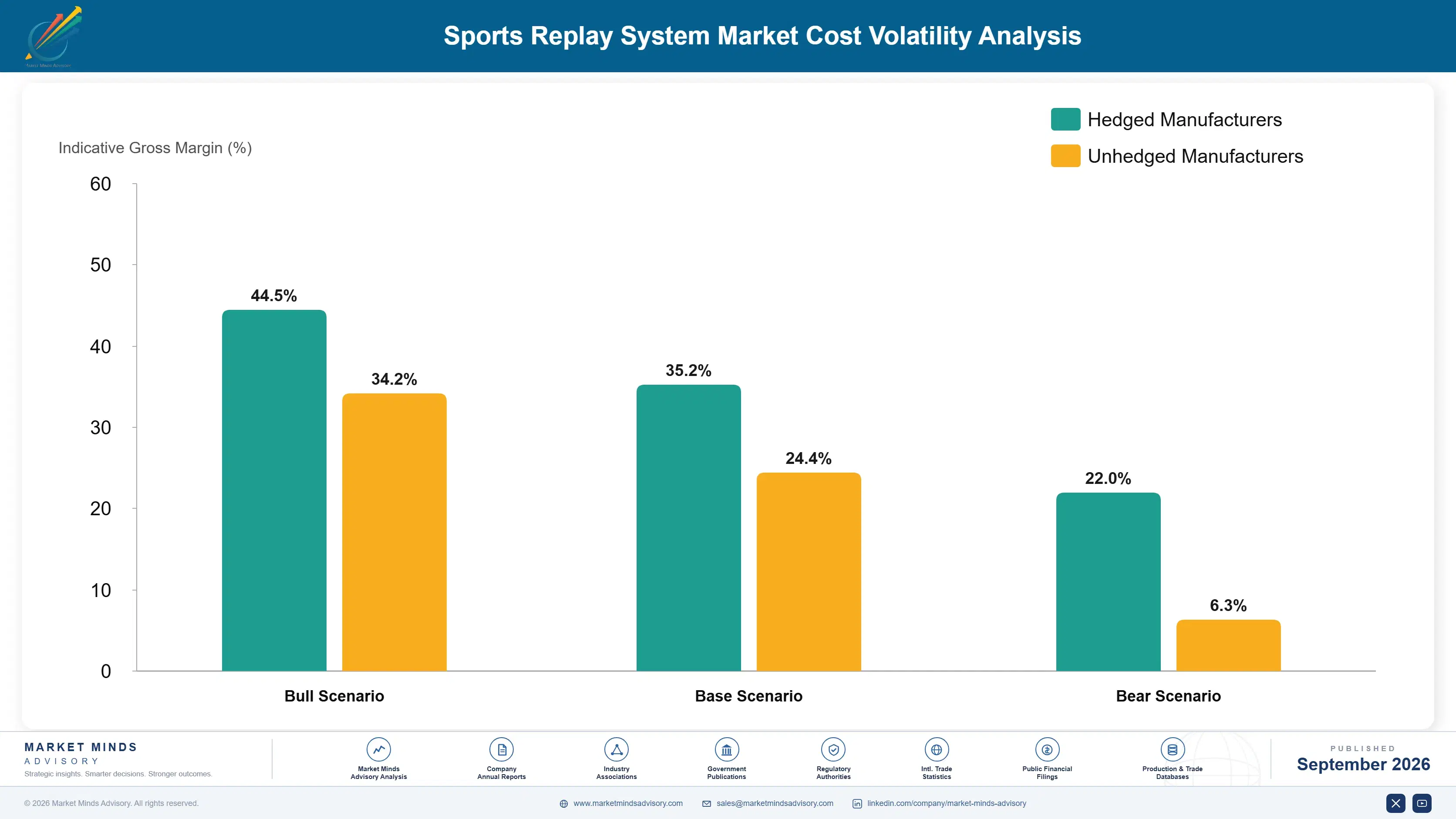
High-speed camera hardware, specialized image processing components, and network infrastructure equipment represent 50 to 60 percent of total system production cost, with camera sensor pricing tracking closely with broader broadcast imaging component supply and demand cycles. Vendors increasingly negotiate multi-year procurement contracts spanning both camera and processing component categories to smooth cost volatility across their broader supply chain.
Semiconductor component shortages during 2021 and 2022 extended camera hardware delivery lead times considerably, according to industry supplier disclosures, delaying several planned venue deployment projects and forcing vendors to lock in component allocation well ahead of installation timelines during peak shortage periods. This episode prompted several vendors to reassess their component procurement strategy and pursue longer-term supply arrangements going forward with key suppliers. Prices have since partially stabilized but remain elevated relative to historical norms.

Vendors without diversified camera component supplier relationships face considerably higher supply disruption risk than larger competitors with dedicated procurement teams and multi-source qualification programs. This dynamic increasingly favors scaled vendors like Hawk-Eye and EVS over smaller specialists dependent on single-source component relationships. Independent specialists increasingly pursue joint purchasing arrangements with industry partners to capture comparable volume discount pricing on component inputs.
sports-replay-system-market-cost-volatility-analysis-1788413676966

Qualify Multiple Camera Component Sources

Establishing qualified relationships with multiple camera sensor and component suppliers reduces exposure to single-source supply disruption, protecting deployment timelines during component shortage events that have repeatedly disrupted delivery schedules across the broader electronics industry. Manufacturers with established multi-source qualification programs weathered the last shortage cycle considerably better than single-source-dependent competitors. Adoption grows. Costs decline.

Build Strategic Component Inventory Buffers

Maintaining strategic inventory buffers for critical camera and processing components provides a cushion against short-term supply disruptions, trading modest carrying cost for meaningfully reduced risk of deployment delays during periods of component market volatility. This flexibility becomes particularly valuable during periods of concentrated component manufacturer capacity constraints affecting the broader industry. Adoption grows steadily.

Standardize Camera Rig Designs Across Sports

Standardizing camera rig and mounting hardware designs across multiple sports applications enables larger volume procurement and reduces per-unit component cost, following the same manufacturing scale economics common across broadcast equipment categories. This standardization approach requires more upfront engineering investment but pays back considerably during high-volume production runs. Adoption grows steadily across most product lines and vendor segments.

Portfolio Architecture for Margin Defence

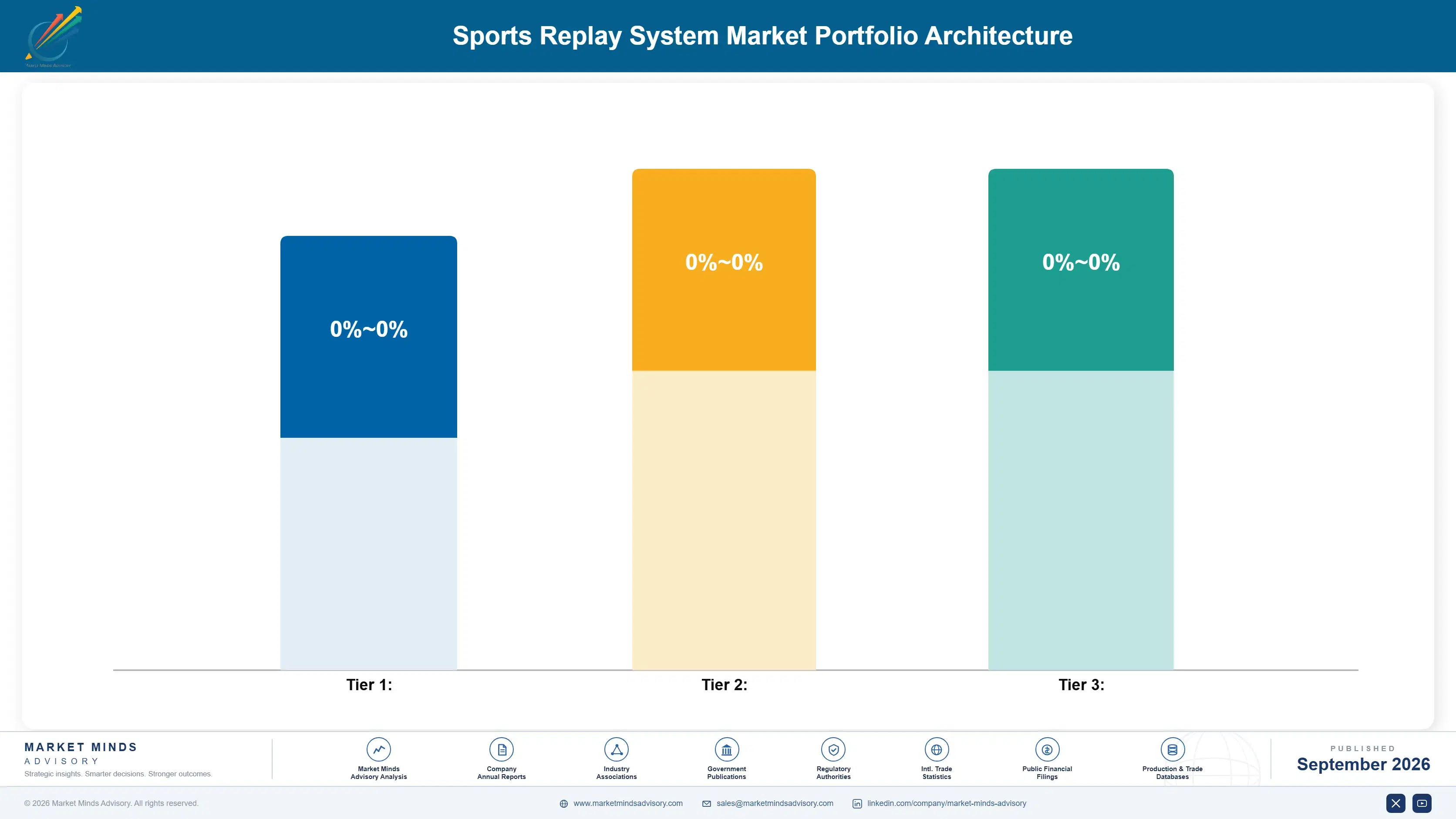
Vendor portfolios split across three tiers: commodity single-sport review hardware competing on price, certified multi-sport officiating platforms commanding qualification-driven premiums, and next-generation AI content and analysis systems still gaining commercial scale. Margin economics diverge considerably between tiers. Investment increasingly follows this margin logic across most vendor product development roadmaps. This bifurcation increasingly shapes vendor capital investment and hiring decisions.
Commodity single-sport hardware competes almost entirely on manufacturing cost and delivery reliability, with thin margins that leave little room for differentiation beyond price and basic quality consistency. Multi-sport certified platforms capture meaningfully wider margins through certification credential depth, insulating vendors from pure commodity price competition that defines the volume tier. Vendors without a credible certification narrative increasingly struggle to defend premium pricing against well-positioned competitors.

High-value pools concentrate in AI content generation and multi-sport certification, where technical differentiation and regulatory trust reward vendors willing to invest in specialized capability. Commodity single-sport hardware remains the volume anchor but offers limited margin upside absent meaningful crossover application differentiation. Investment allocation increasingly follows this margin logic across most vendor strategic planning decisions. Vendors that recognized this shift early now hold a meaningful competitive advantage over slower-moving rivals.

Commodity single-sport review hardware competing primarily on manufacturing cost and delivery reliability for standard deployments. Price competition among established vendors keeps margins thin across most standard deployment scenarios. Margins remain thin.
Gross Margin

Multi-sport certified officiating platforms with regulatory credentials commanding premium pricing from reliability-focused league buyers. Demand grows steadily as reliability-focused leagues value proven certification track records highly. Demand grows steadily too.
Gross Margin

AI content generation and analysis systems still gaining commercial scale among broadcast-focused enterprise customers. Early adoption remains concentrated among the largest, most technically sophisticated broadcast organizations. Adoption grows steadily too.
Gross Margin
sports-replay-system-market-portfolio-architecture-1788413677465

High-value Sub-segments and Strategic Watch-out

AI-Enhanced Highlight and Analysis Systems

The clearest high-value, high-growth pool, combining strong content-driven margins with a 14.5 percent CAGR as adoption accelerates. Engineering firms report a growing project pipeline across most major broadcast accounts globally today. Momentum remains strong. Adoption continues expanding steadily. Momentum holds. Progress continues steadily. Interest holds firm.

Officiating Video Review Systems

Strong margins and steady growth from expanding mandatory review scope across major leagues and international sports federations. Certification investment increasingly pays back as review scope continues expanding across most professional leagues. Interest keeps rising. Adoption continues expanding steadily. Growth continues. Progress continues steadily. Interest holds firm.

Broadcast Multi-Angle Replay Production Systems

The volume core, generating most industry revenue despite thinner margins, anchored by decades of established broadcast adoption. Price competition remains intense here as differentiation opportunities narrow considerably relative to premium alternatives. Volume stays high. Demand remains resilient overall. Volume grows slowly. Progress continues. Interest holds.

Player Challenge Review Systems

A strategic watch-out given commoditization pressure despite steady demand, since differentiation from basic review tools remains genuinely difficult. Vendors still serving this niche increasingly focus on legacy customer retention rather than new product development. Decline continues steadily. Interest keeps fading steadily. Focus narrows further. Progress persists.

Officiating Trust Anchors Recurring Investment

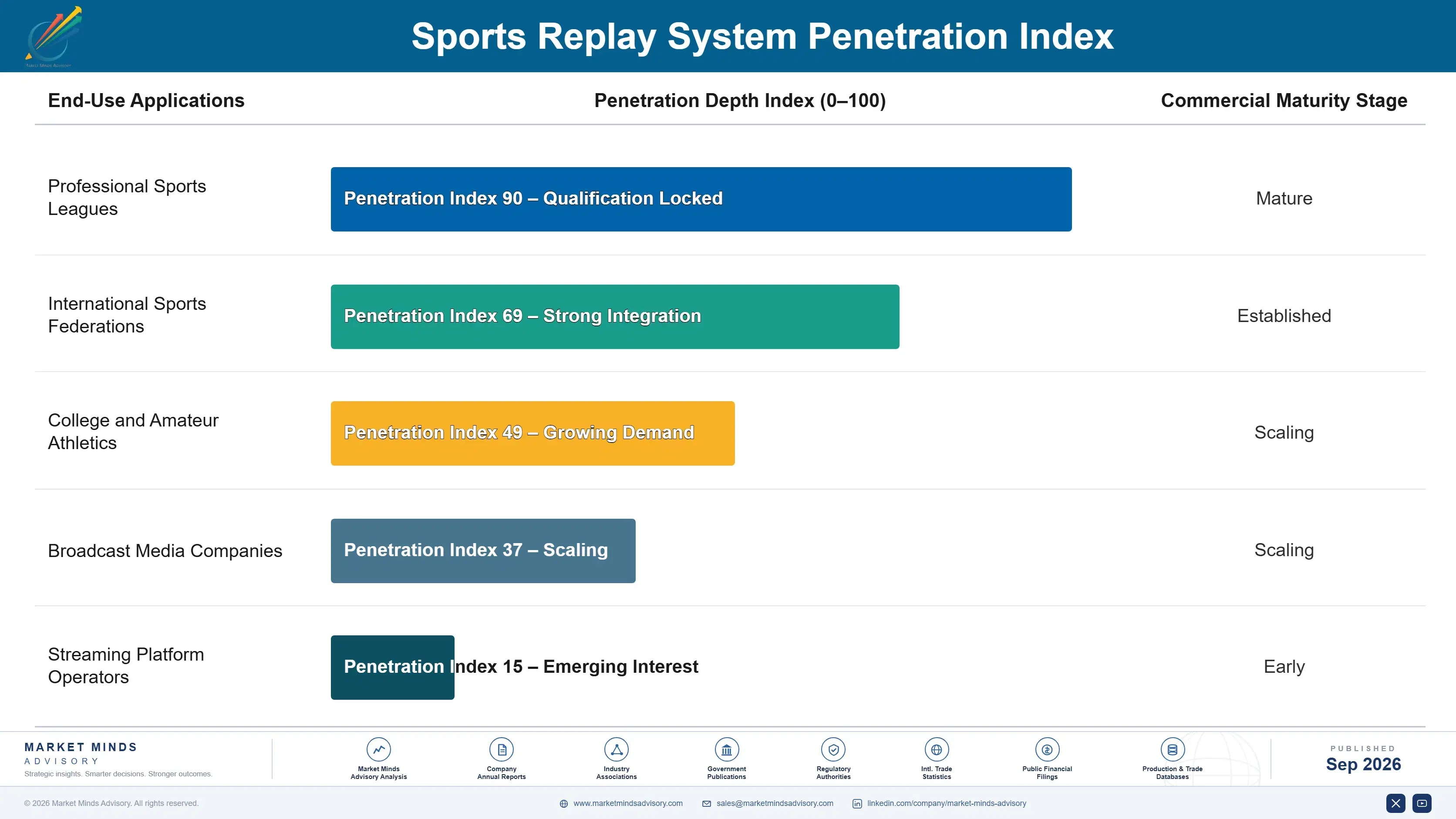
Demand for sports replay systems behaves as an officiating trust necessity rather than a discretionary broadcast enhancement for major leagues, since a controversial missed call carries reputational and commercial consequences that vastly exceed any technology cost saved by deferring investment. This trust-necessity framing insulates demand from the discretionary spending cuts that periodically hit other broadcast technology categories during broader media industry budget tightening cycles at most organizations.
Adoption depth varies considerably by competition tier: top professional leagues show near-universal comprehensive review adoption, while lower-tier and semi-professional competitions retain considerably more limited deployment given the substantial capital cost relative to available media rights revenue. This bifurcation means vendors cannot rely on a single sales narrative but must instead segment their approach by competition tier and available media rights revenue.

Buyer profiles are shifting as broadcast production and content teams increasingly influence procurement decisions traditionally made purely by officiating and competition management departments, reflecting a generational shift toward treating replay infrastructure as a content generation asset rather than a purely regulatory compliance requirement. Vendors without established relationships with broadcast production stakeholders increasingly find themselves competing only for basic officiating deployments rather than the largest integrated technology contracts.
sports-replay-system-market-end-use-penetration-index-1788413677946

Certification Breadth and AI Content Priorities

These are among the four positions where our research anticipates prominent divergence between winners and laggards over the coming forecast period. Each is grounded in the demand model, the regulatory perimeter, and the announced capacity pipeline.
01 / MULTI-SPORT CERTIFICATION STRATEGY

Expand certification credentials across additional sports now

Vendors without multi-sport certification credentials face a widening gap against competitors already capturing the leagues consolidating technology procurement around fewer, more capable suppliers with broader deployment experience. Building comparable certification credentials from scratch takes years of regulatory relationship development that vendors cannot compress by simply offering lower prices to interested leagues. Vendors that delay this investment risk losing the highest-value multi-sport contracts to faster-moving, better-prepared competitors already firmly established across multiple major sports categories, a window that is narrowing quickly across the industry.
02 / AI CONTENT GENERATION INVESTMENT

Build AI highlight generation capability before competitors do

Broadcasters increasingly demand AI-powered content generation capability that reduces manual editing labor while producing highlight and analysis content considerably faster than traditional production workflows require for social media distribution. Vendors without this capability increasingly lose broadcast production contracts to competitors offering integrated content generation alongside pure officiating review functionality. Early investment in AI content generation positions vendors ahead of the broader industry shift already clearly underway across most major broadcasters and their content distribution partners, where timing matters considerably for long-term positioning.
03 / DECISION LATENCY REDUCTION

Reduce review processing time to improve broadcast flow

Fans and broadcasters increasingly view lengthy review pauses as a broadcast quality failure regardless of decision accuracy, creating competitive pressure on vendors to demonstrate meaningful latency reduction without compromising underlying review accuracy standards. Vendors achieving measurable latency improvements increasingly differentiate themselves during competitive procurement evaluations against slower-processing rivals still relying on legacy processing infrastructure. Building this capability now positions vendors favorably as leagues increasingly prioritize broadcast flow alongside officiating accuracy in their vendor selection criteria, a gap that keeps widening steadily.
04 / EMERGING MARKET EXPANSION STRATEGY

Establish certification partnerships in fast-growing cricket markets

Fast-growing cricket and football broadcast markets in South Asia and parts of Africa are adopting comprehensive video review systems for the first time as domestic leagues pursue broadcast sophistication comparable to established Western markets. Vendors entering these markets early through local partnership structures increasingly capture disproportionate share of new league contracts as domestic competitions mature. Building these relationships now captures deal flow that would otherwise default to competitors with broader existing regional networks and established local partnerships, where early movers capture disproportionate share.

Engagement Snapshot From the Field

A live engagement with an industry participant carrying material or product regulatory and market exposure ahead of a defining policy shift, showing how our research translates into a defensible multi-year portfolio strategy.
MARKET MINDS ADVISORY · CLIENT ENGAGEMENT SUMMARY
Sports Replay System Producer Strategic Portfolio Review and Transition Roadmap 2026·Investment Scenario on Sports Replay System Exposure Evaluation 2025-26
CLIENT PROFILE
A regional professional cricket league seeking to expand its broadcast production sophistication and officiating accuracy sought to evaluate vendor options for its first comprehensive video review system deployment, given growing fan expectations shaped by exposure to established international cricket broadcast standards. The league's board needed a clear, cost-effective path forward before its next season began, given limited time and budget flexibility available.
STRATEGIC CHALLENGE
The league lacked internal technical expertise to evaluate competing vendor proposals and faced budget constraints considerably tighter than the established international leagues its fans increasingly used as a broadcast quality benchmark for comparison during matches. Delaying the decision further risked continued fan dissatisfaction and potential sponsorship revenue loss as competing leagues advanced their own broadcast technology capability.
MMA APPROACH
MMA benchmarked vendor proposals from three established review system providers, modeled total cost of ownership across different deployment scales, and evaluated phased implementation strategies that would let the league begin with essential officiating functionality before expanding into broadcast enhancement capability. Interviews with the league's broadcast partners and officiating staff informed the final vendor recommendation and implementation timeline.
KEY FINDINGS
  1. A phased deployment approach could reduce initial capital investment by an estimated 35 percent compared to full-scale implementation (client-reported, unverified by MMA).
  2. Fan surveys indicated strong demand for basic video review functionality even without full broadcast enhancement capability initially (client-reported, unverified by MMA). even before full broadcast enhancement rollout
  3. Vendor certification credentials varied considerably in relevance to cricket-specific review requirements versus other sports (client-reported, unverified by MMA). requiring careful vendor-specific evaluation criteria
  4. Competing regional leagues that delayed similar investments reported measurably lower fan engagement and sponsorship interest (client-reported, unverified by MMA). during the same competitive broadcast season
CLIENT PROFILE
A regional professional cricket league seeking to expand its broadcast production sophistication and officiating accuracy sought to evaluate vendor options for its first comprehensive video review system deployment, given growing fan expectations shaped by exposure to established international cricket broadcast standards. The league's board needed a clear, cost-effective path forward before its next season began, given limited time and budget flexibility available.
STRATEGIC CHALLENGE
The league lacked internal technical expertise to evaluate competing vendor proposals and faced budget constraints considerably tighter than the established international leagues its fans increasingly used as a broadcast quality benchmark for comparison during matches. Delaying the decision further risked continued fan dissatisfaction and potential sponsorship revenue loss as competing leagues advanced their own broadcast technology capability.
MMA APPROACH
MMA benchmarked vendor proposals from three established review system providers, modeled total cost of ownership across different deployment scales, and evaluated phased implementation strategies that would let the league begin with essential officiating functionality before expanding into broadcast enhancement capability. Interviews with the league's broadcast partners and officiating staff informed the final vendor recommendation and implementation timeline.
KEY FINDINGS
  1. A phased deployment approach could reduce initial capital investment by an estimated 35 percent compared to full-scale implementation (client-reported, unverified by MMA).
  2. Fan surveys indicated strong demand for basic video review functionality even without full broadcast enhancement capability initially (client-reported, unverified by MMA). even before full broadcast enhancement rollout
  3. Vendor certification credentials varied considerably in relevance to cricket-specific review requirements versus other sports (client-reported, unverified by MMA). requiring careful vendor-specific evaluation criteria
  4. Competing regional leagues that delayed similar investments reported measurably lower fan engagement and sponsorship interest (client-reported, unverified by MMA). during the same competitive broadcast season
RECOMMENDED STRATEGY
Phase 1: Phase one: deploy essential officiating video review functionality within the first season to address fan expectations. Speed to deployment mattered considerably here. Phase 2: Phase two: expand into broadcast enhancement capability once officiating functionality proves reliable and cost-effective operationally. Cost-effectiveness validation preceded further expansion. Phase 3: Phase three: evaluate AI content generation capability once broadcast enhancement infrastructure is fully established and functioning well. Full evaluation depends on broadcast infrastructure readiness.
OUTCOME
The league deployed its phased officiating review system within four months, reporting improved fan satisfaction scores and beginning conversations with broadcast partners about expanded enhancement capability (client-reported, unverified by MMA). Additional sponsorship inquiries continued arriving steadily following the initial deployment announcement. League leadership viewed this early progress positively.

Frequently Asked Questions

Foundational context covering the market sizes, CAGR, scope, country, region and competition that inform every finding below. This section is provided to cover basics and most often pre-purchase conversations, answered from the MMA Primary Research Dataset.

What is the current size of the Sports Replay System Market?

The global sports replay system market reached an estimated $1.3 billion in 2025, driven by expanding officiating scope and broadcast content demand. North America hosts the largest installed system base.

How large will the Sports Replay System Market be by 2036?

MMA projects the market will reach approximately $3.28 billion by 2036, up from $1.41 billion in 2026. That represents roughly a 2.33x expansion across the ten-year forecast window.

What is the CAGR for the Sports Replay System Market 2026 to 2036?

The base case forecast CAGR is 8.8% across 2026 to 2036, with a bull scenario of 10.1% and a bear scenario of 7.5% depending on federation mandates and media rights growth.

Which segment is growing fastest?

AI-Enhanced Highlight and Analysis Systems lead at a 14.5% CAGR, roughly 1.65 times the overall market rate, as broadcasters seek faster content production for social platforms.

Who are the major companies in the Sports Replay System Market?

Hawk-Eye Innovations, EVS Broadcast Equipment, ChyronHego, Vizrt, and Stats Perform lead the market, together holding an estimated combined installed-system share of 50% measured globally today.

Which country is growing fastest?

India leads growth at a 13.0% CAGR, driven by its cricket league's substantial media rights value and expanding domestic broadcast sophistication ambitions across the country.

Report Segmentation Architecture

The full report scope spans multiple orthogonal segmentation dimensions, with cross-tabulated demand data provided for each dimension pair. Coverage extends further to regional breakdowns, trend trajectories, and the competitive detail needed to support segment-level decision-making.
  • Ball-Tracking and Goal-Line Technology
  • Officiating Video Review Systems
  • Broadcast Multi-Angle Replay Production Systems
  • AI-Enhanced Highlight and Analysis Systems
  • Player Challenge Review Systems
  • Virtual and Augmented Reality Replay Systems
  • Professional Sports Leagues
  • International Sports Federations
  • College and Amateur Athletics
  • Broadcast Media Companies
  • Streaming Platform Operators
  • Direct League Procurement Contracts
  • Broadcast Rights Holder Agreements
  • Federation Certification Programs
  • Venue Installation Service Contracts

By Region

  • North America
  • Western Europe
  • East Asia
  • South Asia and Pacific
  • Latin America
  • Middle East and Africa
  • Eastern Europe

Scope, Methodology, and Coverage

Every figure in this report is reproducible from documented input assumptions. The scope below maps the historical period, the forecast horizon, the segmentation dimensions, and the countries covered, alongside the underlying primary and qualitative methodology.
Historical Period
2020 to 2025
Forecast Period
2026 to 2036
Base Year
2025 (USD billions; MMA Primary Research Dataset, September 2026)
Market Definition
This report covers video-based replay systems used for sports officiating review and broadcast production, including multi-camera capture, ball-tracking, and instant replay analysis technology, measured on a global installed-system basis. It excludes general-purpose broadcast cameras and production switching equipment not specifically configured for sports replay applications.
Quantitative Units
USD billions, installed venue systems, and percentage CAGR
Segmentation Dimensions
Technology type (ball-tracking/goal-line, officiating review, broadcast multi-angle, AI-enhanced analysis, player challenge, VR/AR replay), end-use vertical, commercial channel, and geography
Regions Covered
North America, Western Europe, East Asia, South Asia and Pacific, Latin America, Middle East and Africa, Eastern Europe
Countries Covered
United States, United Kingdom, India, China, Brazil, Australia, and 20+ additional countries across seven global regions
Key Companies Profiled
Hawk-Eye Innovations, EVS Broadcast Equipment, ChyronHego, Vizrt, Stats Perform, and 15 additional vendors across the global competitive set
Quantitative Methodology
Primary survey, n=3,800 respondents, Q4 2025, six countries; demand-side model with trade association cross-validation
Qualitative Methodology
47 expert interviews, Q4 2025; applied to validate demand model assumptions, identify emerging dynamics, and assess competitive positioning
Report Format
PDF and XLSX data workbook (Word format preview document)
Publisher
Market Minds Advisory
Report Code
MMA-2026-TEC-126
Published
September 2026
Contact
sales@marketmindsadvisory.com | www.marketmindsadvisory.com

Purchase the full Sports Replay System Market Report (2026 to 2036).

This report delivers a complete assessment of the global sports replay system market across the full 2026 to 2036 forecast period ahead. It combines primary survey data from 3,800 respondents with 47 expert interviews to quantify segment, regional, and competitive dynamics in careful detail. Coverage spans officiating review, broadcast production, and AI content generation categories, alongside detailed vendor benchmarking across twenty companies. Analysts translate raw data into actionable certification strategy, content investment, and market entry guidance for vendors, investors, and leagues evaluating this converging officiating and broadcast technology category.
Ten-year global market sizing and forecast model
Seven-region demand, pricing, and share breakdown
Twenty-company competitive benchmarking and positioning analysis
Segment-level growth, margin, and pricing analysis
Camera and processing cost exposure assessment
Strategic verdict and prioritized investment guidance

Built For The People Who Decide

From boardroom strategy to bench-side execution, this report is read cover-to-cover by leaders shaping the next decade of their industry, turning demand scenarios, market dynamics and valuation benchmarks into decisions.
CXOs/ Presidents/ VPs/ Managers
M&A and Corporate Development
Strategy Teams and R&D Heads
Procurement and Product Directors
Regulatory and Compliance Leaders
Investor Relations and Equity Analysts