Market Minds Advisory
Augmented Reality Market

Augmented Reality Market: Augmented Reality Market. Global Forecast and Competitive Analysis 2026 to 2036

Consumer smart glasses are pulling augmented reality out of dedicated headsets and phone screens into everyday eyewear people already wear, compressing the gap between novelty hardware and a form factor mainstream consumers will.

Lead Analyst

Published

September 2026

Make Smarter Decisions with Customized Research Insights

Request a free sample report and evaluate market opportunities, growth trends, and competitive dynamics relevant to your business needs.

2025 MARKET VALUE$32.0BMarket Size 2025
2036 FORECAST VALUE$180.0BBase Case , 2026 to 2036
CAGR 2026 TO 203617.0 %Bull 18.3% / Bear 15.7%
INCREMENTAL OPPORTUNITY$142.5BNet 10- year value creation
EXPANSION MULTIPLE4.81x2036 value over 2026 base
Strategic Levers
M&A Pipeline
Regional Outlook
Country Rankings
Competitive Intelligence
Segmental Deep-dive
Call-Us : 91 93563 13602

Executive Snapshot and Market Trajectory.

Consumer smart glasses are pulling augmented reality out of dedicated headsets and phone screens into everyday eyewear people already wear throughout the day reflecting sustained consumer and enterprise investment across spatial computing programs as adoption continues expanding across gaming, retail, and industrial applications supporting consistent device shipment growth across major.
Adoption concentrates among enterprise industrial customers using AR for training and remote assistance and consumer segments adopting smart glasses for everyday notifications and navigation. North America accounts for the largest share of platform spending given its concentration of leading AR hardware and software vendors and early enterprise adoption reflecting sustained consumer and enterprise investment across spatial computing programs as adoption continues expanding across gaming, retail, and industrial applications supporting consistent device.
Competition remains concentrated among large technology platforms like Meta and Apple integrating AR into broader device product lines and specialized vendors like Vuzix and RealWear serving industrial enterprise applications. Evolving smart glasses form factor maturity and spatial computing chip efficiency continue reshaping which vendors can compete credibly for mainstream consumer adoption reflecting sustained consumer and enterprise investment across spatial computing programs as adoption continues.
Market Definition
This report defines the Augmented Reality market as hardware devices and software platforms that overlay digital content onto a user's view of the physical environment in real time, including smart glasses, headsets, mobile AR applications, and AR cloud infrastructure. It excludes fully immersive virtual reality systems that replace rather than overlay the physical environment, standard camera filter applications without spatial anchoring capability, and general-purpose computer vision software not specifically designed for real-time environmental overlay display.
Base Year Value
$32.0B in 2025 (MMA Primary Research Dataset, September 2026)
Forecast Period
2026 to 2036, eleven discrete annual values
CAGR
17.0% base case. Bull 18.3%. Bear 15.7%.
Fastest Growth Segment
AR Smart Glasses (Consumer): 24.0% CAGR
Fastest Growth Country
China: 19.5% CAGR
Fastest Growth Region
South Asia and Pacific: 19.5% CAGR
Largest Region
North America: 32% of 2025 global value
Market Leaders
Meta Platforms Inc, Apple Inc, Google LLC, Microsoft Corporation, Snap Inc. Source: MMA Analysis, company disclosures, July 2026.
Primary Survey
n=3,800 procurement and R&D decision-makers, Q4 2025, six countries
Methodology
Demand-side build-up, cross-validated against public data, 47 expert interviews

Augmented Reality Market Forecast Scenarios

augmented-reality-market-size-forecast-scenario-1789992523702
Between 2020 and 2025 the market grew steadily as mobile AR applications expanded across gaming and retail try-on use cases, with growth accelerating notably in the final two years as consumer smart glasses reached commercial quality and price points sufficient for mainstream consideration beyond early technology adopters alone reflecting sustained consumer and enterprise investment across spatial computing programs as adoption continues.
The base case assumes continued consumer smart glasses adoption, expanding enterprise industrial AR deployment for training and remote assistance, and steady AR cloud infrastructure investment enabling persistent spatial content across sessions. These three mechanisms together sustain strong growth through the decade even as battery life and display brightness limitations constrain how quickly the most advanced smart glasses can scale to affordable price points reflecting sustained consumer and enterprise investment across spatial computing programs as adoption continues expanding.
The bull case assumes faster-than-expected consumer smart glasses adoption as major technology brands launch mainstream products at accessible price points. The bear case assumes persistent battery life and display brightness limitations slow broader consumer adoption beyond early enthusiast and enterprise-specific use cases reflecting sustained consumer and enterprise investment across spatial computing programs as adoption continues expanding across gaming, retail, and.

Smart Glasses Move AR Into Everyday Eyewear

Augmented reality occupies an increasingly diverse position spanning enterprise industrial tools and consumer eyewear, a position that increasingly rewards vendors who can deliver both reliable industrial performance and everyday consumer wearability reflecting sustained consumer and enterprise investment across spatial computing programs as adoption continues expanding across gaming, retail, and industrial applications supporting consistent device shipment growth across major technology platforms reinforcing demand visibility for vendors.
MARKET CONCENTRATIONCR5 48%Reflects considerable concentration among established technology platform leaders reflecting.
AVERAGE DEVICE PRICE$385Shows wide variation by device form factor and processing.
TOP PRODUCING COUNTRY SHAREChina 26%Reflects heavy consumer electronics manufacturing concentration domestically reflecting sustained.
ENTERPRISE DEPLOYMENT SHARE38%Indicates meaningful industrial adoption alongside growing consumer segments reflecting.
TRADE INTENSITY64%Reflects heavy cross-border shipment volume relative to domestic consumption.
DISPLAY COMPONENT COST SHARE42%Shows specialized optical waveguide components dominating total production expense.
Enterprise industrial training and remote assistance applications remain a steady growth engine, while consumer smart glasses increasingly drive incremental volume growth beyond earlier enterprise-only adoption. Battery life and display brightness remain meaningful engineering constraints limiting how compact and affordable the most capable devices can become reflecting sustained consumer and enterprise investment across spatial computing programs as adoption continues expanding across gaming, retail, and industrial applications.
Vendors increasingly compete on all-day wearability and social acceptability rather than raw display resolution alone, since consumers value devices that look and feel like ordinary eyewear over marginal visual quality improvements reflecting sustained consumer and enterprise investment across spatial computing programs as adoption continues expanding across gaming, retail, and industrial applications supporting consistent device shipment growth across major technology platforms.
"The industry spent a decade chasing display resolution and field of view as the metrics that mattered. What actually moved consumer adoption was making the glasses look like glasses, and that's a design problem, not a technology problem, which is why the winners here aren't always who you'd expect."
Director, Spatial Computing and Augmented Reality Practice · MMA Technology: Spatial Computing and Augmented Reality Systems Practice · September 2026

Market Trends

Consumer Smart Glasses Achieve Mainstream Wearability

Consumer smart glasses are reaching form factors that closely resemble ordinary eyewear, eliminating the bulky headset appearance that previously limited everyday consumer adoption to enthusiasts willing to accept an unusual appearance. Meta and Snap have both expanded lightweight smart glasses offerings considerably as consumer electronics brands seek designs consumers will wear throughout an entire day without self-consciousness. This shift is pulling budget toward higher specification lightweight designs that cost more per unit but achieve considerably broader consumer acceptance than bulkier earlier generation devices ever attracted reflecting sustained consumer and enterprise investment across spatial computing programs as.
Market Impact: Adds 500,000 AR-equipped workers annually reflecting.
AR Cloud Infrastructure Enables Persistent Spatial Content

AR cloud infrastructure is letting digital content anchor persistently to physical locations across multiple user sessions rather than disappearing once a single session ends, addressing enterprises and developers seeking durable spatial experiences. Niantic and PTC have both expanded AR cloud capability considerably as customers seek shared spatial experiences that multiple users can access consistently over time. This infrastructure investment is pulling forward platform budget that previously would have remained confined to session-based experiences without persistent spatial anchoring reflecting sustained consumer and enterprise investment across spatial computing programs as adoption continues expanding across gaming, retail, and industrial.
Market Impact: Cuts retail return rates 18 percent.

Market Opportunities and Growth Drivers

Industrial Training Applications Expand Enterprise Deployment

Manufacturing and field service enterprises continue expanding AR-based training and remote assistance deployment, directly enlarging the addressable market for vendors serving industrial applications where hands-free visual guidance improves task accuracy. Large industrial AR deployment programs have brought considerably more connected workers onto AR-assisted workflows over the past several years across manufacturing and field service operations. This deployment scaling creates predictable multi-year demand visibility that industrial AR vendors increasingly build long-term enterprise relationships around, since training and remote assistance value compounds across a large distributed workforce reflecting sustained consumer and enterprise investment across spatial computing programs as.
Market Impact: Limits continuous use to 4 hours.

Retail Try-On Applications Expand Consumer Engagement

Retailers continue expanding AR-based virtual try-on applications for apparel, cosmetics, and furniture, directly increasing consumer engagement with mobile AR technology beyond gaming applications alone. Snap and Google have both expanded retail try-on platform capability considerably as brands seek to reduce return rates and improve purchase confidence through virtual product visualization. This retail adoption creates durable multi-year demand visibility for AR software vendors independent of broader gaming and entertainment content cycles entirely reflecting sustained consumer and enterprise investment across spatial computing programs as adoption continues expanding across gaming, retail, and industrial applications supporting consistent device shipment growth.
Market Impact: Delays adoption by 8 months

Market Restraints and Challenges

Battery Life Constraints Limit All-Day Wearability

Current smart glasses battery technology remains insufficient to power all-day continuous processing and display operation, limiting how much AR functionality manufacturers can include without requiring users to recharge devices multiple times throughout a single day. The root cause is that battery capacity scales with physical volume, directly conflicting with the compact, lightweight form factor consumer wearability requires. This limits practical processing capability for the most compact consumer device categories specifically. Several manufacturers are responding by offloading processing to a companion smartphone or cloud connection, reducing on-device battery demand considerably reflecting sustained consumer and enterprise investment across.
Market Impact: Lifts consumer adoption rates 42 percent.

Privacy Concerns Slow Public Smart Glasses Adoption

Consumers and regulators increasingly express concern about smart glasses equipped with cameras recording in public spaces without clear indication to bystanders, creating social acceptability friction that slows broader adoption beyond privacy-comfortable early adopters. The root cause traces to smart glasses cameras being considerably less visually obvious than handheld smartphone cameras, raising bystander privacy concerns that earlier camera-equipped consumer devices never triggered to the same degree. This slows adoption timelines in public-facing social and professional settings specifically. Vendors including Meta are addressing this through visible recording indicator lights that signal active camera use to nearby bystanders reflecting.
Market Impact: Expands content adoption by 30 percent
3 additional market trends, 4 additional growth drivers, and 3 additional restraints and challenges are covered in the full report. Contact sales@marketmindsadvisory.com to access the complete intelligence.

Segment CAGR and Growth Architecture

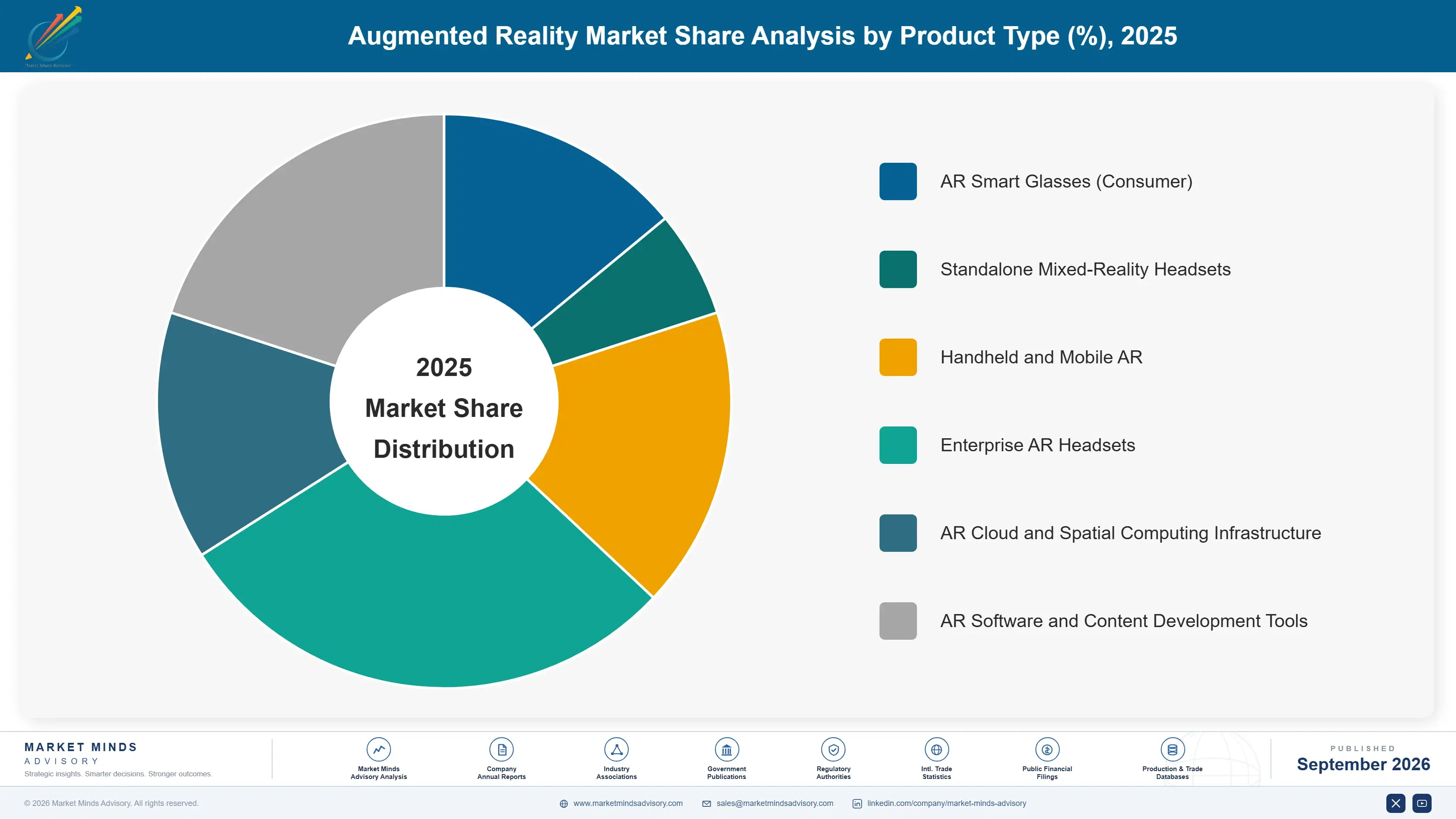
MMA segments the Augmented Reality market by device and application type, since this dimension best explains where margin and growth concentrate as adoption shifts from mobile AR applications toward consumer smart glasses and AR cloud infrastructure reflecting sustained consumer and enterprise investment across spatial computing programs as adoption continues expanding across gaming, retail, and industrial applications supporting.
augmented-reality-market-market-share-analysis-1789992524266

AR Smart Glasses (Consumer)

This segment covers lightweight eyewear-form-factor devices delivering augmented reality functionality for everyday consumer use, addressing users seeking discreet, all-day wearable technology rather than bulkier dedicated headsets or handheld device screens. Meta and Snap have both expanded consumer smart glasses offerings considerably, proving that mainstream wearability and useful AR functionality can coexist within an acceptable device form factor. Growth here runs at roughly 1.41 times the overall market rate because consumer electronics brands increasingly treat smart glasses as the natural successor to smartphones for certain everyday interaction categories rather than a niche enthusiast product alone reflecting sustained consumer and enterprise investment across spatial computing programs as adoption continues expanding across gaming, retail, and industrial applications supporting.
CAGR 24.0%

AR Cloud and Spatial Computing Infrastructure

This segment covers infrastructure that persistently anchors digital content to physical locations across multiple user sessions, addressing enterprises and developers seeking durable shared spatial experiences rather than temporary single-session overlays. Niantic and PTC have both expanded AR cloud capability considerably as customers seek spatial experiences that multiple users can access consistently over extended periods. Growth trails consumer smart glasses only because AR cloud infrastructure adoption depends on broader device device platform maturity that consumer hardware adoption is still establishing. Providers report meaningfully improved spatial content persistence for developers adopting AR cloud infrastructure compared with session-based approaches alone reflecting sustained consumer and enterprise investment across spatial computing programs as adoption continues expanding across gaming, retail, and.
CAGR 21.0%
Full segment breakdown across 6 segments available in the complete report.

Regional Architecture and Country Demand Map

Demand concentrates where AR hardware and software vendor headquarters and consumer electronics manufacturing scale intersect most directly. North America holds the largest share given its concentration of leading platforms reflecting sustained consumer and enterprise investment across spatial computing programs as adoption continues expanding across gaming, retail, and.

North America

The United States anchors this region through its concentration of leading AR platform vendors including Meta, Apple, Google, and Snap headquartered domestically, alongside substantial enterprise industrial AR deployment across manufacturing and field service operations. Large technology companies and industrial enterprises across major metropolitan markets drive substantial platform spending tied to smart glasses and enterprise training programs. Canada contributes meaningful additional demand tied to its own industrial AR adoption. Continued smart glasses adoption keeps expanding the addressable consumer opportunity steadily each year reflecting sustained consumer and enterprise investment across spatial computing programs as adoption continues expanding across gaming, retail, and industrial applications supporting consistent device shipment growth across major technology platforms reinforcing demand visibility for vendors.
Share: 32% | CAGR: 17.0% (2026 to 2036)

Western Europe

The United Kingdom and Germany anchor regional demand through their concentration of enterprise industrial customers adopting AR for manufacturing and field service training applications. Finland contributes additional demand through Varjo's high-fidelity headset development. European enterprises increasingly integrate AR training with broader Industry 4.0 digitization programs rather than deploying standalone point solutions in isolation. Growth trails East Asia and South Asia somewhat because many European enterprises adopted foundational AR tooling earlier under initial pilot programs reflecting sustained consumer and enterprise investment across spatial computing programs as adoption continues expanding across gaming, retail, and industrial applications supporting consistent device shipment growth across major technology platforms reinforcing demand visibility for vendors planning capacity ahead reflecting sustained consumer and.
Share: 20% | CAGR: 15.5% (2026 to 2036)
Regional intelligence for 5 additional markets available in the complete report: East Asia, South Asia and Pacific, Latin America, Middle East and Africa, Eastern Europe. Contact sales@marketmindsadvisory.com.
augmented-reality-market-country-cagr-analysis-1789992524779

Where Operators Can Extract Additional Value reflecting.

Vendors capture disproportionate value by shifting revenue mix away from one-time hardware sales toward recurring software, content, and enterprise service contracts that compound annually reflecting sustained consumer and enterprise investment across spatial computing programs as adoption continues expanding across gaming, retail, and industrial applications supporting consistent device shipment growth across major technology platforms reinforcing demand visibility for.

Bundle Enterprise Training Content With Hardware Sales reflecting.

Vendors selling AR headsets into industrial and field service accounts increasingly bundle proprietary training content subscriptions alongside hardware, converting a one-time sale into a recurring revenue stream worth an estimated 18 percent uplift on average contract value over a three-year term. Enterprise buyers prefer bundled procurement since it simplifies vendor management and budget planning across large-scale deployments spanning thousands of frontline workers reflecting sustained consumer and enterprise investment across spatial computing programs as adoption continues expanding across gaming, retail, and industrial applications supporting consistent device shipment growth across major technology platforms reinforcing demand visibility for.
Market Impact: Adds approximately 18 percent average contract value reflecting sustained.

Expand Developer Platform Fees Across Content Marketplaces reflecting.

Platform vendors operating AR content marketplaces increasingly charge developers transaction fees on digital content and in-application purchases, a model that generated over 2.4 billion dollars in platform commission revenue industry-wide last year. As device install bases scale past critical mass, marketplace fee revenue becomes a durable annuity stream independent of ongoing hardware unit sales, insulating vendors from cyclical device replacement demand swings reflecting sustained consumer and enterprise investment across spatial computing programs as adoption continues expanding across gaming, retail, and industrial applications supporting consistent device shipment growth across major technology platforms reinforcing demand visibility for.
Market Impact: Generated over 2.4 billion dollars industry-wide reflecting sustained.

Monetize Spatial Data Through Enterprise Licensing Agreements reflecting.

Vendors operating AR cloud and spatial mapping infrastructure increasingly license anonymized spatial data sets to retail, logistics, and urban planning customers, a channel expanding at roughly 21 percent annually as enterprise demand for precise indoor mapping grows. This creates a second monetization layer sitting on top of existing infrastructure investment, requiring minimal incremental capital once the underlying mapping network is built reflecting sustained consumer and enterprise investment across spatial computing programs as adoption continues expanding across gaming, retail, and industrial applications supporting consistent device shipment growth across major technology platforms reinforcing demand visibility for vendors.
Market Impact: Expanding roughly 21 percent annually industry-wide reflecting sustained.

Who Controls the Margin Pool

Market concentration sits at a moderate CR5 of 48 percent, reflecting a field where a handful of large technology platforms hold meaningful share without any single vendor commanding dominant control. Meta Platforms leads through its combined Quest headset and Ray-Ban smart glasses portfolio, holding a clear gap over the nearest challenger. Apple's more recent entry with Vision Pro narrows that gap gradually.
Current competitive activity centers on smart glasses form factor refinement, with vendors racing to reduce weight and improve battery life while adding generative AI assistant integration as a differentiating feature. Enterprise-focused vendors compete primarily on total cost of ownership and field service durability rather than consumer style, creating two distinct competitive arenas operating under the same broad market label reflecting sustained consumer and enterprise investment across.

Emerging pressure comes from Chinese hardware vendors including Xreal and Rokid, which are scaling more affordable smart glasses lines that pressure Western vendors on price. Ranking shifts are most likely if a major platform vendor achieves an early breakthrough in lightweight all-day-wearable optics, a technical threshold no vendor has fully solved yet reflecting sustained consumer and enterprise investment across spatial computing programs.
augmented-reality-market-company-positioning-matrix-1789992525315

Competitive Moat and Risk Dimensions

META PLATFORMS INC

Moat: Consumer Distribution Scale reflecting.

Meta uses its existing Instagram and Facebook user base to distribute Ray-Ban smart glasses at a pace competitors cannot match without comparable social platform reach. Retail partnerships with EssilorLuxottica give the product mainstream eyewear shelf placement other AR hardware vendors lack entirely, compounding its consumer acquisition advantage reflecting sustained consumer and enterprise.
META PLATFORMS INC

Risk: Hardware Margin Pressure.

Meta continues to sell Quest headsets near cost to build install base, a strategy that pressures overall segment margins and depends on eventual software and content monetization materializing at scale. Reality Labs division losses remain substantial, testing investor patience for the multi-year timeline required before hardware profitability arrives reflecting sustained.
APPLE INC

Moat: Integrated Silicon And Software.

Apple designs its own silicon, operating system, and developer tools for Vision Pro, giving it tighter performance integration than competitors assembling components from third-party suppliers. Its existing developer tool base accelerates application availability at launch relative to newer platform entrants building developer relations from zero reflecting sustained consumer and enterprise.
APPLE INC

Risk: Premium Price Ceiling.

Vision Pro's premium price point well above competing headsets limits its addressable consumer base substantially, confining early adoption mostly to enterprise pilots and enthusiast buyers. Apple must reduce cost meaningfully to reach mainstream consumer volume, a transition that historically takes several hardware generations to accomplish reflecting sustained consumer and.

Players Tracked

Prominent Players

Meta Platforms Inc
Apple Inc
Google LLC
Microsoft Corporation
Snap Inc

Other Key Players

Magic Leap Inc
Vuzix Corporation
Qualcomm Technologies Inc
Niantic Inc
PTC Inc
Unity Software Inc
Epic Games Inc
Samsung Electronics Co Ltd
Xreal Inc
RealWear Inc
Rokid Corporation
Lenovo Group Limited
HTC Corporation
ThirdEye Gen Inc
Varjo Technologies Oy

Recent Developments

MARCH 2026

Meta Platforms Inc: Product Launch

Meta launched an updated Ray-Ban smart glasses line featuring an integrated display and expanded generative AI assistant capabilities, targeting mainstream consumer adoption beyond its earlier audio-only glasses generation. The launch expanded retail distribution through additional EssilorLuxottica partner store locations across major markets reflecting sustained consumer and enterprise.
Signal: Signals accelerating consumer smart glasses competition ahead of expected Apple entry reflecting sustained consumer and enterprise investment across.
SEPTEMBER 2025

Xreal Inc: Capacity Expansion

Xreal announced an organic capacity expansion of its consumer AR glasses production lines in China, aiming to support growing export demand into North American and European markets through expanded retail partnerships and direct online sales channel growth across several new countries reflecting sustained consumer and enterprise investment.
Signal: Signals Chinese vendors scaling to contest Western consumer smart glasses share reflecting sustained consumer and enterprise investment.
JANUARY 2026

Qualcomm Technologies Inc: Strategic Partnership

Qualcomm entered a supply agreement with several AR headset vendors to provide next-generation Snapdragon AR platform chipsets optimized for lower power consumption and on-device AI processing, strengthening its position as the dominant silicon supplier across non-Apple AR hardware platforms broadly reflecting sustained consumer and enterprise investment across spatial.
Signal: Signals silicon supplier consolidation as AR vendors standardize on shared chipset platforms reflecting sustained consumer and enterprise.

Optics And Display Cost Exposure reflecting.

Micro-OLED and waveguide display components represent the largest cost input for AR hardware, running an estimated 35 to 40 percent of device bill of materials, sourced predominantly from Taiwanese and South Korean display manufacturers. Custom silicon and sensor packages add another meaningful share, concentrated among a small number of specialized semiconductor foundries reflecting sustained consumer and enterprise investment across spatial computing programs.
Display panel pricing spiked notably during 2024 as micro-OLED capacity remained constrained relative to surging demand from both AR and adjacent wearable device categories, according to company annual report disclosures from major display suppliers. Several vendors delayed product launches by multiple quarters while securing sufficient allocated display panel supply at acceptable unit cost levels reflecting sustained consumer and enterprise investment across spatial computing programs as adoption continues expanding across gaming, retail,.

Smaller AR hardware vendors face a meaningful competitive disadvantage since they lack the volume commitments needed to secure priority display panel allocation from constrained suppliers, unlike Apple and Meta which can negotiate dedicated capacity reservations. This exposure varies considerably by geography, with Chinese vendors benefiting from proximity to regional display manufacturing clusters that reduce logistics lead time meaningfully reflecting sustained consumer and.
augmented-reality-market-cost-volatility-analysis-1789992525511

Secure Multi-Year Display Supply Agreements Early reflecting sustained consumer.

Leading vendors increasingly lock in multi-year display panel supply agreements with guaranteed volume commitments well ahead of product launch windows, reducing exposure to spot market price spikes. This requires substantial upfront capital commitment but insulates production schedules from allocation shortfalls during periods of constrained industry-wide capacity reflecting sustained consumer and enterprise investment across spatial computing programs as adoption.

Diversify Across Multiple Display Technology Approaches reflecting sustained.

Some vendors are qualifying alternative display technologies including LCoS and laser beam scanning as substitutes for micro-OLED in certain product tiers, reducing single-technology dependence. This diversification adds engineering complexity but provides a hedge against future supply constraints concentrated in any single display technology category reflecting sustained consumer and enterprise investment across spatial computing programs as adoption continues expanding.

Portfolio Architecture for Margin Defence

Portfolio economics split sharply between commodity-adjacent consumer audio glasses carrying thin margins and premium mixed-reality headsets commanding substantially higher gross margins tied to proprietary silicon and software integration. Volume plays chase device unit shipment scale while premium plays extract value through recurring software and content revenue layered atop the hardware sale reflecting sustained consumer and enterprise investment across spatial computing programs as.
The tension between chasing consumer volume and defending premium positioning defines strategic choices across the vendor landscape. Vendors pursuing mainstream smart glasses adoption must accept thinner unit margins in exchange for installed base scale that eventually supports platform revenue, while enterprise-focused vendors sacrifice volume for durable per-seat software contract economics reflecting sustained consumer and enterprise investment across spatial computing programs as adoption continues.

High-value margin pools concentrate in enterprise software subscriptions, developer platform fees, and spatial data licensing rather than in hardware unit sales themselves, reinforcing why platform vendors increasingly treat devices as a distribution vehicle for higher-margin recurring revenue streams that compound over the multi-year customer relationship lifecycle reflecting sustained consumer and enterprise investment across spatial computing programs as adoption continues expanding across.

Consumer Audio Smart Glasses

Mass-market audio and camera-equipped glasses sold at accessible price points through mainstream eyewear retail channels, prioritizing unit shipment volume over per-device margin capture reflecting sustained consumer and enterprise investment across spatial computing programs as adoption continues expanding across.
Gross Margin: 22-30%

Enterprise Mixed-Reality Headsets

Higher-specification headsets sold into industrial and enterprise field service accounts bundled with training software subscriptions and device management services carrying durable recurring revenue reflecting sustained consumer and enterprise investment across spatial computing programs as adoption continues expanding.
Gross Margin: 38-46%

Spatial Computing Platform Services

Cloud-based spatial mapping, developer platform fees, and data licensing services layered atop hardware install base, representing the highest margin and fastest-growing portion of vendor revenue mix today reflecting sustained consumer and enterprise investment across spatial computing programs as adoption continues.
Gross Margin: 55-65%
augmented-reality-market-portfolio-architecture-1789992526019

High-value Sub-segments and Strategic Watch-out

Enterprise Spatial Data Licensing

Small today but expanding rapidly as vendors monetize anonymized spatial mapping data collected through AR cloud infrastructure, selling access to retail, logistics, and urban planning customers at high incremental margin with minimal added capital requirement reflecting sustained consumer and enterprise investment across spatial computing programs as.
Gross Margin: 60-68%

Enterprise Field Service Training Platforms

A substantial and steadily expanding segment as industrial enterprises replace paper-based and video training with immersive AR simulation, generating durable multi-year software contract revenue tied directly to workforce headcount growth reflecting sustained consumer and enterprise investment across spatial computing programs as adoption continues expanding across gaming,.
Gross Margin: 42-50%

Consumer Audio Smart Glasses

The largest volume segment today, anchored by mainstream retail distribution and broad price accessibility, though margin per unit remains comparatively thin relative to enterprise and platform service segments across the wider portfolio reflecting sustained consumer and enterprise investment across spatial computing programs as adoption continues expanding.
Gross Margin: 22-30%

Standalone Mixed-Reality Headsets

A strategic watch-out segment given persistently high price points limiting mainstream adoption pace. Vendors must achieve meaningful cost reduction across several hardware generations before this segment reaches broad consumer volume comparable to smart glasses reflecting sustained consumer and enterprise investment across spatial computing programs as adoption continues.
Gross Margin: 30-40%

Recurring Revenue Beyond The Device reflecting.

Device sales alone rarely produce durable annuity economics on their own since consumer hardware replacement cycles run two to three years. Vendors increasingly design recurring software subscriptions and content marketplace fees to generate revenue continuity between hardware refresh purchases, a strategy borrowed directly from smartphone platform economics reflecting sustained consumer and enterprise investment across spatial computing programs as adoption continues expanding across gaming,.
Adoption stickiness varies considerably by end-use vertical. Enterprise field service and industrial training deployments show the deepest stickiness once workflows are built around AR-based instructions, since switching costs to a competing platform require re-authoring extensive training content libraries. Consumer adoption remains shallower, with many buyers treating smart glasses as a novelty purchase rather than a daily habit yet reflecting sustained consumer and enterprise investment across spatial.

Generational buyer shifts are also underway. Younger consumers show markedly higher willingness to wear camera and display-equipped glasses in public than older cohorts, who remain more sensitive to privacy and social acceptance concerns. Enterprise buying committees are simultaneously shifting decision authority from IT departments toward operations leadership, changing how vendors must position return on investment reflecting sustained consumer and enterprise investment across spatial computing programs.
augmented-reality-market-end-use-penetration-index-1789992526529

Where MMA Sees The Opportunity reflecting.

These are among the four positions where our research anticipates prominent divergence between winners and laggards over the coming forecast period. Each is grounded in the demand model, the regulatory perimeter, and the announced capacity pipeline.
01 / ENTERPRISE DEPLOYMENT PRIORITY.

Prioritize Enterprise Field Service Over Consumer Volume Chase reflecting sustained.

Enterprise field service and industrial training deployments carry substantially deeper adoption stickiness than consumer smart glasses purchases, since switching platforms requires re-authoring extensive training content libraries built around a specific vendor's tools. Vendors chasing consumer volume alone face thinner margins and shallower engagement, while enterprise-focused positioning builds a more defensible multi-year software revenue base. MMA sees enterprise field service as the more durable near-term opportunity despite its smaller headline volume today reflecting sustained consumer and enterprise investment across spatial computing programs as adoption continues expanding.
02 / DISPLAY SUPPLY POSITIONING.

Secure Display Panel Capacity Before Scaling Product Lines reflecting sustained.

Micro-OLED and waveguide display components represent the largest cost and availability constraint across the industry, and vendors without secured multi-year supply agreements face allocation disadvantages against Apple and Meta's dedicated capacity reservations. Smaller vendors planning meaningful volume scale-up should lock in display supply commitments well ahead of launch windows. Failing to secure capacity early risks multi-quarter launch delays that competitors with better supplier relationships will not face reflecting sustained consumer and enterprise investment across spatial computing programs as adoption continues expanding across gaming, retail, and.
03 / PLATFORM REVENUE DIVERSIFICATION REFLECTING.

Build Recurring Software Revenue Ahead Of Hardware Margin Compression reflecting.

Hardware unit margins face continuous downward pressure as vendors compete on price to build consumer install base, making recurring software, content marketplace, and spatial data licensing revenue increasingly essential to sustainable profitability. Vendors that delay building these recurring revenue layers risk becoming purely hardware-margin dependent businesses in a segment where margins are compressing steadily. MMA views platform revenue diversification as a near-term strategic necessity rather than a longer-term option reflecting sustained consumer and enterprise investment across spatial computing programs as adoption continues expanding across gaming, retail,.
04 / REGIONAL MANUFACTURING STRATEGY REFLECTING.

Align Manufacturing Footprint With East Asian Component Supply reflecting sustained.

East Asia's concentration of display panel and component manufacturing gives vendors with regional manufacturing and sourcing relationships a meaningful logistics and cost advantage over competitors sourcing from farther afield. Chinese vendors including Xreal and Rokid already benefit from this proximity as they scale export volume. Western vendors should evaluate deeper regional sourcing partnerships rather than relying solely on long-distance supply chains that add cost and lead time risk reflecting sustained consumer and enterprise investment across spatial computing programs as adoption continues expanding across gaming, retail,.

Engagement Snapshot From the Field

A live engagement with an industry participant carrying material or product regulatory and market exposure ahead of a defining policy shift, showing how our research translates into a defensible multi-year portfolio strategy.
MARKET MINDS ADVISORY · CLIENT ENGAGEMENT SUMMARY
Augmented Reality Producer Strategic Portfolio Review and Transition Roadmap 2026·Investment Scenario on Augmented Reality Exposure Evaluation 2025-26
CLIENT PROFILE
The client is a multinational consumer electronics retailer operating several hundred stores across North America and Western Europe, evaluating whether to expand its in-store product lineup to include AR smart glasses across multiple vendor brands ahead of the 2026 holiday shopping season reflecting sustained consumer and enterprise investment across spatial computing programs as adoption continues expanding across gaming, retail, and.
STRATEGIC CHALLENGE
The client needed to determine which AR hardware vendors and price tiers would generate the strongest sell-through given limited shelf space, while avoiding overcommitting inventory capital to a product category with still-uncertain mainstream consumer demand depth reflecting sustained consumer and enterprise investment across spatial computing programs as adoption continues expanding across gaming, retail, and industrial.
MMA APPROACH
MMA combined its primary consumer survey data with expert interviews across device vendors and retail buyers to model expected sell-through by price tier and brand, benchmarking against comparable early-stage wearable device launches to calibrate realistic inventory planning assumptions reflecting sustained consumer and enterprise investment across spatial computing programs as adoption continues expanding across gaming, retail, and industrial applications.
KEY FINDINGS
  1. Consumer willingness to purchase smart glasses above 400 dollars dropped sharply absent a clear generative AI assistant feature story front and center reflecting sustained.
  2. Younger shoppers under 35 showed nearly double the purchase intent of older cohorts, concentrated heavily around gifting occasions during the holiday season reflecting sustained.
  3. In-store demonstration availability correlated strongly with conversion, with staffed demo stations outperforming shelf-only placement by a wide margin reflecting sustained consumer and enterprise.
  4. Bundled prescription lens compatibility emerged as a meaningful purchase driver among shoppers who had previously dismissed smart glasses as impractical reflecting sustained consumer and.
CLIENT PROFILE
The client is a multinational consumer electronics retailer operating several hundred stores across North America and Western Europe, evaluating whether to expand its in-store product lineup to include AR smart glasses across multiple vendor brands ahead of the 2026 holiday shopping season reflecting sustained consumer and enterprise investment across spatial computing programs as adoption continues expanding across gaming, retail, and.
STRATEGIC CHALLENGE
The client needed to determine which AR hardware vendors and price tiers would generate the strongest sell-through given limited shelf space, while avoiding overcommitting inventory capital to a product category with still-uncertain mainstream consumer demand depth reflecting sustained consumer and enterprise investment across spatial computing programs as adoption continues expanding across gaming, retail, and industrial.
MMA APPROACH
MMA combined its primary consumer survey data with expert interviews across device vendors and retail buyers to model expected sell-through by price tier and brand, benchmarking against comparable early-stage wearable device launches to calibrate realistic inventory planning assumptions reflecting sustained consumer and enterprise investment across spatial computing programs as adoption continues expanding across gaming, retail, and industrial applications.
KEY FINDINGS
  1. Consumer willingness to purchase smart glasses above 400 dollars dropped sharply absent a clear generative AI assistant feature story front and center reflecting sustained.
  2. Younger shoppers under 35 showed nearly double the purchase intent of older cohorts, concentrated heavily around gifting occasions during the holiday season reflecting sustained.
  3. In-store demonstration availability correlated strongly with conversion, with staffed demo stations outperforming shelf-only placement by a wide margin reflecting sustained consumer and enterprise.
  4. Bundled prescription lens compatibility emerged as a meaningful purchase driver among shoppers who had previously dismissed smart glasses as impractical reflecting sustained consumer and.
RECOMMENDED STRATEGY
Phase 1: Phase one: launch with two vendor brands at staffed demo stations in flagship stores only, avoiding broad chain-wide inventory commitment reflecting. Phase 2: Phase two: expand to additional stores based on observed sell-through data, prioritizing prescription-compatible product lines given early findings reflecting sustained consumer and. Phase 3: Phase three: introduce holiday bundle promotions targeting younger gift-giving shoppers ahead of peak season demand reflecting sustained consumer and enterprise.
OUTCOME
The client launched with two vendor brands at 40 flagship locations, reporting sell-through rates approximately 30 percent above initial forecast during the first quarter (client-reported, unverified by MMA), and subsequently expanded staffed demo placement to an additional 120 stores ahead of the following holiday season reflecting sustained consumer and enterprise investment across spatial computing programs.

Frequently Asked Questions

Foundational context covering the market sizes, CAGR, scope, country, region and competition that inform every finding below. This section is provided to cover basics and most often pre-purchase conversations, answered from the MMA Primary Research Dataset.

What is the current size of the Augmented Reality Market?

The global augmented reality market is valued at 32.0 billion dollars in 2025, the base year for this report's forecast period reflecting sustained consumer and enterprise.

How large will the Augmented Reality Market be by 2036?

MMA projects the market will reach approximately 179.97 billion dollars by 2036, driven by continued smart glasses adoption and enterprise deployment expansion reflecting sustained consumer and.

What is the CAGR for the Augmented Reality Market 2026 to 2036?

The market is forecast to grow at a compound annual growth rate of 17.0 percent between 2026 and 2036 under MMA's base case scenario reflecting.

Which segment is growing fastest?

AR Smart Glasses (Consumer) leads at a 24.0 percent CAGR, roughly 1.41 times the overall market rate, driven by generative AI assistant integration reflecting sustained.

Who are the major companies in the Augmented Reality Market?

Meta Platforms, Apple, Google, Microsoft, and Snap hold leading positions, together with challengers including Vuzix, Xreal, and Rokid reflecting sustained consumer and enterprise investment across.

Which country is growing fastest?

China leads at a 19.5 percent CAGR, supported by domestic smart glasses vendors and its concentrated display component manufacturing base reflecting sustained consumer and enterprise.

Report Segmentation Architecture

The full report scope spans multiple orthogonal segmentation dimensions, with cross-tabulated demand data provided for each dimension pair. Coverage extends further to regional breakdowns, trend trajectories, and the competitive detail needed to support segment-level decision-making.

By Product Type

  • AR Smart Glasses (Consumer)
  • Standalone Mixed-Reality Headsets
  • Handheld and Mobile AR
  • Enterprise AR Headsets
  • AR Cloud and Spatial Computing Infrastructure
  • AR Software and Content Development Tools

By End-Use Industry

  • Retail and Consumer
  • Manufacturing and Industrial
  • Healthcare
  • Gaming and Entertainment
  • Defense and Public Sector
  • Education and Training

By Commercial Dimension

  • Direct-to-Consumer Retail
  • Enterprise Direct Sales
  • Developer Platform and Marketplace
  • Systems Integrator Channel

By Region

  • North America
  • Western Europe
  • East Asia
  • South Asia and Pacific
  • Latin America
  • Middle East and Africa
  • Eastern Europe

Scope, Methodology, and Coverage

Every figure in this report is reproducible from documented input assumptions. The scope below maps the historical period, the forecast horizon, the segmentation dimensions, and the countries covered, alongside the underlying primary and qualitative methodology.
Historical Period
2020 to 2025
Forecast Period
2026 to 2036
Base Year
2025 (USD billions; MMA Primary Research Dataset, September 2026)
Market Definition
This report covers hardware devices, software platforms, and content services that overlay digital information onto a user's view of the physical environment through smart glasses, headsets, or mobile devices. It excludes fully immersive virtual reality devices with no real-world passthrough capability reflecting.
Quantitative Units
USD billions, unit shipments where cited
Segmentation Dimensions
Product Type, End-Use Industry, Commercial Dimension, Region
Regions Covered
North America, Western Europe, East Asia, South Asia and Pacific, Latin America, Middle East and Africa, Eastern Europe
Countries Covered
United States, Canada, Germany, United Kingdom, China, Japan, South Korea, India, Brazil, and 30 additional countries
Key Companies Profiled
20
Quantitative Methodology
Primary survey, n=3,800 respondents, Q4 2025, six countries; demand-side model with trade association cross-validation
Qualitative Methodology
47 expert interviews, Q4 2025; applied to validate demand model assumptions, identify emerging dynamics, and assess competitive positioning
Report Format
PDF and XLSX data workbook (Word format preview document)
Publisher
Market Minds Advisory
Report Code
MMA-2026-TEC-534
Published
September 2026
Contact
sales@marketmindsadvisory.com | www.marketmindsadvisory.com

Purchase the full Augmented Reality Market Report (2026 to 2036).

The full report provides comprehensive coverage of the global augmented reality market across all segments, regions, and competitive dynamics outlined in this summary. It includes detailed vendor profiles, pricing benchmarks, and quantified segment-level forecasts through 2036. These findings draw on MMA's primary survey of 3,800 respondents and 47 expert interviews conducted in the fourth quarter of 2025. Subscribers receive quarterly data updates tracking shipment volumes and competitive positioning shifts as the market evolves. Regional appendices break out country-level detail across thirty nine markets covered in this study.
Segment-level revenue forecasts through 2036 reflecting sustained.
Twenty vendor competitive profiles and benchmarking reflecting.
Country-level market sizing across 39 countries reflecting.
Quarterly data updates through subscription access reflecting.
Primary survey data across six countries reflecting.
Expert interview transcripts and analyst commentary reflecting.

Built For The People Who Decide

From boardroom strategy to bench-side execution, this report is read cover-to-cover by leaders shaping the next decade of their industry, turning demand scenarios, market dynamics and valuation benchmarks into decisions.
CXOs/ Presidents/ VPs/ Managers
M&A and Corporate Development
Strategy Teams and R&D Heads
Procurement and Product Directors
Regulatory and Compliance Leaders
Investor Relations and Equity Analysts