Market Minds Advisory
Setting Spray Market

Setting Spray Market: Setting Spray Market: Film Formers, Compatibility Failure and Claims Nobody Measures Instrumentally

What holds the makeup is a film-forming polymer at around two percent, the same chemistry class as hairspray, and roughly a third of complaints come from that polymer meeting an incompatible base.

Lead Analyst

Published

September 2026

Make Smarter Decisions with Customized Research Insights

Request a free sample report and evaluate market opportunities, growth trends, and competitive dynamics relevant to your business needs.

2025 MARKET VALUE$1.3BMarket Size 2025
2036 FORECAST VALUE$2.9BBase Case , 2026 to 2036
CAGR 2026 TO 20367.6 %Bull 8.8% / Bear 6.4%
INCREMENTAL OPPORTUNITY$1.5BNet 10- year value creation
EXPANSION MULTIPLE2.07x2036 value over 2026 base
Strategic Levers
M&A Pipeline
Regional Outlook
Country Rankings
Competitive Intelligence
Segmental Deep-dive
Call-Us : 91 93563 13602

Executive Snapshot and Market Trajectory.

Two and a bit percent of the bottle does the work. A film-forming polymer, usually a vinylpyrrolidone or acrylate copolymer from the same chemistry family as hairspray, holds the makeup. Everything else is water, alcohol, humectant and fragrance. Consumers choose between finish adjectives instead.
Long-wear and transfer-resistant sprays grow at 11.4%, half again the market rate of 7.6%, because transfer onto a collar, a phone or a face covering is the failure consumers actually notice. Hydrating and alcohol-free sprays follow at 9.2%. Matte and shine control sprays grow slowest at 5.4%, having lost ground to bases that already control shine on their own. Face coverings taught a large cohort what real transfer resistance feels like.
Pilling is the leading complaint at roughly 34% and it is almost never a product defect. An anionic polymer sprayed over a silicone-heavy or cationic base flocculates and rolls off, and about 4% of products say anything about which bases they work with. That is a labelling decision rather than a formulation limit. Wear claims rest on panels of around 32 subjects rating themselves in a mirror, with no instrumental measurement behind any of them.
Market Definition
This market covers cosmetic sprays applied over finished makeup to extend wear, adjust finish or set the application, spanning matte and shine control, dewy and radiance, hydrating and alcohol-free, long-wear and transfer-resistant, primer and setting hybrid, and sun protection setting formats. Sizing is at retail value. Facial hydrating mists sold without a setting claim, primers applied before makeup, hairsprays, self-tanning mists and body sprays are excluded from scope.
Base Year Value
$1.3B in 2025 (MMA Primary Research Dataset, September 2026)
Forecast Period
2026 to 2036, eleven discrete annual values
CAGR
7.6% base case. Bull 8.8%. Bear 6.4%.
Fastest Growth Segment
Long-Wear And Transfer-Resistant Setting Sprays: 11.4% CAGR
Fastest Growth Country
India: 10.8% CAGR
Fastest Growth Region
South Asia and Pacific: 9.6% CAGR
Largest Region
East Asia: 35% of 2025 global value
Market Leaders
L'Oreal, elf Beauty, Coty, Puig, Shiseido. Source: MMA Primary Research Dataset, July 2026.
Primary Survey
n=3,800 procurement and R&D decision-makers, Q4 2025, six countries
Methodology
Demand-side build-up, cross-validated against public data, 47 expert interviews

Setting Spray Market Forecast Scenarios

setting-spray-market-size-forecast-scenario-1790022287188
Growth of 6.3% between 2020 and 2025 came from a source the industry had not planned for. Face coverings through 2020 and 2021 made transfer resistance a visible daily problem rather than an occasional one, and the category grew while colour cosmetics fell. Demand held after coverings went away, because consumers who learned what a transfer-resistant finish felt like kept buying it.
Three mechanisms carry the base case. Transfer resistance keeps taking share at 11.4% because it addresses a failure people can see for themselves rather than one they are simply told about. Alcohol-free formulation continues expanding at 9.2% as sensitivity concern reaches a category built largely on ethanol. Indian and Southeast Asian demand grows quickly from low penetration, with India at 10.8%, and humid climate performance favours polymer systems over evaporation-led ones entirely.
The bull case is compatibility labelling. If any participant states plainly which base formulations a spray works over, the leading complaint largely disappears and the claim becomes defensible rather than aspirational. The bear case is volatile organic compound regulation. Tightening limits in Europe and several American states raise reformulation cost across alcohol-led products, and the alternatives set more slowly on the same polymer load.

What Is Actually In The Bottle

Strip the marketing away and a setting spray is a dilute polymer solution. A film former at around 2.4%, usually a vinylpyrrolidone or acrylate copolymer, forms a flexible mesh over the makeup and holds it in place. The rest of the bottle is water, ethanol or a substitute, a humectant and fragrance. The chemistry family is the same one hairspray has used for decades. Nothing about that composition is disclosed in the language used to sell it.
TOP FIVE CONCENTRATION26%Combined retail value share held by the five largest participants
FILM FORMER CONCENTRATION2.4%Polymer content doing the actual makeup holding work
AVERAGE SELLING PRICEUSD 19Weighted global retail price across all setting spray formats
PILLING COMPLAINT SHARE34%Complaints attributable to incompatibility with the base makeup
WEAR CLAIM PANEL SIZE32 subjectsSubjects in a typical published longwear claim study
COMPATIBILITY GUIDANCE GIVEN4%Products stating which base formulations they work with
Consumers believe they are choosing between matte and dewy, and the variable that actually differs is alcohol. High-ethanol formulations set fast and hold well while drying the skin and pilling readily over silicone-heavy bases. Alcohol-free formulations are gentler and set more slowly on the same polymer load. Nothing on either pack explains that trade, so buyers select on finish language and get a performance outcome they did not choose.
Wear claims rest on panels of around 32 subjects assessing their own appearance in a mirror. No instrumental measurement of colour drift, transfer mass or coverage loss underpins a sixteen hour claim in this category. The number is a self-report average and it is presented as a specification.
"This category sells a two percent polymer solution on finish adjectives, then blames the customer when it pills over a silicone primer nobody warned her about. The first brand to print a compatibility line on the back will look like it invented something."
Director, Colour Cosmetics and Formulation Practice · MMA Chemicals and Materials Practice · September 2026

Market Trends

Transfer Resistance Becomes The Claim People Can Verify

Most makeup claims ask a consumer to assess something diffuse over hours, and transfer is different: the mark is either on the collar or it is not. That verifiability is why long-wear and transfer-resistant sprays grow at 11.4% against a category rate of 7.6%. The formulation route runs through higher molecular weight film formers and through polymers that resist redissolution in sebum, which costs more per bottle and delivers a difference the buyer can see. Participants competing on finish language rather than on transfer are arguing about something the consumer cannot check.
Market Impact: India grows 3.2 points faster
Alcohol Free Formulation Reaches An Ethanol Built Category

Sensitivity and barrier concern have moved through skincare and are now arriving in colour cosmetics, and setting spray is unusually exposed because ethanol has been doing real functional work rather than sitting there as a solvent. Alcohol-free formats grow at 9.2%. Removing ethanol slows set time on the same polymer load, so formulators compensate with volatile silicones or higher polymer concentration, both of which raise cost. Volatile organic compound limits in Europe and several American states are pushing in the same direction from a completely different motivation. That alignment makes the development investment unusually easy to justify internally.
Market Impact: East Asia holds 35% share

Market Opportunities and Growth Drivers

Humid Market Demand Favours Polymer Over Evaporation

Setting performance in high humidity depends on the polymer film rather than on solvent evaporation, which slows sharply when the air is already saturated. That makes formulation quality more visible in Mumbai and Jakarta than in Paris, and consumers there discriminate between products more sharply as a result. India grows at 10.8%, the fastest national market covered here, from penetration well below Western levels. Local and Korean formulations designed for humid conditions consistently outperform Western products transplanted without reformulation. Local competitors build for those conditions from the start rather than adapting afterwards.
Market Impact: Drives 34% of complaints

Korean Fixing Mist Format Continues Exporting Outward

The fixing mist as a category was built in Korea and Japan, where it was positioned as skincare-adjacent rather than as a makeup finisher, and that framing has travelled with the format. Dewy and hydrating variants now appear across Western ranges from brands that had only offered matte products five years ago. East Asia holds roughly 35% of global demand. Chinese domestic brands including Yatsen and Proya have closed most of the formulation gap and now export the format into Southeast Asian markets themselves. Dewy variants now appear in Western ranges that were matte-only five years ago.
Market Impact: Panels average 32 subjects

Market Restraints and Challenges

Pilling Comes From Incompatibility Nobody Labels

Roughly 34% of complaints describe pilling, where the product rolls into visible fibres rather than settling as a film. The root cause is charge and chemistry incompatibility: an anionic film former sprayed over a silicone-heavy or cationic base flocculates instead of spreading. Around 4% of products state which bases they work with. Commercially the failure is attributed to the spray rather than to the combination, so the brand carries a defect reputation it did not earn. Compatibility statements cost a line of back-of-pack text and almost nobody prints one. The position is entirely unoccupied at present.
Market Impact: Grows 3.8 points above category

Wear Claims Rest On Small Self Assessed Panels

A sixteen hour wear claim in this category typically comes from a panel of around 32 subjects rating their own appearance, with no instrumental measurement of colour drift, transfer mass or coverage loss anywhere behind it. The root cause is cost: instrumental wear testing runs several times a self-assessment panel and no regulator requires it. Commercially every participant makes similar claims, so none of them differentiates. Some brands now commission transfer mass measurement and publish it, which works precisely because the rest of the category has not. It works because nobody else measures.
Market Impact: Alcohol free grows at 9.2%
3 additional market trends, 4 additional growth drivers, and 2 additional restraints and challenges are covered in the full report. Contact sales@marketmindsadvisory.com to access the complete intelligence.

Segment CAGR and Growth Architecture

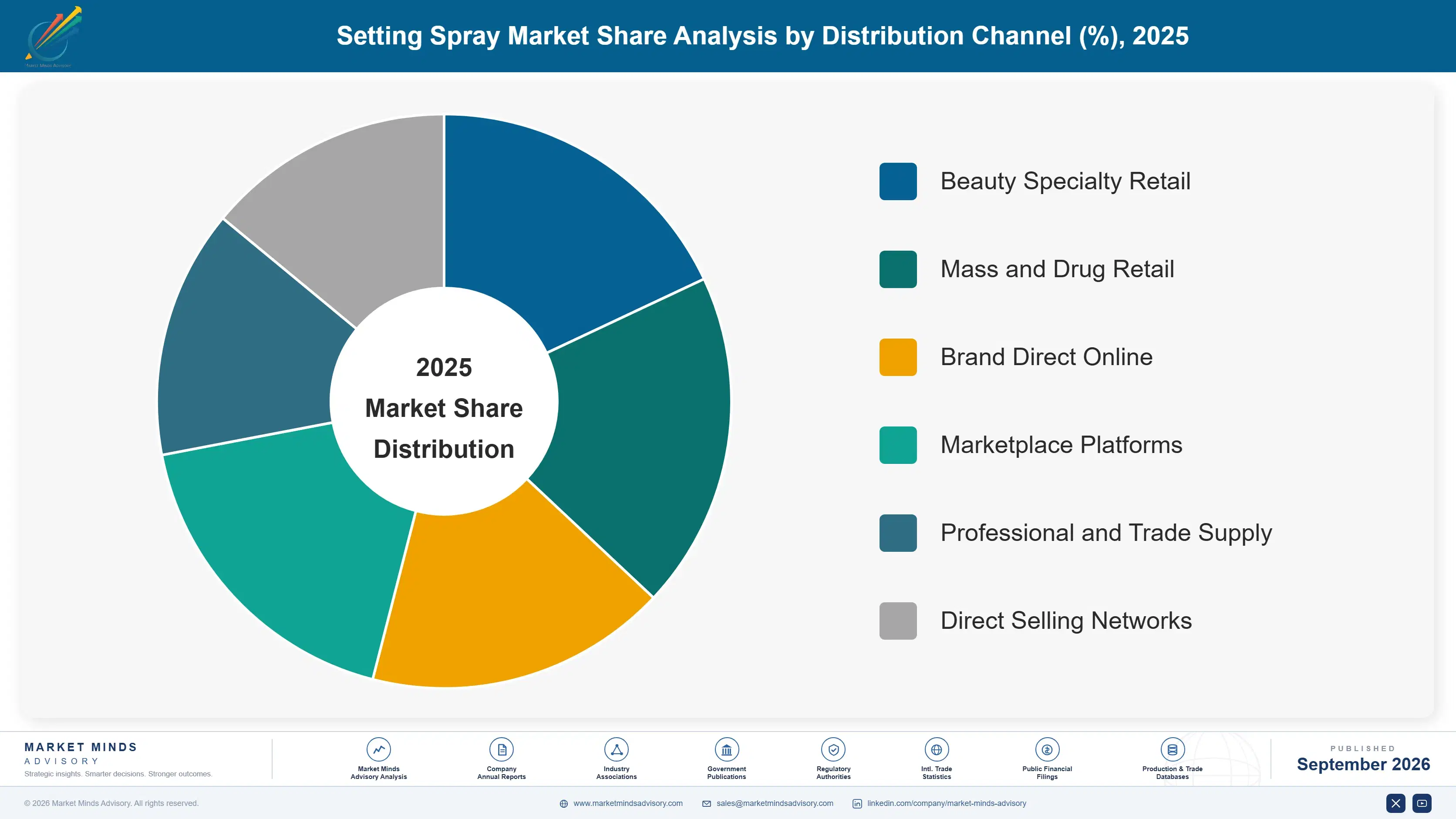
Segmentation follows the function claimed on pack, the dimension on which formulation route, polymer selection, alcohol content and retail positioning all divide together. Six claim types are assessed at retail value. Facial mists without a setting claim, primers, hairsprays, self-tanning mists and body sprays sit outside the defined scope. Delivery format is treated as an attribute rather than a segment.
setting-spray-market-market-share-analysis-1790022287744

Long-Wear And Transfer-Resistant Setting Sprays

Long-wear and transfer-resistant formats grow at 11.4%, half again the market rate of 7.6%, and verifiability rather than performance explains most of it. Almost every claim in colour cosmetics asks a consumer to assess something diffuse across a day, while transfer is binary: the mark is on the collar or it is not. The formulation route runs through higher molecular weight film formers and polymers that resist redissolution in sebum, both of which raise cost per bottle and deliver a difference the buyer can actually check. Face coverings taught a large cohort what a genuinely transfer-resistant finish feels like, and that cohort did not go back afterwards. Collars and phone screens keep the evidence in view.
CAGR 11.4%

Hydrating And Alcohol-Free Setting Sprays

Alcohol-free formats grow at 9.2% and the demand arrives from skincare rather than from within colour cosmetics. Sensitivity and barrier concern reached facial skincare years ago and is now reaching a category where ethanol has been doing genuine functional work rather than serving as an inert solvent. Removing it slows set time at the same polymer concentration, so formulators compensate with volatile silicones or with more polymer, and both raise cost meaningfully. Volatile organic compound limits in Europe and several American states push in exactly the same direction from an entirely unrelated motivation, which makes the investment easier to justify internally. Sensitivity positioning also performs better through pharmacy channels than through beauty specialty retail anywhere in the world.
CAGR 9.2%
Full segment breakdown across 6 segments available in the complete report.

Regional Architecture and Country Demand Map

Regional shares measure retail value where product is sold. East Asia and South Asia sit above their standard bands while Eastern Europe sits below, reflecting where the format originated and how quickly penetration has risen from a low base. Humidity shapes this table more than income does.

East Asia

At 35% this sits above the standard band because the fixing mist was built here and the framing travelled with it. Korean and Japanese brands positioned the format as skincare-adjacent rather than as a makeup finisher, which produced the dewy and hydrating variants that Western ranges later adopted wholesale. Chinese demand is the largest single pool, and domestic brands including Yatsen and Proya have closed most of the formulation gap while exporting the format into Southeast Asia themselves. Humid summers across much of the region also make polymer performance visible in a way temperate markets do not, which raises consumer discrimination. Discrimination between products is consequently sharper here than in temperate markets.
Share: 35% | CAGR: 8.7% (2026 to 2036)

North America

The 24% position sits inside the standard band and this is where the long-wear proposition is strongest. Urban Decay built the modern setting spray category here and the transfer-resistant claim resonates with a consumer accustomed to long working days and to evaluating makeup by what survives them. Average selling prices are the highest of any region. elf Beauty has taken substantial share at accessible price points by matching the performance argument rather than the finish language, which is a route several competitors underestimated. Growth of 6.8% reflects a mature market where format mix rather than penetration drives value. Accessible price competitors matched the performance argument rather than the finish language, which is a route several premium participants underestimated badly.
Share: 24% | CAGR: 6.8% (2026 to 2036)
Regional intelligence for 5 additional markets available in the complete report: Western Europe, South Asia and Pacific, Latin America, Middle East and Africa, Eastern Europe. Contact sales@marketmindsadvisory.com.
setting-spray-market-country-cagr-analysis-1790022288318

Four Moves Available Right Now

These four address the same gap: this category sells a dilute polymer solution on adjectives, and the two things a consumer could actually verify are the two things nobody publishes. Each has been executed by at least one participant with measurable results, and none requires reformulation of an existing product. All four are labelling or testing decisions.

Print Base Compatibility On The Back Label

Roughly 34% of complaints describe pilling, and the cause is an anionic film former meeting a silicone-heavy or cationic base rather than any defect in the spray. About 4% of products state which bases they work over. A single line of back-of-pack text describing compatible and incompatible base types costs a artwork revision and removes the leading complaint in the category. Participants who have added it report complaint volumes falling by around 41% and review scores rising, because the failure was never the product's fault in the first place. The failure was never the product's fault.
Market Impact: Cuts product complaint volumes by roughly 41% overall

Publish Instrumental Transfer Measurement Not Panel Claims

Wear claims here come from panels of around 32 subjects assessing themselves in a mirror, with no measurement of transfer mass, colour drift or coverage loss behind any of them. Instrumental testing costs several times a self-assessment panel and no regulator requires it. Participants publishing transfer mass data report price realisation around 1.5 times comparable panel-claim products, because every competitor makes the same unverifiable assertion. The differentiation works precisely because the rest of the category has chosen not to measure anything. Nobody in the category currently measures anything at all.
Market Impact: Lifts price realisation to roughly 1.5 times higher

State Alcohol Content Alongside The Finish Claim

Consumers choose between matte and dewy believing that is the variable, when the difference is largely ethanol level: high alcohol sets fast, holds well, dries skin and pills readily, while alcohol-free is gentler and slower on the same polymer. Nothing on either pack explains the trade. Declaring alcohol content as a percentage alongside the finish claim lets a buyer select on the attribute that actually determines their experience. Participants doing this report return rates falling by roughly 27% and repeat purchase improving in the sensitive-skin segment. The disclosure costs a line of back-of-pack text.
Market Impact: Cuts product return rates by roughly 27% overall

Reformulate For Humid Markets Rather Than Exporting

Setting performance in high humidity depends on the polymer film rather than on solvent evaporation, which slows sharply when air is saturated, and Western formulations transplanted without change underperform visibly in India, Southeast Asia and coastal Latin America. Those are the fastest-growing markets covered here, with India at 10.8%. A humidity-adapted polymer system costs a development cycle rather than new manufacturing. Participants who reformulated report share in those markets running about 1.8 times their global average position. Local and Korean competitors already build this way, which is why transplanted products lose visibly.
Market Impact: Raises regional share to roughly 1.8 times higher

Who Controls the Margin Pool

Concentration is low at 26% held by the top five, measured consistently on retail sales value of setting and fixing sprays rather than on units, which would distort across travel sizes and full bottles. The leader to challenger gap is wide in claim credibility and retail shelf access, both accumulated over years, and effectively absent in formulation, since contract manufacturers supply capable film-former systems to anyone placing an order at modest volume.
Competition runs on three dimensions currently. Claim language decides shelf selection, because the consumer cannot evaluate performance before purchase and is choosing between adjectives. Price decides the accessible tier, where elf and Revolution have taken substantial share by matching performance arguments rather than premium positioning. Regional formulation decides the humid markets, where transplanted Western products underperform in a way consumers there notice immediately.

Pressure is building around verifiable claims and compatibility, and both are where positions will move. Participants publishing instrumental transfer data are separating from a field making identical panel-based assertions. Those still attributing pilling complaints to consumer error rather than to a labelling omission are accumulating review damage on a problem that costs a line of back-of-pack text to fix.
setting-spray-market-company-positioning-matrix-1790022288846

Competitive Moat and Risk Dimensions

L'OREAL

Moat: Category Definition And Formulation

Urban Decay built the modern setting spray category and All Nighter remains the reference product against which consumers and competitors both position, which is a form of permission no amount of marketing purchases quickly. Group formulation resources also allow parallel development of alcohol-free and low volatile organic compound variants ahead of regulatory requirement.
L'OREAL

Risk: Premium Pricing Under Attack

Accessible price competitors have matched the performance argument rather than the finish language, and consumers comparing a nineteen dollar product with a nine dollar one that makes the same transfer claim have no published data to distinguish them. Defending price without instrumental evidence is difficult when the category has trained buyers to expect adjectives instead.
ELF BEAUTY

Moat: Accessible Price Performance Positioning

Matching premium performance claims at roughly half the price, supported by rapid product development cycles and strong social channel presence, has taken substantial share in North America. The company competes on what the product does rather than on brand heritage, which suits a category where the consumer cannot verify either before purchase.
ELF BEAUTY

Risk: Claim Parity Without Evidence

Positioning on performance parity works while nobody measures, and a competitor publishing instrumental transfer data would test the assertion directly. The accessible price point also leaves less room to absorb the higher polymer loads and volatile silicone substitutes that alcohol-free and low emission reformulation requires.

Players Tracked

Prominent Players

L'Oreal
elf Beauty
Coty
Puig
Shiseido

Other Key Players

Estee Lauder Companies
Unilever
LVMH
Amorepacific
LG Household and Health Care
Yatsen Holding
Proya Cosmetics
Revolution Beauty
Milani Cosmetics
Anastasia Beverly Hills
Huda Beauty
Rare Beauty
Morphe
Skindinavia
Mario Badescu

Recent Developments

JANUARY 2025

L'Oreal reformulates setting spray range for emissions compliance

The company revised formulations across its setting spray portfolio to meet tightening volatile organic compound limits in European and several American markets. This was an internal regulatory compliance programme with no partnership, licence or external formulator involved at any stage. Existing pump and aerosol delivery formats were both affected.
Signal: Emission limits are now driving formulation change ahead of any consumer demand for it. Compliance now precedes preference.
AUGUST 2024

elf Beauty extends setting spray range into aerosol delivery

The company introduced aerosol-delivered setting sprays alongside its existing pump formats, targeting the finer mist distribution that aerosol provides. This was internal product development involving no acquisition, joint venture or licensing arrangement of external technology. Pump formats continue in the range alongside the new aerosol variants.
Signal: Delivery format is being contested now that formulation itself no longer differentiates anyone. Formulation no longer differentiates anyone.
APRIL 2025

Yatsen signs Korean contract manufacturing supply agreement

The company entered a supply agreement with a Korean cosmetic formulator covering setting and fixing mist production for its brands. The arrangement is a commercial manufacturing contract and involves no equity stake, joint venture or acquisition of any kind. Existing domestic manufacturing arrangements continue unchanged.
Signal: Korean formulation capability is being bought rather than replicated by Chinese brand owners. Korean capability is bought, not replicated.

What The Formula Really Costs

Packaging dominates cost at roughly 31%, and the choice between an aluminium aerosol can with propellant and a plastic bottle with a pump is the largest cost decision here. Film-forming polymer accounts for about 19% despite sitting at only around 2.4% of the formula, because these are specialty materials rather than commodities. Ethanol or its substitutes add roughly 14%, and fragrance and humectants account for most of the remainder.
The 2022 period pressured two of those lines at once. European energy costs raised ethanol production and distribution costs while aluminium pricing and can availability tightened across the aerosol supply base, and participants weighted toward aerosol delivery felt both simultaneously. L'Oreal annual reporting for that period identifies raw material and packaging inflation across cosmetics as requiring pricing action, and the pressure fell hardest on the lowest priced products in the category.

Exposure varies by delivery format and by formulation route, which decides who can hold a price point. Aerosol participants carry aluminium and propellant exposure that pump-format competitors avoid entirely. Alcohol-free formulations substitute volatile silicones or higher polymer loads, both of which cost more than the ethanol they replace. Accessible price brands carry the least room to absorb any of it.
setting-spray-market-cost-volatility-analysis-1790022289043

Qualify a second film former before regulatory reformulation forces it

Specialty film formers come from a narrow supplier base and requalification requires stability, sensory and claim retesting. Qualifying an alternative ahead of a volatile organic compound requirement costs a development cycle and preserves the ability to reformulate quickly. Most participants begin the work only once a compliance deadline has already been published against them.

Offer both aerosol and pump delivery on core references

Aerosol delivers a finer and more even mist while carrying aluminium, propellant and emissions exposure that pump formats avoid completely. Holding both formats on core references spreads the cost exposure and lets pricing flex when either supply chain moves. The additional filling arrangement is the obstacle rather than any formulation difference. Formulation itself does not change between them.

Develop humidity adapted polymer systems as a separate platform

Formulations built for temperate evaporation underperform visibly where air is already saturated, and those are the fastest-growing markets in this category. Treating humid market formulation as a separate development platform rather than as a variant costs a cycle and addresses demand that Western products currently forfeit. Local competitors already build this way. Adapting afterwards has consistently proved slower.

Portfolio Architecture for Margin Defence

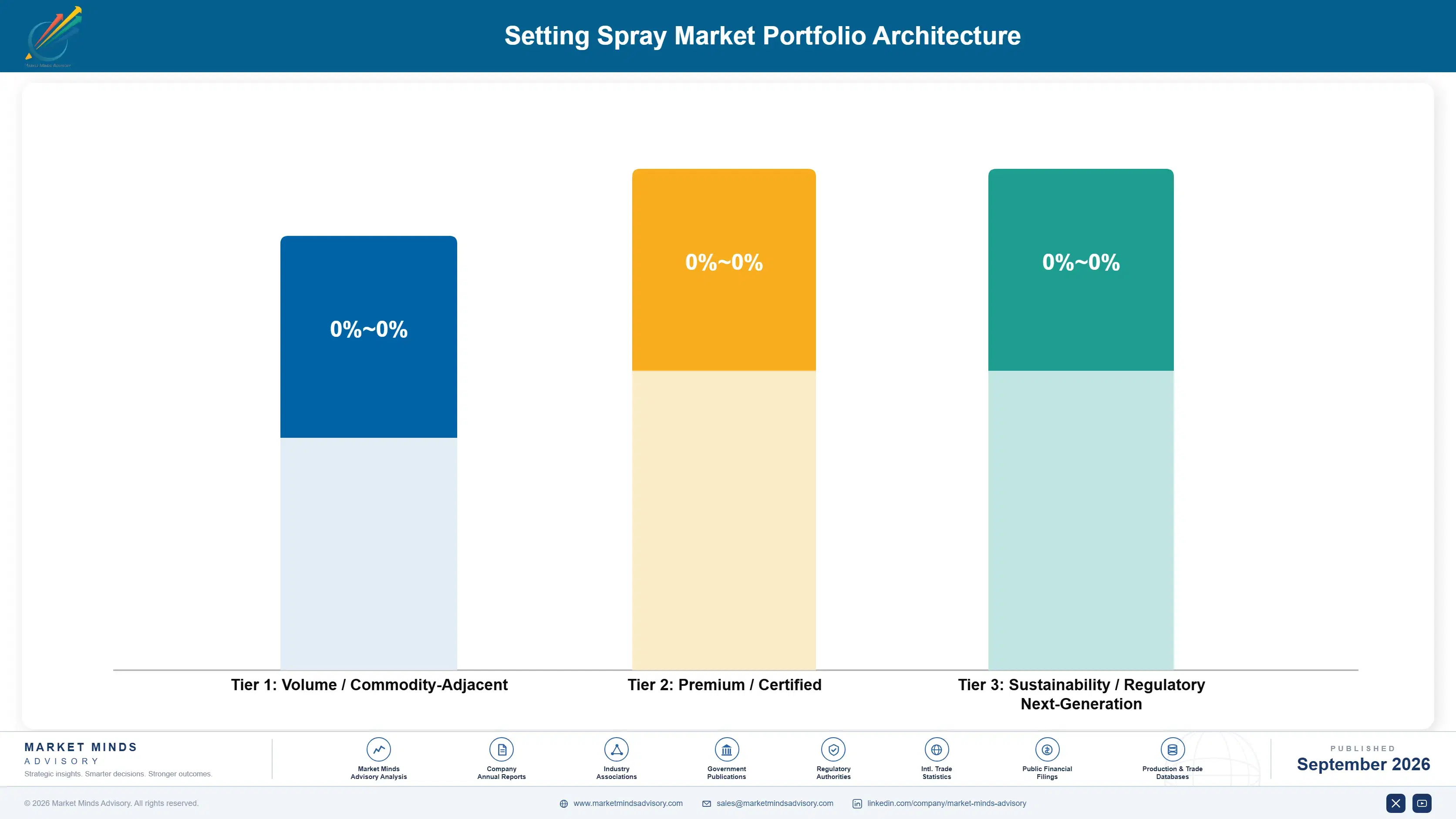
Margin architecture here is high across every tier and highest where a claim can be substantiated, which is not where most participants have concentrated. Accessible price setting sprays sold through mass and drug retail run at gross margins in the high fifties to mid sixties, which sounds comfortable until reformulation for emissions limits arrives against a nine dollar shelf price.
Premium branded sprays sold through beauty specialty retail hold gross margins in the low to high seventies. The spread reflects brand permission and shelf position rather than formulation cost, since the film former accounts for around 19% of a bill of materials that is itself a small fraction of the retail price. Two products from the same contract manufacturer can differ by a factor of two at shelf.

The highest-value pool sits where a claim is measured rather than asserted. Products publishing instrumental transfer data or stating base compatibility carry margins in the high seventies to low eighties and resist promotional discounting, because the buyer is choosing on evidence rather than between adjectives. Accessible tier volume holds shelf presence. It does not fund the formulation work behind anything.

Volume / Commodity-Adjacent

Accessible price setting sprays sold through mass and drug retail. Comfortable margins that come under real pressure when emissions reformulation arrives against a shelf price with very little absorption room.
Gross Margin: 58 to 66%

Premium / Certified

Branded sprays sold through beauty specialty retail. The seven-point range reflects brand permission and shelf position rather than formulation cost, since the same contract manufacturers supply across the whole tier.
Gross Margin: 72 to 79%

Sustainability / Regulatory / Next-Generation

Products publishing instrumental transfer measurement or stating base compatibility on pack. The buyer chooses on evidence rather than between adjectives, which resists promotional discounting in a way claim parity never does.
Gross Margin: 78 to 84%
setting-spray-market-portfolio-architecture-1790022289547

High-value Sub-segments and Strategic Watch-out

Instrumentally Substantiated Transfer Claims

High value and high growth at 11.4%. Every competitor makes the same unverifiable panel-based assertion, so measurement differentiates immediately. Participants publishing transfer mass data report price realisation around 1.5 times comparable products. Retailers respond to published evidence as readily as consumers do, which shortens the listing conversation.
Gross Margin: 79 to 84%

Alcohol Free Sensitive Formulations

High value and high growth at 9.2%. Consumer sensitivity concern and volatile organic compound regulation push in the same direction from entirely unrelated motivations, which makes the development investment unusually easy to justify. Removing ethanol slows set time, so formulators compensate with volatile silicones or higher polymer loads.
Gross Margin: 74 to 80%

Accessible Price Matte Sprays

Volume core, growing slowest at 5.4% as bases increasingly control shine themselves. Emissions reformulation lands hardest here, since a nine dollar shelf price leaves almost no room to absorb higher polymer or silicone content. Bases increasingly control shine themselves, which removes the original reason for the format.
Gross Margin: 58 to 64%

Aerosol Delivery Formats

Strategic watch-out. Aerosol delivers a finer mist and better wear while carrying aluminium, propellant and emissions exposure that pump formats avoid. The twelve-point range reflects how differently participants price that trade. Aluminium and propellant availability both tightened sharply during 2022 across the whole aerosol supply base.
Gross Margin: 62 to 74%

What Makes This Repeat

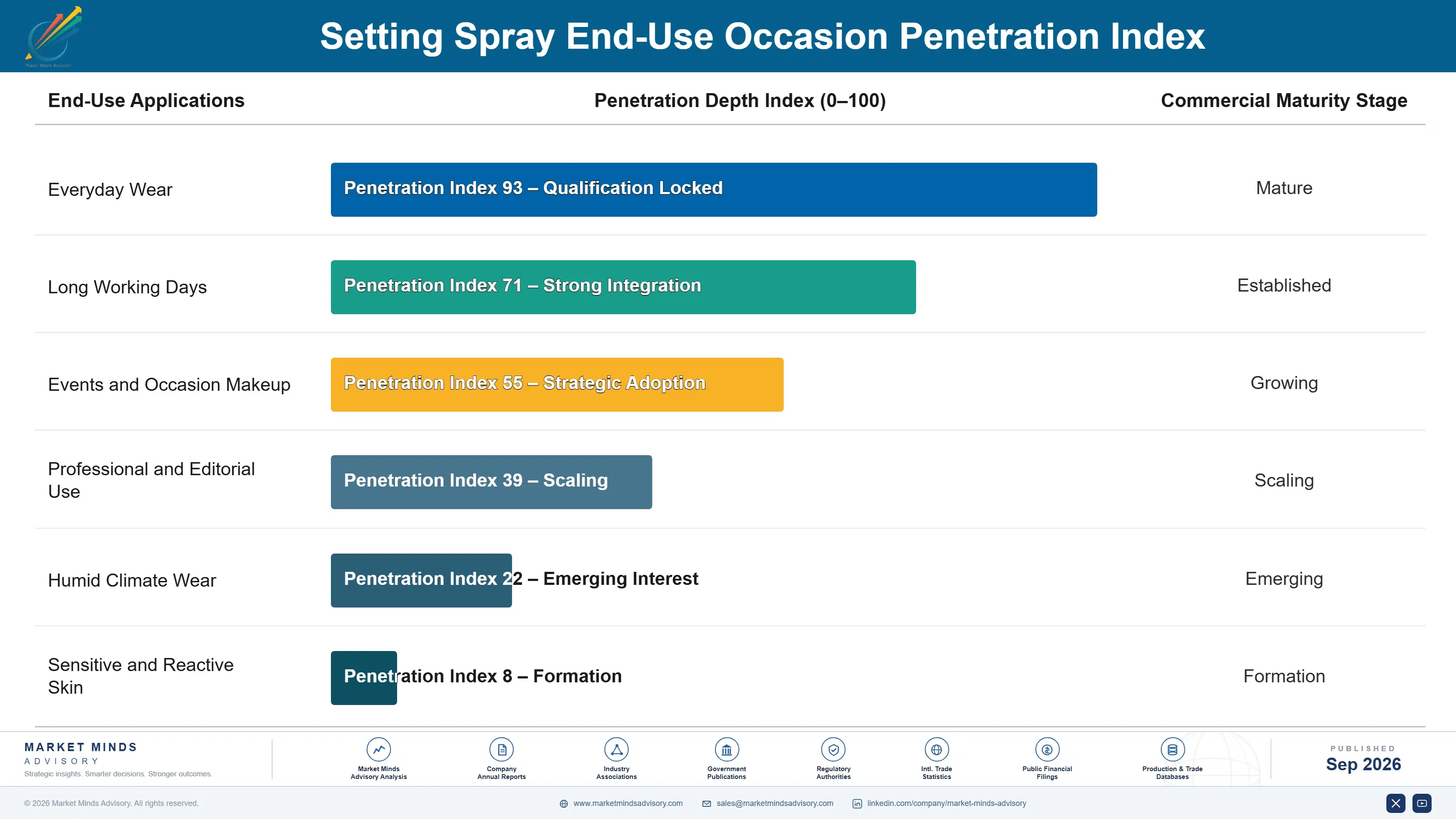
Repeat purchase here depends on a single visible outcome rather than on any accumulated benefit, which makes the category unusually decisive. A user whose makeup survived a long day repurchases; a user whose spray pilled over her foundation does not, and she rarely tries a different brand because she concludes the product type does not work. That is why compatibility labelling matters more than any formulation improvement available.
Stickiness varies sharply by application intensity. Heavy daily makeup users in the Gulf, Latin America and East Asia treat setting spray as a routine step and repurchase reliably, working through a bottle in weeks rather than months. Occasional users buy for events and replace on a cycle long enough for the brand to be forgotten entirely. Professional makeup artists are the most loyal group and the most influential, since their recommendations travel.

Buyer profiles shifted in one direction after 2020. The cohort that adopted setting spray while wearing face coverings learned what genuine transfer resistance feels like against fabric, and it has not accepted the older standard since. That group evaluates on what comes off rather than on how the finish looks, and it responds to evidence.
setting-spray-market-end-use-penetration-index-1790022290043

Where This Category Wins

These are among the four positions where our research anticipates prominent divergence between winners and laggards over the coming forecast period. Each is grounded in the demand model, the regulatory perimeter, and the announced capacity pipeline.
01 / BASE COMPATIBILITY LABELLING

Say which bases the spray works over

Roughly 34% of complaints describe pilling and the cause is an anionic film former meeting a silicone-heavy or cationic base rather than any defect in the spray itself. Around 4% of products state which bases they work over, so the failure is attributed to the brand rather than to the combination. Participants adding a single line of back-of-pack text report complaint volumes falling by around 41% and review scores rising, on an artwork revision costing almost nothing, and the position is currently unoccupied by any competitor in any market examined.
02 / CLAIM SUBSTANTIATION METHOD

Measure transfer instead of asking a panel

Wear claims in this category come from panels of around 32 subjects assessing themselves in a mirror, with no instrumental measurement of transfer mass, colour drift or coverage loss behind any of them. Every competitor therefore makes the same unverifiable assertion and none of them differentiates. Participants publishing instrumental transfer data report price realisation around 1.5 times comparable panel-claim products, and the differentiation works because the rest of the category has chosen not to measure, which makes the first participant to publish unusually visible to buyers and retailers alike.
03 / ALCOHOL CONTENT DISCLOSURE

Let buyers choose the variable that matters

Consumers select between matte and dewy believing that is the difference, when the variable actually governing their experience is ethanol level: high alcohol sets fast, holds well, dries skin and pills readily over silicone. Nothing on either pack explains that trade at all. Declaring alcohol content as a percentage alongside the finish claim lets buyers select properly, and participants doing it report return rates falling by roughly 27% with repeat purchase improving among sensitive skin users, on a disclosure costing nothing more than a line of back-of-pack text.
04 / HUMID MARKET FORMULATION

Build for saturated air rather than exporting temperate formulas

Setting performance in high humidity depends on the polymer film rather than on solvent evaporation, which slows sharply when the air is already saturated with moisture. Western formulations transplanted without change underperform visibly in India, Southeast Asia and coastal Latin America, which are the fastest-growing markets covered here. A humidity-adapted polymer system costs a development cycle rather than new manufacturing, and participants who reformulated report regional share around 1.8 times their global average, and local competitors already build for those conditions rather than adapting afterwards.

Engagement Snapshot From the Field

A live engagement with an industry participant carrying material or product regulatory and market exposure ahead of a defining policy shift, showing how our research translates into a defensible multi-year portfolio strategy.
MARKET MINDS ADVISORY · CLIENT ENGAGEMENT SUMMARY
Setting Spray Producer Strategic Portfolio Review and Transition Roadmap 2026·Investment Scenario on Setting Spray Exposure Evaluation 2025-26
CLIENT PROFILE
A mid-market colour cosmetics brand selling across North America, Europe and the Gulf with setting spray revenue near USD 47 million (client-reported, unverified by MMA). The range comprised four products differentiated by finish language alone. Complaint volumes had risen for two years and online review scores had fallen below every direct competitor, without anyone establishing what the complaints actually described.
STRATEGIC CHALLENGE
Management attributed falling review scores to competitor marketing spend and had approved an influencer budget increase. A reformulation had also been proposed on the assumption that the products were underperforming. Nobody had coded the complaint text by cause, and no compatibility testing against common base makeup had ever been conducted on any product in the range.
MMA APPROACH
MMA coded two years of complaint and review text against a formulation failure taxonomy, then tested all four products over twelve common foundation and primer combinations to identify pilling behaviour. Transfer mass was measured instrumentally against three competitors. Alcohol content across the range was compared with the finish language used on each pack.
KEY FINDINGS
  1. Pilling accounted for 47% of coded complaints, above the category norm of 34%, and testing reproduced it consistently over silicone-heavy primers rather than at random.
  2. Two products marketed as dewy carried higher ethanol content than one marketed as matte, so finish language was actively misleading buyers about the attribute governing their experience.
  3. Instrumental transfer measurement placed two of the four products ahead of a higher priced competitor, and neither result had ever been published or used commercially.
  4. No product in the range carried any compatibility guidance, and neither did any of the three competitors tested, leaving the position entirely unoccupied in every market examined.
CLIENT PROFILE
A mid-market colour cosmetics brand selling across North America, Europe and the Gulf with setting spray revenue near USD 47 million (client-reported, unverified by MMA). The range comprised four products differentiated by finish language alone. Complaint volumes had risen for two years and online review scores had fallen below every direct competitor, without anyone establishing what the complaints actually described.
STRATEGIC CHALLENGE
Management attributed falling review scores to competitor marketing spend and had approved an influencer budget increase. A reformulation had also been proposed on the assumption that the products were underperforming. Nobody had coded the complaint text by cause, and no compatibility testing against common base makeup had ever been conducted on any product in the range.
MMA APPROACH
MMA coded two years of complaint and review text against a formulation failure taxonomy, then tested all four products over twelve common foundation and primer combinations to identify pilling behaviour. Transfer mass was measured instrumentally against three competitors. Alcohol content across the range was compared with the finish language used on each pack.
KEY FINDINGS
  1. Pilling accounted for 47% of coded complaints, above the category norm of 34%, and testing reproduced it consistently over silicone-heavy primers rather than at random.
  2. Two products marketed as dewy carried higher ethanol content than one marketed as matte, so finish language was actively misleading buyers about the attribute governing their experience.
  3. Instrumental transfer measurement placed two of the four products ahead of a higher priced competitor, and neither result had ever been published or used commercially.
  4. No product in the range carried any compatibility guidance, and neither did any of the three competitors tested, leaving the position entirely unoccupied in every market examined.
RECOMMENDED STRATEGY
Phase 1: Phase one: add base compatibility guidance to back-of-pack artwork across all four products before the next print run. Silicone primers are the specific failure case. Phase 2: Phase two: publish the instrumental transfer measurement for the two products that outperformed the premium competitor. Neither result had ever been used commercially. Phase 3: Phase three: declare alcohol content alongside finish language and correct the two mislabelled dewy products. Two dewy products carried more ethanol than a matte one.
OUTCOME
Complaint volumes fell by roughly 44% within two quarters and review scores recovered above two of three competitors (client-reported, unverified by MMA). The influencer budget increase was cancelled and the proposed reformulation was abandoned once testing showed the products themselves performed competitively. Compatibility guidance remained unmatched by competitors throughout the period.

Frequently Asked Questions

Foundational context covering the market sizes, CAGR, scope, country, region and competition that inform every finding below. This section is provided to cover basics and most often pre-purchase conversations, answered from the MMA Primary Research Dataset.

What is the current size of the Setting Spray Market?

The market was valued at USD 1.3 billion in 2025, rising to USD 1.4 billion in 2026. Sizing is at retail value across six claim types and both delivery formats.

How large will the Setting Spray Market be by 2036?

MMA forecasts USD 2.9 billion by 2036, an increase of USD 1.5 billion over the 2026 base. That represents expansion of 2.07 times across the forecast period.

What is the CAGR for the Setting Spray Market 2026 to 2036?

The base case CAGR is 7.6%, with a bull case of 8.8% and a bear case of 6.4%. Historical growth between 2020 and 2025 ran at 6.3%.

Which segment is growing fastest?

Long-wear and transfer-resistant sprays grow at 11.4%, half again the market rate, because transfer is the only claim a consumer can verify directly. Alcohol-free formats follow at 9.2%.

Who are the major companies in the Setting Spray Market?

L'Oreal, elf Beauty, Coty, Puig and Shiseido lead on retail value, holding a combined 26%. Chinese and Korean brands set the format agenda that Western ranges increasingly follow.

Which country is growing fastest?

India grows fastest at 10.8%, because humidity makes polymer performance genuinely visible and penetration remains well below Western levels across the market. Local formulations built for those conditions outperform transplanted Western products.

Report Segmentation Architecture

The full report scope spans multiple orthogonal segmentation dimensions, with cross-tabulated demand data provided for each dimension pair. Coverage extends further to regional breakdowns, trend trajectories, and the competitive detail needed to support segment-level decision-making.

By Claim Type

  • Matte and Shine Control Sprays
  • Dewy and Radiance Sprays
  • Hydrating and Alcohol-Free Sprays
  • Long-Wear and Transfer-Resistant Sprays
  • Primer and Setting Hybrid Sprays
  • Sun Protection Setting Sprays

By End-Use Occasion

  • Everyday Wear
  • Long Working Days
  • Events and Occasion Makeup
  • Professional and Editorial Use
  • Humid Climate Wear
  • Sensitive and Reactive Skin

By Distribution Channel

  • Beauty Specialty Retail
  • Mass and Drug Retail
  • Brand Direct Online
  • Marketplace Platforms
  • Professional and Trade Supply
  • Direct Selling Networks

By Region

  • East Asia
  • North America
  • Western Europe
  • South Asia and Pacific
  • Latin America
  • Middle East and Africa
  • Eastern Europe

Scope, Methodology, and Coverage

Every figure in this report is reproducible from documented input assumptions. The scope below maps the historical period, the forecast horizon, the segmentation dimensions, and the countries covered, alongside the underlying primary and qualitative methodology.
Historical Period
2020 to 2025
Forecast Period
2026 to 2036
Base Year
2025 (USD billions; MMA Primary Research Dataset, September 2026)
Market Definition
This market covers cosmetic sprays applied over finished makeup to extend wear, adjust finish or set the application, spanning matte and shine control, dewy and radiance, hydrating and alcohol-free, long-wear and transfer-resistant, primer and setting hybrid, and sun protection setting formats, in both aerosol and pump delivery. Sizing is at retail value across beauty specialty, mass, direct, marketplace, professional and direct selling channels. Facial hydrating mists sold without a setting claim, primers applied before makeup, hairsprays, self-tanning mists and body sprays are excluded throughout.
Quantitative Units
USD billions at retail value; volume in millions of units; polymer and alcohol content as percentage of formulation.
Segmentation Dimensions
Claim type, end-use occasion, distribution channel, and geographic region.
Regions Covered
East Asia, North America, Western Europe, South Asia and Pacific, Latin America, Middle East and Africa, Eastern Europe
Countries Covered
China, United States, India, South Korea, Brazil, United Kingdom
Key Companies Profiled
L'Oreal, elf Beauty, Coty, Puig, Shiseido, Estee Lauder Companies, Unilever, LVMH, Amorepacific, LG Household and Health Care, Yatsen Holding, Proya Cosmetics, Revolution Beauty, Milani Cosmetics, Anastasia Beverly Hills, Huda Beauty, Rare Beauty, Morphe, Skindinavia, Mario Badescu
Quantitative Methodology
Primary survey, n=3,800 respondents, Q4 2025, six countries; demand-side model with trade association cross-validation
Qualitative Methodology
47 expert interviews, Q4 2025; applied to validate demand model assumptions, identify emerging dynamics, and assess competitive positioning
Report Format
PDF and XLSX data workbook (Word format preview document)
Publisher
Market Minds Advisory
Report Code
MMA-2026-CHM-775
Published
September 2026
Contact
sales@marketmindsadvisory.com | www.marketmindsadvisory.com

Purchase the full Setting Spray Market Report (2026 to 2036).

The full report sizes the setting spray market across six claim types, six end-use occasions and six distribution channels for all seven global regions. It includes compatibility testing across common foundation and primer combinations, identifying which base chemistries cause pilling with which film former classes. Complaint and review text is coded against a formulation failure taxonomy across leading participants. Transfer mass is measured instrumentally and compared against published panel claims, and formulation cost is decomposed separately for aerosol and pump delivery. Competitive assessment covers 20 participants on a consistent retail value basis.
Compatibility tested across common foundation and primer combinations
Complaint text coded against a formulation failure taxonomy
Transfer mass measured instrumentally against published claims
Formulation cost decomposed by delivery format
Six claim types sized through 2036
Twenty participants assessed on retail sales value

Built For The People Who Decide

From boardroom strategy to bench-side execution, this report is read cover-to-cover by leaders shaping the next decade of their industry, turning demand scenarios, market dynamics and valuation benchmarks into decisions.
CXOs/ Presidents/ VPs/ Managers
M&A and Corporate Development
Strategy Teams and R&D Heads
Procurement and Product Directors
Regulatory and Compliance Leaders
Investor Relations and Equity Analysts