Market Minds Advisory
Light Setting Spray Market

Light Setting Spray Market: Light Setting Spray Market. Lightweight Hold as Category Disruptor

Haircare brands race to reformulate away from flaking, stiff-hold aerosols as buyers demand lightweight, touchable finishes, while clean-label propellant reformulation and humidity-resistance claims reshape which setting sprays retailers will stock.

Lead Analyst

Published

September 2026

Make Smarter Decisions with Customized Research Insights

Request a free sample report and evaluate market opportunities, growth trends, and competitive dynamics relevant to your business needs.

2025 MARKET VALUE$2.1BMarket Size 2025
2036 FORECAST VALUE$5.2BBase Case , 2026 to 2036
CAGR 2026 TO 20368.7 %Bull 10.0% / Bear 7.4%
INCREMENTAL OPPORTUNITY$3.0BNet 10- year value creation
EXPANSION MULTIPLE2.30x2036 value over 2026 base
Strategic Levers
M&A Pipeline
Regional Outlook
Country Rankings
Competitive Intelligence
Segmental Deep-dive
Call-Us : 91 93563 13602

Executive Snapshot and Market Trajectory.

Light setting spray has emerged as the preferred alternative to traditional stiff-hold hairspray, as buyers increasingly prioritize touchable, natural-looking hold over the crunchy, visible finish older formulations left behind across nearly every hair type, styling occasion, price tier, and climate condition available today across the entire world and beyond.
Humidity-resistant and flexible-hold formulations are pulling disproportionate revenue growth, concentrated among younger buyers in East Asian and North American markets who research ingredient transparency before purchase through dedicated haircare community platforms and stylist-endorsed content nationwide and internationally. Brands investing in flake-free, buildup-resistant formulation science are capturing outsized loyalty among buyers who previously avoided hairspray entirely due to stiffness complaints and visible residue concerns across most hair textures, climates, and styling routines.
Mass haircare conglomerates and prestige salon-professional brands compete on distinctly different terms, as clean-label propellant reformulation and humidity-resistance testing increasingly determine which brands can credibly claim all-day hold without buildup or residue across every major retail channel and price tier available nationwide. Independent clean-beauty brands increasingly partner with contract formulation labs to generate propellant-free alternatives larger conglomerates historically monopolized through in-house expertise and testing infrastructure.
Market Definition
The light setting spray market covers lightweight, flexible-hold hairsprays formulated for touchable finish and humidity resistance, sold through mass, prestige, and salon-professional channels. It excludes traditional stiff-hold aerosol hairsprays and non-spray styling products such as gels, mousses, and creams.
Base Year Value
$2.1B in 2025 (MMA Primary Research Dataset, September 2026)
Forecast Period
2026 to 2036, eleven discrete annual values
CAGR
8.7% base case. Bull 10.0%. Bear 7.4%.
Fastest Growth Segment
Humidity-Resistant Sprays: 12.4% CAGR
Fastest Growth Country
South Korea: 11.1% CAGR
Fastest Growth Region
South Asia and Pacific: 10.7% CAGR
Largest Region
North America: 28% of 2025 global value
Market Leaders
L'Oreal, Unilever, Henkel, Amika, Olaplex Holdings. Source: MMA Analysis based on company annual reports.
Primary Survey
n=3,800 procurement and R&D decision-makers, Q4 2025, six countries
Methodology
Demand-side build-up, cross-validated against public data, 47 expert interviews

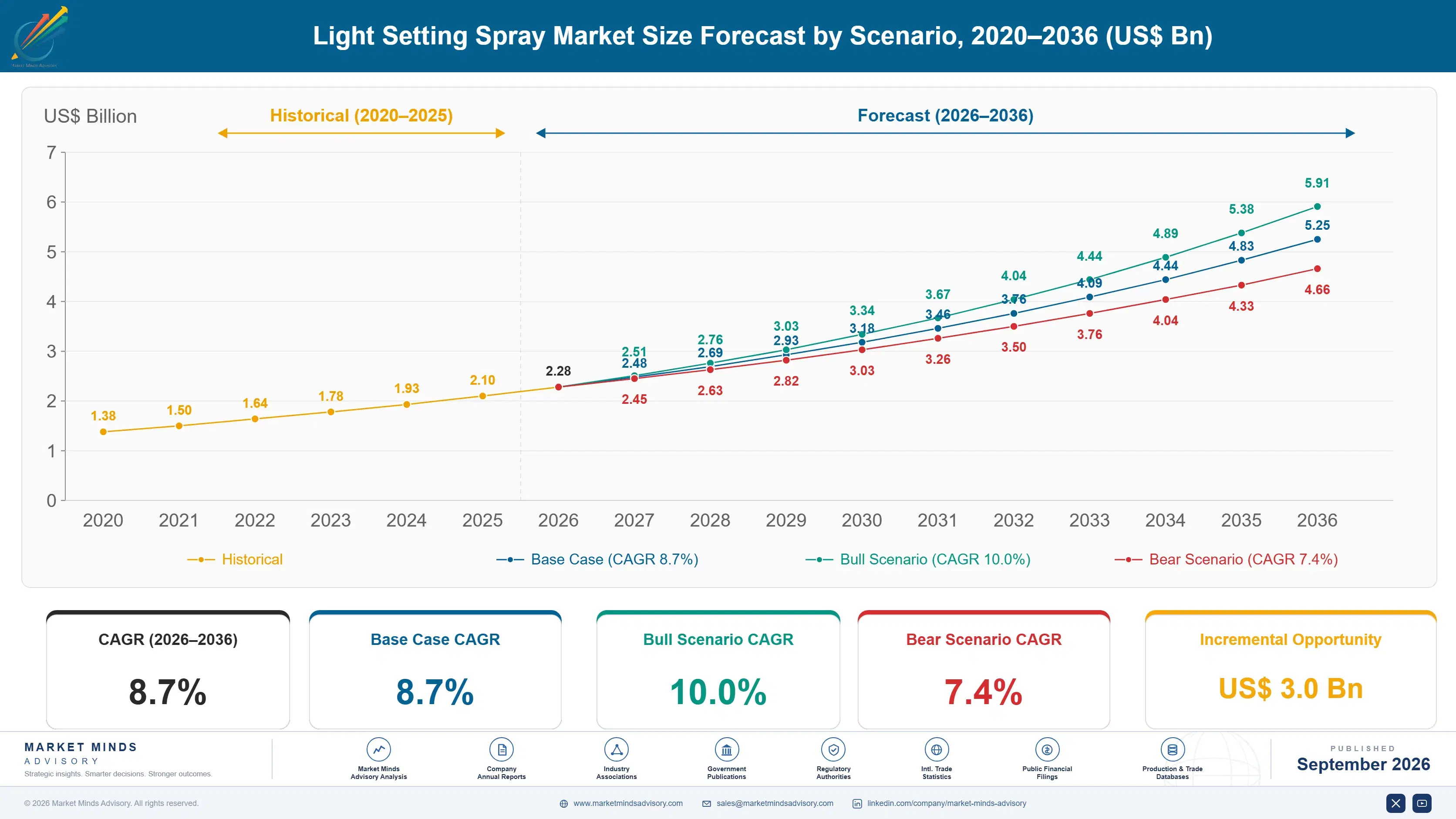
Light Setting Spray Market Forecast Scenarios

light-setting-spray-market-size-forecast-scenario-1790015548179
Between 2020 and 2025, light setting spray demand grew steadily as buyers shifted away from stiff-hold aerosols, accelerating sharply once mass and prestige brands launched flake-free, humidity-resistant formulations addressing longstanding buyer complaints about older hairspray textures and residue across most retail price tiers and channels worldwide, with East Asian markets leading early adoption well ahead of most Western peers.
The base case rests on three commercial mechanisms operating together: formulation science eliminating flaking and buildup that historically limited hairspray appeal, salon-professional brands extending flexible-hold products into mass retail channels, and East Asian buyers sustaining premium repeat-purchase rates for humidity-resistant formulations across multiple price tiers and retail formats worldwide. Together these mechanisms support continued double-digit growth in premium segments even as commodity aerosol hairspray growth stagnates across most consuming markets.
The bull case rests on clean-label, propellant-free formulations scaling faster than expected among environmentally conscious buyers seeking sustainable packaging alternatives at accessible price points nationwide and abroad. The bear case centers on raw material cost inflation outpacing manufacturers' ability to maintain accessible price points, compressing volume growth across mass retail channels over the next several forecast years.

Lightweight Formulation Disrupts Legacy Hairspray

Light setting spray has moved from a niche alternative to the default choice for buyers seeking flexible hold without the stiffness and visible residue traditional aerosol hairsprays leave behind, as formulation science finally resolved the flaking complaints that limited category appeal for decades across most consuming markets worldwide. This shift is converging with rising humidity-resistance demand across East Asian markets and clean-label packaging preferences among younger buyers.
MARKET CONCENTRATIONCR5 33%top five brands hold moderate combined market share
AVERAGE UNIT PRICE$9.80blended mass and prestige bottle price nationwide currently
TOP PRODUCING COUNTRYSouth Korea 21%share of global lightweight formulation innovation output today
PROPELLANT-FREE SHARE38%share of new launches using non-aerosol pump packaging formats
ACTIVE INGREDIENT COST SHARE27% COGSpolymer and film-forming input share of production cost
REPLACEMENT CYCLE7 weeksaverage repurchase interval among daily setting spray users
Commercially, salon-professional brands are extending flexible-hold formulations into mass retail to capture buyers who previously associated setting spray exclusively with prestige salon visits and stylist recommendations across every income bracket. Mass conglomerates are responding by acquiring or partnering with formulation labs to close the technical credibility gap faster than building comparable in-house expertise from scratch, particularly in fast-moving premium segments where trust drives repeat purchase.
Over the next decade, propellant-free packaging innovation and humidity-resistance testing will separate formulators who can supply credible all-day-hold claims from those relying on marketing language alone, while clean-label positioning tests whether sustainability claims can command premium pricing beyond early-adopter segments and into mainstream mass retail channels worldwide and across every price tier tracked.
"Setting spray used to mean crunchy and stiff. Now the brands winning shelf space are the ones that figured out how to make hold invisible, and most of the legacy players are still catching up."
Director, Haircare and Styling Products Practice · MMA Chemicals and Materials Practice · September 2026

Market Trends

Propellant-Free Pump Formats Gain Retail Shelf Space

Major mass and prestige retailers have expanded propellant-free pump packaging assortments to cover roughly 38 percent of new setting spray launches, up sharply from a marginal share several years ago as environmental packaging concerns spread among younger buyers across most consuming markets and price tiers. This packaging shift also resolves flight restriction concerns for frequent travelers, since pump formats avoid the aerosol classification limiting carry-on liquid volumes at airport security checkpoints. Manufacturers investing in pump technology report meaningfully higher repeat purchase rates among sustainability-conscious buyers who previously avoided aerosol hairspray entirely.
Market Impact: Expands regional demand 10% yearly
Humidity-Resistance Testing Becomes Key Marketing Differentiator

Formulators are increasingly publishing third-party humidity-chamber testing results documenting hold performance across specific humidity levels, with roughly 24 percent of premium launches now citing quantified humidity-resistance data across most price tiers, retail channels, and geographic markets tracked worldwide and across every season. This testing transparency responds directly to buyer skepticism toward vague all-day-hold marketing claims that historically failed to perform consistently across climates and seasons. Brands publishing rigorous testing data report stronger conversion rates among buyers in humid climate regions who had previously abandoned setting spray after repeated performance disappointments.
Market Impact: Grows propellant-free share to 38%

Market Opportunities and Growth Drivers

East Asian Beauty Spending Drives Styling Innovation

Rising East Asian beauty spending is driving demand for lightweight styling products as buyers move beyond basic haircare into layered styling routines popularized through short-form video content featuring detailed hair tutorials and product comparisons. South Korean and Japanese formulators are launching setting spray lines specifically calibrated to finer hair textures common in the region, distinct from thicker formulations popular in Western markets. Domestic beauty conglomerates are expanding regional research centers to develop climate-specific humidity resistance profiles, shortening product development cycles considerably across the category and accelerating time to market for new formulations.
Market Impact: Raises input costs by roughly 14%

Environmental Awareness Drives Pump Packaging Adoption

Growing awareness of aerosol propellant environmental impact is pushing buyers toward pump-based packaging alternatives, a shift accelerated by younger consumers researching sustainability credentials before purchase across most personal care categories, price tiers, and geographic markets nationwide and internationally as well. Retailers are responding by expanding shelf space dedicated to propellant-free formats, recognizing the segment's disproportionate growth relative to traditional aerosol assortments across nearly every price category tracked. This environmental positioning is proving particularly effective among urban buyers already primed toward sustainable packaging choices across other personal care categories they regularly purchase.
Market Impact: Cuts hold performance by 30%

Market Restraints and Challenges

Specialty Polymer Cost Burden on Smaller Manufacturers

Polymer and film-forming ingredient costs have risen steadily as specialty chemical feedstock prices remain elevated, compressing manufacturer margins across nearly every price tier of setting spray production. The root cause is formulators' reliance on specialty polymers with limited alternative supplier options, since achieving flexible, flake-free hold requires precise chemistry that commodity ingredients cannot replicate. The commercial impact concentrates among smaller manufacturers lacking pricing power to pass costs through without losing shelf placement to larger competitors. Some manufacturers are exploring reformulation with alternative polymer chemistries to reduce dependence on volatile specialty ingredient pricing.
Market Impact: Covers 38% of new launches

Humid Climate Performance Failures Damage Trust

Humid climate performance failures continue generating negative reviews even for premium-priced products, since achieving genuinely durable hold across extreme humidity remains technically difficult despite marketing claims suggesting otherwise across nearly every price tier tracked. The root cause is the inherent trade-off between lightweight, flexible formulations and maximum humidity resistance, a chemistry constraint formulators have not fully solved. The commercial impact includes returned product complaints and damaged brand trust concentrated among buyers in tropical and high-humidity climate regions specifically. Formulators are mitigating exposure through region-specific formulation variants calibrated to local climate conditions.
Market Impact: Cited in 24% of launches
3 additional market trends, 2 additional growth drivers, and 4 additional restraints and challenges are covered in the full report. Contact sales@marketmindsadvisory.com to access the complete intelligence.

Segment CAGR and Growth Architecture

Segmentation follows formulation and functional type, the dimension driving both technical development and buyer purchase decisions across mass and prestige retail channels alike. Flexible-hold sprays, humidity-resistant sprays, propellant-free pump sprays, heat-protectant dual-function sprays, volumizing dual-function sprays, and clean-label natural-derived sprays each carry distinct cost and price positioning worth tracking separately across the full forecast period.
light-setting-spray-market-market-share-analysis-1790015548719

Humidity-Resistant Sprays

Humidity-resistant sprays lead segment growth as formulators finally resolve the technical trade-off between lightweight formulation and durable hold across extreme climate conditions, a challenge that limited category credibility for years across most consuming markets and price tiers. These formulations command meaningful pricing premiums since achieving genuine humidity resistance requires specialty polymer chemistry and third-party testing validation most commodity formulators cannot easily replicate. East Asian and Southeast Asian buyers drive much of this segment's growth, given the region's consistently high humidity levels and correspondingly strong demand for products that credibly perform under tropical conditions. Formulators publishing quantified humidity-chamber testing data are capturing disproportionate share from competitors relying on unverified marketing claims.
CAGR 12.4%

Propellant-Free Pump Sprays

Propellant-free pump sprays remain the second-fastest-growing segment as environmental awareness and travel convenience concerns drive buyers away from traditional aerosol packaging formats across most retail channels, price tiers, and geographic markets worldwide and beyond. Pump formats avoid airline carry-on liquid restrictions applied to aerosol products, making them increasingly popular among frequent travelers who previously had to purchase travel-specific product formats separately at additional cost. Younger, sustainability-conscious buyers are driving much of this segment's adoption, researching packaging environmental impact before purchase through dedicated haircare community platforms and stylist-endorsed content. Manufacturers are racing to reformulate flagship products into pump-compatible formats without sacrificing the spray distribution consistency aerosol propellants traditionally provided across most bottle sizes and formats.
CAGR 10.8%
Full segment breakdown across 6 segments available in the complete report.

Regional Architecture and Country Demand Map

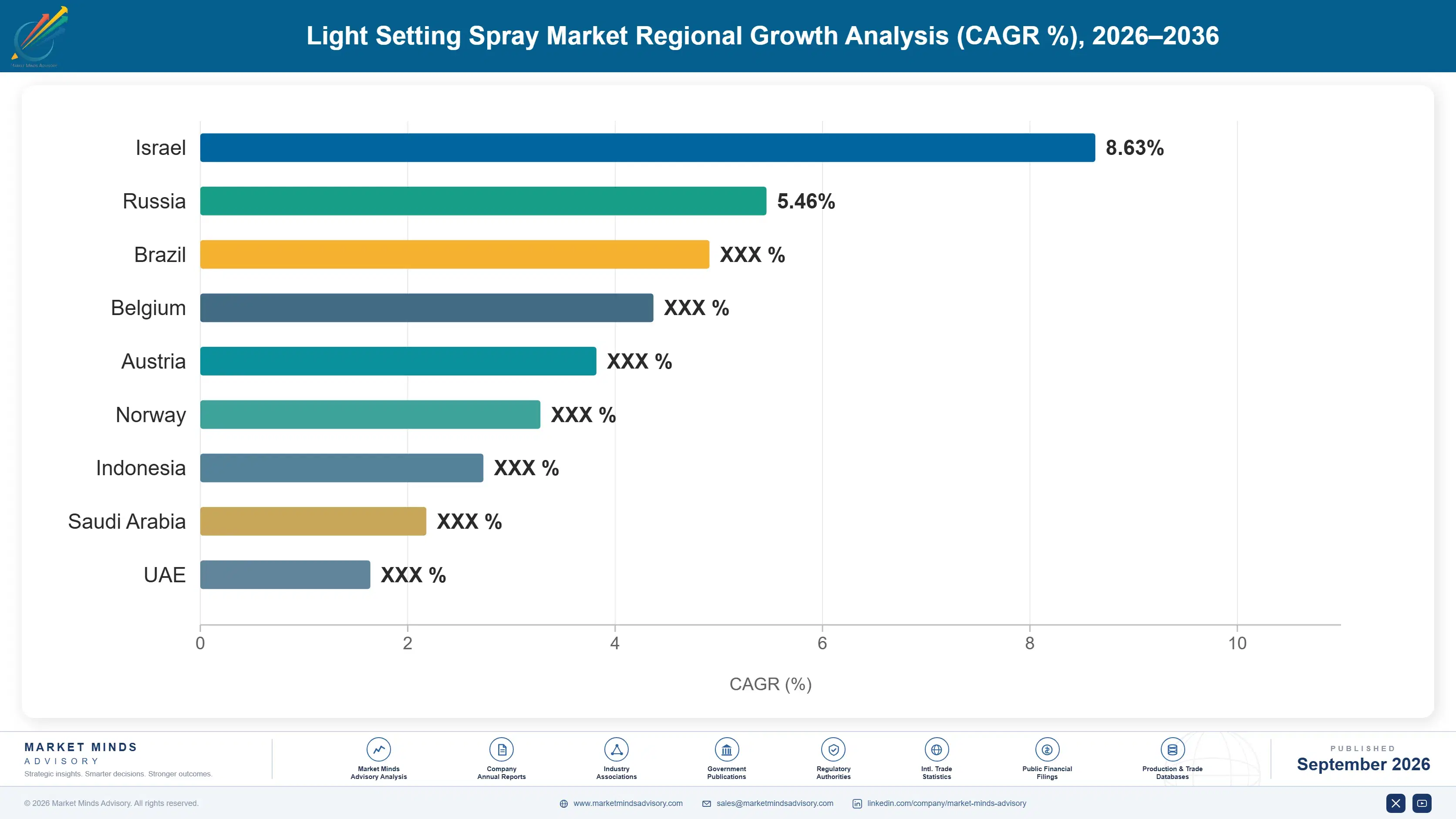
North America leads global share on concentration of lightweight formulation innovation among prestige and salon-professional brands nationwide, followed by East Asia's humidity-driven demand base across major metropolitan cities and coastal regions. South Asia and Pacific grows fastest as buyers rapidly adopt layered styling routines nationwide.

North America

North America's light setting spray demand centers on prestige and salon-professional brands pioneering lightweight formulation innovation, with roughly 28 percent of global revenue tied to a mature but still-expanding market across most retail formats and price tiers. Clean-label positioning drives much of recent product launch activity, as brands reformulate around propellant-free and sustainably packaged claims to satisfy increasingly ingredient-conscious buyers shopping through both specialty retail and direct-to-consumer subscription channels. Canadian demand tracks closely with US patterns, though at smaller absolute scale. Retail consolidation among specialty beauty chains has concentrated prestige haircare distribution into fewer but larger-format stores, giving houses with strong wholesale relationships a meaningful advantage nationwide and across e-commerce channels.
Share: 28% | CAGR: 9.4% (2026 to 2036)

Western Europe

Western Europe combines established haircare heritage with growing lightweight formulation adoption, anchored by French and German prestige brands whose salon-professional credibility commands premium pricing even as regional growth trails faster-expanding Asian markets and comparable retail formats. UK buyers show particularly strong interest in propellant-free packaging formats, reflecting broader environmental consciousness across British beauty retail and consumer culture. German mass retailers are expanding lightweight setting spray assortments to compete with salon experiences, narrowing the gap between prestige and drugstore hair styling products nationwide and across most price categories. Regulatory leadership on aerosol propellant restrictions, driven by EU environmental regulation, continues to set the compliance benchmark other regions follow closely each year.
Share: 20% | CAGR: 7.1% (2026 to 2036)
Regional intelligence for 5 additional markets available in the complete report: East Asia, South Asia and Pacific, Latin America, Middle East and Africa, Eastern Europe. Contact sales@marketmindsadvisory.com.
light-setting-spray-market-country-cagr-analysis-1790015549232

Where Lightweight Formulation Margin Lives

Four levers separate light setting spray brands capturing outsized margin from those competing purely on price: humidity-resistance testing investment, propellant-free packaging conversion, salon-professional brand extension, and travel-format innovation. Each shifts revenue toward credibility-backed premium pricing rather than commodity price competition across mass and prestige retail channels alike worldwide, compounding customer loyalty over successive purchase cycles.

Publish Third-Party Humidity-Chamber Testing Results Early

Brands publishing independent, third-party humidity-chamber testing results for flagship setting spray products command retail price premiums averaging 24 percent over comparable products relying on unverified all-day-hold marketing claims alone across every major retail channel, price tier, and geographic market. Retailers increasingly favor tested products for premium shelf placement, and buyer conversion rates run measurably higher for quantified humidity-resistance data than for vague marketing language. The upfront testing cost is significant, but brands report faster retailer approval cycles and stronger repeat purchase rates once credibility is established with skeptical, previously disappointed buyers.
Market Impact: Commands a 24 percent price premium over untested rivals

Convert Flagship Lines to Propellant-Free Packaging

Brands converting flagship products to propellant-free pump packaging capture the roughly 38 percent of new launches already shifting toward non-aerosol formats, positioning ahead of competitors still committed to traditional aerosol delivery across most retail formats, price tiers, and geographic markets worldwide and beyond. This conversion also resolves airline carry-on liquid restrictions that limit aerosol product travel appeal, opening a growing travel-retail-adjacent customer segment worth pursuing aggressively. Early movers in pump conversion report capturing sustainability-conscious buyers before slower-moving competitors complete comparable reformulation investments across their full product range and price tiers.
Market Impact: Captures the 38 percent pump-format growth segment overall

Extend Salon-Professional Brands Into Mass Retail

Salon-professional brands extending flexible-hold formulations into mass retail channels capture buyers who previously associated setting spray exclusively with prestige salon visits, lifting addressable market meaningfully beyond salon-going customers alone across most demographic segments, income levels, and geographic regions worldwide and beyond every year. This extension also builds brand awareness among buyers who eventually trade up to full salon-professional product lines once trust is established through accessible mass retail entry points. Brands executing this extension successfully report average selling prices roughly 45 percent above pure mass-market competitors lacking salon heritage credibility.
Market Impact: Commands prices roughly 45 percent above mass rivals

Develop Travel-Format and Carry-On Compliant Packaging

Brands developing dedicated travel-format packaging compliant with airline carry-on liquid restrictions capture frequent traveler demand that full-size aerosol products cannot serve at all under current regulations limiting containers to 100 milliliters across most international routes, destinations, and travel corridors worldwide. This format innovation also introduces new buyers to a brand through low-commitment trial sizes before converting them to full-size product purchases at meaningfully higher price points. Manufacturers report travel-format products driving incremental revenue rather than cannibalizing existing full-size sales, since occasions and purchase triggers differ substantially between the two format types.
Market Impact: Adds incremental revenue with less than 5% cannibalization

Who Controls the Margin Pool

Ranked on global revenue from light setting spray product sales, the market carries a CR5 near 33 percent, with L'Oreal and Unilever leading over Henkel, Amika, and Living Proof across most tracked geographies and price tiers. The gap between the top two and the rest of the field reflects deeper formulation research infrastructure and dermatology partnership networks rather than mass-market scale alone.
Current competitive activity centers on humidity-resistance testing investment, propellant-free packaging conversion, and salon-professional brand extension into mass retail across most consuming markets worldwide and price tiers tracked. Several conglomerates are also acquiring or partnering with independent formulation labs to close the technical credibility gap against clean-beauty challengers faster than building comparable in-house expertise from scratch.

Emerging pressure comes from South Korean and Japanese domestic formulators exporting both finished products and humidity-resistance testing methodology itself, plus independent clean-beauty houses gaining share through digitally native marketing that bypasses traditional salon and department store counters entirely across most retail formats. Rankings could shift meaningfully if East Asian formulators continue converting formulation science leadership into global market share faster than Western incumbents can respond with comparable clinical infrastructure.
light-setting-spray-market-company-positioning-matrix-1790015549758

Competitive Moat and Risk Dimensions

L'OREAL

Moat: Broadest Multi-Tier Formulation Portfolio

L'Oreal operates across mass, salon-professional, and prestige tiers simultaneously through owned and licensed brands, letting it capture buyers migrating between price points without losing them to competitors entirely. This portfolio breadth also spreads humidity-resistance testing costs across a far larger revenue base than smaller single-tier competitors can match.
L'OREAL

Risk: Slower Propellant-Free Conversion Pace

L'Oreal's scale and established aerosol manufacturing infrastructure can slow adoption of propellant-free packaging relative to nimbler independent brands willing to convert product lines faster with less extensive internal validation, potentially ceding early-mover advantage in this fast-growing segment to smaller, faster-moving competitors across every price tier.
UNILEVER

Moat: Deep Mass Retail Distribution Relationships

Unilever maintains long-standing wholesale relationships with mass retailers built over decades, giving its setting spray brands preferential shelf placement and volume purchasing terms that newer entrants struggle to secure regardless of product quality, marketing investment, formulation innovation claims, or humidity-resistance testing data across nearly every market.
UNILEVER

Risk: Limited Salon-Professional Credibility

Unilever's mass-market positioning leaves it exposed to salon-professional brands offering superior formulation credibility at premium price points, particularly among buyers increasingly willing to pay more for products with genuine stylist endorsement rather than mass-market marketing, celebrity advertising, and broad retail distribution alone across most price tiers.

Players Tracked

Prominent Players

L'Oreal
Unilever
Henkel
Amika
Olaplex Holdings

Other Key Players

Procter & Gamble
Kao Corporation
Shiseido Company
Coty Inc.
Revlon Inc.
R+Co
Not Your Mother's
Color Wow
Kevin Murphy
Moroccanoil
Wella Company
Aveda
Ouai Haircare
IGK Hair
Verb Products

Recent Developments

FEBRUARY 2026

L'Oreal Launches Humidity-Chamber Certified Setting Spray Line

L'Oreal launched a setting spray line backed by newly obtained third-party humidity-chamber testing certification, its first formalized humidity-resistance rating system across the entire brand portfolio nationwide. The launch responds directly to retailer demand for documented performance testing following rising buyer skepticism toward unverified hold claims.
Signal: Signals major conglomerates are formalizing quantified humidity testing into structured, certified product positioning strategies industry-wide today
SEPTEMBER 2025

Unilever Converts Flagship Brand to Propellant-Free Packaging

Unilever converted its flagship setting spray brand to propellant-free pump packaging across all major markets, its largest reformulation investment in the category to date by a wide margin. The conversion responds directly to rising retailer demand for sustainable packaging formats amid environmental regulatory pressure worldwide.
Signal: Signals mass conglomerates are proactively prioritizing propellant-free conversion well ahead of anticipated regulatory mandates nationwide today
APRIL 2026

Amika Expands Salon-Professional Line Into Mass Retail

Amika expanded its salon-professional flexible-hold setting spray line into major mass retail chains for the first time, entering roughly 2,000 new store locations nationwide within a single quarter. The expansion builds on the brand's existing salon credibility to capture mass-market buyers seeking professional-grade formulation and trusted stylist endorsement.
Signal: Signals salon-professional brands are increasingly extending into mass retail channels to capture much broader consumer demand

Specialty Polymer Supply Exposure

Film-forming polymers and specialty fixative ingredients account for roughly 27 percent of finished product cost of goods sold, sourced from a concentrated base of specialty chemical suppliers headquartered in Germany, Japan, and the United States, with propellant-free pump hardware sourced from China and Southeast Asia feeding downstream formulation and bottling operations across most producing regions worldwide and forecast years.
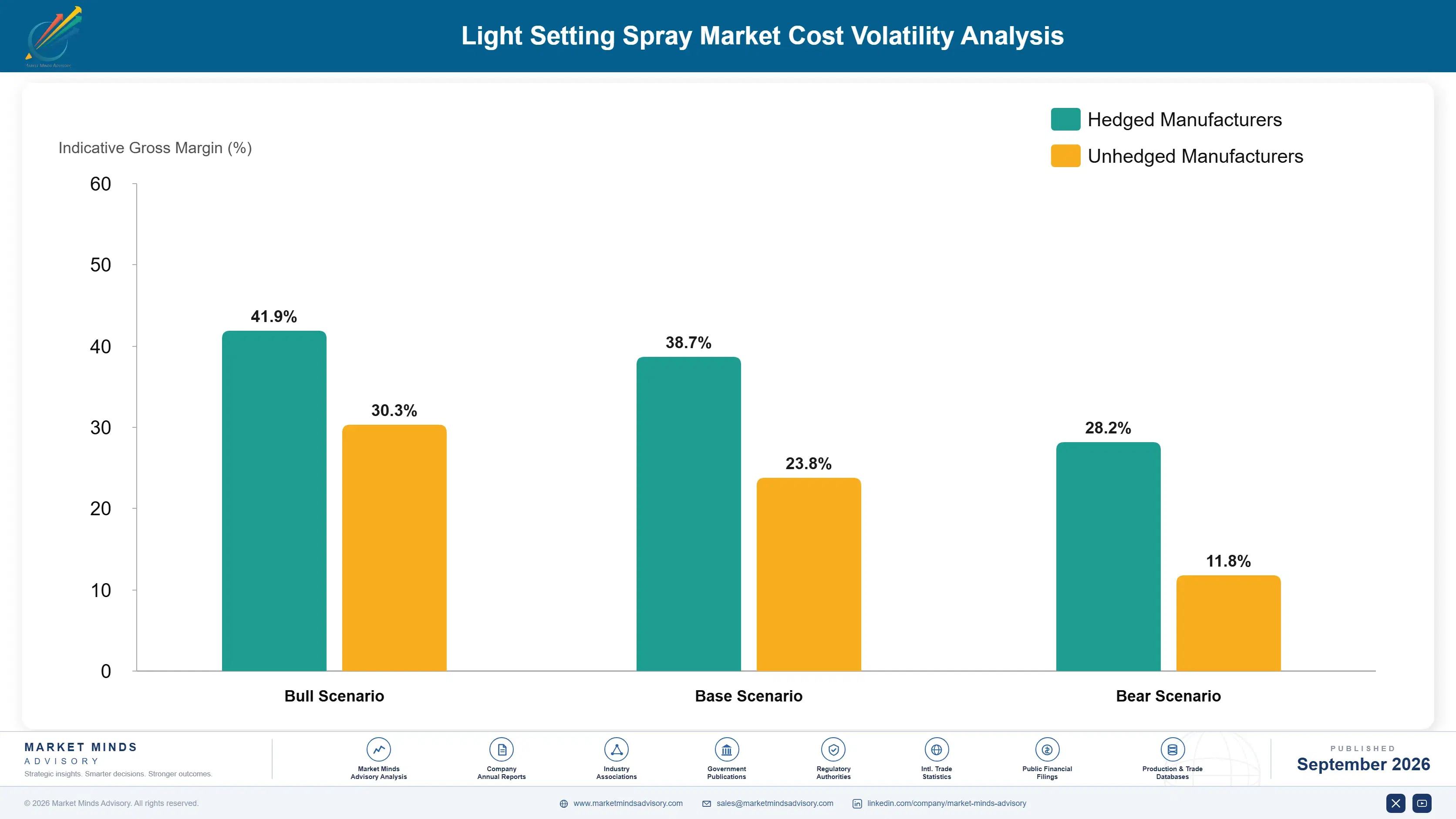
Specialty polymer prices spiked sharply during 2024 after a major German chemical manufacturer temporarily halted production for environmental compliance upgrades, a volatility event documented in company annual reports from major formulation suppliers, forcing several mid-tier brands to seek alternative polymer sourcing within a single production quarter and renegotiate longer-term supply contracts with alternative regional suppliers across multiple sourcing countries, manufacturing hubs, shipping routes, and logistics providers.

Vertically integrated conglomerates with long-term polymer supply contracts absorb raw material volatility more easily than independent clean-beauty brands purchasing on shorter-term spot arrangements, widening the cost gap between large and small players during price spikes considerably across most product categories. Geographic exposure also varies, since European formulators maintain deeper supplier relationships than newer Asian entrants still building comparable sourcing networks.
light-setting-spray-market-cost-volatility-analysis-1790015549955

Diversify Polymer Sourcing Across Multiple Countries

Formulators are qualifying dual-pathway polymer sourcing across Germany, Japan, and domestic US suppliers, reducing dependence on any single production facility or region for a critical formulation ingredient supply chain nationwide. This flexibility lets brands substitute during supply disruptions while maintaining consistent hold performance and avoiding costly reformulation delays under time pressure from retail partners.

Lock In Long-Term Polymer Supply Contracts

Larger conglomerates are signing multi-year supply agreements directly with specialty polymer suppliers, bypassing volatile spot markets entirely for core ingredient volumes needed across their full product range and price tiers. These contracts lock in pricing and volume commitments years ahead, insulating houses from facility disruption that smaller competitors purchasing spot remain fully exposed to.

Portfolio Architecture for Margin Defence

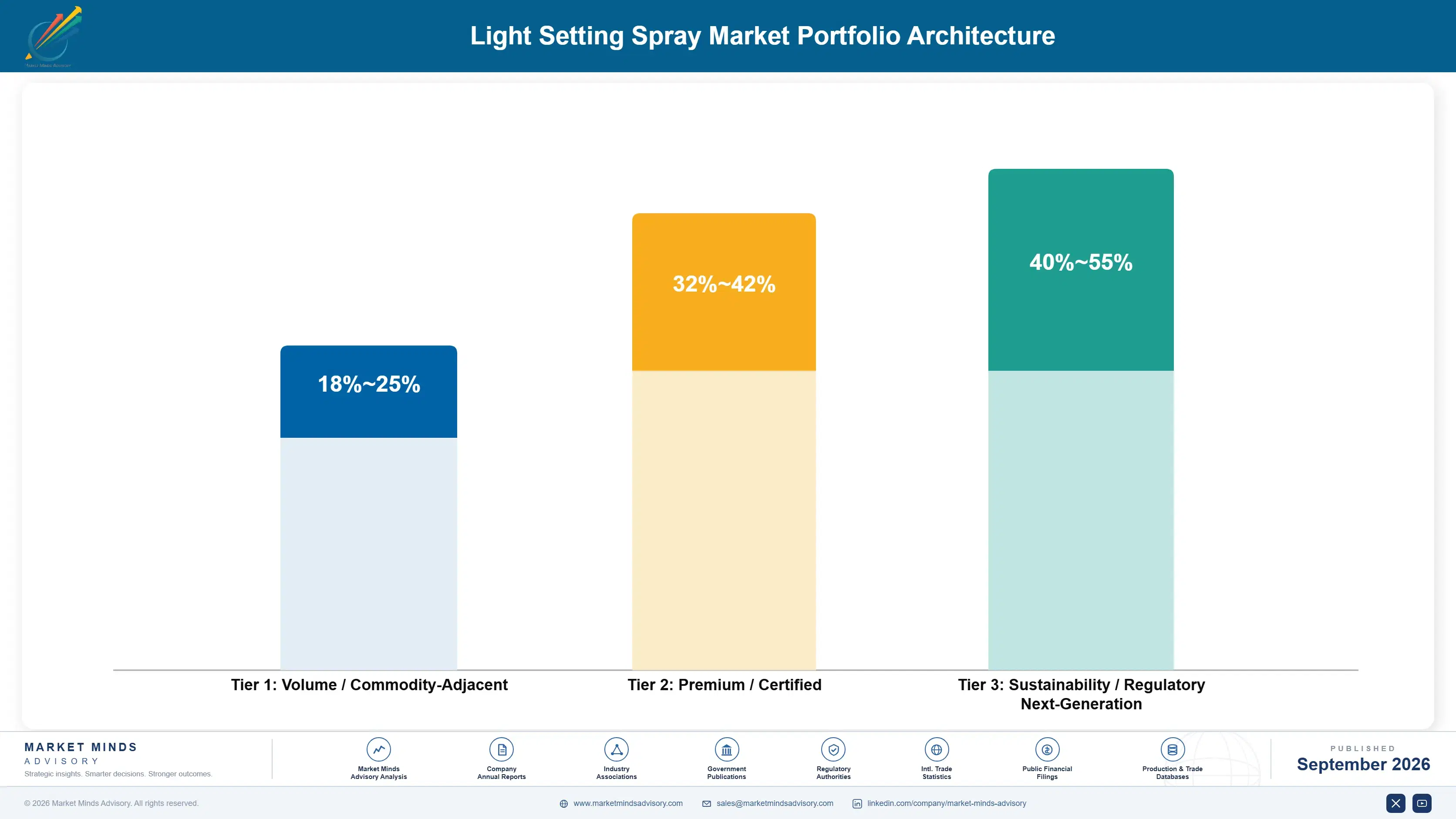
Light setting spray splits into three tiers by margin structure: mass-market commodity sprays sold on price and basic hold claims, certified premium lines commanding trust through humidity-resistance testing premiums, and next-generation propellant-free and salon-professional formulas built around clean-label and stylist credibility across most retail formats and price tiers. Volume commodity products carry gross margins typically between 18 and 25 percent across mass channels.
Certified premium lines, backed by third-party humidity-chamber testing, command gross margins of 32 to 42 percent, reflecting trust and performance verification buyers pay for beyond raw formulation cost alone across most retail formats and price categories. Salon-professional and propellant-free lines sit at the top of the value pool, often exceeding 48 percent gross margin given specialized formulation science and limited early competition worldwide.

The tension between volume and premium tiers shapes capital allocation heavily, since scaling humidity-resistance credibility requires deliberate testing investment rather than manufacturing expansion alone across every product line, price tier, and retail channel tracked. High-value pools concentrate in East Asian formulation science hubs and North American salon-professional brands, where buyers consistently pay meaningfully more for verified performance and documented efficacy.

Volume / Commodity-Adjacent

Mass-market setting sprays sold primarily on price and basic hold claims across grocery and drugstore channels, competing heavily on promotional cadence and private-label substitution pressure from major national and regional retailers.
Gross Margin: 18-25%

Premium / Certified

Third-party humidity-chamber certified lines sold through specialty and prestige retail channels, commanding trust and performance verification premiums over uncertified competitors lacking documented testing, traceable formulation data, third-party validation, and consistent quality assurance.
Gross Margin: 32-42%

Sustainability / Regulatory / Next-Generation

Propellant-free and salon-professional formulas targeting clean-label and stylist-endorsed positioning, produced through specialized formulation science commanding outsized early-mover margin advantages across most premium and prestige retail channels worldwide and internationally as well.
Gross Margin: 40-55%
light-setting-spray-market-portfolio-architecture-1790015550461

High-value Sub-segments and Strategic Watch-out

Humidity-Resistant Sprays

The fastest-growing and highest-margin segment, driven by East Asian formulation science leadership and younger buyers seeking genuinely durable hold beyond established flexible-hold formulations, sustaining premium first-mover pricing across nearly every major consuming market, prestige retail channel, price tier, and buyer demographic tracked in this ten-year forecast.
Gross Margin: 45-58%

Propellant-Free Pump Sprays

A high-value, moderately fast-growing segment revitalized by environmental packaging concerns and travel convenience needs, now commanding renewed buyer trust after early pump-format consistency issues were resolved across most mass and prestige retail formats worldwide, price categories, geographic markets, distribution channels, buyer segments, and purchase occasions.
Gross Margin: 35-48%

Flexible-Hold Sprays

The volume core of the market, valued for versatile everyday styling and broad compatibility with other products, anchoring overall category revenue even as growth concentrates elsewhere in newer humidity-resistant and propellant-free formulations gaining traction among younger, ingredient-literate buyers nationwide, internationally, and across most price tiers.
Gross Margin: 18-25%

Unverified Aerosol Hold Claims

A strategic watch-out as regulatory scrutiny intensifies around unsubstantiated humidity-resistance marketing claims, risking costly reformulation or claim withdrawal for brands lacking peer-reviewed testing documentation well ahead of tightening compliance deadlines across most consuming markets, price tiers, retail formats, geographic regions, distribution channels, and buyer segments.
Gross Margin: n/a

Repurchase Loyalty and Ingredient Trust

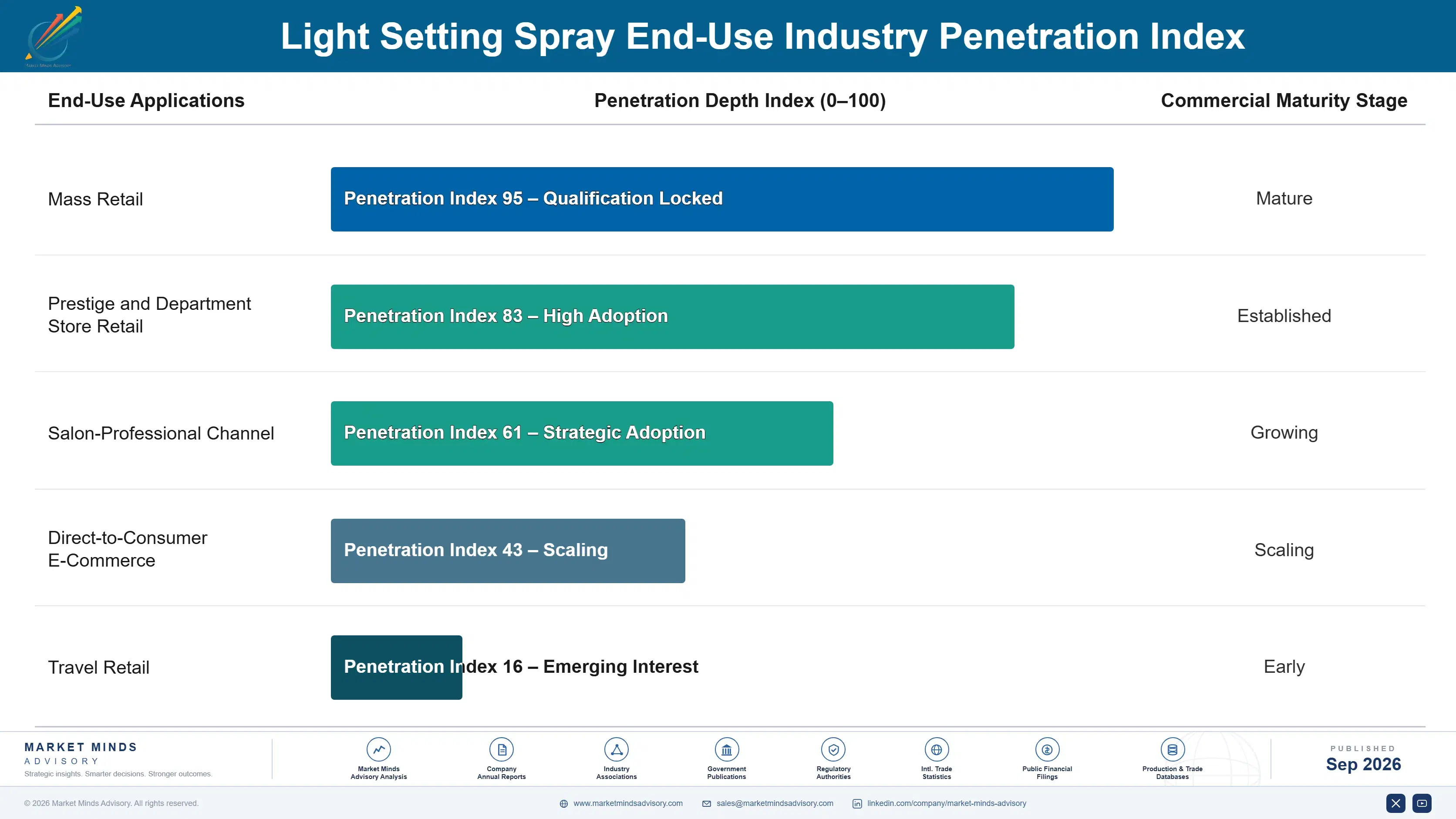
Light setting spray purchasing follows recurring replenishment cycles rather than one-time capital decisions, with average repurchase intervals of roughly seven weeks among daily users, generating steadier revisit revenue than most other discretionary beauty categories track across comparable forecast periods and buyer cohorts worldwide, particularly within salon-professional product lines carrying documented efficacy claims, stylist endorsement, third-party certification data, and dermatology partnership backing nationwide.
Adoption depth varies by vertical across the entire category. Salon-professional buyers show the deepest loyalty once a specific formulation proves effective for their hair type, often repurchasing for years without switching brands or formulations entirely, while mass commodity buyers switch readily between products chasing promotional pricing rather than maintaining consistent formulation loyalty across purchase occasions, price tiers, retail channels, product categories, and geographic markets nationwide.

Generational buyer shifts favor propellant-free packaging and humidity-resistance credibility over brand heritage alone, as younger buyers raised on ingredient-conscious consumer habits treat hold performance claims as verifiable data points rather than the marketing trust older generations extended without question, reshaping brand loyalty economics considerably across most consuming markets, retail formats, price tiers, buyer demographics, and purchase channels nationwide.
light-setting-spray-market-end-use-penetration-index-1790015550953

Priority Moves for Setting Spray Brands

These are among the four positions where our research anticipates prominent divergence between winners and laggards over the coming forecast period. Each is grounded in the demand model, the regulatory perimeter, and the announced capacity pipeline.
01 / HUMIDITY TESTING INVESTMENT

Publish Humidity-Chamber Testing Before Competitors Do

Retailers and buyers are already favoring products backed by quantified humidity-resistance testing over vague marketing claims across nearly every price tier, and this credibility shift shows no sign of reversing as buyer skepticism toward unverified hold claims deepens. Brands that publish independent testing results now secure premium shelf placement and buyer trust ahead of competitors still relying on unverified claims alone. Waiting until testing becomes the industry norm risks losing shelf space entirely to faster-moving, better-documented rivals across every major retail channel.
02 / PROPELLANT-FREE PACKAGING CONVERSION

Convert to Pump Packaging Before Regulation Forces It

Propellant-free pump packaging already covers a meaningful and growing share of new launches, driven by environmental awareness and airline travel restrictions that aerosol formats cannot satisfy across comparable price tiers and geographic markets tracked worldwide and beyond. Brands converting flagship products now capture sustainability-conscious buyers and travel-format demand before slower-moving competitors complete comparable reformulation investments across their full product range. Delaying conversion risks facing costly compliance retrofits once regulatory mandates make propellant-free packaging effectively unavoidable across most consuming markets worldwide.
03 / SALON-PROFESSIONAL RETAIL EXTENSION

Extend Salon Credibility Into Mass Retail Now

Salon-professional brands extending into mass retail capture buyers who previously associated setting spray exclusively with prestige salon visits, meaningfully expanding addressable market beyond salon-going customers alone across most demographic segments, income levels, and geographic regions tracked. Brands that extend now build awareness among buyers who eventually trade up to full salon-professional lines once trust is established through accessible entry points. Remaining confined to salon-exclusive distribution risks ceding mass retail growth entirely to conglomerates lacking comparable formulation credibility and stylist endorsement.
04 / EAST ASIAN MARKET PRIORITY

Prioritize East Asian Formulation Science Partnerships

East Asia combines substantial regional share with the fastest-growing humidity-resistant segment, anchored by South Korean and Japanese formulation science leadership most Western competitors cannot easily replicate at comparable speed, cost, or investment scale currently or soon. Brands partnering with East Asian formulation labs now capture technical expertise and regional credibility before domestic conglomerates fully consolidate their advantage across most price tiers and distribution channels. Remaining dependent on Western formulation approaches risks ceding the category's most technically demanding and fastest-growing segment entirely.

Engagement Snapshot From the Field

A live engagement with an industry participant carrying material or product regulatory and market exposure ahead of a defining policy shift, showing how our research translates into a defensible multi-year portfolio strategy.
MARKET MINDS ADVISORY · CLIENT ENGAGEMENT SUMMARY
Light Setting Spray Producer Strategic Portfolio Review and Transition Roadmap 2026·Investment Scenario on Light Setting Spray Exposure Evaluation 2025-26
CLIENT PROFILE
The client is an independent salon-professional haircare brand focused on flexible-hold setting sprays, operating primarily through salon distribution and select specialty retail in North America, with annual revenue of approximately $32 million (client-reported, unverified by MMA). The company built its reputation on stylist endorsement but had not yet extended into mass retail channels despite growing buyer demand.
STRATEGIC CHALLENGE
The client faced slowing growth as salon distribution alone limited addressable market size, while mass retail competitors expanded lightweight formulation assortments capturing buyers the client's salon-only distribution model could not reach at any meaningful scale. Growth had plateaued as salon count growth slowed nationally across most regions and metropolitan markets.
MMA APPROACH
MMA conducted primary interviews with 30 mass retail buyers and 15 salon owners to map how salon credibility actually transfers to mass retail purchase decisions, benchmarked against three competitor extension approaches already in market. The engagement modeled expected revenue impact under two distribution partnership scenarios before recommending a phased mass retail entry sequence.
KEY FINDINGS
  1. Mass retail buyers weighted salon-professional heritage more heavily than brand tenure when evaluating new setting spray submissions for premium shelf placement nationwide.
  2. Salon owners expressed limited concern about brand dilution from mass retail expansion, provided pricing and packaging remained clearly differentiated between channels and formats.
  3. Competitors with formalized mass retail extension programs reported revenue growth roughly 30 percent higher than salon-exclusive competitors over comparable periods and channels.
  4. Buyers under 35 showed the strongest willingness to purchase salon-professional brands through mass retail channels rather than visiting salons directly for purchases.
CLIENT PROFILE
The client is an independent salon-professional haircare brand focused on flexible-hold setting sprays, operating primarily through salon distribution and select specialty retail in North America, with annual revenue of approximately $32 million (client-reported, unverified by MMA). The company built its reputation on stylist endorsement but had not yet extended into mass retail channels despite growing buyer demand.
STRATEGIC CHALLENGE
The client faced slowing growth as salon distribution alone limited addressable market size, while mass retail competitors expanded lightweight formulation assortments capturing buyers the client's salon-only distribution model could not reach at any meaningful scale. Growth had plateaued as salon count growth slowed nationally across most regions and metropolitan markets.
MMA APPROACH
MMA conducted primary interviews with 30 mass retail buyers and 15 salon owners to map how salon credibility actually transfers to mass retail purchase decisions, benchmarked against three competitor extension approaches already in market. The engagement modeled expected revenue impact under two distribution partnership scenarios before recommending a phased mass retail entry sequence.
KEY FINDINGS
  1. Mass retail buyers weighted salon-professional heritage more heavily than brand tenure when evaluating new setting spray submissions for premium shelf placement nationwide.
  2. Salon owners expressed limited concern about brand dilution from mass retail expansion, provided pricing and packaging remained clearly differentiated between channels and formats.
  3. Competitors with formalized mass retail extension programs reported revenue growth roughly 30 percent higher than salon-exclusive competitors over comparable periods and channels.
  4. Buyers under 35 showed the strongest willingness to purchase salon-professional brands through mass retail channels rather than visiting salons directly for purchases.
RECOMMENDED STRATEGY
Phase 1: Phase 1 (Months 1 to 3): Launch a mass-retail-specific product line with distinct packaging targeting two priority national retail accounts. Phase 2: Phase 2 (Months 4 to 8): Expand mass retail distribution to five additional accounts based on Phase 1 sell-through performance data. Phase 3: Phase 3 (Months 9 to 14): Introduce a loyalty program bridging salon and mass retail purchases to retain existing salon customer relationships.
OUTCOME
Within 14 months, the client reported securing distribution with seven mass retail accounts and revenue growth of approximately 32 percent over the engagement period (client-reported, unverified by MMA). The client also reported no measurable decline in salon channel sales, addressing the brand dilution concern raised during initial planning.

Frequently Asked Questions

Foundational context covering the market sizes, CAGR, scope, country, region and competition that inform every finding below. This section is provided to cover basics and most often pre-purchase conversations, answered from the MMA Primary Research Dataset.

What is the current size of the Light Setting Spray Market?

The global light setting spray market reached approximately $2.1 billion in 2025. This figure covers lightweight, flexible-hold hairsprays formulated for touchable finish and humidity resistance sold across mass, prestige, and salon-professional channels.

How large will the Light Setting Spray Market be by 2036?

The market is projected to reach approximately $5.25 billion by 2036, roughly 2.3 times its 2026 value. Growth is led by humidity-resistant and propellant-free formulations expanding fastest across East Asian markets.

What is the CAGR for the Light Setting Spray Market 2026 to 2036?

The market is forecast to grow at a compound annual growth rate of 8.7 percent between 2026 and 2036. Bull and bear scenarios range from 10.0 percent to 7.4 percent depending on raw material and adoption factors.

Which segment is growing fastest?

Humidity-resistant sprays are the fastest-growing segment at a 12.4 percent CAGR, roughly 1.43 times the overall market rate. Propellant-free pump sprays follow closely as the second-fastest segment at 10.8 percent.

Who are the major companies in the Light Setting Spray Market?

Leading companies include L'Oreal, Unilever, Henkel, Amika, and Olaplex Holdings. Together these five players hold a combined market share of roughly 33 percent, ranked on global setting spray product revenue.

Which country is growing fastest?

South Korea is the fastest-growing country market at an 11.1 percent CAGR, driven by formulation science leadership and humidity-resistance demand. This outpaces the broader East Asian regional average of 9.7 percent.

Report Segmentation Architecture

The full report scope spans multiple orthogonal segmentation dimensions, with cross-tabulated demand data provided for each dimension pair. Coverage extends further to regional breakdowns, trend trajectories, and the competitive detail needed to support segment-level decision-making.

By Formulation Type

  • Flexible-Hold Sprays
  • Humidity-Resistant Sprays
  • Propellant-Free Pump Sprays
  • Heat-Protectant Dual-Function Sprays
  • Volumizing Dual-Function Sprays
  • Clean-Label Natural-Derived Sprays

By End-Use Industry

  • Mass Retail
  • Prestige and Department Store Retail
  • Salon-Professional Channel
  • Direct-to-Consumer E-Commerce
  • Travel Retail

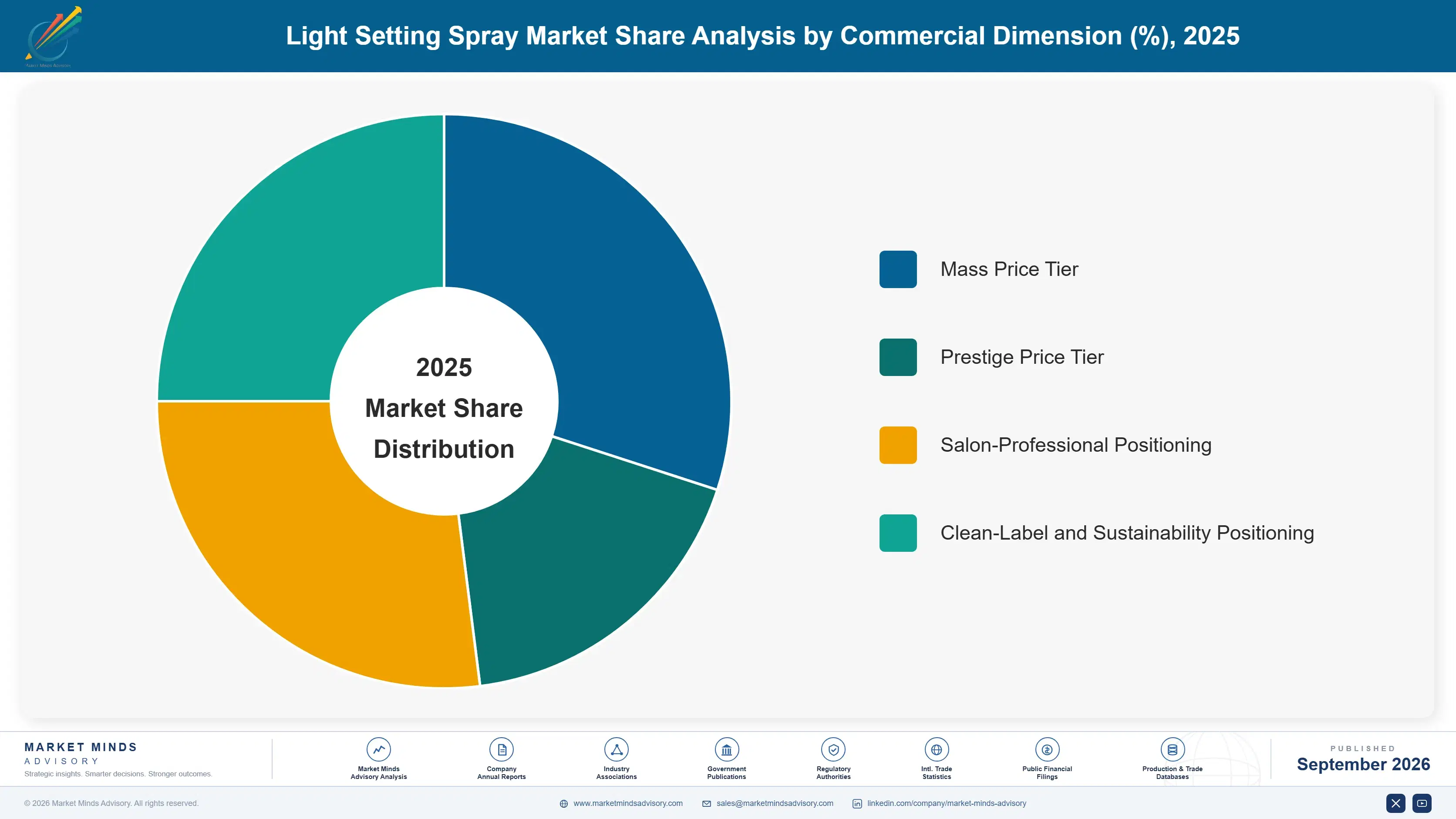
By Commercial Dimension

  • Mass Price Tier
  • Prestige Price Tier
  • Salon-Professional Positioning
  • Clean-Label and Sustainability Positioning

By Region

  • North America
  • Western Europe
  • East Asia
  • South Asia and Pacific
  • Latin America
  • Middle East and Africa
  • Eastern Europe

Scope, Methodology, and Coverage

Every figure in this report is reproducible from documented input assumptions. The scope below maps the historical period, the forecast horizon, the segmentation dimensions, and the countries covered, alongside the underlying primary and qualitative methodology.
Historical Period
2020 to 2025
Forecast Period
2026 to 2036
Base Year
2025 (USD billions; MMA Primary Research Dataset, September 2026)
Market Definition
The light setting spray market comprises lightweight, flexible-hold hairsprays formulated for touchable finish and humidity resistance, sold through mass, prestige, and salon-professional channels. It excludes traditional stiff-hold aerosol hairsprays and non-spray styling products such as gels, mousses, and creams.
Quantitative Units
USD billions (current prices); unit volume in million bottles where applicable
Segmentation Dimensions
By Formulation Type; By End-Use Industry; By Commercial Dimension; By Region
Regions Covered
North America, Western Europe, East Asia, South Asia and Pacific, Latin America, Middle East and Africa, Eastern Europe
Countries Covered
USA, China, Germany, France, UK, Japan, South Korea, India, Australia, Canada, Brazil, Mexico, Indonesia, Vietnam, Thailand, Malaysia, UAE, Saudi Arabia, South Africa, Nigeria, Turkey, Poland, Netherlands, Italy, Spain, Sweden, Switzerland, Argentina, Colombia, Singapore, and additional markets relevant to this sector
Key Companies Profiled
L'Oreal, Unilever, Henkel, Amika, Olaplex Holdings, Procter & Gamble, Kao Corporation, Shiseido Company, Coty Inc., Revlon Inc., R+Co, Not Your Mother's, Color Wow, Kevin Murphy, Moroccanoil, Wella Company, Aveda, Ouai Haircare, IGK Hair, Verb Products
Quantitative Methodology
Primary survey, n=3,800 respondents, Q4 2025, six countries; demand-side model with trade association cross-validation
Qualitative Methodology
47 expert interviews, Q4 2025; applied to validate demand model assumptions, identify emerging dynamics, and assess competitive positioning
Report Format
PDF and XLSX data workbook (Word format preview document)
Publisher
Market Minds Advisory
Report Code
MMA-2026-CHM-120
Published
September 2026
Contact
sales@marketmindsadvisory.com | www.marketmindsadvisory.com

Purchase the full Light Setting Spray Market Report (2026 to 2036).

The full report delivers a comprehensive analysis of the global light setting spray market, spanning flexible-hold, humidity-resistant, propellant-free, and dual-function formulations across all seven world regions. It includes detailed competitive profiling of 20 major players, ten-year forecast modeling through 2036, and country-level demand analysis across major producing and consuming markets. The report examines humidity-resistance testing dynamics, propellant-free packaging trends, and input cost exposure across the specialty polymer value chain. Buyers receive segmentation data across formulation type, end-use channel, and commercial positioning suitable for strategic planning and competitive benchmarking.
Ten-year market sizing and forecast model
Twenty-company competitive profiling and benchmarking analysis
Seven-region demand and growth trend analysis
Humidity-resistance testing trends and regulatory assessment
Formulation-type segmentation with detailed margin data
Anonymized client case study and strategy playbook

Built For The People Who Decide

From boardroom strategy to bench-side execution, this report is read cover-to-cover by leaders shaping the next decade of their industry, turning demand scenarios, market dynamics and valuation benchmarks into decisions.
CXOs/ Presidents/ VPs/ Managers
M&A and Corporate Development
Strategy Teams and R&D Heads
Procurement and Product Directors
Regulatory and Compliance Leaders
Investor Relations and Equity Analysts