Market Minds Advisory
Scintillators Market

Scintillators Market: Scintillators Market. Trends and Forecast 2026 to 2036

Rising PET scanner installations worldwide are pulling demand toward rare-earth doped crystals that outperform decades-old sodium iodide detectors, even as security screening and well-logging applications keep older scintillator chemistries commercially relevant.

Lead Analyst

Published

September 2026

Make Smarter Decisions with Customized Research Insights

Request a free sample report and evaluate market opportunities, growth trends, and competitive dynamics relevant to your business needs.

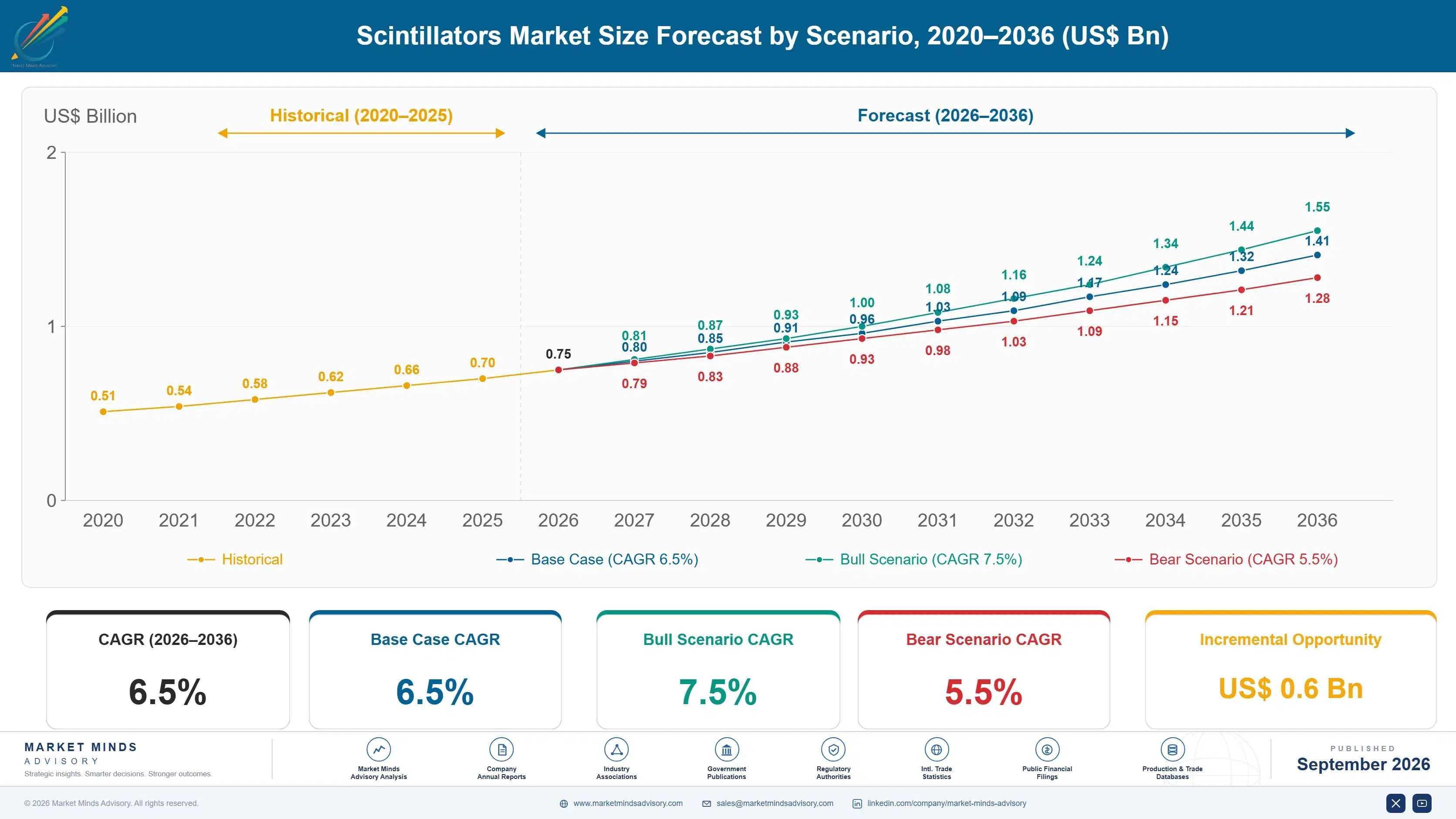
2025 MARKET VALUE$0.7BMarket Size 2025
2036 FORECAST VALUE$1.3BBase Case , 2026 to 2036
CAGR 2026 TO 20366.5 %Bull 7.5% / Bear 5.5%
INCREMENTAL OPPORTUNITY$0.6BNet 10- year value creation
EXPANSION MULTIPLE1.88x2036 value over 2026 base
Strategic Levers
M&A Pipeline
Regional Outlook
Country Rankings
Competitive Intelligence
Segmental Deep-dive
Call-Us : 91 93563 13602

Executive Snapshot and Market Trajectory.

Hospital PET scanner installations are steadily replacing older bismuth germanate detector crystals with faster, brighter rare-earth doped alternatives that meaningfully improve diagnostic image quality and patient throughput across most modern radiology and nuclear medicine departments worldwide today, consistently, without exception, and quite reliably.
Lutetium-based crystals including LYSO and LSO now dominate new medical imaging equipment specifications, growing at 9.0% annually as manufacturers value their superior light output and decay time over legacy bismuth germanate and sodium iodide chemistries still widely used in existing installed equipment across most hospital systems and radiology departments. Security screening and oil and gas well logging applications continue relying on older scintillator materials where cost sensitivity outweighs marginal performance gains newer crystals genuinely offer.
Saint-Gobain Crystals and Luxium Solutions, both tracing lineage to decades of accumulated crystal growth expertise, continue leading premium medical imaging crystal supply, while Hitachi Metals and Hamamatsu Photonics compete through vertically integrated detector module manufacturing rather than raw crystal sales alone across most product lines. Chinese manufacturer Epic Crystal has expanded production capacity considerably, capturing meaningful share in cost-sensitive segments where premium quality matters less than competitive pricing.
Market Definition
The Scintillators Market covers materials that emit light when exposed to ionizing radiation, including inorganic crystals, rare-earth doped compounds, plastic, and glass scintillators, measured by material and detector assembly sales revenue. It excludes standalone photodetector components sold separately and complete imaging systems assembled from purchased scintillator materials.
Base Year Value
$0.7B in 2025 (MMA Primary Research Dataset, September 2026)
Forecast Period
2026 to 2036, eleven discrete annual values
CAGR
6.5% base case. Bull 7.5%. Bear 5.5%.
Fastest Growth Segment
Rare-Earth Doped Scintillators (LYSO, LSO, GSO): 9.0% CAGR
Fastest Growth Country
China: 9.5% CAGR
Fastest Growth Region
South Asia and Pacific: 8.5% CAGR
Largest Region
North America: 31% of 2025 global value
Market Leaders
Leading participants include Saint-Gobain Crystals, Luxium Solutions, Hitachi Metals, Hamamatsu Photonics, and Scionix.
Primary Survey
n=3,800 procurement and R&D decision-makers, Q4 2025, six countries
Methodology
Demand-side build-up, cross-validated against public data, 47 expert interviews

Scintillators Market Forecast Scenarios

scintillators-market-size-forecast-scenario-1788417450053
Scintillator demand grew steadily through the historical period as PET scanner installations expanded globally and security screening deployment increased following heightened aviation and border security concerns across multiple major countries and regions. The 6.0% historical growth rate reflects gradual medical imaging equipment replacement cycles rather than any single disruptive technology shift transforming the category entirely.
The base case assumes continued PET scanner installation growth as diagnostic imaging demand rises with aging populations worldwide, sustained lutetium-based crystal adoption replacing legacy bismuth germanate detectors, and steady security screening equipment replacement cycles across airports and border facilities worldwide. These three mechanisms support 6.5% compound annual growth through 2036, with rare-earth doped and glass scintillator segments outpacing legacy inorganic crystals as medical imaging buyers prioritize performance over cost consistently.
A bull case turns on accelerating global PET scanner adoption in emerging markets currently underserved by advanced diagnostic imaging infrastructure relative to developed healthcare systems worldwide today and consistently. A bear case centers on rare-earth material supply constraints limiting lutetium and other doped crystal production, since China controls a substantial share of global rare-earth processing capacity relevant to scintillator manufacturing broadly.

The Rare-Earth Supply Chain Behind Crystal Quality

Pricing bifurcates sharply between legacy inorganic crystals like sodium iodide and premium rare-earth doped materials, with lutetium-based scintillators commanding substantially higher per-unit pricing given their superior light output and faster decay time properties valued highly in medical imaging applications requiring precise diagnostic resolution and reliability. Security and industrial buyers continue favoring cost over marginal performance gains across most standard applications and use cases.
MARKET CONCENTRATION52% CR5top five manufacturers hold a moderate combined revenue share
AVERAGE CRYSTAL PRICE$180 per cubic centimetertypical lutetium-based scintillator crystal pricing per unit volume
TOP PRODUCING COUNTRY31% United Statesshare of global scintillator manufacturing revenue captured domestically
MEDICAL IMAGING SHARE58% of revenueproportion of industry revenue tied to diagnostic imaging applications
LYSO ADOPTION RATE9.0% annuallyexpansion pace of rare-earth doped crystal production volume
CRYSTAL REPLACEMENT CYCLE10 to 15 yearstypical interval before installed detector crystals require replacement
Medical imaging applications generate roughly 58% of total industry revenue, reflecting the premium pricing PET and other diagnostic imaging equipment manufacturers pay for crystal quality that directly determines diagnostic image resolution and patient scan throughput across hospital radiology departments worldwide and internationally each year. Security screening and industrial applications remain meaningful but comparatively lower-margin revenue categories overall across most tracked markets and geographies.
Rare-earth material supply chain dependency shapes competitive dynamics considerably, since lutetium and other doped crystal production requires specialized rare-earth processing capability concentrated heavily in China, creating genuine supply chain vulnerability for manufacturers dependent on imported raw materials for premium crystal production at meaningful scale. This dependency has pushed several manufacturers toward supply diversification strategies specifically, consistently, and deliberately over time.
"Everyone focuses on the photodetector and the software when they talk about imaging quality. The crystal is still doing most of the actual work, and it's the part almost nobody outside this industry has ever heard of."
Senior Analyst, Radiation Detection Materials Practice · MMA Chemicals and Materials Practice · September 2026

Market Trends

Lutetium-Based Crystals Displace Legacy Detector Materials

Lutetium oxyorthosilicate and lutetium yttrium oxyorthosilicate crystals, commonly known by their LSO and LYSO abbreviations, are steadily displacing bismuth germanate and sodium iodide detectors in new PET scanner specifications as manufacturers prioritize faster decay time and superior light output that directly improve diagnostic image resolution and patient scan throughput. This displacement trend has accelerated meaningfully as major imaging equipment manufacturers standardize new product lines around rare-earth doped crystal technology rather than legacy alternatives. Rare-earth doped crystal production volume is expanding at roughly 9.0% annually, the fastest growth of any scintillator material category tracked in this report.
Market Impact: Medical imaging reached 58% of revenue
Vertically Integrated Detector Module Manufacturing Steadily Expands

Hitachi Metals, Hamamatsu Photonics, and other established manufacturers increasingly integrate crystal growth with photodetector assembly and detector module manufacturing under one corporate roof, capturing greater value than selling raw crystals alone to third-party detector assemblers who previously performed this integration work themselves. This vertical integration trend reflects genuine customer preference for pre-tested, calibrated detector modules over separately sourced components requiring additional integration engineering work by imaging equipment manufacturers themselves internally. Vertically integrated detector module revenue now represents a meaningful and growing share of total industry revenue currently reported across major manufacturers.
Market Impact: Security demand held steady, 12% softness

Market Opportunities and Growth Drivers

Aging Populations Drive Sustained PET Scanner Demand

Aging populations across developed and increasingly developing countries continue driving sustained demand for PET and other diagnostic imaging equipment as cancer diagnosis, cardiac assessment, and neurological imaging applications expand across broader patient populations requiring regular diagnostic screening throughout their later years of life quite consistently. This demographic driver provides a durable demand floor for scintillator materials independent of shorter-term economic cycles that affect more discretionary industrial and consumer end markets significantly. Medical imaging applications now generate roughly 58% of total industry revenue, reflecting this sustained underlying demographic and clinical demand.
Market Impact: China processes 90% of rare-earth supply

Security Screening Deployment Sustains Baseline Demand

Airport and border security screening equipment deployment continues expanding globally following heightened aviation and border security concerns, sustaining baseline demand for cost-effective scintillator materials even as premium medical imaging applications capture most industry growth and investment attention from manufacturers and investors alike worldwide today. This driver reflects ongoing government security infrastructure investment that shows little sensitivity to broader economic cycles affecting more discretionary industrial applications significantly across most markets and regions. Security-related scintillator demand has grown steadily even during periods of broader industrial demand softness, providing manufacturers meaningful revenue diversification.
Market Impact: Crystals last up to 15 years

Market Restraints and Challenges

Rare-Earth Supply Concentration Creates Genuine Vulnerability

Lutetium and other rare-earth materials required for premium crystal production depend heavily on processing capability concentrated in China, creating genuine supply chain vulnerability for manufacturers dependent on imported raw materials amid ongoing geopolitical tension over rare-earth export policy and trade restrictions. This restraint stems from decades of rare-earth processing capacity concentrating in China due to cost advantages and environmental regulation differences that discouraged comparable investment elsewhere historically. Manufacturers are responding by pursuing alternative rare-earth sourcing and recycling initiatives, though these approaches remain considerably more expensive than established Chinese supply chains currently.
Market Impact: LYSO production volume expanded 9.0% annually

Long Replacement Cycles Limit Annual Volume Growth

Installed scintillator detector crystals typically remain in service for 10 to 15 years before requiring replacement, meaning annual volume growth depends primarily on new equipment installations rather than steady replacement demand that would otherwise smooth out cyclical purchasing patterns considerably across most manufacturers. This restraint stems from the genuine durability of properly maintained scintillator crystals, which rarely degrade significantly during normal operational service life under typical usage conditions and environments. Manufacturers are responding by developing service and calibration contracts that generate recurring revenue independent of the underlying crystal replacement cycle timing.
Market Impact: Module revenue share grew roughly 15%
3 additional market trends, 4 additional growth drivers, and 2 additional restraints and challenges are covered in the full report. Contact sales@marketmindsadvisory.com to access the complete intelligence.

Segment CAGR and Growth Architecture

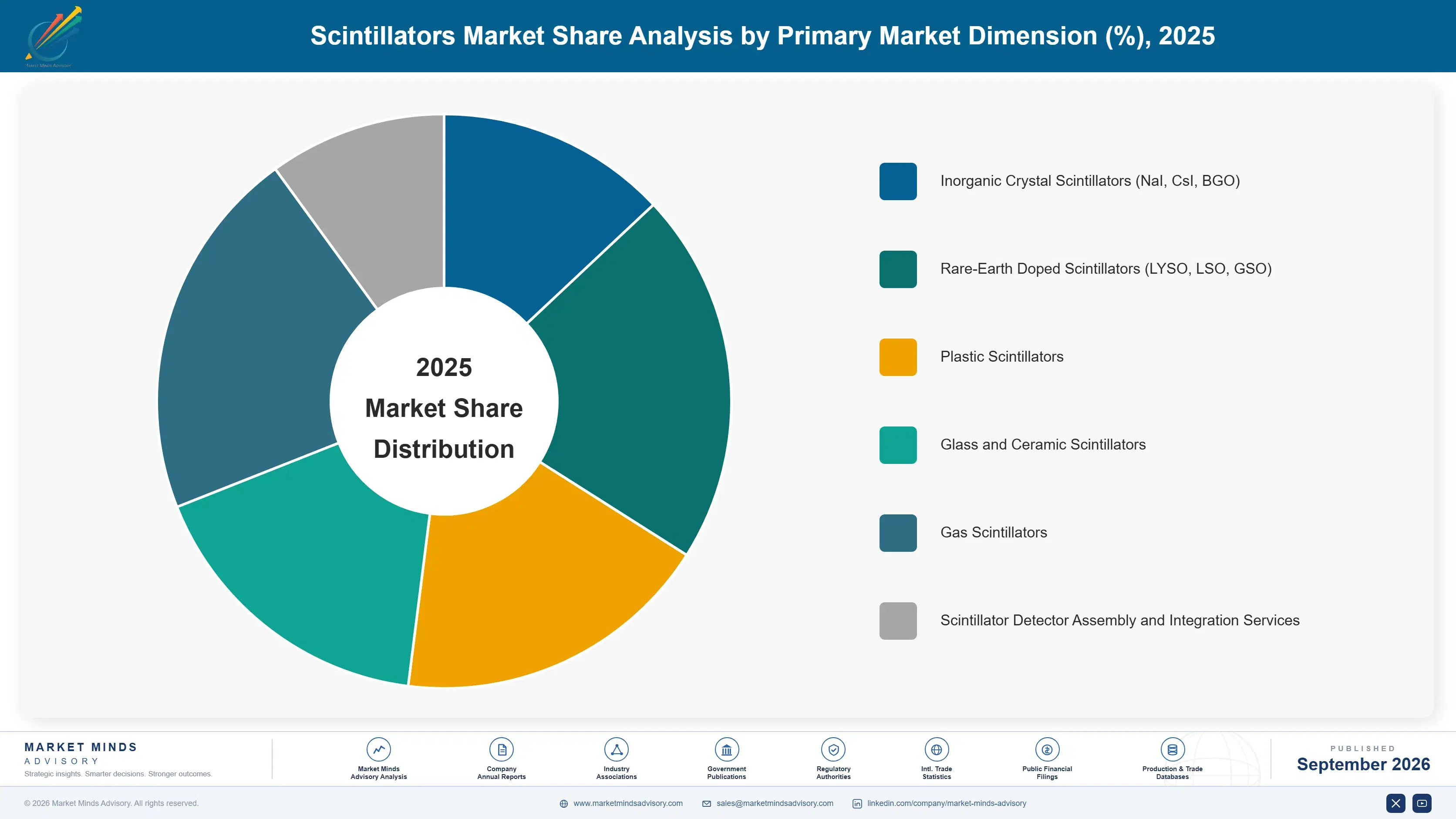
The Scintillators Market segments by material composition, spanning traditional inorganic crystals through rare-earth doped compounds, plastic, glass, ceramic, and gas scintillators, plus detector assembly and integration services serving medical, security, and industrial buyers worldwide and quite consistently. Rare-earth doped and glass scintillator segments are pulling ahead of legacy crystals as diagnostic imaging demand grows.
scintillators-market-market-share-analysis-1788417450581

Rare-Earth Doped Scintillators (LYSO, LSO, GSO)

Rare-earth doped scintillators including LYSO, LSO, and GSO represent the fastest-growing segment, expanding at 9.0% annually as PET scanner manufacturers standardize new product specifications around these materials rather than legacy bismuth germanate and sodium iodide detector crystals used in older imaging equipment generations still in wide service today. This segment benefits directly from superior light output and faster decay time properties that meaningfully improve diagnostic image resolution and patient scan throughput, characteristics increasingly demanded by radiology departments seeking to maximize equipment utilization. Adoption concentrates among premium medical imaging equipment manufacturers willing to pay substantial crystal price premiums that directly translate into measurable clinical diagnostic performance improvements for patients undergoing scans.
CAGR 9.0%

Glass and Ceramic Scintillators

Glass and ceramic scintillators form the second-fastest segment, growing at 7.5% annually as manufacturers seek alternatives to traditional crystal growth processes that offer comparable performance characteristics at potentially lower production cost and greater manufacturing flexibility across varied detector geometries and equipment designs used broadly today and internationally as well. This segment benefits from ongoing materials science research that continues narrowing the performance gap between glass and ceramic formulations and traditional single-crystal scintillator materials used predominantly in premium diagnostic applications. Demand concentrates among manufacturers seeking cost-effective alternatives for large-area detector applications where traditional single-crystal growth processes prove economically impractical at the manufacturing scale required for these specific product categories and applications.
CAGR 7.5%
Full segment breakdown across 6 segments available in the complete report.

Regional Architecture and Country Demand Map

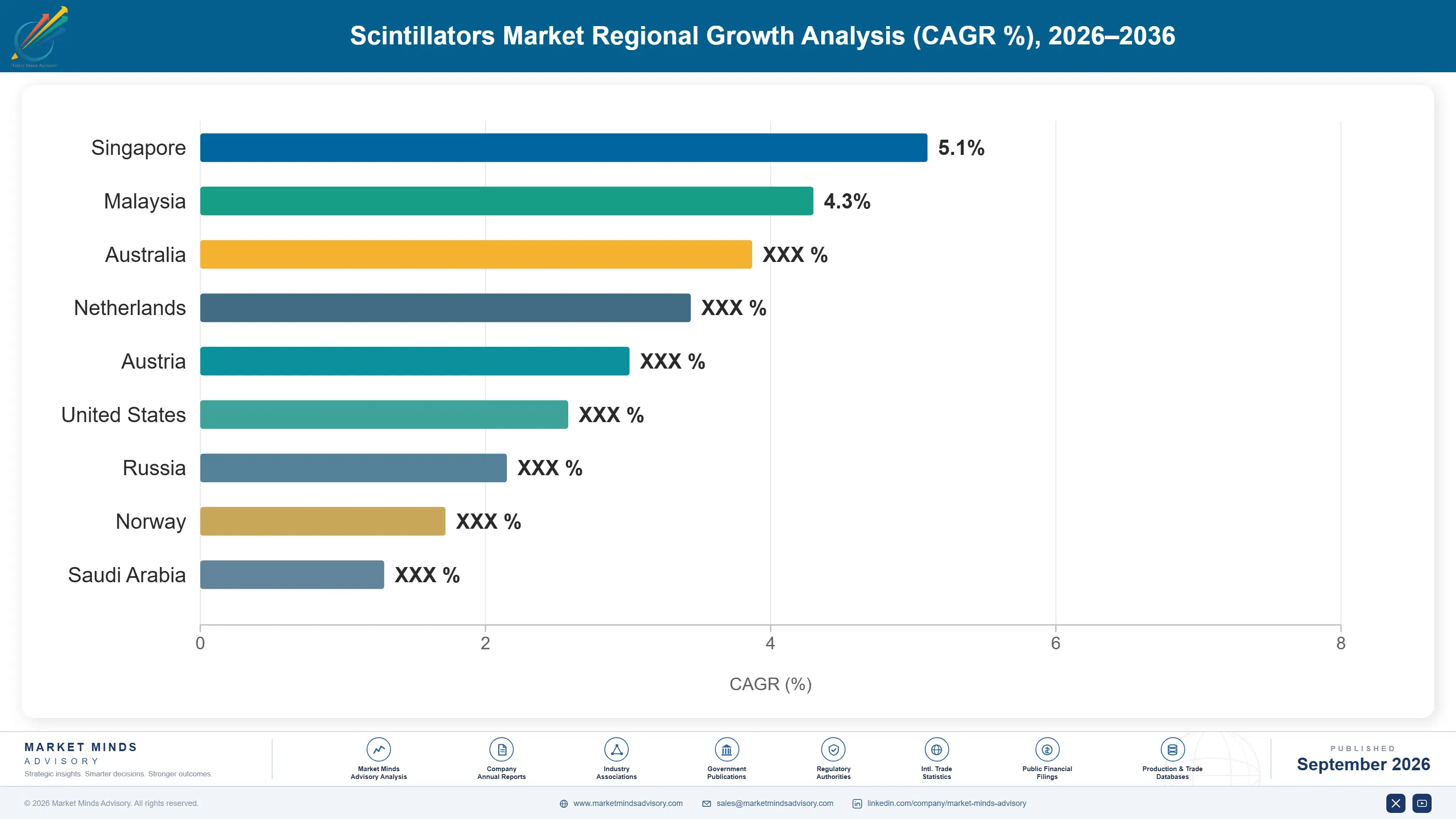
North America leads the Scintillators Market given Luxium Solutions and Radiation Monitoring Devices' domestic presence alongside a large installed base of diagnostic PET imaging equipment found consistently nationwide today, while East Asia follows closely behind through Hitachi Metals and Hamamatsu Photonics quite steadily each year.

North America

The United States hosts Luxium Solutions, spun off from Saint-Gobain's crystal growth division, alongside Radiation Monitoring Devices and Mirion Technologies, giving domestic manufacturers direct access to the world's largest installed base of PET and other diagnostic imaging equipment requiring premium scintillator crystals. American healthcare spending and reimbursement policy sustain substantial diagnostic imaging equipment replacement and new installation demand that anchors baseline domestic manufacturer revenue considerably. Canada contributes a smaller but meaningful base of demand tied to its own national healthcare system's diagnostic imaging infrastructure investment. This concentration explains why roughly 31% of global scintillator manufacturing revenue originates from United States-headquartered operators specifically, well above the country's overall share of global manufacturing activity.
Share: 31% | CAGR: 7.0% (2026 to 2036)

Western Europe

France hosts Saint-Gobain Crystals' historical headquarters and continued research and development operations, even though its commercial crystal production has partly transitioned to Luxium Solutions following the 2022 corporate divestiture and restructuring. Germany and the United Kingdom contribute meaningful diagnostic imaging equipment manufacturing demand through Siemens Healthineers and other major medical device companies headquartered in the region requiring scintillator crystal supply. The Netherlands hosts Scionix, a specialty scintillator detector assembly manufacturer serving both medical and industrial radiation detection customers across European and international markets. Growth here trails North America somewhat given the region's more gradual diagnostic imaging equipment replacement cycles relative to American healthcare spending patterns and reimbursement structures overall and quite consistently.
Share: 20% | CAGR: 5.5% (2026 to 2036)
Regional intelligence for 5 additional markets available in the complete report: East Asia, South Asia and Pacific, Latin America, Middle East and Africa, Eastern Europe. Contact sales@marketmindsadvisory.com.
scintillators-market-country-cagr-analysis-1788417451093

How Manufacturers Extract Value Beyond Raw Crystals

Manufacturers expand revenue beyond raw crystal sales by pricing vertically integrated detector modules at premium rates, bundling calibration and service contracts into multi-year equipment agreements, licensing crystal growth technology to a broader base of smaller competitors, and selling recycling and rare-earth recovery services to industrial buyers specifically at each annual full contract renewal cycle.

Vertically Integrated Detector Module Pricing Model

Manufacturers increasingly bundle crystal growth with photodetector assembly and detector module manufacturing, capturing integration value that previously went to separate third-party assemblers unfamiliar with the specific calibration requirements each crystal batch demands for optimal performance across varied clinical use cases and imaging equipment types. These integrated modules typically carry pricing 25% above comparable raw crystal sales, reflecting the engineering value of pre-tested, calibrated assemblies that reduce integration risk for imaging equipment manufacturers purchasing finished detector components. This premium tier now anchors baseline revenue for manufacturers with established detector assembly capability specifically.
Market Impact: Integrated modules price 25% above raw crystal costs

Multi-Year Calibration and Service Contract Bundling

Manufacturers increasingly bundle ongoing calibration and maintenance service directly into multi-year equipment supply agreements, capturing service revenue that previously went to independent third-party calibration providers unfamiliar with manufacturer-specific crystal performance characteristics and degradation patterns over extended operational periods spanning many years of continuous clinical service, use, monitoring, calibration, and maintenance work. This bundled approach has lifted average contract value by roughly 20% compared to hardware-only sales, since hospital systems value having a single accountable vendor responsible for both crystal quality and ongoing performance verification across the equipment's full operational lifetime.
Market Impact: Service bundling lifts contract value roughly 20% overall

Crystal Growth Technology Licensing to Competitors

Established manufacturers increasingly license their proprietary crystal growth process technology to smaller competitors seeking to enter premium rare-earth doped crystal production without matching the decades of accumulated process engineering investment required to develop comparable technology independently from scratch over many years of dedicated internal research and development. This licensing arrangement lets technology leaders monetize accumulated crystal growth expertise well beyond direct sales alone, capturing royalty revenue on production volume from licensees who lack comparable in-house engineering capability. Technology licensing revenue already represents roughly 7% of total industry revenue currently reported industry-wide.
Market Impact: Technology licensing already adds roughly 7% of revenue

Rare-Earth Recovery and Recycling Services for Buyers

Manufacturers sell rare-earth material recovery and recycling services specifically to hospital systems and industrial buyers replacing older scintillator detectors, capturing value from decommissioned crystals containing valuable rare-earth materials that would otherwise be discarded as waste rather than reprocessed into new production and future manufacturing use. These recovery services typically carry gross margins roughly 2 times higher than standard crystal sales, since the underlying rare-earth material already exists within decommissioned units at essentially no incremental extraction cost beyond processing. Adoption concentrates among large hospital systems and government buyers facing rising environmental disposal regulation requirements.
Market Impact: Recovery services carry margins roughly 2x crystal sales

Who Controls the Margin Pool

Saint-Gobain Crystals, Luxium Solutions, Hitachi Metals, Hamamatsu Photonics, and Scionix together hold an estimated 52% combined share of tracked revenue, a moderate concentration reflecting the category's continued fragmentation across many specialty crystal growers and regional manufacturers. Luxium Solutions and Saint-Gobain lead through decades-long crystal growth expertise inherited from a shared corporate lineage, while Hitachi Metals and Hamamatsu compete through vertically integrated detector module manufacturing rather than raw crystal sales alone.
Competitive activity centers on rare-earth doped crystal quality and vertical integration capability, since imaging equipment manufacturers increasingly evaluate suppliers on light output consistency and detector module reliability rather than on raw crystal price alone. Manufacturers are racing to expand LYSO and LSO crystal production capacity, and several have begun forming strategic partnerships with imaging equipment makers to secure long-term supply commitments ahead of demand growth.

Pressure is building from Chinese manufacturer Epic Crystal, which continues expanding production capacity considerably and capturing meaningful share in cost-sensitive segments where premium Western crystal quality matters less than competitive pricing. Rankings could shift meaningfully if rare-earth material supply constraints intensify, since manufacturers with diversified or domestic rare-earth sourcing would gain a genuine cost and reliability advantage over competitors dependent entirely on Chinese processing capacity.
scintillators-market-company-positioning-matrix-1788417451612

Competitive Moat and Risk Dimensions

SAINT-GOBAIN CRYSTALS

Moat: Decades of Crystal Growth Expertise

Saint-Gobain's multi-decade accumulated expertise in crystal growth chemistry and process engineering gives it technical credibility that newer entrants cannot replicate quickly regardless of available capital or manufacturing investment. This expertise lets Saint-Gobain command premium pricing among research institutions and specialized applications that value proven reliability and consistent crystal quality over marginal cost savings from less-established competitors entering the category.
SAINT-GOBAIN CRYSTALS

Risk: Corporate Restructuring Uncertainty

Saint-Gobain's 2022 divestiture of much of its commercial crystal business to Luxium Solutions has created some customer uncertainty about long-term product roadmap continuity and research and development investment commitment going forward. If this restructuring uncertainty persists among key research and specialized industrial customers, Saint-Gobain risks losing accounts to competitors offering clearer long-term strategic commitment and product roadmap visibility.
LUXIUM SOLUTIONS

Moat: Inherited Commercial Crystal Production Scale

Luxium Solutions inherited Saint-Gobain's commercial crystal production infrastructure and customer relationships following the 2022 divestiture, giving it immediate manufacturing scale and established medical imaging customer accounts that a genuinely new entrant would need years to build independently. This inherited position lets Luxium compete immediately at meaningful scale in premium rare-earth doped crystal categories.
LUXIUM SOLUTIONS

Risk: Newer Identity Without Track Record

As a relatively new corporate entity separate from Saint-Gobain's established brand reputation, Luxium must independently prove its long-term reliability and commitment to customers who previously valued Saint-Gobain's decades-long track record specifically. This transition risk matters most for conservative institutional buyers like hospital systems that prioritize proven long-term vendor stability over other purchasing considerations.

Players Tracked

Prominent Players

Saint-Gobain Crystals
Luxium Solutions
Hitachi Metals
Hamamatsu Photonics
Scionix

Other Key Players

Epic Crystal
Advatech
Radiation Monitoring Devices
Mirion Technologies
Amcrys
Zecotek Photonics
Crytur
Alpha Spectra
CapeSym
Inrad Optics
Berkeley Nucleonics
Ludlum Measurements
Nihon Kessho Kogaku
Shanghai SICCAS High Technology
ScintiTech

Recent Developments

APRIL 2025

Luxium Solutions announced expanded production capacity for LYSO crystal manufacturing at its United States facility to meet growing demand from PET scanner manufacturers upgrading equipment specifications to rare-earth doped detector materials. The expansion reflects continued confidence in sustained medical imaging equipment demand growth through the current decade.
Signal: Confirms continued capacity investment by the newest major rare-earth crystal manufacturer entering this fast-growing category broadly.
AUGUST 2025

Hitachi Metals, operating under the Proterial brand, launched a new detector module product line integrating advanced crystal materials with improved photodetector coupling technology for next-generation PET scanner applications and clinical use cases. The launch strengthens Hitachi's vertically integrated manufacturing positioning against competitors selling raw crystals separately.
Signal: Signals continued momentum toward vertically integrated detector module manufacturing across the entire imaging industry more broadly.
DECEMBER 2025

Epic Crystal announced substantial new manufacturing capacity in China specifically targeting cost-sensitive scintillator crystal segments, expanding its addressable market beyond its traditional domestic Chinese customer base into international export markets. The expansion reflects growing Chinese manufacturing capability in premium crystal categories previously dominated by Western producers.
Signal: Reflects Chinese manufacturers steadily narrowing the technology gap in premium crystal production categories worldwide today too.

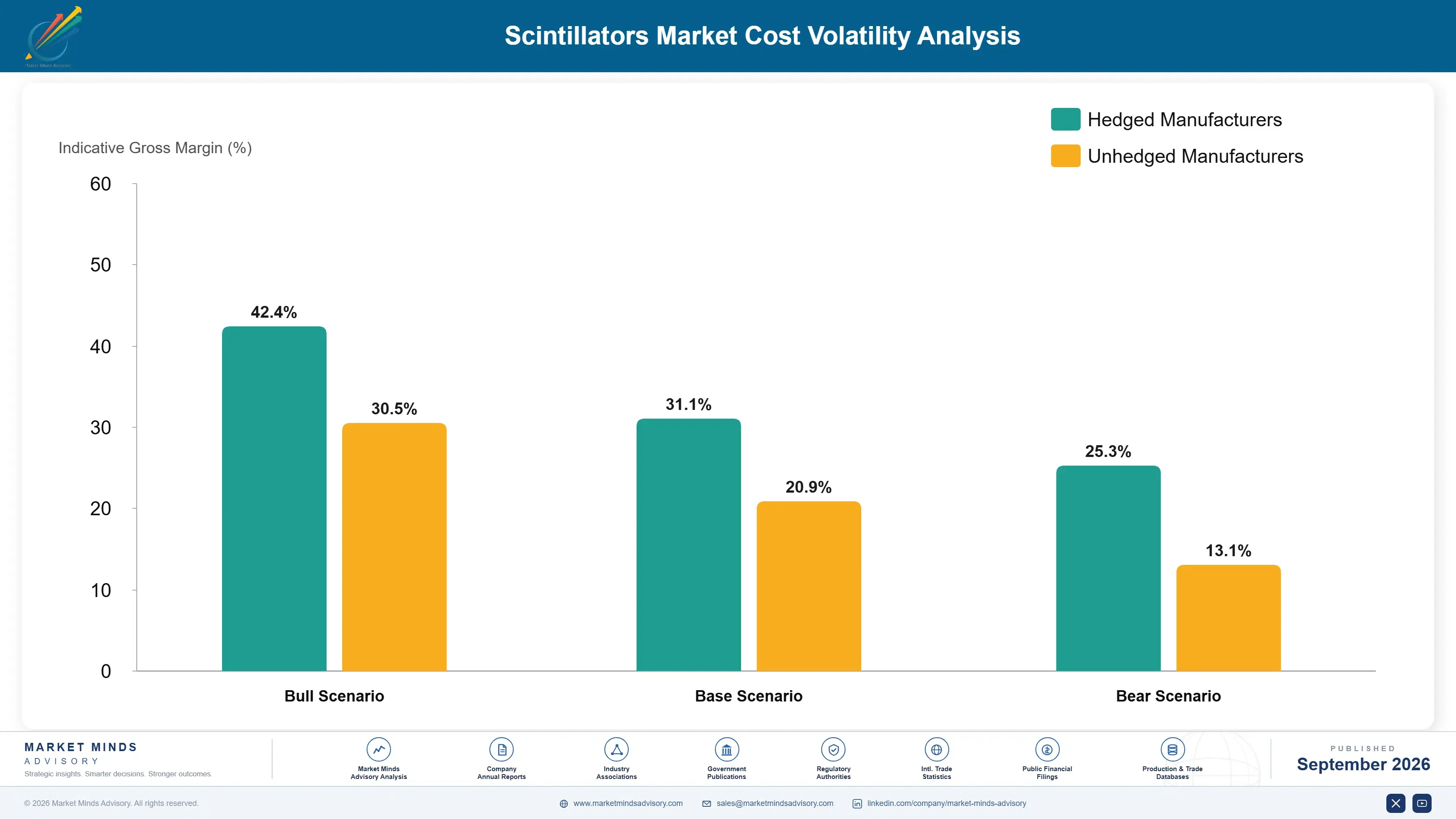
Rare-Earth Material Supply Cost Exposure

Scintillator manufacturers carry a materials-intensive cost structure dominated by high-purity raw material procurement, with rare-earth oxides and other specialty precursor chemicals representing roughly 30% to 40% of unit cost for premium crystal products, alongside crystal growth furnace energy consumption, precision cutting, optical polishing labor, and thorough final quality inspection processes required at every single stage.
Rare-earth material pricing volatility, documented across company annual reports and industry trade association publications, has fluctuated considerably as China periodically adjusts export quotas and processing capacity allocation affecting global lutetium and other doped crystal precursor availability. One manufacturer disclosed rare-earth material cost increases exceeding 35% during a period of tightened Chinese export policy, a margin hit that took several quarters to pass through given existing multi-year crystal supply agreements already signed at fixed pricing terms.

Manufacturers without direct rare-earth supplier relationships or long-term procurement agreements face a durable cost disadvantage against larger incumbents like Saint-Gobain and Luxium who negotiate favorable pricing through established, decades-long supply chain relationships built over considerable time. This dynamic concentrates cost advantage among manufacturers with the negotiating scale and supplier relationships needed to secure stable rare-earth material pricing regardless of periodic market volatility.
scintillators-market-cost-volatility-analysis-1788417451807

Diversified Rare-Earth Supplier Relationships

Manufacturers increasingly qualify multiple rare-earth material suppliers across different countries rather than depending entirely on Chinese processing capacity, letting them switch sourcing during supply disruptions or pricing disputes without halting crystal production entirely. This approach adds modest qualification cost but meaningfully reduces exposure to any single country's export policy decisions or processing capacity constraints.

Rare-Earth Recycling From Decommissioned Crystals

Manufacturers increasingly recover rare-earth materials from decommissioned scintillator crystals returned by hospital systems and industrial customers, reducing dependence on newly mined and processed rare-earth material for a meaningful portion of ongoing annual production needs across facilities. This approach favors manufacturers with established take-back and recycling infrastructure already built for other regulatory or customer service purposes.

Portfolio Architecture for Margin Defence

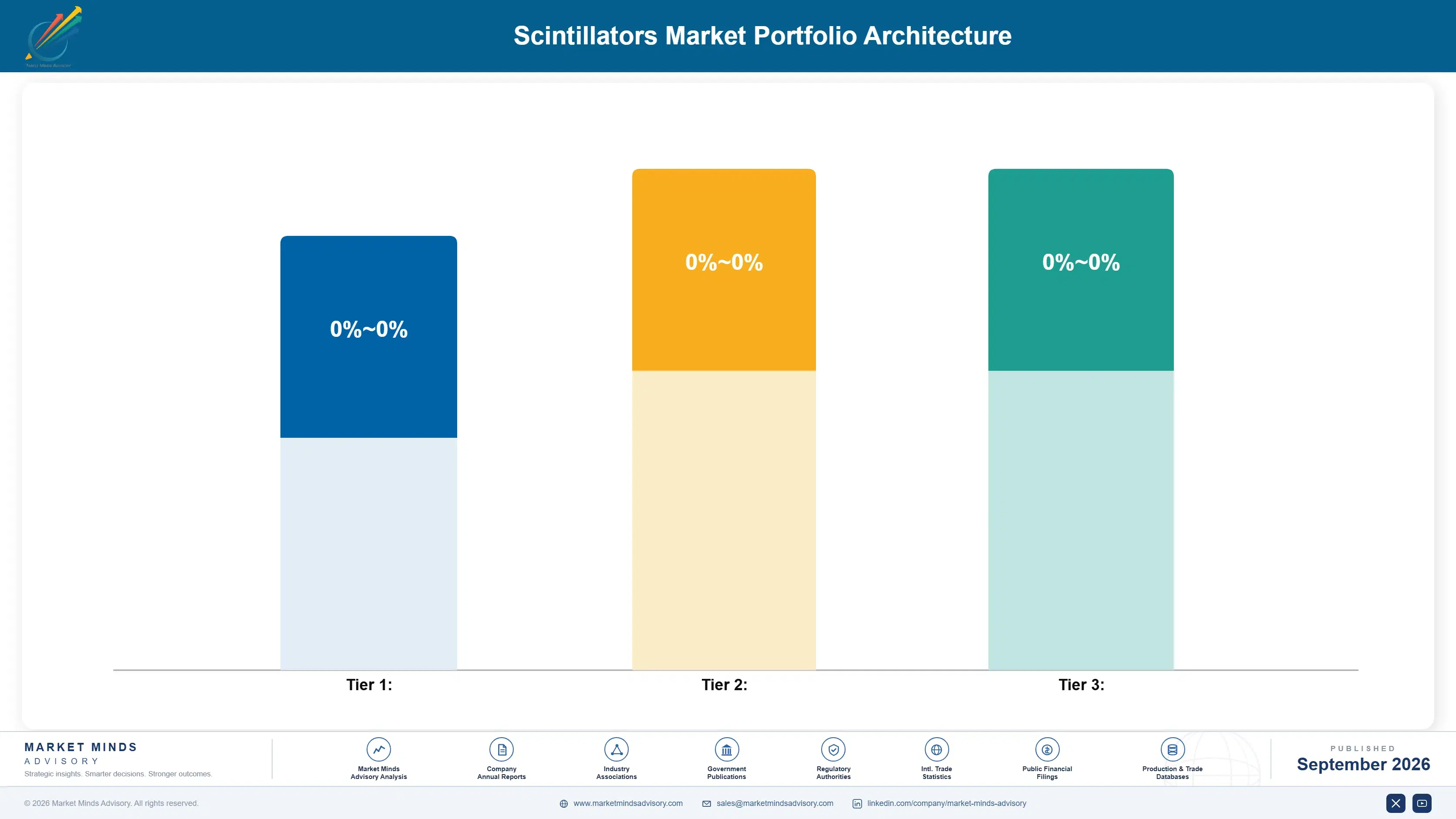
Scintillator material revenue organizes into three commercially distinct tiers separated by application criticality and technical differentiation rather than by manufacturer size alone. Volume tiers cover standard inorganic crystals sold into security and industrial applications, while premium tiers add rare-earth doped crystals serving medical imaging equipment. The newest tier bundles vertically integrated detector modules and recycling services commanding the steepest margins.
Gross margins vary considerably across tiers because standard inorganic crystals face price competition from an expanding pool of Chinese and regional manufacturers, while rare-earth doped crystals and integrated services carry differentiated technical capability that commands durable premium pricing from medical imaging equipment customers. Premium and next-generation tiers therefore capture disproportionate profit relative to their share of total crystal volume shipped.

High-value pools concentrate overwhelmingly in rare-earth doped crystal supply and vertically integrated detector modules rather than in commodity inorganic crystals, which face mounting price pressure from expanding Chinese manufacturing capacity entering cost-sensitive segments. The volume tier remains essential for maintaining overall manufacturing scale and security screening equipment relationships, but incremental profit growth increasingly comes from premium tier expansion and medical imaging demand rather than additional commodity crystal sales alone.

Standard inorganic crystals like sodium iodide sold into security screening and industrial applications facing intensifying Chinese manufacturing competition, priced with gross margins in the 20% to 30% range typically achieved.
Gross Margin

Rare-earth doped crystals like LYSO and LSO sold to PET scanner manufacturers under multi-year supply agreements, carrying gross margins between 40% and 50% as performance commands genuine premium pricing today.
Gross Margin

Vertically integrated detector modules and rare-earth recovery services commanding gross margins above 55% because software and service components carry favorable, near-fixed cost economics once fully established, validated, and consistently scaled.
Gross Margin
scintillators-market-portfolio-architecture-1788417452302

High-value Sub-segments and Strategic Watch-out

Rare-Earth Doped Scintillators (LYSO, LSO, GSO)

High-value and high-growth, this segment combines the fastest expansion rate in the market with the steepest pricing premiums as PET scanner manufacturers standardize new specifications around these superior materials nationwide and internationally, a trend expected to continue accelerating for many years and decades still to come across most markets.

Glass and Ceramic Scintillators

High-value with strong growth, glass and ceramic materials capture meaningful premiums through manufacturing flexibility even though adoption trails the fastest rare-earth doped segment considerably across most tracked application categories currently evaluated in this full study, ongoing analysis, and detailed report published in July 2026 broadly.

Inorganic Crystal Scintillators (NaI, CsI, BGO)

Volume core of the market, legacy inorganic crystals remain the largest segment by unit volume and the primary entry point for cost-sensitive buyers, though pricing power here continues eroding steadily each passing year across most tracked regions, countries, markets, territories, and customer segments broadly today.

Gas Scintillators

Strategic watch-out segment, growing steadily as specialized nuclear physics and radiation monitoring applications require gas-based detection, but facing uncertain long-term differentiation as solid-state alternatives improve performance considerably over time, scale, cost, overall reliability, durability, safety, and full regulatory compliance metrics tracked closely across most markets.

The Annuity Value of Imaging Contracts

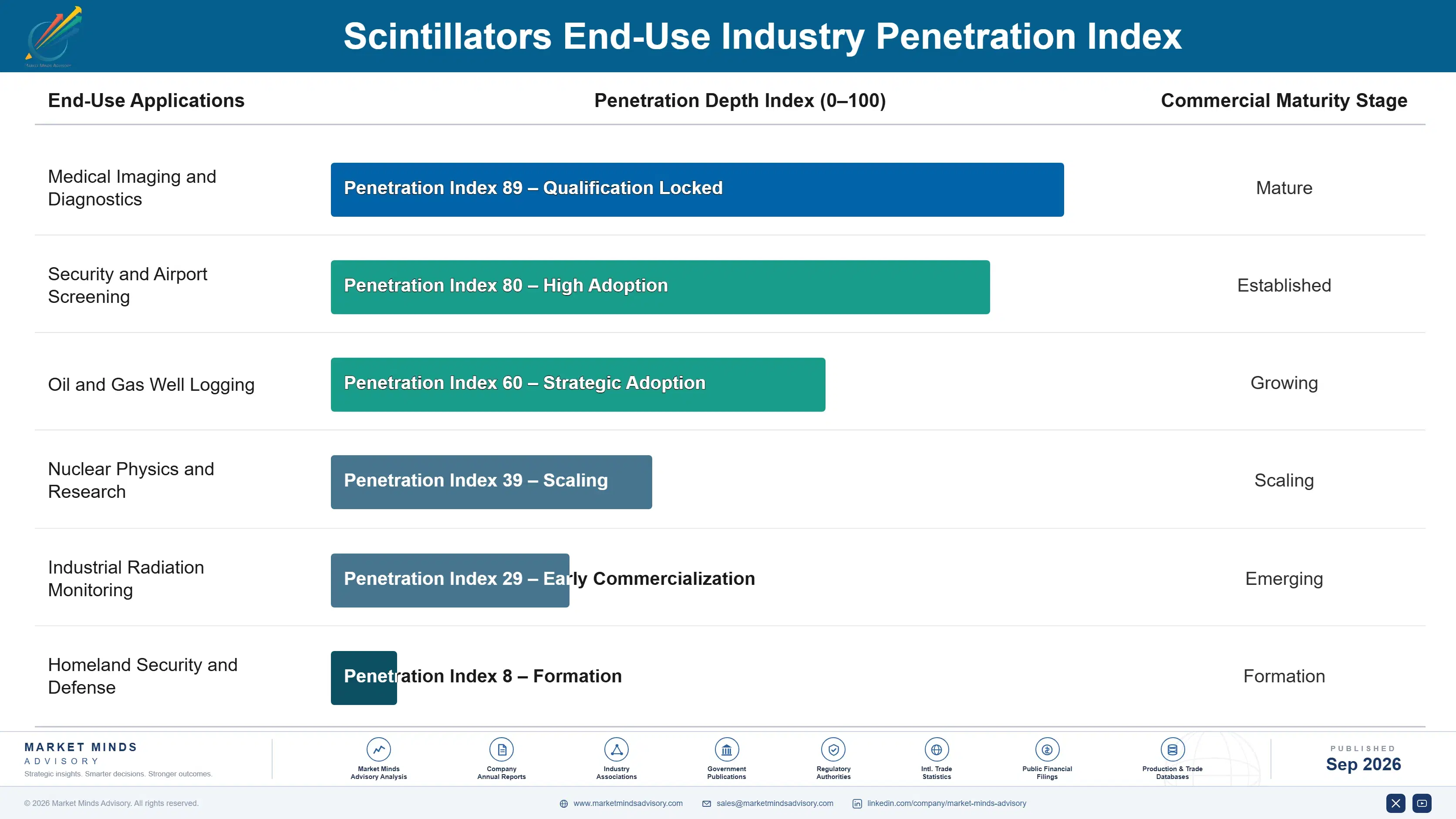
Scintillator revenue increasingly behaves like an annuity once multi-year equipment supply agreements with hospital systems and imaging equipment manufacturers are established, since switching crystal suppliers requires extensive requalification testing that customers cannot easily justify absent a severe quality issue or documented reliability failure. Contract renewal rates already exceed 75% at expiration, reflecting how deeply these relationships embed into hospital procurement and equipment lifecycle planning cycles.
Adoption stickiness varies considerably by end-use vertical across the industry and its many distinct customer segments worldwide. Medical imaging customers show the deepest dependency given extensive regulatory certification requirements and clinical validation needs, while security screening and industrial buyers show more price-sensitive, easily switched engagement given standardized specifications and abundant competing suppliers across multiple countries and manufacturers globally.

A generational shift is underway in who evaluates and purchases these materials. Hospital procurement officers increasingly evaluate crystal suppliers using diagnostic performance data and total cost of ownership analysis rather than purely upfront pricing comparisons common in earlier procurement decision processes. Younger biomedical engineering staff with materials science backgrounds now influence crystal selection decisions directly, reshaping how manufacturers position their products commercially.
scintillators-market-end-use-penetration-index-1788417452782

Where Manufacturers Should Focus Next

These are among the four positions where our research anticipates prominent divergence between winners and laggards over the coming forecast period. Each is grounded in the demand model, the regulatory perimeter, and the announced capacity pipeline.
01 / RARE-EARTH SOURCING DIVERSIFICATION

Diversify rare-earth suppliers before the next export restriction

China's dominant position in rare-earth processing capacity creates genuine supply chain vulnerability for manufacturers dependent entirely on Chinese sourcing for lutetium and other doped crystal precursor materials used in premium production. Manufacturers should qualify alternative rare-earth suppliers across multiple countries now, before the next export policy tightening cycle forces reactive scrambling that competitors with diversified sourcing already in place will not need to undertake at all. This diversification protects margin stability during periodic rare-earth pricing volatility episodes affecting the industry.
02 / VERTICAL INTEGRATION INVESTMENT

Pursue detector module integration rather than raw crystal sales

Vertically integrated detector module revenue already commands pricing 25% above comparable raw crystal sales, reflecting genuine customer preference for pre-tested, calibrated assemblies over separately sourced components requiring additional integration engineering work by equipment manufacturers themselves internally. Manufacturers currently selling only raw crystals should pursue detector module integration capability development, since this positioning captures meaningfully more value per unit of crystal material produced and shipped to customers directly. This investment matters most for manufacturers competing primarily on crystal quality alone today.
03 / RECYCLING INFRASTRUCTURE DEVELOPMENT

Build take-back and recycling infrastructure ahead of regulation

Environmental disposal regulation for decommissioned scintillator crystals containing rare-earth materials continues tightening across major markets, creating both compliance obligation and genuine commercial opportunity for manufacturers with established take-back infrastructure already in place and operational. Manufacturers should build recycling and rare-earth recovery capability now, ahead of regulatory mandates, since this positioning both reduces raw material cost exposure and differentiates manufacturers on environmental responsibility grounds increasingly valued by institutional buyers today. This investment requires modest capital relative to core crystal production infrastructure already established.
04 / MEDICAL IMAGING RELATIONSHIP DEPTH

Deepen hospital system relationships beyond transactional crystal sales

Medical imaging applications generate roughly 58% of total industry revenue and carry contract renewal rates exceeding 75%, making hospital system relationships the single most valuable and durable revenue category available to any manufacturer competing in this market currently. Manufacturers should invest in deepening these relationships through service contracts and calibration support rather than treating each transaction as a standalone crystal sale disconnected from the broader customer relationship over time. This approach protects against competitive displacement during equipment replacement cycles industry-wide.

Engagement Snapshot From the Field

A live engagement with an industry participant carrying material or product regulatory and market exposure ahead of a defining policy shift, showing how our research translates into a defensible multi-year portfolio strategy.
MARKET MINDS ADVISORY · CLIENT ENGAGEMENT SUMMARY
Scintillators Producer Strategic Portfolio Review and Transition Roadmap 2026·Investment Scenario on Scintillators Exposure Evaluation 2025-26
CLIENT PROFILE
A regional hospital network operating four diagnostic imaging centers had relied on aging PET scanners equipped with legacy bismuth germanate detector crystals for well over a decade without significant upgrades, facing growing physician complaints about scan times and image resolution quality compared to newer facilities using rare-earth doped crystal technology in the same metropolitan market.
STRATEGIC CHALLENGE
Leadership needed to evaluate whether upgrading to rare-earth doped crystal detector technology across all four imaging centers could meaningfully improve diagnostic quality and patient throughput, while facing significant capital budget constraints that made a simultaneous full-fleet replacement financially impractical given competing hospital capital investment priorities and pressing operational needs overall.
MMA APPROACH
MMA benchmarked three candidate scintillator crystal suppliers against the network's specific requirements for image resolution improvement, scan time reduction, and total cost of ownership across the full equipment lifecycle, then carefully modeled expected patient throughput and diagnostic quality improvement across a full, phased three-year replacement scenario spanning all four facilities.
KEY FINDINGS
  1. Rare-earth doped crystal upgrades reduced average scan times by roughly 25% compared to the network's legacy bismuth germanate equipment (client-reported, unverified by MMA) tested.
  2. Diagnostic image resolution improvements were most pronounced in oncology applications, where physicians reported meaningfully improved tumor boundary visibility (client-reported, unverified by MMA) consistently.
  3. Total cost of ownership analysis favored phased replacement over full-fleet simultaneous upgrade given available capital budget constraints (client-reported, unverified by MMA) identified.
  4. Patient throughput increased measurably at upgraded facilities, allowing the network to accommodate more daily diagnostic imaging appointments (client-reported, unverified by MMA) overall.
CLIENT PROFILE
A regional hospital network operating four diagnostic imaging centers had relied on aging PET scanners equipped with legacy bismuth germanate detector crystals for well over a decade without significant upgrades, facing growing physician complaints about scan times and image resolution quality compared to newer facilities using rare-earth doped crystal technology in the same metropolitan market.
STRATEGIC CHALLENGE
Leadership needed to evaluate whether upgrading to rare-earth doped crystal detector technology across all four imaging centers could meaningfully improve diagnostic quality and patient throughput, while facing significant capital budget constraints that made a simultaneous full-fleet replacement financially impractical given competing hospital capital investment priorities and pressing operational needs overall.
MMA APPROACH
MMA benchmarked three candidate scintillator crystal suppliers against the network's specific requirements for image resolution improvement, scan time reduction, and total cost of ownership across the full equipment lifecycle, then carefully modeled expected patient throughput and diagnostic quality improvement across a full, phased three-year replacement scenario spanning all four facilities.
KEY FINDINGS
  1. Rare-earth doped crystal upgrades reduced average scan times by roughly 25% compared to the network's legacy bismuth germanate equipment (client-reported, unverified by MMA) tested.
  2. Diagnostic image resolution improvements were most pronounced in oncology applications, where physicians reported meaningfully improved tumor boundary visibility (client-reported, unverified by MMA) consistently.
  3. Total cost of ownership analysis favored phased replacement over full-fleet simultaneous upgrade given available capital budget constraints (client-reported, unverified by MMA) identified.
  4. Patient throughput increased measurably at upgraded facilities, allowing the network to accommodate more daily diagnostic imaging appointments (client-reported, unverified by MMA) overall.
RECOMMENDED STRATEGY
Phase 1: Phase one upgraded the network's highest-volume imaging center first to maximize immediate patient throughput improvement benefits achieved most quickly and rapidly. Phase 2: Phase two extended rare-earth doped crystal upgrades to the remaining three imaging centers over the following two full budget years. Phase 3: Phase three established ongoing equipment performance monitoring to inform future crystal replacement timing across the entire hospital network system fully.
OUTCOME
The hospital network completed its phased PET scanner upgrade within budget and reported measurably improved scan times and diagnostic image quality across all four facilities overall and quite consistently throughout (client-reported, unverified by MMA), while accommodating meaningfully higher daily patient imaging volume across the network.

Frequently Asked Questions

Foundational context covering the market sizes, CAGR, scope, country, region and competition that inform every finding below. This section is provided to cover basics and most often pre-purchase conversations, answered from the MMA Primary Research Dataset.

What is the current size of the Scintillators Market?

The Scintillators Market reached an estimated $0.65 billion in global revenue in 2025. This figure covers inorganic crystal, rare-earth doped, plastic, glass, and gas scintillator materials sold for radiation detection applications.

How large will the Scintillators Market be by 2036?

MMA projects the market will reach approximately $1.30 billion by 2036, driven mainly by PET scanner installations and rare-earth doped crystal adoption. That represents roughly a 1.88 fold expansion from 2026 levels.

What is the CAGR for the Scintillators Market 2026 to 2036?

The market is forecast to grow at a 6.5% compound annual rate between 2026 and 2036. Bull and bear scenarios range between roughly 5.5% and 7.5% depending on medical imaging adoption pace.

Which segment is growing fastest?

Rare-earth doped scintillators including LYSO, LSO, and GSO lead all segments, expanding at an estimated 9.0% annually. That is well above the overall market's 6.5% average growth rate through 2036.

Who are the major companies in the Scintillators Market?

Saint-Gobain Crystals, Luxium Solutions, Hitachi Metals, Hamamatsu Photonics, and Scionix form the five leading manufacturers tracked in this report. Together they hold an estimated 52% combined share of tracked revenue.

Which country is growing fastest?

China posts the fastest national growth rate in the study, expanding at an estimated 9.5% annually. Its rapidly expanding domestic healthcare infrastructure and manufacturing capacity drive unusually rapid demand growth there.

Report Segmentation Architecture

The full report scope spans multiple orthogonal segmentation dimensions, with cross-tabulated demand data provided for each dimension pair. Coverage extends further to regional breakdowns, trend trajectories, and the competitive detail needed to support segment-level decision-making.

By Primary Market Dimension

  • Inorganic Crystal Scintillators (NaI, CsI, BGO)
  • Rare-Earth Doped Scintillators (LYSO, LSO, GSO)
  • Plastic Scintillators
  • Glass and Ceramic Scintillators
  • Gas Scintillators
  • Scintillator Detector Assembly and Integration Services

By End-Use Industry

  • Medical Imaging and Diagnostics
  • Security and Airport Screening
  • Oil and Gas Well Logging
  • Nuclear Physics and Research
  • Industrial Radiation Monitoring
  • Homeland Security and Defense

By Commercial Dimension

  • Direct OEM Procurement
  • Hospital and Healthcare System Contracts
  • Government and Security Agency Procurement
  • Distributor and Channel Sales

By Region

  • North America
  • Western Europe
  • East Asia
  • South Asia and Pacific
  • Latin America
  • Middle East and Africa
  • Eastern Europe

Scope, Methodology, and Coverage

Every figure in this report is reproducible from documented input assumptions. The scope below maps the historical period, the forecast horizon, the segmentation dimensions, and the countries covered, alongside the underlying primary and qualitative methodology.
Historical Period
2020 to 2025
Forecast Period
2026 to 2036
Base Year
2025 (USD billions; MMA Primary Research Dataset, September 2026)
Market Definition
The Scintillators Market covers materials that emit light when exposed to ionizing radiation, including inorganic crystals, rare-earth doped compounds, plastic, and glass scintillators, measured by material and detector assembly sales revenue. It excludes standalone photodetector components sold separately and complete imaging systems assembled from purchased scintillator materials.
Quantitative Units
USD Billion, CAGR (%), Share (%), 2020 to 2036
Segmentation Dimensions
By Primary Market Dimension; By End-Use Industry; By Commercial Dimension; By Region
Regions Covered
North America, Western Europe, East Asia, South Asia and Pacific, Latin America, Middle East and Africa, Eastern Europe
Countries Covered
United States, Canada, France, Germany, United Kingdom, Netherlands, Japan, China, South Korea, India, Australia, Thailand, Malaysia, Brazil, Mexico, Argentina, United Arab Emirates, Saudi Arabia, Israel, South Africa, Poland, Russia, Ukraine, and additional markets relevant to this sector.
Key Companies Profiled
Saint-Gobain Crystals, Luxium Solutions, Hitachi Metals, Hamamatsu Photonics, Scionix, Epic Crystal, Advatech, Radiation Monitoring Devices, Mirion Technologies, Amcrys, Zecotek Photonics, Crytur, Alpha Spectra, CapeSym, Inrad Optics, Berkeley Nucleonics, Ludlum Measurements, Nihon Kessho Kogaku, Shanghai SICCAS High Technology, ScintiTech
Quantitative Methodology
Primary survey, n=3,800 respondents, Q4 2025, six countries; demand-side model with trade association cross-validation
Qualitative Methodology
47 expert interviews, Q4 2025; applied to validate demand model assumptions, identify emerging dynamics, and assess competitive positioning
Report Format
PDF and XLSX data workbook (Word format preview document)
Publisher
Market Minds Advisory
Report Code
MMA-2026-CHM-611
Published
September 2026
Contact
sales@marketmindsadvisory.com | www.marketmindsadvisory.com

Purchase the full Scintillators Market Report (2026 to 2036).

This report delivers a comprehensive assessment of the global Scintillators Market, covering sizing, segmentation, and competitive dynamics across inorganic crystal, rare-earth doped, and glass material categories found worldwide. It examines regional manufacturing concentration, revenue diversification strategies, and rare-earth material cost exposure shaping manufacturer profitability through 2036 in considerable detail. The analysis draws on primary survey data, expert interviews, and company disclosures to size the opportunity precisely and rigorously. Buyers gain a structured view of where competitive advantage concentrates as medical imaging demand reshapes material priorities.
Ten-year market sizing and forecast model through 2036
Six-segment material-composition-based market breakdown and analysis
Seven-region manufacturing and demand concentration analysis
Competitive benchmarking of twenty tracked scintillator manufacturers
Rare-earth material supply cost exposure and mitigation assessment
Anonymized regional hospital network client engagement case study

Built For The People Who Decide

From boardroom strategy to bench-side execution, this report is read cover-to-cover by leaders shaping the next decade of their industry, turning demand scenarios, market dynamics and valuation benchmarks into decisions.
CXOs/ Presidents/ VPs/ Managers
M&A and Corporate Development
Strategy Teams and R&D Heads
Procurement and Product Directors
Regulatory and Compliance Leaders
Investor Relations and Equity Analysts