Market Minds Advisory
Japan Resveratrol Market

Japan Resveratrol Market: Fermentation Purity, Functional Claim Notification and a Domestic Formulator Base That Sets Its Own Standards

Fermentation-derived purity is displacing knotweed extraction across Japanese formulation, while the Foods with Function Claims notification regime rewards published human evidence in a way no other Asian market currently matches.

Lead Analyst

Lisa Gevelber

Published

September 2026

Make Smarter Decisions with Customized Research Insights

Request a free sample report and evaluate market opportunities, growth trends, and competitive dynamics relevant to your business needs.

2025 MARKET VALUE$0.1BMarket Size 2025
2036 FORECAST VALUE$0.3BBase Case , 2026 to 2036
CAGR 2026 TO 203610.2 %Bull 11.4% / Bear 9.0%
INCREMENTAL OPPORTUNITY$0.2BNet 10- year value creation
EXPANSION MULTIPLE2.64x2036 value over 2026 base
Strategic Levers
M&A Pipeline
Regional Outlook
Country Rankings
Competitive Intelligence
Segmental Deep-dive
Call-Us : 91 93563 13602

Executive Snapshot and Market Trajectory

Japan buys resveratrol differently from everywhere else, and the reason is a notification regime that rewards published human evidence rather than marketing assertion. Ingredient suppliers who understood that early are inside formulations today. Everybody else is still explaining specifications to a buyer who already has one in front of them.
Fermentation-derived material carries the growth on purity above 99% and the absence of emodin, which is the impurity plant extraction has never fully resolved. Foods with Function Claims formulations grow nearly as fast on a regime that transformed the category after 2015. East Asia holds essentially the entire market by definition, since this is a Japan-scoped report and every regional figure below reflects supply origin rather than consumption.
Concentration reads at 58% for the top five, which is high because few suppliers carry both the purity specification and the documentation Japanese formulators demand. Domestic ingredient houses hold advantages in relationship and quality expectation that imported material struggles against, and evidence rather than price is what moves a formulator to change a supplier here. Trading houses still intermediate much of the supply, though the larger formulators increasingly buy direct and run their own audits.
Market Definition
This market covers resveratrol ingredient supply into Japanese functional food, beverage, supplement and cosmetic formulation, spanning fermentation-derived trans-resveratrol, Japanese knotweed extract, grape and wine-derived material, and formulated resveratrol preparations. Finished consumer products sold at retail, other stilbene compounds including pterostilbene, and resveratrol supplied outside Japan are excluded from the sizing.
Base Year Value
$0.1B in 2025 (MMA Primary Research Dataset, August 2026)
Forecast Period
2026 to 2036, eleven discrete annual values
CAGR
10.2% base case. Bull 11.4%. Bear 9.0%.
Fastest Growth Segment
Fermentation-Derived Trans-Resveratrol: 15.3% CAGR
Fastest Growth Country
Japan: 10.2% CAGR
Fastest Growth Region
South Asia and Pacific: 12.5% CAGR
Largest Region
East Asia: 86% of 2025 global value
Market Leaders
DSM-Firmenich, Evolva, Oriental Yeast, Tokiwa Phytochemical and Maruzen Pharmaceuticals lead on resveratrol ingredient supply into Japan. Source: MMA Primary Research Dataset, July 2026.
Primary Survey
n=3,800 procurement and R&D decision-makers, Q4 2025, six countries
Methodology
Demand-side build-up, cross-validated against public data, 47 expert interviews

Resveratrol Market Forecast Scenarios

resveratrol-market-insights-in-japan-size-forecast-scenario-1787335645362
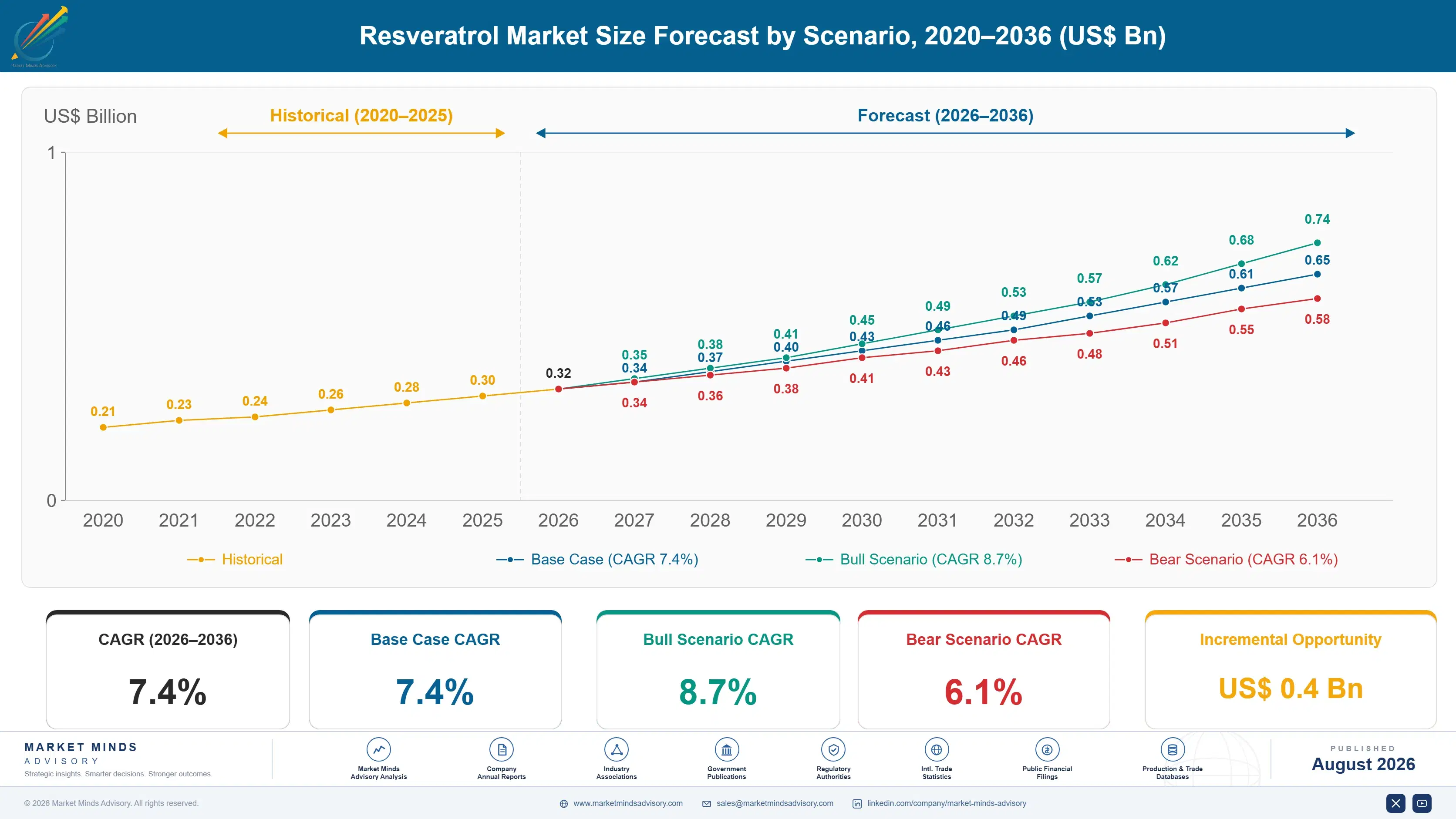
Between 2020 and 2025 the market grew at an estimated 6.6% historical CAGR, expanding steadily as wellness ingredient demand recovered and biosynthesis production technology matured across major specialty ingredient hubs throughout the historical period. Producers investing early in fermentation capability captured a disproportionate share of this accelerating demand base ahead of slower-moving extraction-only competitors across the wider industry.
The base case assumes 7.4% CAGR through 2036, anchored in three commercial mechanisms: expanding cosmetics anti-aging formulation demand across major developed and emerging markets requiring proportional resveratrol capacity, rising nutraceutical wellness investment sustaining base extraction demand, and growing formulator preference for biosynthesized purity over standard knotweed extraction alone. Rising pharmaceutical-grade research investment adds a further reinforcing tailwind across both mature and emerging ingredient markets worldwide, from established formulation hubs through fast-growing manufacturing regions.
A bull scenario, near 8.7% CAGR, assumes faster biosynthesis cost reduction and accelerated cosmetics formulation adoption pull premium ingredient orders forward across more application categories worldwide. The bear case, near 6.1% CAGR, assumes broader wellness capital spending tightens considerably and formulators extend existing knotweed extraction inventories rather than converting to biosynthesized formats on the standard formulation refresh cycle.

Evidence And Purity Decide Japanese Formulation

Japan is the most demanding resveratrol market anywhere and the reason is procedural rather than cultural. The Foods with Function Claims regime lets a company make a specific functional statement by filing a notification supported by published evidence, without the cost and delay of full Foods for Specified Health Uses approval. That single mechanism rewards ingredients carrying real human trial data.
TOP FIVE CONCENTRATION58%High, since few suppliers meet purity and documentation requirements together
FERMENTATION PURITY99.5%Trans isomer specification typical of engineered yeast fermentation routes
INGREDIENT PRICE$580 per kgTypical contract pricing for high purity trans isomer material
QUALIFICATION CYCLE16 monthsTypical time to qualify a supplier with a Japanese formulator
FUNCTION CLAIM SHARE44%Portion of volume entering notified functional claim product formulations
IMPORT DEPENDENCE71%Share of material sourced from outside the domestic supply base
Purity is where suppliers actually compete. Fermentation routes deliver trans-resveratrol above 99% with no residual emodin, the anthraquinone impurity that plant extraction has never fully resolved and that Japanese formulators treat as a genuine quality failure rather than an acceptable trace. Batch-to-batch consistency matters as much as the headline number, because specification deviation here is understood as a supplier problem rather than as normal variance.
Import dependence sits near 71%, which shapes commercial behaviour more than the figure suggests. Domestic ingredient houses hold relationship advantages and quality expectations that imported material must work to match, while overseas fermentation producers hold the purity position. Qualification takes roughly 16 months and formulators change suppliers rarely, so the contest is fought at the point of new product development rather than through displacement.
"Everyone selling into Japan talks about purity specifications. The suppliers who actually win are the ones who read the notification database and worked out which evidence gap their material could close."
Director, Functional Ingredients and Asia Nutrition Practice · MMA Nutraceutical Ingredients Practice · August 2026

Market Trends

Fermentation Routes Displace Knotweed Extraction In Premium Formulation

Engineered yeast fermentation produces trans-resveratrol above 99% purity with no residual emodin, and Japanese formulators treat that impurity as a quality failure rather than an acceptable trace. Extracted knotweed material has never fully resolved it. Fermentation also delivers identical specification every batch, which suits a market where deviation is understood as a supplier problem. Cost per kilogram remains above extracted material but the gap has narrowed considerably as capacity scaled, and premium applications have already moved. This segment now grows at 15.3% annually. Extraction is now defending the commodity end alone.
Market Impact: Domestic demand grows 10.2% annually
Notification Database Transparency Raises The Evidence Standard

Foods with Function Claims notifications are public documents, so any company can read exactly what evidence supported an accepted claim and build its own filing accordingly. That transparency has raised the evidence standard across the whole category faster than a regulator instruction ever could. Ingredients carrying published human trial data accumulate filings while those relying on mechanistic argument do not. Roughly 44% of Japanese resveratrol volume now enters notified functional claim products, and the share rises with each filing season. Mechanistic argument on its own no longer carries a filing at all.
Market Impact: Over 29% of population above sixty-five

Market Opportunities and Growth Drivers

Ingestible Beauty Habits Support Formulation No Other Market Matches

Japanese consumers have treated ingestible beauty products as ordinary daily routine for over two decades, which gives resveratrol a formulation home that simply does not exist at comparable scale elsewhere. Collagen drinks in convenience stores are normal rather than novel. Skin condition claims are among the better supported notification areas for the ingredient, and beauty formulation absorbs premium purity material at prices that functional food applications would resist. That combination keeps domestic demand growing at 10.2% annually. Convenience store distribution of functional beverages also reaches consumers no supplement channel ever touches at all.
Market Impact: Filings slow by 5 months typically

Ageing Population Sustains Functional Food Category Spending

Japan has the oldest population of any major economy and functional food spending among consumers over sixty is both high and habitual rather than occasional. Blood flow and vascular function claims sit well with that demographic, and resveratrol carries published evidence in the area. Purchase behaviour is also unusually loyal once established, with repeat rates well above Western equivalents, which makes formulation wins durable in a way that consumer marketing alone never produces. The demographic base is not going to reverse. Pharmacy and direct mail order both reach that demographic reliably.
Market Impact: Import share sits at 71%

Market Restraints and Challenges

Consumer Agency Scrutiny Threatens Notification Substantiation Standards

The Consumer Affairs Agency has increased scrutiny of Foods with Function Claims substantiation following incidents that damaged confidence in the regime, and any tightening raises the evidence bar for every ingredient at once. The root cause is that notification is self-declared rather than pre-approved, which was the whole point and is also the vulnerability. Commercially this puts filings at risk and slows the accumulation the market depends on. Participants are responding with stronger human trial investment, conservative claim wording, and legal review ahead of filing. Conservative wording costs less than a withdrawn filing.
Market Impact: Delivers purity above 99% consistently

Import Dependence Exposes Formulators To Supply And Currency Risk

Roughly 71% of resveratrol used in Japan is sourced from outside the domestic base, mostly from Chinese knotweed extraction and European or American fermentation capacity. The root cause is that domestic production economics have never justified building scale for an ingredient of this volume. Commercially this exposes formulators to yen movement and to supply decisions made overseas. Participants are responding with dual qualification of domestic and imported sources, longer contract terms, and inventory positions that Japanese formulators historically avoided carrying. Domestic capacity at any meaningful scale is not currently being built.
Market Impact: Notified products take 44% of volume
4 additional market trends, 2 additional growth drivers, and 3 additional restraints and challenges are covered in the full report. Contact sales@marketmindsadvisory.com to access the complete intelligence.

Segment CAGR and Growth Architecture

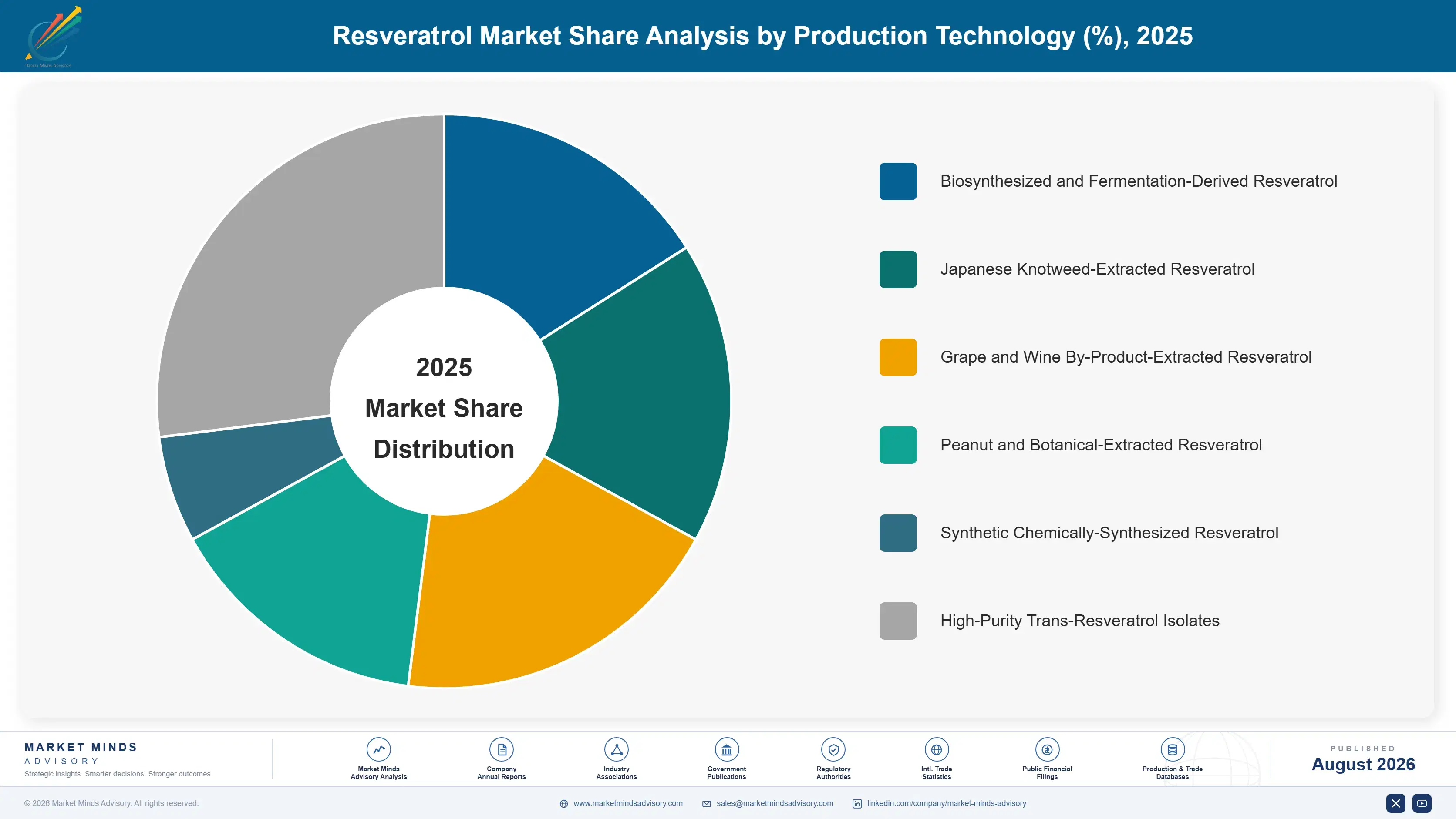
Five supply routes divide this market on how the resveratrol is actually produced rather than on where it ends up being used. Production route determines purity, impurity profile, batch consistency and cost position simultaneously, and those four factors decide which Japanese formulators will qualify a supplier at all. Route choice therefore precedes every other decision.
resveratrol-market-insights-in-japan-market-share-analysis-1787335645902

Fermentation-Derived Trans-Resveratrol

Growing at 15.3% and clearly the fastest part of this market. Trans-resveratrol produced by engineered yeast fermentation rather than extracted from Japanese knotweed root delivers purity above 99% with no residual emodin, which is the impurity that has caused Japanese formulators the most difficulty with plant-extracted material. Batch consistency is the commercial argument that actually wins here. Japanese quality expectations in functional ingredients are unusually demanding, and a fermentation route producing identical material every run suits a market where specification deviation is treated as a supplier failure rather than a normal variance. Cost per kilogram remains above extracted material, though the gap has narrowed considerably as fermentation capacity has scaled.
CAGR 15.3%

Functional Claim Formulation Grade

Growing at 12.4% on resveratrol supplied into Foods with Function Claims products, the notification-based regime that transformed this market after 2015 by letting companies make specific functional statements without the cost and delay of full Foods for Specified Health Uses approval. The regime rewards ingredients with published human trial evidence, and resveratrol carries enough of it to support notifications on skin condition and blood flow. Notification documents are public, which means competitors can see exactly what evidence supported an approval and build accordingly. That transparency has raised the evidence standard across the category faster than any regulator instruction could have managed on its own. Mechanistic argument on its own no longer suffices.
CAGR 12.4%
Full segment breakdown across 5 segments available in the complete report.

Regional Architecture and Country Demand Map

This is a Japan-scoped report, so East Asia holds essentially the entire market and every regional figure reflects supply origin rather than consumption. All seven regional shares therefore sit outside the standard global bands, with supply-side reasons given in each body below. Consumption sits entirely in Japan.

East Asia

Note: East Asia holds 86% because this is a Japan-scoped report and the region captures both the entire consumption base and the Chinese knotweed extraction that supplies most imported volume. Japanese formulators sit at the centre of it, running qualification processes of roughly 16 months and quality expectations that treat specification deviation as a supplier failure. Chinese extraction capacity in Shaanxi and Hubei supplies the bulk of plant-derived material at prices no other origin matches, though emodin content remains the recurring difficulty. Korean formulators buy to similar standards at smaller volume. Domestic Japanese ingredient houses hold relationship positions that imported material has to work considerably harder to displace. Korean volumes remain modest.
Share: 86% | CAGR: 11.1% (2026 to 2036)

Western Europe

Note: Western Europe registers at 6% purely as a supply origin, since consumption falls outside a Japan-scoped market. European fermentation capacity supplies high purity trans-resveratrol into Japanese premium formulation, and the regulatory documentation European producers carry as standard suits Japanese qualification requirements unusually well. Swiss and Danish producers hold most of the position. Novel food authorisation experience in Europe also produces the safety documentation packages Japanese formulators expect to receive without asking. Currency movement between the euro and the yen affects delivered pricing more than production cost does, which several formulators have addressed through longer contract terms. Delivered lead times from Europe run longer than Japanese formulators prefer to carry in inventory.
Share: 6% | CAGR: 8.4% (2026 to 2036)
Regional intelligence for 5 additional markets available in the complete report: North America, South Asia and Pacific, Latin America, Middle East and Africa, Eastern Europe. Contact sales@marketmindsadvisory.com.
resveratrol-market-insights-in-japan-country-cagr-analysis-1787335646436

Where Resveratrol Supply Earns In Japan

Four positions separate suppliers holding durable Japanese business from those quoting against price per kilogram: qualifying into formulations before a competitor is evaluated, funding human trial evidence the notification regime rewards, holding fermentation purity specification, and carrying documentation Japanese formulators expect without asking for it. The first two of those are the hard ones to copy.

Qualify Into Formulations Before Competitors Are Evaluated

Japanese formulator qualification takes roughly 16 months of specification work, stability testing, audit and documentation review, and once a supplier is inside a formulation it is rarely displaced because the formulator gains nothing and carries reformulation risk. Qualified suppliers realise 24% to 31% higher pricing than those quoting spot material, on volumes stable enough to plan production against. The contest is fought at new product development rather than through displacement, which means timing matters more than the offer does. Japanese formulators change suppliers reluctantly and very rarely without a specific cause.
Market Impact: Realises 31% higher pricing on qualified formulation volume

Fund Human Trial Evidence The Notification Regime Rewards

Foods with Function Claims filings require published human evidence, and notification documents are public so competitors can see precisely what supported an acceptance. Suppliers funding trials on their own material give formulators a filing route that generic literature cannot provide, and roughly 44% of Japanese volume now enters notified products. A single well-designed trial costs less than a year of commercial effort spent arguing without one, and the evidence does not expire once published. Formulators reading the public database can also see which claim areas remain commercially underserved by existing filings.
Market Impact: Opens the 44% of volume in notified products

Hold Fermentation Purity Above The Emodin Threshold

Japanese formulators treat residual emodin as a quality failure rather than an acceptable trace, and plant extraction has never fully resolved it. Fermentation material above 99% trans isomer with no detectable emodin commands roughly 35% premium pricing over extracted grades and reaches premium beauty and functional applications extracted material cannot enter at all. Capacity scale has narrowed the cost gap considerably, which means the premium now reflects genuine specification advantage rather than production scarcity. Formulators specify around the impurity rather than around the production route itself, which keeps the standard honest.
Market Impact: Commands roughly 35% premium over extracted material grades

Carry Documentation Japanese Formulators Expect Without Asking

Safety files, stability data, audit history and impurity profiling are assumed rather than requested in Japanese qualification, and suppliers who assemble them after being asked have usually already lost the evaluation. Building the documentation capability costs roughly 5% of revenue annually and takes years. What it buys is consideration by formulators who will not evaluate incomplete files at all, which is most of the commercially meaningful buyer base in this market. Suppliers assembling files on request signal inexperience with the market, which is itself read as a risk by the buyer.
Market Impact: Documentation capability costs roughly 5% of annual revenue

Who Controls the Margin Pool

Concentration reads at 58% for the top five measured on resveratrol ingredient supply into Japan, the basis used throughout this section, and it reflects documentation and purity capability rather than manufacturing scale. DSM-Firmenich and Evolva hold fermentation positions. Oriental Yeast, Tokiwa Phytochemical and Maruzen Pharmaceuticals bring domestic relationships and quality expectations that imported material must work hard to match. Nobody dominates on scale alone.
Competition runs on three fronts. Formulation qualification is the first and the most decisive, since displacement is rare and the real contest happens at new product development. Evidence supporting notification filings is the second, and it has become the practical route into functional claim products. Purity specification is the third, where fermentation and extraction routes are no longer genuinely comparable on quality.

Pressure arrives from two directions. Chinese extraction capacity continues supplying material at prices no other origin matches, which holds the commodity end of the market regardless of purity arguments. Separately, domestic Japanese houses are adding fermentation-sourced grades to their own ranges. Rankings will shift toward suppliers holding both proprietary trial evidence and fermentation specification rather than one alone. Both together is the position that will actually hold.
resveratrol-market-insights-in-japan-company-positioning-matrix-1787335646959

Competitive Moat and Risk Dimensions

DSM-FIRMENICH

Moat: Fermentation purity and documentation

Engineered yeast fermentation delivering trans isomer purity above 99% with no detectable emodin meets the specification Japanese formulators treat as a quality requirement rather than a preference. Regulatory documentation assembled as standard for European and American markets also satisfies Japanese qualification expectations without additional work, which shortens evaluation considerably against suppliers assembling files on request.
DSM-FIRMENICH

Risk: Cost position against extraction

Fermentation material still prices above Chinese knotweed extract, which holds the commodity end of Japanese demand where purity arguments carry less weight than delivered cost. Domestic Japanese ingredient houses also hold relationship positions built over decades that specification advantage alone does not overcome in a market where supplier change is genuinely rare.
ORIENTAL YEAST

Moat: Domestic relationships and expectations

Long-standing relationships with Japanese food, beverage and supplement formulators, combined with quality systems built to domestic expectations rather than adapted to them, produce a position imported suppliers spend years trying to reach. Proximity also supports the technical service and rapid response that Japanese formulators treat as part of the supply relationship rather than as an extra.
ORIENTAL YEAST

Risk: Limited fermentation production capability

Purity specification is moving toward fermentation-derived material and building that capability requires process capital and organism development experience a traditional ingredient house has had little reason to develop. Sourcing fermentation material from overseas producers to resell narrows the margin considerably and puts the supply position in somebody else's hands.

Players Tracked

Prominent Players

DSM-Firmenich
Evolva
Oriental Yeast
Tokiwa Phytochemical
Maruzen Pharmaceuticals

Other Key Players

Sabinsa
Laurus Labs
Xi'an Sost Biotech
Shaanxi Jiahe Phytochem
Hubei Yuancheng Saichuang
Bioriginal Food and Science
Ashland
Ajinomoto
Kaneka
Fuji Chemical Industries
Nagase and Company
Iwase Cosfa
Riken Vitamin
Nippon Shinyaku
Toyo Sugar Refining

Recent Developments

FEBRUARY 2025

Human trial published supporting skin condition notification filing

An ingredient supplier published a randomised human trial measuring skin condition outcomes on its own fermentation-derived material, giving Japanese formulators a filing route for Foods with Function Claims notification that generic published literature had not been sufficient to support on its own. Two formulators filed within six months.
Signal: Trial evidence on specific material rather than generic literature is what the notification regime now effectively requires
JUNE 2025

Fermentation capacity expansion targets Asian formulation demand

A fermentation producer commissioned additional trans-resveratrol capacity aimed at Asian functional ingredient demand, narrowing the cost gap against Chinese knotweed extraction that had been the principal argument for extracted material in price-sensitive Japanese applications. Commissioning completed ahead of the original published schedule, with output committed forward.
Signal: Capacity scale is closing the cost gap that kept extracted material commercially viable in Japanese formulation
OCTOBER 2025

Consumer agency tightens functional claim substantiation review

The Consumer Affairs Agency announced closer review of Foods with Function Claims substantiation following incidents that damaged confidence in the notification regime, raising the practical evidence bar for every ingredient filing at once rather than for any single category. Several filings were subsequently withdrawn voluntarily by their holders.
Signal: Self-declared notification remains the regime's strength and its vulnerability, and scrutiny raises evidence cost for everyone

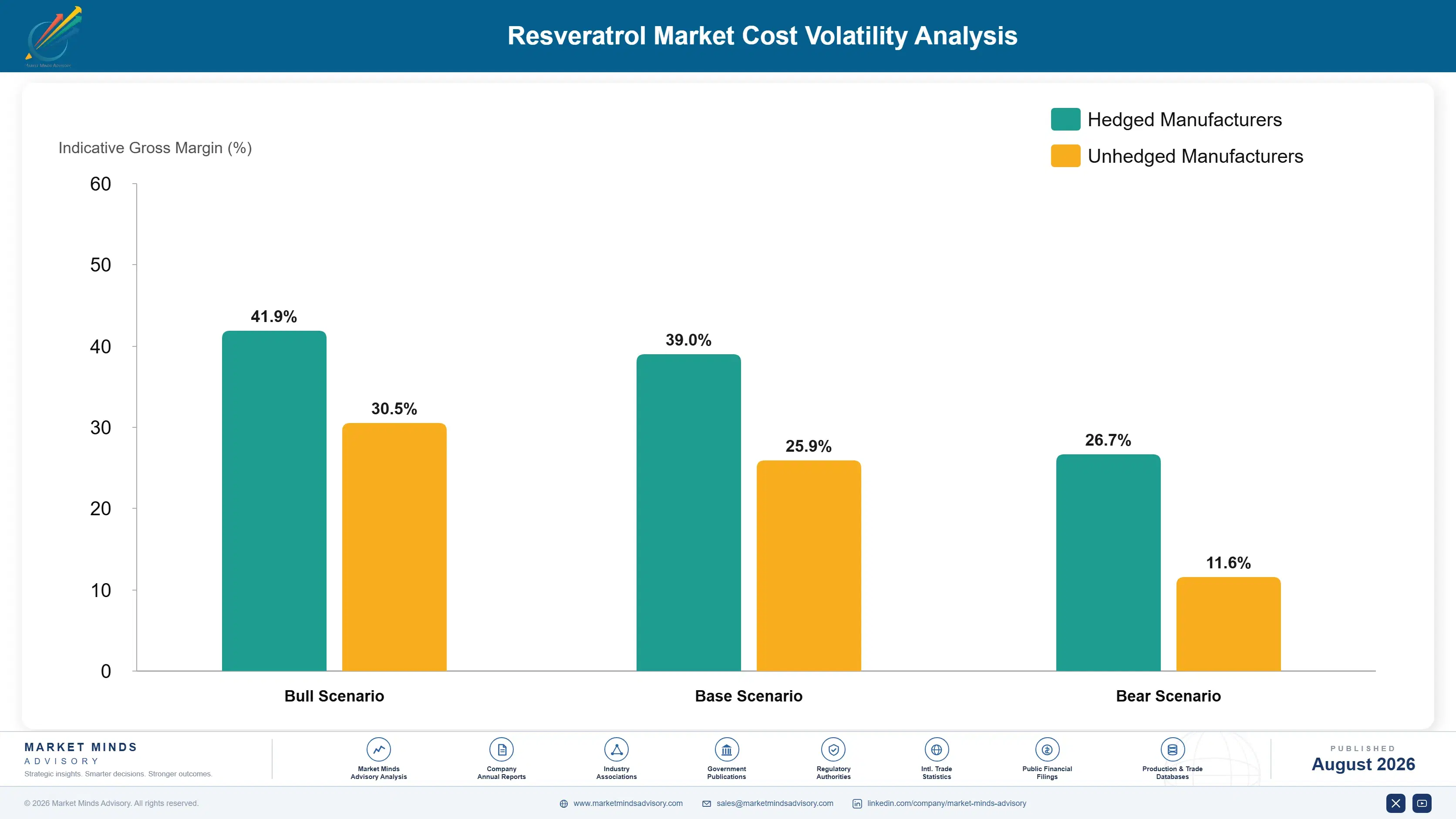
What Drives Resveratrol Supply Cost

For fermentation routes, feedstock sugars and fermentation media account for roughly 29% of manufactured cost while downstream purification and crystallisation add around 34%, which is where the purity specification is actually earned. Energy contributes about 12%. For extraction routes the shape differs entirely, with knotweed root raw material near 46% and solvent recovery and purification close to 27%. Documentation and quality systems add roughly 7% across both.
Chinese knotweed root pricing moved sharply through 2023 and 2024 on cultivation area shifts and environmental enforcement affecting extraction operations in Shaanxi and Hubei, which fed into extracted resveratrol pricing across export markets. Fermentation feedstock costs followed agricultural sugar markets tracked in United States Department of Agriculture data. Yen weakness through the same period raised delivered cost for Japanese formulators regardless of what happened at origin.

The disadvantage mechanism is currency combined with import dependence, and it falls entirely on the Japanese formulator rather than on the supplier. With roughly 71% of material imported, yen movement moves input cost directly and no domestic alternative exists at scale. Exposure varies by supply origin, since European material carries euro exposure while Chinese material carries a different currency and a different set of environmental compliance risks.
resveratrol-market-insights-in-japan-cost-volatility-analysis-1787335647155

Qualify domestic and imported sources in parallel

Dual qualification gives a formulator somewhere to move when currency, supply or quality problems hit a single origin, and Japanese formulators have historically been slower to do this than the import dependence justifies. Each additional source requires its own specification work, stability testing and audit history. The cost is qualification effort rather than material price, and it is paid once.

Contract in yen terms across multi-year supply agreements

Currency movement affects delivered cost more than production cost does for imported material, and contracting in yen shifts that exposure to the supplier who is better placed to hedge it across a wider book. Longer terms also secure allocation during the capacity tightness that periodically affects fermentation supply. Suppliers will price the risk in, which is the genuine cost here.

Specify purity thresholds rather than production route

Writing specifications around trans isomer content and emodin limits rather than around fermentation or extraction keeps the supplier base wider while holding the quality standard that actually matters. It also lets improved extraction routes compete if they reach the threshold. The risk is that batch consistency differs by route even at equal specification, which stability testing must establish.

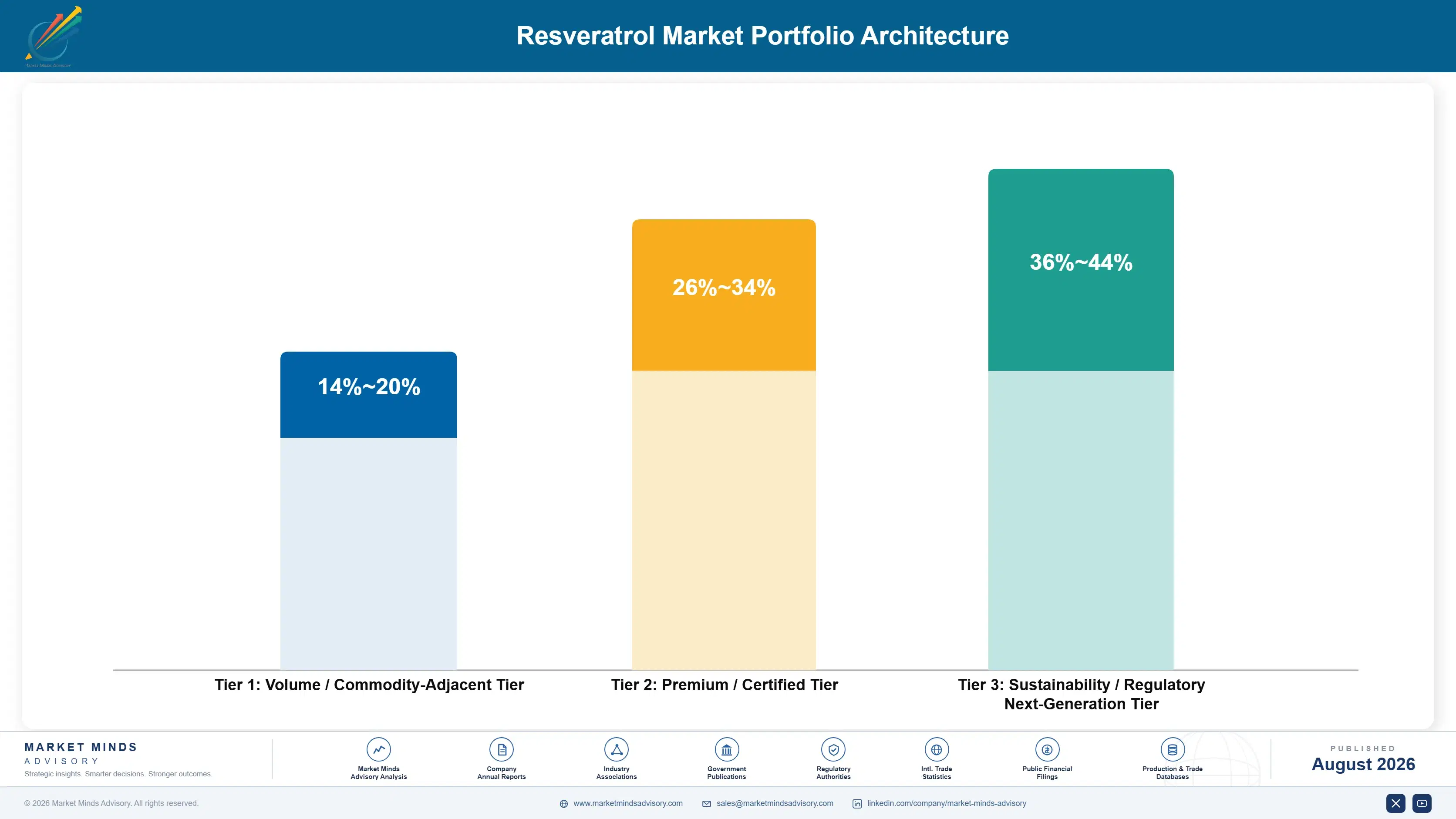
Portfolio Architecture for Margin Defence

Portfolio economics here divide on specification and evidence rather than on volume. Commodity extracted material sold on price per kilogram into non-claim applications competes against Chinese supply that no other origin matches on cost, and the buyer treats it as interchangeable because at that specification it genuinely is. Price is the only conversation available to anybody at that specification.
The middle tier is qualified fermentation material inside named formulations. Sixteen months of specification work, stability testing and audit produce a position rarely displaced, with realised pricing 24% to 31% above spot material and volumes stable enough to plan production against. Margins reach the high thirties and hold because formulators change suppliers reluctantly. Reformulation and refiling risk both work in the incumbent's favour.

Above both sits material supported by proprietary human trial evidence. A supplier funding its own trial gives formulators a notification filing route generic literature cannot provide, reaching the 44% of volume entering functional claim products, and margins reach the low fifties. That position requires clinical investment and regulatory understanding of a regime most overseas suppliers have never studied properly, which is precisely why so few hold it.

Volume / Commodity-Adjacent

Extracted material sold on price per kilogram into non-claim applications. The range reflects knotweed root cost and solvent recovery efficiency rather than anything the supplier controls, and buyers treat the material as interchangeable.
Gross Margin: 16 to 23%

Premium / Certified

Qualified fermentation material inside named Japanese formulations. The range reflects how deep the technical relationship runs and whether a second source sits qualified alongside in the same product. Displacement is rare.
Gross Margin: 34 to 42%

Sustainability / Regulatory / Next-Generation

Material supported by proprietary human trial evidence enabling notification filings. The wide range reflects how directly the trial supports a claim area and whether competitors can build on the published document.
Gross Margin: 47 to 57%
resveratrol-market-insights-in-japan-portfolio-architecture-1787335647655

High-value Sub-segments and Strategic Watch-out

Trial-Supported Notification Grade

High value and high growth together. Proprietary human evidence gives formulators a filing route generic literature cannot provide, reaching notified products entirely. The wide range reflects how directly the trial supports a specific claim area under review. Few overseas suppliers have studied that regime properly at all.
Gross Margin: 47 to 57%

Qualified Fermentation Material

High value on steady growth and the most defensible ordinary position. Sixteen months of qualification produces a formulation place rarely displaced. The range reflects technical relationship depth and whether a competing second source sits qualified alongside. Reformulation risk is what actually keeps these incumbents in place.
Gross Margin: 34 to 42%

Premium Beauty Formulation Supply

The volume core of premium demand, drawing on ingestible beauty habits no other market matches at this scale. The range reflects purity grade and whether the supplier holds a direct formulator relationship or sells through a trading house. Trading margin explains most of the pricing difference.
Gross Margin: 29 to 37%

Commodity Extracted Material

The strategic watch-out. Volumes are real but Chinese extraction holds a cost position no other origin matches, emodin content remains unresolved, and buyers treat the material as fully interchangeable. The range reflects root cost rather than commercial skill. Competing here means competing directly on Chinese extraction cost.
Gross Margin: 16 to 23%

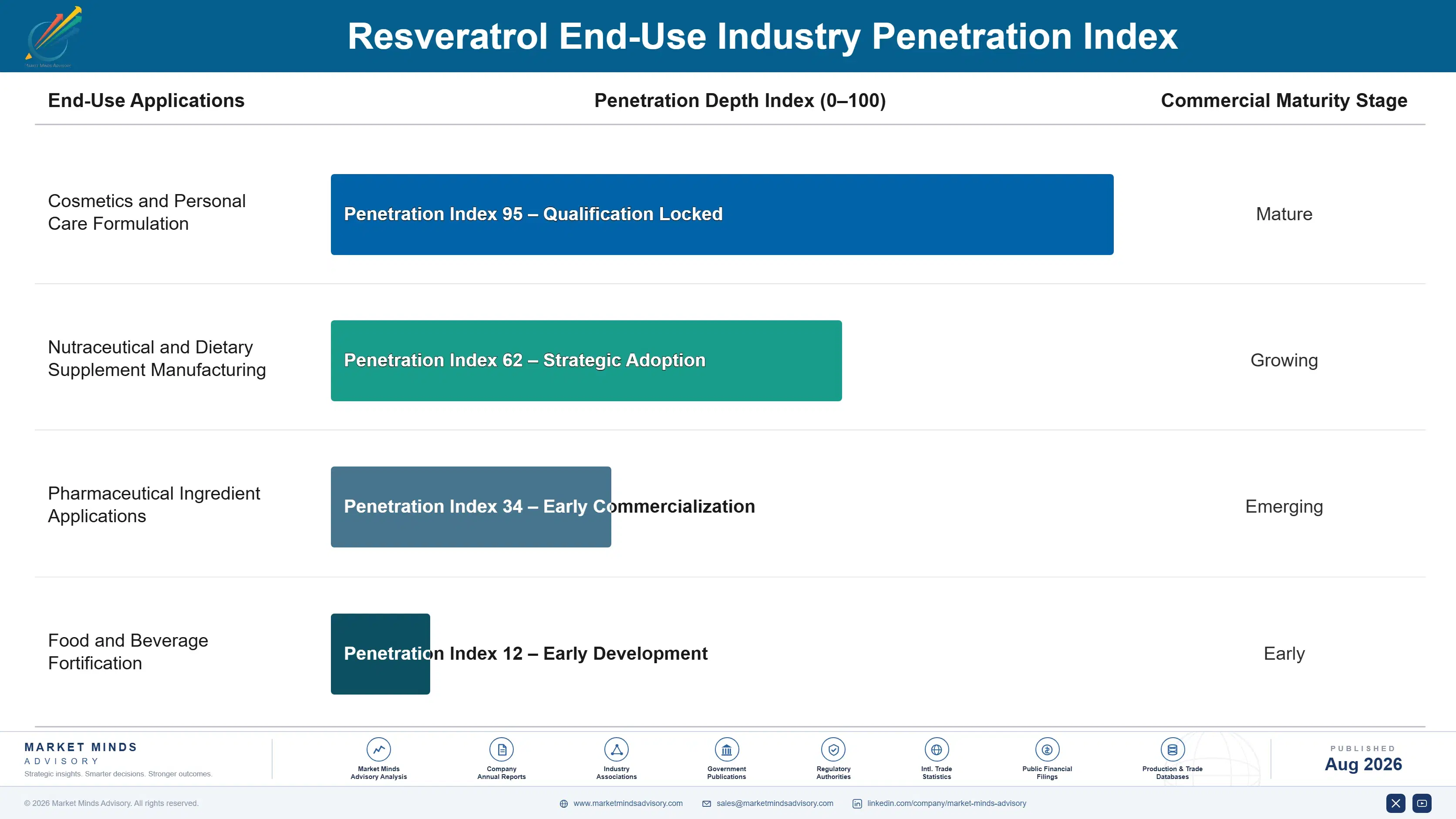
How Japanese Formulation Demand Repeats

Qualified formulation positions behave like annuities and very little else in this market does. Once a supplier sits inside a Japanese product formulation the volume repeats for as long as the product is made, which is often years, because the formulator gains nothing from switching and carries reformulation and refiling risk if the material behaves differently. Spot supply repeats only when somebody happens to need volume quickly.
Stickiness varies sharply by application. Notified functional claim products hold best, since the filing references specific evidence and changing material can require the notification to be revisited entirely. Premium beauty formulations hold well on purity specification. Non-claim functional food is considerably less sticky, because the specification is looser and price becomes the deciding factor once a purchasing manager rather than a formulator is making the call.

The buyer profile has shifted noticeably. Purchasing once ran through trading houses that intermediated most ingredient supply into Japan and held the formulator relationships. Larger formulators increasingly buy direct, running their own qualification and audit processes, which rewards suppliers able to service that relationship without an intermediary and disadvantages those whose Japanese presence exists only through a trading partner.
resveratrol-market-insights-in-japan-end-use-penetration-index-1787335648153

Where To Compete And Why

These are among the four positions where our research anticipates prominent divergence between winners and laggards over the coming forecast period. Each is grounded in the demand model, the regulatory perimeter, and the announced capacity pipeline.
01 / FORMULATION QUALIFICATION TIMING

Displacement is rare, development is not

Japanese formulator qualification takes roughly 16 months of specification work, stability testing, audit and documentation review, and once a supplier is inside a formulation displacement is genuinely rare because the formulator gains nothing and carries reformulation risk. Qualified suppliers realise 24% to 31% higher pricing than spot material on volumes stable enough to plan production against properly. The contest is therefore fought at new product development rather than through displacement, which makes timing matter considerably more than the commercial offer a supplier puts forward.
02 / NOTIFICATION EVIDENCE INVESTMENT

Public filings raise everyone's bar

Foods with Function Claims notifications require published human evidence and the filing documents are public, so competitors read exactly what supported each acceptance and build accordingly. Suppliers funding trials on their own material give formulators a route generic literature cannot provide, reaching the 44% of volume entering notified products, and that route is not available to competitors until they fund their own. A single well-designed trial costs less than a year spent arguing without one, and published evidence does not expire afterwards.
03 / PURITY SPECIFICATION HOLDING

Emodin is a failure, not variance

Japanese formulators treat residual emodin as a quality failure rather than an acceptable trace, and plant extraction has never fully resolved the impurity despite considerable effort across the industry. Fermentation material above 99% trans isomer with no detectable emodin commands roughly 35% premium pricing and reaches premium applications extracted grades cannot enter. Capacity scale has narrowed the cost gap, so the premium now reflects specification advantage rather than any production scarcity, which is a considerably more durable basis for a premium to rest on.
04 / DOCUMENTATION READINESS BUILDING

Files are assumed, not requested

Safety files, stability data, audit history and impurity profiling are assumed in Japanese qualification rather than requested, and suppliers assembling them after being asked have usually already lost the evaluation without being told so. Building that capability costs roughly 5% of revenue annually and takes years to assemble properly. What it buys is consideration by the formulators who will not evaluate incomplete files at all, which amounts to most of the commercially meaningful buyer base anywhere in this particular market.

Engagement Snapshot From the Field

A live engagement with an industry participant carrying material or product regulatory and market exposure ahead of a defining policy shift, showing how our research translates into a defensible multi-year portfolio strategy.
MARKET MINDS ADVISORY · CLIENT ENGAGEMENT SUMMARY
Japan Resveratrol Producer Strategic Portfolio Review and Transition Roadmap 2026·Investment Scenario on Japan Resveratrol Exposure Evaluation 2025-26
CLIENT PROFILE
A European fermentation-derived ingredient producer with annual revenue near $210 million (client-reported, unverified by MMA), supplying specialty actives into food, supplement and cosmetic formulators across Europe and North America. The business held strong fermentation capability and full European documentation, but Japanese sales ran entirely through a trading house and had not grown in three years.
STRATEGIC CHALLENGE
Japanese formulators were adopting fermentation-derived resveratrol steadily while the client's volume stayed flat, and management could not see where the material was actually going. The choice was between deepening the trading house relationship, building direct formulator coverage, or funding a human trial to support notification filings the client had never studied.
MMA APPROACH
MMA mapped Foods with Function Claims filings referencing resveratrol against the material grades and evidence each cited, benchmarked the client's documentation package against Japanese qualification expectations, and modelled realised pricing by relationship type. Eighteen expert interviews with Japanese formulators, trading house managers and regulatory consultants tested how supplier selection actually happens.
KEY FINDINGS
  1. Formulators buying through the trading house had no awareness of the client as a producer at all, and several named the trading house itself when asked who supplied their fermentation material.
  2. Direct-relationship suppliers realised roughly 27% higher pricing than the same material moving through intermediation, with the difference sitting almost entirely in the trading margin.
  3. Every notification filing examined cited human trial evidence on specific material, and none had been accepted on mechanistic argument or generic published literature alone.
  4. The client's European documentation package already met Japanese qualification requirements almost completely, which neither the client nor the trading house had ever established or communicated.
CLIENT PROFILE
A European fermentation-derived ingredient producer with annual revenue near $210 million (client-reported, unverified by MMA), supplying specialty actives into food, supplement and cosmetic formulators across Europe and North America. The business held strong fermentation capability and full European documentation, but Japanese sales ran entirely through a trading house and had not grown in three years.
STRATEGIC CHALLENGE
Japanese formulators were adopting fermentation-derived resveratrol steadily while the client's volume stayed flat, and management could not see where the material was actually going. The choice was between deepening the trading house relationship, building direct formulator coverage, or funding a human trial to support notification filings the client had never studied.
MMA APPROACH
MMA mapped Foods with Function Claims filings referencing resveratrol against the material grades and evidence each cited, benchmarked the client's documentation package against Japanese qualification expectations, and modelled realised pricing by relationship type. Eighteen expert interviews with Japanese formulators, trading house managers and regulatory consultants tested how supplier selection actually happens.
KEY FINDINGS
  1. Formulators buying through the trading house had no awareness of the client as a producer at all, and several named the trading house itself when asked who supplied their fermentation material.
  2. Direct-relationship suppliers realised roughly 27% higher pricing than the same material moving through intermediation, with the difference sitting almost entirely in the trading margin.
  3. Every notification filing examined cited human trial evidence on specific material, and none had been accepted on mechanistic argument or generic published literature alone.
  4. The client's European documentation package already met Japanese qualification requirements almost completely, which neither the client nor the trading house had ever established or communicated.
RECOMMENDED STRATEGY
Phase 1: Phase one: establish direct technical contact with the eight largest formulators, since documentation already meets requirements and the gap is purely awareness rather than capability. Phase 2: Phase two: restructure the trading house arrangement toward logistics and credit rather than relationship ownership, retaining coverage while recovering the pricing difference. Phase 3: Phase three: fund a human trial in a claim area the notification database shows to be underserved, opening filing routes competitors cannot follow immediately.
OUTCOME
The client established direct qualification with five formulators within fourteen months and lifted realised pricing by roughly 23% on that volume (client-reported, unverified by MMA). Japanese revenue grew by $6 million across the period, the trading house was retained for logistics only, and the human trial began recruiting in early 2026.

Frequently Asked Questions

Foundational context covering the market sizes, CAGR, scope, country, region and competition that inform every finding below. This section is provided to cover basics and most often pre-purchase conversations, answered from the MMA Primary Research Dataset.

What is the current size of the Japan Resveratrol Market?

The Japan resveratrol market was valued at $0.10 billion in 2025, reaching an estimated $0.11 billion in 2026. That measures ingredient supply into Japanese functional food, supplement and cosmetic formulation.

How large will the Japan Resveratrol Market be by 2036?

MMA forecasts the market reaching $0.29 billion by 2036, an increase of $0.18 billion over the 2026 base. That represents an expansion multiple of 2.64 times across the forecast period.

What is the CAGR for the Japan Resveratrol Market 2026 to 2036?

The base case compound annual growth rate is 10.2%, with a bull case of 11.4% and a bear case of 9.0%. Historical growth between 2020 and 2025 ran at 9.1% annually.

Which segment is growing fastest?

Fermentation-derived trans-resveratrol grows at 15.3%, a full 1.50 times the market rate, on purity above 99% with no residual emodin. Functional claim formulation grade follows at 12.4% annually.

Who are the major companies in the Japan Resveratrol Market?

DSM-Firmenich, Evolva, Oriental Yeast, Tokiwa Phytochemical and Maruzen Pharmaceuticals lead on ingredient supply into Japan. Together they account for roughly 58% of market value, which is high for a specialty ingredient.

Which country is growing fastest?

Japan is the defined scope of this report and grows at 10.2% annually, driven by notification filings, ingestible beauty formulation and an ageing population. No comparison country applies here.

Report Segmentation Architecture

The full report scope spans multiple orthogonal segmentation dimensions, with cross-tabulated demand data provided for each dimension pair. Coverage extends further to regional breakdowns, trend trajectories, and the competitive detail needed to support segment-level decision-making.

By Production Route

  • Fermentation-Derived Trans-Resveratrol
  • Japanese Knotweed Root Extract
  • Grape and Wine-Derived Material
  • Functional Claim Formulation Grade
  • Formulated Resveratrol Preparations

By End-Use Industry

  • Functional Food and Beverage
  • Dietary Supplements and Capsules
  • Ingestible Beauty Products
  • Topical Cosmetic Formulation
  • Clinical and Medical Nutrition
  • Pet and Animal Nutrition

By Commercial Dimension

  • Direct Supply to Formulators
  • Trading House Intermediated Supply
  • Contract Manufacturing Supply
  • Notified Functional Claim Products
  • Non-Claim Functional Applications

By Region

  • East Asia
  • Western Europe
  • North America
  • South Asia and Pacific
  • Latin America
  • Middle East and Africa
  • Eastern Europe

Scope, Methodology, and Coverage

Every figure in this report is reproducible from documented input assumptions. The scope below maps the historical period, the forecast horizon, the segmentation dimensions, and the countries covered, alongside the underlying primary and qualitative methodology.
Historical Period
2020 to 2025
Forecast Period
2026 to 2036
Base Year
2025 (USD billions; MMA Primary Research Dataset, August 2026)
Market Definition
This report covers resveratrol ingredient supply into Japanese functional food, beverage, dietary supplement and cosmetic formulation, spanning fermentation-derived trans-resveratrol, Japanese knotweed root extract, grape and wine-derived material, functional claim formulation grades, and formulated resveratrol preparations, across direct, trading house and contract manufacturing channels. Finished consumer products sold at retail, other stilbene compounds including pterostilbene and piceatannol, and resveratrol supplied into markets outside Japan are excluded from the sizing.
Quantitative Units
USD billions at supplier realised value; volume in tonnes; contract pricing in USD per kilogram.
Segmentation Dimensions
By production route; by end-use industry; by commercial dimension; by supply origin region.
Regions Covered
East Asia, Western Europe, North America, South Asia and Pacific, Latin America, Middle East and Africa, Eastern Europe
Countries Covered
Japan as the defined market, with supply origin coverage of China, South Korea, India, Australia, United States, Canada, Chile, Argentina, Switzerland, Denmark, Germany, France, Italy, Spain, Netherlands, Poland, Hungary, Turkey, Egypt and South Africa.
Key Companies Profiled
DSM-Firmenich, Evolva, Oriental Yeast, Tokiwa Phytochemical, Maruzen Pharmaceuticals, Sabinsa, Laurus Labs, Ashland, Ajinomoto, Kaneka, Fuji Chemical Industries, Nagase and Company, Riken Vitamin, Nippon Shinyaku and others.
Quantitative Methodology
Primary survey, n=3,800 respondents, Q4 2025, six countries; demand-side model with trade association cross-validation
Qualitative Methodology
47 expert interviews, Q4 2025; applied to validate demand model assumptions, identify emerging dynamics, and assess competitive positioning
Report Format
PDF and XLSX data workbook (Word format preview document)
Publisher
Market Minds Advisory
Report Code
MMA-2026-HLT-089
Published
August 2026
Contact
sales@marketmindsadvisory.com | www.marketmindsadvisory.com

Purchase the full Japan Resveratrol Market Report (2026 to 2036).

The full report sizes the Japan resveratrol market across five production routes, six end-use categories and seven supply origin regions, with tonnage and per kilogram pricing detail behind every value estimate. It profiles twenty companies on qualification position, evidence holdings and documentation capability. Chapters cover the Foods with Function Claims regime, filing history and substantiation practice in detail. Cost analysis quantifies fermentation and extraction economics separately by production route. Supply origin analysis maps import dependence, currency exposure and qualification barriers facing each producing region in turn.
Tonnage and per kilogram pricing by production route
Foods with Function Claims filing history and analysis
Qualification cycle benchmarking across Japanese formulators
Fermentation and extraction cost economics compared directly
Competitive position assessments across twenty companies
Import dependence and supply origin risk analysis

Built For The People Who Decide

From boardroom strategy to bench-side execution, this report is read cover-to-cover by leaders shaping the next decade of their industry, turning demand scenarios, market dynamics and valuation benchmarks into decisions.
CXOs/ Presidents/ VPs/ Managers
M&A and Corporate Development
Strategy Teams and R&D Heads
Procurement and Product Directors
Regulatory and Compliance Leaders
Investor Relations and Equity Analysts