Market Minds Advisory
Probiotic for Kids Market

Probiotic for Kids Market: A Daily Habit Sold on Acute Evidence

The strongest paediatric evidence covers two short acute episodes a child might have twice a year, and roughly seven in ten purchases are for something taken every single morning instead.

Lead Analyst

Lisa Gevelber

Published

September 2026

Make Smarter Decisions with Customized Research Insights

Request a free sample report and evaluate market opportunities, growth trends, and competitive dynamics relevant to your business needs.

2025 MARKET VALUE$2.7BMarket Size 2025
2036 FORECAST VALUE$7.4BBase Case , 2026 to 2036
CAGR 2026 TO 20369.6 %Bull 10.9% / Bear 8.3%
INCREMENTAL OPPORTUNITY$4.4BNet 10- year value creation
EXPANSION MULTIPLE2.50x2036 value over 2026 base
Strategic Levers
M&A Pipeline
Regional Outlook
Country Rankings
Competitive Intelligence
Segmental Deep-dive
Call-Us : 91 93563 13602

Executive Snapshot and Market Trajectory

Paediatric probiotic evidence is strongest in two acute situations: shortening infectious diarrhoea and preventing the diarrhoea that follows a course of antibiotics. Both are short, episodic and specific. Roughly 72% of purchases are for daily preventive use in healthy children instead. Positioning followed commerce rather than evidence.
Effects are also strain-specific rather than genus-specific, and only 38% of products name the actual strain rather than the species. A label reading Lactobacillus tells a parent nothing about whether the organism inside has any paediatric data behind it, which is a gap most of the category quietly depends on. Parents are beginning to learn the distinction, and brands already disclosing hold an argument the rest cannot make at all.
Format is where the money and the problem both sit. Children will not swallow capsules, so gummies took 31% of volume, and sugar and water activity leave roughly 21% of organisms viable at expiry. Infant drops grow fastest at 14.4%, half again the market rate of 9.6%, on paediatrician recommendation. East Asia holds 33% of value on a supplementation culture Western markets do not share. South Asia and Pacific sits above its band at 15%.
Market Definition
Probiotic supplements formulated and marketed for children from birth to adolescence, spanning infant drops and oil suspensions, powder sachets, gummies and chewables, chewable tablets, ready-to-drink beverages and sprinkle capsules, measured at retail and pharmacy selling value. Excludes probiotic strains and cultures sold as ingredients, infant formula containing probiotics, adult probiotic products, and fermented foods.
Base Year Value
$2.7B in 2025 (MMA Primary Research Dataset, August 2026)
Forecast Period
2026 to 2036, eleven discrete annual values
CAGR
9.6% base case. Bull 10.9%. Bear 8.3%.
Fastest Growth Segment
Infant Drops and Oil Suspensions: 14.4% CAGR
Fastest Growth Country
India: 13.2% CAGR
Fastest Growth Region
South Asia and Pacific: 11.8% CAGR
Largest Region
East Asia: 33% of 2025 global value
Market Leaders
BioGaia, Danone, Nestlé Health Science, Reckitt, Church and Dwight. Source: MMA Primary Research Dataset, July 2026.
Primary Survey
n=3,800 procurement and R&D decision-makers, Q4 2025, six countries
Methodology
Demand-side build-up, cross-validated against public data, 47 expert interviews

Probiotic for Kids Market Forecast Scenarios

probiotic-for-kids-market-trends-size-forecast-scenario-1787580968173
Growth ran near 8.4% between 2020 and 2025 as parental interest in immune support rose sharply through the pandemic period and did not fully retreat afterwards. Gummy formats expanded fastest through those years on convenience rather than on any performance argument. Paediatrician recommendation grew more slowly and more durably, concentrated in infant colic and antibiotic-associated situations where the evidence actually sits.
Base case 9.6% rests on three mechanisms. Paediatrician engagement with infant drops continues expanding, particularly around colic and antibiotic courses where recommendation is specific rather than general. Strain designation is becoming a competitive requirement as parents learn to check it. And Indian and Southeast Asian paediatric supplement spending is rising quickly with urban household income and with paediatric practice distribution. None of the three depends on general immunity positioning surviving scrutiny.
The bull case at 10.9% assumes strain-level evidence expands into further paediatric indications, which would convert marketing-led volume into recommendation-led volume at higher prices. The bear case at 8.3% is a regulator requiring strain-specific substantiation for paediatric claims, which would remove positioning from the majority of products currently on shelf rather than merely constraining it. Positioning rather than product would have to change.

Two Good Indications, One Daily Habit

The paediatric evidence base is narrow and reasonably solid where it exists. Specific strains shorten acute infectious diarrhoea by around a day and reduce the incidence of diarrhoea following antibiotic courses. Both are acute, short and infrequent. What the category actually sells is a daily supplement for healthy children, bought for general immunity and gut health, which is a different proposition resting on considerably thinner ground.
TOP FIVE CONCENTRATION29%Established brands lead a crowded field of specialist entrants
STRAIN DESIGNATION DISCLOSURE38%Products naming the specific strain rather than the species
GUMMY FORMAT SHARE31%Portion of paediatric volume sold in gummy presentation
PROFESSIONAL RECOMMENDATION SHARE26%Sales following a healthcare professional recommendation given directly
DAILY PREVENTIVE USE SHARE72%Portion bought for ongoing rather than acute episodic use
GUMMY VIABILITY AT EXPIRY21%Organisms surviving to expiry in sugar based formats
Strain specificity is the second gap and the easier one to check. Effects belong to particular strains rather than to a genus, so a product listing Lactobacillus without a strain designation is telling a parent nothing useful. Only 38% of paediatric products name the strain. Parents are beginning to learn this, and the brands that already disclose have an argument the rest cannot make.
Format drives both the volume and the trouble. Children will not reliably swallow capsules, so gummies took roughly 31% of the category on palatability alone, and gummies are a poor home for live organisms because sugar content and water activity both work against survival. Viability at expiry in gummy formats runs near 21%, against considerably better figures in drops and powders.
"A parent buying this is usually solving anxiety rather than a diagnosis, and the industry has been careful never to say so. The interesting companies are the ones building around the two indications where a paediatrician will actually recommend something, because that demand survives any change in the conversation."
Director, Paediatric Nutrition and Consumer Health Practice · MMA Healthcare and Nutrition Practice · August 2026

Market Trends

Paediatrician recommendation concentrating on specific indications

Paediatricians recommend probiotics for infant colic and around antibiotic courses far more readily than for general immune support, because those are the situations where strain-level trial evidence exists. That recommendation converts reliably and carries through a course rather than fading with a marketing campaign. Roughly 26% of category sales now follow a professional recommendation, and the share is considerably higher in infant drops than in any other format. Brands built around general wellness positioning cannot access that channel at all. Brands built on general wellness positioning cannot access that channel at all.
Market Impact: Ties demand to 2 clinical events

Strain designation becoming a checkable purchase criterion

Probiotic effects belong to specific strains rather than to a species or genus, and only 38% of paediatric products name the strain on pack. Parent-facing information sources increasingly explain the distinction, and brands disclosing full strain designation are beginning to use it as a point of difference. That is a comparison a competitor listing only a species cannot answer without reformulating or disclosing a strain with no data behind it. Retailer technical teams have started asking the same question. Retailer technical teams have started asking the same question of their own label suppliers.
Market Impact: Delivers 13.2% annual Indian growth

Market Opportunities and Growth Drivers

Antibiotic course prescribing creating episodic demand reliably

Paediatric antibiotic prescribing remains high across most healthcare systems, and antibiotic-associated diarrhoea is common enough that prevention has become a routine conversation between prescriber and parent. That produces episodic demand tied to prescriptions rather than to any marketing calendar, and it arrives with a recommendation attached. The demand is small per event and highly repeatable across a childhood. Pharmacies dispensing the antibiotic are the natural point of sale, which few brands have built around deliberately. Pharmacies dispensing the antibiotic are the natural point of sale, and few brands have built around that deliberately.
Market Impact: Covers 72% of purchase occasions

Indian paediatric supplement spending rising with urban incomes

India grows fastest anywhere at 13.2%, as urban household spending on children's health rises and paediatric practice distribution carries considerable weight in a market where a doctor's recommendation is rarely questioned. Diarrhoeal illness burden in young children is high, which makes the acute indication genuinely relevant rather than aspirational. Domestic and international brands both compete through paediatric channels rather than through retail. Growth here is need-led in a way most developed market growth is not. Growth here is need-led in a way that most developed market growth simply is not.
Market Impact: Leaves 21% viable at expiry

Market Restraints and Challenges

Daily preventive positioning resting on thin evidence

Roughly 72% of purchases are for daily use in healthy children on general immunity and gut health grounds, where paediatric evidence is considerably weaker than for the acute indications the category's reputation rests on. The root cause is that a daily habit is a far better business than an occasional course, so positioning followed commerce rather than evidence. Producers are funding paediatric trials on defined endpoints and repositioning toward indications where recommendation is available, and both routes are slow. Both routes are slow and neither is optional. Neither is optional now.
Market Impact: Drives 26% of category sales

Gummy formats losing most organisms before expiry

Gummies took roughly 31% of paediatric volume because children accept them readily, and they are a poor home for live organisms because sugar content and water activity both reduce survival through ambient storage. Viability at expiry runs near 21% in gummy formats against far better figures in drops and powders. The root cause is water activity rather than any manufacturing failure. Producers are using spore-forming strains and improved encapsulation, and neither fully closes the gap against a drop or sachet. Neither fully closes the gap against a drop or a sachet.
Market Impact: Disclosed by only 38% of products
3 additional market trends, 4 additional growth drivers, and 2 additional restraints and challenges are covered in the full report. Contact sales@marketmindsadvisory.com to access the complete intelligence.

Segment CAGR and Growth Architecture

Six segments split by product format, because format determines organism survival, the age a child can take it, and whether a paediatrician will recommend it at all. Drops and gummies solve entirely different problems for entirely different buyers. Age group and commercial channel are handled in the framework rather than here. Buyers differ entirely.
probiotic-for-kids-market-trends-market-share-analysis-1787580968707

Infant Drops and Oil Suspensions

Growing at 14.4%, half again the market rate of 9.6%, infant drops carry the strongest paediatrician engagement in the category because colic and antibiotic-associated situations are where strain-level trial evidence sits. Oil suspension formats protect organisms far better than water-based or sugar-based alternatives, with viability at expiry well above gummy formats. The buyer is frequently a distressed parent acting on a specific recommendation rather than a general wellness shopper, which changes both conversion and price sensitivity considerably. Professional channel access is the barrier and the protection at once, since retail marketing does not reach this purchase. Professional channel access is the barrier and the protection at once, since retail marketing does not reach this purchase.
CAGR 14.4%

Powder Sachets and Stick Packs

At 12.6% powder sachets deliver dose flexibility across a wide age range and considerably better organism survival than gummies, since a dry powder has low water activity and no sugar matrix working against viability. Sachets can be mixed into food or drink, which resolves the swallowing problem without resorting to a confectionery format. Dosing accuracy is better than a drop for older children and worse for infants. The format suits both acute courses and daily use, which makes it the most versatile presentation and the one least constrained by the age of the child. Dosing accuracy is better than a drop for older children and worse for infants, which shapes where the format actually competes.
CAGR 12.6%
Full segment breakdown across 6 segments available in the complete report.

Regional Architecture and Country Demand Map

East Asia holds 33% of value, above its usual band, because paediatric supplementation is culturally established and premium imported products command real pricing. South Asia and Pacific sits above its band at 15% on Indian growth and on a genuine clinical need rather than mere aspiration.

North America

Gummy formats dominate the American shelf more completely than anywhere else, which is also where organism survival is weakest, and the two facts are rarely discussed together in the category. Daily preventive positioning carries most volume, sold on immune support language that pandemic-era concern established and did not fully retire. Paediatrician recommendation is growing around antibiotic courses specifically. Retail distribution splits between grocery, drug retail and a substantial direct-to-consumer segment where strain disclosure is more common than on mainstream shelves. Direct-to-consumer brands disclose strain designation more often than mainstream shelves do. The two facts are rarely discussed together in the category, which is a telling silence in itself. Retail distribution splits three ways.
Share: 22% | CAGR: 8.6% (2026 to 2036)

Western Europe

European claim regulation is the strictest anywhere and has largely removed general immune claims from paediatric supplements, which pushes positioning toward the acute indications where evidence exists. That has made European products more honest and the category smaller than it would otherwise be. Pharmacy distribution carries most volume and pharmacist recommendation reaches parents directly. BioGaia and other strain specialists hold strong positions built on clinical work. Nordic and German markets show the highest infant drop penetration anywhere in the region. Claim regulation has made European products more honest and the category smaller than it would otherwise be. Pharmacy distribution carries most of the volume. Strain specialists hold strong positions here.
Share: 19% | CAGR: 8.1% (2026 to 2036)
Regional intelligence for 5 additional markets available in the complete report: East Asia, South Asia and Pacific, Latin America, Middle East and Africa, Eastern Europe. Contact sales@marketmindsadvisory.com.
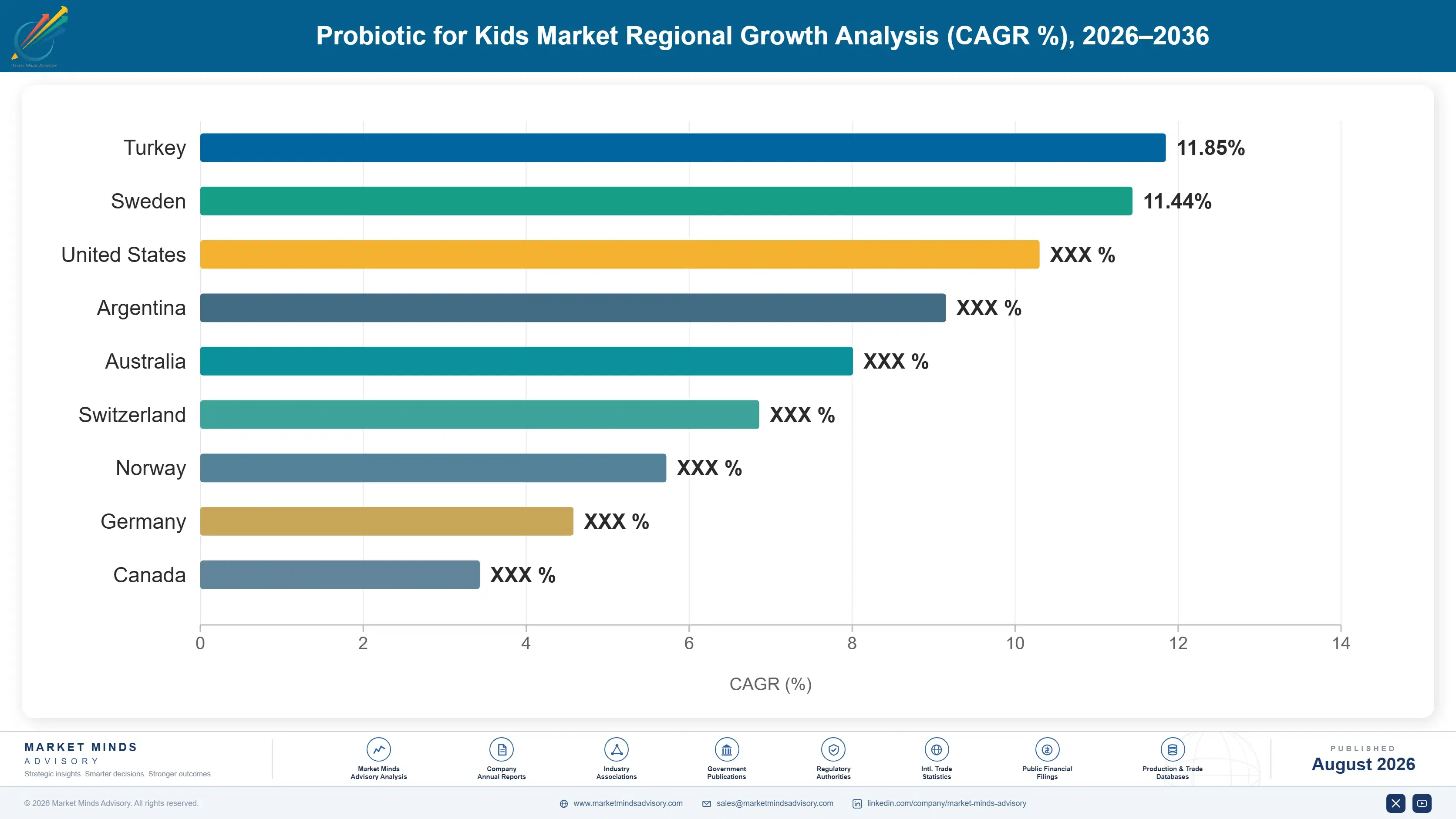
probiotic-for-kids-market-trends-country-cagr-analysis-1787580969223

Four Moves Toward the Evidence

The category sells a daily habit on the reputation of two acute indications, in formats children accept and organisms do not survive. Every durable position runs through professional recommendation, strain disclosure or a format that actually delivers a live organism. Marketing spend buys none of those. Recommendation is the channel. Marketing buys nothing here.

Build around the indications paediatricians will recommend

Paediatricians recommend probiotics for infant colic and around antibiotic courses because that is where strain-level trial evidence sits, and roughly 26% of category sales already follow a professional recommendation. That share runs considerably higher in infant drops than in any other format. Building around those indications means clinical evidence a paediatrician will read, practice sampling and dosing guidance rather than retail spend. General wellness positioning cannot access the channel at all, whatever it spends. Spend cannot substitute for evidence. Evidence a paediatrician will read is the requirement, and the channel does not open without it.
Market Impact: Grows the 26% professional recommendation channel much further

Disclose the strain and make competitors explain theirs

Only 38% of paediatric products name the specific strain rather than the species, and effects belong to strains rather than genera. A brand disclosing full designation alongside the evidence behind it makes a comparison competitors cannot answer without reformulating or admitting their organism has no paediatric data. Parents are learning the distinction and retailer technical teams have begun asking. Disclosure costs nothing where the strain is defensible and everything where it is not, which is precisely the point. That asymmetry is precisely the point. Retailers are asking already. Silence becomes the answer.
Market Impact: Exposes the 62% that disclose no strain at all

Move volume out of gummies into surviving formats

Gummies took roughly 31% of paediatric volume on palatability and leave around 21% of organisms viable at expiry, because sugar content and water activity both work against survival through ambient storage. Powder sachets and oil drops preserve organisms far better and solve the swallowing problem without a confectionery matrix. Shifting mix costs consumer acceptance work rather than capital, and it converts a product that mostly does not deliver into one that does. Few brands have made that trade deliberately. Few brands made that trade deliberately. Acceptance work rather than capital.
Market Impact: Improves on the 21% viability in gummy formats

Sell at the pharmacy counter when antibiotics are dispensed

Antibiotic-associated diarrhoea prevention is a recommendation a pharmacist makes while handing over a prescription, which is the most precisely targeted moment this category has and one almost nobody has built around. Paediatric antibiotic prescribing remains high across most healthcare systems, generating repeatable episodic demand across a childhood. Reaching it means pharmacist education and counter positioning rather than shelf presence. The demand is small per event and arrives with authority attached, which retail marketing never manages. Paediatric antibiotic prescribing stays high, which makes this demand repeatable perhaps 6 times across a childhood.
Market Impact: Captures demand across 2 distinct clinical event types

Who Controls the Margin Pool

Participation is measured on retail and pharmacy channel sales value of paediatric probiotic products, and the top five hold 29%. Concentration is low because contract manufacturing makes entry cheap and hundreds of brands have taken that route. BioGaia leads on clinical strain ownership and paediatric evidence rather than on volume, with Danone and Nestlé leading on distribution reach. The gap between those two groups is capability rather than scale.
Competition runs on three things. Strain evidence decides whether professional recommendation is available, which is the only channel that converts reliably and repeats. Format capability decides whether the organism survives to the child, and gummy-heavy portfolios perform worst on that measure. Distribution decides reach, and pharmacy and paediatric practice channels suit this category considerably better than grocery shelves do.

The pressure ahead is substantiation. A regulator requiring strain-specific evidence for paediatric claims would remove positioning from the majority of products on shelf rather than constraining it, and European claim regulation has already moved partly in that direction. Expect strain licensing and clinical investment rather than acquisitions. Rankings shift as parents learn to check strain designation and as professional channels mature.
probiotic-for-kids-market-trends-company-positioning-matrix-1787580969743

Competitive Moat and Risk Dimensions

BIOGAIA

Moat: Paediatric clinical evidence ownership

BioGaia owns strains carrying paediatric trial evidence on defined endpoints including infant colic, which is exactly what a paediatrician needs before recommending anything to a parent. That evidence took years and considerable expense to generate, and a competitor cannot obtain equivalent standing by licensing a culture from a catalogue at any price.
BIOGAIA

Risk: Narrow indication and format base

Revenue concentrates in infant drops and a small number of indications, which is defensible and small. Broadening into older children and daily formats means competing on shelf against distribution machines rather than on evidence in a consulting room, and the clinical advantage that defines the business carries considerably less weight in a grocery aisle.
DANONE

Moat: Paediatric nutrition distribution reach

Danone reaches paediatric healthcare professionals and retail simultaneously through a nutrition business built around early life, which very few competitors can match on either side alone. That dual reach lets it introduce a supplement through the same relationships that already carry formula and growing-up milks into practices and pharmacies.
DANONE

Risk: Infant nutrition marketing scrutiny

Association with infant formula marketing draws scrutiny from health professionals and campaigners in exactly the paediatric channels that matter most for recommendation. That history complicates relationships competitors without formula exposure do not have to manage, and it can turn a distribution advantage into a reason a practice declines to engage.

Players Tracked

Prominent Players

BioGaia
Danone
Nestlé Health Science
Reckitt
Church and Dwight

Other Key Players

Bayer
Haleon
Abbott
By-Health
Health and Happiness Group
Pharmavite
Jarrow Formulas
i-Health
Renew Life
Garden of Life
Blackmores
Swisse Wellness
Yakult Honsha
Meiji Holdings
Amway

Recent Developments

MARCH 2026

Paediatric society guidance names specific strains for two indications

A paediatric professional society issued guidance naming specific probiotic strains for acute infectious diarrhoea and antibiotic-associated diarrhoea, while noting insufficient evidence for general immune support in healthy children. The guidance reached paediatricians who advise parents directly on supplement selection. No product endorsements were given. Practitioners received it directly.
Signal: Strain-level guidance separates products carrying real evidence from those with only a genus printed on the label
AUGUST 2025

Retailer requires strain designation on own-label paediatric probiotics

A European grocery retailer required full strain designation and supporting evidence for own-label paediatric probiotic products, following technical review of the category. Suppliers unable to name a strain with paediatric data lost listings at the following range review across affected products. Reformulation timelines were tight.
Signal: Retail technical teams are now asking the strain question that informed parents have already started asking
JUNE 2026

Brand shifts paediatric range from gummies to powder sachets

A paediatric supplement brand moved its core range from gummy to powder sachet presentation, citing organism viability through shelf life rather than any consumer preference finding. The reformulation required consumer acceptance work, since gummies had driven the original growth of the range. Acceptance testing preceded the change.
Signal: Viability rather than palatability is beginning to decide format, which reverses a decade of category direction

Cultures, Matrix and Survival

Probiotic cultures account for roughly 34% of finished product cost, with licensed clinical strains costing several times commodity cultures and paediatric evidence carrying its own royalty. Format matrix is the second element and varies enormously: gummy base, sugars and gelling agents carry about 22%, while oil suspension and powder sachet formats cost less in materials and more in filling. Packaging and stability testing add a further 18%.
Culture pricing has been relatively stable while licensed strain royalties rose across the industry as paediatric evidence accumulated and licensors repriced. Gelatin and pectin pricing moved with wider ingredient markets through 2022, affecting gummy formats specifically. The larger cost variable is not ingredients but stability, since achieving acceptable viability in a hostile matrix requires encapsulation, overage or both, and each adds cost the label never shows.

Exposure divides on strain position and format choice. A brand licensing a clinical paediatric strain pays royalties and obtains professional access, while one using commodity cultures pays less and cannot reach the recommendation channel at all. Format is the second divide, since gummy overage to compensate for 21% survival costs more culture per delivered organism than a sachet requiring almost none.
probiotic-for-kids-market-trends-cost-volatility-analysis-1787580969937

Choose format for survival before choosing for palatability

Gummy formats require substantial culture overage to deliver a meaningful count at expiry, which costs more per delivered organism than a sachet or drop needing almost none. That cost is invisible on the label and real in the bill of materials. Brands optimising for acceptance first and survival second routinely pay twice for the same delivered dose.

License paediatric evidence rather than a bare culture

Licensed strains carrying paediatric trial evidence cost several times commodity cultures in royalties and buy professional channel access that no marketing budget substitutes for. In a category where recommendation converts and advertising largely does not, that royalty is the price of entry to the only reliable channel rather than an avoidable ingredient premium. Nothing else opens that door.

Invest in encapsulation before increasing declared counts

Raising a declared organism count is cheap and means little when 21% survives to expiry in a gummy matrix. Encapsulation and strain selection both improve survival at real formulation cost and convert into an end of shelf life declaration competitors cannot match. Spending on the number rather than the survival remains the more common and less defensible choice.

Portfolio Architecture for Margin Defence

Margin here tracks evidence and channel rather than formulation cost. Gummy and general wellness products earn margins in the low thirties, which looks comfortable until the retail promotional support and the culture overage required to deliver any meaningful count at expiry are both deducted from it. Culture overage to compensate for poor matrix survival is invisible on the label and real in the bill of materials.
Powder sachets and chewables positioned on defined benefits do better in the high thirties to mid forties, because format survival is genuinely better, dosing is flexible across ages and pharmacy placement supports pricing that a grocery comparison would not. The range reflects strain disclosure and whether any professional recommendation supports the product. Pharmacy placement supports pricing that a grocery comparison never would.

Clinically supported infant drops hold the strongest economics, running into the low fifties, where paediatric trial evidence, professional recommendation and an oil matrix that protects organisms combine to remove price comparison almost entirely. Those margins reflect years of clinical investment rather than any manufacturing advantage. Years of clinical investment rather than manufacturing advantage stand behind those margins.

Gummy and General Wellness Formats

Gummy and chewable products using commodity cultures and general immunity language sold through grocery and drug retail. The eight point range reflects promotional support and the culture overage that poor matrix survival requires.
Gross Margin: 28-36%

Sachet and Defined Benefit Products

Powder sachets and chewables positioned on specific benefits with better organism survival and pharmacy distribution. The eight point range reflects strain disclosure and whether professional recommendation supports the product at all.
Gross Margin: 37-45%

Clinically Supported Infant Formats

Infant drops and oil suspensions built on strains carrying paediatric trial evidence on defined endpoints. The nine point range reflects depth of clinical evidence and the exclusivity terms attached to each licensing arrangement.
Gross Margin: 44-53%
probiotic-for-kids-market-trends-portfolio-architecture-1787580970439

High-value Sub-segments and Strategic Watch-out

Clinically Supported Infant Drops

High value and the fastest growth at 14.4%, where paediatric trial evidence and an oil matrix that protects organisms both work in the same direction. Professional recommendation removes price comparison in a way retail never does. Clinical investment is what stands behind it. Comparison largely disappears.
Gross Margin: 46-53%

Powder Sachets and Stick Packs

High value and growing at 12.6% on dose flexibility and genuinely better organism survival than any sugar-based format. Suits both acute courses and daily use, which makes it the least age-constrained presentation available. Survival and flexibility both favour it strongly. Age constraints barely apply here.
Gross Margin: 39-45%

Gummy Format Products

The volume core at roughly 31% of the category and the worst home for a live organism. Sugar content and water activity leave around 21% viable at expiry, and culture overage to compensate is invisible on the label. Palatability drove a decade of category growth.
Gross Margin: 28-36%

General Immunity Positioned Products

The strategic watch-out. Roughly 72% of purchases are daily preventive use on evidence far thinner than the acute indications the category's reputation rests upon. Substantiation requirements would remove the positioning entirely. Acute evidence carries a chronic proposition. Substantiation would end it. Nothing else supports it.
Gross Margin: 26-38%

Course, Habit and Recommendation

Two demand patterns share this category and behave nothing alike. Acute use is episodic, tied to an illness or an antibiotic course, short and highly repeatable across a childhood, and it arrives with a recommendation attached. Daily preventive use is a habit a parent maintains until they forget or the child objects, which produces higher revenue per customer and considerably weaker persistence than the numbers initially suggest.
Stickiness follows recommendation rather than format. A paediatrician-recommended infant drop is reordered reliably through a course and often through a subsequent child. Pharmacy-recommended products around antibiotics repeat with every prescription. Retail-acquired daily products show the weakest persistence, which is consistent with a purchase made on anxiety rather than on a specific expectation the parent can evaluate afterwards. A parent evaluating nothing in particular has nothing to return for.

The specifying influence sits partly outside retail and increasingly so. Roughly 26% of sales follow a professional recommendation, and that share is far higher in infant formats. A brand's real audience is frequently a paediatrician with a few minutes and a parent who will not question the advice, rather than a shopper reading a pack in a grocery aisle.
probiotic-for-kids-market-trends-end-use-penetration-index-1787580970932

Where We Would Commit Capital

These are among the four positions where our research anticipates prominent divergence between winners and laggards over the coming forecast period. Each is grounded in the demand model, the regulatory perimeter, and the announced capacity pipeline.
01 / INDICATION LED BUILDING

Build where a paediatrician will actually recommend something

Paediatricians recommend probiotics for infant colic and around antibiotic courses because those are the situations where strain-level trial evidence genuinely exists, and roughly 26% of category sales already follow a professional recommendation. That share runs far higher in infant drops than in any other format on the market. Building there means clinical evidence a paediatrician will actually read, practice sampling and dosing guidance, and none of that can be substituted for by general wellness positioning at any level of marketing spend.
02 / STRAIN DISCLOSURE POSITIONING

Name the strain and let competitors explain their silence

Only 38% of paediatric products name the specific strain rather than the species, and probiotic effects belong to strains rather than to genera. A brand disclosing the full designation alongside the evidence behind it creates a direct comparison that competitors cannot answer without either reformulating or admitting their organism carries no paediatric data at all. Parents are learning the distinction and retailer technical teams have already started asking, which makes strain disclosure a widening advantage rather than a static one.
03 / FORMAT SURVIVAL CHOICE

Stop optimising for the format that kills the product

Gummies took roughly 31% of paediatric volume on palatability alone and leave around 21% of organisms viable at expiry, because sugar content and water activity both work against survival through ambient storage. Powder sachets and oil drops both preserve organisms far better while still solving the swallowing problem without a confectionery matrix. Shifting the mix costs consumer acceptance work rather than any capital, and it converts a product that largely fails to deliver its dose into one that actually does.
04 / DISPENSING COUNTER ACCESS

Be there when the antibiotic is handed across the counter

Antibiotic-associated diarrhoea prevention is a recommendation that a pharmacist makes while dispensing the prescription itself, which is comfortably the most precisely targeted moment this category has, and one that almost nobody has built around deliberately. Paediatric antibiotic prescribing stays high across most healthcare systems, which generates repeatable episodic demand right through a childhood. Reaching that moment needs pharmacist education and counter positioning rather than any shelf presence, and the demand itself arrives with clinical authority already firmly attached to it.

Engagement Snapshot From the Field

A live engagement with an industry participant carrying material or product regulatory and market exposure ahead of a defining policy shift, showing how our research translates into a defensible multi-year portfolio strategy.
MARKET MINDS ADVISORY · CLIENT ENGAGEMENT SUMMARY
Probiotic for Kids Producer Strategic Portfolio Review and Transition Roadmap 2026·Investment Scenario on Probiotic for Kids Exposure Evaluation 2025-26
CLIENT PROFILE
A European paediatric supplement brand selling probiotic gummies and chewables across seven markets through grocery and drug retail, with annual revenue near 58 million euros (client-reported, unverified by MMA). The range used commodity cultures listed at species level, and organism counts were declared at manufacture in line with prevailing category practice. No professional channel existed.
STRATEGIC CHALLENGE
A grocery retailer had required strain designation and supporting evidence for own-label paediatric probiotics and the client could not supply either. A paediatric society had separately published guidance naming specific strains for two indications while noting insufficient evidence for general immune support. Management needed to decide whether to reformulate, relicense or reposition.
MMA APPROACH
MMA measured organism viability at expiry across the client's range and eight competitors, reviewed paediatric evidence by strain with independent academic input, and tested pharmacy and paediatric practice channel receptivity across four markets. Strain licensing terms were reviewed with three licensors. Interviews with 47 experts covered paediatric practice, probiotic formulation and retail technical specification.
KEY FINDINGS
  1. Measured viability at expiry across the client's gummy range averaged 19% of declared count, and culture overage to compensate exceeded the cost of switching to a sachet format entirely.
  2. None of the strains used in the client's range carried paediatric trial evidence, which excluded the products from professional recommendation in every market examined.
  3. Paediatric practices in all four markets tested were receptive to sampling for antibiotic-associated indications and none had been approached by the client previously.
  4. Two licensors would supply strains carrying published paediatric evidence at royalty rates recoverable within the pricing that the pharmacy channel already supports.
CLIENT PROFILE
A European paediatric supplement brand selling probiotic gummies and chewables across seven markets through grocery and drug retail, with annual revenue near 58 million euros (client-reported, unverified by MMA). The range used commodity cultures listed at species level, and organism counts were declared at manufacture in line with prevailing category practice. No professional channel existed.
STRATEGIC CHALLENGE
A grocery retailer had required strain designation and supporting evidence for own-label paediatric probiotics and the client could not supply either. A paediatric society had separately published guidance naming specific strains for two indications while noting insufficient evidence for general immune support. Management needed to decide whether to reformulate, relicense or reposition.
MMA APPROACH
MMA measured organism viability at expiry across the client's range and eight competitors, reviewed paediatric evidence by strain with independent academic input, and tested pharmacy and paediatric practice channel receptivity across four markets. Strain licensing terms were reviewed with three licensors. Interviews with 47 experts covered paediatric practice, probiotic formulation and retail technical specification.
KEY FINDINGS
  1. Measured viability at expiry across the client's gummy range averaged 19% of declared count, and culture overage to compensate exceeded the cost of switching to a sachet format entirely.
  2. None of the strains used in the client's range carried paediatric trial evidence, which excluded the products from professional recommendation in every market examined.
  3. Paediatric practices in all four markets tested were receptive to sampling for antibiotic-associated indications and none had been approached by the client previously.
  4. Two licensors would supply strains carrying published paediatric evidence at royalty rates recoverable within the pricing that the pharmacy channel already supports.
RECOMMENDED STRATEGY
Phase 1: Phase one: license a strain carrying paediatric evidence and move the core range from gummy to powder sachet, since overage already exceeds the format switching cost. Phase 2: Phase two: build paediatric practice and pharmacy channels around antibiotic-associated indications, which no competitor in the client's markets currently works. Phase 3: Phase three: reposition remaining gummy volume onto palatability rather than efficacy, rather than defending an immunity claim the evidence cannot support.
OUTCOME
The brand licensed a clinically evidenced strain and converted its core range to sachets during 2026, with measured viability at expiry rising above 60% (client-reported, unverified by MMA). Paediatric practice sampling began in two markets, and the retailer listing lost the previous year was recovered at the following range review.

Frequently Asked Questions

Foundational context covering the market sizes, CAGR, scope, country, region and competition that inform every finding below. This section is provided to cover basics and most often pre-purchase conversations, answered from the MMA Primary Research Dataset.

What is the current size of the Probiotic for Kids Market?

MMA sizes it at USD 2.7 billion in 2025, rising to USD 2.96 billion in 2026. The figure covers probiotic supplements formulated for children at retail and pharmacy selling value.

How large will the Probiotic for Kids Market be by 2036?

USD 7.40 billion by 2036, an incremental USD 4.44 billion over the 2026 base and an expansion multiple of 2.50 times. Infant and sachet formats account for a disproportionate share.

What is the CAGR for the Probiotic for Kids Market 2026 to 2036?

9.6% in the base case, with a bull case at 10.9% and a bear case at 8.3%. The spread turns on whether regulators require strain-specific substantiation for paediatric claims.

Which segment is growing fastest?

Infant drops and oil suspensions at 14.4%, half again the market rate of 9.6%. Paediatric trial evidence and an oil matrix that protects organisms both point the same way.

Who are the major companies in the Probiotic for Kids Market?

BioGaia, Danone, Nestlé Health Science, Reckitt and Church and Dwight lead on retail and pharmacy channel sales value. Fifteen further participants are profiled in the report.

Which country is growing fastest?

India at 13.2%, where rising urban household health spending coincides with a diarrhoeal illness burden that makes the acute indication genuinely relevant rather than aspirational.

Report Segmentation Architecture

The full report scope spans multiple orthogonal segmentation dimensions, with cross-tabulated demand data provided for each dimension pair. Coverage extends further to regional breakdowns, trend trajectories, and the competitive detail needed to support segment-level decision-making.

By Product Format

  • Infant Drops and Oil Suspensions
  • Powder Sachets and Stick Packs
  • Gummies and Chewables
  • Chewable Tablets
  • Ready-to-Drink and Fortified Beverages
  • Sprinkle and Swallow Capsules

By End-Use Age Group

  • Newborn and Infant
  • Toddler and Pre-School
  • Primary School Age
  • Adolescent
  • Antibiotic Course Users
  • Acute Illness Episodes

By Commercial Dimension

  • Retail Pharmacy
  • Grocery and Mass Retail
  • Paediatric Practice Distribution
  • Direct-to-Consumer Subscription
  • Cross-Border Online Sales
  • Hospital and Clinic Supply

By Region

  • North America
  • Western Europe
  • East Asia
  • South Asia and Pacific
  • Latin America
  • Middle East and Africa
  • Eastern Europe

Scope, Methodology, and Coverage

Every figure in this report is reproducible from documented input assumptions. The scope below maps the historical period, the forecast horizon, the segmentation dimensions, and the countries covered, alongside the underlying primary and qualitative methodology.
Historical Period
2020 to 2025
Forecast Period
2026 to 2036
Base Year
2025 (USD billions; MMA Primary Research Dataset, August 2026)
Market Definition
Probiotic supplements formulated and marketed for children from birth to adolescence, spanning infant drops and oil suspensions, powder sachets and stick packs, gummies and chewables, chewable tablets, ready-to-drink and fortified beverages and sprinkle or swallow capsules, measured at retail and pharmacy selling value. Probiotic strains and cultures sold as ingredients to manufacturers, infant formula containing probiotics, adult probiotic products, and fermented foods are excluded from scope entirely.
Quantitative Units
USD billions (current prices); million courses supplied annually; USD per course by product format and channel
Segmentation Dimensions
Product format; end-use age group; commercial dimension; region
Regions Covered
North America, Western Europe, East Asia, South Asia and Pacific, Latin America, Middle East and Africa, Eastern Europe
Countries Covered
United States, Canada, Mexico, Germany, Sweden, Denmark, United Kingdom, France, Italy, China, Japan, South Korea, India, Indonesia, Australia, Brazil, Colombia, United Arab Emirates, South Africa, Poland
Key Companies Profiled
BioGaia, Danone, Nestlé Health Science, Reckitt, Church and Dwight, Bayer, Haleon, Abbott, By-Health, Health and Happiness Group, Pharmavite, Jarrow Formulas, i-Health, Renew Life, Garden of Life, Blackmores, Swisse Wellness, Yakult Honsha, Meiji Holdings, Amway
Quantitative Methodology
Primary survey, n=3,800 respondents, Q4 2025, six countries; demand-side model with trade association cross-validation
Qualitative Methodology
47 expert interviews, Q4 2025; applied to validate demand model assumptions, identify emerging dynamics, and assess competitive positioning
Report Format
PDF and XLSX data workbook (Word format preview document)
Publisher
Market Minds Advisory
Report Code
MMA-2026-HLT-122
Published
August 2026
Contact
sales@marketmindsadvisory.com | www.marketmindsadvisory.com

Purchase the full Probiotic for Kids Market Report (2026 to 2036).

The full report separates the acute indications where paediatric evidence exists from the daily preventive use that carries most volume, and sizes each format independently through 2036. It measures organism viability at expiry across formats and competitors, assesses evidence quality by strain and paediatric endpoint, and tracks professional recommendation channel development by market. Regional chapters cover all seven regions with channel detail across retail, pharmacy and paediatric practice routes. Competitive profiling covers 20 participants on a single sales value basis, with strain disclosure practice compared across the competitive set.
Each product format sized independently through 2036
Viability at expiry measured across formats and competitors
Evidence quality assessed by strain and paediatric endpoint
Professional recommendation channels tracked by market
Twenty participants profiled on one consistent basis
Strain disclosure practice compared across the competitive set

Built For The People Who Decide

From boardroom strategy to bench-side execution, this report is read cover-to-cover by leaders shaping the next decade of their industry, turning demand scenarios, market dynamics and valuation benchmarks into decisions.
CXOs/ Presidents/ VPs/ Managers
M&A and Corporate Development
Strategy Teams and R&D Heads
Procurement and Product Directors
Regulatory and Compliance Leaders
Investor Relations and Equity Analysts