Market Minds Advisory
Probiotic Supplements for Kids Market

Probiotic Supplements for Kids Market: Clinical Strain Validation and the Pediatrician-Led Purchase Decision

Pediatricians are recommending probiotic strains by name now, not just the category, and that specificity is reshaping which children's supplement brands parents trust enough to buy repeatedly across most major retail channels worldwide.

Lead Analyst

Lisa Gevelber

Published

September 2026

Make Smarter Decisions with Customized Research Insights

Request a free sample report and evaluate market opportunities, growth trends, and competitive dynamics relevant to your business needs.

2025 MARKET VALUE$1.6BMarket Size 2025
2036 FORECAST VALUE$4.8BBase Case , 2026 to 2036
CAGR 2026 TO 203610.4 %Bull 11.8% / Bear 9.0%
INCREMENTAL OPPORTUNITY$3.0BNet 10- year value creation
EXPANSION MULTIPLE2.69x2036 value over 2026 base
Strategic Levers
M&A Pipeline
Regional Outlook
Country Rankings
Competitive Intelligence
Segmental Deep-dive
Call-Us : 91 93563 13602

Executive Snapshot and Market Trajectory

Parents are increasingly choosing children's probiotic supplements by specific clinically studied strain rather than generic category label, turning pediatrician recommendation into the single most powerful purchase driver across most major retail and e-commerce channels worldwide today and increasingly well beyond that reach.
Commercial momentum concentrates in gummy and chewable delivery formats sold through mass retail, pharmacy, and specialty wellness e-commerce channels, where strain-specific clinical validation and third-party testing increasingly separate premium brands from generic commodity formulations across most tracked distribution categories. North America and East Asia together account for the deepest commercial penetration, reflecting concentrated pediatric wellness spending and established supplement retail infrastructure built over years of steady category investment across most major consuming markets worldwide today.
Competitive character is shifting as legacy adult probiotic brands extend into pediatric formulations, while dedicated children's wellness startups without manufacturing scale increasingly partner with or get acquired by larger diversified suppliers. Pediatric dosing and allergen labeling standards are tightening steadily across major food safety jurisdictions worldwide today, pushing certification investment higher for suppliers competing in premium clinically validated categories nationwide and across most major export markets globally today.
Market Definition
The children's probiotic supplements market covers probiotic formulations, including gummies, chewables, drops, and powders, marketed specifically for pediatric consumption from infancy through adolescence. It excludes infant formula and prescription pediatric pharmaceuticals.
Base Year Value
$1.6B in 2025 (MMA Primary Research Dataset, August 2026)
Forecast Period
2026 to 2036, eleven discrete annual values
CAGR
10.4% base case. Bull 11.8%. Bear 9.0%.
Fastest Growth Segment
Clinically Validated Strain-Specific Probiotics: 17.8% CAGR
Fastest Growth Country
India: 13.2% CAGR
Fastest Growth Region
South Asia and Pacific: 12.4% CAGR
Largest Region
North America: 28% of 2025 global value
Market Leaders
Church and Dwight Co Inc, Bayer AG, Reckitt Benckiser Group plc, Nestle Health Science SA, Culturelle Inc. Source: MMA Analysis based on company annual reports.
Primary Survey
n=3,800 procurement and R&D decision-makers, Q4 2025, six countries
Methodology
Demand-side build-up, cross-validated against public data, 47 expert interviews

Probiotic Supplements for Kids Market Forecast Scenarios

probiotic-supplements-for-kids-market-size-forecast-scenario-1787335328370
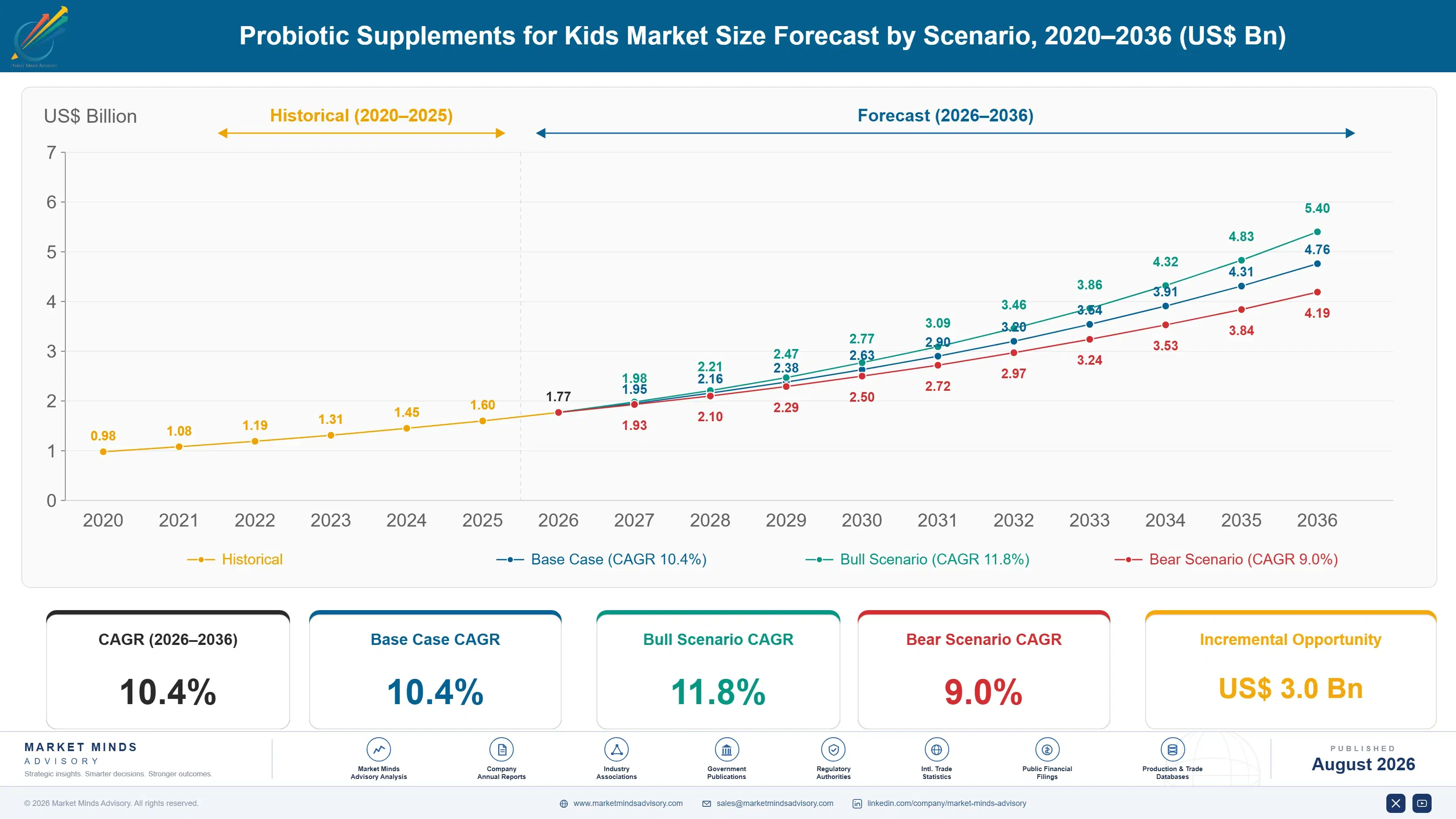
Children's probiotic supplement demand grew steadily from 2020 through 2025 as pediatrician awareness of strain-specific gut health research expanded and parents grew more comfortable giving daily supplements to young children across most tracked households nationwide today, a trend that accelerated once gummy delivery formats made compliance dramatically easier for households with picky younger eaters across most major markets.
MMA's base case assumes a 10.4% CAGR through 2036, anchored by three mechanisms: expanding pediatrician recommendation of specific clinically studied strains, rising parental willingness to pay for premium clinically validated formulations over generic alternatives, and steady category penetration growth across East Asia and South Asia and Pacific where pediatric wellness spending is scaling rapidly, a combination that should sustain above-average growth even as North American category penetration begins to mature steadily.
The bull case assumes pediatrician recommendation rates accelerate faster than expected as strain-specific clinical research publishes new pediatric efficacy data worldwide, lifting growth toward 11.8%. The bear case assumes parental price sensitivity compresses premium formulation adoption faster than clinical validation can offset it, pulling growth down toward 9.0% across most commodity-weighted supplier portfolios industry wide today.

Clinical Validation Reshapes Category Economics

The children's probiotic supplements market sits at the intersection of pediatric medical validation and consumer wellness marketing, where clinically studied strain specificity increasingly separates premium brands from generic gummy formulations sold primarily on flavor across nearly every major retail channel worldwide today. Pediatrician recommendation, not shelf placement alone, is becoming the primary driver of brand loyalty across most established markets, a shift reshaping supplier revenue models meaningfully.
TOP FIVE SUPPLIER CONCENTRATION34% CR5Share held by the five largest suppliers globally today
AVERAGE GUMMY BOTTLE PRICE$16.80Typical retail price across children's gummy probiotic products
LEADING COUNTRY OUTPUT SHAREUnited States 26%Share of global production concentrated in one country
PRODUCTION LINE CAPACITY UTILIZATION80%Average utilization across tracked manufacturing facilities worldwide today
CROSS-BORDER TRADE INTENSITY27%Share of finished product moving across international borders yearly
CLINICAL VALIDATION COGS SHARE39%Portion of production cost tied to clinical validation spending
Commercially, the category behaves like a trust-driven purchase decision rather than an impulse buy, with parents researching strain names, clinical citations, and third-party testing certifications before committing to a brand for their children across most tracked distribution channels. Suppliers with genuine clinical validation infrastructure capture disproportionate loyalty and repeat purchase behavior versus flavor-focused commodity competitors lacking documented efficacy data and pediatrician endorsement.
Over the next decade, clinical strain validation depth and pediatrician relationship investment will separate suppliers more decisively than flavor innovation or packaging alone, as parents demand more rigorous proof before trusting a brand with their children's health worldwide today. Suppliers that invest early in pediatric clinical trials and third-party testing should capture a disproportionate share of the category's expanding premium segment through 2036, well ahead of slower moving flavor-only competitors.
"Parents don't buy probiotics for kids because of the cartoon on the bottle anymore. They buy them because their pediatrician said a strain name out loud."
Director, Pediatric Nutrition and Consumer Wellness Practice · MMA Agriculture and Consumer Nutrition Practice · August 2026

Market Trends

Strain-Specific Clinical Validation Reshapes Purchase Decisions

Parents increasingly research specific probiotic strain names, clinical trial citations, and colony forming unit counts before purchasing, treating strain-level specificity as a genuine purchase requirement rather than a marketing nuance across most tracked demographic segments nationwide. Brands publishing pediatric-specific clinical trial data and third-party purity testing are capturing disproportionate loyalty and shelf space versus flavor-focused competitors lacking documented efficacy evidence. This shift is pulling formulation investment away from marketing spend toward genuine clinical research partnerships with pediatric universities and research hospitals, reshaping how suppliers compete for pediatrician trust and recommendation across most major retail and specialty wellness channels.
Market Impact: Adds 26 pediatric practice partnerships yearly
Gummy Delivery Format Displaces Liquid Drop Formulations

Gummy delivery formats are steadily displacing liquid drops and powder sachets as the preferred children's probiotic format, driven by dramatically higher compliance rates among picky younger eaters who resist liquid or powder textures. Parents report meaningfully higher adherence to daily supplementation routines when gummies replace liquid formats, and pediatricians increasingly recommend gummies specifically for compliance reasons rather than efficacy differences alone. This format shift is reshaping manufacturing investment priorities industry wide, as suppliers without gummy production capability increasingly lose shelf space to competitors who have already made the capital investment.
Market Impact: Adds 19 new e-commerce accounts yearly

Market Opportunities and Growth Drivers

Rising Pediatrician Recommendation Sustains Baseline Category Growth

Pediatricians are increasingly recommending specific probiotic strains for common childhood conditions including antibiotic-associated digestive upset and general gut health support, sustaining durable baseline demand even during periods of broader retail softness across most tracked pediatric wellness categories. Pediatric practice networks have responded by partnering with brands that provide clinical trial documentation and physician education materials at a pace well above the broader supplement category average, reflecting genuine confidence in continued demand growth. This baseline demand gives suppliers with reliable clinical validation infrastructure a defensible revenue floor even as premium formulations capture a growing share of incremental spending nationwide.
Market Impact: Limits premium adoption growth to 6%

Expanding E-Commerce Wellness Retail Drives New Demand

E-commerce and specialty wellness retail have expanded distribution reach well beyond traditional pharmacy and grocery channels, letting smaller and mid-tier children's supplement brands reach parents directly without the shelf space negotiations that historically favored the largest incumbent suppliers. Subscription and auto-replenishment models common in these channels are also lifting repeat purchase rates measurably above traditional retail averages, improving unit economics for suppliers with strong direct-to-consumer capability. This channel expansion is proving especially valuable for clinically validated premium formats, which face considerably less shelf space competition online than in crowded traditional pharmacy aisles nationwide.
Market Impact: Delays new strain claims 18 months

Market Restraints and Challenges

Parental Price Sensitivity Limits Premium Formulation Adoption

Parental price sensitivity remains a genuine constraint on premium clinically validated formulation adoption, as many households default to lower-cost generic gummy formulations regardless of documented strain-specific efficacy claims made on packaging. The root cause is that most parents cannot easily distinguish genuine clinical validation from marketing language on crowded shelves, leaving price as the deciding factor absent explicit pediatrician guidance toward a specific brand. Some suppliers are mitigating this by partnering directly with pediatric practices to provide physician recommendation cards that bridge the credibility gap at the point of purchase decision.
Market Impact: Lifts clinical strain share 24%

Clinical Trial Recruitment Difficulty Limits Pediatric Validation

Conducting rigorous pediatric clinical trials for probiotic strain efficacy faces genuine recruitment and ethical review difficulty, since research involving young children requires considerably more stringent institutional review board approval and parental consent processes than comparable adult studies typically do. The root cause is heightened regulatory caution around pediatric research generally, which slows the pace at which new strain claims can be scientifically substantiated for children specifically. Some suppliers are mitigating this by partnering with established pediatric research hospitals that have existing institutional review infrastructure and trial recruitment relationships already in place.
Market Impact: Lifts gummy format share to 61%
3 additional market trends, 4 additional growth drivers, and 3 additional restraints and challenges are covered in the full report. Contact sales@marketmindsadvisory.com to access the complete intelligence.

Segment CAGR and Growth Architecture

Segmentation here follows product delivery format, the dimension that most directly determines compliance rates, dosing precision, and parental purchase preference across this market right now today. Six categories span liquid drops through the clinically validated strain-specific gummy systems commanding the industry's fastest growth and highest sustained margin today across most major developed markets worldwide.
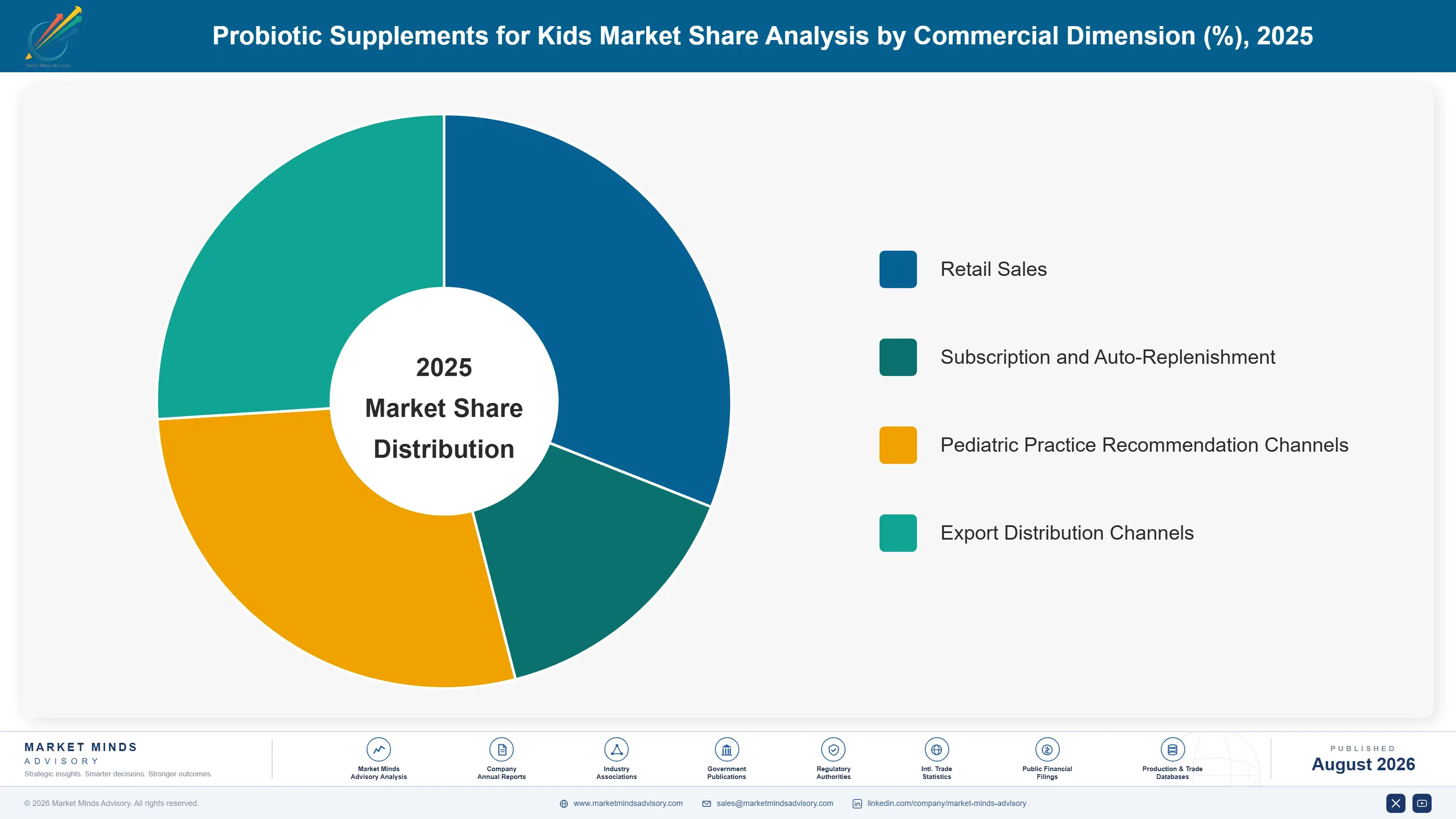
probiotic-supplements-for-kids-market-market-share-analysis-1787335328907

Clinically Validated Strain-Specific Probiotics

Clinically validated strain-specific probiotics, formulated around documented strains with published pediatric efficacy data, are growing at roughly 17.8% CAGR, well over 1.7 times the broader category average pace, as pediatricians increasingly recommend brands by strain name rather than category alone across most major markets nationwide and internationally today. Suppliers with genuine clinical trial partnerships and third-party purity testing are capturing pricing premiums well above generic gummy formulations, and that gap is widening further as parental research behavior shifts toward evidence-based purchasing across most major retail and specialty wellness channels worldwide today. This segment increasingly behaves like a pharmaceutical-adjacent category rather than a traditional confectionery-style supplement sold on flavor alone today.
CAGR 17.8%

Gummy Format Probiotics

Gummy format probiotics, engineered for palatability and dosing compliance among younger children, are growing at roughly 12.4% CAGR as gummy delivery steadily displaces liquid drop and powder sachet formats across most major pediatric supplement categories worldwide today and increasingly well beyond their current reach and scope entirely. Parents report meaningfully higher daily adherence when gummies replace less palatable liquid or powder formats, and pediatricians increasingly recommend gummies specifically for compliance reasons independent of underlying strain efficacy differences. Suppliers with established gummy manufacturing capability are capturing disproportionate share of new product launches as the format becomes the default expectation across most major retail categories today and increasingly well beyond that reach.
CAGR 12.4%
Full segment breakdown across 6 segments available in the complete report.

Regional Architecture and Country Demand Map

North America leads on the strength of the deepest pediatric wellness spending and established supplement retail infrastructure, while South Asia and Pacific posts the fastest regional growth as pediatric wellness awareness expands rapidly across India and Australia, and East Asia follows closely behind at meaningful scale.

North America

The United States anchors North America's leadership position, driven by the world's deepest pediatric wellness supplement spending and the highest concentration of pediatrician-endorsed brand relationships across most major retail and e-commerce channels nationwide and increasingly well beyond its current footprint and reach entirely and completely today. Parents here show strong willingness to pay for clinically validated formulations, and retailers have responded by dedicating expanding children's wellness aisles carrying strain-specific gummy products well ahead of most other regions worldwide today. Canada contributes meaningfully too, with a comparably mature pediatric supplement retail infrastructure supporting steady regional category growth alongside its larger neighbor across most established distribution channels nationwide, regionally, and well beyond.
Share: 28% | CAGR: 10.4% (2026 to 2036)

Western Europe

Germany, the United Kingdom, and France drive Western Europe's children's probiotic demand, supported by well established pharmacy retail channels and increasingly strict EU labeling regulations that favor clinically documented, certified formulations over unsubstantiated marketing claims still common elsewhere globally today and well beyond. Parents across the region show strong preference for pediatrician-endorsed and clinically validated brands, pushing suppliers toward genuine clinical trial investment faster than in less regulated markets elsewhere around the world today. Growth trails the global average modestly as the category matures earlier here than in faster growing developing regions, though clinically validated formats continue gaining share within an otherwise steady overall regional demand base nationwide and beyond.
Share: 20% | CAGR: 8.9% (2026 to 2036)
Regional intelligence for 5 additional markets available in the complete report: East Asia, South Asia and Pacific, Latin America, Middle East and Africa, Eastern Europe. Contact sales@marketmindsadvisory.com.
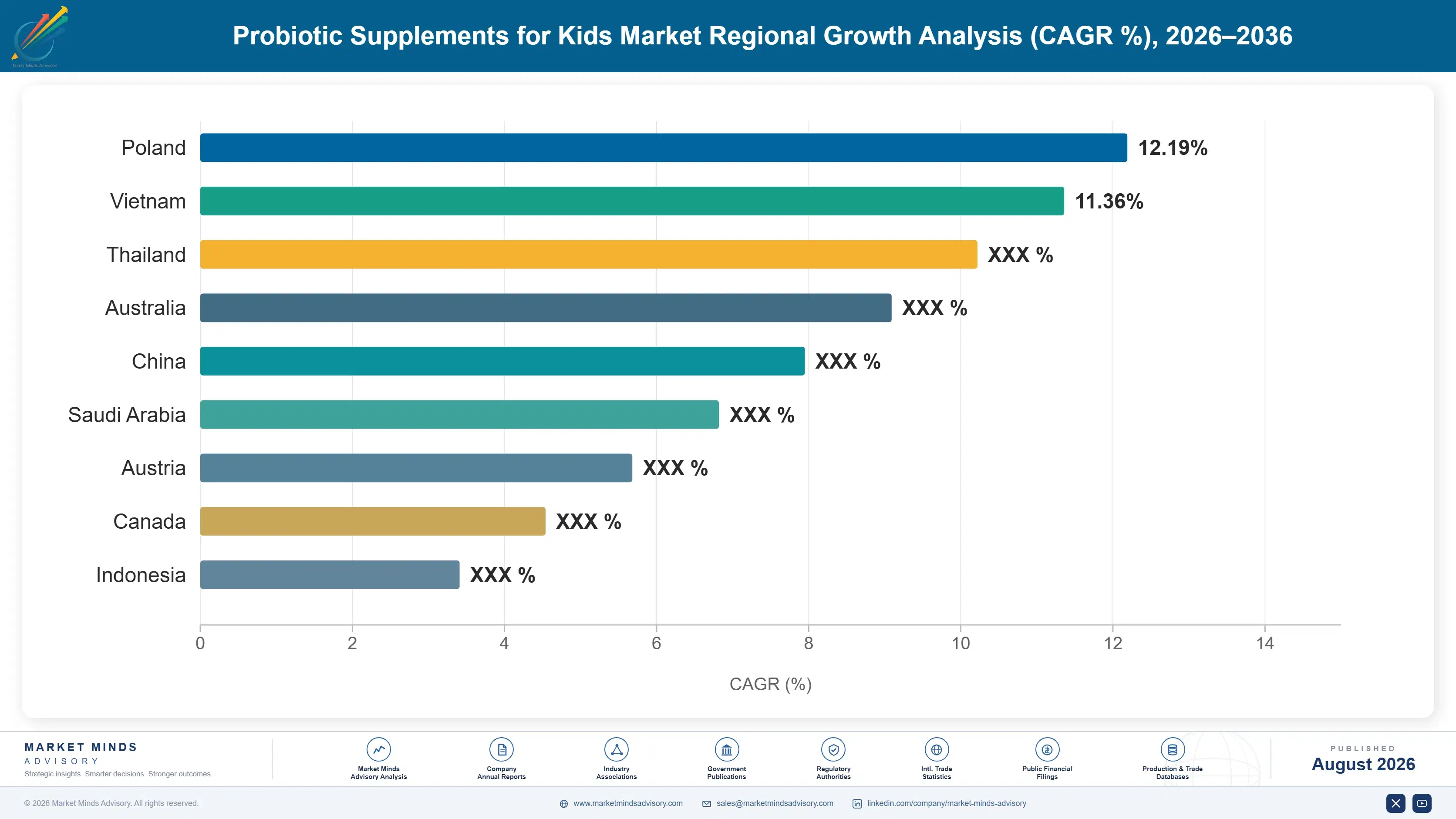
probiotic-supplements-for-kids-market-country-cagr-analysis-1787335329418

Moving Beyond the Commodity Gummy Sale

Suppliers moving decisively beyond commodity flavor-driven gummy pricing toward clinical validation depth, pediatrician relationship investment, and targeted regional expansion are capturing a disproportionate share of the category's expanding premium margin pool across most major consuming markets worldwide. Four levers stand out as the clearest paths to sustained margin growth through the full 2036 forecast window.

Building Dedicated Pediatric Clinical Trial Capability

Building dedicated pediatric clinical trial capability, including partnerships with research hospitals and institutional review board relationships, lets suppliers command pricing 33 to 45% above generic gummy formulations while capturing the fastest growing segment of the category overall today. This requires substantial upfront capital in clinical research and regulatory navigation, but suppliers that have already invested are seeing pediatrician relationships deepen quickly as published efficacy data matures and physician confidence grows steadily. The capability gap between suppliers with and without dedicated clinical infrastructure is widening each year as parental expectations rise steadily.
Market Impact: Commands pricing 33 to 45% above generic formulations

Building Direct Pediatrician Recommendation Relationship Programs

Building direct relationships with pediatric practice networks through physician education materials and sample programs adds 20 to 28% above standard retail pricing as pediatrician recommendation becomes the single most influential purchase driver in this category across most major markets worldwide today and beyond. Suppliers that invest in physician-facing sales and education capability capture disproportionate loyalty versus competitors relying solely on consumer marketing and shelf placement alone. This lever requires sustained investment in medical affairs infrastructure but pays back quickly once pediatrician recommendation opens durable, prescription-adjacent demand across most regulated retail channels.
Market Impact: Adds 20 to 28% above standard retail pricing now

Expanding East Asian Formulation and Distribution Capacity

Expanding formulation and distribution capacity across China and South Korea captures a growing $8M regional demand segment now while the region still has meaningfully less established clinical validation competition than North America or Western Europe currently offer suppliers. Early movers building local manufacturing relationships and pediatric practice partnerships are securing preferential positioning ahead of larger multinational suppliers that have not yet prioritized dedicated regional capacity investment. Given the region's above average growth rate, suppliers establishing genuine local presence now should see that early investment compound meaningfully over the coming decade.
Market Impact: Captures a growing $8M regional demand segment now

Securing Long-Term Retailer Design-In Supply Contracts

Securing long-term supply contracts with major mass retailers and pharmacy chains captures a growing $12M distribution demand pool now while locking in shelf space ahead of increasingly intense competition for premium children's wellness positioning nationwide and well beyond today. These contracts typically require suppliers to commit dedicated production capacity and meet stricter clinical documentation and testing standards, but they provide revenue visibility that supports further clinical trial investment. Suppliers without such contracts face genuine risk of losing shelf space to competitors willing to commit capacity on more favorable long-term terms.
Market Impact: Captures a growing $12M distribution demand pool now

Who Controls the Margin Pool

The children's probiotic supplements market carries a CR5 of 34%, reflecting a landscape where consumer goods conglomerates hold meaningful but not dominant share alongside a long tail of specialty and pediatrician-endorsed brand formulators. Assessment here is based on annual revenue disclosed across pediatric and children's wellness supplement segments. The gap between leading suppliers and mid-tier challengers has narrowed as clinical validation matters more than raw production scale.
Current competitive activity centers on three dimensions: clinical trial investment and pediatric research partnerships, direct pediatrician relationship building through medical affairs teams, and channel expansion into East Asia and South Asia and Pacific. Leading suppliers are increasingly acquiring specialty pediatric wellness formulators to close clinical capability gaps faster than internal research timelines would allow, reshaping the competitive landscape meaningfully.

Emerging pressure comes from dedicated pediatric wellness startups without legacy manufacturing scale but with genuine clinical trial and physician relationship expertise, an area where larger conglomerates have historically underinvested relative to their marketing budgets. Rankings are most likely to shift among suppliers still concentrated in generic flavor-driven gummy formats, since price competition there shows no sign of easing and clinical validation capability increasingly determines pediatrician trust and shelf survival.
probiotic-supplements-for-kids-market-company-positioning-matrix-1787335329942

Competitive Moat and Risk Dimensions

CHURCH AND DWIGHT CO INC

Moat: Integrated Brand Portfolio Scale

Church and Dwight's integrated formulation and manufacturing scale, spanning multiple established children's wellness brands, lets it absorb clinical trial investment costs faster than smaller specialty competitors. Its existing retailer relationships across mass and pharmacy channels give new clinically validated formats immediate shelf access that competitors without comparable brand portfolios must earn incrementally over multiple retail cycles.
CHURCH AND DWIGHT CO INC

Risk: Slower Clinical Pivot

The company's portfolio still includes meaningful generic flavor-driven gummy lines, leaving exposure to price competition from private label competitors in its less differentiated categories. Its pivot toward clinically validated, pediatrician-endorsed formats has moved more slowly than smaller, specialty-focused competitors, risking share loss in the fastest growing segment of the category if that pace does not accelerate.
BAYER AG

Moat: Pharmaceutical-Grade Testing Infrastructure

Bayer's established pharmaceutical-grade testing infrastructure and existing pediatrician relationships from its broader healthcare portfolio give it a genuine advantage in certified and clinically validated pediatric categories where documentation requirements are tightening fastest. That infrastructure, built originally for pharmaceutical products, transfers efficiently to certified pediatric supplement production without the capital investment smaller competitors must make from scratch.
BAYER AG

Risk: Pharmaceutical Brand Perception

Bayer's brand association with pharmaceutical products, while a strength in clinical credibility, can create parental hesitation among those preferring dedicated wellness-focused brands over pharmaceutical company extensions into children's supplements. Its scale in flavor and format innovation specifically still trails dedicated children's wellness specialists that have built deeper consumer-facing brand loyalty over a longer, more focused period.

Players Tracked

Prominent Players

Church and Dwight Co Inc
Bayer AG
Reckitt Benckiser Group plc
Nestle Health Science SA
Culturelle Inc

Other Key Players

Garden of Life LLC
NOW Health Group Inc
Nordic Naturals Inc
Renzo's Vitamins Inc
Olly PBC
SmartyPants Vitamins Inc
Nature's Way Products LLC
Zarbee's Inc
Ritual Inc
Enfamil PetitPass
BioGaia AB
Nature's Bounty Co
Genexa Inc
Mary Ruth Organics LLC
Yumi Care Inc

Recent Developments

APRIL 2026

Church and Dwight Acquires South Korean Pediatric Formulator

Church and Dwight acquired a South Korean pediatric probiotic formulator in April 2026, adding regional clinical validation and formulation capacity to support the company's expansion into East Asia's fastest growing children's wellness segment. The deal gives Church and Dwight established distribution relationships across South Korean pharmacy retail immediately upon closing.
Signal: Signals accelerating multinational investment in East Asian pediatric probiotic manufacturing capacity ahead of rising demand growth.
DECEMBER 2025

Bayer Signs North American Pediatric Practice Partnership

Bayer signed a multi-year partnership agreement with a major North American pediatric practice network in December 2025, securing dedicated physician education and recommendation placement for its clinically validated children's probiotic lines across the network's member practices. The agreement covers both retail and direct-to-provider distribution channels.
Signal: Signals growing supplier reliance on pediatric practice partnerships to secure recommendation access in mature North American markets.
AUGUST 2025

Reckitt Benckiser and Culturelle Form Pediatric Joint Venture

Reckitt Benckiser and Culturelle formed a joint venture in August 2025 to develop pediatric probiotic strain technology, combining Reckitt's consumer wellness distribution scale with Culturelle's established clinical trial infrastructure and pediatric research partnerships. The venture initially targets North American and European pharmacy retail channels first.
Signal: Signals consolidating clinical validation expertise as suppliers pool capability rather than building it independently from scratch.

Clinical Validation and Ingredient Cost Exposure

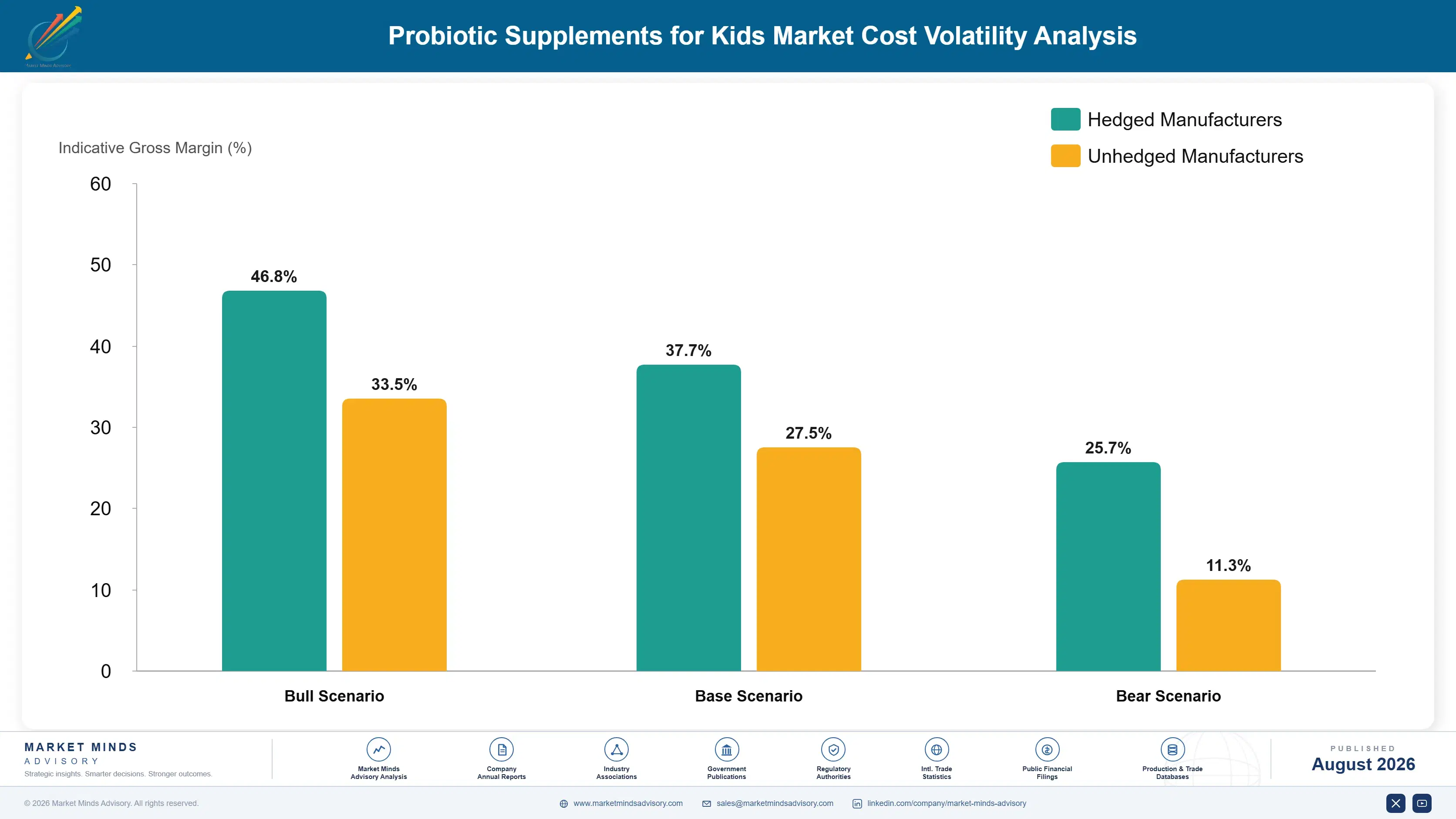
Probiotic culture ingredients and clinical trial investment together represent roughly 34 to 42% of COGS for most pediatric supplement producers, sourced primarily from specialty fermentation facilities across Europe and North America alongside dedicated pediatric research partnerships nationwide. Gelatin and natural flavoring inputs add another meaningful share of total input cost for gummy format producers specifically.
Probiotic culture and clinical research costs rose sharply through 2024 following tightening institutional review board requirements for pediatric studies nationwide, an event reflected in rising development costs across most global children's supplement producers during that period according to disclosures in several producers' annual reports covering the affected period. Suppliers without established research hospital partnerships absorbed meaningfully higher costs than those with existing clinical infrastructure relationships already in place.

Smaller regional formulators face the steepest competitive disadvantage from this cost pressure, since they typically lack the capital scale to fund dedicated pediatric clinical trials that larger diversified producers can absorb routinely. Exposure varies meaningfully by supplier type too: pharmaceutical-adjacent producers with existing clinical infrastructure face considerably less incremental cost than pure consumer goods companies entering the category for the first time.
probiotic-supplements-for-kids-market-cost-volatility-analysis-1787335330139

Research Hospital Partnership Networks for Trial Access

Suppliers are establishing standing partnerships with pediatric research hospitals that maintain existing institutional review board infrastructure, meaningfully reducing the time and cost required to launch new clinical validation studies for additional probiotic strains across multiple product lines simultaneously and repeatedly over time and well into the future across most major markets today and beyond.

Shared Clinical Trial Consortium Participation

Smaller suppliers are increasingly pooling clinical trial costs through shared research consortiums, letting multiple brands co-fund pediatric efficacy studies for common probiotic strains rather than each bearing the full research cost independently and separately across most affected product categories nationwide and internationally this year and well into the future ahead of most competitors entirely.

Diversified Multi-Region Probiotic Culture Sourcing

Diversifying probiotic culture sourcing across multiple specialty fermentation facilities in Europe and North America reduces single-supplier concentration risk meaningfully, giving formulators considerably more negotiating leverage on ingredient pricing and substantially reducing the commercial impact of any single facility disruption on production continuity across most major product lines and categories nationwide today and going forward.

Portfolio Architecture for Margin Defence

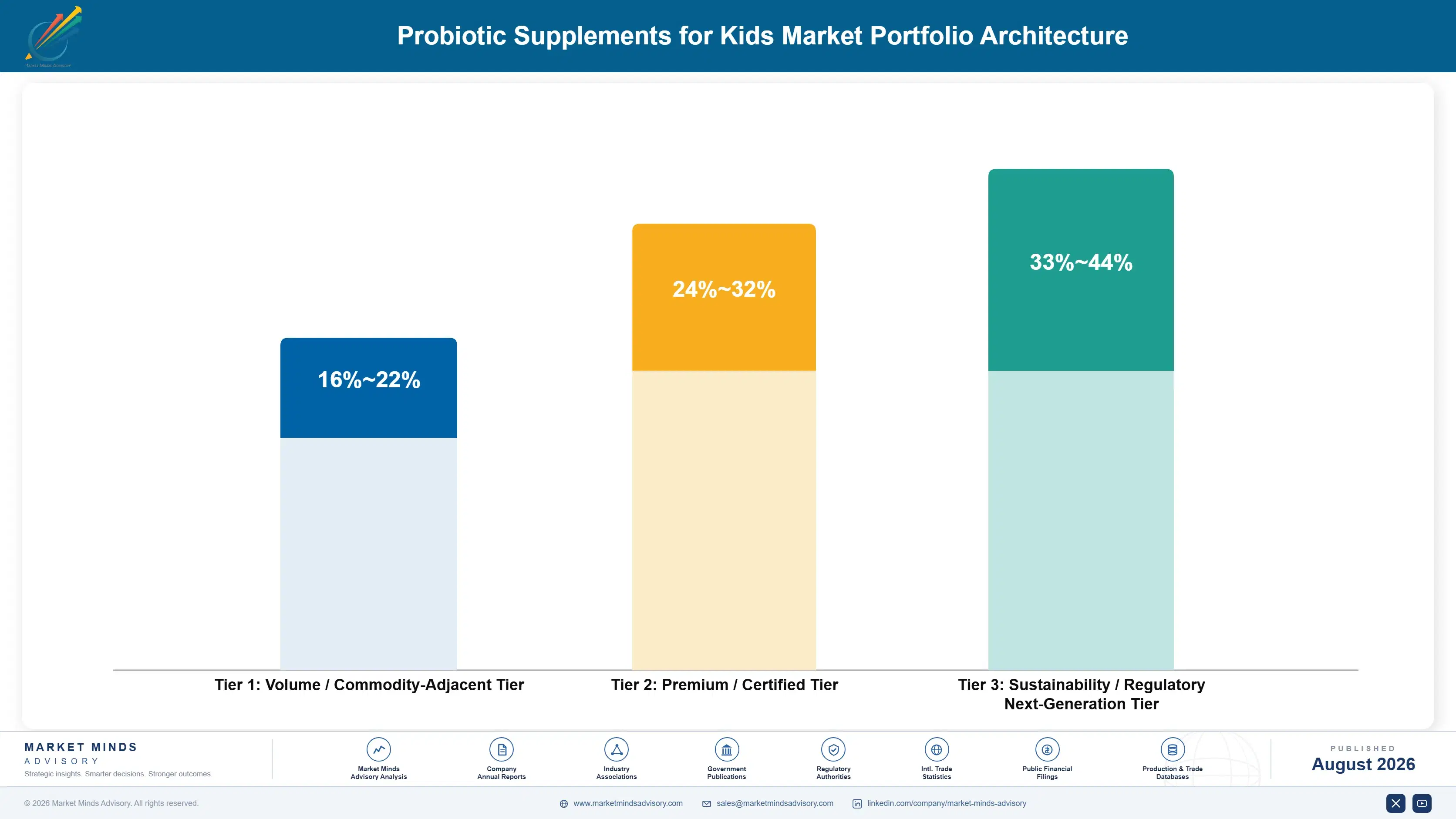
The children's probiotic supplements portfolio splits across three tiers with meaningfully different margin economics: volume commodity-adjacent generic gummy formats carrying gross margin near 16 to 22%, premium certified formulations near 24 to 32%, and clinically validated strain-specific systems commanding the highest gross margin of the three tiers at 33 to 44% across nearly every producing region worldwide today and increasingly well beyond.
Suppliers competing purely in the volume tier face persistent price compression from private label competitors scaling aggressively on flavor and cost alone, while those with clinical validation capability capture considerably fatter margin pools that keep expanding as pediatrician recommendation broadens across major consumer and export accounts nationwide and increasingly well beyond their traditional domestic markets and established multi year distribution networks.

The clearest strategic tension sits between chasing volume share in commodity flavor-driven gummy categories and committing capital toward the clinical trial infrastructure premium tiers genuinely require, a tradeoff nearly every major supplier in this market is actively navigating this year as clinically validated demand accelerates and pediatrician recommendation requirements tighten steadily across most regulated end-use categories and adjacent commercial segments nationwide and beyond.

Volume / Commodity-Adjacent Tier

Standard flavor-driven gummy formats serving routine retail and pharmacy needs across most established distribution channels, priced primarily on ingredient cost and production scale rather than differentiated formulation or clinically documented performance features today.
Gross Margin: 16%-22%

Premium / Certified Tier

Certified premium formulations engineered for potency and dosing consistency, commanding meaningful premiums through validated production performance and third-party testing documentation that pharmacy retailers now require for most regulated categories today.
Gross Margin: 24%-32%

Sustainability / Regulatory / Next-Generation Tier

Clinically validated strain-specific systems designed for documented pediatric efficacy and dosage compliance, engineered for extended shelf outcomes and validated clinical trial data that increasingly anchor long-term pediatrician recommendation and retailer procurement decisions across most major regulated accounts.
Gross Margin: 33%-44%
probiotic-supplements-for-kids-market-portfolio-architecture-1787335330644

High-value Sub-segments and Strategic Watch-out

Clinically Validated Strain-Specific Probiotics

Clinically validated strain-specific systems serving major pharmacy and export retailer accounts represent the highest value, fastest growing pool in this market, combining premium pricing with expanding pediatrician linked procurement mandates across large multinational retailer accounts spanning multiple continents and steadily growing even much wider still today.
Gross Margin: 35%-44%

Certified Premium Formulations

Certified premium formulations serving regulated pharmacy retail categories offer strong value with moderate growth, sustained by steady replacement demand and potency certification requirements that limit competitive entry from smaller, less differentiated regional formulators lacking dedicated testing infrastructure and capability of their own to fully match.
Gross Margin: 25%-32%

Standard Flavor-Driven Gummy Formats

Standard flavor-driven gummy formats remain the volume core of the market, delivering steady but comparatively thin margin on routine retailer shipments across most established distribution channels nationwide today, sustained mainly by recurring restocking cycles rather than any meaningful pricing power or genuine differentiation now overall.
Gross Margin: 16%-20%

Multi-Strain Combination Premium Formats

Multi-strain combination premium formats warrant strategic monitoring as adoption in premium immune and digestive wellness categories could accelerate quickly if major retailers standardize around the format industry wide, a shift that would meaningfully reshape competitive positioning among mid-tier suppliers currently underexposed to this fast growing category overall.
Gross Margin: 22%-28%

Recurring Purchase Economics and Trust Evolution

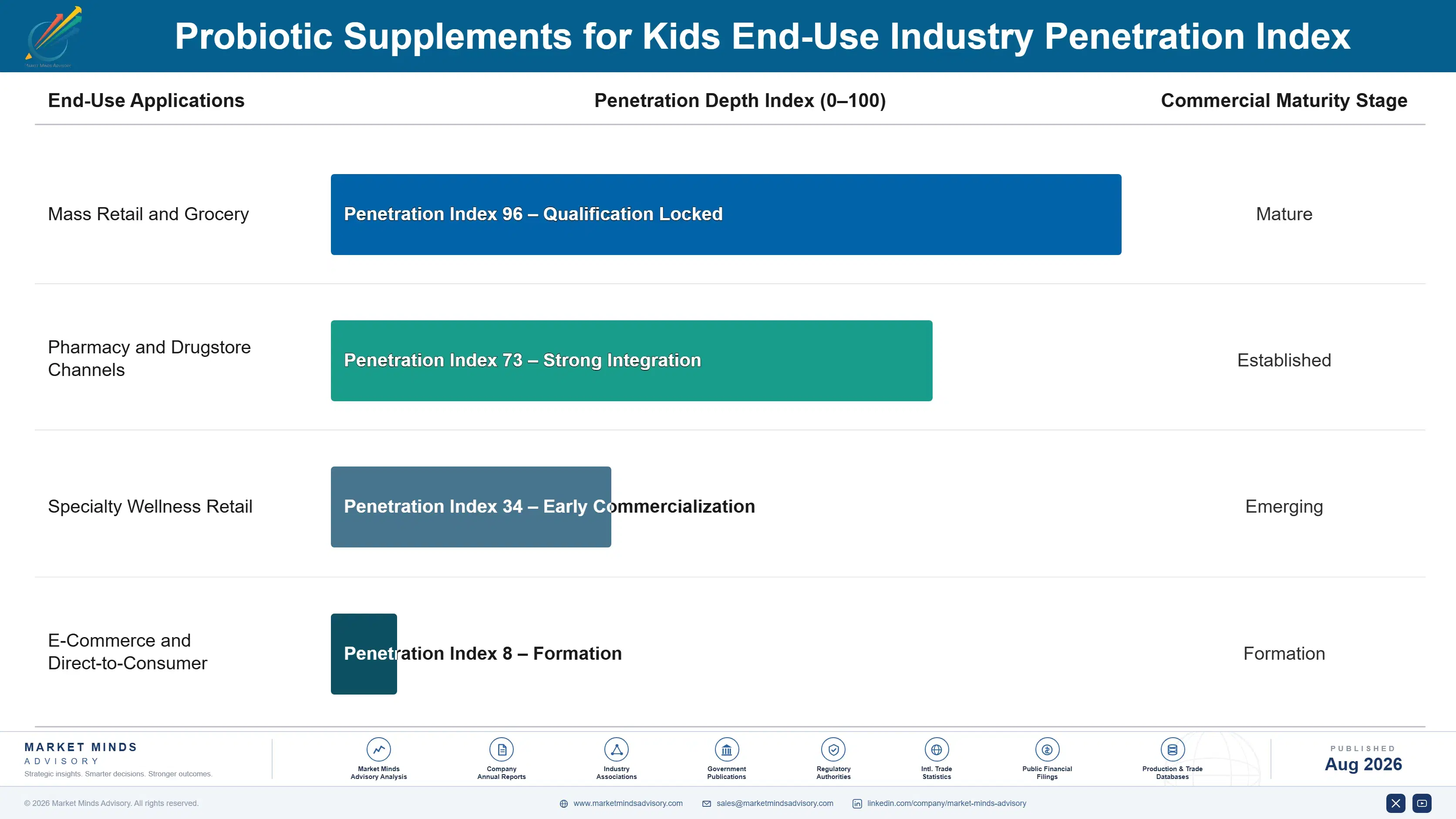
Children's probiotic purchasing behaves like a genuine subscription business once parents settle on a trusted brand and strain, even without formal subscription contracts across most retail channels today. Parents who adopt a specific formulation for their child typically repurchase the identical product eight to twelve times yearly across most tracked households, turning a first cautious trial purchase into a recurring revenue stream lasting years as children grow.
Adoption stickiness varies meaningfully by end use vertical. Digestive and immune support formats show the deepest entrenchment once parents witness visible symptom improvement, while general wellness gummies see higher switching as parents chase new flavor or ingredient claims each purchase cycle. Sleep and calm formats sit between the two, anchored by routine bedtime habits that sustain repeat purchase discipline across most tracked demographic cohorts.

Buyer profiles have shifted generationally too. Younger, research-driven parents overwhelmingly research strain names and clinical citations before purchasing, treating supplement selection as an evidence-based decision rather than a habitual purchase from a familiar brand. Older or less research-oriented parents increasingly follow that shift as pediatrician recommendation becomes more common. That convergence is broadening the addressable buyer base well beyond the category's original wellness-focused customer core nationwide.
probiotic-supplements-for-kids-market-end-use-penetration-index-1787335331137

MMA Category Growth Verdict

These are among the four positions where our research anticipates prominent divergence between winners and laggards over the coming forecast period. Each is grounded in the demand model, the regulatory perimeter, and the announced capacity pipeline.
01 / CLINICAL VALIDATION INVESTMENT

Build Clinical Validation Capability Before Generic Margin Erodes Further

Suppliers still concentrated in standard flavor-driven gummy formats face intensifying price competition as clinically validated strain-specific probiotics grow at roughly 1.7 times the broader category average through 2036, a gap that compounds meaningfully across even a five year planning horizon for established producers. The clinical trial and research hospital infrastructure validation requires takes years to build and cannot be assembled quickly once competitors have already secured pediatrician endorsement relationships. Acting within the next two years preserves considerably more pricing power than waiting for the gap to widen further.
02 / PEDIATRICIAN RELATIONSHIP BUILDING

Invest in Direct Pediatrician Relationships Before Competitors Lock Them In

Pediatrician recommendation has become the single most influential purchase driver in this category, yet most suppliers still rely primarily on consumer marketing rather than direct physician relationship investment to build that trust over time. Suppliers that build genuine medical affairs capability and physician education programs now, before competitors lock in exclusive practice partnerships, will capture a durable trust advantage that consumer marketing alone cannot replicate quickly. Suppliers that wait risk losing pediatrician mindshare to competitors already embedded in practice networks nationwide.
03 / REGIONAL CAPACITY ALLOCATION

Weight New Capacity Toward East Asian Pediatric Wellness Growth

East Asia is growing faster than the global category average, yet capacity commitments across the industry still concentrate disproportionately in North America and Western Europe despite that widening demand gap across major pediatric wellness markets. That mismatch leaves suppliers exposed to meaningful logistics cost and lead time disadvantages against regional competitors building formulation capacity closer to these faster growing demand centers across multiple large national markets. Early regional capacity investment secures durable share before local suppliers fully scale production and close the current cost and speed gap.
04 / FORMAT COMPLIANCE OPTIMIZATION

Prioritize Gummy Format Investment to Capture Compliance Advantage

Gummy formats deliver measurably higher daily compliance among young children than liquid or powder alternatives, and that compliance advantage is increasingly what pediatricians cite when recommending a specific brand over competitors offering less palatable formats. Suppliers still weighted toward liquid or powder formulations risk losing pediatrician endorsement and parental loyalty to competitors that have already made the capital investment in gummy manufacturing capability. Prioritizing gummy format capacity now captures that compliance advantage before it becomes the default industry expectation everywhere.

Engagement Snapshot From the Field

A live engagement with an industry participant carrying material or product regulatory and market exposure ahead of a defining policy shift, showing how our research translates into a defensible multi-year portfolio strategy.
MARKET MINDS ADVISORY · CLIENT ENGAGEMENT SUMMARY
Probiotic Supplements for Kids Producer Strategic Portfolio Review and Transition Roadmap 2026·Investment Scenario on Probiotic Supplements for Kids Exposure Evaluation 2025-26
CLIENT PROFILE
The client is a mid-tier North American children's wellness brand with an established flavor-driven gummy probiotic portfolio sold primarily through mass retail and grocery accounts. Revenue had plateaued as private label competitors undercut pricing, and leadership sought an independent assessment of where to reallocate formulation and capital investment across the broader children's probiotic category going forward.
STRATEGIC CHALLENGE
The client's portfolio skewed heavily toward generic flavor-driven formats generating thin margin and facing accelerating private label price competition. Leadership needed clarity on whether to defend that volume position or pivot capital toward clinically validated formats where competitors were already capturing premium pharmacy shelf space and stronger pediatrician endorsement relationships.
MMA APPROACH
MMA conducted primary interviews with regional pediatricians and pharmacy retail buyers across multiple accounts, benchmarked margin structures across all three portfolio tiers in detail, and modeled demand trajectories for clinically validated, certified, and standard gummy formats through 2036 using the firm's primary survey dataset and forty seven expert interview panel.
KEY FINDINGS
  1. Clinically validated strain-specific probiotics were forecast to grow at roughly 1.7 times the client's existing flavor-driven revenue base over the coming decade.
  2. Pediatrician recommendation was found to be the single strongest predictor of repeat purchase behavior, yet the client had no dedicated medical affairs or physician outreach capability.
  3. Competitors with dedicated clinical trial capability were commanding meaningful pricing premiums over standard gummy formats across comparable pharmacy distribution channels nationwide and internationally.
  4. The client's East Asian distribution penetration lagged the category average significantly, concentrating revenue in slower growing, more mature North American mass retail channels.
CLIENT PROFILE
The client is a mid-tier North American children's wellness brand with an established flavor-driven gummy probiotic portfolio sold primarily through mass retail and grocery accounts. Revenue had plateaued as private label competitors undercut pricing, and leadership sought an independent assessment of where to reallocate formulation and capital investment across the broader children's probiotic category going forward.
STRATEGIC CHALLENGE
The client's portfolio skewed heavily toward generic flavor-driven formats generating thin margin and facing accelerating private label price competition. Leadership needed clarity on whether to defend that volume position or pivot capital toward clinically validated formats where competitors were already capturing premium pharmacy shelf space and stronger pediatrician endorsement relationships.
MMA APPROACH
MMA conducted primary interviews with regional pediatricians and pharmacy retail buyers across multiple accounts, benchmarked margin structures across all three portfolio tiers in detail, and modeled demand trajectories for clinically validated, certified, and standard gummy formats through 2036 using the firm's primary survey dataset and forty seven expert interview panel.
KEY FINDINGS
  1. Clinically validated strain-specific probiotics were forecast to grow at roughly 1.7 times the client's existing flavor-driven revenue base over the coming decade.
  2. Pediatrician recommendation was found to be the single strongest predictor of repeat purchase behavior, yet the client had no dedicated medical affairs or physician outreach capability.
  3. Competitors with dedicated clinical trial capability were commanding meaningful pricing premiums over standard gummy formats across comparable pharmacy distribution channels nationwide and internationally.
  4. The client's East Asian distribution penetration lagged the category average significantly, concentrating revenue in slower growing, more mature North American mass retail channels.
RECOMMENDED STRATEGY
Phase 1: Phase one: reallocate a defined share of capital expenditure toward clinical trial infrastructure and pediatric research partnerships over an eighteen month window. Phase 2: Phase two: build dedicated pediatrician outreach and medical affairs capability to meaningfully reduce dependence on consumer marketing alone across all channels. Phase 3: Phase three: phase down commodity flavor-driven capacity gradually while monitoring margin recovery across the repositioned, clinically validated portfolio segments over time.
OUTCOME
Within twelve months of the engagement, the client reported (client-reported, unverified by MMA) a meaningful gross margin improvement across its repositioned clinically validated portfolio segments, alongside new pharmacy retail account wins it attributed directly to the pediatrician relationship investment guided by MMA's independent analysis and recommendations.

Frequently Asked Questions

Foundational context covering the market sizes, CAGR, scope, country, region and competition that inform every finding below. This section is provided to cover basics and most often pre-purchase conversations, answered from the MMA Primary Research Dataset.

What is the current size of the Probiotic Supplements for Kids Market?

The global children's probiotic supplements market reached an estimated $1.6 billion in 2025. This figure reflects consumption across all delivery format segments and regions tracked by MMA's primary survey dataset.

How large will the Probiotic Supplements for Kids Market be by 2036?

The market is forecast to reach approximately $4.8 billion by 2036, expanding at a 10.4% compound annual growth rate from 2026 through 2036 under MMA's base case scenario.

What is the CAGR for the Probiotic Supplements for Kids Market 2026 to 2036?

MMA projects a base case CAGR of 10.4% for 2026 to 2036, with a bull scenario of 11.8% and a bear scenario of 9.0% depending on clinical adoption pace.

Which segment is growing fastest?

Clinically Validated Strain-Specific Probiotics is the fastest growing segment, expanding at roughly 17.8% CAGR, about 1.7 times the category average, driven by pediatrician recommendation of documented strains.

Who are the major companies in the Probiotic Supplements for Kids Market?

Major companies include Church and Dwight, Bayer, Reckitt Benckiser, Nestle Health Science, and Culturelle, alongside a broad base of specialty and pediatrician-endorsed formulators competing across all three portfolio tiers.

Which country is growing fastest?

India is the fastest growing major country market, supported by rapidly expanding organized retail infrastructure and rising pediatric wellness awareness among a large and increasingly urban middle class population.

Report Segmentation Architecture

The full report scope spans multiple orthogonal segmentation dimensions, with cross-tabulated demand data provided for each dimension pair. Coverage extends further to regional breakdowns, trend trajectories, and the competitive detail needed to support segment-level decision-making.

By Product Delivery Format

  • Gummy Probiotics
  • Chewable Tablet Probiotics
  • Liquid Drop Probiotics
  • Powder Sachet Probiotics
  • Clinically Validated Strain-Specific Probiotics
  • Multi-Strain Combination Probiotics

By End-Use Industry

  • Mass Retail and Grocery
  • Pharmacy and Drugstore Channels
  • Specialty Wellness Retail
  • E-Commerce and Direct-to-Consumer

By Commercial Dimension

  • Retail Sales
  • Subscription and Auto-Replenishment
  • Pediatric Practice Recommendation Channels
  • Export Distribution Channels

By Region

  • North America
  • Western Europe
  • East Asia
  • South Asia and Pacific
  • Latin America
  • Middle East and Africa
  • Eastern Europe

Scope, Methodology, and Coverage

Every figure in this report is reproducible from documented input assumptions. The scope below maps the historical period, the forecast horizon, the segmentation dimensions, and the countries covered, alongside the underlying primary and qualitative methodology.
Historical Period
2020 to 2025
Forecast Period
2026 to 2036
Base Year
2025 (USD billions; MMA Primary Research Dataset, August 2026)
Market Definition
The children's probiotic supplements market covers probiotic formulations, including gummies, chewables, drops, and powders, marketed specifically for pediatric consumption from infancy through adolescence. It excludes infant formula and prescription pediatric pharmaceuticals.
Quantitative Units
USD billions (current prices); million bottle units of volume where applicable
Segmentation Dimensions
By Product Delivery Format; By End-Use Industry; By Commercial Dimension; By Region
Regions Covered
North America, Western Europe, East Asia, South Asia and Pacific, Latin America, Middle East and Africa, Eastern Europe
Countries Covered
USA, Canada, Germany, UK, France, China, Japan, South Korea, India, Australia, Brazil, Mexico, Indonesia, Vietnam, UAE, Saudi Arabia, South Africa, Nigeria, Turkey, Poland, Czech Republic, Netherlands, Italy, Spain, Sweden, Switzerland, Argentina, Colombia, Singapore, Thailand, and additional markets relevant to this sector
Key Companies Profiled
Church and Dwight Co Inc, Bayer AG, Reckitt Benckiser Group plc, Nestle Health Science SA, Culturelle Inc, Garden of Life LLC, NOW Health Group Inc, Nordic Naturals Inc, Renzo's Vitamins Inc, Olly PBC, SmartyPants Vitamins Inc, Nature's Way Products LLC, Zarbee's Inc, Ritual Inc, Enfamil PetitPass, BioGaia AB, Nature's Bounty Co, Genexa Inc, Mary Ruth Organics LLC, Yumi Care Inc
Quantitative Methodology
Primary survey, n=3,800 respondents, Q4 2025, six countries; demand-side model with trade association cross-validation
Qualitative Methodology
47 expert interviews, Q4 2025; applied to validate demand model assumptions, identify emerging dynamics, and assess competitive positioning
Report Format
PDF and XLSX data workbook (Word format preview document)
Publisher
Market Minds Advisory
Report Code
MMA-2026-AGR-106
Published
August 2026
Contact
sales@marketmindsadvisory.com | www.marketmindsadvisory.com

Purchase the full Probiotic Supplements for Kids Market Report (2026 to 2036).

This report provides comprehensive coverage of the global children's probiotic supplements market, including detailed segmentation across six delivery format categories and seven-region demand analysis. It benchmarks twenty leading suppliers on clinical validation capability, pediatrician relationship depth, and margin structure, and models base, bull, and bear demand trajectories through 2036. The analysis draws on MMA's primary survey of 3,800 respondents and 47 expert interviews conducted in Q4 2025, alongside company disclosures and government trade data. Together these give strategy and commercial teams a defensible basis for capital and formulation investment decisions.
Six-segment format breakdown with growth rankings
Seven-region demand architecture and pricing analysis
Twenty-company competitive benchmarking and moat analysis
Clinical validation and ingredient cost exposure modeling
Revenue lever and margin expansion pathway analysis
Anonymized client case study with strategic recommendations

Built For The People Who Decide

From boardroom strategy to bench-side execution, this report is read cover-to-cover by leaders shaping the next decade of their industry, turning demand scenarios, market dynamics and valuation benchmarks into decisions.
CXOs/ Presidents/ VPs/ Managers
M&A and Corporate Development
Strategy Teams and R&D Heads
Procurement and Product Directors
Regulatory and Compliance Leaders
Investor Relations and Equity Analysts