

Market Minds Advisory
Printed Aluminium Foil Packaging Market

Printed Aluminium Foil Packaging Market: The Only Absolute Barrier, and the Worst Thing in the Bin

A continuous foil layer stops oxygen and moisture completely rather than slowly, which nothing else in flexible packaging does, and it is also what makes the pack impossible to recover afterwards.

Lead Analyst

Bilal Shaikh

Published

September 2026

Make Smarter Decisions with Customized Research Insights

Request a free sample report and evaluate market opportunities, growth trends, and competitive dynamics relevant to your business needs.

2025 MARKET VALUE$18.3BMarket Size 2025
2036 FORECAST VALUE$30.6BBase Case , 2026 to 2036
CAGR 2026 TO 20364.8 %Bull 6.0% / Bear 3.6%
INCREMENTAL OPPORTUNITY$11.5BNet 10- year value creation
EXPANSION MULTIPLE1.60x2036 value over 2026 base
Strategic Levers
M&A Pipeline
Regional Outlook
Country Rankings
Competitive Intelligence
Segmental Deep-dive
Call-Us : 91 93563 13602

Executive Snapshot and Market Trajectory

Every other flexible barrier slows transmission. A continuous aluminium foil layer stops it, which is a different physical claim entirely and the reason moisture-sensitive medicines, long-life aseptic milk and premium coffee all use foil and cannot substitute their way out of it. The substitution conversation ends there.
That absoluteness has one condition and one consequence. Below roughly nine microns the foil develops pinholes and stops being absolute, which puts ultra-thin gauges into competition with barrier coatings on the coatings' own terms. And the aluminium that delivers the barrier is what makes the laminate unrecoverable, with roughly 4% reaching any recycling stream. The laminates that would supply recycled metal are exactly the ones nobody can collect. Nothing about that resolves itself.
Pharmaceutical blister lidding grows fastest at 7.2%, half again the market rate of 4.8%, because it is the one application where nothing else meets the requirement and where an eighteen month qualification protects whoever holds it. East Asia holds 33% of value, above the usual band, on foil rolling and converting capacity together. South Asia and Pacific sits above its band at 14% on aseptic and pharmaceutical demand together.
Market Definition
Printed and converted aluminium foil packaging supplied to food, pharmaceutical and consumer goods manufacturers, spanning pharmaceutical blister lidding, flexible laminate pouches and sachets, aseptic carton foil layers, confectionery wraps, container lidding films and semi-rigid foil containers, measured at converter selling price. Excludes unconverted foil stock, metallised polymer films, aluminium cans and closures, and rigid aluminium containers for beverages.
Base Year Value
$18.3B in 2025 (MMA Primary Research Dataset, August 2026)
Forecast Period
2026 to 2036, eleven discrete annual values
CAGR
4.8% base case. Bull 6.0%. Bear 3.6%.
Fastest Growth Segment
Pharmaceutical Blister Lidding: 7.2% CAGR
Fastest Growth Country
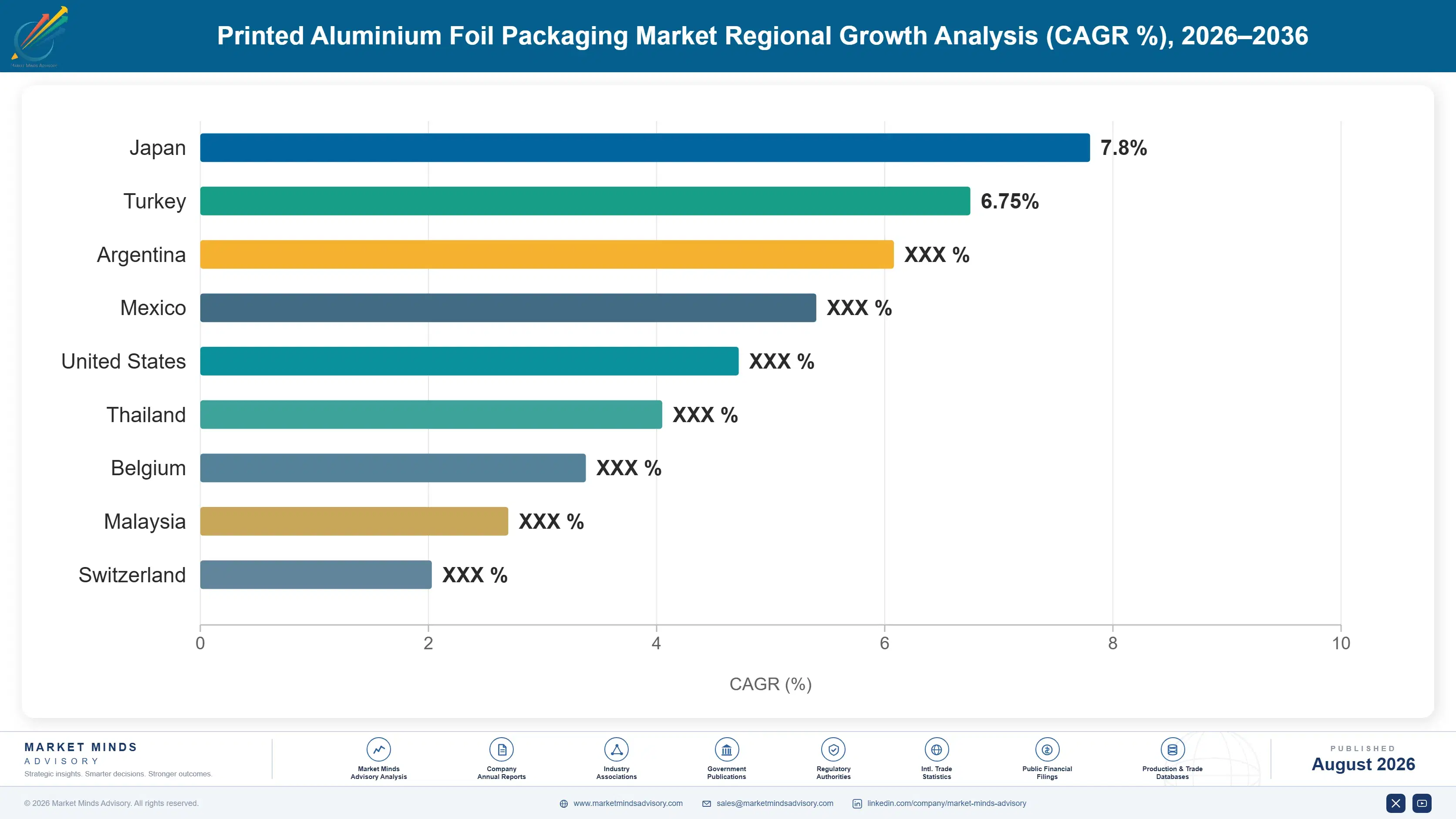
India: 7.8% CAGR
Fastest Growth Region
South Asia and Pacific: 7.0% CAGR
Largest Region
East Asia: 33% of 2025 global value
Market Leaders
Amcor, Constantia Flexibles, Huhtamaki, Toyo Aluminium, Sonoco. Source: MMA Primary Research Dataset, July 2026.
Primary Survey
n=3,800 procurement and R&D decision-makers, Q4 2025, six countries
Methodology
Demand-side build-up, cross-validated against public data, 47 expert interviews

Printed Aluminium Foil Packaging Market Forecast Scenarios

printed-aluminium-foil-packaging-market-outlook-20-size-forecast-scenario-1787580931861
Growth ran near 3.7% between 2020 and 2025 as pharmaceutical demand held firm while food packaging faced steady substitution pressure from barrier coated films. Aluminium pricing moved sharply through 2022 on European smelter curtailments driven by power costs, lifting value ahead of volume that year. Packaging waste rules tightened across Europe throughout the period without yet displacing foil from applications where nothing replaces it.
Base case 4.8% rests on three mechanisms. Pharmaceutical demand keeps growing with generic manufacturing volume and with moisture-sensitive formulations that no alternative barrier serves adequately. Aseptic packaging expansion across South Asian and African dairy and beverage markets consumes foil layers in cartons where ambient distribution has no other route. And recycled content aluminium is improving the embodied carbon position without changing the barrier at all. None of the three depends on food laminate volume holding up.
The bull case at 6.0% assumes recycled aluminium content rises far enough to neutralise the carbon argument, since recycled metal uses roughly 5% of the energy primary production requires. The bear case at 3.6% is European packaging waste rules extending recyclability requirements into food laminates before any recovery route exists, which would strand applications faster than substitutes can qualify.

Absolute, Until It Is Nine Microns Thin

Barrier performance in flexible packaging is normally a rate. A metallised film or an ethylene vinyl alcohol layer transmits oxygen slowly, and the shelf life follows from how slowly. Continuous aluminium foil transmits none, which is why a moisture-sensitive tablet, an ambient milk carton and a coffee pack that must taste identical after a year all use it and why the substitution conversation ends there.
TOP FIVE CONCENTRATION24%Converters compete regionally against many specialist local producers
FOIL GAUGE THRESHOLD9 micronsThickness below which pinholes begin compromising the barrier
ALUMINIUM COST SHARE44%Share of laminate cost carried by the foil layer
RECYCLED METAL ENERGY SAVING95%Energy avoided using recycled rather than primary aluminium
PHARMACEUTICAL QUALIFICATION PERIOD18 monthsTime to qualify a lidding change on a licensed product
LAMINATE RECOVERY RATE4%Share of foil laminates recovered from consumer waste streams
The absoluteness has a threshold. Below roughly nine microns, rolling produces pinholes and the layer stops being continuous, so ultra-thin foil transmits like a very good coating rather than like foil. That matters commercially because downgauging is the obvious response to aluminium cost and carbon, and it moves the material into a comparison it was previously exempt from entirely.
The circularity problem is genuinely circular. Aluminium content is what makes a laminate valuable to recover and impossible to separate, so roughly 4% reaches any recycling stream. Recycled metal uses about 5% of the energy primary production needs, which would transform the carbon position, and the laminates that would supply it are the ones nobody can collect. Nothing about that resolves itself.
"Foil is the only barrier in flexible packaging that makes an absolute claim, and the industry keeps trying to defend it with arguments about grams of carbon. The pharmacist does not care about carbon and the recycler cannot use the pack, and both of those things will still be true in ten years."
Director, Flexible Packaging and Barrier Materials Practice · MMA Packaging Practice · August 2026

Market Trends

Barrier coatings closing the gap in food applications

Transparent silicon and aluminium oxide coatings on polyester now reach oxygen transmission rates adequate for many ambient food applications, and they leave a laminate that sorting facilities can process. They still suffer flex cracking and pinholing under creasing, which foil below nine microns also does, so the honest comparison is between two imperfect barriers rather than between absolute and approximate. Brand owners under packaging waste pressure increasingly accept a shorter shelf life to obtain a recyclable structure, which is a trade foil cannot answer. That is a trade an absolute barrier simply cannot answer on its own terms.
Market Impact: Locks specifications for 18 months

Recycled aluminium content reframing the embodied carbon position

Recycled aluminium requires roughly 5% of the energy that primary smelting consumes, which changes the embodied carbon of a foil laminate substantially without altering the barrier at all. Converters are specifying higher recycled content from rolling mills and documenting it in product declarations. The awkwardness is that foil laminates themselves are almost never recovered, at roughly 4% of consumer waste streams, so the recycled content arrives from other aluminium products rather than from any loop this industry closes. Recycled content arrives from other aluminium products rather than from any loop this industry manages to close.
Market Impact: Delivers 7.8% annual Indian growth

Market Opportunities and Growth Drivers

Pharmaceutical demand where no substitute meets the requirement

Moisture-sensitive and oxygen-sensitive formulations require barrier performance that only continuous foil delivers, and regulators require stability data supporting whatever pack is used. That combination makes blister lidding effectively unsubstitutable rather than merely preferred. Generic manufacturing volume keeps rising, and each new product qualification locks a lidding specification for the product's licensed life. Qualification takes around eighteen months, which protects the incumbent supplier and slows every challenger regardless of price or sustainability argument. Packaging waste rules have so far exempted pharmaceutical primary packaging from requirements applied across food and consumer categories.
Market Impact: Recovers only 4% of laminates

Aseptic packaging expanding across South Asian and African markets

India grows fastest anywhere at 7.8%, as ambient dairy and beverage distribution expands into markets where cold chain does not reach and aseptic cartons are the only practical route. Every aseptic carton contains a foil layer, since ambient shelf stability at those temperatures requires an absolute oxygen barrier rather than a good one. African markets follow the same pattern behind India. This demand is created by infrastructure limitations rather than by preference, which makes it durable until cold chain arrives. Cold chain arriving is a longer horizon than most packaging forecasts assume.
Market Impact: Exposes 44% of laminate cost

Market Restraints and Challenges

Foil laminates failing every recyclability criterion being written

Aluminium bonded to polymer layers cannot be separated in any conventional recovery process, and roughly 4% of foil laminates reach a recycling stream at all. The root cause is that the barrier depends on the foil being continuous and bonded, which is precisely what defeats separation. Packaging waste rules across Europe are being written against exactly that structure. Converters are developing higher recycled content, thinner gauges and paper-based structures with thin barrier layers, and none of them recovers the absolute barrier that foil provides. None of the alternatives recovers the absolute barrier.
Market Impact: Competes below 9 micron gauges

Aluminium pricing and smelter curtailment risk in Europe

Foil accounts for roughly 44% of laminate cost, and primary aluminium production is among the most electricity-intensive industrial processes anywhere. The root cause is thermodynamic rather than operational, since reducing alumina requires that energy however the smelter is run. European smelter curtailments during the 2022 power crisis demonstrated how quickly regional supply tightens. Converters are contracting metal on longer tenor and increasing recycled content, which reduces both the cost exposure and the carbon figure simultaneously. Converters are contracting metal on longer tenor and increasing recycled content, which reduces the cost exposure and the carbon figure at the same time.
Market Impact: Cuts energy by 95% per tonne
3 additional market trends, 4 additional growth drivers, and 2 additional restraints and challenges are covered in the full report. Contact sales@marketmindsadvisory.com to access the complete intelligence.

Segment CAGR and Growth Architecture

Six segments split by converted pack format, because format determines the barrier requirement, the qualification burden and whether any substitute exists at all. Blister lidding and a confectionery wrap use the same metal to entirely different commercial effect. End-use industry and channel are handled in the framework rather than here. Substitutability decides everything. Nothing else matters.
printed-aluminium-foil-packaging-market-outlook-20-market-share-analysis-1787580932399

Pharmaceutical Blister Lidding

Growing at 7.2%, half again the market rate of 4.8%, blister lidding is the one application where no substitute meets the requirement rather than merely underperforming it. Moisture-sensitive formulations need an absolute barrier and regulators need stability data supporting the specific pack used, so a lidding change requires around eighteen months of qualification on a licensed product. That protects incumbents heavily and makes price a secondary consideration behind supply reliability and documentation. Generic manufacturing volume drives the growth, and packaging waste pressure has so far exempted pharmaceutical packaging from requirements applied to food. Packaging waste pressure has so far exempted pharmaceutical packaging from requirements applied to food categories. Price runs a clear second to supply reliability.
CAGR 7.2%

Aseptic Carton Foil Layers

At 6.4% aseptic carton foil grows on ambient distribution expanding across markets where cold chain infrastructure does not reach. Every aseptic carton contains a thin foil layer, because shelf stability for months at ambient temperature requires an absolute oxygen barrier rather than a good one, and coated alternatives have not matched it in that duty. Demand therefore follows infrastructure limitation rather than consumer preference, which makes it unusually predictable. The structure is also among the most criticised on recyclability grounds, and separation technology for carton laminates remains limited in most markets. Separation technology for carton laminates remains limited in most markets, which leaves the structure among the most criticised on recyclability grounds.
CAGR 6.4%
Full segment breakdown across 6 segments available in the complete report.

Regional Architecture and Country Demand Map

East Asia holds 33% of value, above its usual band, on foil rolling and converting capacity concentrated across China, Japan and Korea. South Asia and Pacific sits above its band at 14% on aseptic and pharmaceutical growth, while North America falls below its band at 20% on food laminate substitution.

North America

The 20% share sits below the usual band because food laminate converting has been under substitution pressure here for longer than elsewhere, with brand owners moving toward recyclable structures ahead of any regulation requiring it. Pharmaceutical blister lidding remains untouched and is the healthiest part of the regional business, supported by domestic generic manufacturing. State-level packaging legislation is creating a patchwork that converters plan around rather than a single requirement. Mexican converting serves North American demand and has grown with nearshoring in food manufacturing. State legislation creates a patchwork converters plan around rather than a single national requirement. Mexican converting has grown with nearshoring in food manufacturing across the border.
Share: 20% | CAGR: 3.9% (2026 to 2036)

Western Europe

European packaging waste rules are the most developed anywhere and aimed directly at multi-material laminates, which makes this the region where foil faces its sharpest commercial challenge. Constantia and Amcor hold substantial capacity built around pharmaceutical and premium food applications. German and Swiss pharmaceutical manufacturing supports blister lidding demand that regulation has so far exempted from recyclability requirements. Aluminium supply is the second concern, since European smelter curtailments during the 2022 power crisis showed how quickly regional metal availability tightens under energy stress. German and Swiss pharmaceutical manufacturing supports lidding demand that regulation has so far exempted. Smelter curtailments showed how quickly regional metal availability tightens under stress. Foil faces its sharpest challenge here.
Share: 22% | CAGR: 3.4% (2026 to 2036)
Regional intelligence for 5 additional markets available in the complete report: East Asia, South Asia and Pacific, Latin America, Middle East and Africa, Eastern Europe. Contact sales@marketmindsadvisory.com.
printed-aluminium-foil-packaging-market-outlook-20-country-cagr-analysis-1787580932922

Four Moves Around an Absolute Barrier

Foil sells on a claim nothing else can make and is attacked on a property nothing else has. The defensible positions are where the claim is a requirement rather than a preference, and where qualification stands between a competitor and the business. Arguing carbon on a food laminate is not one of them. Requirement beats preference.

Weight the portfolio toward pharmaceutical qualification

Blister lidding requires an absolute barrier that no alternative delivers and regulatory stability data supporting the specific pack, which makes a lidding change an eighteen month qualification on a licensed product. That protects incumbents far more effectively than any commercial relationship could, and packaging waste rules have so far exempted pharmaceutical packaging from recyclability requirements applied to food. Growth at 7.2% comes with pricing that reflects supply reliability rather than tonnage. It is the best position in this market by a wide margin. Nothing else in this market compares. Regulation has confirmed it.
Market Impact: Protected by an 18 month qualification cycle throughout

Push recycled aluminium content and document it

Recycled metal uses roughly 5% of the energy that primary smelting requires, which transforms the embodied carbon of a laminate without touching the barrier performance at all. Specifying higher recycled content from rolling mills and documenting it in product declarations answers the carbon argument even where it cannot answer the recovery one. Metal cost also falls, since recycled aluminium prices below primary. Very few converters have pushed this as far as the rolling mills would actually supply it. Metal cost falls at the same time. Mills will supply more than most ask for.
Market Impact: Cuts embodied energy by 95% for each tonne

Defend gauge rather than downgauging into a fight

Below roughly nine microns foil develops pinholes and stops making an absolute barrier claim, which puts it into direct comparison with coated films that recycle better and cost less. Downgauging to answer metal cost therefore surrenders the only argument foil has. Holding gauge where absoluteness matters and conceding thin-gauge food applications to coatings is a clearer portfolio position than competing badly in both. Several converters have discovered this the expensive way rather than deciding it deliberately. Below 9 microns the claim simply stops being true, which is the whole argument in a single number.
Market Impact: Holds the barrier above a 9 micron threshold

Follow aseptic demand where cold chain does not reach

Ambient distribution is the only practical route in markets where refrigeration reaches a small share of households, and every aseptic carton needs a foil layer because months of ambient stability requires an absolute oxygen barrier. India grows at 7.8% on this and African markets follow behind it. The demand is created by infrastructure limitation rather than preference, which makes it durable until cold chain arrives, and that is a longer horizon than most packaging forecasts assume. Infrastructure rather than preference creates it. Refrigeration reaches few households. Every aseptic carton needs the layer.
Market Impact: Follows the 7.8% annual growth in Indian demand

Who Controls the Margin Pool

Participation is measured on annual converted foil packaging production volume in tonnes, and the top five hold 24%. Concentration is moderate because converting is regional on freight economics while foil rolling is concentrated among far fewer producers upstream. Amcor and Constantia lead on pharmaceutical qualification depth and multinational customer coverage. The gap to challengers is regulatory qualification rather than printing or laminating capability itself.
Competition divides by application in a way few packaging markets do. Pharmaceutical lidding competes on qualification history, documentation and supply reliability, where price is genuinely secondary and switching takes eighteen months. Food laminates compete against coated films and paper structures rather than against other foil converters, which is a different fight entirely. Aseptic carton foil is supplied into a carton system controlled by a small number of system owners.

The pressure ahead is regulatory and it points one way. European packaging waste rules target multi-material laminates directly, and no development in recycled content or gauge answers a recyclability criterion that foil fails on construction. Expect portfolio repositioning toward pharmaceutical and aseptic applications rather than acquisitions. Rankings shift as food laminate volume erodes and converters weighted toward it find the erosion faster than their repositioning.
printed-aluminium-foil-packaging-market-outlook-20-company-positioning-matrix-1787580933447

Competitive Moat and Risk Dimensions

AMCOR

Moat: Pharmaceutical qualification breadth

Amcor holds qualified blister lidding positions across a large number of licensed pharmaceutical products, each representing stability data and regulatory filings that a competitor would have to reproduce over roughly eighteen months. Manufacturing presence across most major markets also lets a multinational pharmaceutical customer qualify one supplier globally rather than several regionally.
AMCOR

Risk: Food laminate portfolio erosion

A substantial part of the portfolio sits in food laminates facing coated film and paper substitution driven by packaging waste rules that foil cannot satisfy by construction. Repositioning toward pharmaceutical and aseptic applications is the obvious response and those segments cannot absorb the displaced volume quickly, which leaves capacity utilisation exposed during the transition.
CONSTANTIA FLEXIBLES

Moat: European pharmaceutical converting depth

Constantia holds deep pharmaceutical converting capability across European markets where blister packaging penetration is highest and regulatory documentation requirements are most demanding. That capability took decades to establish and is precisely the segment packaging waste rules have exempted, which makes it a durable position while food laminate volume around it comes under pressure.
CONSTANTIA FLEXIBLES

Risk: European aluminium supply exposure

European smelter curtailments during the 2022 power crisis demonstrated how quickly regional aluminium availability tightens under energy stress, and foil is 44% of laminate cost. A converter concentrated in Europe carries that exposure directly, and longer metal contracts reduce the price volatility without addressing physical availability if curtailments recur.

Players Tracked

Prominent Players

Amcor
Constantia Flexibles
Huhtamaki
Toyo Aluminium
Sonoco

Other Key Players

Mondi
ProAmpac
UFlex
EPL Limited
Clondalkin
Winpak
Berry Global
Danapak
Wipak
Schur Flexibles
Symetal
Eurofoil
Carcano Antonio
Hindalco
Nicholl Food Packaging

Recent Developments

MARCH 2026

European rules confirm pharmaceutical packaging exemption from recyclability criteria

European packaging waste implementing rules confirmed an exemption for pharmaceutical primary packaging from recyclability criteria applied across food and consumer categories, citing regulatory stability requirements. Converters holding pharmaceutical qualification gained a protected position that food laminate business does not enjoy. Food categories received no equivalent exemption.
Signal: Regulation is now separating the untouchable applications from the exposed ones, which reshapes every converter's portfolio
AUGUST 2025

Brand owner accepts shorter shelf life for a recyclable coated structure

A food brand owner converted a dry goods range from foil laminate to a coated polyester structure, accepting a materially shorter stated shelf life in exchange for a recyclable pack. Distribution and stock rotation were adjusted to accommodate the reduced window across the affected product lines.
Signal: Brand owners are trading shelf life for recyclability, which is a trade an absolute barrier cannot answer
JANUARY 2026

Converter specifies high recycled content foil across a pharmaceutical range

A European converter specified high recycled content aluminium foil across a pharmaceutical lidding range, documenting the embodied carbon reduction in product declarations without altering the barrier specification. The change required no requalification, since foil composition rather than performance had altered. Metal cost fell at the same time.
Signal: Recycled content answers the carbon argument without touching the barrier, and few converters have pushed it

Metal, Energy and the Lamination

Aluminium foil accounts for roughly 44% of laminate cost, rolled from stock produced by a small number of mills and priced against exchange aluminium plus a rolling conversion premium. Polymer films and adhesives add about 21%, with printing inks and solvents a further 12%. Lamination, slitting and converting energy carry the balance, and solvent recovery equipment adds cost that water-based systems avoid.
European smelter curtailments during the 2022 power crisis showed how quickly regional metal availability tightens, since primary aluminium is among the most electricity-intensive industrial processes anywhere and several European smelters reduced output rather than buy power at prevailing prices, per IEA industrial energy data. Foil converters saw both price and availability move against them, and those holding fixed customer contracts absorbed a substantial share of it.

Exposure divides on metal contracting and on recycled content. A converter buying foil on spot terms against annual customer pricing carries the full swing, while one contracting metal on matched tenor does not. Recycled content is the second divide, since recycled aluminium prices below primary and uses roughly 5% of the energy, and very few converters have pushed it as far as the mills would supply.
printed-aluminium-foil-packaging-market-outlook-20-cost-volatility-analysis-1787580933644

Contract aluminium on tenor matched to customer pricing

Foil at 44% of laminate cost bought on spot terms against annually agreed customer pricing guarantees margin variance whenever metal moves. Matching contract tenor on both sides removes most of it at modest premium. The 2022 episode demonstrated that availability rather than price can become the binding problem, which longer contracts address considerably better than hedging does.

Specify maximum recycled content the mills will supply

Recycled aluminium prices below primary and uses roughly 5% of the energy, which improves cost and embodied carbon simultaneously without changing barrier performance at all. Very few converters have pushed specification as far as rolling mills would actually supply. The requalification burden is minimal for food applications and modest even in pharmaceutical ones, since composition rather than performance changes.

Move printing to water-based inks where quality permits

Solvent-based printing requires recovery equipment, emissions controls and handling procedures that water-based systems largely avoid, and ink and solvent together carry about 12% of laminate cost. Water-based inks do not match solvent systems on every substrate or every print quality requirement, which limits substitution, and where they do work the cost and compliance saving is genuine.

Portfolio Architecture for Margin Defence

Margin here tracks whether a substitute exists rather than anything about the converting itself. Confectionery wraps, container lidding and general food laminates earn margins in the high teens, because coated films and paper structures compete directly and brand owners under packaging waste pressure are actively looking for reasons to switch away from them.
Aseptic carton foil and technically demanding food structures do better in the mid to high twenties, since the barrier requirement is genuine and the alternatives have not matched it in those duties. The range reflects how close a coated alternative has come in a given application, which varies considerably by product and by shelf life requirement. How close a coated alternative has come varies considerably by product and by shelf life duty.

Pharmaceutical blister lidding holds the strongest position by a wide margin, running into the high thirties, because no substitute meets the requirement, qualification takes eighteen months and packaging waste rules have exempted the category. Those margins reflect a regulatory position rather than any manufacturing advantage, and they are the most durable in flexible packaging. No manufacturing advantage in flexible packaging is comparably durable.

Food Laminates and Confectionery Wraps

General food laminates, wraps and container lidding facing direct substitution from coated films and paper structures. The seven point range reflects converting scale and metal buying position rather than any defensible barrier requirement.
Gross Margin: 16-23%

Aseptic and Technical Food Structures

Aseptic carton foil layers and high barrier food structures where coated alternatives have not matched performance. The six point range reflects how close a substitute has come in each specific application and shelf life duty.
Gross Margin: 24-30%

Pharmaceutical Qualified Lidding

Blister lidding qualified onto licensed pharmaceutical products with stability data and regulatory filings behind it. The eight point range reflects qualification depth and whether the converter holds sole or shared supply positions.
Gross Margin: 31-39%
printed-aluminium-foil-packaging-market-outlook-20-portfolio-architecture-1787580934166

High-value Sub-segments and Strategic Watch-out

Pharmaceutical Blister Lidding

High value and the fastest growth at 7.2%, protected by an eighteen month qualification and by a packaging waste exemption regulators have confirmed. No substitute meets the barrier requirement for moisture-sensitive formulations at all. Regulators have confirmed the exemption directly. Nothing substitutes for it. Growth is genuine.
Gross Margin: 33-39%

Aseptic Carton Foil Layers

High value and growing at 6.4% on ambient distribution reaching markets cold chain does not serve. Demand follows infrastructure limitation rather than preference, which makes it unusually forecastable across a long horizon. Carton system owners control the specification. Ambient stability requires it. Horizon is long.
Gross Margin: 25-30%

General Food Laminates

The volume core and the position under active substitution pressure. Coated films and paper structures compete directly, and brand owners are trading shelf life for recyclability where the product tolerates it. Shelf life is being traded for recyclability. Coated films compete directly. Erosion is under way.
Gross Margin: 16-23%

Structures Facing Recyclability Criteria

The strategic watch-out. European rules target multi-material laminates directly and no development in recycled content or gauge answers a criterion foil fails on construction. Recovery sits at 4% of consumer streams. Construction rather than composition is the problem. Recovery sits at 4% today. No development answers it.
Gross Margin: 12-22%

Where the Volume Cannot Move

Pharmaceutical lidding is the closest thing to a permanent annuity in flexible packaging. A qualified lidding sits inside a regulatory filing and is consumed for the licensed life of the product, at volumes following prescription demand rather than any purchasing decision, and changing it requires around eighteen months of stability work nobody undertakes to save on packaging. That is a position no commercial relationship in food packaging comes close to matching.
Stickiness falls sharply outside pharmaceutical work. Aseptic carton foil is supplied into systems controlled by a small number of carton owners, which makes the relationship durable but the pricing constrained. Technical food structures switch when a coated alternative qualifies on shelf life. General food laminates, wraps and lidding switch on price and increasingly on recyclability, at whatever pace the brand owner's own commitments dictate.

The specifying buyer has separated completely by application. Pharmaceutical packaging is chosen by regulatory and quality functions who evaluate stability data and supply reliability. Food packaging is increasingly chosen by sustainability functions evaluating recyclability against a criterion foil cannot meet, and those two conversations have almost nothing in common despite involving the same converter.
printed-aluminium-foil-packaging-market-outlook-20-end-use-penetration-index-1787580934656

Where We Would Commit Capital

These are among the four positions where our research anticipates prominent divergence between winners and laggards over the coming forecast period. Each is grounded in the demand model, the regulatory perimeter, and the announced capacity pipeline.
01 / PHARMACEUTICAL PORTFOLIO WEIGHTING

Move the mix toward the applications regulation exempts

Blister lidding requires an absolute barrier no alternative delivers alongside the regulatory stability data supporting that specific pack, which makes any lidding change an eighteen month qualification exercise on a licensed product. European implementing rules have now confirmed a recyclability exemption for pharmaceutical primary packaging that food laminates do not enjoy. Growth at 7.2% arrives alongside pricing that reflects supply reliability rather than tonnage shipped, and it is comfortably the most durable commercial position available anywhere in this whole market.
02 / RECYCLED CONTENT SPECIFICATION

Push recycled metal as far as the mills will supply it

Recycled aluminium uses roughly 5% of the energy that primary smelting requires and prices below primary metal, which improves embodied carbon and cost simultaneously without altering barrier performance in any way. Documenting that content in product declarations answers the carbon argument even where nothing answers the recovery one. The requalification burden is minimal in food and modest even in pharmaceutical applications, since composition rather than performance changes, and very few converters anywhere have pushed their specification anything like this far.
03 / GAUGE POSITION DISCIPLINE

Stop downgauging into a fight foil cannot win

Below roughly nine microns foil develops pinholes and stops making the absolute barrier claim that distinguishes it, which puts thin gauge material into direct comparison against coated films that recycle better and cost rather less to produce. Downgauging in order to answer metal cost therefore surrenders the only genuine argument the material actually has. Holding gauge where absoluteness matters and conceding thin gauge food applications is a considerably clearer portfolio position than competing badly in both of them at once.
04 / ASEPTIC DEMAND FOLLOWING

Chase the markets where cold chain has not arrived

Ambient distribution is the only practical route across markets where refrigeration reaches only a small share of households, and every aseptic carton requires a foil layer, because months of stability at ambient temperature needs an absolute oxygen barrier. India grows at 7.8% on exactly this mechanism, and African markets are now following along behind it. The demand is created by infrastructure limitation rather than by preference, which makes the demand durable over a horizon considerably longer than most packaging forecasts assume.

Engagement Snapshot From the Field

A live engagement with an industry participant carrying material or product regulatory and market exposure ahead of a defining policy shift, showing how our research translates into a defensible multi-year portfolio strategy.
MARKET MINDS ADVISORY · CLIENT ENGAGEMENT SUMMARY
Printed Aluminium Foil Packaging Producer Strategic Portfolio Review and Transition Roadmap 2026·Investment Scenario on Printed Aluminium Foil Packaging Exposure Evaluation 2025-26
CLIENT PROFILE
A European converter producing printed aluminium foil laminates for food and pharmaceutical customers across three plants, with annual revenue near 290 million euros and roughly two thirds of volume in food applications (client-reported, unverified by MMA). Pharmaceutical lidding was a smaller established business, and recycled aluminium content had never been specified deliberately. Recycled content was never specified.
STRATEGIC CHALLENGE
Two food brand owners had converted ranges to coated polyester structures on recyclability grounds, accepting shorter shelf life, and a third had signalled the same intention. Packaging waste implementing rules were tightening. Management needed to decide how fast to reposition toward pharmaceutical and aseptic work, and whether food laminate capacity should be defended or run down.
MMA APPROACH
MMA modelled food laminate volume at risk against announced brand owner recyclability commitments, costed pharmaceutical qualification expansion against available customer opportunities, and benchmarked coated film barrier performance against the client's foil structures by application. Recycled content availability was tested with three rolling mills. Interviews with 47 experts covered barrier materials, pharmaceutical packaging qualification and brand owner sustainability commitments.
KEY FINDINGS
  1. Roughly 38% of food laminate volume sat with brand owners holding public recyclability commitments that foil structures could not satisfy under any development pathway examined.
  2. Coated polyester matched the client's foil structures on barrier for dry goods applications but not for products requiring more than nine months of ambient shelf life.
  3. Pharmaceutical qualification expansion could roughly double lidding volume within three years, constrained by the client's own qualification capacity rather than by available customer demand.
  4. All three rolling mills would supply substantially higher recycled content than the client had ever specified, at prices below primary metal and with no requalification required.
CLIENT PROFILE
A European converter producing printed aluminium foil laminates for food and pharmaceutical customers across three plants, with annual revenue near 290 million euros and roughly two thirds of volume in food applications (client-reported, unverified by MMA). Pharmaceutical lidding was a smaller established business, and recycled aluminium content had never been specified deliberately. Recycled content was never specified.
STRATEGIC CHALLENGE
Two food brand owners had converted ranges to coated polyester structures on recyclability grounds, accepting shorter shelf life, and a third had signalled the same intention. Packaging waste implementing rules were tightening. Management needed to decide how fast to reposition toward pharmaceutical and aseptic work, and whether food laminate capacity should be defended or run down.
MMA APPROACH
MMA modelled food laminate volume at risk against announced brand owner recyclability commitments, costed pharmaceutical qualification expansion against available customer opportunities, and benchmarked coated film barrier performance against the client's foil structures by application. Recycled content availability was tested with three rolling mills. Interviews with 47 experts covered barrier materials, pharmaceutical packaging qualification and brand owner sustainability commitments.
KEY FINDINGS
  1. Roughly 38% of food laminate volume sat with brand owners holding public recyclability commitments that foil structures could not satisfy under any development pathway examined.
  2. Coated polyester matched the client's foil structures on barrier for dry goods applications but not for products requiring more than nine months of ambient shelf life.
  3. Pharmaceutical qualification expansion could roughly double lidding volume within three years, constrained by the client's own qualification capacity rather than by available customer demand.
  4. All three rolling mills would supply substantially higher recycled content than the client had ever specified, at prices below primary metal and with no requalification required.
RECOMMENDED STRATEGY
Phase 1: Phase one: specify maximum recycled content across the existing range immediately, since it reduces cost and carbon at once and requires no requalification anywhere. Phase 2: Phase two: expand pharmaceutical qualification capacity deliberately, since customer demand exceeds what the client can currently qualify within a useful timeframe. Phase 3: Phase three: run down food laminate capacity serving brand owners with recyclability commitments, rather than defending volume that cannot be retained.
OUTCOME
The converter specified higher recycled content across its full range within four months, reducing metal cost and reported embodied carbon simultaneously (client-reported, unverified by MMA). Pharmaceutical lidding volume grew materially during 2026, and food laminate capacity at one plant was withdrawn rather than defended against substitution.

Frequently Asked Questions

Foundational context covering the market sizes, CAGR, scope, country, region and competition that inform every finding below. This section is provided to cover basics and most often pre-purchase conversations, answered from the MMA Primary Research Dataset.

What is the current size of the Printed Aluminium Foil Packaging Market?

MMA sizes it at USD 18.3 billion in 2025, rising to USD 19.18 billion in 2026. The figure covers printed and converted foil packaging at converter selling price, excluding unconverted foil stock.

How large will the Printed Aluminium Foil Packaging Market be by 2036?

USD 30.65 billion by 2036, an incremental USD 11.47 billion over the 2026 base and an expansion multiple of 1.60 times. Pharmaceutical and aseptic applications account for a disproportionate share.

What is the CAGR for the Printed Aluminium Foil Packaging Market 2026 to 2036?

4.8% in the base case, with a bull case at 6.0% and a bear case at 3.6%. The spread turns on how far packaging waste rules extend into food laminate applications.

Which segment is growing fastest?

Pharmaceutical blister lidding at 7.2%, half again the market rate of 4.8%. No substitute meets the barrier requirement, and qualification takes around eighteen months on a licensed product.

Who are the major companies in the Printed Aluminium Foil Packaging Market?

Amcor, Constantia Flexibles, Huhtamaki, Toyo Aluminium and Sonoco lead on annual converted production volume. Fifteen further participants are profiled in the full report on that basis.

Which country is growing fastest?

India at 7.8%, on aseptic carton demand where cold chain does not reach and on pharmaceutical blister lidding supporting generic manufacturing that supplies much of the world.

Report Segmentation Architecture

The full report scope spans multiple orthogonal segmentation dimensions, with cross-tabulated demand data provided for each dimension pair. Coverage extends further to regional breakdowns, trend trajectories, and the competitive detail needed to support segment-level decision-making.

By Converted Pack Format

  • Pharmaceutical Blister Lidding
  • Flexible Laminate Pouches and Sachets
  • Aseptic Carton Foil Layers
  • Confectionery and Snack Wraps
  • Container Lidding and Sealing Films
  • Semi-Rigid Foil Containers

By End-Use Industry

  • Pharmaceutical Manufacturing
  • Dairy and Beverage Processing
  • Confectionery and Snacks
  • Coffee and Tea
  • Ready Meals and Chilled Foods
  • Personal Care and Household

By Commercial Dimension

  • Direct Supply to Manufacturers
  • Carton System Owner Supply
  • Pharmaceutical Contract Supply
  • Distributor and Trader Channels
  • Private Label Converting
  • Export and Cross-Border Supply

By Region

  • North America
  • Western Europe
  • East Asia
  • South Asia and Pacific
  • Latin America
  • Middle East and Africa
  • Eastern Europe

Scope, Methodology, and Coverage

Every figure in this report is reproducible from documented input assumptions. The scope below maps the historical period, the forecast horizon, the segmentation dimensions, and the countries covered, alongside the underlying primary and qualitative methodology.
Historical Period
2020 to 2025
Forecast Period
2026 to 2036
Base Year
2025 (USD billions; MMA Primary Research Dataset, August 2026)
Market Definition
Printed and converted aluminium foil packaging supplied to food, pharmaceutical and consumer goods manufacturers, spanning pharmaceutical blister lidding, flexible laminate pouches and sachets, aseptic carton foil layers, confectionery and snack wraps, container lidding and sealing films and semi-rigid foil containers, measured at converter selling price. Unconverted foil stock, metallised polymer films without foil, aluminium cans and closures, and rigid aluminium beverage containers are excluded from scope entirely.
Quantitative Units
USD billions (current prices); thousand tonnes converted annually; USD per tonne by pack format and region
Segmentation Dimensions
Converted pack format; end-use industry; commercial dimension; region
Regions Covered
North America, Western Europe, East Asia, South Asia and Pacific, Latin America, Middle East and Africa, Eastern Europe
Countries Covered
United States, Canada, Mexico, Germany, Switzerland, Italy, France, United Kingdom, China, Japan, South Korea, India, Indonesia, Vietnam, Australia, Brazil, Argentina, Egypt, South Africa, Poland
Key Companies Profiled
Amcor, Constantia Flexibles, Huhtamaki, Toyo Aluminium, Sonoco, Mondi, ProAmpac, UFlex, EPL Limited, Clondalkin, Winpak, Berry Global, Danapak, Wipak, Schur Flexibles, Symetal, Eurofoil, Carcano Antonio, Hindalco, Nicholl Food Packaging
Quantitative Methodology
Primary survey, n=3,800 respondents, Q4 2025, six countries; demand-side model with trade association cross-validation
Qualitative Methodology
47 expert interviews, Q4 2025; applied to validate demand model assumptions, identify emerging dynamics, and assess competitive positioning
Report Format
PDF and XLSX data workbook (Word format preview document)
Publisher
Market Minds Advisory
Report Code
MMA-2026-PAC-118
Published
August 2026
Contact
sales@marketmindsadvisory.com | www.marketmindsadvisory.com

Purchase the full Printed Aluminium Foil Packaging Market Report (2026 to 2036).

The full report distinguishes applications where foil is a requirement from those where it is merely a preference, and sizes each converted format independently through 2036. It benchmarks coated film barrier performance against foil by application and shelf life duty, maps packaging waste recyclability criteria and exemptions by jurisdiction, and quantifies the embodied carbon effect of recycled aluminium content. Regional chapters cover all seven regions with converting capacity detail where disclosure permits. Competitive profiling covers 20 participants on a single converted volume basis, with pharmaceutical qualification positions compared across converters.
Each converted format sized independently through 2036
Coated film performance benchmarked against foil by application
Recyclability criteria and exemptions mapped by jurisdiction
Recycled aluminium carbon effect quantified per tonne
Twenty participants profiled on one consistent basis
Pharmaceutical qualification positions compared across converters

Built For The People Who Decide

From boardroom strategy to bench-side execution, this report is read cover-to-cover by leaders shaping the next decade of their industry, turning demand scenarios, market dynamics and valuation benchmarks into decisions.
CXOs/ Presidents/ VPs/ Managers
M&A and Corporate Development
Strategy Teams and R&D Heads
Procurement and Product Directors
Regulatory and Compliance Leaders
Investor Relations and Equity Analysts