Market Minds Advisory
Portable Filtration System Market

Portable Filtration System Market: Disaster Preparedness and Outdoor Demand Reshape a Fragmented Category

Climate-driven disaster response, expanding military hydration budgets, and a surging outdoor recreation base are pulling filtration demand away from single-use bottled water toward reusable engineered systems faster than legacy suppliers planned for.

Lead Analyst

David Horsley

Published

September 2026

Make Smarter Decisions with Customized Research Insights

Request a free sample report and evaluate market opportunities, growth trends, and competitive dynamics relevant to your business needs.

2025 MARKET VALUE$3.8BMarket Size 2025
2036 FORECAST VALUE$8.3BBase Case , 2026 to 2036
CAGR 2026 TO 20367.4 %Bull 8.6% / Bear 6.1%
INCREMENTAL OPPORTUNITY$4.2BNet 10- year value creation
EXPANSION MULTIPLE2.04x2036 value over 2026 base
Strategic Levers
M&A Pipeline
Regional Outlook
Country Rankings
Competitive Intelligence
Segmental Deep-dive
Call-Us : 91 93563 13602

Executive Snapshot and Market Trajectory

Portable filtration demand is shifting from a niche outdoor-recreation category into a broader emergency-preparedness and humanitarian procurement category, a transition suppliers are still restructuring product lines and distribution channels around even as order patterns keep changing underneath them industry-wide, faster than most anticipated just a few years ago.
UV purification units are pulling engineering investment fastest as miniaturized LED components make compact, battery-powered designs viable at consumer price points for the first time. Reverse osmosis portable units follow closely, driven by military and disaster-relief procurement that demands higher contaminant removal than gravity or squeeze filters can reliably deliver in the field. South Asia and Pacific carries outsized demand relative to its population share given recurring flood and cyclone response cycles across the region.
Five manufacturers hold under 40 percent of revenue, leaving substantial share open to specialists who move fastest on humanitarian procurement contracts and military qualification testing. A technology transition toward hollow-fiber membrane and UV designs, combined with growing disaster-response budgets, is reshaping which suppliers win the largest institutional and government contracts over the coming decade across nearly every major economy tracked.
Market Definition
The market comprises self-contained, mobile water filtration and purification systems designed for personal, household emergency, humanitarian relief, and military field use, including straw filters, gravity and squeeze filters, pump filters, portable reverse osmosis units, and UV purification devices. It excludes fixed point-of-use household filtration systems plumbed into permanent water lines and municipal-scale treatment equipment.
Base Year Value
$3.8B in 2025 (MMA Primary Research Dataset, August 2026)
Forecast Period
2026 to 2036, eleven discrete annual values
CAGR
7.4% base case. Bull 8.6%. Bear 6.1%.
Fastest Growth Segment
UV Purification Units: 12.5% CAGR
Fastest Growth Country
India: 11.2% CAGR
Fastest Growth Region
South Asia and Pacific: 9.6% CAGR
Largest Region
North America: 30% of 2025 global value
Market Leaders
LifeStraw, Katadyn Group, Sawyer Products, Cascade Designs, 3M. Source: MMA Analysis based on company annual reports.
Primary Survey
n=3,800 procurement and R&D decision-makers, Q4 2025, six countries
Methodology
Demand-side build-up, cross-validated against public data, 47 expert interviews

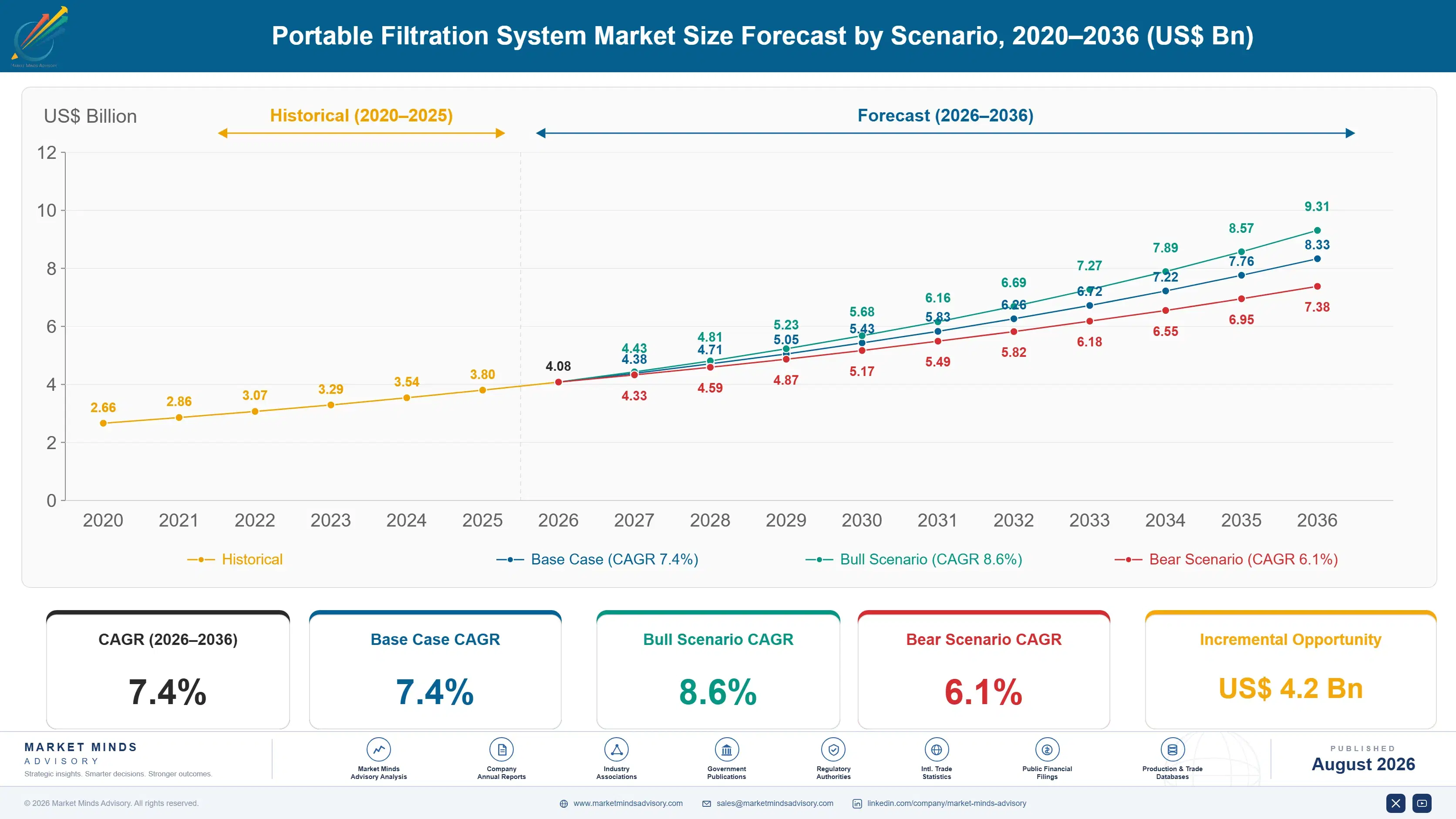
Portable Filtration System Market Forecast Scenarios

portable-filtration-system-market-size-forecast-scenario-1787300108055
Between 2020 and 2025 the market grew at a historical pace of 6.4 percent as pandemic-era outdoor recreation growth gave way to accelerating disaster-relief and military procurement demand, a transition that broadened the buyer base well beyond the hiking and camping retail channel that originally defined this category for most suppliers operating at the time.
The base case rests on three commercial mechanisms holding together over the decade: expanding humanitarian and disaster-relief agency procurement budgets responding to more frequent climate-driven flooding and storm events worldwide, sustained military hydration modernization programs replacing legacy field filtration equipment across multiple national defense budgets simultaneously, and continued growth in outdoor recreation participation supporting steady consumer retail demand across developed markets covered in this report.
A bull scenario hinges on a major humanitarian agency standardizing procurement around a single filtration technology class, pulling forward multi-year contract volume industry-wide. The bear case centers on disaster-relief funding volatility tied to shifting government aid budgets, which could compress the fastest-growing institutional demand segment faster than consumer retail growth can offset the resulting revenue gap.

From Outdoor Niche to Institutional Procurement Category

Three forces are converging on this category at once: a consumer outdoor recreation base that still anchors the largest unit volume, a fast-scaling humanitarian and disaster-relief procurement channel that pays materially higher prices per unit, and a military modernization cycle that is pulling premium reverse osmosis and multi-stage designs into government budgets across several major defense spenders.
MARKET CONCENTRATIONCR5 38%top five manufacturers hold well under half of total revenue
AVERAGE UNIT PRICE$62/unitblended average selling price across all portable filter classes
LEADING RETAIL COUNTRYUSA, 24% sharelargest single-country consumer and institutional demand base overall
HUMANITARIAN ORDER SHARE22% of revenueproportion of category revenue tied to relief agency procurement
FILTER CARTRIDGE LIFE1,000 to 4,000 Ltypical rated filtration volume before cartridge needs replacement
MEMBRANE INPUT COST SHARE28% of COGShollow-fiber and membrane material proportion of goods sold
Commercially, the market increasingly splits along buyer sophistication rather than pure product-class lines. Consumer retail buyers still purchase largely on brand recognition and price point, while humanitarian and military buyers evaluate suppliers on certified contaminant removal performance, field durability testing, and delivered logistics support far more heavily than brand history alone.
Over the next decade, certification speed against evolving humanitarian and military performance standards will matter as much as raw manufacturing scale. Suppliers who move fastest through NSF, WHO, and defense-specific qualification testing will capture a disproportionate share of the fastest-growing institutional order categories before the broader supplier base can match those specifications.
"This used to be a camping-store category. It's turning into a procurement category, and the two buyer bases want almost nothing in common from a product beyond the word filtration."
Director, Consumer and Humanitarian Equipment Practice · MMA Consumer and Humani

Market Trends

Humanitarian Agencies Standardize Emergency Filtration Procurement

Major humanitarian organizations, including several United Nations agencies and large international relief groups, are increasingly standardizing emergency response kits around a narrower set of certified filtration technologies rather than sourcing opportunistically across many suppliers during each crisis response. This shift rewards manufacturers who complete rigorous, agency-specific certification testing well ahead of any actual emergency, since standardized kit contracts commonly run multiple years once awarded. Climate-driven flooding and storm events have increased the frequency of large-scale emergency water response deployments across South and Southeast Asia specifically, expanding the addressable procurement volume for agencies operating under fixed annual budgets that must stretch further each year.
Market Impact: Affects over 500 million people annually
Military Hydration Modernization Replaces Legacy Field Gear

Several national defense budgets, including the United States, United Kingdom, and multiple NATO members, have allocated funding toward replacing legacy individual and squad-level water filtration equipment with lighter, higher-capacity reverse osmosis and multi-stage systems capable of treating a broader range of field water sources reliably. These modernization programs typically specify multi-year qualification testing before awarding production contracts, creating a durable revenue window for suppliers who complete testing early relative to competitors still validating designs. Defense-specific contracts also carry meaningfully higher per-unit pricing than consumer retail channels, reflecting the additional durability required for extended field deployment.
Market Impact: First-time buyers reach 55% of sales

Market Opportunities and Growth Drivers

Climate-Driven Disaster Frequency Expands Relief Procurement

The frequency of major flooding, cyclone, and storm-related displacement events has risen measurably over the past decade, expanding the baseline procurement volume that humanitarian agencies must maintain in standing emergency-response inventory rather than sourcing reactively after each disaster occurs. The World Health Organization estimates hundreds of millions of people are affected by water-related emergencies annually, a population base that far exceeds current standing filtration inventory capacity held by the largest relief agencies combined. This gap between affected population and available standing inventory is the single largest addressable growth driver in the institutional segment of this market, expanding faster than most suppliers had planned capacity around.
Market Impact: Erodes brand pricing power over 15%

Outdoor Recreation Participation Sustains Consumer Retail Demand

Outdoor recreation participation rates have climbed steadily across North America, Western Europe, and parts of East Asia since the pandemic period, sustaining a durable consumer retail base for hiking, camping, and backpacking filtration products well beyond what pre-pandemic trends would have predicted. Roughly 55 percent of new portable filtration purchases in North America now come from first-time outdoor participants rather than repeat gear buyers, according to retailer point-of-sale data, expanding the addressable consumer base meaningfully. This first-time buyer growth is also lifting demand for simpler, lower-maintenance filter designs over more technical multi-stage systems favored by experienced users.
Market Impact: Costs exceed $100K per product line

Market Restraints and Challenges

Counterfeit Products Undermine Brand Trust and Pricing

Low-cost counterfeit and unlicensed copies of popular straw and gravity filter designs have proliferated across major e-commerce marketplaces, undercutting legitimate manufacturer pricing while often failing to meet the contaminant removal performance claimed on their packaging. The root cause is the relatively low manufacturing complexity of basic filter housings combined with weak marketplace enforcement of intellectual property claims. The commercial impact includes both direct lost sales and, more damaging, consumer safety incidents that erode trust in the broader category when counterfeit units fail during use. Manufacturers are mitigating this through authentication codes, retailer takedown partnerships, and direct-to-consumer channels.
Market Impact: Directs 22% of category revenue

Certification Costs Slow Smaller Manufacturer Entry

NSF, WHO, and defense-specific certification testing required to win institutional and military contracts can cost well into six figures per product line and commonly takes over a year to complete, a barrier that disproportionately affects smaller manufacturers relative to well-capitalized incumbents who can amortize that cost across larger production volumes. The root cause is the genuinely rigorous testing these buyer segments require given the safety stakes of field water treatment failure. The commercial impact concentrates institutional and military revenue among a small number of certified suppliers even as consumer retail remains fragmented. Smaller manufacturers mitigate this through private-label arrangements with certified incumbents.
Market Impact: Prices defense units 3x above retail
3 additional market trends, 3 additional growth drivers, and 4 additional restraints and challenges are covered in the full report. Contact sales@marketmindsadvisory.com to access the complete intelligence.

Segment CAGR and Growth Architecture

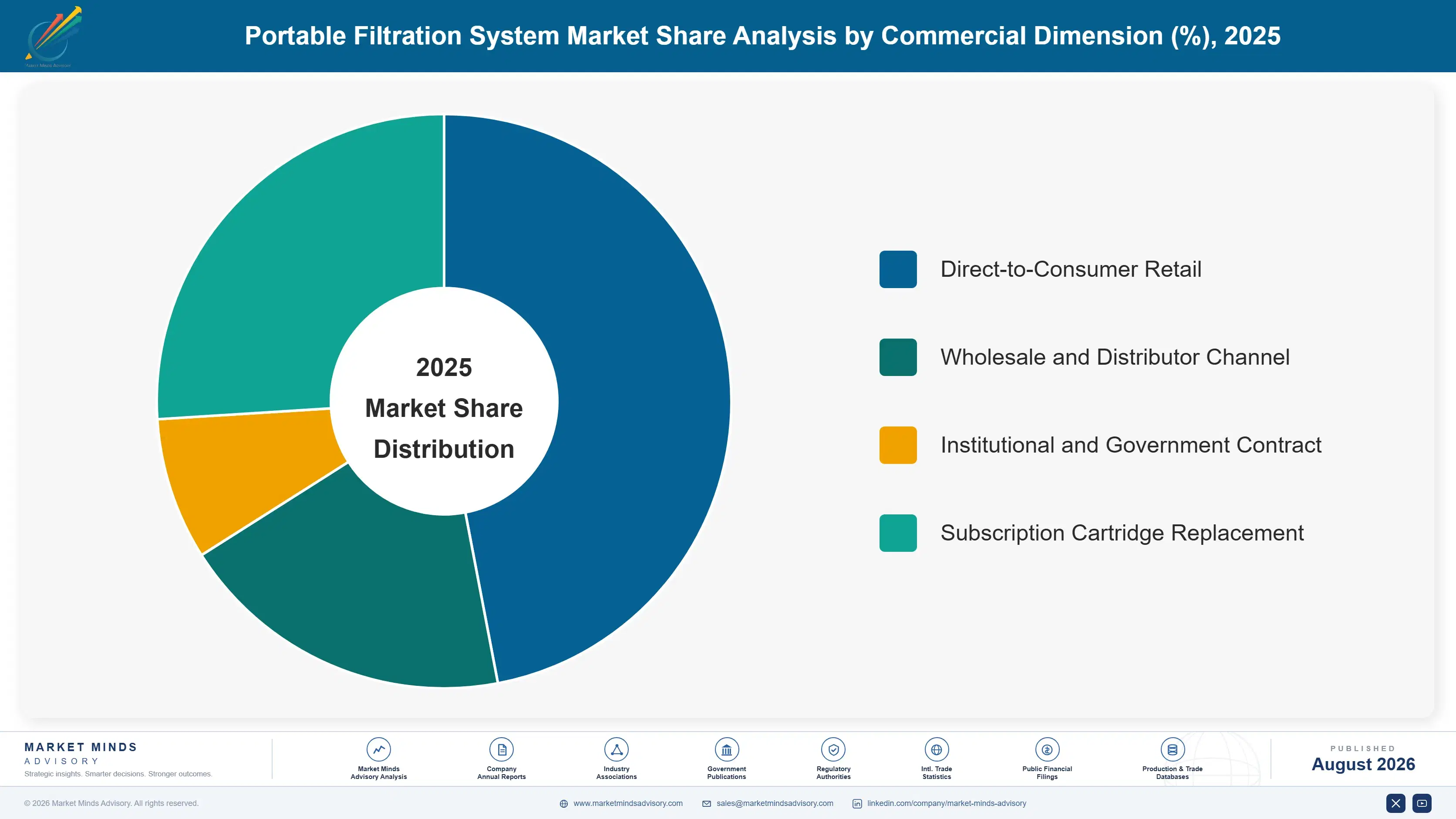
Segmentation follows filtration technology, the dimension buyers and institutional specifiers use to select equipment for a given contaminant removal requirement and specific field use case across this market. Multi-stage combination systems are treated as a distinct category given their layered technology approach relative to single-mechanism designs sold separately.
portable-filtration-system-market-market-share-analysis-1787300108586

UV Purification Units

UV purification units are the fastest-growing product category, driven by the miniaturization of UV-LED components that has made compact, battery-powered designs viable at consumer price points for the first time in the category's history. Unlike membrane filters, UV units neutralize pathogens without removing them physically, which makes them fast and lightweight but dependent on reliable battery power in the field, a tradeoff outdoor and humanitarian buyers weigh carefully. Demand is concentrated among backcountry recreational users and increasingly among humanitarian responders who value treatment speed during rapid deployment scenarios. Manufacturers are racing to extend battery life and add solar charging options, since power reliability remains the primary limitation constraining broader institutional adoption relative to membrane alternatives requiring no power source at all.
CAGR 12.5%

Reverse Osmosis Portable Units

Portable reverse osmosis units form the second-fastest-growing category, delivering the broadest contaminant removal of any portable technology, including dissolved salts and certain chemical contaminants that membrane and UV systems cannot address at all. This makes them the preferred choice for military field deployment and maritime survival applications, where water source quality is often entirely unknown. Manufacturers have made meaningful progress miniaturizing pump mechanisms and reducing required manual effort, though units remain heavier and pricier than simpler filter types, keeping this segment concentrated among institutional buyers rather than mainstream consumer retail. Defense procurement across several NATO members is the single largest demand driver, rewarding manufacturers who invest early in meeting defense-specific standards.
CAGR 9.8%
Full segment breakdown across 6 segments available in the complete report.

Regional Architecture and Country Demand Map

North America commands the largest combined consumer retail and military procurement base, East Asia follows closely on manufacturing scale and expanding humanitarian demand, and South Asia and Pacific punches well above its revenue share on disaster-response intensity alone.

North America

The United States carries the largest combined consumer retail and defense procurement base in this market, sustained by a large outdoor recreation population and a defense budget actively modernizing individual soldier hydration equipment across multiple service branches. Federal Emergency Management Agency disaster-response stockpiling adds a further institutional demand layer distinct from military procurement, particularly following major hurricane and wildfire seasons that have grown more frequent in recent years. Canada's outdoor recreation retail channel mirrors similar consumer trends, though at meaningfully smaller absolute scale given its smaller population base. Mexico's market remains comparatively underdeveloped relative to its northern neighbors, with growth concentrated mainly in urban emergency-preparedness retail rather than outdoor recreation specifically.
Share: 30% | CAGR: 6.8% (2026 to 2036)

Western Europe

Germany and the United Kingdom together anchor the region's outdoor recreation retail demand, supported by well-established hiking and camping cultures with long-standing brand loyalty toward established European manufacturers headquartered locally for decades. Several European Union member states maintain civil defense stockpiling programs that include portable filtration equipment, a category several governments have expanded funding for following recent regional security concerns. France's humanitarian sector, anchored by several major international relief organizations headquartered in the country, drives meaningful institutional procurement volume distinct from consumer retail channels entirely. Nordic countries show comparatively high per-capita consumer adoption, reflecting strong outdoor recreation participation rates relative to population size across the wider region overall.
Share: 19% | CAGR: 5.9% (2026 to 2036)
Regional intelligence for 5 additional markets available in the complete report: East Asia, South Asia and Pacific, Latin America, Middle East and Africa, Eastern Europe. Contact sales@marketmindsadvisory.com.
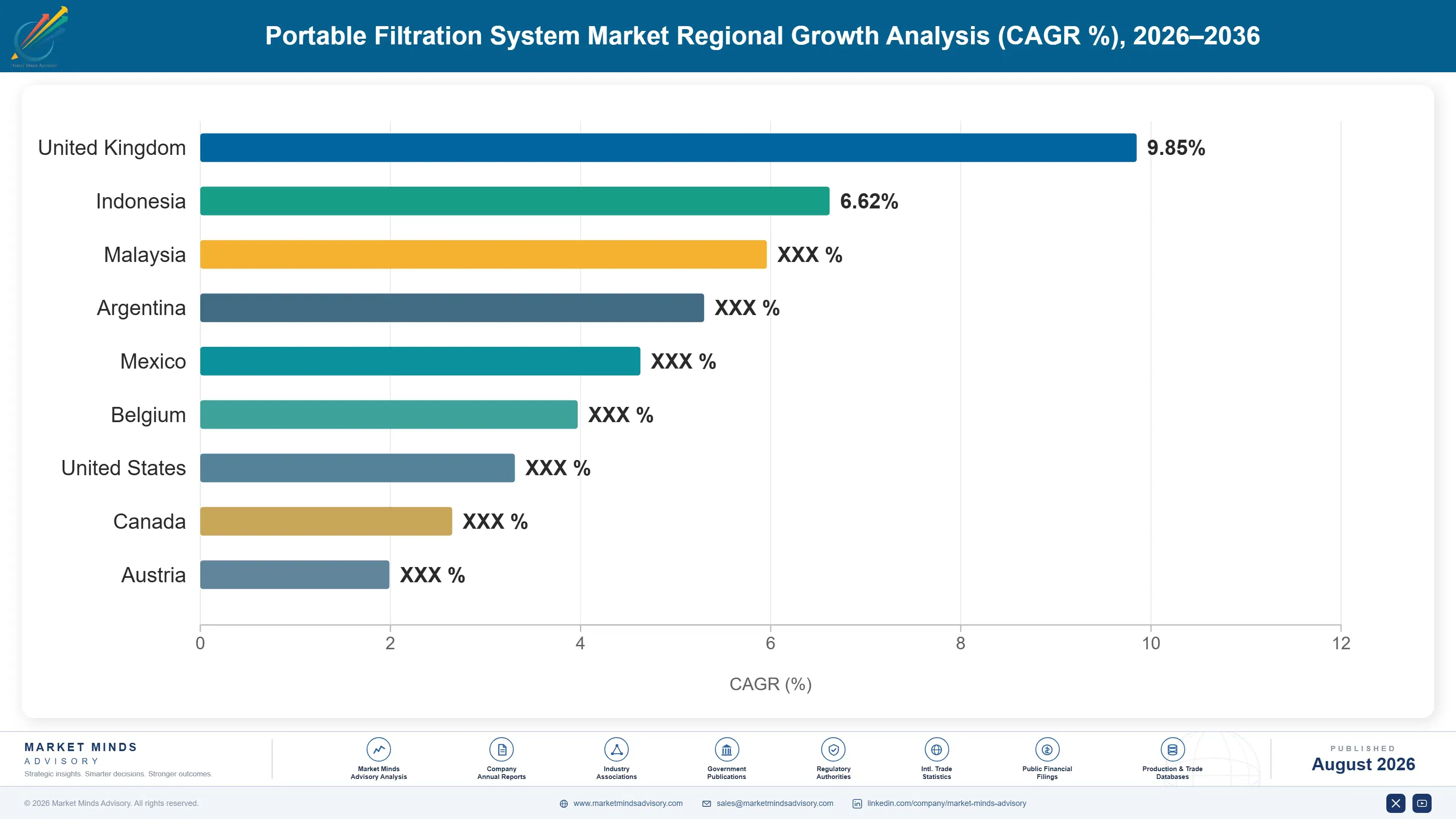
portable-filtration-system-market-country-cagr-analysis-1787300109100

Where Suppliers Can Defend Category Margin

As consumer retail growth moderates, suppliers are shifting commercial strategy toward humanitarian and military certification, direct-to-consumer channels that reduce counterfeit exposure, and subscription cartridge replacement models to defend margin across the category over the coming decade.

Pursue Humanitarian Agency Standardization Contracts Early

Manufacturers who complete rigorous humanitarian agency certification testing ahead of competitors are winning multi-year standardized procurement contracts that guarantee order volume well beyond what opportunistic post-disaster sourcing ever delivered historically for the category. Suppliers with completed agency certification report contract win rates roughly three times higher than uncertified competitors bidding the same opportunities across similar programs. This lever requires meaningful upfront investment in certification testing but converts into a durable, multi-year revenue relationship considerably more predictable than consumer retail demand cycles tied to discretionary outdoor recreation spending patterns that shift with the economy.
Market Impact: Triples contract win rate versus uncertified rivals

Build Direct-to-Consumer Channels Against Counterfeits

Manufacturers expanding direct-to-consumer e-commerce and branded retail presence are reducing exposure to third-party marketplace counterfeiting while capturing margin previously shared with wholesale distributors and marketplace platforms taking a cut of every sale. Brands with strong direct channel presence report counterfeit-related customer complaints down by roughly 40 percent compared to brands still relying primarily on third-party marketplace sales for most of their volume. This shift also gives manufacturers direct customer data that supports better product development decisions than the limited visibility wholesale distribution historically provided across the category for years.
Market Impact: Cuts counterfeit complaints by roughly 40 percent

Launch Subscription Cartridge Replacement Programs Widely

Suppliers are increasingly launching subscription programs that automatically ship replacement filter cartridges on a schedule matched to rated filtration volume, converting a historically one-time hardware purchase into a recurring revenue relationship worth considerably more over the customer's full ownership period. Early subscription program adopters report customer lifetime value roughly 2.5 times higher than one-time hardware purchasers who buy replacement cartridges irregularly if at all across their ownership. This lever also improves customer retention, since subscription customers rarely switch brands once enrolled given the friction of changing cartridge specifications mid-subscription across devices.
Market Impact: Lifts customer lifetime value 2.5 times over

Qualify Products for Defense Procurement Programs Early

Manufacturers who begin defense-specific qualification testing ahead of formal procurement announcements position themselves to win first-mover contracts once national modernization programs formally open bidding, rather than competing from behind against already-qualified incumbents with a head start. Suppliers with early defense qualification have won meaningfully larger contract shares, in several cases exceeding 45 percent of a given national program's total award value across categories. This lever requires patient multi-year investment ahead of confirmed government budget allocation but delivers outsized returns once programs move from planning into active procurement cycles.
Market Impact: Wins over 45 percent of program awards

Who Controls the Margin Pool

The top five manufacturers hold roughly 38 percent of revenue on a company-revenue basis, among the most fragmented structures in this report, reflecting how many regional and application-specific brands still compete successfully across consumer, humanitarian, and military channels. The gap between LifeStraw and Katadyn, the two largest players, and the broader field remains narrower than in most comparable equipment categories covered by MMA.
Current competitive activity centers on three fronts: humanitarian and military certification races against evolving performance standards, direct-to-consumer channel expansion designed to counter marketplace counterfeiting, and subscription cartridge programs intended to build recurring revenue on top of historically one-time hardware sales.

Pressure is building from Asian manufacturers, particularly Chinese component and finished-unit producers, who are moving up the value chain from private-label component supply into branded finished products sold directly through e-commerce channels. Several have already won humanitarian agency reference contracts, evidence that could accelerate their move into higher-margin certified segments faster than Western incumbents currently expect.
portable-filtration-system-market-company-positioning-matrix-1787300109626

Competitive Moat and Risk Dimensions

LIFESTRAW (VESTERGAARD)

Moat: Strongest Consumer Brand Recognition

LifeStraw's brand recognition extends well beyond the outdoor recreation category into general consumer awareness of portable filtration as a product concept, a marketing advantage built over nearly two decades that smaller and newer competitors cannot easily replicate through advertising spend alone in a short window.
LIFESTRAW (VESTERGAARD)

Risk: Heavy Dependence On One Category

LifeStraw's brand identity remains closely tied to a single straw-filter product family even as it expands into other formats, leaving it more exposed than diversified competitors if buyer preference shifts decisively toward UV or reverse osmosis technology over the current forecast period across major markets.
KATADYN GROUP

Moat: Deepest Military Qualification Portfolio

Katadyn holds qualified platforms across more national defense procurement programs than any other manufacturer in this market, giving it a reference base and testing track record that newer entrants would need years of comparable qualification investment to credibly match against incumbents at scale.
KATADYN GROUP

Risk: Slower Consumer Channel Innovation

Katadyn's institutional and military focus has left its consumer retail product line innovating more slowly than newer direct-to-consumer competitors, risking gradual share erosion in the outdoor recreation segment even as its institutional position remains comparatively secure across major defense programs.

Players Tracked

Prominent Players

LifeStraw (Vestergaard)
Katadyn Group
Sawyer Products Inc.
Cascade Designs Inc.
3M Company

Other Key Players

Grayl Inc.
General Ecology Inc.
Renovo Water LLC
Medentech Ltd.
Pentair plc
Culligan International Company
Hydro-Photon Inc.
Seychelle Environmental Technologies Inc.
Innovative Water Technologies LLC
New Millennium Concepts Ltd.
Water-to-Go Ltd.
McNett Corporation
LifeSaver Systems Ltd.
Doulton Water Filters
Xylem Inc.

Recent Developments

MAY 2025

Katadyn Group Acquires Specialty Membrane Filter Manufacturer

Katadyn Group completed the acquisition of a specialty hollow-fiber membrane manufacturer, adding proprietary membrane production capability rather than continuing to source membrane material from third-party suppliers, a move expected to shorten new product development timelines meaningfully across upcoming product lines.
Signal: Backward integration into membrane manufacturing is becoming a meaningful competitive differentiator among the largest suppliers.
AUGUST 2025

Sawyer Products Signs Multi-Year Supply Agreement With Relief Agency

Sawyer Products signed a multi-year supply agreement, not an acquisition or joint venture, with a major international relief agency to provide standardized filtration units for regional emergency-response stockpiles, securing predictable order volume across the agreement's full multi-year term nationwide.
Signal: Humanitarian agencies are increasingly shifting toward standardized multi-year contracts rather than reactive post-disaster sourcing.
JANUARY 2026

3M Expands Portable Filtration Manufacturing Capacity

3M announced an organic capacity expansion at an existing North American facility dedicated to portable and defense filtration products, adding production capacity to meet growing military modernization demand without relying on contract manufacturing partners for defense-qualified units going forward.
Signal: Established diversified manufacturers are committing dedicated in-house capacity to defense-qualified filtration production lines.

Membrane and Activated Carbon Input Exposure

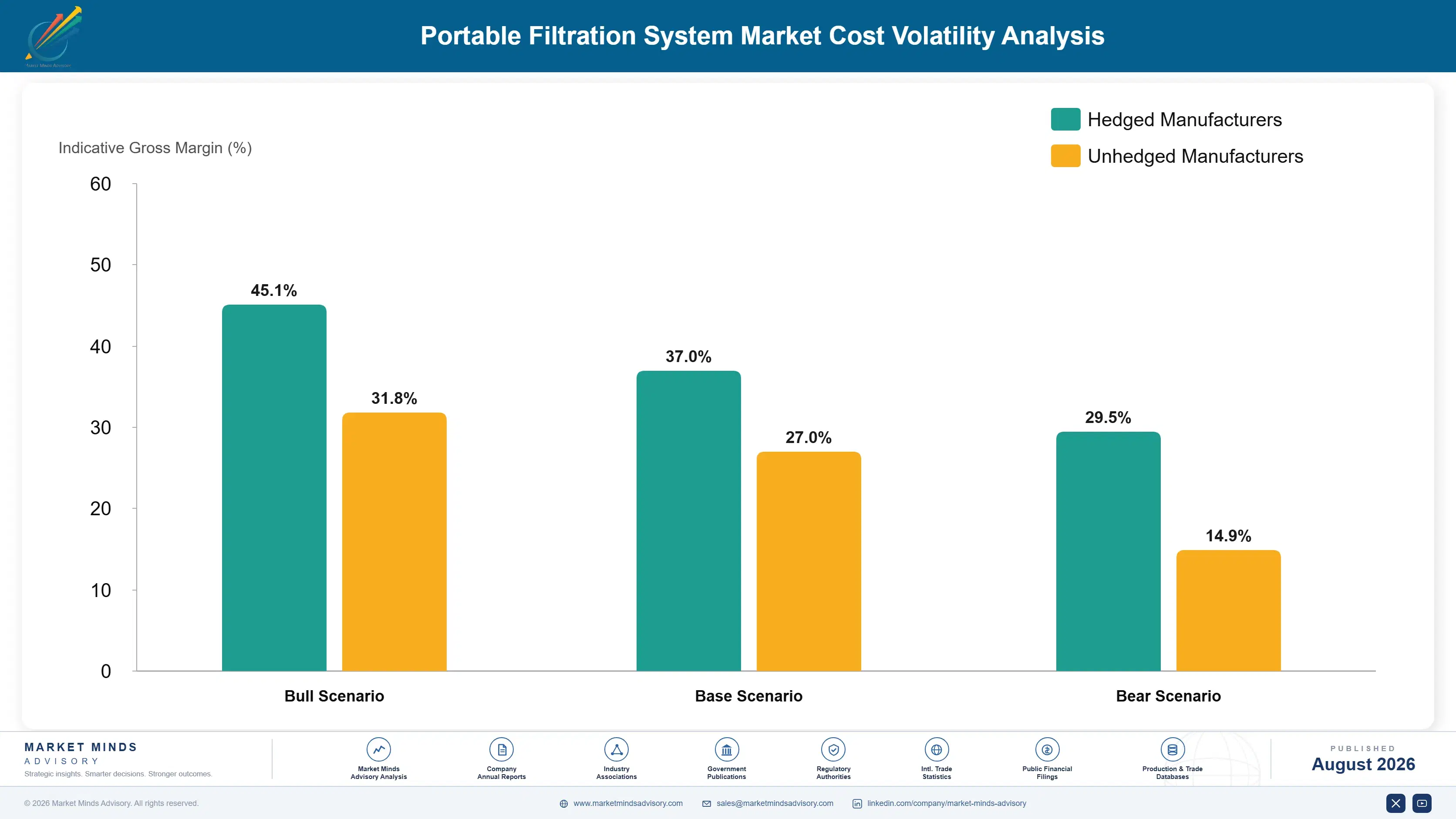
Hollow-fiber membrane material and activated carbon media together account for roughly 28 percent of cost of goods sold across the category, with plastic housing components, packaging, and assembly labor making up most of the remainder. Membrane production capacity concentrates among a relatively small number of specialty polymer manufacturers, most located in East Asia and North America.
Activated carbon prices rose sharply during 2022 and 2023 amid coconut shell feedstock supply disruptions across Southeast Asia, a period the United States Energy Information Administration's broader industrial materials commentary flagged as unusually volatile for specialty filtration media pricing generally across the sector. Several smaller manufacturers disclosed order fulfillment delays during this period as carbon supply tightened faster than alternative feedstock sources could be qualified.

Exposure varies by company scale and integration. Larger manufacturers with long-term membrane supply agreements or partial backward integration into membrane production absorbed the volatility with comparatively limited disruption, while smaller specialists reliant entirely on spot-market carbon and membrane purchasing faced sharper cost swings that occasionally opened share for better-hedged competitors during the tightest supply quarters.
portable-filtration-system-market-cost-volatility-analysis-1787300109825

Diversify Activated Carbon Feedstock Sourcing

Manufacturers are increasingly qualifying alternative activated carbon feedstocks beyond coconut shell, including coal-based and wood-based carbon sources, reducing dependence on a single geographically concentrated supply region prone to periodic disruption during peak harvest seasons each year across Southeast Asia.

Secure Long-Term Membrane Supply Agreements

Several of the largest suppliers have signed multi-year fixed-volume membrane supply agreements directly with specialty polymer producers, trading some pricing flexibility for meaningfully greater supply certainty during periods of tight global production capacity across the broader sector overall.

Invest In Backward Integration Into Membrane Production

A small number of the largest manufacturers have acquired or built captive membrane production capacity, insulating a meaningful share of their output from third-party pricing pressure and allowing faster new product development cycles than competitors relying entirely on external suppliers for materials.

Portfolio Architecture for Margin Defence

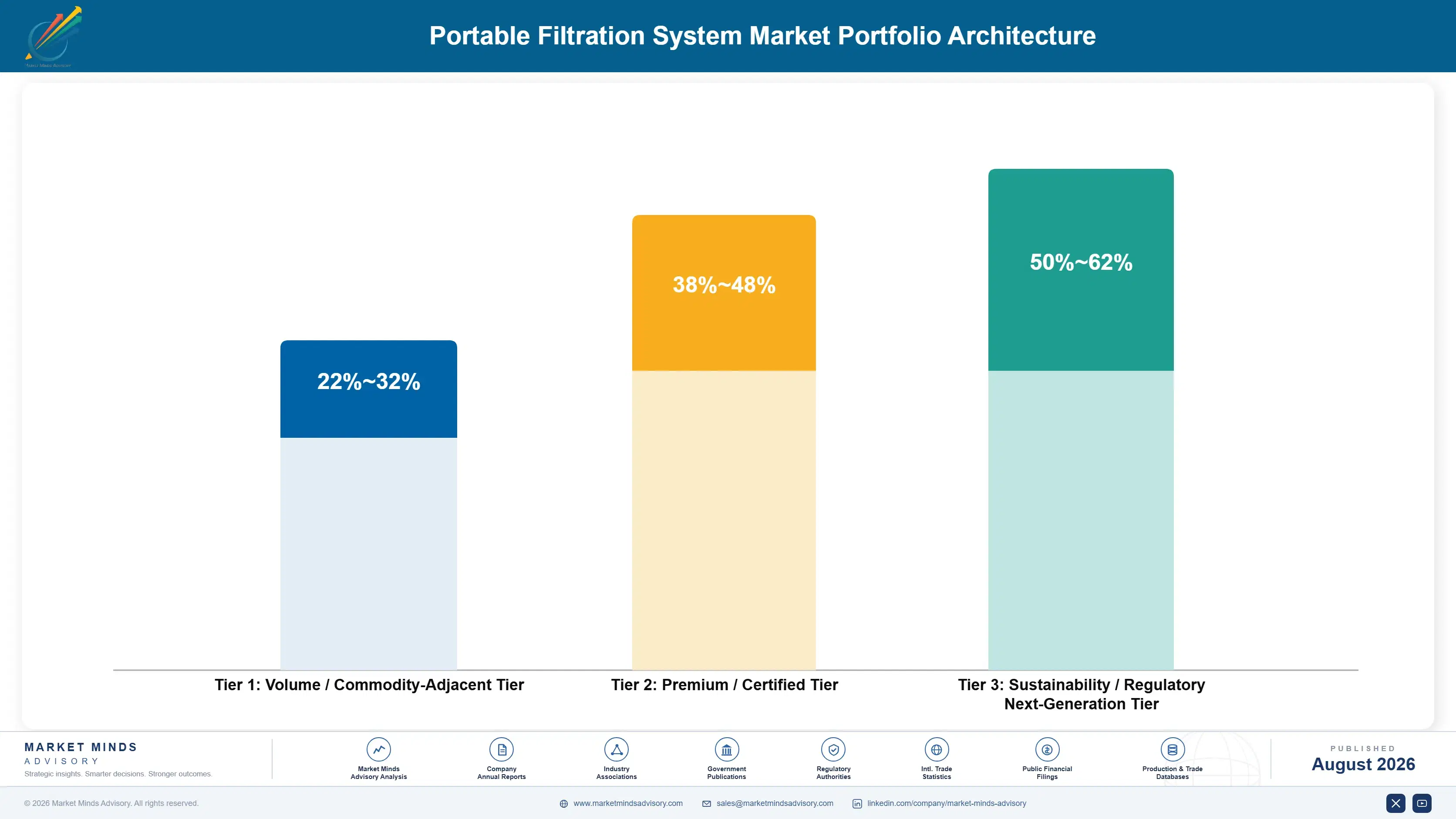
The market splits into three commercial tiers with distinct margin economics. Basic consumer straw and gravity filters compete largely on price and retail shelf presence, certified humanitarian and outdoor multi-stage systems carry meaningfully higher margin on performance certification, and military and defense-qualified reverse osmosis platforms command the highest margin given their narrow qualified supplier base.
The tension between volume and premium positioning shapes how manufacturers allocate product development spending: basic consumer filters still represent the largest unit volume by a wide margin, but nearly all incremental profit growth over the forecast period concentrates in humanitarian-certified and defense-qualified platforms, which is where the leading suppliers increasingly direct testing and certification investment.

High-value margin pools concentrate specifically in defense-qualified reverse osmosis units during their current limited-supplier-base window and in humanitarian-certified multi-stage systems with standing agency contracts. Both pools reward manufacturers who invest ahead of demand in certification rather than those who wait for institutional programs to mature before committing capital.

Volume / Commodity-Adjacent Tier

Basic consumer straw, gravity, and squeeze filters sold largely on price, brand recognition, and retail shelf placement across mass-market and outdoor specialty channels covered in this report.
Gross Margin: 22-32%

Premium / Certified Tier

Humanitarian-certified multi-stage systems and premium outdoor filters carrying NSF or WHO performance certification, commanding meaningful pricing premiums over uncertified alternatives across most retail channels.
Gross Margin: 38-48%

Sustainability / Regulatory / Next-Generation Tier

Defense-qualified reverse osmosis units and next-generation UV-LED purification systems, carrying the category's highest margins given the narrow qualified supplier base currently serving these government programs.
Gross Margin: 50-62%
portable-filtration-system-market-portfolio-architecture-1787300110331

High-value Sub-segments and Strategic Watch-out

UV Purification Units

Highest current growth in the category, driven by LED miniaturization, though still constrained by battery reliability concerns that limit broader institutional and military adoption relative to membrane alternatives requiring no power at all.
Gross Margin: 42-55%

Defense-Qualified Reverse Osmosis Units

Steady high-value growth tracking national defense modernization budgets closely, increasingly favoring suppliers with proven qualification track records over newer entrants still completing lengthy testing cycles today.
Gross Margin: 50-60%

Basic Consumer Straw and Gravity Filters

The volume core of the market by unit count, competing primarily on price and retail presence rather than deep technical differentiation between competing manufacturer offerings across channels.
Gross Margin: 22-30%

Uncertified Marketplace Filter Brands

A strategic watch-out segment as counterfeit and uncertified low-cost competitors erode brand trust and pricing power across the broader consumer retail portion of the category overall.
Gross Margin: 12-24%

Hardware Sale Meets Recurring Cartridge Revenue

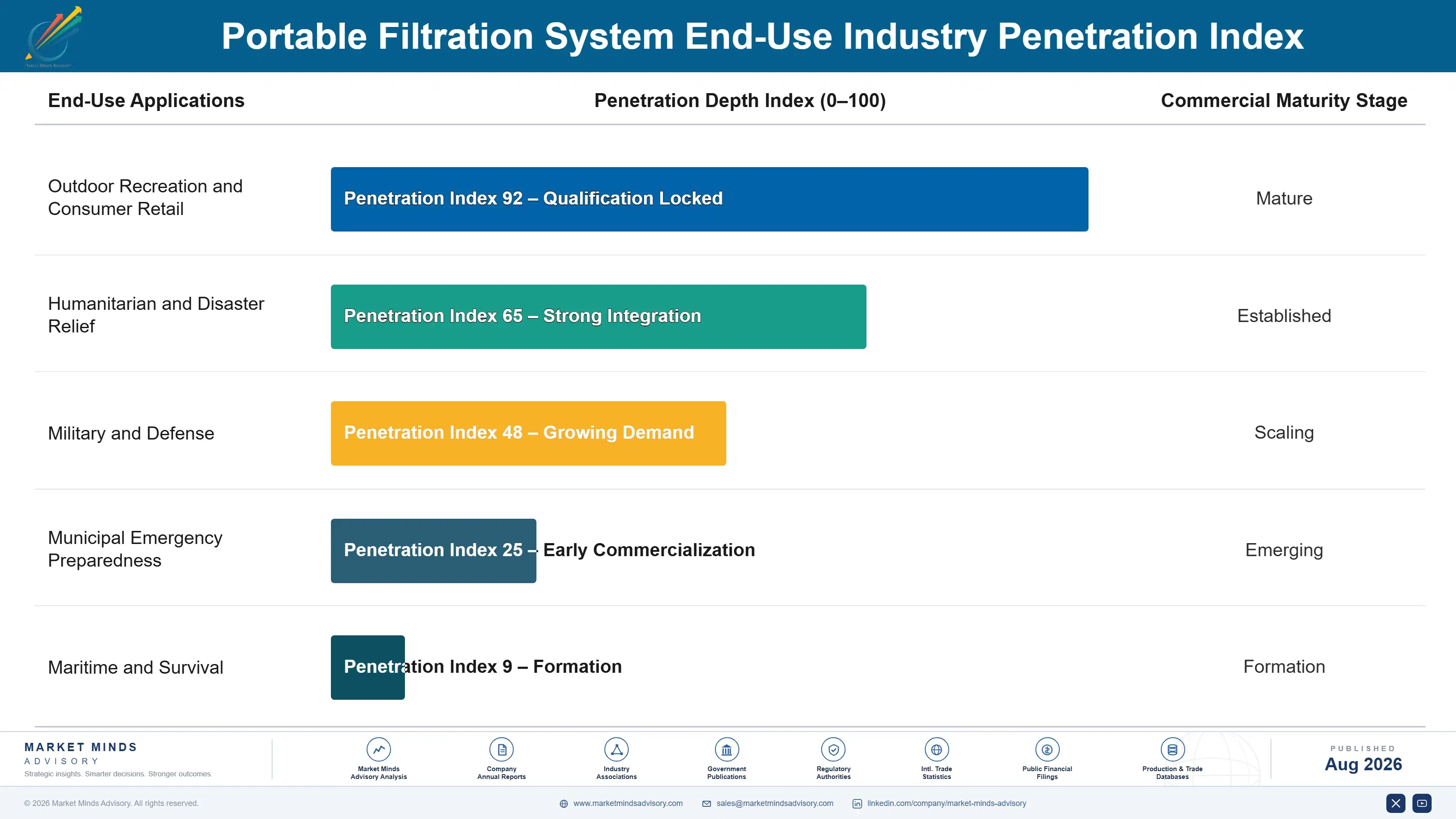
Portable filtration has historically behaved as a one-time hardware purchase followed by irregular cartridge replacement, but the category is shifting toward a more annuity-like model as subscription cartridge programs and institutional service contracts convert hardware buyers into recurring customers across a multi-year relationship rather than a single transaction.
Adoption depth varies sharply by end-use vertical. Humanitarian and military buyers show the deepest recurring-relationship adoption given standing multi-year procurement contracts, outdoor recreation consumers adopt subscription cartridge programs more slowly and remain more price-sensitive at the point of hardware purchase, and municipal emergency-preparedness buyers sit somewhere between the two, constrained by public procurement rules favoring lowest-bid purchasing structures.

A generational shift in buyer profile is underway as younger outdoor recreation consumers, more accustomed to subscription models from other product categories entirely, adopt cartridge subscription programs faster than older generations of buyers. Humanitarian and defense procurement teams are also increasingly staffed by specialists who evaluate total cost of ownership across a multi-year contract rather than simply comparing upfront hardware pricing between competing suppliers.
portable-filtration-system-market-end-use-penetration-index-1787300110822

Where This Market Goes Next

These are among the four positions where our research anticipates prominent divergence between winners and laggards over the coming forecast period. Each is grounded in the demand model, the regulatory perimeter, and the announced capacity pipeline.
01 / HUMANITARIAN CERTIFICATION SPEED

Early agency-certified suppliers will lock in a durable lead

Humanitarian agencies increasingly standardize procurement around a narrow set of certified suppliers rather than sourcing opportunistically after each disaster, because standardized kit contracts commonly run multiple years once awarded and reduce agency administrative burden considerably. Manufacturers still pursuing certification are already missing early standardization waves at several major relief organizations actively consolidating their supplier base. This gap should widen rather than narrow as certified suppliers accumulate the agency relationships and reference deployments that uncertified competitors cannot replicate quickly regardless of product quality.
02 / COUNTERFEIT BRAND DEFENSE

Direct channels are now a necessary defense, not a luxury

Counterfeit products are eroding both sales and brand trust across the consumer retail segment faster than most manufacturers anticipated just several years ago, and the gap is widening. Suppliers building direct-to-consumer channels and marketplace enforcement partnerships are meaningfully reducing this exposure relative to brands still reliant primarily on third-party marketplace sales alone for most volume. Manufacturers who delay this investment risk allowing counterfeit-driven safety incidents to damage category trust broadly, a risk that ultimately affects legitimate suppliers regardless of which brand the counterfeit imitated originally in the first place.
03 / RECURRING REVENUE TRANSITION

Subscription cartridge programs are reshaping unit economics

Suppliers launching subscription cartridge replacement programs are converting historically one-time hardware sales into recurring revenue relationships worth considerably more over a customer's ownership period than a single transaction ever delivered. Early adopters of this model report meaningfully higher customer lifetime value and materially improved retention compared to one-time purchasers who replace cartridges irregularly if at all. Manufacturers still selling pure hardware without a subscription option risk losing share to competitors offering superior long-term value and convenience to increasingly subscription-accustomed consumers.
04 / DEFENSE QUALIFICATION INVESTMENT

Early defense qualifiers are winning outsized contract shares

National defense modernization programs reward manufacturers who begin qualification testing years before formal procurement bidding opens, since already-qualified suppliers can respond immediately once budgets are approved and bidding formally begins. Katadyn's broad qualification portfolio illustrates how a sustained multi-year testing investment converts into durable institutional contract share across multiple national programs simultaneously. Manufacturers weighing this investment against nearer-term consumer retail spending should recognize that defense contracts, once won, typically deliver multi-year revenue visibility that consumer retail demand simply cannot match.

Engagement Snapshot From the Field

A live engagement with an industry participant carrying material or product regulatory and market exposure ahead of a defining policy shift, showing how our research translates into a defensible multi-year portfolio strategy.
MARKET MINDS ADVISORY · CLIENT ENGAGEMENT SUMMARY
Portable Filtration System Producer Strategic Portfolio Review and Transition Roadmap 2026·Investment Scenario on Portable Filtration System Exposure Evaluation 2025-26
CLIENT PROFILE
The client is a large international relief organization operating emergency water response programs across multiple countries, deploying filtration equipment to an estimated two million affected people annually (client-reported, unverified by MMA) during active crisis response operations worldwide. The organization historically sourced filtration equipment opportunistically from whichever supplier could deliver fastest during each individual emergency, without a consistent standard.
STRATEGIC CHALLENGE
Inconsistent equipment performance across different suppliers had created field reliability concerns and complicated staff training, since responders needed to learn different operating procedures for each new equipment batch. Leadership wanted to standardize around a smaller number of certified suppliers but needed an evidence-based business case to justify the transition given existing supplier relationships built over many years.
MMA APPROACH
MMA benchmarked field performance and failure rates across the organization's historical supplier base, evaluated leading certified manufacturers against the organization's specific deployment requirements including weight, treatment speed, and durability, and modeled the operational and cost impact of standardizing procurement around two to three primary certified suppliers going forward across regions.
KEY FINDINGS
  1. Field failure rates varied by more than threefold across the organization's existing supplier base, with several smaller uncertified suppliers showing the highest incident rates during deployment.
  2. Standardizing around fewer suppliers was modeled to reduce staff training time by roughly 30 percent during rapid deployment scenarios requiring fast onboarding.
  3. Multi-year standardized contracts offered modeled unit cost savings of 12 to 18 percent versus continued opportunistic post-disaster sourcing practices (client-reported, unverified by MMA).
  4. Two of the three recommended suppliers already held relevant regional certification, shortening the anticipated transition timeline considerably relative to fully unqualified alternatives.
CLIENT PROFILE
The client is a large international relief organization operating emergency water response programs across multiple countries, deploying filtration equipment to an estimated two million affected people annually (client-reported, unverified by MMA) during active crisis response operations worldwide. The organization historically sourced filtration equipment opportunistically from whichever supplier could deliver fastest during each individual emergency, without a consistent standard.
STRATEGIC CHALLENGE
Inconsistent equipment performance across different suppliers had created field reliability concerns and complicated staff training, since responders needed to learn different operating procedures for each new equipment batch. Leadership wanted to standardize around a smaller number of certified suppliers but needed an evidence-based business case to justify the transition given existing supplier relationships built over many years.
MMA APPROACH
MMA benchmarked field performance and failure rates across the organization's historical supplier base, evaluated leading certified manufacturers against the organization's specific deployment requirements including weight, treatment speed, and durability, and modeled the operational and cost impact of standardizing procurement around two to three primary certified suppliers going forward across regions.
KEY FINDINGS
  1. Field failure rates varied by more than threefold across the organization's existing supplier base, with several smaller uncertified suppliers showing the highest incident rates during deployment.
  2. Standardizing around fewer suppliers was modeled to reduce staff training time by roughly 30 percent during rapid deployment scenarios requiring fast onboarding.
  3. Multi-year standardized contracts offered modeled unit cost savings of 12 to 18 percent versus continued opportunistic post-disaster sourcing practices (client-reported, unverified by MMA).
  4. Two of the three recommended suppliers already held relevant regional certification, shortening the anticipated transition timeline considerably relative to fully unqualified alternatives.
RECOMMENDED STRATEGY
Phase 1: Phase 1 (Months 1-4): Complete comparative field performance evaluation and select two to three primary certified suppliers overall. Phase 2: Phase 2 (Months 5-10): Negotiate multi-year standardized supply agreements and retrain regional response staff on unified procedures nationwide. Phase 3: Phase 3 (Months 11-18): Roll out standardized equipment across all active regional deployment programs and monitor ongoing field performance data.
OUTCOME
Twelve months into the transition, the organization reported field failure incidents down an estimated 35 percent and staff deployment training time reduced by roughly 25 percent (client-reported, unverified by MMA), tracking closely to MMA's modeled operational improvement projections across every active deployment region.

Frequently Asked Questions

Foundational context covering the market sizes, CAGR, scope, country, region and competition that inform every finding below. This section is provided to cover basics and most often pre-purchase conversations, answered from the MMA Primary Research Dataset.

What is the current size of the Portable Filtration System Market?

The market is valued at approximately 3.8 billion dollars in 2025, expanding to roughly 4.08 billion dollars in 2026 as humanitarian and military procurement continue growing alongside steady consumer outdoor recreation demand.

How large will the Portable Filtration System Market be by 2036?

MMA forecasts the market reaching approximately 8.33 billion dollars by 2036, roughly 2.04 times its 2026 value, driven primarily by disaster-response procurement growth and military hydration modernization programs.

What is the CAGR for the Portable Filtration System Market 2026 to 2036?

The base-case compound annual growth rate is 7.4 percent, with a bull scenario of 8.6 percent and a bear scenario of 6.1 percent depending on humanitarian funding stability and defense procurement pace.

Which segment is growing fastest?

UV purification units are growing fastest at a 12.5 percent CAGR, roughly 1.69 times the overall market rate, driven by LED component miniaturization making compact designs newly viable.

Who are the major companies in the Portable Filtration System Market?

LifeStraw, Katadyn Group, Sawyer Products, Cascade Designs, and 3M lead the market, together holding roughly 38 percent of revenue on a company-revenue basis across all channels.

Which country is growing fastest?

India is the fastest-growing country at an 11.2 percent CAGR, driven by expanding humanitarian and disaster-response procurement tied to recurring monsoon flooding events nationwide.

Report Segmentation Architecture

The full report scope spans multiple orthogonal segmentation dimensions, with cross-tabulated demand data provided for each dimension pair. Coverage extends further to regional breakdowns, trend trajectories, and the competitive detail needed to support segment-level decision-making.

By Filtration Technology

  • Straw and Squeeze Filters
  • Gravity and Pump Filters
  • Reverse Osmosis Portable Units
  • UV Purification Units
  • Ceramic Filters
  • Multi-Stage Combination Systems

By End-Use Industry

  • Outdoor Recreation and Consumer Retail
  • Humanitarian and Disaster Relief
  • Military and Defense
  • Municipal Emergency Preparedness
  • Maritime and Survival

By Commercial Dimension

  • Direct-to-Consumer Retail
  • Wholesale and Distributor Channel
  • Institutional and Government Contract
  • Subscription Cartridge Replacement

By Region

  • North America
  • Western Europe
  • East Asia
  • South Asia and Pacific
  • Latin America
  • Middle East and Africa
  • Eastern Europe

Scope, Methodology, and Coverage

Every figure in this report is reproducible from documented input assumptions. The scope below maps the historical period, the forecast horizon, the segmentation dimensions, and the countries covered, alongside the underlying primary and qualitative methodology.
Historical Period
2020 to 2025
Forecast Period
2026 to 2036
Base Year
2025 (USD billions; MMA Primary Research Dataset, August 2026)
Market Definition
The market covers self-contained, mobile water filtration and purification systems designed for personal, household emergency, humanitarian relief, and military field use, including straw filters, gravity and squeeze filters, pump filters, portable reverse osmosis units, and UV purification devices. Fixed point-of-use household systems and municipal-scale treatment equipment are excluded.
Quantitative Units
USD billions (current prices); unit shipments where cited
Segmentation Dimensions
By Filtration Technology; By End-Use Industry; By Commercial Dimension; By Region
Regions Covered
North America, Western Europe, East Asia, South Asia and Pacific, Latin America, Middle East and Africa, Eastern Europe
Countries Covered
USA, China, Germany, France, UK, Japan, South Korea, India, Australia, Canada, Brazil, Mexico, Indonesia, Vietnam, Thailand, Malaysia, UAE, Saudi Arabia, South Africa, Nigeria, Turkey, Poland, Netherlands, Italy, Spain, Sweden, Switzerland, Argentina, Colombia, Singapore, and additional markets relevant to this sector
Key Companies Profiled
LifeStraw (Vestergaard), Katadyn Group, Sawyer Products Inc., Cascade Designs Inc., 3M Company, Grayl Inc., General Ecology Inc., Renovo Water LLC, Medentech Ltd., Pentair plc, Culligan International Company, Hydro-Photon Inc., Seychelle Environmental Technologies Inc., Innovative Water Technologies LLC, New Millennium Concepts Ltd., Water-to-Go Ltd., McNett Corporation, LifeSaver Systems Ltd., Doulton Water Filters, Xylem Inc.
Quantitative Methodology
Primary survey, n=3,800 respondents, Q4 2025, six countries; demand-side model with trade association cross-validation
Qualitative Methodology
47 expert interviews, Q4 2025; applied to validate demand model assumptions, identify emerging dynamics, and assess competitive positioning
Report Format
PDF and XLSX data workbook (Word format preview document)
Publisher
Market Minds Advisory
Report Code
MMA-2026-CON-442
Published
August 2026
Contact
sales@marketmindsadvisory.com | www.marketmindsadvisory.com

Purchase the full Portable Filtration System Market Report (2026 to 2036).

The full report delivers a complete quantitative and strategic assessment of the portable filtration system market across all seven regions and more than thirty countries covered in this study. It includes detailed segment-level forecasts through 2036, competitive benchmarking across twenty profiled manufacturers, and primary research drawn from 3,800 survey respondents and 47 expert interviews conducted in Q4 2025. Buyers receive editable data tables and full regional narrative detail beyond the two regions previewed in this summary document. A dedicated appendix covers humanitarian certification standards and defense procurement qualification timelines by country.
Fully editable Excel data tables included
All seven full regional narratives included
Twenty-company competitive profiles included
Humanitarian certification standards appendix included
Segment-level 2026-2036 detailed forecasts
Primary survey and interview data included

Built For The People Who Decide

From boardroom strategy to bench-side execution, this report is read cover-to-cover by leaders shaping the next decade of their industry, turning demand scenarios, market dynamics and valuation benchmarks into decisions.
CXOs/ Presidents/ VPs/ Managers
M&A and Corporate Development
Strategy Teams and R&D Heads
Procurement and Product Directors
Regulatory and Compliance Leaders
Investor Relations and Equity Analysts