Market Minds Advisory
Reverse Osmosis Pumps Market

Reverse Osmosis Pumps Market: Lifecycle Energy Economics in a Desalination Buildout Cycle

Desalination capacity additions across the Middle East and China are pushing reverse osmosis pump buyers toward energy recovery-integrated systems, since pump energy consumption still represents the single largest operating cost in seawater desalination economics.

Lead Analyst

David Horsley

Published

August 2026

Make Smarter Decisions with Customized Research Insights

Request a free sample report and evaluate market opportunities, growth trends, and competitive dynamics relevant to your business needs.

2025 MARKET VALUE$3.4BMarket Size 2025
2036 FORECAST VALUE$8.4BBase Case , 2026 to 2036
CAGR 2026 TO 20368.6 %Bull 9.9% / Bear 7.3%
INCREMENTAL OPPORTUNITY$4.7BNet 10- year value creation
EXPANSION MULTIPLE2.28x2036 value over 2026 base
Strategic Levers
M&A Pipeline
Regional Outlook
Country Rankings
Competitive Intelligence
Segmental Deep-dive
Call-Us : 91 93563 13602

Executive Snapshot and Market Trajectory

Water scarcity is no longer a slow-moving policy topic for this category; municipal and industrial buyers are approving desalination and water reuse projects faster than pump manufacturers can currently staff engineering teams to support them, compressing delivery timelines across nearly every major project pipeline worldwide.
Energy recovery-integrated pump systems are pulling demand fastest, since energy consumption remains the largest single operating cost in seawater reverse osmosis and even modest efficiency gains translate into meaningful lifetime savings for large desalination plants. East Asia anchors the largest share of global demand, driven by China's aggressive municipal water reuse and desalination buildout, while Middle Eastern operators continue commissioning some of the world's largest single-site seawater desalination plants using high-pressure positive displacement pumps.
Competitive position here tracks total lifecycle energy efficiency more than upfront price, since desalination plant operators evaluate pumps against decades of power consumption rather than purchase cost alone. Grundfos and Xylem lead on integrated efficiency engineering, but Chinese manufacturers are closing the technical gap while undercutting significantly on price, pressuring established suppliers to defend share in cost-sensitive emerging desalination markets across South Asia and parts of Africa.
Market Definition
The reverse osmosis pumps market covers high-pressure feed pumps, booster pumps, circulation pumps, and energy recovery-integrated pump systems used to pressurize feedwater across seawater, brackish water, and industrial process reverse osmosis systems. It excludes membranes, filtration cartridges, and general-purpose industrial pumps not specifically engineered or certified for reverse osmosis feed pressure duty.
Base Year Value
$3.4B in 2025 (MMA Primary Research Dataset, August 2026)
Forecast Period
2026 to 2036, eleven discrete annual values
CAGR
8.6% base case. Bull 9.9%. Bear 7.3%.
Fastest Growth Segment
Energy Recovery-Integrated Pump Systems: 11.5% CAGR
Fastest Growth Country
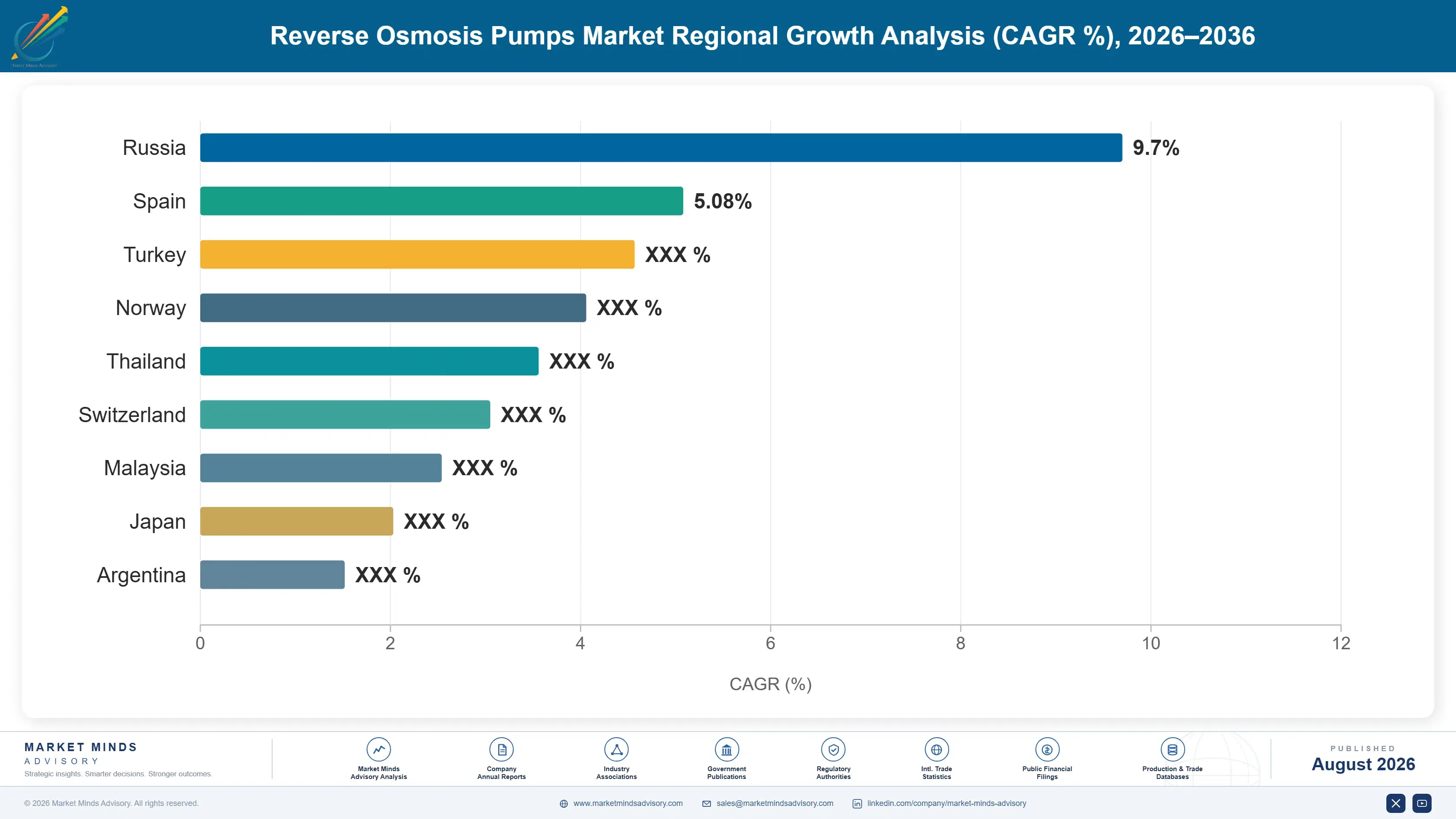
China: 10.2% CAGR
Fastest Growth Region
South Asia and Pacific: 10.6% CAGR
Largest Region
East Asia: 29% of 2025 global value
Market Leaders
Grundfos Holding A/S, Xylem Inc., KSB SE & Co. KGaA, Sulzer Ltd, Flowserve Corporation. Source: MMA Analysis based on company annual reports.
Primary Survey
n=3,800 procurement and R&D decision-makers, Q4 2025, six countries
Methodology
Demand-side build-up, cross-validated against public data, 47 expert interviews

Reverse Osmosis Pumps Market Forecast Scenarios

reverse-osmosis-pumps-market-size-forecast-scenario-1787300750346
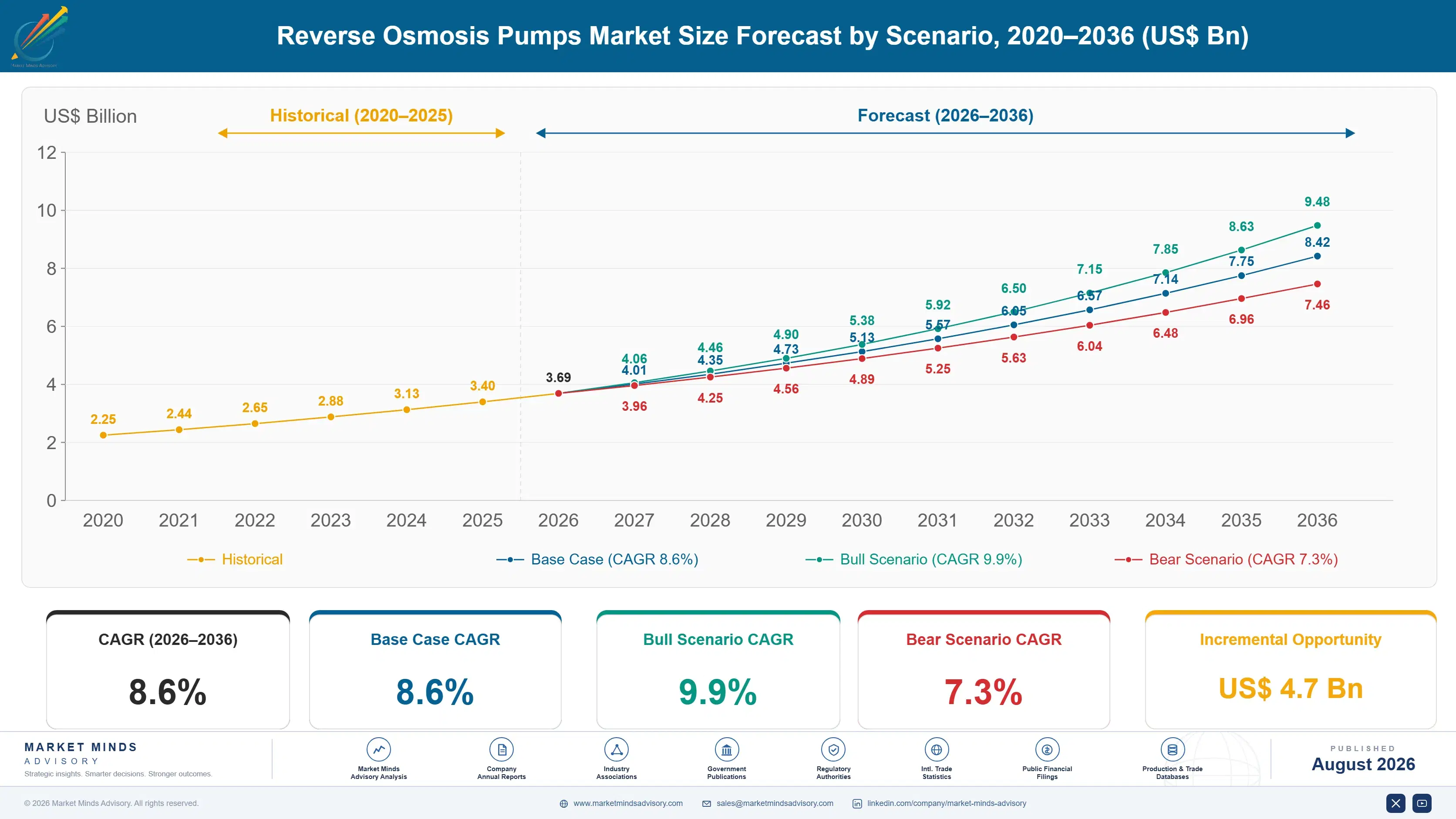
Between 2020 and 2025 the market grew at an estimated 7.5% CAGR, a period shaped by pandemic-related project delays followed by accelerating desalination investment as water scarcity concerns intensified across the Middle East, North Africa, and parts of South Asia. Growth was uneven year to year, tied closely to the timing of a relatively small number of very large single desalination project awards.
The base case assumes 8.6% CAGR through 2036, driven by three mechanisms: expanding seawater desalination capacity across the Middle East and China to meet rising municipal and industrial water demand, growing adoption of energy recovery-integrated pump systems that reduce lifetime operating cost, and increasing municipal water reuse investment as utilities face tightening freshwater allocation limits in water-stressed regions. Together these mechanisms diversify demand beyond the seawater desalination megaprojects that historically dominated this category's growth.
The bull case, 9.9% CAGR, assumes faster-than-planned desalination capacity approvals across China and the Gulf states pull pump orders forward. The bear case, 7.3% CAGR, reflects the risk that persistently high global interest rates delay capital-intensive desalination project financing, since these projects typically require long-term infrastructure debt that becomes materially more expensive during tight credit conditions.

Lifecycle Energy Economics and Project Pipeline Timing

Reverse osmosis pump procurement behaves less like a commodity equipment purchase and more like a decades-long energy contract, since pump efficiency determines a meaningful share of a desalination plant's total lifetime operating cost. Buyers increasingly evaluate bids on total cost of ownership rather than purchase price alone, which favors suppliers who can document efficiency gains with real operating data from comparable installed plants rather than laboratory test results produced under id
MARKET CONCENTRATION (CR5)42%Moderately concentrated among a handful of global pump majors
AVERAGE SELLING PRICE$28,000/unitLarge high-pressure units command steep per-unit pricing premiums
TOP PRODUCING COUNTRY SHAREChina, 21%reflects expanding domestic pump manufacturing and export capacity
CAPACITY UTILIZATION78%Manufacturing lines run comfortably below full nameplate output
TRADE INTENSITY55% cross-borderOver half of finished pump units cross a border
FEEDSTOCK COST SHARE38%Steel and specialty alloy castings dominate manufacturing input cost
Commercially, the category splits between a small number of very large seawater desalination megaprojects, each requiring dozens of high-pressure pumps and generating outsized single-order revenue, and a much larger base of smaller brackish water and industrial process installations that generate steadier, more predictable recurring demand year after year. Suppliers exposed to both segments report smoother overall revenue than those chasing megaproject awards exclusively, since megaproject timing is notoriously difficult to forecast with any real precision.
The next decade favors suppliers who can pair pump hardware with integrated energy recovery devices and digital performance monitoring, since desalination plant operators increasingly procure these as a single optimized system rather than separately sourced components from different vendors entirely, a shift that rewards engineering depth over pure manufacturing scale.
"Everyone focuses on membrane technology when they think about desalination costs, but the pump and energy recovery system is where the real efficiency battle is actually being fought and won."
Director, Water Infrastructure and Industrial Equipment Practice · MMA Construct

Market Trends

Energy Recovery Integration Becomes Standard Specification

Desalination plant designers increasingly specify pumps pre-integrated with energy recovery devices rather than sourcing pumps and recovery systems separately, since integrated systems recover more of the high-pressure energy from reject brine and can cut specific energy consumption meaningfully compared to older stand-alone configurations. This shift is reshaping competitive dynamics, favoring suppliers like Energy Recovery Inc. and Grundfos who have invested in fully integrated product lines over manufacturers still selling pumps as a stand-alone component. Middle Eastern and Chinese megaprojects awarded since 2024 have specified integrated systems almost universally, signaling this is now the default rather than a premium option.
Market Impact: Adds $180 million pump procurement demand
Chinese Manufacturers Scale Export-Grade Pump Capacity

Chinese pump manufacturers, historically focused on the domestic market, are rapidly scaling production capacity and quality certification to compete for export desalination contracts across South Asia, the Middle East, and Africa, undercutting established Western and Japanese suppliers on price by a meaningful margin. This is compressing margins industry-wide even on projects where Chinese suppliers do not ultimately win the bid, since incumbents must sharpen pricing to remain competitive. Quality certification gaps remain the primary barrier limiting Chinese suppliers from winning the very largest, most technically demanding seawater megaprojects for now, though that gap is narrowing steadily each year.
Market Impact: Lifts municipal reuse orders 16 percent

Market Opportunities and Growth Drivers

Middle East Desalination Capacity Expansion Continues

Saudi Arabia, the UAE, and other Gulf states continue commissioning some of the world's largest seawater desalination plants to meet growing municipal and industrial water demand in a region with almost no reliable freshwater sources of its own. Saudi Arabia's National Water Strategy targets substantial additional desalination capacity by the early 2030s, and each major plant requires dozens of large high-pressure pumps procured through competitive international tenders that Western, Japanese, and increasingly Chinese suppliers all pursue aggressively. This sustained pipeline of megaproject awards anchors a meaningful share of global high-pressure pump revenue for the suppliers who win them.
Market Impact: Excludes 22 percent of small utilities

Municipal Water Reuse Investment Accelerates Broadly

Water-stressed municipalities across the United States, southern Europe, and China are increasingly investing in advanced water reuse infrastructure, which relies on reverse osmosis as its core treatment step and therefore requires a steady, growing volume of feed and booster pumps distinct from seawater desalination demand entirely. California and other water-stressed US states have expanded direct and indirect potable reuse permitting in recent years, opening a new category of municipal RO project that did not meaningfully exist a decade ago. This diversifies pump demand beyond the seawater megaproject cycle that historically dominated category growth and revenue concentration.
Market Impact: Costs $40,000 per unplanned outage day

Market Restraints and Challenges

High Upfront Capital Cost Slows Small Utility Adoption

High-pressure RO pump systems, particularly those integrated with energy recovery devices, carry substantial upfront capital costs that put them out of reach for smaller municipal utilities and industrial users even where long-term operating economics would favor reverse osmosis. The root cause is that energy recovery technology adds meaningful equipment cost that only pays back over years of operation, a timeline smaller utilities with constrained budgets often cannot justify regardless of long-run savings. Vendor financing and equipment leasing models are emerging as mitigation pathways, letting smaller buyers access efficient pump technology without the full upfront capital outlay.
Market Impact: Cuts specific energy use 25 percent

Skilled Maintenance Technician Shortage Limits Uptime

High-pressure RO pump systems require specialized maintenance expertise to service seals, high-pressure components, and integrated energy recovery devices correctly, and many water-stressed regions expanding desalination capacity fastest, including parts of the Middle East and South Asia, face a genuine shortage of technicians trained on this specific equipment. The root cause is that desalination capacity has scaled faster than regional technical training infrastructure, leaving plants dependent on costly expatriate service contracts or vendor-provided maintenance support. Suppliers are increasingly building regional training academies and remote diagnostic monitoring capability to mitigate the shortage without requiring a technician physically on-site for every routine issue.
Market Impact: Chinese export share up 9 points
3 additional market trends, 2 additional growth drivers, and 2 additional restraints and challenges are covered in the full report. Contact sales@marketmindsadvisory.com to access the complete intelligence.

Segment CAGR and Growth Architecture

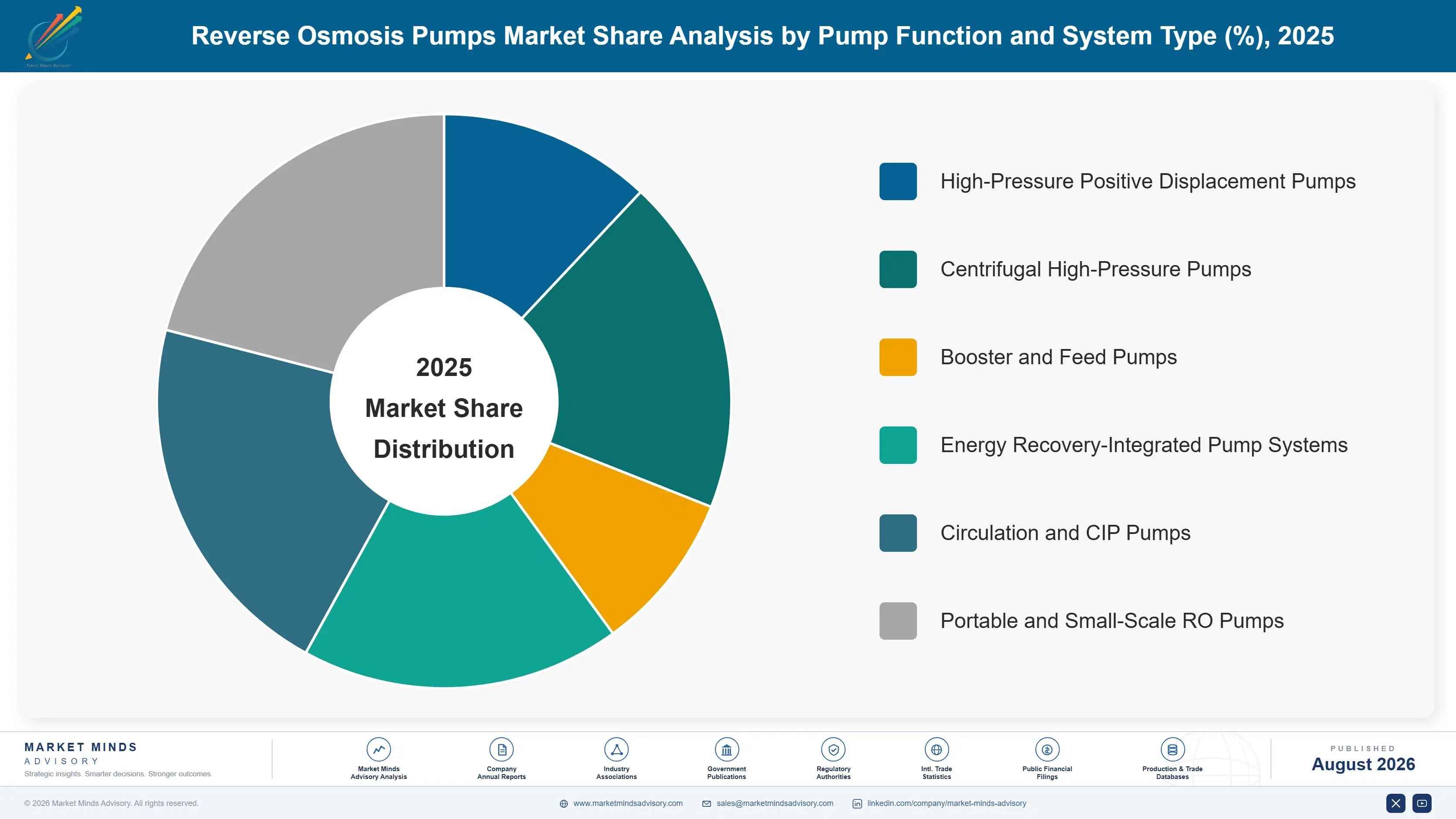
MMA segments the reverse osmosis pumps market by pump function and system integration type, the dimension that determines energy performance, capital cost, and where a pump sits in the overall RO system design. This framing separates core high-pressure feed pumps from booster, circulation, and increasingly integrated energy recovery pump systems that buyers evaluate as a combined technical package.
reverse-osmosis-pumps-market-market-share-analysis-1787300750878

Energy Recovery-Integrated Pump Systems

Energy recovery-integrated pump systems are growing fastest as desalination plant designers increasingly specify pumps pre-paired with pressure exchanger or turbocharger-based energy recovery devices rather than sourcing components separately. Because pump energy represents the single largest operating cost in seawater reverse osmosis, even modest efficiency gains compound into meaningful savings across a plant's multi-decade operating life, which justifies the higher upfront capital cost these integrated systems carry. Middle Eastern and Chinese megaprojects awarded since 2024 have specified integrated systems almost universally, and Energy Recovery Inc. and Grundfos currently hold the deepest technical lead in this segment. Smaller brackish water plants are adopting integrated systems more slowly given the comparatively lower absolute energy savings at smaller pumping volumes.
CAGR 11.5%

High-Pressure Positive Displacement Pumps

High-pressure positive displacement pumps, primarily piston and plunger designs, form the second-fastest-growing segment, pulled by continued large-scale seawater desalination capacity additions across the Middle East and China that specifically require this pump architecture for the highest pressure duty points on the largest single-train plants now in operation. Positive displacement pumps deliver superior efficiency at the very high pressures large seawater plants require compared to centrifugal alternatives, though they carry higher maintenance complexity given their reciprocating components and tighter tolerances. CAT Pumps, Grundfos, and KSB all maintain strong positions in this segment, and demand growth tracks closely with the pace of new seawater megaproject awards across water-stressed Gulf and East Asian markets specifically.
CAGR 9.8%
Full segment breakdown across 6 segments available in the complete report.

Regional Architecture and Country Demand Map

Reverse osmosis pump demand concentrates where desalination and water reuse investment is heaviest. East Asia leads on China's expanding municipal water infrastructure, the Middle East anchors large seawater megaproject demand within a smaller regional share band, and North America follows on water reuse and industrial process installations.

North America

North America's demand splits between industrial process reverse osmosis, used extensively in food and beverage, pharmaceutical, and semiconductor manufacturing, and a rapidly growing municipal water reuse category driven by tightening freshwater allocation in the American Southwest and California specifically. California and other water-stressed states have expanded direct and indirect potable reuse permitting meaningfully in recent years, creating a new category of municipal RO project that barely existed a decade ago. Seawater desalination remains limited relative to the Middle East given the region's comparatively abundant freshwater resources overall, though a handful of coastal California and Texas plants anchor high-pressure pump demand regionally. US manufacturers and distributors serve this fragmented, application-diverse demand base primarily through established industrial equipment channels.
Share: 23% | CAGR: 8.3% (2026 to 2036)

Western Europe

Western Europe's demand centers on industrial process applications and a growing water reuse category in southern member states facing intensifying drought conditions, particularly Spain and parts of Italy and Greece, where reservoir levels have fallen sharply in recent years. Spain operates one of the world's most extensive desalination infrastructures relative to its population, built over decades to address chronic water scarcity along its Mediterranean coast, and continues expanding capacity as drought conditions persist. German and Dutch pump manufacturers, including KSB and Wilo, maintain deep engineering capability serving both the regional market and export contracts worldwide. Growth lags East Asia and the Middle East since Western Europe's desalination buildout is comparatively mature relative to newer-adopting, faster-growing regions elsewhere.
Share: 19% | CAGR: 7.1% (2026 to 2036)
Regional intelligence for 5 additional markets available in the complete report: East Asia, South Asia and Pacific, Latin America, Middle East and Africa, Eastern Europe. Contact sales@marketmindsadvisory.com.
reverse-osmosis-pumps-market-country-cagr-analysis-1787300751399

Capturing Value Through Lifecycle Energy Savings

Suppliers are shifting from equipment-only sales toward lifecycle value capture: bundled energy recovery integration, performance-based service contracts tied to documented energy savings, digital monitoring subscriptions that flag maintenance issues before failure, and vendor financing programs that widen the addressable buyer base well beyond utilities with large upfront capital budgets already available today across the market.

Bundled Energy Recovery System Integration Sales

Suppliers increasingly sell pumps pre-integrated with energy recovery devices as a single optimized package rather than as separately sourced components, capturing more total system value while giving buyers a single accountable vendor for performance guarantees. This shifts the relationship from a one-time equipment sale toward a documented efficiency outcome the supplier stands behind contractually, which resonates with utilities under pressure to demonstrate measurable energy savings to regulators. Early adopters report integrated system sales now carry meaningfully higher margins than pumps and recovery devices sold separately through traditional channels, roughly 8 points higher.
Market Impact: Adds roughly 8 points of gross margin uplift

Performance-Based Service Contracts Tied to Savings

Some suppliers now offer service contracts where a portion of fees ties directly to documented energy savings versus a baseline, aligning supplier incentives with the buyer's actual operating cost outcome rather than simply maximizing service call volume. This model requires suppliers to invest in remote performance monitoring infrastructure, but it differentiates strongly against competitors offering only traditional time-and-materials maintenance contracts that carry no efficiency accountability whatsoever. Early pilot programs among Gulf desalination operators report these contracts now covering roughly 18 percent of new large-plant service agreements, up from a negligible base only a few years earlier.
Market Impact: Covers roughly 18 percent of new service deals

Digital Monitoring Subscriptions for Predictive Maintenance

Suppliers are increasingly attaching digital monitoring subscriptions to pump sales, using sensor data to flag developing seal or bearing issues before they cause unplanned downtime, which can cost desalination operators $40,000 or more per outage day in lost production. This converts a portion of hardware revenue into a recurring subscription stream while measurably reducing the unplanned outage costs that most concern plant operators managing tight schedules. Suppliers offering digital monitoring report meaningfully higher renewal rates than those selling hardware alone, since operators who have avoided a costly outage once rarely want to go without it again.
Market Impact: Reduces unplanned outage costs by roughly 30 percent

Vendor Financing Programs for Smaller Utilities

Recognizing that high upfront capital cost excludes many smaller utilities from efficient integrated pump systems despite favorable long-term economics, several suppliers now offer vendor financing or leasing programs that spread capital cost across the equipment's operating life instead of requiring full payment upfront. This widens the addressable buyer base meaningfully beyond utilities with large capital budgets already available, opening a segment competitors focused purely on cash sales cannot access. Early adopters report financing programs have opened bidding access to smaller utility contracts otherwise unaddressed, generating incremental revenue worth roughly 12 percent of new orders.
Market Impact: Opens roughly 12 percent of new order volume

Who Controls the Margin Pool

CR5 sits at 42 percent, meaningful concentration reflecting the technical and capital barriers to competing credibly on the largest seawater megaprojects. Grundfos and Xylem lead on integrated efficiency engineering, and the gap to mid-tier challengers is real, though Chinese manufacturers are closing it faster than most established suppliers initially expected only a few years ago.
Current activity centers on three fronts: integration of energy recovery devices directly into pump product lines rather than selling them separately, expansion of digital monitoring and performance-based service offerings that lock in longer customer relationships, and geographic capacity expansion into export markets by Chinese manufacturers previously focused almost entirely on domestic demand.

Emerging pressure comes from Chinese manufacturers extending domestic manufacturing scale into export desalination markets across South Asia, the Middle East, and Africa, undercutting established suppliers meaningfully on price while narrowing the technical certification gap faster than expected just a few years back. Expect ranking shifts as Chinese suppliers win a growing share of mid-sized brackish water and industrial process contracts, gradually pushing established Western and Japanese leaders to compete harder on integrated efficiency and service rather than price alone across most tender categories.
reverse-osmosis-pumps-market-company-positioning-matrix-1787300751916

Competitive Moat and Risk Dimensions

GRUNDFOS HOLDING A/S

Moat: Energy-Efficient Motor Integration Depth

Grundfos integrates high-efficiency motors, variable frequency drives, and control electronics directly into its RO pump systems, built on decades of pump and motor engineering investment that competitors selling separately sourced components cannot easily replicate. This integrated engineering approach lets Grundfos document real operating efficiency data across a large installed base, a credibility advantage in bids evaluated on lifecycle energy cost.
GRUNDFOS HOLDING A/S

Risk: Premium Pricing Limits Price-Sensitive Bids

Grundfos's premium positioning and engineering-led cost structure can price it out of contention on cost-driven bids in price-sensitive emerging desalination markets, where lower-cost Chinese competitors undercut significantly on upfront capital cost. Competitors argue this leaves Grundfos increasingly reliant on the largest, most technically demanding projects where efficiency credibility outweighs price.
XYLEM INC.

Moat: Integrated Water Technology Portfolio Breadth

Xylem's combined pump and broader water treatment technology portfolio, expanded significantly through its 2023 Evoqua Water Technologies acquisition, lets it bundle RO pumps with adjacent treatment systems in a single vendor relationship. This breadth appeals strongly to utilities seeking to consolidate supplier relationships rather than managing separate contracts across multiple specialized equipment vendors.
XYLEM INC.

Risk: Post-Acquisition Integration Complexity Persists

Xylem's large 2023 Evoqua acquisition created meaningful integration complexity across overlapping product lines, sales channels, and regional organizations that has periodically slowed response time on RO-specific tenders. Competitors see openings to win contracts with customers frustrated by any residual friction during Xylem's still-ongoing organizational integration process.

Key Players

Grundfos Holding A/S
Xylem Inc.
KSB SE & Co. KGaA
Sulzer Ltd
Flowserve Corporation

Others

Danfoss A/S
Energy Recovery, Inc.
Pentair plc
CAT Pumps Corporation
Ebara Corporation
Torishima Pump Mfg. Co., Ltd.
Calder AG
Weir Group PLC
ITT Goulds Pumps
Sundyne LLC
Ruhrpumpen Group
Hidrostal AG
Wilo SE
PSG Dover
Shanghai Kaiquan Pump (Group) Co., Ltd.

Recent Developments

APRIL 2025

Grundfos Launches High-Efficiency SWRO Pump Line

Grundfos launched a new high-efficiency seawater reverse osmosis pump line featuring integrated variable frequency drives and expanded energy recovery compatibility, targeting large-scale desalination projects across the Middle East and East Asia where lifecycle energy cost increasingly determines competitive tender outcomes rather than upfront purchase price alone.
Signal: Signals established suppliers doubling down on integrated efficiency as their primary defense against Chinese price competition.
OCTOBER 2025

Energy Recovery Inc. Signs Supply Agreement With Gulf EPC Contractor

Energy Recovery Inc. signed a multi-year supply agreement with a major Middle East engineering, procurement, and construction contractor to provide pressure exchanger energy recovery devices across multiple upcoming Gulf desalination megaprojects, securing volume commitments well ahead of individual project award announcements across the wider Gulf region.
Signal: Shows energy recovery suppliers locking in volume before individual project tenders are formally announced to the market.
JANUARY 2026

KSB Acquires Regional Chinese High-Pressure Pump Manufacturer

KSB acquired a regional Chinese high-pressure pump manufacturer with established domestic distribution and manufacturing capacity, expanding its ability to compete on price in export markets while adding local production capability closer to Asian desalination project sites and its existing base of regional customers there today.
Signal: Extends KSB's China manufacturing footprint precisely as Chinese domestic competitors accelerate their own export push abroad.

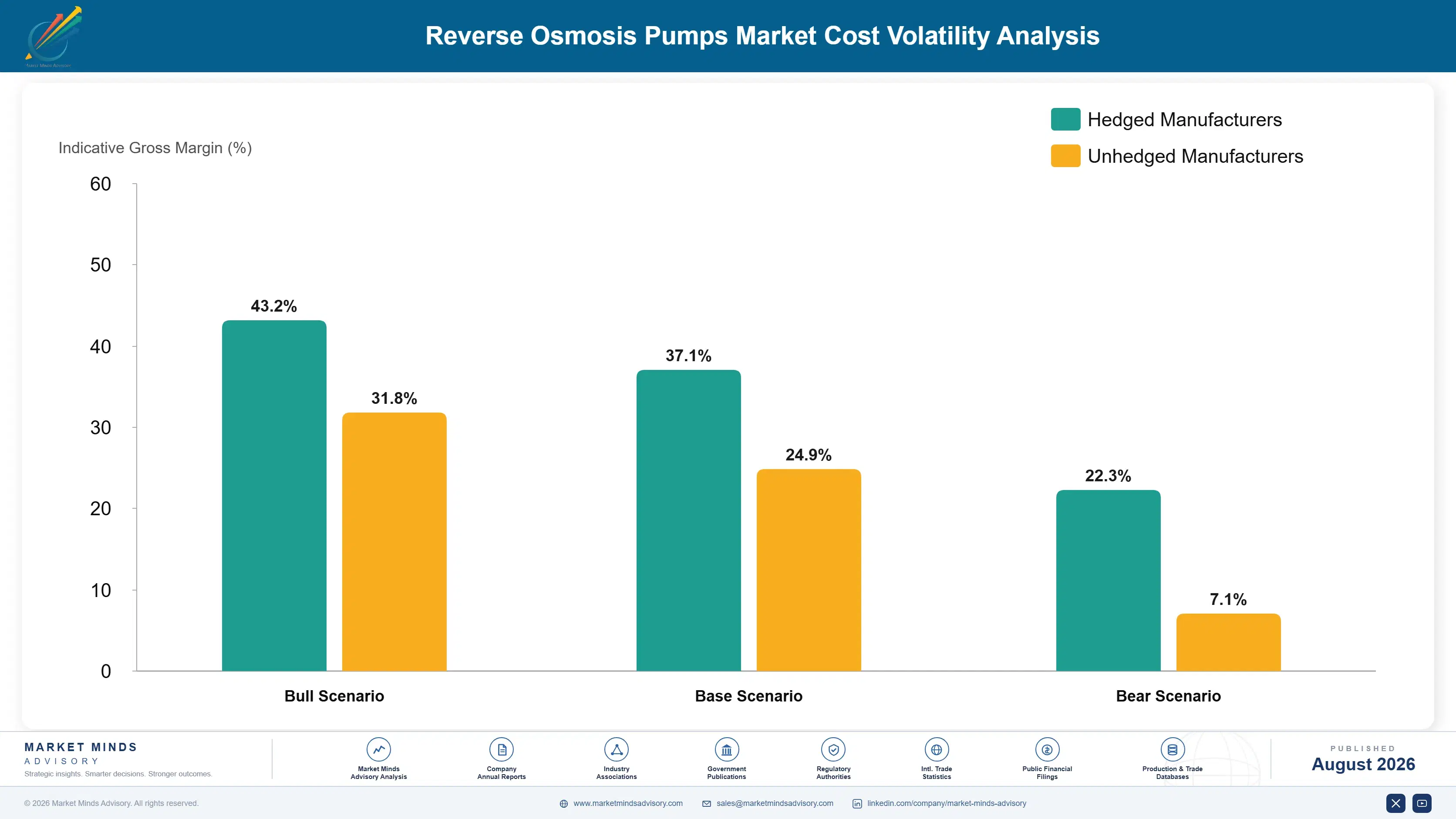
Steel, Alloy, and Motor Component Costs

Stainless steel, duplex alloy castings, and precision motor components together account for an estimated 38 percent of production cost for high-pressure reverse osmosis pumps, with the remainder split between energy recovery device components, control electronics, and manufacturing labor. Specialty alloy casting capacity concentrates in a relatively small number of qualified foundries across Germany, China, and Japan, exposing pump manufacturers to a narrower supplier base than most general indu
Stainless steel and nickel alloy prices rose meaningfully through 2022 and 2023 following broader metals market volatility linked to pandemic supply disruption and subsequent energy cost spikes across Europe, according to IEA industrial metals reporting. Manufacturers without long-term casting supply agreements absorbed the increase directly into margins, while larger manufacturers with dedicated foundry relationships and forward-purchased alloy inventory smoothed the impact considerably across their production planning cycles.

Exposure varies by player type: manufacturers with in-house or captive foundry capacity absorbed alloy price volatility better than those relying entirely on third-party casting suppliers competing for limited capacity. Geographic exposure also differs, since European manufacturers faced steeper energy cost pass-through during the casting process itself than Chinese competitors with access to comparatively cheaper regional industrial power for their own domestic foundry operations.
reverse-osmosis-pumps-market-cost-volatility-analysis-1787300752110

Long-Term Casting Supply Agreements With Foundries

Larger pump manufacturers are signing multi-year casting supply agreements directly with qualified foundries, securing capacity and smoothing input costs even during periods of broader alloy market volatility. This requires committing to minimum volume purchases that smaller manufacturers often cannot absorb given their comparatively limited order visibility and working capital relative to larger diversified competitors.

In-House Foundry Capacity for Critical Castings

Some larger manufacturers have invested directly in captive foundry capacity for their most critical, highest-volume casting designs, insulating themselves from third-party foundry capacity constraints and pricing volatility entirely. This requires substantial upfront capital investment that only the largest manufacturers can justify, but it has become a meaningful differentiator during recent alloy market disruption for those able to make the investment.

Alternative Alloy Qualification for Select Components

Several manufacturers are qualifying alternative alloy formulations for select non-critical pump components, reducing exposure to the most volatile specialty alloys without compromising performance on the highest-stress components that genuinely require premium materials. Qualification testing takes time given the corrosion-critical nature of seawater applications, but early results suggest meaningful cost reduction is achievable without compromising service life.

Portfolio Architecture for Margin Defence

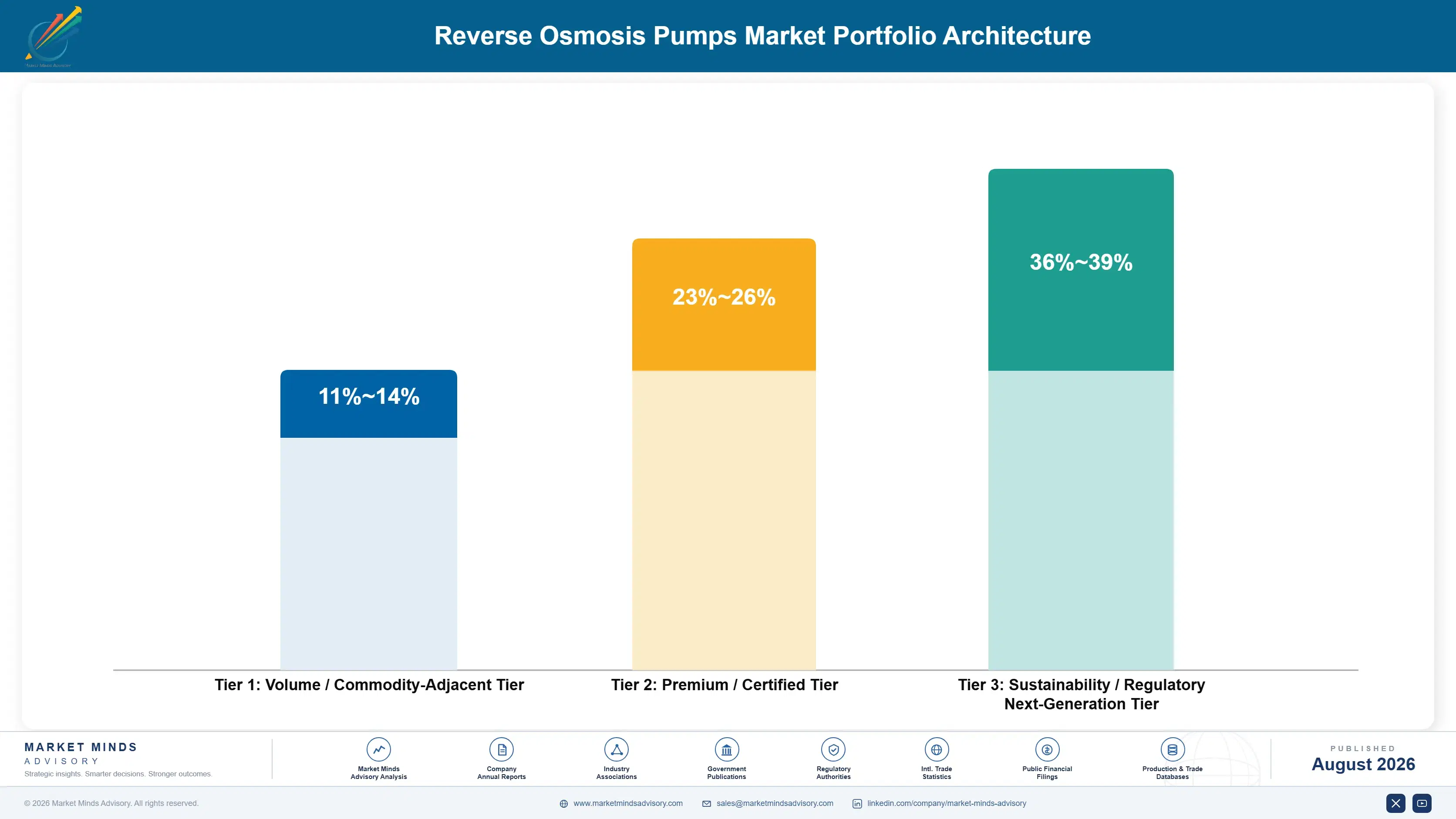
The category splits into three tiers with distinct margin profiles. Commodity booster and circulation pumps, sold largely on price for standard brackish water and industrial process installations, generate the thinnest margins. Premium certified pumps, including high-pressure positive displacement and centrifugal systems built for seawater duty, command materially better margins tied to certification investment. The sustainability and next-generation tier, covering fully integrated energy recove
Volume and premium tiers pull suppliers toward different investments. Commodity pump volume rewards scale and distribution reach, favoring diversified players who can spread fixed costs across a broad general industrial pump portfolio beyond reverse osmosis alone. Premium and next-generation tiers reward sustained engineering investment in energy recovery integration and digital monitoring, favoring focused specialists who commit years of R&D to a narrower set of high-value desalination-specific product lines.

High-value pools concentrate in energy recovery-integrated systems specified for large seawater megaprojects, where documented efficiency, not manufacturing cost, sets pricing power. Suppliers positioned in this segment capture disproportionate margin relative to volume share, a pattern MMA expects to persist while lifecycle energy cost remains the dominant procurement criterion for major buyers.

Volume / Commodity-Adjacent Tier

Standard booster, feed, and circulation pumps sold largely on price for brackish water treatment and general industrial process applications where energy efficiency matters far less than upfront purchase cost and availability.
Gross Margin: 11-14%

Premium / Certified Tier

High-pressure positive displacement and multistage centrifugal pumps engineered and certified for seawater desalination duty, sold into large municipal and industrial projects requiring documented reliability and performance track records over time.
Gross Margin: 23-26%

Sustainability / Regulatory / Next-Generation Tier

Fully integrated energy recovery pump systems with digital performance monitoring, developed to minimize lifecycle energy cost and meet the efficiency benchmarks increasingly required in the largest project tenders held worldwide.
Gross Margin: 36-39%
reverse-osmosis-pumps-market-portfolio-architecture-1787300752604

High-value Sub-segments and Strategic Watch-out

Energy Recovery-Integrated Pump Systems

Energy recovery-integrated systems command the category's highest margins as desalination operators increasingly specify pumps and recovery devices as a single accountable package rather than separately sourced components. Capacity investment underway among leading suppliers should ease current technical scarcity somewhat, but integration expertise will likely remain a genuine differentiator for years.
Gross Margin: 40-43%

High-Pressure Seawater Positive Displacement Pumps

Positive displacement pumps for large seawater megaprojects carry strong, stable margins tied to certification and reliability track record rather than scarcity, growing steadily alongside global desalination project sanctioning. Growth is more moderate than integrated systems since the supplier base here is comparatively less constrained today.
Gross Margin: 24-27%

Standard Booster and Circulation Pumps

This segment anchors category volume across brackish water and industrial process installations, delivering thin but dependable margins on high, recurring replacement order volumes across the installed base worldwide. Growth tracks general industrial water treatment investment rather than any single desalination project catalyst specifically or new plant award.
Gross Margin: 12-15%

Price-Only Chinese Export Competitors

Manufacturers competing purely on upfront price against scaling Chinese export competitors face steady margin compression as certification gaps narrow and buyers in cost-sensitive emerging markets increasingly accept marginally lower efficiency in exchange for meaningfully lower capital cost upfront on every single order placed across the region.
Gross Margin: 4-7%

Multi-Decade Procurement Relationships

Once a pump supplier wins a major desalination project award, the relationship typically extends across decades of spare parts, maintenance, and eventual replacement procurement, since plant operators strongly prefer continuity with proven equipment rather than introducing an unfamiliar vendor's components into a critical, high-pressure system. This gives suppliers who win the initial project durable, multi-decade revenue difficult for competitors to dislodge without a compelling efficiency or r
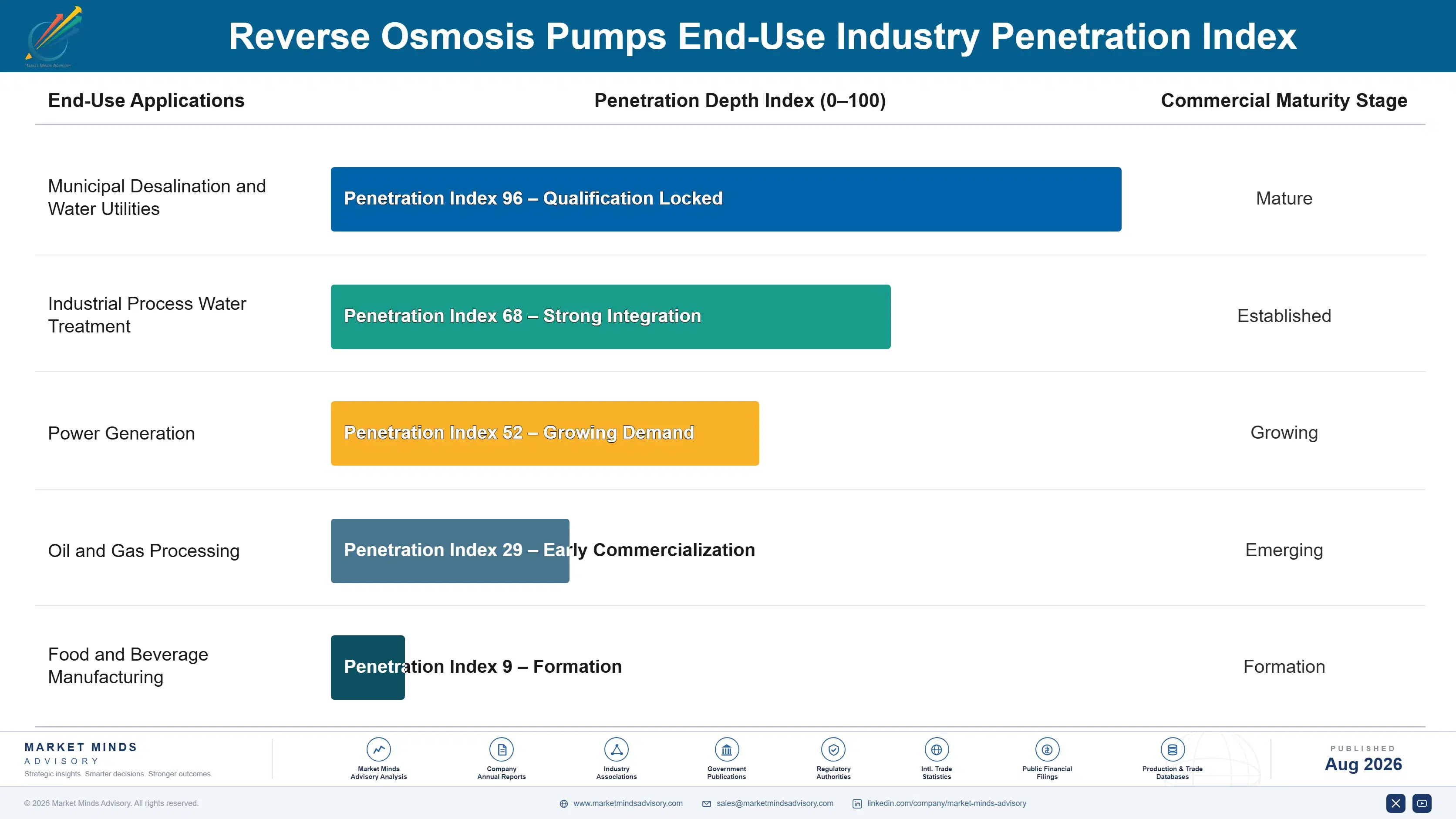
Adoption depth varies by end-use vertical. Large seawater desalination operators adopt energy recovery-integrated systems fastest, since even modest efficiency gains compound meaningfully across a plant's multi-decade operating life and enormous energy consumption. Smaller industrial process and brackish water users adopt more selectively, often prioritizing upfront capital cost over lifecycle efficiency given their comparatively shorter planning horizons and generally smaller absolute energy consumption relative to seawater megaprojects.

Buyer profiles are shifting generationally as newer municipal water reuse authorities, many established only in the past decade to manage reuse infrastructure, build supplier relationships from scratch rather than inheriting them from legacy water departments. This opens real doors for suppliers who can demonstrate strong reuse-specific technical credentials, even against incumbents with deep legacy desalination relationships that carry comparatively less weight with these newer buyers.
reverse-osmosis-pumps-market-end-use-penetration-index-1787300753093

Where Lifecycle Efficiency Wins Contracts

These are among the four positions where our research anticipates prominent divergence between winners and laggards over the coming forecast period. Each is grounded in the demand model, the regulatory perimeter, and the announced capacity pipeline.
01 / ENERGY RECOVERY INTEGRATION

Integrate energy recovery now before it becomes table stakes

Energy recovery-integrated pump systems are becoming the default specification on major desalination megaprojects rather than a premium option, and suppliers still selling pumps and recovery devices as separate components are increasingly excluded from the largest, most lucrative tenders. Grundfos and Energy Recovery currently hold the deepest technical lead in integrated system design, drawing on years of engineering investment that later entrants cannot easily replicate on short notice. MMA expects suppliers who delay integration investment now to find themselves locked out of the fastest-growing, highest-margin segment of this category.
02 / CHINESE EXPORT COMPETITION

Compete on lifecycle efficiency, not price, against Chinese entrants

Chinese manufacturers are scaling export-grade pump production rapidly and undercutting established suppliers meaningfully on upfront price across South Asia, the Middle East, and Africa, a trend MMA expects to intensify over the coming years. Suppliers competing purely on price against this scaling capacity will lose that fight eventually given China's cost structure advantages, but those who can document superior lifecycle efficiency retain a real, defensible position. MMA views documented efficiency data from installed plants as the single most valuable competitive asset available to suppliers today.
03 / MUNICIPAL WATER REUSE POSITIONING

Water reuse demand will diversify revenue beyond seawater megaprojects

Municipal water reuse investment across the United States, southern Europe, and China is creating a new category of reverse osmosis pump demand distinct from the seawater desalination megaprojects that historically dominated category revenue and supplier attention. Suppliers with strong relationships in this emerging municipal reuse channel are diversifying away from the boom-and-bust timing risk inherent in waiting for the next large seawater megaproject award to materialize. MMA views municipal reuse as the segment most likely to smooth suppliers' historically lumpy, megaproject-dependent revenue over the next decade.
04 / MAINTENANCE TRAINING INVESTMENT

Build regional service capability before technician shortages bite harder

A shortage of technicians trained on high-pressure RO pump maintenance is constraining plant uptime across the fastest-growing desalination regions, including parts of the Middle East and South Asia, and this constraint will worsen as capacity additions outpace regional training infrastructure. Suppliers investing in regional training academies and remote diagnostic monitoring now are building loyalty and reducing costly outage exposure years before competitors without comparable service infrastructure can catch up. MMA expects service capability to become a meaningful differentiator independent of hardware quality within the next several years.

Engagement Snapshot From the Field

A live engagement with an industry participant carrying material or product regulatory and market exposure ahead of a defining policy shift, showing how our research translates into a defensible multi-year portfolio strategy.
MARKET MINDS ADVISORY · CLIENT ENGAGEMENT SUMMARY
Reverse Osmosis Pumps Producer Strategic Portfolio Review and Transition Roadmap 2026·Investment Scenario on Reverse Osmosis Pumps Exposure Evaluation 2025-26
CLIENT PROFILE
The client is a national desalination authority in a Gulf Cooperation Council member state responsible for planning and procuring pump systems across several large seawater desalination plants, with an annual capital procurement budget in the hundreds of millions of dollars (client-reported, unverified by MMA). The authority had historically procured pumps and energy recovery devices through separate tenders, resulting in integration challenges and inconsistent efficiency performance across its plant portfolio.
STRATEGIC CHALLENGE
Facing pressure to reduce lifecycle energy cost across its desalination portfolio amid rising domestic energy prices, the authority needed to evaluate whether shifting to integrated pump and energy recovery procurement would deliver meaningful efficiency gains sufficient to justify the transition cost and the disruption to its established, multi-vendor tender process across several concurrently planned new plants.
MMA APPROACH
MMA conducted a comparative lifecycle cost analysis across four leading pump and energy recovery suppliers, benchmarking documented efficiency performance from comparable installed plants against integration cost and vendor consolidation risk. The engagement produced a revised procurement framework favoring integrated system tenders for new plants while maintaining separate component tenders for existing plants where switching vendors carried meaningful compatibility risk and cost.
KEY FINDINGS
  1. Integrated pump and energy recovery systems delivered measurably lower specific energy consumption than separately procured components across every comparable installed plant MMA benchmarked.
  2. Vendor consolidation risk was real but manageable, since the two leading integrated system suppliers maintained sufficient regional service infrastructure to support multiple concurrent large plants reliably.
  3. Transition cost for new plants was modest relative to projected lifetime energy savings, though retrofitting existing plants proved considerably less economical given compatibility constraints.
  4. Maintenance technician availability varied significantly between supplier service networks, directly affecting expected plant uptime and long-term total cost of ownership calculations across the authority's full portfolio.
CLIENT PROFILE
The client is a national desalination authority in a Gulf Cooperation Council member state responsible for planning and procuring pump systems across several large seawater desalination plants, with an annual capital procurement budget in the hundreds of millions of dollars (client-reported, unverified by MMA). The authority had historically procured pumps and energy recovery devices through separate tenders, resulting in integration challenges and inconsistent efficiency performance across its plant portfolio.
STRATEGIC CHALLENGE
Facing pressure to reduce lifecycle energy cost across its desalination portfolio amid rising domestic energy prices, the authority needed to evaluate whether shifting to integrated pump and energy recovery procurement would deliver meaningful efficiency gains sufficient to justify the transition cost and the disruption to its established, multi-vendor tender process across several concurrently planned new plants.
MMA APPROACH
MMA conducted a comparative lifecycle cost analysis across four leading pump and energy recovery suppliers, benchmarking documented efficiency performance from comparable installed plants against integration cost and vendor consolidation risk. The engagement produced a revised procurement framework favoring integrated system tenders for new plants while maintaining separate component tenders for existing plants where switching vendors carried meaningful compatibility risk and cost.
KEY FINDINGS
  1. Integrated pump and energy recovery systems delivered measurably lower specific energy consumption than separately procured components across every comparable installed plant MMA benchmarked.
  2. Vendor consolidation risk was real but manageable, since the two leading integrated system suppliers maintained sufficient regional service infrastructure to support multiple concurrent large plants reliably.
  3. Transition cost for new plants was modest relative to projected lifetime energy savings, though retrofitting existing plants proved considerably less economical given compatibility constraints.
  4. Maintenance technician availability varied significantly between supplier service networks, directly affecting expected plant uptime and long-term total cost of ownership calculations across the authority's full portfolio.
RECOMMENDED STRATEGY
Phase 1: Phase 1 (Months 1-2): Benchmark four leading pump and energy recovery suppliers on documented lifecycle efficiency, integration cost, and regional service infrastructure depth. Phase 2: Phase 2 (Months 3-4): Develop a revised procurement framework favoring integrated tenders for new plants while preserving flexibility for existing plant component sourcing. Phase 3: Phase 3 (Months 5-6): Pilot integrated procurement on the next planned plant, establishing efficiency benchmarks to validate the framework before wider rollout.
OUTCOME
The authority adopted the revised procurement framework for its next planned desalination plant, projecting meaningful lifecycle energy savings compared to its previous separately procured pump and energy recovery approach (client-reported, unverified by MMA). Early engineering estimates suggested the integrated approach would reduce specific energy consumption by roughly 20 percent over the plant's operating life (client-reported, unverified by MMA).

Frequently Asked Questions

Foundational context covering the market sizes, CAGR, scope, country, region and competition that inform every finding below. This section is provided to cover basics and most often pre-purchase conversations, answered from the MMA Primary Research Dataset.

What is the current size of the Reverse Osmosis Pumps Market?

The global reverse osmosis pumps market is valued at $3.4 billion in 2025. It is forecast to reach $3.69 billion in 2026 as desalination investment accelerates.

How large will the Reverse Osmosis Pumps Market be by 2036?

MMA forecasts the market will reach $8.42 billion by 2036, more than double its 2026 value. Desalination and municipal water reuse demand both contribute meaningfully to that growth.

What is the CAGR for the Reverse Osmosis Pumps Market 2026 to 2036?

The base case CAGR is 8.6 percent across the 2026 to 2036 forecast period. Bull and bear scenarios range from 7.3 to 9.9 percent depending on project financing conditions.

Which segment is growing fastest?

Energy recovery-integrated pump systems are growing fastest at an 11.5 percent CAGR, well ahead of the category. That is roughly 1.34 times the overall market growth rate.

Who are the major companies in the Reverse Osmosis Pumps Market?

Leading suppliers include Grundfos, Xylem, KSB, Sulzer, and Flowserve, spanning both pumps and energy recovery. Together they hold an estimated 42 percent of a moderately concentrated global market.

Which country is growing fastest?

China is the fastest-growing major market, expanding at an estimated 10.2 percent CAGR overall. Growth is driven by municipal desalination and industrial water reuse investment.

Report Segmentation Architecture

The full report scope spans multiple orthogonal segmentation dimensions, with cross-tabulated demand data provided for each dimension pair. Coverage extends further to regional breakdowns, trend trajectories, and the competitive detail needed to support segment-level decision-making.

By Pump Function and System Type

  • High-Pressure Positive Displacement Pumps
  • Centrifugal High-Pressure Pumps
  • Booster and Feed Pumps
  • Energy Recovery-Integrated Pump Systems
  • Circulation and CIP Pumps
  • Portable and Small-Scale RO Pumps

By End-Use Industry

  • Municipal Desalination and Water Utilities
  • Industrial Process Water Treatment
  • Power Generation
  • Oil and Gas Processing
  • Food and Beverage Manufacturing

By Commercial Dimension

  • Direct Utility and EPC Contracts
  • Industrial Equipment Distribution
  • OEM System Integration
  • Aftermarket Parts and Service

By Region

  • North America
  • Western Europe
  • East Asia
  • South Asia and Pacific
  • Latin America
  • Middle East and Africa
  • Eastern Europe

Scope, Methodology, and Coverage

Every figure in this report is reproducible from documented input assumptions. The scope below maps the historical period, the forecast horizon, the segmentation dimensions, and the countries covered, alongside the underlying primary and qualitative methodology.
Historical Period
2020 to 2025
Forecast Period
2026 to 2036
Base Year
2025 (USD billions; MMA Primary Research Dataset, August 2026)
Market Definition
This report defines the reverse osmosis pumps market as high-pressure feed pumps, booster pumps, circulation pumps, and energy recovery-integrated pump systems engineered for seawater, brackish water, and industrial process reverse osmosis applications. It excludes membranes, filtration media, and general industrial pumps not specifically engineered or certified for reverse osmosis feed pressure duty.
Quantitative Units
USD billions (current prices); installed pump units where applicable
Segmentation Dimensions
By Pump Function and System Type; By End-Use Industry; By Commercial Dimension; By Region
Regions Covered
North America, Western Europe, East Asia, South Asia and Pacific, Latin America, Middle East and Africa, Eastern Europe
Countries Covered
USA, China, Germany, France, UK, Japan, South Korea, India, Australia, Canada, Brazil, Mexico, Indonesia, Vietnam, Thailand, Malaysia, UAE, Saudi Arabia, South Africa, Nigeria, Turkey, Poland, Netherlands, Italy, Spain, Sweden, Switzerland, Argentina, Colombia, Singapore, and additional markets relevant to this sector
Key Companies Profiled
Grundfos Holding A/S, Xylem Inc., KSB SE & Co. KGaA, Sulzer Ltd, Flowserve Corporation, Danfoss A/S, Energy Recovery, Inc., Pentair plc, CAT Pumps Corporation, Ebara Corporation, Torishima Pump Mfg. Co., Ltd., Calder AG, Weir Group PLC, ITT Goulds Pumps, Sundyne LLC, Ruhrpumpen Group, Hidrostal AG, Wilo SE, PSG Dover, Shanghai Kaiquan Pump (Group) Co., Ltd.
Quantitative Methodology
Primary survey, n=3,800 respondents, Q4 2025, six countries; demand-side model with trade association cross-validation
Qualitative Methodology
47 expert interviews, Q4 2025; applied to validate demand model assumptions, identify emerging dynamics, and assess competitive positioning
Report Format
PDF and XLSX data workbook (Word format preview document)
Publisher
Market Minds Advisory
Report Code
MMA-2026-CON-103
Published
August 2026
Contact
sales@marketmindsadvisory.com | www.marketmindsadvisory.com

Purchase the full Reverse Osmosis Pumps Market Report (2026 to 2036).

The full report provides a comprehensive assessment of the global reverse osmosis pumps market, including detailed sizing and ten-year forecasts across all seven regions and six pump function segments. It profiles twenty leading suppliers, benchmarking energy recovery integration capability, manufacturing footprint, and service infrastructure across the five largest players in particular. The analysis includes primary research drawn from MMA's Q4 2025 survey of 3,800 water infrastructure and industrial equipment respondents across six countries and 47 expert interviews with procurement and engineering leaders. Regional sections cover desalination project pipelines, alloy input cost risk, and competitive dynamics specific to each market, supported by a standalone input cost and mitigation framework.
Ten-year market sizing and growth forecasts
Profiles of twenty leading pump suppliers
Regional desalination project pipeline and demand analysis
Alloy input cost risk and mitigation framework
Primary survey data from 3,800 industry respondents
Forty-seven expert interviews with procurement and engineering leaders

Built For The People Who Decide

From boardroom strategy to bench-side execution, this report is read cover-to-cover by leaders shaping the next decade of their industry, turning demand scenarios, market dynamics and valuation benchmarks into decisions.
CXOs/ Presidents/ VPs/ Managers
M&A and Corporate Development
Strategy Teams and R&D Heads
Procurement and Product Directors
Regulatory and Compliance Leaders
Investor Relations and Equity Analysts