

Market Minds Advisory
North America Bulk Aseptic Packaging Market

North America Bulk Aseptic Packaging Market: Deleting the Cold Chain, One Bin at a Time

A bin of mango purée that sits on a warm warehouse floor for twenty-one months removes a freezer container, a freezer warehouse, and a thaw cycle. That deletion is the entire commercial argument.

Lead Analyst

Bilal Shaikh

Published

September 2026

Make Smarter Decisions with Customized Research Insights

Request a free sample report and evaluate market opportunities, growth trends, and competitive dynamics relevant to your business needs.

2025 MARKET VALUE$1.9BMarket Size 2025
2036 FORECAST VALUE$3.8BBase Case , 2026 to 2036
CAGR 2026 TO 20366.6 %Bull 7.8% / Bear 5.4%
INCREMENTAL OPPORTUNITY$1.8BNet 10- year value creation
EXPANSION MULTIPLE1.89x2036 value over 2026 base
Strategic Levers
M&A Pipeline
Regional Outlook
Country Rankings
Competitive Intelligence
Segmental Deep-dive
Call-Us : 91 93563 13602

Executive Snapshot and Market Trajectory

Bulk aseptic exists to delete a cold chain. Purée or paste held commercially sterile in a lined bin sits at ambient temperature for around 21 months, which removes freezer containers, freezer warehousing, and thawing from a supply chain that would otherwise need all three.
Growth comes from format change rather than from more product. Flexible liner and bladder transport systems grow fastest at 9.9%, exactly 1.50 times the market rate, moving bulk liquid inside shipping container and road tank liners instead of rigid palletised bins. Aseptic filling and connection systems follow at 8.3% as low-acid capability spreads. Mexico is the fastest national contributor at 9.4%, on avocado, mango, and tomato output feeding the regional supply chain northward.
Concentration reaches 58% across the top five measured on annual system and bag volume supplied regionally, held by aseptic system builders rather than by bag converters. The category's concentration risk is unusual: tomato paste alone carries 38% of regional volume, so a poor Californian season moves the whole market. Commercial sterility failures run at 0.6% of bins received. Each risks a downstream batch worth far more than the bin.
Market Definition
This market covers bulk aseptic packaging systems supplied into North America for commercially sterile liquid and semi-liquid food products, spanning bag-in-drum, bag-in-bin, intermediate bulk tote, flexible liner and bladder transport, aseptic bulk tank and silo, and aseptic filling and connection systems. Scope is measured at supplier realised prices for containers, liners, and filling hardware. Retail aseptic cartons and pouches, frozen and chilled bulk handling, thermal processing equipment upstream of filling, and the packed food products themselves are excluded.
Base Year Value
$1.9B in 2025 (MMA Primary Research Dataset, August 2026)
Forecast Period
2026 to 2036, eleven discrete annual values
CAGR
6.6% base case. Bull 7.8%. Bear 5.4%.
Fastest Growth Segment
Flexible Liner And Bladder Transport Systems: 9.9% CAGR
Fastest Growth Country
Mexico: 9.4% CAGR
Fastest Growth Region
South Asia and Pacific: 8.6% CAGR
Largest Region
North America: 46% of 2025 global value
Market Leaders
SIG. Sealed Air. JBT Marel. Tetra Pak. Goglio. Source: MMA Analysis based on company annual reports.
Primary Survey
n=3,800 procurement and R&D decision-makers, Q4 2025, six countries
Methodology
Demand-side build-up, cross-validated against public data, 47 expert interviews

North America Bulk Aseptic Packaging Market Forecast Scenarios

north-america-bulk-aseptic-packaging-market-size-forecast-scenario-1787299137919
The 2020 to 2025 period was governed by freight and by weather. Container rates spiked and then collapsed, which changed the arithmetic of shipping frozen versus ambient bulk product twice inside three years. Californian tomato harvests varied sharply, and since that single crop carries a large share of regional volume the whole market moved with it. A 5.3% historical rate averages a freight-driven surge against two difficult growing seasons.
Three mechanisms carry the 6.6% base case. Cold chain avoidance is the largest, as processors reconsider frozen purée and concentrate handling against energy costs that have risen permanently. Plant-based and dairy base growth is the second, both requiring low-acid capability that only a minority of installed systems hold. And Mexican and Central American sourcing is the third, where proximity to the border favours ambient bulk over frozen shipment quite decisively.
The 7.8% bull case rests on low-acid validated capacity expanding fast enough to serve plant-based beverage base demand, which currently outruns the systems able to fill it. The 5.4% bear case is a serious commercial sterility failure reaching a consumer product, which would push processors back toward frozen handling regardless of the cost difference and set adoption back several years.

What Ambient Storage Is Actually Worth

The value proposition here is subtraction rather than addition. Bulk aseptic does not make the product better; it removes a freezer container, a freezer warehouse, a thaw cycle, and the energy behind all three, saving around 34% of logistics cost against the frozen equivalent over comparable distance. Processors who evaluate it as packaging miss the argument entirely, because the saving sits in someone else's budget.
TOP FIVE CONCENTRATION58%Concentrated among aseptic system builders rather than bag converters
AMBIENT SHELF LIFE ACHIEVED21 monthsTypical for high-acid product held in validated bulk aseptic
COLD CHAIN COST AVOIDED34%Logistics saving against the frozen equivalent over comparable distance
STERILITY FAILURE RATE0.6%Bins rejected at receipt across the regional supply base
LOW-ACID SHARE OF VOLUME17%Product requiring full process filing rather than acidified validation
TOMATO PASTE SHARE38%Single application dominating regional bulk aseptic volume entirely
The risk profile is unusual too. Tomato paste alone carries 38% of regional volume, which makes this market unusually sensitive to one crop in one state. And the failure mode is not what people expect: seals rarely fail, while pinholes develop at the fold where a bag is handled or where it meets the bin fitment. Commercial sterility failures run near 0.6% of bins received.
Two forces shape the next decade. Low-acid products, meaning dairy bases, coconut, and most plant-based beverage bases, require a full process filing and validated system that only a minority of installed capacity holds. And liner-based transport is displacing rigid bins where volume justifies it. Neither force is visible in container price comparisons, which is where most buyers still look.
"Processors keep asking us to compare the bin price against a drum price. The comparison that matters is against a refrigerated container, a freezer bay, and three days of thawing, and nobody in the packaging conversation owns any of those lines. The purchase decision sits with the wrong function in most of the companies we look at."
Director. Aseptic Systems and Food Supply Chain Practice · MMA Packaging and Ase

Market Trends

Liner Transport Displaces Rigid Bins At Higher Volumes

A flexible liner fitted inside a shipping container or road tank carries far more product per movement than palletised bins and returns as a folded sheet rather than as empty rigid containers. For processors moving purée or concentrate at scale over long distances, that changes both outbound and return economics substantially. The trade is handling complexity and a much larger single point of failure, since one liner failure loses a full container rather than one bin. Adoption grows at 9.9% against a market rate of 6.6%. Empty container repositioning disappears from the calculation entirely.
Market Impact: Avoids 34% of logistics cost

Plant-Based Bases Push Demand Toward Low-Acid Validation

Oat, almond, soy, and coconut bases sit above pH 4.6, which places them under full low-acid aseptic requirements rather than the acidified processing that covers fruit purée and juice concentrate. That means a process filing, validated equipment, and continuous monitoring rather than a simpler acidified protocol. Only around 17% of regional bulk aseptic volume currently runs low-acid, and the installed capacity able to handle it is smaller still. Demand is outrunning the systems able to fill it, which is unusual in a mature packaging category. That is unusual in a mature packaging category.
Market Impact: Mexico grows at 9.4% annually

Market Opportunities and Growth Drivers

Frozen Handling Costs Rose And Did Not Come Back Down

Refrigerated container rates, freezer warehouse charges, and industrial electricity all moved upward through the recent period and have not returned to prior levels. Ambient bulk aseptic avoids every one of them, saving around 34% of logistics cost against frozen over comparable distance. Processors who evaluated the switch when energy was cheap and rejected it are reopening the analysis with different numbers. The capital cost of an aseptic filler has not changed materially, so the payback period has shortened purely because the alternative became more expensive. Payback shortened because the alternative got more expensive.
Market Impact: Failures affect 0.6% of bins

Mexican And Central American Sourcing Favours Ambient Bulk

Avocado, mango, tomato, and citrus flowing north from Mexico and Central America travel distances short enough that ambient bulk removes a cold chain without extending transit risk. Mexico contributes the fastest national growth rate in this forecast at 9.4%. Nearshoring of food processing has reinforced the pattern, with more primary processing happening at origin and semi-finished bulk product crossing the border rather than whole fruit. That shifts value into aseptic bulk systems installed at Mexican processing sites serving North American manufacturers. Semi-finished bulk now crosses the border instead of fruit, which relocates the filling capacity too.
Market Impact: One crop drives 38% of volume

Market Restraints and Challenges

Pinholes At The Fold Cause Most Sterility Failures

Bag seals are engineered and tested thoroughly, and they rarely fail. What fails is the laminate at a fold line where handling flexes the film, or at the fitment where the bag meets the bin. Commercial sterility failures run around 0.6% of bins received, and each one risks contaminating a downstream production batch worth far more than the bin. The root cause is mechanical handling rather than any weakness in the barrier itself. Participants are working on fold-tolerant laminates, protective fitment collars, and handling protocols at both filling and receipt.
Market Impact: Growing at 9.9% annually

Tomato Paste Concentration Makes The Market Weather-Dependent

A single application carries 38% of regional bulk aseptic volume, and almost all of it comes from one growing region in one state. A poor Californian season reduces demand for bins, liners, and filling capacity across the whole market regardless of what any other application does. The root cause is that no other product has ever reached comparable scale in bulk aseptic form. Suppliers are responding by pursuing dairy base, plant-based, and pet food applications specifically to reduce a concentration nobody chose deliberately. No other product ever reached comparable bulk aseptic scale.
Market Impact: Low-acid is 17% of volume
3 additional market trends, 2 additional growth drivers, and 4 additional restraints and challenges are covered in the full report. Contact sales@marketmindsadvisory.com to access the complete intelligence.

Segment CAGR and Growth Architecture

Segmentation follows bulk aseptic system format, because format determines fill volume, handling method, return logistics, capital requirement, and the failure mode a processor must manage. Product category and acidity class both cut across every format rather than separating them, so neither works as a workable primary dimension here. Six formats result, and they fail in different ways.
north-america-bulk-aseptic-packaging-market-market-share-analysis-1787299138449

Flexible Liner And Bladder Transport Systems

The fastest format at 9.9%, exactly 1.50 times the market rate, and it grows by attacking the return leg rather than the outbound one. A liner fitted inside a shipping container or road tank moves far more product per journey than palletised bins and comes back as a folded sheet weighing almost nothing, which removes the empty container repositioning that rigid formats require. Filling and discharge both need more careful handling. The genuine drawback is concentration of risk: a single liner failure loses an entire container load rather than one bin, which makes the sterility question far more consequential than format economics alone suggest. Handling protocols matter far more with liners than bins.
CAGR 9.9%

Aseptic Filling And Connection Systems

Second fastest at 8.3%, and the part of the system where commercial sterility is actually won or lost. The filler sterilises the fitment with peroxide and steam, opens the pre-sterilised bag, fills under sterile air, and reseals, and every one of those steps is a contamination opportunity. Low-acid capability lives here rather than in the container, since a validated system and process filing attach to the equipment. Demand grows faster than container volume because processors adding low-acid capability must buy new filling systems even where their existing bins and liners remain perfectly adequate for the job. Every step in the sequence is a contamination opportunity, and validation attaches to the equipment rather than the bag.
CAGR 8.3%
Full segment breakdown across 6 segments available in the complete report.

Regional Architecture and Country Demand Map

This is a single-region market, so the seven-region table cannot describe demand geography at all here. It has been repurposed instead to show where the product passing through North American bulk aseptic systems actually originates, which puts almost every share outside its normal framework band.

North America

Forty-six percent of product passing through regional bulk aseptic systems originates domestically, and this share sits outside the framework band because the table has been repurposed to show content origin rather than demand geography. Californian tomato paste dominates that figure and carries 38% of all regional volume by itself. Domestic apple and citrus concentrate, dairy bases from the upper Midwest, and liquid egg add the remainder. Growth at 5.9% trails the overall market rate because tomato acreage is not expanding and the crop's yield varies with season rather than trending upward in any reliable way. Liquid egg and dairy base add the remainder here, Tomato acreage is not expanding in any reliable way.
Share: 46% | CAGR: 5.9% (2026 to 2036)

Latin America

Twenty-one percent of content originates here, far above the framework band under this repurposed reading, and Mexico accounts for most of it. Avocado pulp, mango purée, tomato paste, and citrus concentrate all move north, and the distances involved are short enough that ambient bulk removes a cold chain without extending transit risk meaningfully. Mexico contributes the fastest national growth rate in this forecast at 9.4%. Brazilian. Costa Rican. Chilean, and Peruvian fruit adds substantially. Growth at 7.4% runs above the market rate on nearshoring of primary processing and on expanding Mexican aseptic filling capacity at origin. Aseptic filling capacity at origin keeps expanding steadily, Brazilian, Costa Rican, and Peruvian fruit adds substantially.
Share: 21% | CAGR: 7.4% (2026 to 2036)
Regional intelligence for 5 additional markets available in the complete report: South Asia and Pacific, Western Europe, East Asia, Middle East and Africa, Eastern Europe. Contact sales@marketmindsadvisory.com.
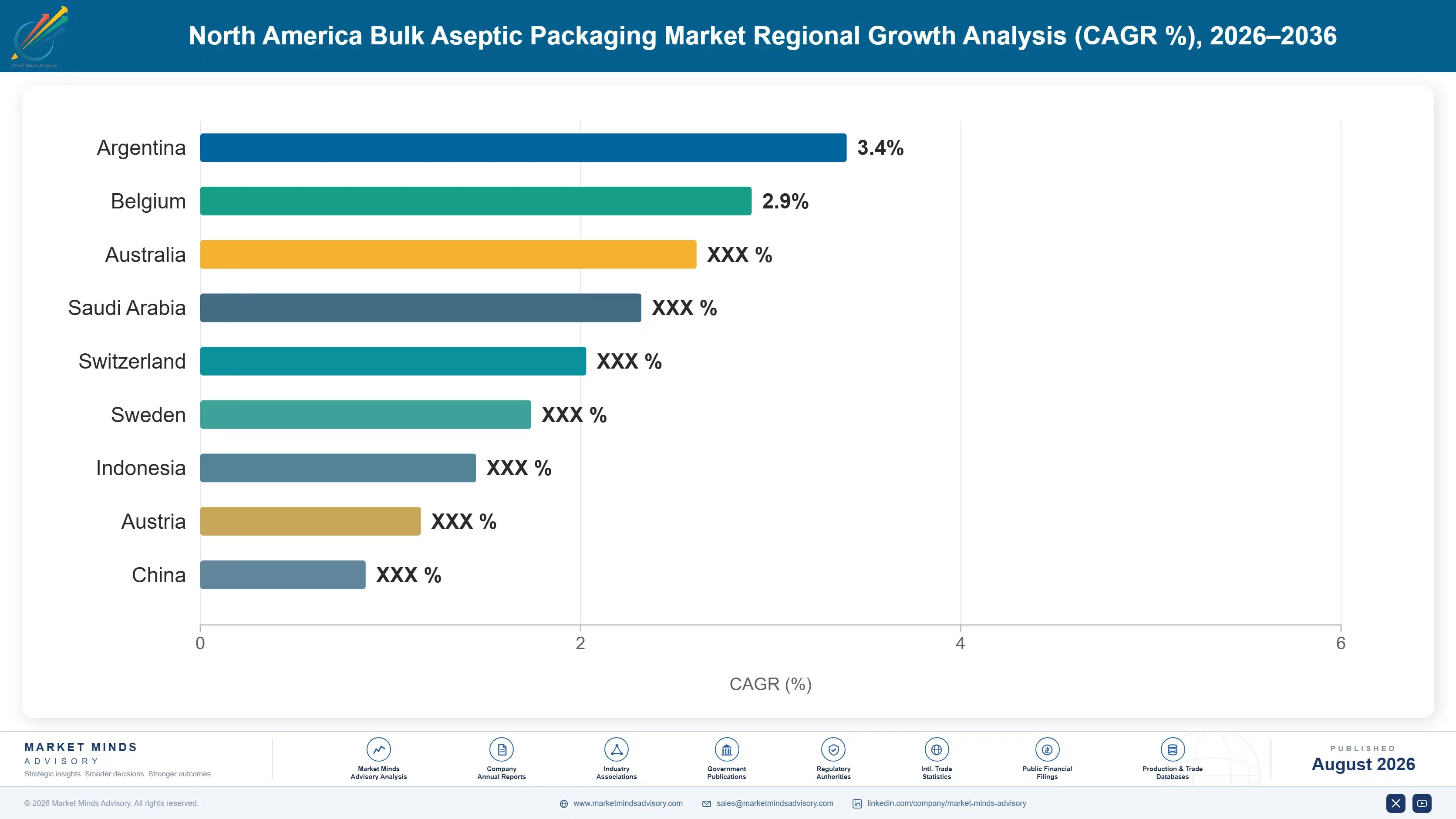
north-america-bulk-aseptic-packaging-market-country-cagr-analysis-1787299138966

Four Ways to Grow Aseptic Bulk

Bag laminate and bin steel are commodity inputs nobody wins on. Value comes from selling cold chain avoidance to the function that pays for it, from fixing the pinhole failure mode, from building low-acid validation capability, and from finding applications beyond a single Californian crop. Four levers follow, and the first is about who you talk to.

Sell To Logistics. Because Packaging Does Not Own The Saving

The 34% logistics saving against frozen handling sits in transport and warehousing budgets while the purchase decision sits with packaging procurement, which is why bulk aseptic proposals keep being evaluated as a bin price against a drum price. Presenting the total supply chain comparison to logistics and operations functions changes the conversation completely and shortens sales cycles materially. Suppliers who rebuilt their proposals around delivered supply chain cost report win rates well above those still quoting container prices to the wrong department. The saving lives in a budget packaging never sees.
Market Impact: Saving reaches 34% of the total logistics cost

Engineer Out The Fold Pinhole Rather Than The Seal

Development effort concentrates on seal integrity because seals are testable, while the failures that actually occur happen at fold lines and at the fitment interface. Fold-tolerant laminate constructions, protective fitment collars, and handling protocols at both ends address the real mechanism. Reducing the 0.6% sterility failure rate by half removes a cost that processors currently absorb quietly, and it is worth far more to them than any price concession because a contaminated bin can spoil a production batch worth many times the container. Development effort still concentrates on the seal instead.
Market Impact: Halves the 0.6% sterility failure rate currently observed

Build Low-Acid Validated Capability Ahead Of Plant-Based Demand

Oat, almond, soy, and coconut bases all sit above pH 4.6 and require full process filing with validated equipment rather than simpler acidified protocols. Only about 17% of regional volume runs low-acid today and installed capacity able to handle it is smaller still, while demand from plant-based beverage manufacturers keeps growing. Developing validated low-acid systems costs roughly 8 million dollars in equipment and validation work. It is the one genuine capability gap in this market where demand currently exceeds what the installed base can fill. Demand here exceeds what installed capacity can fill.
Market Impact: Validation costs roughly 8 million dollars in total

Diversify Away From A Single Californian Crop

Tomato paste carries 38% of regional volume from essentially one growing region, which makes every supplier's order book dependent on rainfall in one part of one state. Pursuing dairy bases, pet food, plant-based, and liquid egg applications reduces that exposure directly. Each requires different validation and different handling, so it is genuine business development rather than simple selling. Suppliers who have diversified show materially less revenue variance across seasons, which matters more to a board than the incremental margin on any individual new application does. Revenue variance falls sharply once the mix broadens.
Market Impact: Reduces exposure below the current 38% concentration level

Who Controls the Margin Pool

Concentration reaches 58% across the top five measured on annual system and bag volume supplied into the region, which is high for a packaging category and reflects how much of the offer is equipment rather than container. Aseptic system builders hold the strongest positions because the filler carries the process validation, and a processor who has validated on one supplier's machine buys that supplier's bags afterwards. Bag-only converters compete for a narrower slice.
Competition runs on three fronts. Low-acid validated capability is the first and the qualified supplier set is genuinely small. Sterility failure performance is the second, since a processor who has suffered a contaminated batch weighs it heavily. Liner and large-format capability is the third, where the fastest growth sits. Very few suppliers hold all three positions together, which is why the ranking has been stable.

Pressure builds from two directions. Mexican and Indian filling capacity installed at origin shifts value away from suppliers serving North American processors directly. And plant-based demand keeps arriving at suppliers who cannot fill low-acid product at all. Both pressures move value away from the incumbent position, and neither responds to price competition at all.
north-america-bulk-aseptic-packaging-market-company-positioning-matrix-1787299139484

Competitive Moat and Risk Dimensions

SIG

Moat: Filler validation locks bag supply

The aseptic filling system carries the process validation a processor files and depends on, and bags qualified against that machine are what the processor buys for its working life. Selling the filler therefore secures the consumable stream in a way no bag converter attacks directly. Revalidating a filling process is something processors avoid.
SIG

Risk: Bag supply invites price attack

The consumable revenue that makes filler placement attractive also attracts converters offering compatible bags at lower prices, and processors under cost pressure will test whether validation genuinely prevents substitution. Each successful substitution weakens the model. Equipment placement is capital intensive and slow to recover if the consumable annuity behind it erodes faster than the installed base grows.
SEALED AIR

Moat: Laminate engineering and barrier depth

Bulk aseptic bags fail at folds and fitments rather than at seals, and solving that is a film engineering problem rooted in laminate structure and flex resistance. Deep barrier film capability developed across food applications transfers directly. A supplier who genuinely reduces sterility failures holds an argument equipment cannot answer.
SEALED AIR

Risk: No installed filler base

Without an installed filling base, bag supply depends on qualifying against machines other suppliers placed and validated, which puts the company on the wrong side of the lock-in that governs this market. Processors default to the filler supplier's bags unless given a strong reason to qualify an alternative. That reason has to be earned repeatedly rather than held structurally.

Players Tracked

Prominent Players

SIG
Sealed Air
JBT Marel
Tetra Pak
Goglio

Other Key Players

Smurfit Westrock
TriMas
Amcor
Bericap
GEA Group
Krones
CDF Corporation
Fres-co System USA
DS Smith
Greif
Hoover Ferguson
Sonoco
ProAmpac
Coveris
Mauser Packaging Solutions

Recent Developments

MARCH 2025

Aseptic supplier commissions low-acid validated filling capability

An aseptic systems supplier completed validation of low-acid bulk filling capability aimed at plant-based and dairy base customers requiring full process filing. The work was internal equipment development and validation rather than any acquisition or partnership, and commercial supply follows customer process filing approvals. Customer process filings remain in progress.
Signal: Low-acid capability is the one capability gap where demand currently exceeds what installed capacity can actually fill
JUNE 2025

Mexican processor installs aseptic bulk filling at fruit origin

A Mexican fruit processor commissioned aseptic bulk filling capacity at an existing site, packing avocado and mango purée for ambient shipment into North American manufacturers. The investment was organic capital expenditure funded internally rather than any joint venture with a United States food manufacturer or packaging supplier.
Signal: Filling capacity moving to origin shifts value away from suppliers who serve North American processors directly
SEPTEMBER 2025

Film supplier launches fold-tolerant bulk aseptic laminate

A barrier film manufacturer introduced a bulk aseptic bag laminate engineered for flex resistance at fold lines, addressing the pinhole mechanism responsible for most commercial sterility failures. The launch was internal product development rather than any licensing arrangement with a resin producer or converter. Laminate structure details were not disclosed.
Signal: Somebody has finally targeted the failure mode that actually occurs rather than the one that is easy to test

Film. Steel, and Sterilisation

Three input groups carry the cost. Multi-layer barrier film, typically metallised polyester with an ethylene vinyl alcohol layer and polyethylene sealant, runs about 41% of bag cost. Fitments, spouts, and closures add roughly 17%. Off-line sterilisation by gamma or electron beam irradiation accounts for around 12%, and rigid bin or drum steel and plastic makes up the remainder where those formats are used.
Barrier resin and irradiation capacity were the exposures that mattered. Ethylene vinyl alcohol pricing moved sharply through the recent period on upstream availability, and irradiation service capacity tightened as medical device sterilisation demand competed for the same facilities. Company annual reports across flexible packaging describe both effects, and several bag suppliers extended lead times rather than commit to delivery dates they could not hold reliably.

The competitive disadvantage mechanism runs through sterilisation access rather than film purchasing. A supplier with contracted irradiation capacity ships on schedule while one buying service on demand queues behind medical device customers who pay more and book further ahead. Film exposure is broadly shared across the industry. Smaller bag converters without irradiation contracts carry the worst position, and several have exited bulk aseptic rather than manage it.
north-america-bulk-aseptic-packaging-market-cost-volatility-analysis-1787299139679

Contract irradiation capacity rather than buying service on demand

Gamma and electron beam facilities allocate capacity to contracted customers first, and medical device sterilisation books further ahead and pays more than food packaging does. Multi-year service agreements secure scheduling position rather than merely price. Suppliers buying on demand discovered during the last tightening that their bags simply could not be sterilised within their customers' delivery windows at all.

Qualify a second barrier resin grade within the same structure

Bag laminates specified around one ethylene vinyl alcohol grade cannot be built when that grade tightens, while structures documented with equivalence between two grades can. Qualification requires barrier testing and customer notification, both of which take months and cannot be started during a shortage. The work is cheap in advance and impossible to do quickly once it becomes urgent.

Standardise fitment designs across bag formats and sizes

Fitments and spouts are moulded components at roughly 17% of bag cost, and suppliers frequently run distinct designs across drum, bin, and liner formats when a common family would serve all three. Standardising consolidates tooling, improves purchasing leverage, and simplifies the spare parts position for customers running mixed formats. Engineering resists it and the case rarely survives examination.

Portfolio Architecture for Margin Defence

Three tiers describe this business and the spread reflects validation burden rather than material content. Standard high-acid bag and drum supply sits at the bottom, competing on price for fruit purée and juice concentrate where the process is well understood by everybody. Validated system supply with filling equipment and process support sits considerably higher. And low-acid capability with full process filing support occupies a third tier where very few suppliers can compete at all.
The tension is that high-acid volume funds the validation capability the top tier requires. Building and maintaining low-acid systems, validation documentation, and process support is expensive, and it needs the cash flow that ordinary fruit purée bag supply generates. Suppliers who moved upmarket too quickly found they could not fund the technical infrastructure that made their premium offer credible. Technical infrastructure is expensive to build and maintain.

High-value pools concentrate where the supplier carries regulatory burden the processor would otherwise carry alone. Low-acid process filing support and sterility failure reduction both do exactly that. Processors pay for burden they would otherwise carry alone, which is a different sale entirely, and it commands a price the container never would.

Volume / Commodity-Adjacent Tier

Standard high-acid bags, drums, and bins for fruit purée, juice concentrate, and tomato paste. Thin margin under price competition from converters supplying compatible bags, and the volume that funds validation capability across the rest of the portfolio.
Gross Margin: 16-24%

Premium / Certified Tier

Validated aseptic filling systems supplied with qualified containers, commissioning, and ongoing process support. Margin reflects the validation that a processor files against and depends upon, which converters supplying bags alone cannot provide at all.
Gross Margin: 29-40%

Sustainability / Regulatory / Next-Generation Tier

Low-acid validated systems with process filing support, fold-tolerant laminates, and large-format liner solutions. Best margin because very few suppliers can compete and the supplier absorbs regulatory burden the processor would otherwise carry alone.
Gross Margin: 35-48%
north-america-bulk-aseptic-packaging-market-portfolio-architecture-1787299140203

High-value Sub-segments and Strategic Watch-out

Low-Acid Validated Systems

Best margin in the category and the one genuine capability gap, since plant-based and dairy base demand exceeds what installed capacity can fill. Validation costs around 8 million dollars in equipment and documentation, which keeps the qualified supplier set very small. Process filing support is what customers actually buy.
Gross Margin: 35-48%

Aseptic Filling System Placements

Strong margin and the position that secures container supply afterwards, since a processor validates against a specific machine and buys its bags thereafter. Growth at 8.3% runs ahead of container volume as processors add low-acid capability to existing lines. Revalidation is something processors avoid at almost any cost.
Gross Margin: 29-40%

High-Acid Bags. Drums. And Bins

The volume core at thin margin, carrying tomato paste and fruit purée where the process is well understood and compatible bags are widely available. It funds the validation infrastructure that makes everything above it credible to a processor. Compatible bags are widely available from other converters.
Gross Margin: 16-24%

Flexible Liner Transport Systems

The strategic watch-out and fastest growth at 9.9%, improving both outbound and return economics against rigid bins substantially. One liner failure loses an entire container load rather than a single bin, which makes sterility performance far more consequential here. Return logistics improve as dramatically as outbound capacity.
Gross Margin: 26-37%

How Aseptic Bulk Demand Recurs

The filler sells once and the bags sell forever, which is the commercial architecture underneath everything here. A processor validates its aseptic process against a specific filling system and then buys qualified containers for that machine's working life, because revalidating means filing again with regulators and nobody does that voluntarily. Bag volume tracks production volume directly. What breaks the annuity is a sterility failure serious enough to force a review of the whole system.
Depth of relationship varies sharply by processor type. Large tomato processors run enormous seasonal volume on well-understood high-acid processes and negotiate hard on bag price every year. Fruit purée importers value ambient shelf life above almost everything and switch reluctantly. Dairy and plant-based manufacturers running low-acid depend heavily on supplier process support and behave like pharmaceutical customers. Co-packers change product mix constantly and are the hardest accounts to serve.

Buyer profiles are shifting as supply chain functions take over decisions packaging procurement used to own. Freezer warehousing and refrigerated freight costs now appear in evaluations that once compared only container prices. Packaging procurement is no longer the deciding function, and suppliers are slow to redirect their sales effort.
north-america-bulk-aseptic-packaging-market-end-use-penetration-index-1787299140696

What We Would Tell a Board

These are among the four positions where our research anticipates prominent divergence between winners and laggards over the coming forecast period. Each is grounded in the demand model, the regulatory perimeter, and the announced capacity pipeline.
01 / SUPPLY CHAIN SALES FRAMING

You are pitching the wrong department entirely

The 34% logistics saving that justifies bulk aseptic sits in transport and warehousing budgets, while the purchase decision sits with packaging procurement comparing a bin price against a drum price. That mismatch is precisely why sound proposals keep losing to cheaper containers that carry a far higher total supply chain cost. Suppliers who rebuilt their proposals around delivered supply chain economics, and took them directly to logistics and operations functions, report materially better win rates and considerably shorter sales cycles.
02 / FAILURE MODE ENGINEERING

Fix the fold, not the seal you already test

Seals are engineered, tested, and rarely fail, while sterility losses occur at fold lines where handling flexes the laminate and at the fitment interface where the bag meets the bin. Commercial sterility failures run near 0.6% of bins received and each one risks a downstream production batch worth many times the container. Halving that failure rate is worth far more to a processor than any price concession could ever be, and yet development effort across this industry is still going into the seal.
03 / LOW-ACID CAPABILITY INVESTMENT

One capability gap where demand exceeds supply

Oat, almond, soy, and coconut bases all sit above pH 4.6 and need full process filing with validated equipment rather than simpler acidified protocols. Only around 17% of regional volume runs low-acid and the installed capacity able to handle it is smaller still, while plant-based demand keeps arriving at suppliers who simply cannot fill it. Developing validated capability costs roughly 8 million dollars in equipment and documentation, which is modest against becoming the only supplier able to quote at all.
04 / APPLICATION CONCENTRATION RISK

Rainfall in one state moves your whole order book

Tomato paste carries 38% of regional bulk aseptic volume and almost all of it originates in a single Californian growing region, which makes every supplier's revenue dependent on one crop in one place. Pursuing dairy bases, pet food, plant-based, and liquid egg applications reduces that exposure directly, though each one requires distinct validation and distinct handling. Suppliers who have diversified show materially less revenue variance across seasons, which a board ought to value well above incremental margin on any single application.

Engagement Snapshot From the Field

A live engagement with an industry participant carrying material or product regulatory and market exposure ahead of a defining policy shift, showing how our research translates into a defensible multi-year portfolio strategy.
MARKET MINDS ADVISORY · CLIENT ENGAGEMENT SUMMARY
North America Bulk Aseptic Packaging Producer Strategic Portfolio Review and Transition Roadmap 2026·Investment Scenario on North America Bulk Aseptic Packaging Exposure Evaluation 2025-26
CLIENT PROFILE
A North American bulk aseptic packaging supplier with approximately 190 million dollars in annual revenue (client-reported, unverified by MMA), supplying bags, drums, and bins alongside a small installed base of filling systems. Roughly half of revenue came from Californian tomato paste customers, the company held no low-acid validated capability, and all proposals were addressed to packaging procurement functions.
STRATEGIC CHALLENGE
Revenue had swung sharply across three seasons with tomato harvest volume, and the company had lost several plant-based beverage opportunities without ever quoting because it could not fill low-acid product. Management proposed price reductions to defend tomato volume. The board wanted an independent view before conceding margin on its largest customer group.
MMA APPROACH
We modelled revenue variance against Californian harvest data across five seasons, reviewed the lost plant-based opportunities to establish what capability had actually been required, and benchmarked sterility failure rates across the client's bag constructions against comparable suppliers. Buying function influence was tested through interviews across eleven processor accounts of varying size and product type.
KEY FINDINGS
  1. Revenue variance tracked Californian harvest tonnage almost exactly, and no other application in the portfolio was large enough to offset a poor season in any way.
  2. All six lost plant-based opportunities had required low-acid validated filling that the client could not offer, and price had never entered any of those conversations at all.
  3. Supply chain rather than packaging functions held decisive influence at seven of eleven accounts interviewed, and the client's proposals had never reached them.
  4. Client sterility failure rates ran above the comparable benchmark, concentrated at fold lines rather than seals, and no fold-tolerant laminate had ever been evaluated.
CLIENT PROFILE
A North American bulk aseptic packaging supplier with approximately 190 million dollars in annual revenue (client-reported, unverified by MMA), supplying bags, drums, and bins alongside a small installed base of filling systems. Roughly half of revenue came from Californian tomato paste customers, the company held no low-acid validated capability, and all proposals were addressed to packaging procurement functions.
STRATEGIC CHALLENGE
Revenue had swung sharply across three seasons with tomato harvest volume, and the company had lost several plant-based beverage opportunities without ever quoting because it could not fill low-acid product. Management proposed price reductions to defend tomato volume. The board wanted an independent view before conceding margin on its largest customer group.
MMA APPROACH
We modelled revenue variance against Californian harvest data across five seasons, reviewed the lost plant-based opportunities to establish what capability had actually been required, and benchmarked sterility failure rates across the client's bag constructions against comparable suppliers. Buying function influence was tested through interviews across eleven processor accounts of varying size and product type.
KEY FINDINGS
  1. Revenue variance tracked Californian harvest tonnage almost exactly, and no other application in the portfolio was large enough to offset a poor season in any way.
  2. All six lost plant-based opportunities had required low-acid validated filling that the client could not offer, and price had never entered any of those conversations at all.
  3. Supply chain rather than packaging functions held decisive influence at seven of eleven accounts interviewed, and the client's proposals had never reached them.
  4. Client sterility failure rates ran above the comparable benchmark, concentrated at fold lines rather than seals, and no fold-tolerant laminate had ever been evaluated.
RECOMMENDED STRATEGY
Phase 1: Phase 1 (months one to six): withdraw the tomato price reduction and rebuild proposals around delivered supply chain cost for logistics functions. Phase 2: Phase 2 (months six to twenty-one): develop and validate low-acid filling capability, targeting plant-based beverage and dairy base applications specifically. Phase 3: Phase 3 (months twenty-one to thirty-six): qualify fold-tolerant laminate constructions and pursue pet food and liquid egg applications for diversification.
OUTCOME
The client withdrew the price reduction and redirected the budget into low-acid validation. Supply chain focused proposals won two conversions from frozen handling within three quarters, and the first low-acid system entered validation ahead of schedule (client-reported, unverified by MMA), with tomato concentration falling as new applications came on.

Frequently Asked Questions

Foundational context covering the market sizes, CAGR, scope, country, region and competition that inform every finding below. This section is provided to cover basics and most often pre-purchase conversations, answered from the MMA Primary Research Dataset.

What is the current size of the North America Bulk Aseptic Packaging Market?

The market is valued at USD 1.9 billion in 2025, rising to USD 2.03 billion in 2026. Tomato paste alone carries roughly 38% of regional volume.

How large will the North America Bulk Aseptic Packaging Market be by 2036?

MMA forecasts USD 3.84 billion by 2036, an increase of USD 1.81 billion over the 2026 base. That represents an expansion multiple of 1.89 times.

What is the CAGR for the North America Bulk Aseptic Packaging Market 2026 to 2036?

The base case CAGR is 6.6%, with a bull case of 7.8% and a bear case of 5.4%. The historical rate from 2020 to 2025 was 5.3%.

Which segment is growing fastest?

Flexible liner and bladder transport systems at 9.9%, exactly 1.50 times the market rate. They improve both outbound capacity and return logistics against rigid bins.

Who are the major companies in the North America Bulk Aseptic Packaging Market?

SIG, Sealed Air, JBT Marel, Tetra Pak, and Goglio lead on annual system and bag volume supplied regionally. The top five together hold 58% of the market.

Which country is growing fastest?

Mexico at 9.4%, driven by avocado, mango, and tomato processing packed aseptically at origin for ambient shipment north. Nearshoring of primary processing has reinforced that pattern.

Report Segmentation Architecture

The full report scope spans multiple orthogonal segmentation dimensions, with cross-tabulated demand data provided for each dimension pair. Coverage extends further to regional breakdowns, trend trajectories, and the competitive detail needed to support segment-level decision-making.

By Bulk Aseptic System Format

  • Bag-In-Drum Systems
  • Bag-In-Bin Systems
  • Intermediate Bulk Tote Systems
  • Flexible Liner And Bladder Transport Systems
  • Aseptic Bulk Tank And Silo Systems
  • Aseptic Filling And Connection Systems

By End-Use Industry

  • Tomato Processing And Paste Supply
  • Fruit Purée And Juice Concentrate
  • Dairy And Cream Base Manufacturing
  • Plant-Based Beverage Base Production
  • Pet Food And Liquid Egg Processing

By Commercial Model

  • Filling System Placement With Container Supply
  • Container And Bag Supply Only
  • Validated Low-Acid System Contracts
  • Seasonal Campaign Supply Agreements

By Region

  • North America
  • Latin America
  • South Asia and Pacific
  • Western Europe
  • East Asia
  • Middle East and Africa
  • Eastern Europe

Scope, Methodology, and Coverage

Every figure in this report is reproducible from documented input assumptions. The scope below maps the historical period, the forecast horizon, the segmentation dimensions, and the countries covered, alongside the underlying primary and qualitative methodology.
Historical Period
2020 to 2025
Forecast Period
2026 to 2036
Base Year
2025 (USD billions; MMA Primary Research Dataset, August 2026)
Market Definition
This market comprises bulk aseptic packaging systems supplied into the North American region for commercially sterile liquid and semi-liquid food products, measured at supplier realised prices across containers, liners, fitments, and filling and connection hardware. Format coverage spans bag-in-drum, bag-in-bin, intermediate bulk tote, flexible liner and bladder transport, aseptic bulk tank and silo, and aseptic filling and connection systems across both high-acid and low-acid applications. Retail aseptic cartons, pouches and cups, frozen and chilled bulk handling equipment, thermal processing and sterilisation equipment upstream of the filler, warehousing services, and the packed food products themselves fall outside scope.
Quantitative Units
USD billions (current prices); million bulk units filled annually; realised price per filled unit
Segmentation Dimensions
By Bulk Aseptic System Format; By End-Use Industry; By Commercial Model; By Content Origin
Regions Covered
North America, Latin America, South Asia and Pacific, Western Europe, East Asia, Middle East and Africa, Eastern Europe
Countries Covered
USA, Canada, Mexico, and product origin coverage spanning Brazil, Costa Rica, Chile, Peru, Guatemala, India, Thailand, Philippines, Vietnam, China, Italy, Spain, Netherlands, Poland, Turkey, Egypt, Morocco, South Africa, and additional origins relevant to this regional supply chain
Key Companies Profiled
SIG, Sealed Air, JBT Marel, Tetra Pak, Goglio, Smurfit Westrock, TriMas, Amcor, Bericap, GEA Group, Krones, CDF Corporation, Fres-co System USA, DS Smith, Greif, Hoover Ferguson, Sonoco, ProAmpac, Coveris, Mauser Packaging Solutions
Quantitative Methodology
Primary survey, n=3,800 respondents, Q4 2025, six countries; demand-side model with trade association cross-validation
Qualitative Methodology
47 expert interviews, Q4 2025; applied to validate demand model assumptions, identify emerging dynamics, and assess competitive positioning
Report Format
PDF and XLSX data workbook (Word format preview document)
Publisher
Market Minds Advisory
Report Code
MMA-2026-PAC-308
Published
August 2026
Contact
sales@marketmindsadvisory.com | www.marketmindsadvisory.com

Purchase the full North America Bulk Aseptic Packaging Market Report (2026 to 2036).

The full report sizes North American bulk aseptic packaging across six system formats, five end-use industries, four commercial models, and seven content origins, with detailed treatment of the tomato paste concentration that dominates regional volume. Cold chain avoidance economics are modelled against frozen handling across representative lanes and storage durations, since that comparison is what actually drives conversion. Commercial sterility failure rates are benchmarked by bag construction and failure location. Competitive profiling covers twenty suppliers on regional system and bag volume. Low-acid validated capacity is mapped by supplier and by site.
Cold chain avoidance modelled against frozen handling by lane
Sterility failure rates benchmarked by construction and failure location
Low-acid validated capacity mapped by supplier and site
Tomato paste concentration risk quantified against harvest variance
Content origin flows tracked across seven supplying regions
Liner and rigid bin economics compared including return logistics

Built For The People Who Decide

From boardroom strategy to bench-side execution, this report is read cover-to-cover by leaders shaping the next decade of their industry, turning demand scenarios, market dynamics and valuation benchmarks into decisions.
CXOs/ Presidents/ VPs/ Managers
M&A and Corporate Development
Strategy Teams and R&D Heads
Procurement and Product Directors
Regulatory and Compliance Leaders
Investor Relations and Equity Analysts