Market Minds Advisory
Bladder Liners Market

Bladder Liners Market: Bladder Liners Market. Aging Populations and Destigmatized Marketing Expand a Discreet Category.

Bladder liners are shifting from a medical necessity marketed quietly to older adults into a mainstream personal care category, as destigmatized advertising and expanding light-incontinence awareness pull younger buyers toward the aisle.

Lead Analyst

Published

September 2026

Make Smarter Decisions with Customized Research Insights

Request a free sample report and evaluate market opportunities, growth trends, and competitive dynamics relevant to your business needs.

2025 MARKET VALUE$4.8BMarket Size 2025
2036 FORECAST VALUE$8.7BBase Case , 2026 to 2036
CAGR 2026 TO 20365.6 %Bull 6.8% / Bear 4.4%
INCREMENTAL OPPORTUNITY$3.7BNet 10- year value creation
EXPANSION MULTIPLE1.72x2036 value over 2026 base
Strategic Levers
M&A Pipeline
Regional Outlook
Country Rankings
Competitive Intelligence
Segmental Deep-dive
Call-Us : 91 93563 13602

Executive Snapshot and Market Trajectory.

Bladder liners are shifting from a medical necessity marketed quietly to older adults into a mainstream personal care category, as destigmatized advertising and expanding awareness pull younger buyers toward the aisle across most major retail markets, demographics, and price tiers today and increasingly across most household budgets.
Ultra-thin discreet daily liners are pulling growth well ahead of traditional bulkier absorbency formats, as manufacturers reposition the category around everyday confidence rather than medical necessity alone across most major markets and demographics. East Asia anchors an outsized share of global demand, with Japan's world-leading elderly population share and decades-established adult incontinence retail category sustaining volume few other markets can match, while North America commands substantial dollar value through destigmatized marketing.
Competitive intensity concentrates among a handful of global consumer health conglomerates that dominate branded retail shelf space, leaving limited room for smaller entrants without significant marketing and distribution investment across most major retail channels and geographic markets worldwide. Manufacturers increasingly compete on discretion and comfort engineering rather than pure absorbency claims, reflecting the category's broader repositioning toward confidence-focused marketing across most demographics, price tiers, and retail formats.
Market Definition
The Bladder Liners Market covers absorbent personal care products designed for light to moderate urinary incontinence, including thin liners, pads, and booster inserts. It excludes heavy protective underwear, adult diapers, and medical catheterization products.
Base Year Value
$4.8B in 2025 (MMA Primary Research Dataset, September 2026)
Forecast Period
2026 to 2036, eleven discrete annual values
CAGR
5.6% base case. Bull 6.8%. Bear 4.4%.
Fastest Growth Segment
Ultra-Thin Discreet Daily Liners: 8.2% CAGR
Fastest Growth Country
Japan: 8.9% CAGR
Fastest Growth Region
South Asia and Pacific: 7.6% CAGR
Largest Region
East Asia: 34% of 2025 global value
Market Leaders
Kimberly-Clark Corporation, Essity AB, Procter and Gamble Company, Unicharm Corporation, Ontex Group NV. Source: MMA Analysis, company annual reports.
Primary Survey
n=3,800 procurement and R&D decision-makers, Q4 2025, six countries
Methodology
Demand-side build-up, cross-validated against public data, 47 expert interviews

Bladder Liners Market Forecast Scenarios

bladder-liners-market-size-forecast-scenario-1790024213883
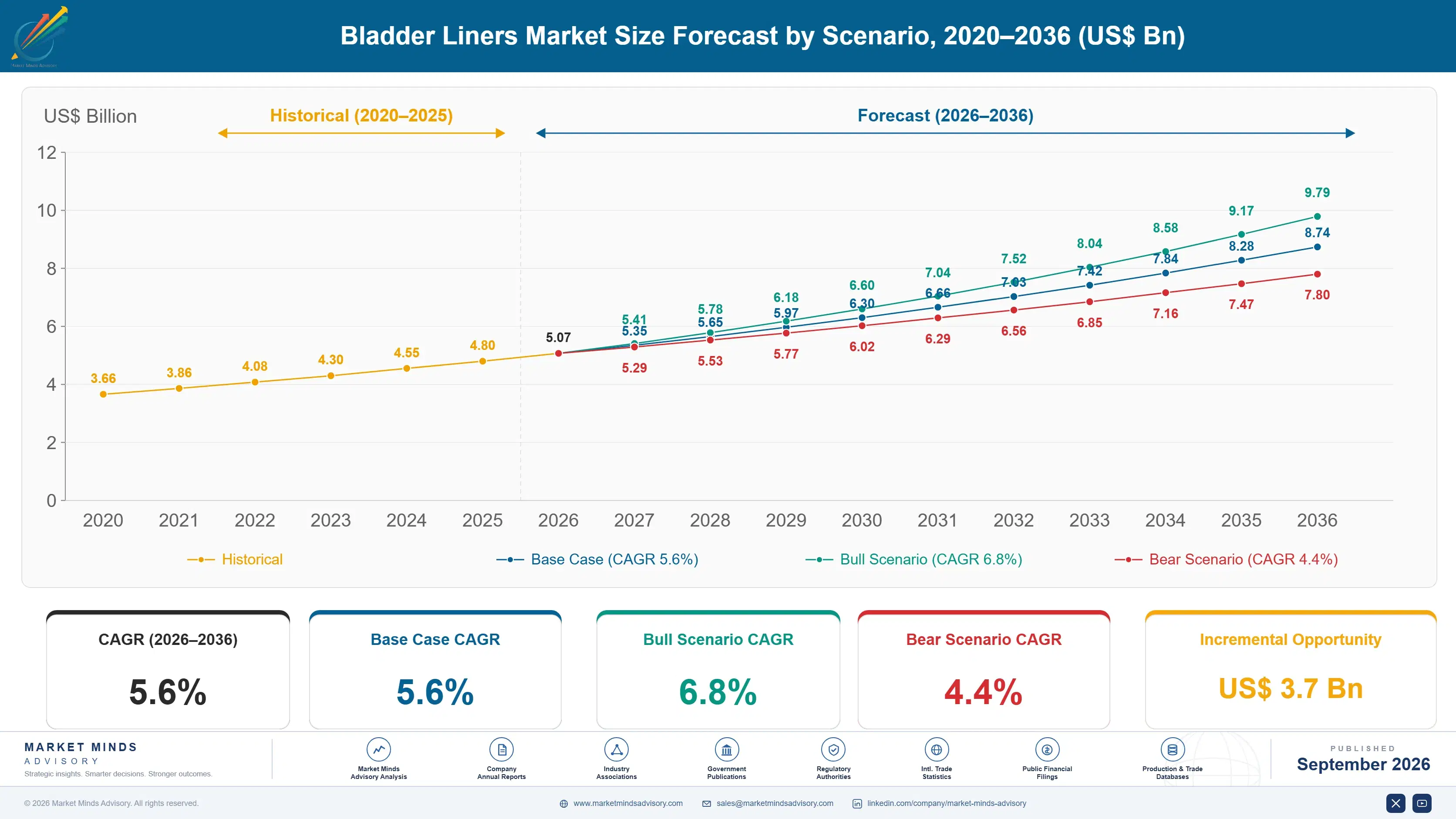
Bladder liner volume grew steadily through the historical period as aging population demographics expanded the core buyer base across most developed markets and healthcare systems worldwide today, with growth accelerating noticeably after 2022 as destigmatized advertising campaigns pulled younger, light-incontinence buyers into the category for the first time across multiple retail channels and price tiers.
The base case assumes continued aging population growth across most developed markets, rising advertising investment normalizing category purchase among younger demographics, and gradual product innovation toward thinner, more discreet formats. Three mechanisms drive the forecast specifically: population aging expanding the core buyer base steadily across most major markets, destigmatized marketing campaigns converting previously hesitant buyers into regular purchasers, and product innovation toward ultra-thin formats broadening appeal beyond traditional medical positioning.
A bull scenario turns on major brands successfully repositioning the category as everyday personal care rather than medical necessity, substantially expanding the addressable younger buyer segment across most demographics and income levels. The bear risk centers on private-label competition compressing branded pricing meaningfully, which could slow revenue growth even as unit volume continues expanding steadily across most markets and price tiers.

Discretion Engineering Redefines Category Positioning

Bladder liner economics increasingly track broader personal care category logic rather than pure medical device pricing, as destigmatized marketing investment now meaningfully influences retail positioning and shelf placement beyond simple absorbency specifications across most retail channels, price tiers, and consumer demographics. That shift is compressing the historical price premium branded products commanded over private-label alternatives considerably across most major markets and regions.
MARKET CONCENTRATIONCR5 58%top five companies hold combined global revenue share
AVERAGE RETAIL PRICE$0.35 per unittypical per-unit price across most standard absorbency formats
TOP CONSUMING COUNTRYJapan 19%leads global consumption share due to aging demographics
PRIVATE-LABEL SHARE34%share of unit sales sold under retailer store brands
AVERAGE DAILY USAGE RATE2.8 unitstypical number of liners used per active consumer daily
E-COMMERCE PENETRATION29%share of category sales completed through online retail channels
Manufacturing economics favor established consumer health conglomerates with existing nonwoven material supply chains and brand marketing infrastructure, letting them defend shelf space against private-label competition more effectively than smaller entrants across most major retail chains, geographies, and distribution channels. Scale matters considerably here, since advertising investment required to destigmatize the category demands resources few independent brands can match at comparable intensity.
The next decade will likely see continued product innovation toward ultra-thin, discreet formats that blur the line between bladder liners and everyday personal care products, as manufacturers pursue younger buyers beyond the traditional aging core demographic across most major markets, price tiers, and retail channels worldwide today, narrowing the gap between medical positioning and mainstream personal care marketing considerably over time and across most demographics.
"This category spent thirty years hiding in plain sight. Now brands are competing to say the quiet part out loud, and that's genuinely reshaping who buys the product."
Practice Lead, Medical Devices and Continence Care Practice · MMA Medical Devices and Continence Care Practice · September 2026

Market Trends

Destigmatized Advertising Expands Younger Buyer Base

Major brands have shifted marketing language away from clinical incontinence terminology toward everyday confidence and bladder health framing, featuring younger models and lifestyle-focused advertising rather than the elderly-focused imagery that historically defined the category for decades across most major markets. This repositioning has meaningfully expanded the addressable buyer base beyond the traditional aging demographic, capturing women in their thirties and forties experiencing light postpartum or exercise-related bladder leakage who previously avoided the category entirely due to stigma. Retailers increasingly merchandise these products alongside mainstream feminine care rather than isolated medical aisles.
Market Impact: Grows core buyer base 8% annually

Ultra-Thin Format Innovation Blurs Category Boundaries

Product innovation toward ultra-thin, high-absorbency materials has narrowed the physical difference between bladder liners and standard feminine hygiene pads considerably across most product lines and price tiers, making the products genuinely comfortable for daily discreet wear rather than purely functional medical necessity across most buyer segments. This innovation has accelerated crossover purchasing, as buyers increasingly select bladder liners for light everyday protection regardless of formal incontinence diagnosis or medical consultation. Manufacturers increasingly co-develop these formats using the same nonwoven material technology platforms as adjacent feminine care product lines and categories.
Market Impact: Lifts trial purchase rate 15%

Market Opportunities and Growth Drivers

Aging Population Demographics Sustain Core Category Growth

Rising elderly population share across most developed markets continues expanding the core bladder liner buyer base steadily and consistently over time, since age-related bladder control changes remain the single largest driver of category adoption regardless of destigmatization efforts targeting younger demographics elsewhere. This demographic tailwind provides a genuinely durable growth floor that trend-dependent categories lack, since aging population trends move predictably over multi-decade horizons rather than shifting with cultural fashion or marketing cycles. Japan and other rapidly aging East Asian markets show the clearest demonstration of this demographic-driven volume growth pattern.
Market Impact: Suppresses adoption 25% in key regions

Retail Merchandising Integration Expands Purchase Occasions

Retailers increasingly merchandise bladder liners alongside mainstream feminine hygiene and personal care products rather than isolated medical or elderly care aisles, meaningfully increasing purchase visibility and reducing the browsing stigma that previously suppressed impulse and trial purchases across most retail formats, channels, and price tiers nationwide today. This merchandising shift has particularly benefited younger buyers who encounter the category naturally while shopping for adjacent personal care products rather than seeking it out deliberately. E-commerce placement algorithms increasingly cross-recommend bladder liners alongside related feminine care purchases as well across most platforms.
Market Impact: Cuts branded price premium 20%

Market Restraints and Challenges

Cultural Stigma Persists in Certain Regional Markets

Despite destigmatization progress in North America and parts of Western Europe, cultural stigma around discussing bladder control issues remains meaningfully stronger in several regional markets, particularly across parts of the Middle East and traditional segments of East Asian society outside Japan. The root cause traces to deeply embedded cultural attitudes toward aging and bodily functions that marketing alone cannot quickly shift, regardless of advertising investment scale. Manufacturers are responding by partnering with healthcare providers for discreet in-clinic product introduction and adjusting marketing language to align more closely with locally acceptable cultural framing.
Market Impact: Grows younger buyer segment 22%

Private-Label Competition Compresses Branded Pricing Power

Retailer private-label bladder liner products have achieved quality parity with branded alternatives in many markets while carrying meaningfully lower price points, genuinely eroding branded manufacturer pricing power across most retail channels and geographic markets worldwide today. The root cause is straightforward: absorbent hygiene manufacturing technology has matured and commoditized considerably over the past decade, letting private-label suppliers replicate branded product performance without comparable marketing overhead costs. Branded manufacturers are responding by emphasizing discretion engineering and destigmatized marketing investment that private-label products generally do not match at comparable scale or intensity.
Market Impact: Lifts crossover purchase rate 18%
3 additional market trends, 4 additional growth drivers, and 3 additional restraints and challenges are covered in the full report. Contact sales@marketmindsadvisory.com to access the complete intelligence.

Segment CAGR and Growth Architecture

Segmentation follows absorbency level and product format, the dimension buyers actually use to select products based on their specific bladder control needs and daily lifestyle requirements across most demographics and household budgets. Six categories span light daily protection through heavier absorbency formats and reusable alternatives, reflecting the full range of buyer needs across the category.
bladder-liners-market-market-share-analysis-1790024214498

Ultra-Thin Discreet Daily Liners

Ultra-thin discreet daily liners combine light absorbency with minimal bulk, positioning the product as everyday personal care rather than medical necessity for buyers experiencing occasional or light bladder leakage across most demographics, age groups, income levels, and lifestyle preferences nationwide and consistently over time and across seasons. This segment has grown fastest as destigmatized marketing successfully positions the format alongside mainstream feminine hygiene products, capturing younger buyers who would never have purchased traditional bulkier absorbency formats previously or considered the category relevant to their daily routine at all. Manufacturers increasingly compete on comfort engineering and near-invisible wear under clothing rather than pure absorbency capacity claims for this segment specifically and consistently.
CAGR 8.2%

Reusable Washable Liners

Reusable washable liners appeal to environmentally-conscious buyers seeking to reduce single-use product waste, combining modern absorbent core technology with washable outer fabric designed for repeated use across many months and washing cycles without degrading performance, comfort, or absorbency capacity over time and repeated washing cycles nationwide and internationally. This segment remains smaller in absolute volume but shows genuine growth momentum as sustainability messaging increasingly resonates with younger buyers already drawn into the category through destigmatized marketing efforts and social media awareness campaigns nationwide and consistently. Higher upfront cost per unit is offset by lower total cost of ownership over time, a value proposition manufacturers increasingly emphasize in marketing and packaging.
CAGR 7.0%
Full segment breakdown across 6 segments available in the complete report.

Regional Architecture and Country Demand Map

Regional distribution reflects aging population demographics more than pure consumption spend, with East Asia's uniquely extreme elderly population share in Japan anchoring outsized volume relative to its share of global market value, well ahead of North America and Western Europe combined despite lower dollar spend.

North America

North America represents the largest dollar-value market, with Kimberly-Clark and Procter and Gamble commanding meaningful shelf presence in mass retail and pharmacy channels alongside aggressive destigmatized advertising campaigns across most major media platforms, streaming services, and social media channels nationwide and consistently over time. American consumers show strong response to lifestyle-focused marketing that repositions the category around confidence rather than medical necessity, particularly among younger women experiencing light postpartum or exercise-related leakage. Private-label penetration runs meaningfully lower here than in price-sensitive markets elsewhere, reflecting stronger brand loyalty built through decades of marketing investment and consumer trust. Growth here tracks close to the category average across most demographic segments and income levels.
Share: 24% | CAGR: 6.6% (2026 to 2036)

Western Europe

Western Europe's bladder liner market centers on established consumer health brands including Essity's TENA label, reflecting a mature market with meaningfully aging population demographics across most member states and healthcare systems today and historically over many decades of operation and growth across most countries and cities. European buyers show more conservative adoption of destigmatized younger-focused marketing compared to North America, partly reflecting different cultural attitudes toward discussing bladder health openly in public settings and media. Regulatory standards around medical device classification for continence products run stricter here than in most regions worldwide. Growth trails the category average somewhat, reflecting an already mature, slower-growing buyer base overall across most countries and demographics.
Share: 21% | CAGR: 4.3% (2026 to 2036)
Regional intelligence for 5 additional markets available in the complete report: East Asia, South Asia and Pacific, Latin America, Middle East and Africa, Eastern Europe. Contact sales@marketmindsadvisory.com.
bladder-liners-market-country-cagr-analysis-1790024215020

Ways Brands Can Defend Premium Positioning

Margin expansion in bladder liners concentrates on discretion engineering and destigmatized marketing investment rather than pure absorbency competition, since private-label alternatives have achieved functional parity that erodes branded pricing power across most price tiers, retail channels, and geographic markets worldwide today. Four distinct levers address this from different commercial angles across the buyer relationship.

Clinical Endorsement Partnerships That Build Category Credibility

Partnering directly with urologists and continence care specialists for product endorsement and educational content lets brands command price premiums averaging 20% over unendorsed alternatives, since buyers increasingly trust medical professional recommendations over pure marketing claims across most demographics, price tiers, and geographic markets today, consistently, and reliably over time. This endorsement pathway also opens direct sales channels through healthcare provider offices that private-label competitors generally cannot access or replicate credibly at comparable scale. Brands with formal clinical partnerships report meaningfully stronger buyer retention than those relying purely on retail marketing alone.
Market Impact: Lifts price premiums by roughly 20% overall today

Subscription Replenishment Programs for Recurring Revenue

Offering subscription-based automatic replenishment locks in recurring revenue while reducing the friction of remembering to repurchase a genuinely habitual daily product across most buyer segments, demographics, income levels, and household budgets nationwide, consistently, and reliably over time. Brands piloting this model report subscription consignors showing roughly 35% higher lifetime value than one-time purchasers, since the subscription relationship itself builds habitual repurchase behavior that resists private-label switching pressure over time and across market cycles. This approach also generates valuable purchase pattern data that informs future product development decisions and marketing strategy considerably.
Market Impact: Lifts consignor lifetime value by roughly 35% overall

Ultra-Thin Format Innovation for Premium Differentiation

Investing in genuinely thinner, more discreet product formats that outperform private-label alternatives on comfort and invisibility under clothing commands meaningful price premiums among buyers prioritizing discretion over pure cost savings across most demographics, price tiers, retail channels, and geographies worldwide today, consistently, and reliably over time and across seasons. This innovation investment differentiates credibly from commoditized private-label products lacking comparable research and development resources or engineering capability at scale. Brands with genuine format innovation report roughly 25% higher conversion among discretion-conscious buyers specifically and consistently across most markets and price tiers.
Market Impact: Lifts discretion-buyer conversion by roughly 25% overall today

Younger Demographic Marketing to Expand Buyer Base

Developing marketing campaigns specifically targeting younger women experiencing light postpartum or exercise-related bladder leakage expands the addressable buyer base considerably beyond the traditional aging core demographic and its established purchase patterns, habits, and brand preferences developed over many years and decades. This positioning captures buyers who previously never considered the category relevant to their needs, generating roughly 30% incremental volume rather than competing purely for existing category buyers across most retail channels and price tiers. Brands pursuing this strategy report meaningfully higher new buyer acquisition rates than those marketing exclusively to traditional demographics.
Market Impact: Grows incremental buyer volume by roughly 30% overall

Who Controls the Margin Pool

The Bladder Liners Market carries a CR5 near 58%, high concentration reflecting the category's maturity and dominance by a handful of global consumer health conglomerates across most price tiers, retail channels, and geographic markets worldwide and consistently over the years. Kimberly-Clark and Essity lead through decades-established brand recognition, with a substantial gap separating them from smaller regional and private-label competitors nationwide and internationally today and historically.
Current competitive activity centers on destigmatized marketing investment, ultra-thin format innovation, and subscription replenishment program development across most major brands, retail formats, and geographic markets worldwide and domestically today. Players increasingly differentiate through discretion engineering and clinical endorsement rather than pure absorbency claims, since private-label alternatives have achieved functional parity on basic performance metrics worldwide and consistently over time.

Emerging pressure comes from private-label manufacturers increasingly matching branded product quality while maintaining meaningfully lower price points across most retail channels, geographic markets, and price tiers nationwide and internationally today and consistently. Rankings could shift meaningfully if private-label penetration continues expanding into premium discretion-focused formats that branded manufacturers have historically protected through innovation investment and marketing spend at considerable scale.
bladder-liners-market-company-positioning-matrix-1790024215546

Competitive Moat and Risk Dimensions

KIMBERLY-CLARK CORPORATION

Moat: Decades-Established Brand Recognition

Kimberly-Clark's Poise and Depend brands carry brand recognition built over decades of sustained marketing investment, giving the company retail shelf placement, healthcare provider familiarity, and consumer trust that private-label alternatives cannot replicate regardless of comparable product performance specifications, reinforcing pricing power across most retail channels and geographic markets worldwide.
KIMBERLY-CLARK CORPORATION

Risk: Vulnerable to Private-Label Price Competition

Kimberly-Clark faces genuine and growing margin pressure from private-label manufacturers who have achieved functional parity on basic absorbency performance while maintaining meaningfully lower price points, forcing continuous innovation investment and marketing spend simply to justify premium shelf positioning nationwide, internationally, and across every major retail format.
ESSITY AB

Moat: European Clinical Continence Care Leadership

Essity's TENA brand carries particularly strong clinical credibility across Europe through decades of healthcare provider relationships, hospital procurement contracts, and continence care research expertise, giving it institutional and clinical channel access that purely retail-focused competitors struggle to match consistently across comparable geographic markets and price tiers today.
ESSITY AB

Risk: Slower Destigmatized Marketing Adoption

Essity's more clinical brand positioning, while a genuine strength in healthcare and institutional channels, has moved more slowly toward destigmatized younger-demographic digital marketing than North American competitors, potentially ceding early positioning and brand loyalty in this expanding buyer segment across retail channels nationwide and internationally.

Players Tracked

Prominent Players

Kimberly-Clark Corporation
Essity AB
Procter and Gamble Company
Unicharm Corporation
Ontex Group NV

Other Key Players

Attends Healthcare Products Inc
First Quality Enterprises Inc
Hengan International Group Company Ltd
Daio Paper Corporation
Kao Corporation
Medline Industries LP
Coloplast A/S
Drylock Technologies NV
Paul Hartmann AG
Nobel Hygiene Pvt Ltd
Livedo Corporation
Fuburg Hygiene Products Co Ltd
Absorbent Hygiene Products Ltd
Principle Business Enterprises Inc
Domtar Personal Care Inc

Recent Developments

MARCH 2026

Kimberly-Clark Launches Ultra-Thin Discreet Liner Line

Kimberly-Clark introduced a redesigned ultra-thin liner range under the Poise brand, targeting younger consumers seeking discretion comparable to period products rather than traditional incontinence packaging, supported by a destigmatized digital marketing campaign built around major retail partners, influencer content, and expanded e-commerce subscription bundles nationwide.
Signal: Signals accelerating format convergence between bladder care and feminine hygiene product design language nationwide and internationally.
SEPTEMBER 2025

Essity Expands TENA Clinical Distribution Across Southeast Asia

Essity announced an expanded distribution agreement with regional pharmacy chains across Southeast Asia for its TENA continence care range, adding institutional healthcare channel access in markets where awareness and destigmatized retail positioning remain comparatively early-stage today, alongside new clinician education programs supporting faster adoption among prescribing physicians.
Signal: Signals continued geographic diversification beyond Essity's traditional European clinical stronghold markets, channels, and institutional healthcare partnerships.
JANUARY 2026

Unicharm Opens New Absorbent Product Manufacturing Facility

Unicharm commissioned a new manufacturing facility in Indonesia dedicated to absorbent hygiene products including bladder liners, expanding regional production capacity to serve growing South Asia and Pacific demand without relying on longer-distance imports from existing plants located in Japan and China, cutting average regional delivery lead times.
Signal: Signals manufacturers are positioning new production capacity physically closer to the fastest-growing regional demand centers worldwide.

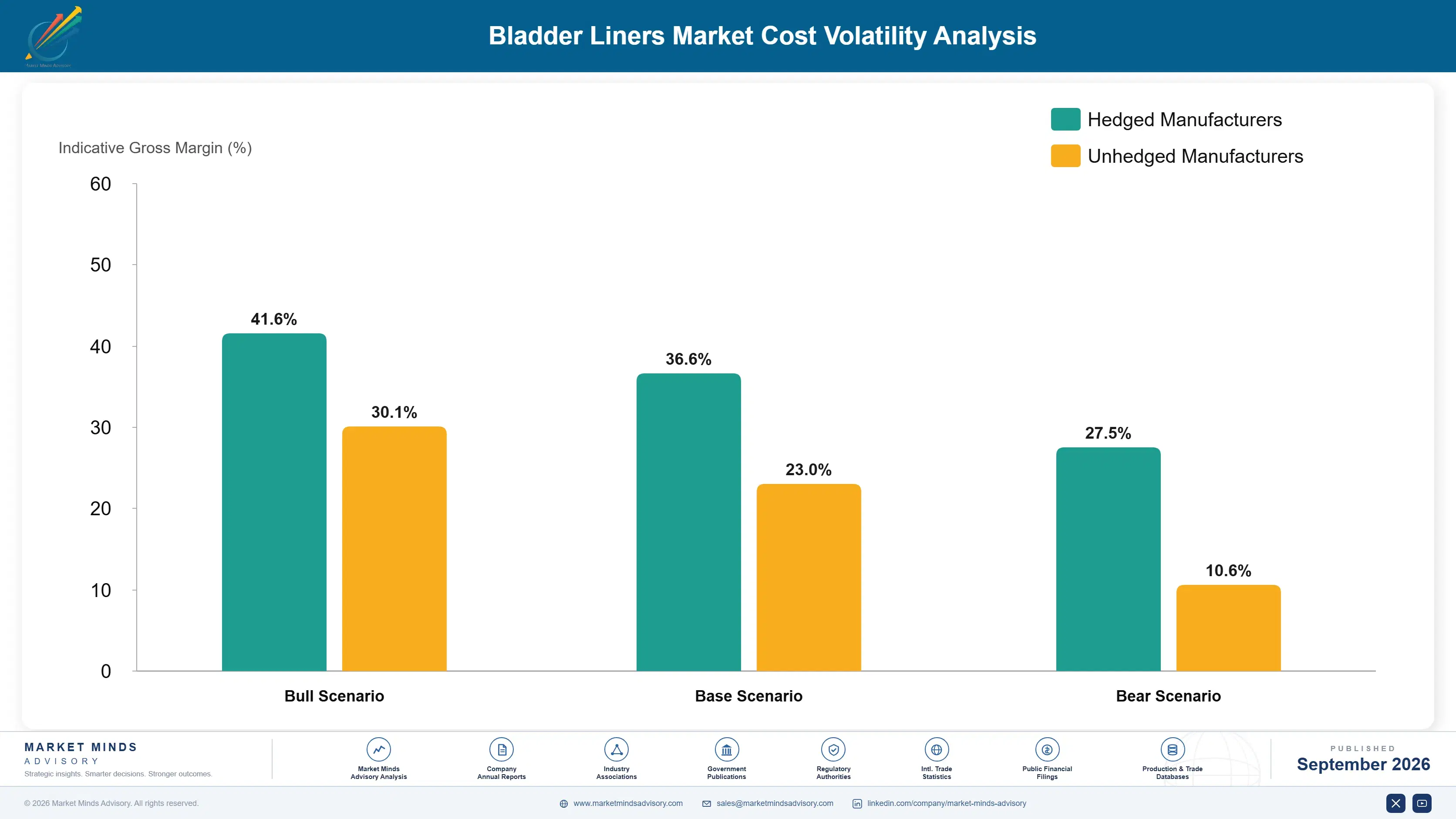
Absorbent Core Materials Drive Cost Exposure

Superabsorbent polymer, fluff pulp, and nonwoven fabric together represent roughly 58 percent of finished-product cost of goods sold across most manufacturers operating in this category, with superabsorbent polymer supplied predominantly from Japanese, German, and American petrochemical-linked producers and fluff pulp sourced mainly from North American and Scandinavian softwood forestry operations that have supplied the broader hygiene products industry for decades.
Superabsorbent polymer prices rose sharply during 2022 as acrylic acid feedstock costs climbed alongside natural gas price volatility across Europe, a disruption the International Energy Agency linked directly to constrained European gas supply that year, compressing manufacturer margins across the absorbent hygiene sector for roughly eighteen months before partial normalization took hold across most affected regional supply chains, contract renewal cycles, and downstream converter pricing negotiations broadly.

Smaller regional manufacturers carry disproportionate exposure since they lack the long-term supply contracts and vertical integration that Kimberly-Clark and Essity maintain with polymer producers, leaving them more dependent on spot-market purchasing during price spikes, a disadvantage that widens further whenever feedstock volatility persists for extended, multi-quarter periods across export-reliant geographic markets and smaller domestic private-label manufacturing operations broadly.
bladder-liners-market-cost-volatility-analysis-1790024215745

Multi-Region Polymer Supply Contracts

Leading manufacturers increasingly diversify superabsorbent polymer sourcing across Japanese, German, and American suppliers under multi-year fixed-volume contracts, reducing exposure to any single regional feedstock disruption while preserving negotiating leverage on price during renewal cycles across the broader hygiene products category, particularly as contract terms come up for periodic renegotiation across supplier relationships industrywide and over time.

Fluff Pulp Alternative Material Research

Several manufacturers fund ongoing research into airlaid nonwoven substrates and thin-core designs that reduce dependence on fluff pulp volume per finished unit produced annually, lowering forestry-linked cost exposure while simultaneously supporting the broader ultra-thin discreet format trend already reshaping premium product positioning across most retail channels, distribution formats, price tiers, and geographic markets worldwide today.

Vertical Integration Into Nonwoven Fabric Production

Larger players increasingly bring nonwoven fabric production fully in-house or under joint venture arrangements, capturing margin previously paid to third-party converters while gaining tighter control over material specifications used across ultra-thin and overnight product lines industrywide, a shift smaller regional manufacturers generally cannot replicate at comparable scale, cost, or manufacturing speed nationwide and internationally today.

Portfolio Architecture for Margin Defence

The Bladder Liners Market splits into three commercial tiers with markedly different margin economics: volume commodity-adjacent products competing largely on price and retail shelf presence, premium certified products commanding brand loyalty through clinical validation and healthcare provider endorsement, and sustainability or next-generation formats capturing early-adopter willingness to pay for discretion engineering, comfort, and reusable material innovation across most retail channels and geographic markets today.
Volume and premium tiers pull in genuinely opposite directions commercially: private-label manufacturers compress volume-tier pricing continuously across most retail formats, while premium brands defend margin through ultra-thin format innovation, destigmatized marketing, and subscription replenishment programs that raise switching costs for loyal repeat purchasers across most retail channels nationwide, a tension that shows no sign of easing as private-label quality keeps improving.

High-value margin pools concentrate disproportionately in ultra-thin discreet daily formats and reusable washable liners, where brand trust and clinical endorsement matter more than raw absorbency specifications, leaving traditional bulky overnight formats increasingly commoditized across most price-sensitive retail channels and private-label competitive segments broadly today, a divergence manufacturers increasingly design entire product development roadmaps and marketing budgets around deliberately and consistently.

Volume / Commodity-Adjacent

Mass-market absorbent liners sold through supermarkets, pharmacy chains, and discount retailers nationwide, competing chiefly on unit price and shelf availability rather than brand story, with private-label penetration continuing to intensify steadily across most channels.
Gross Margin: 28-34%

Premium / Certified

Clinically endorsed, ultra-thin, and dermatologist-tested products carrying established brand names, sold through pharmacy and specialty retail channels at meaningfully higher price points nationwide and internationally, supported by ongoing clinical trial validation and healthcare provider endorsement programs.
Gross Margin: 40-48%

Sustainability / Regulatory / Next-Generation

Reusable washable liners and next-generation biodegradable materials targeting environmentally conscious consumers willing to pay a premium for reduced landfill waste over product lifetime, long-term ownership, and total cost of ownership.
Gross Margin: 45-52%
bladder-liners-market-portfolio-architecture-1790024216253

High-value Sub-segments and Strategic Watch-out

Ultra-Thin Discreet Daily Liners

The fastest-growing, highest-value segment, driven by demand for period-product-style discretion among younger consumers previously reluctant to purchase visibly medical continence products, commanding premium pricing across most retail channels, geographic markets, distribution formats, and demographic cohorts nationwide, internationally, and across most price-sensitive tiers and purchasing occasions today.
Gross Margin: 44-50%

Reusable Washable Liners

A high-value, moderate-growth segment appealing to sustainability-conscious consumers willing to absorb a higher upfront cost in exchange for reduced long-term spending and less landfill waste over the product's usable lifetime, particularly across environmentally regulated developed markets, retail channels, demographic segments, and household purchasing patterns broadly.
Gross Margin: 45-52%

Standard Overnight Liners

The volume core of the category, sold predominantly through mass retail and pharmacy channels at established price points, facing continuous margin compression from private-label competition, slower unit growth than premium formats, and increasingly price-sensitive repeat purchasing behavior across most geographic markets, demographic segments, and retail formats today.
Gross Margin: 26-32%

Subscription Replenishment Programs

A strategic watch-out segment as direct-to-consumer subscription models expand, threatening traditional retail distribution margins while simultaneously offering brands a defensible recurring revenue relationship with loyal repeat customers across most demographic, geographic, and retail channel segments nationwide, internationally, and across most price, format, and subscription tiers today.
Gross Margin: 38-44%

Discretion Drives Repeat Purchase Loyalty

Bladder liners function economically as an annuity product once a consumer adopts a preferred brand: replenishment purchasing repeats weekly or monthly for years, sometimes decades, generating predictable recurring revenue far more valuable to manufacturers than any single transaction, and brand switching costs rise further once subscription programs lock in automatic reorder habits across most retail channels, geographic markets, demographic cohorts, and price tiers nationwide and internationally, consistently and reliably.
Adoption stickiness varies meaningfully by end-use vertical: postpartum users often churn within months as symptoms resolve, while age-related and chronic-condition users stay loyal for years once satisfied with fit and discretion, making the chronic-condition segment disproportionately valuable despite representing a smaller share of total unit volume across most geographic markets, retail formats, price tiers, and distribution channels today and consistently.

Buyer profiles are shifting generationally as younger consumers, exposed to destigmatized period product marketing, enter the category earlier and with less embarrassment than previous cohorts, a shift retailers increasingly reflect by relocating bladder liners away from clinical incontinence aisles toward general feminine care sections nationwide, internationally, and across most major pharmacy chains, mass retailers, and e-commerce platforms broadly and consistently.
bladder-liners-market-end-use-penetration-index-1790024216741

MMA Category Investment Verdict

These are among the four positions where our research anticipates prominent divergence between winners and laggards over the coming forecast period. Each is grounded in the demand model, the regulatory perimeter, and the announced capacity pipeline.
01 / BRAND POSITIONING DISCIPLINE

Fund discretion engineering ahead of pure absorbency claims

Manufacturers should prioritize discretion engineering and destigmatized marketing investment over incremental absorbency performance claims, since private-label competitors have already closed most functional performance gaps at meaningfully lower price points across most retail channels and price-sensitive customer segments today. Brand loyalty now depends far more heavily on comfort, fit, and social acceptability than on technical absorbency specifications that consumers increasingly cannot distinguish between competing branded and private-label products. Marketing budgets should shift accordingly toward younger-demographic acquisition channels and digital-first campaigns nationwide.
02 / CHANNEL INVESTMENT PRIORITY

Build subscription replenishment programs before competitors lock in loyal buyers

Subscription replenishment programs represent the clearest near-term lever for defending margin against private-label erosion, since automatic reorder habits raise switching costs meaningfully once established with a given household across most retail channels, geographic markets, demographic cohorts, price tiers, and distribution formats worldwide today and consistently. Brands that delay subscription program investment risk ceding the most loyal, highest-lifetime-value customers to faster-moving competitors already building direct-to-consumer relationships and proprietary purchasing data. Early movers gain a durable and increasingly difficult-to-replicate advantage nationwide and internationally.
03 / GEOGRAPHIC EXPANSION SEQUENCING

Prioritize East Asia manufacturing and distribution investment now

East Asia's outsized regional share reflects genuine manufacturing concentration and aging-population demand that will persist for at least a decade, making it the clearest priority for expanded distribution and localized product development investment among global manufacturers competing for regional shelf space and healthcare provider relationships. Japan in particular combines the fastest-growing national demand with established manufacturing infrastructure, reducing execution risk relative to greenfield expansion elsewhere in the region. Later entrants will face steeper competitive entry costs and weaker retail shelf positioning across most channels.
04 / SUSTAINABILITY POSITIONING TIMING

Begin reusable liner development before regulatory mandates force the shift

Reusable washable liners currently represent a smaller but faster-growing segment that regulatory pressure on single-use absorbent products will likely accelerate over the coming decade, particularly across European Union member states enforcing extended producer responsibility rules on manufacturers and importers alike. Manufacturers that establish credible reusable product lines now, ahead of mandatory requirements, gain both premium pricing power and reputational advantage over competitors forced into reactive compliance later. Waiting risks ceding this segment entirely to faster-moving specialist entrants across most developed regional markets.

Engagement Snapshot From the Field

A live engagement with an industry participant carrying material or product regulatory and market exposure ahead of a defining policy shift, showing how our research translates into a defensible multi-year portfolio strategy.
MARKET MINDS ADVISORY · CLIENT ENGAGEMENT SUMMARY
Bladder Liners Producer Strategic Portfolio Review and Transition Roadmap 2026·Investment Scenario on Bladder Liners Exposure Evaluation 2025-26
CLIENT PROFILE
A mid-sized regional pharmacy chain operator with roughly 340 retail locations across the American Midwest approached MMA seeking guidance on expanding its continence care shelf footprint amid rising customer inquiries for discreet, younger-demographic-oriented bladder liner products the chain's existing supplier relationships did not adequately serve across its full regional store network and category merchandising strategy overall.
STRATEGIC CHALLENGE
The client's continence care category was positioned entirely within clinical incontinence aisles, generating declining foot traffic and unit sales despite the client-reported growth in national category demand, and management could not determine whether the shortfall reflected weak supplier assortment, poor shelf placement, or genuine local demand softness across its six-state footprint.
MMA APPROACH
MMA combined primary survey data across the client's six-state footprint with confidential store-level sales data to isolate assortment and placement effects from underlying demand trends, supplementing the analysis with expert interviews among regional category managers, supplier representatives, and two competing pharmacy chain executives to benchmark merchandising practices across comparable regional markets and store formats.
KEY FINDINGS
  1. Store-level sales data showed 34 percent higher unit velocity when liners were merchandised prominently in feminine care aisles rather than incontinence sections.
  2. Younger consumers aged 25 to 40 represented 22 percent of total category purchasers, a segment the client's existing assortment barely addressed at all.
  3. Competing regional chains carrying ultra-thin discreet formats consistently reported 18 percent higher category revenue per square foot of shelf space on average.
  4. Private-label penetration in the client's stores lagged the regional average by 11 percentage points, indicating a real unrealized margin opportunity worth capturing.
CLIENT PROFILE
A mid-sized regional pharmacy chain operator with roughly 340 retail locations across the American Midwest approached MMA seeking guidance on expanding its continence care shelf footprint amid rising customer inquiries for discreet, younger-demographic-oriented bladder liner products the chain's existing supplier relationships did not adequately serve across its full regional store network and category merchandising strategy overall.
STRATEGIC CHALLENGE
The client's continence care category was positioned entirely within clinical incontinence aisles, generating declining foot traffic and unit sales despite the client-reported growth in national category demand, and management could not determine whether the shortfall reflected weak supplier assortment, poor shelf placement, or genuine local demand softness across its six-state footprint.
MMA APPROACH
MMA combined primary survey data across the client's six-state footprint with confidential store-level sales data to isolate assortment and placement effects from underlying demand trends, supplementing the analysis with expert interviews among regional category managers, supplier representatives, and two competing pharmacy chain executives to benchmark merchandising practices across comparable regional markets and store formats.
KEY FINDINGS
  1. Store-level sales data showed 34 percent higher unit velocity when liners were merchandised prominently in feminine care aisles rather than incontinence sections.
  2. Younger consumers aged 25 to 40 represented 22 percent of total category purchasers, a segment the client's existing assortment barely addressed at all.
  3. Competing regional chains carrying ultra-thin discreet formats consistently reported 18 percent higher category revenue per square foot of shelf space on average.
  4. Private-label penetration in the client's stores lagged the regional average by 11 percentage points, indicating a real unrealized margin opportunity worth capturing.
RECOMMENDED STRATEGY
Phase 1: Phase one: relocate bladder liner assortment into feminine care sections across all 340 stores within the first two fiscal quarters. Phase 2: Phase two: expand ultra-thin discreet SKU count and introduce a competitively priced private-label line within six months of phase one completion. Phase 3: Phase three: pilot subscription replenishment enrollment at 40 flagship locations before considering a broader, data-informed, chain-wide rollout across additional regional markets.
OUTCOME
Within nine months of implementing phase one and two recommendations, the client reported (client-reported, unverified by MMA) a 27 percent increase in category unit sales and a 15 percent improvement in category gross margin, attributing the shift primarily to merchandising relocation and expanded ultra-thin assortment reaching previously underserved younger customers.

Frequently Asked Questions

Foundational context covering the market sizes, CAGR, scope, country, region and competition that inform every finding below. This section is provided to cover basics and most often pre-purchase conversations, answered from the MMA Primary Research Dataset.

What is the current size of the Bladder Liners Market?

The Bladder Liners Market reached an estimated 4.8 billion dollars in 2025, reflecting steady demand growth driven by aging populations and destigmatized marketing across major consumer markets worldwide.

How large will the Bladder Liners Market be by 2036?

MMA projects the market will reach approximately 8.7 billion dollars by 2036, driven by aging demographics, expanding retail distribution, and continued destigmatization of continence care purchasing.

What is the CAGR for the Bladder Liners Market 2026 to 2036?

The market is projected to grow at a 5.6 percent compound annual growth rate between 2026 and 2036, supported by rising product awareness and expanding ultra-thin discreet formats.

Which segment is growing fastest?

Ultra-Thin Discreet Daily Liners lead segment growth at an 8.2 percent CAGR, roughly 1.46 times the overall market rate, driven by younger consumers seeking period-product-style discretion.

Who are the major companies in the Bladder Liners Market?

Kimberly-Clark Corporation and Essity AB lead the category, followed by Procter and Gamble Company, Unicharm Corporation, and Ontex Group NV, together holding roughly 58 percent combined market concentration.

Which country is growing fastest?

Japan leads national growth at an 8.9 percent CAGR, reflecting the country's rapidly aging population, established manufacturing base, and long-standing cultural comfort with discreet absorbent hygiene products.

Report Segmentation Architecture

The full report scope spans multiple orthogonal segmentation dimensions, with cross-tabulated demand data provided for each dimension pair. Coverage extends further to regional breakdowns, trend trajectories, and the competitive detail needed to support segment-level decision-making.

By Primary Market Dimension

  • Ultra-Thin Discreet Daily Liners
  • Reusable Washable Liners
  • Standard Overnight Liners
  • Postpartum Liners
  • Male-Specific Liners
  • Booster Pad Add-Ons

By End-Use Industry

  • Retail Consumer Purchases
  • Healthcare and Clinical Institutions
  • Long-Term Care Facilities
  • Home Healthcare Providers
  • Hospitality and Travel

By Commercial Dimension

  • Mass Retail and Pharmacy Channels
  • E-Commerce and Direct-to-Consumer
  • Subscription Replenishment Programs
  • Institutional Bulk Procurement
  • Private-Label Distribution

By Region

  • North America
  • Western Europe
  • East Asia
  • South Asia and Pacific
  • Latin America
  • Middle East and Africa
  • Eastern Europe

Scope, Methodology, and Coverage

Every figure in this report is reproducible from documented input assumptions. The scope below maps the historical period, the forecast horizon, the segmentation dimensions, and the countries covered, alongside the underlying primary and qualitative methodology.
Historical Period
2020 to 2025
Forecast Period
2026 to 2036
Base Year
2025 (USD billions; MMA Primary Research Dataset, September 2026)
Market Definition
The Bladder Liners Market covers disposable and reusable absorbent liner products designed for light to moderate urinary incontinence management, excluding full-brief diapers, catheters, and surgical continence devices.
Quantitative Units
USD billions, unit volume in millions of pieces
Segmentation Dimensions
Product format, end-use vertical, distribution channel
Regions Covered
North America, Western Europe, East Asia, South Asia and Pacific, Latin America, Middle East and Africa, Eastern Europe
Countries Covered
40+ countries across seven global regions
Key Companies Profiled
Kimberly-Clark Corporation, Essity AB, Procter and Gamble Company, Unicharm Corporation, Ontex Group NV, and 15 additional participants
Quantitative Methodology
Primary survey, n=3,800 respondents, Q4 2025, six countries; demand-side model with trade association cross-validation
Qualitative Methodology
47 expert interviews, Q4 2025; applied to validate demand model assumptions, identify emerging dynamics, and assess competitive positioning
Report Format
PDF and XLSX data workbook (Word format preview document)
Publisher
Market Minds Advisory
Report Code
MMA-2026-MED-210
Published
September 2026
Contact
sales@marketmindsadvisory.com | www.marketmindsadvisory.com

Purchase the full Bladder Liners Market Report (2026 to 2036).

The full Bladder Liners Market report delivers a complete forecast model spanning 2026 through 2036. Granular segmentation spans product format, end-use vertical, and distribution channel. It includes detailed competitive profiles for all twenty tracked participants, regional demand analysis across seven geographies, and input cost exposure modeling grounded in primary survey and expert interview data. The report further examines portfolio margin economics, revenue lever strategies, demand architecture, and a fully anonymized client engagement case study illustrating practical application of the underlying research findings across comparable market contexts.
Full regional breakdown across all seven global markets
Company-level competitive benchmarking analysis with moat and risk assessment
Segment-by-segment growth rate forecasts through 2036
Input cost exposure analysis and mitigation pathway detail
Portfolio tiering framework with margin economics detail
Primary survey data collected across six countries

Built For The People Who Decide

From boardroom strategy to bench-side execution, this report is read cover-to-cover by leaders shaping the next decade of their industry, turning demand scenarios, market dynamics and valuation benchmarks into decisions.
CXOs/ Presidents/ VPs/ Managers
M&A and Corporate Development
Strategy Teams and R&D Heads
Procurement and Product Directors
Regulatory and Compliance Leaders
Investor Relations and Equity Analysts