

Market Minds Advisory
NLP In Education Market

NLP In Education Market: NLP In Education Market. Automated Feedback Reshapes Classroom Assessment

Schools and universities are adopting NLP-powered grading, tutoring, and learning analytics software as large language model capability matures, reshaping how teachers manage assessment workloads that have grown faster than staffing budgets.

Lead Analyst

Published

September 2026

Make Smarter Decisions with Customized Research Insights

Request a free sample report and evaluate market opportunities, growth trends, and competitive dynamics relevant to your business needs.

2025 MARKET VALUE$2.1BMarket Size 2025
2036 FORECAST VALUE$13.0BBase Case , 2026 to 2036
CAGR 2026 TO 203618.0 %Bull 19.3% / Bear 16.7%
INCREMENTAL OPPORTUNITY$10.5BNet 10- year value creation
EXPANSION MULTIPLE5.23x2036 value over 2026 base
Strategic Levers
M&A Pipeline
Regional Outlook
Country Rankings
Competitive Intelligence
Segmental Deep-dive
Call-Us : 91 93563 13602

Executive Snapshot and Market Trajectory.

Educational institutions worldwide are increasingly adopting NLP-powered grading and tutoring tools as large language models finally deliver feedback quality that teachers now consider trustworthy enough for classroom use rather than experimental novelty limited to pilot programs and small-scale trials only, changing daily workflows meaningfully.
AI-powered essay grading and feedback tools are growing fastest as language models mature enough to provide nuanced writing feedback beyond simple grammar checking that earlier automated grading tools offered decades ago before recent AI breakthroughs transformed the category. Higher education and standardized test preparation drive the largest current share of demand, reflecting their disproportionate exposure to essay-heavy assessment formats that consume enormous grading time across every academic term and subject.
Competitive intensity is rising as established education technology vendors add NLP capability while specialized AI-native startups compete on genuine feedback quality and teacher trust rather than integration breadth alone or existing brand recognition built over years. Academic integrity concerns and student data privacy requirements are shaping which vendors can credibly win school district contracts without extensive compliance review and lengthy procurement cycles. Vendors demonstrating clear institutional academic integrity alignment increasingly win over skeptical procurement committees.
Market Definition
This market covers natural language processing software used for automated essay grading, writing feedback, tutoring dialogue, and learning analytics in educational settings from primary school through higher education. It excludes general-purpose chatbot platforms not specifically designed for educational assessment or tutoring use cases.
Base Year Value
$2.1B in 2025 (MMA Primary Research Dataset, September 2026)
Forecast Period
2026 to 2036, eleven discrete annual values
CAGR
18.0% base case. Bull 19.3%. Bear 16.7%.
Fastest Growth Segment
AI-Powered Essay Grading and Feedback Tools: 23.0% CAGR
Fastest Growth Country
India: 21.0% CAGR
Fastest Growth Region
South Asia and Pacific: 20.0% CAGR
Largest Region
North America: 31% of 2025 global value
Market Leaders
Turnitin, Gradescope, Carnegie Learning, ETS, Grammarly for Education
Primary Survey
n=3,800 procurement and R&D decision-makers, Q4 2025, six countries
Methodology
Demand-side build-up, cross-validated against public data, 47 expert interviews

NLP In Education Market Forecast Scenarios

nlp-in-education-market-size-forecast-scenario-1788503320435
NLP in education demand between 2020 and 2025 grew unevenly as early automated grading tools delivered inconsistent quality that limited teacher trust and broader institutional adoption beyond narrow pilot programs. The 2023 arrival of dramatically more capable large language models marked a genuine inflection point, converting skeptical educators into active adopters once feedback quality reached a threshold teachers considered classroom-ready rather than experimental.
The base case assumes continued expansion driven by three commercial mechanisms: rising student-to-teacher ratios making automated grading assistance increasingly necessary rather than optional for maintaining feedback turnaround times, higher education institutions scaling standardized writing assessment programs that benefit directly from consistent automated scoring, and existing education technology vendors adding NLP capability to defend market position against AI-native challengers. Test preparation companies are also expanding NLP-powered practice feedback tools, reinforcing the base trajectory without requiring a major new market entrant.
A bull scenario centers on rapid large language model capability improvement continuing to outpace current adoption timelines, pulling institutional trust and adoption forward faster than currently modeled base case levels. The bear risk is high-profile academic integrity or grading accuracy failures undermining institutional trust broadly, which would slow the adoption curve projected here across multiple segments.

Where Language Models Meet Classroom Assessment

NLP in education sits at the intersection of natural language processing technology and classroom assessment practice, delivering feedback quality that finally matches teacher expectations after years of automated grading tools that produced inconsistent or superficial results. The category expanded from basic grammar checking into genuinely substantive writing feedback as underlying language model capability improved dramatically over a short period. This shift is reshaping assumptions about what automated feedback tools can deliver.
MARKET CONCENTRATIONCR5 34%Top five vendors hold a moderate combined revenue share
AVERAGE PER-STUDENT LICENSE COST$5 to $20 yearlyTypical annual cost range across school and university tiers
TOP COUNTRY USER SHAREUnited States leadsSingle country contributes the largest share of institutional spending
GRADING TIME REDUCTION~50% fasterTypical improvement in teacher grading turnaround using automated tools
HIGHER EDUCATION ADOPTION SHARE~60% of revenuePortion of total market revenue from higher education institutions
INSTITUTION RENEWAL RATE~85% annuallyShare of institutional customers renewing their contracts each year
Teacher trust remains the primary adoption gate rather than pure technical capability, since educators who experienced earlier generations of unreliable automated grading tools require demonstrated accuracy before fully incorporating new tools into formal assessment workflows. Higher education institutions increasingly lead adoption given their larger class sizes and standardized writing assessment requirements that benefit disproportionately from consistent automated scoring capability.
Competitive advantage increasingly rests on demonstrated grading accuracy validation and academic integrity safeguards rather than raw feature breadth alone, since institutions weigh reputational risk heavily when adopting AI-assisted assessment tools. Vendors lacking transparent accuracy benchmarking data face growing difficulty winning school district and university procurement processes that increasingly require documented validation studies before contract approval. Vendors investing early in third-party accuracy validation gain a meaningful trust advantage with procurement committees.
"Teachers do not want a tool that grades for them, they want one that catches what they would have caught anyway on their fifth cup of coffee, not their first."
Principal Analyst, Education Technology and Learning Analytics Practice · MMA Natural Language Processing Software for Automated Grading Practice · September 2026

Market Trends

Vendors Publish Third-Party Grading Accuracy Validation Studies

NLP grading vendors increasingly commission independent third-party validation studies comparing their automated scoring accuracy against experienced human grader consensus, addressing the trust barrier that historically limited institutional adoption of automated assessment tools beyond narrow pilot programs. Turnitin and Gradescope have both published peer-reviewed validation research demonstrating scoring consistency comparable to trained human graders across multiple essay types and academic levels. This shift matters because procurement committees increasingly require documented accuracy validation before approving new assessment technology, making transparent third-party research a genuine competitive differentiator rather than an optional marketing exercise for vendors seeking institutional contracts.
Market Impact: Cuts grading time 50 percent
Formative Feedback Tools Expand Beyond Summative Grading

NLP tools increasingly focus on formative feedback delivered during the writing process rather than purely summative grading applied after submission, helping students improve drafts iteratively before final assessment rather than simply receiving a score after the fact. This shift toward process-oriented feedback aligns more closely with pedagogical best practices that education researchers have long advocated, giving vendors emphasizing formative capability a genuine pedagogical credibility advantage with faculty evaluators. Grammarly for Education and similar tools increasingly market this formative positioning specifically to differentiate from purely summative automated grading competitors. Faculty evaluators increasingly favor tools demonstrating this pedagogical alignment during procurement decisions.
Market Impact: Adoption grew roughly 28 percent yearly

Market Opportunities and Growth Drivers

Rising Student-to-Teacher Ratios Strain Grading Capacity

Student-to-teacher ratios have climbed steadily across many public education systems facing budget constraints, directly increasing the grading workload each individual teacher must manage without corresponding increases in available working hours or compensation. This capacity strain makes automated grading assistance increasingly necessary rather than optional for teachers seeking to maintain reasonable feedback turnaround times for students awaiting assessment results. Teachers report meaningful time savings when using NLP grading tools for initial draft feedback, freeing time for higher-value instructional activities that automated tools cannot replicate. Larger school districts increasingly cite this time savings directly in their technology procurement justifications.
Market Impact: Adds 6 to 12 months

Higher Education Scales Standardized Writing Assessment Programs

Higher education institutions are scaling standardized writing assessment programs across large introductory courses, creating grading volume that benefits disproportionately from consistent automated scoring capability compared to variable human grader consistency across dozens of teaching assistants grading the same assignment. This scaling trend particularly affects large public universities managing thousands of students in standardized first-year writing courses requiring consistent evaluation criteria. Automated scoring also reduces grading consistency disputes between different human graders evaluating comparable student work under time pressure. Vendors serving this large-course segment increasingly build dedicated features supporting multi-grader coordination and calibration workflows.
Market Impact: Adds 3 to 6 months

Market Restraints and Challenges

Academic Integrity Concerns Slow Institutional Adoption

Faculty and administrators increasingly worry that AI-assisted grading tools could inadvertently reward AI-generated student writing that mimics acceptable style without genuine understanding, creating a circular problem where AI grades AI-produced content without detecting the underlying academic integrity violation. The root cause is that current AI detection tools remain imperfect and increasingly outpaced by more sophisticated language model capabilities that produce genuinely difficult-to-detect text. This concern slows adoption among institutions with strong academic integrity cultures and reputational sensitivity. Some vendors are mitigating this by bundling AI detection capability alongside their core grading and feedback tools.
Market Impact: Validated accuracy now exceeds 90 percent

Student Data Privacy Requirements Complicate Procurement

Educational institutions face increasingly strict student data privacy regulations that complicate procurement of cloud-based NLP tools processing student writing samples, particularly for younger students protected under specific children's privacy legislation in multiple jurisdictions. The root cause is that student writing data is considered particularly sensitive given its connection to academic records and personal expression, triggering heightened scrutiny compared to more generic enterprise software procurement processes. This compliance burden disproportionately affects smaller vendors lacking dedicated compliance and legal resources. Larger vendors are mitigating this by pursuing comprehensive compliance certifications that simplify procurement review processes.
Market Impact: Formative tool adoption grew 35 percent
3 additional market trends, 4 additional growth drivers, and 2 additional restraints and challenges are covered in the full report. Contact sales@marketmindsadvisory.com to access the complete intelligence.

Segment CAGR and Growth Architecture

NLP in education segments by the core application function delivered, spanning AI-powered essay grading and feedback tools, formative writing assistance, tutoring dialogue systems, automated plagiarism and AI-content detection, learning analytics and progress tracking, and language proficiency assessment tools serving primary, secondary, and higher education institutions with genuinely distinct pedagogical, technical, budget, and compliance requirements.
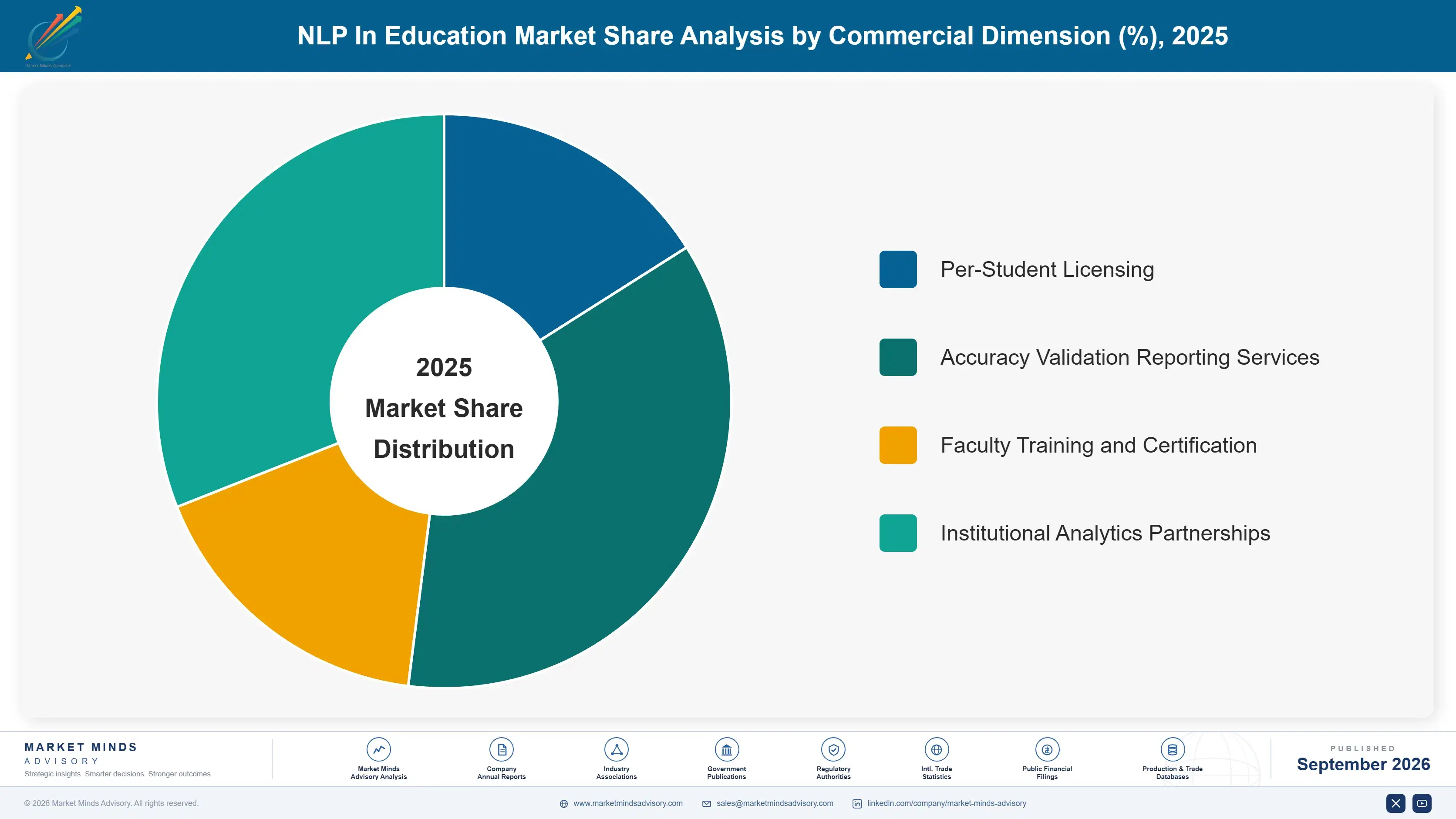
nlp-in-education-market-market-share-analysis-1788503320989

AI-Powered Essay Grading and Feedback Tools

AI-powered essay grading and feedback tools use large language models to evaluate student writing across dimensions including argument structure, clarity, and grammar, delivering feedback quality that recent model capability improvements have finally made trustworthy enough for institutional adoption at meaningful scale. Growth outpaces the broader market because essay grading historically consumed the largest share of teacher assessment time, making it the segment where automated assistance delivers the most immediately measurable time savings and institutional return on investment. Turnitin and Gradescope both report accelerating institutional adoption as validated accuracy benchmarks give procurement committees the confidence needed to approve broader deployment beyond narrow initial pilot programs. Institutional budget cycles further shape when new licensing agreements can realistically begin.
CAGR 23.0%

Tutoring Dialogue Systems

Tutoring dialogue systems use conversational natural language processing to provide personalized, interactive instructional support that adapts to individual student questions and misconceptions in real time, functioning as a scalable supplement to limited human tutoring capacity. This segment grows more slowly than essay grading because conversational tutoring requires deeper pedagogical modeling and higher accuracy standards given the real-time, interactive nature of student engagement compared to asynchronous written feedback delivery. Carnegie Learning leads this category given its established adaptive learning research foundation, though numerous newer entrants are pursuing this category given the large addressable tutoring market opportunity. Adoption also spans corporate training and language learning applications beyond traditional academic institutional settings specifically.
CAGR 17.5%
Full segment breakdown across 6 segments available in the complete report.

Regional Architecture and Country Demand Map

North America leads given Turnitin, Gradescope, and ETS headquarters concentration and the deepest institutional spending on assessment technology among all tracked global markets today, while South Asia and Pacific posts the fastest overall growth as digital classroom adoption expands rapidly across its huge student population.

North America

The United States hosts the deepest concentration of NLP education technology providers, with Turnitin, Gradescope, ETS, and Carnegie Learning all headquartered domestically and serving the region's large higher education and K-12 school district customer base. American institutions also show the highest willingness to pilot new assessment technology among tracked markets, supporting faster product iteration cycles and richer validation data than markets with more conservative procurement processes. Canada's education technology sector also contributes meaningfully to regional demand, particularly around bilingual language assessment tools serving its French and English-speaking populations. Growing state-level education funding for digital assessment tools further reinforces this steady regional demand base. Mexico's growing higher education sector also contributes modestly to this broader regional grouping's demand.
Share: 31% | CAGR: 19.0% (2026 to 2036)

Western Europe

German and British universities show strong institutional interest in NLP writing assessment tools, though data privacy requirements under European regulation shape product design toward more conservative data handling than American competitors typically employ. The United Kingdom hosts a growing cluster of education technology startups building NLP tutoring tools for both domestic and broader European market distribution. Slower adoption compared to North America reflects more cautious European institutional procurement processes and heightened scrutiny of AI-assisted assessment tools specifically within academic settings. France and the Nordic countries contribute additional demand through their growing digital classroom investment programs. Regional universities increasingly view multi-tool assessment bundling as standard procurement practice going forward. This trend continues expanding steadily.
Share: 20% | CAGR: 16.5% (2026 to 2036)
Regional intelligence for 5 additional markets available in the complete report: East Asia, South Asia and Pacific, Latin America, Middle East and Africa, Eastern Europe. Contact sales@marketmindsadvisory.com.
nlp-in-education-market-country-cagr-analysis-1788503321498

Where Assessment Vendors Build Lasting Trust

Beyond standard per-student licensing fees, NLP education vendors build durable revenue through mechanisms that deepen institutional dependency and demonstrate measurable accuracy and pedagogical value over multi-year contract relationships, rewarding vendors that invest early in validation research, faculty training support, and AI integrity safeguards rather than pure feature breadth competition across every institutional customer segment.

Bundling AI-Content Detection With Grading Services

Vendors increasingly bundle AI-generated content detection capability alongside core grading and feedback tools, addressing the academic integrity concern that most directly threatens institutional trust in automated assessment technology adoption. This bundled detection capability typically commands 15 to 20 percent premium pricing over grading-only offerings, reflecting the genuine institutional value placed on integrated integrity safeguards rather than requiring a separate point solution. Institutions increasingly treat this bundling as a baseline procurement requirement rather than an optional add-on, making it an effective way to differentiate from grading-only competitors. Larger institutions with strict academic integrity policies increasingly demand this bundling by default.
Market Impact: Bundled detection commands roughly 15 to 20pp premium

Selling Faculty Training and Onboarding Certification Programs

Vendors increasingly sell dedicated faculty training and certification programs helping educators integrate NLP tools effectively into existing assessment workflows, a revenue stream distinct from standard licensing and typically billed as a separate professional development engagement. This training revenue captures incremental value from an existing institutional relationship while also improving product adoption rates and long-term contract renewal likelihood among trained faculty champions. Training engagements typically generate 8 to 12 percent additional revenue per institutional relationship beyond standard annual licensing fees alone. Vendors report trained faculty champions meaningfully improve product adoption rates across their departments.
Market Impact: Training programs add roughly 8 to 12pp yearly

Offering Third-Party Accuracy Validation Reporting Services

Vendors increasingly offer dedicated accuracy validation reporting services that provide institutions with documented benchmarking data comparing automated scoring against human grader consensus, addressing the procurement requirement for transparent validation evidence that increasingly gates purchasing decisions. This validation reporting service, typically priced 5 to 8 percent above standard licensing, commands meaningfully higher margins, since it requires specialized statistical expertise and ongoing benchmark maintenance rather than pure software delivery costs. Institutions increasingly view this documented validation as a mandatory procurement requirement rather than optional supplementary marketing material. This validation revenue stream also strengthens vendor credibility during competitive procurement evaluation processes.
Market Impact: Validation reporting adds roughly 5 to 8pp yearly

Building Multi-Year Institutional Data Analytics Partnerships

Vendors increasingly build multi-year data analytics partnerships with institutions, providing longitudinal learning analytics insights beyond individual assignment grading that help administrators track program-level writing improvement trends across cohorts and academic years. This partnership-level engagement captures contract values 2 to 3 times larger than standard per-student licensing alone, since institutions value the strategic insight beyond pure operational grading assistance. Larger universities increasingly prefer this deeper partnership model over transactional point-solution licensing arrangements that leave valuable institutional data underutilized. Vendors report these partnerships also meaningfully improve long-term institutional contract renewal likelihood considerably.
Market Impact: Analytics partnerships add roughly 10 to 15pp yearly

Who Controls the Margin Pool

Concentration among the top five NLP education vendors sits at roughly thirty-four percent, moderate for a category still fragmenting across dozens of specialized point-solution providers targeting different assessment functions and institutional segments. Turnitin and Gradescope lead on higher education installed base and academic integrity credibility, while the gap separating them from mid-tier challengers like Carnegie Learning remains narrow enough that a well-validated new accuracy benchmark could shift rankings within a single procurement cycle.
Current competitive activity centers on accuracy validation research publication and AI-content detection bundling, since both directly address the institutional trust barrier that historically limited automated assessment adoption. Several vendors have also launched dedicated faculty training and certification programs, deepening institutional relationships beyond simple software licensing arrangements alone. Academic integrity credibility in particular has become a key differentiator vendors highlight prominently in procurement discussions.

Emerging pressure comes from general-purpose AI chatbot providers extending into education-specific tutoring and feedback use cases, threatening specialized vendors lacking comparable underlying language model scale and development resources. Ranking shifts are most likely among mid-tier vendors lacking either published accuracy validation research or demonstrated academic integrity safeguards, since both dimensions increasingly separate durable market leaders from vulnerable niche competitors.
nlp-in-education-market-company-positioning-matrix-1788503322027

Competitive Moat and Risk Dimensions

TURNITIN

Moat: Deep Academic Integrity Credibility

Turnitin built its reputation over decades as the plagiarism detection standard for higher education, giving it institutional trust and procurement relationships that newer AI-native competitors cannot easily replicate without years of comparable credibility building. This trust advantage compounds each renewal cycle as institutions reference existing satisfied deployments.
TURNITIN

Risk: Legacy Brand Modernization Pressure

Turnitin faces pressure to modernize its product perception beyond pure plagiarism detection toward genuinely innovative AI-assisted feedback capability, a repositioning challenge that newer, AI-native competitors without legacy brand baggage do not face. Turnitin has invested heavily in AI capability to address this perception gap directly.
GRADESCOPE

Moat: Strong STEM Grading Specialization

Gradescope's specialization in grading STEM coursework including handwritten mathematical work gives it technical capability and institutional trust in a specific academic domain that generalist writing-focused competitors have not developed comparable expertise in. This domain specialization has historically translated into faster grading turnaround for complex technical assignments.
GRADESCOPE

Risk: Narrow Subject Matter Dependence

Gradescope's revenue remains concentrated around STEM coursework grading, exposing the company to competitive risk if broader multi-subject platforms develop comparable STEM-specific grading capability and erode this specialized positioning advantage over time. Gradescope has responded by expanding into adjacent humanities grading categories to diversify this exposure.

Players Tracked

Prominent Players

Turnitin
Gradescope
Carnegie Learning
ETS
Grammarly for Education

Other Key Players

Coursera (AI grading tools)
Duolingo English Test
Squirrel AI
Century Tech
Photomath
Quizlet
Knewton
DreamBox Learning
IXL Learning
Pearson (AI assessment)
McGraw Hill (AI tools)
Cognii
PaperPal for Education
Riiid
Yellowdig

Recent Developments

MARCH 2026

Turnitin Launches Bundled AI Detection and Grading Suite

Turnitin launched a bundled product suite combining its AI-generated content detection capability with its core grading and feedback tools, extending its existing academic integrity portfolio into a unified offering. The launch represents an internal product development effort rather than an acquisition of external technology or another company.
Signal: Demonstrates the AI-detection bundling pattern this report identifies as central to future overall platform growth strategy
NOVEMBER 2025

Gradescope Signs Contract With Major State University System

Gradescope signed a multi-campus contract with a major state university system covering STEM course grading across dozens of individual campuses within the broader public university network. The agreement is a service contract rather than an acquisition or joint venture between the two organizations involved. Terms were not disclosed publicly.
Signal: Extends established vendor reach into a large public university system network and its full student base
AUGUST 2025

Carnegie Learning Acquires Conversational Tutoring Startup

Carnegie Learning acquired a smaller conversational AI tutoring startup to accelerate development of its dialogue-based tutoring capability beyond its traditional adaptive learning platform foundation. The acquisition brought in specialized natural language dialogue technology that Carnegie Learning plans to integrate directly into its existing platform offerings.
Signal: Signals continued vendor investment in conversational tutoring capability expansion beyond its original core adaptive learning roots

Model Training and Compute Cost Exposure

NLP education software cost structures are dominated by large language model API usage fees, cloud computing infrastructure for inference at scale, and specialized model fine-tuning expense for education-specific accuracy, rather than physical inputs or manufacturing costs. Per-query inference cost represents a meaningful and growing share of total operating cost as institutional usage scales, with pricing concentrated among a handful of major foundation model providers.
Large language model API pricing declined meaningfully during 2023 and 2024 as competition among foundation model providers intensified, according to public pricing disclosures and industry cost benchmarking reports tracking inference cost trends across major providers. Vendors that locked in earlier, higher-priced API contracts before this decline absorbed some near-term cost disadvantage, while newer market entrants benefited from more favorable pricing available at their later market entry point.

Smaller vendors lacking negotiating scale with major foundation model providers face meaningfully higher per-query inference costs than larger competitors able to negotiate volume-based enterprise pricing agreements directly with providers. This exposure varies by player type: vendors with proprietary fine-tuned models trained on education-specific data reduce dependence on general-purpose foundation model API costs more effectively than competitors relying entirely on unmodified third-party models for their core grading functionality.
nlp-in-education-market-cost-volatility-analysis-1788503322224

Fine-Tune Smaller, Specialized Education Models

Vendors are fine-tuning smaller, education-specific language models rather than relying entirely on general-purpose foundation model APIs, reducing per-query inference cost meaningfully while maintaining grading accuracy tailored specifically to academic writing evaluation use cases. This approach also improves response latency meaningfully, since smaller specialized models typically process requests faster than larger general-purpose alternatives currently available.

Negotiate Volume-Based Foundation Model Agreements

Vendors are negotiating multi-year volume-based pricing agreements with foundation model providers rather than paying standard per-query rates, converting a volatile usage-based cost into a more predictable, discounted expense that simplifies financial planning considerably. Vendors report these agreements have meaningfully reduced unplanned cost spikes during periods of rapid seasonal usage growth tied to academic terms.

Cache and Reuse Common Feedback Patterns

Vendors are building caching systems that reuse common feedback patterns and grading rubric applications across similar student submissions, reducing redundant model inference calls for frequently occurring writing errors and common assignment types encountered repeatedly. This caching approach also improves response consistency for common, previously encountered feedback scenarios across the entire platform and user base.

Portfolio Architecture for Margin Defence

Portfolio economics across NLP education vendors split between standard per-student grading licenses competing largely on price, and premium accuracy-validated or AI-integrity-bundled offerings commanding meaningfully higher margins given specialized validation research and faculty training capability sold alongside core grading functionality across every institutional customer segment served today, from small charter schools to large research universities.
The tension between volume and premium positioning shows clearly in institutional tier structure: broad K-12 licenses compete on low per-student pricing and district-wide adoption scale, while higher education and premium accuracy-validated tiers command substantially higher per-seat revenue justified by deeper validation research and academic integrity safeguards across every regulated academic program and institutional accreditation level.

High-value margin pools concentrate around accuracy validation services and multi-year institutional analytics partnerships, both requiring specialized statistical expertise and accumulated benchmarking data that smaller vendors cannot easily replicate without years of dedicated research investment and faculty trust building. Vendors positioned purely on low-cost per-student licensing will struggle to capture this premium tier without meaningful, sustained investment in validation research and analytics capability. Larger vendors with established research teams increasingly capture this premium tier ahead of smaller specialized competitors.

Volume / Commodity-Adjacent

Standard per-student grading licenses competing largely on price against similar undifferentiated offerings from established competitors serving broad K-12 district-wide deployments with thin margins typical of high-volume commodity licensing arrangements today.
Gross Margin: 15-25%

Premium / Certified

Accuracy-validated grading and AI-content detection bundles sold to higher education institutions requiring documented validation research and academic integrity safeguards beyond what basic grading services can reliably deliver at meaningful scale.
Gross Margin: 35-45%

Sustainability / Regulatory / Next-Generation

Multi-year institutional analytics partnerships and faculty training programs requiring specialized statistical expertise smaller vendors cannot easily replicate quickly, commanding the category's strongest and most defensible overall margin position available currently.
Gross Margin: 40-55%
nlp-in-education-market-portfolio-architecture-1788503322726

High-value Sub-segments and Strategic Watch-out

AI-Powered Essay Grading and Feedback Tools

The fastest-growing, highest-value segment as language models finally deliver feedback quality trustworthy enough for institutional adoption across every academic level, converting years of teacher skepticism into active enthusiasm once accuracy benchmarks reached a genuinely defensible threshold for classroom use, grading, and formal assessment purposes overall.
Gross Margin: 35-45%

Accuracy Validation and Analytics Services

High-value and steadily growing as institutions increasingly require documented benchmarking data before approving broader deployment of automated grading tools, rewarding vendors that invest early in transparent, peer-reviewed accuracy validation research and reporting capability across every academic discipline, institutional accreditation level, and geography served worldwide today.
Gross Margin: 40-55%

Standard Per-Student Grading Licenses

The volume core of the market, generating steady per-seat revenue but facing margin pressure from general-purpose AI chatbot competition, requiring efficient operations and multi-project coverage breadth to sustain acceptable margins as competition intensifies across every institutional segment, geography, student population, and budget tier tracked here.
Gross Margin: 15-25%

General-Purpose AI Chatbot Encroachment

A strategic watch-out category where general-purpose AI providers extending into education-specific tutoring could meaningfully compress specialized vendor pricing power over time, potentially reshaping which vendors capture the classroom assessment opportunity this report identifies as central to sustained future growth, margin, and overall long-term competitive positioning.
Gross Margin: N/A, external

How Institutional Trust Compounds Adoption

Institutional licensing contracts function like an annuity once a faculty body has built trust in a vendor's grading accuracy and integrated it into formal assessment workflows, since switching vendors mid-relationship risks disrupting the validated accuracy baseline and faculty training investment built up over semesters of documented reliable performance that a new vendor relationship would need to reestablish from the beginning, adding real institutional risk.
Adoption stickiness varies by end-use vertical: higher education institutions show the deepest lock-in given accreditation documentation tied to specific assessment tool validation and faculty governance approval processes, while K-12 school districts switch more readily given shorter procurement cycles and less formal faculty governance requirements tied to any single vendor's specific grading methodology across a typical school year. Faculty governance approval alone can extend procurement timelines by many months in some institutions.

Generational shifts in educator expectations are reshaping buyer profiles, as newer teachers entering the profession now expect AI-assisted grading tools as a baseline classroom capability rather than a controversial technology requiring extensive institutional justification and debate. This mindset shift extends to students too, with younger students showing greater comfort receiving automated feedback than older student cohorts accustomed to purely human-graded assessment.
nlp-in-education-market-end-use-penetration-index-1788503323213

MMA Verdict on NLP in Education

These are among the four positions where our research anticipates prominent divergence between winners and laggards over the coming forecast period. Each is grounded in the demand model, the regulatory perimeter, and the announced capacity pipeline.
01 / VALIDATION RESEARCH PRIORITY

Publish independent accuracy validation research proactively

Vendors lacking published, peer-reviewed accuracy validation research increasingly lose procurement decisions to competitors who can demonstrate documented scoring consistency against experienced human grader consensus across multiple essay types, academic levels, and subject areas. Investing in this validation research now, even at meaningful upfront research cost, positions a vendor to satisfy procurement requirements that are becoming standard rather than exceptional across institutional customers of every size and type. Vendors delaying this investment risk losing credibility to faster-moving, research-forward competitors already publishing comparable data.
02 / AI INTEGRITY BUNDLING

Bundle AI-content detection with core grading services

Vendors offering grading capability without integrated AI-generated content detection increasingly lose institutional trust as academic integrity concerns around AI-assisted student writing intensify across faculty and administrator communities nationwide and internationally as well. Bundling detection capability directly addresses the circular integrity problem that most threatens institutional confidence in automated assessment technology adoption at meaningful scale across every academic discipline and institution type. Vendors should treat this bundling as a baseline product requirement rather than an optional premium feature reserved for select customers.
03 / FACULTY TRUST BUILDING

Invest in faculty training ahead of procurement decisions

Vendors treating faculty training as a post-sale afterthought rather than a genuine sales enablement investment risk lower adoption rates and weaker contract renewal likelihood compared to competitors building faculty champions before formal procurement approval processes even begin in earnest at any institution. Faculty members who understand and trust a tool's underlying methodology become internal advocates who meaningfully influence broader institutional adoption decisions beyond their own individual classroom usage patterns and habits. Vendors should prioritize this investment earlier in the sales cycle than currently typical.
04 / FORMATIVE FEEDBACK POSITIONING

Position tools as formative rather than purely summative

Vendors marketing purely summative grading automation risk alienating faculty who value pedagogical alignment with formative feedback practices that education researchers have long advocated for improving student writing outcomes over time, across disciplines, and across every institution type served. Positioning tools explicitly around iterative, process-oriented feedback rather than final scoring alone gives vendors a genuine pedagogical credibility advantage with faculty evaluators skeptical of purely automated assessment approaches broadly and consistently. This framing choice measurably affects institutional adoption willingness and long-term trust.

Engagement Snapshot From the Field

A live engagement with an industry participant carrying material or product regulatory and market exposure ahead of a defining policy shift, showing how our research translates into a defensible multi-year portfolio strategy.
MARKET MINDS ADVISORY · CLIENT ENGAGEMENT SUMMARY
NLP In Education Producer Strategic Portfolio Review and Transition Roadmap 2026·Investment Scenario on NLP In Education Exposure Evaluation 2025-26
CLIENT PROFILE
The client is a mid-sized public university system with several campuses, previously relying entirely on human graders for large introductory writing courses but facing rising costs and inconsistent grading quality across dozens of teaching assistants grading the same standardized assignments. The system had never deployed automated grading technology and needed guidance on vendor selection, faculty buy-in strategy, and expected accuracy performance.
STRATEGIC CHALLENGE
Leadership needed to select an NLP grading vendor capable of improving grading consistency across large introductory writing courses without alienating faculty concerned about academic integrity and pedagogical appropriateness of AI-assisted assessment, weighing potential cost savings against the real risk of faculty resistance derailing implementation entirely across the entire university system.
MMA APPROACH
MMA conducted a structured vendor evaluation across four NLP grading vendors, assessing published accuracy validation research, AI-content detection bundling, and faculty training support against the client's existing course structure and faculty governance requirements, supplementing vendor-provided data with reference calls to comparable public university system clients already using each vendor's tools.
KEY FINDINGS
  1. Two of four evaluated vendors lacked published, peer-reviewed accuracy validation research the client's faculty governance committee explicitly required before granting formal approval to proceed.
  2. Vendors bundling AI-content detection alongside grading services faced meaningfully less faculty resistance during pilot discussions than grading-only competitors did overall across departments.
  3. Faculty members who participated in vendor training sessions became noticeably more supportive advocates during subsequent departmental adoption discussions and formal committee votes.
  4. Reference university clients reported meaningful grading consistency improvement across multiple teaching assistants after adopting the selected vendor's grading tools entirely system-wide and permanently.
CLIENT PROFILE
The client is a mid-sized public university system with several campuses, previously relying entirely on human graders for large introductory writing courses but facing rising costs and inconsistent grading quality across dozens of teaching assistants grading the same standardized assignments. The system had never deployed automated grading technology and needed guidance on vendor selection, faculty buy-in strategy, and expected accuracy performance.
STRATEGIC CHALLENGE
Leadership needed to select an NLP grading vendor capable of improving grading consistency across large introductory writing courses without alienating faculty concerned about academic integrity and pedagogical appropriateness of AI-assisted assessment, weighing potential cost savings against the real risk of faculty resistance derailing implementation entirely across the entire university system.
MMA APPROACH
MMA conducted a structured vendor evaluation across four NLP grading vendors, assessing published accuracy validation research, AI-content detection bundling, and faculty training support against the client's existing course structure and faculty governance requirements, supplementing vendor-provided data with reference calls to comparable public university system clients already using each vendor's tools.
KEY FINDINGS
  1. Two of four evaluated vendors lacked published, peer-reviewed accuracy validation research the client's faculty governance committee explicitly required before granting formal approval to proceed.
  2. Vendors bundling AI-content detection alongside grading services faced meaningfully less faculty resistance during pilot discussions than grading-only competitors did overall across departments.
  3. Faculty members who participated in vendor training sessions became noticeably more supportive advocates during subsequent departmental adoption discussions and formal committee votes.
  4. Reference university clients reported meaningful grading consistency improvement across multiple teaching assistants after adopting the selected vendor's grading tools entirely system-wide and permanently.
RECOMMENDED STRATEGY
Phase 1: Phase one: pilot the selected vendor's tool in a single large introductory writing course to validate accuracy and faculty acceptance. Phase 2: Phase two: expand deployment to additional introductory courses once initial accuracy and faculty satisfaction metrics clear defined internal thresholds set. Phase 3: Phase three: evaluate expansion into upper-level courses as faculty comfort and institutional trust in the tool continue building over time.
OUTCOME
The client piloted its selected vendor's tool in one introductory course, reporting meaningful grading consistency improvement across teaching assistants during the pilot term and across multiple assignment types (client-reported, unverified by MMA). Leadership credited the phased faculty training approach with building support before broader rollout began.

Frequently Asked Questions

Foundational context covering the market sizes, CAGR, scope, country, region and competition that inform every finding below. This section is provided to cover basics and most often pre-purchase conversations, answered from the MMA Primary Research Dataset.

What is the current size of the NLP In Education Market?

The NLP In Education Market is valued at 2.1 billion dollars in 2025. It is expected to reach 2.48 billion dollars by 2026 as institutional trust in AI grading grows.

How large will the NLP In Education Market be by 2036?

The market is projected to reach 12.98 billion dollars by 2036, up from 2.48 billion dollars in 2026. That represents a 5.23 times expansion over the forecast period.

What is the CAGR for the NLP In Education Market 2026 to 2036?

The market is forecast to grow at an 18.0 percent compound annual growth rate between 2026 and 2036. This reflects rapid adoption as language model capability matures.

Which segment is growing fastest?

AI-Powered Essay Grading and Feedback Tools lead at a 23.0 percent CAGR, roughly 1.28 times the overall market rate. Improved accuracy is driving this rapid adoption.

Who are the major companies in the NLP In Education Market?

Leading vendors include Turnitin, Gradescope, Carnegie Learning, ETS, and Grammarly for Education. Together these five hold an estimated 34 percent combined market share worldwide today.

Which country is growing fastest?

India leads at a 21.0 percent CAGR, driven by its massive student population and rapidly expanding digital classroom infrastructure investment. Government initiatives are also accelerating adoption further.

Report Segmentation Architecture

The full report scope spans multiple orthogonal segmentation dimensions, with cross-tabulated demand data provided for each dimension pair. Coverage extends further to regional breakdowns, trend trajectories, and the competitive detail needed to support segment-level decision-making.

By Primary Market Dimension

  • AI-Powered Essay Grading and Feedback
  • Formative Writing Assistance
  • Tutoring Dialogue Systems
  • AI-Content Detection Tools
  • Learning Analytics and Progress Tracking
  • Language Proficiency Assessment

By End-Use Industry

  • Higher Education
  • K-12 Primary and Secondary Schools
  • Standardized Test Preparation
  • Corporate Training
  • Language Learning

By Commercial Dimension

  • Per-Student Licensing
  • Accuracy Validation Reporting Services
  • Faculty Training and Certification
  • Institutional Analytics Partnerships

By Region

  • North America
  • Western Europe
  • East Asia
  • South Asia and Pacific
  • Latin America
  • Middle East and Africa
  • Eastern Europe

Scope, Methodology, and Coverage

Every figure in this report is reproducible from documented input assumptions. The scope below maps the historical period, the forecast horizon, the segmentation dimensions, and the countries covered, alongside the underlying primary and qualitative methodology.
Historical Period
2020 to 2025
Forecast Period
2026 to 2036
Base Year
2025 (USD billions; MMA Primary Research Dataset, September 2026)
Market Definition
This market covers natural language processing software used for automated essay grading, writing feedback, tutoring dialogue, and learning analytics in educational settings from primary school through higher education. It excludes general-purpose chatbot platforms not specifically designed for educational assessment or tutoring use cases.
Quantitative Units
USD billions, market share percentages, CAGR percentages
Segmentation Dimensions
Application function type, end-use industry, commercial dimension, region
Regions Covered
North America, Western Europe, East Asia, South Asia and Pacific, Latin America, Middle East and Africa, Eastern Europe
Countries Covered
United States, United Kingdom, Germany, Japan, China, India, Brazil, United Arab Emirates, and 30 additional countries across all seven global regions
Key Companies Profiled
Turnitin, Gradescope, Carnegie Learning, ETS, Grammarly for Education, and 15 additional vendors
Quantitative Methodology
Primary survey, n=3,800 respondents, Q4 2025, six countries; demand-side model with trade association cross-validation
Qualitative Methodology
47 expert interviews, Q4 2025; applied to validate demand model assumptions, identify emerging dynamics, and assess competitive positioning
Report Format
PDF and XLSX data workbook (Word format preview document)
Publisher
Market Minds Advisory
Report Code
MMA-2026-TEC-165
Published
September 2026
Contact
sales@marketmindsadvisory.com | www.marketmindsadvisory.com

Purchase the full NLP In Education Market Report (2026 to 2036).

This report examines the NLP In Education Market across its full 2026 to 2036 forecast horizon, covering market sizing, segmentation, competitive dynamics, and regional demand patterns in depth. It draws on primary survey data from 3,800 respondents and 47 expert interviews conducted in the fourth quarter of 2025. The analysis profiles twenty leading vendors and quantifies revenue levers, compute cost exposure, and portfolio economics across the category's major segments. Strategic recommendations address validation research, AI integrity bundling, and faculty trust building for vendors and investors.
Full 2026-2036 market sizing and forecast data
Seven-region demand and growth rate breakdown
Twenty-company competitive profiles and moat analysis
Segment-level CAGR and market share detail
Revenue lever and compute cost exposure analysis
Anonymised client case study with strategy recommendations

Built For The People Who Decide

From boardroom strategy to bench-side execution, this report is read cover-to-cover by leaders shaping the next decade of their industry, turning demand scenarios, market dynamics and valuation benchmarks into decisions.
CXOs/ Presidents/ VPs/ Managers
M&A and Corporate Development
Strategy Teams and R&D Heads
Procurement and Product Directors
Regulatory and Compliance Leaders
Investor Relations and Equity Analysts