Market Minds Advisory
Micro Perforation Machines Market

Micro Perforation Machines Market: Hole Geometry, Respiration Matching and the Equipment Behind Every Salad Bag

A bag of salad breathes at a rate somebody had to calculate, and the machine that puts those holes in the film decides whether the produce inside lasts nine days or four.

Lead Analyst

Bilal Shaikh

Published

September 2026

Make Smarter Decisions with Customized Research Insights

Request a free sample report and evaluate market opportunities, growth trends, and competitive dynamics relevant to your business needs.

2025 MARKET VALUE$0.6BMarket Size 2025
2036 FORECAST VALUE$1.3BBase Case , 2026 to 2036
CAGR 2026 TO 20367.9 %Bull 9.1% / Bear 6.7%
INCREMENTAL OPPORTUNITY$0.7BNet 10- year value creation
EXPANSION MULTIPLE2.10x2036 value over 2026 base
Strategic Levers
M&A Pipeline
Regional Outlook
Country Rankings
Competitive Intelligence
Segmental Deep-dive
Call-Us : 91 93563 13602

Executive Snapshot and Market Trajectory

Cut produce keeps respiring after it is packed. It consumes oxygen and releases carbon dioxide, and unless the film lets gas through at very nearly the same rate the pack either suffocates the leaves or dries them out. That exchange rate is set by holes measured in tens of microns.
Laser micro perforation compounds at 11.9%, exactly 1.50 times the market, because a laser can hold hole diameter within a few microns and change it between products without tooling. East Asia holds 31% of demand, above the standard band, on fresh produce packing volume and converting capacity that no other region matches. Fresh cut packing takes roughly 68% of equipment demand. Every one of those packs needs a matched atmosphere that loose produce never did.
Five suppliers hold 54%. What separates them is not the machine but the application data: knowing what hole density a particular cultivar at a particular temperature actually needs, which comes from respiration testing rather than from engineering. Laser source costs have fallen enough to widen the addressable base considerably, which invites entrants holding no application knowledge whatsoever. Respiration measurement takes years to accumulate and cannot be purchased.
Market Definition
The market covers equipment that creates micro-scale perforations in packaging film and paper webs, spanning laser micro perforation systems, mechanical needle and pin perforation, hot needle systems, electrostatic and spark perforation, inline converting-integrated modules, and laboratory and pilot perforation units. Macro perforation for easy-open features, film extrusion and converting lines without perforation capability, and packaging materials themselves are excluded.
Base Year Value
$0.6B in 2025 (MMA Primary Research Dataset, August 2026)
Forecast Period
2026 to 2036, eleven discrete annual values
CAGR
7.9% base case. Bull 9.1%. Bear 6.7%.
Fastest Growth Segment
Laser Micro Perforation Systems: 11.9% CAGR
Fastest Growth Country
India: 11.6% CAGR
Fastest Growth Region
South Asia and Pacific: 10.1% CAGR
Largest Region
East Asia: 31% of 2025 global value
Market Leaders
Bobst, Perfotec, Micro Perforation Technologies, Preco, Hulftegger. Source: MMA Analysis based on company annual reports.
Primary Survey
n=3,800 procurement and R&D decision-makers, Q4 2025, six countries
Methodology
Demand-side build-up, cross-validated against public data, 47 expert interviews

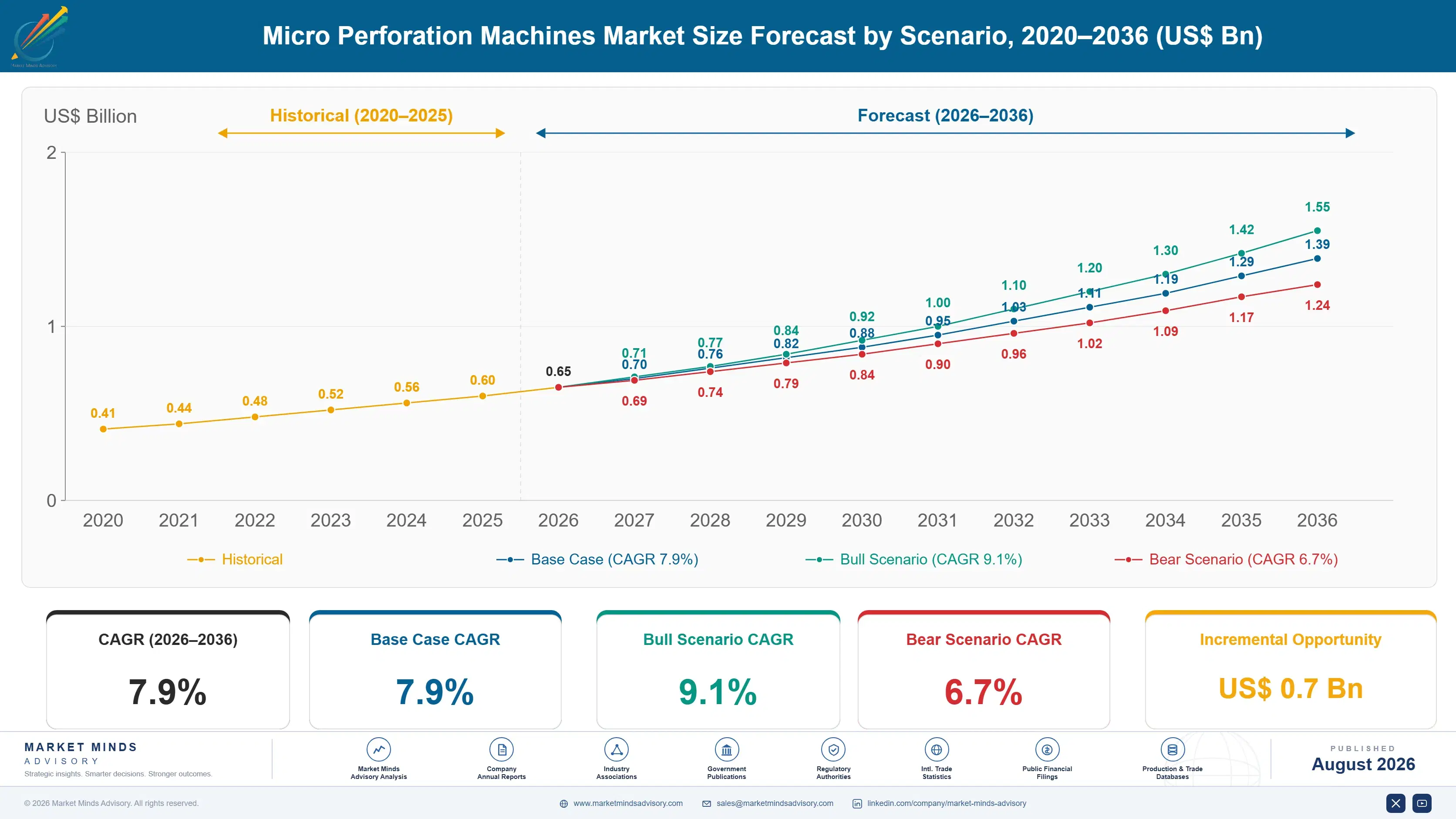
Micro Perforation Machines Market Forecast Scenarios

micro-perforation-machines-market-size-forecast-scenario-1787308576793
Growth ran at an implied 6.5% across 2020 to 2025 and fresh produce packing drove most of it. Retail demand for prepared salads, cut fruit and prepared vegetables rose steadily through the period, and every new packing line needed perforation capability rather than treating it as an option to be added later once problems appeared. Mechanical needle systems took most of those installations on price.
The base case at 7.9% rests on three mechanisms. Fresh cut produce categories keep expanding as retail ranges widen and preparation moves from the household to the packer. Food waste reduction commitments give shelf life extension a value beyond the sale itself. And laser systems keep displacing mechanical perforation where hole precision determines whether respiration matching actually works. Laser compounds at 11.9%, and integrated modules specified at line build take further share.
The bull case at 9.1% assumes food waste regulation extends into retail supply agreements more forcefully, since a pack that reliably lasts nine days rather than four changes markdown economics substantially. The bear case at 6.7% follows from fresh cut category growth slowing in mature markets alongside loose produce returning in retailers cutting plastic packaging.

Holes Small Enough to Keep Lettuce Alive

A bag of cut lettuce is a live respiring system in a sealed container. The leaves consume oxygen and release carbon dioxide, and if the film is impermeable the oxygen runs out, anaerobic respiration begins and the contents ferment. If the film is too open, the produce transpires, dehydrates and wilts. The correct answer sits in a narrow band and differs by cultivar, cut size and storage temperature.
TOP FIVE CONCENTRATION54%Combined share held by the five largest equipment suppliers
TYPICAL HOLE DIAMETER60 micrometresPerforation size governing gas exchange in respiring produce packs
SHELF LIFE EXTENSION5 additional daysStorage life gained through correctly matched atmosphere in packs
LASER DIAMETER TOLERANCE4 micrometresVariation achievable against mechanical perforation across a web
CHANGEOVER TIME SAVED94% reductionSetup removed by changing settings rather than physical tooling
WASTE REDUCTION ACHIEVED31% fewer markdownsRetail reduction where correctly matched packs replaced generic film
Micro perforation is how packers hit that band. Holes around 60 micrometres across, placed at a calculated density, let gas exchange proceed at roughly the rate the produce demands. Get it right and shelf life extends by around five days, which changes both waste and the retailer's markdown behaviour. Get it wrong and the pack looks fine leaving the plant and fails in a chilled cabinet three days later.
The machinery is the smaller part of the problem. A laser holds hole diameter within about four micrometres and switches between products without tooling, which mechanical perforation cannot approach. What decides whether a customer succeeds is knowing what hole density a specific product actually needs, and that knowledge comes from respiration measurement rather than from any equipment specification.
"Every packer who has bought one of these machines on throughput alone has the same story. The equipment worked perfectly and the product still failed, because nobody had measured what the lettuce was actually doing inside the bag at four degrees."
Director, Converting Equipment and Fresh Produce Packaging Practice · MMA Conver

Market Trends

Laser Systems Displace Mechanical Perforation on Precision

A mechanical needle produces a hole whose size depends on needle condition, film tension and web speed, and the variation across a wide web is considerable. A laser holds diameter within roughly four micrometres and changes hole size and density between products by altering settings rather than changing tooling, which cuts changeover time by around 94%. For respiration matching, where the correct gas exchange rate sits in a narrow band, that precision is the difference between a working pack and a failing one. Laser compounds at 11.9% against a market at 7.9%.
Market Impact: Fresh cut at 68% of demand
Food Waste Commitments Give Shelf Life a Separate Value

Retailers and food producers have made public food waste reduction commitments with dates attached, and a fresh produce pack that lasts nine days rather than four reduces both in-store markdown and household waste measurably. Correctly matched perforation delivers around five additional days and cuts retail markdowns by roughly 31% against generic film. That converts a packing equipment decision into a waste reduction argument, which reaches a sustainability budget rather than a capital expenditure committee that has already declined it. Retailers now write shelf life into supply agreements rather than leaving pack performance to the packer entirely.
Market Impact: Extension reaching 5 additional day

Market Opportunities and Growth Drivers

Fresh Cut Preparation Moves From Household to Packer

Retail ranges of prepared salads, cut fruit, prepared vegetables and stir fry mixes keep widening as households buy preparation rather than performing it. Every one of those products respires and every pack therefore needs a matched atmosphere, which loose or whole produce never did. Packers entering the category discover perforation as a requirement rather than an option, and they discover it after their first product failure rather than during line specification. Roughly 68% of micro perforation equipment demand now serves fresh cut produce packing. That share keeps rising as prepared ranges widen further.
Market Impact: Failures appearing 3 days later

Respiration Data Rather Than Equipment Decides Pack Performance

Correct hole density depends on the specific product, cut size, fill weight and storage temperature, and it differs enough between cultivars that a specification working for one lettuce variety fails for another. Suppliers holding respiration measurement capability can calculate the requirement rather than guessing at it, and that capability sells more machines than any throughput figure does. It also creates a service relationship extending well past installation, since every new product a packer launches raises the same question again. Correctly matched packs deliver around five additional days of usable shelf life, which is the number that persuades a buyer.
Market Impact: Loose sale removing 6% annually

Market Restraints and Challenges

Packers Buy Equipment Before Understanding the Requirement

Micro perforation equipment is frequently specified on throughput, web width and price without any respiration measurement behind it, and the resulting packs fail in the chilled cabinet rather than at the factory. The root cause is that the failure appears days later at a retailer, by which time nobody connects it to a hole density decision made months earlier. Suppliers mitigate by measuring respiration before quoting, which lengthens the sale and dramatically improves the outcome for both sides. Measured respiration across twenty products at one temperature can vary by more than a factor of three.
Market Impact: Laser holding 4 micrometre toleranc

Loose Produce Return Removes Packs From the Category

Retailers reducing plastic packaging have moved some fruit and vegetable lines back to loose sale, which removes the pack and the perforation requirement together. The root cause is a genuine tension between plastic reduction and food waste reduction, since loose produce spoils faster in a household than a matched pack does. Suppliers mitigate by supporting paper-based perforated formats where the same respiration problem applies, and by arguing waste data against packaging weight data. Roughly 6% of packed produce lines move back to loose sale each year in markets where plastic reduction targets bind hardest, which removes the equipment requirement outright.
Market Impact: Markdowns falling 31% with matching
3 additional market trends, 4 additional growth drivers, and 2 additional restraints and challenges are covered in the full report. Contact sales@marketmindsadvisory.com to access the complete intelligence.

Segment CAGR and Growth Architecture

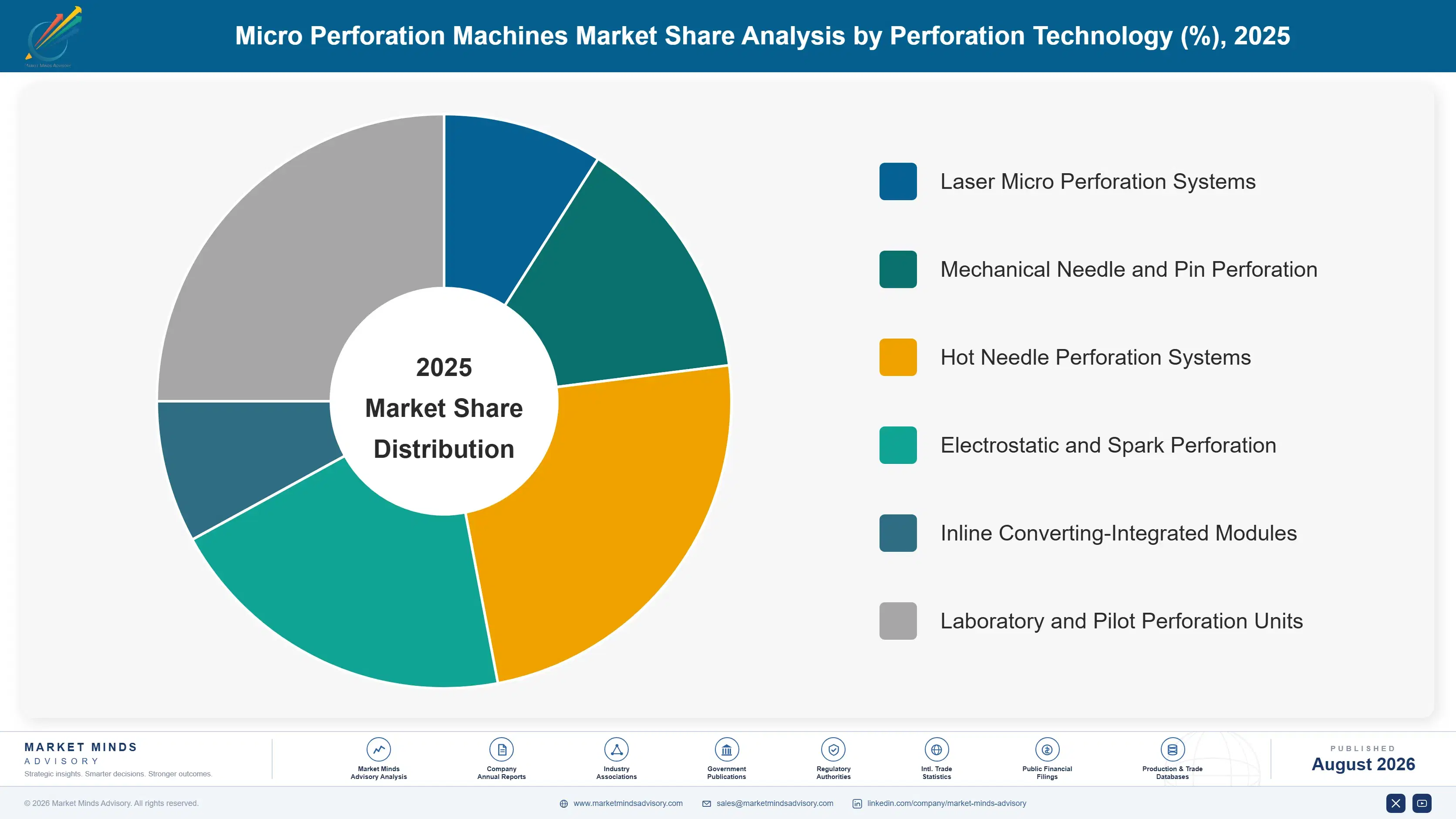
Segmentation follows perforation technology, because each produces a different hole geometry, tolerance and changeover behaviour. Laser and mechanical needle systems create holes that look comparable and behave quite differently in a respiring pack, and the choice determines what products a packer can run. Six technologies sit in the hierarchy, separated by how the hole is formed.
micro-perforation-machines-market-market-share-analysis-1787308577365

Laser Micro Perforation Systems

Laser systems compound at 11.9%, exactly 1.50 times the market rate, on precision that mechanical perforation cannot reach. A carbon dioxide laser ablates a clean hole whose diameter holds within roughly four micrometres across a full web width, and changing hole size or density between products means altering a setting rather than swapping tooling, which removes about 94% of changeover time. For respiration matching that precision decides whether a pack works, since the correct gas exchange rate sits in a narrow band. The capital cost is considerably higher than a needle roller, extraction is required for the vapour generated, and film composition affects how cleanly the hole forms, which is why application testing matters as much as machine selection.
CAGR 11.9%

Inline Converting-Integrated Modules

Integrated modules grow at 9.6% by placing perforation inside an existing converting or packing line rather than running it as a separate offline operation. That removes a handling step, a web rewind and the inventory of perforated film a packer would otherwise hold against forecast rather than actual demand. It also lets hole density change with the product running rather than with whatever roll was loaded. The engineering difficulty is registration and web tension control at line speed, since a perforation module that disturbs the web creates problems downstream at the sealing station. Retrofitting into an existing line is considerably harder than specifying one at build, which is where most of these sales actually originate.
CAGR 9.6%
Full segment breakdown across 6 segments available in the complete report.

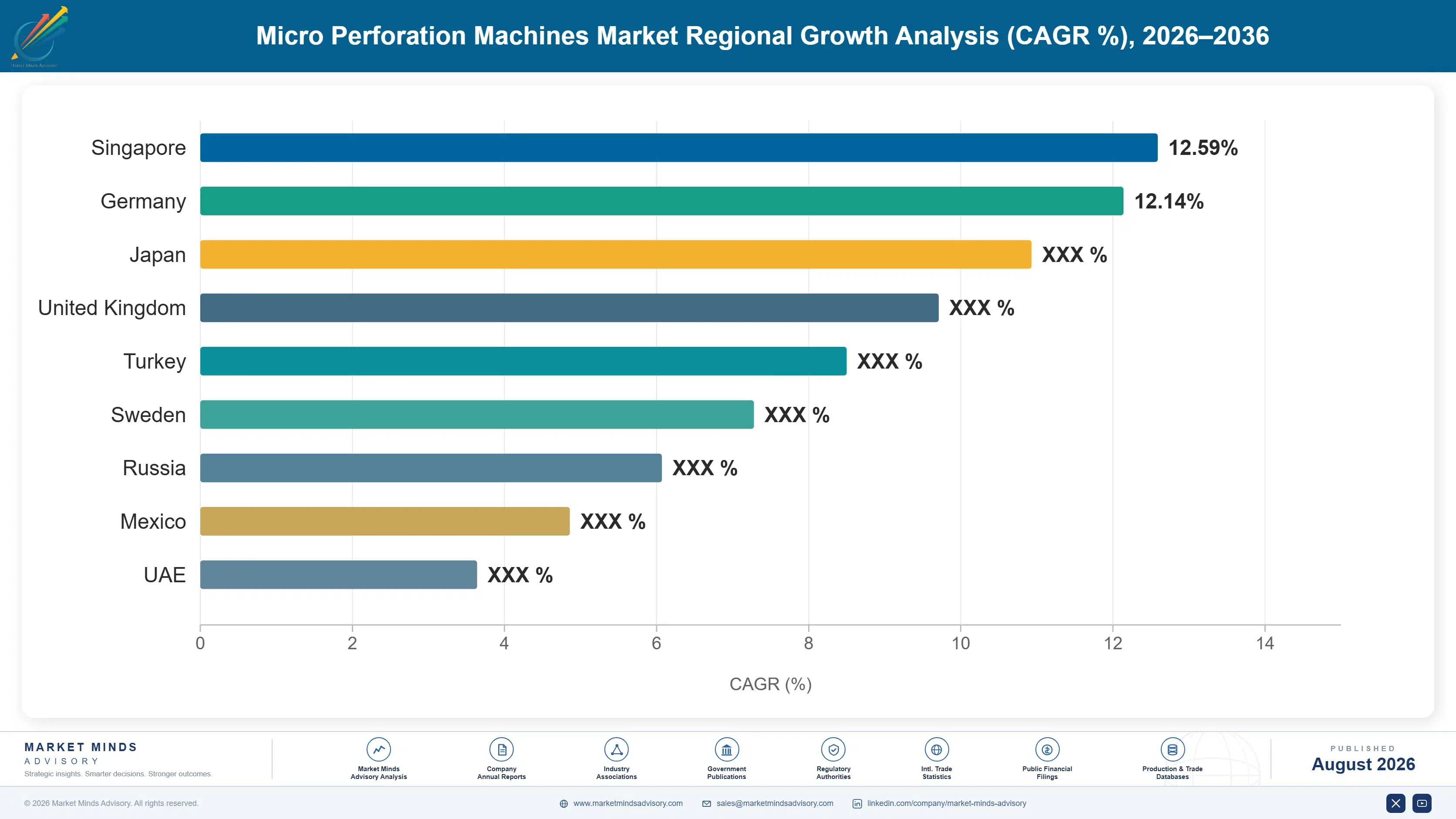
Regional Architecture and Country Demand Map

Demand follows fresh cut produce packing capacity rather than produce consumption, since perforation happens where product is packed. Retail prepared produce penetration varies enormously between regions and determines how much of that packing needs matched atmosphere at all. East Asia leads on packing capacity rather than consumption.

East Asia

East Asia holds 31% of global demand. Note: this exceeds the standard band because Chinese, Japanese and Korean fresh produce packing capacity together outweighs any other region, and perforation equipment is installed where packing happens rather than where produce is grown. Japanese convenience store fresh food ranges are the most demanding application anywhere, with very short shelf lives, precise presentation requirements and daily range changes that reward laser changeover speed heavily. Chinese prepared produce has grown rapidly with modern retail and food delivery. Korean packing serves both retail and an extensive prepared meal sector. Regional growth of 8.9% reflects category expansion rather than equipment replacement in an established installed base.
Share: 31% | CAGR: 8.9% (2026 to 2036)

South Asia and Pacific

The fastest growing region at 10.1%, with India compounding at 11.6%, South Asia and Pacific accounts for 11% of demand. Indian cold chain investment has made fresh cut produce commercially viable in a way it was not a decade ago, and organised retail expansion is creating packing capacity from a very low base. Ambient temperatures make respiration rates considerably higher than in temperate markets, which raises the gas exchange requirement and makes correct hole density more critical rather than less. Australian packing is mature and technically advanced. Southeast Asian demand follows both retail modernisation and produce export where destination shelf life requirements apply. Regional installations are almost entirely first-time rather than replacement.
Share: 11% | CAGR: 10.1% (2026 to 2036)
Regional intelligence for 5 additional markets available in the complete report: North America, Western Europe, Latin America, Middle East and Africa, Eastern Europe. Contact sales@marketmindsadvisory.com.
micro-perforation-machines-market-country-cagr-analysis-1787308577887

Selling Respiration Data With the Machine

Perforation equipment is bought on throughput and web width by packers who then discover their packs fail in a chilled cabinet. Every commercially useful position here involves knowing what the produce actually needs before the machine is specified. Four positions qualify here, and two of them concern who is being sold to rather than what is actually sold.

Measure Respiration Before Quoting the Equipment

Correct hole density depends on product, cut size, fill weight and storage temperature, and differs between cultivars enough that one lettuce specification fails on another. Suppliers measuring respiration on the customer's actual product calculate the requirement rather than guessing, which prevents the pack failure that follows a throughput-based purchase. It converts a capital transaction into a service relationship, since every new product raises the same question again. Measured respiration across twenty products at one temperature commonly varies by a factor of three, and correct matching adds around five days of usable shelf life and cuts retail markdowns by roughly 31%.
Market Impact: Shelf life extended 5 additional da

Sell Markdown Reduction Into Retail Waste Budgets

Correctly matched perforation delivers around five additional days of usable shelf life and cuts retail markdowns by roughly 31% against generic film. Presented to a packer as capital equipment it competes against every other machine on the floor. Presented to a retailer as waste reduction, backed by their own markdown data, it reaches a sustainability commitment with a public deadline attached. Retailers then specify the capability into supply agreements, which converts an equipment sale into a requirement the packer cannot decline. Five additional days of usable life changes the markdown arithmetic outright.
Market Impact: Retail markdowns cut 31% across the

Position Laser on Changeover Rather Than Hole Quality

Hole quality arguments reach engineers who already understand them and rarely control the budget. Changeover reaches operations, since altering hole size and density by setting rather than tooling removes roughly 94% of setup time, and a packer running twenty products across a week counts that in shifts recovered. Laser compounds at 11.9% and carries gross margins roughly 16 to 24 points above mechanical systems, and the changeover argument is what actually moves a customer already running needle perforation adequately. Twenty products a week is roughly two shifts of setup recovered.
Market Impact: Changeover time reduced 94% on each

Reach Line Builders Before Retrofit Becomes Necessary

Integrated perforation modules placed inside a converting or packing line remove a handling step, a rewind and the perforated film inventory a packer holds against forecast. Retrofitting into an existing line is considerably harder than specifying at build, because registration and web tension control at line speed is difficult to add afterwards. Suppliers holding relationships with packing machinery builders reach the specification at design stage, where integrated modules grow at 9.6% and where a competitor selling offline equipment never appears at all. Integrated modules also remove the perforated film inventory held against forecast rather than orders.
Market Impact: Integrated line modules compounding

Who Controls the Margin Pool

Five suppliers hold 54% of the market measured on perforation equipment and service revenue, the basis applied consistently through this section. Concentration is high for converting equipment, and application knowledge rather than machine building explains it, since laser sources and web handling are both available to any competent equipment maker. Bobst and Perfotec lead from quite different positions. Bobst arrives from converting line engineering and Perfotec from produce respiration measure
Competition operates on three dimensions. Respiration measurement capability decides whether a supplier can specify hole density correctly or must ask the customer to guess. Line integration capability decides participation in the modules specified at build rather than retrofitted. And service response decides whether a packer running fresh product daily will risk an unfamiliar supplier at all.

Two pressures are reshaping position. Laser source costs have fallen enough that the technology is reaching packers who previously could not justify it, which widens the market and invites entrants. Against that, respiration application knowledge takes years to accumulate and cannot be purchased. Rankings will move toward whoever pairs application data with genuine line integration capability.
micro-perforation-machines-market-company-positioning-matrix-1787308578405

Competitive Moat and Risk Dimensions

BOBST

Moat: Converting line integration breadth

Bobst supplies converting equipment across printing, laminating and finishing, which places perforation inside a line the company is already engineering rather than as an added module somebody else must integrate. Registration and web tension control at line speed are exactly the problems Bobst solves routinely elsewhere, and that engineering transfers directly into integrated perforation work.
BOBST

Risk: Respiration application depth

Hole density specification depends on respiration measurement of specific produce at specific temperatures, which is food science rather than converting engineering. Specialists holding that data specify correctly where a converting supplier relies on the customer, and a pack failing in a chilled cabinet damages the equipment supplier regardless of origin.
PERFOTEC

Moat: Respiration measurement and specification

Perfotec built its position around measuring produce respiration and calculating the perforation required rather than around selling machines, so the company arrives with an answer where competitors arrive with a specification sheet. That data accumulates across cultivars and temperatures into a library no equipment maker assembles quickly.
PERFOTEC

Risk: Line integration engineering scale

Integrated modules specified at line build require registration and web tension engineering at speed, and large converting equipment manufacturers hold that capability across whole lines rather than for a single station. As integration displaces offline perforation, a specialist strong on application science competes at a disadvantage on the engineering side of the same installation.

Players Tracked

Prominent Players

Bobst
Perfotec
Micro Perforation Technologies
Preco
Hulftegger

Other Key Players

Sitma Machinery
Coherent
LasX Industries
Rofin-Sinar
Nordson Corporation
Amcor
Ampac Machinery
Kampf Schneid
Comexi Group
Sun Automation Group
PSA Technology
Elettro Sistemi
Rollem International
Hangzhou Cronite
Zhejiang Zhengye Machinery

Recent Developments

FEBRUARY 2025

Retail waste commitments specify shelf life into supply agreements

Grocery retailers extended food waste reduction commitments into fresh produce supply agreements, specifying usable shelf life on delivery rather than leaving pack performance to the packer. These were retailer policy decisions rather than regulatory actions or supplier transactions, and the resulting requirement now sits squarely with the packer.
Signal: A shelf life requirement written into a su
JUNE 2025

Laser source cost decline widens the addressable packer base

Falling carbon dioxide laser source and control costs brought laser micro perforation within reach of mid-sized produce packers who had previously used mechanical needle systems on cost grounds. This reflects component pricing rather than any corporate transaction between manufacturers. Capital cost had previously ruled the technology out for them.
Signal: Cheaper laser sources widen the market and
OCTOBER 2025

Paper-based perforated formats trialled against plastic reduction

Fresh produce packers trialled perforated paper and fibre-based formats to reconcile plastic reduction commitments with food waste targets, since respiring produce still requires controlled gas exchange whatever the substrate. These were format development trials rather than commercial launches, and hole formation in fibre behaves quite differently under a laser.
Signal: Changing substrate does not remove the res

Laser Sources, Controls and Application Staff

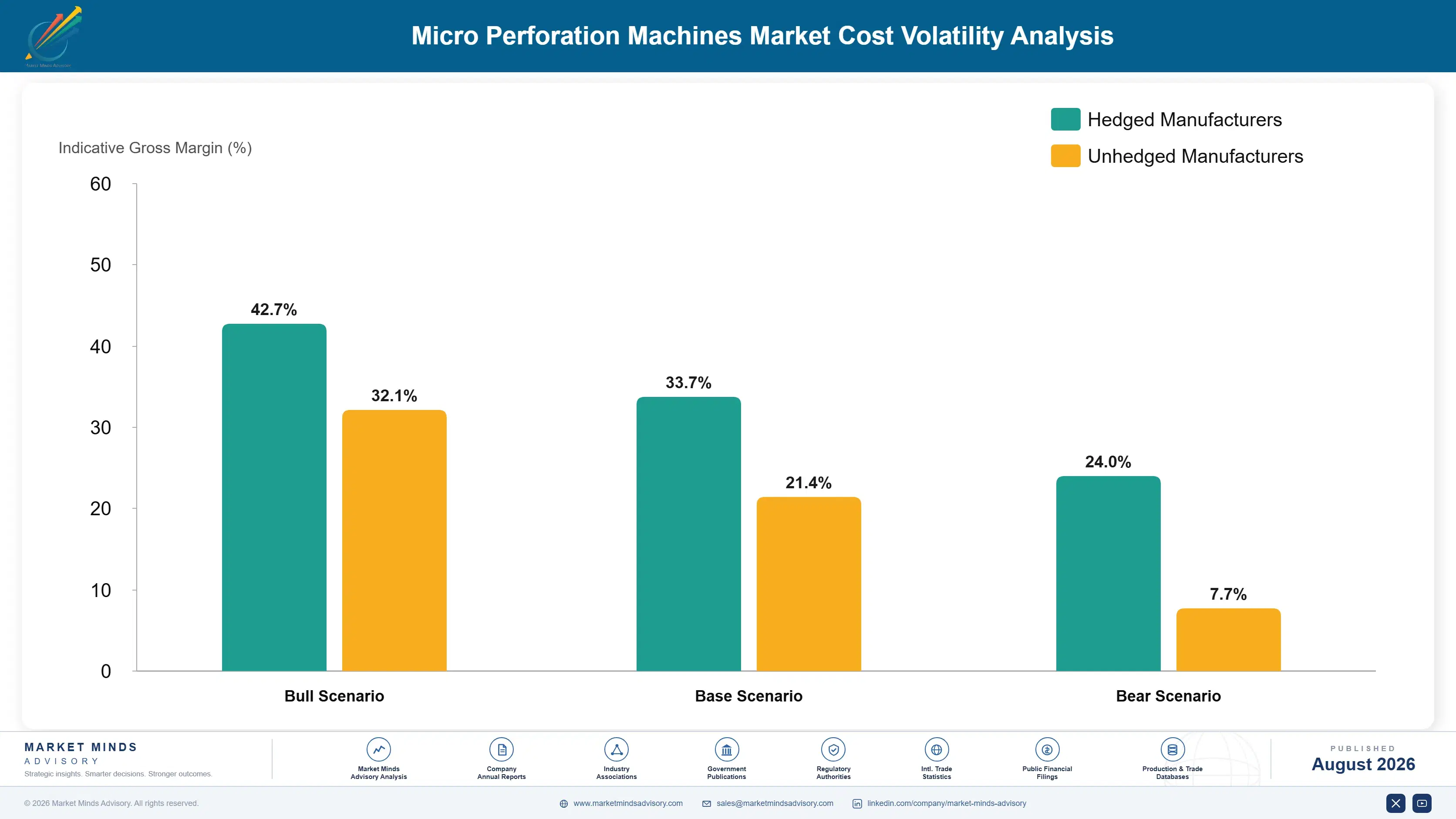
Laser sources, optics and beam delivery account for roughly 31% of equipment cost of goods, purchased from a small number of specialist manufacturers. Control electronics, web handling and mechanical assembly run a further 28%. Application science staff, respiration testing capability and field service make up most of the remainder and sit largely outside cost of goods as ongoing commitment rather than build cost.
Laser source and control component availability disrupted equipment build schedules through 2021 and 2022, extending lead times and pushing customers toward repair of mechanical systems rather than laser conversion. Company annual reports covering converting equipment segments disclose the resulting backlog effects. European energy costs documented in International Energy Agency reporting raised manufacturing overhead over the same period. Laser source supply stayed concentrated enough that qualifying a second route took a full engineering cycle.

Exposure divides by business model rather than by scale. Suppliers selling equipment alone carry component cost against a one-time sale and compete on price with entrants attracted by falling laser source costs. Those selling application science alongside equipment carry higher ongoing staff cost and earn recurring revenue from product development work, which is a more defensible position as the hardware itself commoditises.
micro-perforation-machines-market-cost-volatility-analysis-1787308578601

Dual-source laser components and control electronics

Laser sources and control components caused most of the 2021 and 2022 build disruption, and qualifying a second supplier costs one engineering cycle against months of extended lead time later. Standardising beam delivery and control architecture across machine families reduces the number of distinct components requiring qualification and shortens recovery when a route closes.

Fund application science from recurring product work

Respiration measurement is expensive to maintain and it is the only durable differentiator as laser hardware costs fall. Charging for product development and respiration specification work separately from equipment, rather than absorbing it as a sales cost, converts the capability into a revenue line that survives the machine sale being completed and funds the testing staff who deliver it.

Build application data into a reusable cultivar library

Respiration measurements taken for one customer's product apply to the same cultivar, cut size and temperature elsewhere, and most suppliers treat each measurement as a one-off. Accumulating results into a structured library turns repeated cost into an asset that shortens every subsequent specification and that competitors cannot replicate without doing the same years of work.

Portfolio Architecture for Margin Defence

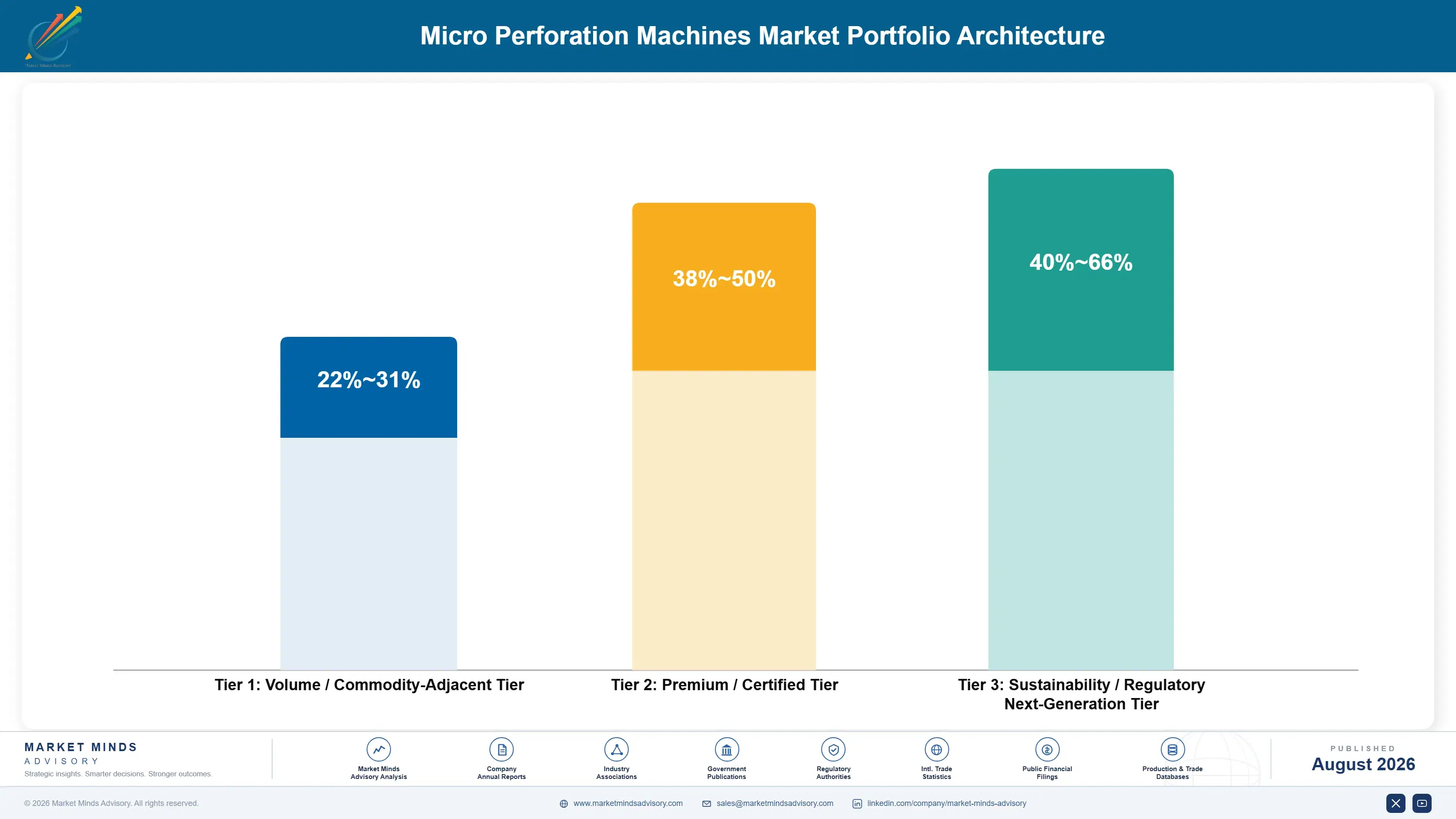
The portfolio separates on whether the supplier knows what the produce needs. Mechanical needle and hot needle systems are web handling equipment sold on throughput and price, and any competent machine builder can supply them. Laser systems add precision that respiration matching genuinely requires. Integrated modules add line engineering. Application science and respiration specification add the only thing that reliably prevents a pack failing.
The tension is that hardware is commoditising as laser source costs fall while application knowledge takes years to build and cannot be bought. Suppliers selling machines alone face entrants attracted by cheaper components. Those selling specification alongside equipment carry higher staff cost and a considerably better position, but they must charge for it separately rather than absorbing it as a cost of sale.

High-value pools concentrate where a produce failure has consequences or where a retailer has written shelf life into an agreement. Laser systems for demanding cultivars, integrated line modules and respiration specification services all qualify, and none is decided on machine throughput. Paper substrate perforation belongs there too, since plastic reduction moves produce onto fibre without changing what happens inside the pack.

Volume / Commodity-Adjacent Tier

Mechanical needle and hot needle perforation systems sold on throughput, web width and delivered price. Any competent web equipment builder can supply them, and hole tolerance across a wide web is poor enough to rule out demanding respiration applications.
Gross Margin: 22-31%

Premium / Certified Tier

Laser micro perforation systems and electrostatic perforation holding tight hole tolerance with settings-based changeover. Precision rather than throughput decides selection, and film composition testing is required before a specification can be committed.
Gross Margin: 38-50%

Sustainability / Regulatory / Next-Generation Tier

Inline converting-integrated modules and respiration specification services. The wide margin range reflects the gap between established integration engineering and application science still being priced as a sales cost rather than as a revenue line.
Gross Margin: 40-66%
micro-perforation-machines-market-portfolio-architecture-1787308579092

High-value Sub-segments and Strategic Watch-out

Laser Micro Perforation Systems

Compounding at 11.9% on four micrometre hole tolerance and settings-based changeover removing roughly 94% of setup time. Falling laser source costs are widening the addressable base to mid-sized packers who previously could not justify the capital at all. Application testing on film composition remains a precondition for any committed specification.
Gross Margin: 40-50%

Respiration Specification Services

The most defensible position in the category and the least monetised. Hole density depends on cultivar, cut size and temperature, and a library of measurements is an asset competitors cannot assemble without years of identical testing work. Most suppliers still absorb the cost as a sales expense.
Gross Margin: 52-66%

Mechanical Needle Perforation

The volume core at 4.8%, sold on throughput and price with hole variation across a wide web that rules out demanding respiration work. Run for installed base presence rather than margin, since packers upgrade rather than switch supplier entirely. Replacement demand rather than new capacity sustains the volumes.
Gross Margin: 22-31%

Paper-Based Format Perforation

The watch-out and the opportunity together. Plastic reduction is moving some produce onto fibre substrates where the respiration problem persists unchanged, but hole formation in paper behaves quite differently from film under a laser. The wide margin range reflects how early the capability still sits.
Gross Margin: 34-56%

Every New Product Reopens the Question

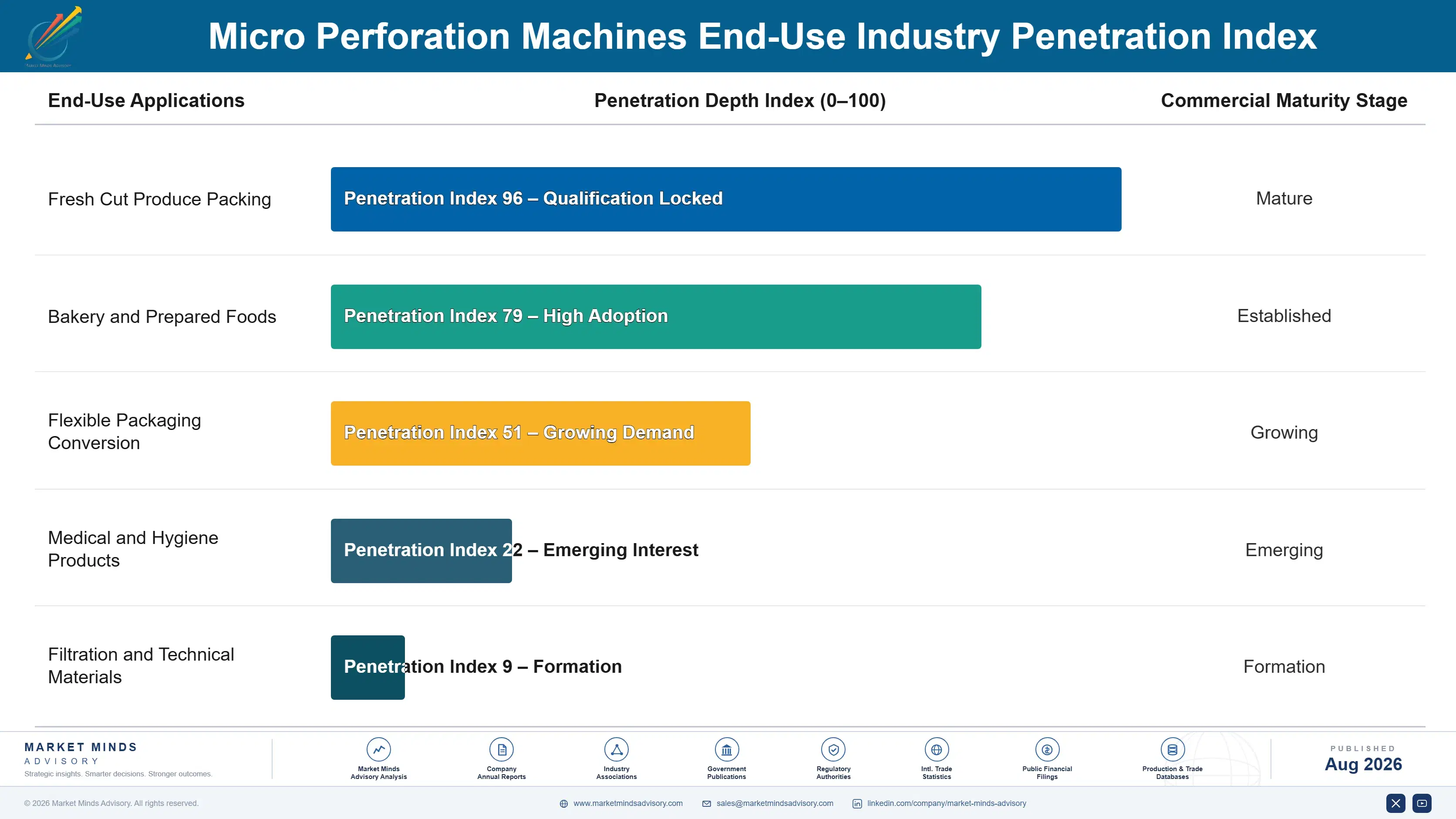
Recurring revenue here comes from product launches rather than from consumables or contracts. A packer that has installed perforation equipment returns to the supplier whenever it launches a new product, because hole density depends on cultivar, cut size, fill weight and temperature, and the previous specification does not transfer. That makes the relationship continuous in a way capital equipment sales rarely are, provided the supplier can actually answer the question rather than referring it b
Depth varies by category demand. Fresh cut salad and prepared vegetable packers buy deepest, launching products frequently and facing failures visibly in a chilled cabinet. Export produce packers buy deeply on transit shelf life. Whole produce and ambient packers buy shallowly, since respiration matters far less. Contract packers sit between, running whatever specification their retail customer has approved.

The deciding population has shifted upward. Perforation was historically specified by a packing engineer choosing equipment on throughput. Retail food waste commitments have moved part of that decision to category management at the retailer, who writes shelf life into a supply agreement and leaves the packer to achieve it however they can.
micro-perforation-machines-market-end-use-penetration-index-1787308579579

Where Perforation Suppliers Win

These are among the four positions where our research anticipates prominent divergence between winners and laggards over the coming forecast period. Each is grounded in the demand model, the regulatory perimeter, and the announced capacity pipeline.
01 / RESPIRATION DATA OWNERSHIP

The machine works perfectly and the product still fails

Correct hole density depends on product, cut size, fill weight and storage temperature, and it differs between cultivars enough that a specification working for one lettuce variety fails on another. Packers buying on throughput discover this when packs fail in a chilled cabinet days after leaving the plant. Suppliers that measure respiration on the customer's actual product before quoting prevent that outcome entirely, and the capability cannot be bought or copied quickly, which is why the packers that succeed here bought the measurement before they bought the machine.
02 / WASTE BUDGET ACCESS

Sell markdown reduction to the retailer, not equipment to the packer

Correctly matched perforation delivers around five additional days of usable shelf life and cuts retail markdowns by roughly 31% against generic film. Presented to a packer it competes against every other machine on the floor for capital. Presented to a retailer with a public food waste commitment and their own markdown data, it becomes a supply agreement requirement, and the packer then has to buy the capability regardless of what any capital committee had already said, and the supplier who reached the retailer first is named in the specification.
03 / CHANGEOVER ARGUMENT FRAMING

Engineers understand hole quality and operations controls the budget

Hole tolerance arguments reach engineers who already accept them and who rarely hold the capital authority. Changing hole size and density by setting rather than tooling removes roughly 94% of setup time, and a packer running twenty products across a week counts that in shifts recovered rather than in microns. Laser compounds at 11.9% and carries 16 to 24 additional margin points, and changeover is the argument that actually moves an adequate incumbent, because it speaks to time recovered rather than to precision nobody disputes.
04 / SUBSTRATE TRANSITION READINESS

Plastic reduction changes the material, not the respiration problem

Retailers moving produce onto paper and fibre substrates to cut plastic have not changed what the produce does inside the pack, since cut lettuce respires identically whatever surrounds it. Hole formation in fibre behaves quite differently from film under a laser, and the specification libraries built on film do not transfer across. Suppliers building that capability now, ahead of any confirmed volume, will meet a requirement that arrives whether or not plastic reduction ultimately prevails over the food waste argument in any given retail market.

Engagement Snapshot From the Field

A live engagement with an industry participant carrying material or product regulatory and market exposure ahead of a defining policy shift, showing how our research translates into a defensible multi-year portfolio strategy.
MARKET MINDS ADVISORY · CLIENT ENGAGEMENT SUMMARY
Micro Perforation Machines Producer Strategic Portfolio Review and Transition Roadmap 2026·Investment Scenario on Micro Perforation Machines Exposure Evaluation 2025-26
CLIENT PROFILE
A prepared salad and cut vegetable packer supplying four grocery retailers across three European markets, with roughly EUR 320 million in revenue (client-reported, unverified by MMA). The operation ran eleven packing lines using mechanical needle perforation across the whole range, with hole density specified from a supplier default rather than from any product measurement. Perforation had never been reviewed since the lines were commissioned.
STRATEGIC CHALLENGE
Two retail customers had raised shelf life complaints on specific salad lines, and one had written a usable shelf life requirement into its renewed supply agreement. Operations attributed the problem to cold chain performance during distribution. Nobody had measured what the products were actually respiring at, or whether the perforation specification suited them.
MMA APPROACH
MMA measured respiration rates across the client's twenty highest-volume products at realistic chilled storage temperatures, then compared required gas exchange against the perforation actually being applied. Retailer markdown data was obtained for the affected lines and compared against comparable products from other suppliers. Cold chain temperature records through distribution were reviewed alongside the complaint history to test the explanation operations had been working to.
KEY FINDINGS
  1. Fourteen of the twenty products tested were being perforated to a single default specification, and measured respiration rates across them varied by more than a factor of three at the same storage temperature.
  2. The two lines generating complaints were both substantially under-perforated for their measured respiration, which caused anaerobic conditions and the off-flavours the retailers had described.
  3. Cold chain temperature records through distribution were within specification on every complaint investigated, which eliminated the explanation operations had been working to for over a year.
  4. Mechanical needle hole variation across the full web width was wide enough that the achieved gas exchange differed measurably between the edge and centre of the same bag.
CLIENT PROFILE
A prepared salad and cut vegetable packer supplying four grocery retailers across three European markets, with roughly EUR 320 million in revenue (client-reported, unverified by MMA). The operation ran eleven packing lines using mechanical needle perforation across the whole range, with hole density specified from a supplier default rather than from any product measurement. Perforation had never been reviewed since the lines were commissioned.
STRATEGIC CHALLENGE
Two retail customers had raised shelf life complaints on specific salad lines, and one had written a usable shelf life requirement into its renewed supply agreement. Operations attributed the problem to cold chain performance during distribution. Nobody had measured what the products were actually respiring at, or whether the perforation specification suited them.
MMA APPROACH
MMA measured respiration rates across the client's twenty highest-volume products at realistic chilled storage temperatures, then compared required gas exchange against the perforation actually being applied. Retailer markdown data was obtained for the affected lines and compared against comparable products from other suppliers. Cold chain temperature records through distribution were reviewed alongside the complaint history to test the explanation operations had been working to.
KEY FINDINGS
  1. Fourteen of the twenty products tested were being perforated to a single default specification, and measured respiration rates across them varied by more than a factor of three at the same storage temperature.
  2. The two lines generating complaints were both substantially under-perforated for their measured respiration, which caused anaerobic conditions and the off-flavours the retailers had described.
  3. Cold chain temperature records through distribution were within specification on every complaint investigated, which eliminated the explanation operations had been working to for over a year.
  4. Mechanical needle hole variation across the full web width was wide enough that the achieved gas exchange differed measurably between the edge and centre of the same bag.
RECOMMENDED STRATEGY
Phase 1: Phase 1 (months 1 to 5): Reperforate the two complaint lines to measured respiration requirements and confirm shelf life against the retailer specification. Phase 2: Phase 2 (months 5 to 14): Measure respiration across the full product range and build a specification per product rather than a single default. Phase 3: Phase 3 (months 14 to 24): Convert the highest-variability lines to laser perforation for hole tolerance and settings-based changeover across the wider product range.
OUTCOME
Shelf life complaints ceased on both affected lines within one production cycle of reperforation (client-reported, unverified by MMA). Retail markdowns across the converted range fell by roughly 27%, and the renewed supply agreement shelf life requirement was met without dispute. Equipment spend of approximately EUR 1.8 million was approved on the strength of the retailer data (client-reported, unverified by MMA).

Frequently Asked Questions

Foundational context covering the market sizes, CAGR, scope, country, region and competition that inform every finding below. This section is provided to cover basics and most often pre-purchase conversations, answered from the MMA Primary Research Dataset.

What is the current size of the Micro Perforation Machines Market?

The global market was worth USD 0.58 billion in 2025, reaching USD 0.63 billion in 2026. East Asia holds the largest regional share at 31% of demand.

How large will the Micro Perforation Machines Market be by 2036?

MMA forecasts USD 1.32 billion by 2036, an expansion multiple of 2.10 times the 2026 base. That represents roughly USD 0.69 billion of incremental value.

What is the CAGR for the Micro Perforation Machines Market 2026 to 2036?

The base case compounds at 7.9% annually, with a bull case of 9.1% and a bear case of 6.7%. Historical growth from 2020 to 2025 ran at 6.5%.

Which segment is growing fastest?

Laser micro perforation systems compound at 11.9%, exactly 1.50 times the market rate. They hold hole diameter within four micrometres and change specification without any tooling.

Who are the major companies in the Micro Perforation Machines Market?

Bobst, Perfotec, Micro Perforation Technologies, Preco and Hulftegger together hold a combined 54% of the market. Application knowledge rather than machine building sustains that level of concentration.

Which country is growing fastest?

India compounds at 11.6%, ahead of every other national market. Cold chain investment has made fresh cut produce commercially viable where it previously was not.

Report Segmentation Architecture

The full report scope spans multiple orthogonal segmentation dimensions, with cross-tabulated demand data provided for each dimension pair. Coverage extends further to regional breakdowns, trend trajectories, and the competitive detail needed to support segment-level decision-making.

By Perforation Technology

  • Laser Micro Perforation Systems
  • Mechanical Needle and Pin Perforation
  • Hot Needle Perforation Systems
  • Electrostatic and Spark Perforation
  • Inline Converting-Integrated Modules
  • Laboratory and Pilot Perforation Units

By End-Use Industry

  • Fresh Cut Produce Packing
  • Bakery and Prepared Foods
  • Flexible Packaging Conversion
  • Medical and Hygiene Products
  • Filtration and Technical Materials

By Commercial Dimension

  • Direct Supply to Food Packers
  • Original Equipment Supply to Line Builders
  • Distributor and Integrator Channel
  • Application Testing and Specification Services

By Region

  • North America
  • Western Europe
  • East Asia
  • South Asia and Pacific
  • Latin America
  • Middle East and Africa
  • Eastern Europe

Scope, Methodology, and Coverage

Every figure in this report is reproducible from documented input assumptions. The scope below maps the historical period, the forecast horizon, the segmentation dimensions, and the countries covered, alongside the underlying primary and qualitative methodology.
Historical Period
2020 to 2025
Forecast Period
2026 to 2036
Base Year
2025 (USD billions; MMA Primary Research Dataset, August 2026)
Market Definition
The market covers equipment creating micro-scale perforations in packaging film, laminate and paper webs, spanning laser micro perforation systems, mechanical needle and pin perforation, hot needle systems, electrostatic and spark perforation, inline converting-integrated modules, and laboratory and pilot units, together with the respiration testing and specification services supplied alongside them. Macro perforation for easy-open and tear features, film extrusion and converting lines without perforation capability, and the packaging materials themselves are excluded. Sizing is measured at supplier revenue in current prices.
Quantitative Units
USD billions (current prices); installed systems and hole diameter in micrometres where applicable
Segmentation Dimensions
By Perforation Technology; By End-Use Industry; By Commercial Dimension; By Region
Regions Covered
North America, Western Europe, East Asia, South Asia and Pacific, Latin America, Middle East and Africa, Eastern Europe
Countries Covered
USA, China, Germany, France, UK, Japan, South Korea, India, Australia, Canada, Brazil, Mexico, Indonesia, Vietnam, Thailand, Malaysia, UAE, Saudi Arabia, South Africa, Nigeria, Turkey, Poland, Netherlands, Italy, Spain, Sweden, Switzerland, Argentina, Colombia, Singapore, and additional markets relevant to this sector
Key Companies Profiled
Bobst, Perfotec, Micro Perforation Technologies, Preco, Hulftegger, Sitma Machinery, Coherent, LasX Industries, Rofin-Sinar, Nordson Corporation, Amcor, Ampac Machinery, Kampf Schneid, Comexi Group, Sun Automation Group, PSA Technology, Elettro Sistemi, Rollem International, Hangzhou Cronite, Zhejiang Zhengye Machinery
Quantitative Methodology
Primary survey, n=3,800 respondents, Q4 2025, six countries; demand-side model with trade association cross-validation
Qualitative Methodology
47 expert interviews, Q4 2025; applied to validate demand model assumptions, identify emerging dynamics, and assess competitive positioning
Report Format
PDF and XLSX data workbook (Word format preview document)
Publisher
Market Minds Advisory
Report Code
MMA-2026-CON-815
Published
August 2026
Contact
sales@marketmindsadvisory.com | www.marketmindsadvisory.com

Purchase the full Micro Perforation Machines Market Report (2026 to 2036).

The full report sizes micro perforation equipment across six technologies, three commercial dimensions and seven regions, with annual forecasts to 2036 under base, bull and bear scenarios. Respiration requirements are compiled by produce type, cut size and storage temperature, which is the data that decides whether a pack works and which most suppliers do not hold. Retail shelf life requirements written into supply agreements are tracked by market and category. Laser and mechanical hole tolerance is compared across web widths at production speed. Twenty suppliers are profiled on a consistent equipment and service revenue basis.
Respiration requirements compiled by produce type and temperature
Retail shelf life supply agreement requirements tracked by market
Hole tolerance compared across web widths at production speed
Changeover time economics quantified by product range breadth
Paper substrate perforation behaviour assessed against film
Markdown reduction data correlated with atmosphere matching accuracy

Built For The People Who Decide

From boardroom strategy to bench-side execution, this report is read cover-to-cover by leaders shaping the next decade of their industry, turning demand scenarios, market dynamics and valuation benchmarks into decisions.
CXOs/ Presidents/ VPs/ Managers
M&A and Corporate Development
Strategy Teams and R&D Heads
Procurement and Product Directors
Regulatory and Compliance Leaders
Investor Relations and Equity Analysts