Market Minds Advisory
Magazine and Literature Bag Market

Magazine and Literature Bag Market: Trends and Forecast 2026 to 2036

Extended producer responsibility regulations on single-use plastic packaging are pushing publishers and direct mail marketers toward compostable and paper-based literature bags, even as conventional polyethylene formats remain the lowest-cost option for high-volume magazine distribution.

Lead Analyst

Bilal Shaikh

Published

September 2026

Make Smarter Decisions with Customized Research Insights

Request a free sample report and evaluate market opportunities, growth trends, and competitive dynamics relevant to your business needs.

2025 MARKET VALUE$1.4BMarket Size 2025
2036 FORECAST VALUE$2.1BBase Case , 2026 to 2036
CAGR 2026 TO 20363.8 %Bull 4.9% / Bear 2.7%
INCREMENTAL OPPORTUNITY$0.7BNet 10- year value creation
EXPANSION MULTIPLE1.45x2036 value over 2026 base
Strategic Levers
M&A Pipeline
Regional Outlook
Country Rankings
Competitive Intelligence
Segmental Deep-dive
Call-Us : 91 93563 13602

Executive Snapshot and Market Trajectory

Magazine and literature bag demand is shifting toward compostable and paper-based formats as extended producer responsibility regulations restrict single-use plastic packaging across several major regional markets, even as conventional polyethylene bags continue anchoring most high-volume magazine and catalog distribution programmes across established postal and subscription networks.
Commercial forces now split the market between publishers and direct mail marketers under sustainability mandates paying premium pricing for compostable packaging and smaller distributors continuing to purchase lower-cost conventional polyethylene bags at high volume. Biodegradable and compostable film bags are the fastest-growing format, expanding as regulatory pressure spreads across major publishing and retail catalog markets nationwide. North America and Western Europe together account for most global demand.
Competitive intensity concentrates among a handful of specialty converters holding the compostable film formulation and postal compliance certification required to serve regulated publishing markets, leaving conventional polyethylene bag supply more fragmented across regional converters. Postal service dimensional and weight specifications add a further layer of complexity, since publishers rarely switch packaging formats mid-subscription cycle given the operational disruption reformatting mailing equipment can create across their distribution and fulfillment operations nationwide and internationally.
Market Definition
The Magazine and Literature Bag Market covers polymer, biodegradable, and paper-based bags used to wrap, protect, and distribute magazines, catalogs, and direct mail literature through postal and retail channels. It excludes rigid mailers, corrugated packaging, and general retail carrier bags.
Base Year Value
$1.4B in 2025 (MMA Primary Research Dataset, August 2026)
Forecast Period
2026 to 2036, eleven discrete annual values
CAGR
3.8% base case. Bull 4.9%. Bear 2.7%.
Fastest Growth Segment
Biodegradable/Compostable Film Bags: 7.5% CAGR
Fastest Growth Country
India: 6.0% CAGR
Fastest Growth Region
South Asia and Pacific: 5.8% CAGR
Largest Region
North America: 30% of 2025 global value
Market Leaders
Leading participants include Novolex, ProAmpac, Berry Global, Coveris, and Inteplast Group. Source: MMA Primary Research Dataset, July 2026.
Primary Survey
n=3,800 procurement and R&D decision-makers, Q4 2025, six countries
Methodology
Demand-side build-up, cross-validated against public data, 47 expert interviews

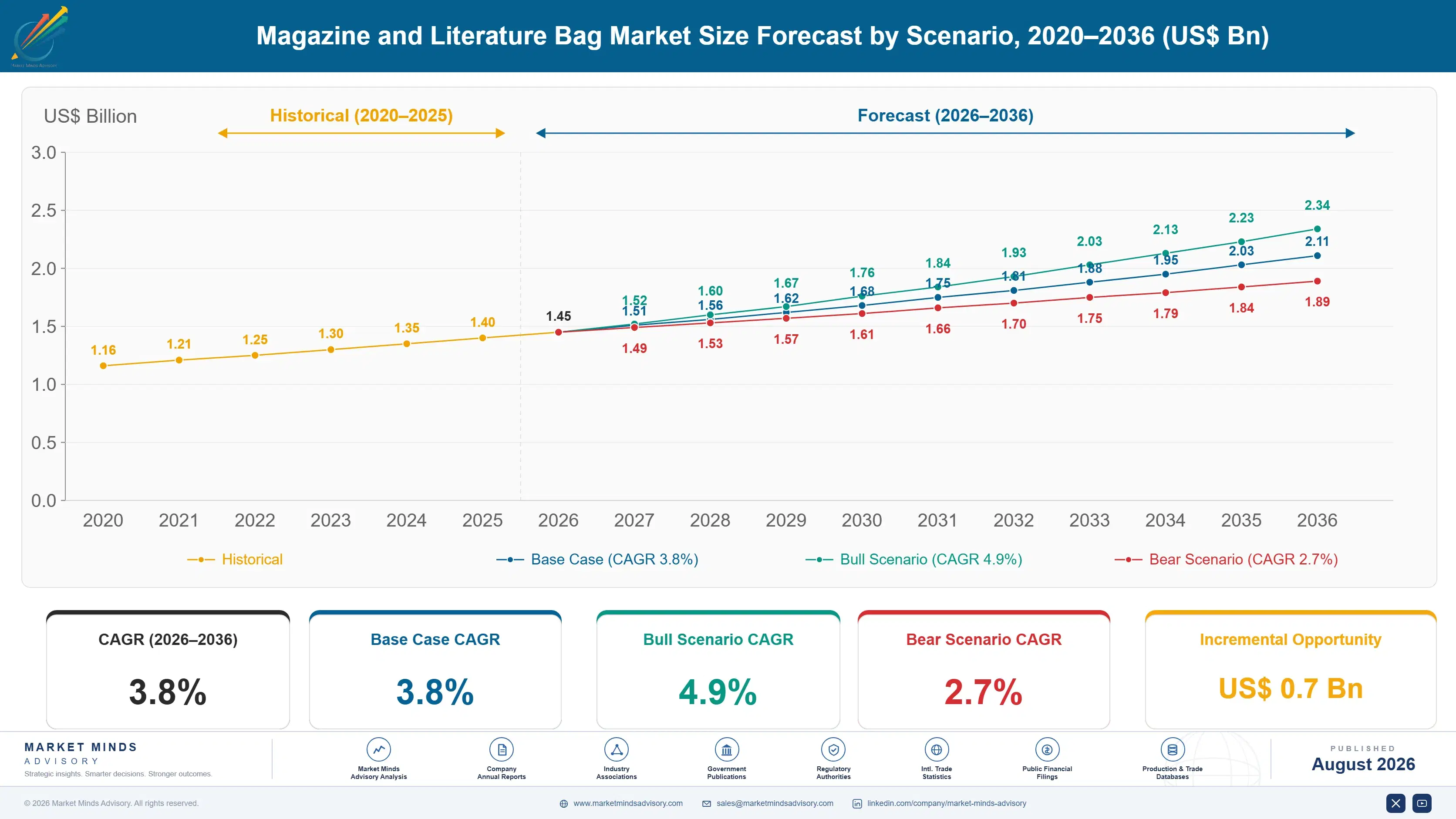
Magazine and Literature Bag Market Forecast Scenarios

magazine-and-literature-bag-market-size-forecast-scenario-1787554941047
Between 2020 and 2025 the market grew at an estimated 3.5% annual pace, held back by pandemic-era print circulation declines and slow recovery in catalog mailing volume. Polyethylene bags dominated the period, since publishers prioritized cost stability over sustainability credentials while postal operators kept dimensional specifications largely unchanged across most contract renewal cycles through 2025.
The base case assumes 3.8% annual growth to 2036, driven by three mechanisms: extended producer responsibility regulation phasing out non-compostable plastic film across the European Union and several US states, publisher sustainability commitments tying packaging format to brand positioning, and postal operators standardizing lightweight compostable specifications to lower handling costs. Direct mail marketers adopt compostable formats more slowly than magazine publishers, since switching costs remain secondary to catalog publishers facing direct regulatory exposure and sustainability scrutiny from retail brand partners.
The bull case centers on the European Union's Packaging and Packaging Waste Regulation accelerating compostable format mandates faster than currently scheduled, pushing growth toward 4.9%. The bear risk is compostable film cost premiums staying above 30% versus polyethylene, which would slow conversion among cost-sensitive regional distributors and catalog publishers, holding growth closer to 2.7% through the forecast window.

Print Packaging Under Regulatory Reformulation Pressure

The Magazine and Literature Bag Market sits at the intersection of print media distribution and packaging regulation, where postal specifications, brand sustainability commitments, and material cost dictate format selection more than raw underlying demand growth. Publishers and direct mail marketers together represent the two largest buyer categories, each facing distinct pressure to reduce plastic film volume across their respective distribution programmes.
MARKET CONCENTRATION32%Share held by five largest bag converters combined
AVERAGE SELLING PRICE$0.04 per unitTypical cost publishers pay per standard film bag
TOP PRODUCING COUNTRY26%Share of global output from the United States
CAPACITY UTILIZATION71%Average operating rate across compostable film production lines
FEEDSTOCK COST SHARE48%Portion of production cost from resin and paper inputs
REPLACEMENT CYCLESingle-useTypical usage duration before bag disposal or recycling
Polyethylene film remains the workhorse material across high-volume magazine wrapping, prized for low unit cost and tear resistance during automated postal sorting and handling equipment. Compostable film and kraft paper formats carry a meaningful cost premium, yet the European Union and a growing number of US states are tightening restrictions on non-compostable film fast enough that converters are investing in certified compostable production lines well ahead of firm confirmed demand.
Converter concentration remains moderate, with a handful of specialty compostable film producers holding certification advantages that smaller regional converters cannot easily replicate at comparable cost. Capacity utilization runs consistently tighter in compostable lines than in conventional polyethylene extrusion, reflecting the lag between installed compostable capacity and accelerating regulatory-driven demand across major publishing and direct mail markets.
"Publishers aren't switching packaging because they want to. They're switching because postal contracts and state-level packaging laws are quietly forcing the decision two years earlier than most converters had planned for."
Senior Analyst, Packaging and Materials Practice · MMA Packaging Practice · August 2026

Market Trends

Compostable Film Adoption Accelerates Across Regulated Publishing Markets

Publishers serving the European Union and a growing list of US states are converting magazine wrapping from conventional polyethylene film to certified compostable formats ahead of hard regulatory deadlines. Converters report certified compostable film now represents a rising share of new production line investment, even though it remains a minority of total volume shipped. The shift is uneven: catalog retailers with strong sustainability branding are moving faster than smaller regional publishers operating on tighter packaging budgets, creating a two-speed adoption pattern that is reshaping converter investment priorities across the industry through the remainder of the decade.
Market Impact: Compliance fees add $0.006 daily
Postal Operators Standardize Lightweight Bag Specifications

National postal operators across North America and Western Europe are revising dimensional and weight specifications to favor lighter, thinner bag formats that reduce handling and transport cost across automated sorting systems. These specification changes push converters toward thinner-gauge polyethylene and compostable film alike, since both formats must meet identical tear-resistance and moisture-barrier thresholds under the new postal standards. Publishers adjusting to the specifications face a brief transition cost as packaging lines are recalibrated, but most report the changeover completing within two to three quarters once new film specifications are finalized.
Market Impact: Brand pledges cover 40% of volume

Market Opportunities and Growth Drivers

Extended Producer Responsibility Rules Restrict Non-Compostable Film

Extended producer responsibility legislation in the European Union and several US states now assigns packaging waste disposal cost directly to producers and importers, making non-compostable polyethylene film measurably more expensive to place on the market than it was five years ago. The regulation directly targets single-use plastic film used in magazine and catalog wrapping, since it represents a visible and easily identifiable waste stream in municipal recycling audits. Publishers facing rising compliance fees are shifting procurement toward certified compostable and paper-based alternatives faster than cost comparisons alone would otherwise justify, reshaping converter order books industry-wide.
Market Impact: Premium adds $0.012 to $0.016

Brand Sustainability Commitments Reshape Catalog Packaging Procurement

Major retail and publishing brands have adopted public packaging sustainability targets tied to corporate emissions reduction commitments, and magazine and literature bags fall squarely within the scope of those pledges given their visibility to end consumers. Procurement teams at large catalog retailers now specify compostable or recycled-content film as a contract requirement for new converter agreements, rather than treating it as an optional upgrade. This has pulled forward converter capacity investment in compostable production lines well ahead of the point where cost parity with conventional film would have justified it on economics alone.
Market Impact: Only 45% of households compost

Market Restraints and Challenges

Compostable Film Cost Premium Slows Broad Conversion

Certified compostable film costs roughly 30 to 40% more per unit than conventional polyethylene, a gap rooted in smaller production runs, higher-cost feedstock, and the additional certification testing required to meet composting standards. For smaller regional publishers and direct mail marketers operating on thin packaging budgets, this premium is difficult to absorb without raising subscription or catalog distribution prices, which risks reducing response rates. Some converters are exploring co-extrusion techniques that blend compostable and conventional resins to narrow the cost gap, though these hybrid formats have not yet achieved full composting certification in most jurisdictions.
Market Impact: Compostable film gains 8 points share

Composting Infrastructure Gaps Limit End-of-Life Claims

Compostable bags require access to industrial composting facilities to break down within the timeframes producers advertise, yet municipal composting infrastructure remains unevenly distributed even across regulated markets in the European Union and North America. In regions lacking industrial composting access, compostable bags often end up in landfill or conventional recycling streams where they fail to decompose as intended, undermining the environmental case converters use to justify the cost premium. Industry groups are lobbying municipalities to expand composting collection alongside packaging mandates, but infrastructure build-out lags the pace of regulatory adoption by several years in most markets.
Market Impact: Sorting cost falls 12% now
3 additional market trends, 4 additional growth drivers, and 2 additional restraints and challenges are covered in the full report. Contact sales@marketmindsadvisory.com to access the complete intelligence.

Segment CAGR and Growth Architecture

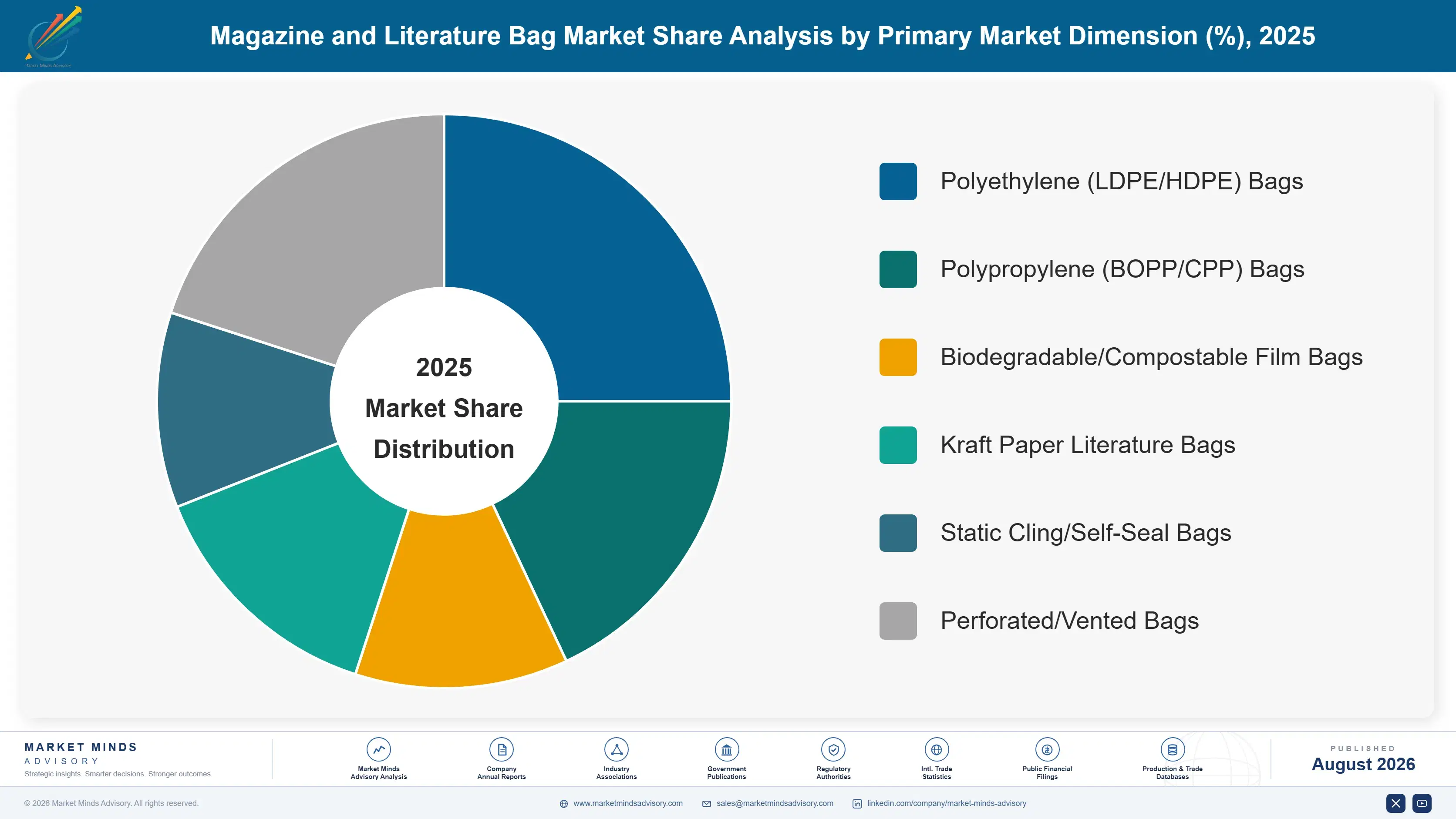
The market divides into six material-based segments spanning conventional and next-generation formats. Polyethylene and polypropylene film bags anchor current volume, while biodegradable and compostable formats, kraft paper variants, static cling designs, and perforated ventilated bags serve regulatory compliance, premium branding, and specialized postal distribution needs across the publishing and direct mail marketing industries worldwide.
magazine-and-literature-bag-market-market-share-analysis-1787554941578

Biodegradable/Compostable Film Bags

Biodegradable and compostable film bags are converting fastest as extended producer responsibility rules phase out conventional polyethylene film across the European Union and a growing list of US states. Made from certified compostable resins that break down fully under industrial composting conditions, these bags command a meaningful price premium over standard film yet increasingly appear as a contract requirement rather than an optional upgrade in major publisher and catalog retailer procurement agreements. Converter investment in compostable extrusion lines has accelerated well ahead of firm volume commitments, reflecting expectations that regulatory deadlines across additional jurisdictions will pull remaining conventional film demand toward certified compostable alternatives over the coming decade and beyond.
CAGR 7.5%

Kraft Paper Literature Bags

Kraft paper literature bags are the second-fastest-growing format, favored by publishers and direct mail marketers seeking a recyclable, widely accepted alternative that avoids the composting infrastructure gaps limiting some biodegradable film formats in less developed regional municipal recycling systems. Kraft paper carries strong recyclability credentials recognized across nearly all municipal recycling systems worldwide, unlike compostable film which requires industrial composting access that remains unevenly distributed across regulated markets. Weight and moisture resistance limitations restrict kraft paper's use in humid climates and heavier catalog formats, but converters are addressing this through wax and polymer coating treatments that preserve recyclability while improving durability for postal handling across varied climate conditions and seasons.
CAGR 6.5%
Full segment breakdown across 6 segments available in the complete report.

Regional Architecture and Country Demand Map

Regional demand tracks print media infrastructure and packaging regulation intensity rather than population or income. North America and Western Europe lead on established subscription and direct mail volume, while East Asia's converter base and tightening compostable rules across South Asia and Pacific reshape where new capacity gets built.

North America

United States and Canadian publishers still mail more magazines and catalogs per capita than any other region, sustaining the largest single pool of demand for both conventional and compostable literature bags. Postal specification changes from the US Postal Service are pushing converters toward standardized lightweight formats faster than in most other tracked markets worldwide. California and several northeastern states have already restricted non-compostable film distribution, creating a patchwork of state-level rules that national publishers must navigate simultaneously across differing compliance timelines. Direct mail marketers serving retail catalog clients represent a growing share of regional volume, even as overall print magazine circulation continues its slow multi-decade decline across most subscription categories nationwide and across most demographic segments.
Share: 30% | CAGR: 3.3% (2026 to 2036)

Western Europe

Packaging regulation, not print volume, drives Western European demand: the European Union's Packaging and Packaging Waste Regulation is phasing out non-compostable film faster here than in any other tracked region worldwide. Germany and France account for the largest national volumes, reflecting their large subscription magazine and mail-order catalog bases relative to smaller neighboring markets. Converters serving this region have invested earliest in certified compostable production capacity, positioning them to supply certified film to other regulated markets as similar rules phase in elsewhere over time. Print circulation is declining gradually, but the region's early regulatory lead means packaging format conversion, rather than volume growth, defines competitive positioning among converters through the forecast period and beyond.
Share: 24% | CAGR: 2.5% (2026 to 2036)
Regional intelligence for 5 additional markets available in the complete report: East Asia, South Asia and Pacific, Latin America, Middle East and Africa, Eastern Europe. Contact sales@marketmindsadvisory.com.
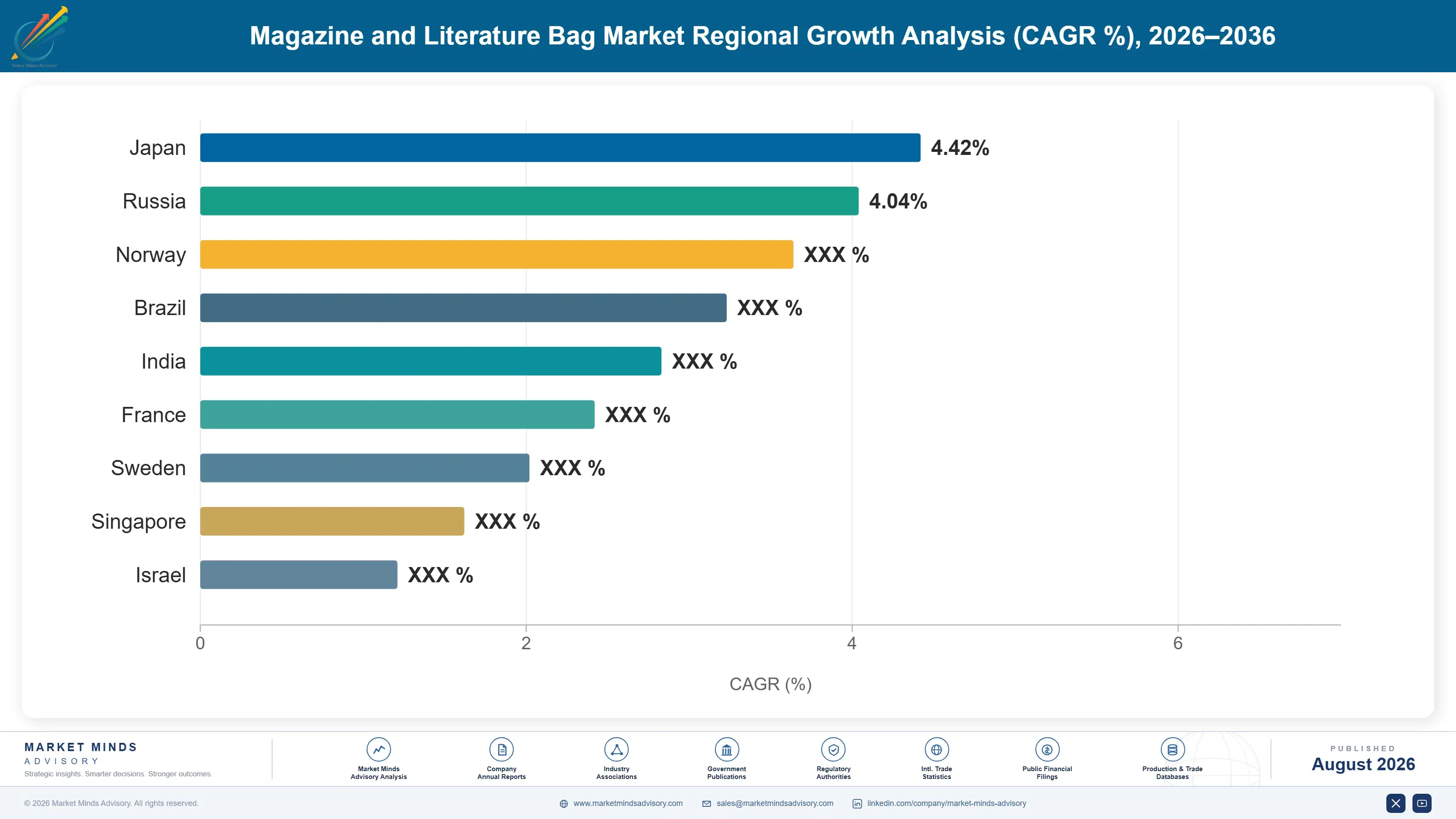
magazine-and-literature-bag-market-country-cagr-analysis-1787554942103

Where Converters Can Capture Additional Margin

Converters face a widening gap between commodity polyethylene pricing and the certification, formulation, and postal-compliance capabilities that regulated publishers now demand from their packaging suppliers. Four levers stand out for capturing margin above baseline film extrusion economics: certification services, hybrid material formulation, postal compliance consulting, and direct-to-publisher contract structuring that bypasses traditional wholesale distributor markups entirely across the supply chain.

Compostable Certification and Third-Party Testing Services

Converters holding third-party compostability certification, such as EN 13432 or ASTM D6400 approval, can charge publishers a premium averaging 15 to 20% above uncertified film, since certification removes the compliance risk publishers would otherwise bear directly under tightening state and national regulations. Building in-house testing capability rather than outsourcing to certification labs cuts per-batch certification cost by roughly 25% once volume justifies the fixed investment in testing equipment and qualified technical staff. Mid-sized converters lacking certification currently cede this margin entirely to larger competitors already holding accredited status across multiple film formulations, gauges, and regional markets.
Market Impact: Certification premium adds 15 to 20% pricing power

Hybrid Compostable and Conventional Film Formulation Development

Blending compostable and conventional resins through co-extrusion technology can narrow the cost premium compostable film carries from roughly 35% down to near 18%, while still qualifying for partial compostability claims in jurisdictions with tiered certification standards and phased compliance timelines. This approach lets converters serve cost-sensitive publishers transitioning gradually rather than losing that volume entirely to competitors offering only fully conventional film at the lowest price point. Early movers in hybrid formulation are capturing share from mid-market publishers unwilling to pay the full compostable premium but under growing regulatory and brand pressure to reduce plastic content measurably and quickly.
Market Impact: Hybrid formulation cuts compostable premium down to 18%

Postal Compliance Consulting and Specification Testing Services

Converters offering dimensional and weight specification consulting alongside bag supply capture an estimated 8 to 12% service fee on top of product pricing, since publishers increasingly lack in-house expertise to navigate frequently changing postal handling requirements across multiple national jurisdictions and carrier networks worldwide today. This bundled service model deepens customer relationships and raises switching costs, since publishers who have already validated a converter's specifications against postal requirements face real friction and cost in re-qualifying a new supplier mid-contract cycle across their distribution network and fulfillment operations nationwide and internationally.
Market Impact: Consulting fees add 8 to 12% extra revenue

Direct Publisher Contract Structuring and Volume Commitments

Converters negotiating multi-year direct contracts with large publishers, bypassing wholesale distributors, can improve gross margin by roughly 6 to 9 percentage points by eliminating distributor markup while offering publishers price stability against resin cost volatility over the full multi-year contract term. These direct arrangements typically require minimum volume commitments of two to three years, which favor larger converters with the balance sheet capacity to guarantee supply continuity that smaller regional competitors cannot credibly match given their far more limited production capacity, working capital, and financial reserves across full market cycles.
Market Impact: Direct contracts improve margin by 6 to 9 points

Who Controls the Margin Pool

Concentration remains moderate: the top five converters hold 32% combined share on a revenue basis, evaluated consistently across producers regardless of whether they compete primarily in conventional film or compostable formats. Novolex leads on scale and vertical integration into resin conversion, followed closely by ProAmpac, while a wide gap separates the leading pair from Berry Global and Coveris, who compete on regional density and specialty capability rather than national scale.
Competitive activity currently centers on compostable certification investment, as converters race to secure EN 13432 and ASTM D6400 approval ahead of tightening state and European Union deadlines. Several mid-tier players have announced new extrusion lines dedicated to compostable film, while others are pursuing kraft paper capacity instead, betting that recyclability credentials will outcompete compostable claims among cost-sensitive publishers reluctant to pay a lasting premium.

Emerging pressure comes from smaller regional specialists who reached compostable certification early and are now underpricing larger converters still amortizing legacy polyethylene extrusion assets. Rankings could shift meaningfully if postal operators standardize specifications around a single film gauge, since that would commoditize a capability several mid-tier players currently treat as differentiated, forcing consolidation among converters lacking sufficient scale to compete purely on cost.
magazine-and-literature-bag-market-company-positioning-matrix-1787554942616

Competitive Moat and Risk Dimensions

NOVOLEX

Moat: Vertical Resin Integration Advantage

Novolex operates its own polyethylene resin conversion capacity, insulating it from the spot-market price swings that smaller converters absorb directly when feedstock costs spike. This integration also lets the company qualify new compostable resin formulations faster than competitors dependent on third-party resin suppliers, since it controls formulation testing internally rather than negotiating trial batches externally with outside resin producers.
NOVOLEX

Risk: Legacy Polyethylene Asset Exposure

A meaningful share of Novolex's installed extrusion capacity remains configured for conventional polyethylene film, requiring capital-intensive retrofitting or new line construction to meet rising compostable format demand. Competitors building compostable-dedicated lines from scratch avoid this stranded-asset risk entirely, which could erode Novolex's cost advantage if regulatory phase-outs accelerate faster than its retrofit investment schedule currently allows for.
PROAMPAC

Moat: Early Compostable Certification Lead

ProAmpac secured EN 13432 and ASTM D6400 certification across its core film lines earlier than most competitors, letting it win contract-required compostable business from major European and North American publishers before rivals could qualify. This first-mover certification position also gives ProAmpac pricing power on premium compostable formats that uncertified competitors cannot yet match on comparable delivery terms.
PROAMPAC

Risk: Higher Cost Base Than Peers

ProAmpac's compostable-first capacity mix carries a higher average production cost than competitors still running predominantly conventional polyethylene lines, limiting its ability to compete on price for cost-sensitive publishers not yet under firm regulatory pressure to convert. If compostable premiums compress faster than expected, this cost structure could pressure margins more than at competitors with a more balanced format mix.

Players Tracked

Prominent Players

Novolex
ProAmpac
Berry Global
Coveris
Inteplast Group

Other Key Players

Sonoco Products
Amcor
Mondi Group
Smurfit WestRock
International Paper
Huhtamaki
Constantia Flexibles
Sealed Air
Winpak
Polykar Inc
American Packaging Corporation
Hood Packaging Corporation
Duro Bag Manufacturing
Bemis Company
Transcontinental Inc

Recent Developments

FEBRUARY 2025

Novolex commissioned a new compostable film extrusion line at its Tennessee facility, adding dedicated capacity for EN 13432 and ASTM D6400 certified formats to serve publishers and catalog retailers converting away from conventional polyethylene film under tightening state-level packaging regulations across multiple US markets and jurisdictions.
Signal: Signals accelerating conversion of legacy polyethylene extrusion assets toward certified compostable production capacity across the converter's national footprint.
SEPTEMBER 2025

ProAmpac acquired a mid-sized kraft paper converter in Poland to gain recyclable paper literature bag capacity serving Eastern European direct mail and catalog markets, extending its compostable film leadership into a second material category ahead of upcoming European Union packaging waste regulation compliance deadlines across member states.
Signal: Confirms leading converters are diversifying beyond compostable film into recyclable paper formats to broaden their addressable customer base.
JUNE 2025

Berry Global signed a multi-year supply agreement with a major European direct mail marketer to provide certified compostable film bags across four countries, securing volume commitments that support continued investment in the company's compostable extrusion capacity through the remainder of the current ten-year forecast decade.
Signal: Shows major publishers locking in multi-year compostable supply commitments well ahead of approaching regulatory compliance deadlines.

Resin and Paper Feedstock Cost Exposure

Polyethylene resin accounts for roughly 48% of production cost across conventional film formats, sourced primarily from ethylene crackers in the United States Gulf Coast and Middle East, with smaller volumes from East Asian petrochemical complexes. Compostable resin inputs, largely polylactic acid and starch-based blends, carry a higher cost share and depend on a narrower base of specialty chemical suppliers concentrated in North America and Western Europe.
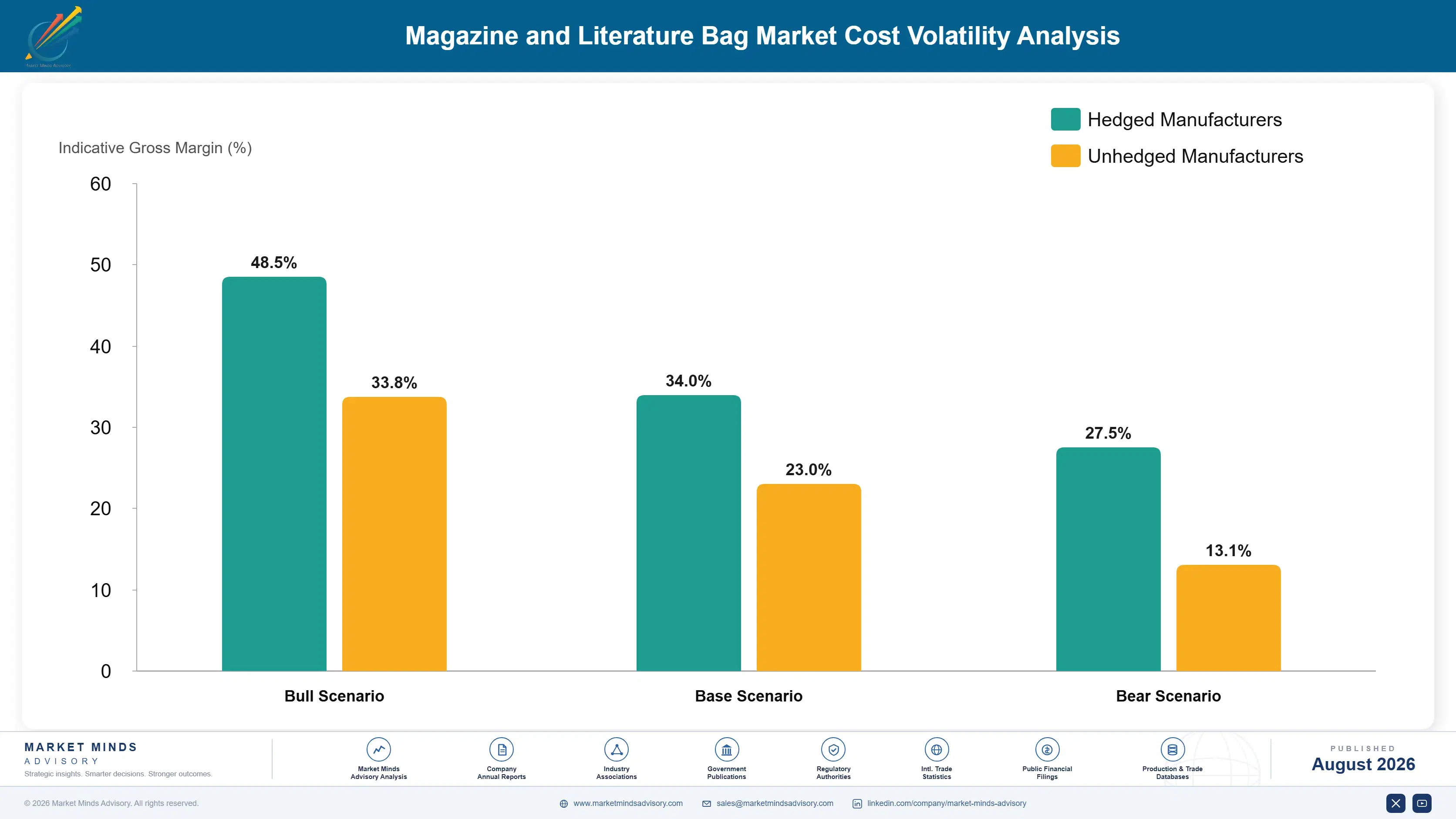
Ethylene prices spiked sharply during 2022 as Russia's invasion of Ukraine disrupted European natural gas supply feeding regional crackers, a volatility event documented in IEA quarterly petrochemical market reports. Converters without long-term resin supply contracts absorbed cost increases directly, while those holding fixed-price agreements passed through smaller increases to publishers, illustrating how contract structure shapes margin resilience during feedstock price shocks across the industry broadly.

Smaller regional converters lacking scale to negotiate favorable resin contracts face a real competitive disadvantage against integrated players like Novolex, who convert resin internally and capture margin that independent buyers pay away to suppliers. This exposure varies by geography too: European converters face higher baseline energy costs embedded in resin pricing than North American competitors benefiting from cheaper domestic natural gas feedstock for ethylene cracking operations.
magazine-and-literature-bag-market-cost-volatility-analysis-1787554942812

Long-Term Resin Supply Contracts With Fixed Pricing Bands

Converters increasingly negotiate multi-year resin contracts with price collars that cap upside exposure during feedstock spikes while sharing some downside benefit with suppliers during periods of falling prices. This reduces earnings volatility for converters lacking the balance sheet to absorb sudden cost increases without passing them through to publishers immediately, preserving customer relationships during volatile pricing periods.

Diversifying Compostable Resin Supplier Base Geographically

Several converters are qualifying secondary polylactic acid suppliers outside their traditional North American and Western European base, including emerging Southeast Asian producers, to reduce dependence on a narrow supplier group. This diversification lowers single-source risk and creates negotiating leverage during contract renewals, though qualification testing typically takes twelve to eighteen months to complete before large orders.

Co-Extrusion Blending to Reduce Compostable Resin Dependence

Blending compostable resin with recycled or bio-based conventional content reduces the volume of premium-priced virgin polylactic acid required per unit of finished film, lowering exposure to that supplier group's pricing power over time. This technique also allows converters to stretch limited compostable resin allocations across more total production volume during periods of tight market supply.

Portfolio Architecture for Margin Defence

Portfolio economics split sharply along a volume-versus-premium axis across the industry. Conventional polyethylene film competes almost entirely on unit cost, with gross margins compressed by resin price volatility and thin differentiation among suppliers competing for the same publisher accounts. Certified compostable and specialty kraft formats carry meaningfully higher margins, reflecting certification barriers, formulation expertise, and the contract-required status these formats now hold among regulated publishers and catalog retailers.
The tension between volume and premium is intensifying as regulatory deadlines pull demand toward certified formats faster than certification capacity can scale industry-wide across most converter networks. Converters over-indexed on conventional polyethylene face margin erosion as that segment shrinks toward a smaller, price-sensitive core, while those who invested early in compostable certification are capturing a disproportionate share of the industry's expanding premium revenue pool relative to their overall production volume.

High-value margin pools concentrate in compostable film serving European Union and California-regulated publishers, where certification barriers and contract-required status limit competitive entry from smaller regional converters. A second, smaller pool sits in specialty kraft paper serving premium catalog retailers seeking recyclability credentials without the composting infrastructure dependency that limits compostable film's practical end-of-life claims in less developed municipal recycling systems worldwide.

Conventional polyethylene and polypropylene film bags sold primarily on unit cost to high-volume magazine and catalog distributors, where thin margins reflect limited differentiation and intense price competition among regional converters serving cost-sensitive accounts.
Gross Margin

Certified compostable film and treated kraft paper formats commanding contract-required status among regulated publishers, where certification barriers and formulation expertise support meaningfully higher margins than conventional format alternatives across most regional markets.
Gross Margin

Emerging hybrid formulations, advanced bio-based resins, and next-generation compostable technologies still in early commercial scale-up, commanding the highest margins as converters price in scarcity value ahead of broader industry-wide adoption and capacity buildout.
Gross Margin
magazine-and-literature-bag-market-portfolio-architecture-1787554943309

High-value Sub-segments and Strategic Watch-out

Compostable Film for Regulated Publishers

Certified compostable film serving European Union and California-regulated publishers combines the fastest segment growth with the highest margins in the portfolio, driven by contract-required status and certification barriers limiting new entrant competition. Converters holding early certification are best positioned to capture this expanding pool fully.

Kraft Paper for Premium Catalog Retailers

Kraft paper literature bags serve premium catalog retailers seeking recyclability credentials without composting infrastructure dependency, combining solid growth with above-average margins tied to specialty coating treatments. This segment benefits from broader municipal recycling acceptance than compostable film, supporting steady expansion among sustainability-focused retail brand partners.

Conventional Polyethylene Film for High-Volume Distribution

Conventional polyethylene film remains the volume core of the market, serving cost-sensitive magazine and catalog distributors not yet under firm regulatory pressure to convert. Growth is slow and margins are thin, but the segment still represents the largest single share of total unit volume shipped across the industry currently.

Static Cling and Self-Seal Specialty Formats

Static cling and self-seal bags serve a narrow specialty niche within direct mail marketing, facing uncertain long-term demand as postal operators standardize specifications toward simpler, lower-cost formats. Converters should monitor whether postal rule changes eliminate this format's practical advantages within the next several forecast years ahead.

Recurring Demand Behind Print Distribution

Magazine and literature bag demand behaves like an annuity for converters holding long-term publisher contracts, since subscription and catalog mailing cycles recur predictably regardless of short-term economic conditions. Multi-year supply agreements, once won, tend to renew automatically unless a competitor offers a meaningfully lower price or superior postal compliance support, giving incumbent converters durable, recurring revenue streams across their contracted publisher base.
Stickiness varies meaningfully by end-use vertical: subscription magazine publishers rarely switch converters mid-contract given the operational disruption of reformatting mailing equipment, while direct mail marketers running episodic campaigns switch more readily based on price and format availability. Retail catalog distributors sit between these extremes, valuing consistency but willing to test new compostable suppliers when sustainability commitments require format changes across their broader packaging portfolio.

Buyer profiles are shifting generationally as procurement decisions move from print production managers focused purely on unit cost toward sustainability and compliance officers weighing regulatory exposure alongside price. This generational shift favors converters who can speak credibly to certification standards and postal compliance rather than cost alone, reshaping which sales relationships and technical capabilities matter most in winning and retaining large publisher accounts.
magazine-and-literature-bag-market-end-use-penetration-index-1787554943800

MMA Verdict on Market Positioning

These are among the four positions where our research anticipates prominent divergence between winners and laggards over the coming forecast period. Each is grounded in the demand model, the regulatory perimeter, and the announced capacity pipeline.
01 / CERTIFICATION INVESTMENT PRIORITY

Secure Compostable Certification Before Deadlines Bind

Converters without EN 13432 or ASTM D6400 certification are ceding contract-required business to certified competitors right now, not in some future compliance year several budget cycles away from today's decision point. The premium certified converters command, averaging 15 to 20% above uncertified film, will only widen as European Union and multiple US state deadlines approach through 2028 and beyond, rewarding early movers disproportionately. Delaying certification investment past 2027 risks permanent exclusion from the fastest-growing and highest-margin segment of the entire market for years to come.
02 / HYBRID FORMAT DIVERSIFICATION

Build Hybrid Capacity to Bridge the Cost Gap

Pure-play compostable converters are pricing out cost-sensitive publishers who need a transition format between conventional polyethylene and full compostable film that most cannot yet afford to adopt outright at scale. Hybrid co-extrusion technology narrows that premium substantially while still qualifying for partial compostability claims in several tiered regulatory jurisdictions across Europe and parts of North America facing phased compliance timelines. Converters who build this bridge capacity now will capture volume that pure premium or pure commodity players cannot economically serve today or in coming years.
03 / POSTAL RELATIONSHIP DEPTH

Deepen Postal Compliance Consulting Capabilities

Postal specification changes are accelerating across major markets, and publishers increasingly lack the in-house expertise to navigate them without dedicated supplier support, guidance, and ongoing technical reassurance throughout the contract relationship. Converters who bundle compliance consulting alongside bag supply are capturing meaningful service fees and, more importantly, raising switching costs for their existing publisher accounts across multiple successive contract renewal cycles. This capability gap is currently underexploited by all but the largest converters serving this fragmented and still-consolidating industry landscape today.
04 / GEOGRAPHIC SUPPLY POSITIONING

Expand Compostable Capacity in Southeast Asia Early

Southeast Asian converters are building export-oriented compostable film capacity to serve regulated Western markets facing certification bottlenecks and rising domestic production costs back home in Europe and North America. Early movers securing certification and customer relationships in Vietnam and Indonesia now will hold a durable cost and lead-time advantage over competitors entering once the region's capacity build-out is further along and better established regionally. This window will likely close within three to four years as regional capacity investment accelerates industry-wide.

Engagement Snapshot From the Field

A live engagement with an industry participant carrying material or product regulatory and market exposure ahead of a defining policy shift, showing how our research translates into a defensible multi-year portfolio strategy.
MARKET MINDS ADVISORY · CLIENT ENGAGEMENT SUMMARY
Magazine and Literature Bag Producer Strategic Portfolio Review and Transition Roadmap 2026·Investment Scenario on Magazine and Literature Bag Exposure Evaluation 2025-26
CLIENT PROFILE
The client is a mid-size subscription magazine publisher operating across four Western European countries, distributing roughly 2.5 million copies monthly through national postal networks. Facing tightening European Union packaging waste regulation, the publisher's packaging procurement team needed an independent assessment of compostable format conversion timing, cost impact, and converter selection ahead of an approaching multi-year contract renewal decision affecting its entire distribution footprint.
STRATEGIC CHALLENGE
The publisher faced a binary choice between renewing its existing conventional polyethylene supply contract at attractive pricing or transitioning to certified compostable film ahead of regulatory deadlines at meaningfully higher unit cost. Internal finance and sustainability teams disagreed on timing, and the packaging team lacked independent market data to model the true cost, timeline, and competitive risk of each path forward.
MMA APPROACH
MMA conducted converter capability benchmarking across five European compostable film suppliers, modeled three-year cost scenarios under different regulatory phase-in assumptions, and interviewed postal compliance officers in each of the client's four markets. The engagement combined primary survey data with direct converter interviews to produce a decision framework balancing near-term cost against multi-year regulatory and reputational exposure.
KEY FINDINGS
  1. Certified compostable film carried a 32% cost premium at the time of assessment, expected to narrow to roughly 20% within three years as converter capacity scales (client-reported, unverified by MMA).
  2. Two of five benchmarked converters already held certification across all four target markets, while three would require nine to fourteen months of additional qualification testing before full deployment.
  3. Regulatory modeling showed a meaningful compliance cost gap emerging within twenty-four months if the client delayed conversion past the current contract renewal cycle across its distribution footprint.
  4. Postal compliance officers in two of four markets indicated upcoming dimensional specification changes that would require packaging redesign regardless of the material format ultimately selected by the client.
CLIENT PROFILE
The client is a mid-size subscription magazine publisher operating across four Western European countries, distributing roughly 2.5 million copies monthly through national postal networks. Facing tightening European Union packaging waste regulation, the publisher's packaging procurement team needed an independent assessment of compostable format conversion timing, cost impact, and converter selection ahead of an approaching multi-year contract renewal decision affecting its entire distribution footprint.
STRATEGIC CHALLENGE
The publisher faced a binary choice between renewing its existing conventional polyethylene supply contract at attractive pricing or transitioning to certified compostable film ahead of regulatory deadlines at meaningfully higher unit cost. Internal finance and sustainability teams disagreed on timing, and the packaging team lacked independent market data to model the true cost, timeline, and competitive risk of each path forward.
MMA APPROACH
MMA conducted converter capability benchmarking across five European compostable film suppliers, modeled three-year cost scenarios under different regulatory phase-in assumptions, and interviewed postal compliance officers in each of the client's four markets. The engagement combined primary survey data with direct converter interviews to produce a decision framework balancing near-term cost against multi-year regulatory and reputational exposure.
KEY FINDINGS
  1. Certified compostable film carried a 32% cost premium at the time of assessment, expected to narrow to roughly 20% within three years as converter capacity scales (client-reported, unverified by MMA).
  2. Two of five benchmarked converters already held certification across all four target markets, while three would require nine to fourteen months of additional qualification testing before full deployment.
  3. Regulatory modeling showed a meaningful compliance cost gap emerging within twenty-four months if the client delayed conversion past the current contract renewal cycle across its distribution footprint.
  4. Postal compliance officers in two of four markets indicated upcoming dimensional specification changes that would require packaging redesign regardless of the material format ultimately selected by the client.
RECOMMENDED STRATEGY
Phase 1: Phase one: transition 40% of volume to certified compostable film within twelve months, prioritizing the two markets facing the nearest regulatory deadlines. Phase 2: Phase two: complete full conversion across remaining markets within twenty-four months, timed to align with postal specification changes already announced. Phase 3: Phase three: renegotiate converter contracts at eighteen months to capture expected cost declines as compostable production capacity scales industry-wide across the region.
OUTCOME
The client converted 100% of volume to certified compostable film within twenty-two months, ahead of its original regulatory deadline, and reported a lower-than-expected 24% blended cost premium during the transition period as converter competition intensified across all four target national markets simultaneously (client-reported, unverified by MMA).

Frequently Asked Questions

Foundational context covering the market sizes, CAGR, scope, country, region and competition that inform every finding below. This section is provided to cover basics and most often pre-purchase conversations, answered from the MMA Primary Research Dataset.

What is the current size of the Magazine and Literature Bag Market?

The Magazine and Literature Bag Market is valued at $1.4 billion in 2025. This figure reflects global demand across polyethylene, compostable, and kraft paper formats used for magazine and catalog distribution.

How large will the Magazine and Literature Bag Market be by 2036?

The market is projected to reach $2.11 billion by 2036. Growth is driven primarily by regulatory-mandated conversion from conventional polyethylene to certified compostable and paper-based formats.

What is the CAGR for the Magazine and Literature Bag Market 2026 to 2036?

The market is forecast to grow at a 3.8% compound annual growth rate between 2026 and 2036. Bull and bear scenarios range from 4.9% to 2.7% depending on regulatory pacing.

Which segment is growing fastest?

Biodegradable and compostable film bags are the fastest-growing segment, expanding at a 7.5% CAGR, roughly twice the overall market rate. Regulatory phase-outs of conventional polyethylene film are the primary driver.

Who are the major companies in the Magazine and Literature Bag Market?

Leading participants include Novolex, ProAmpac, Berry Global, Coveris, and Inteplast Group. Together these five converters hold approximately 32% of global market share on a revenue basis.

Which country is growing fastest?

India is the fastest-growing country market, expanding at a 6.0% CAGR. Extended producer responsibility regulation and rising catalog retail volume are accelerating conversion toward compostable formats.

Report Segmentation Architecture

The full report scope spans multiple orthogonal segmentation dimensions, with cross-tabulated demand data provided for each dimension pair. Coverage extends further to regional breakdowns, trend trajectories, and the competitive detail needed to support segment-level decision-making.

By Primary Market Dimension

  • Polyethylene (LDPE/HDPE) Bags
  • Polypropylene (BOPP/CPP) Bags
  • Biodegradable/Compostable Film Bags
  • Kraft Paper Literature Bags
  • Static Cling/Self-Seal Bags
  • Perforated/Vented Bags

By End-Use Industry

  • Magazine Publishing
  • Direct Mail Marketing
  • Retail Catalog Distribution
  • Subscription Fulfillment Services

By Commercial Dimension

  • Direct Publisher Contracts
  • Distributor and Wholesale Channel
  • Postal Compliance Consulting Bundled

By Region

  • North America
  • Western Europe
  • East Asia
  • South Asia and Pacific
  • Latin America
  • Middle East and Africa
  • Eastern Europe

Scope, Methodology, and Coverage

Every figure in this report is reproducible from documented input assumptions. The scope below maps the historical period, the forecast horizon, the segmentation dimensions, and the countries covered, alongside the underlying primary and qualitative methodology.
Historical Period
2020 to 2025
Forecast Period
2026 to 2036
Base Year
2025 (USD billions; MMA Primary Research Dataset, August 2026)
Market Definition
The Magazine and Literature Bag Market covers polymer, biodegradable, and paper-based bags used to wrap, protect, and distribute magazines, catalogs, and direct mail literature through postal and retail channels. It excludes rigid mailers, corrugated packaging, and general retail carrier bags.
Quantitative Units
USD billions (current prices); million units for volume-referenced segment discussion where applicable
Segmentation Dimensions
By Primary Market Dimension; By End-Use Industry; By Commercial Dimension; By Region
Regions Covered
North America, Western Europe, East Asia, South Asia and Pacific, Latin America, Middle East and Africa, Eastern Europe
Countries Covered
USA, Canada, Germany, France, UK, Netherlands, China, Japan, South Korea, India, Australia, Indonesia, Vietnam, Brazil, Mexico, Argentina, Chile, UAE, Saudi Arabia, South Africa, Poland, Czech Republic, Romania, Hungary, and additional markets relevant to this sector
Key Companies Profiled
Novolex, ProAmpac, Berry Global, Coveris, Inteplast Group, Sonoco Products, Amcor, Mondi Group, Smurfit WestRock, International Paper, Huhtamaki, Constantia Flexibles, Sealed Air, Winpak, Polykar Inc, American Packaging Corporation, Hood Packaging Corporation, Duro Bag Manufacturing, Bemis Company, Transcontinental Inc
Quantitative Methodology
Primary survey, n=3,800 respondents, Q4 2025, six countries; demand-side model with trade association cross-validation
Qualitative Methodology
47 expert interviews, Q4 2025; applied to validate demand model assumptions, identify emerging dynamics, and assess competitive positioning
Report Format
PDF and XLSX data workbook (Word format preview document)
Publisher
Market Minds Advisory
Report Code
MMA-2026-PAC-226
Published
August 2026
Contact
sales@marketmindsadvisory.com | www.marketmindsadvisory.com

Purchase the full Magazine and Literature Bag Market Report (2026 to 2036).

This report provides a comprehensive ten-year forecast of the global Magazine and Literature Bag Market. Coverage spans polyethylene, polypropylene, biodegradable and compostable film, kraft paper, static cling, and perforated formats across all seven world regions. Deliverables include segment-level and regional sizing to 2036, competitive benchmarking of twenty profiled converters on a consistent revenue basis, and feedstock cost exposure analysis. A strategic verdict identifies where converters should concentrate certification and capacity investment over the coming decade. The report draws on primary survey data, expert interviews, and company disclosures rather than secondary aggregation.
Ten-year market sizing across seven world regions
Segment-level CAGR and market share benchmarking
Competitive profiling of twenty leading converters
Regulatory and certification pathway analysis by region
Feedstock cost exposure and mitigation strategies
Strategic verdict on capital allocation priorities

Built For The People Who Decide

From boardroom strategy to bench-side execution, this report is read cover-to-cover by leaders shaping the next decade of their industry, turning demand scenarios, market dynamics and valuation benchmarks into decisions.
CXOs/ Presidents/ VPs/ Managers
M&A and Corporate Development
Strategy Teams and R&D Heads
Procurement and Product Directors
Regulatory and Compliance Leaders
Investor Relations and Equity Analysts